PART 2: HOA President Built a Berm to Block My View—Then One Storm Exposed What She’d Done to the Entire Hillside
PART 2
The water moved faster than I expected.
It crossed the edge of our yard in a brown ribbon, cut through the mulch beneath Sarah’s roses, and spilled toward Arthur’s lawn with enough force to carry bark, leaves, and loose soil with it.
“Sarah.”
She was already standing behind me.
Her hand rose slowly to her mouth.
The stone path she had laid herself five summers earlier was gone beneath a shallow sheet of muddy water. One of the rose bushes leaned sideways, its roots submerged. Another had been pressed almost flat by the current.
Those roses weren’t just landscaping.
Sarah’s grandmother, Evelyn, had grown the original plants behind a small brick house in western Pennsylvania. When Evelyn died, Sarah took cuttings. Those cuttings followed us through three states, two rentals, one deployment, and a winter where we kept half of them alive inside our garage under grow lights.
When we bought Oak Ridge Meadows, planting those roses had been one of the first things Sarah did.
Now brown water swirled around them because Karen Vance wanted privacy for a gazebo.
I felt anger rise through me so quickly that my first instinct was to walk straight outside, cross the property line, and demand she come look at what she had done.
Then another part of me took over.
The part that had learned years earlier that anger was information, not instruction.
“Keep the back door closed,” I told Sarah.
“Where are you going?”
“Nowhere yet.”
I raised my phone and kept filming.
I recorded the water collecting against the berm. I recorded the high-water mark beginning to form near the edge of our foundation. I recorded the direction of the current and slowly followed it as it moved toward Arthur Henderson’s yard.
The rain hammered against the glass so hard it sounded like gravel.
For another twenty minutes, the pooling worsened.
Then the water found a new route.
It slipped around the lower end of the berm, concentrated into a narrow stream, and cut across Arthur’s grass.
I zoomed in.
Arthur was standing inside his sliding glass door.
Even from that distance I could see the way his shoulders dropped.
He loved that lawn.
People joked about it, but I understood.
Arthur had lost his wife, Helen, three years earlier. After she died, the yard became his routine. Every Saturday morning he mowed in alternating diagonal lines. Every spring he reseeded thin patches by hand. He kept a coffee can filled with grass seed in his garage and treated bare soil like a personal insult.
The storm carved through it in fifteen minutes.
By the time the rain weakened, a brown scar stretched across the center of his backyard.
Sarah stood beside me.
“Do you think Karen can see this?”
“She can.”
“Do you think she understands?”
I looked toward the dark shape of the berm.
“She’s going to.”
The storm finally faded to a steady drizzle.
I put on boots.
Sarah caught my arm before I opened the door.
“Don’t go over there angry.”
“I’m going to Arthur’s.”
She held my gaze another second.
Then she released me.
Outside, the air smelled of wet clay and torn grass.
Water still pooled ankle-deep near the rose bed.
I stepped carefully around it, crossed our patio, and walked toward Arthur’s house.
He was already outside.
No umbrella.
No jacket.
Just a soaked flannel shirt and an old pair of work pants.
He stared at the channel through his lawn.
For a while, neither of us spoke.
Then he said, “She did this.”
“I know.”
“I told her.”
That turned me toward him.
“You told Karen?”
“The day they started bringing dirt.”
Arthur rubbed rainwater from his forehead.
“I saw where they were putting it. I walked over and told her water has crossed between your lots every heavy storm since this subdivision was built.”
“What did she say?”
Arthur gave a humorless laugh.
“She told me their consultant approved it.”
“Consultant?”
“That’s the word she used.”
“Did she show you anything?”
“No.”
“Did you ask?”
“I did.”
“And?”
“She said HOA planning documents were confidential.”
I looked toward Karen’s house.
Every light on the first floor was on.
The berm stood between us, wet and dark and already streaked with erosion from a single storm.
“Arthur, I recorded everything.”
He turned.
“The flooding?”
“From the moment it started pooling.”
He looked at the channel through his lawn again.
“I wish Helen were here.”
The words caught me off guard.
Arthur rarely mentioned her.
“She would’ve been madder than I am,” he said.
I almost smiled.
“She once made a roofing contractor redo half our garage because one row of shingles wasn’t straight.”
“That sounds like Helen.”
“She’d have marched over to Karen’s house.”
“Sarah stopped me from doing that.”
Arthur nodded slowly.
“Sarah’s smart.”
“Usually smarter than me.”
He finally looked at me.
“What do we do?”
I glanced toward the berm.
“We stop arguing about opinions.”
He frowned.
“We get somebody who can prove exactly what this thing is doing.”
The next morning, I called an old Army friend named Tom Reyes.
Tom and I had worked together years earlier on a base expansion project where half our problems involved drainage, grading, and contractors who insisted water would somehow ignore gravity because fixing their mistakes was expensive.
Tom had retired before I did and gone into commercial construction management.
I explained the berm.
He interrupted me twice.
Not because he was impatient.
Because he understood the problem.
“You said compacted clay?”
“Mostly.”
“Across an existing swale?”
“Yes.”
“Who designed it?”
“That’s what I’m trying to find out.”
Tom went quiet.
Then he said, “Call Eleanor Albright.”
“Who?”
“Dr. Eleanor Albright. Civil engineer. Hydrology specialist. She does forensic drainage work.”
“Good?”
“Annoyingly good.”
“How annoyingly?”
“She proved one of my subcontractors had altered runoff around a commercial site by less than two inches of grade.”
“That sounds like what I need.”
“I’ll text you her number.”
Before we hung up, Tom said, “One more thing.”
“What?”
“Don’t touch that berm.”
“I wasn’t planning to.”
“I mean don’t move a shovel of dirt. Don’t try to improve the drainage yourself. Don’t give anybody the chance to say you changed conditions after the storm.”
“Understood.”
I called Dr. Albright ten minutes later.
Her office assistant transferred me directly.
“Dr. Albright speaking.”
I explained what happened.
She asked precise questions.
Was the swale shown on the original grading plan?
Yes.
Did I have a closing survey?
Yes.
Did I have photographs before construction?
Several.
Video during the storm?
Almost the whole event.
Was the berm entirely on the neighbor’s property?
That was less clear. It appeared to straddle the line in some places.
She paused.
“Has anyone independently located the boundary since construction?”
“No.”
“Good. We’ll include that.”
There was something reassuring about the way she said we.
Not because I knew what she would find.
Because she wasn’t treating the problem like a feud.
She was treating it like a site.
“When can you come?”
“Tomorrow morning.”
“That soon?”
“You said standing water is still present?”
“Yes.”
“Then the site is telling us something now that it may not tell us next week.”
I liked her immediately.
After I hung up, Sarah stood in the kitchen doorway.
“How much?”
I told her the estimate.
Her eyebrows rose.
“That’s not nothing.”
“No.”
“Can we afford it?”
“Yes.”
She folded her arms.
“That isn’t the question.”
I knew where she was going.
Sarah had spent enough years married to me to recognize when a problem had become personal.
“Ask it.”
“Are you hiring her because this is dangerous, or because Karen made you angry?”
I looked through the kitchen window.
Karen’s berm filled half the lower view now.
Beyond it, the valley was just visible at the edges.
“Both.”
Sarah nodded.
“Then make sure the first reason stays more important.”
“I will.”
“Promise?”
“Yes.”
She studied my face.
“That sounded like an officer answering paperwork.”
I sighed.
“I promise.”
“Better.”
Dr. Eleanor Albright arrived at 8:04 the next morning in a mud-splattered Subaru.
She wasn’t what I expected.
For some reason, I had pictured a gray-haired man in pressed khakis carrying rolled blueprints.
Instead, a woman in her early forties stepped out wearing hiking boots, cargo pants, a navy work shirt, and a vest with enough pockets to carry a small hardware store.
Her hair was tied back in a practical ponytail.
She shook my hand once.
Firm.
“Major Davis?”
“Retired.”
“Dr. Albright.”
She looked past me.
Her eyes found the berm.
She tilted her head.
“Well.”
“That good or bad?”
“I don’t diagnose sites from driveways.”
Then she noticed the standing water.
“But I understand why you called.”
Her assistant, a younger man named Caleb, began unloading equipment.
They worked for nearly four hours.
Not dramatically.
Methodically.
They established elevations.
They located the property line.
They measured the berm’s height at regular intervals.
They mapped the low point where the storm water had escaped.
They examined soil compaction.
They took samples from our yard and, with Arthur’s permission, from his.
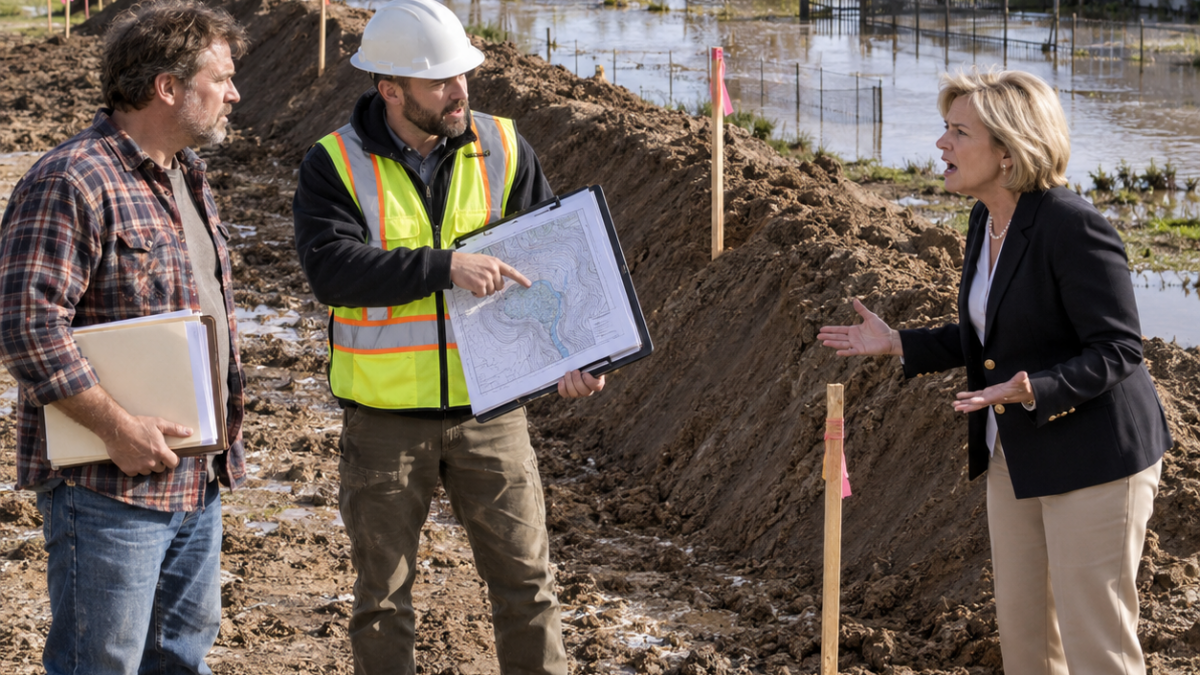
Dr. Albright reviewed the subdivision grading plan while standing in my backyard with the paper clipped to a hard board.
Every few minutes she looked from the plan to the land.
At one point, she crouched beside Sarah’s rose garden and pushed a narrow probe into the soil.
“How long has this stayed saturated?”
“Since the storm.”
She checked her watch as if the storm had happened that morning.
“What was your yard usually like after heavy rain?”
“Wet for a few hours. Never standing water like this.”
“Any basement seepage?”
“No.”
“Foundation issues?”
“No.”
“Sprinkler leak?”
“No.”
She nodded.
“Good.”
I smiled slightly.
“That sounded like you were hoping for no sprinkler leak.”
“I’m hoping for fewer variables.”
About ninety minutes into the survey, Karen appeared.
I saw her before Dr. Albright did.
Karen walked out of her house, crossed her patio, and stopped several feet from the property line.
She wore sunglasses even though the sky was overcast.
“What is going on here?”
Dr. Albright continued taking a measurement.
Karen raised her voice.
“I asked what you’re doing.”
Dr. Albright stood.
“Conducting a site assessment.”
“Authorized by whom?”
“My client.”
Karen pointed at me.
“He has no authority to conduct work on common property.”
I stepped forward.
“This isn’t common property.”
“The HOA maintains this boundary.”
“Maintenance rights don’t make it common land.”
Karen’s mouth tightened.
“This work was not submitted for architectural approval.”
Dr. Albright looked genuinely confused.
“You require architectural approval for surveying?”
Karen ignored the question.
“You need to stop immediately.”
Dr. Albright glanced at Caleb.
He kept working.
Then she looked back at Karen.
“Ma’am, I’m a state-licensed civil engineer performing measurements from my client’s private property. I have not entered yours.”
“The property line is shared.”
“The line is shared. The land is not.”
Karen took another step.
“I am the president of this HOA.”
Dr. Albright waited.
Karen appeared to expect the title to do more.
Finally Dr. Albright said, “Understood.”
“I’m ordering you to stop.”
“You’re free to send that request to my office.”
Karen’s cheeks reddened.
“I’ll call security.”
Dr. Albright nodded.
“I’ll show them the survey.”
“I’ll call the police.”
“That’s also fine.”
Something about the complete absence of fear in Dr. Albright’s voice seemed to frustrate Karen more than shouting would have.
Karen turned toward me.
“You are escalating this.”
“No.”
I gestured toward the berm.
“That escalated it.”
“This project was approved.”
“Then you should have no problem with an independent engineer looking at the consequences.”
“There are no consequences.”
Dr. Albright glanced toward Arthur’s scarred lawn.
Karen saw her do it.
For the first time, her confidence faltered.
Only for a second.
Then she turned and walked away.
Dr. Albright watched until Karen went inside.
“Is she always like that?”
Arthur, who had wandered over to observe, answered before I could.
“That was polite.”
Dr. Albright looked at him.
Arthur shrugged.
“She didn’t fine you.”
Dr. Albright almost smiled.
Then she returned to work.
Two weeks later, a courier delivered a blue-bound report to my front door.
I took it into the kitchen.
Sarah poured coffee.
Arthur came over because I had promised not to open it without him.
We sat around the table.
For a few seconds, nobody touched the report.
Then Sarah said, “Well?”
I opened it.
The title read:
HYDROLOGICAL AND TOPOGRAPHICAL ANALYSIS OF LOTS 71, 72, AND 73, OAK RIDGE MEADOWS.
The first section documented existing conditions.
The second compared the original approved grading plan with current topography.
The third contained runoff modeling.
I understood enough of it to follow the logic.
Before the berm, storm water spread across the natural swale as broad sheet flow.
After the berm, runoff encountered compacted fill, pooled, then traveled laterally toward the lower end.
Dr. Albright estimated that approximately eighty-five percent of the runoff from the relevant drainage area was being redirected toward my property during substantial rainfall.
The peak flow rate across our yard had increased dramatically.
Arthur whistled softly.
“That sounds bad.”
“It is.”
Sarah turned a page.
Then stopped.
“What are the red arrows?”
I leaned closer.
Dr. Albright had extended the model beyond our lots.
A red arrow crossed my yard.
Then Arthur’s.
Then Lot 74.
Lot 75.
Lot 76.
The pattern continued downhill.
Each arrow represented concentrated runoff.
Each shaded area represented potential impact.
I read the conclusion twice.
Ten properties.
Mine and nine others.
Arthur removed his glasses.
“Wait.”
He counted the lots with one finger.
“Mine. The Millers. The Garcias.”
“Yes.”
“The Bowers.”
“Yes.”
“The young woman with the little white dog.”
“Rachel Kim.”
He kept counting.
“My God.”
Sarah leaned toward me.
“So Karen didn’t just flood us.”
“Potentially, no.”
Arthur corrected her gently.
“She flooded us. She endangered the others.”
I appreciated the distinction.
Dr. Albright’s report was careful.
It identified observed damage on our property and Arthur’s.
For the downhill homes, it identified predicted impact and increased risk.
The report listed potential consequences: erosion, repeated soil saturation, hydrostatic pressure near foundations, basement moisture, damaged landscaping, and localized flooding during large storms.
Sarah stared at the map.
“What happens if we get three storms close together?”
I read the section on antecedent soil moisture.
“Risk goes up.”
She leaned back.
Arthur whispered, “Helen would have burned that berm down.”
Sarah laughed despite herself.
“Arthur.”
“I’m not saying I would.”
He paused.
“I’m saying Helen would.”
I closed the report.
“We need to show the others.”
Arthur nodded.
“When?”
“Tonight.”
Sarah put one hand over mine.
“Facts first.”
I looked at her.
“Facts first.”
We started with David and Melissa Miller on Lot 74.
David answered the door holding his three-year-old daughter, Sophie.
He listened while Arthur explained why we were there.
I showed him the report.
His first reaction was skepticism.
Not hostility.
Just normal skepticism.
“I don’t want to get pulled into some HOA fight,” he said.
“I don’t blame you.”
“Karen told people this is about your view.”
“It started with my view.”
I handed him the report.
“It isn’t anymore.”
He shifted Sophie to his other arm.
“Our yard hasn’t flooded.”
“Can I show you something?”
We walked around back.
The Miller yard sloped gently toward the greenbelt.
A wooden swing set stood near the rear fence.
I had noticed something while walking past the day before.
A thin line of exposed soil.
I pointed.
“That channel wasn’t there last month.”
David frowned.
“You don’t know that.”
Arthur said, “I do.”
David looked at him.
Arthur explained that he walked the neighborhood almost every evening.
He had photographs on his phone from Sophie’s birthday party two months earlier.
In the background, the ground beneath the swing set was intact.
Now a narrow erosion channel had begun cutting through it.
David set Sophie down beside Melissa, who had joined us.
He crouched.
Touched the soil.
Then looked toward the slope above.
“What does your engineer say?”
I showed him the diagram.
He read silently.
His face changed.
Not dramatically.
Slowly.
The skepticism disappeared first.
Then concern replaced it.
Finally anger.
“This runs behind where my kids play.”
“According to the model, yes.”
“During every storm?”
“Not necessarily at the same intensity. But the drainage pattern has changed.”
David looked at Melissa.
She had gone pale.
“What do you need us to do?” she asked.
“Read the report. Ask questions. If you agree this needs to be addressed, join us.”
David looked toward the swing set one more time.
“I’m a paralegal.”
That surprised me.
“What kind?”
“Commercial litigation.”
Arthur grinned.
“Well, this is becoming convenient.”
David ignored him.
“Leave me a copy.”
“I brought one.”
“I’ll read it tonight.”
We walked next door to the Garcias.
Maria Garcia opened the door before we knocked twice.
“I saw you at the Millers.”
“We’re talking to several neighbors.”
She looked at the report in my hand.
“This is about the berm, isn’t it?”
“Yes.”
Maria stepped aside.
“You should come downstairs.”
Luis Garcia met us at the basement stairs.
The smell hit me before we reached the bottom.
Damp drywall.
Maria pointed to a section near the baseboard.
“We noticed it after the storm.”
Luis crouched.
“I thought maybe the window leaked.”
Maria looked at him.
“There is no window on that wall.”
He frowned.
“I know that now.”
Despite the tension, Arthur coughed to hide a laugh.
I examined the wall without touching it.
“Have you called anyone?”
“Tomorrow,” Maria said.
I opened the report to the map.
“Dr. Albright’s model identifies this side of your lot as an area where soil saturation could increase because of redirected runoff.”
Maria read the highlighted section.
“You’re saying the berm caused this?”
“I’m saying the report identifies it as a plausible contributor. You need a proper inspection before anybody can say more.”
Luis appreciated that answer.
I could tell.
He wasn’t looking for drama.
He wanted to know what was happening to his house.
“We finished this room six months ago,” Maria said quietly.
A sofa sat against the opposite wall.
Family photographs hung above it.
A television was mounted near the stairs.
It was obviously more than a basement.
It was where they lived.
Luis folded his arms.
“What did Karen say?”
“She says the project was approved.”
“By who?”
“That’s one of the questions we’re trying to answer.”
We left them with a copy.
By the next evening, they called.
They were in.
Over the next two days, Arthur and I visited every affected property.
The Bowers worried about foundation movement because their house sat lower than the Garcias’.
Rachel Kim, the young woman Arthur knew only as “the one with the white dog,” was initially convinced the muddy area behind her patio came from an irrigation problem.
Then she shut off her sprinklers for twenty-four hours.
The ground remained wet.
An elderly couple on Lot 78 had lost two azaleas after the storm.
Another family discovered water pooling beside their crawlspace vents.
Not every problem could be blamed on Karen’s berm without further inspection.
I made that clear every time.
That restraint helped.
People listened because I wasn’t trying to scare them.
I was trying to show them what the engineer had actually found.
By the end of the second evening, all ten affected households had agreed that the drainage issue needed immediate professional correction.
David Miller invited everyone to his house.
We crowded around his dining room table.
Folders.
Photographs.
Phones.
Printed reports.
Rainfall records.
People who had barely spoken beyond driveway greetings were suddenly comparing foundation walls and yard elevations.
David opened a legal pad.
“Before we do anything else, we need rules.”
Arthur raised his hand.
“Already sounds terrible.”
David ignored him.
“No social media attacks.”
Someone groaned.
“No threatening emails.”
Arthur lowered his hand.
“No banging on Karen’s door.”
A few people glanced at me.
“I haven’t.”
“Good.”
David continued.
“No exaggerating damages. If an inspector says something is unrelated, we accept it. If an engineer says something is uncertain, we call it uncertain.”
Maria nodded.
“That matters.”
“It matters a lot.”
David pointed toward me.
“And no making this about his view.”
I smiled.
“I agree.”
Arthur whispered loudly, “His view is very nice.”
People laughed.
The tension in the room broke for a moment.
Then David became serious again.
“We focus on drainage, damage, process failure, and risk.”
“Exactly,” I said.
We decided to form a homeowner coalition.
Nothing fancy.
No dues.
No officers.
Just ten households acting together.
David drafted the first version of our demand letter.
I revised the technical language.
Arthur Jennings, the real estate attorney I contacted later that week, reviewed it for legal accuracy.
Jennings had been recommended through a veterans legal-assistance network.
He was semi-retired and selective about what he accepted.
When I first called him, he sounded almost bored.
Then I emailed Dr. Albright’s report.
He called me back forty minutes later.
“This is interesting.”
“Interesting good or interesting bad?”
“For your HOA? Bad.”
I explained Karen’s fine.
He asked me to send that too.
Then her rejection letter.
Then the project notice.
By the end of our conversation, his tone had changed completely.
“This isn’t a view dispute anymore.”
“That’s what I’ve been saying.”
“I know. I’m confirming it.”
Our formal letter went to every member of the HOA board.
Karen Vance, president.
Frank Delaney, treasurer.
Margaret Cole, secretary.
Dennis Harper and Elaine Ross, at-large directors.
The letter summarized Dr. Albright’s findings and demanded several corrective actions.
Professional removal of the berm.
Restoration of the original approved grade.
Independent inspections of affected properties.
A remediation mechanism for documented damage.
Preservation of all records related to approval of the berm.
And a written response within ten business days.
We sent copies by certified mail from every affected household.
The volume was intentional.
Nobody on the board would later be able to say they were unaware.
Two days after delivery, Karen walked down the sidewalk smiling at neighbors as though nothing had happened.
Maria called me.
“Is she serious?”
“She knows.”
“How can she act like this is normal?”
“Because she thinks she still controls the process.”
Maria was quiet.
Then she said, “That scares me more.”
On the fifth day, flyers appeared under doors throughout Oak Ridge Meadows.
SPECIAL COMMUNITY MEETING.
The subtitle was almost insulting.
ADDRESSING RECENT MISINFORMATION AND RESTORING COMMUNITY HARMONY.
Sarah brought ours into the kitchen.
She set it beside my coffee.
“Restoring community harmony?”
“Apparently.”
“She really believes she can talk her way out of this.”
“She’s done it before.”
“How do you know?”
“Because the board keeps approving things without asking questions.”
Sarah sat across from me.
“She’s going to make you the problem.”
“I know.”
“She’ll say you’re angry about losing your view.”
“I know.”
“She’ll bring up the fine.”
“I know.”
Sarah narrowed her eyes.
“You’re enjoying this.”
“No.”
“You have that face.”
“What face?”
“The one you used to get before presenting something to a colonel who had ignored your emails.”
I smiled despite myself.
“That specific?”
“Very.”
The coalition met at David’s house the afternoon before the meeting.
Jennings joined us.
He wore a charcoal suit even though everyone else was in casual clothes.
Arthur stared at him.
“You planning to scare somebody?”
Jennings looked down at his jacket.
“This is what I wear.”
“It’s working.”
Jennings placed his briefcase on the table.
“Karen’s objective tonight is straightforward.”
“Make us look unreasonable,” David said.
“Correct.”
Jennings looked around.
“She controls the agenda. She controls the microphone. She’ll frame this as a dispute between the board and a small group of disruptive homeowners.”
Maria asked, “So what do we do?”
“Nothing emotional.”
Arthur sighed dramatically.
Jennings continued.
“She’ll probably use words like harassment, misinformation, hostility, and maybe intimidation.”
I glanced at the two-hundred-dollar fine in my folder.
“She already used harassment.”
“Good. Then she’s predictable.”
Jennings tapped Dr. Albright’s report.
“You have evidence. Let the evidence create the pressure.”
David asked, “What about personal liability?”
Jennings leaned back.
“That gets complicated. HOA directors may have protections depending on governing documents, insurance, state law, and whether conduct was negligent, reckless, or knowingly improper. Don’t go into the meeting declaring you’re taking their houses.”
Arthur looked disappointed again.
“What can we say?”
“That the board has been placed on notice of a substantial alleged drainage defect and should get independent legal and engineering advice immediately.”
“That sounds boring.”
“Boring wins cases.”
Arthur nodded.
“Fine.”
The clubhouse was full before the meeting began.
Not just the ten affected households.
Karen had clearly encouraged her supporters to attend.
Several older residents sat near the front.
A few people stood along the back wall.
The other board members sat beside Karen behind folding tables.
Frank Delaney looked uncomfortable.
Margaret Cole kept checking her phone.
Dennis Harper whispered something to Elaine Ross.
Karen stood at the lectern smiling.
She looked completely at home.
That should have worried me.
Instead, it reminded me that people often make their biggest mistakes where they feel safest.
“Thank you all for coming,” Karen began.
For nearly ten minutes, she talked about community standards.
Civility.
Respect.
Rumors.
Misinformation.
She discussed the need to preserve Oak Ridge Meadows from “individual agendas.”
She never once said berm.
She never once said storm water.
She never mentioned ten affected properties.
Then she finally looked toward me.
“I believe Major Davis has some concerns he would like to share.”
She gestured toward the microphone in the center aisle.
I stayed beside my chair.
Her smile tightened.
“Major?”
I stood.
“Thank you.”
I didn’t walk toward the microphone.
I looked around the room instead.
“We’re not here because of rumors.”
David and Arthur began passing out copies of Dr. Albright’s executive summary.
Paper moved from row to row.
“We’re here because a state-licensed civil engineer evaluated a grading alteration between Lots 71 and 72 and found that it substantially changed storm-water flow.”
Karen interrupted.
“An engineer hired by you.”
“Yes.”
“Without board authorization.”
I looked at her.
“I don’t need board authorization to inspect drainage on my property.”
Murmurs moved through the room.
Karen leaned toward her microphone.
“That report has not been validated by the association.”
“Then validate it.”
She paused.
I continued.
“Hire your own engineer.”
A few heads turned toward the board.
“Compare their findings to Dr. Albright’s.”
Karen’s voice sharpened.
“The board has already consulted professionals.”
“Good.”
I waited.
“Who?”
Karen stared at me.
“Our Architectural Review Committee obtained appropriate guidance.”
“From whom?”
“That information is internal.”
A man in the back called out, “Why?”
Karen ignored him.
I said, “Then provide the consultant’s qualifications.”
“This isn’t a trial.”
“No. It’s a homeowners meeting.”
I held up the report.
“And homeowners are entitled to know why water that used to follow the approved swale is now being redirected across multiple private properties.”
Karen’s face began turning red.
“You continue to misrepresent the situation.”
“Which part?”
“The berm is a landscaping feature.”
“It is also a physical obstruction across an established drainage route.”
“That is your interpretation.”
“No.”
I opened the report.
“That is the engineer’s conclusion.”
She slapped one hand against the lectern.
“An engineer you paid.”
“Then show us yours.”
Silence.
Frank looked toward Karen.
I saw it happen.
Not suspicion yet.
Something closer to uncertainty.
Karen said, “The board is not obligated to litigate every complaint in public.”
Arthur Jennings stood.
He didn’t rush.
Didn’t speak immediately.
Just stood.
Karen noticed him.
So did the room.
“My name is Arthur Jennings,” he said. “I represent the affected homeowners for purposes of this dispute.”
The clubhouse became completely quiet.
Jennings rested one hand on the back of his chair.
“The homeowners have provided the board with a professional engineering analysis alleging that an HOA-approved structure has altered established drainage and created risk to multiple properties.”
Karen started to interrupt.
Jennings lifted one hand slightly.
Not aggressively.
She stopped anyway.
“The board does not need to accept that report blindly,” he continued. “In fact, I would recommend that you obtain an independent engineering review.”
Frank nodded almost imperceptibly.
“But now that you have notice of the alleged condition, failing to investigate would be a serious mistake.”
Karen folded her arms.
“There is no hazard.”
Jennings looked at her.
“Are you a civil engineer?”
“No.”
“Hydrologist?”
“No, but—”
“Do you have a competing report?”
Karen’s mouth tightened.
Jennings nodded once.
“That is why professional review would be prudent.”
Then he sat down.
No threat.
No speech about lawsuits.
He didn’t need one.
Maria stood next.
“My basement wall is wet.”
Karen’s expression changed.
“What?”
Maria held up the report.
“The wall on the uphill side of our basement became wet after the last storm. We are having it professionally inspected.”
Karen shook her head.
“Maria, basement moisture can happen for many reasons.”
“I know.”
Maria’s voice remained calm.
“That’s why I want the berm removed until we know what it’s doing.”
David stood.
“We found a new erosion channel behind our children’s swing set.”
Another homeowner raised her hand.
“My backyard has stayed saturated since the storm.”
Then Arthur Henderson stood.
The room quieted again.
Arthur did not like speaking in public.
Everyone who knew him understood that.
“I warned Karen before they finished the berm.”
Karen stared at him.
Arthur held her gaze.
“I told her water runs through that swale.”
“I don’t recall that conversation.”
“I do.”
“Arthur—”
“You told me a consultant approved the project.”
Karen glanced toward the board.
That movement was small.
It was also a mistake.
Frank noticed.
“So did you,” Arthur continued. “You told me not to worry.”
Karen’s voice rose.
“I receive dozens of homeowner concerns. I cannot remember every casual conversation.”
Arthur nodded slowly.
“Maybe not.”
He looked down at the report.
“But I remember the rain in my yard.”
Frank leaned toward his microphone.
“Karen.”
She turned.
“What?”
“Who was the consultant?”
“The committee received landscaping advice.”
“From whom?”
“This isn’t relevant.”
Frank frowned.
“You told us the project had been reviewed.”
“It was.”
“By an engineer?”
Karen did not answer.
I saw Margaret Cole look at Elaine Ross.
Dennis Harper stopped whispering.
Frank repeated the question.
“Did a licensed engineer review the drainage?”
Karen gripped the lectern.
“It wasn’t required.”
That sentence changed the room.
It didn’t explode immediately.
First there was silence.
Then someone near the back said, “What?”
Another homeowner asked, “Then what did she mean by professionally reviewed?”
Questions began coming faster.
“Did anybody check drainage?”
“Why did the board approve it?”
“Are our dues paying for this?”
“What happens if someone’s foundation gets damaged?”
“Who approved the grade change?”
Karen raised both hands.
“Everyone needs to calm down.”
Nobody did.
Frank pushed his chair back.
The legs scraped across the floor.
He looked genuinely angry now.
“Karen, did you present this to us as a minor landscaping project?”
Her eyes flashed.
“It is a landscaping project.”
“Did you know Davis had raised drainage concerns before construction?”
“He was objecting because of his view.”
“That isn’t what I asked.”
Karen looked around.
For the first time, the room was no longer following her.
Frank stood.
“This meeting is adjourned.”
Karen spun toward him.
“You cannot adjourn my meeting.”
“The board needs an executive session.”
“I am the president.”
“And I’m the treasurer.”
His voice shook slightly.
But he continued.
“And I want to understand what financial exposure we have before we say another word.”
The other board members rose.
Karen stared at them.
“You’re leaving?”
Nobody answered.
Frank, Margaret, Dennis, and Elaine walked through the side door into the board office.
Karen remained behind the lectern.
Alone.
The symbolism was impossible to miss.
Residents began surrounding her.
Questions came from every side.
Our coalition stayed seated.
Jennings gathered his papers.
“That’s enough,” he said quietly.
I looked at him.
“We should leave.”
Outside, the air was cool.
Through the clubhouse walls, we could still hear raised voices.
Arthur Henderson exhaled.
“Well.”
David looked at Jennings.
“How bad was that for them?”
Jennings adjusted his cuff.
“Potentially useful.”
Arthur stared at him.
“That’s all?”
“What were you expecting?”
“Legal doom.”
Jennings smiled slightly.
“Legal doom is expensive. Useful is better.”
Sarah slipped her hand into mine.
I realized my fingers had been clenched.
She squeezed once.
“Facts first.”
“Facts first.”
We gathered at our house afterward.
No celebration.
Not exactly.
There was relief.
Energy.
Questions.
Maria wanted to know how quickly the board could act.
David wanted copies of meeting minutes.
Rachel was already emailing photographs of her saturated backyard.
Arthur sat at the kitchen island drinking coffee as if it were noon instead of almost ten at night.
Jennings stayed for thirty minutes.
Before leaving, he said, “Do not assume you’ve won.”
Nobody liked hearing that.
He continued.
“Karen lost control of a meeting. That is not the same thing as resolving the drainage problem.”
David nodded.
“What do you expect?”
“An independent engineer. Insurance notification. Internal review.”
“And Karen?”
Jennings closed his briefcase.
“She’ll either become quieter or more aggressive.”
Arthur asked, “Which one do you think?”
Jennings looked toward the dark window facing Karen’s house.
“People who confuse authority with identity rarely give it up gracefully.”
The next morning my phone rang at 8:17.
Frank Delaney.
I answered from Sarah’s garden, where I was propping one damaged rose stem with a bamboo stake.
“Major Davis?”
“Yes.”
“This is Frank.”
“I know.”
A pause.
Then he said, “I owe you an apology.”
I straightened.
“That isn’t why I sent the letter.”
“I understand.”
His voice sounded exhausted.
“We were told the berm was a minor landscaping installation. Karen represented that concerns had been addressed.”
“By whom?”
Another pause.
“We are determining that.”
“What does that mean?”
“It means we asked for the consultant documentation last night.”
“And?”
“We haven’t received it.”
I looked toward Karen’s house.
All her curtains were closed.
Frank continued.
“The board reviewed Dr. Albright’s report after the meeting.”
“All of it?”
“Yes.”
“And?”
“We are hiring an independent engineer.”
“That’s reasonable.”
He sounded surprised.
“You don’t object?”
“Why would I?”
“I assumed you’d insist on using Dr. Albright.”
“I trust her. You’re entitled to verify her findings.”
Frank exhaled.
“We have someone coming tomorrow.”
“Good.”
“The board has also issued an emergency suspension of all further work involving the berm.”
“There shouldn’t be further work.”
“I know.”
Paper rustled.
“And the two-hundred-dollar fine against you has been rescinded.”
“That was quick.”
“It should never have been issued.”
I didn’t respond.
Frank said, “Major?”
“I’m here.”
“I need you to understand something.”
“All right.”
“We started reading the correspondence last night.”
My jaw tightened.
“What correspondence?”
“Your original objection.”
“You had it?”
“The management company had it.”
“Did the board see it before approving the berm?”
Silence.
That was the answer.
Frank finally said, “Not all of us.”
“How many?”
“I’m not prepared to answer that until we complete the review.”
I looked at the muddy ground around Sarah’s roses.
“Frank, that letter specifically raised drainage.”
“I know.”
“I cited the covenant.”
“I know.”
“And Karen told the meeting this was misinformation.”
“I know.”
His voice became quieter.
“That’s why we’re reviewing everything.”
After we hung up, Sarah came outside.
“What did he want?”
I told her.
She listened without interrupting.
When I finished, she looked toward Karen’s house.
“So the board didn’t even read your objection.”
“Somebody didn’t.”
“Karen did.”
“Yes.”
“And she still pushed it through.”
“Yes.”
Sarah crouched beside the rose bush.
“That bothers me more than the first part.”
“Why?”
“Because making a mistake is one thing.”
She pressed wet soil around the bamboo stake.
“Knowing there might be a problem and deciding you don’t want to hear it is different.”
The board’s engineer arrived the next morning.
His name was Malcolm Reed.
He was in his late fifties, wore a sun-faded ball cap, and had the tired patience of someone who had spent decades explaining gravity to developers.
Dr. Albright attended too.
I expected tension.
There wasn’t any.
They shook hands.
Compared instruments.
Argued mildly about one elevation reference.
Then worked together for nearly three hours.
I stayed out of the way.
Karen came outside once.
She walked toward Frank, who was observing from the sidewalk.
They spoke quietly.
I couldn’t hear most of it.
Then Karen’s voice rose.
“This is unnecessary.”
Frank answered, “We’re past that.”
“You’re letting him control the board.”
“No.”
Frank pointed toward Malcolm Reed.
“I’m letting an engineer tell us what the dirt is doing.”
Karen stared at him.
Then at me.
Then went inside.
Malcolm Reed submitted his preliminary findings the following afternoon.
His calculations differed slightly from Dr. Albright’s.
His conclusion did not.
The berm substantially obstructed the designed drainage route.
It diverted storm water laterally.
It increased concentrated flow across adjoining properties.
And it should be removed.
The board called an emergency session.
Two hours later, Frank phoned me.
“The vote was four to zero.”
“With Karen abstaining?”
“Yes.”
“On removal?”
“Removal and full restoration of the original grade.”
I sat at the kitchen table.
Sarah watched my face.
Frank continued.
“We’re hiring a licensed contractor under engineering supervision.”
“When?”
“Within the week.”
“What about damage?”
“The board approved inspections for all ten affected properties and an initial fifty-thousand-dollar remediation escrow.”
Sarah’s mouth opened.
I held up one finger.
Frank wasn’t finished.
“We also voted to remove Karen as president.”
I leaned back.
“From the presidency?”
“And, under the removal clause in our bylaws, from the board.”
I said nothing.
For weeks I had imagined hearing those words.
I expected satisfaction.
Instead I felt tired.
Frank asked, “Major?”
“I’m here.”
“We should have asked more questions.”
“Yes.”
“We trusted one person too much.”
“Yes.”
“We won’t do that again.”
“That matters more than the apology.”
He was quiet.
“I know.”
After we hung up, Sarah asked, “Well?”
“They’re removing it.”
“The berm?”
“Yes.”
Her shoulders dropped.
“And Karen?”
“Removed from the board.”
Sarah sat.
For a moment she looked almost relieved enough to cry.
Then she turned toward the garden.
“What about the roses?”
I laughed softly.
“Of course that’s your question.”
“They matter.”
“I know.”
“Are they paying for the soil work?”
“Yes.”
“I don’t want replacement roses.”
“I know.”
“These are Grandma’s.”
“I know.”
She looked at me.
“Then help me save them.”
So we did.
Before lawyers.
Before inspections.
Before neighbors gathered.
Sarah and I spent an afternoon cutting damaged roots, loosening saturated soil, moving mulch, staking stems, and doing everything we could to keep those plants alive.
It felt good to solve one problem with our hands.
A week later, the equipment arrived.
The same kind of yellow dump trucks that had brought the soil now returned to take it away.
This time a licensed contractor supervised the work.
Malcolm Reed and Dr. Albright both checked elevations.
The excavator operator moved slowly.
Bucket by bucket, the berm disappeared.
Arthur Henderson brought a folding chair.
David Miller brought coffee.
Maria Garcia arrived with muffins.
Rachel Kim walked over with the little white dog Arthur had been talking about for two years.
Someone joked that we should sell tickets.
Nobody did.
Still, half the block seemed to find a reason to be outside.
At one point Karen opened her back door.
She stood there for perhaps thirty seconds.
No one said anything.
No one waved.
She closed the door.
By noon the berm was half gone.
The Blue Creek Valley began reappearing in sections.
First the tree line.
Then the lower meadow.
Then the pale ribbon of creek beyond the greenbelt.
Sarah stood beside me.
“I forgot how wide it looked.”
“I didn’t.”
She nudged me.
“Of course you didn’t.”
By late afternoon, the last major mound of clay was loaded into a truck.
The excavator operator shut down the machine.
For a few seconds there was complete silence.
Then Arthur clapped once.
Someone laughed.
A few others joined in.
Soon nearly everyone was applauding.
I didn’t.
Not because I wasn’t happy.
Because I was looking at the ground.
The berm was gone.
But the scar remained.
Compacted soil.
Ruts.
Damaged grass.
A missing section in Sarah’s garden.
Winning didn’t erase what happened.
It only gave us the chance to repair it.
The next morning, the contractor restored the original swale.
They followed the subdivision grading plan.
Topsoil was replaced.
The ground was reseeded.
Temporary erosion-control fabric went down.
Dr. Albright checked the slope.
Malcolm Reed checked it independently.
Then they tested drainage with controlled water flow.
I watched from the patio.
For the first time in weeks, water moved the way it was supposed to.
Around the house.
Through the swale.
Downhill in a broad, shallow path.
Not trapped.
Not concentrated.
Not weaponized by bad grading.
Then came inspections.
The Millers had minor erosion behind the swing set.
Repairable.
The Garcias hired a basement specialist.
The conclusion was cautious but significant: elevated exterior soil moisture had likely contributed to seepage along the uphill foundation wall.
Fortunately, there was no structural damage.
Drying, sealing, and exterior drainage correction solved it.
The Bowers had no foundation damage, though inspectors documented unusual saturation.
Rachel’s patio area required regrading.
Arthur’s lawn needed more work than anyone else’s.
He stood beside the contractor while they removed damaged turf.
“You know what Helen would say?”
The contractor looked nervous.
“What?”
“She’d say you missed a spot.”
The man stared at him.
Arthur pointed.
Then grinned.
“Kidding.”
The contractor did not laugh.
I did.
Sarah’s garden was the hardest.
Nine major rose bushes had been affected.
Seven survived.
Two didn’t.
When the first one failed, Sarah accepted it quietly.
When the second did, she went outside after dinner and stayed there a long time.
I found her sitting on the stone border.
The dead plant had already been removed.
Only disturbed soil remained.
I sat beside her.
“I’m sorry.”
She rubbed her thumb against her palm.
“My grandmother gave me that one.”
“I know.”
“She grew it beside her kitchen window.”
I put an arm around her shoulders.
“We can find the same variety.”
“That isn’t the point.”
“I know.”
She wiped her face.
For several minutes, we just sat there.
Then she said, “I’m angry at you too.”
That surprised me.
“Me?”
“A little.”
“Why?”
“Because part of you is still turning this into a mission.”
I started to answer.
She stopped me.
“I know you didn’t build the berm.”
“I know.”
“I know you warned them.”
“I know.”
“But every time something goes wrong, you start thinking about what you should’ve predicted earlier.”
I looked at the empty patch of soil.
“That’s not entirely wrong.”
“Yes, it is.”
Her voice was gentle now.
“You couldn’t force Karen to listen.”
“I might have stopped the trucks.”
“How?”
“I don’t know.”
“Exactly.”
I exhaled.
Sarah leaned against me.
“You prevented the next storm from being worse.”
I looked toward the restored swale.
“That has to be enough.”
“Yes.”
The internal HOA review continued after the physical repairs.
David pushed for records access.
Frank agreed.
What we eventually learned was both less dramatic and more infuriating than I expected.
Karen’s “consultant” was her nephew.
His name was Bryce.
He owned a small lawn-maintenance company.
Not an engineering firm.
Not a landscape architecture practice.
He mowed lawns, installed mulch, trimmed trees, and built small decorative garden features.
There was nothing wrong with that work.
There was something very wrong with Karen presenting his casual opinion as professional review of a drainage-altering structure.
The email chain told the story.
Karen had sent Bryce photographs of several decorative berms from landscaping websites.
She asked what type of soil would hold shape and support ornamental grasses.
Bryce replied with suggestions about clay content, topsoil, and erosion-resistant plantings.
He never discussed storm-water flow.
Never reviewed the grading plan.
Never visited the site before construction.
Never claimed to be an engineer.
Frank handed me the printed emails in the clubhouse office.
“This is what she relied on.”
I read them twice.
“That’s all?”
“Yes.”
“No drainage analysis?”
“No.”
“No revised site plan?”
“No.”
“No engineer?”
“No.”
I closed the folder.
“How did this get approved?”
Frank rubbed both hands over his face.
“Because we got lazy.”
I waited.
He didn’t make excuses.
“Karen had handled architectural requests for years. Most were fence colors, sheds, mailboxes, landscaping. She presented this as another landscaping request.”
“And when I objected?”
“She told us you were angry about losing your view.”
My jaw tightened.
“That’s not what my letter said.”
“I know.”
“It specifically cited drainage.”
“I know.”
“Did you read it?”
Frank looked at me.
“Not before approval.”
The answer irritated me even though I already suspected it.
“Why?”
“Because it went through the management company to Karen as committee chair.”
“So the person pushing the project controlled the objection.”
“Yes.”
“That didn’t bother anyone?”
“It does now.”
I slid the folder toward him.
“Then fix that.”
“We are.”
The new procedures took months.
Oak Ridge Meadows required professional engineering review for significant grade changes, retaining walls, drainage modifications, major fill, and similar projects.
Applications and objections had to be distributed to all board members.
No committee chair could summarize objections without attaching the original.
Board minutes became more detailed.
Homeowners received a defined appeal process.
Conflicts of interest had to be disclosed.
None of it made for exciting neighborhood conversation.
That was the point.
Good systems are often boring because boring systems keep one person from quietly turning personal preference into policy.
Karen remained next door during all of this.
For the first two weeks after removal from the board, I barely saw her.
Her car came and went.
Groceries appeared on the porch.
Curtains remained closed.
People stopped dropping by.
I didn’t enjoy that.
I also didn’t interfere.
Nobody had organized a campaign against her.
Nobody needed to.
Trust disappears quietly.
One afternoon I was checking grass growth along the restored swale when her back door opened.
Karen stepped outside.
I expected her to turn away when she saw me.
She didn’t.
“Are you happy?”
I straightened.
“What?”
“You got what you wanted.”
Her voice was flat.
No audience.
No board.
No lectern.
Just two neighbors standing across a strip of newly seeded ground.
“The drainage is fixed.”
“That isn’t what I asked.”
“What do you think I wanted?”
“My position.”
“No.”
“To embarrass me.”
“No.”
“To turn everyone against me.”
I shook my head.
“I wanted you to remove the berm.”
“You brought a lawyer into a community meeting.”
“You brought ten properties into a drainage problem.”
Her jaw tightened.
“You always hated me.”
I laughed once.
Not to mock her.
The idea genuinely surprised me.
“I barely thought about you before this.”
That hit her harder than anger would have.
She looked away.
I regretted the sharpness for about half a second.
Then I remembered Sarah’s roses.
Arthur’s lawn.
The Garcias’ basement.
Still, I kept my voice calm.
“You wanted a gazebo. Fine. You wanted privacy. Fine. There were twenty ways to handle that.”
“I had the right to improve my property.”
“Yes.”
“And you thought your view mattered more.”
“No. I thought drainage mattered more.”
“You only cared because it blocked your valley.”
“At first? Yes. The view is why I looked closely.”
She folded her arms.
“So you admit it.”
“Of course I do.”
That seemed to surprise her.
“I was angry about the view. Then I saw the drainage plan.”
Karen looked toward the ground.
I continued.
“If your berm had been engineered properly, remained entirely on your property, complied with the covenants, and didn’t affect anyone else, I would’ve hated looking at it.”
I paused.
“But I wouldn’t have had this case.”
She stared at me.
“You went through board records.”
“Yes.”
“You had no right.”
“The bylaws say otherwise.”
Her face changed.
She knew what I had seen.
“The emails with Bryce,” I said.
Karen looked away again.
“He knows landscaping.”
“I never said he didn’t.”
“He’s worked on hundreds of properties.”
“I believe you.”
“He told me the berm would hold.”
“It held.”
She looked back at me.
“Then what is your point?”
“My point is that holding dirt in place and managing watershed flow are different problems.”
Her lips pressed together.
“I was trying to improve my yard.”
“At everyone else’s expense.”
“That wasn’t my intention.”
There it was.
The first thing she had said that sounded less like defense and more like admission.
I studied her.
“I believe you.”
That surprised her.
“You do?”
“I don’t think you sat down and decided to flood nine neighbors.”
Her shoulders relaxed slightly.
“I didn’t.”
“But you did decide that the warning didn’t matter because it came from me.”
The relaxation disappeared.
“You were biased.”
“Yes.”
Again, she looked surprised.
“So were you.”
Silence.
“You wanted privacy. I wanted my view. Neither of us was neutral.”
I pointed toward the restored swale.
“That’s why we should’ve listened to an engineer before anybody moved dirt.”
Karen looked toward the valley.
For a moment, I thought she might actually say something different.
Something like I should have.
Instead she said, “People won’t even look at me anymore.”
I didn’t know what she wanted from me.
Sympathy?
Permission?
Forgiveness?
“I didn’t tell them not to.”
“They think I endangered their homes.”
“The engineers said the berm created that risk.”
“That is not the same thing.”
“You approved the berm.”
“The board approved it.”
“Based on what you told them.”
Her eyes hardened.
“There it is.”
“What?”
“You wanted this.”
“The board removing you?”
“Yes.”
“No.”
“You expect me to believe that?”
“I expected the berm to come down. I expected the board to take responsibility. What happened to your position was their decision.”
She shook her head.
“You made it inevitable.”
“No.”
I looked at her.
“You did.”
That ended the conversation.
She went inside.
Three weeks later, a FOR SALE sign appeared on her front lawn.
Sarah noticed first.
She came into my office.
“You should look outside.”
I walked to the window.
The sign belonged to a quick-sale company.
Not a traditional real estate brokerage.
Karen and her husband were apparently ready to leave fast.
Arthur came over that evening.
He stood at the curb looking at the sign.
“Think she’ll get a good price?”
“Probably.”
“Even with the infamous drainage swale?”
“It’s repaired.”
Arthur nodded.
“Helen would negotiate.”
“I’m sure.”
“She once got twelve thousand dollars off a house because the refrigerator door opened the wrong direction.”
“How?”
“I still don’t know.”
The neighborhood reaction to Karen’s sale was strange.
Some people seemed pleased.
Others uncomfortable.
Maria admitted she felt sorry for her.
David said consequences did not require celebration.
Rachel simply said, “I hope whoever buys it is normal.”
That turned out to be the general consensus.
On moving day, I saw Karen once more.
She stood beside the truck while two movers carried furniture from the house.
No floral dress.
No clipboard.
No HOA binder.
Gray sweatpants.
A plain sweatshirt.
For the first time since I had known her, she looked like an ordinary person having a difficult moving day.
She glanced toward our house.
Our eyes met.
For one moment, I considered walking outside.
I could have wished her well.
I could have said I hoped things worked out.
I could have said nothing about the past.
But I stayed where I was.
Not because I hated her.
Because some conversations are finished before people are ready to admit it.
Karen turned away.
By sunset, the truck was gone.
The house remained empty for several weeks.
Then a young couple bought it.
Megan and Chris Walsh.
They arrived on a Saturday with a rented moving truck, two exhausted parents, a golden retriever, and enough cardboard boxes to reconstruct the house next door from scratch.
That evening, there was a knock.
Sarah opened the door.
Megan stood there holding a potted lavender plant.
“Hi. We’re the new people next door.”
Sarah smiled.
“I’m Sarah.”
“I’m Megan. My husband is Chris.”
Chris stood behind her carrying what looked like a bakery box.
“We come bearing carbohydrates.”
Sarah immediately stepped aside.
“Then you’re welcome here.”
We sat at the kitchen table.
For ten minutes we talked about ordinary things.
Moving companies.
Schools.
The greenbelt.
Grocery stores.
Then Chris hesitated.
“So.”
I knew what was coming.
He scratched the back of his neck.
“We heard there was some neighborhood drama.”
Sarah looked at me.
I looked at her.
Megan said quickly, “We’re not trying to gossip.”
“It’s okay,” I said.
Chris pointed toward the backyard.
“The seller disclosure mentioned recent grading restoration.”
“That’s accurate.”
“What happened?”
I gave them the short version.
Very short.
A berm had altered drainage.
Several properties were affected.
Engineers evaluated it.
The HOA removed it.
Drainage was restored.
I did not tell them Karen was a tyrant.
I did not tell them they had purchased the former castle of the queen of Oak Ridge Meadows.
I didn’t need to.
Megan looked relieved.
“So the problem is fixed?”
“Yes.”
“Professionally?”
“Two engineers signed off.”
“Good.”
Chris opened the bakery box.
“Then I think this deserves cookies.”
Arthur heard about the cookies later.
He complained that nobody invited him.
Within months, Megan and Chris became exactly what Rachel had requested.
Normal.
Chris worked from home three days a week.
Megan taught middle school science.
Their dog, Cooper, repeatedly escaped under one loose fence board and showed up in our yard carrying stolen tennis balls.
Sarah loved him.
I pretended not to.
The following spring, Megan knocked on our door carrying a folder.
That made me nervous.
She laughed when she saw my face.
“This isn’t an HOA complaint.”
“Good.”
“We want to build a pergola.”
I looked at Sarah.
Megan held up both hands.
“Small. Wooden. No dirt mountains.”
Sarah burst out laughing.
Megan opened the plan on our kitchen table.
The pergola would sit on the far side of their yard.
No sightline issue.
No drainage alteration.
No grading.
She pointed toward the dimensions.
“We already submitted it to the HOA, but after what you told us, I wanted to ask you too.”
“You don’t need my permission.”
“I know.”
“But?”
“But we have to live next to each other.”
That sentence stayed with me.
We have to live next to each other.
Karen had viewed neighbor relationships through authority.
Approval.
Compliance.
Enforcement.
Megan viewed them through coexistence.
It shouldn’t have felt revolutionary.
It did.
The pergola went up in May.
Megan planted climbing jasmine.
By June, it smelled sweet in the evenings.
It never blocked our view.
Arthur Henderson’s lawn recovered too.
The first new grass came in uneven.
He hated that.
He reseeded twice.
By spring, you could barely see where the water channel had cut through.
I found him one Saturday morning crouching beside the repaired section.
“Problem?”
He shook his head.
“Checking.”
“For what?”
He pointed.
“One different shade of green.”
I stared.
“You’re kidding.”
“No.”
“I can’t see anything.”
“That’s because you lack standards.”
“Helen?”
“Helen.”
The Miller children returned to their swing set.
David sent me a picture one afternoon.
Sophie was hanging upside down from the monkey bars.
Behind her, the repaired drainage area was dry.
He wrote one sentence.
This is why we bothered.
I saved the message.
The Garcia basement remained dry through spring storms.
Then through summer storms.
Then through one tropical system that dumped nearly three inches of rain in a day.
That storm became the real test.
The forecast arrived forty-eight hours early.
I pretended not to care.
Sarah knew better.
“You’re going to stand at the window all night, aren’t you?”
“No.”
“You absolutely are.”
“I trust the engineering.”
“Good.”
“I can trust engineering from the window.”
She rolled her eyes.
The storm began around ten.
By eleven, rain hammered the roof.
Water crossed the upper lawns.
Reached the restored swale.
Spread.
Moved downhill.
Exactly as designed.
No pond beside the roses.
No stream across Arthur’s yard.
No muddy channel behind the Miller swing set.
I stood beneath the porch roof with a flashlight.
Sarah came outside wearing a robe.
“You said you weren’t going to watch.”
“I’m not worried.”
“You’re holding a flashlight in a thunderstorm.”
“That doesn’t mean I’m worried.”
She looked at the water.
It moved gently through the swale.
For a while, we listened to the rain.
Then Sarah smiled.
“Looks boring.”
“Very.”
“Good.”
“Very good.”
The next morning, our phones began buzzing.
Arthur sent a picture of his lawn.
Dry.
David sent one from behind the swing set.
Dry.
Maria sent a photo of her basement wall.
Dry.
Rachel sent a video of her white dog refusing to step into one shallow puddle.
Caption:
TRAUMATIZED BY MOISTURE.
For the first time, the neighborhood group chat made me laugh.
Frank Delaney eventually became HOA president.
I voted for him.
Not because he had handled the berm perfectly.
He hadn’t.
That was precisely why I trusted him more afterward.
He understood what failure looked like.
At his first annual meeting as president, he stood at the same lectern Karen had used.
The room was less crowded.
Less tense.
He opened with budget numbers.
Arthur leaned toward me and whispered, “Boring.”
I smiled.
“Boring wins.”
Jennings would have been proud.
Frank discussed insurance.
Landscape maintenance.
Reserve funding.
Then architectural procedures.
He showed the new review checklist.
Drainage impact.
Property boundary verification.
Conflict-of-interest disclosure.
Professional review when required.
Appeal mechanism.
No applause.
No dramatic confrontation.
Just a room full of homeowners quietly accepting a process designed to prevent another berm.
Afterward, Frank approached me.
“You staying out of HOA politics?”
“Absolutely.”
“That’s disappointing.”
“No, it isn’t.”
He smiled.
“Would you consider joining the drainage committee?”
I stared at him.
“We have a drainage committee?”
“We do now.”
“No.”
“Advisory only.”
“No.”
“Quarterly meetings.”
“Frank.”
He laughed.
“Fine.”
Arthur appeared beside us.
“I’ll do it.”
I looked at him.
“You will?”
“Yes.”
“Why?”
“Free coffee.”
Frank nodded.
“We can arrange that.”
And somehow Arthur Henderson became a member of the Oak Ridge Meadows Drainage Advisory Committee.
Helen would have found that hilarious.
The months passed.
The fight faded.
Grass covered the scar where the berm had stood.
New residents moved into two houses farther downhill and never knew why the drainage rules in their closing packet were unusually detailed.
Life became ordinary again.
That was what Sarah wanted most.
Ordinary mornings.
Coffee.
Roses.
The valley.
No certified mail.
No process servers.
No engineering reports on the kitchen table.
Still, parts of the experience stayed with me.
For years in the Army, I had believed that planning solved problems.
Enough data.
Enough preparation.
Enough discipline.
You could identify failure points before they failed.
Oak Ridge Meadows reminded me there was another variable I had underestimated.
Ego.
A drainage map could show where water moved.
It could not make someone listen.
A covenant could state a rule.
It could not make a board read an objection.
A title could grant authority.
It could not grant judgment.
Those lessons bothered me because they were harder to engineer around.
One evening, months after Karen moved, Arthur came over carrying a cardboard box.
“What’s that?”
“Helen’s things.”
I didn’t understand.
He set the box on our kitchen table.
“I’m clearing out the garage.”
Sarah came closer.
Arthur opened the flaps.
Inside were gardening tools.
Old gloves.
Seed packets.
A small metal trowel with a worn wooden handle.
Then he pulled out a plastic bag containing several rose cuttings.
Sarah froze.
“What are those?”
“Helen took them from your grandmother’s roses.”
Sarah stared at him.
“When?”
“Years ago.”
“You’re kidding.”
“No.”
Arthur looked embarrassed.
“She asked you first.”
Sarah frowned.
“I don’t remember.”
“You were leaving for some Army thing.”
She looked at me.
“Fort Leonard Wood.”
Arthur nodded.
“Probably.”
He held up the bag.
“Helen rooted them along our side fence.”
Sarah’s hand went to her mouth.
“Are they still alive?”
“Three are.”
We walked to Arthur’s backyard.
Along the far fence, partially hidden behind a hydrangea bush, grew three mature roses.
Sarah stepped toward them slowly.
The flowers were deep red.
Same leaves.
Same shape.
Same scent.
For a moment she didn’t speak.
Arthur rubbed one hand against his neck.
“I figured you might want cuttings.”
Sarah turned and hugged him.
Arthur went completely stiff.
He looked at me over her shoulder as if I should rescue him.
I didn’t.
He patted her back awkwardly.
“Okay.”
Sarah laughed through tears.
“Sorry.”
“It’s fine.”
He looked at the roses.
“Helen would’ve wanted you to have them.”
That autumn, Sarah rooted six cuttings.
Four survived.
The following spring, she planted two in the empty spaces left by the roses we lost during the flood.
Not replacements.
Descendants.
The same family of plants returning from another yard.
There was something about that I couldn’t stop thinking about.
Karen’s berm had pushed water from one property into another.
Damage had traveled downhill.
But so had something else over the years.
Plants.
Friendships.
Help.
Information.
Concern.
One property was never truly isolated from the next.
That had been Karen’s mistake from the beginning.
She thought she could change her side of the line without affecting anyone else.
But property lines organize ownership.
They don’t stop water.
They don’t stop roots.
They don’t stop consequences.
And occasionally, they don’t stop roses either.
A year after the berm came down, Dr. Albright returned to Oak Ridge Meadows.
Not because there was another problem.
Frank had asked her to conduct a drainage workshop for the board and architectural committee.
I almost skipped it.
Sarah insisted I go.
“You’ll complain if they learn it wrong.”
“That’s unfair.”
“It’s accurate.”
The workshop took place in the clubhouse.
Dr. Albright stood beside a projector.
She showed maps of the subdivision.
Explained swales.
Explained sheet flow.
Explained how a change measured in inches could redirect surprising amounts of water.
Arthur sat in the front row taking notes.
I sat in the back.
At one point, Dr. Albright showed a generic diagram of a berm placed across a drainage path.
She did not use names.
Did not mention Karen.
Did not mention our fight.
Still, everyone knew.
She pointed toward the diagram.
“People often assume water goes where they want it to go.”
A few residents laughed.
Dr. Albright smiled.
“Water is extremely democratic. It follows gravity regardless of your title.”
Arthur turned around and looked at me.
I tried not to laugh.
Afterward, I thanked her.
“You know,” she said, “your case was almost boring.”
“Almost?”
“The engineering was obvious.”
“That doesn’t sound boring.”
“Technically, it was.”
She packed her laptop.
“The difficult part wasn’t proving what the berm did.”
“What was?”
“Getting people to stop arguing long enough to look.”
That was exactly right.
The view from our porch eventually became just a view again.
Not evidence.
Not disputed property value.
Not the center of an HOA conflict.
Just hills.
Trees.
Blue Creek.
Fog in the mornings.
Hawks circling in the afternoon.
Sarah’s garden recovered.
The two new roses from Helen’s plants grew slowly at first.
Then vigorously.
By the second summer, one produced more flowers than the plant we had lost.
Sarah stood over it one morning with garden shears.
“Don’t say it.”
“I didn’t say anything.”
“You’re thinking something sentimental.”
“I was thinking it needs fertilizer.”
She narrowed her eyes.
“Liar.”
I laughed.
She cut one flower and carried it to the porch.
We sat with coffee.
Across the property line, Megan watered jasmine around her pergola.
Chris threw a tennis ball for Cooper.
Arthur’s mower started next door.
Normal.
Beautifully normal.
Sarah handed me the rose.
“What am I supposed to do with this?”
“Hold it.”
“Why?”
“Because I’m making a point.”
She smiled.
“There it is.”
I looked toward the valley.
A year earlier, a wall of clay had blocked most of it.
For weeks I thought getting that view back would feel like victory.
It didn’t.
Not by itself.
Victory had been Arthur asking, “What do we do?”
It had been David finding the erosion line behind his daughter’s swing set.
It had been Maria refusing to exaggerate the basement damage even while she was furious.
It had been two engineers agreeing on physics while everyone else argued about personalities.
It had been Frank admitting the board had failed instead of finding a lawyer to invent excuses.
It had been Sarah reminding me that being right did not mean I could have prevented every loss.
And maybe most of all, it had been those rose cuttings returning from Helen’s yard.
I had spent years believing the strongest response to a threat was control.
Control the terrain.
Control the variables.
Control the plan.
But the neighborhood had recovered because no one person controlled it.
We had engineers.
Lawyers.
Neighbors.
Inspectors.
Board members.
Gardeners.
Old men with perfect lawns.
Children with swing sets.
People looking at the same problem from different angles.
Karen had tried to centralize everything around her authority.
The solution came from distributing responsibility again.
That evening, clouds gathered over Blue Creek.
Nothing severe.
Just a normal summer storm.
The first drops landed on the porch railing.
Sarah looked toward me.
“You going to get your phone?”
“No.”
“Flashlight?”
“No.”
“Rain gauge?”
“I don’t own a rain gauge.”
“You looked at three online.”
“That doesn’t mean I bought one.”
She laughed.
The rain grew steadier.
Across the lawn, water moved toward the restored swale.
It spread gently.
Turned downhill.
Kept going.
Arthur stepped onto his patio and looked at his grass.
He saw me watching.
Then he pointed two fingers toward his eyes and then toward the lawn, as if conducting an inspection.
I shook my head.
He grinned.
Sarah leaned back in her chair.
“You know what my grandmother used to say about roses?”
“No.”
“She said people fuss over them too much.”
“That sounds unlikely.”
“I’m serious. She used to say the roots know what they’re doing if you give them somewhere decent to grow.”
I looked toward the two newer bushes.
Rain darkened their leaves.
One flower bent beneath the weight of the water, then slowly lifted again as droplets slid from its petals.
Somewhere beyond the greenbelt, thunder rolled.
The valley faded behind the curtain of rain.
But this time, nothing blocked it.
Nothing needed to.
The view would return when the storm passed.
And the water, finally given the path it had always needed, simply kept moving downhill.
[END OF STORY]








