PART 2: HOA President Broke Into My House to “Rescue” My Five Retired K9s — She Had No Idea They Were Waiting Inside
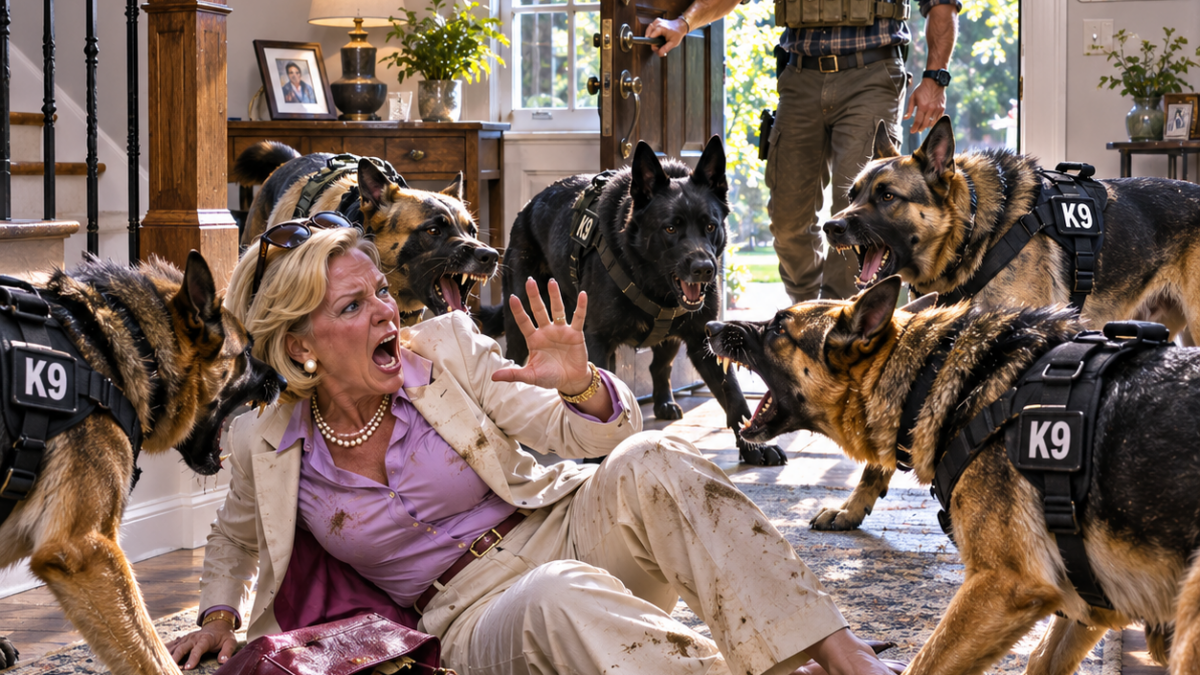
At 2:17 in the morning, my security camera showed HOA president Emily Lopez picking the lock on my front door with a flashlight in one hand and a bag of animal-control equipment hanging from her shoulder, convinced she was about to “rescue” the five German Shepherds she had spent months accusing me of abusing. She had already fined me, photographed my yard, filed false complaints, tried to force my retired police K9s out of the neighborhood, and somehow convinced herself that breaking into my home was the next logical step. What Emily did not know was that the dogs she expected to find locked helplessly in backyard kennels were sleeping loose inside the house, and every one of them had spent years learning exactly what to do when an uninvited stranger crossed a protected doorway.
My name is Matthew Clark.
For twenty years, I worked as a K9 officer.
By the time I retired, I wanted exactly three things: quiet mornings, a little space, and enough room for the dogs that had spent their lives beside officers, firefighters, and search teams to grow old without hearing sirens every night.
I found all three in Maplewood Estates.
Or at least I thought I had.
My brick house sat at the end of a cul-de-sac with a fenced backyard and enough shade for five retired German Shepherds.
Rex was the oldest, calm enough to ignore almost anything.
Atlas was enormous but gentle.
Bear watched everything.
Nova had the sharpest instincts of the group.
Scout was the youngest and still carried herself like she was waiting for the next command.
They weren’t attack dogs waiting for an excuse.
They were retired working animals—licensed, trained, disciplined, and safer around people than many humans I had dealt with during two decades wearing a badge.
For the first six months, Maplewood was peaceful.
Then Emily Lopez became HOA president.
Emily was in her early fifties, always perfectly dressed and always carrying a clipboard. She had the strange talent of making a conversation about grass height sound like testimony before Congress.
Our first disagreement started with the dogs.
She knocked one Saturday morning and looked past me into the house.
“Mr. Clark, several residents have concerns.”
“About?”
“Your animals.”
I glanced behind me.
Five shepherds were lying quietly across the living-room floor.
“Those animals?”
“They’re intimidating.”
“They’re sleeping.”
“That doesn’t mean residents feel safe.”
“They’re behind a locked fence and under voice control.”
Emily wrote something.
“I’ve also received barking complaints.”
“When?”
“Late evenings.”
“My dogs don’t bark without a reason.”
Her smile tightened.
“We’ll be monitoring the situation.”
A week later, I received a $150 noise violation.
I appealed with documentation from county animal control.
The fine disappeared.
Emily didn’t.
Next came my fence.
Wrong color.
Then my grass.
Too tall.
I measured it myself.
It wasn’t.
Then came something called “failure to comply with community tone and decorum.”
I framed that one.
But underneath the absurdity, something was changing.
Emily started walking past my property every day.
My cameras caught her photographing the fence.
The driveway.
The dogs.
Once, she leaned over the side gate to photograph the backyard.
When I confronted her, she called it a “visual inspection.”
I called it trespassing.
At the next HOA meeting, she projected a photograph of my house onto the clubhouse wall and told the room my dogs were aggressive.
I stood.
“They’re retired law-enforcement K9s.”
Emily folded her arms.
“That doesn’t exempt them from community safety concerns.”
“No. But facts should exempt them from lies.”
The room went quiet.
I told everyone animal control had already inspected my dogs.
Twice.
No violations.
No attacks.
No nuisance findings.
Then I mentioned my cameras.
For the first time, Emily lost her composure.
“You’ve been recording me?”
“On my property.”
Her face hardened.
“You’ll regret making this hostile.”
That sentence stayed with me.
Two weeks later, I found my back gate slightly open.
I never left it open.
When I checked the camera, there was fifteen minutes of frozen video followed by a shadow disappearing down the alley.
I upgraded every lock that afternoon.
Added night vision.
Motion sensors.
Cloud backup.
Then I found something outside my fence that made the HOA fines stop feeling ridiculous.
A piece of raw meat.
Rex sniffed it once and backed away.
I bagged it with gloves and took it to my veterinarian.
The next morning, the clinic called.
There were sedative traces in it.
Enough that I immediately understood what someone might have intended.
That night, I brought all five dogs inside.
And somewhere across Maplewood Estates, Emily Lopez was already preparing to make the worst decision of her life.
PART 2
I spent most of that evening sitting at my kitchen table staring at the veterinary report.
Rex lay beside my chair.
His muzzle had gone gray over the years, but his eyes were still clear and alert.
Every few minutes he lifted his head and looked toward the back door.
“You know something I don’t?” I asked him.
His ears shifted.
That was all.
I had worked around police dogs long enough to know people romanticize their instincts.
Dogs aren’t supernatural.
They don’t smell evil.
They don’t read minds.
What they do exceptionally well is recognize patterns.
Sounds.
Body language.
Changes in routine.
And that week, my entire routine had changed.
So had theirs.
I called Detective Ryan Harris, an old friend from my department.
He had spent years working K9 cases with me before transferring to investigations.
He came by after his shift.
I handed him the lab report.
His expression changed immediately.
“Where’d you find it?”
“Fence line.”
“Camera?”
“Nothing useful.”
“You touch it?”
“Gloves.”
“Good.”
He studied the document.
“You know I can’t say Emily did this.”
“I know.”
“Even with everything else.”
“I know.”
“You don’t sound like you know.”
I leaned back.
“I spent twenty years telling victims the same thing. Suspicion isn’t evidence.”
“Exactly.”
I hated hearing my own training used against my anger.
Harris looked toward the living room.
Nova was lying near the hallway entrance.
Scout was asleep upside down beside the couch.
“How are they?”
“Fine.”
“Vet tested them?”
“Yes.”
“No exposure?”
“No.”
He nodded.
“Then that’s what matters tonight.”
“It matters who put it there.”
“We’ll file a report.”
“And then?”
“And then you don’t do anything stupid.”
I laughed once.
“You came all this way to say that?”
“I came because retired cops make terrible civilians.”
“Fair.”
Harris photographed the location and took the bag into evidence.
Before leaving, he pointed at my camera system.
“You have cloud storage?”
“Multiple.”
“Exterior?”
“Every approach.”
“Interior?”
“Not yet.”
“Get it.”
I did.
Not because I wanted to trap Emily.
That distinction became important later.
I wanted to know if someone entered my house.
There is a difference between preparing for a crime and manufacturing one.
I added cameras covering the living room, hallway, kitchen entrance, and foyer.
No bedrooms.
No bathrooms.
Just common areas.
The feeds uploaded automatically.
Motion alerts went straight to my phone.
I changed the locks too.
Then I changed them again when I realized someone had already been close enough to tamper with the back gate.
For the next three nights, nothing happened.
That should have reassured me.
Instead, it made me more nervous.
Emily disappeared.
No morning inspection walks.
No silver SUV creeping past the cul-de-sac.
No new violation letters.
No HOA posts.
Silence from someone like Emily wasn’t peace.
It was absence.
There is a difference.
On the fourth afternoon, Denise Parker stopped me while I was walking Atlas.
Denise lived three houses down.
She had always been polite but cautious around the dogs.
“Matt?”
“Hey, Denise.”
She glanced toward her house.
Then toward mine.
“Can I ask you something?”
“Sure.”
“Did Emily really report your dogs for attacking a child?”
I stopped.
“What?”
“She said there was an incident last summer.”
“I moved here fourteen months ago.”
Denise’s face changed.
“I thought so.”
“Where did she say this?”
“Private HOA chat.”
“Do you have it?”
She hesitated.
“Denise.”
“I don’t want to get involved.”
“You already are if somebody is spreading false claims.”
She sighed and pulled out her phone.
There it was.
A message from Emily:
We have documented concerns suggesting one of Mr. Clark’s animals may have been involved in an aggressive incident prior to formal reporting.
No name.
No date.
No victim.
Just enough fog to create fear.
“Send me a screenshot.”
Denise did.
Then she said quietly:
“She told another neighbor you were hiding something.”
“What?”
“I don’t know.”
“About the dogs?”
“About you.”
That bothered me.
“What exactly?”
“She said your law-enforcement career ended under questionable circumstances.”
I actually laughed.
“I retired.”
“I know.”
“Full pension.”
“I know.”
“Department gave me a plaque.”
“I’ve seen it.”
“So what’s questionable?”
She looked uncomfortable.
“I think she’s trying to make people afraid.”
That was exactly what she was doing.
Not proving anything.
Creating atmosphere.
People are easier to control when you convince them danger is nearby.
By dinner, I had saved screenshots of seven different posts.
Aggressive dogs.
Possible past incident.
Unverified safety concerns.
Questions about my professional history.
I didn’t respond publicly.
I sent everything to an attorney.
Laura Bennett.
I had known her professionally for years.
She had represented officers in civil cases and handled property disputes.
She read the screenshots, the HOA notices, the animal-control reports, and the veterinary report.
Then she looked at me.
“You want revenge?”
“No.”
“You hesitated.”
“About half a second.”
“That’s hesitation.”
“I want her to stop.”
“Good. That’s a better legal objective.”
She separated everything into piles.
“HOA enforcement first. Are the dogs allowed under your covenants?”
“Yes.”
“Breed restrictions?”
“No.”
“Number limit?”
Six.
“You have five.”
“Yes.”
“County licenses?”
I handed them over.
“Noise evidence?”
“None against me.”
“Animal control?”
“Three clean visits.”
“Then the HOA’s legal position is weak.”
“Tell them.”
“I will.”
She picked up the social-media screenshots.
“This is different.”
“Defamation?”
“Potentially. Context matters. We preserve it.”
Then the lab report.
“This is criminal.”
“I know.”
“But not attributable to Emily yet.”
“I know.”
“You keep saying that like it causes pain.”
“It does.”
Laura folded her hands.
“Matt, the biggest danger here is that you know exactly how investigations work.”
“That sounds useful.”
“It means you’re going to want to investigate her yourself.”
I didn’t answer.
She smiled without humor.
“Don’t.”
“I wasn’t planning to.”
“You upgraded your entire house like a surveillance van.”
“Security.”
“Keep it security.”
“Understood.”
“And don’t confront her about the meat again.”
I looked away.
Laura noticed.
“You already did?”
“Sort of.”
“What does sort of mean?”
I told her about seeing Emily near the post office.
I’d walked up.
Accused her.
She had smiled and said, “Prove it.”
Laura closed her eyes.
“That woman’s attorney is going to love you.”
“I don’t think she has one.”
“She will.”
Fair.
I left with a cease-and-desist letter being prepared and strict instructions to stop playing detective.
I followed them.
Mostly.
Emily made that easier by returning to harassment almost immediately.
The next certified HOA notice ordered me to remove all five dogs within thirty days.
Reason:
CONTINUING COMMUNITY SAFETY RISK.
I read it twice.
Then called Laura.
She laughed.
Actually laughed.
“Good.”
“Good?”
“She put it in writing.”
“So?”
“So now we have a formal action to challenge instead of vague harassment.”
She sent the HOA board a demand the same afternoon.
Provide the specific covenant authorizing removal.
Provide documented findings supporting the safety designation.
Provide copies of complaints.
Suspend enforcement pending appeal.
Retain all related communications.
That last line mattered.
Records preservation.
Once litigation is reasonably anticipated, destroying relevant documents becomes much more interesting to lawyers.
The HOA responded through its management company.
There had been no board vote removing my dogs.
Emily had issued the notice under what she called “emergency presidential authority.”
Laura read the email out loud.
Then looked at me.
“Does that phrase exist in your bylaws?”
“No.”
“Excellent.”
“You really enjoy weak paperwork.”
“It’s why I went to law school.”
A board hearing was scheduled.
I attended.
Emily sat at the center table.
Vice President Harold Green to her right.
Treasurer Judy Wallace to her left.
Four other board members.
Maybe fifty residents.
More than usual.
Emily began with a prepared statement.
“Maplewood Estates exists to preserve the health, safety, and peaceful enjoyment of all residents.”
She looked directly at me.
“In recent months, multiple credible concerns have arisen regarding large trained animals housed at one property.”
I raised my hand.
She ignored it.
“These animals have specialized training that may make them unsuitable for a residential environment.”
That one was new.
Police training now made the dogs more dangerous rather than safer.
Emily continued.
“The board must consider whether removal is necessary.”
Harold leaned toward her.
“Emily.”
She muted the microphone.
They whispered.
Then Harold turned his own microphone on.
“For clarification, the board has not voted to seek removal.”
A murmur passed through the room.
Emily’s face tightened.
“I issued the emergency notice.”
Harold said:
“We’re reviewing whether you had authority.”
She stared at him.
Laura leaned toward me.
“Interesting.”
When public comments opened, Denise stood.
She held her phone.
“I want to ask about something.”
Emily looked annoyed.
“Go ahead.”
“You told people one of Matt’s dogs attacked a child.”
Emily folded her hands.
“I said there were concerns.”
“You said there was an incident last summer.”
“I may have referenced information provided to me.”
“By who?”
“I can’t reveal complainants.”
Denise glanced at me.
“He didn’t live here last summer.”
Laughter started in the back.
Emily flushed.
“This is not funny.”
“No,” I said.
Her eyes snapped toward me.
“It isn’t.”
Laura whispered:
“Careful.”
I stood when recognized.
“My dogs have been inspected three times by county animal control.”
I placed copies of the reports on the table.
“No nuisance findings.”
Second document.
“No aggression findings.”
Third.
“All five are currently licensed and vaccinated.”
Then I placed their training records down.
“These dogs spent their working lives finding missing children, narcotics, evidence, and people trapped after disasters.”
I looked around the room.
“Rex found a six-year-old boy alive after a tornado.”
Someone whispered.
“Atlas worked search operations after a building collapse.”
Another page.
“Nova located an elderly woman with dementia after she disappeared overnight in January.”
I stopped.
“They are not decorations to me. They are not weapons. They are retired partners.”
My throat tightened more than I expected.
“That doesn’t mean they’re above rules.”
I looked at Emily.
“But rules require facts.”
The room stayed quiet.
I continued.
“If somebody has a legitimate complaint about my dogs, file it. I’ll answer it.”
Then:
“But inventing attacks that never happened isn’t safety.”
Emily said:
“You’re accusing me of lying.”
“No.”
I slid the screenshot across the table.
“I’m showing people what you wrote.”
That was better.
Laura smiled faintly.
The board voted six to one to suspend the removal notice pending legal review.
Emily was the one.
Afterward she cornered me near the exit.
No cameras from the HOA room covered the hallway.
Mine didn’t either.
That made me careful.
“You think you’ve won.”
“I think my dogs are coming home with me.”
“This isn’t over.”
“It can be.”
She stepped closer.
“Those animals don’t belong here.”
“Why?”
“Because people are afraid.”
“People or you?”
Her eyes narrowed.
“You have no idea what you’re dealing with.”
That sounded less like an HOA president than someone warning me about a conspiracy.
I almost said so.
Instead:
“Good night, Emily.”
She grabbed my arm.
Not hard.
Just enough.
I looked down at her hand.
She let go instantly.
Laura had seen it from the doorway.
“Emily,” she said calmly, “do not touch my client.”
Emily’s face changed.
“You brought a lawyer to an HOA meeting.”
Laura smiled.
“Yes.”
“I wasn’t speaking to you.”
“You are now.”
Emily walked away.
That should have been the turning point.
Instead, it seemed to push her farther.
Two nights later, my cameras recorded her silver SUV parked across the street for forty-three minutes.
No crime.
Public road.
Nothing illegal about sitting in a car.
Still unsettling.
The following night:
Twenty minutes.
Then again:
Thirty-two.
I documented it.
Didn’t approach.
Didn’t post.
Didn’t call police.
Then the meat appeared.
More than one piece this time.
Inside my fence.
Not near the sidewalk.
I found three pieces under the maple tree.
The dogs had not touched them.
Rex sat six feet away, staring.
That dog had been trained to ignore food not given by a handler.
The others had too.
Training I once considered a professional necessity may have saved them.
I bagged everything.
Veterinary analysis identified both a sedative and a toxic rodenticide.
I felt something inside me change.
Harassment was one thing.
Threatening animals that trusted me was another.
I called Harris.
He arrived with an evidence technician.
“Any camera?”
“No.”
“How?”
“Blind spot beneath the tree.”
“You still have one?”
“Apparently.”
He walked the perimeter.
Then pointed toward the rear corner.
“Someone could throw it from the alley.”
“Yes.”
“Camera coverage there?”
“Partial.”
We reviewed.
At 1:43 a.m., a shape moved at the edge of the frame.
Not enough for identification.
A pale sleeve.
A hand.
Nothing else.
Harris looked at me.
“Could be Emily.”
“Yes.”
“Could be someone else.”
“Yes.”
“You’re getting better.”
“I hate you.”
“Good.”
He photographed the meat.
Then:
“We’re increasing patrol passes.”
“Okay.”
“Do not sleep outside with a shotgun.”
“I wasn’t planning to.”
“Retired cops.”
“Stop.”
Before leaving, Harris asked:
“Why do you think she wants the dogs gone this badly?”
“Control.”
“That’s not enough.”
“What do you mean?”
“Control explains the HOA notices.”
He looked toward the fence.
“It doesn’t explain poisoned meat.”
That stayed with me.
Maybe Emily hated the dogs.
Maybe she’d become fixated.
Or maybe something else had made me a problem.
I started thinking back.
When had her behavior really changed?
Not the first fine.
Not the fence dispute.
The meeting.
Specifically, when I mentioned cameras.
You’ll regret this.
Maybe the cameras were what frightened her.
But why?
I called Laura.
“I have a question.”
“You’re investigating.”
“No.”
“That’s what every client says before explaining an investigation.”
“Hypothetically.”
“No.”
“Emily’s behavior escalated after she found out I record the property.”
Laura paused.
“Okay.”
“What if she’s worried the cameras caught something unrelated?”
“Like what?”
“I don’t know.”
“Then stop.”
“Laura.”
“No.”
“You don’t even want to hear—”
“I know exactly where your brain is going. You are about to turn HOA harassment into organized crime.”
“That’s dramatic.”
“You were a cop for twenty years.”
“Yes.”
“You’re physically incapable of seeing one suspicious fact without building a corkboard.”
I looked at my office wall.
I had, in fact, printed a timeline.
I took it down.
Mostly.
The answer came without me investigating.
Frank Lopez knocked on my door.
Emily’s husband.
I had met him twice.
Quiet man.
Late fifties.
Worked in insurance.
He looked exhausted.
“Mr. Clark.”
“Matt.”
“Can we talk?”
I glanced at the dogs.
“Porch?”
“Fine.”
We sat.
Frank rubbed both hands over his face.
“Emily isn’t doing well.”
“I’ve noticed.”
He almost laughed.
“Understatement.”
“What do you want from me?”
“Nothing.”
He stared at the road.
“I wanted you to understand something.”
“Okay.”
“Her mother died last year.”
“I heard.”
“She handled everything.”
“Estate?”
“Everything. Funeral. House. Bills. Her sister fell apart, so Emily took over.”
He paused.
“She hasn’t stopped taking over since.”
I didn’t say anything.
“She became HOA president because the previous president resigned. At first it helped.”
“Helped what?”
“She had somewhere to put the energy.”
He looked at me.
“Then it became everything.”
“That explains the clipboard.”
Frank didn’t smile.
“She doesn’t sleep.”
My anger softened slightly.
Not much.
“She keeps files on people.”
“What kind?”
“Violations. Complaints. Notes.”
“That sounds normal for an HOA.”
“No.”
His voice dropped.
“Not normal.”
“What do you mean?”
“She has notebooks.”
“About me?”
“Yes.”
“How much?”
Frank looked ashamed.
“I saw pages about when you walk your dogs. When you leave. What cameras you installed.”
My stomach tightened.
“Why?”
“She thinks you’re watching her.”
“I am watching my property.”
“I know.”
“She thinks what?”
Frank stood.
“I shouldn’t have come.”
“Frank.”
He stopped.
“Is she planning something?”
“I don’t know.”
“That’s not good enough.”
He looked at me.
“I don’t know.”
His eyes were wet.
“I’ve tried getting her help. She says everybody is against her.”
“Did she put something in my yard?”
His face changed.
That told me enough emotionally.
Not legally.
“I don’t know,” he repeated.
“Frank.”
“I didn’t see her do anything.”
That distinction mattered.
“Did you see sedatives?”
He shook his head.
“Animal-control equipment?”
Another hesitation.
Then:
“She ordered something online.”
“What?”
“I don’t know.”
“Frank.”
“I saw a case. That’s all.”
He left five minutes later.
I called Harris.
Told him everything.
He contacted Frank formally.
That was the last investigating I did myself.
At least before the break-in.
The following week was quiet.
Then quieter.
Emily stopped attending HOA events.
Harold began running meetings.
The removal order against my dogs was formally rescinded.
Laura received a letter from the HOA’s attorney acknowledging that no documented aggression evidence supported it.
I should have relaxed.
Instead, Nova started watching the hallway at night.
Bear paced near the front window.
Rex slept lighter.
Dogs react to us.
I knew that.
Maybe they were reading my tension.
Maybe I was reading theirs.
Either way, I decided they would sleep inside.
Usually Rex and Bear preferred the climate-controlled kennel room connected to the rear garage.
That night I brought everybody into the main house.
Rex by my bedroom door.
Nova in the living room.
Bear near the kitchen.
Atlas on the rug.
Scout wherever Scout decided gravity allowed.
At 11:30, I checked the cameras.
Nothing.
Midnight.
Nothing.
12:47.
Nothing.
At some point after one, I fell asleep.
At exactly 2:17 a.m., my phone vibrated.
Front porch motion.
I woke instantly.
Old training.
No confusion.
No reaching for the clock.
Phone.
Camera.
Feed.
A figure stepped into frame.
Dark hoodie.
Black pants.
Sneakers.
Flashlight covered partly by her palm.
I enlarged the image.
Emily.
For a moment my brain refused to accept it.
She walked to the front door.
Looked toward the street.
Then toward the camera.
She knew where the original camera was.
She stayed just outside its strongest angle.
What she didn’t know was I had added another camera beneath the porch eave.
That one had her face perfectly.
She removed something from her pocket.
Worked near the lock.
I couldn’t see exactly what.
Didn’t need to.
She was trying to enter.
I called 911 before the door opened.
“911. What’s your emergency?”
“My name is Matthew Clark. I’m at 1123 Maplewood Court. Someone is attempting to enter my residence.”
“Do you know who?”
“Yes. Emily Lopez.”
“Is she armed?”
I watched her reach into the large tote at her side.
“I don’t know yet.”
Then the deadbolt moved.
My blood went cold.
The door opened.
“I need units now.”
“They’re responding. Are you in a secure location?”
“Yes.”
“Do not confront her.”
“I understand.”
The dogs were awake.
No barking.
That part surprised people later.
Five trained shepherds did not explode automatically.
They looked at me.
Rex stood.
Nova’s ears went forward.
Bear moved into the hallway.
I gave one quiet command.
“Place.”
They held.
Emily entered my living room.
The camera showed her closing the door behind herself.
That detail disturbed me more than anything.
She wasn’t panicking.
She wasn’t looking for help.
She expected to be inside.
She whispered:
“Easy.”
Like she thought the dogs were nearby.
She opened her tote.
Removed a compact animal-control dart device.
Not something I was going to describe or demonstrate.
What mattered was that it was capable of delivering veterinary sedatives and that she had no lawful reason to bring it into my home.
My stomach turned.
“Dispatcher, she has what appears to be an animal tranquilizer device.”
“Do not approach.”
“I won’t.”
Emily moved toward the rear hall.
“Where are you?” she whispered.
Then:
“It’s okay. I’m here to help.”
Help.
That word nearly made me lose control.
She was invading my home with drugs and telling herself she was helping.
Nova shifted.
Emily heard the nails on hardwood.
She stopped.
The flashlight moved.
A low growl came from the hall.
Rex.
One sound.
Deep.
Controlled.
Emily froze.
“Hello?”
Bear stepped into the edge of the flashlight.
Then Atlas.
Emily backed up.
Another shepherd appeared from behind the couch.
Nova.
Scout moved to the opposite side.
They weren’t performing some choreographed attack formation.
They were dogs with years of control training reacting to an intruder while looking to me for direction.
I gave another command from upstairs.
“Hold.”
Emily heard my voice.
Her head snapped up.
“Matthew?”
I stayed where I was.
“The police are coming, Emily.”
Her face changed.
“No.”
“Yes.”
She backed toward the front door.
Nova barked once.
Emily screamed and dropped the flashlight.
The dart device hit the floor next.
The dogs erupted.
Not forward.
Not biting.
Barking.
Five German Shepherds inside a closed house produce a sound you feel in your ribs.
Emily pressed herself against the wall.
“Call them off!”
“They’re under control.”
“They’re going to attack me!”
“They haven’t moved.”
That was true.
Rex was closest.
Six feet away.
Watching.
Waiting.
I came halfway down the stairs.
No gun in my hand.
No theatrical badge.
Just my phone connected to 911.
“Keep your hands visible.”
Emily looked at the door.
“Don’t.”
“I’m leaving.”
“Police are outside.”
Red light flashed across the curtains.
Then blue.
Her knees seemed to weaken.
“Matt.”
I had never heard her call me that.
Always Mr. Clark.
“Please.”
“Don’t move.”
“I made a mistake.”
“You broke into my house.”
“I was helping your dogs.”
“At two in the morning?”
“I had reports.”
“You brought sedatives.”
Her eyes filled.
“They needed to be removed.”
“By who?”
“The association.”
“No.”
She shook her head rapidly.
“You don’t understand.”
“Then explain it to the officers.”
A voice came from outside.
“Police! Matthew, announce yourself!”
“Harris! Upstairs landing. Homeowner. Five dogs under control. Suspect in living room.”
“Secure the dogs!”
I gave the command.
“Back.”
Every dog moved away from Emily.
Rex hesitated half a second.
Then obeyed.
I guided them behind a closed interior door.
Only then did officers enter.
Harris came first.
Another officer behind him.
Weapons ready but lowered once they saw Emily.
The dart device remained on the floor.
Her tote lay open.
Harris looked at it.
Then at me.
“Everybody okay?”
“Yes.”
“Dogs?”
“Yes.”
Emily started speaking.
“Officer, this is a misunderstanding.”
Harris looked at the damaged lock.
Then the device.
Then her bag.
“Keep your hands where I can see them.”
“I’m the HOA president.”
“Okay.”
“I had authority to inspect.”
“At 2:17 a.m.?”
“It was an emergency.”
“What emergency?”
“The animals.”
Harris looked toward the closed room where five dogs were now completely silent.
“Those animals?”
“They’re dangerous.”
“They’re currently quieter than we are.”
She began crying.
Not loudly.
The kind of crying that comes when somebody realizes the story in their own head is no longer controlling the room.
Harris asked:
“Did Mr. Clark give you permission to enter?”
“No, but—”
“Did you have a warrant?”
“I’m not law enforcement.”
“Correct.”
“Animal control authority?”
“No.”
“Court order?”
“No.”
“Then stop talking for a second.”
Another officer photographed the scene.
The tote contained veterinary-type darts, packaged sedative material, heavy gloves, restraints, a small cutter, printed HOA documents, and several dog leads.
One folder was labeled:
RESCUE OPERATION — CLARK PROPERTY.
Harris looked at me.
His face said everything.
This was no longer an HOA disagreement.
Emily was handcuffed.
She started shaking.
“Please don’t do this.”
Harris answered:
“Ma’am, you’re being detained based on what we have in front of us.”
She looked at me.
“Tell them.”
“Tell them what?”
“That I wasn’t hurting them.”
I stared.
“You entered my house with sedatives.”
“I was going to remove them.”
“That’s the problem.”
“Matthew.”
For one second, I saw someone other than the woman with the clipboard.
Terrified.
Exhausted.
Maybe even aware.
Then she looked toward the hallway.
“They were going to hurt somebody eventually.”
“No.”
“You don’t know that.”
“I know them.”
“You think because you trained them—”
“Emily.”
My voice cracked harder than I intended.
“You tried to take my family.”
That shut her up.
The officers led her outside.
Half the cul-de-sac was awake.
Porch lights.
Windows.
People standing in robes.
Nobody applauded.
That part of the source story always felt too clean.
Real neighbors don’t automatically understand what they’re watching.
Some looked shocked.
Some frightened.
Denise covered her mouth.
Frank came running from farther down the street.
“Emily?”
She looked at him.
He stopped.
“What did you do?”
She couldn’t answer.
The patrol car door closed.
I stood in my doorway while the vehicle drove away.
Rex came up behind me.
He pressed his shoulder against my leg.
My hands started shaking.
Not during the break-in.
After.
That’s how adrenaline works sometimes.
You function first.
Then your body presents the bill.
I sat on the floor.
All five dogs gathered around me.
“Everybody okay?”
Nova licked my wrist.
Scout shoved his nose beneath my arm.
Rex lay across my feet.
For several minutes, I said nothing.
Then I noticed blood.
Not theirs.
Mine.
I had gripped the stair railing hard enough to split a healing cut on my palm.
That was the only injury in the entire incident.
I was grateful for that.
Police processed the house until sunrise.
They photographed the door.
Collected the equipment.
Took digital copies of camera footage.
Harris gave me an evidence receipt.
“Go sleep.”
“No chance.”
“Try.”
“What charges?”
“That’s the DA’s decision.”
“Ryan.”
He sighed.
“Potential burglary. Unlawful entry. Attempted theft. Animal-related offenses depending on what the lab finds. Possession issues depending on the drugs and equipment.”
“Poisoned meat?”
“We’re looking again.”
“Do you think—”
“I think you need to stop.”
Right.
Evidence.
Not anger.
The news spread before breakfast.
Not because I posted anything.
One neighbor had filmed Emily being taken away.
Another heard police radio traffic through a scanner app.
By nine, Maplewood’s private group had exploded.
IS THIS TRUE?
WHY WAS EMILY ARRESTED?
DID SHE BREAK INTO MATT’S HOUSE?
WHAT HAPPENED TO THE DOGS?
Harold Green called an emergency HOA meeting for that evening.
I nearly skipped it.
Laura told me to attend.
“Why?”
“Because she was acting as HOA president and using HOA documents.”
“I don’t want a spectacle.”
“Then don’t create one.”
“Helpful.”
“Bring facts.”
The clubhouse was packed.
Harold looked like he hadn’t slept.
Judy sat beside him.
Emily’s chair was empty.
That mattered.
For two years, she had occupied the center like it was a throne.
Now there was just an empty chair.
Harold opened.
“Last night, HOA president Emily Lopez was arrested following an incident at a private residence.”
Whispers.
He continued.
“We do not know all facts, and criminal charges are for law enforcement and courts to determine.”
Good.
Responsible.
“However, the board has reviewed documents recovered at the scene that appear to use HOA branding.”
All eyes turned toward me.
I stood only when Harold recognized me.
“I don’t want anybody guessing about what happened.”
I held up printed stills.
“These are from my cameras.”
First:
Emily entering.
Second:
The tote.
Third:
The animal-control device.
I did not show the most humiliating image of her against the wall.
That wasn’t necessary.
“I called 911 before she entered fully.”
Someone asked:
“Did your dogs attack her?”
“No.”
“Bite?”
“No.”
“Touch her?”
“No.”
“Then why did police take her?”
“Ask police.”
That answer disappointed people.
Too bad.
Another resident asked:
“What was she trying to do?”
“I can’t tell you what she intended beyond what she said and what investigators found.”
“What did she say?”
“She said she was removing my dogs.”
The room erupted.
Harold banged the gavel.
“Please.”
Denise stood.
“I have messages.”
She walked forward.
“Emily called Matt her ‘project.’”
She showed Harold.
Another resident spoke.
“She fined me after I appealed a trash-can violation.”
Another.
“She entered my backyard without permission last year.”
Another.
“She threatened to lien my house over a $75 late fee that wasn’t late.”
I sat down.
This meeting was no longer about me.
That was good.
For years, everyone had thought their problem with Emily was private.
A personality conflict.
A misunderstanding.
Their own failure to comply.
Then people started comparing notes.
Abuse thrives in isolation.
Whether it’s an HOA, a workplace, or anything else, controlling people benefit when everybody thinks they’re the only one struggling.
Harold looked wrecked.
Judy was crying.
Finally Harold said:
“We failed.”
The room quieted.
“We treated complaints about Emily as disagreements instead of governance issues.”
He looked at me.
“Matt, you complained repeatedly.”
“Yes.”
“We should have investigated.”
“Yes.”
He nodded.
“I’m sorry.”
That simple admission did more for me than applause could have.
The board voted unanimously to suspend Emily pending formal removal.
Then they froze her access to HOA accounts, files, and email.
That decision became much more important a week later.
Detective Harris called me.
“Come down when you can.”
“What happened?”
“Not over the phone.”
I hated that sentence.
At the station, he placed a folder on the table.
Photographs.
My house.
My truck.
Dogs.
Backyard.
Dates.
Times.
Notes.
One picture showed me walking Rex at 6:12 a.m.
Another showed Laura leaving my home.
Another showed Harris’s vehicle.
“She was tracking me.”
“Yes.”
“How long?”
“Months.”
“Why?”
“We found similar files on other homeowners.”
I flipped through.
Denise.
Mark Ellis.
Mr. Jenkins.
Carol Bryant.
People Emily had fined.
“She did this to everyone?”
“Not everyone.”
“How many?”
“Twenty-three files.”
I sat back.
“Twenty-three?”
“Color-coded.”
I laughed once.
No humor.
“What do the colors mean?”
“Still figuring that out.”
He opened another folder.
“Now the bigger issue.”
Bank records.
Invoices.
Vendor payments.
HOA accounts.
My stomach tightened.
“Emily?”
Harris nodded.
“Financial investigators are reviewing approximately eighty thousand dollars in questionable payments over several years.”
“Stealing?”
“Questionable.”
He pointed at me.
“Use the right word.”
“You’ve been waiting to do that.”
“Yes.”
I looked at the invoices.
Landscaping.
Beautification.
Security consulting.
Community monitoring.
One company:
Lopez Residential Solutions.
“Frank’s?”
“No.”
“Emily’s?”
“Registered to her cousin in Florida.”
“Does the company exist?”
“Technically.”
“Work?”
“That’s being reviewed.”
Another vendor charged the HOA monthly for “neighborhood risk assessment.”
“What is this?”
“Apparently some of the reports she used to justify fines.”
“So residents paid for her to investigate residents?”
“Potentially.”
That was ugly enough.
Then Harris slid one final page toward me.
An email recovered under warrant.
From Emily to the cousin.
Subject:
CLARK.
He won’t stop documenting. Cameras everywhere. If board reviews accounts, we’re exposed. I need him discredited before audit season.
I read it twice.
The room went silent.
“So the dogs…”
Harris shook his head.
“Don’t oversimplify.”
“What?”
“She clearly became fixated on them. Her statements show genuine belief they were dangerous.”
“And?”
“And she also believed you were a threat to her position.”
“Because of the money.”
“Partly.”
He leaned back.
“People can have more than one motive.”
That was an important lesson.
I wanted a clean answer.
Emily targeted me because I was about to expose embezzlement.
Simple.
Satisfying.
But reality rarely gives us motives with one label.
She disliked the dogs.
She craved control.
She resented being challenged.
She was hiding financial misconduct.
She became paranoid about cameras.
All those things could be true at once.
“What about the meat?”
Harris’s expression changed.
“She admitted placing sedative-laced meat.”
My jaw tightened.
“Poison?”
“She denies knowing about the rodenticide.”
“Do you believe her?”
“Doesn’t matter what I believe.”
“Ryan.”
“Forensics found the toxic substance in samples. Investigators are determining whether it was added intentionally, contamination, or something else.”
I looked away.
“She admitted sedatives?”
“Yes.”
“Why?”
“She wanted to prove the dogs could be removed safely.”
I felt sick.
“She could have killed them.”
“Yes.”
For the first time since this began, Harris stopped sounding like a detective.
He sounded like my friend.
“I know.”
I stared at the table.
Rex.
Atlas.
Bear.
Nova.
Scout.
Every one of them had trusted people for years.
They had entered smoke-filled buildings because handlers asked.
Searched woods in freezing weather.
Ignored gunfire.
Followed commands when every instinct said run.
Someone had thrown drugged meat into their yard because a clipboard wasn’t enough.
I closed the folder.
“What happens now?”
“The DA decides charges.”
“Bail?”
“Court.”
“HOA money?”
“Separate investigation.”
“Frank?”
“Cooperating.”
That surprised me less than it would have earlier.
“How much did he know?”
“Apparently less than Emily believed.”
“Divorce?”
Harris looked at me.
“I’m a detective, not People magazine.”
Fair.
The HOA board ordered an independent audit.
That was where the financial story became clearer.
About $82,000 in payments required explanation.
Not all criminal.
Some legitimate expenses had awful documentation.
Some contractors existed and had done work.
Others were related parties.
Several invoices had been inflated.
Some services could not be verified at all.
Investigators eventually focused on roughly $46,000 they believed could be directly tied to fraudulent billing or personal benefit.
That was still a lot of money.
More damaging than the amount was the method.
Emily had used fear of “community risk” to justify spending.
Dog complaints.
Security inspections.
Compliance monitoring.
Property reviews.
Every new threat created another reason to spend.
And every expenditure increased her authority.
It was a machine that fed itself.
One board meeting after the audit, Harold stood before nearly a hundred homeowners.
“I signed some of these approvals.”
Nobody spoke.
“I trusted the president’s representations.”
He looked ashamed.
“That is not an excuse.”
Judy followed.
“I approved reimbursements I didn’t adequately review.”
Another board member:
“I voted for contracts without asking whether vendors were connected to Emily.”
People were angry.
They had every right.
But I respected those admissions.
Responsibility isn’t pretending you never made the mistake.
It’s naming your part in it.
The HOA implemented reforms.
Quarterly independent review.
Competitive bids.
Conflict-of-interest disclosures.
No unilateral fines by the president.
No property entry without consent or lawful authority.
Formal appeal procedures.
Board access to all vendor contracts.
And one rule Denise jokingly proposed:
“No secret homeowner dossiers.”
It actually passed in more professional language.
I was invited to join the board.
My answer:
“No.”
Harold laughed.
“Think about it.”
“No.”
“Safety committee?”
“No.”
“Advisory role?”
“Harold.”
“Okay.”
I had spent twenty years in bureaucracy.
Retirement did not need another badge.
Emily’s criminal case took months.
There was no instant trial.
No courtroom where fifty residents cheered while a judge delivered a television monologue.
There were hearings.
Psychological evaluation requested by her defense.
Plea negotiations.
Financial tracing.
Veterinary evidence.
Digital evidence.
Restitution calculations.
My victim statement.
That was harder than I expected.
Laura helped me write it.
She read my first draft.
“This is an incident report.”
“I know how to write incident reports.”
“The court wants impact.”
“I wrote damages.”
“Matt.”
She pushed it back.
“Write what happened to you.”
“That is what happened.”
“No. You wrote the door cost $1,840.”
“It did.”
“What did you feel when you found sedatives in the yard?”
I looked away.
“That isn’t relevant.”
“It is.”
I hated lawyers.
I went home.
Sat in the living room.
Rex slept beside me.
Then I wrote again.
I wrote that after the poisoned meat, I stopped letting the dogs roam their own yard without watching.
I wrote that Nova began reacting to every vehicle slowing outside.
I wrote that I checked cameras so often I sometimes woke without knowing whether I’d actually heard an alert.
I wrote that my home—where I had moved to finally stop living like a cop—had become another place where I scanned doors before sleeping.
I wrote that the worst part wasn’t fear for myself.
It was realizing the dogs had retired from danger only for me to bring them somewhere danger followed.
That sentence broke me.
I stopped typing.
Rex raised his head.
I put my hand on his neck.
“Sorry, buddy.”
He licked my wrist.
Dogs are merciful that way.
They don’t make you explain every mistake.
At the plea hearing, Emily looked nothing like the HOA president I remembered.
No perfect hair.
No pastel suit.
No clipboard.
Simple navy dress.
Hands folded.
Her attorney described her grief after her mother’s death.
Her growing obsession with control.
Insomnia.
Anxiety.
A pattern of rigid behavior that had worsened under stress.
The prosecutor acknowledged those factors.
Then refused to let them become excuses.
That distinction mattered.
Pain can explain behavior.
It doesn’t erase victims.
Emily entered guilty pleas to felony burglary-related conduct, attempted theft involving my dogs, animal-cruelty-related offenses tied to the sedative bait, and financial fraud counts connected to HOA funds.
Other charges were dismissed under the agreement.
She was ordered to pay restitution.
She received a custodial sentence largely suspended under strict probation conditions, significant community service, mandatory treatment, and a long-term protective order barring contact with me, my property, and my animals.
The financial conditions also barred her from controlling association or fiduciary accounts during probation.
Before sentencing, the judge allowed her to speak.
Emily stood.
For several seconds, she said nothing.
Then:
“I thought I was protecting Maplewood.”
I felt my jaw tighten.
She continued.
“That’s what I told everybody.”
Her voice weakened.
“And eventually that’s what I told myself.”
She looked toward the gallery.
“I was afraid all the time.”
The room stayed quiet.
“After my mother died, I couldn’t fix anything that mattered.”
She swallowed.
“So I started fixing things that didn’t need fixing.”
A few people shifted.
“Mailboxes. Lawns. Fences. Dogs.”
Her eyes found me.
“When Matthew challenged me, I didn’t hear disagreement.”
She breathed.
“I heard danger.”
I had not expected that.
She continued.
“I believed if I lost control of the HOA, people would discover the money.”
There it was.
No excuse.
A confession.
“I had started taking small amounts through inflated invoices. I told myself I would put it back.”
She looked down.
“I didn’t.”
“Then I needed more lies to protect the first lie.”
Her shoulders shook.
“When Matthew installed cameras, I became convinced he had proof.”
The prosecutor had already established that.
But hearing her say it changed something.
“I convinced myself his dogs were dangerous because that gave me a reason to remove them.”
She looked at me.
“And if the dogs were gone, I thought I could get inside his property without being stopped.”
My skin turned cold.
The room was completely still.
“The night I entered his house, I told myself I was rescuing animals.”
She began crying.
“But I had tools to sedate them. I had restraints. I had no warrant. No permission.”
She wiped her face.
“I knew better.”
That was the most important sentence.
Not:
I was confused.
Not:
I was grieving.
Not:
I meant well.
I knew better.
The judge sentenced her according to the plea agreement, emphasizing treatment, restitution, public accountability, and protection of the victims.
No cheering.
I didn’t want cheering.
When she was led away, she looked at me once.
I didn’t smile.
Didn’t glare.
Just watched.
Justice didn’t feel like winning.
It felt like a door closing.
Frank filed for divorce.
Months later, he stopped by.
The protective order allowed him to come.
He brought no excuses.
No request that I forgive her.
He sat on my porch.
Rex watched through the screen.
“I should’ve done more.”
I looked at him.
“When?”
“Earlier.”
“Probably.”
He nodded.
That answer hurt him.
But he deserved honesty.
“I knew she was spiraling.”
“Did you know about the money?”
“No.”
“I believe you.”
“Police did too.”
We sat quietly.
Then Frank said:
“I kept thinking if I could keep her calm at home, everything else would settle.”
“Didn’t work.”
“No.”
He looked toward my house.
“I’m sorry about the dogs.”
“Thank you.”
“She asked me something.”
I tensed.
“She wants permission to write you someday.”
“Not now.”
“I told her that.”
“Good.”
“She understands.”
“I hope so.”
He stood.
“Take care of them.”
I almost laughed.
“That’s the plan.”
Maplewood changed after Emily.
At first, everybody overcorrected.
Nobody wanted to enforce anything.
A resident parked a broken RV across two guest spaces for six weeks.
Harold refused to address it.
“Don’t want to become Emily.”
I stared at him.
“Enforcing a valid parking rule isn’t tyranny.”
He blinked.
“You’re defending the HOA?”
“No.”
“Sounds like it.”
“Rules aren’t evil.”
“That sounds dangerously mature.”
I sighed.
“Authority becomes abuse when you stop respecting limits.”
Harold smiled.
“Would make a good board slogan.”
“Don’t.”
They used it anyway.
MAPLEWOOD: RULES WITH LIMITS.
I hated it.
Denise thought it was hilarious.
The refunds came slowly.
Residents who had been improperly fined received credits or reimbursements.
The HOA’s insurance covered part.
Restitution covered some.
Not everyone got every dollar back.
Real recovery is messy.
But something more valuable happened.
People stopped being afraid to question meetings.
Budget discussions went from eight residents to forty.
Vendor contracts were posted.
Board votes were recorded.
Harold occasionally lost motions.
And survived.
That was progress.
My dogs became local celebrities despite my best efforts.
Children started asking to meet them.
At first I said no.
Then Denise suggested a supervised K9 education afternoon.
I almost refused.
Rex changed my mind.
He loved kids.
Always had.
So one Saturday, I brought Rex and Nova to the community park.
No demonstrations involving aggression.
No bite work.
Just obedience.
Search games.
How police dogs work.
How to approach unfamiliar dogs safely.
How working dogs retire.
A little girl named Sophie raised her hand.
“Did Nova scare the bad lady?”
Every adult froze.
Nova sat beside me.
I looked at Sophie.
“She barked at someone who wasn’t supposed to be in our house.”
“Did she bite her?”
“No.”
“Why not?”
“Because Nova listens.”
Sophie thought about that.
“So she’s a good girl.”
“The best.”
Nova’s tail thumped.
That clip somehow ended up online.
Not Emily screaming.
Not the arrest.
A seven-year-old calling Nova a good girl.
That was the video I liked.
Rex slowed down that winter.
He was nearly twelve.
Hip stiffness.
Longer naps.
Shorter walks.
The veterinarian told me what I already knew.
Age.
Nothing dramatic.
Nothing unfair.
Just time.
I adjusted our routine.
Morning walks became one block instead of three.
I built a ramp for the porch.
Atlas stopped stealing Rex’s favorite sleeping spot, as if even he understood seniority.
One evening, Rex stood at the front window and growled.
My body reacted instantly.
I checked the camera.
Mail carrier.
Nothing else.
“Easy.”
Rex looked at me.
Then lay down.
I realized I had reacted faster than he had.
The break-in had trained me too.
That bothered me.
I began seeing a counselor.
Not because I was falling apart.
Because I didn’t want fear to become another version of control.
That was the irony.
I had spent months watching Emily destroy herself trying to eliminate uncertainty.
I could have done the same thing differently.
More cameras.
More locks.
More scanning.
More suspicion.
Eventually security becomes a cage if you don’t remember what it’s protecting.
The counselor asked:
“What would feeling safe look like?”
I said:
“Not checking the front camera every time a car slows down.”
“Good.”
“What else?”
I thought.
“Letting the dogs sleep in the backyard again.”
“Do you want them to?”
“Atlas does.”
“So start small.”
I did.
Ten minutes.
Then thirty.
Then an afternoon.
Nothing happened.
The world kept turning.
A few months later, Harold stopped by with plans for a small community dog park.
I laughed when I saw them.
“You’re kidding.”
“No.”
“Maplewood?”
“People voted.”
“After all this?”
“Especially after all this.”
He pointed toward the fenced design.
“Separate areas. Shade. Water station.”
“Rules?”
“Some.”
I raised an eyebrow.
“Reasonable ones.”
“Define reasonable.”
“No HOA president permitted to enter after midnight carrying sedatives.”
I stared at him.
He cracked up.
“You’re terrible.”
“I’ve been saving that for weeks.”
The park opened in spring.
Rex didn’t run.
He walked.
Slowly.
But he was there.
Nova chased a ball.
Scout made friends with a golden retriever.
Bear sat beside me judging everybody.
Atlas discovered the water fountain and refused to leave.
Kids laughed.
Nobody called them dangerous.
That evening, I returned home and found an envelope forwarded through Laura’s office.
No direct contact.
Proper channel.
Emily.
Laura had written:
You are not obligated to read this.
I almost threw it away.
Instead, I left it on the kitchen counter for three days.
Then opened it.
Matthew,
I don’t expect you to forgive me.
For a long time I thought apology meant explaining why I did something until the other person understood me.
Counseling has taught me that explanation is not repair.
I broke into your home.
I tried to take your dogs.
I put sedatives in food near your property.
I lied about them.
I lied about you.
I misused money entrusted to me by people who believed I was protecting their community.
Those are my actions.
My grief did not do them.
Stress did not do them.
I did.
I have spent months working through why control became more important to me than truth.
I still do not completely understand it.
Maybe I never will.
I wanted you to know one thing.
Your dogs did not attack me.
I have told prosecutors, counselors, and anyone who asked that they remained under control.
They could have hurt me.
They didn’t.
That matters.
Please give them the kindness I failed to give them.
Emily
I read the letter twice.
Then put it away.
Not forgiveness.
Not yet.
Maybe never in the form people expect.
But the letter didn’t make me angry.
That was new.
Two months later, Frank told me Emily was completing community service at an animal shelter outside the protected-distance area.
No dramatic irony arranged by me.
The probation office chose placement based on available programs and treatment recommendations.
At first, I thought putting her near animals was a terrible idea.
Then I learned she was never alone with them and worked under supervision.
Cleaning.
Laundry.
Food preparation.
Administrative work.
Slow, unglamorous responsibility.
Apparently she stayed after her required hours once to help wash bedding after a rescue intake.
I didn’t know what to do with that information.
So I did nothing.
Sometimes the safest response to somebody changing is to let them change without making yourself the audience.
Summer came.
Maplewood settled into ordinary life.
Grass.
Barbecues.
Parking complaints.
Pool arguments.
One family painted their front door bright yellow.
Three neighbors complained.
The architectural committee approved it.
The republic survived.
I retired most of my security obsession.
Kept the cameras.
Stopped watching them constantly.
One night, my phone buzzed with a motion alert.
I picked it up.
Then stopped.
Rex was asleep beside me.
Nova didn’t move.
Bear didn’t move.
Nobody cared.
I put the phone face down.
Ten minutes later, I checked.
Raccoon.
Progress.
Then came the hardest goodbye.
Rex’s health declined.
Not suddenly.
Slowly.
His back legs weakened.
He still ate.
Still wanted to sit outside.
Still lifted his head when I said his name.
But one October morning, he couldn’t get up.
The veterinarian came to the house.
I sat beside him on the porch.
His favorite place.
Atlas lay a few feet away.
Nova pressed against my other side.
Bear and Scout stayed near the door.
I held Rex’s head.
“Twelve years.”
He breathed slowly.
“Pretty good run, partner.”
The vet waited.
I wasn’t ready.
Nobody ever is.
Rex looked at me.
Same eyes that had looked at me during searches.
Storms.
Traffic stops.
Retirement.
Emily’s break-in.
Everything.
I whispered the old release command.
“Free.”
He relaxed.
And then he was gone.
I cried harder than I had in years.
No shame.
No badge.
No retirement toughness.
Just grief.
Neighbors learned by evening.
Denise left flowers.
Harold left a handwritten note.
Sophie—the little girl from the K9 day—left a drawing of Rex wearing a police vest with angel wings.
I kept that one.
Three weeks later, Laura called.
“There’s a letter.”
“Emily?”
“Yes.”
“How does she know?”
“Local community newsletter mentioned Rex.”
I almost said no.
Then:
“Send it.”
The letter was short.
Matthew,
I heard about Rex.
I am sorry.
I know I have no right to make your grief about anything connected to me, so I won’t.
I only want to say that the night I entered your house, Rex was the first dog I saw.
He could have attacked me.
He didn’t.
I remember his eyes more than the barking.
He was controlled when I was not.
I am grateful he had a peaceful retirement after everything he gave.
Emily
I folded it.
Sat on the porch.
Nova rested where Rex used to.
For the first time, I cried about Rex without anger getting mixed into the grief.
That mattered.
A year after the break-in, Maplewood held another K9 day.
Harold asked whether we could dedicate a bench at the dog park to Rex.
I agreed on one condition.
“No giant speech.”
“Tiny speech?”
“No.”
“Plaque?”
“Small.”
The plaque read:
REX
Retired K9
Good Partner. Good Dog.
Perfect.
At the dedication, Sophie stood beside me.
She was eight now.
“Do dogs know when they’re heroes?”
“No.”
“Why?”
“They’re smarter than us.”
She nodded seriously.
Nova leaned against her.
Sophie scratched behind her ears.
“Is Nova a hero?”
I looked at the dog.
“Yes.”
“For barking at Emily?”
“No.”
“For what?”
“For knowing when to stop.”
Sophie smiled.
I hadn’t realized until I said it how true that was.
The dogs’ greatest strength that night had not been their ability to frighten an intruder.
It had been restraint.
Training.
Control.
The very thing Emily had spent months pretending to possess.
A few weeks after the dedication, Laura called one last time.
“Emily has completed the custodial portion and is continuing supervised probation.”
“Okay.”
“She requested permission through counsel to send one final item.”
“What?”
“A photograph.”
“Of?”
“Shelter dog.”
I laughed quietly.
“Send it.”
The picture showed Emily kneeling beside an older German Shepherd.
No makeup.
Shelter T-shirt.
Dog leaning against her.
On the back:
His name is Walter. Nobody wanted him because he’s ten. I thought you might appreciate that old dogs still have work to do. Thank you for showing me that protection and control are not the same thing.
I stared at the photograph.
Then I put it beside Rex’s old service picture.
Not because Emily belonged beside him.
She didn’t.
Because the two photographs represented the distance between who she had been and who she was trying to become.
Whether she succeeded wasn’t mine to manage.
That was another lesson.
I didn’t need to punish her forever.
I didn’t need to forgive everything.
I didn’t need to monitor her progress.
The court had handled consequences.
Treatment belonged to her.
My job was to live.
So I did.
Morning walks.
Coffee.
Atlas aging badly but complaining loudly enough to prove he remained himself.
Bear still suspicious of delivery trucks.
Scout still stealing socks.
Nova still watching the hallway whenever the wind moved something outside.
Maplewood continued having HOA problems because HOA problems never disappear completely.
A resident built a shed six inches too tall.
Someone planted a tree that blocked another person’s satellite dish.
The pool committee nearly started a civil war over guest passes.
Normal problems.
Beautiful problems.
One Tuesday evening, Harold knocked.
“Emergency.”
“What?”
“Someone’s mailbox is turquoise.”
I stared.
He burst out laughing.
“I hate you.”
“I deserved that.”
He sat on the porch.
We drank coffee.
After a while he looked toward the dog park.
“You ever regret moving here?”
I thought about it.
The fines.
Poisoned meat.
Broken door.
Police lights.
Rex.
Then Sophie.
The bench.
Neighbors who now questioned budgets.
Emily’s letters.
The quiet.
“No.”
“Really?”
“I regret what happened.”
“Different thing.”
“Yes.”
Harold nodded.
“What do you think would’ve happened if Emily never broke in?”
I looked toward the street.
“Eventually somebody would’ve found the money.”
“Maybe.”
“Or she would’ve stopped.”
“You believe that?”
“No.”
He laughed.
I continued.
“I think she would’ve kept pushing.”
“Until?”
“Until somebody stopped her.”
“Your dogs?”
I looked at Nova asleep beside the porch chair.
“No.”
“The law stopped her.”
Then:
“The dogs just made it impossible for her to pretend she was still in control.”
That was the truth.
The revenge people expected from me never happened.
I didn’t sue her into homelessness.
Didn’t publish humiliating footage.
Didn’t train the dogs to scare her.
Didn’t use my old police contacts to make her life harder.
The most satisfying payback was simpler.
Every false fine was reviewed.
Every improper charge refunded where supported.
Every resident got access to records Emily had treated like personal property.
The HOA changed its rules.
My dogs stayed.
My house stayed mine.
Emily lost the authority she abused.
And the evidence she created herself became the reason she couldn’t escape accountability.
That was enough.
More than enough.
On the second anniversary of the break-in, I woke at 2:17 a.m.
No alarm.
Just memory.
The house was quiet.
Nova slept at the foot of my bed.
Atlas snored from the hallway.
Bear was in the living room.
Scout had somehow stolen a couch cushion.
I went downstairs.
The front door had been replaced long ago.
New lock.
No damage.
The camera light glowed faintly above it.
I opened the door.
Stepped onto the porch.
Maplewood was dark.
Peaceful.
No silver SUV.
No flashlight.
No clipboard.
A sprinkler clicked somewhere.
An owl called from the trees.
Nova came up behind me.
She sat.
I scratched her neck.
“You remember?”
She yawned.
Apparently not.
Or maybe dogs remember differently.
Maybe they don’t spend years replaying the night someone crossed a boundary.
Maybe once the danger is gone, they accept that the danger is gone.
Humans could learn something from that.
I sat on the porch steps.
Nova beside me.
For a long time, the two of us watched nothing happen.
And I realized nothing happening was exactly what I had moved to Maplewood for.
Not victory.
Not revenge.
Not viral footage.
Nothing.
Quiet.
Safety.
Home.
When the sun came up, Scout came outside carrying one of my socks.
Bear followed.
Atlas took his time.
Nova stretched.
I poured coffee.
A delivery truck rolled into the cul-de-sac.
Nobody panicked.
The driver waved.
I waved back.
Children rode bicycles toward the park.
Somewhere near Rex’s bench, a dog barked.
Just once.
Normal barking.
No violation.
No emergency meeting.
No accusation.
I thought about Emily’s first visit years earlier.
“Several residents have expressed concern about their size.”
Five dogs sleeping behind me.
A woman with a clipboard convinced peace meant controlling everything she could see.
She had been wrong.
So had I, in a different way.
For months after the break-in, I thought peace would return when every threat disappeared.
It didn’t.
Peace came when I stopped arranging my life around the possibility of the next threat.
I looked at Nova.
“Breakfast?”
Her ears rose.
That word required no retraining.
All four dogs followed me inside.
Before closing the door, I glanced once toward the quiet street.
Then I shut it.
Not locked immediately.
Just closed.
A small thing.
But after everything we’d lived through, it felt bigger than any court sentence, HOA vote, or apology letter.
The woman who once tried to take my dogs had finally learned that authority without boundaries becomes obsession.
Maplewood had learned that rules without accountability become weapons.
And I had learned that protecting something you love doesn’t mean spending the rest of your life afraid somebody will take it.
Sometimes the strongest guard isn’t the one who attacks.
It’s the one who knows exactly when to stand.
Exactly when to stop.
And exactly when it’s safe to lie down again.
[END OF STORY]








