PART 2: HOA President Booked My Private Yacht for 40 Guests — She Had No Idea What I Actually Owned
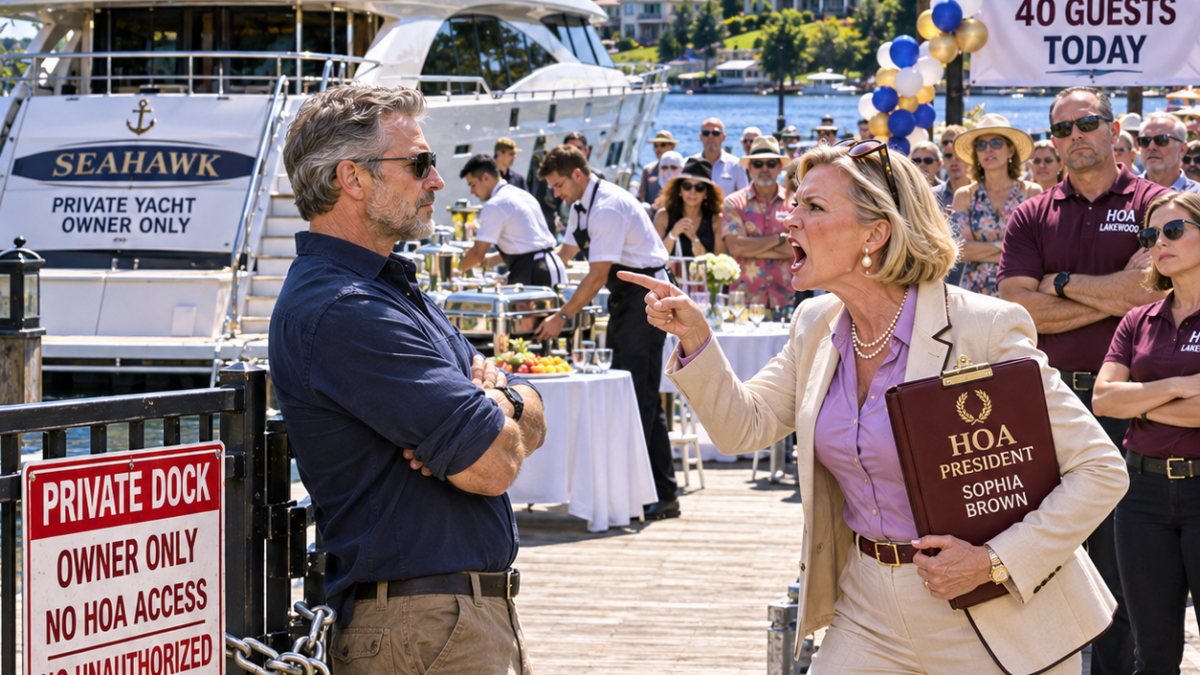
The morning HOA president Sophia Brown announced that forty of her guests would be boarding my sixty-foot yacht at noon, she was already standing on my dock with caterers, folding tables, balloons, a portable speaker system, and two teenagers trying to remove the lock from my boarding gate. She had spent weeks insisting that anything inside the Lakewood marina automatically belonged to the community, threatened me with $500-a-day fines when I refused to hand over my yacht’s schedule, and even convinced dozens of neighbors that I was some selfish rich man stealing an amenity they had always been entitled to use. What Sophia still didn’t understand was that I had stopped arguing with her several days earlier, because I had finally decided to let her push this fantasy as far as she possibly could before I showed everyone exactly what her HOA had been pretending to own.
My name is Michael Johnson.
I was forty-eight when I moved to Lakewood Estates, thirty miles outside Denver, after twenty-five years in corporate finance.
I had spent enough of my life inside conference rooms where people fought over numbers they didn’t understand and power they hadn’t earned. Retirement was supposed to be different.
That was why I bought the house overlooking the water.
And that was why I bought *Serenity*.
She was sixty feet of polished teak, white fiberglass, stainless steel, and quiet.
I’d saved for that yacht for nearly a decade.
Not because I wanted to impress anyone.
Because after thousands of nights answering emails at midnight, I wanted something that moved only when I decided it should.
Lakewood looked perfect at first.
Fifty acres of blue water.
Elegant houses following the shoreline.
Private docks.
A central marina with covered slips, fuel pumps, storage, and a small café.
Then I met Sophia Brown.
Sophia had been HOA president for seven years.
She wore pearls before breakfast, a pastel blazer in weather that didn’t require one, and carried a clipboard as if the Constitution had been printed on it.
The first words she ever said to me were:
“Your SUV is three inches too close to the curb.”
Not hello.
Not welcome.
Three inches.
I should have understood what I was dealing with.
For almost two years, though, I stayed out of her way.
I paid legitimate dues.
Maintained my house.
Skipped HOA politics.
Spent my afternoons aboard *Serenity*.
And quietly completed one investment Sophia knew nothing about.
While reviewing my property documents during a renovation, I discovered the marina everyone called “the HOA marina” didn’t actually belong to the HOA.
The original developer still owned it.
Lakewood Estates merely operated portions of it through an old lease.
I called the developer.
One conversation became five.
Five became negotiations.
Then one afternoon, I signed papers purchasing the marina parcel, docks, fueling infrastructure, and associated shoreline rights, subject to existing lawful access agreements.
I didn’t announce it.
I had no reason to.
For almost two years, nothing changed.
Then Sophia noticed *Serenity*.
I was polishing a railing when I heard her heels behind me.
“Beautiful boat,” she said.
“Thank you.”
“Very community spirited.”
I turned.
“What does that mean?”
She smiled.
“We’ve been discussing expanded shared use of marina assets.”
“Good luck.”
Her smile tightened.
“Your yacht would be perfect for resident lake tours.”
I laughed.
Sophia didn’t.
A week later, I received an HOA email requesting my “vessel availability calendar.”
Then another announcing a proposed marina-sharing program.
Then a notice informing residents that unused boats could be reserved for community activities.
I called Sophia.
“That’s my yacht.”
“All marina assets fall under HOA oversight.”
“No.”
“You agreed to HOA rules.”
“HOA rules don’t transfer ownership of a boat.”
“We’ll see.”
That should have ended it.
Instead, Sophia held a community vote.
Sixty-seven residents supported her proposal.
Thirty-three opposed it.
She announced that the vote authorized the HOA to schedule resident-owned vessels.
Then she looked directly at me and smiled.
Two days later, my first $500 fine arrived.
The next morning, another.
Then another.
I gave everything to my attorney.
And waited.
Because by then, Sophia wasn’t merely making a mistake.
She was building something.
A paper trail.
A public spectacle.
And, if I stayed patient enough, the perfect stage on which to destroy her own argument.
That stage appeared Saturday morning.
At 10:32, I stepped onto my porch and heard music coming from below.
I looked toward the marina.
Forty people.
Tables.
Food.
Balloons tied to my railing.
And Sophia Brown standing beside *Serenity* with a megaphone.
I started walking downhill.
Then I heard her announce:
“Boarding begins at noon.”
I stopped for one second.
Took out my phone.
And called my lawyer before I took another step.
PART 2
Daniel answered on the third ring.
“Please tell me you’re not calling about another $500 fine.”
“Forty people are standing on my marina.”
Silence.
Then:
“What?”
“Sophia organized a party.”
“On your property?”
“Yes.”
“Did you authorize it?”
“No.”
“Is anyone touching the yacht?”
I looked down the slope.
Two young men were working near the boarding gate.
“One of them appears to be messing with the lock.”
Daniel’s voice changed immediately.
“Michael, do not get into a physical confrontation.”
“I wasn’t planning to.”
“You’re a retired CFO. Your definition of physical confrontation is probably sending a strongly worded spreadsheet.”
“Very funny.”
“I’m serious. Record everything. Tell them clearly they don’t have permission. If they refuse to leave, call law enforcement.”
I started toward the marina.
“Already recording.”
“Good.”
“And Daniel?”
“Yes?”
“I think we’re past the friendly letter.”
“Long past.”
I ended the call.
The music became louder as I approached.
Someone had set up a buffet beside the café.
A man in a golf shirt was lighting a propane grill.
Children were running between dock carts.
Someone had tied blue-and-white balloons around one of my dock posts.
Several guests were dressed as though they expected a yacht cruise.
Sophia stood in the middle of it all.
Pink blazer.
White pants.
Pearls.
Clipboard.
The woman looked as comfortable on my property as I did.
“Michael!”
She spread her arms.
“You made it.”
I kept walking.
“You’re hosting a party on my marina.”
“Our marina.”
“No.”
She tilted her head.
“We’ve been through this.”
“Yes.”
“And apparently you learned nothing.”
A few conversations stopped.
Sophia’s smile tightened.
“Let’s not create a scene.”
“Then get everybody off my property.”
The crowd quieted further.
Her expression changed.
Only slightly.
Enough that I saw the anger beneath the performance.
“Michael, these are your neighbors.”
“They’re currently trespassing.”
One woman near the buffet looked at Sophia.
“Trespassing?”
Sophia didn’t take her eyes off me.
“Don’t be ridiculous. The HOA approved today’s event.”
“The HOA can’t approve an event on property it doesn’t own.”
She laughed.
“Again with this fantasy.”
I pointed toward the yacht.
“Did you tell those boys to remove my lock?”
Sophia glanced over.
One of them immediately stopped touching it.
“They’re preparing the vessel.”
“For what?”
“The cruise.”
“There will be no cruise.”
Her jaw tightened.
“You agreed to live in a community.”
“I did not agree to donate a yacht.”
“Nobody said donate.”
“You’re trying to put forty strangers aboard it.”
“Your neighbors.”
“Still strangers to my insurance company.”
That got a few nervous laughs.
Sophia heard them.
Her face hardened.
“The board voted.”
“So what?”
She stared at me.
I continued.
“You can vote to use my toothbrush. Doesn’t make it yours.”
More laughter.
She turned toward the crowd.
“Please continue setting up.”
Then back to me.
“Michael, if you interfere with an approved HOA event, you’ll face additional penalties.”
“How many?”
Her eyes narrowed.
“Excuse me?”
“How many additional penalties?”
“That depends on your behavior.”
I nodded slowly.
“Good.”
I took out my phone.
“Because I want every threat clear.”
Her eyes dropped to the screen.
“You’re recording me?”
“I’m standing on my property.”
“Turn that off.”
“No.”
“Michael.”
“No.”
That was the moment her polished performance cracked.
“Fine!” she snapped. “You want to act like a spoiled child? We’ll treat you like one. Your yacht is registered in the community marina. The community has approved access. Either open it voluntarily or the board will proceed without you.”
Several guests stopped moving completely.
One man whispered:
“Proceed how?”
Sophia ignored him.
I looked at the lock.
Then at her.
“Last warning. Tell everyone to leave.”
She folded her arms.
“No.”
I called the sheriff’s office.
Not 911.
There was no immediate threat to life.
I called the county non-emergency line.
“This is Michael Johnson at Lakewood Marina. I have approximately forty unauthorized people on privately owned property. At least two individuals have attempted to tamper with the lock to my vessel. I’ve told the organizer to leave. She’s refusing.”
Sophia laughed loudly enough for the phone to catch it.
“This is embarrassing.”
“Maybe.”
She stepped closer.
“You’re calling the police on forty neighbors because you’re too selfish to share a boat?”
“No.”
I looked at the guests.
“I’m calling because the person who invited you doesn’t own the place she invited you to.”
That changed the mood.
A man near the grill shut off the burner.
The woman hanging balloons stopped.
Someone asked Sophia:
“You said this was HOA property.”
“It is.”
I said:
“No.”
She whirled toward me.
“You are not going to undermine me in front of everyone.”
There it was.
Not:
You’re wrong about the deed.
Not:
I have documents.
Not:
The HOA owns it.
You are not going to undermine me.
That was what mattered.
Control.
The deputies arrived eighteen minutes later.
Deputy Elena Reyes came first.
Her partner, Arjun Patel, followed.
Reyes looked at the crowd.
Then the decorations.
Then *Serenity*.
“This the trespassing call?”
“Yes.”
Sophia immediately stepped forward.
“Officer, this is not trespassing. This is an HOA event.”
Reyes looked at her.
“Who owns the property?”
“The community.”
I said:
“I do.”
Sophia pointed at me.
“He claims he does.”
Reyes sighed in the exhausted way law enforcement does when two adults each insist the other one doesn’t understand reality.
“Documents?”
“I have them.”
I had already brought the folder down from the house.
Deed.
Recorded parcel description.
Purchase agreement.
Map.
The marina lease.
A certificate of insurance.
Reyes studied the first page.
Patel looked at the county parcel map through his tablet.
Sophia started talking.
“The HOA declaration clearly identifies the marina as a community amenity.”
Reyes held up one hand.
“Ma’am.”
Sophia kept going.
“All homeowners pay dues supporting this facility.”
“Ma’am.”
“It’s absurd to let one person—”
“Please stop for a moment.”
Sophia froze.
Reyes looked at me.
“How long have you owned this parcel?”
“Almost two years.”
“The HOA uses it?”
“Under an existing lease covering specified marina operations.”
“Does that lease give the HOA ownership?”
“No.”
“Authority over your yacht?”
“No.”
Sophia scoffed.
“That’s his interpretation.”
Reyes handed me the documents back.
Then turned to her.
“Do you have something showing ownership or authority to enter the vessel?”
“The HOA voted.”
“That isn’t ownership documentation.”
“The HOA bylaws—”
“Don’t transfer title to somebody’s yacht.”
Sophia’s face went pale.
Behind her, somebody whispered:
“Oh my God.”
Reyes continued.
“Is anyone here refusing to leave after being told by the owner?”
Most of the crowd started moving immediately.
Chairs folded.
Bags picked up.
Parents called children.
The man at the grill unplugged the speaker.
Sophia stood still.
“You cannot do this.”
Reyes remained calm.
“I am asking everyone to leave private property because the property owner has withdrawn permission.”
“This is a civil dispute.”
“The ownership dispute may be civil. Refusing to leave after notice can become something else.”
Patel walked toward the yacht gate.
“Who cut this lock?”
I followed.
The padlock wasn’t fully cut.
But the protective housing had been damaged.
Metal gouges.
Tool marks.
Sophia said:
“No one cut anything.”
Patel looked at the two young men.
They looked at each other.
One said:
“We were told to open it.”
“By who?”
Neither answered.
Sophia shouted:
“Don’t interrogate children.”
Patel looked at her.
“They’re adults.”
The older-looking one said quickly:
“Mrs. Brown told us the owner had refused to provide the key and the HOA authorized access.”
Sophia turned red.
“I said prepare the gate.”
“You told us to remove the lock.”
“I did not.”
The second young man nodded.
“You did.”
The crowd went silent.
I didn’t smile.
I wanted to.
But Daniel had spent enough time teaching me the value of not looking delighted while documenting your opponent’s collapse.
Reyes took names.
Photographed the damage.
No one was arrested that morning.
That part mattered.
Sophia had arranged an unauthorized event and encouraged interference with the gate, but the deputies weren’t there to deliver cinematic justice.
They documented.
They cleared the property.
They told Sophia the ownership dispute belonged in court if she wished to contest it.
Then Reyes looked at me.
“Change the lock.”
“Already planned.”
“Cameras?”
“Yes.”
“Good.”
She lowered her voice.
“People who get embarrassed publicly sometimes escalate.”
I glanced toward Sophia.
She was walking uphill alone.
“I know.”
Reyes looked at me.
“Don’t provoke her.”
“I’m not.”
She gave me a look.
“Don’t enjoy provoking her either.”
Apparently Daniel had recruited law enforcement.
I went back to the marina after everyone left.
Balloons remained tied to one post.
A paper plate floated beside the dock.
Half a bowl of potato salad sat abandoned on a table.
*Serenity* was untouched except for the gate damage.
I walked aboard.
Sat behind the helm.
And for the first time that morning, I felt angry.
Not theatrical anger.
Not clever-boardroom anger.
Real anger.
The yacht had always represented the opposite of my career.
Nobody asking for quarterly projections.
Nobody scheduling my day.
Nobody telling me how a decision would look to shareholders.
Now Sophia had turned it into another corporate resource.
Something to be “allocated.”
Scheduled.
Shared.
Managed.
She had taken the one thing I’d bought specifically because it was mine to choose and tried to put it on a reservation calendar.
I put both hands on the wheel.
“Not happening.”
That evening Daniel came over.
He brought a laptop and the kind of smile lawyers have when somebody has handed them free evidence.
“I reviewed your recording.”
“And?”
“She is reckless.”
“Legal term?”
“Professional observation.”
We went through the timeline.
The unauthorized yacht-sharing resolution.
The fines.
The letters.
The event.
The lock damage.
The deputies’ report.
Then Daniel opened the old marina lease.
“Here’s what interests me.”
“Besides the obvious?”
“The HOA never purchased this marina.”
“I know.”
“They’ve been operating under this lease.”
“Yes.”
“One dollar annually.”
“Developer’s symbolic arrangement.”
Daniel nodded.
“And you assumed the lessor position when you bought the property.”
“Yes.”
He scrolled.
“Read Section Six.”
I had read it before.
But not carefully enough.
The HOA’s marina-use privileges could be suspended or terminated for material breach, including unauthorized subletting, interference with ownership rights, misuse of facilities, failure to maintain insurance requirements, or conduct exposing the property owner to unreasonable liability.
I looked at him.
“You’re smiling.”
“I like contracts.”
“You said that about weak paperwork too.”
“I’m a simple man.”
“Could I terminate the lease?”
“Possibly.”
“Possibly?”
“Lawyers use that word because houses cost money.”
I leaned back.
“Would today’s party qualify?”
“Today’s party plus the sharing resolution plus attempts to access a private vessel without permission create a strong argument.”
“What happens to residents’ slips?”
“That’s where we need to be careful.”
Twenty-three families stored boats at the marina under arrangements administered through the HOA.
None of them had created Sophia.
At least not individually.
If I terminated access overnight and locked everyone out, I’d be punishing residents to get at one woman.
That wasn’t what I wanted.
“So we don’t strand them.”
Daniel nodded.
“Exactly.”
“What do we do?”
“Put HOA management on formal notice of breach.”
“Cure period?”
“Lease gives ten days for curable violations.”
“And non-curable?”
“Immediate termination for intentional misuse or interference.”
I thought.
“Give them ten days anyway.”
Daniel looked surprised.
“Why?”
“Because I want Sophia to have every opportunity to correct course.”
“You’re either very reasonable or very vindictive.”
“Both.”
He smiled.
“That can be useful.”
The breach notice went out Monday morning.
No community post.
No dramatic confrontation.
Certified letter.
HOA attorney.
Board members.
Sophia.
The notice demanded:
Withdrawal of the yacht-sharing resolution.
Cancellation of all fines related to refusal to provide access to privately owned vessels.
Written acknowledgment that the HOA lease did not transfer ownership of the marina.
No further unapproved events.
No attempts to enter my yacht.
Ten days.
Sophia responded in four hours.
Not through the attorney.
Directly.
INVALID AND REJECTED.
Then, beneath it:
The HOA does not recognize Mr. Johnson’s purported authority to interfere with community assets.
Daniel stared at the email.
“She typed ‘purported.’”
“Very legal.”
“She also just rejected cure.”
“Very helpful.”
Sophia went on the offensive.
Violation notices appeared every other day.
Dock accessories.
Exterior lighting.
Failure to cooperate with community safety.
Obstruction of amenities.
Then:
$500 daily noncompliance assessment.
I paid none.
The HOA’s management software showed my alleged balance climbing past $4,000.
Daniel disputed everything formally.
Sophia posted a newsletter statement:
Certain residents are attempting to privatize shared assets for personal enrichment.
No name.
Everyone knew.
Patricia Evans came to my porch that evening.
Patricia was seventy-two, widowed, and possessed the most useful quality in Lakewood:
She listened before speaking.
“I believed her,” she said.
“About what?”
“The marina.”
“Most people did.”
“She said you secretly bought something that was supposed to be ours.”
“I did buy it quietly.”
“That made it sound suspicious.”
“I understand.”
“Why didn’t you tell everyone?”
“Because I wasn’t changing anyone’s access.”
She nodded.
“That makes sense now.”
I poured her coffee.
She looked toward the water.
“My husband kept our fishing boat down there before he died.”
“I remember the blue one.”
“You do?”
“Old Ranger hull.”
Her face softened.
“That’s the one.”
She looked back at me.
“I don’t think most people care who owns the dirt under the marina.”
“What do they care about?”
“Being able to get to their boats.”
Fair.
“And Sophia knows that.”
“Yes.”
Patricia sighed.
“She tells people you’re going to close everything.”
“I’m trying not to.”
“But you can?”
“Yes.”
“That scares them.”
I thought about that.
Sophia had found my weak point.
Not legally.
Socially.
She could make me the villain by forcing me to exercise rights that affected innocent residents.
Patricia leaned forward.
“If you want to beat her, don’t make everybody else pay.”
I smiled.
“Daniel said almost the same thing.”
“Then your lawyer is unusually smart.”
“He’ll be delighted.”
That conversation changed my strategy.
I sent every marina slip holder a direct letter.
Not through the HOA.
I explained ownership.
Included copies of the recorded deed.
Explained the lease.
Promised that no lawful boat owner would lose access without notice.
If the HOA lease terminated, I would offer temporary direct access agreements while a long-term arrangement was negotiated.
No retaliation.
No surprise lockout.
No hostage-taking.
That did more damage to Sophia’s narrative than any threat I could have made.
People stopped asking:
“Why is Michael closing our marina?”
They started asking:
“Why did Sophia say he was?”
At the next HOA meeting, I attended with Daniel.
Sophia stood at the podium.
Same pink blazer.
Same pearls.
But something had changed.
People were reading documents instead of watching her.
That is dangerous for anyone whose authority depends on being the only interpreter.
She called the meeting to order.
“The purpose tonight is to address continued interference with Lakewood amenities.”
I raised my hand.
She ignored me.
Harold White, one of the older board members, spoke.
“Sophia, before that, I’d like clarification.”
Her expression flickered.
“On?”
“The deed Michael sent residents.”
“This meeting isn’t about that.”
“It seems like that’s exactly what it’s about.”
A murmur of agreement.
Sophia straightened.
“The HOA’s attorneys are reviewing those claims.”
Daniel whispered:
“News to their attorney.”
I almost smiled.
Harold continued.
“Do we own the marina?”
Sophia didn’t answer.
“Do we?”
“We hold community rights.”
“That wasn’t my question.”
She stared at him.
I recognized the feeling.
Board meetings.
Corporate acquisitions.
The exact second when one question becomes the only question in the room.
Finally Sophia said:
“The HOA has always treated the marina as a common asset.”
Harold asked:
“Is our name on the deed?”
Silence.
Then:
“No.”
The room shifted.
One word.
That was all.
Harold sat back.
“Thank you.”
Sophia glared.
Then looked at me.
“This does not give Mr. Johnson the right to disrupt established community expectations.”
I stood.
“I’m not disrupting anything.”
“You’re threatening to cancel marina access.”
“No.”
I held up my letter.
“I guaranteed residents continued temporary access even if the HOA lease ends.”
People began looking at copies.
Sophia’s face changed.
She had not expected that.
“You cannot enter individual agreements designed to undermine the HOA.”
Daniel stood.
“He owns the property.”
Sophia snapped:
“You are not recognized.”
Daniel sat.
“Didn’t hurt to try.”
Laughter.
Sophia banged the gavel.
“Enough.”
I looked around the room.
“I don’t want your boats.”
I paused.
“I don’t want your marina fees.”
Another pause.
“I don’t want your HOA position.”
Then:
“I want one thing.”
Everyone waited.
“My property to remain mine until I choose otherwise.”
That was the line people remembered later.
Not because it was brilliant.
Because almost everyone in the room understood it.
Their house.
Their boat.
Their porch.
Their retirement.
Their choice.
The sharing initiative had sounded harmless when Sophia called it community spirit.
It sounded very different when people imagined the HOA voting to use their own possessions.
A man near the back raised his hand.
“Could the HOA vote to let people use my pontoon?”
Sophia said:
“That’s not the issue.”
“Why not?”
Another woman:
“What about my golf cart?”
“Please.”
Another:
“Could we reserve Sophia’s SUV?”
The room exploded in laughter.
Sophia slammed the gavel.
“Meeting adjourned!”
People ignored her.
That was the first time I saw real fear on her face.
Not fear of me.
Fear of becoming irrelevant.
Three nights later, somebody went after *Serenity*.
My phone buzzed at 1:37 a.m.
Dock motion.
I opened the feed.
Three figures.
Hoodies.
Flashlights.
One at the engine hatch.
I was already calling 911.
I did not go down.
That decision mattered later.
“Three people are on my yacht without permission. I have live camera footage.”
“Are you in the residence?”
“Yes.”
“Stay there.”
“I will.”
The three fled before deputies arrived.
But they left tools.
Footprints.
And one phone.
Deputy Reyes came to my house the next morning.
She held an evidence bag.
“You know Ethan Brown?”
“Sophia’s son.”
“Age?”
“Nineteen, I think.”
“Correct.”
My stomach tightened.
“The phone is registered to him.”
“Was he there?”
“We’re investigating.”
“Camera has faces.”
“Give us the original files.”
I did.
“Don’t post anything.”
“I won’t.”
She looked surprised.
“What?”
“You’re learning.”
“Everyone keeps saying that.”
The video showed Ethan clearly enough for investigators to identify him.
The other two were friends.
The footage showed them opening an exterior service panel and tampering around the yacht’s engine compartment.
Damage was limited because they apparently fled when one motion light triggered.
But marine systems aren’t toys.
A stupid act around fuel, electrical equipment, or engines can hurt people.
The sheriff’s office treated it seriously.
Sophia called me before lunch.
I didn’t answer.
She left six voicemails.
The first:
“Michael, we need to talk.”
Second:
“You are misinterpreting what happened.”
Third:
“Ethan believed he had authority to inspect the vessel.”
Fourth:
“You need to call the sheriff and correct this.”
Fifth:
“If you destroy my son’s future over an HOA disagreement, people will see what kind of man you are.”
Sixth:
“Call me.”
I sent all six to Daniel.
His response:
DO NOT CALL HER.
I didn’t.
At the next emergency meeting, Sophia tried to get ahead of the story.
“False accusations are being made against my family.”
I was sitting in the second row.
Daniel beside me.
She continued.
“Certain residents are using manipulated surveillance video to retaliate against this board.”
I stood.
Daniel whispered:
“Wait.”
I sat.
He raised his hand instead.
Sophia reluctantly recognized him.
“My client has not publicly accused your son of anything.”
“He gave video to police.”
“Yes.”
“Exactly.”
Daniel looked around the room.
“If any resident here finds someone tampering with their property at 1:37 in the morning, I recommend the same thing.”
Several heads nodded.
Sophia’s face tightened.
“The footage is misleading.”
Daniel asked:
“Have you seen it?”
“No.”
“Then how do you know?”
Silence.
Harold spoke.
“I’ve seen it.”
Sophia looked at him sharply.
“How?”
“The sheriff’s office showed Ethan’s attorney evidence relevant to the incident. Ethan called me afterward.”
Everyone turned.
Sophia’s face drained.
Harold continued.
“He admitted being on the yacht.”
“Harold!”
“He said he thought he was proving the boat wasn’t secure.”
“That is confidential.”
“He called me.”
Sophia slammed the table.
“You had no right—”
I stood.
This time Daniel let me.
“Sophia.”
She stopped.
“You’ve spent weeks telling people I fabricated everything.”
“I never said—”
“You published it.”
I held up the newsletter.
She went quiet.
I continued.
“I haven’t posted your son’s video.”
People murmured.
“I haven’t distributed his picture.”
I looked around the room.
“Because this isn’t entertainment.”
Then back to her.
“If Ethan committed a crime, the court will deal with Ethan.”
Her lips trembled.
“But you keep dragging everybody else into it.”
She whispered:
“You want to destroy us.”
“No.”
I shook my head.
“I wanted you to stay off my yacht.”
That sentence ended the meeting emotionally.
Not legally.
But emotionally.
Because it reduced months of warfare to its absurd origin.
A woman had tried to reserve something that wasn’t hers.
Everything after came from her refusal to accept no.
The HOA’s ten-day cure period expired.
No withdrawal of the sharing resolution.
No cancellation of fines.
No acknowledgment of ownership.
Instead, Sophia escalated.
The board—under her influence—voted to suspend my access to common amenities.
Pool.
Gym.
Clubhouse.
I didn’t care.
Then she blocked the marina road.
That I cared about.
One morning, an aluminum barrier appeared across the access lane.
PRIVATE HOA ACCESS.
AUTHORIZED RESIDENTS ONLY.
Two security guards stood beside it.
I pulled up.
One approached.
“Mr. Johnson?”
“Yes.”
“We’ve been instructed not to let you pass.”
“I’m a resident.”
“Your amenity privileges are suspended.”
“This road provides access to my marina.”
“HOA orders.”
I laughed once.
Not because it was funny.
Because sometimes disbelief escapes that way.
“Who hired you?”
“Northstar Community Security.”
“I’m going to park here.”
“Sir—”
“I’m not threatening you. I’m calling my attorney.”
Daniel arrived within an hour.
He brought a survey.
An easement document.
And the expression of a man whose opponent had finally stepped on the rake he had been watching for weeks.
“You have a recorded access easement.”
“I know that now.”
“You didn’t before?”
“I assumed the road was part of the marina parcel.”
He sighed.
“Retired CFO.”
“Stop.”
“The HOA can own the road strip.”
“Can they block me?”
“No.”
“How fast can we fix it?”
“Court.”
I hated that answer.
But we went to court.
Daniel filed for emergency injunctive relief based on interference with a recorded access easement.
The judge reviewed the deed, easement, barrier, and correspondence.
A temporary order required the HOA to restore access pending litigation.
No dramatic courtroom speech.
No gavel shattering Sophia’s empire.
Just law.
The barrier opened the next afternoon.
That hurt Sophia more than any argument.
Her favorite sentence had always been:
Rules are rules.
Now a court had handed her one.
She obeyed it.
Barely.
The board began fracturing.
Harold stopped supporting her.
Judy Wallace demanded an independent legal opinion on the marina.
Another director asked why the board had spent nearly eighteen thousand dollars in three months on “marina enforcement.”
That number caught Daniel’s attention.
“Eighteen thousand?”
“Apparently.”
“Doing what?”
“Guards. Consultants. Legal review.”
“Who approved it?”
“Sophia.”
“Vendor names?”
I got them through records homeowners were entitled to inspect.
One company stood out.
Brown Community Strategies.
I stared at the name.
“Related?”
Daniel said:
“Let’s not guess.”
Public registration answered quickly.
Registered agent:
Richard Brown.
Sophia’s husband.
That didn’t automatically mean fraud.
An HOA can hire a related company if properly disclosed and approved according to governing rules.
The problem was disclosure.
We couldn’t find any.
Harold couldn’t either.
Then another invoice appeared.
LAKE ACCESS CONSULTING.
Mailing address matched a business suite used by Sophia’s friend from her inner circle.
Another:
SPECIAL EVENT COORDINATION.
That invoice covered the day Sophia tried to board forty people onto my yacht.
I stared.
“Residents paid for her trespassing party.”
Daniel corrected me.
“Residents were billed for event coordination. Whether the expenditure was authorized is another question.”
“You ruin every good sentence.”
“That’s what you pay me for.”
The questions spread.
At the next board meeting, residents demanded an audit.
Sophia resisted.
“We do not need to waste community money on another accountant.”
Harold said:
“We’re spending community money on your husband’s company.”
She froze.
The room erupted.
“Excuse me?”
Harold held up invoices.
“Brown Community Strategies.”
“That is a legitimate vendor.”
“Did you disclose the relationship?”
“Everyone knows Richard is my husband.”
“That’s not a disclosure.”
“We have done nothing improper.”
“Then an audit will prove it.”
She stared at him for several seconds.
Then said the worst possible thing.
“I will not authorize an audit designed to attack me.”
Not:
The board.
Not:
The association.
Me.
Several residents noticed.
So did I.
The motion passed without her.
Independent audit.
Five years.
That was the beginning of the end.
But Sophia still had one weapon left.
Narrative.
She sent a community-wide newsletter.
MICHAEL JOHNSON’S PRIVATE TAKEOVER THREATENS LAKEWOOD.
It accused me of buying the marina secretly to profit from neighbors.
Threatening residents’ boat access.
Using legal technicalities to undermine community governance.
Daniel read it.
“Some of this is opinion.”
“And some?”
“Potentially actionable.”
“Defamation?”
“Maybe. More importantly, it helps establish retaliation.”
“So what do we do?”
“Nothing publicly.”
I groaned.
“You’re obsessed with boring revenge.”
“Boring revenge wins.”
He filed the civil lawsuit the next morning.
Claims related to interference with property rights.
Easement obstruction.
Unauthorized use.
Damage to the yacht gate.
Improper fines.
Retaliatory enforcement.
Defamation claims limited to specific provably false statements.
And declaratory relief confirming marina ownership and lease status.
Sophia was served at the clubhouse.
Not by me.
A professional process server.
I wasn’t there.
Patricia called afterward.
“You missed a show.”
“I didn’t want one.”
“She dropped her coffee.”
“That part I regret missing.”
The board called another emergency meeting.
By then, the audit had begun.
The lawsuit was active.
The marina lease cure period had passed.
Daniel and I made the decision.
Terminate the HOA’s marina-management lease.
Not residents’ access.
The HOA’s management authority.
I issued temporary individual licenses to existing legitimate slip holders for ninety days at the same effective rate they had been paying while a permanent agreement was developed.
No one lost their boat.
No one was locked out.
But Sophia lost the marina.
That was the revenge.
Not a gate.
Not humiliation.
Control.
The one thing she had tried to take from me.
The HOA meeting was standing room only.
Sophia sat at the front.
Harold to one side.
Judy to the other.
Daniel and I entered together.
Conversations stopped.
Sophia banged the gavel.
“Due to the unlawful termination notice issued by Mr. Johnson, the board will vote tonight to reaffirm association control over the marina.”
Daniel whispered:
“She really likes voting on things she doesn’t own.”
“Habit.”
Sophia continued.
“This community cannot allow one wealthy resident to seize shared resources.”
I raised my hand.
She looked directly at me.
“You are not recognized.”
Daniel stood.
“Your bylaws require opportunity to be heard before a vote directly affecting a member’s claimed property rights.”
Her expression changed.
She looked toward the HOA attorney.
He reluctantly nodded.
Sophia clenched her jaw.
“Five minutes.”
I walked forward.
Not angry.
That surprised me.
Months earlier, I wanted to expose her.
Now I just wanted the truth in one room.
I held up the deed.
“Two years ago, I bought the Lakewood Marina from Lakewood Development Holdings.”
Copies moved through the room.
“The HOA did not own it then.”
I held up the lease.
“And it does not own it now.”
Another set of copies.
“The HOA used the marina under a one-dollar lease inherited when I purchased the property.”
Sophia said:
“That lease guarantees community use.”
Daniel answered:
“Subject to its terms.”
I continued.
“Those terms prohibit unauthorized use and interference with ownership rights.”
I displayed photographs.
The forty-person party.
Damaged gate.
HOA sharing resolution.
Road barrier.
Then the court order restoring access.
“After repeated breaches, the HOA was given a cure notice.”
I displayed Sophia’s email.
INVALID AND REJECTED.
A ripple went through the room.
I continued.
“The HOA did not cure.”
I held up the termination letter.
“So its management lease is terminated.”
Someone shouted:
“What about our boats?”
That was the question Sophia wanted.
I answered immediately.
“Every existing lawful slip holder has already been offered a ninety-day direct license at the same effective price.”
People started whispering.
Sophia’s face tightened.
“There will be no mass lockout.”
More whispers.
“No retaliation.”
Then:
“No yacht-sharing program.”
Laughter.
Sophia slammed the gavel.
“This is extortion.”
“No.”
I looked directly at her.
“This is ownership.”
Daniel stepped forward.
“And since the association’s management lease has terminated, the association cannot vote itself back into a contract.”
Sophia turned toward the HOA attorney.
“Tell them.”
The attorney looked miserable.
“Sophia.”
“Tell them we’re still authorized.”
He removed his glasses.
“Based on the documents I’ve reviewed, the association’s ownership claim is not supportable.”
The room changed.
Sophia stared at him.
“You work for us.”
“I represent the association.”
“Exactly.”
“Not individual officers.”
Her face turned pale.
That distinction landed like a hammer.
Harold stood.
“I move for a vote of no confidence in the president.”
Sophia whirled.
“You cannot be serious.”
“I am.”
“We’re in litigation!”
“Because of decisions you made.”
“You approved them!”
“Some.”
Harold looked ashamed.
“And I was wrong.”
That quieted the room.
He continued.
“I believed the marina belonged to us because I never checked.”
He glanced toward residents.
“I approved enforcement spending I should have questioned.”
Then toward Sophia.
“But when the documents contradicted you, you kept going.”
Sophia’s voice shook.
“You’re betraying me.”
“No.”
Harold sat.
“I’m correcting myself.”
The vote proceeded.
Not eighty-nine percent exactly.
Not some perfect theatrical number.
But overwhelmingly enough.
Sophia Brown was removed as president.
She remained a homeowner.
Nothing more.
She sat perfectly still after the count.
No screaming.
No dramatic collapse.
That somehow felt more powerful.
The room that had once watched her every gesture now kept talking around her.
Judy asked about interim leadership.
Someone asked about marina slips.
Another asked about the audit.
Sophia had become background noise.
She gathered her papers.
Then walked past me.
At the door, she stopped.
“This was your plan.”
I looked at her.
“No.”
“You wanted my position.”
“I’ve turned down every board role I’ve ever been offered.”
“You wanted revenge.”
I thought before answering.
“Yes.”
She looked almost satisfied.
Then I continued.
“For a while.”
Her expression changed.
“But eventually I just wanted you to stop.”
She walked away.
The audit results arrived six weeks later.
They were ugly.
Not everything Sophia had done was criminal.
Some expenditures were simply poorly documented.
Some vendors had performed work.
Some board approvals existed.
But investigators and auditors identified approximately fifty-eight thousand dollars in related-party and personal-benefit transactions requiring repayment or further investigation.
Richard Brown’s company had received payments not properly disclosed.
Several “community appreciation” expenses included resort charges.
Home landscaping purchases had been billed through association accounts.
Special-event expenses included the attempted yacht party.
And one payment mattered directly to my case:
A locksmith expense submitted through an HOA vendor account around the time Ethan and his friends first tampered with *Serenity*.
That did not prove Sophia had ordered the vandalism.
The criminal investigation handled that separately.
But Ethan’s messages did.
I learned about them later through the case.
Ethan had texted one friend:
Mom says if we show the boat isn’t secured she can prove he created a safety issue.
Another:
Just open the panel. Don’t wreck anything.
His friend:
This is stupid.
Ethan:
I know.
Sophia had not texted the boys directly about vandalizing the engine.
But investigators found messages between her and Ethan.
She had told him:
We need documentation that Johnson is failing to secure community equipment.
Ethan:
It’s his boat.
Sophia:
Not according to the HOA.
That was enough to show influence.
Not enough for some imaginary conspiracy charge tying every action together.
Ethan ultimately accepted responsibility for unlawful entry and property damage.
He was nineteen.
No criminal history.
He paid restitution, completed community service, and entered a diversion-style program that gave him a chance to avoid carrying the worst consequences forever if he stayed out of trouble.
I supported that.
Daniel was surprised.
“He damaged your yacht.”
“He was nineteen.”
“He knew better.”
“So did I at nineteen.”
“You tampered with yachts?”
“No.”
“Then your comparison needs work.”
I smiled.
“He should face consequences.”
“He is.”
“I don’t need his life destroyed.”
Daniel nodded.
“That is annoyingly reasonable.”
Sophia’s situation was different.
The financial investigation showed a longer pattern.
She eventually entered a negotiated plea to theft/fraud-related charges involving association funds and record falsification.
No cinematic twenty-year sentence.
No judge calling her the queen of anything.
Restitution.
Probation.
A short custodial component under the plea structure.
Community service.
And a prohibition on serving in fiduciary leadership for a homeowners association for years.
Richard filed for divorce during the investigation.
I didn’t celebrate that.
There are consequences you can want.
And consequences that are simply sad.
The civil case settled separately.
Lakewood’s insurance carrier and the association agreed to cover documented property damage, legal costs, and a negotiated payment related to retaliatory enforcement and access interference.
The settlement was roughly fifty thousand dollars in total value to me after the various components were calculated.
More important:
The HOA formally recognized my ownership.
The marina management lease remained terminated.
Existing slip holders could contract directly with me or move their boats.
The association published a correction.
No more claims that my yacht was a community vessel.
No more fines for refusing to share it.
No more road blockade.
No more “marina sharing initiative.”
The newsletter apology was painfully corporate.
The Board of Lakewood Estates acknowledges that previous communications incorrectly characterized privately owned marina property and vessels as association assets. The Board regrets the resulting conflict, unauthorized enforcement measures, and inconvenience caused to Mr. Michael Johnson and other residents.
I read it twice.
Patricia called.
“They made ‘we were wrong’ sound like a tax return.”
“That’s impressive.”
“What are you going to do with the marina?”
That was the real question.
I could have closed it completely.
Private marina.
Private docks.
My property.
Legally, within the remaining easements and agreements, I had options.
Financially, I could increase rates.
Demand deposits.
Turn the whole place into an exclusive facility.
For about ten minutes, I liked imagining Sophia hearing that.
Then I thought about Patricia’s husband.
The blue fishing boat.
Neighbors who had stored boats there for years.
People who had believed Sophia because she had been the one in charge.
Being wrong didn’t make them enemies.
So I created a direct marina agreement.
Simple.
Clear.
Two hundred dollars a month for standard slips.
Maintenance included.
Insurance requirements.
No HOA middleman.
No compulsory sharing.
No using anyone else’s boat.
No board permission needed to access your own property.
Harold White, now interim president, read it.
“This seems almost too straightforward.”
“That’s intentional.”
“Can I ask something?”
“No.”
He laughed.
“I was going to ask whether you’d consider being HOA treasurer.”
“Absolutely not.”
“You’re a retired CFO.”
“Exactly why.”
“You’d be good.”
“I would rather hand-sand the entire yacht with a toothbrush.”
“President?”
I stared.
He laughed.
“Worth trying.”
Life began returning to normal.
Then one afternoon, I saw Sophia walking near the mailboxes.
No blazer.
No pearls.
Jeans.
Sweater.
She looked smaller somehow.
Not physically.
Just without the machinery of office surrounding her.
I considered turning around.
She saw me.
“Michael.”
“Sophia.”
For several seconds we stood there.
Then she said:
“Ethan told me you supported diversion.”
“I supported consequences that didn’t permanently destroy a nineteen-year-old.”
Her eyes lowered.
“Thank you.”
“I didn’t do it for you.”
“I know.”
That was new.
No argument.
No comeback.
She looked toward the marina.
“You really own all of it.”
“Yes.”
“I checked every record.”
“I assumed you eventually would.”
A faint, bitter smile.
“I should have done that first.”
“Yes.”
Another silence.
Then:
“I thought the developer promised it to us.”
“Planned to sell it to you.”
“They told me years ago.”
“Then why didn’t the HOA buy it?”
She looked embarrassed.
“We couldn’t afford it.”
I already knew.
“So I kept talking about it like it was ours.”
“Why?”
“Because residents expected it.”
That answer reminded me of every bad executive I’d ever known.
A promise made too early.
A fact ignored because correcting it would be embarrassing.
Then another lie to protect the first.
She continued.
“When I found out you’d bought it, I thought you’d taken advantage of us.”
“You could have called me.”
“I did.”
“You demanded my yacht schedule.”
She almost smiled.
“That was not my best opening.”
“No.”
She looked at me.
“I hated being told no.”
“I noticed.”
“I spent seven years being the person who solved everything.”
“You spent seven years being the person who decided everything.”
Her eyes tightened.
Then relaxed.
“That’s probably more accurate.”
She started to leave.
I stopped her.
“Sophia.”
She turned.
“Why *Serenity*?”
“What?”
“Why did you care so much about using my yacht?”
For the first time, she looked genuinely ashamed.
“The spring fundraiser.”
“What about it?”
“I promised donors a private yacht event.”
I stared.
“You promised forty people my yacht before asking me.”
“Yes.”
“Why?”
She looked down.
“Because I assumed you’d agree.”
“And after I didn’t?”
“I had already sold tickets.”
That explained more than I expected.
Not everything.
But enough.
“How much?”
“Two hundred dollars per couple.”
My jaw tightened.
“Where did the money go?”
“Community beautification fund.”
“Did the audit find it?”
“Yes.”
“Good.”
She looked at me.
“I should have canceled.”
“Yes.”
“I couldn’t stand the embarrassment.”
I thought about everything that followed.
Fines.
Votes.
Trespassing.
Police.
Her son.
The audit.
Lawsuits.
Charges.
All because canceling a party felt too humiliating.
“Sophia.”
“Yes?”
“You lost a lot more than a fundraiser.”
“I know.”
Then she walked away.
That conversation stayed with me.
Because it reminded me of something I had seen for decades in business.
The worst disasters rarely begin with somebody planning a disaster.
They begin with one person refusing to admit a small mistake.
A bad forecast.
A missed target.
A bad acquisition.
A promise they couldn’t keep.
Most problems are survivable early.
Pride makes them expensive.
Three months later, moving trucks arrived at Sophia’s house.
No crowd gathered to celebrate.
No one needed that.
She had sold.
Patricia and I watched from my porch across the curve of the lake.
“Feels strange,” she said.
“What?”
“How quiet people are.”
“Would cheering help?”
“No.”
She shook her head.
“I think everybody’s just tired.”
So was I.
Sophia’s white SUV pulled out last.
She stopped near my driveway.
Window lowered.
I walked toward the road.
She held out an envelope.
I hesitated.
“What is it?”
“A letter.”
“Legal?”
“No.”
“Should go through Daniel.”
“It isn’t about the case.”
I took it.
She looked toward the marina one final time.
Then at me.
“I really did think I was protecting Lakewood.”
“I believe you thought that.”
“That’s not the same as believing I was.”
“No.”
She nodded.
“Goodbye, Michael.”
“Goodbye, Sophia.”
Her SUV disappeared through the gate.
I opened the letter that evening aboard *Serenity*.
Michael,
I have spent most of my adult life believing leadership meant making sure nothing slipped beyond my control.
The HOA rewarded that belief for a long time.
People came to me with complaints and I fixed them.
Then they came to me with expectations and I promised things I did not have the authority to promise.
When you refused me, I treated your boundary as a personal attack.
That was wrong.
I told myself your yacht should be shared because you had more than other people.
What I really believed was that if I wanted something for the community badly enough, ownership became an inconvenience.
That is a dangerous belief.
I dragged my son into my obsession.
I embarrassed my husband.
I misused money people trusted me to manage.
I hurt neighbors I claimed to protect.
And I turned your retirement into another battlefield because I could not tolerate hearing one word:
No.
You were right to say it.
I don’t ask for forgiveness.
I only wanted to acknowledge that the thing I called selfishness was actually a boundary.
I understand that now.
Sophia
I folded the letter.
No sudden tears.
No dramatic feeling of forgiveness.
Mostly exhaustion.
But underneath it, something softer.
Closure, maybe.
I put the letter in the drawer beneath the navigation table.
Then I poured one glass of whiskey.
Not to victory.
Not to Sophia losing her house.
Not to lawsuits or court orders.
To silence.
Actual silence.
The water lapped against the hull.
Marina lights reflected across the lake.
Two slips down, Patricia’s nephew was cleaning the old blue fishing boat her husband had once owned.
At another slip, a young family loaded life jackets onto a pontoon.
People were using the marina.
Their boats.
Their choice.
No one had to donate anything to prove community spirit.
That summer, Harold proposed a neighborhood picnic.
He approached me carefully.
“We want to use the marina lawn.”
“Okay.”
He blinked.
“That easy?”
“It’s an event area.”
“Can we have music?”
“Until ten.”
“Food trucks?”
“Insurance certificates.”
He grinned.
“Can we use your yacht?”
I stared.
He burst out laughing.
“I’m joking.”
“Meeting over.”
The picnic happened in July.
Nearly a hundred people attended.
I stayed aboard *Serenity* for the first hour watching from the upper deck.
Then Patricia appeared.
“You planning to hide all afternoon?”
“I’m supervising.”
“You’re drinking iced tea.”
“Executive supervision.”
“Come down.”
I did.
People talked to me.
Not about the lawsuit.
Not about Sophia.
Mostly normal things.
Boat maintenance.
Weather.
Whether the café should serve breakfast.
A little boy asked why my yacht was named *Serenity*.
I crouched beside him.
“Because that’s what I wanted when I retired.”
“Did you get it?”
I looked around.
Children running along the grass.
Boats moving slowly through the marina.
Patricia laughing near the food table.
Harold arguing with a vendor about extension cords.
I smiled.
“Eventually.”
Later that afternoon, I did something Sophia had wanted from the beginning.
I invited people aboard *Serenity*.
Not forty.
Ten.
Patricia.
Harold and his wife.
A few neighbors who had helped during the worst months.
The little boy and his parents.
We didn’t leave the dock.
I gave them a tour.
The helm.
Galley.
Cabins.
Engine room from a safe viewing point.
The boy stared at the controls.
“Can I drive?”
“No.”
“Why?”
“Because some boundaries remain sacred.”
Everyone laughed.
Patricia looked at me.
“You realize Sophia would say this proves her point.”
“No.”
“What point?”
“That sharing builds community.”
I leaned against the railing.
“Sharing does.”
Then I looked toward the dock.
“Taking doesn’t.”
Patricia smiled.
“There it is.”
“What?”
“The lesson.”
“I hate lessons.”
“You’ve been talking like one for ten months.”
“Get off my yacht.”
She laughed harder.
At sunset, everyone left.
No broken locks.
No HOA vote.
No fines.
No police.
I walked the deck alone afterward.
For the first time since the fight began, I didn’t see evidence everywhere.
Not the spot where the lock had been damaged.
Not the service panel Ethan had opened.
Not the dock where Sophia stood with her megaphone.
Just wood.
Water.
Metal.
Rope.
A boat.
My boat.
That mattered.
The marina continued operating under direct agreements.
Financial reports from the new HOA became available quarterly.
Harold hired independent management.
Conflict disclosures became mandatory.
Related-party contracts required additional approval.
No president could impose major fines without board review.
Residents could appeal.
Sophia’s “inner circle” dissolved almost immediately once there was nothing to orbit.
Some apologized.
Others avoided me.
Both were acceptable.
Ethan completed community service.
He sent me a letter too.
Shorter than his mother’s.
Mr. Johnson,
I was stupid.
My mom told me you were trying to steal the marina from everyone and that if we proved your boat wasn’t secure, the HOA could force action.
I knew going onto the yacht was wrong.
I did it anyway.
I am sorry for the damage.
Thank you for not trying to destroy my future.
Ethan
I kept that one too.
Not because letters erased anything.
They didn’t.
But accountability should have somewhere to land.
Otherwise punishment becomes the whole story.
A year after the first yacht party, Lakewood held another summer event.
This time the sign said:
LAKEWOOD MARINA SUMMER NIGHT
HOSTED WITH PERMISSION OF THE PROPERTY OWNER
Harold claimed that last line was legally necessary.
I knew he added it to annoy me.
It worked.
Patricia brought cookies.
Same recipe she had brought after the settlement.
I stood on the dock watching people arrive.
Nobody crossed the boarding gate of *Serenity*.
No sign needed.
Everyone understood.
At one point, Harold came beside me.
“You know what I think is funny?”
“I’m sure you’ll tell me.”
“If Sophia had just asked nicely at the beginning, would you ever have agreed to a charity cruise?”
I thought about it.
“Maybe.”
He laughed.
“All of this.”
He gestured toward the marina.
“Court cases. Audit. Police. Lawsuit. Board removal.”
“Yep.”
“Because she couldn’t ask.”
“No.”
I looked at the yacht.
“Because she couldn’t accept the answer might be no.”
He became quiet.
“That’s worse.”
“Yes.”
We stood there watching the lake.
The sun disappeared behind the hills.
Lights came on one by one along the shoreline.
People laughed near the café.
A pontoon returned slowly to its slip.
The air smelled like pine, charcoal, and water.
Exactly the kind of evening I had imagined when I retired.
Then Harold ruined it.
“Still no interest in becoming HOA president?”
I stared at him.
“Leave.”
He laughed and walked away.
Patricia approached a moment later with a plate.
“Cookie?”
“Yes.”
“Whiskey?”
“Later.”
She sat beside me.
For a while, neither of us spoke.
Then she said:
“You know, when all this started, I thought you were stubborn.”
“I am.”
“I thought Sophia was stubborn too.”
“She was.”
“Difference?”
I looked toward *Serenity*.
“One of us was trying to control his own property.”
“And the other?”
“Everybody else’s.”
Patricia nodded.
“That’ll do it.”
Night settled across Lakewood.
I walked aboard after the last guest left.
Closed the boarding gate.
Locked it.
Not because I feared anyone.
Because locks are normal when boundaries are normal.
I climbed to the upper deck and sat behind the helm.
One year earlier, Sophia had stood below and announced that forty people were boarding my yacht whether I liked it or not.
She believed a vote could convert ownership into entitlement.
She believed a title made her judgment superior to my consent.
She believed community meant nobody was allowed to say no to her.
She learned otherwise.
So did Lakewood.
So did I.
I had spent my career thinking money was the most dangerous thing people fought over.
I was wrong.
Control was worse.
Money can be counted.
Control keeps demanding more.
A dock.
A road.
A vote.
A boat.
A person’s right to choose.
And once somebody convinces themselves that your boundary is an insult, they’ll keep crossing until something finally stops them.
In my case, what stopped Sophia wasn’t a screaming match.
It wasn’t revenge vandalism.
It wasn’t humiliating her online.
It was documents.
Cameras.
Contracts.
Court orders.
An audit.
Patience.
And the word she should have accepted the first time I said it.
No.
I poured a small whiskey.
The lake was almost perfectly still.
The name *Serenity* reflected faintly off the polished stern.
I had chosen that name years earlier because serenity sounded like something a man could buy after enough work.
I understood it differently now.
Peace isn’t something you purchase.
It’s something you protect without letting the protection consume you.
That was why I reopened the marina.
Why I gave Ethan a chance to repair what he had done.
Why I didn’t celebrate when Sophia left.
Why I invited neighbors aboard voluntarily after spending months fighting anyone who tried to force their way aboard.
A boundary isn’t meaningful because nobody ever crosses it.
It’s meaningful because the choice remains yours.
I raised the glass toward the empty dock.
“To asking first.”
The water tapped softly against the hull.
No response.
Perfect.
I finished my drink.
Turned off the deck lights.
And for the first time since Sophia Brown decided my yacht belonged on her HOA reservation calendar, I didn’t check the gate twice before going below.
Once was enough.
Because *Serenity* was still mine.
The marina was finally peaceful.
And Lakewood had learned the difference between sharing something freely and taking it because you think you’re entitled to it.
That was all I had wanted from the beginning.
[END OF STORY]








