PART 2: HOA President Blocked My Only Farm Road With Three Giant Boulders—48 Hours Later, a Judge Put Them on Her Perfect Front Lawn
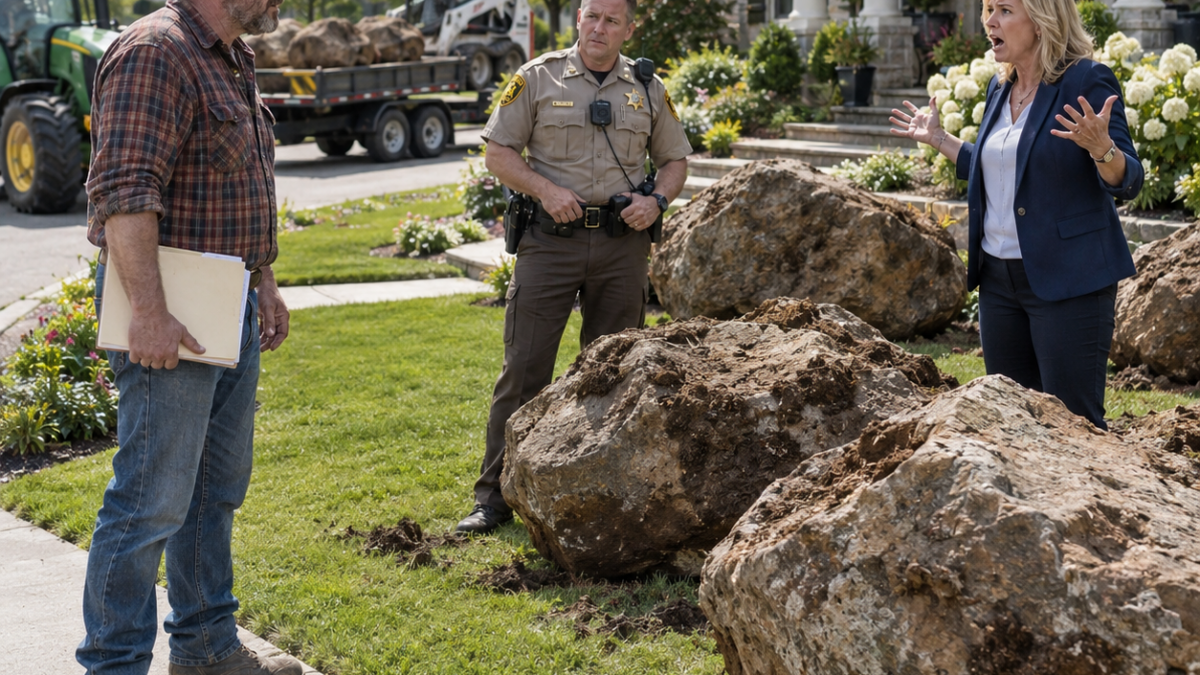
Karen stood at my property line with a ten-thousand-dollar stack of HOA fines and told me my woods, my tractor, and even the wildflowers on my land were dragging down the value of every house in her neighborhood. She thought enough penalties, legal threats, and public humiliation would eventually force me to landscape twenty acres I had owned years before her subdivision even existed. What she never considered was that the same county laws protecting my land from her HOA also allowed me to use that land in a way her perfectly manicured community was going to notice immediately.
My name is Jack Henderson, and I bought my property ten years before anybody had ever heard the name Estates at Whispering Pines.
After two decades in the Army Corps of Engineers, I wanted silence more than I wanted luxury. I had spent enough years around diesel engines, construction sites, aircraft, radios, deadlines, and places where every decision seemed to arrive with somebody shouting over machinery. When I finally had the chance to choose where I wanted to live, I bought twenty wooded acres beside a thousand-acre state forest and built a modest house in a small clearing with my own hands.
For five years, it was exactly the life I wanted.
Then the survey stakes appeared on the neighboring hills.
Bulldozers followed.
Trees disappeared.
Roads appeared.
And eventually hundreds of large houses rose where woods had once been.
I did not like watching it happen, but their land was their land. Property rights meant something to me, even when someone used their property differently than I would.
Then the HOA arrived.
My first introduction was almost friendly. Someone left a welcome basket containing cheap champagne and a thick green booklet of neighborhood rules.
I glanced through it.
Approved mailbox styles.
Approved landscaping.
Approved exterior colors.
Approved fence materials.
I dropped it into the recycling bin.
My deed contained no HOA covenant. My parcel had never been part of the development. Their rules stopped at their property line.
Karen Miller apparently disagreed.
The first note concerned a hundred-year-old oak tree near the boundary.
A few branches were dead.
They were over my land and threatened nobody.
Karen’s architectural committee nevertheless requested that I remove them for “aesthetic harmony.”
I ignored the request.
Two weeks later, I received a fifty-dollar fine.
That was when I wrote back.
I enclosed my county survey and deed and explained, politely, that my property was not part of Whispering Pines and therefore could not be fined under its covenants.
I sent the letter certified.
Karen signed for it.
The next envelope contained another fine.
One hundred dollars for failing to pay the first.
Then another for my tractor.
Another for “nonconforming natural flora,” which apparently meant wildflowers.
Another for my split-rail fence.
Another for the color of a birdhouse.
The numbers climbed from hundreds into thousands.
Every letter I sent was ignored.
Then one Saturday morning, Karen drove her HOA golf cart to the boundary while I was repairing a fence post.
She stopped on her side.
“Mr. Henderson, your fines for that tractor alone are now over two thousand dollars.”
I rested my hands on the post-hole digger.
“Karen, you don’t govern this land.”
Her smile disappeared.
“That’s where you’re wrong. Our attorneys have determined that the master development plan provides us with authority over adjacent properties affecting community values.”
“That makes no legal sense.”
“We have a visual easement.”
I almost laughed.
“A what?”
“Your property affects what our residents see. Their homes lose value because of your lack of maintenance.”
I looked behind me at twenty acres of healthy woods, meadow, deer trails, and an old tractor beside a barn.
“You mean nature?”
“I mean an eyesore.”
Then she handed me the envelope.
Final warning.
$10,475 in accumulated penalties.
A threat to pursue a lien.
A threat to take me to court.
Karen adjusted her sunglasses.
“You need to decide whether you want to be a good neighbor or an expensive problem.”
She drove away.
I stood there for a long time.
That evening, I attended their HOA meeting with my deed, survey, tax records, and every certified receipt proving they had received my objections.
Karen let me speak.
Then she told a room full of homeowners that my land was damaging their investments.
People applauded her.
One man complained about seeing my “rusty tractor.”
Another demanded to know why they had to tolerate an unkempt property beside their expensive homes.
I walked out carrying a folder full of facts nobody wanted to hear.
But Karen had made one mistake during that meeting.
She told me exactly what mattered most to her.
Property values.
That night I opened the county zoning code, turned to the permitted uses for my rural land, and started reading.
By two in the morning, I had found something that made me sit back in my chair and smile.
Karen wanted control over how I used my property because she claimed it affected her community.
Fine.
I was about to show her what a legal land use actually looked like.
PART 2
I did not sleep much that night, but for the first time in months it was not anger keeping me awake.
It was planning.
There is a difference.
Anger runs in circles. Planning looks for doors.
I had spent most of my adult life around engineers, logistics officers, survey crews, construction teams, and military planners. When a problem refused to move, the habit drilled into me was simple: stop pushing against the strongest point and figure out what actually controls the system.
Karen controlled her HOA meetings.
She controlled the violation notices.
She controlled the narrative inside Whispering Pines.
Every time I tried to explain jurisdiction, she turned the issue into property values. Every time I showed a survey, she called my land ugly. Every time I said no, she described me as selfish.
So I stopped asking how to beat Karen inside her system.
I asked a different question.
What could I legally do on my land that her system could not control?
The answer was sitting in the county code.
My parcel was zoned rural residential and agricultural, a classification created long before Whispering Pines existed. It permitted ordinary agricultural uses, livestock, limited private recreational uses, and certain sporting-club activities provided they met county safety, licensing, and land-use requirements.
I read the section three times.
Then I pulled my survey closer.
Twenty acres.
State forest on one side.
County road on another.
Whispering Pines to the east.
My house near the center.
Enough distance from their homes that a properly designed private sporting area could potentially meet county requirements.
Potentially.
That word mattered.
I was not going to do what Karen did and decide legality based on what I wanted to believe.
The next morning, I called the county planning office.
A woman named Pat answered.
“Planning and zoning.”
“My name is Jack Henderson. I own a rural residential parcel on Old Forest Road, parcel number 18-442.”
She typed.
“Twenty acres?”
“Yes.”
“What can I do for you?”
“I’m researching whether a private membership sporting club is an allowed accessory use.”
“What kind of sporting club?”
“Outdoor recreational and hunting-related activities. Private membership only. Not open to the public.”
I deliberately kept the description broad because I wanted her interpretation, not mine.
Pat spent a moment reading.
“Your zoning allows certain private recreational clubs subject to safety review and operating conditions. You’ll need to submit a site plan before I tell you anything definitive.”
“Who reviews safety?”
“Depends on the exact activity. Planning, sheriff’s office, sometimes environmental health.”
“So it isn’t automatically prohibited because there’s a planned residential development next door?”
“No.”
That sentence was beautiful.
I did not celebrate.
I asked:
“What about their HOA?”
Pat actually laughed.
“Your deed in their association?”
“No.”
“Recorded covenant tying you to them?”
“No.”
“Then their HOA is not the county.”
I wrote that down even though I already knew it.
“What should I submit?”
She gave me the checklist.
Site plan.
Property boundaries.
Existing structures.
Proposed recreational area.
Access.
Parking.
Insurance information later.
Any relevant safety plan.
Potential noise impacts.
Operating hours.
I thanked her and hung up.
Then I made my first call to Mike Callahan.
Mike had been a JAG officer years earlier and had the unfortunate personality trait of becoming happier as legal problems became stranger.
He answered on the third ring.
“Jack.”
“Mike.”
“What did you break?”
“Nothing.”
“What did someone accuse you of breaking?”
“Property values.”
Silence.
Then:
“I’m listening.”
I told him everything.
The fines.
The birdhouse.
The tractor.
Karen’s invented visual easement.
The HOA meeting.
The applause.
Then the zoning provision.
When I finished, he laughed for almost ten seconds.
“You want to form a private sporting club because Karen says your woods lower property values?”
“I want to use my land lawfully.”
“That is the most engineer answer possible.”
“Can I?”
“Maybe.”
“That’s disappointing.”
“Jack, I’m a lawyer. ‘Maybe’ is our version of romance.”
He became serious.
“Do this correctly.”
“That’s why I called.”
“No improvising. No assuming. No ‘somebody online said it’s legal.’ County approval in writing. Safety review in writing. Insurance. Operating rules. If any relevant state requirement applies, satisfy it. If you intend to use a portion of the property for lawful shooting sports, range design gets reviewed before anyone uses it.”
“Understood.”
“And one more thing.”
“What?”
“Your purpose.”
I knew what he meant.
“Private club.”
“No.”
His voice hardened.
“Your actual purpose.”
I looked out the window toward Whispering Pines.
“Karen wants me to understand that how I use my property affects her residents.”
Mike sighed.
“Jack.”
“I’m not going to break any law.”
“That wasn’t my concern.”
“Then what is?”
“Don’t become reckless just because your paperwork is better than hers.”
That irritated me.
Which meant he was probably right.
“I want my property left alone.”
“Good.”
“Anything else?”
“Yes.”
“I want her board exposed.”
“That is a different mission.”
“I know.”
“Keep them separate.”
I wrote that down too.
The sporting club would be lawful use of my land.
Karen’s conduct would be challenged with evidence.
Do not mix the two.
That rule saved me more than once.
Before I filed anything, I started examining Karen.
Not her personal life.
Not secrets.
Public records.
The HOA was a corporation.
Its budgets were available to members, and several summary filings could be accessed publicly.
I searched the vendors listed in the association’s published financial material.
One company stood out.
Lawn and Order Landscaping.
I laughed at the name.
Then I looked up the business registration.
Owner: Gary Phillips.
The name seemed familiar.
I searched Karen’s publicly visible social media.
There he was.
Thanksgiving.
Christmas.
A barbecue.
Gary Phillips.
Karen’s brother-in-law.
That alone proved nothing illegal.
Family members can own businesses.
HOAs can hire businesses owned by relatives if conflicts are disclosed and contracts are handled properly.
But it was worth noting.
I downloaded the corporate filing.
Then I looked through the budget again.
Lawn and Order had received a surprisingly large amount.
Landscaping.
Seasonal plantings.
Mulch.
Tree trimming.
Entry monument maintenance.
I did not know whether those prices were high.
But I knew somebody who would.
David Chen.
He lived two streets inside Whispering Pines.
I had noticed him at the HOA meeting because he did not clap when Karen finished describing me as a threat to everyone’s home equity.
I also remembered something else.
His basketball hoop had disappeared.
For years, whenever I drove past, I saw David’s two boys shooting baskets in the driveway.
Then suddenly the hoop was gone.
I found him the following Saturday working on a lawn mower with the garage door open.
“David?”
He looked up.
“Yes?”
“Jack Henderson.”
His expression tightened.
“The woods guy.”
“That’s apparently my official title.”
That earned half a smile.
“What can I do for you?”
“I wanted to ask about your basketball hoop.”
He looked toward the house.
Then back at me.
“Why?”
“I remember your sons using it.”
“They did.”
“What happened?”
“HOA.”
One word.
Enough.
“What did they say?”
David wiped his hands.
“Backboard had faded.”
“That’s it?”
“The pole had surface rust.”
“So?”
“So Karen decided it lowered neighborhood appearance.”
I leaned against the garage frame.
“How much?”
“First fine was two hundred fifty.”
“And then?”
“Five hundred.”
He gave a tired laugh.
“She told us if we didn’t remove it, the penalties would increase weekly and they’d send the account to counsel.”
“Your boys?”
“Devastated.”
He looked toward the empty driveway.
“My oldest practiced every morning.”
“Why didn’t you appeal?”
“We did.”
“What happened?”
“Karen chaired the hearing.”
Of course she did.
“She denied it.”
David studied me.
“Why are you asking?”
“I’m trying to understand whether what happened to me is isolated.”
“It isn’t.”
“I found something else.”
I showed him the public registration for Lawn and Order.
Then a photograph identifying Gary Phillips as Karen’s brother-in-law.
David’s eyebrows rose.
“That landscaping company?”
“Yes.”
“You know what they charge?”
“No.”
“Too much.”
“How do you know?”
“I work in corporate finance. Last year I asked for three independent quotes because our landscaping line seemed ridiculous. Lawn and Order was almost a third higher than two competitors.”
“Did you tell anyone?”
“I asked Karen at a meeting.”
“What happened?”
“She said Lawn and Order met specialized community standards and that cheaper vendors could compromise property values.”
I smiled.
“There are those property values again.”
David did not.
“You think she’s steering money to family?”
“I think we should prove things before saying them.”
He looked at the documents again.
“What are you planning?”
“For now?”
I folded the papers.
“Facts.”
David stared at me for a long moment.
Then he said:
“I want in.”
That was how I got my first real ally.
My second was Maria Gable.
Mrs. Gable was in her seventies, lived alone, and kept the kind of front garden that made you slow down when you passed.
Petunias.
Marigolds.
Roses.
Tiny painted stones her grandchildren had made.
But something was missing.
The gnomes.
There used to be at least ten.
I found her kneeling beside a flower bed.
“Mrs. Gable?”
She looked up.
“Yes?”
“I’m Jack Henderson.”
“Oh.”
She stood carefully.
“I saw you at the meeting.”
“Then I apologize.”
That made her laugh.
“What can I do for you?”
“I wanted to ask about your garden gnomes.”
Her face changed immediately.
“They’re gone.”
“I noticed.”
“She made me remove them.”
“Karen?”
Mrs. Gable nodded.
“Said they were tacky.”
She pulled off one glove.
“My grandchildren gave them to me.”
I did not say anything.
She continued.
“One every birthday for years. My youngest granddaughter used to come over and move them around. She’d hide one behind the roses and make me find it.”
“Why did you remove them?”
Mrs. Gable looked embarrassed.
“I got tired.”
That answer hit harder than anger would have.
“She sent letters. Then fines. Then she said if I kept refusing, the legal department might get involved. I’m seventy-four years old, Mr. Henderson. I didn’t want lawyers over garden gnomes.”
I looked around.
Her property was immaculate.
Not because Karen deserved obedience.
Because Mrs. Gable took pride in it.
“What if you weren’t alone?”
She looked at me.
“I think Karen depends on everyone believing their problem is private.”
Mrs. Gable’s eyes sharpened.
“What are you doing?”
“Trying to find out how many people she’s done this to.”
She pulled her glove back on.
“Come inside.”
Her kitchen was filled with old photographs.
Grandchildren.
A husband who had died six years earlier.
Church picnics.
Christmas.
On one shelf sat three of the forbidden gnomes.
Mrs. Gable made coffee.
Then she brought out a folder.
Letters.
Fines.
Photos.
Warnings.
“You kept everything?”
“My husband taught accounting.”
She smiled.
“He used to say paper remembers when people don’t.”
I liked her immediately.
By the time I left, she had agreed to speak quietly with residents she trusted.
No rumors.
No exaggeration.
Just ask who had received violations and whether they were willing to document them.
Our committee became three people.
David.
Mrs. Gable.
Me.
We met in my kitchen the next Thursday.
I laid out two folders.
The first held HOA material.
The second held county zoning and the beginnings of my private-club application.
David opened the second.
“You’re serious?”
“Yes.”
“Whispering Pines Rod and Gun Club?”
I had chosen the name partly because it sounded respectable and partly because I knew Karen would hate seeing Whispering Pines attached to something she did not control.
Mrs. Gable adjusted her glasses.
“What exactly happens at a rod and gun club?”
“Private outdoor sporting activities.”
“Will it be noisy?”
I looked at her.
“Potentially.”
Her mouth twitched.
“Karen won’t like that.”
“No.”
For the first time since I met her, Mrs. Gable looked mischievous.
“Good.”
David laughed.
“You’re both terrifying.”
I held up one hand.
“This only happens if everything is legal and safe.”
David nodded.
“Obviously.”
“No. I mean everything.”
I told them what Mike said.
The club was not a harassment operation.
It would be a lawful private use of my land, reviewed by the appropriate authorities.
Our HOA investigation was separate.
David took charge of the financial analysis.
Mrs. Gable took resident statements.
I continued through permitting.
Pat at county zoning reviewed my preliminary site plan.
She made me move one proposed parking area because of drainage.
Fine.
The sheriff’s office reviewed the safety layout.
They recommended additional protective measures and changes to the written operating rules.
Fine.
The insurer required specific site standards and member agreements.
Fine.
Every time somebody identified a deficiency, I corrected it.
That was what legitimate regulation looked like.
Not humiliation.
Not personal power.
Rules tied to actual reasons.
Safety.
Liability.
Access.
I found myself almost enjoying the process.
The irony was not lost on me.
Karen thought I hated rules.
I did not.
I hated fake authority.
There is a tremendous difference.
By the end of the month, the approvals were in place.
Private membership.
Limited operations.
Daylight hours consistent with county requirements.
Liability insurance.
Written safety procedures.
Clear boundary signs.
No public admission.
No commercial free-for-all.
I made a binder.
Mike reviewed it.
Then reviewed it again.
“Any holes?” I asked.
“Someone can still sue you.”
“That wasn’t the question.”
“No obvious holes.”
“County?”
“Approved.”
“Safety review?”
“Approved.”
“Insurance?”
“Active.”
He sighed.
“You’re going to do it.”
“Yes.”
“You understand the HOA will lose its mind.”
“Yes.”
“Don’t gloat.”
“I don’t gloat.”
“You absolutely gloat.”
“Quietly.”
“That still counts.”
I hired Hank Morris to perform the site work.
Hank owned a backhoe, a small excavation company, and an opinion about every new subdivision built in the last twenty years.
He looked at my plan.
“Private club?”
“Yes.”
“Those folks know?”
“No.”
He glanced toward Whispering Pines.
“You don’t like them?”
“I like some of them.”
“The HOA?”
“No.”
“That makes sense.”
He spent two days completing the earthwork required by the approved design.
When it was finished, the sporting area looked professional.
Purposeful.
Nothing improvised.
I installed signs.
PRIVATE PROPERTY.
MEMBERS ONLY.
AUTHORIZED RECREATIONAL AREA.
All exactly where the insurance and safety plan required.
My first members were three men I had served with years earlier.
Frank.
Bill.
Marcus.
All responsible.
All experienced.
All old enough that reckless behavior had stopped being interesting.
When I explained the HOA situation, Frank stared at me.
“So let me understand this.”
“Go ahead.”
“They fined you because your woods allegedly lower property values.”
“Yes.”
“So you responded by researching legal rural land uses.”
“Yes.”
“And discovered you could form a private club.”
“Yes.”
“And you named it after their neighborhood.”
“Yes.”
He held out his hand.
“I’ve never been prouder.”
“Don’t encourage him,” Bill said.
Marcus looked toward the development.
“When do we start?”
“Saturday.”
The first morning was almost anticlimactic on my side of the line.
That surprised me.
I had spent weeks imagining Karen’s reaction.
But when the day actually arrived, I was more concerned with checklists.
Member sign-in.
Safety briefing.
Site inspection.
Communication.
Everything exactly as approved.
We began during lawful operating hours.
The first legal session lasted less than an hour.
The sound carried.
There was no pretending otherwise.
Whispering Pines heard it.
Within minutes, lights came on across the edge of the development.
Then came the calls.
The sheriff’s department arrived not long afterward.
I was expecting them.
I met two deputies at my driveway with the binder.
A senior deputy stepped out.
“We’ve received multiple reports concerning shooting in the area.”
“Yes, sir.”
“This your property?”
“Yes.”
“Anybody hurt?”
“No.”
“Everything contained to the approved area?”
“Yes.”
I handed him the documentation.
He read.
His partner read over his shoulder.
Then the senior deputy looked toward the property.
“You have a county-approved private club?”
“Yes.”
“Safety plan?”
“In your hand.”
He almost smiled.
“I see that.”
Then Karen arrived.
Silk robe.
Sunglasses.
Golf cart.
Pure fury.
She stopped behind the cruiser and pointed at me.
“Arrest him!”
The deputy turned.
“Ma’am?”
“He’s terrorizing our community.”
“Are you Karen Miller?”
“Yes. President of the Whispering Pines Homeowners Association.”
“Okay.”
“He’s firing weapons next to residential homes.”
The deputy held up a hand.
“We’ve inspected his documents.”
“So?”
“His use appears legally authorized.”
Karen blinked.
“What?”
“He has county approval and a department-reviewed safety plan.”
“No.”
The deputy frowned.
“No?”
“That cannot be legal.”
“It is.”
“The noise ordinance—”
“He’s operating within the applicable county rules.”
Karen looked at me.
I said nothing.
That made her angrier.
“You did this deliberately.”
The deputy glanced between us.
I answered carefully.
“I established a permitted private sporting club on property I own.”
“You did this because of the HOA.”
“I started researching permitted uses after you told a room full of people that you controlled how my property could look because it affected their values.”
The deputy’s eyebrows rose.
Karen stepped closer.
“We will stop this.”
“That is your right to try through lawful channels.”
She stared at me as though I had insulted her.
Then she turned to the deputy.
“You’re really going to allow this?”
He sighed.
“Ma’am, I don’t allow or disallow lawful property uses. The county does.”
Actual law.
Not Karen’s law.
She climbed into the golf cart and left.
Frank watched from the driveway.
When the deputies drove away, he said:
“I think she disliked it.”
“You noticed?”
“Subtle.”
That afternoon, I received my first email from an actual Whispering Pines resident.
No insult.
No threat.
Just:
Mr. Henderson, I think what you’re doing is childish.
I wrote back:
I understand your frustration. I encourage you to ask your HOA board why it chose to pursue more than $10,000 in fines against property outside its jurisdiction after receiving documentation proving that fact.
Then I attached my survey.
No sarcasm.
No argument.
Facts.
More emails came.
Some angry.
Some curious.
Some apologetic.
One from a homeowner named Robert surprised me.
I was at the meeting where Karen spoke about you. I applauded. I believed her. I’m starting to think we were not told the whole story.
That mattered.
The sporting club changed the conversation.
Before, I was the weird landowner outside the gates.
Now residents had a direct reason to ask why their board had spent months antagonizing the person next door.
Karen tried legal pressure.
A cease-and-desist letter arrived from an expensive law firm.
Mike read it.
Then called me.
“They’re alleging nuisance.”
“Can they win?”
“Anyone can make an argument.”
“That’s a lawyer answer.”
“Here’s the useful answer: your compliance record is strong, your zoning is favorable, and they would need to establish their claim based on facts, not Karen’s preferences.”
“So?”
“So don’t change anything.”
“Meaning?”
“Follow every condition exactly.”
“I already am.”
“Keep doing it.”
“Can I respond?”
“I’ll respond.”
His letter was devastatingly boring.
I loved it.
Permit numbers.
Zoning references.
Site approval.
Insurance.
Operating restrictions.
A request that future allegations identify specific legal violations rather than broad assertions.
The HOA attorney did not reply immediately.
Karen did.
She sent another newsletter to the community.
It referred to “hostile neighboring activities” and promised the board was pursuing every avenue necessary to protect home values.
That phrase again.
Home values.
And then the first house went up for sale.
It belonged to a family near the western edge of Whispering Pines.
I knew nothing about them.
I did not know why they were moving.
But the listing drew attention to the club next door.
Prospective buyers asked questions.
The seller complained to the HOA.
Karen promised she was handling it.
Then another house listed.
Then another.
Some residents blamed me.
Some blamed Karen.
The difference was that they were finally arguing about her decisions instead of simply trusting them.
I did not enjoy seeing innocent homeowners worry about equity.
That was the part of my plan I had not emotionally prepared for.
One Saturday, David came to my house after a club session.
“You look miserable.”
“I’m thinking.”
“Dangerous.”
“I spoke to Robert.”
“The guy who emailed?”
“Yes.”
“He bought near the western edge three years ago.”
“And?”
“He has two kids.”
David sat down.
“So?”
“So none of them fined my tractor.”
David understood.
“Jack.”
“I know.”
“You aren’t doing anything illegal.”
“That doesn’t mean there aren’t consequences.”
He watched me.
“Are you going to stop?”
“Not yet.”
“Why?”
“Because Karen still has the lien threat active.”
David opened his laptop.
“Then look at this.”
He turned the screen toward me.
Spreadsheet.
Invoices.
Vendor payments.
Comparable pricing.
Lawn and Order.
His analysis suggested the company’s charges were significantly above several market comparisons.
“How confident are you?”
“That they’re high? Very.”
“That Karen did something improper?”
“That requires more.”
He clicked another file.
“Board minutes.”
A contract renewal.
Karen participated.
No obvious disclosure about the family connection in the minutes David had received.
“That matters,” I said.
“Yes.”
“Illegal?”
“Maybe not automatically.”
“Ethical?”
“Very questionable.”
“What else?”
He smiled.
“Mrs. Gable has twelve residents willing to sign statements.”
“What kind?”
“Selective enforcement. Threats. Petty fines. Appeal hearings chaired by Karen after she initiated complaints. One work-van dispute. One birdbath.”
“The birdbath?”
“Apparently insufficiently classical.”
I stared at him.
“What does that mean?”
“No idea.”
David closed the laptop.
“We’re getting close.”
“To what?”
“Enough people willing to challenge her.”
The residents began attending board meetings in larger numbers.
David became my eyes inside.
The stories were remarkable.
One month, three residents demanded that Karen explain the legal basis for trying to fine my property.
She refused, citing active legal matters.
Another asked whether the HOA had disclosed the Lawn and Order family connection.
Karen called the question defamatory.
Mrs. Gable stood up.
Very slowly.
Then said:
“It’s not defamation to ask who gets our money.”
According to David, people actually clapped.
Karen’s control weakened.
Then she made another mistake.
She sent me a new violation notice.
Not because she had any better legal theory.
Because she was angry.
The violation accused my private club sign of being visible from Whispering Pines and therefore harming community aesthetics.
I read it twice.
Then called Mike.
He was silent for several seconds.
“Jack.”
“Yes?”
“Frame this.”
“I was thinking the same thing.”
“She’s now fining you for a sign identifying a lawful use that exists partly because she was already illegally fining you.”
“Correct.”
“I may retire.”
“Not yet.”
Mike sent a formal demand.
Withdraw all fines.
Confirm no lien would be filed.
Acknowledge lack of jurisdiction.
Stop enforcement.
Karen refused.
Then she finally came to my house.
Not on the golf cart.
On foot.
It was late Tuesday afternoon.
I was sitting on the porch cleaning equipment from a weekend club event.
I saw her crossing the edge of the development.
For once, she did not have a clipboard.
She stopped at the bottom of my porch steps.
“You have to stop.”
I looked at her.
No greeting.
No accusation.
Just that.
“You have to stop.”
“Stop what?”
“The club.”
“It’s legal.”
“I know it’s legal.”
That was new.
“You admit that?”
“Don’t play games.”
“I’m not.”
Her face looked drawn.
“This has gone far enough.”
I set down what I was working on.
“Karen, you came to my property with more than ten thousand dollars in fines.”
“I can remove them.”
“You threatened a lien.”
“We won’t file it.”
“You told homeowners I was destroying their values.”
“You are now.”
There it was.
For a moment, both of us were silent.
Then I said:
“Do you remember what I told you the first time?”
Her jaw tightened.
“My property isn’t your business.”
“I remember.”
“You disagreed.”
“This is different.”
“How?”
“You’re affecting us.”
I almost laughed.
“That was your entire legal theory against me.”
“This is intentional.”
“The trees were intentional too.”
“What?”
“I intentionally kept my woods.”
“Don’t be ridiculous.”
“I intentionally kept my tractor.”
“Jack—”
“I intentionally kept the wildflowers.”
“This is not comparable.”
“No.”
I nodded.
“It isn’t.”
She looked slightly relieved.
“Because those things were harmless.”
Her face hardened again.
“The club is harming people.”
“Then maybe your board should have considered consequences before inventing authority it didn’t have.”
Karen stared at me.
Then her voice dropped.
“Name your price.”
I had expected anger.
Not that.
“What?”
“Twenty thousand.”
“For?”
“You close the club.”
“No.”
“Thirty.”
“No.”
“Fifty.”
I stood.
“This is not a negotiation over noise.”
“Everything is a negotiation.”
“That’s your problem.”
She stepped closer.
“You think this makes you righteous?”
“No.”
“You think because you found some rural zoning loophole—”
“It isn’t a loophole.”
“You know what I mean.”
“No, I don’t.”
I walked to the edge of the porch.
“You want to know what I want?”
“Yes.”
“I want what I had before you decided my property belonged to your vision.”
“We can give you that.”
“No.”
Her expression flickered.
“We’ll cancel every fine.”
“That should happen anyway.”
“No lien.”
“You had no lawful lien.”
“We’ll formally exclude you from future enforcement.”
“I was already excluded.”
Karen clenched her jaw.
“What else do you want?”
I looked toward Whispering Pines.
“David Chen’s sons should be able to have their basketball hoop.”
Her face changed.
“What?”
“Mrs. Gable gets her gnomes.”
“This is absurd.”
“The work-van rule needs to stop being used against people who make a living with their vehicles.”
“You don’t get to rewrite our bylaws.”
“No.”
I looked directly at her.
“Your homeowners do.”
She stared.
Finally she understood.
“This isn’t about you anymore.”
“It stopped being about me when I realized what you had done to everyone else.”
Karen laughed once.
“You’ve been talking to people.”
“Yes.”
“You’re trying to remove me.”
“No.”
“I’m going to let your residents decide whether they want you.”
“You have no standing.”
“Then you have nothing to worry about.”
Her face went pale.
I continued.
“And there’s another issue.”
“What?”
“Lawn and Order.”
Karen stopped breathing for half a second.
That was all I needed.
“What about it?”
“Gary Phillips.”
“Gary runs a reputable company.”
“He’s your brother-in-law.”
“So?”
“Was that relationship disclosed when the board awarded and renewed the contract?”
“You have no idea what you’re talking about.”
“Maybe.”
I nodded.
“That’s why an independent audit would help.”
She stared at me.
Something had changed.
The anger was still there.
But underneath it was fear.
“You went through our finances.”
“Your residents did.”
“You are poisoning them.”
“No.”
I remembered what Mrs. Gable said.
“They’re just talking to each other.”
Karen’s voice cracked.
“You’ve ruined us.”
“No.”
“You have!”
“Your board chose to spend months trying to control property it did not own.”
“We were protecting the community.”
“You were protecting obedience.”
“Same thing.”
“No.”
My voice was quieter now.
“That is exactly the mistake.”
She stood there breathing hard.
Then she looked toward my woods.
“Please.”
The word was almost too soft to hear.
I had never heard Karen say please.
“Stop the club.”
I looked at her.
For all my anger, I suddenly saw what she really was.
Not a queen.
Not a tyrant.
A woman who had built her identity around being obeyed and had no idea what remained when people stopped.
I did not feel victory.
I felt tired.
“I’m willing to settle.”
Her eyes lifted.
“But not privately.”
“What does that mean?”
“Your association’s lawyer contacts Mike.”
“And?”
“The fines disappear.”
“Yes.”
“Written acknowledgment that your HOA has no jurisdiction over my property.”
“Yes.”
“Recorded covenant preventing future boards from reviving this nonsense.”
She hesitated.
“Yes.”
“My legal and documented costs.”
“How much?”
“That gets negotiated.”
She nodded rapidly.
“And the club closes?”
“Not yet.”
Her face fell.
“What else?”
“Independent five-year financial audit.”
“No.”
“Then we’re done.”
“Jack.”
“And a member vote on confidence in the current board.”
“You cannot demand that.”
“I’m not.”
“You just did.”
“I’m making it a condition of settlement.”
Her eyes filled with rage again.
“That is blackmail.”
“No.”
I held her stare.
“You threatened my title using fines you had no authority to issue. I’m offering to settle a legal dispute if your association agrees to transparency and member governance.”
“You’re hiding behind words.”
“That’s what contracts are.”
She turned away.
Then back.
“You’ll destroy property values before that happens.”
“I hope not.”
“You don’t care.”
That one hurt because it was not completely false.
At the beginning, I had wanted them to feel consequences.
Now those consequences had names.
Robert.
David.
Mrs. Gable.
Families who had made mistakes only in trusting their board.
“I care more than I did.”
Karen looked confused.
“That’s why I want this over.”
She left without another word.
Two days later, the HOA’s new attorney called Mike.
Not the aggressive law firm that sent the nuisance threat.
A local attorney named Thomas Bell.
Damage control.
Mike called me afterward.
“They want settlement.”
“Terms?”
“Twenty-five thousand to cover your claimed costs and harassment damages. All fines void. No lien. Formal apology. Recorded covenant barring future HOA enforcement against your parcel.”
“And?”
“In return, club operations cease.”
“No audit?”
“No.”
“No vote?”
“No.”
“Then no.”
Mike sighed.
“Jack, objectively, that is a good personal settlement.”
“I know.”
“You get everything you originally wanted.”
“I know.”
“You understand continuing increases risk?”
“I know.”
He paused.
“You’re doing this for Mrs. Gable.”
“And David.”
“And everyone else.”
“Yes.”
Mike laughed quietly.
“You’ve become annoying.”
“Learned from Karen.”
We met that evening.
David read the proposed agreement.
“Twenty-five thousand.”
“Not enough?”
“No.”
He looked at me.
“I mean they’re offering you twenty-five thousand dollars and permanent protection.”
“Yes.”
“You could walk away.”
“Yes.”
Mrs. Gable sat quietly.
Then she asked:
“What happens to us?”
Nobody answered.
She knew.
If I settled privately, Karen remained president.
The board stayed.
The landscaping contract remained.
The same appeal process remained.
Karen would have lost against me and almost certainly taken that humiliation back inside the neighborhood.
David closed the agreement.
“We don’t take it.”
I looked at him.
“Easy for you to say.”
“I know.”
Mrs. Gable touched my hand.
“You’ve already done more than you needed to.”
“That isn’t the point.”
She looked at me.
“What is?”
I thought about my twenty acres.
All I wanted was quiet.
A little house.
Woods.
Birds.
No meetings.
No committees.
I had somehow become involved in the internal politics of a subdivision I deliberately never joined.
“The point is I don’t want to turn the club off and then hear six months later that she put a lien on you over a ceramic gnome.”
Mrs. Gable’s eyes filled.
David looked away.
“That’s the point.”
We rejected the offer.
Counterproposal:
Independent audit covering five years.
Disclosure and review of all vendor conflicts.
Member vote regarding confidence in the current board.
Then settlement.
Thomas Bell called Mike.
Then Mike called me.
“He says internal governance is outside the dispute.”
“Then the dispute continues.”
“You really want me to tell him that?”
“Yes.”
“You’re impossible.”
“So I’ve heard.”
The next morning, the HOA scheduled an emergency general meeting.
Agenda item one:
Independent financial audit.
Agenda item two:
Confidence vote regarding current board leadership.
I did not attend.
That surprised everyone.
David called.
“You’re seriously staying home?”
“Yes.”
“Why?”
“It’s your HOA.”
“But this whole thing—”
“Started because Karen crossed my property line.”
I looked toward the development.
“What happens inside yours is up to you.”
Mrs. Gable called after him.
“You sure?”
“Yes.”
“We could use you.”
“No.”
She was quiet.
Then:
“You’re right.”
“What?”
“We need to do it.”
Exactly.
That Thursday evening, I sat on my porch.
No club activity.
No revenge.
Just quiet.
For once.
I could see the clubhouse lights through the trees.
Cars filled the parking lot.
At 8:17, David texted:
AUDIT PRESENTATION NEXT.
At 8:31:
KAREN TRYING TO SHUT ME DOWN.
At 8:35:
ROOM IS TURNING.
Then silence.
At 9:02, my phone rang.
Mrs. Gable.
I answered.
“Well?”
She was crying.
For one terrifying second I thought something had gone wrong.
Then she laughed.
“She’s gone.”
I stood.
“What happened?”
“David showed everything.”
“The contract?”
“All of it.”
“What did Karen say?”
“She said it was a smear.”
“And?”
“Then I spoke.”
Her voice trembled.
“What did you say?”
“I told them about the gnomes.”
I smiled.
“That was enough?”
“No.”
She laughed again.
“I told them about everybody.”
The blue door.
The birdbath.
The work van.
The basketball hoop.
A widow fined over a memorial bench.
A family cited because children’s bicycles were visible from the street.
One after another.
Not dramatic crimes.
That was the point.
Years of tiny humiliations.
Years of people made to feel like renters in homes they owned.
Mrs. Gable gave those humiliations names.
Then the vote happened.
No confidence.
Overwhelming.
Karen lost.
The rest of the board resigned within the hour.
David was elected interim treasurer.
A woman named Helen Price became interim president.
First action:
Authorize the independent audit.
Second:
Accept the settlement framework with me.
Mrs. Gable paused.
“And Jack?”
“Yes?”
“Someone brought my gnomes.”
“What?”
“My granddaughter.”
I could hear people laughing behind her.
“She put them on the table while I was speaking.”
I sat back down.
For reasons I could not explain, that nearly broke me.
Not the money.
Not Karen losing.
A seventy-four-year-old woman putting silly painted garden statues back where they belonged.
That was the victory.
The next afternoon, Thomas Bell came to my house with Mike.
The final agreement sat on my dining table.
Twenty-five thousand dollars.
Every alleged fine rescinded.
Any threatened lien formally withdrawn.
Written apology from the association acknowledging that my parcel had never been subject to Whispering Pines HOA covenants.
Recorded declaration barring the HOA and successor boards from asserting covenant authority over my property absent my voluntary future agreement.
Reimbursement included for certain documented costs.
The association agreed to an independent audit.
Vendor-conflict rules would be strengthened.
The new board would review enforcement procedures.
In return, I agreed that the private club would cease operating.
I read the last paragraph.
Then looked at Mike.
“Good?”
“Good.”
“Permanent?”
“The property protection is recorded.”
I signed.
Thomas signed for the association.
Mike notarized.
Then Thomas slid the check toward me.
Twenty-five thousand dollars.
I looked at it.
It felt strangely small.
Not the amount.
The meaning.
Months earlier, Karen had stood at my property line holding ten thousand dollars in fictional debt like a weapon.
Now her association was paying me because that debt never should have existed.
I folded the check.
Thomas cleared his throat.
“There is one practical question.”
“What?”
“When does the club cease?”
I looked at my watch.
“Now.”
He looked surprised.
“You’re not doing one final weekend?”
“No.”
Mike stared at me.
“I thought you’d be tempted.”
“I was.”
“What changed?”
I looked toward Whispering Pines.
“Mission’s over.”
That afternoon, I walked out to the club sign.
Whispering Pines Rod and Gun Club.
Members Only.
I removed the bolts.
Took the sign down.
Carried it to the barn.
Then I stood in the meadow.
For weeks, the space had been defined by conflict.
Planning.
Permits.
Members.
Complaints.
Sheriff visits.
Legal letters.
Now it was just land again.
Wind moved through the grass.
A hawk circled over the tree line.
I realized I could hear insects.
That weekend was silent.
Deeply silent.
The kind of silence I had bought twenty acres to find.
Sarah—who had watched the whole war with a mixture of support and disbelief—came outside Saturday morning carrying coffee.
She handed me a mug.
“You miss it?”
“The club?”
“Yes.”
“No.”
“Not even a little?”
I thought about it.
“Maybe the paperwork.”
She laughed.
“You need help.”
We sat on the porch.
No golf cart.
No violation letter.
No distant arguments.
Just woods.
After a while, Sarah asked:
“Was it worth it?”
That question stayed with me.
At the beginning, I would have said yes immediately.
Karen came after my home.
I defended it.
Simple.
But life becomes less simple when you win.
Whispering Pines homeowners had lost sleep too.
Some property sellers struggled.
Families had argued.
Neighbors blamed one another.
The club was legal.
But legal does not mean consequence-free.
“I don’t know,” I said.
Sarah looked surprised.
“You don’t?”
“I know standing up was worth it.”
“And the rest?”
“I’m still deciding.”
She rested her head against my shoulder.
“That sounds healthier than you usually are.”
“Thank you.”
“Not a compliment.”
The independent audit started two weeks later.
Karen’s Lawn and Order arrangement became the first major issue.
The auditors did not conclude that every dollar was stolen.
Reality was more complicated.
But they found inadequate conflict disclosures, weak competitive-bidding practices, and pricing significantly above several comparable market estimates.
The new board terminated the contract.
Gary Phillips threatened to sue.
He did not.
Competitive bids reduced the landscaping budget substantially.
That alone made residents furious.
For years they had paid premium prices while being told every expense was necessary to “protect property values.”
David became obsessed with transparency.
He created monthly financial summaries understandable to normal human beings.
Not forty pages of accounting categories.
One page.
Money in.
Money out.
Reserve balance.
Contracts.
Pending expenses.
Residents loved him.
He hated the attention.
Perfect qualification for leadership.
The board rewrote the enforcement rules.
No single board member could initiate, judge, and finalize the same violation.
Appeals required an independent panel.
Notice periods were standardized.
Fines could not escalate automatically without review.
Work vehicles received reasonable exemptions.
Basketball hoops returned.
The Chen boys installed a new one.
I helped David set the pole.
He looked at me.
“Little straighter.”
“It’s level.”
“It looks crooked.”
“I was in the Army Corps of Engineers.”
“And?”
“And if you touch that level again, I’m leaving.”
His sons laughed.
The backboard went up.
That evening, I drove past.
Both boys were playing.
No HOA letter.
No fine.
Just a basketball hitting pavement.
Mrs. Gable’s gnomes returned the same week.
All of them.
Apparently there were seventeen.
I had underestimated her collection.
She arranged them among the flowers.
One stood near the sidewalk holding a tiny sign.
WELCOME.
Karen’s old rule classified them as tacky.
The new board classified them as none of its business.
Property values did not collapse.
That became a running joke.
A homeowner painted her door dark green.
Property values survived.
Someone installed a birdbath.
Still standing.
A contractor parked his work van overnight.
Civilization continued.
The strangest change was how residents treated me.
For months I had been the enemy beyond the woods.
Now people waved.
Some stopped.
Some apologized.
Robert came by one afternoon.
He was the man who emailed me after originally applauding Karen.
“I owe you something.”
“No.”
“Yes.”
He stood on my porch.
“I clapped.”
“I remember.”
“I believed her.”
“You had no reason to know me.”
“That’s not an excuse.”
“It’s an explanation.”
He looked toward my meadow.
“My wife wanted to move because of the club.”
“I’m sorry.”
“We almost listed.”
“I’m sorry.”
Robert shook his head.
“No.”
He looked embarrassed.
“I’m trying to say I understand why you did it.”
I waited.
“I spent six months being angry at you.”
“Fair.”
“Then the audit started.”
He laughed bitterly.
“Turns out I was angry at the only guy who forced us to look at what was happening.”
“I didn’t force anybody.”
“You made ignoring it uncomfortable.”
That was probably more accurate.
Robert held out his hand.
I shook it.
“Neighbors?”
He asked.
I smiled.
“Neighbors.”
Karen did not disappear immediately.
For several weeks, she remained in her house.
No golf cart patrols.
No committee meetings.
No official emails.
She became almost invisible.
Then the FOR SALE sign appeared.
I saw it on a Tuesday morning.
Large.
Professional.
Exactly the kind of sign Karen once would have required architectural approval to display.
I admit I smiled at that.
Not because she was leaving.
Because life appreciates irony.
The house sold within two months.
Her moving day came in early spring.
I was checking fence posts when I saw the truck.
Karen came outside carrying a box.
She noticed me.
For a moment, I thought she would ignore me.
Instead, she set the box in her car and walked toward the property line.
I stayed where I was.
She stopped on her side.
That mattered.
Months earlier she behaved as though the boundary did not exist.
Now she respected it.
“You got what you wanted,” she said.
“Did I?”
“The club is gone.”
“Yes.”
“I’m gone.”
“I didn’t ask you to move.”
“You didn’t have to.”
She looked toward the woods.
“They hate me.”
“I don’t think all of them do.”
“Don’t insult me.”
“I’m not.”
Karen crossed her arms.
“You think you’re better than me.”
“No.”
“You destroyed home values to prove a point.”
I took a breath.
That accusation deserved an answer.
“I used my property in a way the county legally allowed.”
“That isn’t an answer.”
“No.”
I nodded.
“The answer is I was angry.”
She looked surprised.
“I wanted you to understand that you couldn’t control me.”
“So you punished three hundred families.”
“I created consequences that affected more people than you.”
She stared at me.
I continued.
“That is something I’ve had to live with.”
For once, Karen had nothing prepared.
“I thought you’d brag.”
“About what?”
“Winning.”
I looked toward her development.
David’s basketball hoop was visible between houses.
Mrs. Gable’s garden was farther in.
“I’m glad you lost authority.”
Her face hardened.
“That sounds like bragging.”
“No.”
“I’m glad because you were hurting people.”
“You think I enjoyed those fines?”
“Yes.”
Karen flinched.
I regretted saying it that sharply.
Then she surprised me.
“At first.”
I stared.
She looked toward her house.
“At first, I liked fixing things.”
“What?”
“When the HOA started, nobody wanted to do anything.”
She laughed quietly.
“Everybody complained about weeds, parking, contractors, garbage, but nobody wanted responsibility.”
I listened.
“So I volunteered.”
“And?”
“People thanked me.”
Her voice became distant.
“Someone left trash bins out for a week. I got it fixed. Someone let a rental house fall apart. I pushed the owner. People said I was good at it.”
She looked at me.
“Then people started expecting me to fix everything.”
“That doesn’t explain the gnomes.”
“No.”
“The basketball hoop.”
“No.”
“My birdhouse.”
She almost smiled.
“No.”
“What happened?”
Karen looked at the ground.
“I stopped asking whether something mattered.”
That was the most honest thing she ever said to me.
“I only asked whether it violated something.”
I nodded.
“And eventually you started deciding everything violated something.”
“Yes.”
The moving truck driver shouted her name.
Karen looked back.
Then at me.
“I still think the club was cruel.”
“Sometimes I do too.”
That clearly surprised her.
“You’d do it again?”
I thought for a long time.
“I’d fight you again.”
“That wasn’t my question.”
“No.”
I looked toward my land.
“I’m not sure I’d choose every same weapon.”
She nodded.
That seemed enough.
Then she looked at the old tractor beside my barn.
“You know that thing really is ugly.”
I laughed.
“You’re leaving. Don’t start.”
For the first time, Karen laughed too.
It lasted maybe one second.
Then she picked up her box.
“Goodbye, Jack.”
“Goodbye, Karen.”
She drove away.
No applause.
No crowd.
No dramatic downfall.
Just a woman leaving a neighborhood she once believed she controlled.
That ending felt more truthful than revenge usually does.
The settlement check sat in my desk for almost a week before I deposited it.
Twenty-five thousand dollars.
Sarah asked what I wanted to do with it.
“Legal bills first.”
“After that?”
I thought.
Then called Mrs. Gable.
She came over.
David came too.
I put a proposal on the table.
“I want to use part of the settlement for something.”
David frowned.
“What?”
“Community recreation.”
He stared.
“You spent months weaponizing recreation against them and now you want to fund it?”
“Growth.”
Mrs. Gable smiled.
“What kind?”
I looked at David.
“Basketball court improvements.”
He laughed.
“No.”
“Yes.”
“The HOA can pay.”
“I want to.”
“Why?”
“Because your sons lost theirs first.”
David became quiet.
We eventually compromised.
I donated part of the money anonymously through the community recreation fund.
The board contributed the rest.
The neighborhood upgraded an old half-court near the clubhouse.
New surface.
New hoops.
Benches.
No plaque with my name.
I refused.
Mrs. Gable tried to sneak one in.
I caught her.
“What did you want it to say?”
She looked innocent.
“Nothing.”
“Maria.”
She smiled.
“THE COURT KAREN COULDN’T FINE.”
I shook my head.
“No.”
“Coward.”
The opening day was crowded.
David’s sons played first.
Mrs. Gable sat beside me.
“You know what’s missing?”
“What?”
“Gnomes.”
“Please don’t.”
“One at each corner.”
“Absolutely not.”
“You’re no fun since the club closed.”
She patted my hand.
The neighborhood became almost aggressively normal.
That was the best part.
People argued over pool hours.
Someone complained about dog waste.
Someone else wanted speed bumps.
The board debated holiday decorations.
Ordinary community problems.
No one threatened liens over flower colors.
No one created imaginary jurisdiction.
No one treated minor disagreement like rebellion.
And my twenty acres returned to silence.
The former club area slowly became meadow again.
I removed the signs.
Hank came back and helped reshape one section of earth for drainage and habitat restoration.
Wildflowers returned.
Deer returned.
One morning, I watched a doe and two fawns walk across the exact ground where the range had operated.
Sarah stood beside me.
“Better.”
“Yes.”
“You going to admit I was right?”
“About?”
“You wanted quiet.”
“I know.”
“And you built the loudest possible response.”
“Temporarily.”
She looked at me.
“Men.”
“That is not an argument.”
“It has survived thousands of years.”
I laughed.
Our marriage survived too.
That mattered more than I admitted during the fight.
There were nights Sarah hated the whole thing.
Not my resistance.
The obsession.
The folders.
The phone calls.
The constant feeling that every day required another strategic move.
One evening months after it ended, she said:
“I got you back.”
We were sitting on the porch.
“What does that mean?”
“For a while, every conversation was Karen.”
I looked down.
“You didn’t tell me.”
“You were busy.”
“That isn’t an excuse.”
“I know.”
She leaned against me.
“You looked like you did before deployments.”
That hit me.
“How?”
“Focused somewhere else.”
I did not answer.
Sarah continued.
“You were home, but some part of you was always at the next meeting, the next legal response, the next move.”
“I’m sorry.”
“I know.”
She took my hand.
“That’s why I like this.”
She meant the silence.
No operation.
No enemy.
No next move.
Just life.
I understood then that winning a home back is useless if the fight makes you unavailable to the people living in it.
That became the lesson I carried longer than Karen’s defeat.
Years later, David became HOA president.
He called me the morning after the election.
“I hate you.”
“What happened?”
“They elected me.”
“Congratulations.”
“No.”
“You wanted reform.”
“I wanted someone else to implement it.”
“That’s leadership.”
“I’m resigning.”
“You aren’t.”
“How do you know?”
“Because you called me before your wife.”
Silence.
Then:
“She’s standing here.”
I heard his wife yell:
“HE IS NOT RESIGNING.”
I laughed.
David became exactly the president Whispering Pines needed because he distrusted power.
He created term limits.
Conflict disclosures.
Competitive bids.
A resident bill of rights.
Transparent appeals.
The board posted meeting minutes within seven days.
Major contracts required multiple bids unless emergencies made that impossible.
Family connections had to be disclosed.
The name Karen Miller slowly stopped appearing in conversation.
That was healthy.
A community cannot spend forever defining itself by the person it removed.
Mrs. Gable became unofficial minister of morale.
Nobody elected her.
Nobody could have stopped her.
Every Christmas she put Santa hats on the gnomes.
Every spring she rearranged them.
Children walking to the school bus started leaving tiny notes beside them.
One year, somebody stole one.
The neighborhood reacted as though a museum had been robbed.
David sent an email.
PLEASE RETURN THE GABLE GNOME. NO QUESTIONS ASKED.
It reappeared the next morning.
No fines required.
Years after the fight, I found the old Whispering Pines Rod and Gun Club sign in my barn.
Dusty.
Leaning behind a toolbox.
I carried it outside.
Sarah saw it.
“Oh no.”
“What?”
“You’re not reopening.”
“No.”
“Promise.”
“Promise.”
I set it against the porch.
For a few minutes, I just looked.
That sign represented the angriest version of me.
Not violent.
Not out of control.
But strategic anger.
The kind that can justify almost anything if every step remains technically legal.
I did not regret defending my land.
I did not regret exposing Karen.
I did not regret helping Mrs. Gable or David.
But I had become more cautious about one belief.
Legal does not automatically mean wise.
Karen believed something similar in reverse.
She believed a rule being written made its enforcement right.
Both ideas are dangerous.
A person can be within their rights and still ask whether exercising those rights is necessary.
A board can possess authority and still ask whether using it serves anyone.
That distinction is where decent communities live.
I carried the sign to my workshop.
Cut it into pieces.
Used the lumber to build two birdhouses.
Sarah watched me paint them.
“What color?”
“Blue.”
“Approved HOA color?”
“I don’t know.”
“Dangerous.”
I mounted one near the meadow.
The other went beside the old oak tree that started the whole fight.
The oak was still there.
Dead branches and all.
I had eventually hired an arborist to inspect it.
He removed the genuinely hazardous limbs.
Not because Karen ordered me.
Because the tree needed it.
Again:
Good rule.
Real reason.
Right process.
The difference mattered.
One autumn afternoon, a young couple from Whispering Pines walked up my driveway.
I recognized them vaguely.
New residents.
“Mr. Henderson?”
“Yes?”
“We’re Ethan and Claire.”
“Nice to meet you.”
Ethan looked toward the woods.
“We heard a story.”
“That sounds dangerous.”
Claire smiled.
“About the hunting club.”
I sighed.
“Of course.”
“They say you started it because the HOA fined your tractor.”
“That is an incomplete version.”
“They say Karen called the sheriff and got told your club was legal.”
“Also incomplete.”
“They say property values collapsed.”
“Exaggerated.”
“They say you forced the whole board out.”
“Definitely wrong.”
Claire laughed.
“So what actually happened?”
I looked toward Whispering Pines.
Twenty years earlier, I had wanted nothing to do with the neighborhood.
Now I knew half the people there.
“The HOA tried to control land it didn’t own.”
I pointed around us.
“My land.”
“They fined you?”
“Yes.”
“So you opened the club.”
“Eventually.”
“Why?”
I thought carefully.
“Because I wanted them to understand that property rights work both directions.”
Ethan nodded.
“And did they?”
“Yes.”
“Would you do it again?”
There was that question.
I smiled.
“I’d hire a lawyer earlier.”
They laughed.
But I meant it.
The dramatic solution makes the better story.
The boring solution often makes the better life.
Still, sometimes a story needs the dramatic part to wake everyone up.
The couple thanked me and walked away.
Claire turned back.
“One more thing.”
“Yes?”
“Is it true Mrs. Gable’s gnomes brought down the board?”
I smiled.
“Absolutely.”
That version I allowed.
Mrs. Gable died peacefully several years later.
That was the hardest chapter.
Her daughter called me.
Cancer.
Fast.
By the time we understood how sick she was, she had weeks.
I visited her in hospice.
David came too.
The room had flowers everywhere.
On the windowsill sat one small gnome.
Of course.
Mrs. Gable looked tiny beneath the blankets.
But her eyes were still sharp.
“Jack.”
“Maria.”
“Come closer.”
I sat.
She pointed weakly at me.
“You caused trouble.”
“I learned from you.”
“Nonsense.”
She smiled.
“David still president?”
“For six more months.”
“Good.”
“Why?”
“He worries too much.”
“That’s good?”
“Means he cares.”
She closed her eyes.
Then opened them.
“Karen ever come back?”
“No.”
“Good.”
A pause.
“I feel bad saying that.”
“You’re allowed.”
Mrs. Gable looked toward the gnome.
“My granddaughter wants those.”
“She should have them.”
“She doesn’t want all seventeen.”
“I don’t blame her.”
Mrs. Gable glared weakly.
“Rude.”
I smiled.
“What do you want me to do?”
“Take one.”
I looked at her.
“No.”
“Yes.”
“Maria.”
“Jack.”
She still knew how to win.
A week after she died, her family gave me a gnome.
Small.
Red hat.
Gray beard.
Tiny shovel.
I put it beside the old oak tree.
Sarah found me standing there.
“You okay?”
“No.”
She took my hand.
I looked at the ridiculous little statue.
“Karen called these tacky.”
Sarah wiped her eyes.
“She was wrong about a lot.”
That gnome remains on my property.
Not because I suddenly developed a passion for lawn ornaments.
Because sometimes the smallest things represent whether somebody is allowed to feel at home.
That was what Karen never understood.
She thought property values came from sameness.
Same lawns.
Same doors.
Same approved decorations.
Same obedience.
But value has more than one definition.
A house is valuable because people feel safe inside it.
A neighborhood is valuable because residents can trust one another.
Land is valuable because the person who owns it can breathe when they stand on it.
My twenty acres were valuable long before Whispering Pines built its first beige house.
They were valuable because they gave me silence.
Because Sarah and I could drink coffee beneath old trees.
Because hawks nested beyond the meadow.
Because the tractor Karen hated helped me maintain the trails.
Because wildflowers grew without asking permission.
Karen tried to reduce that value to what her residents could see from a window.
In the end, that narrow definition cost her everything she actually cared about.
Authority.
Reputation.
Control.
Years later, the neighborhood houses were worth more than before.
The club was gone.
The woods remained.
The tractor remained too.
Still ugly.
Still running.
David once asked if I kept it purely to annoy the memory of Karen.
“That would be childish.”
“You didn’t answer.”
“It’s a good tractor.”
“It leaks oil.”
“Character.”
“It’s rusting.”
“Patina.”
“It looks terrible.”
I pointed at him.
“Careful.”
He laughed.
“No fines.”
“Smart.”
We sat on my porch drinking coffee.
His term as president had ended.
He looked relieved.
“What was the hardest part?” I asked.
“Of being president?”
“Yes.”
“Knowing that every decision annoys somebody.”
“That’s leadership.”
“I hated it.”
“That’s why you were decent.”
He nodded toward my woods.
“You know something funny?”
“What?”
“Karen was wrong about your property lowering values.”
“Shocking.”
“No, seriously. Realtors use the wooded boundary as a selling point now.”
I looked at him.
“You’re kidding.”
“‘Adjacent preserved acreage provides privacy and natural views.’”
I laughed so hard coffee spilled.
“What?”
He pulled out his phone.
A listing.
There it was.
NATURAL WOODLAND VIEWS.
The same woods Karen called an eyesore.
The same wildflowers she fined.
The same rural property she claimed damaged the community.
Now helping sell houses.
Sarah came outside.
“What’s funny?”
David showed her.
She read it.
Then looked at me.
“Do not let this go to your head.”
“Too late.”
David raised his mug.
“To natural flora.”
I clinked mine against it.
“To nonconforming natural flora.”
The old oak tree still stood near the property line.
A storm finally took one large limb years later.
It landed entirely on my side.
I cut it into firewood.
Saved one thick section.
Turned it into a bench.
I placed the bench where I could see both my meadow and the edge of Whispering Pines.
On the underside, where nobody sees it, I carved one sentence:
PROPERTY LINES WORK BOTH WAYS.
Not elegant.
True.
On quiet evenings, Sarah and I sit there.
Sometimes children laugh in the neighborhood.
Sometimes David’s sons—grown now—visit their parents and shoot basketball in the driveway.
Sometimes wind chimes carry through the trees.
Sometimes a dog barks too long.
Nobody sends me a violation notice.
Nobody measures my grass.
Nobody photographs my tractor.
The recorded covenant protects the land.
But more important than the paper is the culture that replaced Karen’s system.
People learned that boards are servants, not rulers.
Rules are tools, not weapons.
And property values are not an excuse to erase every difference between neighbors.
The club lasted only as long as the conflict required.
The peace lasted much longer.
That is why I do not tell the story as revenge anymore.
Revenge was part of it.
I would be lying if I claimed otherwise.
When Karen arrived in her bathrobe demanding the sheriff arrest me and was told my permits were valid, I enjoyed that moment.
When her lawyer had to negotiate with mine, I enjoyed that too.
When the no-confidence vote removed her, I felt relief.
But relief lasts longer than triumph.
That is what I remember now.
The first silent Saturday after the settlement.
No club.
No sirens.
No golf cart.
No certified envelope.
Just coffee.
Wind in the trees.
Sarah beside me.
My home mine again.
One morning not long ago, I found an envelope in my mailbox bearing the Whispering Pines association logo.
For half a second, old instincts returned.
My stomach tightened.
Then I laughed at myself.
I opened it.
Inside was an invitation.
ANNUAL NEIGHBOR PICNIC.
Neighbors adjoining the community welcome.
At the bottom, someone had handwritten:
Jack — bring Sarah. Tractor optional.
David.
I showed her.
“We going?”
She asked.
“I suppose.”
“Taking the tractor?”
“Obviously.”
“You are sixty-eight years old.”
“And?”
“Nothing. Just checking.”
We drove over in my truck.
The tractor stayed home.
I have limits.
The picnic was held beside the clubhouse.
Children ran across the lawn.
Someone had brought cornhole boards.
Mrs. Gable’s granddaughter attended and brought two of the gnomes.
David grilled burgers.
Nobody talked about Karen.
That was the final proof the neighborhood had healed.
She no longer mattered.
At sunset, I walked toward the edge of the property where the development met my woods.
There was no physical fence there.
Just a surveyed boundary.
Invisible.
Real.
On one side, manicured community land.
On the other, my meadow.
Different.
Neither wrong.
That was all I had ever wanted people to understand.
I felt Sarah’s hand slip into mine.
“You’re thinking too hard.”
“Probably.”
“What about?”
“The line.”
“What line?”
I pointed.
“Our boundary.”
She looked at the grass.
“I can’t see it.”
“Exactly.”
She smiled.
“You engineers.”
I laughed.
But the invisible line meant everything.
Karen crossed it first with a fifty-dollar fine over an oak tree.
Then again with a hundred-dollar penalty.
Then the tractor.
Wildflowers.
Birdhouse.
Fence.
Eventually more than ten thousand dollars.
Each letter told the same lie:
Because our neighborhood cares about your land, your land belongs partly to us.
I fought because that idea was dangerous.
Not merely annoying.
Property ownership comes with laws.
Responsibilities.
Safety requirements.
Environmental rules.
Taxes.
Zoning.
Neighbors matter.
Consequences matter.
But none of those things give the loudest nearby committee ownership of someone else’s choices.
When Karen finally learned that, it cost all of us more than it should have.
That is why the ending matters.
I did not keep the club open forever.
I could have.
The permits did not vanish when Karen lost.
The county did not order me closed.
The sheriff did not shut me down.
I chose silence.
That choice was the part Karen never understood about power.
Real ownership is not the ability to do the most disruptive thing legally available to you.
It is having the right to choose what serves your life.
Before Karen, I chose woods.
During the fight, I chose pressure.
Afterward, I chose peace.
My land never changed owners.
I did.
Or maybe I simply remembered why I bought it.
Not to defeat an HOA.
Not to make headlines.
Not to prove that I understood zoning better than Karen.
I bought it because after twenty years in loud places, silence felt sacred.
Karen threatened that silence because she could not tolerate land outside her control.
So I showed her that the law protected more than the right to keep a rusty tractor.
It protected choices she would never have approved.
Then when the fight was finished, I chose quiet again.
That is the part I am proudest of.
The old oak still throws shade across the boundary.
Wildflowers still grow in the meadow.
The birdhouse is blue.
The tractor still looks terrible.
Mrs. Gable’s little gnome stands beneath the tree holding his shovel.
And every now and then, when the wind is just right, I can hear a basketball bouncing somewhere inside Whispering Pines.
No club.
No battle.
No fines.
Just neighbors living differently on land that belongs to each of us.
Karen once told me I had to choose whether I wanted to be a good neighbor or an expensive problem.
Years later, I finally know the answer.
A good neighbor is not somebody who obeys you.
A good neighbor respects the line.
And once everyone at Whispering Pines learned that, the property values took care of themselves.
The silence did too.








