PART 2: HOA KAREN Blocked My Inherited Driveway for Two Weeks—Then She Learned the New Owner Was the County Sheriff
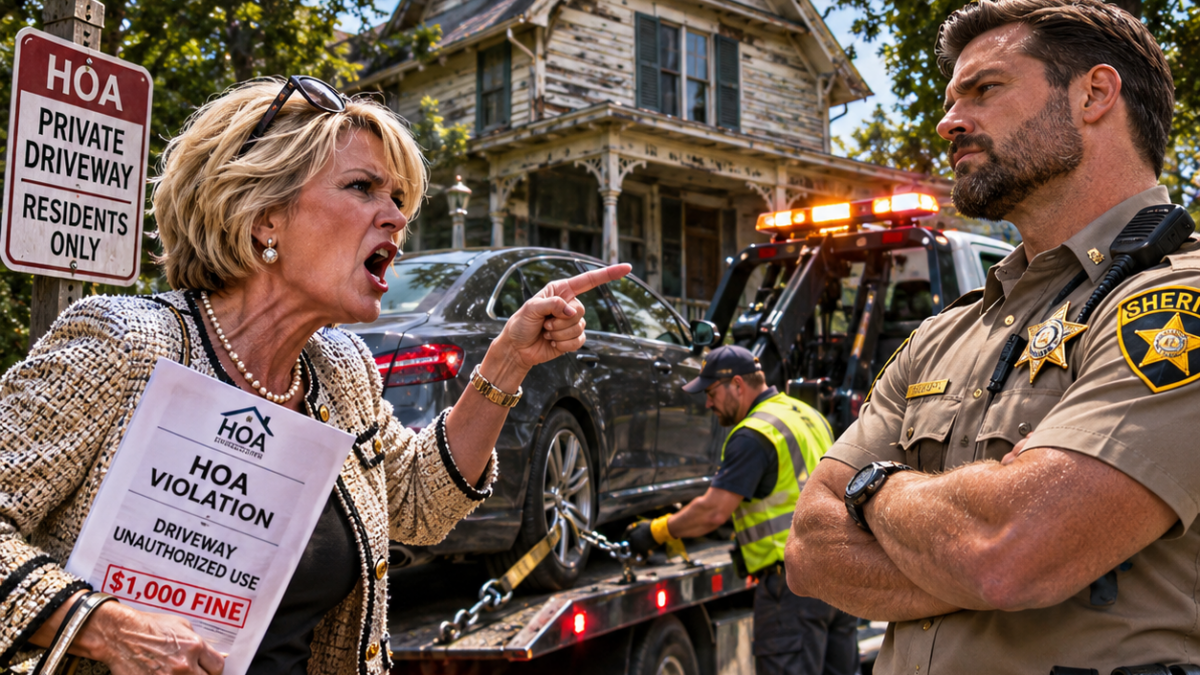
PART 2
I sat at Louise’s kitchen table until after midnight.
The cardboard box stayed open in front of me.
At first, I tried reading every notice in order.
That lasted maybe twenty minutes.
There were too many.
The language changed slightly from year to year, but the message remained the same.
NOTICE OF NONCOMPLIANCE.
NOTICE OF ASSESSMENT.
FINAL WARNING.
PAYMENT REQUIRED.
FURTHER ACTION MAY FOLLOW.
The oldest notices went back fifteen years.
A few were almost laughable.
One accused Louise of keeping holiday lights up three days beyond the approved display period.
Another complained that her mailbox post was not painted an approved shade.
Another said the wooden fence along the back property line exceeded Maplewood’s permitted height by six inches.
Another demanded she remove a rose trellis because the structure had not been reviewed by an architectural committee.
The house had been standing since 1952.
The trellis had probably been there longer than some of Brenda’s board members had been alive.
Yet Louise had paid.
I found the checks tucked into envelopes.
Some were copies.
Some were carbon receipts.
Two hundred dollars.
Three hundred.
One hundred fifty.
Four hundred.
Then another.
Then another.
I took out my phone.
Opened the calculator.
By the time I crossed eight thousand dollars, I stopped for coffee.
When I finished adding everything I could document, the total was slightly over twelve thousand.
I sat there staring at the number.
Twelve thousand dollars.
Louise had been retired for years.
She had medical expenses.
Prescription costs.
Repairs she delayed because she said money was tight.
I remembered one winter when she told me the furnace was “still hanging on.”
I had offered to send money.
She refused.
“Save it, Marcus. I’m fine.”
That was Louise.
She would go cold before making someone else worry about her.
Now I wondered how many of those sacrifices had been made because Brenda Holloway had been draining hundreds of dollars from her account through fines Louise never legally owed.
I picked up the 2015 letter again.
The attorney’s language was plain.
No legal gymnastics.
No ambiguity.
The Whitmore parcel was recorded in 1952.
The Maplewood subdivision plat was filed decades later.
The Whitmore parcel was not included in the subdivision boundaries.
Louise had never executed an annexation agreement, covenant, deed restriction, or voluntary submission bringing the property under the authority of the Maplewood Estates HOA.
The conclusion was almost brutally simple.
Maplewood Estates Homeowners Association has no legal authority to impose assessments, fines, architectural controls, or other HOA restrictions upon the Whitmore parcel.
That should have ended the problem.
Instead, the notices continued.
Eight more years.
I leaned back in Louise’s chair and rubbed both hands over my face.
“How long did you let them do this to you?”
The refrigerator hummed.
No answer.
But I knew why.
Louise hated confrontation.
When a restaurant got her order wrong, she ate the wrong meal.
If someone cut in front of her at the grocery store, she moved back without saying anything.
Once, when a contractor overcharged her for a plumbing repair, she paid the bill because she did not want to “make an ugly situation uglier.”
She could be stubborn about the things that mattered.
Family.
Her house.
The garden.
But direct conflict exhausted her.
After my parents divorced, I spent three months living with her.
I was twelve.
Angry at both my parents.
Angry at the world.
Louise never tried to fix me.
She gave me a fishing pole, let me disappear to the pond every afternoon, and made sure there was dinner waiting when I came back.
That was how she loved people.
Quietly.
Without demanding anything.
Someone like Brenda would see that as weakness.
I saw it as kindness.
But kindness, in the wrong neighborhood, can become an invitation to the wrong person.
The next morning proved Brenda had no intention of slowing down.
I walked to the mailbox with coffee in one hand.
Inside was a white envelope.
Heavy paper.
Blue Maplewood Estates logo.
OFFICE OF COMPLIANCE.
I opened it standing beside the driveway.
Bold red letters:
VIOLATION NOTICE
Violation:
UNREGISTERED VEHICLE PARKED ON PROPERTY WITHOUT HOA APPROVAL
Fine:
$200.
Payment due within fourteen days.
Failure to pay may result in lien action.
I looked at my truck.
My truck.
Parked in my driveway.
At my house.
On property their own lawyer correspondence should have told them was outside their authority.
I laughed once.
Not because it was funny.
Because I was beginning to understand how Brenda operated.
She did not need to convince me she was right.
She needed to create enough pressure that proving she was wrong became exhausting.
I went inside.
Pulled out Louise’s document box.
Deed.
Attorney letter.
Tax statements.
Then I walked next door.
Brenda opened the door after the second knock.
Same controlled smile.
Same cardigan.
Same clipboard.
“Mr. Cole.”
I held up the notice.
“You fined me for parking in my own driveway.”
She barely glanced at it.
“All vehicles located in Maplewood Estates must be registered with the association.”
“This house is not part of Maplewood Estates.”
For the first time, I saw something unmistakable in her eyes.
Recognition.
She knew.
Not surprise.
Not confusion.
Recognition.
“I have documentation,” I said.
She folded her arms.
“I don’t care what old paperwork says.”
That answer told me more than any argument could.
“You don’t care?”
“You live in this community.”
“I live beside your subdivision.”
“You benefit from our maintenance.”
“Maple Drive is county maintained.”
“Our standards support property values.”
“That doesn’t create legal authority over my parcel.”
Her expression tightened.
“Everyone here follows rules.”
“I follow laws.”
“Those rules are part of living here.”
“Not if they don’t apply to this property.”
She stepped closer.
“Be careful.”
“About what?”
“I’ve run Maplewood Estates for twelve years.”
I said nothing.
People often keep talking when silence makes them uncomfortable.
Brenda did.
“I know everyone on the board.”
Nothing.
“I know people at the county offices.”
Still nothing.
“I know everyone who matters.”
There it was.
A threat dressed as social information.
She lowered her voice.
“I can make living here extremely uncomfortable.”
I looked at her.
“I’m sure you can try.”
Brenda laughed.
Short.
Dismissive.
Then she made the mistake I had been hoping she would make.
“Your aunt tried this once.”
My attention sharpened.
“Tried what?”
“Fighting.”
“The lawyer letter?”
Her smile widened.
“Yes.”
“So you knew about it.”
“I knew she had some attorney send an opinion.”
“It wasn’t an opinion. It was a legal analysis of the deed and plat.”
Brenda shrugged.
“Nothing changed.”
I stared at her.
“What?”
“After the letter.”
She tilted her head.
“We continued enforcement.”
“Meaning you knew she was claiming the property was exempt.”
“Louise lived within Maplewood.”
“No. Maplewood was built around Louise.”
“Same difference.”
“No.”
Her smile disappeared.
“She eventually understood.”
“Understood what?”
“That fighting costs more energy than compliance.”
The sentence was so direct I almost thought I had misheard it.
But I had not.
Brenda had just described the strategy.
Wear the homeowner down.
Keep sending paper.
Keep inventing deadlines.
Keep threatening consequences.
Eventually the target pays simply because fighting costs too much time, energy, and money.
Louise had done exactly that.
“You’ll learn the same thing,” Brenda said.
“I won’t be paying this fine.”
“We’ll see.”
“I’d suggest you stop sending them.”
“People always say they’ll fight.”
She stepped backward.
“They usually don’t.”
The door closed.
For several seconds, I stood there.
My first instinct was to knock again.
My second was to pull out my wallet and show the badge.
Sheriff Marcus Cole. Madison County.
One jurisdiction over.
Twenty years in law enforcement.
I could already imagine the change in her face.
The smile disappearing.
The voice softening.
The apology appearing out of nowhere.
That would have felt good.
And it would have been a mistake.
Brenda would learn one lesson:
Do not bully a sheriff.
I wanted something broader.
Do not bully anyone.
More importantly, I still did not know how much of Louise’s story could be proven.
So I walked home.
Tore the $200 violation notice in half.
Dropped it into the trash.
Then stopped.
“Damn it.”
I pulled it back out.
That was sloppy.
At work, I would never destroy evidence because it annoyed me.
Personal cases distort judgment.
I taped the notice together.
Photographed it.
Scanned it.
Then wrote one line on a legal pad.
DOCUMENT FIRST. REACT SECOND.
I underlined it twice.
Through the kitchen window, Brenda’s white Escalade still sat partly across the driveway.
At first, I had considered it childish.
Then I understood what it was.
A test.
Power does not always begin with big gestures.
Sometimes it starts with something small enough that objecting makes you look unreasonable.
A car left across your driveway.
A rule that technically should not apply.
A twenty-five-dollar administrative charge.
A request that you “just cooperate.”
If you tolerate the first thing, the second becomes easier.
So I started documenting the small things too.
That evening, I drove to a hardware store.
Bought three motion-activated security cameras.
Night vision.
Cloud storage.
One covered the driveway.
One covered the garage.
One covered the front property line.
I mounted them myself.
Tested every angle.
The Escalade appeared clearly on the driveway feed.
Timestamp visible.
I created a folder on my laptop.
MAPLEWOOD — VIDEO LOG
Date.
Time.
Vehicle.
Position.
Duration.
It felt ridiculous.
A county sheriff creating a spreadsheet about a neighbor’s parking habits.
But twenty years of police work had taught me that patterns are often hidden inside facts everyone else considers too small to matter.
Three mornings later, the neighborhood changed.
A woman walking a golden retriever crossed the street before reaching my driveway.
A man washing his SUV turned away when I waved.
At the mailbox cluster, two women stopped talking when I approached.
Nobody said anything directly.
That was worse in some ways.
I had lived there less than a week.
Louise had lived there forty years.
Somebody had already turned me into a problem.
The only person who approached voluntarily was Tom Bradock.
Late seventies.
White beard.
Lean.
A little stooped.
He stood at the edge of the driveway holding a coffee mug.
“You’re Louise’s nephew.”
“Yes.”
“Marcus?”
“Yes.”
He nodded.
“Tom Bradock.”
I recognized the name from Louise’s stories.
“You’re the first neighbor willing to speak to me.”
Tom gave a dry laugh.
“I’m too old to care what Brenda thinks.”
He pointed down Maple Drive.
“Come have coffee.”
His house smelled like instant coffee and pipe tobacco.
Wind chimes covered the porch.
He poured two cups without asking.
“Louise was my friend.”
“I know.”
“Forty years.”
He sat.
“When Brenda became HOA president twelve years ago, she made Louise’s house her personal project.”
“Why?”
Tom shrugged.
“It didn’t match.”
“That’s it?”
“That’s enough for some people.”
He told me about the board meetings.
Brenda complaining that Louise’s house damaged the “visual continuity” of Maplewood.
The old porch.
The paint.
The fence.
The mailbox.
The garden.
Louise’s Christmas decorations.
Everything became an offense.
“She paid most of the fines,” Tom said.
“I found around twelve thousand dollars.”
His face tightened.
“That sounds right.”
“She had medical bills.”
“I know.”
“Why didn’t anyone stop this?”
Tom stared into his coffee.
“Because everyone was scared of becoming next.”
“Scared of what?”
“Letters. Fines. Complaints. Rumors.”
“What rumors?”
He looked at me.
“Brenda told people Louise was becoming senile.”
My hand tightened around the mug.
“What?”
“At board meetings.”
“Louise wasn’t senile.”
“I know.”
“Then why say it?”
“Because if people think a woman is confused, they stop listening when she says she’s being mistreated.”
That sentence sat between us.
I had seen versions of that tactic professionally.
Discredit the victim before the victim can discredit you.
Tom continued.
“Louise brought the attorney letter to a board meeting.”
“You were there?”
“Yes.”
“What happened?”
“Brenda read it.”
“And?”
“She said Maplewood had an obligation to enforce community standards regardless of technical exemptions.”
“You remember that clearly?”
“Clear enough to swear to it.”
“Would anyone else?”
Tom laughed bitterly.
“Now?”
“Yes.”
“Probably not.”
“Why?”
“They still have to live here.”
He reached for his phone.
“There’s more.”
He opened the Maplewood community page.
Brenda’s profile photograph appeared at the top.
Below it:
A photograph of my truck.
A second photograph of me carrying boxes into Louise’s house.
The post read:
COMMUNITY ALERT
The individual currently claiming ownership of the Whitmore property has not provided verified documentation establishing inheritance or lawful possession. Residents should exercise caution until his claims are authenticated.
Forty-three likes.
Twenty-seven comments.
One person wrote:
Louise never mentioned having a nephew.
Another:
Could this be a probate scam?
Another:
Someone should contact law enforcement.
I handed Tom the phone.
“Has Brenda asked me for probate documents?”
“No.”
“Has she seen them?”
“No.”
“Then she has no basis for suggesting fraud.”
“No.”
Tom took a sip.
“She’s done similar things before.”
“With who?”
“Three people I know.”
“What happened?”
“Two sold and moved.”
“And the third?”
“Hired an attorney.”
“Won?”
Tom’s mouth tightened.
“Depends what you call winning.”
“What happened?”
“Spent so much money fighting that he sold anyway.”
There it was again.
The same strategy.
Brenda did not need to win legally.
She only needed to make staying more painful than leaving.
I set the coffee down.
“Why are you helping me?”
Tom looked toward the window.
“Because Louise deserved somebody to.”
Then he looked back at me.
“And because I’m tired of telling myself I couldn’t do anything.”
“You could testify.”
“I know.”
“That might make you unpopular.”
“I’m seventy-eight.”
He smiled.
“Popularity expired around seventy.”
I shook his hand.
Before I left, he said:
“Whatever you’re planning, don’t underestimate Brenda.”
“I’m not.”
“She’ll escalate.”
I opened the door.
“I’m counting on it.”
Back at Louise’s house, I created a master folder.
MAPLEWOOD DOCUMENTATION
I scanned the deed.
The attorney letter.
The violation notices.
Canceled checks.
Screenshots of Brenda’s post.
Camera footage.
Then I drove to the county clerk’s office.
Because Louise’s house sat outside Madison County, I approached like any private citizen.
No badge.
No call ahead.
No favors.
The clerk pulled the records.
Original deed:
Maplewood subdivision plat:
Maplewood Estates HOA incorporation:
She pointed at the map.
“The Whitmore parcel is outside this plat.”
“Completely?”
“Yes.”
“Any later annexation?”
She searched.
“Not that I’m finding.”
“Any covenant bringing it in?”
“No.”
“Voluntary HOA agreement?”
“No.”
I requested certified copies.
Then went to the assessor.
Same answer.
Separate parcel number.
Separate tax record.
No HOA assessment.
Then the recorder.
“Any Maplewood liens against this property?”
The clerk searched.
“None.”
“Ever?”
“None recorded.”
That told me something important.
Brenda had threatened liens for fifteen years.
Yet she had never filed one.
Why?
Because threats did not require scrutiny.
A recorded lien did.
If she put the claim in front of the wrong clerk, lawyer, title company, or judge, someone might ask the simplest question.
Is this property actually in the HOA?
Brenda’s power depended on nobody asking.
I returned home with certified copies.
That afternoon, I made another mistake.
I called Maplewood’s management company.
A receptionist answered.
“Maplewood Estates. How can I help?”
I gave Louise’s address.
“I need the CC&Rs governing this property.”
“Certainly.”
Hold music.
Two minutes.
Then:
“Sir?”
“Yes?”
“I’m not finding the address.”
I stayed quiet.
She typed again.
“Actually, it doesn’t appear to be part of our association database.”
For half a second, relief made me careless.
I almost said:
“I know.”
I caught myself.
“Maybe I wrote the wrong information down.”
“Would you like me to search by owner?”
“No, thank you.”
I hung up.
Sat there staring at my phone.
Twenty years of investigations.
Interviews.
Interrogations.
And I had nearly tipped my hand to a receptionist because the case was personal.
At work, emotional distance protects your judgment.
Here, every piece of evidence belonged to Louise.
Every canceled check felt like somebody had reached backward through time and taken something from her.
I wrote another note beneath the first.
THIS IS PERSONAL. SLOW DOWN.
Then I went back to the footage.
Nine days of recordings.
Brenda’s Escalade appeared in nearly all of them.
Some days blocking half the driveway.
Some days almost everything.
She moved it for errands.
Then put it back.
I logged each instance.
Date.
Start time.
End time.
She also appeared on the sidewalk photographing my truck.
Legal from public space.
Still useful to document.
The tenth morning changed everything.
I woke at 6:47 to an engine idling.
Not passing.
Stationary.
Close.
I pulled aside the curtain.
A black Ford F-250 sat directly behind my truck.
Inside the driveway.
Inches from my bumper.
I opened the camera app.
Rewound.
3:17 a.m.
The pickup entered slowly.
Headlights off.
Driver parked with deliberate precision.
Male figure.
Baseball cap.
He stepped out.
Walked directly toward Brenda’s house.
No hesitation.
I got dressed.
Outside, cold October air hit my face.
Breath visible.
The black pickup sat there covered in dew.
At the sidewalk stood Brenda.
Three men beside her.
I recognized one from the community page.
Kevin.
He had commented under Brenda’s post:
Should we call the police?
Now his truck was on my property.
Brenda smiled.
“Good morning, Mr. Cole.”
I pointed.
“Whose truck?”
“That belongs to Kevin.”
Kevin crossed his arms.
Brenda tapped her clipboard.
“He’s assisting with community vehicle compliance.”
I stared at her.
“Vehicle compliance.”
“Yes.”
“My truck is parked at my house.”
“Without HOA registration.”
“This property isn’t in your HOA.”
“We disagree.”
“No. Recorded documents disagree.”
Kevin stepped forward.
“Brenda says you’re violating the bylaws.”
I looked at him.
“Your truck has been on my private property without permission since three seventeen this morning.”
He glanced toward Brenda.
She laughed.
“We contacted a tow company.”
“For what?”
“To remove your vehicle.”
I looked at my truck.
Then her.
“You’re going to tow my truck from my driveway.”
“If it isn’t relocated to a compliant location within thirty minutes.”
“Where exactly is a compliant location?”
“Somewhere that doesn’t violate HOA regulations.”
“My house isn’t in the HOA.”
Brenda checked her watch.
“Twenty-nine minutes.”
My hand almost moved toward my jacket.
The badge was inside.
One motion.
One sentence.
This entire little performance could end.
I imagined the reaction.
Kevin backing away.
Brenda apologizing.
The other men suddenly remembering appointments.
It would feel good.
Which was exactly why I didn’t do it.
Emotional satisfaction is not the same as solving a problem.
If I showed the badge, Brenda would learn to avoid me.
She would not learn to stop.
So I waited.
Fifteen minutes later, a tow truck came down Maple Drive.
White cab.
Yellow flatbed.
MARTINEZ TOWING
The driver stepped out.
Mid-thirties.
Work jacket.
He looked at me.
Then Brenda.
Then both vehicles.
“Who called?”
Brenda raised her hand.
“I did.”
She pointed toward my red truck.
“That vehicle needs removal.”
The driver looked at the driveway.
Then the house.
“Stolen?”
“No.”
“Abandoned?”
“No.”
“Police order?”
“No.”
“Owner request?”
“I’m HOA president.”
He scratched the back of his neck.
“That wasn’t one of the options.”
Brenda frowned.
“This property falls within Maplewood Estates.”
“Who owns the house?”
“I do,” I said.
The driver turned.
“You want your truck towed?”
“No.”
He looked back at Brenda.
“Then I’m not touching it.”
“I’m authorizing the tow.”
“HOA authority doesn’t automatically let me remove a vehicle from a private residential driveway.”
“Our bylaws—”
“Call police.”
Brenda’s expression tightened.
The driver turned toward me again.
Then squinted.
“Wait.”
I knew that look.
He stepped closer.
“You’re Sheriff Cole.”
Everything went silent.
Brenda’s head turned sharply.
I nodded.
“Madison County?”
“Yes.”
The driver smiled.
“I knew it. You handled my cousin’s stolen-car recovery last year.”
“I remember.”
“You were decent to him.”
“Glad to hear that.”
Behind him, the mood collapsed.
Kevin uncrossed his arms.
The other two men exchanged looks.
Brenda’s face went pale.
“Sheriff?”
I looked at her.
“Madison County.”
“You’re the sheriff?”
“One county over.”
She stared.
I could almost see the last ten days replay in her mind.
Fake fine.
Threats.
Defamation post.
Escalade.
Kevin’s truck.
Attempted tow.
All aimed at someone she had assumed was ignorant and powerless.
Martinez gestured toward the flatbed.
“So no tow?”
“Not mine.”
I pointed at Kevin’s F-250.
“But that truck entered my property at three seventeen this morning without permission and blocked my vehicle.”
Kevin’s face reddened.
“If the owner doesn’t move it, I’d like it removed.”
“Now wait a second—”
I looked at Kevin.
“Five minutes.”
He did not need five.
Keys came out immediately.
The F-250 reversed so fast the tires chirped.
The other two men walked away without saying anything.
Martinez shook his head.
Brenda stood holding the clipboard.
“We need to talk.”
“Yes.”
I let the silence sit.
“But not now.”
Her face hardened.
“I didn’t know who you were.”
“That’s the problem.”
“What’s that supposed to mean?”
“You shouldn’t need to know someone’s job before respecting their property.”
“You concealed your position.”
“I never said I wasn’t sheriff.”
“You let me—”
She stopped herself.
I waited.
“Let you what?”
Her eyes shifted toward the camera.
“You’re recording this?”
“I’m recording my driveway.”
Her anger returned.
“You’re using your position to investigate me.”
“No.”
“You’re a sheriff.”
“Outside my jurisdiction.”
“That doesn’t matter.”
“It matters to me.”
I stepped closer, but kept my voice even.
“I haven’t used department resources. I haven’t ordered deputies. I haven’t pulled restricted records. I’ve used public documents, my aunt’s files, and cameras on my property.”
Brenda’s jaw tightened.
“If I were you, I’d speak with a lawyer before our next conversation.”
She turned.
Walked home.
Martinez watched her door close.
Then looked at me.
“What did she do to you?”
I looked toward Louise’s porch.
“Not to me.”
He waited.
“To someone who didn’t have enough fight left.”
Three days passed.
The Escalade disappeared.
No notices arrived.
No community posts.
No Brenda.
Her house stayed dark most evenings.
I might have believed she finally understood if I had not spent twenty years dealing with people whose identity depended on control.
People like that do not surrender after embarrassment.
They regroup.
On the fourteenth morning, voices outside woke me before eight.
I looked through the front window.
Fifteen.
Maybe twenty neighbors.
Brenda stood in the middle.
Clipboard.
White Escalade parked directly across my driveway.
Same place where this began.
This time she wanted witnesses.
I stepped outside.
Conversation stopped.
Brenda faced me.
“Mr. Cole.”
Then louder:
“Or perhaps I should say Sheriff Cole.”
I walked down the porch.
“Marcus is fine.”
She gestured behind her.
“These homeowners are here because the community has voted to pursue formal legal action against your continued noncompliance.”
“What noncompliance?”
“Exterior paint.”
“Not applicable.”
“Fence height.”
“Not applicable.”
“Landscaping.”
“Not applicable.”
“Unregistered vehicles.”
“Not applicable.”
Her smile hardened.
“We’ve completed a historical accounting.”
My stomach tightened.
“How historical?”
“Fifteen years.”
Louise.
Of course.
“And?”
“The outstanding balance is fourteen thousand six hundred dollars.”
Several people murmured.
“If payment is not received within thirty days, the HOA will pursue a lien against the property.”
I looked at her.
“File it.”
Her smile flickered.
“What?”
“File the lien.”
“You think I won’t?”
“I think you spent fifteen years threatening one without ever putting the claim in front of a recorder.”
Her eyes narrowed.
“You don’t understand this process.”
“I checked.”
I returned to the porch table.
Picked up my folder.
“Original deed recorded 1952.”
I held it up.
“Maplewood subdivision plat filed 1997.”
Another page.
“HOA incorporated 1998.”
I unfolded the certified map.
“The Whitmore parcel is outside the subdivision boundary.”
A man near the back leaned sideways trying to see.
“Separate tax parcel.”
Another document.
“Separate county assessment.”
Then:
“Your own management company doesn’t list this address as part of Maplewood Estates.”
That caused the first real reaction.
A woman said:
“What?”
Brenda spoke quickly.
“Administrative databases are imperfect.”
I held up the attorney’s letter.
“Louise’s lawyer told you in 2015 that this property was exempt.”
“I don’t remember receiving that.”
“You told me she sent it.”
Silence.
“You said nothing changed afterward.”
Brenda’s mouth opened.
Closed.
Someone behind her asked:
“Brenda?”
She ignored them.
I turned toward the group.
“I also have fourteen days of video showing Brenda’s Escalade repeatedly obstructing this driveway.”
People looked at the vehicle.
“Footage shows Kevin’s truck entering my private property at three seventeen in the morning.”
A second neighbor said:
“Kevin did what?”
“Brenda then called a tow company to remove my legally parked vehicle.”
Brenda pointed at me.
“He’s twisting everything.”
A voice came from behind the group.
“No, he isn’t.”
Tom.
He stepped forward.
Brenda’s expression darkened.
“Tom, stay out of this.”
“No.”
“You don’t understand the legal issues.”
“I understand Louise showed you that lawyer letter.”
Brenda stared at him.
“I was at the meeting.”
“You’re misremembering.”
“You read it.”
“I reviewed it.”
“You said the HOA would continue enforcing rules anyway.”
“I never said that.”
“You did.”
“Your memory is unreliable.”
Tom smiled.
“That’s the same thing you told people about Louise.”
That landed.
The crowd shifted.
A woman asked:
“Is Marcus’s house actually inside Maplewood?”
“Yes,” Brenda answered immediately.
I said:
“No.”
The woman looked between us.
“Then why isn’t it in the management-company system?”
Brenda snapped:
“Because databases contain errors.”
Another man asked:
“Why have we never seen a lien against the property if Louise owed fines?”
Brenda’s fingers tightened around the clipboard.
“She paid most assessments.”
Tom shook his head.
“Not all.”
“Stay out of this, Tom.”
“No.”
The man continued.
“If you had authority, why not file?”
Brenda looked toward me.
“You see what he’s doing? He’s using his badge and legal experience to intimidate everyone.”
I almost admired the pivot.
It was clever.
Turn my knowledge into the threat.
Make herself the victim.
“You moved in here and immediately started recording neighbors,” she continued.
“My cameras cover my property.”
“You threatened Kevin with towing.”
“Kevin parked inside my driveway at three in the morning.”
“You’re using your position as sheriff to frighten ordinary residents.”
“I haven’t used it.”
“You’re standing there telling everyone you’re sheriff.”
“You announced it.”
A few nervous laughs moved through the group.
Brenda flushed.
“This man is not above community rules.”
I nodded.
“She’s right.”
The crowd went quiet.
Even Brenda looked surprised.
“I’m not above any lawful rule.”
I took out my phone.
“But because this is outside my jurisdiction and because I’m personally involved, I will not arrest Brenda, order my deputies to investigate her, or use Madison County resources.”
Her expression changed.
I dialed.
“I’m calling the sheriff’s office that actually has jurisdiction.”
The direct line connected.
I identified myself.
Then spoke deliberately like any complainant.
Private driveway obstruction.
Documented trespass history.
Possible harassment.
Vehicle blocking ingress and egress.
Address.
I hung up.
“A unit is coming.”
The crowd began dissolving almost immediately.
One man checked his watch.
Two women stepped away.
A couple returned to their car.
Someone muttered:
“I didn’t know police were involved.”
Within five minutes, more than half had left.
Brenda remained.
The Escalade still blocked my driveway.
Tom leaned toward me.
“Strong army.”
“Crowds are brave until reports start.”
Twelve minutes later, a cruiser arrived.
Deputy Janet Reyes.
I knew her professionally from cross-jurisdictional cases.
Thorough.
Calm.
No patience for theatrics.
She stepped out.
“Sheriff Cole.”
“Deputy.”
Then she turned toward Brenda.
“Ma’am?”
Brenda immediately launched into an explanation.
“This man has been harassing the Maplewood Estates association since he arrived—”
Janet held up a hand.
“Start with the vehicle.”
“My vehicle is legally parked.”
Janet looked at the Escalade.
“It’s across a driveway.”
“This is HOA-controlled access.”
Janet looked at me.
“Documents?”
I handed over the certified copies.
She read the deed.
The plat.
Parcel record.
Then watched camera footage.
Fourteen days.
Escalade blocking access.
Kevin’s truck entering overnight.
Attempted tow.
She returned my phone.
“Mrs. Holloway, move your vehicle.”
Brenda’s voice sharpened.
“This is a civil dispute.”
“Some aspects may be.”
Janet pointed toward the Escalade.
“Repeatedly obstructing access after notice is a separate issue.”
“You’re taking his side because he’s a sheriff.”
Janet’s expression cooled.
“I’m reading documents.”
Brenda looked as though that sentence had slapped her.
She pulled out her keys.
Climbed into the Escalade.
Started it.
Then everything happened too quickly.
She reversed hard.
The rear bumper struck Louise’s mailbox post.
Plastic cracked.
Brenda panicked.
Turned too sharply.
The right tires climbed onto my lawn.
Wet grass tore beneath them.
Janet raised a hand.
“Stop.”
Brenda braked.
Janet walked toward the damaged mailbox.
Then the tire tracks.
Then the driver’s window.
“Turn the engine off.”
Brenda did.
She opened the door.
“My foot slipped.”
“Okay.”
“I’ll move it.”
“Not right now.”
“What?”
“You’re visibly upset.”
“I can drive.”
“You just struck a fixed object and drove onto private property.”
“It was an accident.”
“I understand.”
Brenda’s eyes filled.
For the first time since I met her, the tears looked real.
“I just want to go home.”
Janet unclipped her radio.
“I need a tow at Maple Drive.”
Brenda stared.
“A tow?”
“Yes.”
“You cannot tow my car.”
Janet’s face remained neutral.
“I can.”
Twenty minutes later, the same tow truck came down the street.
Martinez.
He slowed.
Looked at the white Escalade.
Looked at me.
Then Brenda.
He climbed out.
“Well.”
I almost laughed.
Janet pointed at the vehicle.
“Law-enforcement tow.”
Martinez nodded.
“Keys?”
Brenda handed them over.
Her hands were shaking.
The Cadillac rolled onto the flatbed.
The vanity plate disappeared last.
Two weeks earlier, Brenda had parked that same Escalade across my driveway and told me she would move it when she was ready.
Now she stood beside the curb watching it leave without her.
I would be lying if I said there was no satisfaction.
There was.
For maybe thirty seconds.
Then I looked at Louise’s mailbox lying crooked beside the driveway.
And the satisfaction disappeared.
Louise was still dead.
The twelve thousand dollars was still gone.
The years of harassment had still happened.
A tow truck could not fix any of that.
What it did accomplish was something else.
It put Brenda’s behavior into an official report handled by someone outside my office.
Deputy Reyes did not stop at the mailbox.
She started asking questions.
Tom gave a statement.
The HOA management company supplied records.
County filings confirmed Louise’s parcel status.
I provided copies of the notices and canceled checks.
Reyes requested the community-page screenshots.
She spoke with other residents.
People who had been unwilling to testify for me became more willing once a deputy started asking neutral questions.
That was another thing I had learned during my career.
Some people will not challenge a bully alone.
But once a formal process starts, they finally believe speaking might matter.
Three weeks later, Janet Reyes called.
“Marcus.”
“What did you find?”
“Enough to send the file to the district attorney.”
“For what?”
“Harassment pattern. Fraud-related conduct. Trespass issues.”
“Anything felony-level?”
“Not from what we have.”
“Fine.”
She paused.
“You don’t sound disappointed.”
“I’m not.”
“Most complainants want the biggest possible charge.”
“I want charges that survive.”
“That’s why I called.”
The case did not turn into some massive criminal conspiracy.
It did not need to.
Brenda had not forged my deed.
Had not secretly transferred the house.
Had not stolen millions.
What she had done was smaller.
And that was exactly why it had lasted so long.
A $200 fine seems too small to hire a lawyer over.
A $300 landscaping notice feels easier to pay.
A blocked driveway feels petty.
One ugly social-media post feels like neighborhood gossip.
One threat about a lien feels easier to ignore than fight.
But line up fifteen years of those small acts and something different appears.
A pattern.
The district attorney approved misdemeanor charges supported by the evidence.
Harassment.
Fraud-related conduct.
Trespass.
The arraignment happened on a Tuesday morning.
I did not attend.
There was no reason.
And I did not want my presence turning it into something theatrical.
Tom went.
Of course Tom went.
He called me immediately afterward.
“She had a lawyer.”
“I assumed.”
“Suit probably cost more than my truck.”
“Brenda or the lawyer?”
“Both.”
I laughed.
“What plea?”
“Not guilty.”
“Expected.”
“Released on her own recognizance.”
“Also expected.”
“Court ordered no contact with you.”
That mattered.
“Distance?”
Tom told me.
I looked out the kitchen window toward Brenda’s house.
“That’ll be complicated considering she lives next door.”
“It’s being worked out.”
The conditions were later adjusted through counsel so Brenda could deal with her property while avoiding direct contact or harassment.
For a period, she stayed elsewhere.
Maplewood’s board called an emergency meeting.
I did not attend.
I wasn’t a member.
Had no interest in becoming one.
Tom attended.
He called that evening.
“Removed.”
“What?”
“Brenda.”
“Vote?”
“Twelve to zero.”
I leaned against the counter.
“She show up?”
“No.”
“Gary?”
“Yes.”
“What did he say?”
“Nothing.”
Tom’s voice changed.
“Honestly, Marcus, he looked relieved.”
Gary Holloway had been nearly invisible through the entire conflict.
I had seen him maybe twice.
Once collecting mail.
Once driving away.
Later, neighbors implied Brenda’s need for control did not stop at HOA boundaries.
I never knew enough to judge their marriage.
And I did not need to.
Three months later, Brenda accepted a plea agreement.
She pleaded no contest to harassment and fraud-related counts.
The trespassing charge was dismissed under the agreement.
Two years’ probation.
Two thousand dollars in fines.
Two hundred hours of community service at a local food bank.
Restitution.
The restitution issue became more complicated than I expected.
Louise’s records showed more than twelve thousand dollars in payments.
Brenda’s lawyer argued some payments went through the HOA rather than directly benefiting Brenda.
Some records were old.
Some incomplete.
Some charges had been approved by boards, even if wrongly applied.
Eventually, the court ordered six thousand dollars in restitution to Louise’s estate, payable over twenty-four months.
Half.
When the final paperwork arrived, I sat at Louise’s kitchen table.
Six thousand.
I expected anger.
Instead, I felt tired.
The money was never the point.
Louise could not use it.
Could not buy medicine with it.
Could not replace the furnace sooner.
Could not get back the afternoons she had spent worrying every time another envelope appeared.
But the order mattered because it created something Brenda could no longer redefine.
Official acknowledgment.
The collections were wrong.
Not a misunderstanding.
Not “community standards.”
Not voluntary cooperation.
Wrong.
The HOA removed Brenda permanently from leadership.
The board also reviewed its enforcement procedures.
Some residents wanted Maplewood dissolved completely.
That did not happen.
There were legitimate shared areas.
Maintenance contracts.
Landscaping.
Community obligations.
An HOA was not automatically the problem.
Brenda had been.
New policies required property-boundary verification before enforcement.
Legal review before filing liens.
Conflict-of-interest disclosures.
Appeal procedures.
Documentation.
Simple safeguards.
Tom began attending every board meeting.
Not because he suddenly loved homeowners associations.
Because he enjoyed making them nervous.
At the first meeting under the new leadership, the president proposed a landscaping amendment.
Tom raised his hand.
“Does it apply to Marcus?”
The president sighed.
“No, Tom.”
“Did you check the parcel?”
“Yes, Tom.”
“Just making sure.”
He told me later and laughed so hard he had to wipe his eyes.
Six weeks after Brenda’s plea, the Holloway house went up for sale.
White-and-red sign.
NEW LISTING.
By then Brenda and Gary had moved out.
A truck came while I was buying groceries.
When I returned, the curtains were gone.
Windows dark.
Someone told Tom they had moved to another state.
Someone else said they had separated.
I never confirmed either.
For months, I had been documenting every move Brenda made.
Now I realized I no longer cared where she went.
That felt healthier than any court order.
The house sold in three weeks.
Young couple.
Mike and Sarah.
Toddler named Emma.
They came over the day they moved in carrying a bottle of wine.
Mike nodded toward my house.
“We heard there was some neighborhood drama.”
I smiled.
“Every neighborhood has some.”
Sarah looked nervous.
“Is the HOA difficult?”
“Not anymore.”
She visibly relaxed.
Emma was not interested in any of that.
She pointed toward Louise’s bird feeder.
“Bird.”
I looked.
Cardinal.
“Yes.”
“Bird.”
“Correct.”
Apparently that made us friends.
I spent winter repairing Louise’s house.
The roof first.
Then porch boards.
Back fence.
Shutters.
Things that actually needed attention.
I repainted the wraparound porch the same white Louise had always used.
No application.
No architectural committee.
No approval.
Just paint.
The crocheted blankets stayed on the chairs.
Her paperback romances stayed on the shelves.
The old wind chime beside the kitchen window stayed.
I repaired the garden beds instead of replacing them.
At first, every decision felt like I was asking myself:
Would Louise approve?
Eventually, the question changed.
What do I want?
That was when I realized the house was becoming mine.
Tom became a Sunday visitor.
Every week.
Coffee on the porch.
He told stories about Maple Drive before Maplewood.
Farmland.
Open fields.
Three houses.
He remembered my mother running barefoot across land that later became someone’s backyard.
He remembered my grandfather helping rebuild Louise’s porch.
“Your grandfather was stubborn,” he said.
“Family trait.”
“Your mother too.”
“I know.”
“Louise wasn’t.”
I looked at him.
“She was.”
“Not like you.”
“No.”
I thought about it.
“She was stubborn about kindness.”
Tom smiled.
“That she was.”
Spring arrived slowly.
Emma discovered Louise’s garden.
The first time she wandered toward the bird feeder, Sarah came running.
“I’m so sorry.”
“It’s fine.”
“She shouldn’t come onto your property.”
“Louise would have loved her.”
Sarah stopped.
“She liked children?”
“She always complained Maple Drive needed more.”
After that, Emma became part of the view.
Never alone.
Always with Mike or Sarah nearby.
Tiny boots.
Juice boxes.
Questions about butterflies.
She would sit on the porch step while I watered tomatoes.
The house stopped feeling like a monument to someone who had died.
It started feeling alive again.
In May, I found Louise’s journal.
Small leather notebook.
Back of the nightstand.
Behind old reading glasses.
Most pages were ordinary.
Buy milk.
Dentist Thursday.
Call Marcus.
That one hurt.
Then I found the Brenda entries.
Another fence notice today. I don’t understand why she cares so much.
Later:
Attorney says the HOA cannot legally fine me. Brenda says the board disagrees. I don’t want to go to court.
Another:
Paid $400. I know I shouldn’t have. I just wanted the letters to stop.
I closed the journal.
Walked outside.
Stood on the porch until my breathing slowed.
Then I went back in.
Near the end, only months before Louise died, I found an entry that stopped me completely.
Her handwriting had become shakier.
Sometimes I wonder if I should have fought back. Marcus would have. He’s never been afraid of standing up when something is wrong. But I’m tired, and fighting takes energy I don’t have anymore. I just hope whoever gets this house after me has more strength than I did.
I read it once.
Then again.
Then a third time.
For months, I had been telling myself I fought Brenda because Louise had been mistreated.
That was true.
But the journal forced me to see something I had missed.
Louise was never ignorant.
She knew.
She knew the fines were wrong.
Knew the lawyer had told her the HOA lacked authority.
Knew paying encouraged Brenda.
She simply ran out of energy.
There is a difference between being afraid and being exhausted.
People talk about standing up for yourself as though strength is an endless resource.
It is not.
Work drains it.
Illness drains it.
Grief.
Bills.
Family.
Age.
Pain.
Then somebody adds another fight.
Another envelope.
Another phone call.
Another meeting.
Another legal threat.
Eventually paying $300 becomes easier than spending twenty hours proving you do not owe it.
That was Brenda’s true weapon.
Not fear.
Exhaustion.
Louise had the same legal rights I did.
Same deed.
Same exemption.
Same house.
What she did not have in those last years was energy.
I had twenty years of law-enforcement training.
I knew how to build a paper trail.
I had professional confidence dealing with threats.
I had a salary.
I could afford time.
Louise could not.
The difference was not courage.
It was capacity.
That realization took some of the pride out of what I had done.
I put the journal down.
Walked onto the porch.
Emma was next door in Mike’s arms.
She saw me.
Waved.
I waved back.
The wind chime moved behind me.
A month later, I found an envelope in the mailbox.
No return address.
Pale-blue stationery.
Small flowers in the corner.
I recognized it.
Brenda had used the same paper for handwritten HOA notes.
Inside:
I’m sorry.
Two words.
No signature.
No explanation.
I stood in the driveway for a long time.
Part of me wanted more.
Sorry for what?
Louise?
The money?
The lies?
The driveway?
The public accusation?
The intimidation?
The years?
But apologies do not arrive in the format victims order.
I carried the note inside.
Opened Louise’s cardboard box.
Fifteen years of notices.
Receipts.
Threats.
Attorney letter.
I placed the apology on top.
Smoothed it flat.
Closed the lid.
That was enough.
Not forgiveness.
Not absolution.
Just completion.
Summer came.
Then another fall.
Maple Drive became wonderfully boring.
Dogs barked.
Kids rode bicycles.
People argued about garbage collection.
The HOA sent notices to properties it actually governed.
None came to me.
Tom still attended meetings.
Mostly because he enjoyed asking questions.
One Sunday, he sat beside me drinking coffee.
“You know what I keep thinking about?”
“What?”
“The Escalade.”
I laughed.
“Of course.”
“Same tow driver.”
“Yes.”
“Beautiful.”
“Tom.”
“What?”
“You’re enjoying this too much.”
“I waited twelve years.”
Fair.
He looked toward the former Holloway house.
Mike was assembling a plastic playhouse.
Emma supervised with the seriousness of a construction foreman.
“You glad you stayed?”
“Yes.”
“You ever going back to Madison County?”
“I work there every day.”
“I mean move.”
“No.”
Tom nodded.
“Good.”
After a moment, I asked:
“Did you ever tell Louise to fight harder?”
His expression changed.
“Once.”
“What happened?”
“She got angry.”
“Louise?”
“Yes.”
“What did she say?”
Tom stared into his coffee.
“‘You don’t know how tired I am.’”
That sentence hit harder than I expected.
“I apologized.”
“Did she forgive you?”
“Brought pie the next morning.”
I smiled.
“That sounds like Louise.”
“It does.”
We sat quietly.
Then Tom said:
“She’d be proud of you.”
“I hope so.”
“She wrote it down, didn’t she?”
I turned.
“How do you know about the journal?”
“I didn’t.”
He smiled.
“But your face just told me.”
“Old people are dangerous.”
“Exactly.”
Years later, people still told the story incorrectly.
They said:
“The HOA president blocked the sheriff’s driveway and he towed her car.”
Good headline.
Not quite true.
I did not tow Brenda’s Escalade.
Deputy Reyes ordered the tow after Brenda damaged my mailbox and lawn while visibly upset.
I did not use my office to destroy Brenda.
I deliberately kept Madison County out of the dispute because I was personally involved and the property sat outside my jurisdiction.
I did not win because I had a badge.
The badge mattered only because Brenda’s face changed when Martinez recognized me.
What defeated her was evidence.
The 1952 deed.
The 1997 subdivision plat.
The separate parcel number.
The management company’s database.
The 2015 attorney letter.
Louise’s checks.
Tom’s testimony.
Fourteen days of camera footage.
Brenda’s own public post.
The overnight truck.
The attempted tow.
The repeated driveway obstruction.
Every one of those facts existed whether I was sheriff or unemployed.
Louise had possessed the most important fact for years.
The property never belonged to Maplewood.
That lesson followed me professionally.
Titles mean less than evidence.
President.
Sheriff.
Manager.
Attorney.
Director.
Anybody can sound important.
Authority has boundaries.
Good systems depend on people respecting those boundaries.
Brenda did not.
One evening, years after the case ended, I noticed faint marks at the edge of the driveway where the Escalade tires used to sit.
Weather had almost erased them.
I considered pressure-washing the concrete.
Then decided not to bother.
Some things disappear naturally when people stop giving them power.
Emma rode past on a bicycle.
Older now.
Helmet slightly crooked.
“Hi, Sheriff Marcus!”
“Hi, Emma.”
Sarah shouted from behind her:
“Slow down!”
Emma did not.
I laughed.
Inside the kitchen, Louise’s wind chime moved in the breeze from the open window.
The evidence box remained in the closet.
The journal stayed in the nightstand.
The restitution paperwork lived in a filing cabinet.
But the house no longer felt like evidence.
That mattered.
One night, I opened Louise’s journal again.
The page fell almost naturally to the entry I had read so many times.
I just hope whoever gets this house after me has more strength than I did.
For years, I interpreted that sentence one way.
I had more strength.
More training.
More resources.
More fight.
Eventually, I realized that interpretation was unfair.
Louise spent fifteen years dealing with Brenda.
Fifteen.
I dealt with her for a few months.
Louise stayed.
Kept paying the property taxes.
Kept the house maintained.
Kept the deed clean.
Kept the lawyer’s letter.
Kept every notice.
Kept receipts.
Kept enough records that I could reconstruct what had happened.
Maybe Louise had fought.
Just differently.
Maybe strength was not always confrontation.
Maybe sometimes strength was keeping the house long enough for somebody else to inherit the chance to finish the argument.
I closed the journal.
Walked outside.
Maple Drive was quiet.
Tom’s wind chimes rang at the far end of the street.
Mike carried Emma inside next door.
My truck sat in the driveway.
Completely unobstructed.
No Escalade.
No F-250.
No clipboard.
No violation taped to the door.
Nobody telling me whether my vehicle was registered.
I leaned against the porch rail.
Behind me stood the house Louise had loved for forty years.
The house she had protected with whatever energy she had left.
I looked toward the driveway where Brenda Holloway had first tried to tell me I did not belong.
Then I said quietly:
“I kept it, Louise.”
The wind moved through the trees.
Her old chime beside the kitchen window answered with that soft familiar sound I remembered from childhood.
And for the first time since I inherited the place, I did not feel like I was standing inside Louise’s unfinished fight.
I was simply home.
[END OF STORY]








