PART 2: HOA President Banned My Tractor—Then a Blizzard Buried 14 Cars and Forced Her to Watch Me Save the Neighborhood
PART 2
That night, I spread every document from our closing across the kitchen table.
Sarah made coffee and sat across from me.
She had seen this version of me before.
Not angry.
Focused.
She used to call it my “mission face.”
I preferred “reading.”
“You’re doing the thing,” she said.
“What thing?”
“The thing where somebody annoys you and suddenly there are maps.”
I unfolded the subdivision plat.
“There should always be maps.”
She smiled despite herself.
Our property was easy to identify.
Prestigious Meadows wrapped around the eastern side of our five acres like a horseshoe.
Every HOA lot was shaded and numbered.
Our parcel wasn’t.
It appeared as a clean rectangular gap marked with its old agricultural parcel number.
A thirty-foot access easement connected us to the county road.
That was it.
I read the recorded documents again.
Then again.
No covenant tied us to Prestigious Meadows.
No provision gave the HOA architectural authority over us.
No language gave them power over equipment stored on our land.
Their rules might regulate their members.
I wasn’t one.
Around midnight, Sarah put a hand over the page I was reading.
“Come to bed.”
“I want to finish.”
“You’ve already finished.”
“I haven’t read the amendment section.”
She stared at me.
“You’ve been retired for six months.”
“And?”
“You’re acting like a colonel is going to inspect the kitchen.”
“I was never a colonel.”
“That’s what you took from that sentence?”
I laughed.
It broke the tension.
I closed the binder.
Upstairs, though, I couldn’t sleep.
Not because of the fine.
Five hundred dollars mattered.
So did a hundred dollars a day.
But what bothered me was the confidence behind Karen’s threat.
She had come onto land she didn’t govern and told me exactly how she intended to punish me.
People don’t become that comfortable overnight.
They become that comfortable because it has worked before.
The next morning, I called the lawyer who had handled our purchase.
His name was Michael Bowen.
I explained the notice.
There was a long pause.
Then he asked, “Did you join the association after closing?”
“No.”
“Sign any supplemental covenant?”
“No.”
“Agree to maintenance dues?”
“No.”
“Did I somehow miss a document?”
“You didn’t.”
Another pause.
Then he laughed.
“Jack, they can send you a letter saying you’re required to paint your tractor pink if they want. Doesn’t make it binding.”
“What about the access easement?”
“That grants access. It doesn’t convert your parcel into association property.”
“So I’m right.”
“You’re very right.”
Sarah, listening from across the kitchen, mouthed, Don’t enjoy that too much.
I ignored her.
Michael continued.
“Respond politely. Certified mail. Don’t threaten. Don’t editorialize. Just state the parcel is not subject to the HOA declaration and request the legal basis for their claim.”
That’s exactly what I did.
My reply was one page.
No insults.
No emotion.
Just parcel numbers, deed references, and the recorded plat.
I sent it certified.
Four days later, Karen escalated.
A community email appeared in my inbox because somehow, despite not being an HOA member, I had been added to their distribution list.
The subject line read:
PROTECTING THE CHARACTER OF PRESTIGIOUS MEADOWS.
I knew before opening it.
Karen wrote three paragraphs about “visual encroachment,” “industrial equipment,” and “the need to preserve shared investment.”
Then came the real purpose.
SPECIAL MEETING.
PROPOSED AMENDMENT 11B.
The proposed language prohibited storage or regular use of agricultural equipment—including tractors, backhoes, tillers, loaders, and implements—on any property visible from a Prestigious Meadows road.
I read that line twice.
Sarah leaned over my shoulder.
“Can they do that?”
“To their members?”
“Maybe.”
“To us?”
“That’s the question.”
She pointed at the screen.
“This is because of you.”
“That’s not even subtle.”
“What are you going to do?”
“Attend the meeting.”
“You’re not a member.”
“They’re trying to write a rule targeting my property.”
“Which means?”
“I’m going.”
She sighed.
“Of course you are.”
The meeting was scheduled for Thursday at seven.
Until then, I started walking.
Not spying.
Walking.
Sarah came with me most evenings.
Prestigious Meadows looked different on foot.
From a car, it seemed affluent and serene.
Walking slowly, you noticed the tension.
Trash bins vanished within minutes of collection.
Garage doors stayed closed.
Children’s toys were packed away before sunset.
Everything felt managed.
One evening, we met a woman named Helen Gable watering flowers beside her garage.
She nodded toward our property.
“You’re the tractor people.”
Sarah laughed.
“Apparently.”
Helen looked around before saying quietly, “Karen’s furious.”
“I gathered.”
“She doesn’t like people telling her no.”
“Has anyone tried?”
Helen gave me a tired smile.
“My garden hose was blue.”
I waited.
She pointed toward a dark green hose curled beside the house.
“She fined me two hundred dollars because blue wasn’t an approved exterior accessory color.”
I thought she was joking.
She wasn’t.
Another night, an elderly man named Arthur explained that he had removed a stone birdbath after Karen deemed it “non-conforming ornamentation.”
A father told me the board had demanded that his children’s bright red and yellow playset be repainted in muted earth tones.
Then we met Mark and Emily Henderson.
They were walking with a stroller.
Their older boy, maybe fourteen, rode a bicycle beside them.
Mark nodded toward my tractor.
“Heard you’re the new public enemy.”
“I’m hoping to move up the list.”
He laughed.
Emily didn’t.
“Be careful,” she said.
“With Karen?”
“She doesn’t lose gracefully.”
Mark looked annoyed that she’d said it.
But then he nodded.
“We challenged her over the playset.”
“What happened?”
“Six months of violations.”
He started counting.
“Grass half an inch too high. A trash can visible from the road for forty minutes. An oil spot in the driveway. Christmas lights up one day past the deadline.”
Emily looked toward their house.
“We had a newborn.”
Her hand rested on the stroller.
“I finally told Mark to stop fighting. I couldn’t take another envelope.”
The baby shifted under the blanket.
Something about that stayed with me.
Karen hadn’t beaten them because she was right.
She had exhausted them.
That was her method.
Make resistance more painful than surrender.
The Thursday meeting confirmed it.
The clubhouse looked like every multipurpose suburban room I’d ever seen.
Beige walls.
Industrial carpet.
Stackable chairs.
Coffee in aluminum urns.
At the front sat Karen with Barb Lawson, the vice president, and Gerald Pike, the secretary.
Barb had the rigid expression of someone who enjoyed rules nearly as much as Karen.
Gerald looked like a man who had agreed to serve on the board because nobody else wanted the job and had regretted it ever since.
Sarah and I sat near the back.
Mark Henderson gave me a slight nod from two rows over.
The meeting dragged through financial reports and landscaping updates.
Then Karen reached Amendment 11B.
She became almost theatrical.
“Our residents chose Prestigious Meadows because of its pastoral elegance.”
I glanced at Sarah.
She bit her lip.
Karen continued.
“We must protect the value and visual integrity of our shared environment from industrial-style equipment and incompatible uses.”
Then she held up a photograph.
My tractor.
But she’d cropped everything else out.
No field.
No barn.
No five acres.
Just the front tire and loader bucket.
It looked like construction equipment parked outside a condominium.
“This,” she announced, “is what unchecked visual encroachment looks like.”
I almost admired the manipulation.
Almost.
When public comment opened, I stood.
Karen’s mouth tightened.
“Mr. Riley. You have three minutes.”
“That’s enough.”
I introduced myself.
Explained that Sarah and I owned the five-acre parcel west of the subdivision.
Then I held up the recorded plat.
“Our property is not part of this HOA.”
A few people shifted.
Karen interrupted.
“The amendment concerns visibility from association roads.”
“I understand what it says.”
“Then perhaps you can explain why you believe residents should be forced to view heavy machinery every day.”
I looked around the room.
“Because that machinery isn’t decoration.”
I explained the land.
The garden Sarah wanted.
The brush.
The driveway.
Winter maintenance.
Then I said, “You can dislike my tractor. That doesn’t create jurisdiction.”
Karen gave a little laugh.
“This isn’t a courtroom.”
“No.”
I looked directly at her.
“In a courtroom, you’d have to answer the question.”
A murmur moved through the room.
Her face reddened.
I kept going.
“Today it’s my tractor. Last year it was the Hendersons’ playset.”
Mark’s head snapped toward me.
“Before that, Mrs. Gable’s hose.”
Helen lowered her eyes.
“Mr. Arthur’s birdbath.”
Karen struck the gavel.
“You are out of order.”
“Why?”
“Because we’re discussing agricultural equipment.”
“No. We’re discussing power.”
The room went still.
Sarah’s fingers tightened around mine.
I said, “A community should have reasonable standards. But there’s a difference between standards and control.”
Karen stood.
“Your time is finished.”
I held up my hands.
“Then vote.”
They did.
Karen raised her hand.
Barb followed.
Gerald hesitated, then raised his.
Several residents raised theirs.
When Karen called for opposition, Mark Henderson’s hand went up.
Emily’s followed.
Helen Gable.
Arthur.
Five others.
Not enough.
Karen smiled.
“Amendment 11B passes.”
The gavel struck.
My tractor was officially banned by an organization that still had no obvious authority over my land.
As we left, Mark caught up.
“Sorry.”
“For what?”
“I should’ve spoken.”
“You voted.”
“I should’ve said something.”
Emily touched his arm.
“You did more than last time.”
I looked at them.
“That matters.”
Karen passed us carrying her binder.
“Thirty days, Mr. Riley.”
She smiled.
Then she walked into the night.
Sarah waited until we reached our truck.
“You wanted to throw that gavel into the lake.”
“There isn’t a lake.”
“You would’ve found one.”
I laughed, but I was angry.
Not because I’d lost the vote.
Because people in that room knew it was wrong and had still been afraid.
At home, I stood in the dark garage looking at the John Deere.
Sarah came up behind me.
“What now?”
“I could park it behind the barn.”
“You’d hate that.”
“Yes.”
“You could fight them in court.”
“Expensive.”
“You could pay the fines.”
“Not happening.”
She wrapped both arms around my waist.
“Then call David.”
I turned.
“You mean Chen?”
“I mean the lawyer who has been waiting twenty years for you to finally admit you need help.”
David Chen and I had served together overseas.
I built things.
He made sure the government had legal authority to build them.
Later, he’d become the guy we called when paperwork was more dangerous than explosives.
Now he practiced civil litigation.
I phoned him Saturday.
When I finished the story, he was silent.
Then:
“Her name is Karen?”
“Yes.”
“The HOA president?”
“Yes.”
“And she banned your tractor?”
“Yes.”
“Jack, I don’t know what I did to deserve this gift, but thank you.”
“I’m serious.”
“So am I.”
He drove out the next weekend.
David was still exactly as I remembered.
Tailored suit.
Expensive shoes.
Coffee black.
Sense of humor inappropriate for almost every situation.
He spread the documents across our kitchen table.
“Your parcel is clearly outside the declaration.”
“I know.”
He held up Amendment 11B.
“But she’s being clever.”
Sarah frowned.
“How?”
“She isn’t explicitly saying his property is subject to HOA covenants. She’s pretending the association can regulate things outside its boundaries because they’re visible from association property.”
“Can they?”
“Not simply because they wish it.”
He tapped the easement.
“And this helps.”
“Why?”
“Because access rights aren’t decorative. You have a deeded right to reasonably use that route to reach and maintain your land.”
David looked through the window at the tractor.
“What do you use it for?”
“Grading. Loader work. Brush clearing. Snow.”
“Snow.”
His eyes paused.
“Yes.”
“How much snow do you get?”
“Depends on the winter.”
He smiled.
“That word may matter later.”
“Snow?”
“Necessity.”
He explained that the cleanest approach was not to rush straight to court.
First, we would establish a paper trail.
He sent Prestigious Meadows a formal dispute letter.
The tractor was on non-HOA property.
The amendment could not be used to burden my deeded rights.
Any lien against my property would be contested.
Continued enforcement could expose the association to damages.
We waited.
Karen doubled down.
The first fine was $500.
Then $100.
Then another.
And another.
Every Monday, an envelope appeared.
Sarah stopped opening them.
She dated them and placed them in a binder.
By mid-November, Karen claimed I owed more than $3,000.
Then came the lien threat.
David read it.
“This is getting interesting.”
“I wouldn’t use that word.”
“You’re not a lawyer.”
“Thank God.”
He grinned.
“They’re threatening a lien on property that isn’t governed by their declaration.”
“So?”
“So if they actually file it, they turn a ridiculous dispute into something much more serious.”
Sarah looked uncomfortable.
“Can they hurt our credit?”
“We won’t let it get that far.”
Then David’s expression became serious.
“But we need patience.”
Patience became easier when winter arrived.
The first storm was small.
Three inches.
Enough to reveal another problem.
Prestigious Meadows’ longtime snow contractor had been replaced.
The old company had served the neighborhood for nearly a decade.
Karen had fired them.
The new contractor was called Pristine Plowing.
On its website, everything looked impressive.
Multiple trucks.
Twenty-four-hour service.
Commercial-grade response.
What showed up after that first snowfall was one battered pickup with a crooked plow.
Six hours late.
It cleared a narrow path through the main road and ignored two cul-de-sacs.
Snow piled across driveways.
Cars slid on compacted slush.
The community message board exploded.
Karen sent an email defending the contractor.
Then blamed residents for lacking snow tires.
Then warned people not to “harass vendors.”
Sarah read it aloud.
I stared at her.
“Did she just blame homeowners for the contractor not plowing?”
“She used more words.”
“Impressive.”
The second storm wasn’t much better.
Pristine arrived late again.
By December, people were openly grumbling.
Karen remained defensive.
Then the forecast changed.
It started six days before Christmas.
Every weather service began tracking the same system.
First they predicted eight inches.
Then twelve.
Then eighteen.
Then two feet.
Wind gusts over fifty miles per hour.
Whiteout conditions.
Temperatures dropping below zero after the front passed.
The county emergency manager used the word historic.
Prestigious Meadows received a reassuring message from Karen.
She had, she wrote, spoken personally with the “executive leadership” of Pristine Plowing.
There was a “robust storm-management plan.”
Residents should remain calm.
Nobody should contact Pristine directly.
Sarah read it from the couch.
“Executive leadership?”
“Probably the guy with the rusty truck.”
She laughed.
I didn’t.
I was watching the forecast.
Years of engineering and field work had taught me to respect weather.
Especially when somebody told you not to worry.
The day before the storm, I filled the tractor.
Checked hydraulic fluid.
Greased fittings.
Inspected the battery.
Mounted the loader bucket.
Set chains and tow straps beside the garage door.
Filled spare diesel cans.
Sarah watched me.
“You expecting war?”
“No.”
She pointed at the equipment.
“This looks like war.”
“Preparation looks excessive until it isn’t.”
We stocked wood.
Food.
Water.
Flashlights.
Battery packs.
Propane for the camp stove.
By sunset, the first snow was falling.
I walked outside.
The John Deere sat under the garage lights.
A month earlier, Karen had called it industrial blight.
Now I rested one hand on its hood.
“Don’t embarrass me tomorrow.”
Sarah stood in the doorway.
“Talking to machinery again?”
“It listens better than some people.”
The storm arrived after midnight.
Not gradually.
Violently.
At 2:40 a.m., the power failed.
I woke instantly.
The house became unnaturally quiet.
Then the wind slammed against the siding.
Sarah sat up.
“Power?”
“Yeah.”
I went downstairs.
Outside the kitchen window, nothing existed.
No driveway.
No trees.
No neighboring lights.
Only snow driven horizontally across the glass.
By daylight, the world had been erased.
Four-foot drifts covered sections of our driveway.
Our mailbox had disappeared.
Prestigious Meadows looked like a collection of rooftops floating in white.
No plow marks.
No tire tracks.
No Pristine.
The county radio announced road closures.
Emergency crews were overwhelmed.
People were instructed to remain indoors.
We were fine.
Wood stove burning.
Plenty of food.
No urgent medical needs.
I assumed we’d stay home.
At 11:52 a.m., my phone buzzed.
MARK HENDERSON.
The text had taken nearly three minutes to arrive through the weak network.
JACK ARE YOU OKAY? ELLA’S NEBULIZER BATTERY IS ALMOST DEAD. SHE’S WHEEZING BAD. 911 BUSY.
I read it again.
Ella.
Their eight-year-old daughter.
I’d met her once after the HOA meeting.
Thin little girl.
Brown ponytail.
Asthma severe enough that Emily always carried medication.
Sarah saw my face.
“What?”
I handed her the phone.
She read it.
Then looked toward the garage.
Neither of us said tractor.
We didn’t have to.
I pulled on insulated bibs.
Heavy coat.
Gloves.
Sarah tied the hood tight around my face like I was a child.
“Jack.”
“I know.”
“No hero stuff.”
“I know.”
“Get the road open. Let professionals handle the rest.”
“That is the plan.”
She gripped my jacket.
“And if it becomes unsafe?”
“I turn around.”
“Promise.”
I looked at her.
“Promise.”
The garage was twenty degrees colder than the house.
I climbed into the tractor.
Turned the key.
The diesel cranked slowly.
Once.
Twice.
Then came alive.
The sound filled the garage.
Deep.
Mechanical.
Reassuring.
I let it warm.
Raised the bucket.
The drift outside the garage was chest-high.
My first push moved maybe six feet.
Snow rolled over the bucket like surf.
I backed up.
Hit it again.
Ten minutes later I had broken through.
Then began the driveway.
A quarter mile.
Some sections had two feet.
Others nearly five where wind had stacked snow against the tree line.
The loader wasn’t a plow.
That made the work slower.
Push.
Lift.
Dump.
Reverse.
Repeat.
My hands knew the controls.
The machine strained.
Diesel smoke hung briefly in the frozen air before the wind tore it away.
After forty minutes, I reached our property line.
Prestigious Meadows was worse.
The subdivision road had become one continuous drift.
Somewhere beneath it lay curbs, medians, street signs.
I knew the layout from our evening walks.
That mattered.
I turned toward the Henderson house.
One hundred yards.
Normally nothing.
That morning it looked like a mile.
I lowered the bucket.
And started digging.
Every few feet, I could feel the tires lose traction.
I backed up.
Changed angle.
Kept moving.
Twenty minutes later, Mark appeared outside his house.
No hat.
Half-zipped coat.
Panic on his face.
He ran toward me.
“Jack!”
I killed the throttle enough to hear him.
“Ella?”
“Getting worse.”
“911?”
“Got through once. They can’t enter the neighborhood.”
“Where are they?”
“They said they’d send somebody if a route opens.”
I looked down the main road.
Nearly a mile to the county highway.
Buried.
Then I looked at Mark.
He didn’t have to ask.
“Get her ready.”
His eyes filled.
“What?”
“Call dispatch. Tell them I’m clearing from your house to the entrance.”
“Jack, that’s almost—”
“I know how far.”
He grabbed my arm.
“Can you do it?”
I looked at the tractor.
“Yes.”
I hoped I was right.
I called Sarah.
“Found them.”
“Ella?”
“Needs an ambulance.”
A pause.
“What are you doing?”
“Opening the main road.”
Another pause.
“Okay.”
No argument.
Just trust.
“Be careful.”
I started moving.
This time I wasn’t clearing neatly.
I was making one lane.
Enough for an ambulance.
At intersections, snow had drifted higher.
I pushed until the loader couldn’t carry more, then dumped it across buried lawns where I knew no structures stood.
I avoided mailboxes when I could identify them.
Probably destroyed somebody’s decorative landscape edging.
Didn’t care.
The temperature was falling.
My beard froze inside my face covering.
My shoulders burned.
Halfway to the entrance, my phone rang.
COUNTY DISPATCH.
“Mr. Riley?”
“Yes.”
“This is emergency communications. Henderson gave us your number. Are you operating a tractor inside Prestigious Meadows?”
“Yes.”
“We have an ambulance staged on County Route Nine. They cannot access the development.”
“I’ll reach them.”
“How long?”
I looked ahead.
“Fifteen minutes if the machine holds.”
“Can an ambulance fit through your cleared path?”
“Yes.”
“Keep your phone on.”
“Understood.”
Ten minutes later, I saw red lights through the blowing snow.
Best sight I’ve ever seen.
The ambulance sat beyond a massive drift across the entrance.
Two EMTs stood outside looking toward me.
I pushed through.
The drift broke around the bucket.
Snow piled over the hood.
For a second, visibility disappeared.
Then the tractor emerged onto the county road.
One EMT climbed beside the ambulance.
“You Riley?”
“Yes.”
“You cleared that?”
“Enough for you.”
He looked behind me at the narrow canyon through the development.
“Lead us.”
So I did.
John Deere first.
Ambulance behind.
Hazard lights flashing.
Everywhere we passed, curtains moved.
People appeared in windows.
Some came onto porches.
I saw Helen Gable standing behind her storm door.
Arthur lifted one hand.
At one house, a man filmed us with his phone.
No one mentioned visual harmony.
No one mentioned Amendment 11B.
When we reached the Hendersons, Mark was waiting.
Emily came behind him carrying Ella.
The girl was wrapped in blankets, face pale, breathing fast.
The EMTs rushed her inside the ambulance.
Emily climbed in.
Mark stood frozen.
“You going?”
He looked toward his younger son.
“My boy’s here.”
“I’ll stay with him,” a neighbor shouted from two houses over.
Mark looked at me.
His eyes broke.
“You saved her.”
“She’s not saved yet.”
The rear doors closed.
I climbed back onto the tractor.
“Come on.”
Mark rode in the ambulance.
I led them out.
At the county road, the ambulance stopped briefly.
Mark jumped down.
I thought something had happened.
Instead, he ran to the tractor.
He hugged me.
Hard.
I froze.
He stepped back.
“I don’t know how to thank you.”
“You don’t have to.”
“Yes, I do.”
“Go with your daughter.”
He nodded.
Climbed aboard.
The ambulance disappeared.
I sat in the tractor.
For maybe thirty seconds, I allowed myself to feel it.
Relief.
Fear.
Exhaustion.
Then my phone rang.
“Is this Jack?”
“Yes.”
“Bill Peterson. Cul-de-Sac Circle.”
I knew the name vaguely.
“My wife is diabetic. We need to get medication from a neighbor three houses away. Drifts are too deep for her.”
“I’ll come.”
That became the rest of my day.
One call became three.
Three became ten.
Somebody passed my number around.
I cleared a path to an elderly couple’s door.
Moved snow around a generator so a family could restart it.
Carried two propane cylinders in the loader bucket to a house where the furnace had failed.
Opened a route to a woman who needed oxygen.
Cleared an intersection so a county utility truck could reach a damaged transformer.
Nobody appointed me.
Nobody organized it.
I simply kept moving.
Around three that afternoon, I reached the steep curve near the south entrance.
That’s where I saw the cars.
At first they looked like snow-covered rocks.
Then I recognized mirrors.
Windshields.
Roofs.
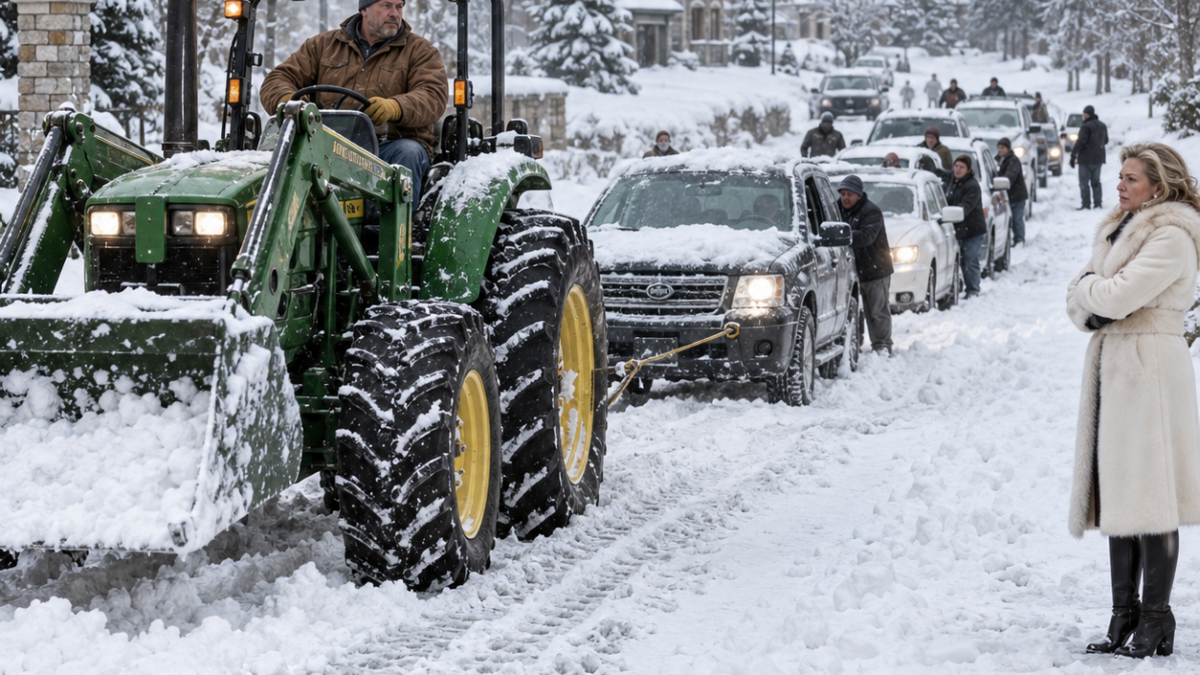
Fourteen vehicles.
Some had slid into the same ditch before the worst of the storm.
Others had become stuck behind them.
The owners had abandoned them and walked home before conditions became deadly.
Now the vehicles were half buried.
I climbed down.
A man came from the nearest house.
“You think you can get them out?”
“Depends.”
He pointed.
“My Subaru’s third one.”
Of course it was a Subaru.
I walked the ditch.
Some cars were simply snowbound.
Others had wheels off the shoulder.
One Ford F-150 was buried to the lower windows.
I returned to the tractor.
“Get anyone whose car is here.”
Within twenty minutes, people began appearing.
Bundled in coats.
Carrying shovels.
Standing ten feet back.
I explained the plan.
“I’ll clear around each vehicle first. Nobody hooks anything until I tell you. Tow points only. If you don’t know your vehicle’s recovery point, find the manual.”
A man asked, “You done this before?”
“I’ve moved heavier things.”
First came a Civic.
Then a RAV4.
Then the Ford.
The Ford took three attempts.
I changed angle.
Cleared more snow beneath the chassis.
Attached the recovery strap.
Low gear.
Steady pull.
The truck finally climbed back onto the road.
The owner raised both arms.
Then stopped.
Maybe he remembered he had voted against me.
I didn’t know.
I didn’t care.
Next came a minivan.
Then two Subarus.
A pickup.
A crossover.
A Lexus.
Number eleven was a black Mercedes.
I recognized it.
Barb Lawson.
Karen’s vice president.
The woman who had raised her hand first to ban my tractor.
Barb stood near her porch watching.
I climbed down.
“Keys?”
Her husband held them out.
Barb said nothing.
We cleared the car.
I attached the strap.
Pulled.
The Mercedes slid free.
I disconnected it.
Her husband said, “Thank you.”
Barb looked at me.
Her lips parted.
Then closed.
She turned toward her house.
That moment bothered me more than I expected.
Not because I needed gratitude.
I didn’t.
But because shame was keeping her from saying two simple words.
The final three cars took another hour.
By then my gloves were wet.
My legs cramped every time I climbed down.
The tractor was low on fuel.
The sky had begun to darken.
When the fourteenth vehicle reached the cleared road, everyone stood around silently.
Fourteen cars.
Fourteen families who now had transportation once the county roads reopened.
For a few seconds nobody moved.
Then one man I’d never met stepped forward.
“Jack?”
“Yes.”
He removed one glove.
Held out his hand.
“Thank you.”
I shook it.
Others nodded.
But most remained quiet.
Maybe embarrassed.
Maybe exhausted.
Maybe unsure what to say to the outsider they’d spent months watching Karen attack.
I climbed into the tractor.
Nobody applauded.
Nobody made a speech.
There was no dramatic moment.
Just the engine starting again.
As I drove toward home, something struck me.
Karen had spent months telling these people my tractor damaged their community.
That day the tractor was the only reason much of the community was moving at all.
When I finally reached our driveway, Sarah was waiting outside.
I shut off the engine.
Silence crashed down.
She walked toward me.
“You look terrible.”
“Good to see you too.”
She huggedged me before I could climb down fully.
I felt her shaking.
“You were gone seven hours.”
“I called.”
“Three times.”
“Signal.”
“I know.”
She held me tighter.
“Ella?”
“Ambulance got her out.”
Sarah buried her face against my coat.
For the first time all day, I felt my own fear.
“What?”
“I kept thinking about that stupid tractor.”
I smiled weakly.
“Careful. You’ll hurt its feelings.”
She hit my shoulder.
Then she started crying.
Not dramatically.
Quietly.
I kissed her forehead.
“I’m home.”
We walked inside.
I fell asleep in a chair with my boots still on.
The next morning, power returned.
And with it came the internet.
My phone exploded.
Messages.
Missed calls.
Notifications.
A video was circulating.
Mark Henderson’s teenage son had filmed me leading the ambulance through the snow.
The caption read:
THE HOA TRIED TO BAN THIS TRACTOR. TODAY IT CLEARED THE ROAD THAT SAVED MY SISTER.
By noon, thousands of people had shared it locally.
The regional television station picked it up.
A reporter called me.
I declined.
He called again.
I declined again.
I didn’t want to become “tractor guy.”
Sarah thought that was funny.
“You absolutely are tractor guy.”
“I reject the title.”
“You own overalls.”
“I own work clothes.”
“You talk to your tractor.”
“Preventive maintenance.”
She laughed.
Then my phone rang.
Mark.
I answered immediately.
“How is she?”
“Stable.”
I closed my eyes.
“She needed treatment fast, but they got her breathing under control.”
Sarah saw my face and covered her mouth.
Mark’s voice cracked.
“Jack, the doctor said another hour could’ve been dangerous.”
I sat down.
“She’s okay.”
“She is because of you.”
“No.”
“Yes.”
“Mark—”
“Don’t do that.”
“Do what?”
“Pretend it wasn’t a big deal.”
I looked through the kitchen window toward Prestigious Meadows.
“Take care of her.”
“We will.”
Then his tone changed.
“And we’re taking care of something else.”
“What?”
“Karen.”
I didn’t answer.
“Emergency meeting next week.”
“Mark.”
“No.”
His voice hardened.
“She doesn’t get to send another email and pretend none of this happened.”
Apparently half the neighborhood agreed.
Karen remained silent for four days.
No storm update.
No apology.
No explanation for Pristine Plowing’s absence.
Then Gerald, the secretary, sent an email announcing an emergency meeting to review snow response.
It was the first official HOA message I’d ever seen that didn’t sound like Karen wrote it.
The meeting was scheduled for Tuesday.
Before then, David Chen called me.
“Have you seen the news?”
“Unfortunately.”
“You look heroic.”
“I look frozen.”
“You always were ungrateful.”
“What do you want?”
“I’ve got something.”
His tone changed.
“Remember Pristine Plowing?”
“Yes.”
“You asked me to review the HOA records we already had from the lien dispute.”
“I remember.”
“I found the contract.”
“And?”
“Karen signed it.”
“She’s president.”
“Without the approval required for that contract value.”
I sat straighter.
“That bad?”
“Gets better.”
“Whose company is it?”
David paused dramatically.
“Her brother-in-law.”
I closed my eyes.
“You’re kidding.”
“I don’t joke about nepotism before lunch.”
“How much?”
“Nearly thirty percent above what their actual equipment and service history appear to justify once you account for the change-order provisions.”
“But she told everyone the new contractor was cheaper.”
“Yes.”
“Why?”
“That’s what I intend to ask.”
I felt anger rising.
Not for me.
For Ella.
If the HOA had retained a competent contractor, the ambulance might have reached the Hendersons without me spending two hours cutting through the development.
“Anything illegal?”
“Don’t jump there yet.”
“But?”
“But we have undisclosed conflict concerns, procurement irregularities, and enough to demand a forensic audit.”
I thought about Karen standing beside my driveway threatening $500 fines.
“Bring everything Tuesday.”
“I planned to.”
The clubhouse was packed.
People stood along every wall.
Some had never attended a meeting before.
When Sarah and I entered, conversations stopped.
Then someone clapped.
I hated it immediately.
Another person joined.
Then several.
I raised both hands.
“Please don’t.”
That got a laugh.
Mark met us.
His face was tired.
“How’s Ella?”
“Home.”
Sarah hugged him.
“Tell Emily we’ll bring dinner tomorrow.”
“She’s going to argue.”
“Tell her I wasn’t asking.”
Mark smiled.
At the front, Karen sat between Barb and Gerald.
For the first time, she looked uncertain.
Barb wouldn’t meet my eyes.
The meeting started badly.
Gerald tried to read a prepared statement.
Someone shouted, “Where were the plows?”
Another voice:
“Why didn’t anybody answer?”
Another:
“My mother was trapped eighteen hours!”
Gerald raised his hands.
“Please.”
Karen grabbed the microphone.
“Everybody needs to calm down.”
That was a mistake.
The room erupted.
“Calm down?”
“My pipes froze!”
“My husband couldn’t get his medication!”
“You said they had a plan!”
“Where was Pristine?”
Karen struck the gavel.
“Order!”
Nobody cared.
The gavel had lost its magic.
Eventually Mark stood.
He didn’t shout.
That was why everyone listened.
“My daughter almost stopped breathing.”
The room quieted.
Karen looked down.
Mark continued.
“We called 911.”
His voice tightened.
“They told us an ambulance couldn’t enter the development.”
Emily sat beside him, tears already running down her face.
“Jack Riley cleared nearly a mile of road.”
Mark pointed toward me.
“With the tractor this board voted to ban.”
Nobody moved.
“He opened a path from my house to the county road. Then he led the ambulance back.”
He swallowed.
“My daughter is home because he did.”
A woman behind me began crying.
Mark looked at Karen.
“And where was the contractor you promised would protect us?”
Karen shifted.
“This was an unprecedented weather event.”
“Yes.”
“Pristine was dealing with equipment failures.”
“Why weren’t backup resources available?”
“The county itself was overwhelmed.”
“The county didn’t collect our HOA dues.”
Applause exploded.
Karen’s face reddened.
Another resident stood.
His name was Paul.
I’d pulled his Ford from the ditch.
“I voted for Amendment 11B.”
He looked directly at me.
“I thought the tractor looked terrible.”
A few uncomfortable laughs.
Paul continued.
“I thought property values mattered more.”
He shook his head.
“Then I watched that machine pull my truck out when nothing else could even reach us.”
He turned toward Karen.
“You told us Jack was hurting this community.”
He paused.
“That man did more for this neighborhood in one day than this board did all year.”
Applause.
Louder.
Then Barb stood.
Everyone went quiet.
Karen looked relieved.
Finally, an ally.
Barb faced the room.
“My Mercedes was one of the fourteen cars.”
Karen’s expression changed.
Barb swallowed.
“I voted for the ban.”
She looked toward me.
“I supported the fines.”
Her voice trembled.
“And when my car was buried, Jack pulled it out.”
I nodded once.
She continued.
“He didn’t remind me how I voted.”
Another pause.
“He didn’t ask whether I supported him.”
She looked toward Karen.
“He just helped.”
Karen whispered, “Barb.”
Barb shook her head.
“No.”
It was the first time I’d heard anyone on that board tell Karen no.
“No, Karen. We were wrong.”
The room became completely silent.
Karen stared at her.
Then her face hardened.
“So now we’re making policy based on one snowstorm?”
Barb recoiled.
Karen stood.
“Are we going to pretend Mr. Riley hasn’t spent months antagonizing this board?”
I felt Sarah’s hand touch my arm.
Karen continued.
“He knowingly violated community standards.”
I stood.
She pointed at me.
“You see? Always ready for confrontation.”
I stopped.
Then sat back down.
The gesture drew scattered laughter.
Karen’s face darkened.
Mark stood again.
“I move for a vote of no confidence in the HOA president.”
Gerald nearly dropped his papers.
“That isn’t—”
“I second it.”
Helen Gable.
“Third.”
Someone yelled.
“There isn’t a third!”
More laughter.
Karen slammed the gavel.
“This meeting has an agenda.”
“So change it,” Paul shouted.
“You cannot simply improvise governance!”
That was when David entered.
He had waited outside until I texted.
He walked slowly down the aisle carrying a folder.
Karen recognized him.
Her face went still.
“Mr. Chen.”
“Mrs. Miller.”
“This is an HOA meeting.”
“I represent Mr. Riley.”
“We know.”
David looked at Gerald.
“May I address the membership regarding a material financial matter related directly to storm preparedness?”
Gerald looked toward Karen.
Then away from her.
“Yes.”
Karen snapped, “Gerald.”
He flinched.
Then said again:
“Yes.”
David stood at the front.
“I’ll keep this short.”
He held up the Pristine contract.
“The HOA’s current snow-removal provider was hired under an agreement executed by President Miller.”
Karen crossed her arms.
“That is public knowledge.”
“What appears not to be public knowledge is that the contract exceeded the president’s unilateral procurement authority under your own bylaws.”
Murmurs.
Karen said, “The board approved it.”
David looked at Barb.
“Did you?”
Barb froze.
“I—”
Karen cut in.
“Don’t answer that.”
David smiled faintly.
“That’s also an answer.”
Gerald stared at the contract.
“I never voted.”
The room erupted.
Karen struck the gavel.
David waited.
When the noise faded, he continued.
“There is also an undisclosed relationship between the contractor and President Miller.”
Karen went white.
Mark said, “What relationship?”
David looked at Karen.
“Would you like to explain?”
“No.”
“All right.”
He turned toward the residents.
“Public business records identify the owner of Pristine Plowing as Thomas Granger.”
Karen gripped the table.
“Mr. Granger is Mrs. Miller’s brother-in-law.”
The sound that went through the room wasn’t a gasp.
It was closer to a growl.
Paul shouted, “You’ve got to be kidding.”
Helen said, “We replaced a company that worked here ten years for her family?”
Karen grabbed the microphone.
“My personal relationships have nothing to do with vendor competency.”
Mark pointed toward the window.
“His company didn’t show up!”
“The storm overwhelmed them!”
David raised a hand.
“There are additional concerns.”
Karen’s eyes flashed.
“You’re threatening this board.”
“No.”
David placed another document down.
“My client was threatened with a lien against property outside your association.”
He laid down another.
“We have evidence of selective enforcement following homeowner disagreements.”
Another.
“Records showing unusually high fine revenue compared with similarly sized associations.”
Another.
“And now a related-party vendor contract that appears not to have followed your approval process.”
Karen’s voice dropped.
“What are you accusing me of?”
“I’m not accusing you of a crime.”
The distinction mattered.
David was careful.
“I’m saying the homeowners have ample reason to demand an independent audit before anyone makes assumptions about where their money went.”
Mark looked around.
“I move for a full forensic audit.”
“Second.”
Voices rose everywhere.
Karen stood.
“This meeting is over.”
Gerald surprised all of us.
“No.”
Karen turned.
“What?”
Gerald’s hands shook.
But he remained standing.
“No, Karen.”
His voice barely carried.
Then he leaned toward the microphone.
“The meeting is not over.”
Karen stared at him.
Gerald said, “I’ve signed things for years because you told me they were routine.”
His voice strengthened.
“I am not signing anything else.”
The room went silent.
Karen looked from Gerald to Barb.
Barb lowered her eyes.
Karen had lost the board before the vote even happened.
The no-confidence motion passed overwhelmingly.
Only four homeowners voted to keep her.
Karen remained seated while Gerald announced the result.
Her face looked emptied out.
Mark Henderson was nominated interim president.
He tried to decline.
The room refused to let him.
He accepted on the condition that elections be scheduled quickly.
His first motion was repeal of Amendment 11B.
Unanimous.
Nobody even hesitated.
The second was suspension of all disputed tractor fines.
Unanimous.
The third authorized an independent financial audit and legal review of the Pristine contract.
Unanimous.
Karen finally stood.
“You’re all going to regret this.”
Nobody answered.
That was worse than shouting.
She gathered her purse.
Her clipboard fell.
The papers scattered across the floor.
For years, people had probably rushed to help her.
Nobody moved.
After a few seconds, I stood.
Sarah whispered, “Jack.”
I walked forward.
Karen stared at me.
I bent down.
Collected the papers.
Placed them on the table.
She looked confused.
“Why?”
“Because I’m not you.”
Her jaw tightened.
I returned to my seat.
The meeting ended without police.
Without handcuffs.
Without anything cinematic.
At least, that was what I thought.
The audit began the following week.
The outside accounting firm requested five years of statements, invoices, checks, expense reports, contracts, reimbursement requests, and electronic records.
Gerald cooperated fully.
Barb did too.
Karen initially refused access to an HOA laptop she’d been using at home.
The association attorney sent a demand.
She returned it.
What they found went beyond the snow contract.
Several vendor agreements had undisclosed personal connections.
Landscaping.
Pressure washing.
Event catering.
None alone proved theft.
But payments didn’t always match documented work.
Some reimbursements lacked receipts.
Late fees had been moved between accounts in ways that were hard to explain.
Then investigators found checks made to a consulting company.
The company had an address connected to a relative.
The audit expanded.
The HOA’s insurance carrier became involved.
Then attorneys.
Then county investigators.
I stayed out of it.
That was deliberate.
This had stopped being my fight.
One afternoon, Mark called.
“They want statements from board members.”
“Expected.”
“They may refer something to law enforcement.”
“Then let the professionals handle it.”
“You don’t want to know?”
“Of course I want to know.”
I looked toward Sarah.
She shook her head.
“But I don’t need to know before everyone else.”
That was the hardest part.
Waiting.
Meanwhile, Prestigious Meadows began changing.
Not dramatically.
Quietly.
Violation letters almost disappeared.
The interim board suspended discretionary fines while rules were reviewed.
Residents formed committees that included people who had never served before.
Gerald resigned.
Barb stayed long enough to help transfer records, then stepped down.
She came to our house one Saturday.
I saw the black Mercedes before she reached the door.
Sarah opened it.
Barb stood holding an envelope.
“I wanted to give this to you.”
Inside was a handwritten apology.
Not from the HOA.
From her.
I read it silently.
She wrote that she’d allowed fear of conflict with Karen to turn into complicity.
She admitted supporting rules she privately believed were excessive because opposing Karen made life harder.
At the bottom:
YOU DIDN’T HAVE TO PULL MY CAR OUT. I WOULD’VE UNDERSTOOD IF YOU LEFT IT THERE. THANK YOU FOR NOT BEING THE PERSON I WAS TO YOU.
I folded it.
“You didn’t have to write this.”
“Yes, I did.”
She looked toward the tractor.
“I hated that thing.”
“It gets that a lot.”
She laughed awkwardly.
Then became serious.
“My husband said something after the storm.”
“What?”
“He said the worst part wasn’t that we were wrong about you.”
She swallowed.
“It was realizing we knew Karen was wrong before the storm and supported her anyway.”
I didn’t know what to say.
So I nodded.
Barb left.
I kept the letter.
Not as a trophy.
As proof that people can change when shame becomes honesty.
Mark’s daughter recovered completely.
The first time Ella visited after the storm, she walked straight past me and hugged the tractor tire.
Sarah laughed so hard she cried.
Ella looked up.
“Dad says this saved me.”
I crouched beside her.
“Your doctors saved you.”
She pointed at the tractor.
“But it got them.”
I couldn’t argue with that.
She gave me a small plastic ornament.
A tiny green tractor.
“I made it.”
It looked nothing like a tractor.
I put it on the workbench anyway.
For Christmas, the neighborhood held a potluck.
We weren’t technically residents.
They invited us anyway.
Nobody asked whether our equipment was visible.
Nobody discussed property values.
Paul brought beer.
Helen brought pie.
Arthur brought a replacement birdbath brochure and announced loudly that he was buying “the most obnoxious one legally available.”
Sarah almost choked laughing.
It felt like the beginning of something better.
Then, three days after New Year’s, two sheriff’s deputies arrived at Karen’s house.
I know because I happened to be outside splitting wood.
They didn’t use lights.
No dramatic sirens.
They knocked.
Karen opened the door.
They spoke for several minutes.
Then she went back inside.
Returned wearing a coat.
Got into the rear of their vehicle.
She was not handcuffed where I could see.
I did not cheer.
Neither did the neighbors who had begun appearing at windows.
Later, Mark confirmed investigators were questioning her regarding financial records.
The exact charges took months to sort out.
Some allegations did not hold.
Others did.
The eventual case centered on misuse of association funds, falsified reimbursement documentation, and undisclosed related-party transactions.
I learned that from public court records.
David called me when the filing became official.
“You sitting down?”
“Standing.”
“Sit.”
“No.”
He told me.
I listened.
When he finished, I felt less satisfaction than I expected.
“That’s it?”
“Jack, those are serious charges.”
“I mean that’s how I feel.”
David understood.
“You wanted fireworks.”
“No.”
I looked toward the window.
“I think I expected it to feel bigger.”
“Most endings don’t.”
The legal case took nearly a year.
Karen eventually reached a plea agreement on several counts involving financial misconduct.
She was ordered to repay money.
Received probation with strict conditions.
Lost any ability to serve in a fiduciary role for the association.
The HOA’s insurer covered some losses.
Other money was recovered through restitution and negotiated settlements.
Pristine Plowing’s contract was terminated immediately.
The old local company returned the following winter.
When the first snow came, three trucks arrived before dawn.
By breakfast, every street was clear.
I stood at our kitchen window.
Sarah handed me coffee.
“Disappointed?”
“About?”
“You weren’t needed.”
I watched one of the plows turn at the entrance.
“No.”
She leaned against me.
“Good.”
“Little hurt.”
“I knew it.”
We laughed.
The civil dispute over my tractor ended too.
The HOA formally withdrew its lien threat.
Every fine was canceled.
Their attorney sent a letter acknowledging that our parcel was not subject to Prestigious Meadows’ architectural covenants.
They reimbursed David’s fees under a settlement agreement.
I thought that was the end.
Then Mark came over.
He was carrying an envelope.
“No.”
“You don’t know what this is.”
“If it’s HOA paperwork, no.”
“You should open it.”
Inside was a letter.
Not legal.
Not formal.
Signed by eighty-seven homeowners.
It began:
DEAR JACK AND SARAH,
WE OWE YOU AN APOLOGY.
I stopped reading.
Mark waited.
“Finish.”
I did.
They apologized for allowing the board to target us.
For treating us as outsiders.
For remaining silent during the vote.
For benefiting from my tractor during the storm after supporting efforts to remove it.
They thanked Sarah too.
That mattered.
Because she’d absorbed months of stress without wanting any of the conflict.
At the bottom were signatures.
Paul.
Helen.
Arthur.
Barb.
Gerald.
Families I hadn’t even met.
Sarah read it after me.
By the time she reached the final line, she was crying.
“What does it say?” Mark asked.
She wiped her face.
“You know what it says.”
“Wanted to hear you say it.”
She laughed.
“It says you’re all a pain in the ass.”
Mark grinned.
“Accurate.”
Then he handed me a second envelope.
“What’s this?”
“Open it.”
A check.
I stared.
“What the hell is this?”
“Community reimbursement.”
“For?”
“Diesel. Wear. Tow straps. Whatever.”
“I don’t want this.”
“We knew you’d say that.”
“Then why—”
“Because we’re not asking.”
I handed it back.
He refused.
We argued for ten minutes.
Finally Sarah took the check.
“Thank you.”
I stared at her.
She ignored me.
After Mark left, I said, “I don’t want their money.”
“I know.”
“Then why—”
“We’re donating it.”
I stopped.
“To what?”
She smiled.
“The volunteer rescue squad.”
That was perfect.
We added our own money.
The rescue squad used the donation toward a new portable medical-response kit.
When Mark heard, he added more.
Then other neighbors did.
By spring, Prestigious Meadows had funded two emergency kits.
One was mounted in the clubhouse.
The second went to the county volunteer unit.
Something that began with an ugly HOA fight ended up putting emergency equipment into the hands of people who might someday save somebody else’s daughter.
That mattered more to me than winning.
Spring arrived late.
The snow melted.
Mud replaced ice.
Our five acres turned green.
Sarah finally planted the garden we’d talked about for years.
Tomatoes.
Beans.
Peppers.
Corn.
Zucchini.
Far too much zucchini.
The tractor tilled the soil.
Moved compost.
Carried lumber.
Graded the driveway.
No one complained.
Sometimes children from Prestigious Meadows stood at the property line watching.
One Saturday, Ella came with Mark.
“Can I ride?”
Sarah looked at me.
I looked at Mark.
Mark said, “Very slowly.”
I drove Ella around the back field at walking speed.
She wore pink hearing protection.
Her smile could’ve powered the tractor without diesel.
When we returned, Mark leaned against the fence.
“Funny.”
“What?”
“This machine almost got you run out of the neighborhood.”
“I don’t live in the neighborhood.”
“You know what I mean.”
He looked back toward the rows of houses.
“Now everybody feels safer because it’s here.”
I shut down the engine.
“Machines aren’t good or bad.”
“No.”
He nodded.
“People decide what they’re for.”
That summer, the new HOA board rewrote several policies.
Not to eliminate standards.
To make them understandable.
Fines required documented authority.
Homeowners had appeal rights.
Vendor contracts above a certain amount required competitive bids.
Board members had to disclose family or financial relationships with contractors.
Meeting minutes were posted publicly.
Emergency plans were created.
Most importantly, the culture changed.
Neighbors began talking before reporting each other.
That sounds small.
It wasn’t.
One afternoon, Helen came over carrying tomatoes.
“We grew too many.”
Sarah looked at our garden.
“We have forty plants.”
Helen laughed.
“Then take cucumbers.”
Arthur installed a ridiculous birdbath shaped like a heron.
Completely compliant.
He invited me over specifically to admire it.
“I checked the rules twice.”
“You’ve become dangerous.”
“I’ve become informed.”
The Hendersons installed another playset.
Bright red.
Blue slide.
Yellow swings.
Nobody died.
Property values survived.
One evening, Sarah and I sat on the porch watching sunset turn the valley gold.
The tractor sat beside the barn.
Dusty.
Ordinary.
“You know what bothers me?” she asked.
“What?”
“The title.”
“What title?”
“The one everyone uses when they tell the story.”
I looked at her.
“What are they calling it?”
“The tractor that saved fourteen cars.”
“It did.”
She shook her head.
“You saved fourteen cars.”
“Technically I pulled them.”
“You cleared a road for an ambulance.”
“Yes.”
“You spent seven hours helping people who voted against you.”
“Yes.”
She looked annoyed.
“What?”
“You always do that.”
“Do what?”
“Make it sound like machinery did everything.”
I smiled.
“The machinery helped.”
She leaned back.
“Why did you help Barb?”
I knew what she meant.
I thought about it.
“Because her car was stuck.”
“That simple?”
“Yes.”
“You weren’t tempted to drive past?”
I paused.
“A little.”
She laughed.
“At least you’re honest.”
“But if I had, Karen would’ve won something.”
Sarah looked at me.
“What?”
“She would’ve turned me into the person she said I was.”
The troublemaker.
The selfish outsider.
The man who cared only about being right.
If I had left Barb’s car buried because she voted against me, then the tractor would have become exactly what Karen claimed it was.
A symbol of division.
Instead, it became something else.
That was the victory.
Not humiliating Karen.
Not canceling fines.
Not winning a legal argument.
It was helping people who had not helped me.
Because community isn’t a reward you give to people who agree with you.
It’s what you build when things go wrong.
The following December, the neighborhood invited us to its annual winter meeting.
I tried to decline.
Mark threatened to drive over and drag me.
Sarah wanted to go.
So we went.
The clubhouse had changed.
New paint.
New chairs.
Still beige, unfortunately.
At the front stood a framed emergency map.
Marked evacuation routes.
Generator locations.
Medical-resource contacts.
Snow contractor procedures.
And at the bottom, laminated in green:
PRIVATE EQUIPMENT VOLUNTEER RESPONSE LIST.
My name was first.
I looked at Mark.
“Seriously?”
“You own the biggest tractor.”
“That’s not a qualification.”
“It absolutely is.”
Sarah laughed.
During the meeting, Mark announced a new community emergency fund.
Then he said something I wasn’t expecting.
“Last winter taught us that preparedness can’t be outsourced completely.”
He looked toward me.
“We spent years confusing appearance with security.”
The room went quiet.
“We cared about whether a tractor could be seen from the road.”
He paused.
“Then we learned what mattered when the road disappeared.”
I looked down.
I still didn’t like public attention.
Mark continued.
“We owe Jack Riley an apology, but more than that, we owe ourselves a promise.”
He looked around the room.
“That this neighborhood will never again punish someone simply because one person in authority doesn’t like the way they live.”
Applause followed.
I stood only because everyone was staring.
I walked toward the front.
“No speeches,” I said.
Someone yelled, “Too late.”
Laughter.
I looked around.
Some faces had changed.
Some hadn’t.
Barb was there.
Gerald too.
Helen.
Arthur.
Paul.
Mark and Emily.
Ella sat between her parents.
I said, “Last winter, nobody had time to ask who voted for what.”
The room quieted.
“When someone needed medicine, we cleared a path.”
“When Ella needed an ambulance, we cleared a road.”
“When cars were stuck, we pulled them out.”
I shrugged.
“That is the whole lesson.”
I looked toward the windows.
Outside, light snow had begun falling.
“You can write a thousand pages of rules.”
A few people laughed.
“But when the power dies, the road disappears, and somebody needs help, the rule that matters is pretty simple.”
I paused.
“Be useful.”
That was all I said.
Years later, I still have the John Deere.
The paint isn’t perfect anymore.
The loader bucket is scratched.
There’s a dent on the left fender from a branch I misjudged.
Sarah insists that proves I’m not the flawless equipment operator I claim to be.
I insist the branch moved.
Every winter, I service the tractor before the first serious snow.
Fuel.
Hydraulics.
Chains.
Tow straps.
Emergency lights.
Not because I’m expecting another historic blizzard.
Because being ready became a habit.
Prestigious Meadows changed too.
Karen eventually moved away after her legal case ended.
There wasn’t a parade.
Nobody stood outside watching the moving truck.
Her house sold to a family with three children.
Within a month, bicycles appeared on the driveway.
A basketball hoop went up.
One afternoon, I drove past and saw sidewalk chalk everywhere.
Pink.
Blue.
Yellow.
Completely destroying the visual harmony.
I smiled the whole way home.
The funniest part happened the next spring.
The new owner of Karen’s old house bought a riding mower.
Bright red.
He parked it where it could be seen from the road.
Nobody filed a complaint.
Nobody called an emergency meeting.
Nobody wrote Amendment 11C.
The world kept turning.
One afternoon, Mark stopped by while I was grading the driveway.
He brought two beers.
I parked the tractor.
We sat on the tailgate of his truck.
He looked at Prestigious Meadows.
“You ever think about selling?”
“Our place?”
“Yeah.”
“No.”
“Good.”
“Why?”
“Because people sleep better knowing that tractor’s over here.”
I laughed.
“That’s ridiculous.”
“Maybe.”
He took a drink.
“Ella still remembers the ambulance.”
“So do I.”
“She doesn’t remember much about not breathing.”
“Good.”
“She remembers looking through the back window while the ambulance followed your tractor.”
I stared out across the field.
Mark continued.
“She said the green lights—your hazards or whatever—looked like something leading them home.”
I swallowed.
“She said that?”
“Yeah.”
He smiled.
“Eight-year-olds make everything poetic.”
For a moment, neither of us spoke.
Then Mark said, “I never told you the worst part.”
“What?”
“The night before the storm, I had almost signed a petition supporting the lien against you.”
I turned toward him.
He looked ashamed.
“Karen brought it around.”
“Why?”
“She said if the board didn’t stand united, you’d sue us all individually.”
“That wasn’t true.”
“I know that now.”
He rubbed his hands together.
“I didn’t sign.”
“But you almost did.”
“Yes.”
I waited.
“The next morning, you came for Ella.”
I looked at him.
“You were scared.”
“No excuse.”
“It explains it.”
He shook his head.
“That’s why I never knew how to thank you.”
I remembered my original frustration after pulling the cars out.
The silence.
The people who couldn’t look at me.
Maybe I’d misunderstood some of them.
Gratitude is easy when you believe you deserve rescue.
Harder when rescue comes from someone you failed.
I put my beer down.
“Mark.”
He looked at me.
“You don’t owe me anything.”
“I know.”
“Then stop paying interest.”
He laughed.
“That sounds like something David would say.”
“Don’t insult me.”
We sat until sunset.
Before leaving, Mark walked toward the tractor.
He slapped one tire.
“Still ugly.”
“Get off my property.”
He laughed and drove away.
That evening, Sarah asked why I’d been smiling.
I told her.
She leaned against the counter.
“You know what I think?”
“Dangerous opening.”
“I think you liked Karen banning the tractor.”
I stared.
“Excuse me?”
“You loved having an enemy.”
“No.”
“You had maps.”
“I always have maps.”
“You called David.”
“That was legal necessity.”
“You labeled a binder.”
“That was organization.”
“You polished the tractor.”
“Maintenance.”
She laughed until she had tears in her eyes.
Then she walked over.
Wrapped her arms around me.
“I’m glad you fought.”
That surprised me.
“You hated it.”
“I hated watching you fight.”
“Difference?”
“A big one.”
She looked out the window.
“If you’d hidden the tractor behind the barn, we would’ve spent years letting that woman decide what kind of life we were allowed to have.”
I kissed her forehead.
“Probably.”
“And we wouldn’t have been ready for the storm.”
That was true.
If we’d sold it, moved it miles away, or surrendered entirely, Ella’s ambulance might not have reached her when it did.
Maybe someone else would have solved it.
Maybe the county would eventually have broken through.
Maybe everything would have been fine.
But “maybe” is a terrible thing to think about when it concerns a child struggling to breathe.
Sarah whispered, “Funny how close something stupid came to something terrible.”
I looked at the tractor.
“That’s usually how it happens.”
Big disasters don’t always begin with big decisions.
Sometimes they begin with somebody firing the competent snow contractor because she doesn’t like being questioned.
Or a board too afraid to demand bids.
Or neighbors staying silent because challenging authority is inconvenient.
Or a ridiculous equipment rule everyone knows is targeted but nobody wants to oppose.
Each choice seems small.
Until weather strips away the illusion.
The blizzard did not create Prestigious Meadows’ problems.
It revealed them.
It revealed that Karen’s control wasn’t leadership.
That silence wasn’t agreement.
That appearances weren’t preparedness.
And that the “industrial eyesore” people feared was more useful than every polished promise in the HOA newsletter.
The tractor saved fourteen cars.
But the number I remember is one.
Ella.
A little girl wrapped in a blanket.
A father standing in the snow with tears freezing on his face.
An ambulance following the path I’d cut through a neighborhood that had voted to make my machine disappear.
That is why, even now, when people ask whether I felt vindicated, I tell them no.
Vindication wasn’t the feeling.
Responsibility was.
If you have the ability to help and someone needs you, there shouldn’t be a vote first.
You don’t ask how they treated you last month.
You don’t pull out old letters.
You don’t check whether their hand went up against you at an HOA meeting.
You help.
The accounting comes later.
And sometimes the accounting is brutal.
Karen lost her title.
Then her reputation.
Then the protection of people who had been too frightened to challenge her.
The audit took away the last illusion that her decisions had always been about protecting the neighborhood.
Her legal consequences came from choices she made long before the snow.
But that was never the revenge that mattered most.
The revenge was quieter.
The bright playset in Mark’s yard.
Arthur’s ridiculous birdbath.
Helen’s blue garden hose returned the following spring.
Children leaving bicycles in driveways.
Neighbors knocking before reporting.
Board meetings where ordinary people asked questions without being punished.
Vendor contracts openly reviewed.
Emergency plans based on capability instead of image.
And my tractor parked exactly where Karen said it could never remain.
No banner.
No plaque.
No smug sign.
Just steel, diesel, and mud.
A tool.
One winter morning, years after the blizzard, I woke before dawn to six inches of fresh snow.
Nothing dangerous.
Just ordinary winter weather.
The new plow company had already cleared Prestigious Meadows.
I started the John Deere and began working on my driveway.
Halfway down, I noticed a sedan stuck near the easement.
Young driver.
New family.
I hadn’t met them.
The father stood outside with a shovel.
I pulled alongside.
“Need a hand?”
He looked embarrassed.
“I thought I could make it.”
“Everybody thinks that once.”
I attached the strap.
Pulled him free.
His little boy watched from inside the car.
When they were back on clear pavement, the man shook my hand.
“Thank you.”
I nodded.
“No problem.”
He looked at the tractor.
“My neighbor told me about this thing.”
“Oh no.”
“He said it saved the whole neighborhood.”
“Your neighbor exaggerates.”
“He said the HOA tried to ban it.”
“That part’s true.”
The man laughed.
Then his son lowered the window.
“Are you the tractor guy?”
I closed my eyes.
The father laughed.
“Sorry.”
I pointed toward the road.
“Go before I put you back in the ditch.”
They drove away.
I sat there grinning.
Snow fell quietly across the hood.
Prestigious Meadows looked peaceful.
Not artificially perfect.
Just peaceful.
A basketball hoop stood beside one driveway.
A red sled leaned against another porch.
Someone’s trash bin was still out.
Arthur’s heron birdbath wore a ridiculous white cap of snow.
Farther down, Mark was helping Ella scrape ice from her first car.
She was sixteen now.
She saw me.
Waved.
I waved back.
Then I turned toward home.
The diesel engine settled into its familiar hum.
The same sound Karen once called incompatible with her vision of the community.
The same sound people heard coming through the blizzard when they realized somebody was still moving.
I don’t know what happened to Karen after she left.
Occasionally somebody tells me they saw her in another town.
I never ask.
For a long time, I thought winning meant making sure she understood what she had done.
Eventually I realized that didn’t matter.
Some people never understand.
Some rewrite the story until they’re the victim.
Some carry their anger with them.
You can’t control that.
What you can control is what remains after they leave.
Prestigious Meadows remained.
The people remained.
Their families remained.
The lessons remained.
And so did my tractor.
That was enough.
The winter Karen tried to ban farm equipment, she thought power meant having the authority to tell another man what he could keep on his own property.
The blizzard taught all of us a different definition.
Power was having a machine capable of clearing a road.
Leadership was climbing onto it when somebody’s child couldn’t breathe.
Character was pulling fourteen cars free without asking who had voted against you.
And community was what happened after the storm—when people finally looked at one another instead of looking toward one person for permission.
Karen wanted uniformity.
What we got instead was something better.
Neighbors.
Sarah and I eventually built the life we’d imagined before any of this began.
The garden became absurdly productive.
Every July, zucchini took over the kitchen.
We kept chickens for a while until Sarah discovered chickens have no respect for property boundaries or personal dignity.
We built a bigger barn.
I planted fruit trees.
Mark helped.
Arthur supervised without being asked.
Helen brought lemonade.
Ella attended college not far away and still sends Sarah pictures when she sees old tractors.
Prestigious Meadows stopped feeling like a hostile development beside our property.
It became the place where our friends lived.
That’s the part Karen never understood.
You cannot force community into existence with matching mailboxes.
You cannot fine people until they care about one another.
You cannot write enough rules to manufacture trust.
Trust comes from knowing that when your daughter can’t breathe, somebody will come through four feet of snow.
It comes from knowing the neighbor you embarrassed might still pull your Mercedes from a ditch.
It comes from admitting when you were wrong.
It comes from showing up.
One summer evening, years later, I was cleaning mud from the tractor when Sarah walked into the barn.
She held up the original HOA violation notice.
I hadn’t seen it in years.
“Found this in a box.”
I read the first line.
REMOVE PROHIBITED HEAVY EQUIPMENT FROM PUBLIC VIEW.
The paper had yellowed slightly.
The official gold logo looked ridiculous.
Sarah asked, “Keep or throw away?”
I took it.
For a second, I remembered Karen standing at the end of the driveway.
Clipboard.
Certainty.
Threatening fines.
Believing she could erase the machine from her perfect view.
Then I remembered headlights through snow.
Ella wrapped in blankets.
Fourteen cars rising one by one from the ditch.
Barb’s apology.
The vote.
The audit.
The emergency kits.
The neighborhood finally talking.
I tore the notice in half.
Then again.
And dropped it into the trash.
Sarah smiled.
“Finally?”
“Yeah.”
“Why now?”
I looked at the John Deere.
“Because I don’t need it anymore.”
The paper had once represented a fight.
Now it was just paper.
The tractor started on the first turn of the key.
I drove it outside.
The evening sun lay across the valley.
Children shouted somewhere in Prestigious Meadows.
A lawn mower buzzed.
A dog barked.
Someone laughed.
Ordinary sounds.
The sounds of people actually living.
I parked the tractor where it had always sat.
Visible from the road.
Exactly where Karen had ordered me never to keep it.
Then I went inside to have dinner with my wife.
No victory speech.
No revenge left to chase.
No enemy left to defeat.
Just peace.
The kind we had been looking for from the beginning.
And whenever winter comes now, that old John Deere still sits ready beside the barn.
Not because anybody voted to approve it.
Not because an HOA finally decided it looked acceptable.
Because years ago, in the worst storm our valley had seen in decades, fourteen buried cars, one desperate ambulance, and an entire frightened neighborhood learned something no bylaw could ever teach them:
Sometimes the thing people are quickest to ban is the very thing they will pray is still there when everything else fails.








