PART 2: HOA Paved Over My Drainage Swale for 47 Parking Spaces—The First Storm Turned Their $184,000 Lot Into a Lake
PART 2
At that moment, I still believed paperwork might stop her.
That was my first mistake.
Not because paperwork didn’t matter.
It mattered enormously.
But Mara didn’t think normal rules applied to her once the board had voted.
She treated approval like ownership.
If enough people in the clubhouse raised their hands, she seemed to believe property lines moved automatically.
I tried one more time to avoid a fight.
“Mara.”
She stopped walking.
“Move the parking area uphill.”
She turned.
“Near the tennis courts?”
“Yes.”
“That destroys the landscaping plan.”
“It keeps you off my land.”
“It also costs tens of thousands of dollars.”
“Then hire an engineer and design a real drainage crossing.”
“We already have a design.”
“You have a drawing.”
She frowned.
“Same thing.”
“No.”
I pointed down into the swale.
“A design tells you how much water comes through here. It tells you how big the outlet needs to be. It tells you whether your fill is going to back water into the parking area.”
“Grant, it’s rain.”
I stared at her.
“That’s exactly the problem.”
She walked away.
The next HOA board meeting took place two days later.
I wasn’t a member of Silver Creek Estates, so I didn’t attend.
But later, Taran Holloway told me exactly what happened.
Taran was the treasurer.
An accountant.
The kind of person who read every page instead of trusting the summary on top.
Mara presented beautiful renderings.
Fresh asphalt.
Decorative light poles.
Forty-seven spaces.
Landscaping.
A clean pedestrian path to the clubhouse.
Then she showed a financial projection.
Paid events.
Wedding revenue.
Corporate bookings.
Property values.
One board member asked whether the low ground would need drainage work.
Mara said it had already been handled.
Then Taran asked:
“Who owns the land along the eastern edge?”
Mara answered immediately.
“The HOA controls it through our drainage rights.”
Taran frowned.
“Controls the water or owns the land?”
According to Taran, Mara’s smile disappeared for half a second.
“Legal counsel has reviewed the project.”
“Can we see the title documentation?”
“It’s not necessary.”
“I think it is if we’re building beyond the existing parking area.”
Mara accused her of delaying a project residents overwhelmingly supported.
Someone called for the vote.
The motion passed.
Three days later, an excavator woke me before sunrise.
I knew the sound before I opened my eyes.
Heavy diesel.
Bucket against earth.
Backup alarm.
I pulled on jeans and boots and drove across the pasture.
By the time I reached the east line, dump trucks were already pouring fill into the swale.
The grass was disappearing.
Crushed stone covered the low point.
And the old boundary markers were gone.
I walked straight toward the foreman.
“Stop!”
He turned.
Weathered face.
Gray beard.
Hard hat with PARD CONTRACTING printed across the front.
His name was Wade Pard.
“What can I do for you?”
“You’re working on my land.”
He looked toward the subdivision.
“This is the HOA project.”
“I know whose project it is.”
I handed him the survey.
“This is the boundary.”
Wade studied it.
Unlike Mara, he actually read.
Then he looked toward his stakes.
Back at my map.
His face changed.
“Where’d you get this?”
“Recorded survey.”
“Current?”
“Certified.”
He waved to the excavator operator.
“Hold up!”
Machines went quiet.
For maybe forty-five minutes, I thought common sense had won.
Then Mara arrived.
Two board members followed.
She got out of her SUV already furious.
“What happened?”
Wade held up my survey.
“We’ve got a boundary conflict.”
“There is no boundary conflict.”
Mara turned toward me.
“You don’t get to shut down a community project because you don’t like the view.”
“This has nothing to do with the view.”
“Then what?”
“You’re trespassing.”
She laughed.
“Again with this?”
“And you’re destroying a working drainage channel.”
“The drainage will be piped.”
“What size?”
She hesitated.
“What?”
“What size pipe?”
“I don’t know.”
“Who calculated the watershed?”
“Our contractor.”
Wade looked uncomfortable.
I turned toward him.
“Did you?”
“No.”
Mara cut in.
“Grant, stop interrogating my contractor.”
“Then who calculated it?”
She ignored me.
Instead, she threatened to fine me $500 per day for interfering with HOA construction.
I actually laughed.
“You can’t fine me.”
“Any adjoining property interfering with community improvements—”
“I’m not in your HOA.”
“You’re adjacent to it.”
“That doesn’t make your bylaws contagious.”
One board member looked away to hide a smile.
Mara didn’t.
She called the sheriff.
She told dispatch an aggressive rancher was interfering with contractors.
I stood beside my truck and waited.
When the deputy arrived, I showed him my deed.
Survey.
Recorded easement.
Mara showed him her project plans.
After about twenty minutes, he shook his head.
“This is a civil land dispute.”
Mara crossed her arms.
“He’s stopping authorized work.”
“He says you’re on his property.”
“He’s wrong.”
The deputy looked at me.
“Mr. Bellamy, I’m not deciding title.”
“I understand.”
“You can seek a court order.”
“I will.”
Then he looked at Mara.
“And until that happens, everybody should avoid escalating this.”
She watched the patrol car leave like she’d been betrayed.
I didn’t touch the equipment.
Didn’t block trucks.
Didn’t threaten anybody.
Instead, I made four calls.
First, an independent surveyor.
Second, the county stormwater division.
Third, my attorney, Norah Keen.
Fourth, a hydrologist I had worked with years earlier.
Then I started documenting everything.
Every truck.
Every hour.
Every machine.
Every photograph.
Every elevation point I could still identify.
Mara responded by speeding up construction.
That told me something important.
She wasn’t trying to prove she was right.
She was trying to finish before anyone could stop her.
Wade called me later that afternoon.
Quietly.
“Grant.”
“Yeah?”
“I asked for the stormwater permit.”
“What did she give you?”
“Nothing.”
“Nothing?”
“She says it’s resurfacing existing ground.”
I looked out my kitchen window toward the grassy swale being buried.
“There has never been pavement there.”
“I know.”
“Then why are you working?”
Long pause.
“I have written direction from the owner.”
“Mara?”
“Yes.”
“Keep it.”
“What?”
“Keep every email.”
He didn’t answer.
Then:
“I already am.”
The independent survey came back two days later.
At the widest point, the parking design extended about twelve feet into Bellamy Ranch.
But that wasn’t even the part that scared me most.
The fill elevation sat almost two feet above the bottom of the old swale.
In simple terms, the HOA was building a dam.
Not a concrete dam.
Not something anyone would recognize as one.
Just compacted fill beneath asphalt.
But water doesn’t care what you call a structure.
If you block its low path, water backs up.
Mara had replaced a sixteen-foot-wide open swale with a narrow pipe.
I went out after the crew left.
From my side of the line, I measured the pipe opening.
Roughly ten inches.
I stared at it.
Ten inches.
For runoff from twenty-one acres.
I called Sloan Mercer.
Sloan was a hydrologist who had spent years analyzing drainage failures on construction sites.
She came out with maps, a level, old drainage drawings, and the patience of someone who preferred numbers to arguments.
She walked the slope.
Checked elevations.
Looked at the fill.
Then stood beside the pipe.
“Who sized this?”
“Good question.”
“This isn’t replacing the capacity of that swale.”
“I know.”
“How much impervious area drains here?”
“About twenty-one acres.”
She looked at me.
“All through this low point?”
“Most of it.”
Sloan shook her head.
“This needs analysis before anybody parks here.”
“How bad?”
“I won’t predict without rainfall assumptions.”
“Worst case?”
She looked toward the new fill.
“If inflow exceeds that pipe’s capacity, water backs up on the north side.”
“Which is the new parking lot.”
“Exactly.”
She wrote a preliminary report.
Very careful language.
No sensational claims.
No prediction that the first storm would destroy anything.
Just engineering.
The filled corridor blocked the historic flow path.
The proposed pipe appeared inadequate absent hydraulic calculations.
A full watershed analysis was needed.
No public use until safe conveyance was demonstrated.
I sent the report to Mara.
Every board member.
The county.
Wade.
I underlined one sentence.
Use of the proposed parking area before proper drainage evaluation presents significant risk during heavy rainfall.
Mara responded with four words handwritten on a printed copy of my warning.
YOUR PERMISSION IS NOT REQUIRED.
She mailed it back.
I put the page in a plastic sleeve.
At the time, it made me furious.
Later, it would make Norah smile without humor.
“She wrote this?”
“With a pen.”
“And sent it back?”
“Certified mail.”
Norah stared at the sentence.
“Keep this somewhere safe.”
“Why?”
“Because people spend a lot of money proving knowledge.”
She tapped the paper.
“Mara just mailed you hers.”
The HOA called another emergency meeting.
Mara presented Sloan’s report as proof that I was trying to frighten residents.
“He hired his own expert,” she told the board, “to produce exactly the conclusion he wanted.”
Taran asked:
“Why don’t we hire our own?”
Mara rejected the idea.
Two weeks of delay.
More engineering fees.
Potential loss of event deposits.
Another board member asked what would happen if Sloan was correct.
Mara answered:
“We have insurance.”
That sentence eventually made its way back to me.
I couldn’t believe it.
Insurance wasn’t drainage.
Insurance didn’t keep water out of engines.
Insurance didn’t stop somebody from getting swept off their feet in darkness.
I sent another warning.
No response.
Then Taran called me privately.
Her voice was low.
“I think the board saw a different engineering memo.”
“What do you mean?”
“I saw a technical document earlier in the project.”
“And?”
“It had a flooding paragraph.”
“What flooding paragraph?”
“A warning about filling the low corridor.”
“What happened to it?”
“I don’t know.”
“The board version?”
“Didn’t have it.”
I sat quietly.
“Taran, can you get the original?”
“I’ll try.”
“Don’t take anything you’re not entitled to.”
“I know.”
“If you find it, preserve it.”
“I will.”
Two days later, the roller made the final pass.
Forty-seven spaces.
Fresh white lines.
Decorative lamps.
A new railing.
Silver Creek Parking Expansion — A Community Investment.
Mara stood in the middle of the pavement.
Someone took a photo of her.
According to one worker, she looked toward my ranch and said:
“It’s finished. There’s nothing he can do now.”
That afternoon, my weather app issued a severe thunderstorm alert.
I looked north.
Dark clouds were gathering.
I called Everett Hale at the county stormwater office.
He had already opened a complaint file.
“Everett.”
“I saw the forecast.”
“The lot is open tonight.”
“Already?”
“Grand opening.”
He sighed.
“If you see active flooding, call emergency services.”
“I will.”
“Don’t enter the lot.”
“I won’t.”
“Don’t touch their drainage.”
“I haven’t.”
“Document from your property.”
“That I can do.”
At six that evening, Silver Creek Estates began celebrating.
Catering trucks arrived.
A string quartet played beneath a canopy.
Residents gathered around the new lot.
Mara wore a dark green dress and carried a champagne flute.
I watched from my side of the fence.
Not because I wanted to ruin their party.
Because the sky looked wrong.
Heavy.
Green-gray.
The kind of air that makes cattle restless.
Mara gave a speech.
She talked about vision.
Leadership.
Investment.
The future.
Then she said:
“A community cannot move forward if it listens to every person afraid of change.”
People laughed.
Some clapped.
Then she looked toward me.
We both knew who she meant.
I took a photograph of the boundary.
That was all.
At 6:40, the weather alert escalated.
I emailed the full HOA board.
Heavy rainfall approaching. I strongly recommend that no vehicles remain overnight in the lowest portion of the new lot. The blocked swale may cause rapid water accumulation.
Mara called within minutes.
“You emailed everyone?”
“Yes.”
“You couldn’t stop construction, so now you’re sabotaging the opening.”
“How?”
“Scaring people.”
“Move the cars.”
“No.”
“Mara.”
“This is a parking lot.”
“Yes.”
“Not a flood basin.”
I looked toward the dark clouds.
“It used to be where the floodwater went.”
She hung up.
I saved the call time.
Inside the clubhouse, dinner continued.
The first raindrops hit the asphalt.
Some guests checked their phones and left early.
Others stayed.
The event planner suggested moving cars to higher ground.
Mara refused.
She told one board member:
“This storm will prove Grant wrong.”
At nine o’clock, water began spreading across the north end of the lot.
Thin at first.
A dark sheen over fresh asphalt.
A security guard checked the storm drains.
They were already struggling.
Mara told him to clear leaves.
But there weren’t enough leaves in North Carolina to explain what was happening.
The pipe couldn’t move the water fast enough.
From my barn, I watched runoff race down the subdivision streets.
Every gutter became a channel.
Every driveway sent water downhill.
Every roof added more.
All of it headed toward the old swale.
Except the swale was gone.
At ten-thirty, water reached several wheel rims.
I called emergency services.
“Blocked stormwater corridor.”
I gave them the address.
Explained the layout.
Then I opened the east ranch gate.
My higher pasture road provided a safer approach from the back.
At 11:38, people started leaving the clubhouse and found water above their ankles on the walkway.
Security stopped anyone from entering the deeper section.
Some residents ran toward cars.
Staff shouted at them to stay back.
A few vehicles were moved successfully.
Others were already surrounded.
Mara came outside in a designer raincoat.
Her SUV sat near the grand-opening sign.
Water swirled around the tires.
“Move my car!”
A young employee shook his head.
“It’s too deep.”
“Take the keys!”
“No.”
“That’s a ninety-thousand-dollar SUV!”
The employee shouted back:
“I’m not drowning for your car!”
Then another surge came down the hill.
The water jumped higher.
The SUV’s hazard lights flashed.
Orange.
Orange.
Orange.
Then stopped.
Blackness swallowed the lower half of the vehicle.
At 1:17 a.m., almost every painted line in the low portion had vanished.
Headlights reflected beneath muddy water.
Car alarms shrieked.
The $184,000 parking lot looked like a lake.
I stood beneath my equipment barn roof.
I did not smile.
People later assumed I must have enjoyed it.
I didn’t.
I’d spent weeks trying to stop exactly this.
No honest person wants to be proven right by watching other people’s property drown.
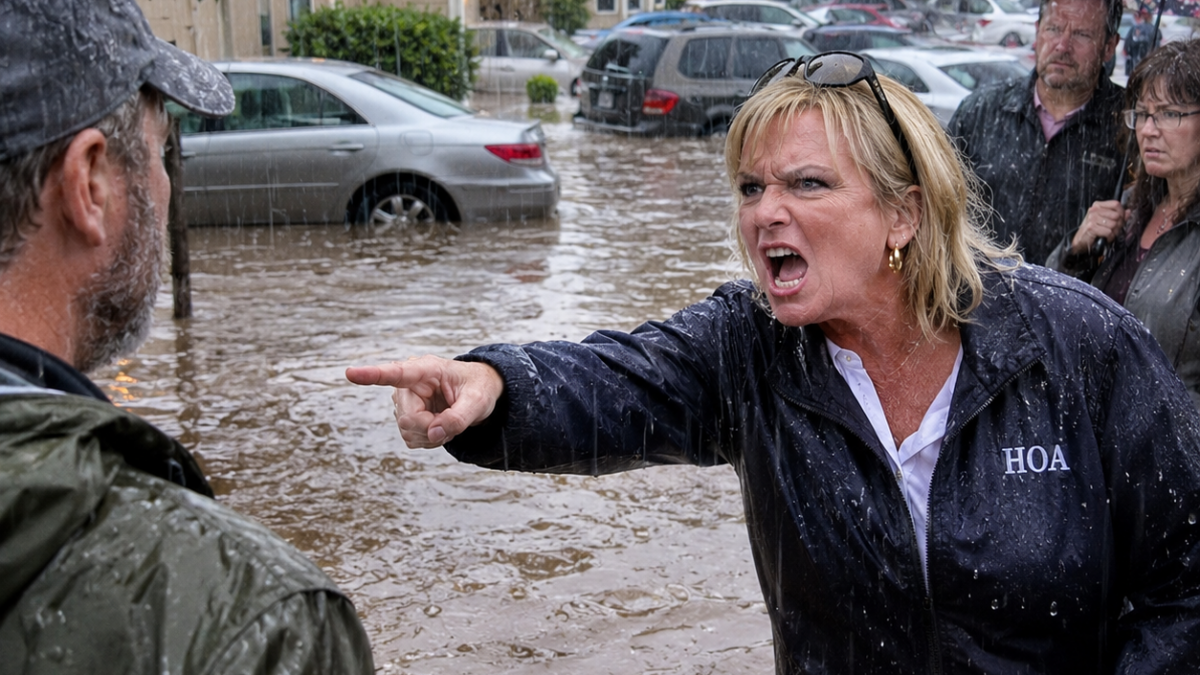
Mara came toward the fence.
Soaked.
Hair plastered to her face.
She pointed at me.
“You did this!”
“No.”
“You changed something!”
“I haven’t touched the drainage.”
“You flooded my lot!”
I pointed uphill.
Streams of runoff were pouring down from Silver Creek Estates.
“The water is coming from your streets.”
“You diverted it!”
“The water has always come through here.”
I pointed at the asphalt.
“That’s the only thing that changed.”
She screamed that I would pay for every damaged car.
I didn’t argue.
Then we heard a crack.
Sharp.
Loud.
Everyone turned.
The asphalt edge had begun to sag.
Water was cutting underneath the fill.
A fissure opened beside the curb.
A responder immediately ordered people back.
That was the moment Mara stopped shouting.
Flooded cars could be repaired.
Insurance could be argued over.
But if the pavement itself was being undermined, the whole project might have to come out.
By dawn, the rain weakened.
Mud covered the lot.
Branches.
Trash.
Silt.
Nine vehicles had substantial water damage.
Others needed inspection.
Mara’s SUV was among the worst.
Twenty-three cars had still been in the lot when conditions became dangerous, although several were moved before the deepest flooding.
The grand-opening banner hung crooked over a scene of total embarrassment.
Then Everett Hale arrived.
He walked the site with emergency officials.
Looked at the failed edge.
Looked at the drainage inlet.
Looked at the ten-inch pipe.
Then he opened the county’s old drainage plan.
His face changed.
“Grant.”
“Yeah?”
“Come here.”
He pointed.
The corridor was clearly marked.
STORMWATER CONVEYANCE — KEEP OPEN.
Everett looked toward the asphalt.
“Did they get approval to replace this?”
“Not that I’ve seen.”
He looked at Mara.
“What permit did you use?”
She started talking about resurfacing.
Everett stared at her.
“Resurfacing what?”
“The existing area.”
“There wasn’t pavement here.”
She didn’t answer.
By eight in the morning, the county closed the entire lot.
A red sign went up beside the gold grand-opening banner.
PARKING AREA CLOSED
FLOOD AND STRUCTURAL HAZARD
Less than twenty-four hours after Mara cut the ribbon, all forty-seven spaces were unusable.
The survey team came out after the water receded.
So did Sloan.
We walked the old elevations.
Checked the asphalt edge.
Measured the fill.
Inspected the places where water had carved underneath.
Sloan crouched beside one exposed section.
“This is worse than I expected.”
“Can they drill more drains?”
“No.”
“Bigger pipe?”
“Not without redesign.”
She stood.
“You can’t fix a blocked corridor by poking holes in the parking lot.”
Everett compared my property survey with the site plan.
Twelve feet of pavement crossed onto Bellamy Ranch in the widest location.
The county plan required an open drainage path.
The HOA had neither ownership nor a permit allowing it to fill the corridor.
Now they faced two problems.
Trespass.
And stormwater violations.
Then Wade Pard called Everett.
He turned over his emails.
His requests for drainage clarification.
His warning that he hadn’t seen an approved stormwater redesign.
And Mara’s written direction to continue.
That didn’t make Wade innocent.
He had still built the work.
His company still had questions to answer.
But it destroyed Mara’s claim that nobody warned her.
The county issued formal orders.
Parking lot closed.
No additional work.
No use.
Produce all permit records.
Submit a drainage-correction plan.
Preserve the site.
Norah filed for emergency relief.
The judge temporarily barred the HOA from using or expanding the disputed area.
Mara could no longer reopen it by board vote.
That should have been enough for her to reconsider.
Instead, she attacked me.
An email went to every homeowner.
According to Mara, abnormal runoff from Bellamy Ranch had caused the flood.
She implied I had interfered with drainage.
She told residents the HOA was considering suing me.
My phone started ringing.
One man shouted:
“My daughter’s car was in that lot!”
“I know.”
“You flooded it!”
“No.”
“Mara says—”
“I have video.”
He stopped.
“What video?”
“Runoff coming from your subdivision.”
Silence.
“I haven’t touched the drainage.”
Another homeowner called.
Then another.
I stopped answering.
Norah sent a formal demand that Mara correct the false claims.
We preserved footage.
My cameras showed the entire boundary.
No sabotage.
No blocked ditch.
No altered berm.
Nothing.
Only stormwater pouring downhill toward the asphalt.
Then Mara made her next mistake.
She proposed a special assessment.
Several thousand dollars per household.
To pay for repairs.
Residents packed the clubhouse.
Mara stood at the front.
“This was an unforeseeable natural disaster.”
A homeowner stood.
“You spent our reserve money on a parking lot that lasted six hours.”
“It was an extreme storm.”
“Now you want us to pay again?”
“Repairs are necessary.”
Another resident shouted:
“Why didn’t the lot drain?”
Mara blamed unusual runoff.
Then Taran stood.
She held a printed email.
“Mara.”
The room quieted.
“I found this in the archived system.”
Mara’s face changed.
“What is it?”
“Drainage Design Rejected — Parking Expansion.”
People began whispering.
Taran read the relevant paragraph.
The engineering consultant had warned that filling the swale and using a small pipe lacked proper drainage analysis.
The consultant recommended against constructing the lot until an approved alternative design existed.
Then Taran held up another document.
“This is the technical memo presented to the board.”
She placed both pages side by side.
“The warning is missing.”
Silence.
Mara said:
“That was a draft.”
Taran stared at her.
“Then why did the board never receive the version with the warning?”
Mara tried to explain.
Nobody believed her.
A man whose car had been damaged stood.
“You knew?”
“Mara?”
“Did you know?”
She raised her voice.
“We received conflicting technical information.”
Taran answered:
“No. You received a warning.”
The board froze further spending.
Then approved an independent audit.
Mara accused everyone of letting me manipulate them.
That didn’t work anymore.
The residents had seen their cars underwater.
They weren’t interested in speeches.
Norah strengthened my case.
My deed.
Survey.
Recorded easement.
County drainage plan.
Before-and-after elevations.
Sloan’s report.
Wade’s emails.
Mara’s handwritten response.
Storm footage.
Engineering warning.
Altered board memo.
Then Taran found the money.
$61,000.
Paid from the parking project.
Recipient:
WINTHROP SITE SERVICES LLC.
She looked up the state business records.
Mara owned an interest in the company.
The board had never been told.
Taran called me.
“Grant.”
“What happened?”
“There’s a payment.”
“How much?”
“Sixty-one thousand.”
“To who?”
“Winthrop Site Services.”
I went quiet.
“That’s hers?”
“Yes.”
“What was it for?”
“Consulting and coordination.”
“Did the board approve the conflict?”
“No disclosure in the minutes.”
Norah was careful.
“This doesn’t automatically prove fraud.”
“I know.”
“But it creates a serious conflict issue.”
Taran sent the findings to the HOA attorney.
Then the auditors.
Mara told her to keep quiet because disclosure could “damage the community.”
Taran’s response became famous inside Silver Creek.
“The parking lot was a bad decision. Hiding who got paid is something else.”
Six weeks after the flood, we went to court.
The back benches were filled with Silver Creek residents.
Some still had insurance claims pending.
Mara sat at the HOA table.
Navy suit.
Hair perfect.
No champagne.
Norah stood.
“This case isn’t about a storm.”
She let the sentence hang.
“It is about what the HOA knowingly built in the stormwater’s path.”
First came ownership.
My survey showed the encroachment.
The easement allowed water to cross my property.
It did not let the HOA pave my land.
It did not grant parking rights.
It did not transfer title.
Mara’s lawyers had no deed.
No license.
No written permission from me.
No easement authorizing construction.
Then Sloan testified.
She showed rainfall data.
About 3.7 inches over several hours.
Heavy.
But not some impossible once-in-five-hundred-years event.
She showed the watershed.
Twenty-one acres.
The elevation map.
The original open swale.
Then the fill.
Then the ten-inch pipe.
“What caused the flooding?” Norah asked.
“The runoff exceeded the replacement conveyance capacity.”
“In normal language?”
“The parking lot blocked the path the water had used for decades.”
“Was the rain alone responsible?”
“No.”
“Would the original swale have provided substantially greater conveyance?”
“Yes.”
“Was the parking lot built at the lowest collection point?”
“Yes.”
Wade testified next.
His company had responsibility too.
He admitted construction should have stopped for clarification.
But he produced emails showing he repeatedly asked about drainage.
Mara repeatedly pushed schedule.
Grand opening.
Fall festival.
No delay.
Then Norah placed the two technical memos on the screen.
Original.
Board version.
The warning paragraph was gone.
The judge leaned forward.
“Who prepared the version shown to the board?”
Mara answered carefully.
“I summarized technical information.”
“Why was the risk paragraph excluded?”
“I considered it preliminary.”
“Did you disclose that decision?”
“No.”
“Did you tell the board an engineer had recommended against construction pending further analysis?”
She hesitated.
“No.”
Then came the $61,000.
Taran testified.
Project budget.
Payment.
Winthrop Site Services LLC.
No conflict disclosure.
No board record showing members knew Mara had an interest.
Norah didn’t overreach.
She didn’t call it theft.
She didn’t call it fraud.
She asked simple questions.
“What services justified $61,000?”
Mara produced invoices.
Some were vague.
Coordination.
Project facilitation.
Vendor management.
“Do these invoices document specific hours?”
“Not all.”
“Deliverables?”
“Some.”
“Did you disclose your ownership interest before the HOA approved payment?”
“No.”
“Why?”
“I didn’t believe it was relevant.”
The courtroom went silent.
The judge looked at her.
“You personally pushed the project forward while a company in which you held an interest received money from its budget?”
Mara’s attorney stood.
The judge waved him down.
“I asked the witness.”
Mara answered:
“Yes, but the services were legitimate.”
That issue would continue separately.
For my case, the judge focused on land and drainage.
Then came the ruling.
The HOA could not use the disputed portion.
The work encroaching on Bellamy Ranch had to be removed.
The drainage corridor had to be restored under county-approved engineering.
The HOA would bear the restoration cost subject to separate allocation of responsibility among other involved parties.
Vehicle claims would be addressed through insurance and appropriate settlements.
Mara protested.
“Your Honor, the association has already spent $184,000.”
The judge looked over his glasses.
“The amount you spent does not create a right to build on another person’s land.”
Mara stopped.
“Nor does it authorize you to obstruct a protected drainage corridor.”
Outside the courthouse, reporters asked what I wanted.
I gave them one sentence.
“Give the water its path back.”
That was all.
I didn’t want HOA property.
Didn’t want the clubhouse.
Didn’t want Mara’s house.
Didn’t want damages from innocent residents beyond what the law required.
I wanted my land restored.
And I wanted the drainage safe.
Mara apparently thought she could resign and escape the worst of it.
Then Taran informed her the board had launched separate proceedings over the $61,000.
A few weeks later, crews returned.
This time there was no ribbon.
No quartet.
No catering.
No champagne.
Only construction fencing.
Pavement saws.
Excavators.
Dump trucks.
I stood on my side of the boundary.
The saw cut through asphalt.
A machine lifted the first slab.
Fresh pavement cracked.
Rolled.
Fell into a truck.
Mara appeared on the subdivision street.
She stood alone.
Watched.
One decorative light pole came down.
Then another.
White parking lines vanished beneath broken chunks.
The grand-opening sign was gone.
One neighbor walked past Mara.
Stopped.
Looked at the demolition.
Then asked:
“Wasn’t this supposed to increase our property values?”
Mara said nothing.
She walked away.
I would be lying if I said that moment wasn’t satisfying.
It was.
She had stood in that lot declaring nothing could stop her.
Now the same asphalt she called progress was being hauled away because the law said it never belonged there.
But satisfaction faded quickly.
Restoration was messy.
Expensive.
Slow.
Crews removed compacted fill under engineering supervision.
They couldn’t simply dig everything out at once.
The channel had to be rebuilt safely.
Banks stabilized.
Grades restored.
Drainage capacity checked.
Eroded edges repaired.
County inspectors came repeatedly.
The final financial picture was ugly.
Original construction:
$184,000.
Demolition and swale restoration:
About $136,000.
Vehicle damage handling and claims:
About $92,000.
Engineering, auditing, and legal costs:
Another $48,000.
Roughly $460,000 in total losses and expenses tied to one parking project.
Insurance covered parts of some claims.
Settlements shifted other responsibility.
But residents still paid through lost reserves, canceled events, higher professional costs, and months of chaos.
The revenue Mara had promised never materialized.
The board had to redesign its budget.
Future events requiring extra parking were canceled or moved.
Eventually, the HOA found legal parking options on land it actually owned.
Nothing glamorous.
Just parking.
That became the joke.
After losing nearly half a million dollars, Silver Creek Estates discovered that boring solutions were cheaper.
Then came the recall.
Forty-four valid ballots.
Forty-one to remove Mara.
Three against.
She lost.
Not because I voted.
I couldn’t.
I wasn’t a member.
Her own neighbors removed her.
Taran joined the interim board.
The audit continued.
Invoices tied to Winthrop Site Services were reviewed.
Contracts.
Approvals.
Conflicts.
Documentation.
Eventually, the HOA filed a civil claim seeking recovery of the $61,000.
Mara resisted.
Then settled.
Under a written repayment schedule, she agreed to return the entire amount.
Personal obligation.
Not paid from HOA funds.
That mattered.
For months she had treated association money like an extension of her authority.
Now she had to write checks back into the community she had nearly buried financially.
Two months after the court-ordered restoration began, the swale was finished.
Not beautiful in the way Mara understood beautiful.
No blacktop.
No lights.
No painted lines.
No stone sign.
Just green banks.
Fresh seed.
Proper stabilization.
A low open corridor curving along my fence.
Exactly what had been there before.
I walked the boundary with Everett and Sloan on final inspection day.
Everett checked the restored monuments.
Sloan checked grades.
The county engineer confirmed the flow path.
“Good,” Sloan said.
“That it?”
“That’s it.”
I looked down.
“It doesn’t look like much.”
She smiled.
“Good drainage usually doesn’t.”
That was true.
Nobody throws a ribbon-cutting ceremony for a ditch that quietly does its job.
Water infrastructure is invisible when it’s working.
People only notice when it fails.
A small metal plaque went up near the subdivision side.
PROTECTED STORMWATER DRAINAGE
KEEP CLEAR
No mention of Mara.
No mention of me.
Just the rule that should have been respected from the beginning.
A few weeks later, another storm came.
Not as dramatic as the first.
But heavy enough.
I stood beneath the equipment barn overhang.
Same place.
Same view.
Rain hammered the roof.
Water came down the hill.
I watched it reach the restored swale.
For a second, it collected.
Then turned south.
Smoothly.
Exactly as designed.
No ponding.
No alarms.
No headlights underwater.
No emergency vehicles.
No Mara screaming through the fence.
Just water moving where gravity had always intended.
I stood there longer than necessary.
Maybe because for the first time since the project began, the rain didn’t make me angry.
I heard a truck behind me.
Taran stepped out carrying an umbrella.
“You came to inspect the ditch?”
“Swale.”
“Sorry.”
She smiled.
We watched the water.
“The board got the second repayment from Mara.”
“Good.”
“Still feels strange.”
“What does?”
“All of it.”
She looked toward the green corridor.
“Forty-seven parking spaces.”
“Yep.”
“Nearly half a million dollars.”
“Yep.”
“All because she couldn’t accept being told no.”
I thought about that.
“Partly.”
“What else?”
“She thought finishing made her right.”
Taran nodded.
“That was always her strategy.”
“If she could get the asphalt down before the court acted, she thought nobody would make her remove it.”
“She said exactly that in one meeting.”
I looked at her.
“What?”
“Not those exact words.”
Taran remembered.
“She said, ‘Once residents start using it, nobody will seriously consider tearing it out.’”
I laughed quietly.
“That aged well.”
For the first time in months, Taran laughed too.
Then she became serious.
“I should have stopped it.”
“You tried.”
“Not hard enough.”
“You asked for ownership documents.”
“I let the vote happen.”
“You were one board member.”
“I still knew something felt wrong.”
I understood the guilt.
Wade had it too.
Sloan didn’t.
She had warned everyone clearly.
But Taran and Wade had both seen pieces of the problem and let Mara’s certainty push past their doubts.
“I’ll tell you what my father used to say.”
Taran looked at me.
“If somebody drives through a stop sign, the person in the passenger seat doesn’t become the driver.”
She thought about that.
“But the passenger can yell.”
“Yes.”
“I should have yelled sooner.”
“Probably.”
She laughed.
“You’re terrible at making people feel better.”
“I’ve been told.”
“But you’re right.”
The rain intensified.
Water rushed faster.
Still inside the channel.
Taran stared at it.
“It works.”
“It always worked.”
That was the part that bothered me most.
Mara hadn’t solved a problem.
She had destroyed a solution.
The swale existed because generations of water had already shown everyone where the low ground belonged.
The original development engineers understood it.
The county understood it.
My family’s records understood it.
All Mara had to do was leave it alone.
But leaving something alone didn’t look like leadership.
A new parking lot did.
Forty-seven painted spaces.
Decorative lights.
A banner.
A speech.
Photos.
A ribbon.
That was progress you could point at.
A grass channel quietly carrying stormwater?
Nobody applauds that.
Maybe that was the deeper problem.
People often confuse visible construction with improvement.
Sometimes the best infrastructure is the thing you don’t touch.
After the flood, Silver Creek changed.
The HOA wasn’t magically perfect.
People still argued.
Landscaping budgets.
Pool hours.
Fence colors.
Normal nonsense.
But board meetings became different.
Documents were attached to agendas.
Vendor ownership had to be disclosed.
Large capital projects required independent technical review.
Conflicts of interest had to be stated in writing.
Residents could inspect supporting records before votes.
Taran insisted on one new rule.
“No board member may summarize an engineering report without attaching the original.”
That one made me laugh.
She said:
“I’m serious.”
“I know.”
“No more edited warnings.”
“Good rule.”
Silver Creek residents also learned something about experts.
Before the flood, Mara had dismissed Sloan as “Grant’s engineer.”
Afterward, residents wanted to know why the HOA hadn’t hired its own independent hydrologist.
Expert disagreement is normal.
Ignoring expertise because the conclusion is inconvenient isn’t.
Wade’s company faced its own consequences.
Insurance.
Contract review.
Professional scrutiny.
He came by the ranch one afternoon.
Got out of his pickup.
Stood awkwardly beside my barn.
“I owe you an apology.”
“You already testified.”
“That doesn’t repair anything.”
“No.”
He took off his cap.
“I should’ve walked.”
“When?”
“When she wouldn’t give me drainage approval.”
“Probably.”
“I knew the pipe looked small.”
“You built it anyway.”
“Yes.”
I didn’t make it easier for him.
He needed to own that.
Then he said:
“I’ve changed my contracts.”
“How?”
“If a property boundary is disputed, work stops.”
“Good.”
“If stormwater modification isn’t permitted, work stops.”
“Also good.”
“No owner override.”
I smiled.
“Mara inspire that clause?”
He laughed.
“It’s called the Winthrop provision in the office.”
“Seriously?”
“No.”
He grinned.
“But it should be.”
We shook hands.
I didn’t forgive the construction itself.
Not completely.
But people can make bad decisions and learn.
Mara’s problem was that she had chances to stop.
Many.
She saw the survey.
Ignored it.
Saw Sloan’s warning.
Dismissed it.
Received the technical memo.
Removed its warning from the board packet.
Heard Wade’s concerns.
Ordered him forward.
Received my certified notice.
Wrote back:
YOUR PERMISSION IS NOT REQUIRED.
Every step gave her another exit.
She chose the wall every time.
That’s why the first storm became so devastating legally.
The rain didn’t create her decisions.
It revealed them.
The water didn’t care about HOA politics.
Didn’t care about ribbon-cuttings.
Didn’t care whether residents thought I was difficult.
Didn’t care whether Mara’s SUV cost ninety thousand dollars.
Water followed elevation.
That’s all.
Gravity was the only participant in the dispute that never changed its story.
Months later, Mara’s repayment schedule became public through the HOA records.
Some residents wanted more.
They wanted criminal charges.
Personal bankruptcy.
Public humiliation.
I stayed out of it.
My case was finished.
My land was restored.
The county handled its rules.
The HOA handled its money.
Insurance companies handled vehicle claims.
Whatever else happened needed to happen through proper channels.
One resident asked me:
“Aren’t you angry she isn’t paying the full $460,000 personally?”
“No.”
“Why not?”
“Because she didn’t personally cause every dollar.”
“She started it.”
“Yes.”
“But?”
“Contractors made decisions. Board members approved spending. Insurance covers certain losses. Legal responsibility isn’t the same as emotional responsibility.”
He seemed disappointed.
People like simple endings.
One villain.
One bill.
One punishment.
Reality is messier.
Mara carried the largest moral responsibility in my eyes because she knowingly pushed the project.
But the law had to separate who did what.
That was fine with me.
I never wanted revenge badly enough to stop caring about fairness.
What I wanted was accountability.
There’s a difference.
Revenge says:
Make her hurt.
Accountability says:
Put the consequences where they belong.
The second is slower.
Less dramatic.
But it lasts.
One Saturday, a family from Silver Creek walked along the boundary.
A father.
Mother.
Two children.
The little boy pointed at the swale.
“Dad, is that the place the cars flooded?”
His father looked embarrassed when he saw me nearby.
“Yes.”
The boy looked disappointed.
“But it’s just grass.”
I laughed.
His father did too.
“That’s kind of the point.”
The boy asked:
“Where was the parking lot?”
I pointed.
“Right there.”
“Why’d they put it there?”
His father and I looked at each other.
Finally, I answered:
“Because someone thought dry ground and safe ground were the same thing.”
The boy frowned.
“They’re not?”
“No.”
“Why?”
“Because water remembers where it goes.”
He thought about that.
Then ran ahead.
His father stayed behind.
“I was angry at you.”
“I know.”
“I called your attorney.”
“I remember.”
“I said you caused the flood.”
“I remember that too.”
He rubbed the back of his neck.
“Sorry.”
“You believed what your president told you.”
“I should’ve looked.”
“Yes.”
He smiled.
“You really don’t soften anything.”
“No point.”
He looked toward his kids.
“We stayed.”
“In Silver Creek?”
“Yeah.”
“Good.”
“I almost sold.”
“Why didn’t you?”
“New board.”
He shrugged.
“People finally started showing up.”
That mattered more than he probably realized.
Organizations get dangerous when ordinary members decide attention is somebody else’s job.
Mara gained power because residents liked the results.
Clean lawns.
Fast decisions.
Fancy events.
She handled problems.
Nobody wanted to read stormwater reports.
They wanted parking.
That created a vacuum.
Mara filled it.
Afterward, people started paying attention.
Not obsessively.
Just enough.
Enough to ask:
Who owns this land?
Who gets this contract?
Where’s the engineering report?
Has the conflict been disclosed?
What does insurance actually cover?
Simple questions.
Cheap questions.
Questions that could have saved hundreds of thousands of dollars.
Eventually, Silver Creek built additional parking.
On higher ground.
Near the tennis courts.
The exact area I had suggested originally.
Twenty-nine spaces instead of forty-seven.
Permeable pavement in part of the layout.
Proper drainage.
Real permits.
No encroachment.
No flood basin.
The project cost less than repairing the mistake.
Taran sent me the plans before construction.
Not because she legally needed my approval.
Just courtesy.
“Thought you’d enjoy this.”
I opened the email.
Scrolled.
The drainage calculations were attached.
I laughed.
Then replied:
Looks boring.
She answered:
Perfect.
The new parking opened without a party.
No champagne.
No banner.
No quartet.
Residents parked.
Went inside.
Went home.
Nobody wrote an article.
Nobody filed a lawsuit.
Nobody flooded.
That is what success often looks like.
Nothing happens.
A year after the original flood, another severe storm arrived.
The weather service issued warnings.
Thunder shook the barn.
Rain poured.
I stood outside again.
Not because I was worried.
Because anniversaries have a way of pulling you back.
At 1:17 a.m., I checked my watch.
Same time.
Different year.
The restored swale was full.
Water rushing.
Fast.
Brown.
But contained.
The banks held.
The outlet carried the flow south.
Across the fence, Silver Creek’s legal parking sat dry on higher ground.
I thought about Mara’s SUV.
The grand-opening sign.
The submerged white lines.
Her finger pointing through the rain.
You did something to the drainage.
No, Mara.
You paved over the only place the water could go.
I didn’t say it out loud this time.
No need.
The landscape had already delivered its verdict.
The next morning, I walked the swale.
A few branches caught in the grass.
Some silt.
Nothing unusual.
I picked up a plastic bottle.
Straightened the metal drainage plaque.
Then stood looking north.
Sunlight broke through the clouds.
Water continued south.
Years earlier, I had thought winning meant stopping the asphalt before it went down.
When I failed, I felt powerless.
I remember standing at my fence as the roller finished.
Black pavement where grass had been.
Mara smiling.
It’s finished. There’s nothing he can do now.
That sentence lived in my head for months.
Because there is something psychologically powerful about finished construction.
Once concrete hardens or asphalt cools, people treat it like destiny.
Too late.
Already done.
Too expensive to reverse.
Move on.
That mindset protects bad decisions.
Mara counted on it.
She thought the cost of undoing the project would pressure everyone into accepting it.
Residents would say:
We already spent the money.
The court would say:
Removing it is wasteful.
The county would find a workaround.
I would eventually take compensation.
But wrongful construction doesn’t become rightful because demolition is inconvenient.
That’s the lesson I carried forward.
If somebody builds on your property without permission, their expense doesn’t become your obligation.
If somebody blocks a drainage corridor, the cost of fixing it doesn’t make water safer.
And if a leader hides warnings to get a vote, finishing the project doesn’t erase what they knew.
I never gained anything from the fight.
People sometimes misunderstood that.
I didn’t receive forty-seven parking spaces.
Didn’t take HOA land.
Didn’t charge Silver Creek to use my ranch.
Didn’t get some giant payday.
What I got was what I started with.
My boundary.
My swale.
My safe drainage.
That’s all.
The fight cost me time.
Stress.
Attorney meetings.
Survey fees.
Hours documenting machines instead of running the ranch.
And emotionally, it cost more.
For weeks, I woke every time heavy rain hit the roof.
I imagined water climbing higher.
Someone being hurt.
A firefighter slipping.
A child running toward a car.
We got lucky.
Cars were damaged.
Property was lost.
But nobody died.
That mattered more than every legal victory.
Sometimes I wondered whether Mara ever understood how close her pride came to making the story much worse.
The employee who refused to move her SUV made the right choice.
If he had walked deeper into moving water, anything could have happened.
A car isn’t worth a life.
A parking lot definitely isn’t.
Years later, I saw Mara once at a county hardware store.
She was standing in the garden section.
No HOA badge.
No clipboard.
No audience.
We noticed each other.
I expected her to leave.
She didn’t.
Instead, she approached.
“Grant.”
“Mara.”
For a few seconds, neither of us spoke.
Then she asked:
“Still running cattle?”
“Yeah.”
She looked older.
So did I.
“The swale still working?”
I almost laughed.
“Every storm.”
She nodded.
“I heard.”
Silence.
Then she said:
“You got what you wanted.”
That bothered me.
“Did I?”
“Your land back.”
“I already had it.”
She looked away.
“You know what I mean.”
“No.”
I stepped closer.
“What I wanted was for you not to pave it.”
She didn’t answer.
“I wanted you to read the survey.”
Silence.
“I wanted you to listen to Sloan.”
Nothing.
“I wanted you to tell the board the truth.”
Her jaw tightened.
“Things were complicated.”
“No.”
I shook my head.
“They got complicated after you ignored the simple part.”
She looked at me.
“What simple part?”
“You didn’t own the dirt.”
That ended the conversation.
She walked away.
I didn’t feel victorious.
Just tired.
That encounter helped me understand something.
Mara probably always told herself a different version.
Maybe she believed the project was good for the community.
Maybe she thought I was unreasonable.
Maybe she convinced herself the drainage warnings were conservative engineering.
Maybe she believed taking $61,000 through her company was legitimate because she did coordination work.
People rarely see themselves as villains.
They build stories where every compromise feels necessary.
Every omitted detail is harmless.
Every warning is exaggerated.
Every opponent is difficult.
Then one day, water is up to the windows.
The hardest part isn’t the flood.
It’s admitting the flood began long before the rain.
It began when she decided a survey was negotiable.
When she decided an easement meant ownership.
When she decided an engineer’s warning was inconvenient.
When she removed the paragraph.
When she told Wade to continue.
When she wrote:
YOUR PERMISSION IS NOT REQUIRED.
When she left cars in the lowest part of the site because moving them would look like doubt.
The storm only arrived at the end.
After that encounter, I stopped thinking about Mara much.
The ranch demanded attention.
Cattle don’t care about lawsuits.
Hay doesn’t care who won a recall vote.
Fence posts still rot.
Tractors still break.
Rain still comes.
That normal life was the part I had missed most.
For months, every trip to the east pasture reminded me of conflict.
Orange stakes.
Dump trucks.
Asphalt.
Flood debris.
Engineers.
Survey flags.
Restoration crews.
Eventually, the grass filled in.
The soil settled.
Wildflowers returned.
By the third spring, you had to know exactly where to look to recognize there had ever been a parking lot.
That might have been the most satisfying revenge of all.
Not seeing Mara suffer.
Watching the land forget her.
Nature covered the scars.
The drainage returned to doing what it had done for decades.
Water came.
Water left.
No speeches required.
One evening, my niece visited the ranch.
She was nine.
We walked toward the east pasture.
She saw the metal plaque.
“Protected stormwater drainage.”
She read it slowly.
“Uncle Grant, what’s stormwater?”
“Rain after it hits the ground.”
“Why does it need protection?”
“Because people like to build things where water wants to go.”
She frowned.
“Why?”
“Usually because it’s cheap land.”
“Was somebody building here?”
“Parking lot.”
She looked at the grass.
“Where?”
“Here.”
“No way.”
“Forty-seven spaces.”
She stared.
“What happened?”
“It rained.”
She waited.
“That all?”
“Pretty much.”
She looked disappointed.
Kids want dramatic stories.
I smiled.
“Then the parking lot flooded.”
Her eyes widened.
“All the cars?”
“Some.”
“Did you know it would?”
“I knew it could.”
“Did you tell them?”
“Many times.”
“Did they listen?”
“No.”
She shook her head with the absolute judgment only a nine-year-old can deliver.
“That’s dumb.”
I laughed.
“Engineering summary complete.”
She ran ahead.
I stood near the swale.
Maybe the whole story could be reduced to that.
Someone knew enough to warn.
Someone powerful refused to listen.
Then physics answered.
But the adult version mattered because consequences aren’t always immediate.
Mara’s mistake cost more than asphalt.
Residents lost trust.
People lost money.
Cars were damaged.
The HOA reserve was weakened.
Lawyers got involved.
Insurance claims dragged on.
Neighbors turned against one another.
Taran carried guilt.
Wade carried guilt.
Residents who accused me had to live with realizing they had defended the wrong person.
A bad infrastructure decision creates social damage too.
That’s harder to calculate.
The final project total was around $460,000 in direct losses and expenses.
But there was no line item for embarrassment.
No invoice for mistrust.
No receipt for the months Silver Creek residents spent wondering whether their own board had lied to them.
No calculation for the hours I spent defending myself against sabotage claims.
Those costs were real.
Eventually, Taran was elected HOA president.
She didn’t want the job.
That was probably why she was good at it.
Her first capital-project meeting started differently from Mara’s.
Before presenting anything, Taran put a stack of documents on the table.
Survey.
Budget.
Engineering report.
Vendor disclosures.
Permits.
Then said:
“Read these first.”
Someone joked:
“Do we get champagne afterward?”
Taran answered:
“Only if nothing floods.”
The room laughed.
Humor helped.
Silver Creek didn’t need to spend forever ashamed of what happened.
Communities recover by learning.
Not by pretending.
One day, Taran asked whether I’d consider serving as an informal reviewer on future stormwater projects.
“No.”
She looked surprised.
“That fast?”
“I’m not joining the HOA by accident.”
She laughed.
“Fair.”
“But if something affects my boundary, send it over.”
“I will.”
“And hire your own engineer.”
“We do now.”
“Good.”
The new board eventually added a sentence to its capital-project policy:
No improvement may proceed based solely on an easement without review of the easement’s precise legal scope.
That existed because of my swale.
Another rule required full attachment of technical reports.
Another required conflict disclosure.
Mara probably hated knowing that.
I loved it.
Not because her name was attached.
It wasn’t.
Because mistakes had been converted into safeguards.
That’s the best use of a disaster.
Don’t just repair the damage.
Make repetition harder.
The swale itself became more protected than before.
Survey markers reset.
County records updated.
Drainage designation reaffirmed.
Signs installed.
No future board could plausibly call it an unused ditch.
In trying to bury it, Mara made everyone learn exactly what it was.
That irony never stopped satisfying me.
The lot had been her monument.
The swale became mine.
Except I didn’t need a ribbon.
On the fifth anniversary of the flood, a storm came through after dark.
I stood under the barn overhang with coffee.
Not because I was worried.
Habit.
The restored channel filled.
Water moved.
Moonlight reflected off the surface.
Across the boundary, cars sat safely on higher ground.
No alarms.
No shouting.
No tow truck.
Just rain.
I thought back to 1:17 that first night.
Mara’s SUV disappearing.
Her accusation.
The asphalt cracking.
The warning letter inside my jacket.
Your permission is not required.
Those four words had once made me feel powerless.
Now they felt absurd.
Permission isn’t about ego.
It’s not something you demand because you want respect.
Permission is part of how society distinguishes your property from mine.
Your authority from my rights.
Your plan from my obligation.
Mara thought she could skip that step because her project was popular.
Popular isn’t legal.
Expensive isn’t legal.
Finished isn’t legal.
And confidence isn’t engineering.
The storm taught all of that in one night.
The court taught it again months later.
But the water taught it first.
Water doesn’t argue.
It doesn’t get intimidated.
You can’t fine it.
Can’t threaten it.
Can’t call it difficult at a board meeting.
Can’t remove a paragraph from its report.
You can block it.
For a while.
Then pressure builds.
And eventually, it finds the truth in the landscape.
That was what happened to Silver Creek.
Mara buried the swale.
The first storm uncovered the mistake.
Then the investigation uncovered the warnings.
The audit uncovered the money.
The court uncovered the limits of the HOA’s power.
And her own neighbors uncovered their courage to remove her.
Layer after layer.
Until nothing remained except the facts.
My land was mine.
The drainage path mattered.
The parking lot didn’t belong there.
The warnings had been real.
And Mara had known more than she admitted.
People sometimes ask whether watching her parking lot get ripped out felt like revenge.
Yes.
For about five minutes.
I’d be lying otherwise.
Watching fresh asphalt loaded into dump trucks after she told me nothing could stop her?
There was satisfaction in that.
Watching her company repay $61,000?
Satisfying.
Hearing the recall vote was forty-one to three?
Also satisfying.
But revenge wasn’t the ending I remember most.
I remember the second storm.
Water entering the restored swale.
Moving south.
Leaving everything else untouched.
That was better.
Because revenge depends on Mara.
Peace didn’t.
Once the land was restored, her choices stopped controlling my property.
That’s freedom.
Not seeing your enemy punished.
Seeing their damage stop defining your day.
I finished my coffee.
Rain continued falling.
The swale continued working.
At the old parking entrance, the small metal plaque shone beneath a security light.
PROTECTED STORMWATER DRAINAGE.
KEEP CLEAR.
No grand-opening sign.
No “community investment.”
No president’s name.
Just six words that told the truth.
Mara spent $184,000 trying to bury my drainage swale beneath forty-seven parking spaces.
The first storm took her lot.
The court took the asphalt.
Her own neighbors took her presidency.
And in the end, all I wanted—and all the water ever needed—was the same thing.
Its path back.
::








