PART 2: HOA Ordered Me to Tear Down the Dam Protecting 200 Homes — Three Days Later Their Streets Were Underwater
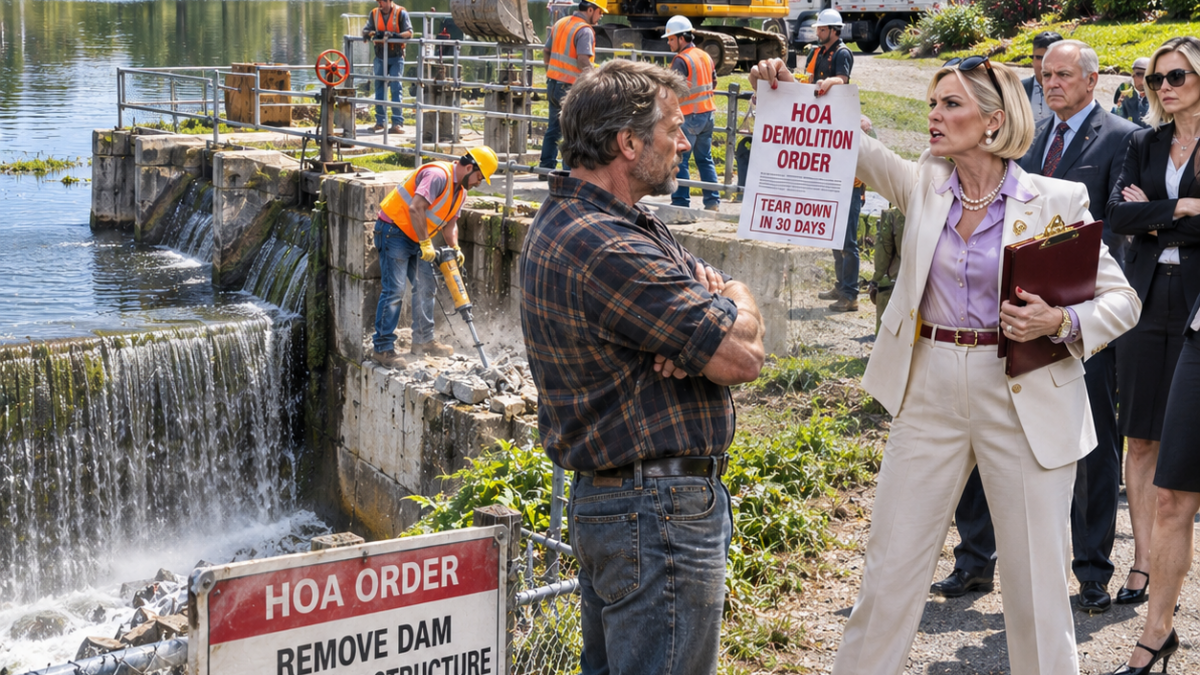
PART 2
Thursday night, I walked into the Willowbrook community center carrying a folder.
Patricia had an army.
Or at least she wanted it to look that way.
Five board members sat behind folding tables arranged in a shallow semicircle.
Patricia occupied the center position.
Beside her sat Sharon Kellerman, the board treasurer and Patricia’s closest ally.
Kevin Walsh sat at the opposite end.
He looked uncomfortable before I even took my seat.
Two other board members stared at their phones.
Patricia folded her hands.
“Mr. Sterling.”
“Alexander is fine.”
“Mr. Sterling, you constructed an unauthorized water-control structure that substantially alters natural drainage patterns.”
“Correct on the water-control structure. Incorrect on the rest.”
Her nostrils flared.
Sharon slid a document across the table.
“Thirty-day notice of required remediation.”
I read the first page.
Then the second.
Then I reached the number.
$60,000.
I looked up.
“What exactly costs sixty thousand dollars?”
Patricia answered.
“Environmental restoration.”
“To restore what?”
“The original flow pattern.”
I nearly laughed.
“You mean the flow pattern created when Drummond Development filled wetlands and removed half the retention infrastructure from the approved 1987 plan?”
Silence.
Not total silence.
The fluorescent lights buzzed.
Someone shifted in a plastic chair behind me.
Patricia recovered.
“That has nothing to do with this discussion.”
“It has everything to do with it.”
Sharon leaned forward.
“Your dam is creating environmental risk.”
“According to whom?”
“Our consultant.”
I opened my folder.
“Great. What are his credentials?”
Patricia gave me a thin smile.
“Tommy Kellerman has extensive experience managing water systems.”
Kevin Walsh cleared his throat.
Patricia looked toward him.
“What?”
Kevin opened his phone.
“Tommy Kellerman?”
“Yes.”
“Sharon’s nephew?”
Sharon stiffened.
“That relationship is irrelevant.”
Kevin continued reading.
“Owner of Kellerman Pool Solutions?”
Nobody answered.
He looked at me.
“He installs automatic pool covers.”
I bit the inside of my cheek.
Patricia slammed one hand lightly against the table.
“The board has reviewed the matter.”
“With a pool-cover installer?”
“Mr. Sterling.”
I opened my engineering assessment.
Twelve pages.
Hydraulic calculations.
Site photographs.
Rainfall assumptions.
Flow estimates.
Storage capacity.
Downstream conditions.
“I spent twenty-five years designing stormwater infrastructure,” I said. “My system stores and slowly releases roughly forty thousand gallons during a typical heavy-rain event. That reduces the peak flow going into a neighborhood drainage network already operating beyond what it was originally designed to handle.”
Patricia smiled as if I had proven her point.
“You admit altering water flow.”
“I admit controlling it.”
“Without board permission.”
“Public safety doesn’t become unsafe because you didn’t vote on it.”
She pushed the notice toward me.
“Thirty days.”
“Or sixty thousand dollars.”
“And continuing penalties.”
“How much?”
“Two thousand dollars per week after the deadline.”
I stared at her.
She stared back.
That was the moment the dispute changed.
Before that meeting, I thought Patricia was wrong.
Maybe arrogant.
Maybe overly rigid.
But sixty thousand dollars wasn’t enforcement.
It was coercion.
And when people use oversized penalties to stop reasonable questions, there is usually something underneath the argument they don’t want examined.
I stood.
“Then I guess I have thirty days.”
Patricia smiled.
“I’m glad we understand each other.”
“We don’t.”
Her smile disappeared.
“I have thirty days to figure out why you’re so desperate to make me remove something that protects half your neighborhood.”
Kevin found me in the parking lot.
“Alexander.”
I stopped.
He glanced toward the community center.
“Keep your voice down.”
“I’m not the one hiding.”
He sighed.
“You don’t understand how Patricia operates.”
“I’m beginning to.”
“She’s done this for years.”
“With drainage systems?”
“With anything.”
He shoved his hands into his jacket pockets.
“New residents get violations. Her friends get exceptions. If somebody challenges her, the fines multiply.”
“Why hasn’t anyone voted her out?”
“Because most people don’t want another job.”
I understood that.
Small organizations become dictatorships because normal people have lives.
The person willing to attend every meeting, write every email, interpret every rule, and argue for three hours over mailbox colors eventually accumulates power simply because everybody else is exhausted.
Kevin continued.
“Remember the Patels?”
“No.”
“Lived on Brookside. Patricia forced them to rebuild their fence twice. Claimed the stain color was wrong.”
“Twice?”
“Second time she said the replacement boards were inconsistent width.”
“What happened?”
“They sold.”
That word bothered me.
“Who bought the house?”
Kevin looked at me strangely.
“Why?”
“Curiosity.”
“No idea.”
“I’ll find out.”
The next morning, I drove to the county planning office.
There are places where history is hidden in dramatic vaults.
County records are not one of them.
History there lives in beige folders beneath fluorescent lights beside a printer that jams every fourth page.
I started with Willowbrook’s original subdivision plat.
Then grading plans.
Stormwater calculations.
Permit revisions.
Inspection records.
The original design was exactly what I expected.
Multiple retention areas.
Open channels.
Larger outfalls.
More flood-storage capacity.
The final as-built record was different.
Smaller pond.
Additional lots.
Reduced storage.
Modified drainage.
One engineering signature appeared repeatedly.
I searched the name.
His professional license had been suspended shortly after Willowbrook was completed for fraudulent documentation on unrelated projects.
I sat back.
Interesting.
Then I found Drummond Development.
Original owner.
Developer.
Builder.
Patricia’s father-in-law.
The company had dissolved years ago.
But Bradley Drummond had later operated a construction business that received city contracts.
I copied everything.
My next stop was the Melanie house.
Mrs. Melanie had lived two streets downhill from me for twelve years.
When she opened the basement door, I smelled mold before we reached the stairs.
Her sump pump ran continuously.
“Every spring,” she said.
Water marks striped the concrete wall.
“How many times has it flooded?”
“Four badly. Maybe eight if you count smaller ones.”
“Insurance?”
“They dropped us.”
“After how many claims?”
“The fourth.”
Her voice carried no anger anymore.
That was worse.
It carried fatigue.
People become dangerous to corrupt systems when they are angry.
Fatigue is safer.
Fatigue makes them surrender.
Mrs. Melanie pointed to a wall.
“My husband used to have a workshop down here.”
“What happened?”
“After the third flood, he stopped rebuilding.”
The Kowalskis had spent fifteen thousand dollars waterproofing their basement.
It still leaked.
The Martinez family had lost their children’s playroom twice.
Maria Martinez showed me photographs of toys floating in brown water.
“We stopped using the basement,” she said.
“How long ago?”
“Three years.”
“Why didn’t the HOA address it?”
She laughed once.
“Patricia said groundwater is an owner-maintenance issue.”
“Did anyone ask about the storm drains?”
“Several people.”
“What happened?”
“Meetings. Committees. Assessments. Nothing.”
“Any special assessments for drainage?”
She nodded.
“Twice.”
That got my attention.
“How much?”
“Three thousand the first time. Twenty-five hundred the second.”
“For every house?”
“I think so.”
Two hundred houses.
Even if only a portion paid the full amount, that was serious money.
“What work did they say they performed?”
“Emergency drainage improvement.”
“Where?”
She shrugged.
That evening, I went through city contracts.
Bradley Drummond’s construction company appeared again.
Storm repair.
Emergency pumping.
Drainage rehabilitation.
Culvert improvement.
Millions over several years.
The same neighborhood that supposedly received repeated infrastructure improvements still flooded.
That doesn’t automatically prove fraud.
But engineers learn to distrust repeated repairs that never improve performance.
Either the diagnosis is wrong, the work is bad, or the work isn’t happening.
I called the city engineering department.
That was how I met Janet Rodriguez.
She pulled into my driveway three days later in a city sedan.
No dramatic entrance.
No entourage.
Just a measuring wheel, inspection tablet, rain boots, and the quiet confidence of someone who knew what she was looking at.
We spent forty minutes around the dam.
She checked the spillway.
Measured grades.
Reviewed my calculations.
Asked good questions.
The kind where you know the other person already understands half the answer and is testing whether you understand the rest.
Finally, she stood.
“This is good work.”
“I’ll frame that.”
“I’m serious.”
“So am I.”
She looked downstream.
“This neighborhood has deficiencies.”
“I know.”
“You’ve been digging.”
“I’m an engineer. It’s a disease.”
She smiled.
“Your structure reduces downstream peak flow.”
“Exactly.”
“Probably significantly.”
“Exactly.”
“Did you file the minor grading notification?”
“Yes.”
She scrolled.
“Found it.”
“That’s everything the city required.”
“Yes.”
A voice interrupted us.
“This is private HOA property business.”
Patricia.
I turned.
She had entered my yard without permission again.
Janet looked at her.
“Patricia Drummond?”
“Yes.”
“I’m Janet Rodriguez, deputy city engineer.”
“I know who you are.”
“Good. Then you know stormwater falls within city jurisdiction.”
“The HOA has independent authority over architectural and environmental modifications.”
“Not authority to require removal of a system if doing so creates a public drainage concern.”
Patricia stiffened.
“My husband sits on the city council.”
Janet’s expression changed by half an inch.
That was enough.
“Councilman Drummond recused himself from Willowbrook drainage review last year.”
Patricia blinked.
“Why?”
“Conflict concerns involving historical family development interests.”
The temperature seemed to drop.
“Who told you that?”
“It’s in the meeting record.”
Patricia looked at me.
“You’ve turned this into something much larger than necessary.”
“No,” I said. “I asked why my basement floods.”
She walked away.
Her BMW accelerated hard enough to throw gravel.
Janet watched the car disappear.
“She’s subtle.”
“You should see her board meetings.”
Then Janet told me something important.
“Forty-seven documented flood-insurance claims in Willowbrook in the last several years.”
“How much?”
“More than three hundred thousand in reported residential losses.”
“And city repair contracts?”
Her face became cautious.
“That’s outside what I can discuss informally.”
“Which means yes.”
“Which means nothing.”
“Engineer answer.”
“Exactly.”
That afternoon, I found an envelope in my mailbox.
No stamp.
No return address.
Inside were photocopied emails.
Bank records.
Invoices.
HOA correspondence.
The first page showed payments from the city to Bradley Drummond’s company for emergency storm repair.
The next showed subcontract transfers.
Then related companies.
Then an email between Patricia and Sharon Kellerman discussing “managing residents who create infrastructure liability exposure.”
One family name appeared.
Patel.
Another.
Rodriguez.
Another.
Sterling.
Mine.
I read the sentence twice.
**Sterling understands drainage. Need issue resolved before next spring.**
I sat down at the kitchen table.
That was the first moment I felt something colder than anger.
They had noticed me before I noticed them.
My dam wasn’t the beginning.
It was the excuse.
I called an attorney.
Jennifer Walsh had represented municipalities, contractors, and whistleblowers.
She listened for nearly an hour.
Then she said, “Do not confront Patricia about these records.”
“I wasn’t planning to.”
“You were absolutely planning to.”
“I was considering several communication options.”
“That sentence is why engineers need lawyers.”
She told me to preserve everything.
Original envelope.
Copies.
Digital scans.
Chain of custody.
I did.
That night, twenty-three neighbors packed into my living room.
Mrs. Melanie brought photographs.
The Kowalskis brought receipts.
Maria brought insurance correspondence.
Kevin brought old board minutes.
One man brought three years of special-assessment statements.
Another brought HOA newsletters praising Bradley Drummond’s company for “rapid emergency response.”
The more documents we compared, the worse the pattern looked.
People had paid.
City taxpayers had paid.
Insurance companies had paid.
Yet the neighborhood still flooded.
Maria held her toddler while staring at my drainage map.
“So what happens if they make you tear the dam down?”
I looked at the contour lines.
At drainage arrows.
At street elevations.
“At some point, a large enough storm overwhelms the lower system.”
“How bad?”
“Depends on rainfall.”
Mrs. Melanie spoke quietly.
“Would my basement flood again?”
“Yes.”
She closed her eyes.
Kevin looked at me.
“What about Patricia’s street?”
“Lower than mine.”
His eyebrows rose.
“Her house?”
“Also downstream.”
Nobody laughed.
Not then.
This wasn’t funny anymore.
Patricia wasn’t only threatening me.
If she succeeded, other people could pay for it.
That was when my anger changed direction.
I no longer cared about defeating her personally.
I wanted the truth exposed before somebody got hurt.
Unfortunately, Patricia was becoming desperate.
At 2:47 one Wednesday morning, my phone vibrated.
Motion alert.
Rear property.
I opened the camera feed.
Three teenagers were standing beside my spillway carrying crowbars.
One whispered, “Just crack the stones.”
Another said, “She said five hundred each.”
I was already calling the police.
They managed to damage superficial facing before officers arrived.
The boys ran.
One slipped in the mud.
The other two made it thirty yards.
Detective Morrison reviewed the footage at sunrise.
“You know them?”
“No.”
“They’re local.”
Their parents arrived later.
By nine, the story changed.
One boy admitted an “HOA lady” had paid them.
Then a name.
Patricia.
Jennifer called me immediately.
“Do not celebrate.”
“I’m not.”
“You sound like you’re celebrating.”
“I’m breathing.”
“You’re breathing smugly.”
“Is that illegal?”
“Not yet.”
The police opened an investigation.
That should have been enough to make Patricia stop.
Instead, she escalated.
Two men in dark suits spent six hours parked outside my house.
My cameras captured their plates.
Detective Morrison traced them to a private reputation-management and security firm.
Then someone filed an anonymous complaint claiming I had threatened the HOA.
Then city offices received questions about whether my engineering work constituted an unlicensed environmental hazard.
Then a local online page started posting that I was a “dangerous extremist experimenting with water diversion.”
The wording was so ridiculous I initially ignored it.
Jennifer didn’t.
“They’re trying to build a narrative.”
“For who?”
“Police. Media. A judge. Anybody.”
“They’re calling a dam terrorism.”
“They don’t need the claim to be believable forever. They need it believable long enough to get an order.”
That sentence proved prophetic.
But before Patricia got there, the past came knocking.
Dr. Sarah Kim called me.
She had been the original drainage engineer on Willowbrook in 1987.
She was seventy-one now.
Retired.
Still sharp.
She arrived carrying a reinforced drawing tube and two banker boxes.
“I saw the news segment about your dispute.”
“What news segment?”
“The one Patricia’s people planted.”
I sighed.
Sarah smiled.
“You’re popular.”
“Apparently.”
We spread the original Willowbrook drawings across my kitchen table.
They were beautiful.
Engineers understand that word differently.
Clear grading.
Proper retention.
Redundant overflow.
Large storage volume.
She pointed to two ponds that had never existed.
“These were required.”
“What happened?”
“Developer wanted more lots.”
“Drummond?”
“Yes.”
“Why did you sign off?”
“I didn’t.”
I looked at her.
She tapped another sheet.
“This is my original.”
Then a revised version.
Different signature.
Different calculations.
“They fired me when I refused to certify the revision.”
“Did you report it?”
“To the county.”
“What happened?”
“Nothing I ever saw.”
She looked toward the backyard.
“Your dam is compensating for part of the missing capacity.”
“How much was the original neighborhood supposed to hold?”
“About two hundred thousand gallons across the network during a major event.”
“What did they build?”
“Maybe sixty thousand reliably.”
I leaned back.
My structure added a substantial buffer.
Not enough to fix the entire neighborhood.
But enough to change what happened downstream.
Sarah Kim looked at me.
“The next major storm is going to expose them.”
I didn’t like the way she said it.
“People live there.”
“I know.”
“I don’t want a demonstration.”
“Neither do I.”
That mattered.
Because revenge fantasies are easy when you’re angry.
Reality is different.
Reality contains children.
Pets.
Elderly residents.
People who had nothing to do with Patricia.
If the system failed, being right would not make flooded homes satisfying.
I contacted emergency management.
Shared the calculations.
Shared the deficient infrastructure records.
Shared Sarah’s originals.
Janet Rodriguez joined the review.
The city began quietly preparing.
Then the FBI contacted the engineering department.
That changed everything.
They were investigating municipal contracts connected to Bradley Drummond.
Insurance claims.
Emergency repair payments.
Possible shell companies.
Jennifer reviewed the material from my anonymous envelope.
“This isn’t just HOA abuse.”
“What is it?”
“Potential public corruption.”
She pointed to payment records.
“Potential wire fraud.”
Another page.
“False billing.”
Another.
“Possibly racketeering depending on what federal prosecutors can prove.”
“That word gets used too casually.”
“Correct.”
“So?”
“So stop using it casually and let them investigate.”
I nodded.
Then I found the dropped envelope.
Patricia had come to my property during another police interview.
At some point, a manila envelope fell near the mailbox.
I did not open it immediately.
I called Morrison.
He documented it.
Only after he determined how it would be handled did we see the contents.
Internal correspondence.
Financial spreadsheets.
Insurance contacts.
A handwritten planning note.
And one email that made my stomach turn.
**Sterling’s the type who’ll identify drainage fraud if he stays. Need him relocated before spring.**
I read it once.
Then again.
Then I stood.
Walked into the garage.
And punched a cardboard box.
That was the most violent thing I did during the entire dispute.
Jennifer found me ten minutes later.
“You okay?”
“No.”
“Good answer.”
“They knew.”
“Yes.”
“Before the dam.”
“Yes.”
“I thought I started this.”
“You didn’t.”
I looked toward the house.
“I moved here because I wanted quiet.”
“I know.”
“They were already planning to push me out.”
“Looks that way.”
My hands were shaking.
That embarrassed me.
Jennifer noticed.
“Sit down.”
“I’m fine.”
“No. You’re angry.”
“Obviously.”
“And angry engineers make spreadsheets or terrible decisions. I prefer spreadsheets.”
Despite myself, I laughed.
Then I sat.
We built a timeline.
Eight years of questionable HOA enforcement.
Residents pushed out.
Drainage complaints minimized.
Special assessments collected.
Municipal contracts awarded.
Flooding continued.
Potential critics targeted.
Bradley’s city position overlapped with contracts benefiting connected companies.
Patricia used HOA authority to control homeowners.
Sharon helped.
Others looked away.
The system was not complicated because corruption is rarely brilliant.
It survives because people see only one piece at a time.
Mrs. Melanie saw a flooded basement.
Maria saw an insurance claim.
Kevin saw selective HOA enforcement.
Janet saw inadequate infrastructure.
Sarah Kim saw altered plans.
I saw runoff.
Jennifer saw a legal pattern.
Once the pieces sat on the same table, the picture became obvious.
Channel 7 aired the investigation Thursday night.
Reporter Sarah Martinez stood beside Willowbrook Creek while graphics displayed the original 1987 drainage plan.
Then the revised construction.
Then contract payments.
Then flood claims.
Then Patricia’s own words from recorded board meetings.
Patricia responded with a press conference.
That was a mistake.
She stood behind a podium and called me a “radical engineer weaponizing infrastructure.”
One reporter asked, “Mrs. Drummond, is Mr. Sterling licensed?”
“Yes, but—”
“Did the city inspect his structure?”
“That doesn’t—”
“Did the deputy city engineer determine it exceeded relevant standards?”
Patricia’s face tightened.
“Our concern is HOA authority.”
“Did your husband’s company receive city storm-repair contracts for this subdivision?”
“No comment.”
“Did your family develop Willowbrook?”
“That is irrelevant.”
“Did the original design contain retention ponds that were never built?”
Her lawyer stepped forward.
The press conference ended.
The next morning, Patricia filed a police report claiming I had threatened to flood the neighborhood.
She provided edited audio clips.
Detective Morrison called me.
“You say during one recording, ‘If this system is removed, the lower streets will be underwater.’”
“That’s an engineering prediction.”
“She says it was a threat.”
“I also said gravity makes water move downhill. Should I turn myself in?”
He sighed.
“Send me the full recording.”
My cameras had captured it.
Unedited.
Twenty minutes of me explaining drainage to neighbors.
Two hours later, Morrison called again.
“Complaint dismissed.”
“Thank you.”
“New inquiry opened.”
“Into what?”
“Potential false report.”
Patricia was now failing faster than I could document her.
Systems under stress reveal weak points.
She was the weakest point.
Then came the restraining order.
Certified mail.
Immediate removal pending safety review.
An outside judge had granted temporary relief based partly on expert testimony from Tommy Kellerman.
The pool-cover installer.
Jennifer read the filing and stared at me.
“You have got to be kidding.”
“What?”
“They’re citing obsolete engineering guidance.”
She turned the page.
“And this federal regulation doesn’t exist.”
“Maybe it’s classified.”
She glared.
“Do not start.”
At the hearing, Tommy wore a suit that looked borrowed.
Patricia arrived with three attorneys.
Sarah Kim sat beside Jennifer.
Federal investigators sat quietly in the gallery.
The judge asked Tommy about water management.
He did fine until Sarah Kim began asking technical questions.
“What is hydraulic head?”
Tommy hesitated.
“Pressure.”
“In what context?”
“Water pressure.”
“How do you calculate retention volume from a hydrograph?”
He stared.
“I’d have to review my notes.”
“What engineering license do you hold?”
“I have extensive water-industry experience.”
“License?”
“No formal engineering license.”
“What is your profession?”
Silence.
The judge leaned forward.
“Mr. Kellerman?”
“Pool systems.”
“Swimming pools?”
“Yes, Your Honor.”
The judge removed his glasses.
I looked down because if I saw Jennifer’s face, I was going to laugh.
The restraining order was dissolved.
Patricia left the courthouse through a wall of cameras.
An FBI agent approached her outside.
I stayed away.
That mattered.
The case was no longer mine to chase.
Then the weather forecast changed.
A storm system moving across Georgia strengthened.
Forecast rainfall climbed.
Three inches.
Then four.
Then potentially six over less than a day.
I stood in my workshop watching radar.
Sarah Kim called.
“You seeing this?”
“Yes.”
“That’s near the event we modeled.”
“I know.”
Emergency management issued flood alerts.
The city staged pumps.
Neighbors moved valuables out of basements.
For the first time in Willowbrook history, people prepared based on actual drainage maps instead of pretending every flood was random.
Patricia should have disappeared.
Instead, she called an emergency HOA meeting at six in the morning Friday.
Forty-seven residents showed up.
Some brought folding chairs.
Someone brought donuts.
Mrs. Melanie brought a thermos the size of a fire extinguisher.
Patricia sat at the front table looking furious.
“This meeting was intended for board members.”
Kevin Walsh looked around.
“Residents are permitted.”
“This is an emergency session.”
“So?”
She glared at him.
Then opened her folder.
“The purpose of this meeting is to authorize removal of Mr. Sterling’s dangerous unauthorized structure before Sunday’s storm.”
People began shouting.
I didn’t.
I sat in the back.
Kevin raised his hand.
“Before that motion, I move to remove Patricia Drummond as president.”
The room went silent.
Patricia laughed.
“You can’t be serious.”
“I am.”
“On what grounds?”
“Exposing the association to legal liability. Misrepresentation. Potential involvement in criminal activity. Attempting to remove flood protection against professional advice.”
“You are not qualified to make that determination.”
“Neither is Tommy.”
Someone laughed.
Sharon looked at Patricia.
For the first time, I saw fear in her face.
Kevin continued.
“All in favor?”
Four hands.
Patricia did not raise hers.
“Motion passes.”
Patricia stared around the room.
“You’ll regret this.”
Mrs. Melanie stood.
“No.”
Her voice was quiet.
That silenced everybody faster than shouting would have.
“We regret the years we let you make us afraid.”
Patricia looked at her.
Mrs. Melanie continued.
“My husband gave up his workshop because our basement flooded so many times. My insurance was canceled. We paid thousands in assessments. Every year you told us nothing could be done.”
Her eyes filled.
“Then one man moved here, looked at the water, and did more in six months than you did in eight years.”
Patricia’s face hardened.
“You don’t understand the complexity of—”
“I understand my basement stayed dry after Alexander built that dam.”
Patricia stood.
The clipboard shook slightly in her hand.
“Fine.”
She walked out.
No one cheered at first.
Then someone clapped.
Another joined.
Within seconds, the whole room erupted.
I stayed seated.
Kevin came back.
“You okay?”
“Ask me Monday.”
“Storm?”
“Storm.”
Friday evening, Bradley withdrew his proposed emergency drainage ordinance from the city council agenda.
Federal investigators had requested records connected to his past emergency actions.
That door was closing too.
By Saturday night, the air felt heavy.
Storm air.
The kind you can smell.
Wet leaves.
Pressure dropping.
Clouds stacked across the horizon.
I walked to the dam with a flashlight.
Checked everything.
Spillway.
Banks.
Drainage.
Emergency overflow.
No remote stunt.
No theatrical release.
No revenge mechanism.
Just a system doing exactly what it had been designed to do.
That distinction mattered.
I wanted Patricia exposed.
I did not want people flooded to prove a point.
At two in the morning, rain started.
By six, it was heavy.
By nine, the creek had risen.
I stood under my covered patio watching water collect behind the dam.
Slow.
Controlled.
Exactly as designed.
My phone rang constantly.
Janet.
Sarah Kim.
Emergency management.
Neighbors.
Channel 7.
At ten-thirty, reporter Sarah Martinez arrived in a rain jacket.
“You willing to talk live?”
“Only if you stop calling this my revenge dam.”
She smiled.
“No promises.”
Cameras went on.
She gestured behind me.
“What are we seeing?”
“A retention system doing its job.”
“How much water?”
“Thousands of gallons being temporarily stored instead of arriving downstream all at once.”
“Could this neighborhood flood without it?”
“Parts of Willowbrook can flood even with it. The original infrastructure is inadequate.”
“Does your dam make a difference?”
“A major one.”
By noon, four inches had fallen.
My backyard was wet but controlled.
The basement was dry.
Mrs. Melanie called.
“Alexander?”
“What happened?”
“Nothing.”
I frowned.
“What?”
“My basement.”
Her voice broke.
“It’s dry.”
I closed my eyes.
That felt better than winning any lawsuit.
Then Janet called.
“Lower subdivision is backing up.”
“How bad?”
“Street flooding near the east outfall. Pumps are deploying.”
“Any homes?”
“Some water intrusion.”
My stomach tightened.
“What about evacuations?”
“Not yet.”
Channel 7 moved cameras downhill.
What they captured became the image everybody remembered.
Water across streets.
Storm drains bubbling.
Cars moving slowly through standing water.
Emergency crews positioning pumps.
And in the middle of it all, Patricia Drummond’s property.
Her house sat lower than mine and near one of the most overloaded drainage paths.
Her driveway disappeared beneath brown runoff.
Her white BMW sat in several inches of water.
By three, Patricia was outside in designer rain boots shouting into her phone.
Sarah Martinez approached.
“Mrs. Drummond.”
Patricia turned.
“This is Sterling’s fault!”
I watched the live feed from my porch.
Sarah asked, “How?”
“He altered the water system!”
“His retention system is currently holding back runoff.”
“He created this entire problem!”
“City engineers say Willowbrook’s drainage system has been deficient since original construction.”
Patricia pointed uphill.
“That man weaponized water against us!”
Sarah’s expression remained professional.
“You demanded his retention structure be removed.”
“That is irrelevant.”
“It appears directly relevant.”
Patricia opened her mouth.
No words came.
The image froze in my memory.
Not because she looked ridiculous.
Because behind her, water was moving through a neighborhood that had been lied to for years.
Physics had no opinion about Patricia.
Water didn’t care who her husband was.
Gravity didn’t care who chaired the HOA.
The system had exactly the capacity it had.
No more.
No less.
That was the truth.
At four that afternoon, black SUVs arrived near the Drummond property.
Federal agents.
Search warrants.
Bradley stepped outside.
Even through the rain and camera distance, I saw his face change.
Agent Jennifer Torres identified herself.
What happened next moved quickly.
Bradley was taken into custody as part of the public-corruption investigation.
Charges would later include conspiracy and fraud tied to municipal contracts.
Patricia was detained shortly afterward on related allegations.
She argued.
Of course she argued.
Even standing ankle-deep in floodwater.
Even with federal agents around her.
Even with cameras broadcasting across the state.
She kept insisting she had acted to protect the community.
That phrase stayed with me.
Protect the community.
For eight years, she had used it to justify almost anything.
Fines.
Threats.
Selective enforcement.
Silencing complaints.
Now actual community protection was happening all around her.
Emergency crews.
Engineers.
Neighbors helping neighbors.
People carrying furniture upstairs.
Teenagers filling sandbags.
Maria Martinez making coffee for responders.
Kevin checking elderly residents.
Mrs. Melanie opening her dry garage to store another family’s belongings.
Protection had never been Patricia’s clipboard.
It had always been people.
By evening, the rain weakened.
Willowbrook had damage.
Several lower homes took water.
Streets flooded.
Garages flooded.
Cars were damaged.
But the event could have been much worse.
My retention system held.
Mrs. Melanie’s basement stayed dry.
So did the Kowalskis’.
The Martinez home avoided another major loss.
The next morning, sunlight returned.
That always feels unfair after a storm.
Blue sky.
Birds.
Wet pavement.
Mud lines.
People standing beside piles of ruined belongings.
I walked downhill.
Mrs. Melanie hugged me before I reached her porch.
“You saved my basement.”
“No.”
She pulled away.
“Don’t do that engineer thing.”
“What engineer thing?”
“Refusing compliments.”
“I reduced runoff.”
“You saved my basement.”
I surrendered.
“Okay.”
She smiled.
“You saved my basement.”
Then Maria came over.
Then Kevin.
Then people I barely knew.
Thank you.
Thank you.
Thank you.
The words became uncomfortable.
Because the truth was larger.
One small retention dam should never have been necessary to protect an entire neighborhood.
The real failure happened in 1987.
The real failure continued every year people chose politics over maintenance.
I told Channel 7 that.
“The story isn’t that one homeowner outsmarted an HOA.”
Sarah Martinez tilted her head.
“What is it?”
“The story is what happens when people ignore infrastructure because fixing it costs money, while pretending disasters are unavoidable.”
She nodded.
“And Patricia?”
“She’s another symptom.”
“You don’t sound happy about her arrest.”
“I’m happy she can’t threaten people anymore.”
“That’s different?”
“Yes.”
I looked toward the cleanup crews.
“People lost things yesterday.”
That night, I sat alone in my basement.
Dry.
Quiet.
For months, the room had been evidence.
Water lines.
Pump noise.
Calculation.
Now it was just a basement.
I poured a glass of whiskey.
Then I called my daughter.
She lived three states away.
We had become less close after the divorce.
Not estranged.
Just careful.
“You okay?” she asked.
“Yeah.”
“You’re on television.”
“I know.”
“You look terrible.”
“Thank you.”
“You also look happy.”
I thought about that.
“Maybe.”
She hesitated.
“Mom called.”
“That sounds dangerous.”
“She saw the news.”
“What did she say?”
“That you always did love being right.”
I laughed.
“That sounds like her.”
My daughter became quiet.
“Dad?”
“Yeah?”
“I’m proud of you.”
That sentence hit harder than I expected.
“For a dam?”
“For not letting them push you around.”
I swallowed.
“Thank you.”
“And for helping everyone.”
After we hung up, I sat in the quiet basement for a long time.
I had moved to Willowbrook because my marriage ended.
I thought solitude would fix something.
Instead, I found myself surrounded by people.
Life has a sense of humor.
The legal aftermath lasted months.
Federal cases rarely move at the speed television audiences want.
Documents.
Hearings.
Motions.
Negotiations.
Cooperating witnesses.
Forensic accounting.
The truth becomes less dramatic when attorneys organize it into numbered exhibits.
But it becomes stronger.
Bradley’s construction contracts became central.
Investigators found payments for work that was incomplete, overstated, duplicated, or connected to companies with relationships federal prosecutors considered suspicious.
Insurance claims were reviewed.
Emergency repair invoices were compared against physical records.
Patricia’s HOA communications became evidence of efforts to intimidate residents who asked inconvenient questions.
Sharon eventually cooperated.
That shocked Patricia more than anything.
Kevin called me after hearing.
“She flipped.”
“I hate that word.”
“Cooperated.”
“Better.”
“She gave them emails.”
“Good.”
“She says Patricia made all major decisions.”
“That I don’t believe.”
“Neither do prosecutors.”
The teenagers who tried to damage my dam received consequences but avoided having one stupid act destroy their futures.
I supported that.
People asked why.
“Because they were seventeen.”
“They took money.”
“Yes.”
“They could have caused a flood.”
“Yes.”
“So why be lenient?”
“Because Patricia knew exactly what she was doing. They didn’t.”
Accountability should fit responsibility.
That was another thing Patricia never understood.
She used maximum punishment for minimum violations.
Wrong paint.
Wrong fence.
Wrong landscaping.
Wrong person asking questions.
I wanted justice to look different.
The city commissioned a full Willowbrook drainage study.
This time, real engineers.
Sarah Kim joined as historical consultant.
Janet led municipal coordination.
I stayed involved, though I refused the first contract they offered.
“Conflict?” Janet asked.
“Sanity.”
She laughed.
The study confirmed what we already knew.
Willowbrook needed substantial infrastructure improvement.
New retention.
Larger storm conveyance.
Restored drainage corridors.
Updated outfalls.
No single backyard structure could replace what the development should have built originally.
The city, insurers, recovered funds, settlements, and redevelopment agreements eventually financed the work.
For months, Willowbrook looked like a construction zone.
People complained.
Of course they did.
Humans want flood protection with no excavators.
Road improvements with no traffic.
Electricity with no power lines.
But complaints changed after the first major system upgrade handled a heavy storm without street flooding.
Mrs. Melanie stood beside me watching water move through the new detention basin.
“Beautiful,” she said.
I looked at her.
“You’re becoming an engineer.”
“Don’t insult me.”
The HOA changed too.
Kevin became president.
Mrs. Melanie became secretary.
Maria chaired a homeowner safety committee.
Their first major vote rescinded dozens of excessive enforcement policies.
Their second created independent financial review.
Their third recognized engineering and safety recommendations as matters requiring qualified professional evaluation.
Kevin brought me a framed resolution.
**THANK YOU TO ALEXANDER STERLING FOR PROTECTING WILLOWBROOK RESIDENTS DURING THE 20XX FLOOD EVENT.**
I stared at it.
“You made this?”
“The board did.”
“It’s ugly.”
“It cost twelve dollars.”
“That explains it.”
“You’re hanging it.”
“No.”
Mrs. Melanie appeared behind him.
“You are hanging it.”
It hangs in my workshop.
The civil litigation produced restitution.
Residents recovered money.
Insurance disputes were reopened.
Some families received compensation for years of preventable damage.
Not everything could be repaired.
Old photographs.
Children’s belongings.
Furniture from grandparents.
Time spent fighting mold.
Stress.
Fear every time rain appeared in the forecast.
Money is good at assigning numbers to loss.
Bad at replacing it.
The Martinez family rebuilt their basement.
Not luxuriously.
A playroom.
Storage.
A small movie area.
Maria invited me over when it was finished.
Her children were older now.
Her son ran down the stairs and bounced on the carpet.
“See?”
I smiled.
“Dry.”
He looked confused.
“Yeah.”
He didn’t understand.
Good.
Children shouldn’t understand what it means to fear rain entering their home.
The Kowalskis hosted Thanksgiving downstairs for the first time in years.
Mrs. Melanie canceled her backup sump-pump service contract.
“That thing cost me eighty dollars a month.”
“You’re welcome.”
She narrowed her eyes.
“Don’t get arrogant.”
“Yes, ma’am.”
Patricia’s case ended differently than the neighborhood rumors predicted.
People wanted dramatic numbers.
Twenty years.
Thirty.
Life.
Reality was more complicated.
Some charges changed.
Some were dismissed.
Some were consolidated.
She ultimately faced prison time, financial penalties, and years of legal consequences tied to the broader scheme.
Bradley received a longer sentence connected to public corruption and fraudulent contracts.
Their assets were used in part to satisfy restitution and civil claims.
The white BMW was sold.
That detail made Kevin laugh for five uninterrupted minutes.
“You bought it?” he asked.
“No.”
“You should have.”
“Why?”
“Put it beside the dam.”
“I’m trying to improve property values.”
Patricia appeared at sentencing in a plain dark suit.
No clipboard.
No entourage.
She looked older.
So did I.
She spoke before the judge.
She described years of community service.
Board meetings.
Volunteer work.
Neighborhood improvements.
Then she said something that stayed with me.
“I believed I was protecting standards.”
The judge asked, “From whom?”
Patricia hesitated.
People who didn’t comply.
People who asked questions.
People whose homes flooded.
People whose fences were wrong.
People like me.
She had confused obedience with order.
The judge didn’t.
Afterward, Channel 7 waited outside.
Sarah Martinez approached.
“Alexander, do you feel vindicated?”
I had been asked that question many times.
I finally had an answer.
“No.”
She looked surprised.
“No?”
“I feel relieved.”
“What’s the difference?”
“Vindication means I needed Patricia to lose so I could be right.”
“And you didn’t?”
“I needed the water problem fixed.”
I pointed toward Willowbrook.
“That’s fixed.”
“Mostly.”
“Engineering answer?”
“Always.”
She smiled.
“What happens to your dam?”
That question mattered.
The new neighborhood infrastructure made my private retention structure less critical.
I could remove it.
Keep it.
Modify it.
For weeks, I considered restoring the backyard.
Finally, I kept it.
Not as a monument to Patricia.
As a small landscaped retention pond incorporated into the larger drainage plan.
We softened the banks.
Added native plants.
Built a safe walking path around the perimeter.
Children started watching frogs there.
Birds came.
One afternoon, Mrs. Melanie stood beside me.
“They wanted you to tear it down.”
“I remember.”
“Now it’s pretty.”
“It was always pretty.”
“No.”
She looked at me.
“It looked like a dirt pile.”
“Engineers see deeper beauty.”
“That explains your shirts.”
I laughed.
The city university asked me to speak to engineering students.
I almost declined.
Then I remembered Sarah Kim arriving with her old drawings.
Professionals preserve institutional memory.
If we don’t teach what failed, someone repeats it.
My lecture was titled:
**WHEN WATER REMEMBERS WHAT DEVELOPERS FORGOT**
A professor called it dramatic.
I told him drama increases attendance.
I showed the students the original wetlands.
The approved plans.
The missing retention.
Flood claims.
My small dam.
Storm data.
Then the corruption investigation.
But I ended with something less technical.
“Engineers are trained to calculate flows, loads, pressures, capacities.”
I looked at the lecture hall.
“But the most dangerous failures usually begin before the equation.”
A student raised her hand.
“What do you mean?”
“Someone decides the rule doesn’t matter.”
Another asked, “The developer?”
“Sometimes.”
“Politicians?”
“Sometimes.”
“HOAs?”
People laughed.
“Sometimes.”
I continued.
“Sometimes it’s us. The engineer who signs something he shouldn’t. The inspector who doesn’t ask why. The contractor who knows the work isn’t right but keeps going. The homeowner who sees a problem and assumes someone else will deal with it.”
I showed a photograph of Willowbrook during the storm.
“Water eventually audits everybody.”
The room went quiet.
That line ended up quoted in a professional journal.
I pretended not to be proud.
I was.
My consulting career changed afterward.
I had been planning to semi-retire.
Instead, calls came from communities dealing with drainage disputes.
Bad infrastructure.
HOA interference.
Development shortcuts.
I started Residential Engineering Solutions.
Small at first.
Then not so small.
I insisted on one rule.
We did not promise revenge.
People called angry.
Understandably.
“My HOA destroyed my yard.”
“The developer lied.”
“The city ignored us.”
“I want them exposed.”
I always answered the same way.
“We solve the engineering problem first.”
Sometimes that disappointed people.
But it was Sarah Kim who taught me why.
Months after Willowbrook, we were having coffee near the retention pond.
“You know what people remember about your story?” she asked.
“Patricia.”
“The flood.”
“Also Patricia.”
“They remember you were right.”
“I was.”
Sarah smiled.
“That’s the dangerous part.”
“How?”
“Being right can become addictive.”
I considered that.
“You think I enjoyed it.”
“I think you enjoyed proving her wrong.”
“Maybe.”
“You’re human.”
“Unfortunately.”
She pointed toward children near the pond.
“The work mattered because they’re safer. Not because Patricia looked stupid on television.”
That humbled me.
I never forgot it.
Two years later, I married again.
I did not expect that.
Rebecca Santos entered my life through the litigation.
Environmental attorney.
Sharp.
Unimpressed by engineers.
Especially me.
Our first conversation lasted forty minutes and included three arguments.
Afterward, Jennifer asked, “How did it go?”
“She’s impossible.”
Jennifer smiled.
“You like her.”
“No.”
I married Rebecca eighteen months later.
Our wedding took place near the retention pond.
Kevin officiated.
Mrs. Melanie cried before the ceremony started.
Maria brought enough food for one hundred people even though fifty were invited.
Sarah Kim sat in the front row.
My daughter stood beside Rebecca.
My ex-wife sent flowers.
Life is strange when people finally stop fighting the past.
During the reception, Rebecca looked toward the water.
“So this is the famous dam.”
“Retention structure.”
“You call it a dam when telling the story.”
“Storytelling requires compression.”
“You engineers are unbearable.”
“You married one.”
“Temporary lapse in judgment.”
Rain began lightly near sunset.
Half the guests looked at me.
I raised both hands.
“Everybody relax.”
Mrs. Melanie shouted, “Check the spillway!”
The crowd laughed.
I laughed too.
There was a time rain made that neighborhood afraid.
Now it became a joke.
That may have been the greatest victory.
Years later, Willowbrook created an annual Flood Protection Day.
I argued against the name.
Nobody listened.
Families gather around the pond.
Students build model watersheds.
Engineers demonstrate runoff.
Children race little boats through a clear channel.
Emergency crews teach preparedness.
Mrs. Melanie runs the bake sale with terrifying efficiency.
Kevin complains about parking.
Maria organizes volunteers.
Somebody inevitably asks me to tell the Patricia story.
I always shorten it.
“HOA told me to tear down a dam.”
“What happened?”
“It rained.”
“Then what?”
“They stopped asking.”
Kids laugh.
Adults who know the full story laugh harder.
One year, a boy asked, “Did you know their streets would flood?”
I paused.
That question deserves care.
“I knew flooding was possible.”
“So you let it happen?”
“No.”
I crouched so we were eye level.
“We warned people. Emergency crews prepared. We tried to keep everyone safe.”
“But Patricia’s house flooded.”
“Yes.”
He grinned.
“Karma.”
Adults around us laughed.
I smiled.
“Maybe.”
Then I pointed toward the pond.
“But engineering is better than karma.”
“Why?”
“Because karma waits until after something goes wrong.”
“And engineering?”
“Engineering tries to stop it.”
He thought about that.
Then ran toward the model watershed.
I watched him go.
That answer became more important to me with time.
My story gets retold as revenge.
HOA forces engineer to remove dam.
HOA neighborhood floods.
Corrupt president arrested.
Perfect justice.
But real life wasn’t that clean.
People suffered.
Emergency workers spent hours in dangerous water.
Families lost property.
Years of negligence could not be erased by one satisfying television moment.
The revenge that mattered came later.
A basement staying dry.
A child getting her playroom back.
Insurance coverage restored.
Drainage repaired.
Corrupt contracts stopped.
People no longer fearing letters from their own HOA.
That is the revenge I learned to appreciate.
Not destruction.
Restoration.
Five years after the storm, my daughter visited.
We walked around the pond.
She was expecting her first child.
That sentence still makes me feel old.
She stopped beside a bench.
“You happy here?”
“Yes.”
“Really?”
I knew why she asked.
After the divorce, I had told everyone I was fine.
Then moved to a swampy subdivision alone.
That was not the behavior of a man who was fine.
“I am now.”
She nodded.
“Mom says you’re calmer.”
“Your mother is spreading propaganda.”
“She means it as a compliment.”
“I’m suspicious.”
My daughter looked across the water.
“I used to think you cared more about work than people.”
That hurt.
Because there was truth in it.
“I’m sorry.”
“I know.”
“No. I mean it.”
She squeezed my hand.
“I know.”
We watched a heron land near the reeds.
Then she said, “I think this place changed you.”
“It tried to drown me first.”
She laughed.
“Maybe you needed that.”
“Please don’t tell Patricia.”
She laughed harder.
Patricia.
For years, people asked whether I ever heard from her.
I didn’t.
Then one afternoon a letter arrived.
No fancy stationery.
No attorney.
Just handwriting.
I recognized the name before opening it.
Alexander,
I have started and stopped this letter several times.
You were right about the drainage.
That sentence alone almost made me drop the page.
She continued.
I was wrong about many things.
I still believe boards need rules, but I confused enforcement with authority and authority with being correct.
My family spent years protecting things that should have been exposed.
I helped.
I cannot undo the damage.
I do not expect forgiveness.
I heard the retention pond is now part of a community education program.
There is some irony in that.
You once told me water does not care who is on the city council.
I remember thinking you were arrogant.
I understand it now.
—Patricia
I read it twice.
Rebecca watched from the kitchen.
“You okay?”
“Patricia.”
“Threat?”
“No.”
“Money?”
“No.”
“Apology?”
“Almost.”
She held out her hand.
I gave her the letter.
After reading it, she asked, “What are you going to do?”
“Nothing.”
“You won’t respond?”
“I don’t know.”
Three days later, I wrote:
Patricia,
The pond is doing well.
So is the neighborhood.
I hope you are too.
—Alexander
Rebecca read it.
“That’s it?”
“That’s it.”
“No lecture?”
“No.”
“No engineering metaphor?”
“I showed restraint.”
She kissed my cheek.
“Growth.”
I kept Patricia’s letter.
Not because I needed her apology.
Because it reminded me that consequences can do something punishment alone cannot.
They can force people to see what they refused to see.
Not everyone changes.
Maybe Patricia did.
Maybe she simply learned how to write a good letter.
Either way, it was enough.
The original $60,000 demand still hangs in my workshop beneath Kevin’s ugly framed resolution.
Visitors ask why I kept it.
Because paper matters.
It reminds me how official nonsense can look when printed on expensive letterhead.
The demand threatened fines.
Legal action.
Possible lien consequences.
All because I built something that worked.
Below it hangs a photograph taken during the storm.
My retention pond full.
Spillway flowing.
House dry.
I labeled them:
**THEORY**
and
**RESULT.**
Rebecca says that joke proves engineers should not be allowed to design museums.
She is correct.
I eventually learned exactly how much Willowbrook’s infrastructure failure had cost over the decades.
Repairs.
Insurance losses.
Municipal spending.
Private waterproofing.
Destroyed property.
Emergency response.
Legal costs.
Millions.
All because saving money during development had seemed more profitable than building what the original engineer designed.
That lesson appears in every presentation I give now.
Shortcuts rarely remove costs.
They move them.
From developer to homeowner.
From present to future.
From construction budget to insurance claim.
From politician to taxpayer.
From dry basement to ruined family photographs.
Someone pays.
The only question is who, and when.
Patricia tried to move the cost onto me.
Tear down the dam.
Pay $60,000.
Stop asking questions.
Leave if necessary.
Instead, the cost finally returned to the people and institutions that had created it.
That was justice.
Not perfect.
But real.
On the tenth anniversary of the storm, Willowbrook held a community gathering.
The pond area had matured beautifully.
Native grass.
Trees.
Benches.
Walking path.
A small education pavilion.
Near the entrance, they installed a plaque.
I hated the first draft.
It said:
**THE ALEXANDER STERLING FLOOD CONTROL PROJECT**
“No.”
Kevin stared at me.
“It’s accurate.”
“No.”
“You helped design it.”
“No.”
Mrs. Melanie crossed her arms.
“Why are men so difficult when receiving credit?”
“I’m not difficult.”
Three people laughed.
I changed the plaque.
The final version reads:
**WILLOWBROOK COMMUNITY WATER GARDEN
Built to remember that good communities listen before disasters force them to.**
No names.
Better.
During the anniversary event, rain clouds appeared.
People looked at me.
I looked at the sky.
“Very funny.”
A few drops fell.
Then stopped.
The crowd applauded.
I shook my head.
Rebecca whispered, “You realize they think you control weather now.”
“I’m raising my consulting rates.”
That evening, after everyone left, I walked the path alone.
Water moved quietly through the spillway.
The same sound I had heard the morning Patricia first walked into my yard.
So much had changed since then.
Marriage.
Career.
Community.
Politics.
Homes.
Friendships.
Me.
I stood where she had pointed her clipboard at the stones and said:
“This wasn’t approved.”
At the time, I had wanted to beat her.
Prove her wrong.
Expose her.
Make her regret threatening me.
I got all of that.
And eventually discovered none of it was the part I valued most.
The best moment was not watching federal agents arrive.
Not seeing her removed as HOA president.
Not even watching cameras capture water around her driveway.
The best moment was Mrs. Melanie calling and saying:
“My basement is dry.”
That was engineering.
Solve a problem.
Protect a person.
Everything else was noise.
The next morning, a young engineer from another state called my office.
She represented a neighborhood where a developer had built homes beside an undersized drainage channel.
Their HOA blamed homeowners for repeated floods.
She sounded exhausted.
“They keep telling us the system meets standards.”
“Which standards?”
“That’s what I’m trying to determine.”
“Good.”
“Good?”
“You’re asking the right question.”
She hesitated.
“I watched your Willowbrook lecture.”
“The embarrassing one?”
“The university one.”
“They’re all embarrassing.”
She laughed.
Then became serious.
“What do I do first?”
I looked at the old $60,000 demand hanging on my wall.
“Get the original plans.”
“Then?”
“Get the as-built plans.”
“Then?”
“Compare them.”
“What if they don’t match?”
I smiled.
“Then water probably isn’t the only thing that’s been moving in the wrong direction.”
After the call, I stepped outside.
Morning sunlight reflected off the pond.
A woman pushed a stroller along the path.
Two children watched frogs from a bridge.
An elderly man sat reading on a bench.
No emergency pumps.
No sump motors.
No flooded streets.
Just ordinary life.
That is what infrastructure is supposed to create.
The absence of drama.
We notice bridges when they collapse.
Drainage when it floods.
Power when it goes out.
Water when pipes break.
Good systems disappear into normal life.
That is their highest compliment.
Patricia wanted the dam gone because it made an invisible problem visible.
It forced questions.
Why did one homeowner need private flood protection?
Why had neighbors filed so many claims?
Why had millions been spent without solving anything?
Why did original plans differ from construction?
Why did the same family appear around development, HOA power, city contracts, and attempts to silence residents?
She thought tearing down the dam would erase the questions.
Instead, her demand concentrated them.
That was her fatal mistake.
She believed power came from controlling what people were allowed to discuss.
But once twenty-three homeowners sat in my living room comparing photographs, her power began dying.
Once Kevin asked why a pool-cover installer was being used as a water expert, it died more.
Once Sarah Kim opened her original drawings, more.
Once Janet Rodriguez inspected the property, more.
Once reporters followed the money, more.
Once federal investigators entered the picture, it was finished.
Corruption survives through separation.
One flooded basement.
One confused homeowner.
One special assessment.
One unexplained invoice.
One frightened board member.
One engineer told to mind his own business.
Put them together and the pattern emerges.
I learned that from Willowbrook.
I learned something else too.
People think revenge means making your enemy suffer.
Sometimes it does.
That feeling is real.
When I watched Patricia stand in floodwater blaming me for the consequences of the system her family helped create, part of me felt satisfaction.
I won’t pretend otherwise.
But satisfaction passes quickly.
Restoration lasts.
A dry basement lasts.
A repaired drainage system lasts.
A scholarship lasts.
A transparent board lasts.
A daughter telling you she is proud of you lasts.
A second chance at love lasts.
Those became my revenge.
Patricia tried to make me lose my home.
Instead, Willowbrook became my home.
She tried to isolate me.
Instead, she introduced me to half the neighborhood.
She tried to make my engineering experience irrelevant.
Instead, it became the reason people finally understood what had been happening.
She demanded I remove the dam.
Instead, the dam became a garden.
She demanded $60,000.
Instead, the financial investigation recovered millions.
She wanted silence.
Instead, the whole state heard the story.
And the storm?
The storm didn’t take sides.
It simply arrived.
Rain fell.
Water moved downhill.
Undersized systems filled.
Bad assumptions failed.
Good engineering held.
That was the part Patricia never understood until it was too late.
You can intimidate homeowners.
You can manipulate meetings.
You can hide documents.
You can pressure city employees.
You can hire consultants.
You can print sixty-thousand-dollar threats on heavy paper.
But you cannot negotiate with gravity.
You cannot threaten rainfall.
And sooner or later, water finds the truth.
These days, whenever a storm rolls over Willowbrook, I sometimes sit outside beneath the covered porch.
Rebecca thinks I’m strange.
She is correct.
Rain hits the roof.
The pond rises.
The spillway begins flowing.
Slow.
Controlled.
Predictable.
Downstream gauges show the upgraded network handling runoff safely.
No emergency calls.
No television cameras.
No Patricia.
Just water doing what water has always done.
I pour coffee.
Watch the surface ripple.
And remember the morning she stood where the garden is now and said:
“Thirty days or we take your house.”
She sounded so certain.
That certainty once frightened me.
Now it makes me smile.
Because the house is still mine.
The pond is still here.
The neighborhood is safer.
And the only thing Patricia Drummond ever successfully demolished was the illusion that her authority was stronger than the truth.








