PART 2: HOA Ordered Me to Tear Down My Well House—Then the Drought Hit and the Whole Neighborhood Needed My Water
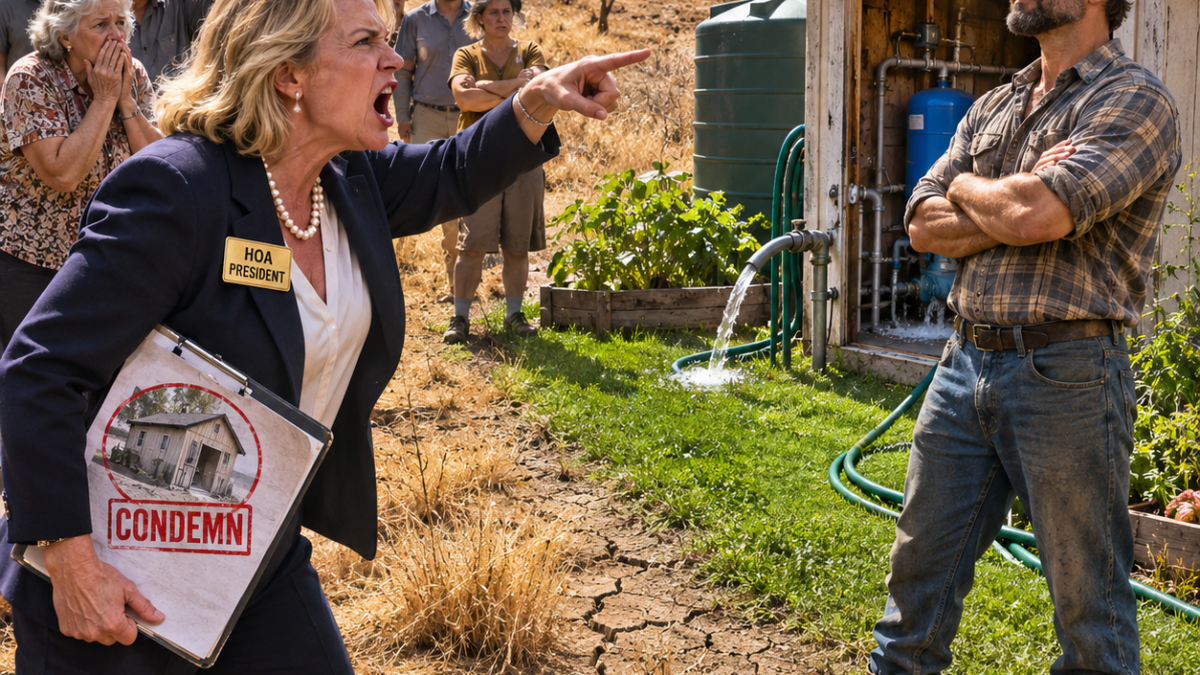
PART 2
The certified letter arrived three days later.
White envelope.
HOA crest.
My full name printed in bold.
Inside was the same threat, only now it had been scrubbed of Karen’s personality and dressed in legal language.
**NOTICE OF NONCOMPLIANCE.**
**DETACHED ACCESSORY STRUCTURE.**
**SECTION C7 — ARCHITECTURAL HARMONY.**
**INITIAL PENALTY: $10,000.**
**REMEDIATION PERIOD: 30 DAYS.**
After that:
One hundred dollars per day.
Potential HOA contractor removal.
Collection costs.
Attorney fees.
I read it once.
Then put it on the dining-room table.
My first call wasn’t to a lawyer.
My first trip was to the fireproof cabinet in my office.
I pulled out the closing records from when I bought the property ten years earlier.
Deed.
Survey.
Title report.
Tax documents.
Utility disclosures.
And there they were.
County well permit.
1978.
Building permit for the protective well structure.
1981.
Stamped.
Recorded.
Signed.
The paper was older than half the houses surrounding me.
I put the HOA notice beside it.
Brand-new white paper threatening destruction.
Forty-year-old county record proving lawful existence.
The contrast was almost funny.
Almost.
I requested a hearing.
The Architectural Review Committee scheduled one for the following Thursday.
Karen chaired it.
Of course she did.
Bob sat beside her.
Retired insurance salesman.
Professional nodder.
Carol sat on the other side.
She had the nervous habit of looking at Karen before answering even the simplest question.
I brought copies of everything.
Karen didn’t.
That should tell you how seriously she took the process.
I laid the well permit on the table.
Then the building permit.
Then the old subdivision survey.
“This well house existed decades before Crestwood Meadows was incorporated.”
Karen barely glanced down.
“It still exists inside Crestwood Meadows today.”
“That doesn’t erase its legal status.”
“We’re discussing HOA compliance, not county compliance.”
“You’re ordering demolition of a permitted utility structure.”
“We’re ordering removal of an architectural violation.”
“The structure predates your architectural code.”
Karen smiled.
“Mr. Peterson, grandfather clauses apply to zoning.”
She tapped the permit.
“Not taste.”
Carol gave a nervous little laugh.
Bob nodded.
I stared at Karen.
“So if you amend the rules tomorrow and require every house to be red brick, you believe you can force all existing homeowners to rebuild?”
“That is a ridiculous hypothetical.”
“Why?”
“Because no such proposal exists.”
“But if it did?”
“We would follow the governing documents.”
“That isn’t an answer.”
“It is the only answer you’re getting.”
I looked toward Bob.
“You’ve reviewed my permits?”
He glanced at Karen.
“The committee has reviewed the issue.”
“That wasn’t my question.”
He shifted.
Karen interrupted.
“The decision stands.”
I gathered my papers.
No anger.
Not there.
The worst move you can make in a rigged hearing is give the people running it a dramatic scene they can later describe as threatening behavior.
So I said:
“Please note in the minutes that I submitted the 1978 well permit and 1981 well-house permit and that the committee declined to reconsider.”
Karen’s face tightened.
“We don’t need instructions on how to record minutes.”
“Fine.”
I looked at Carol.
“Then I assume it’ll be there.”
Carol looked down.
I left.
The $10,000 charge appeared on my next HOA statement.
I paid my regular dues.
Nothing else.
On the memo line I wrote:
**REGULAR ASSESSMENT ONLY — ALL FINES DISPUTED.**
Certified dispute letter followed.
That was when the petty things began.
My newspaper vanished.
Once.
Then twice.
My trash cans moved across the street on pickup morning.
I found anonymous complaints about weeds that didn’t exist.
Then a sign appeared on my lawn.
Professional vinyl.
Green border.
HOA logo.
**FUTURE SITE OF A COMPLIANT & BEAUTIFUL COMMUNITY GREEN SPACE**
I stood looking at it for a long time.
Community green space?
On my property?
Now the well-house attack made even less sense.
I photographed the sign.
Then removed it carefully.
Saved it.
Date.
Time.
Location.
No confrontation.
A week later, grass began dying near my side fence.
Not random.
A curved yellow patch.
Too precise.
Too fast.
I knelt.
Smelled chemicals.
That was the moment the fight changed for me.
Paper harassment was one thing.
Property damage was another.
Someone believed I could be intimidated into leaving.
They were about to learn the difference between quiet and passive.
I ordered cameras.
Good ones.
Night vision.
Timestamped storage.
One faced the well house and gate.
One covered the damaged lawn.
Another covered the rear boundary.
A fourth watched the drive.
I installed them myself.
Then I began reading.
Everything.
CC&Rs.
Bylaws.
Board policies.
ARC procedures.
Archived minutes.
Amendment requirements.
Meeting-notice requirements.
Fine procedures.
Appeal rules.
Crestwood had produced enough paperwork to run a small nation.
Most homeowners had probably never read fifty pages.
I read every one.
Section C7 was new.
Six months old.
The minutes showed it had been adopted at a special meeting.
Three votes.
Karen.
Bob.
Carol.
Two board members absent.
Meeting notice posted less than forty-eight hours earlier.
I pulled the bylaws.
Fourteen-day advance notice required for covenant amendments.
I read the section three times.
Then the minutes again.
Same answer.
The rule being used to condemn my well house had not even been adopted according to their own required process.
I called my daughter Sarah.
She worked as a paralegal in the city.
Sharp.
Organized.
Unimpressed by intimidation.
“Dad.”
“Got a minute?”
“You never call and ask that unless you’re about to give me work.”
“I raised you well.”
“What happened?”
I explained.
She became silent.
Then:
“Scan everything.”
“Already started.”
“Every notice?”
“Yes.”
“Envelope too?”
“Yes.”
“Photos?”
“Yes.”
“Timeline?”
“Working on it.”
“That means no.”
“I’ll make one.”
“Good.”
Then:
“And stop thinking this is only about your building.”
“Why?”
“Because people who abuse rules rarely start with one person.”
That sounded right.
“Find others?”
“Quietly.”
“Don’t make it a crusade yet.”
“Document.”
“Compare.”
“Look for selective enforcement.”
I smiled.
“You’ve become bossy.”
“I learned from you.”
The camera caught something seven nights later.
2:17 a.m.
Motion alert.
I watched the clip the following morning.
A hooded figure approached the fence.
Sprayer in hand.
No hesitation.
He pushed the nozzle through the chain links.
Sprayed my lawn.
Exactly where the grass had died.
When he turned, the hood fell back.
Mr. Henderson.
Retired accountant.
Member of Karen’s landscape committee.
Two streets away.
I froze the frame.
Exported the video.
Backed it up.
Then another copy.
I did not confront him.
I wanted context.
I began talking to neighbors.
Mrs. Maureen Gable lived in one of the oldest homes.
Seventy-something.
Widow.
Mailbox post with a little peeling paint.
Karen had fined her two thousand dollars.
“Two thousand?”
Mrs. Gable nodded.
“She called it community decay.”
She looked embarrassed.
That angered me more than the amount.
Not because she had peeling paint.
Because Karen had convinced an elderly woman that ordinary aging on a mailbox was shameful.
Then the Garcias.
Young couple.
Two children.
Their front lawn had once been drought-tolerant turf.
Less water.
Lower maintenance.
Slightly different green.
Karen forced them to replace it with approved Kentucky bluegrass.
Cost?
Nearly six thousand dollars.
They financed part of it.
Mr. Garcia said:
“We’re still paying for grass we didn’t need.”
Mrs. Garcia added:
“And the new grass uses twice the water.”
That sentence stayed with me.
The Taylors had a custom birdhouse.
Mrs. Taylor’s late father built it.
HOA forced removal because it wasn’t on an approved catalog list.
A family down the street had been fined over a basketball hoop.
Another over vegetable plants visible from the road.
Another over a child’s tree swing.
Individually?
Petty.
Together?
Pattern.
Then I requested financial records.
Karen stalled.
Sarah sent a formal letter quoting the appropriate disclosure requirements.
The documents arrived.
Legal fees had tripled.
That made sense.
The HOA was spending money threatening its own residents.
Then I found:
**PRISTINE ENVIRONMENTS LLC**
Large monthly payments.
Community landscaping.
A business-record search gave me the owner.
Gerald Dobson.
Karen’s brother-in-law.
I called Sarah.
“I found the landscaping company.”
“Related?”
“Brother-in-law.”
“Do not say corruption yet.”
“I know.”
“Conflict of interest?”
“Potentially.”
“Self-dealing?”
“Potentially.”
“Good.”
“Use boring words until boring words become devastating.”
I laughed.
“You really are my daughter.”
The first homeowners gathering happened at my kitchen table.
Mrs. Gable.
The Garcias.
The Taylors.
Nobody wanted rebellion.
Nobody even liked calling it a committee.
So we didn’t.
I let everyone talk.
Mrs. Taylor cried when describing the birdhouse.
Mrs. Gable admitted she had spent weeks afraid the HOA would put a lien on her house.
Mr. Garcia’s anger surfaced when he explained taking a loan to install water-hungry grass.
Then I showed them the documents.
Invalid C7 procedure.
Financial statements.
Pristine Environments.
Then the night-vision video.
Henderson appeared on my screen.
Sprayer.
Fence.
My lawn.
Silence.
Mr. Garcia said:
“We call the police.”
“Not tonight.”
His head snapped toward me.
“He poisoned your yard.”
“Yes.”
“Why wait?”
“Because right now I know what he did.”
“I don’t know why.”
“You think Karen ordered it?”
“I suspect.”
“That isn’t evidence.”
Mrs. Taylor looked at me.
“What do we do?”
“We become more procedural than they are.”
Nobody smiled.
I continued.
“Every fine gets formally challenged.”
“Every hearing requested.”
“Every record requested.”
“We ask for an independent audit.”
“We complain through proper oversight channels where applicable.”
“And every single thing happens in writing.”
Mrs. Gable looked nervous again.
“What if she comes after us harder?”
I answered carefully.
“She might.”
Then:
“But she already came after you when you were alone.”
Mrs. Gable looked around the table.
That changed something.
Five certified envelopes went out Monday.
Legal challenges.
Hearing demands.
Contract-record requests.
Karen called me Wednesday.
Her voice was tight.
“Mr. Peterson.”
“Karen.”
“This coordinated harassment of the board will stop.”
“We filed written appeals.”
“You are organizing malcontents.”
“We’re homeowners.”
“You are interfering with community governance.”
“By requesting records?”
“You know exactly what you are doing.”
“Yes.”
That silenced her briefly.
Then she threatened litigation.
Some version of a lawsuit intended to bury us in costs.
I did not debate terminology.
I said:
“Everything we submitted is factual.”
Then I hung up.
My demolition deadline approached.
Another letter.
Ten-thousand-dollar charge due.
HOA exploring “contractual remediation.”
This was the moment I had been preparing for.
Sarah and I had gone deeper into county rules governing private wells.
The well itself was registered.
The wellhead required protection from contamination and damage.
The old well house was not merely decorative shelter.
It physically protected pumps, electrical equipment, pressure components, and the wellhead environment.
Unauthorized interference with a registered water source could create serious legal and public-health problems.
I wrote Karen one letter.
Short.
No emotion.
I attached the applicable county material.
Then I copied the HOA attorney.
The substance:
This is a permitted private well.
This building protects essential well infrastructure.
Any contractor entering my property to damage or remove the structure without required authorization would be reported immediately to county authorities.
I also put the HOA’s attorney on formal notice.
Then waited.
Nothing.
No reply.
Next statement?
No new well-house fine.
Next week?
Nothing.
The demolition deadline passed.
Nobody arrived.
Karen had retreated.
But she did not rescind anything.
She simply stopped talking about my building.
Instead, she turned harder on my allies.
Mrs. Gable received another notice.
The Garcias got a hearing date.
The Taylors got a lawyer letter.
Karen couldn’t reach me, so she looked for softer targets.
Except they weren’t soft anymore.
That summer became brutally hot.
Rain stopped.
June became July.
July became something closer to an oven.
Lawns browned at the edges.
Reservoir levels fell.
Local news started showing aerial footage of exposed banks.
Then came drought restrictions.
Stage One.
Stage Two.
Then Stage Three.
Outdoor municipal watering prohibited.
No lawn sprinklers.
No car washing.
No pool filling.
Strict limits.
The houses in Crestwood depended on county water.
My property did not.
The reason I bought those three acres was underneath them.
Deep aquifer.
Private artesian well.
Old.
Properly registered.
Protected by the ugly concrete building Karen wanted destroyed.
The county’s surface reservoir dropped.
My well level remained stable.
The neighborhood changed color.
Kentucky bluegrass went yellow.
Then brown.
Karen’s rose beds drooped.
The entrance landscaping curled.
The common areas looked scorched.
The Garcias’ expensive replacement grass—the grass Karen had forced on them because drought-tolerant turf was the wrong shade—began dying fastest of all.
I stood at the edge of their lawn one evening.
Mr. Garcia walked up.
“Funny.”
“What?”
“The old grass would have survived this better.”
I looked down.
“Probably.”
He laughed without humor.
“Six thousand dollars.”
I didn’t know what to say.
My own vegetable garden stayed alive.
I watered responsibly.
My mature trees had deeper roots.
When necessary, the well pump ran.
Low hum.
Water.
Reliable.
The same building Karen called a blight now stood in the hottest summer I could remember doing precisely what it had been built to do.
Protect the source.
I didn’t think of that as revenge.
Not yet.
Then Mrs. Garcia appeared at my driveway.
Two five-gallon buckets.
She looked embarrassed.
“Frank?”
“Yeah?”
“This is silly.”
“Usually means it isn’t.”
She looked toward her house.
“My kids planted a sunflower.”
I waited.
“They’ve been measuring it every day.”
Her voice caught slightly.
“It’s dying.”
I looked at the buckets.
“Fill them.”
Her face changed.
“You sure?”
“Of course.”
“But the drought restrictions—”
“Those apply to the county system.”
“I’m still going to be conservative.”
“Two buckets won’t hurt.”
I led her to the well-fed spigot.
Opened the valve.
Clear water filled the first bucket.
Then the second.
Mrs. Garcia watched as if I were pouring gold.
“Thank you.”
“Tell the kids to water near the roots.”
She smiled.
“I will.”
Next evening?
Someone else.
Small ornamental tree planted after a parent died.
Two watering cans.
Then another.
A vegetable patch.
Then one I did not expect.
Mr. Henderson.
The man on my security footage.
He walked up slowly.
No hoodie.
No sprayer.
Hat in his hands.
He stopped several feet from me.
“Peterson.”
“Henderson.”
He looked at the well house.
Then the ground.
“My wife has azaleas.”
I said nothing.
“Thirty years.”
Still nothing.
“They’re going.”
His voice had changed.
Not the man sneaking around at two in the morning.
Just an old husband worried about something his wife loved.
He finally looked at me.
“Could I get some water?”
I thought about the video.
The yellow grass.
The sprayer.
I could have said no.
Part of me wanted to.
He deserved to feel the consequence.
Then I imagined his wife standing beside dead flowers, maybe never knowing what her husband had done.
Revenge suddenly felt too small.
“Bring the cans.”
He blinked.
“What?”
“Bring your watering cans.”
He returned with two.
I filled them.
No speech.
No bargain.
He lifted one.
Then stopped.
“I’m sorry.”
I looked at him.
“For needing water?”
“No.”
He swallowed.
“You know.”
“Yes.”
His eyes moved toward the camera above my garage.
Of course he had figured it out.
“Karen said—”
I raised one hand.
“Not today.”
He stopped.
“You asked for water.”
“I gave you water.”
“That’s all we’re doing right now.”
His shoulders sagged.
“Thank you.”
He walked away.
I knew then Karen had lost him.
Within days, dusk brought a line.
Not huge.
Five households.
Then ten.
Buckets.
Watering cans.
Large jugs.
People saved young trees.
Foundation plants.
Vegetable gardens.
Memorial shrubs.
I refused requests to flood lawns.
That would have been irresponsible.
But targeted watering?
Enough to preserve important plants and prevent damage?
I helped.
Free.
No favors.
No signatures.
No political agreement.
No:
**Did you support Karen?**
Water does not care who voted for whom.
That lesson came to me faster than I expected.
Children began coming with parents.
One boy carried a tiny red bucket.
“Mr. Peterson?”
“Yes?”
“Is this from underground?”
“Yes.”
“How far?”
“Several hundred feet.”
His eyes widened.
“There’s a lake under your house?”
“Not exactly.”
“Cool.”
His mother laughed.
The line became almost social.
Neighbors who had never spoken stood together.
People helped older residents lift containers.
Someone brought a wagon.
Someone brought lemonade.
Mrs. Gable started sitting in a folding chair near the driveway and directing traffic even though nobody had asked her to.
“You’ve become management.”
“I’m experienced with tyrants.”
“Apparently.”
Then Karen sent an email.
Emergency HOA meeting.
Subject:
**LANDSCAPE DETERIORATION AND PROPERTY VALUE PROTECTION.**
I read the agenda twice.
She wanted to create penalties for homeowners whose lawns had become more than fifty percent brown.
During a county watering ban.
I called Mr. Garcia.
“You see this?”
“Yes.”
He laughed.
Not because it was funny.
“She forced me to install grass that dies without water.”
“Now she wants to fine you because it died without water.”
“Correct.”
“Frank?”
“Yes?”
“I think I’m ready to be unreasonable.”
“No.”
“What?”
“We’re going to be extremely reasonable.”
“That’s less satisfying.”
“Bring the financial presentation.”
The clubhouse was packed.
Not Karen’s usual six supporters.
Everybody.
People were furious.
Brown lawns.
Dead plants.
Water restrictions.
And Karen stood at the front talking about appearances.
“We must protect long-term property values.”
A man behind me muttered:
“I’d like to protect my checking account.”
Karen proposed a $200 monthly landscape remediation fee for properties with excessive brown turf.
Silence.
Then someone shouted:
“You’re fining us for obeying the county?”
The room exploded.
Karen hammered the gavel.
“Order!”
Another:
“Are we supposed to break the watering ban?”
“Order!”
She tried explaining the money would reseed lawns after the drought.
I stood.
“Point of order.”
Her face changed immediately.
“Mr. Peterson, sit down.”
“I’m permitted to address new business.”
“This is not—”
“It is literally a new fee you just proposed.”
Several people laughed.
Karen looked toward Bob.
Then Carol.
Neither helped.
“Five minutes.”
She snapped.
“Use them wisely.”
“I intend to.”
I walked toward the front.
Not quickly.
No theatrics.
“Before anyone votes to pay this board another two hundred dollars a month…”
Mr. Garcia connected his laptop.
“…we should understand where the money already goes.”
Budget appeared.
Legal fees.
More than forty thousand dollars annually during Karen’s escalation period.
Murmurs.
Mr. Garcia stood.
“This is money homeowners paid.”
He changed slide.
Pristine Environments LLC.
Payments.
Then the state business record.
Owner:
Gerald Dobson.
Someone called:
“Who is that?”
Mrs. Garcia answered:
“Karen’s brother-in-law.”
The room erupted.
Karen stood.
“That contract was properly approved!”
I looked toward her.
“At the meeting with inadequate notice?”
Her face went hard.
I put Section C7 adoption timeline on screen.
Forty-eight-hour notice.
Required:
Fourteen days.
“This is the regulation being used against my well house.”
Another slide.
Original permits.
1978.
1981.
“The structure Karen ordered me to demolish predates this HOA.”
Then photographs.
Dead lawn.
Time.
Date.
Finally:
Night-vision video.
Henderson appeared on the projector screen.
Walked toward the fence.
Raised sprayer.
Chemical mist.
The room went completely silent.
Then someone gasped.
Henderson was seated three rows from the front.
He seemed to shrink into the chair.
Karen said:
“This proves nothing.”
I turned.
“It shows a member of your landscape committee spraying something onto my property at 2:17 in the morning.”
“You have no evidence I authorized that.”
“I didn’t say you did.”
That mattered.
I refused to give her an accusation she could attack.
“But it proves the harassment around this dispute went far beyond violation letters.”
A homeowner shouted:
“Call the police!”
Another:
“He should be arrested!”
I raised my hand.
“Everybody stop.”
Slowly, the room quieted.
“This isn’t the most important thing tonight.”
Karen stared.
I changed the slide.
A photograph of my well house.
Faded beige.
Steel door.
No beauty.
No apology.
“This is.”
Someone laughed nervously.
I continued.
“Karen called this a blight.”
“Her board threatened to demolish it.”
“I was fined ten thousand dollars.”
“Then I showed the board that it protects a legally registered well.”
“They stopped threatening demolition.”
I looked around the room.
“Now we’re in the worst drought this community has seen in decades.”
“County water is restricted.”
“Trees are dying.”
“Gardens are dying.”
“Some residents have foundation concerns because the soil is drying and shifting.”
“And every evening people are coming to this well.”
I looked toward Mrs. Garcia.
Mrs. Gable.
Even Henderson.
“No one has paid me.”
“No one has been turned away because of which side they were on.”
“The building Karen wanted destroyed is currently protecting the only independent water source available inside this neighborhood.”
The room became still.
I took a breath.
“My well cannot supply unlimited water.”
“That would be irresponsible.”
“But I have spoken with a plumbing contractor.”
That got attention.
“We can install a controlled distribution manifold.”
“Multiple spigots.”
“Flow regulators.”
“Timers.”
“Emergency quotas.”
“If we manage it carefully, I’m willing to make a limited amount of well water available for critical landscape preservation during officially declared drought emergencies.”
People started whispering.
Karen said:
“You cannot make unilateral decisions affecting this community.”
I looked at her.
“It’s my well.”
Applause broke out.
Karen struck the gavel.
I continued.
“And I have one condition.”
The room quieted.
Karen’s eyes narrowed.
There.
That was the moment she thought I was going to ask for money.
Or revenge.
Or immunity.
I looked toward the homeowners instead.
“My condition is that we fix the governance problem first.”
Karen shot up.
“You are extorting this association!”
“No.”
“I am offering my water.”
“Free.”
“The condition isn’t payment.”
“It is reform.”
I held up the bylaws.
“I am requesting recall proceedings against the current board according to these governing documents.”
The room erupted.
Karen screamed:
“Absolutely not!”
Mrs. Taylor was already standing with petitions.
Mr. Garcia held another stack.
Mrs. Gable rose.
An elderly widow who had once been frightened over peeling mailbox paint.
She walked right past Karen.
Took a pen.
Signed first.
Then Mrs. Garcia.
Then Mr. Taylor.
Then a man I barely knew.
Another.
Another.
Karen kept hammering the gavel.
Nobody cared.
The sound had lost authority.
Within forty-eight hours, more than eighty percent of Crestwood homeowners had signed.
Karen could count.
So could Bob.
So could Carol.
They resigned before the recall vote.
Just like that.
Years of fear.
Gone in two days.
Not because I defeated them alone.
Because homeowners finally stopped believing they were alone.
The interim board formed.
Mrs. Garcia joined.
Mr. Taylor.
A retired teacher named Helen Reeves.
Their first public meeting felt completely different.
No raised platform.
No performance.
Documents posted.
Questions welcomed.
First motion:
Rescind every disputed aesthetic fine issued under Section C7.
Passed.
Mrs. Gable’s mailbox fine.
Gone.
Garcia lawn violation.
Gone.
Taylor birdhouse violation.
Gone.
My well house.
Gone.
Second motion:
Declare preexisting legally permitted structures exempt from retroactive aesthetic requirements unless genuine safety violations existed.
Passed unanimously.
Third:
Terminate Pristine Environments LLC pending financial audit.
Passed.
Fourth:
Hire an independent forensic accountant.
Passed.
Fifth:
Issue written apologies.
Not because an apology repaired financial damage.
But because institutions should admit when they hurt people.
Mine arrived a week later.
One page.
No excuses.
**The Crestwood Meadows Homeowners Association acknowledges that enforcement actions concerning your existing permitted well house were improper. All related fines are rescinded. The association apologizes for the harassment and distress caused by those actions.**
I read it.
Then placed it beside the demolition notice.
Sarah called that evening.
“You happy?”
“About the letter?”
“Yes.”
“I’m satisfied.”
“That is Dad-language for happy.”
“It is not.”
“It is.”
The next project was water.
I had promised.
So I kept my word.
Licensed plumber.
Six-spigot manifold near the property boundary.
Backflow protection.
Flow regulators.
Timers.
Clear operating hours.
Emergency-use policy.
We inspected the well capacity.
Calculated sustainable withdrawal.
I refused to overpump the aquifer for cosmetic lawns.
That defeated the purpose.
Priority went to:
Young trees.
Mature heritage trees under stress.
Food gardens.
Foundation-protection needs where appropriate.
Critical residential uses if public supply became disrupted.
Small quantities for important plants.
The HOA created a schedule.
Every household received a quota.
No favoritism.
No first-class residents.
No board privilege.
At five every evening, people came.
The line was orderly.
Buckets.
Cans.
Carts.
Neighbors talking.
Someone started bringing popsicles for the kids.
Mrs. Gable still directed traffic despite having no official authority.
“What title should we give you?”
I asked.
“Water marshal.”
“That sounds illegal.”
“Then Duchess of Hydration.”
“Worse.”
The children loved her.
The Garcias’ sunflower survived.
It grew over six feet.
Their daughter brought me a photograph.
“You saved it.”
“No.”
“You did.”
“You watered it.”
“You gave us water.”
I accepted that.
Mrs. Taylor saved the Japanese maple her father had planted.
Several mature trees survived.
A few vegetable gardens produced enough that neighbors began leaving baskets of tomatoes and squash beside the manifold.
My well water went out.
Food came back.
That exchange felt more like community than any architectural code Karen had ever written.
Henderson kept appearing.
At first, he only filled cans.
Eventually he asked:
“Can we talk?”
I looked at him.
“About the lawn?”
“Yes.”
We moved away from the line.
He stared at his shoes.
“Karen pressured me.”
“That doesn’t make your hand hold the sprayer.”
“I know.”
“She said she’d start enforcement against my driveway.”
“What’s wrong with your driveway?”
“Oil stain.”
I almost laughed.
“She said if I helped make your property look neglected…”
He stopped.
I waited.
“She thought the board would have stronger grounds.”
“So you poisoned my grass.”
“Yes.”
“Did she specifically tell you to?”
His silence answered.
I said:
“If someone asks you that officially, tell the truth.”
He nodded.
“You pressing charges?”
“I haven’t decided.”
He looked sick.
Eventually I chose not to.
Not because the act was acceptable.
Because he cooperated.
Because the property damage was repairable.
Because public exposure had already shattered his standing.
And because by then, I cared more about rebuilding than extending punishment.
He put his house on the market later that year.
Before he left, he came over once.
His wife stood beside him.
She handed me a small pot.
Azalea cutting.
From the thirty-year-old bushes.
“For you.”
I stared.
“Why?”
She smiled sadly.
“Because you saved them.”
I looked toward Henderson.
He looked away.
I planted the cutting near the well house.
Autumn rains finally arrived.
Not enough at first.
Then steady.
The reservoir climbed.
Drought restrictions loosened.
Then ended.
The neighborhood slowly turned green again.
The emergency manifold stayed.
Covered.
Insulated.
Ready.
The new HOA adopted a written emergency-water agreement with me.
Not ownership.
Not an easement.
Not permanent entitlement.
A revocable emergency arrangement.
Everything clear.
Everything documented.
That was important.
Helping neighbors did not require surrendering property rights.
Generosity works best when boundaries remain visible.
Karen listed her house that fall.
I heard she sold at a loss.
Maybe true.
Maybe neighborhood gossip.
I did not investigate.
One morning, I saw the moving truck.
She stood in the driveway supervising.
For a moment our eyes met across the street.
I expected anger.
Maybe contempt.
She looked tired.
That surprised me.
She walked toward me.
Not all the way.
Stopped at the edge of my property.
Exactly where the entire story had begun.
The well house stood behind me.
Still beige.
Still ugly.
Still there.
Karen looked at it.
Then at me.
“You got what you wanted.”
I shook my head.
“No.”
Her mouth tightened.
“You removed me.”
“I never elected you.”
“You humiliated me in front of everyone.”
“You proposed fining them during a drought.”
“You turned them against me.”
I looked toward the houses.
“No.”
“They compared notes.”
She said nothing.
I could have reminded her of everything.
Ten thousand dollars.
C7.
Henderson.
Pristine Environments.
My lawn.
Mrs. Gable.
The Garcias.
But there was no point.
She looked at the well house again.
“I still think it’s ugly.”
That made me laugh.
For the first time, Karen almost smiled.
Almost.
“Maybe it is.”
I said.
“But it works.”
She nodded once.
Then walked back to her house.
That was the last conversation we ever had.
The truck left that afternoon.
I did not celebrate.
I felt something quieter.
Relief.
The next spring, I renovated the well house.
My decision.
Nobody ordered it.
I repaired cracks.
Pressure-washed the blocks.
Replaced weather stripping.
Serviced the steel door.
Then painted it deep forest green.
Mrs. Gable came over.
“Look at you.”
“What?”
“Beautification.”
“Maintenance.”
“Green paint is aesthetic.”
“It protects masonry.”
“Sure.”
I planted the Henderson azalea cutting beside it.
Then a climbing rose.
Not because Karen would have liked it.
Because I did.
The building looked better.
Still utilitarian.
Still strong.
Still unmistakably a well house.
I didn’t disguise what it was.
Purpose deserves dignity too.
The forensic audit took months.
The independent accountant identified questionable contracts, conflicts, undocumented spending, and procedural failures.
Some matters were referred for additional review.
The new HOA pursued recoveries where its lawyers advised.
I did not make that part my life.
People sometimes asked:
“How much did Karen steal?”
I always corrected them.
“I don’t know that she stole anything.”
“But the audit—”
“Found irregularities.”
“That isn’t the same thing as me making a criminal accusation.”
Twenty years in engineering taught me the danger of pretending certainty exists where it doesn’t.
We had enough truth.
No need to embellish.
Pristine Environments never regained the contract.
Future HOA contracts required competitive bids.
Family relationships had to be disclosed.
Meeting notices became strict.
Covenant amendments required proper homeowner review.
Appeal hearings were no longer chaired by the same person who initiated a violation.
Simple safeguards.
The kind everyone should have insisted on years earlier.
Mrs. Gable got elected to a homeowner advisory committee.
I laughed when she told me.
“You joined the government.”
“I joined to irritate them.”
“That tracks.”
Her mailbox remained slightly imperfect.
Nobody cared.
The Garcias eventually replaced part of their bluegrass.
This time with drought-tolerant landscaping.
The board approved it.
Unanimously.
Mr. Garcia brought me the approval letter.
“Frame it?”
“No.”
“Burn it?”
“Keep it.”
“Why?”
“History has a sense of humor.”
The Taylor birdhouse returned.
Same hand-built design.
Mrs. Taylor’s late father had carved a small date under the roof.
When she reinstalled it, half the neighborhood showed up.
Not officially.
Just neighbors.
Someone brought cookies.
Mrs. Taylor cried.
That was the strange aftermath of Karen’s rules.
They had turned ordinary things into symbols.
A mailbox.
A birdhouse.
Grass.
A well house.
Things that should have meant almost nothing became reminders of what happened when authority forgot proportion.
The drought changed the neighborhood too.
Emergency planning became real.
The HOA commissioned a professional drought-response plan.
Rain barrels where legal.
Native landscaping incentives.
Tree-watering priority.
Leak detection.
Public water conservation.
The irony was impossible to miss.
The same association that once forced the Garcias to rip out drought-tolerant turf now offered a rebate for low-water landscaping.
I attended that meeting.
Mr. Garcia sat beside me.
When the program passed, he leaned over.
“Can I get my six thousand back?”
“No.”
“Had to ask.”
The well remained part of emergency planning, but carefully.
I was adamant.
“This is not a community well.”
At one meeting, a new resident looked confused.
“But everyone used it.”
“During an emergency.”
“So it’s shared.”
“No.”
I pointed toward the agreement.
“My well remains private.”
“The HOA receives limited emergency access by written arrangement.”
“Why does that distinction matter?”
“Because generosity today should not become somebody else’s entitlement tomorrow.”
Mrs. Gable said from the back:
“He learned that the hard way.”
Everyone laughed.
I did too.
That was one of the biggest lessons.
During the drought, it would have been easy to declare:
**Everybody needs water, so boundaries don’t matter.**
Wrong.
Boundaries mattered more.
Because I owned the source, I could protect it.
Manage usage.
Prevent overpumping.
Set priorities.
Make sure one family didn’t drain thousands of gallons for decorative turf while someone else needed water to preserve a mature tree threatening foundation damage.
Ownership and community were not opposites.
Clear ownership made responsible sharing possible.
The second summer after the drought was wet.
Almost too wet.
Nobody lined up at the manifold.
I missed the evening conversations a little.
Then one Saturday, residents proposed a neighborhood picnic near the clubhouse.
Mrs. Gable insisted I attend.
“I don’t like organized fun.”
“You’re coming.”
“Why?”
“You owe me.”
“For?”
“I managed your water distribution.”
“You appointed yourself.”
“Still counts.”
I went.
Children ran around.
Garcias brought salsa.
Taylors brought pie.
The new board president gave a short speech.
Very short.
I appreciated that.
Then she called my name.
I immediately disliked the situation.
“Frank Peterson?”
“No.”
Everyone laughed.
She held something.
A small plaque.
I groaned.
“We wanted to recognize Frank for opening his private well during last summer’s drought.”
Applause.
I stood reluctantly.
The plaque read:
**CRESTWOOD MEADOWS COMMUNITY RESILIENCE AWARD**
Then underneath:
**FOR SHARING WATER WHEN WE NEEDED IT MOST.**
I accepted.
“Thank you.”
Someone yelled:
“Speech!”
“No.”
More laughter.
I looked around.
Then added:
“The well deserves most of the credit.”
Mrs. Gable shouted:
“And the ugly building!”
That got the biggest laugh.
I looked toward my property.
Forest-green well house barely visible through trees.
“Especially the ugly building.”
The plaque hangs inside it now.
Not in my house.
That seemed appropriate.
Years passed.
The well pump eventually needed replacement.
Big job.
Expensive.
When the contractor arrived, he looked at the structure.
“This thing’s built like a bunker.”
“1981.”
“They knew how to overbuild.”
“Yes.”
“You thinking about replacing the building?”
“No.”
“Could modernize.”
“Pump?”
“Yes.”
“Electrical?”
“Yes.”
“Tank?”
“Yes.”
“Building stays.”
He shrugged.
“Your property.”
Exactly.
When the new pump first came online, the hum was different.
Quieter.
More efficient.
I stood with my hand against the pipe.
Water pressure stabilized.
That sound took me back.
Karen at the property line.
Thirty days.
Ten thousand dollars.
Demolition contractor.
I wondered what would have happened if I had obeyed.
Suppose I had torn it down.
Maybe the well equipment would have been exposed while we built something “compliant.”
Maybe contamination risk.
Maybe expensive reconstruction.
Maybe new architectural requirements.
Maybe I eventually disconnected and joined county water because that was easier.
Then the drought.
No independent source.
No buckets.
No saved trees.
No evening line.
No reason for neighbors to gather.
No moment when Henderson asked me for water.
No dramatic public demonstration that the thing everyone had been told was ugly had practical value.
You never know which ordinary piece of infrastructure will become essential until something fails.
That is why engineers respect redundancy.
Most days, redundancy looks wasteful.
Second pump.
Backup generator.
Extra road.
Private well.
Then the main system fails.
Suddenly redundancy looks like wisdom.
Crestwood eventually installed its own emergency water-storage system for common-area use.
Not huge.
Enough for limited needs.
The board invited me to review preliminary plans.
I looked them over.
Then asked:
“Where’s the protective structure?”
The engineer pointed.
A small masonry utility building.
I smiled.
“What?”
“Nothing.”
The HOA president caught it.
“Oh, come on.”
“What?”
“It looks like your well house.”
“It does.”
“We can make it prettier.”
“Careful.”
Everyone laughed.
They added stone veneer.
Architects need hobbies.
The system worked.
That pleased me.
One August, another dry spell came.
Not as bad.
The HOA used stored water for newly planted trees.
Nobody panicked.
Nobody proposed fines.
The public system remained functional.
My manifold stayed closed.
That was success.
A resilient community should not require one homeowner to become its emergency plan forever.
The well taught them.
Then they improved.
Sarah eventually moved closer.
My daughter, not my wife—something the neighbors regularly confused because Sarah had become so involved.
She visited one weekend and stood beside the well house.
“You painted it.”
“Years ago.”
“Looks nice.”
“Functional.”
“It can be both.”
“Dangerous philosophy.”
She touched the plaque inside.
“You kept this?”
“They gave it to the building.”
“They gave it to you.”
“Building did the work.”
She smiled.
Then:
“Dad?”
“Yeah?”
“Were you ever actually scared?”
“Of Karen?”
“Of losing the well house.”
I thought.
“Yes.”
She seemed surprised.
“You never sounded scared.”
“That’s different.”
“What were you scared of?”
“Not the concrete.”
“The precedent.”
She nodded.
“If they could invent a rule after the fact and destroy something permitted before the HOA existed…”
I continued.
“…then every older property was vulnerable.”
She leaned against the door frame.
“And the ten thousand dollars?”
“That too.”
She laughed.
Then became serious.
“I’m glad you didn’t let anger take over.”
“I nearly did.”
“Henderson?”
“Yes.”
“You gave him water.”
“Yes.”
“Why?”
I looked toward the azalea growing beside the wall.
It had become large.
Pink blooms.
“Because his wife’s flowers didn’t poison my lawn.”
Sarah nodded.
That was probably the decision I was proudest of.
Not exposing Karen.
Not beating C7.
Not saving the building.
Water for Henderson.
Because revenge offers a seductive kind of symmetry.
You hurt me.
Now I get to watch you hurt.
The drought handed me that opportunity.
Everyone who had stayed silent suddenly needed something I had.
I could have charged.
Demanded apologies.
Refused Karen supporters.
Turned the spigot into a political checkpoint.
For a brief moment, that would have felt satisfying.
Then I would have become another person deciding basic access based on loyalty.
I had spent months fighting exactly that mentality.
So I gave water.
Not unlimited.
Not recklessly.
But fairly.
That changed people more effectively than punishment.
Henderson confessed.
Other residents reconsidered.
Karen’s base evaporated.
Not because I demanded allegiance.
Because the contrast became impossible to ignore.
She offered fines.
I offered water.
She offered threats.
We offered records.
She demanded uniformity.
Neighbors began helping one another.
You cannot win every conflict through generosity.
Sometimes boundaries need lawyers.
Sometimes courts.
Sometimes police.
Sometimes a hard no.
But when you have enough security to choose generosity without surrendering your rights, it can be devastating to a bully’s story.
Karen needed me to be the villain.
The stubborn man.
The ugly property.
The selfish outsider.
The moment residents stood in my driveway receiving water for free, that story collapsed.
Years later, Mrs. Gable died.
Peacefully.
Her niece invited several of us to a small memorial.
Afterward, she handed me an envelope.
Inside was an old photograph.
Summer drought.
My driveway.
People lined with buckets.
Mrs. Gable in her folding chair pointing like a traffic controller.
On the back, in her handwriting:
**FRANK’S ILLEGAL WATER EMPIRE — 6:12 P.M.**
I laughed so hard I cried.
I framed it.
That photo sits in my workshop.
Not because of the drought.
Because it captures the exact thing Karen never understood.
Community is messy.
People stand crooked.
Buckets don’t match.
Grass dies.
Mailboxes peel.
Birdhouses come in strange shapes.
Some homes are older.
Some utility buildings are ugly.
People disagree.
Real neighborhoods are not architectural renderings.
They are systems of imperfect people trying to live beside one another.
Uniformity can look beautiful from the entrance sign.
It does not automatically create trust.
Trust appears when your neighbor asks for water and you hand them the hose.
Another decade passed.
Crestwood’s houses aged.
Paint faded.
Trees grew.
The development became less visually perfect and more human.
I liked it better.
The architectural committee still existed.
They still reviewed serious projects.
But nobody drove around measuring mailbox paint.
The board once denied a resident’s oversized garage.
He appealed.
Public hearing.
Engineering concerns.
Drainage.
Traffic.
Real reasons.
He revised the design.
Approved.
No war.
I told the president afterward:
“That’s how it’s supposed to work.”
She said:
“I know.”
“You taught us.”
“No.”
“Karen taught you.”
“She taught what not to do.”
“That still counts.”
Fair.
The old C7 amendment remained in the archive.
Marked invalid.
The board could have deleted it.
I suggested keeping it.
Why?
Institutional memory.
New leaders need examples.
Not just good policy.
Bad policy.
The minutes now include a short historical note:
**Section C7 was not validly adopted under required notice provisions and shall have no force or effect.**
Simple.
Permanent.
No future Karen could rediscover it and pretend nobody knew.
Pristine Environments disappeared from the neighborhood.
Competitive bidding lowered landscaping costs.
Dues stabilized.
Legal expenses dropped.
Funny how much money an HOA saves when it stops hiring lawyers to threaten its own members.
The entrance landscaping became simpler.
Native plants.
Less irrigation.
Better during dry weather.
The community garden expanded.
Rain barrels appeared where appropriate.
The Garcias became informal champions of drought-tolerant landscaping.
Their daughter—the sunflower girl—grew up.
Years later, she came home from college studying environmental science.
She stopped at my house.
“You remember me?”
“You carried red buckets.”
She laughed.
“I can’t believe you remember.”
“You asked a lot of questions.”
“I still do.”
She wanted to see the well.
I showed her.
Pump logs.
Aquifer monitoring.
Emergency manifold.
She looked at the forest-green walls.
“My parents told me the HOA tried to tear this down.”
“Yes.”
“Because it was ugly.”
“Yes.”
“That’s insane.”
“It seemed very important at the time.”
She shook her head.
Then:
“That drought is why I picked environmental science.”
I stared.
“What?”
“My sunflower.”
She smiled.
“I was eight.”
“I remember.”
“I thought plants died because adults made stupid rules.”
I laughed.
“Sometimes.”
“Then Dad explained droughts.”
“She survived?”
“The sunflower?”
“Yes.”
“We kept the seeds.”
She pulled out her phone.
Showed me a photograph.
Tall sunflowers along her parents’ fence.
Descendants of the plant watered from my well.
I had to look away for a moment.
You never know what survives because of one bucket.
That became another lesson.
Karen had measured value in appearances.
Paint shade.
Grass color.
Building style.
But real value often hides underground.
Water.
Roots.
Relationships.
Records.
Things you cannot see from a golf cart.
One evening, I sat outside with Mr. Garcia.
We were both older.
His mortgage on the stupid replacement lawn was long paid.
He brought beer.
We watched sunset.
He said:
“You know what still annoys me?”
“What?”
“That grass.”
I laughed.
“Twenty years later?”
“I will die angry about Kentucky bluegrass.”
“That seems unhealthy.”
“We had perfectly good drought-tolerant turf.”
“You did.”
“She made us rip it out.”
“Yes.”
“Then drought.”
“Yes.”
“Then the HOA paid rebates to install basically what we had before.”
“Yes.”
He took a drink.
“That woman owes me six thousand dollars.”
“She’s not here.”
“I know.”
“I’m telling you because you’re here.”
“Excellent friendship.”
He smiled.
Then looked toward the well house.
“You could have made a fortune selling water.”
“Probably.”
“Why didn’t you?”
I thought.
“Because people needing water isn’t a business opportunity I wanted.”
He nodded.
“Thirst changes people.”
“It does.”
He looked toward his home.
“You changed too.”
“How?”
“You were pretty antisocial before.”
“I preferred efficient relationships.”
“You mean no relationships.”
“That was efficient.”
He laughed.
Maybe he was right.
Before Karen, I treated Crestwood as scenery.
My property ended at the line.
Theirs began beyond it.
I paid dues.
Mowed grass.
Waved.
That was enough.
Karen’s abuse forced us to talk.
The drought forced us to depend on one another.
I would never thank her for that.
But I can admit good things grew from bad pressure.
That does not justify the pressure.
It means people can reclaim consequences.
Turn them into something useful.
The well house outlasted Karen.
Outlasted C7.
Outlasted the drought.
Probably outlast me.
Eventually I began planning what would happen to the property after I was gone.
Sarah asked:
“Selling?”
“No.”
“Leaving it to me?”
“Partly.”
She groaned.
“What?”
“You’re going to make me responsible for that well.”
“Yes.”
“I knew it.”
We added language preserving the emergency-water agreement but ensuring future owners retained control.
No automatic community ownership.
No adverse claims.
Clear maintenance obligations.
Clear emergency triggers.
The exact sort of documentation I wished Karen had respected.
Sarah read everything.
“You know normal fathers leave jewelry.”
“I have tools.”
“You have thousands of tools.”
“You’re welcome.”
“What about the well house?”
“Yours.”
“Lucky me.”
She smiled.
“I’ll keep it green.”
“Good.”
“Maybe shutters.”
I stared.
She burst out laughing.
“Not funny.”
“Very funny.”
One Christmas, the neighborhood decorated common spaces.
Someone jokingly placed a small wreath on the well-house door.
No HOA order.
No sign.
Just wreath.
I left it.
It looked ridiculous.
Sarah photographed it.
“Architectural harmony.”
“Leave.”
She laughed.
The building had become part of neighborhood lore.
New residents heard different versions.
Some wildly exaggerated.
One claimed Karen arrived with a bulldozer.
False.
Another claimed the county reservoir dried completely.
False.
Another claimed I supplied every household with all daily water for months.
Definitely false.
Stories grow.
That bothered me.
So at a community history night, I told the real version.
“She never bulldozed anything.”
“She threatened contractor removal.”
“The reservoir never went completely dry.”
“Restrictions were severe.”
“My well did not replace municipal supply.”
“It provided limited emergency water.”
“And no, I did not overthrow the HOA single-handedly.”
Mrs. Garcia interrupted:
“He mostly made spreadsheets.”
Everyone laughed.
“Correct.”
I continued.
“People overthrew bad leadership because they saw documents and compared experiences.”
“That’s less cinematic.”
Mrs. Gable would have said.
But she was gone by then.
I still heard her voice.
The truth was better than the legend.
Because the truth showed ordinary people could change something without becoming extraordinary heroes.
Read the rules.
Keep records.
Talk to neighbors.
Vote.
Ask questions.
Refuse fear.
Share water.
Nothing glamorous.
Everything effective.
The longest-lasting consequence of the drought was not political.
It was practical.
Crestwood became one of the most water-conscious developments in the county.
Native landscaping.
Efficient irrigation.
Drought plans.
Tree preservation.
Residents began valuing resilience instead of endless green turf.
The entrance sign changed too.
Same Crestwood Meadows name.
Less grass around it.
More native shrubs.
Wildflowers.
Karen would probably have hated it.
I loved it.
One dry summer, county officials toured the neighborhood as an example of adaptation.
A planner stopped by my well house.
“This is the famous one?”
“Unfortunately.”
She inspected it.
“Good structure.”
“Thank you.”
“Ugly.”
I stared.
She laughed.
“Kidding.”
“Dangerous sense of humor.”
She asked about the emergency manifold.
I explained.
She nodded.
“This kind of distributed resilience matters.”
That phrase stayed with me.
Distributed resilience.
Military engineers understand it instinctively.
Don’t put everything in one place.
Don’t depend on one supply route.
One power source.
One decision-maker.
One leader.
Crestwood’s biggest vulnerability had never been water.
It was centralizing too much informal authority in one person.
Karen controlled enforcement.
Committees.
Agenda.
Information.
Contracts.
Relationships.
People stopped questioning.
A community with a single point of failure eventually fails.
After Karen, power spread.
Committees independent.
Records public.
Residents involved.
Just like water systems.
Redundancy.
Oversight.
Alternative paths.
You do not need to hate authority to design it safely.
You respect what failure can do.
In my eighties, the walk to the well house became slower.
Knees.
Back.
Age.
Sarah visited more often.
One evening she found me sitting outside the green building.
“You okay?”
“Yes.”
“You look tired.”
“I am old.”
“Fair.”
She sat beside me.
Pump cycled.
Low hum.
Same sound.
“So this is what started everything.”
“The building?”
“Her hating it.”
“More or less.”
Sarah looked at it.
“It really isn’t pretty.”
“I regret raising you.”
She laughed.
Then rested her head against my shoulder.
“Still worth saving.”
“Yes.”
We sat quietly.
The azalea Henderson’s wife gave me was enormous.
The climbing rose had taken over one corner.
Birds moved between branches.
No perfect architectural harmony.
Better.
I thought about Karen’s first threat.
Thirty days.
Ten thousand dollars.
Tear it down.
At the time, winning meant:
**The building stays.**
Later, winning meant:
**Karen loses power.**
During the drought:
**Neighbors get water.**
Years afterward:
**The system gets better.**
Age changed my definition again.
The greatest victory was continuity.
Something useful protected.
Something unjust corrected.
People learning.
Then moving on.
That is what satisfied me.
Not ruining Karen.
Her departure was merely one chapter.
If the entire ending had been her humiliation, the story would have remained about her.
I preferred what came after.
Mrs. Gable’s mailbox.
Garcia sunflowers.
Taylor birdhouse.
Emergency plan.
Neighbors.
Water.
The hum of the pump.
One evening, Sarah asked:
“If Karen showed up now and apologized, what would you say?”
I thought for a long time.
“Thank you.”
“That’s it?”
“Probably.”
“You wouldn’t tell her everything she caused?”
“She knows enough.”
“You’d forgive her?”
“I already stopped carrying her around.”
Sarah smiled.
“That wasn’t the question.”
“It’s my answer.”
Forgiveness, for me, did not mean saying she was right.
It did not mean removing records.
It did not mean pretending Henderson never sprayed my lawn.
It meant she no longer got free space in my head.
That was another boundary.
Maybe the most important one.
The well house taught me about boundaries.
Property line.
Authority.
Aquifer limits.
Water quotas.
Governance.
Forgiveness.
Every good system needs limits.
Without them, use becomes abuse.
Generosity becomes entitlement.
Leadership becomes control.
Karen believed boundaries existed for other people.
That was why she failed.
On the twentieth anniversary of the drought, Crestwood held another community picnic.
Someone asked me to speak.
I declined.
They insisted.
So I stood beside the clubhouse.
No notes.
“Twenty years ago…”
I began.
“…some of you lined up at my house carrying buckets.”
Laughter.
“Some of you were children.”
More laughter.
“Some were afraid to talk to each other because an HOA violation felt like a personal shame.”
The crowd quieted.
“Then we learned everybody had a story.”
I looked toward the newer residents.
“This neighborhood improved not because we eliminated rules.”
“We didn’t.”
“It improved because rules became understandable.”
“Transparent.”
“Appealable.”
“And because neighbors started treating one another as people instead of properties.”
I paused.
“During the drought, water brought us together because everybody understood its value.”
“But the harder thing to remember during ordinary years is that trust works the same way.”
“If you waste it, you may not notice until you desperately need it.”
Nobody applauded immediately.
I liked that.
Then they did.
Afterward, a little girl approached.
“Are you the water man?”
Apparently that was my historical role now.
“I suppose.”
“My mom says your little green house saved the neighborhood.”
I looked toward the hill where it stood beyond trees.
“It helped.”
“Can I see it?”
“With your mom.”
We walked.
She stared.
“That’s it?”
“That’s it.”
“It’s tiny.”
“Compared to what?”
“A neighborhood.”
I smiled.
Good point.
She listened to the pump.
“What’s that?”
“Water moving.”
She placed her hand against the cinder block.
“It’s cold.”
“Concrete.”
She looked disappointed.
Legends rarely survive direct inspection.
But before leaving, she said:
“I like it.”
“Why?”
“It looks strong.”
That was the best compliment the building ever received.
Not beautiful.
Strong.
Useful.
Still standing.
That night, after everyone left, I turned off the lights and walked the property.
The community was quiet.
Lawns no longer uniformly green.
Some native grasses.
Some gardens.
Some traditional turf.
Different fences.
Different trees.
Still cohesive.
Not identical.
I stopped at the well house.
The forest-green paint had faded.
I put my hand on the steel door.
Behind it:
Pump.
Pressure tank.
Pipes.
Valves.
Electrical controls.
Nothing symbolic.
Just infrastructure.
The symbolism belonged to us.
Karen had once looked at this building and seen imperfection.
I looked at it now and saw decades of water.
My home.
Gardens.
Trees.
Neighbors.
One sunflower.
Thirty-year-old azaleas.
A Japanese maple.
Foundation soil kept from cracking.
Children carrying buckets.
Mrs. Gable directing traffic.
Henderson saying thank you.
A community discovering that practical value sometimes hides behind ugly walls.
That was enough.
The next spring, I repainted it again.
Same green.
Sarah helped.
“You missed a spot.”
“I did not.”
“There.”
“That’s shadow.”
“It’s beige.”
“It’s concrete texture.”
“Dad.”
I handed her the roller.
“Fix it.”
She did.
When we finished, we sat under the oak tree.
Water pump cycled.
Birds moved through the rose.
Sarah said:
“You know Karen would hate this color.”
I smiled.
“No.”
“What?”
“She told me the building was ugly.”
“She never said anything about green.”
“Think she’d approve?”
“Absolutely not.”
We laughed.
Then I looked toward the neighborhood.
“I’m glad she didn’t win.”
Sarah’s expression softened.
“Me too.”
“Not because of her.”
“I know.”
“If I had torn it down…”
She nodded.
“The drought.”
“Yes.”
Maybe another system would have worked.
Maybe not.
Life doesn’t give controlled experiments.
But I know what happened in the version we lived.
I kept the well house.
The well kept working.
When neighbors needed water, it was there.
And when they finally had enough evidence and enough courage to change the HOA, they did.
That is the ending I choose to remember.
Karen threatened my home because she believed ugly things had no value.
The drought proved the opposite.
The strongest things in a community are often the least glamorous.
A concrete utility building.
An old permit.
A neighbor with two buckets.
A widow willing to sign her name first.
A family willing to speak about a bad rule.
A recorded vote.
A private well.
A simple glass of water.
Karen’s authority disappeared.
The fines disappeared.
The illegal rule disappeared.
The drought eventually disappeared.
But the lesson stayed.
You don’t protect a community by forcing every home to look the same.
You protect it by building systems that survive pressure.
You protect property rights.
You preserve critical infrastructure.
You hold leaders accountable.
And when somebody next door needs water badly enough to swallow their pride and walk up your driveway carrying an empty bucket, you turn on the spigot.
Today the well house is still there.
Deep green.
Rose climbing one wall.
Azalea beside the door.
The emergency manifold rests under a weatherproof cover near the property line.
Most years, nobody touches it.
That’s exactly how I want it.
A backup system is successful when ordinary life makes it unnecessary.
Every now and then, the pump kicks on while I’m outside.
That familiar hum crosses the yard.
I always hear it.
Even now.
Forty years ago, it was just machinery.
During my fight with Karen, it became defiance.
During the drought, it became survival.
Afterward, it became something quieter.
A reminder.
Karen once stood on my property line and told me that building had thirty days left.
She believed a clipboard, three board votes, and a newly invented aesthetic rule could erase something simply because she didn’t like looking at it.
She was wrong.
The building survived her.
The well survived the drought.
The neighborhood survived bad leadership.
And all these years later, when I open that steel door and hear water moving through the pipes, I still think about the evening the first neighbor arrived with two empty buckets.
Not the recall.
Not Karen’s moving truck.
Not the audit.
That mother.
Two buckets.
A sunflower her children were trying to save.
That was the moment I knew the fight had changed.
I had spent months defending the well house because it was mine.
The drought taught me why it mattered that I had defended it.
Sometimes standing your ground protects more than your own ground.
Sometimes the thing one person calls an eyesore becomes the thing everyone else needs when the world gets hard.
And sometimes the most satisfying revenge isn’t watching the person who threatened you lose everything.
It’s watching the thing they wanted destroyed keep giving life long after their power is gone.
So whenever that old pump starts humming, I don’t hear a machine anymore.
I hear water moving beneath my home.
I hear neighbors talking in line.
I hear children carrying buckets.
I hear a community learning what mattered.
And after everything we went through, that quiet sound is still the sweetest thing on my property.








