PART 2: HOA Ordered Me to Tear Down My Son’s Treehouse—My Structural Report Shut Down Their Entire Playground
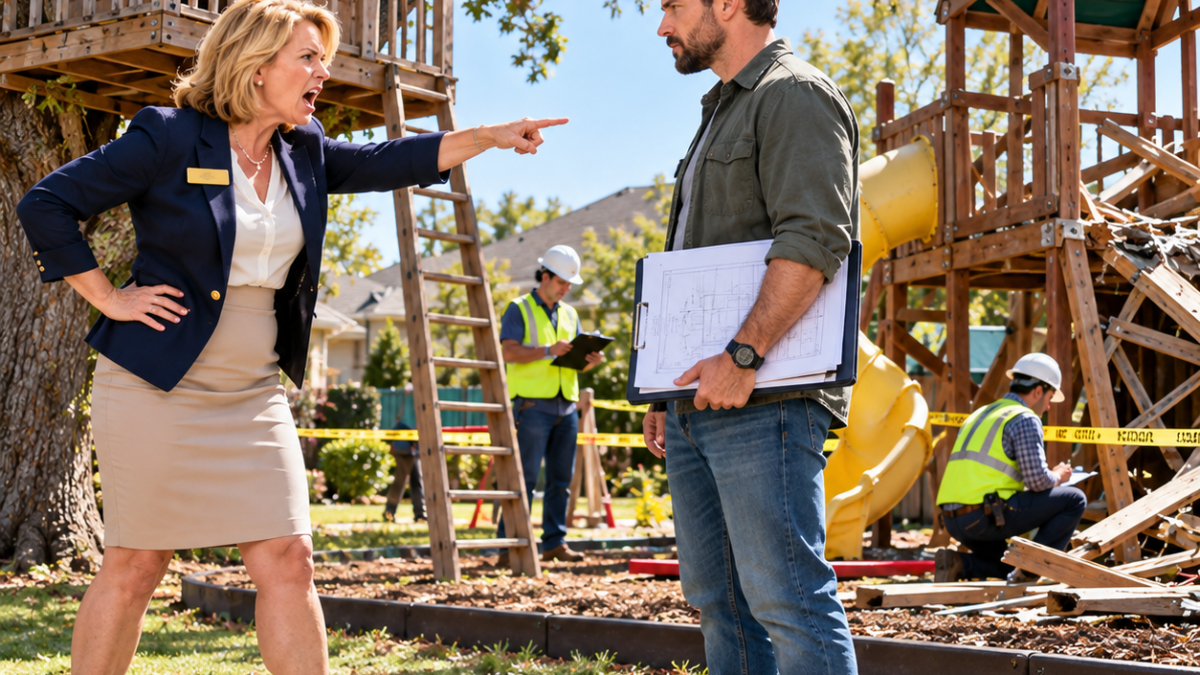
PART 2
I didn’t touch the playground.
That was the first decision that mattered.
Twenty years around construction sites had taught me that the quickest way to turn a legitimate safety concern into an argument was to disturb evidence before anyone independent could see it.
So I took photographs.
Wide shots first.
Then closer images showing corrosion, split lumber, loose fasteners, and the worn swing connector.
I used my phone beside a small measuring scale I kept in the truck.
Leo stood six feet away, confused.
“Is it broken?”
“Parts of it might be.”
“Can I still use it?”
“No.”
His face fell.
“Why?”
“Because until I know what I’m looking at, I’d rather you stay off.”
He looked toward the slide.
Two kids from the next street were climbing the ladder.
For a second, I considered calling out to their mother.
Then I stopped.
I had observations.
Not an inspection.
There is a difference.
An engineer who forgets that difference can cause as much trouble as one who misses a defect.
I called Sarah.
She was at the grocery store.
“I found something.”
There was a pause.
“Those words have never made my life easier.”
“The community playground has visible deterioration.”
Another pause.
“Visible how?”
“Corrosion. Split timber. Anchor issues. One swing connector is badly worn.”
“Dangerous?”
“I don’t know yet.”
“You just told Leo not to use it.”
“That’s what I’d do with my own kid.”
“And other people’s?”
“I’m going to notify the HOA.”
Sarah exhaled slowly.
“Jack.”
“I know.”
“No, listen to me. You are already fighting them about the treehouse. If you suddenly announce their playground is unsafe, Karen is going to say you’re retaliating.”
“She can say anything she wants.”
“That doesn’t mean people won’t believe her.”
I looked at the playground.
Sarah was right.
Being right technically did not automatically make a person persuasive.
“I’ll keep it separate.”
“How?”
“I’ll report the conditions without mentioning the treehouse.”
“Can you do that?”
“Yes.”
“You sound offended.”
“I am mildly offended.”
“Because I asked if a retired Army major can resist making a point?”
“Yes.”
“I’ve met you.”
I smiled.
“I’ll behave.”
“Document everything.”
That was why I married her.
I sent a short email to the HOA management address.
No accusation.
No threat.
No mention of Karen.
I wrote that I had observed several potentially significant maintenance issues affecting playground equipment and recommended prompt review by a qualified inspector.
I attached four photographs.
Then I waited.
By the next morning, I had my answer.
Karen replied personally.
Mr. Riley,
The Harmony Creek playground is inspected and maintained in accordance with all applicable community standards. Residents are asked not to interfere with HOA-owned equipment or spread unnecessary alarm.
Please focus your attention on correcting the active violation at your property.
Regards,
Karen Miller
President, Harmony Creek HOA
I read the email at breakfast.
Sarah was pouring cereal for Leo.
“What did she say?”
I handed her my phone.
She read it.
Then looked at me.
“She actually connected the two.”
“I didn’t.”
“No.”
“She did.”
Leo looked up.
“Is the playground okay?”
Sarah and I exchanged a glance.
“We’re checking,” she said.
He spooned cereal into his mouth.
“Can I go in the treehouse?”
“Yes,” I said.
Karen would have hated that answer.
At 9:15, I called the management company.
A woman named Denise answered.
I asked whether Harmony Creek had a current professional playground inspection report.
She hesitated.
“I’d have to check.”
“Could you?”
“Are you a board member?”
“No. Homeowner.”
“Then you may need to submit a records request.”
“Fine.”
I submitted one.
Annual inspection reports.
Repair invoices.
Maintenance logs.
Insurance recommendations.
Vendor contracts.
Anything related to playground safety for the previous five years.
Then I called a former colleague.
His name was Daniel Ruiz.
Daniel and I had worked together after Hurricane Michael, evaluating schools and public structures after the storm.
He now owned a small structural consulting firm in Tampa.
He answered with, “You retired to become an HOA terrorist?”
“Who told you?”
“Your wife.”
“Traitor.”
“What did you do?”
“I built a treehouse.”
Silence.
Then laughter.
“You started a war over a treehouse?”
“I didn’t start anything.”
“Everyone who starts a war says that.”
“I need a favor.”
His voice changed.
“What kind?”
“Independent residential inspection. My structure.”
“Your treehouse?”
“Yes.”
“You engineered it?”
“Yes.”
“Then why do you need me?”
“Because if I certify my own work, the HOA will call it self-serving.”
“That would be correct.”
“Thank you.”
“When?”
“Tomorrow?”
“You really did retire badly.”
Daniel came Saturday morning.
Leo liked him immediately because Daniel brought a laser level.
Children understand tools better than adults understand diplomacy.
For two hours, Daniel inspected every part of the treehouse.
Connections.
Fasteners.
Ledger supports.
Guardrails.
Platform deflection.
Tree attachment points.
Access ladder.
Clearances.
He checked my calculations.
Then he stood beneath the oak and looked up.
“You overbuilt this.”
“I know.”
“By an embarrassing amount.”
“I had time.”
“You’ve got enough capacity here for a platoon of eight-year-olds.”
“Please don’t put that sentence in the report.”
“No promises.”
Then Daniel noticed the community playground through the gap between houses.
“That theirs?”
“Yes.”
He started walking toward it.
I stopped him.
“Don’t.”
He turned.
“Why?”
“I haven’t asked you to inspect it.”
He looked at my face.
“Ah.”
“What?”
“You found something.”
“I observed some things.”
“Major Riley has returned.”
“Retired.”
“Your eyebrows disagree.”
He walked only as far as the public sidewalk.
From there, part of the playground was visible.
Daniel narrowed his eyes.
“That swing frame leaning?”
“Possibly.”
“Base corrosion?”
“Visible.”
“Who inspects it?”
“That is becoming a very interesting question.”
Daniel looked back at my treehouse.
Then at the playground.
“Oh, this is going to be fun.”
“No.”
“Yes.”
“No fun.”
“You called the wrong engineer.”
His written report arrived Monday.
Twenty-eight pages.
Photographs.
Load assumptions.
Connection details.
Safety observations.
Conclusion:
The treehouse was structurally sound for its intended residential recreational use at the time of inspection, subject to normal maintenance and adult supervision.
He also recommended two minor changes.
Add a second latch to the trap door.
Round one sharp corner on the lower ladder bracket.
I fixed both that afternoon.
Because that was the point.
If someone identifies a legitimate safety issue, you fix it.
You don’t attack the person who noticed.
That distinction would soon become the center of everything.
The HOA appeal hearing was Wednesday night.
Sarah came.
So did Leo.
I wanted to leave him with our neighbor, but he insisted.
“It’s my treehouse too.”
Sarah looked at me.
“He gets that from you.”
“I was going to blame you.”
The Harmony Creek clubhouse was exactly what you would expect from a suburban HOA trying too hard to look upscale.
Beige walls.
Fake ficus trees.
A decorative sign that said COMMUNITY STARTS HERE.
The room smelled like chlorine from the pool and old coffee.
Fifteen residents sat in folding chairs.
At the front was Karen.
Beside her sat board vice president Martin Cole, treasurer Howard Bishop, and secretary Janice Lane.
Janice had the nervous expression of someone who apologized when other people bumped into her.
Karen called my name.
“Mr. Riley.”
I stood.
Leo sat beside Sarah holding a folder containing one of his drawings of the treehouse.
I carried Daniel’s report to the front.
“Thank you for hearing the appeal.”
Karen nodded without warmth.
I laid out photographs.
Plans.
The report.
County code excerpts.
The relevant covenant language.
“I’m requesting that the violation be rescinded.”
Karen did not touch the report.
“On what basis?”
“The covenants do not explicitly prohibit treehouses.”
“They prohibit unapproved structures.”
“They prohibit specified accessory structures and other permanent improvements. Recreational play equipment is treated separately.”
Martin leaned forward.
“Is this play equipment?”
“My son uses it for play.”
“It has a roof.”
“So does the playground tower.”
Karen’s eyes flashed.
Sarah looked at me.
Easy.
I moved on.
“The county does not require a permit for this structure at its size and use classification.”
Karen said, “County permission does not supersede association restrictions.”
“Agreed.”
That surprised her.
I continued.
“That’s why I’m not arguing the HOA has no authority. I’m arguing that it needs to exercise that authority consistently and reasonably.”
I slid Daniel’s report across the table.
“This is an independent structural assessment by a licensed professional engineer. It concludes the treehouse is structurally sound.”
Karen finally looked at it.
She flipped three pages.
Then closed it.
“The concern is not merely structural.”
“What is the concern?”
“Aesthetics.”
My stomach tightened.
The original notice had called the treehouse dangerous.
Now the argument was changing.
“What aesthetic standard does it violate?”
“The board considers it visually incompatible.”
“Based on what published criterion?”
Karen leaned back.
“Mr. Riley, this is not a courtroom.”
“No. It’s an appeal. I’m trying to understand what standard I’m appealing.”
Martin cleared his throat.
“I think what Karen is saying is that the structure is unusually large.”
That was fairer.
“How large is permitted?”
Martin looked at Karen.
Karen answered.
“There is no predetermined square footage for structures that are not approved.”
“So there’s no size threshold.”
“We evaluate each application individually.”
“I didn’t submit an application because there is no treehouse application requirement in the covenants.”
“You should have asked.”
I paused.
That was the real issue.
Not that I had violated a written prohibition.
That I had failed to ask Karen.
“I’m willing to submit a retroactive architectural request.”
“No.”
“Why?”
“Because the board has already determined the structure is unacceptable.”
“Before reviewing this report?”
Karen’s jaw tightened.
“Yes.”
There was a small movement behind me.
Someone shifted in a folding chair.
I let the silence work.
Then I asked, “Is safety still part of the board’s stated reason?”
Karen stared at me.
“Yes.”
I nodded.
“Then I would like the structural report entered into the record.”
Janice immediately wrote something.
Karen said, “Fine.”
“And because safety is the basis being applied to recreational structures, I’d also like my written concern regarding the community playground entered.”
Sarah closed her eyes.
Karen’s face changed.
There it was.
The moment Sarah had predicted.
Retaliation.
Karen’s voice dropped.
“You are attempting to distract the board.”
“No.”
“You are angry because your appeal is failing.”
“I reported the playground before this hearing.”
Martin looked at Karen.
That detail mattered.
I continued.
“I observed visible deterioration. I asked for inspection records.”
Karen said, “The playground has nothing to do with your violation.”
“Then it should be very easy to separate the issues.”
Howard, the treasurer, spoke for the first time.
“What deterioration?”
Karen turned.
“Howard.”
He ignored her.
“What did you see?”
I described it.
No drama.
Just conditions.
Corrosion.
Split wood.
Worn hardware.
Anchor concerns.
Howard frowned.
“My grandkids use that playground.”
Karen cut in.
“The playground is maintained.”
“Do we have an inspection report?” Howard asked.
Karen’s face went still.
“The management company handles maintenance.”
“That wasn’t the question.”
Janice looked up from her notes.
The room changed.
Not much.
Just enough.
Karen noticed.
She banged her pen lightly against the table.
“We are here for Mr. Riley’s appeal.”
Then she looked at me.
“The appeal is denied.”
Leo made a tiny sound behind me.
I turned.
His face collapsed.
Not crying.
Worse.
Trying not to.
Karen continued.
“You have ten remaining days to remove the structure.”
I looked at Sarah.
She gave me the smallest possible nod.
Not approval.
Trust.
I packed my documents.
Then Leo stood.
“Can I say something?”
My heart stopped.
Karen looked annoyed.
Sarah whispered, “Leo.”
But he had already stepped beside me.
He held his drawing with both hands.
“It’s not dangerous.”
Nobody spoke.
“My dad made me wear safety glasses when we built it.”
A couple people smiled.
Leo kept going.
“He made me redo one railing because I measured wrong.”
I swallowed.
“He said if you build something for people you love, you don’t make it just good enough.”
Karen shifted in her chair.
Leo held up the drawing.
“I don’t know your rules. But it’s not dangerous.”
Then he returned to Sarah.
The room remained silent.
I picked up my folder.
“Thank you for your time.”
We left.
In the parking lot, Leo finally cried.
Not loudly.
He just pressed his face into my shirt.
“I’m sorry.”
“For what?”
“I should’ve measured right the first time.”
That nearly broke me.
I crouched.
“This is not because of you.”
“But she hates it.”
“She doesn’t get to decide whether what we built together matters.”
“Is she going to break it?”
I looked toward Sarah.
She looked back.
I could not promise something I didn’t know.
So I said, “I’m going to do everything I can to protect it the right way.”
Leo wiped his face.
“Can I still sleep in it Friday?”
We had promised him a backyard campout.
“Yes.”
Sarah waited until he was buckled into the car.
Then she faced me.
“You okay?”
“No.”
“I know.”
“I wanted to dismantle that table with my bare hands.”
“I also know.”
“But I didn’t.”
“Gold star.”
I looked back toward the clubhouse.
“They denied it before reading the report.”
“Yes.”
“And Karen couldn’t produce a playground inspection.”
“Yes.”
Sarah folded her arms.
“Jack.”
“I’m listening.”
“This is where you decide what this is really about.”
I frowned.
“She’s threatening our son’s treehouse.”
“No. That’s what started it.”
She stepped closer.
“What is it about now?”
The answer came too quickly.
“Standards.”
“Try again.”
I understood what she was doing.
Sarah was forcing me to separate anger from purpose.
I looked through the windshield at Leo.
“Safety.”
“Good.”
“If that playground is unsafe, someone could get hurt.”
“And if it isn’t?”
“Then an independent inspector says so, and I shut up.”
She nodded.
“That is the man I want handling this.”
Not the soldier.
Not the angry father.
The engineer.
The next morning, I called the county parks and structures division.
Harmony Creek’s playground was privately owned, so the county did not conduct routine inspections unless permitting or a complaint triggered review.
They referred me to a certified playground safety inspector.
I hired one.
Personally.
His name was Michael Trent.
Before he accepted the job, he made something clear.
“I can inspect visible conditions from areas you are legally allowed to access, but I need HOA permission for destructive testing or equipment disassembly.”
“Understood.”
“Are you suing them?”
“No.”
“Planning to?”
“No.”
“Why are you doing this?”
“Because my kid uses the playground.”
That was enough.
Michael visited Friday.
Karen appeared within twenty minutes.
Of course she did.
She drove up in the beige sedan.
I was beginning to believe the car could smell dissent.
“What is going on?”
Michael showed his credentials.
“I’m conducting a visual playground safety assessment at Mr. Riley’s request.”
“You have no authority to inspect HOA property.”
He remained polite.
“Then I won’t enter restricted areas or dismantle anything. I can document conditions visible from the publicly accessible recreation area unless you close it.”
Karen looked at me.
“This is harassment.”
“No,” I said.
“This is retaliation.”
“I reported concerns before my appeal.”
“You hired someone to embarrass the board.”
“I hired someone to tell me whether my son should play here.”
Several parents were nearby.
That sentence carried.
Karen noticed.
She lowered her voice.
“You are creating panic.”
Michael spoke.
“Ma’am, if you have current inspection documentation, I’m happy to review it.”
Karen stared at him.
“I don’t take instructions from hired guns.”
Michael sighed.
“I inspect playgrounds.”
“My point stands.”
She left.
Michael watched her car disappear.
“Friendly neighborhood?”
“We have potlucks.”
He spent almost three hours documenting conditions.
At one point, he crouched beneath the main slide platform and became very quiet.
“What?”
He pointed.
A structural timber supporting part of the platform had a longitudinal split extending through a fastener line.
“How bad?”
“I’m not giving a conclusion until I finish.”
I hated responsible professionals.
He moved to the swing frame.
Then the climbing net.
Then the guardrails.
Then the fall surface.
He took measurements.
Photos.
Notes.
At the end, he closed his clipboard.
“Keep your son off it.”
My stomach dropped.
“Immediate hazard?”
“There are enough concerns that I would recommend restricting access until a qualified contractor or engineer completes a detailed evaluation.”
I looked at the playground.
Kids came here every afternoon.
“How quickly can I get the report?”
“Monday.”
“Can you email an interim recommendation?”
“Yes.”
“Send it to me and the management company.”
“You sure?”
“Yes.”
By six o’clock, Harmony Creek’s parent group was exploding.
Someone had forwarded Michael’s interim note.
I hadn’t.
That detail didn’t matter.
Karen emailed the neighborhood at 7:12.
Residents,
A homeowner involved in an unrelated enforcement dispute has hired a private consultant to make alarming claims about the Harmony Creek playground.
The board has no reason to believe the playground is unsafe.
Please refrain from speculation.
The playground will remain open.
I read that line three times.
Will remain open.
Sarah read it too.
“What are you doing?”
“Calling the management company.”
Denise answered after hours because their emergency voicemail routed to an on-call manager.
I explained Michael’s interim recommendation.
She had received it.
“Has the board discussed closure?”
“I don’t know.”
“Children are using it.”
“I’ll contact the board.”
“Please document that I called.”
“I will.”
Then I emailed the full board.
Not just Karen.
Michael’s recommendation attached.
Time stamp.
No emotion.
At 8:03, Howard Bishop replied.
I agree we should temporarily close the playground until evaluated.
At 8:11, Janice replied.
Agreed.
At 8:18, Martin replied.
I support temporary closure out of caution.
Karen did not reply.
At 8:32, the management company emailed all four board members stating that based on the majority direction received and risk-management concerns, the playground would be temporarily closed.
By nine, yellow caution tape surrounded it.
Karen lost that vote.
Quietly.
But everybody saw it.
The next morning, somebody removed the tape.
I was walking with Leo when we saw children on the equipment.
I called Denise.
She sounded horrified.
“It was closed last night.”
“It’s open now.”
“We didn’t authorize that.”
“Who removed the tape?”
“I don’t know.”
I photographed the scene.
Then I saw Karen.
She was across the street speaking to a homeowner.
I walked over.
“Did you reopen the playground?”
She looked at me.
“The board did not vote to close it.”
“Three of four members supported closure in writing.”
“That was not an official meeting.”
“Management closed it.”
“Management exceeded its authority.”
A mother standing nearby heard us.
“Is the playground safe?”
Karen turned.
“Yes.”
I said nothing.
The mother looked at me.
“Jack?”
“I’m waiting for the written report.”
Karen snapped, “This is exactly the panic I warned about.”
The mother took her daughter’s hand.
“Then we’ll wait too.”
They left.
Karen glared at me.
“You are poisoning this neighborhood.”
“I haven’t told anyone what to think.”
“You enjoy this.”
That accusation landed harder than she intended.
Because a small part of me had enjoyed winning.
Not the safety issue.
The fight.
The old familiar clarity of an opponent, a mission, a plan.
Sarah had warned me.
I lowered my voice.
“No. I don’t.”
Karen laughed.
“Yes, you do.”
Then she walked away.
For the rest of the morning, that bothered me.
That afternoon, I took Leo fishing instead of working on the case.
We drove to a county park twenty minutes away.
He caught nothing.
I caught less.
He sat beside me on the dock swinging his legs.
“Dad?”
“Yeah?”
“Are you mad all the time?”
The question hurt.
“No.”
“You look mad.”
“At Karen?”
“At everything.”
I stared at the water.
“When I was gone a lot, Mom said you had important jobs.”
“I did.”
“Is this an important job?”
“No.”
He looked confused.
“The treehouse is important.”
“Yes.”
“The playground?”
“Yes.”
“Then why isn’t it a job?”
I put down the fishing rod.
“Because you’re my job now.”
He thought about that.
“Mom too?”
“Definitely Mom.”
“What about the lawn?”
“Low priority.”
He smiled.
Then became serious.
“I don’t want the treehouse if you’re going to be mad because of it.”
There it was.
The thing I needed someone eight years old to explain.
I had built the treehouse to come home to my son.
And I was turning the fight over it into another deployment.
I put an arm around him.
“I’m sorry.”
“You didn’t do anything.”
“I did.”
“What?”
“I forgot why we built it.”
He leaned against me.
“Dragon observation?”
I smiled.
“Exactly.”
On Monday, Michael Trent’s report arrived.
Thirty-six pages.
It was worse than I expected.
He identified eleven significant deficiencies.
Not all were structural.
Some were safety-zone and maintenance issues.
The most serious included:
Advanced corrosion at the base of two steel supports.
A cracked timber at the elevated slide platform.
Loose anchorage at one climbing element.
Excessive wear in swing hardware.
Deteriorated protective surfacing beneath fall zones.
A guard opening inconsistent with current safety guidance.
And visible evidence that some deterioration had been coated with paint rather than repaired.
His recommendation was clear.
Keep the affected playground closed pending detailed structural evaluation and corrective work.
I sent the report to the management company.
Then, because I did not want Karen accusing me of hiding anything, I sent it to the board.
Within an hour, Denise called.
“The association’s insurance carrier wants the playground closed.”
“Good.”
“They’re also requesting the inspection and maintenance records.”
“Do those exist?”
Silence.
“Denise?”
“We’re gathering them.”
That answer told me enough.
The playground was officially fenced off that afternoon.
Not caution tape this time.
Temporary construction fencing.
A sign read:
CLOSED PENDING SAFETY EVALUATION.
Parents gathered.
Children complained.
Leo stared through the fence.
Then he looked at me.
“Did you close it?”
“No.”
“Kind of.”
“Kind of.”
“Karen’s going to be really mad.”
“Yes.”
“Can we go home?”
“Absolutely.”
By Tuesday, Karen had decided on a strategy.
Blame me.
The neighborhood email came at 10:04 a.m.
She wrote that “a disgruntled homeowner” had initiated a chain of events causing closure of a beloved community amenity and potentially exposing the association to unnecessary expenses.
She never used my name.
She didn’t need to.
Sarah found me in the garage reading the email.
“Don’t answer it.”
“I wasn’t going to.”
“You’re composing an answer in your head.”
“Yes.”
“Delete that too.”
I put the phone down.
She kissed my cheek.
“Growth.”
At noon, Howard Bishop knocked on our door.
He was the HOA treasurer.
Retired banker.
Sixty-eight.
Always wore loafers without socks.
He stood holding a thick binder.
“Can we talk?”
I let him in.
He sat at the dining table.
“I owe you an apology.”
“For what?”
“I voted against your appeal.”
I waited.
“I didn’t read the engineer’s report.”
“I know.”
His face tightened.
“Karen told us the structure violated policy and that the report didn’t matter.”
“Did you think it was unsafe?”
“I assumed she had information I didn’t.”
“That’s dangerous on a board.”
“Yes.”
I appreciated the answer.
He opened the binder.
“This is why I’m here.”
Playground records.
Or what passed for them.
Invoices.
A few maintenance forms.
Emails.
The last formal playground inspection Howard could locate was four years old.
Four years.
There were annual budget lines labeled PLAYGROUND MAINTENANCE.
But very little corresponding documentation.
“How much?”
“About thirty-two thousand dollars over four years.”
“For what?”
“That’s what I’m trying to determine.”
One vendor appeared repeatedly.
SunCoast Community Services.
I recognized the name.
They handled landscaping, pressure washing, and miscellaneous maintenance.
“Who owns it?”
Howard looked uncomfortable.
“Karen’s sister’s husband.”
I leaned back.
“You’re kidding.”
“I wish.”
“Was that disclosed?”
“I don’t remember.”
“You’re treasurer.”
“I know.”
“Do the minutes show it?”
“Not that I found.”
I felt anger rising.
Not because a relative had been hired.
That alone was not proof of wrongdoing.
Family businesses can do legitimate work.
The issue was process.
Transparency.
And maybe whether work had actually been done.
Howard handed me an invoice.
PLAYGROUND REHABILITATION AND SAFETY REFRESH.
$8,750.
Dated eighteen months earlier.
Scope:
Hardware replacement.
Structural touch-up.
Protective coating.
Safety review.
I looked toward the fenced playground.
“Structural touch-up.”
Howard nodded.
“The paint.”
“Maybe.”
Another invoice.
$4,200.
SURFACE SAFETY MAINTENANCE.
Michael’s report said the surfacing was below recommended depth in multiple fall zones.
“Howard.”
“I know.”
“Did you approve these?”
“I approved checks based on invoices submitted through Karen.”
My voice hardened.
“Without verifying completion?”
He looked down.
“Yes.”
I wanted to unload on him.
Then I remembered Leo asking whether I was mad all the time.
“What are you going to do?”
Howard looked up.
“I called for an emergency board meeting.”
“When?”
“Tomorrow.”
“Karen agreed?”
“No.”
“Can you call it without her?”
“Two directors can.”
“Who’s the second?”
“Janice.”
That surprised me.
Howard closed the binder.
“Martin is undecided.”
“And what do you want from me?”
“Come.”
“Why?”
“Because I think the board needs to hear from you as an engineer.”
“About the playground?”
“And the treehouse.”
I studied him.
“You’re reconsidering?”
“I think we handled your appeal badly.”
Not wrongly.
Badly.
Still, it was something.
The emergency meeting drew seventy-three residents.
Word had traveled.
The community room overflowed.
Karen arrived five minutes late.
She looked at the crowd, then at Howard.
“You did this?”
Howard said, “We have a risk issue.”
“We have a public relations issue.”
“No. We have a playground with documented deficiencies.”
Karen dropped her purse onto the table.
“And we have a homeowner manipulating the board.”
Everybody knew she meant me.
Howard said, “The insurer requested closure.”
“Because he created panic.”
Janice spoke.
“The insurer saw the report.”
Karen stared at her.
Janice’s voice weakened.
“But… yes. The report.”
Karen sat down.
The meeting began.
A representative from the management company participated by video.
So did an insurance risk consultant.
That changed Karen’s tone immediately.
Professional outsiders have a way of shrinking local kingdoms.
The risk consultant stated that closure should remain in place until the serious deficiencies were repaired and a qualified party documented safe reopening.
Then Howard raised the invoices.
“SunCoast billed us for playground safety work.”
Karen stiffened.
“We are not discussing vendor procurement tonight.”
“We are discussing why the work they billed us for appears incomplete.”
“You have no evidence it was incomplete at the time.”
That was technically fair.
Howard nodded.
“Then we need documentation.”
“SunCoast has maintained this community for years.”
“Which is why records should exist.”
Karen’s face reddened.
“This meeting is becoming a witch hunt.”
I stayed silent.
That mattered.
Several people expected me to jump in.
I didn’t.
Howard continued.
“Karen, is your brother-in-law the owner of SunCoast?”
Murmurs moved through the room.
“Yes.”
“Was that relationship disclosed before the contract?”
“Everybody knows.”
“That isn’t what I asked.”
Karen’s jaw tightened.
“It was never hidden.”
“Do the minutes reflect disclosure and recusal?”
“Those minutes are incomplete.”
Janice looked startled.
“I write the minutes.”
Karen turned toward her.
“And they are summaries, Janice.”
Janice went pale.
Howard looked at the residents.
“I am requesting an independent audit of all SunCoast invoices.”
The room erupted.
Karen banged the gavel.
“Absolutely not.”
Howard looked at her.
“Why?”
The simplest questions often do the most damage.
Why not audit?
If everything was proper, an audit would clear everyone.
Karen started talking about cost.
About harassment.
About insurance.
About board discretion.
The longer she spoke, the worse it sounded.
Then Martin Cole, who had barely said anything, leaned toward his microphone.
“I support the audit.”
Karen stopped.
Howard had Janice.
Now Martin.
Three of four.
Karen looked around the table.
“You’re all panicking because one homeowner has made noise.”
Martin shook his head.
“No. I’m concerned because I voted on contracts I now realize I did not understand.”
That was the first honest sentence I had heard from the board.
The independent audit passed.
Three to one.
Then Howard turned toward me.
“Jack.”
I stood.
“Can you explain your report?”
“Which one?”
A few people laughed.
Howard almost smiled.
“The treehouse.”
I walked to the front.
I explained Daniel’s findings.
No engineering lecture.
Just basics.
The structure had been independently inspected.
Minor recommendations were corrected.
No permit was required based on the county guidance we had obtained.
The remaining dispute was architectural approval.
Then Howard asked the question I had not expected.
“If the board had reviewed this report before voting, would there have been a reasonable safety basis to require demolition?”
“I can’t speak for the board.”
“As an engineer.”
“No.”
Karen snapped, “You are not impartial.”
“Correct.”
That surprised her.
I continued.
“It’s my son’s treehouse. That’s why I hired an independent engineer.”
I held up Daniel’s report.
“His license and professional liability are attached to his conclusions. You don’t have to trust me.”
Someone in the back said, “But we trusted Karen.”
The room quieted.
Karen looked toward the voice.
I never learned who said it.
Howard made a motion.
Suspend enforcement against my treehouse until the architectural committee conducted a fresh review using defined criteria.
Martin seconded.
Janice voted yes.
Howard voted yes.
Karen voted no.
For the first time in two weeks, the demolition clock stopped.
Leo was waiting when I got home.
Sarah had let him stay up.
“Well?”
I sat beside him on the couch.
“They’re going to review it again.”
“So it’s safe?”
“It was always safe.”
“Can they still make us take it down?”
“Maybe.”
His face fell.
“But now they have to explain why.”
He thought about that.
“That seems fair.”
Eight years old.
He understood governance better than half the board.
The audit began the following week.
A CPA firm from Orlando requested contracts, invoices, canceled checks, meeting minutes, vendor disclosures, and bank records.
SunCoast Community Services suddenly became difficult to reach.
That did not help Karen.
Meanwhile, the playground underwent a detailed structural evaluation.
This time the association hired the engineer.
Not me.
His name was Dr. Samuel Patel.
He spent two days inspecting the equipment.
He used moisture meters.
Torque checks.
Probes.
Measurements.
He opened access points Michael had not been authorized to touch.
His report was devastating.
The main climbing structure required partial replacement.
Two support posts showed advanced internal decay beneath surface coating.
One steel support had section loss near the base.
The swing assembly required immediate hardware replacement.
The fall surfacing required major replenishment.
Several fasteners were not original manufacturer components.
And some previous “repairs” were inappropriate.
Not necessarily fraudulent.
Not necessarily intentionally dangerous.
But inadequate.
Estimated repair and replacement cost:
$46,000 to $63,000.
Harmony Creek exploded.
Dues had increased twice in three years.
Residents had been told maintenance costs were rising because the board was “proactively preserving community assets.”
Now the largest children’s amenity needed tens of thousands in work.
Parents were furious.
Karen’s defense was that no playground could remain perfect forever.
Again, technically true.
But then the audit preliminary findings arrived.
SunCoast had billed the HOA more than $41,000 for playground-related maintenance and rehabilitation over four years.
Documentation supporting several charges was incomplete.
Some invoices lacked detailed work descriptions.
Some alleged replacement parts could not be matched to manufacturer components.
And Karen’s familial connection to the owner was not consistently reflected in board records.
The CPA did not accuse anyone of theft.
That mattered.
It said the internal controls were inadequate.
Competitive bidding had not been consistently documented.
Related-party disclosure procedures were weak.
Invoice verification was insufficient.
That language sounded dull.
It terrified competent board members.
Insurance carriers understand it.
Banks understand it.
Lawyers understand it.
“Inadequate internal controls” can destroy careers without ever raising its voice.
Karen reacted by sending a neighborhood email titled SETTING THE RECORD STRAIGHT.
Sarah read it over my shoulder.
“She used seventeen exclamation points.”
“Strong governance.”
Karen accused “a small faction” of manufacturing a crisis.
She said SunCoast had saved the community money.
She called the playground defects “routine wear.”
She implied that my professional background was being used to intimidate volunteer board members.
Then she made her biggest tactical mistake.
She attached a photograph of my treehouse and wrote:
This oversized private structure remains the clearest example of why architectural rules must be enforced consistently.
I stared at the word.
Consistently.
Sarah saw it too.
“Oh.”
“What?”
“She gave you the word.”
I smiled.
The next architectural review meeting took place ten days later.
This time, the room was full.
I brought one board.
Not a metaphorical one.
An actual wooden board.
A cut section matching the materials used in Leo’s treehouse.
I also brought Daniel.
Karen looked unhappy the moment she saw him.
Daniel introduced himself.
Licensed professional engineer.
Twenty-six years of structural experience.
Expertise in residential, commercial, and post-disaster evaluation.
He explained the treehouse design.
Then Karen asked, “Would you allow your child to play in it?”
Daniel looked at Leo.
“Yes.”
Then he added, “But I would also make him wear shoes.”
People laughed.
Karen did not.
The architectural committee had three members, none of whom were board directors.
That was another thing I had discovered.
Karen had been treating their role as advisory when the covenants gave them actual review authority.
Chairwoman Linda Shaw was a retired architect.
She asked intelligent questions.
Color.
Visibility.
Setback.
Height.
Tree impact.
I answered every one.
Then she asked why I had not submitted the project beforehand.
“Because I read the covenant and reasonably believed it fell under residential recreational equipment rather than permanent accessory structures.”
“Would you submit future projects of similar scale?”
“Yes.”
That answer surprised Sarah.
It surprised me too.
But I had learned something.
Being technically justified did not mean communication was useless.
Linda nodded.
“Mr. Riley, would you accept planting additional screening along the rear fence and using a darker stain on the upper railing when maintenance is next due?”
I looked at Leo.
“Can the door stay red?”
Linda smiled.
“Yes.”
“Then I’m fine with that.”
Karen interrupted.
“This committee cannot reward deliberate noncompliance.”
Linda looked at her.
“We are not rewarding anything. We are reviewing the structure.”
“It was built without approval.”
“The covenants are ambiguous regarding this category.”
Karen’s face tightened.
Linda continued.
“That ambiguity is the association’s responsibility too.”
The vote was unanimous.
Approved with minor aesthetic conditions.
Leo threw both arms around me.
I nearly lost my balance.
Karen gathered her papers.
No speech.
No threat.
She simply left.
I should have felt finished.
I didn’t.
Because the playground was still fenced off.
And the audit was still running.
More importantly, I had begun noticing Sarah watching me.
Not angrily.
Carefully.
One evening after Leo went to sleep, she sat across from me on the back porch.
“You won.”
“The treehouse.”
“Yes.”
“I didn’t win anything.”
“You know what I mean.”
I waited.
“Are you done?”
“The playground isn’t repaired.”
“The board is handling it.”
“The audit—”
“The board is handling it.”
I looked toward the oak.
The treehouse lights glowed faintly.
“Karen still—”
Sarah cut me off.
“Jack.”
I stopped.
“She can be wrong without you needing to defeat her personally.”
“I know.”
“Do you?”
I wanted to answer immediately.
Instead I looked down.
Sarah reached across the table.
“When you came home, you said you were tired of missions.”
“I am.”
“You miss them.”
That hurt because it was true.
“I miss knowing what to do.”
“There it is.”
“In the Army, problems had structure.”
Sarah smiled sadly.
“Your stories did not make deployments sound structured.”
“They had objectives.”
“And here?”
I looked at the treehouse.
“My objective was protecting Leo.”
“And now?”
I had no answer.
Sarah squeezed my hand.
“Come home, Jack.”
“I am home.”
“No.”
Her eyes held mine.
“Come home.”
The next morning, I canceled the spreadsheet I had been keeping on Karen’s emails.
I stopped checking neighborhood discussion boards.
I told Howard I would answer technical questions if asked, but I was stepping away from organizing.
Then I took Leo to the hardware store because he wanted to add a flagpole to the treehouse.
We bought a small pole.
And, because I had learned something, I emailed Linda Shaw first.
Subject: Minor treehouse addition.
She replied sixteen minutes later.
Approved.
I showed Leo.
“See?”
He frowned.
“That was easy.”
“Sometimes asking helps.”
“Did Mom tell you that?”
“Never repeat that.”
The playground took six weeks to repair.
The HOA chose replacement over piecemeal fixes for the main structure.
It cost more upfront but came with a better warranty and updated safety features.
Children watched construction through the fence.
Leo gave daily progress reports.
“Slides are here.”
“New swing beam.”
“They poured concrete.”
“Dad, stop looking at the anchors.”
I tried.
The audit’s final report was presented at a special membership meeting in January.
I almost didn’t go.
Sarah said I should.
“Why?”
“Because finishing something isn’t the same as obsessing over it.”
She had become annoyingly wise.
The clubhouse was packed.
Howard presented first.
The audit found no evidence supporting some of the wild accusations that had circulated around the neighborhood.
That was important.
There was no secret offshore account.
No proof Karen had personally pocketed every dollar SunCoast received.
No vast conspiracy.
What the audit did find was serious enough.
The association had weak controls over vendor selection.
Related-party transactions were not consistently documented.
Work verification was inadequate.
Several invoices lacked support.
Some payments appeared excessive compared with available market estimates.
Board minutes did not consistently reflect contract approvals.
And substantial reserve funds had been used for maintenance without the level of oversight required by the association’s own financial policy.
SunCoast agreed, through counsel, to repay a portion of disputed charges rather than litigate the matter.
Its contract was terminated.
The HOA’s insurer demanded governance changes.
Then Howard addressed Karen directly.
“This is not about whether you intended to help Harmony Creek.”
The room was silent.
“It is about whether one person should ever have been allowed to make this many decisions without effective oversight.”
Karen sat in the first row.
For once, she had no microphone.
Howard continued.
“I failed too.”
That mattered.
He didn’t dump everything on her.
“I signed checks. I trusted verbal explanations. I did not insist on documentation. I am responsible for that.”
Janice spoke next.
Then Martin.
Both accepted responsibility for failing to question the process.
Karen’s expression shifted.
Something between anger and betrayal.
Then membership comments opened.
A father stood.
“My kids lost their playground for two months because maintenance didn’t happen correctly.”
A woman responded.
“We don’t know that no maintenance happened.”
Howard nodded.
“Correct.”
That was the new tone.
Facts.
Not mobs.
Another resident asked whether dues would increase.
Probably modestly, Howard said, because reserves had to be rebuilt.
People groaned.
Nobody likes paying for past mistakes.
Then someone asked about recall procedures.
The room changed.
Karen turned.
Under Harmony Creek’s bylaws, twenty percent of homeowners could petition for a recall vote.
A group had already collected thirty-eight percent.
I had not signed.
Not because I supported Karen.
Because I had promised Sarah I would stop making the outcome personal.
The petition moved forward without me.
That was probably the healthiest thing that could have happened.
The neighborhood no longer needed Jack Riley to fight its battles.
At the recall meeting, Karen was given thirty minutes to speak.
She used twenty-two.
She defended her record.
Pool renovations.
Storm cleanup.
Entrance beautification.
Insurance renewals.
Road drainage.
She reminded everyone that board service was unpaid.
She said volunteers make mistakes.
All true.
Then she said something that surprised me.
“I became too certain that opposition meant ignorance.”
The room went quiet.
Karen looked down at her notes.
“I believed because I spent more time than anyone else on association business, I understood it better than everyone else.”
She swallowed.
“I stopped listening.”
I looked at Sarah.
She looked equally surprised.
Karen continued.
“I still believe many accusations made against me were unfair. I still believe the treehouse should have been submitted before construction.”
A few people laughed.
She almost smiled.
“But I also believe I handled that dispute badly.”
Leo whispered beside me.
“Is she apologizing?”
“Kind of.”
Karen finished.
“If the membership removes me, I will respect the vote.”
That was not the ending I had imagined months earlier.
No screaming.
No gavel thrown across the room.
No villain unmasked.
Just a woman who had confused responsibility with ownership until a community finally corrected her.
The recall passed.
Seventy-one percent voted to remove her as president and director.
She stood.
Collected her purse.
Howard approached her.
They spoke quietly.
Then she left.
People applauded.
Not wildly.
Relieved.
Linda Shaw was elected interim president.
Her first sentence after taking the seat was, “I am not answering emails after 8 p.m.”
The room laughed.
Harmony Creek began rebuilding.
Not dramatically.
Policies.
Forms.
Boring things.
Vendor contracts above a certain amount required competitive quotes.
Related-party relationships had to be disclosed in writing.
Board members with conflicts had to abstain where appropriate.
Major reserve expenditures required supporting documentation.
Architectural standards were rewritten to define sheds, playhouses, treehouses, pergolas, and recreational structures clearly.
The word “treehouse” finally appeared in Harmony Creek’s governing documents.
Leo considered that his greatest contribution to American law.
The playground reopened on a bright Saturday morning in March.
No ribbon cutting had been planned.
Then someone decided there should be one.
Children gathered around the new gate.
Parents drank coffee.
Linda held oversized scissors.
Howard stood nearby.
So did Karen.
That surprised everyone.
She had been invited as a resident.
Not as former president.
Just Karen.
She stayed near the back.
Leo grabbed my hand.
“Come on.”
“What?”
“You have to inspect it.”
“No.”
“Yes.”
“The association hired professionals.”
“Dad.”
“Leo.”
He narrowed his eyes.
Sarah started laughing.
I surrendered.
I walked the playground once.
Not as an official engineer.
As a dad.
New posts.
New hardware.
Fresh impact surfacing.
Manufacturer labels.
Proper clearances.
Nothing obvious concerned me.
Leo watched my face.
“Well?”
I nodded.
“Go.”
He ran.
Within thirty seconds, he was at the top of the new slide yelling something about a pirate invasion.
Sarah came beside me.
“How does it feel?”
“Expensive.”
She laughed.
Then Karen approached.
My body instinctively tightened.
Old habit.
She stopped several feet away.
“Jack.”
“Karen.”
Sarah remained beside me.
Karen looked toward Leo.
“He seems happy.”
“He is.”
She folded her hands.
“I wanted to say something.”
I waited.
“I was wrong to speak to him the way I did that first day.”
I hadn’t expected that.
“He remembered it.”
“I know.”
“No, I mean children remember things adults think are small.”
Her face tightened.
“I understand.”
We stood in awkward silence.
Then she said, “I still think you should have applied first.”
I laughed.
I couldn’t help it.
To my surprise, she smiled too.
“I assumed you would say that.”
“I still think your covenant was ambiguous.”
“I know.”
“I still think you were wrong.”
“I know.”
Another silence.
Then she looked directly at me.
“I did not believe your treehouse was truly dangerous.”
That mattered.
“Why did you say it?”
She took a breath.
“Because it made the enforcement letter stronger.”
There it was.
The whole conflict in one sentence.
Dangerous had been convenient.
A word used to justify a decision already made.
I looked toward the new playground.
“Words like that have consequences.”
“I know that now.”
I nodded.
Karen left.
Sarah bumped my shoulder.
“You survived an apology.”
“Barely.”
“Want a medal?”
“Maybe.”
That evening, Leo and I climbed into the treehouse.
The same treehouse.
Nothing demolished.
Nothing moved.
We had added shrubs along the rear fence.
Darkened the upper railing.
Installed the second trap-door latch Daniel recommended.
Leo had added three flags, all properly approved.
One was a pirate flag.
One was an American flag.
The third was a hand-painted flag that said FORT RILEY in uneven red letters.
We sat on the upper deck.
The new playground was visible between the trees.
Children’s voices drifted across the neighborhood.
Leo drank orange soda.
I had coffee.
“Dad?”
“Yeah?”
“Did you beat Karen?”
I looked at him.
“What do you mean?”
“You know. Did we win?”
Months earlier, I would have answered differently.
I might have said yes.
I might have told him we beat the HOA with facts.
That my report exposed hypocrisy.
That Karen lost her board seat.
But that wasn’t what had happened.
Not really.
“No.”
Leo frowned.
“Then who won?”
I pointed toward the playground.
“You see those kids?”
“Yeah.”
“They have a safe playground.”
I tapped the deck beneath us.
“You still have your treehouse.”
“Castle.”
“Castle.”
“And the HOA rules make more sense now.”
He nodded.
“And people on the board have to show receipts.”
“That’s boring.”
“It is incredibly boring.”
“So nobody won?”
I thought about it.
“The neighborhood did.”
Leo considered that with the seriousness only children can give simple answers.
“Okay.”
Then he climbed through the trap door to search for imaginary dragons.
I remained on the deck.
The sunset spread over Harmony Creek.
Same orange and purple sky from the night we completed the treehouse.
Sarah stepped into the backyard below.
“Dinner!”
Leo leaned over the railing.
“Five minutes!”
“Two!”
“Four!”
“Three!”
“Deal!”
He disappeared back inside.
Sarah looked up at me.
“You coming?”
“In a minute.”
She smiled.
Not the tired smile she had worn while I turned our dining room into an operational planning center.
A real one.
I looked over the railing at the beams beneath me.
Cedar had weathered slightly.
Bolt heads gleamed where I had checked them that morning.
The structure would need maintenance someday.
Everything does.
Wood.
Playgrounds.
Marriages.
Communities.
Even people.
Maybe that was the lesson I had missed during twenty years of building things professionally.
Strength is not something you create once.
You inspect it.
Maintain it.
Question it.
Repair what begins to fail.
And never confuse a fresh coat of paint with sound structure underneath.
Harmony Creek learned that the expensive way.
So did I.
Six months later, Linda asked me to volunteer on the facilities committee.
I said no.
She stared at me.
“You’re the most qualified person in the neighborhood.”
“That sounds like punishment.”
“One meeting a quarter.”
“No.”
“Free coffee.”
“No.”
“Your wife already volunteered you.”
I closed my eyes.
Sarah was standing behind her.
Traitor.
I joined.
But I made one rule.
“No missions.”
Linda didn’t understand.
Sarah did.
My first assignment was reviewing proposals for replacement benches beside the pond.
Three vendors.
All boring.
All properly quoted.
I loved every second.
Howard remained treasurer long enough to complete the financial reforms, then resigned.
He told me he had spent enough evenings staring at spreadsheets to qualify as self-harm.
Janice stayed as secretary.
She became strangely fearless after Karen left.
People who once watched her nervously record minutes discovered she possessed a dry sense of humor and a ruthless devotion to accurate documentation.
At one meeting, a director said, “That’s not what I meant.”
Janice replied, “I record what you say, not what you meant.”
She became my favorite person on the board.
Martin resigned for work reasons.
The new directors included a teacher, an accountant, and a stay-at-home father who cared passionately about storm drains.
Harmony Creek became less efficient.
That was good.
Decisions took longer.
People asked questions.
Votes were messy.
Occasionally meetings became painfully dull.
That was even better.
Healthy government, at almost any level, often looks boring.
Nobody should be exciting while approving your money.
The repaired playground passed its next annual inspection without a major deficiency.
The report was posted to the homeowner portal.
All twelve pages.
Almost nobody read it.
I did.
Of course.
Leo turned nine.
For his birthday, we let him invite six friends for a sleepover in the treehouse.
I calculated the combined live load.
Sarah caught me doing math.
“Put the calculator down.”
“I’m checking something.”
“You already checked it.”
“Children gain weight.”
“Jack.”
I put the calculator down.
Seven boys spent the night telling ghost stories, eating popcorn, and making enough noise to violate at least three sections of the old Harmony Creek nuisance policy.
At midnight, I went outside.
Not to inspect anything.
Mostly.
I stood beneath the tree listening to laughter overhead.
One voice belonged to Leo.
Full.
Unworried.
The sound reached somewhere deep inside me.
For years, I had carried guilt about everything I missed.
Birthdays.
Parent-teacher meetings.
A kindergarten Thanksgiving program Sarah recorded because I was overseas.
The first time Leo rode a bicycle without training wheels.
You don’t get those days back.
That fact cannot be engineered away.
The treehouse had become my attempt to repay a debt childhood does not collect in money.
But standing beneath it, I finally understood that Leo had never asked me to repay anything.
He just wanted me there now.
The trap door opened.
Leo’s head appeared.
“Dad?”
“Yeah?”
“Are you spying?”
“No.”
“You’re standing under our fort at midnight.”
“Security patrol.”
He groaned.
“Go inside.”
“Yes, sir.”
As I walked toward the house, he called down.
“Dad?”
I turned.
“Thanks for not tearing it down.”
I looked up.
“Never had a chance.”
He smiled.
Then closed the trap door.
A year after the original violation, Harmony Creek held its annual community picnic beside the playground.
Karen came.
She still lived two streets over.
Some people avoided her.
Others spoke politely.
Time had softened the sharpest edges.
She was no longer on the board.
She had started working part-time at a local insurance office.
I saw her sitting alone for a while until Janice walked over with a plate of food.
That surprised me.
Sarah noticed too.
“Think they’re friends?”
“Maybe.”
“Does that bother you?”
“No.”
And it didn’t.
That was how I knew I had finally come home.
If I still needed Karen to be miserable, she would still control part of my life.
I didn’t.
At the picnic, Linda tapped a plastic cup with a spoon.
“Tiny announcement.”
Everyone groaned because HOA announcements are never tiny.
She ignored us.
“The board wants to thank the facilities committee and all the residents who helped update our maintenance program this year.”
Someone shouted, “Speech!”
I looked for the nearest exit.
Then Linda pointed at me.
“And especially Jack Riley—”
“No.”
People laughed.
“—who has threatened to resign three times.”
“Four.”
“—and whose obsession with documentation has become deeply annoying.”
Applause.
I stood.
“This is harassment.”
Leo shouted from the playground.
“Dad, make a speech!”
Traitor number two.
I walked reluctantly to the picnic table.
No microphone.
Good.
I looked at the playground.
Then at the tree line behind our house where the top of Fort Riley was barely visible.
“A year ago,” I said, “I thought this whole thing was about whether somebody could make me tear down something I built.”
People quieted.
“I was wrong.”
Sarah watched me.
“It was about whether rules are supposed to protect a community or control one.”
I glanced toward Karen.
She didn’t look away.
“And I learned something about myself too.”
That was harder.
“I spent a long time in a career where solving problems was my job. When I came home, I had to learn that not every disagreement is a mission and not every person on the other side is an enemy.”
Howard smiled.
Karen lowered her eyes.
“I’m grateful my son still has his treehouse.”
Leo raised both arms from the slide.
“FORT!”
“Fort.”
Everyone laughed.
“And I’m grateful the kids have a safe playground. But mostly, I’m grateful we built a system where the next person who has a disagreement doesn’t need a retired Army engineer, a structural report, three emergency meetings, an insurance consultant, and half the neighborhood to get a fair hearing.”
That got applause.
I raised my hands.
“That’s all.”
Linda whispered, “Not terrible.”
“Never again.”
I went back to Sarah.
She handed me lemonade.
“Nice speech.”
“I hated it.”
“I know.”
The sun dropped lower.
Kids ran across the new rubber surfacing.
Parents talked beneath the oak trees.
Someone burned hamburgers.
Howard argued with Martin about baseball.
Janice was laughing with Karen.
Normal life.
Messy.
Imperfect.
Safe enough to enjoy.
Later that evening, after the picnic ended, I walked home with Leo.
He carried a plastic sword he had won in some children’s game.
Halfway down Live Oak Lane, he stopped.
“Dad.”
“What?”
He pointed toward the community playground.
Then toward our backyard.
“Which one is safer?”
I knew exactly what he was doing.
“Don’t start.”
“Come on.”
“No.”
“Treehouse or playground?”
“They serve different purposes.”
“That’s not an answer.”
“Both have been professionally evaluated.”
“Dad.”
I sighed.
“The treehouse.”
He pumped his fist.
“Yes!”
“Marginally.”
“Still counts.”
“You are unbearable.”
“You built me.”
Fair.
We reached our driveway.
The beige sedan was nowhere in sight.
No clipboard.
No violation notice.
No one standing on my lawn deciding whether my son’s joy matched an approved architectural palette.
Only the oak tree.
And Fort Riley above it.
Leo climbed the ladder.
I stayed below.
Not inspecting.
Just watching.
He reached the upper deck and leaned over.
“Dad!”
“What?”
“Dragon at three o’clock!”
I turned dramatically.
“Size?”
“Massive.”
“Threat level?”
“Red.”
“Recommended action?”
He lifted his plastic sword.
“Defend the fort!”
I laughed.
Then climbed after him.
Sarah appeared on the porch.
“Dinner in ten!”
Leo shouted, “We’re under attack!”
Sarah didn’t miss a beat.
“Dragons eat outside if they’re late!”
“Copy that!”
I climbed through the trap door.
Leo handed me another toy sword.
The sunset burned behind him.
For one ridiculous minute, a retired major and his nine-year-old son defended a cedar treehouse from invisible dragons.
No regulations.
No appeals.
No reports.
No board meetings.
Just us.
That was what I had been fighting for from the beginning.
Not the structure.
The moment.
The right to be present for it.
Karen had once stood under that tree and called our little fort dangerous.
In a strange way, she ended up being right.
It was dangerous.
Not to children.
Not to property values.
It was dangerous to the idea that authority should never be questioned.
Dangerous to rules nobody could explain.
Dangerous to decisions made because “that’s how we’ve always done it.”
Dangerous to a board that had stopped checking whether the things it claimed to protect were actually being protected.
The treehouse survived because we asked for evidence.
The playground was rebuilt because someone finally looked beneath the paint.
The board changed because neighbors stopped assuming somebody else was paying attention.
And I changed because my son reminded me that protecting a home means more than winning battles around it.
Years later, the cedar would weather.
The tree would grow.
Leo would get too old for dragon observation.
One day he might climb that ladder for the last time without either of us realizing it was the last time.
That thought used to make me sad.
Now it made me pay attention.
Because structures do not last forever.
Neither does childhood.
So while the sun disappeared beyond Harmony Creek and Leo raised his plastic sword toward an enemy only he could see, I raised mine beside him.
And this time, when my son looked over to make sure his father was still there, I was.








