PART 2: HOA Ordered Me to Tear Down My Satellite Dish—Then Their Guard Shack Went Dark
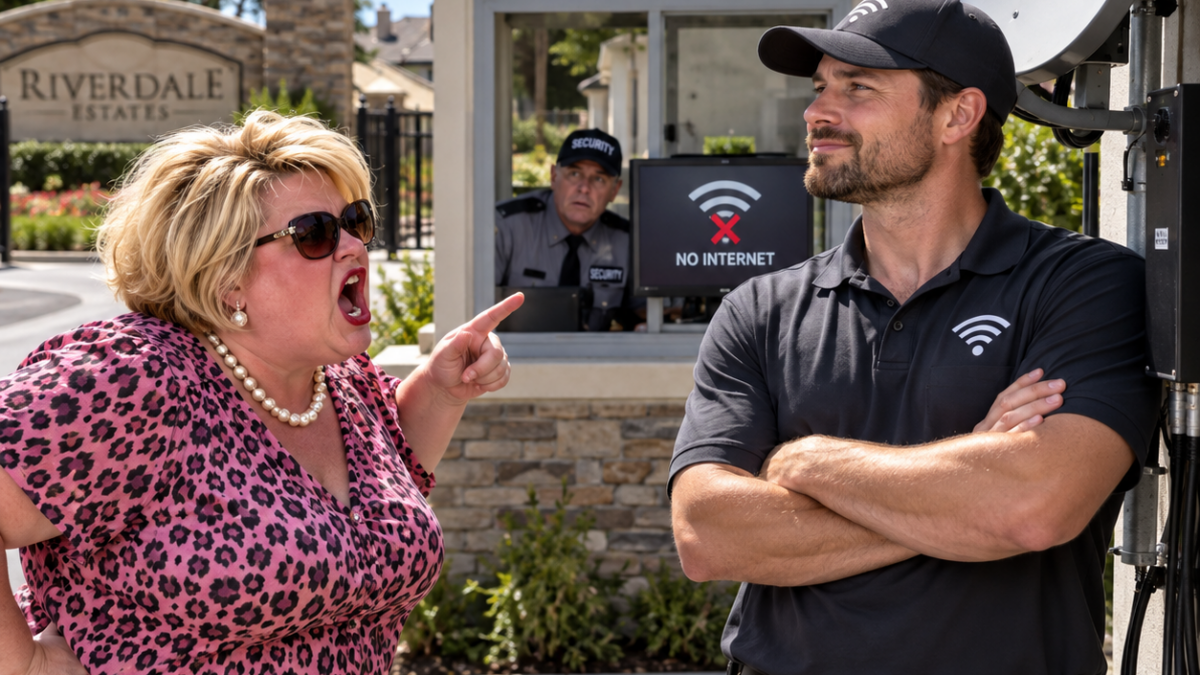
PART 2
I didn’t touch the dish.
Not that night.
Not the next morning.
Instead, I spent four hours at our dining room table reading every page of the Oak Ridge Estates governing documents.
Sarah went to bed sometime after eleven.
I stayed up.
The house became silent except for the air conditioner and the occasional turning of paper.
Twenty years in the Signal Corps had taught me something that applied far beyond communications systems.
Before you touch anything complicated, understand the architecture.
The HOA was an architecture.
Rules.
Committees.
Procedures.
Deadlines.
Authority.
Appeals.
Karen acted as though all of that belonged to her.
It didn’t.
The bylaws confirmed what I remembered.
Architectural applications had to be answered within thirty days.
No answer meant approval.
My submission had been entered through the HOA portal forty-three days before installation.
I still had the confirmation email.
No rejection had ever been sent.
That meant the dish had been approved under the association’s own rules.
Then I found something better.
The fine procedure.
Before monetary penalties could be imposed, a homeowner had to receive written notice and the opportunity for a hearing before the board.
Karen’s letter skipped the hearing completely.
She had gone directly from accusation to punishment.
I wrote two notes on a yellow legal pad.
Dish approved by default.
Fine procedure defective.
Then I opened my laptop.
I could have written an angry email.
I had plenty to be angry about.
Instead, I wrote something painfully polite.
I addressed it to every board member.
Not just Karen.
I attached my original architectural application.
The timestamp.
The relevant section of the bylaws.
The violation notice.
And a short description of the guard-shack network I’d installed at the board’s request.
I did not threaten anyone.
I simply asked that the violation be withdrawn in writing.
Then I added one sentence:
Because the satellite system currently provides the sole internet connection supporting Oak Ridge’s guard-shack network, any decision requiring removal of that equipment will necessarily terminate that complimentary service.
I read the sentence twice.
Then I hit send.
George Whitmore, the HOA treasurer, replied less than an hour later.
George was a retired accountant in his sixties.
I’d met him when the guard-shack problem first came up.
He wasn’t warm exactly, but he was reasonable.
His reply was short.
Jack, I wasn’t aware Karen had issued this notice. I’ll bring it up with the board. I agree we need to review the approval history.
Two other board members sent similarly cautious responses.
Karen sent nothing.
The next morning, I took a walk.
It wasn’t surveillance.
Not officially.
I simply looked at Oak Ridge with new eyes.
A house two streets over had peeling trim.
Another had a large decorative flag hanging long past the HOA’s stated seasonal limit.
Someone had six pink flamingos in a flower bed.
A rusting vintage car sat uncovered in a driveway.
A basketball hoop stood permanently beside the curb.
None of those things bothered me.
That wasn’t the point.
The point was consistency.
If aesthetics were so sacred that my nearly invisible satellite dish justified $500-a-day fines, then why were obvious violations untouched?
Halfway home, I saw Karen’s white SUV outside Arthur and Eleanor Miller’s house.
The Millers were in their late seventies.
Eleanor grew roses.
Not ordinary roses either.
Her front garden looked like someone had painted the yard by hand.
Red.
Yellow.
Cream.
Deep pink.
I sometimes saw her outside before sunrise with pruning shears.
Karen came through their front door.
Eleanor stood behind her holding a tissue.
Karen said something I couldn’t hear.
Then she walked to her SUV and left.
Eleanor remained in the doorway.
I crossed the street.
“Mrs. Miller?”
She quickly wiped her face.
“Oh. Jack.”
“Everything okay?”
“It’s nothing.”
It obviously wasn’t nothing.
I waited.
She finally looked toward her rose bushes.
“Karen says they have to come out.”
I thought I’d misunderstood.
“The roses?”
“She says they’re attracting bees.”
“Roses attract bees.”
“I know.”
Her voice cracked.
“She says it’s a nuisance issue.”
I stared at the garden.
“These have been here how long?”
“Nineteen years.”
“And suddenly they’re a problem?”
She gave a tired little shrug.
“We questioned a special assessment at the last board meeting.”
There it was.
I felt something cold settle into place.
“Has this happened before?”
Eleanor looked toward the street as if Karen might still be watching.
“Come inside.”
Arthur was sitting in the living room.
He walked with a cane and had the posture of a man who had spent most of his life refusing to bend until age finally negotiated a partial surrender.
Eleanor explained why I was there.
Arthur laughed without humor.
“The roses.”
“That’s what she said.”
He pointed toward a desk.
“Show him.”
Eleanor opened a drawer.
Inside was a folder.
Violation notices.
Birdbath.
Window trim.
Holiday wreath.
Trash-bin placement.
The roses.
“How much have you paid?” I asked.
Arthur looked embarrassed.
“More than two thousand dollars.”
My jaw tightened.
“Why?”
“Because Eleanor doesn’t sleep when these letters come.”
He looked at his wife.
“They mention liens. Attorneys. Collection fees.”
Eleanor lowered her eyes.
“We just wanted peace.”
I understood that sentence better than she knew.
Sarah and I had come here for exactly the same thing.
I went home thinking about roses.
That evening, Karen finally responded to my email.
One sentence.
The violation stands.
Nothing about the approval rule.
Nothing about the required hearing.
Nothing about the guard-shack connection.
Just four words.
The violation stands.
I printed the email.
Placed it beside the letter.
Then I started a new folder.
At the top I wrote:
OAK RIDGE HOA — DISH DISPUTE / GOVERNANCE
Sarah was leaning against the kitchen counter.
“You’ve got that look.”
“What look?”
“The Army look.”
“I don’t have an Army look.”
“You absolutely have an Army look.”
I smiled.
“What does it look like?”
“Like somebody just accidentally turned themselves into a project.”
She wasn’t wrong.
But I still wasn’t thinking about taking Karen down.
Not yet.
I wanted to understand whether I was dealing with a stubborn volunteer or something more serious.
So I went to the HOA website.
It looked like it had been designed when dial-up internet was considered fast.
But it had meeting minutes.
Five years’ worth.
I downloaded everything.
For the next two evenings, I read them.
Karen’s name appeared constantly.
Architectural review.
Fine enforcement.
Vendor approvals.
Landscaping.
Security.
Special assessments.
She wasn’t merely HOA president.
She had positioned herself at the center of nearly every decision-making process.
The architectural committee consisted of one person.
Karen.
The compliance committee?
Karen chaired it.
Major contractor discussions?
Karen.
Community standards?
Karen.
The board existed.
But judging from the minutes, most members nodded while she governed.
Then I began comparing dates.
A homeowner named Rodriguez challenged a parking rule at an April meeting.
Two weeks later, the family received a basketball-hoop violation.
Another homeowner criticized landscaping costs.
The following month, she received a mailbox-color notice.
A man who questioned a security contract suddenly accumulated three exterior-maintenance warnings.
None of it proved retaliation.
But the pattern was difficult to ignore.
The next morning, our mail carrier stopped at the curb.
Mike had worked the route for years.
I asked casually whether he’d ever had problems with the HOA.
He laughed.
“With Karen?”
“Yes.”
“She tried to tell me where I could park the mail truck.”
“The federal mail truck?”
“Apparently it offended community aesthetics.”
I laughed.
Mike didn’t.
“She does that to everybody.”
He handed me a stack of envelopes.
“Landscapers too.”
“What about them?”
“They keep quitting.”
“Why?”
“Because she follows them around telling them which direction to cut the grass.”
I thought he was joking.
He wasn’t.
“She went through three companies last year.”
That gave me an idea.
HOA board members could argue about rules forever.
Money was harder to hide.
As a homeowner, I was entitled to inspect certain association financial records.
So I sent a formal request.
Budgets.
Monthly financial statements.
Vendor invoices.
Legal expenses.
Landscaping expenses.
Maintenance expenses.
Three years.
I sent it certified mail.
George called me two days later.
His voice was low.
“Jack.”
“George.”
“I got your request.”
“I assumed you would.”
“Karen’s furious.”
“That seems to happen a lot.”
“She wants the attorney to reject it.”
“Can they?”
A pause.
“Not entirely.”
“Then why reject it?”
Another pause.
I could hear a door close on his end.
“Jack, I need to be careful.”
“Then be careful.”
“You didn’t hear this from me.”
I sat straighter.
“Okay.”
“When you get the records, look at maintenance invoices.”
“Anything specific?”
“Vance Services.”
Karen’s last name.
I wrote it down.
“Vance Services.”
“Yes.”
“What do they do?”
“That’s part of the problem.”
George exhaled.
“I don’t know.”
“You’re the treasurer.”
“I know what the invoices say. General maintenance. Repairs. Grounds services.”
“How much?”
“They’re usually around twenty-four hundred.”
“Usually?”
“Almost always below twenty-five hundred.”
That number mattered.
I remembered reading a purchasing rule in the minutes.
Expenditures above $2,500 required additional board approval.
“Who signs them?”
George hesitated.
“Karen.”
I stopped writing.
“George.”
“I can’t say more.”
“Who owns Vance Services?”
“I told you what to look at.”
He hung up.
I stared at the phone.
Sarah entered carrying two mugs of coffee.
“What happened?”
“I think the satellite dish may be the least interesting thing in Oak Ridge.”
The HOA’s attorney responded to my financial request with four pages of expensive-sounding nonsense.
My request was allegedly overbroad.
Burdening.
Disruptive.
Possibly made in bad faith.
They offered to let me review records at the law office while supervised by a paralegal at $150 per hour.
I read the letter twice.
Then I called an old friend.
David Riley had served as a JAG officer while I was in the Army.
After leaving the service, he’d gone into private practice.
He specialized in contracts and corporate disputes.
More importantly, he had the emotional warmth of a tax audit when someone tried to intimidate his friends.
We met at a diner.
I brought the binder.
He ate half a cheeseburger while reading Karen’s violation notice.
Then he read the bylaws.
Then the attorney’s response.
“This is sloppy.”
“On whose side?”
“Theirs.”
He kept reading.
“You submitted the application?”
“Yes.”
“No response within thirty days?”
“Correct.”
“And this clause says approval is automatic.”
“Yes.”
He nodded.
“Then their dish argument is already weak.”
“I’ve got something else.”
I told him about Vance Services.
David stopped chewing.
“Do you have the invoices?”
“Not yet.”
“Get them.”
“They’re making that difficult.”
He wiped his hands.
“Send another request. Narrow it. Cite the governing statute and documents. Offer to pay reasonable copying costs.”
“You’re enjoying this.”
“I hate bullies.”
“I remember.”
He leaned forward.
“And don’t bluff about what the law says. Paperwork wins because it’s boring and accurate.”
That evening, I sent another request.
Specific records.
Specific time periods.
Specific vendors.
Reasonable copying costs.
Deadline.
No insults.
No threats beyond stating that I would pursue the formal remedies available if access was improperly denied.
Nine days later, a thick envelope arrived from the management company.
Inside were hundreds of pages.
Sarah and I covered the dining table with them.
At 11:40 that night, she tapped one invoice.
“Jack.”
I looked.
VANCE SERVICES
General common-area repair.
$2,450.
Another.
Gate maintenance.
$2,490.
Another.
Grounds upkeep.
$2,475.
Again.
Again.
Again.
I created a spreadsheet.
Three years.
More than forty thousand dollars.
Almost every invoice below the level requiring additional approval.
The descriptions were painfully vague.
I searched the state business registry.
Vance Services was registered to one man.
Harold Vance.
Karen’s husband.
Sarah sat back slowly.
“Oh.”
“Yeah.”
“Could there be a legitimate explanation?”
“Absolutely.”
“You don’t sound convinced.”
“I’m not.”
But I refused to jump directly to theft.
A related-party business wasn’t automatically illegal.
Maybe Harold had actually done the work.
Maybe proper disclosures existed somewhere.
Maybe the rates were fair.
The problem was the pattern.
No obvious competitive bids.
Minimal documentation.
Repeated amounts just below approval thresholds.
The HOA president approving payments connected to her household.
At minimum, it smelled like a conflict of interest.
I called George.
“I found Vance Services.”
Silence.
“George?”
“I figured you would.”
“Why didn’t you stop it?”
His answer came quietly.
“I tried.”
“What happened?”
“She said Harold was cheaper.”
“Was that documented?”
“No.”
“Did she disclose the relationship formally?”
“Everybody knows he’s her husband.”
“That isn’t the same thing.”
“I know.”
He sounded tired.
“I should’ve pushed harder.”
“Then push now.”
“I’ll lose my board seat.”
“Maybe.”
“Easy for you to say.”
He was right.
I wasn’t going to pretend courage was free.
“George, I’m not asking you to leak records. I’m asking whether you’re comfortable signing your name to decisions you don’t believe were handled correctly.”
He didn’t answer.
I softened my voice.
“Think about it.”
I went back to Arthur and Eleanor Miller.
This time I brought copies.
Arthur read them at the kitchen table.
His hands stopped trembling.
Not because he was calmer.
Because he was angry.
“That woman charged us a hundred dollars because Eleanor’s welcome mat looked worn.”
Eleanor looked at the invoices.
“Our dues paid this?”
“Yes.”
“You’re sure that’s her husband?”
I showed her the registration.
Eleanor covered her mouth.
Arthur pushed his chair back.
“What do we do?”
That was the moment everything changed.
Until then, it had been my dispute.
My dish.
My house.
My fines.
But looking at the Millers, I understood why Karen had survived.
Every person thought their suffering was individual.
One rose bush.
One basketball hoop.
One mailbox.
One work truck.
One dish.
Small problems feel embarrassing to organize around.
But when you put them in the same room, they stop looking small.
“We talk to people,” I said.
Arthur smiled.
He had spent years as a union organizer before retirement.
“Now you’re speaking my language.”
We started quietly.
The Rodriguez family.
Dr. Emily Chen.
Mark Simmons, a contractor who had repeatedly been threatened with towing for temporarily parking his work truck on a public street.
Each conversation began the same way.
Not with Karen.
Not with money.
With their story.
I listened.
That mattered.
The Rodriguezes had moved the basketball hoop into their garage every evening, yet Karen still cited them because it was sometimes visible during daylight hours.
Dr. Chen had received violation letters over parking in her own assigned townhouse space.
Mark had been accused of operating a commercial business from his home because his company logo appeared on his truck.
Nobody’s complaint sounded enormous in isolation.
Together, they described a system.
We met at my house on a Tuesday.
Seven people initially.
Sarah.
Me.
Arthur and Eleanor.
The Rodriguezes.
Dr. Chen.
Mark couldn’t attend, but he gave us permission to share his documents.
I started with my dish.
Then the selective-enforcement photos.
Then the approval rule.
Then Vance Services.
Dr. Chen read the first invoice.
Then the second.
Then the business registration.
“How much total?”
“Just over forty thousand in what I’ve seen.”
Mr. Rodriguez leaned forward.
“Our dues increased seven percent last year.”
“Yes.”
“They said insurance.”
“Some increase may have been insurance.”
“And this?”
“I don’t know yet.”
Arthur slapped the table.
“You know what I think.”
“I know.”
“But?”
“We use facts we can prove.”
He grunted.
“Fine.”
Eleanor spoke softly.
“Can she find out we’re doing this?”
“Yes.”
The room became quiet.
I didn’t lie.
“If we challenge her publicly, she’ll know.”
Mrs. Rodriguez looked worried.
“What can she do?”
“She can send letters. She can try more fines. She can make noise.”
“Liens?”
David had already explained enough for me to answer carefully.
“She can’t simply take a house because she’s angry. There are procedures and rights. But she can make things stressful.”
Eleanor looked around the table.
“She already does.”
That sentence broke something.
Fear, mostly.
Dr. Chen straightened the invoice stack.
“So what is the goal?”
“Transparency first.”
“And after that?”
“If the records support what we’re seeing, new leadership.”
“Recall?”
“Yes.”
Arthur smiled.
“I knew I liked you.”
The next hour became planning.
Arthur would research the recall procedure.
Dr. Chen would organize financial evidence into a concise timeline.
The Rodriguezes would speak quietly with other families.
Sarah would manage communications.
I would handle the satellite dispute and continue collecting records.
But Karen still had one enormous blind spot.
The guard shack.
She appeared to have completely forgotten how its internet worked.
Or maybe she believed the network had somehow become independent after I installed it.
Either way, the final violation letter arrived four days later.
It set a removal date.
Ten days.
If I didn’t remove the dish, the HOA would send a contractor.
I took the letter to David.
He read it.
Then smiled.
I knew that smile.
“No.”
“What?”
“You look happy.”
“I am.”
“Why?”
“Because you’re going to comply.”
I stared at him.
“With what?”
“The removal.”
“That’s my work connection.”
“Not permanently.”
He pushed the letter toward me.
“They’ve told you in writing that they’re going to remove the system.”
“Yes.”
“You’ve warned them it supports their gate.”
“Yes.”
“Warn them again.”
“Then what?”
“Let them make the decision.”
I understood.
“You want me to stop protecting them from themselves.”
“Exactly.”
We drafted the letter together.
The subject line was deliberately boring:
Acknowledgment of Satellite Equipment Removal and Related Service Termination
I acknowledged the HOA’s directive.
I stated that I would not physically interfere with the contractor they had hired.
Then I explained—again—that the satellite equipment on my property served two functions.
First, my private internet access.
Second, the complimentary network link I had voluntarily provided to the Oak Ridge guard shack.
Removal would terminate that second function.
We listed the dependent systems.
Security-camera connectivity.
Digital visitor records.
Remote gate diagnostics.
The network telephone.
Other internet-dependent functions.
Then the important part.
I requested written confirmation that the board had arranged replacement connectivity and accepted responsibility for the transition.
I also stated that once my equipment was removed, I could not accept responsibility for outages caused by the HOA’s decision.
I included the original emails where the board accepted my free help.
I sent everything to every director.
Email.
Certified mail.
Management company.
HOA counsel.
No one could reasonably claim surprise.
George called.
“Jack, you’re really going to let them remove it?”
“They ordered me to.”
“You know what happens.”
“So do they.”
“Karen thinks you’re bluffing.”
“That isn’t my problem.”
“She’s saying the guard shack has separate service.”
“It doesn’t.”
“I told her that.”
“And?”
“She said I was undermining her.”
I closed my eyes.
“George.”
“Yeah?”
“Resign before this gets worse.”
He went silent.
“I’m thinking about it.”
Ten days passed.
Karen never withdrew the order.
On removal morning, Sarah paced the kitchen.
“What if nobody comes?”
“Then the dish stays.”
“What if Karen changes her mind?”
“Then we keep the service running.”
She stopped.
“You sound disappointed.”
“I’d actually prefer that.”
“Liar.”
I smiled.
At 10:03 a.m., a white utility van stopped outside.
A handyman climbed out.
He studied the work order.
Then my roof.
Then the work order again.
He knocked.
“Mr. Garrison?”
“Yes.”
“Oak Ridge HOA sent me.”
He held out the paperwork.
“Satellite dish removal.”
Karen Vance’s signature was at the bottom.
I photographed it.
“That’s the dish.”
He looked surprised.
“You’re okay with me taking it down?”
“I’ve documented my objections. I’m not going to interfere with you.”
He looked relieved.
“Usually people yell.”
“I’m saving my energy.”
He laughed nervously.
I had a security camera recording the work.
Not hidden on his person.
Just my exterior camera covering my property.
He set the ladder.
Climbed.
At 10:17, he cut the line.
The sound was small.
A sharp snap.
That was it.
Years of military communications work had taught me how absurdly quiet major failures could begin.
A connector pulled.
A breaker tripped.
A cable cut.
The dish came down.
The handyman placed it carefully in the yard.
I gave him a bottle of water.
He handed me the work-order copy.
Then he left.
Five minutes later, my phone rang.
“Mr. Garrison?”
“Yes.”
“This is Steve at the guard shack.”
His voice was tense.
“Everything’s down.”
I looked at the clock.
10:22.
“What happened?”
“Cameras went black. Visitor computer lost connection. The gate control is throwing network errors. I’ve got cars backing up.”
“Do you have power?”
“Yes.”
“Then I know what happened.”
“What?”
“The HOA contractor removed the satellite system.”
Silence.
“What satellite system?”
“The one providing your internet.”
Another silence.
Longer.
“You’re telling me this entire shack was running through your house?”
“Through my satellite connection and wireless bridge.”
“Did Karen know that?”
“I informed the board repeatedly.”
A horn sounded behind him.
Then another.
“Oh, you’ve got to be kidding me.”
“I’m sorry you’re stuck with it, Steve.”
“What do I do?”
“Call the management company.”
“I did.”
“And?”
“They told me to reboot the router.”
I almost laughed.
“That won’t help.”
“Can you reconnect us?”
“Not without reinstalling the equipment the HOA just ordered removed.”
“Jesus.”
“I’d call Karen.”
He sighed.
“I was afraid you’d say that.”
The entrance became chaos faster than I’d expected.
The gate wasn’t physically destroyed.
But without its network systems functioning correctly, the guards had to switch to manual procedures.
Visitor processing slowed.
Cameras were unavailable remotely.
Cars backed toward the main road.
Residents who had never cared about HOA politics suddenly cared very much.
At 10:30, I sent the community email Sarah and I had prepared.
No insults.
No dramatic accusations.
Just a timeline.
I explained that the guard-shack outage resulted from removal of the equipment supplying its internet connection.
I attached my written warnings.
The signed removal order.
The original emails establishing the complimentary service.
And a short security-camera clip showing the contractor performing the authorized removal.
The subject line read:
Explanation of Today’s Guard-Shack Connectivity Failure
Within minutes, replies started.
Then texts.
Then neighborhood social-media posts.
Sarah sat at the breakfast bar staring at her phone.
“Oh, wow.”
“What?”
“They’re angry.”
“How angry?”
She read one.
“‘I’ve been in line eighteen minutes because Karen decided she didn’t like someone’s satellite dish?’”
Another.
“‘He warned the board in writing. Why did they do this?’”
Another.
“‘If his equipment was unacceptable, why was the HOA using it for our security?’”
I poured coffee.
Sarah stared at me.
“You’re enjoying this.”
“I am enjoying coffee.”
“You are a terrible liar.”
At eleven, Karen called.
Not the board.
Not the attorney.
Karen.
I answered.
“Jack!”
No hello.
“What have you done?”
“Good morning, Karen.”
“You shut down the gate!”
“No.”
“You sabotaged community security!”
“No.”
“You need to restore it immediately.”
“The equipment was removed under your signed order.”
“You knew this would happen!”
“Yes.”
That stopped her.
“What?”
“I told you.”
“You never told me the entire gate depended on it.”
“Yes, I did.”
“That’s a lie.”
“I can forward the letters again.”
Silence.
Then:
“You are playing games.”
“No, Karen.”
My voice stayed calm.
“You ordered removal of equipment from my property. I warned you that removal would terminate the free service connected to that equipment. You proceeded anyway.”
“I am ordering you to restore the service.”
“You don’t have authority to order me to provide free internet.”
“This is an emergency.”
“Then hire an internet provider.”
“You set the system up!”
“As a favor.”
Her breathing became loud.
“You will fix this.”
“No.”
“I’ll sue you.”
“Talk to your attorney.”
She hung up.
At 11:18, George emailed me.
I have resigned from the board effective immediately.
No explanation.
He didn’t need one.
At noon, Arthur Miller called.
“You seeing the entrance?”
“No.”
“People are furious.”
“Don’t turn it into a mob.”
“You’re no fun.”
“Arthur.”
“Fine. Facts only.”
“You have the petition?”
“Printed.”
“How many?”
“Two hundred copies.”
I sighed.
“You’ve been waiting your whole life for this.”
“Pretty much.”
By early afternoon, the recall petition was circulating.
Not secretly anymore.
Residents signed because of the gate outage.
Others signed because of fines.
Others because they’d seen the Vance Services information we had carefully summarized without accusing anyone of crimes we couldn’t prove.
The message was simple.
There were serious questions.
The board wasn’t answering them.
The community deserved a vote.
Then local media appeared.
I hadn’t called them.
Someone else had.
A reporter named Susan Blake phoned.
She had received my community email.
I agreed to speak with her.
I stuck to documents.
No name-calling.
No speculation.
I explained the complimentary service arrangement.
Karen’s removal directive.
My warnings.
The outage.
When Susan asked why the HOA would remove equipment supporting its own guard shack, I answered truthfully.
“You’ll have to ask the board.”
“Do you believe Mrs. Vance targeted you personally?”
“I believe the enforcement raises questions about consistency.”
“Do you think she knew what would happen?”
“She received written notice explaining the likely consequences.”
“Are you trying to embarrass her?”
“No.”
“What are you trying to do?”
“Keep my legally approved communications equipment and have the association follow its own procedures.”
That evening, Karen sent a community-wide response.
It was catastrophic.
She accused me of sabotage.
Harassment.
Manipulation.
Endangering residents.
She claimed my satellite installation had always been illegal.
She claimed the guard-shack connection had been temporary and unreliable.
Every claim created another question.
If it was unreliable, why had the HOA relied on it?
If the installation was illegal, why had the board accepted service from it?
If I had sabotaged anything, why was there a signed work order showing Karen had ordered the removal?
People noticed.
The recall petition passed the required threshold before dinner.
A special meeting was scheduled for two weeks later.
The board expected the clubhouse.
Attendance estimates became so high that the meeting was moved to the local middle-school auditorium.
During those two weeks, our small group grew.
People brought records.
Not gossip.
Records.
Letters.
Receipts.
Violation notices.
Photos.
Hearing requests.
Denials.
Payments.
For the first time, Oak Ridge’s residents weren’t complaining privately.
They were comparing experiences.
Patterns emerged.
A woman named Melissa Park had been fined because her father stayed in an RV in her driveway for two nights during cancer treatment.
A military family received repeated street-parking notices while preparing for deployment.
A widower named Tom had been cited because he missed a grass-cutting deadline during the week of his wife’s funeral.
That one hit me hard.
Tom showed me the letter.
The violation photograph had been taken three days after his wife died.
Karen knew.
He had emailed the board.
Still, the fine remained.
“Why did you pay it?” I asked.
He looked at me with tired eyes.
“I didn’t have anything left for another fight.”
I thought about Sarah and me searching for peace.
Then I thought about how often peace is purchased by people who simply surrender because resistance costs more energy than they have.
That was Karen’s real system.
Not rules.
Exhaustion.
At home that night, Sarah found me sitting in the dark dining room.
“You okay?”
“Yeah.”
“No, you’re not.”
I showed her Tom’s violation.
She read it.
Then sat beside me.
“Don’t become her.”
I looked at her.
“What?”
“You’re angry.”
“Yes.”
“You’re good at planning when you’re angry.”
“Yes.”
“And you’re good at winning.”
I almost smiled.
“That sounds like a compliment.”
“It isn’t tonight.”
She placed her hand over mine.
“Make sure you’re doing this because it’s right, not because you want to hurt her.”
I looked down at the papers.
She was right.
Somewhere between the dish and the financial records, I’d begun thinking in terms of destroying Karen.
That was dangerous.
Not because she deserved protection from consequences.
Because revenge distorts judgment.
I gathered our group the next night.
“No speeches about taking her down.”
Arthur frowned.
“That ruins half my material.”
“I’m serious.”
“So am I.”
“We present facts. Residents decide.”
Dr. Chen nodded.
“Agreed.”
“No humiliation.”
Arthur groaned.
“Jack.”
“No chants. No insults. No circus.”
Eleanor smiled.
“He’s right.”
Arthur looked betrayed.
“Et tu, Eleanor?”
“We want our neighborhood back,” she said. “We don’t need to become ugly to do it.”
That became our rule.
The special meeting opened at seven.
More than four hundred residents filled the auditorium.
Karen sat onstage between the remaining board members.
She wore a black blazer.
Her posture was rigid.
A neutral attorney had been retained to moderate the recall process.
Arthur spoke first.
He surprised me.
No jokes.
No anger.
He stood behind the podium and looked across the room.
“My wife and I have lived in Oak Ridge for almost twenty years.”
He paused.
“We raised grandchildren here. We planted roses here. We buried friends who lived on these streets.”
Eleanor lowered her eyes.
“This community has rules. Rules can be good. They protect shared property and help neighbors solve disputes.”
Another pause.
“But rules become dangerous when they stop being standards and become weapons.”
The auditorium was completely quiet.
“We are not here tonight because anybody hates rules.”
Arthur turned toward Karen.
“We are here because trust has been broken.”
Then he introduced me.
I walked to the podium.
The screen behind me displayed one image.
My satellite dish.
“I wish this entire story were really about that.”
A few people laughed.
“It isn’t.”
I described the application.
The thirty-day approval.
The guard-shack problem.
The free connection.
Karen’s violation notice.
The warning letters.
The removal order.
The outage.
No exaggeration.
Then I put Karen’s signed work order on the screen.
“This matters because leadership requires understanding consequences.”
I changed slides.
A copy of my warning letter appeared.
“The board was warned.”
Next slide.
Email confirmation.
“The warning was received.”
Next.
The removal order.
“The removal proceeded.”
I looked at the room.
“This wasn’t sabotage.”
Silence.
“It was a preventable failure.”
Then I stepped away.
Dr. Chen presented the financial records.
She was better than I could ever have been.
No dramatic language.
A chart showed payments to Vance Services.
Dates.
Amounts.
Descriptions.
Approval thresholds.
Ownership records.
She never used the word theft.
She didn’t need to.
“Over the reviewed period,” she said, “payments to Vance Services exceeded forty thousand dollars.”
Murmurs.
“The company is registered to Harold Vance, spouse of the HOA president.”
Louder murmurs.
“We have not been provided records demonstrating competitive bidding for these payments.”
Karen shifted.
“We have not been provided adequate conflict-of-interest disclosures in the minutes made available to members.”
Someone called out:
“Where did the money go?”
The moderator raised a hand.
“Please allow the speaker to finish.”
Dr. Chen continued.
“The purpose tonight is not to make criminal accusations. The purpose is to determine whether this community continues to trust its current leadership.”
That distinction mattered.
Then residents spoke.
Two minutes each.
Eleanor Miller approached the microphone.
Karen finally looked shaken.
Eleanor was small.
Soft-spoken.
The kind of woman people interrupted without realizing they were doing it.
That night, nobody interrupted her.
“My roses were planted with my daughter.”
Her voice trembled.
“She died eleven years ago.”
I hadn’t known that.
Neither had most of the room.
Eleanor swallowed.
“She picked the yellow ones.”
Karen looked down.
“When I was told to remove the bushes because they attracted bees, I didn’t argue because I was afraid the fines would increase.”
She held up the violation notice.
“I am seventy-eight years old.”
Her hands shook.
“I should not be afraid to open my mailbox.”
That was the most powerful testimony of the night.
Not forty thousand dollars.
Not the gate.
Not my dish.
An elderly woman saying she was afraid of her mailbox.
Arthur helped her back to her seat.
The Rodriguezes spoke.
Tom spoke about receiving the lawn citation after his wife died.
Melissa spoke about her father.
A young Army spouse described being threatened over parking while her husband was deployed.
Story after story.
No yelling.
That made them harder to dismiss.
Finally, Karen was given the podium.
She carried several pages.
For the first minute, she read carefully.
She talked about property values.
Volunteer service.
Community standards.
Difficult decisions.
Then she looked up.
She saw Eleanor.
Tom.
The Rodriguezes.
Me.
Hundreds of neighbors.
Her voice changed.
“You don’t understand what it takes to manage people.”
A murmur moved through the auditorium.
Karen continued.
“Everyone wants exceptions.”
She pointed toward the crowd.
“One person wants a basketball hoop. Another wants an RV. Someone else wants a satellite dish. Someone wants different landscaping. If you allow every exception, standards disappear.”
Dr. Chen quietly whispered beside me:
“She’s making our argument for us.”
Karen raised her voice.
“I sacrificed thousands of hours for this community.”
Nobody disputed that.
“And now I’m being attacked by people who were perfectly happy to let me do the work until they didn’t get their way.”
Arthur shook his head.
Karen saw him.
“You.”
She pointed.
“Your wife violated landscaping standards.”
Arthur started to stand.
I touched his arm.
“Don’t.”
He stayed seated.
Karen turned toward me.
“And you came here six months ago and immediately decided you knew better than everyone.”
I rose only when the moderator recognized me.
Karen kept talking.
“You engineered this entire crisis.”
The moderator said, “Mrs. Vance, please address the membership.”
“I am addressing them!”
Her face flushed.
“This man deliberately allowed the security system to fail!”
I answered from my seat.
“You ordered the equipment removed after receiving written warning.”
She slammed her papers against the podium.
“Because it violated the rules!”
A voice from the audience said:
“Your rules approved it after thirty days.”
Laughter.
Karen’s control slipped.
“Do you think running an HOA is easy?”
Nobody answered.
“I maintained your property values!”
Her voice cracked.
“You should be grateful!”
The room changed.
Not loudly.
Emotionally.
That sentence ended whatever argument remained.
The moderator called for the vote.
Paper ballots.
Secret.
Collected row by row.
We waited.
Sarah held my hand.
“You okay?”
“Ask me after.”
Thirty minutes later, the attorney returned to the microphone.
“On the motion to recall Karen Vance from the Oak Ridge Estates Board…”
I felt the room stop breathing.
“Four hundred twelve votes in favor.”
A pause.
“Seven opposed.”
For a second, silence.
Then applause.
Not everyone cheered.
Eleanor cried.
Tom closed his eyes.
Arthur squeezed his wife’s shoulder.
It felt less like victory than release.
Karen remained seated.
She looked stunned.
The other remaining directors were recalled by similarly overwhelming margins.
George had already resigned.
An interim board had to be formed.
Arthur was nominated.
Dr. Chen.
Then someone shouted my name.
I immediately shook my head.
Sarah laughed.
“Too late.”
I ended up elected.
Not president.
I refused that job.
Arthur accepted it.
Dr. Chen became treasurer.
I took responsibility for technology and infrastructure.
My first motion was simple.
Independent financial audit.
Unanimous.
Second.
Suspend disputed fines pending review.
Unanimous.
Third.
Replace the old HOA law firm with independent counsel selected through competitive proposals.
Unanimous.
Karen left through a side door.
No one followed her.
No one shouted.
I watched her disappear.
For months, she’d seemed enormous.
Not physically.
Institutionally.
Like she occupied every room before entering it.
Now she was simply a woman leaving an auditorium.
Power can vanish remarkably fast when people stop agreeing that you have it.
The next several weeks were difficult.
Removing a bad leader doesn’t magically create good governance.
There were bank signatures to change.
Vendor accounts.
Insurance questions.
Contract reviews.
Maintenance schedules.
Hundreds of emails.
Arthur called me at 6:30 one morning.
“Why did we volunteer for this?”
“You volunteered.”
“You got elected.”
“I was ambushed.”
“We need to discuss pool furniture.”
I nearly hung up.
But slowly, Oak Ridge became functional again.
The front gate was the first visible problem.
I ordered a replacement satellite dish.
Slightly better than the original.
The HOA offered to pay.
I refused.
“This is my equipment.”
Then we created something the previous board should have created from the beginning.
A contract.
The HOA would pay a modest monthly fee for guard-shack connectivity.
Responsibilities were defined.
Maintenance was defined.
Termination notice was defined.
Liability was defined.
Everything written.
Everything approved in an open meeting.
When I installed the new system, Steve stood inside the guard shack watching the network lights come alive.
Camera one connected.
Camera two.
Visitor terminal.
Gate controller.
Phone.
Steve pressed the gate button.
The barrier arm rose smoothly.
He looked at me.
“Beautiful.”
“It’s internet.”
“After two weeks of paper visitor logs, it’s beautiful.”
Arthur and Eleanor had come to watch.
Eleanor carried lemonade.
When the gate returned to normal, she applauded.
I bowed.
Arthur said, “Don’t encourage him.”
The audit took another month.
When the final report arrived, we gathered in the clubhouse.
The numbers were worse than expected.
More than fifty thousand dollars in payments to Vance Services were classified by the auditor as unsupported, inadequately documented, conflicted, or otherwise requiring recovery or further investigation.
Not every dollar could be labeled stolen.
That distinction mattered.
Some actual work had occurred.
But invoices lacked detail.
Competitive bids were missing.
Conflict disclosures were inadequate.
Several expenses had been split or structured in amounts that avoided higher approval requirements.
There were also excessive legal costs connected to petty enforcement disputes.
We presented the report publicly.
Every page.
No secret executive summary.
No selected excerpts.
Residents deserved the whole thing.
Then came the hard question.
What to do about Karen and Harold.
Some residents wanted immediate criminal referrals.
Others wanted lawsuits.
Arthur wanted the money back.
Eleanor surprised everyone.
“I don’t want revenge.”
The clubhouse became quiet.
She looked around.
“I want my money returned. I want everyone’s money returned where fines were improper. I want this never to happen again.”
She glanced toward the window.
“My roses are still alive.”
That became our direction.
Independent counsel sent a formal civil demand to the Vances seeking repayment based on the audit findings.
The letter made clear that the HOA would preserve all evidence and cooperate with any lawful investigation.
We weren’t prosecutors.
We couldn’t promise immunity.
We weren’t going to pretend we could.
But we could pursue the community’s money.
Three weeks later, Karen’s attorney requested settlement discussions.
I didn’t attend the first meeting.
Sarah asked why.
“Because I don’t trust myself to be useful.”
“You’ve gotten wiser.”
“Don’t spread that around.”
The settlement was reached after twelve days.
The Vances repaid the disputed amount identified for recovery.
Additional claims were released under the negotiated agreement.
The HOA recovered more than fifty thousand dollars when reimbursements, credits, and vendor adjustments were included.
Karen and Harold agreed to relinquish any remaining association positions or committee authority.
Two weeks later, a real-estate sign appeared in their yard.
The neighborhood reacted strangely.
No celebration.
No champagne.
No crowd.
People drove past.
Walked dogs.
Collected mail.
Life continued.
One Saturday morning, I saw Karen outside while I was walking.
Boxes filled her garage.
For a moment, I considered crossing the street.
Then she saw me.
“Jack.”
I stopped.
“Karen.”
She looked different without the authority.
Tired.
Older.
“Happy?”
It wasn’t said angrily.
That made it harder.
“About what?”
“You won.”
I looked down the street.
The Rodriguezes’ son was shooting baskets.
The hoop was still there.
Eleanor’s roses were visible behind me.
“I don’t think that’s what happened.”
She laughed bitterly.
“Of course you do.”
“No.”
“You got me removed.”
“The residents voted.”
“Because of you.”
“Because of what they saw.”
Her eyes hardened.
“You wanted revenge.”
“At first?”
I considered lying.
Then didn’t.
“Maybe.”
That surprised her.
“But somewhere along the way, it stopped being about my dish.”
Karen folded her arms.
“You have no idea what these people are like.”
“People?”
“Residents.”
She sounded exhausted.
“They complain about everything.”
“I know.”
“They expect volunteers to solve everything.”
“I know.”
“They ignore meetings until they’re angry.”
“Definitely know.”
For the first time, a tiny smile almost appeared.
Then disappeared.
“I thought if I didn’t keep control, this place would become chaos.”
“You kept adding control.”
“Because people kept pushing.”
“Maybe.”
She stared at me.
“You think you’re different?”
That question stayed with me.
“I hope I am.”
“You’ll see.”
“What?”
“You’ll make exceptions. Then somebody will accuse you of favoritism. You’ll enforce something. Somebody will call you a tyrant. You’ll spend hours fixing problems nobody thanks you for.”
“Probably.”
“And eventually you’ll understand.”
“Maybe.”
I nodded toward the boxes.
“When are you leaving?”
“Friday.”
She looked toward Eleanor’s house.
“Tell her she can keep the roses.”
I almost laughed.
“She doesn’t need your permission.”
Karen closed her eyes.
“Right.”
That single word was the closest thing to an admission I ever received.
Then she went back inside.
Friday morning, the moving truck came.
I didn’t watch it leave.
I was on a client call.
Life had returned to normal enough that Karen’s departure wasn’t the most important thing happening that day.
That felt appropriate.
The new board rewrote several rules.
Not to eliminate standards.
To make them understandable.
The architectural committee expanded from one person to three.
No single director could issue fines.
Homeowners received warnings first except in genuine emergencies.
Hearings became mandatory before substantial penalties.
Conflict-of-interest disclosures were required.
Vendor contracts above defined amounts needed competitive bids.
Board meeting minutes included actual votes instead of vague phrases like “discussion followed.”
Financial statements were posted monthly.
We created term limits.
Arthur hated that one.
“You trying to get rid of me?”
“Eventually.”
“Ungrateful.”
“You’re seventy-four.”
“That’s age discrimination.”
“You fall asleep during landscaping reports.”
“That’s self-defense.”
Most importantly, we reviewed past fines.
Some were legitimate.
A few homeowners really had ignored obvious safety or maintenance problems.
We didn’t erase every rule simply because Karen had enforced some rules badly.
But dozens of penalties were reduced, reversed, or refunded because procedures hadn’t been followed or enforcement was clearly inconsistent.
The Millers received money back.
When Arthur showed me the check, he grinned.
“Eleanor’s buying more roses.”
“Of course she is.”
“She says yellow.”
I remembered what she’d said about her daughter.
“Good choice.”
Tom’s lawn fine was refunded.
He didn’t care about the money.
He cared about the letter we sent with it.
The board apologized.
Not legally evasive language.
Not “we regret any inconvenience.”
An apology.
You were grieving, and this community failed to treat you like a neighbor.
Tom called me after receiving it.
He didn’t say much.
Neither did I.
Some things don’t need many words.
The recovered money went toward visible improvements.
Playground repairs.
Trees.
Drainage work.
Security upgrades.
The tennis court.
Not because everyone wanted tennis.
Because the surface had become unsafe and the work had been delayed while money disappeared into vague maintenance charges.
For the first time, residents could see exactly how their dues were spent.
Attendance at meetings increased.
Initially, that was exhausting.
Everyone had opinions.
Strong ones.
Pool hours.
Landscaping.
Street parking.
Dog waste.
Holiday lights.
Fence stains.
One night Arthur rubbed both temples after three hours of public comment.
“I miss the revolution.”
Dr. Chen didn’t look up from her notes.
“Revolutions are easier than budgets.”
She was right.
But boring governance was the point.
Nobody should feel terrified when the HOA president walks onto their lawn.
Nobody should need a military veteran with a satellite dish to understand their own bylaws.
Nobody should be afraid to open their mailbox.
Spring came.
One Saturday, we held a community barbecue.
Nothing fancy.
Folding tables.
Burgers.
Hot dogs.
A cooler full of soda.
Kids running around the clubhouse lawn.
Steve came over from the guard shack during his break.
The Rodriguezes’ son played basketball with two other boys.
Dr. Chen argued with Arthur about whether he was overcooking the burgers.
Eleanor sat beneath an umbrella showing Sarah photographs of her roses.
They had bloomed spectacularly.
Yellow roses dominated the center.
I knew why.
Arthur walked toward me holding two beers.
He handed me one.
“Look.”
“At what?”
“All of it.”
I looked.
Neighbors talking.
Laughing.
Arguing harmlessly over food.
“Looks expensive.”
“The burgers?”
“No. Community.”
Arthur laughed.
“You Army boys always have to say something dramatic.”
“I was Signal Corps. We’re intellectuals.”
“You climbed roofs for a living.”
“Highly educated roofs.”
He pointed his bottle toward the entrance.
From the clubhouse lawn, I could just see my roof beyond the trees.
And the satellite dish.
The new one.
Small.
Gray.
Quietly doing its job.
Nobody had complained about it.
Actually, the board had jokingly voted to declare it “community infrastructure of unusual historical significance.”
I voted against the motion.
It passed anyway.
Arthur lifted his beer.
“To the ugly thing.”
I shook my head.
“Don’t start.”
“To the dish that killed a dictatorship.”
“It didn’t kill anything.”
He looked at me.
“No?”
“No.”
I pointed toward the people around us.
“They did.”
Arthur considered that.
Then nodded.
“To them.”
We touched bottles.
A few weeks later, I received an envelope.
No return address.
Inside was a handwritten note.
Only three sentences.
Jack, you were right about one thing. I confused being responsible for the neighborhood with owning it. I still believe many of my decisions were made for the right reasons, but I understand now that the methods mattered too. Tell Eleanor I remember the yellow roses.
No signature.
It didn’t need one.
I showed Sarah.
“What are you going to do?”
“Nothing.”
“You’re not going to answer?”
“No address.”
“You could probably find her.”
“I could.”
“But?”
I folded the note.
“But sometimes a conversation gets to end.”
I put it in the back of the old HOA binder.
Right beside Karen’s original satellite violation.
Over time, the whole battle became neighborhood mythology.
New residents heard distorted versions.
In one version, Karen personally climbed onto my roof with bolt cutters.
Never happened.
In another, the FBI raided the clubhouse.
Definitely never happened.
One teenager told me his father said I hacked the gate to teach the HOA a lesson.
That one annoyed me.
“I didn’t hack anything.”
He looked disappointed.
“The HOA ordered my equipment removed.”
“So the gate just failed?”
“The network connection failed.”
“That’s less cool.”
“Reality often is.”
He shrugged.
“Still pretty cool.”
Years passed.
Arthur eventually stepped down.
Dr. Chen became president.
She lasted eighteen months before declaring she’d rather perform emergency surgery during an earthquake than moderate another parking discussion.
A younger father named Miguel Rodriguez took over.
He was patient.
Transparent.
Annoyingly cheerful.
He made residents submit agenda requests in advance.
Meetings became shorter.
I considered him a genius.
I left the board after two years.
Sarah celebrated by opening a bottle of wine.
“That happy?”
“I have my husband back.”
“I never left.”
“You spent forty minutes last Tuesday discussing mailbox post dimensions.”
I poured two glasses.
“I was defending democracy.”
“You were discussing pressure-treated lumber.”
“Same thing.”
My consulting work grew.
The satellite system remained reliable.
Eventually, fiber finally reached our area.
The HOA hired a proper commercial connection for the guard shack.
The day it went live, Miguel came to my house.
“Jack.”
“Yeah?”
“We’re finally cutting the neighborhood off from your internet.”
I looked shocked.
“After everything I’ve done?”
“I know.”
“Betrayal.”
“We can keep paying you if it helps emotionally.”
“That does help.”
He laughed.
The guard shack moved to fiber.
My dish went back to serving only my house.
For the first time since the entire mess began, the gray circle on my roof became exactly what Karen had claimed it was.
Just a satellite dish.
No political symbolism.
No community security.
No weapon.
No leverage.
Just equipment.
I thought I would remove it once fiber reached our property.
I didn’t.
The backup connection was useful.
That was the practical reason.
The less practical reason was that I liked seeing it.
Not because it reminded me that Karen lost.
Because it reminded me what happened after.
Eleanor kept her roses.
Arthur found his voice again.
Tom received an apology.
The Rodriguezes stopped treating their son’s basketball hoop like contraband.
Residents learned where their money went.
Board meetings became transparent.
People understood that an HOA was not a kingdom sitting above homeowners.
It was an organization created by them.
That distinction sounds obvious.
Until people forget it.
One evening, years after Karen left, Sarah and I walked through the neighborhood.
The sun was low.
Eleanor was outside.
She was older now.
Moving more slowly.
Still pruning roses.
We stopped.
“You two want to see something?” she asked.
“Always,” Sarah said.
Eleanor led us to the center bed.
A new yellow rose bush had bloomed.
The flowers were enormous.
“This one’s named Peace,” she said.
I smiled.
“Seriously?”
“That’s the variety.”
Sarah looked at me.
“Don’t make a speech.”
“I wasn’t going to.”
“You were.”
Eleanor laughed.
Then her expression softened.
“You know, I almost pulled all of these out.”
“I know.”
“I had the shovel in the garage.”
She touched a yellow petal.
“Arthur stopped me.”
“Good man.”
“He said if Karen wanted them gone, she could come dig them herself.”
“That sounds like Arthur.”
Eleanor smiled.
“He was scared too.”
That surprised me.
“Arthur?”
“Oh, yes.”
“He never looked scared.”
“He was terrified we’d lose the house.”
She turned toward me.
“So was I.”
I didn’t know what to say.
She continued.
“You changed that.”
“No.”
“Yes.”
“I showed you some paperwork.”
“You showed us that she could be questioned.”
“That was all you.”
“Jack.”
Eleanor looked directly at me.
“People sometimes need someone to go first.”
That stayed with me.
Not because I believed I’d saved Oak Ridge.
I hadn’t.
Communities don’t get saved by one person.
But somebody usually has to speak first.
Somebody has to ask for the document.
Challenge the fine.
Request the vote.
Tell the frightened neighbor that they’re not alone.
Sometimes the first person is brave.
Sometimes they’re just angry enough.
Sometimes they’re a retired Signal Corps guy irritated that somebody called his satellite dish ugly.
Life has a strange sense of humor.
Eleanor cut one yellow rose.
She handed it to Sarah.
“For your kitchen.”
Sarah kissed her cheek.
We continued walking.
At the corner, Sarah looked back toward my house.
The dish was barely visible through the pin oak.
“You know Karen was right.”
I stopped.
“Excuse me?”
“The dish is kind of ugly.”
I stared at my wife.
“After everything?”
She started laughing.
“Technically ugly.”
“That dish defended freedom.”
“That dish provides backup internet.”
“It has a distinguished service record.”
“It’s a gray circle attached to our roof.”
“Traitor.”
She slipped her hand into mine.
We walked home.
The guard shack lights came on as darkness settled.
Cars passed through the gate one at a time.
Cameras functioning.
Visitor system online.
Nobody waiting.
Nobody yelling.
Steve had retired by then.
A young guard waved as we passed.
He probably had no idea why I smiled every time I looked at that little building.
That was fine.
The best ending to a neighborhood war is when the next generation doesn’t have to remember it.
Back home, Sarah placed Eleanor’s yellow rose in a glass vase.
I went into my office.
On the shelf sat the old HOA binder.
For some reason, I pulled it down.
Karen’s first letter remained inside.
The paper had yellowed slightly.
REMOVE SATELLITE EQUIPMENT WITHIN SEVEN DAYS.
$500 DAILY FINE THEREAFTER.
I remembered her standing on the lawn in that floral pantsuit.
So certain.
So completely convinced that authority and ownership were the same thing.
At the time, I’d thought the most satisfying possible ending would be watching her lose everything.
I was wrong.
The satisfying part wasn’t Karen leaving.
It wasn’t the recall vote.
It wasn’t seeing 412 votes against her.
It wasn’t the recovered money.
It wasn’t even the moment the guard shack went dark exactly as I’d warned it would.
The satisfying part was what happened when the lights came back on.
A contract replaced a favor.
A committee replaced one person’s discretion.
Public records replaced whispers.
Warnings replaced automatic punishment.
Neighbors replaced subjects.
And rules became what rules were supposed to be.
Boundaries everyone could understand.
Not weapons one person could aim.
I closed the binder.
Through the office window, I could see the edge of the satellite dish against the evening sky.
Still there.
Still working.
Still ugly, according to Sarah.
I smiled.
Karen had once ordered me to remove it because she believed it damaged Oak Ridge.
Instead, her attempt to remove that dish exposed what was actually damaging the neighborhood.
Fear.
Secrecy.
Selective punishment.
Unaccountable power.
Those things had been much harder to remove than a piece of metal from a roof.
But eventually, we removed them too.
And unlike the satellite dish, nobody ever asked us to put them back.








