PART 2: HOA Ordered Me to Tear Down My Grandfather’s Stone Wall—Then the Hill Started Sliding Toward Their Cul-de-Sac
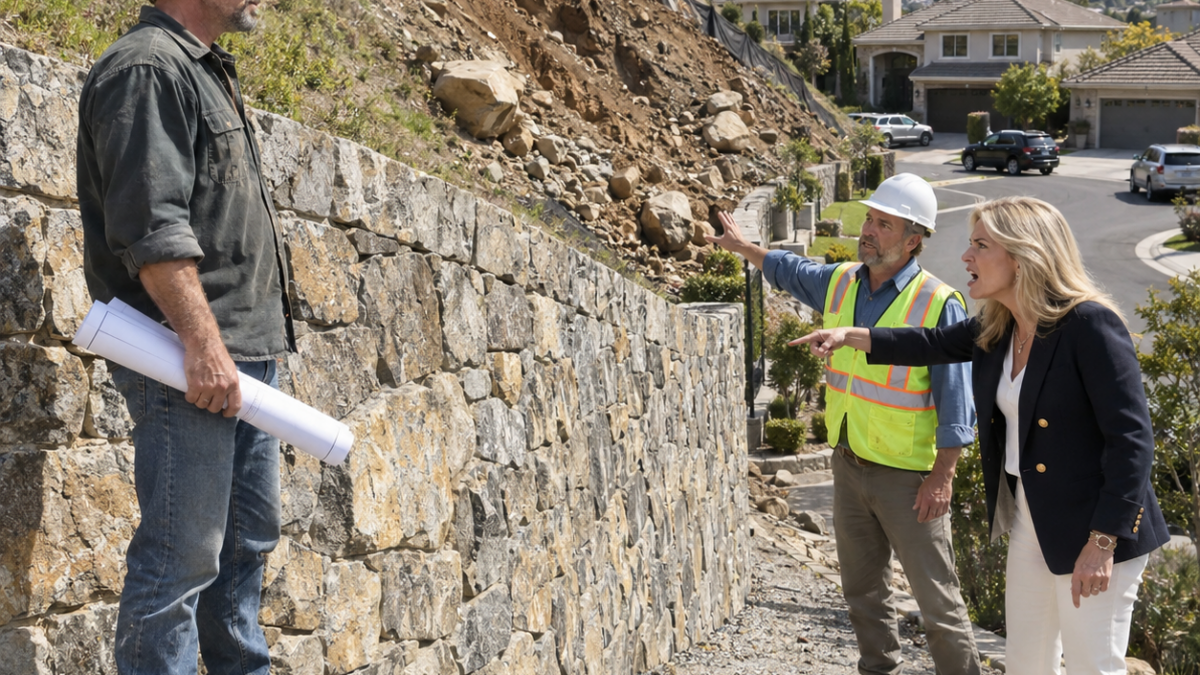
Karen gave me thirty days to tear down the sixty-year-old stone wall my grandfather built with his own hands, then calmly explained that the HOA would demolish it for me if I refused. She called it an ugly pile of rocks, but I knew every massive stone had been placed there for a reason that had nothing to do with landscaping. What she did not know was that the moment she ordered that wall removed, she had started a chain of events that would force an entire neighborhood to question what was really holding their homes together.
My name is Jack Reed, and after twenty years in the Army, I came home wanting the kind of quiet you cannot understand until you have spent half your adult life surrounded by engines, radios, deadlines, and people making decisions where mistakes can cost lives.
My grandfather left me forty acres on the edge of the Appalachians, a wedge of pasture, pine, shale, and old hardwoods that had somehow survived the development spreading across the county. The farmhouse was modest. The barn leaned slightly to the east. The fences needed work.
I loved every inch of it.
The property backed directly against Harmony Ridge Estates, a new subdivision of beige houses built along the bottom of a steep hill. Their prettiest cul-de-sac sat almost directly beneath my pasture.
Between my land and those houses stood the wall.
It stretched nearly two hundred feet across the hillside and rose as high as twelve feet in places. My grandfather and his brothers built it decades earlier from stone pulled directly from the ridge. There was no decorative veneer, no polished cap, no neat suburban symmetry.
It was old.
Moss grew between some stones. Wildflowers found cracks in spring. Rain darkened the granite almost black.
But it was solid.
My grandfather had sold the lower acreage to the original developer years before Harmony Ridge existed, and I remembered him telling me one thing about that sale.
“They can build down there,” he had said, “but nobody touches that wall.”
I was younger then and never asked why.
Karen did.
Or rather, she decided she already knew the answer.
She arrived at my fence one afternoon wearing a floral dress and carrying a clipboard, with two HOA board members standing behind her like backup singers.
“That unsightly structure has to go, Mr. Reed.”
I looked toward the wall.
“You mean the retaining wall?”
“I mean the pile of rocks violating our aesthetic standards.”
“It’s on my property.”
“It is visible from Harmony Ridge.”
“That doesn’t make it yours.”
Her smile tightened.
“Section Twelve, Subsection B gives the association authority over structures negatively affecting visual harmony.”
“My property isn’t part of your HOA.”
“Our attorneys disagree.”
That was a lie, although I did not know how big a lie yet.
She handed me a violation notice.
Thirty days to remove the wall.
Two hundred dollars per day afterward.
If I refused, the HOA would hire a demolition contractor and bill me for the work.
I read the letter twice.
Then I looked at the neat row of houses below us.
“Karen, before you touch that wall, I strongly recommend you hire a geotechnical engineer.”
She laughed.
“Why?”
“Because it isn’t decorative.”
“Neither are most retaining walls.”
“This one is holding the hill.”
One of the men behind her glanced downhill.
Karen didn’t.
“Mr. Reed, I’ve heard every excuse homeowners use when they don’t want to follow rules.”
“This isn’t an excuse.”
“The board has made its decision.”
She turned to leave.
I called after her.
“If you knock that wall down, you may put every house in that cul-de-sac at risk.”
Karen stopped, looked over one shoulder, and gave me a smile I still remember.
“Your personal opinion does not supersede HOA authority.”
That sentence changed everything.
I went inside, opened my grandfather’s old desk, and started searching.
What I found was a notarized land-sale agreement from years earlier containing one sentence highlighted in yellow.
The existing stone retaining structure shall remain permanently undisturbed as a condition necessary to hillside stability.
I sat there staring at the words.
Then I looked through the window toward Harmony Ridge.
Karen thought she had given me thirty days to save my wall.
What she had really given me was thirty days to prove exactly what would happen to her neighborhood if she got what she wanted.
PART 2
I read that sentence at least six times before I called Sarah into the room.
She had been in the kitchen washing vegetables from the garden, and she came in drying her hands on a towel.
“What happened?”
I pointed at the paper.
“Read the highlighted paragraph.”
She leaned over my grandfather’s desk.
The agreement was dated almost fifteen years earlier, from when he sold the lower parcel to Northstar Homes, the developer that eventually built Harmony Ridge.
Sarah read slowly.
Then she looked at me.
“They knew?”
“The developer knew.”
“That wall was part of the sale?”
“More than part of it.”
I slid the document toward her.
“It was a condition.”
She read it again.
“Necessary to hillside stability.”
“Exactly.”
For a moment, neither of us spoke.
Outside the office window, the late-afternoon sun stretched across the pasture, and beyond the tree line I could just see the roofs of Harmony Ridge.
Pretty homes.
Expensive homes.
Families living their lives beneath a hill most of them probably never thought about.
Sarah lowered herself into the chair beside me.
“Jack, why would Karen order it removed if this is in the agreement?”
“Either she doesn’t know.”
“Or?”
“She doesn’t care.”
Sarah frowned.
“That’s worse.”
“Yes.”
I picked up the HOA violation notice.
Two hundred dollars per day after thirty days.
The fine itself did not scare me.
What bothered me was the demolition clause.
Karen had already demonstrated that she believed her authority extended farther than the law did. If she hired a contractor, that contractor might come onto my land with an excavator and begin pulling apart a structure that had been carrying the load of that hillside for sixty years.
I had spent enough of my Army career around combat engineers to know one thing about earth.
It does not care about arguments.
It does not care about HOA bylaws.
It does not care who wins a meeting.
If the slope wanted to move and the wall stopped resisting, gravity would make the final decision.
That night, I did not sleep well.
Around two in the morning, I got out of bed and walked to the kitchen.
Sarah found me standing at the window.
“You’re thinking about the hill.”
I nodded.
“Can’t shut it off.”
“You really think houses could be damaged?”
“I don’t know yet.”
“That’s not like you.”
“What?”
“You usually have an answer.”
I looked at her.
“That’s why I’m worried.”
The next morning, I called Apex Geotechnical Services.
A receptionist transferred me to an engineer named Arthur Vance.
I gave him the short version.
“I have a dry-stack stone retaining wall, roughly two hundred feet long, up to twelve feet tall, holding a natural hillside above a residential development.”
“How old?”
“Approximately sixty years.”
“And what’s wrong with it?”
“Nothing obvious.”
“Then why are you calling?”
“The HOA wants it demolished.”
Silence.
Then:
“They what?”
“They say it’s ugly.”
Arthur laughed once.
Not because it was funny.
Because sometimes absurdity needs a sound.
“What kind of slope?”
“Clay, shale, mixed colluvium from what I can tell.”
His voice changed immediately.
“Any drainage?”
“Natural weeps through the wall. Old stone channels behind portions of it.”
“You know something about this?”
“Army engineer units taught me enough to know what I don’t know.”
“Good answer.”
I heard typing.
“Can you meet tomorrow morning?”
“I’ll be here.”
Arthur arrived at eight.
He was tall, thin, sun-darkened, probably in his late fifties, with the hands of a man who had spent most of his career touching soil instead of merely writing about it.
The moment he saw the wall, he stopped.
“Well.”
“Good well or bad well?”
He walked closer.
“Old well.”
“That clears it up.”
He smiled.
“People underestimate old construction because it doesn’t look modern.”
He began examining the base.
“This isn’t random stone placement.”
“I know.”
“These foundation stones are enormous.”
“My grandfather used a tractor and chain hoist.”
Arthur studied the wall’s slight backward lean into the slope.
“Batter angle is surprisingly consistent.”
He crouched and pushed his hand into one of the gaps.
“Drainage voids.”
“He left them intentionally?”
“Looks like it.”
Arthur stood.
“Whoever built this understood gravity retaining systems whether he knew the terminology or not.”
“He built roads before he farmed.”
“That explains some of it.”
For four hours, Arthur worked.
He took soil samples above the wall.
Measured the slope.
Inspected drainage patterns.
Examined the old stone channels.
Used a probe near the base.
Photographed the wall from multiple angles.
Then we walked downhill toward the property line.
From there, the houses looked disturbingly close.
George Henderson’s home sat nearest.
A beautiful two-story place with a polished black Mustang in the driveway.
Arthur looked from the house to the slope.
“Who approved this setback?”
“I’m working on that.”
“How far is the house from the toe of the slope?”
“Maybe a hundred and twenty feet.”
He stared.
“That’s aggressive.”
“Meaning?”
“Meaning if this hillside is what I think it is, somebody relied very heavily on this wall.”
He looked up at it again.
“And if your HOA president really wants to remove it, she needs to be stopped before anyone touches a stone.”
“How bad?”
“I’m not going to give you conclusions before testing.”
“Fair.”
“But Jack?”
“Yes?”
“Do not let anyone demolish that wall.”
Three days later, the survey crew came.
I hired them for one reason.
Karen was already claiming the wall somehow fell within HOA control because Harmony Ridge residents could see it.
I wanted a professional boundary determination.
The surveyor drove bright orange stakes along my property line.
Every part of the wall sat on my side.
The nearest section was roughly five feet inside my boundary.
I photographed everything.
Wall.
Survey flags.
Property corners.
Harmony Ridge houses in the background.
By the end of the week, Arthur’s report arrived.
Twenty-three pages.
Soil logs.
Slope angles.
Hydrology.
Historic weather patterns.
Photographs.
Calculations.
I read the executive summary first.
Then I read it again.
Sarah sat across from me.
“Well?”
I did not answer.
“Jack?”
I slid the paper across.
She read the conclusion.
The existing dry-stack gravity retaining structure is currently a primary stabilizing element supporting a potentially unstable colluvial soil mass over weathered shale.
Her eyes moved faster.
Removal or significant disturbance of the structure, particularly during periods of elevated soil moisture, would be expected to materially increase the probability of slope failure.
Then the final paragraph.
A major slope failure could mobilize thousands of cubic yards of soil and rock toward the residential properties located below, presenting significant risk of structural damage, roadway blockage, and potential injury or loss of life.
Sarah stopped reading.
“Oh my God.”
I leaned back.
“Arthur estimated roughly ten thousand cubic yards could move in a worst-case event.”
“That’s what?”
“Hundreds of dump-truck loads.”
“And Karen wants to tear it down.”
“Yes.”
Sarah looked toward the window.
“What are you going to do?”
“Warn them again.”
“You already warned them.”
“Now it won’t be my opinion.”
I made ten copies.
Then I drafted a formal response.
I kept the language simple.
The wall was entirely on private property.
The original sale agreement specifically protected it.
A licensed geotechnical engineer had now determined that it was critical to slope stability.
Any attempt to demolish it could create catastrophic risk.
I requested immediate cancellation of the violation.
I requested written confirmation that no contractor would enter my property.
Then I sent everything certified mail.
Karen signed for it.
Six days later, she emailed me.
I still have the message.
Mr. Reed,
The Architectural Review Committee has reviewed the materials you submitted. The private agreement you referenced predates the current Harmony Ridge Estates covenants and is therefore not controlling as to present community standards.
The consultant report represents an opinion obtained by you and does not change the committee’s aesthetic findings.
The violation remains in effect.
Your scheduled board hearing will proceed.
Regards,
Karen Prescott
President
Harmony Ridge Estates HOA
Sarah read it over my shoulder.
“The consultant report represents an opinion?”
“Apparently gravity is subjective now.”
“She didn’t even hire another engineer.”
“No.”
“Is that normal?”
“No responsible board would ignore something like this without verification.”
Sarah crossed her arms.
“She hates you more than she cares whether those people are safe.”
I did not want to believe that.
But the evidence was starting to point that way.
I opened a green binder I had kept from the Army.
On the spine I wrote:
OPERATION KEYSTONE.
Sarah stared at it.
“You named the binder.”
“Yes.”
“We are officially in trouble.”
“It helps organization.”
“You are enjoying this part too much.”
“I’m enjoying the paperwork.”
“That is worse.”
The HOA hearing was scheduled for a Thursday night.
Harmony Ridge held meetings in a small community center near the entrance.
When I arrived, Karen sat at the center of a folding table with three board members.
Two were the same men who had accompanied her to my fence.
The fourth was a woman named Linda Mercer, the treasurer, who looked permanently irritated.
Maybe twelve homeowners attended.
Most seemed bored.
Karen called my case.
“Mr. Reed.”
I walked forward carrying the binder.
“I have copies for the board.”
Karen barely looked up.
I gave everyone the packet.
Original land-sale agreement.
Current survey.
Arthur’s full report.
Photographs.
A short written summary.
“I’ll keep this brief,” I said.
Karen leaned back.
“Please do.”
A few residents smiled.
I started with the survey.
“The entire wall is on my property.”
I pointed to the map.
“It predates your association by decades.”
Then the land agreement.
“When my grandfather sold the lower parcel to the developer, the wall’s permanent preservation was an explicit condition.”
One board member, a man named Steve, actually read that paragraph.
His eyebrows rose.
Karen didn’t look.
Then I reached Arthur’s report.
“This is a professional geotechnical evaluation performed by a licensed engineer.”
I looked at the audience.
“The wall is not decorative. It is retaining an unstable hillside.”
Karen sighed audibly.
I continued.
“Removal could cause a major slope failure endangering the cul-de-sac below.”
A resident in the third row looked up.
“What?”
Karen immediately raised one hand.
“Please. Residents will have an opportunity to speak later.”
I looked at her.
“Karen, these residents are the ones at risk.”
“This is your hearing.”
“Exactly.”
I opened the report.
“The estimated potential volume of mobilized material is approximately ten thousand cubic yards.”
Steve looked at Karen.
“That sounds serious.”
Karen gave him a look.
“It sounds dramatic.”
I stared at her.
“Your board has now received professional notice.”
“Mr. Reed.”
“If you remove that wall—”
“We are not here for another lecture.”
“I’m not lecturing.”
“You are using fear to avoid compliance.”
The room went quiet.
I felt something in me harden.
Not anger.
Clarity.
I had done my duty.
I had warned them.
Now I needed the warning on the record.
I closed the binder.
“Then let the minutes show that the Harmony Ridge Estates board received a licensed engineer’s written warning of catastrophic slope failure and chose not to obtain a second engineering opinion before continuing demolition proceedings.”
Linda shifted.
Karen’s face flushed.
“You do not dictate our minutes.”
“No.”
I looked at the secretary.
“But I would like my statement recorded.”
The secretary nodded nervously.
Karen slammed her hand on the table.
“We have a motion to uphold the violation.”
Linda immediately said, “So moved.”
One of the men seconded.
Karen called the vote.
Four hands.
Unanimous.
“The violation stands.”
She smiled.
“Your current fines total thirty-four hundred dollars.”
I picked up my binder.
“Understood.”
“Will you remove the wall?”
“No.”
Her smile vanished.
“Then the fines continue.”
I turned to leave.
Behind me, I heard the resident from the third row ask:
“Karen, what exactly happens if he’s right?”
She ignored him.
That resident was George Henderson.
I visited George two days later.
He was polishing a 1967 Mustang in his garage.
“I remember you,” he said.
“HOA meeting.”
“The landslide guy.”
“Not the nickname I hoped for.”
He smiled.
“What can I do for you?”
“I wanted to know whether homeowners were ever given information about the slope when you bought.”
George leaned against the car.
“No.”
“Geotechnical disclosures?”
“No.”
“Retaining wall?”
“No.”
He looked uphill.
“We were told the area behind us was permanent open space.”
“Did anyone mention that my wall was stabilizing it?”
“No.”
I showed him the report.
His expression changed.
“My house is right there.”
“I know.”
“Would we know if the hill started moving?”
“Possibly.”
“Possibly?”
“Depends how fast.”
George closed the report.
Then he looked at me.
“Let me tell you something about Karen.”
I waited.
“Last year my wife and I repainted the house.”
He pointed toward the exterior.
“Eggshell.”
“Looks fine.”
“First coat did too.”
“What happened?”
“Committee approved a color sample.”
“Okay.”
“After the painters finished, Karen said the actual house looked half a shade brighter than the sample in afternoon sun.”
I thought I had misheard him.
“She made you repaint?”
“Four thousand dollars the first time.”
He smiled without humor.
“Four thousand the second.”
“Why didn’t you fight?”
“We did.”
“And?”
“She kept adding fines.”
George rubbed the Mustang’s fender.
“My wife finally said it wasn’t worth the stress.”
There it was again.
Not worth the stress.
That was how people like Karen won.
Not because they were right.
Because resistance became exhausting.
George signed an affidavit.
Then he gave me names.
The Millers were first.
They had moved away two years earlier.
Their teenage son had survived cancer.
During recovery, his friends built a permanent basketball hoop so he could practice again.
Harmony Ridge allowed portable hoops.
Not permanent ones.
Karen fined them.
They appealed.
Lost.
The fines grew.
Legal fees followed.
Eventually the family sold their home.
Mrs. Miller cried when she told me.
“My son beat cancer,” she said, “and I spent his first healthy year fighting grown adults over a basketball hoop.”
I had no answer.
She signed an affidavit too.
Then I went to the town records office.
That was where everything became worse.
I searched the original planning files for Harmony Ridge.
Most were digitized.
Some were not.
In a box of preliminary development documents, I found a geotechnical report dated before construction.
The original developer, Northstar Homes, had commissioned it.
The report described the hillside in almost the same language Arthur used.
Colluvial soils.
Weathered shale.
Saturation risk.
Potential slope instability.
Recommended setback:
Two hundred feet.
The houses on Harmony Court sat closer.
Much closer.
I kept reading.
Then I found the town planning minutes.
Northstar had requested a variance.
Why?
Because a two-hundred-foot setback would eliminate several premium lots.
The developer’s representative told the planning board that an existing stone retaining system on the upper parcel significantly reduced the risk.
My grandfather’s wall.
They had used it to justify building those homes.
And they made a promise.
The developer would establish a permanent maintenance and safety provision to preserve the wall.
I read the Harmony Ridge covenants.
No provision.
Nothing.
The developer got its variance.
Built the houses.
Sold them.
Then disappeared into bankruptcy years later.
The promise protecting the wall vanished somewhere between the planning meeting and the final HOA documents.
I sat in the records room staring at the minutes.
This fight was not about Karen anymore.
Karen was simply standing at the newest end of a chain of negligence.
The developer knew.
The town had been told.
My grandfather knew.
But the homeowners at the bottom of the hill apparently knew nothing.
And now the woman entrusted to represent them had received a modern engineering report warning of the exact same danger.
She dismissed it because she disliked moss.
I needed an attorney.
A friend from my old unit gave me one name.
Frank Miller.
Former Marine JAG.
Property and contract law.
I met him Monday morning.
Frank’s office looked like somebody had removed everything unnecessary.
Desk.
Three chairs.
Bookshelves.
Marine Corps War Memorial photograph.
No inspirational quotes.
No decorative plants.
I liked him immediately.
He listened without interrupting.
For almost an hour, I walked through the story.
Then I laid out the documents.
Grandfather’s sale agreement.
Current survey.
Arthur’s report.
Original developer geotechnical study.
Planning minutes.
HOA notices.
Karen’s email.
Affidavits.
Frank slowly arranged them.
When I finished, he leaned back.
“How much are the fines?”
“About five thousand now.”
“Lien yet?”
“Not yet.”
“Threatened?”
“Yes.”
He nodded.
“Good.”
“Good?”
“Not for you.”
He smiled.
“For us.”
I stared at him.
Frank tapped Arthur’s report.
“This is the document that changes the case.”
“How?”
“Before this, you have an HOA overreach dispute.”
He tapped Karen’s email.
“After this, you have a governing board receiving credible notice of a life-safety risk and dismissing it without independent investigation.”
“Negligence.”
“Potentially more than ordinary negligence, depending on what they do next.”
He picked up the developer report.
“And this?”
He whistled.
“This is ugly.”
“For whom?”
“Everyone.”
He leaned forward.
“Developer represented that the wall was part of the safety basis for approval.”
“Yes.”
“HOA documents failed to preserve that obligation.”
“Yes.”
“Current board now wants the wall removed.”
“Yes.”
“And they are proceeding after a modern engineer tells them removal could cause slope failure.”
“Yes.”
Frank smiled.
“Jack, Karen is not just digging a hole.”
“She’s standing under one?”
“No.”
He tapped the table.
“She’s asking somebody to remove the shovel holding the roof up.”
Our first move was a cease-and-desist letter.
Frank drafted it.
It was not emotional.
That made it more frightening.
Immediate cancellation of fines.
Withdrawal of demolition threats.
Removal of any enforcement notices.
Written acknowledgment that the wall would not be altered pending independent engineering review.
Preservation of all board records.
Notification to the HOA’s insurance carrier.
Then the warning.
If the association continued enforcement after documented notice of the safety risk, we would seek injunctive relief, damages, legal fees, and where supported by evidence, individual liability against board members.
I read that paragraph.
“You’re naming them personally?”
“Potentially.”
“That’ll get attention.”
“Fear is Karen’s preferred language.”
He closed the file.
“I speak several dialects.”
The process server delivered it to Karen’s home.
She did not back down.
Ten days later, the HOA’s law firm responded.
Two pages.
They rejected our legal position.
Then Karen filed the lien.
Five thousand dollars in fines.
Interest.
Attorney fees.
Against forty acres she had no authority to govern.
Frank called me laughing.
“She did it.”
“I received the notice.”
“Jack, she actually recorded it.”
“Yes.”
“You sound less excited than I am.”
“It’s my property.”
“Fair.”
He calmed down.
“But legally, she just gave us what we needed.”
We filed suit.
First: declaration that the lien was invalid.
Then slander of title.
Breach of fiduciary duty.
Negligence.
Claims related to the board’s continued pursuit of demolition despite professional warnings.
Requests for injunction.
Legal fees.
Damages.
The HOA.
Karen.
Other board members, where justified.
Then discovery began.
Frank asked for five years of records.
Meeting minutes.
Emails.
Insurance correspondence.
Contracts.
Enforcement logs.
Financial documents.
Every communication mentioning me or the wall.
The documents arrived slowly.
Some were redacted.
Some incomplete.
But enough came through.
Karen’s emails were exactly what I expected.
One said:
Reed is bluffing. He thinks because he was in the Army he can intimidate everyone.
Another:
We cannot allow one stubborn redneck’s pile of rocks to dictate community appearance.
Sarah read that one.
Her face changed.
“She called you a redneck?”
“Technically stubborn redneck.”
“That’s better?”
“More specific.”
She did not laugh.
Then another email.
The board does not need to waste money on another engineering report. This is an aesthetic enforcement issue.
Frank highlighted that sentence.
“She actively chose not to verify.”
Then we deposed Linda, the treasurer.
Frank was almost painfully polite.
“Mrs. Mercer, did you receive Mr. Reed’s geotechnical report?”
“Yes.”
“Did you read it?”
“I skimmed it.”
“Did you understand that it warned of possible catastrophic slope failure?”
“I’m not an engineer.”
“That wasn’t my question.”
Linda swallowed.
“I saw the words.”
“Did you recommend hiring your own engineer?”
“No.”
“Why?”
“Karen said his report was exaggerated.”
“Is Mrs. Prescott an engineer?”
“No.”
“Are you?”
“No.”
“Was anyone on the board?”
“No.”
“Did anyone contact Apex Geotechnical?”
“No.”
“Did anyone contact the original developer’s engineer?”
“No.”
“Did anyone notify homeowners in the affected cul-de-sac?”
“No.”
Frank paused.
“Did anyone notify the association’s insurance carrier?”
Linda shifted.
“Karen handled insurance.”
Frank looked at me.
Then back at Linda.
“So after receiving written professional notice of a threat to member safety, the board took no independent engineering action, did not warn residents, and continued seeking demolition.”
Linda’s eyes filled.
“We voted.”
“That is not the same as acting responsibly.”
She looked down.
Karen’s power was beginning to crack.
Then the rain came.
It started on a Tuesday.
By Thursday, the ground was saturated.
By Saturday, the creek turned brown.
By Sunday, every low spot in the pasture held water.
The storm system stalled.
Rain hammered the roof day and night.
Arthur called me.
“You watching the slope?”
“Every few hours.”
“Look for new springs, leaning vegetation, crescent cracks, bulging soil.”
“Understood.”
“Do not walk directly behind the wall if you see major movement.”
I put on old Army rain gear and started documenting.
First came water.
Thin streams emerged from the hillside where none had been before.
Then muddy seepage.
Then I noticed the oak tree.
It had stood fifty yards above the wall for longer than I had been alive.
Now it leaned.
Only slightly.
But I knew that tree.
I knew its angle.
Something had changed.
At its uphill base, a shallow crack curved through the soil.
At the downhill side, the ground bulged.
I took photographs.
Sent them to Arthur.
He called within five minutes.
“Jack.”
“I know.”
“This is movement.”
“How bad?”
“Impossible remotely.”
“What should I do?”
“Warn the HOA. Warn the houses closest to the slope.”
“They’ve ignored everything.”
“Warn them anyway.”
That was the difference between revenge and responsibility.
I could have said nothing.
Could have let Karen discover reality herself.
But George lived down there.
Families lived down there.
Children slept in those houses.
They had not ordered my wall demolished.
Karen had.
I wrote the warning.
Immediate risk.
Active soil creep.
Extreme saturation.
Possible slope failure.
Do not approach the wall.
Prepare residents for emergency evacuation if conditions worsen.
Frank forwarded it to the HOA lawyer.
Arthur added a technical statement.
Three hours later, Karen responded.
Not privately.
Communitywide email.
Dear Harmony Ridge Residents,
Some of you may have received alarming claims from a disgruntled adjacent landowner concerning the current rainfall.
Please be assured there is no cause for alarm.
The individual in question is presently engaged in litigation with the HOA regarding an aesthetic violation and appears to be using weather conditions to create unnecessary fear.
The Board continues to monitor the situation and believes Harmony Ridge remains safe.
Enjoy the comfort of your homes.
I read the last sentence twice.
Enjoy the comfort of your homes.
Sarah stood beside me.
“She told them to stay home.”
“Yes.”
“After Arthur’s warning?”
“Yes.”
“Jack.”
Her face went pale.
“What if the hill moves tonight?”
I forwarded the email to Frank.
He replied:
Checkmate. Call me.
Frank answered immediately.
“She is done.”
“People could get hurt.”
“I know.”
“What do we do?”
“I’m sending the entire package to the city building inspector and emergency management.”
“Tonight?”
“Now.”
The annual HOA meeting was scheduled the following evening.
It never felt like a coincidence.
The rain still fell.
The community center was full.
I brought a projector.
Karen had reluctantly authorized five minutes for me to “clarify my property position.”
Frank sat in the front.
Sarah sat beside him.
George was three rows back.
People looked anxious.
Karen looked delighted.
She saw a crowd.
She mistook attendance for support.
After the treasurer report and landscaping update, she leaned into the microphone.
“We now need to address the ongoing compliance problem involving the property at 1120 Old Mill Road.”
Every head turned.
She smiled.
“Mr. Reed continues to refuse lawful compliance regarding an unapproved retaining structure that negatively affects our community aesthetics.”
I stood.
Karen continued.
“He has escalated this simple matter with frivolous lawsuits, misleading engineering claims, and irresponsible attempts to frighten homeowners.”
I felt Frank shift.
I looked at him.
He smiled.
Let her talk.
Karen raised a paper.
“The board is seeking authorization tonight to retain a contractor to remove the offending structure.”
A woman gasped.
George stood.
“Remove it now? In this rain?”
Karen looked annoyed.
“The work will be scheduled appropriately.”
I walked toward the projector.
“May I?”
Karen smiled.
“Five minutes.”
“I won’t need much more.”
The first slide appeared.
Current survey.
Wall five feet inside my property.
“This is the legal boundary.”
Murmurs.
Second slide.
Grandfather’s land-sale agreement.
Permanent untouchable retaining structure necessary to hillside stability.
Third slide.
Original developer geotechnical study.
Two-hundred-foot setback recommendation.
The room changed.
A man near the side aisle leaned forward.
“What is that?”
“The developer’s own engineering report.”
I clicked.
Planning-board minutes.
Northstar Homes asking for the setback variance because the existing stone wall would provide sufficient stabilization.
The man stood.
“They knew?”
“Yes.”
Karen interrupted.
“This is outdated material.”
I clicked again.
Arthur’s modern report.
“Then let’s use current material.”
The key conclusion filled the screen.
Primary stabilizing element.
Removal likely to increase probability of slope failure.
Risk to property and life.
The room went quiet.
“This report was delivered to your board.”
I clicked again.
Timestamped photographs from the previous two days.
The leaning oak.
New seepage.
Mud.
Soil bulging.
A homeowner whispered:
“That’s above our street.”
“Yes.”
I clicked again.
Karen’s email.
There is no cause for alarm.
I turned.
Karen’s face had changed.
“This email was sent yesterday.”
Nobody moved.
“After the board received a new written warning from both me and my engineer that soil movement was already occurring.”
People stared at her.
A woman stood.
“Karen, did you know?”
Karen grabbed the microphone.
“This is being manipulated.”
I pointed toward the screen.
“Which part?”
“You are creating panic.”
“Which document is false?”
“This is not the place—”
“It became the place when you told these families they were safe without hiring an engineer.”
The room erupted.
Voices.
Questions.
Anger.
Karen pounded the gavel.
“Order!”
George stood.
“My house is closest to that hill.”
Karen shouted over him.
“We are monitoring—”
“With who?”
George’s voice cracked.
“Who is monitoring it?”
Karen froze.
“What engineer?”
No answer.
“Who did you hire?”
Still nothing.
“You didn’t hire anybody, did you?”
Then a phone rang.
A man near the front answered.
His name was Robert Ellis.
He lived two houses from George.
At first, he simply listened.
Then his face drained.
“What?”
The room slowly quieted.
He stood.
“My wife says…”
He swallowed.
“My wife says our back fence is gone.”
Someone gasped.
Robert pressed the phone tighter.
“What do you mean mud?”
He ran toward the door.
Chaos followed.
Half the room stood.
People grabbed phones.
Several called spouses.
Then the back doors opened.
A city inspector entered wearing a bright yellow rain shell.
A police officer followed.
The inspector walked straight toward the front.
“Everyone remain calm.”
The room went quiet.
“My name is Mike Henderson. Chief building inspector.”
He looked toward Karen.
“We received an emergency complaint and supporting geotechnical documentation regarding instability on the slope above Harmony Court.”
Karen’s lips parted.
No words came.
Henderson continued.
“We have confirmed a localized mud movement affecting one rear property.”
People gasped.
“At this time, that does not mean a full slope failure is occurring.”
Somebody asked:
“Are we safe?”
He raised a hand.
“We are assessing that now.”
Then he turned toward Karen.
“Were you preparing demolition work on the existing retaining wall?”
She hesitated.
“It violates our—”
“Yes or no?”
“Yes.”
Henderson’s face hardened.
“That stops immediately.”
He pulled a document from his clipboard.
“I am issuing an emergency stop-work order prohibiting any disturbance, demolition, excavation, or alteration of that wall pending geotechnical review.”
Karen stared.
“You can’t—”
“I just did.”
Then he looked at the homeowners.
“Residents of the homes closest to the slope should prepare for possible evacuation if rainfall continues or movement increases. Officers will be going door-to-door.”
The police officer nodded.
A woman began crying.
Karen sat down.
Her gavel remained in front of her.
Nobody looked at it.
Her authority had vanished.
Not because I defeated her.
Because reality arrived.
The meeting ended.
People hurried toward their cars.
George stopped me near the door.
“You were right.”
“I wish I wasn’t.”
He looked toward the rain.
“Is my house going to be okay?”
“I don’t know.”
That was the hardest answer I gave all year.
The city closed Harmony Court to unnecessary traffic.
Arthur arrived that night.
He and two city engineers inspected the slope by floodlights.
The small mud flow behind Robert’s house came from a shallow saturated layer.
The main hillside had not failed.
But it was moving.
Slowly.
The wall was carrying enormous pressure.
Arthur stood beside me under an umbrella at two in the morning.
“Your grandfather overbuilt.”
“Good.”
“Very good.”
“How much time?”
“Time for what?”
“If it gets worse.”
Arthur looked uphill.
“Impossible to say.”
“So what do we do?”
“Drainage.”
Temporary pumps.
Ditches.
Surface water diversion.
Monitoring.
Nobody touched the wall.
For three days, contractors worked under city supervision to redirect runoff.
The rain finally weakened.
The soil movement slowed.
The oak tree stopped leaning farther.
Harmony Court remained standing.
Several yards were damaged.
Robert lost a fence and patio section.
No houses were destroyed.
Nobody was injured.
Later, Arthur told me the wall had likely prevented the shallow failure from propagating into something much larger.
The story moved through Harmony Ridge faster than any newsletter Karen had ever written.
The woman who called the wall an ugly pile of rocks had tried to remove the structure that helped protect them.
And she had told residents there was “no cause for alarm” while the hillside was already moving.
That email destroyed her.
The HOA’s insurance company sent a reservation-of-rights letter.
They would defend the association initially.
But intentional or grossly negligent conduct might not be covered.
Translation:
Karen could end up paying personally.
Linda resigned first.
Then Steve.
Then the other board member.
They issued a joint statement apologizing for failing to independently evaluate the engineering warning.
Karen refused.
She called me a manipulator.
Said I had staged the crisis.
Said the mud behind Robert’s house was ordinary runoff.
Then the city released its preliminary report.
It specifically credited the retaining wall as a critical stabilizing element.
Karen’s argument died.
George organized a recall petition.
He needed a threshold of homeowner signatures.
He got nearly twice the required number in two days.
The recall meeting happened in the same community center where Karen had tried to authorize demolition.
This time, she did not sit in the middle.
The remaining interim board placed her at one end.
George stood before the homeowners.
He did not give a dramatic speech.
That made it stronger.
“My wife and I lived under that hill for nine years.”
He looked toward Karen.
“We trusted the board to know what affected our safety.”
Karen folded her arms.
George continued.
“When Jack warned us, the board called him a liar.”
A murmur.
“When an engineer warned us, the board called it an opinion.”
Another murmur.
“When the hillside moved, Karen’s email told us to stay comfortable in our homes.”
He held up the printed message.
“My wife was reading that email while mud was entering our neighbor’s yard.”
Karen stood.
“This is character assassination.”
George turned.
“No.”
He pointed toward the wall visible on the photographs displayed behind him.
“That was almost property destruction.”
The recall vote was overwhelming.
Karen lost.
No screaming.
No dramatic exit.
She simply sat there as the tally was announced.
Then she gathered her papers.
Her clipboard slipped to the floor.
Nobody picked it up.
She bent down herself.
For the first time since I met her, Karen Prescott looked ordinary.
Not powerful.
Not terrifying.
Just a woman who had mistaken authority for invincibility.
She walked out.
The lawsuit remained.
Frank was not finished.
Neither was I.
But my priorities had changed.
At the beginning, I wanted the fines gone.
Then I wanted Karen stopped.
After the storm, I wanted the hillside fixed.
Because the truth was uncomfortable.
My grandfather’s wall was sixty years old.
It had performed remarkably.
But Arthur’s report identified aging drainage channels and several sections that would eventually require stabilization.
The HOA residents depended on it.
My land held the wall.
Their homes depended on the wall.
That created a shared problem whether we liked each other or not.
The new board elected George interim president.
His first call was to me.
“Can we meet?”
“Of course.”
He came to the farmhouse with two other residents.
Sarah made coffee.
George sat at our kitchen table.
“We want to settle.”
“Talk to Frank.”
“We will.”
He looked uncomfortable.
“But I wanted to talk to you first.”
“About?”
“The wall.”
I waited.
“We need it.”
“Yes.”
“And it’s yours.”
“Yes.”
“So what happens now?”
That was the real question.
I could have demanded money.
Could have insisted Harmony Ridge pay rent for relying on my structure.
Could have pushed the lawsuit until the association bled.
Part of me wanted to.
Then I looked at George.
He had spent eight thousand dollars repainting his home because Karen bullied him.
Robert had just lost his patio.
Other families were already facing insurance deductibles and emergency landscaping costs.
Punishing the neighborhood would not punish Karen.
It would punish her victims.
“I want an engineering plan.”
George nodded.
“Annual inspections.”
“Yes.”
“Drainage improvements.”
“Yes.”
“Reserve funding.”
“How much?”
“Arthur estimated starting at fifty thousand.”
George winced.
“But manageable.”
“And my legal costs.”
“Fair.”
“All fines and liens removed.”
“Immediately.”
“Formal acknowledgment that the wall is protected infrastructure.”
George smiled faintly.
“After last week, nobody is calling it ugly again.”
The settlement took several weeks.
Harmony Ridge paid my legal fees.
The lien disappeared.
Every fine vanished.
The association issued a written apology.
Not the vague kind.
It said directly that the board had exceeded its authority, ignored professional safety information, and improperly pursued enforcement against my property.
Apex Geotechnical received a contract to inspect the wall annually.
A dedicated capital reserve was established for stabilization work.
The association funded drainage improvements benefiting the slope.
My wall remained mine.
But Harmony Ridge accepted defined financial responsibility for maintenance measures required because its homes depended on that slope protection.
That arrangement mattered more than money.
It meant the neighborhood would never again forget what stood above it.
Frank settled most claims against the association.
Former board members reached separate agreements.
Karen resisted longest.
Discovery hurt her.
Her emails were bad.
Her decision not to notify residents was worse.
The insurance issues became painful.
Eventually, she settled too.
The terms were confidential.
I will say only this:
She stopped calling my wall ugly.
Two weeks later, a FOR SALE sign appeared in her yard.
I heard about it from George.
“Thought you’d enjoy this.”
“I don’t.”
“You sure?”
“I’m tired, George.”
He nodded.
“So am I.”
That surprised both of us.
For months, we had been fighting.
Winning did not make the months disappear.
Sarah still flinched when certified mail arrived.
I still woke during heavy rain and looked toward the hill.
Robert still had mud stains on the back of his house.
The community had won something important.
But it came with scars.
Karen’s moving day arrived in late fall.
I was walking the upper fence line when I saw the truck.
She came out of her house carrying a box.
She saw me.
For a moment, I thought she would go inside.
Instead, she walked toward the cul-de-sac.
I came down the hill.
We met near George’s mailbox.
Karen looked older.
Not physically older by years.
Older by exhaustion.
“You happy?”
“No.”
She looked surprised.
“You got everything.”
“No.”
“You got me removed.”
“The homeowners did.”
“You sued me.”
“After you put a lien on my land.”
“You humiliated me.”
I looked uphill.
“You called the wall an ugly pile of rocks.”
Her jaw tightened.
“It was.”
“No.”
I pointed toward Robert’s repaired yard.
“That wall helped keep ten thousand cubic yards of earth from coming down here.”
She looked away.
“You don’t know that would have happened.”
“No.”
I nodded.
“That’s true.”
She looked back.
“What?”
“I can’t prove exactly what would have happened if you removed it.”
For the first time, she seemed to relax.
Then I continued.
“That’s why responsible people don’t gamble when the consequence could be dead families.”
Her face hardened again.
“I never wanted anyone hurt.”
“I believe that.”
She stared.
“You do?”
“Yes.”
I meant it.
Karen wanted control.
Not casualties.
That distinction mattered.
But intent does not erase recklessness.
“I think you wanted to win.”
She said nothing.
“And after a while, winning became more important than checking whether you were right.”
Her eyes watered.
Maybe from anger.
Maybe something else.
“I was trying to protect property values.”
I almost smiled.
“A landslide would’ve been bad for resale.”
She looked at me.
Then, unexpectedly, laughed.
A short, bitter laugh.
“That’s not funny.”
“No.”
“But it is.”
We stood in silence.
Finally she said:
“Do they hate me?”
I looked toward the homes.
“I don’t know.”
“You talk to them.”
“I know.”
“What do they say?”
“They’re angry.”
“Same thing.”
“No.”
I remembered something Sarah had said.
“Anger changes.”
Karen looked at the moving truck.
“What would you have done?”
“If?”
“If you were me.”
I thought about it.
“After the first warning?”
“Yes.”
“I’d hire an engineer.”
“That simple?”
“That simple.”
“And if the engineer said you were wrong?”
“I’d say thank you.”
She shook her head.
“You make that sound easy.”
“No.”
I looked toward the wall.
“It’s humiliating.”
Karen said nothing.
“Being wrong is humiliating.”
I looked back at her.
“But staying wrong after you know better is expensive.”
That one landed.
Her shoulders dropped.
The moving-truck driver called.
Karen picked up her box.
Before leaving, she looked uphill.
“It really is holding all that back?”
“Yes.”
She stared.
“My grandfather built it.”
“How did he know?”
“He listened to the hill.”
She frowned.
“That’s not an engineering answer.”
“It’s his answer.”
She almost smiled again.
Then she left.
No apology.
No forgiveness scene.
No dramatic handshake.
Just departure.
That felt honest.
George became HOA president.
He hated it.
That is probably why he was good at it.
He called meetings only when necessary.
Published financial statements.
Created a safety committee.
Required professional review before infrastructure decisions.
The new board eliminated dozens of vague aesthetic rules.
Harmony Ridge did not collapse.
People painted front doors different colors.
Some gardens became messy.
A child installed a basketball hoop.
George voted to approve it.
The first annual wall inspection happened the following spring.
Arthur brought two younger engineers.
They walked every foot.
Installed monitoring points.
Measured movement.
Checked drainage.
Harmony Ridge homeowners came outside to watch.
A little boy asked me:
“Is that the wall that saved our houses?”
I crouched.
“It helped.”
“My mom says the lady wanted to break it.”
“Your mom talks too much.”
His mother laughed from across the street.
The boy touched one stone.
“It’s huge.”
“My grandfather liked overbuilding.”
“Why?”
“Because he hated doing things twice.”
The wall needed work.
Not emergency work.
Maintenance.
Several drainage voids were cleared.
A cracked stone near the eastern end was stabilized.
Surface runoff channels were improved above the slope.
Harmony Ridge paid its agreed share.
I contributed too.
It was my property.
Shared responsibility did not mean abandoning mine.
One Saturday, George showed up wearing gloves.
“What are you doing?”
“Helping.”
“You’re seventy-eight.”
“Seventy-seven.”
“Sorry.”
“You should be.”
He spent three hours hauling small stone.
Robert came too.
Then Tim from farther down the street.
Sarah brought lemonade.
By noon, twelve homeowners were helping.
Not because the wall was HOA property.
Because they understood it mattered.
I stood back for a moment and watched.
Years earlier, my grandfather and his brothers had built that wall as family labor.
Now another generation was helping preserve it.
Different families.
Different reasons.
Same hill.
Sarah came beside me.
“You’re getting emotional.”
“I have dust in my eye.”
“You’re twenty feet from the wall.”
“Wind.”
“There’s no wind.”
I looked at her.
“Go get lemonade.”
She laughed.
That evening, everyone left.
I stayed.
The repaired section looked nearly identical to the old work.
Arthur insisted on preserving the dry-stack character.
Modern drainage was hidden behind the stone.
The visible face remained rough.
Moss would return.
Wildflowers too.
Perfect.
I ran my hand across one of the granite blocks.
I remembered my grandfather’s hands.
Thick fingers.
Split nails.
Calluses.
He had never described the wall as engineering.
He called it “keeping the mountain where it belongs.”
That was his whole philosophy.
Keep things where they belong.
Water in the drainage channel.
Cattle behind the fence.
Tools back in the barn.
Promises kept.
Land respected.
Maybe that was why Karen bothered me so much.
She kept putting things where they did not belong.
Her rules on my land.
Her lien on my title.
Her aesthetics above safety.
Her ego above evidence.
The storm corrected that.
Brutally.
Harmony Ridge installed a small plaque near the public path below the wall.
George showed it to me before mounting it.
HISTORIC STONE RETAINING WALL
Constructed by the Reed Family
Protected Geotechnical Infrastructure
Please Do Not Climb or Disturb
I read it.
“No.”
George frowned.
“What’s wrong?”
“Protected geotechnical infrastructure?”
“That’s what Arthur calls it.”
“My grandfather would come back from the dead just to tear that plaque down.”
George laughed.
“What should it say?”
I thought.
Then wrote:
STONE WALL — BUILT 1964
STILL WORKING.
PLEASE LEAVE IT ALONE.
George stared.
“That’s it?”
“That’s the whole story.”
The board approved it unanimously.
Mr. Abernathy from Oak Ridge would have appreciated the simplicity.
The plaque became surprisingly popular.
People took photographs.
Kids asked questions.
One school teacher brought students to look at old dry-stack methods.
Arthur gave a little demonstration.
The wall Karen wanted demolished as an aesthetic nuisance became a local example of vernacular engineering.
That irony never got old.
One summer evening, Sarah and I attended a block barbecue on Harmony Court.
I had never imagined doing that.
George grilled burgers.
Robert’s patio had been rebuilt.
Children played near the cul-de-sac.
A basketball hoop stood in one driveway.
Somebody’s grass needed cutting.
Harmony Ridge survived.
Robert handed me a beer.
“Jack.”
“Yeah?”
He looked uphill.
“I need to tell you something.”
“What?”
“The night of the storm.”
I waited.
“My wife called me from the meeting.”
“I remember.”
“She was standing in the kitchen when the fence went.”
His expression changed.
“She heard this sound.”
“What sound?”
“Like gravel pouring into a truck, except louder.”
I nodded.
“Mud hit the patio.”
“She ran upstairs.”
He swallowed.
“She thought the whole hill was coming.”
I said nothing.
Robert looked at me.
“If that wall hadn’t been there…”
“Don’t.”
“I think about it.”
“So do I.”
“Every time it rains.”
“Me too.”
He looked surprised.
“You?”
“I live above it.”
“But your house isn’t in danger.”
“No.”
I looked at the wall.
“But responsibility can keep you awake too.”
Robert took a drink.
“You didn’t have to warn us after what Karen did.”
“Yes, I did.”
“Why?”
“Because you’re not Karen.”
He nodded.
Neither of us spoke after that.
That might have been the moment Harmony Ridge stopped feeling like the enemy.
The people below the hill had never been my enemies.
They were just residents trapped inside a system that encouraged silence.
Karen’s mistake was believing their silence meant loyalty.
It meant exhaustion.
Once safety entered the equation, exhaustion disappeared.
Years later, people would exaggerate the story.
They’d say the hill nearly collapsed during the HOA meeting.
It didn’t.
They’d say the wall moved six inches.
It didn’t.
They’d say Karen was arrested.
She wasn’t.
Reality was dramatic enough.
A localized mud flow happened.
The hill showed active movement.
Engineers confirmed elevated danger.
The city stopped demolition.
Residents recalled Karen.
The wall remained.
Nobody died.
That last part was the only ending that mattered.
Frank closed my case file months later.
He came to the farmhouse carrying a bottle of bourbon.
“I thought Marines drank anything.”
“I was Army.”
He stared at me.
“That explains everything.”
“I was wondering how long you’d take to remember.”
We sat on the porch.
He poured two glasses.
“You know what bothers me?”
“What?”
“If she hadn’t filed that lien, our case would’ve been harder.”
“She helped us.”
“She did most of the work.”
I laughed.
Frank looked toward the wall.
“You could’ve gotten more money.”
“I know.”
“Maybe a lot more.”
“I know.”
“Any regrets?”
“No.”
“None?”
I thought.
“One.”
“What?”
“I wish Sarah hadn’t been scared.”
Frank nodded.
“That’s usually the part damages never fix.”
Exactly.
Legal victories clean records.
They remove liens.
Pay bills.
Force resignations.
They do not give back nights spent staring at rain.
They do not erase the moment your wife asks whether you should surrender just to stop the letters.
They do not make George eight thousand dollars richer after repainting his house twice.
They do not give the Millers back the year they spent fighting over their son’s basketball hoop.
Justice can correct.
It cannot rewind.
That realization changed the way I thought about revenge.
At the beginning, I wanted Karen embarrassed.
By the end, I wanted systems fixed.
People like Karen eventually leave.
Bad structures remain unless somebody rebuilds them.
The new HOA wrote engineering review requirements into its rules.
Critical infrastructure could not be altered without licensed professional assessment.
Safety notices had to be distributed promptly.
Board members received fiduciary-duty training.
Insurance reporting procedures were formalized.
Resident appeals were heard by people who had not issued the original violation.
Boring rules.
Important rules.
The kind that never go viral because when they work, nothing dramatic happens.
That was exactly what I wanted.
Nothing dramatic.
A few months after the settlement, Sarah and I were sitting on the porch during another storm.
Not as severe.
Still heavy.
Thunder rolled beyond the ridge.
I noticed Sarah watching me.
“What?”
“You’ve looked at the hill six times.”
“Four.”
“Six.”
“I’m monitoring.”
“You’re obsessing.”
“Professional habit.”
“You’re retired.”
“So I’ve been told.”
She leaned against me.
“Arthur installed sensors.”
“I know.”
“The drains were improved.”
“I know.”
“The wall passed inspection.”
“I know.”
“Then sit down.”
I sat.
Rain blurred the lights of Harmony Ridge below.
For years, those houses had irritated me.
Too uniform.
Too polished.
Too close.
Now the lights looked warm.
Human.
A child’s bedroom.
Someone washing dishes.
A couple watching television.
George probably asleep in a chair.
Robert checking his rebuilt fence.
Ordinary lives.
Protected partly by a wall my grandfather stacked stone by stone.
Sarah followed my gaze.
“Funny.”
“What?”
“You spent months fighting the HOA, and now you stare at their houses every time it rains.”
“I’m checking the slope.”
“Sure.”
She smiled.
“You care about them.”
“I tolerate them.”
“Marine answer.”
“Army.”
She laughed.
I reached for her hand.
The rain continued.
The wall held.
The next morning, Arthur texted me.
Movement sensors normal.
Drainage functioning.
No concerns.
Three lines.
Best message I received all week.
George retired from HOA leadership after two years.
He called me before announcing it.
“Your turn.”
“No.”
“You’d win unanimously.”
“Absolutely not.”
“You’re organized.”
“That is not consent.”
“You understand infrastructure.”
“Still no.”
“You enjoy arguing.”
“That is slander.”
George laughed.
“Fine.”
“Why are you leaving?”
“My wife says if I say ‘reserve study’ one more time at dinner, she’s moving.”
“Reasonable.”
A younger woman named Melissa Grant became president.
Civil engineer.
Mother of two.
First thing she did was walk the wall with Arthur.
That was how I knew Harmony Ridge had learned something.
Not because Karen left.
Because the next leader asked questions before making decisions.
Melissa found me after the inspection.
“Mr. Reed?”
“Jack.”
“Arthur says the western drainage channel needs improvement within three years.”
“He’s right.”
“We’re putting it in next year’s reserve plan.”
“Good.”
She hesitated.
“I’ve read the old meeting minutes.”
“My condolences.”
She smiled.
“I want you to know what happened won’t happen again.”
I looked at her.
“I hope you never have to prove that.”
She understood.
Good leadership rarely gets a dramatic chance to prove itself.
It proves itself in prevention.
Years passed.
The wall aged.
So did I.
Moss thickened.
Wildflowers returned.
One section near the oak tree needed rebuilding after a freeze-thaw cycle.
Arthur retired.
His daughter, also a geotechnical engineer, took over his firm.
The annual inspection continued.
Harmony Ridge kept contributing to the reserve.
Nobody complained.
The one time a new homeowner asked why their dues helped maintain “some guy’s wall,” Melissa showed him the original geotechnical file.
He stopped asking.
My grandfather would have enjoyed that.
I found an old photograph of him during construction.
He was standing beside the unfinished wall wearing suspenders and work gloves.
His brothers were behind him.
The wall was only five feet high.
On the back, my grandmother had written:
THE BOYS TRYING TO STOP THE HILL FROM VISITING THE ROAD.
I framed it.
Sarah put it beside the original settlement agreement.
One afternoon, our granddaughter Emma asked about the picture.
“Why is Grandpa dirty?”
“That’s my grandfather.”
“So your grandpa.”
“Yes.”
“He built the wall?”
“With his brothers.”
“Why?”
I pointed downhill.
“To keep the hill up here.”
She frowned.
“Hills move?”
“Sometimes.”
She looked horrified.
“The whole mountain?”
“Not usually.”
“Did it try?”
“Once.”
She climbed into my lap.
“What happened?”
“The wall said no.”
Children understand engineering better when you tell the truth simply.
She looked through the window.
“Is that why the people have houses there?”
“Partly.”
“Do they know?”
“They do now.”
Emma thought about it.
“Did they say thank you?”
I smiled.
“Eventually.”
She nodded.
“That’s good manners.”
My grandfather would have liked her.
One fall morning, I walked down to inspect the wall after a heavy overnight rain.
The air smelled exactly as it had the day Karen first confronted me.
Pine.
Wet earth.
Stone.
I stopped at the plaque.
STONE WALL — BUILT 1964
STILL WORKING.
PLEASE LEAVE IT ALONE.
Someone had placed flowers beneath it.
I found out later they were from Robert and his wife on the anniversary of the storm.
That made me uncomfortable.
I was not a hero.
Neither was the wall.
It was infrastructure.
It did its job.
That was enough.
But maybe ordinary things become heroic when everyone forgets why they matter.
A retaining wall.
A drainage ditch.
A safety inspection.
A board member willing to ask an inconvenient question.
A homeowner willing to say no.
Karen did not nearly destroy Harmony Ridge because she was uniquely evil.
She nearly created disaster because nobody around her stopped the escalation early enough.
The developer failed to preserve information.
The HOA failed to understand infrastructure.
Board members deferred instead of questioning.
Residents stayed quiet because arguing was exhausting.
Karen mistook that silence for permission.
That lesson stayed with me more than anything else.
Power rarely announces when it becomes abusive.
It grows in the space created by people deciding a fight is not worth the trouble.
Until one day the fight is about something that matters too much to ignore.
For me, it was a wall.
For George, it was his house.
For the Millers, it was their son.
For Robert, it was mud reaching his patio.
For Harmony Ridge, it was the realization that their safest-looking assumptions had never been examined.
The final time I saw Karen was not actually the moving day.
Years later, Sarah and I stopped at a hardware store twenty miles away.
I was buying masonry sealer.
Sarah was looking at garden tools.
I turned a corner and saw Karen.
She saw me too.
For one second, both of us froze.
She looked different.
Shorter hair.
No clipboard.
No floral dress.
Just jeans and a gray sweater.
She was holding a bag of potting soil.
I almost walked away.
Then she said:
“Jack.”
“Karen.”
Sarah came around the aisle.
Karen looked at her.
“Hello, Sarah.”
Sarah nodded politely.
There was no hostility.
Just distance.
Karen looked at the masonry sealer in my cart.
“Still maintaining the wall?”
“Yes.”
She gave a tiny laugh.
“Of course.”
Silence.
Then she surprised me.
“I saw a picture online.”
“Of?”
“The plaque.”
I smiled.
“George’s idea.”
Karen looked down.
“I was wrong.”
There it was.
Years late.
Four words.
No excuses.
I said nothing.
She continued.
“Not about everything.”
I almost laughed.
“Of course not.”
“But about the wall.”
I nodded.
“That’s enough.”
Her eyes met mine.
“I could have hurt people.”
“Yes.”
She swallowed.
“I think about that.”
“So do I.”
“I’m sorry.”
Sarah looked at me.
I looked at Karen.
For years, part of me had imagined hearing those words.
By the time they came, I no longer needed them.
But that did not make them meaningless.
“Thank you.”
Karen nodded.
Then she left with her bag of potting soil.
Sarah watched her go.
“Did that just happen?”
“Yes.”
“How do you feel?”
I thought.
“Lighter.”
Sarah smiled.
“Good.”
We bought the sealer.
Went home.
I spent the afternoon working on the wall.
That evening, Sarah brought two glasses of iced tea.
We sat above Harmony Ridge while the sun dropped behind the mountains.
Kids rode bicycles in the cul-de-sac.
Somebody grilled.
A dog barked.
The neighborhood looked peaceful.
Not perfect.
Real.
Sarah rested her head against my shoulder.
“Worth it?”
She had asked that question before.
This time I laughed.
“You keep asking.”
“And you keep changing.”
I looked at the wall.
Then at the houses.
Then at our farmhouse behind us.
“Yes.”
“All of it?”
“No.”
She waited.
“The fear wasn’t worth it.”
“The lawsuit wasn’t worth it.”
“The storm definitely wasn’t worth it.”
I smiled.
“But standing up was.”
Sarah squeezed my hand.
The light faded.
The stones turned dark and cool.
Sixty years earlier, my grandfather put them there because he understood something the developer later forgot and Karen never bothered to learn.
The hill did not care whether the wall was pretty.
Its job was not to match the neighborhood.
Its job was to hold.
And sometimes that is what people need to do too.
Hold.
Not lash out.
Not destroy.
Not become the person hurting them.
Just hold your ground long enough for facts to catch up with arrogance.
Karen ordered me to tear down my grandfather’s wall because she thought it ruined the view.
Instead, she forced us to rediscover why the wall existed.
Her demolition order uncovered the developer’s buried engineering records.
Her fines created the paper trail.
Her lien opened the courthouse door.
Her refusal to listen united the residents.
Her reckless email exposed her when the rain came.
And the wall she wanted removed became the very thing her own neighborhood paid to preserve.
I never got revenge in the way angry people imagine revenge.
I did not take Karen’s house.
I did not bankrupt every family in Harmony Ridge.
I did not stand on a stage and celebrate while she lost everything.
I got something better.
The lien disappeared.
My grandfather’s agreement was honored.
The wall was protected.
The hill was monitored.
The residents learned the truth.
The HOA changed.
And eventually, even Karen understood what she had almost done.
Some victories are loud.
This one was not.
Most days, nothing happens at the wall.
Rain falls.
Water drains.
Moss grows.
Birds land on the stones.
Kids ride bicycles below it.
Families sleep in houses that still stand exactly where developers placed them years ago.
Nobody applauds.
Nobody thinks about ten thousand cubic yards of wet earth.
Nobody should have to.
That is what good infrastructure does.
It quietly prevents disasters people never see.
My grandfather understood that.
So I run my hand across the rough stone whenever I pass.
Not because the wall defeated Karen.
Because it outlasted everybody’s mistakes.
The developer’s shortcut.
The missing covenant.
The board’s arrogance.
My own anger.
The storm.
All of it.
The wall simply kept doing what it had been built to do.
Hold the hill.
Protect the people below.
And stay exactly where it belonged.
So did I.








