PART 2: HOA Ordered Me to Tear Down My Creek Bridge—Then the Fire Marshal Asked to See Her Records
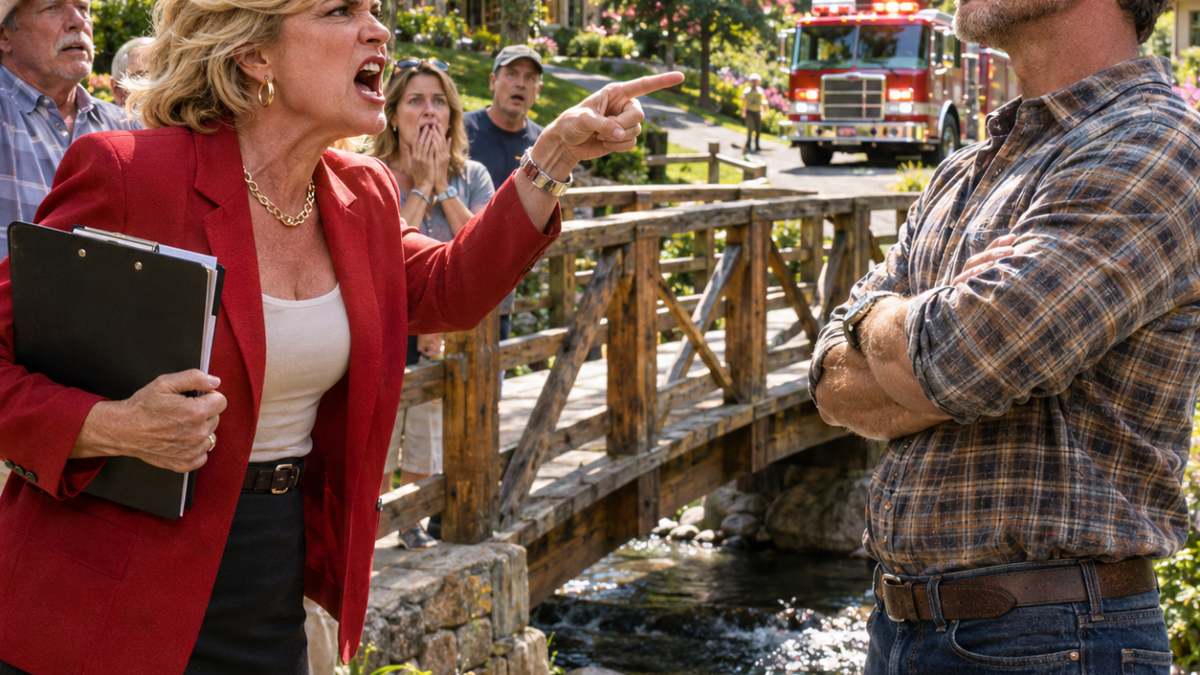
Part 2
I read the paragraph twice.
Then a third time.
The language was dry, bureaucratic, and absolutely devastating.
Six years earlier, before Karen became HOA president, Whispering Pines had formally accepted a twenty-foot-wide emergency-access easement across my property as the subdivision’s required secondary route for fire and rescue vehicles. The easement had been negotiated with the original developer and recorded with the county, and the agreement expressly recognized that my parcel was not subject to Whispering Pines covenants.
The meeting minutes documented the HOA’s acceptance of that arrangement.
And at the bottom of the page, in neat blue ink, was the signature of the board secretary who had certified the minutes.
Karen Miller.
I leaned back in my chair.
For several seconds, I could hear nothing but the clock on the wall.
She knew.
Maybe she had forgotten the exact wording after six years. Maybe she had convinced herself that becoming president gave her powers the previous board never possessed. Maybe she genuinely believed the aesthetic rules had somehow expanded beyond the association boundary.
But she could not honestly claim that she had never heard of the emergency route.
Her own signature destroyed that defense.
Sarah appeared in the doorway wearing her robe.
“You’re still up?”
I turned the page toward her.
“Come look at this.”
She walked over.
I pointed.
She read the motion.
Then the signature.
Her eyebrows lifted.
“Oh.”
“Yeah.”
“She signed it?”
“Certified it as secretary.”
Sarah pulled out the chair beside me.
“So she knows the bridge is on the emergency-access route.”
“At minimum she knew the easement existed.”
“And she still wants you to demolish the bridge?”
I nodded.
Sarah looked toward the dark window. Beyond it, hidden by the trees, the creek ran below the bridge.
“What happens if you do?”
“That access route becomes a dirt road ending at a creek.”
“Meaning a fire truck can’t use it.”
“Not during high water.”
Her expression changed.
Whispering Pines had one normal entrance: a landscaped boulevard connecting to the county road. The rear service road existed because the county had required a secondary access point when the development was approved.
If a wreck, fallen tree, wildfire, or structure fire blocked the main entrance, emergency crews needed another route.
That route crossed my land.
And now, for the first time, it had a bridge capable of carrying them.
Sarah sat quietly.
Then she said, “You need a lawyer.”
“I know.”
“Tomorrow.”
“Yes.”
“And Jack?”
I looked at her.
“Don’t enjoy this too much.”
I almost smiled.
“What?”
“I know that face.”
“What face?”
“The one where you’ve decided somebody walked into an ambush.”
“I didn’t create this.”
“No.”
She tapped Karen’s signature.
“But now you know exactly where the weak point is.”
She knew me too well.
Twenty-five years as a combat engineer had given me habits that retirement didn’t erase. When something threatened people I cared about, my mind stopped treating it as an irritation and started treating it as a system.
Terrain.
Authority.
Resources.
Failure points.
Objectives.
Karen’s objective was simple: make me submit.
Mine was becoming equally simple.
Make her prove she had the power she claimed.
The next morning, I drove to the county records office.
I requested everything.
My original deed.
Current survey.
Recorded easements.
The development plat.
Whispering Pines articles of incorporation.
Its CC&Rs.
Recorded amendments.
Board filings.
And, most importantly, the official copy of those six-year-old minutes.
The clerk looked at the growing stack.
“Property dispute?”
“Something like that.”
“HOA?”
I stared at her.
She smiled.
“People with normal neighbors don’t request this much paper.”
Fair point.
By noon, I had certified copies.
At home, I arranged everything chronologically.
Sarah brought coffee.
“You look happy.”
“I’m not.”
“You alphabetized the exhibits.”
“That isn’t happiness.”
“For you, it’s close.”
I handed her the original easement agreement.
The developer had needed the secondary route as part of the county’s approval of the subdivision. In exchange for my cooperation, I had received two things: compensation toward closing costs and a written acknowledgment that my land would remain outside future HOA jurisdiction.
That last sentence was blunt.
No ambiguity.
No “subject to interpretation.”
No possibility that some future board president could claim the right to regulate my bridge because she could see it from a walking trail.
Sarah read it.
“Why didn’t you show her this immediately?”
“Because I did when she first started bothering us.”
“You did?”
“Copy went in my response to the mailbox complaint.”
She stared.
“You sent her the easement?”
“Summary page.”
“And she kept going?”
“Yes.”
Sarah shook her head.
“Then I withdraw my request that you not enjoy this.”
I laughed.
That afternoon, I called Dave Mercer.
Dave and I had served together years earlier.
He left the Army after twenty-two years, went to law school, and discovered that his personality was uniquely suited to dealing with bureaucracy.
His words, not mine.
When he answered, I could hear traffic.
“Jack Henderson. Please tell me you’re calling because you finally bought that motorcycle.”
“HOA problem.”
There was a pause.
Then:
“Even better.”
“I knew you’d say that.”
“What happened?”
I walked him through it.
The bridge.
The $10,000 violation.
$500 daily fines.
Foreclosure threat.
My non-member status.
The easement.
The fire route.
Karen’s signature.
Dave became progressively quieter.
When I finished, he said, “Send me everything.”
“Already scanned.”
“Of course it is.”
“I’m retired, not disorganized.”
“I’m going to pretend I didn’t hear that.”
An hour later, he called back.
“Jack.”
“Yeah?”
“Do not demolish that bridge.”
“Wasn’t planning to.”
“I mean do not alter a bolt until I tell you.”
“Understood.”
“Second, do not threaten Karen.”
“I haven’t.”
“Do not tell her what you found.”
That surprised me.
“Why?”
“Because right now she’s making statements under the assumption that you don’t have the documents.”
I sat down.
“Go on.”
“She’s already overreached. What we need now is clarity. Is she confused, or is she knowingly misrepresenting the facts?”
“How do we establish that?”
“We ask questions.”
“That’s your legal strategy?”
“Politely.”
I could hear him smiling.
“We send a boring letter.”
I groaned.
“Boring?”
“Painfully boring.”
He explained.
Instead of revealing the easement and signed minutes, we would ask the HOA to identify the exact legal basis for claiming jurisdiction over my non-member property.
We would ask for the specific covenant extending architectural authority beyond HOA boundaries.
We would ask for documentation supporting the assertion that the bridge lacked permits.
And finally, we would ask whether the board had reviewed the status of any emergency-access easement affecting the property.
“If she’s smart,” Dave said, “she’ll finally check her own records and back down.”
“And if she isn’t?”
“She’ll answer in writing.”
I understood.
Documentation.
I’d built bridges under enemy observation.
Dave built cases the same way.
We sent the letter certified.
Three days later, I received the return receipt.
Karen had signed.
Then I attended the HOA meeting.
Technically I didn’t have to.
Their authority over me was the very question in dispute.
But Karen had offered an appeal, and I wanted to watch her operate in front of residents.
Sarah came with me.
“You sure?”
“Yes.”
“Why?”
“Reconnaissance.”
She sighed.
“You know normal retired couples take cruises.”
“Ships are crowded.”
“We could go to Vermont.”
“Too many covered bridges.”
She stared at me.
I smiled.
“Sorry.”
The Whispering Pines clubhouse was exactly what I expected.
Beige walls.
Beige carpet.
Stacking chairs.
Artificial pine scent.
A framed list of COMMUNITY VALUES.
Thirty or forty residents sat scattered around the room.
Karen occupied the center chair at the board table.
Gerald sat to her right.
Brenda to her left.
Arthur Bell, the treasurer, sat at the far end with a spreadsheet in front of him.
He looked nervous before the meeting even started.
That interested me.
Karen moved through the agenda with clipped efficiency.
A homeowner wanted permission to replace a mailbox.
Denied.
Wrong style.
A young couple had left trash bins visible until noon the day after pickup.
Formal warning.
An elderly woman requested approval for a decorative bench near her front garden.
Karen questioned the stain color for almost six minutes.
Sarah leaned toward me.
“She likes this.”
I whispered, “What?”
“Being asked permission.”
I watched Karen.
Sarah was right.
This wasn’t simply someone reluctantly enforcing rules.
Karen enjoyed being the point through which every decision passed.
Eventually, she announced my name.
“Mr. Jack Henderson, appeal regarding unauthorized structural addition at 1412 Creek Road.”
Dozens of heads turned.
I walked to the lectern with one folder.
Karen looked disappointed.
Maybe she expected a lawyer.
Maybe a stack of documents.
I gave her neither.
“Good evening.”
I unfolded the county GIS map.
“My property is shown here in red. Whispering Pines parcels are shown in blue. As you can see, my property predates the HOA and is not included within association boundaries.”
Murmurs.
Karen interrupted.
“We have already reviewed that argument.”
“It isn’t an argument. It’s a recorded boundary.”
“The structure is visible from common property.”
“Yes.”
“Our covenants protect the visual character of the community.”
“For association members.”
Her eyes hardened.
“The board’s counsel disagrees.”
“Can you identify the recorded instrument that subjects my property to those covenants?”
Silence.
Gerald shifted.
Karen said, “You are not here to interrogate the board.”
“I’m asking the basis of a $10,000 fine.”
“The basis has been provided.”
“Article Four, Section Two applies to properties governed by the association.”
“That is your interpretation.”
I opened the folder.
“Then perhaps safety is easier.”
Her eyes narrowed.
I held up the bridge permit.
“This bridge was permitted by the county, reviewed by an engineer, and passed final inspection.”
Karen looked toward the residents.
“We have no independent verification of that.”
I almost laughed.
I handed the document to Gerald.
“Now you do.”
He read it.
His face changed.
“Karen.”
She didn’t look at him.
“The board has already voted.”
Gerald tried again.
“This has the county seal.”
“I can see that.”
A man in the audience called, “So it is permitted?”
Karen struck the gavel.
“Residents will not interrupt.”
I retrieved the document from Gerald.
“The bridge is rated beyond the weight of a loaded fire engine.”
That got a reaction.
Karen leaned forward.
“Mr. Henderson, your attempt to overwhelm this board with irrelevant technical information does not change the aesthetic violation.”
“A structural-safety claim isn’t aesthetic.”
“Enough.”
The gavel cracked.
“You have been heard. The violation stands.”
Sarah stiffened behind me.
Karen continued.
“Failure to submit a demolition schedule within ten days will result in the daily fine increasing to one thousand dollars.”
Someone gasped.
I stayed where I was.
“Are you putting that in the minutes?”
Karen stared.
“Yes.”
“Good.”
That bothered her.
I returned to my seat.
Sarah whispered, “Why did you say good?”
“Because she just documented it herself.”
We stayed for the rest of the meeting.
Arthur, the treasurer, barely spoke.
Gerald avoided looking at Karen.
Brenda supported every motion automatically.
Outside, Sarah took my arm.
“I understand now.”
“What?”
“She doesn’t hear disagreement.”
“No.”
“She hears disobedience.”
Exactly.
Two days later, Dave’s clarification letter received a response.
Not from Karen.
From a law firm.
Five pages.
The tone was designed to intimidate.
The fines had climbed above $16,000.
The HOA’s lawyer claimed the visibility clause granted broad authority to protect the “aesthetic integrity and property values” of Whispering Pines from adjacent structures.
No statute.
No recorded covenant binding my parcel.
No precedent.
Just assertion.
Then I reached the section about emergency access.
I stopped reading.
Sarah noticed.
“What?”
I handed her the page.
She read aloud.
“‘The board has no record of any bridge on the Henderson parcel constituting a designated emergency route. The structure instead presents a potential obstruction to future emergency-access planning.’”
She lowered the paper.
“Oh, Jack.”
I picked up the six-year-old minutes.
Karen’s signature.
Then the lawyer’s letter.
No record.
One of those documents could not coexist honestly with the other.
I called Dave.
He answered on the first ring.
“She answered?”
“Through counsel.”
“And?”
I read the paragraph.
Silence.
Then a low whistle.
“She actually did it.”
“Looks that way.”
“Send me the original PDF and envelope.”
“Already scanning.”
“Jack.”
“Yes?”
“Now we stop treating this as a stupid bridge dispute.”
“What is it now?”
“A safety issue.”
That afternoon, Karen posted a community notice.
PUBLIC SAFETY WARNING
It referred to an “unapproved and potentially unstable bridge structure” on adjacent property.
Parents were cautioned not to allow children near it.
The board was “pursuing all remedies necessary to protect residents.”
My name wasn’t used.
It didn’t need to be.
Everyone knew.
Sarah found the notice online.
She set her tablet on the kitchen counter.
“This is ugly.”
“It’s desperate.”
“What if people believe her?”
“Some will.”
“That doesn’t bother you?”
“Of course it does.”
The truth was, it bothered me more than I wanted to admit.
The bridge wasn’t simply an engineering project.
I had built it myself.
Every weld.
Every measurement.
Every footing.
Karen wasn’t criticizing a contractor’s work.
She was accusing me of building something dangerous.
For someone who’d spent a career making sure structures kept people alive under terrible conditions, that accusation hit deeper than her fines.
Sarah knew.
She put her hand on mine.
“Don’t turn this into proving you’re smarter than her.”
I looked away.
“I’m serious.”
“I know.”
“Protect the bridge. Protect the house. Protect the people who might need that route.”
“And Karen?”
“Let her consequences be hers.”
That was harder advice than any Dave had given me.
The following Monday, a county code-enforcement truck came down my driveway.
The inspector looked young enough to be my son.
He stepped out carrying a tablet.
“Mr. Henderson?”
“Yes.”
“We received a complaint about an unpermitted bridge.”
“Unsafe?”
His eyes widened slightly.
“Yes.”
“Danger to children?”
He looked even more uncomfortable.
“That was included.”
I smiled.
“Come inside.”
He frowned.
“Sir?”
“I have a folder for you.”
Twenty minutes later, he sat at my study table surrounded by permits.
Plans.
Inspection records.
Engineering review.
Creek-work authorization.
His discomfort turned to embarrassment.
“This is all approved.”
“Yes.”
He flipped another page.
“This final inspection was signed by my department head.”
“Yes.”
“I apologize.”
“You don’t need to.”
“I kind of do.”
“You responded to a complaint.”
He closed the folder.
“Everything is in order.”
“Can I get that in writing?”
He looked at me.
Then smiled.
“Yes, sir.”
My cameras caught him leaving.
They also caught him standing beside his truck, making a call.
I couldn’t hear everything.
Only fragments.
“…already inspected…”
“…complete waste…”
“…yes, I saw the permit…”
Karen’s complaint had failed.
She responded by escalating again.
The next lawyer’s letter announced that the HOA intended to pursue a lien for unpaid fines.
Sarah read it at the kitchen table.
For the first time since the conflict began, she looked genuinely frightened.
“Can they?”
“No.”
“You’re sure?”
“Dave is sure.”
“But can they file something anyway?”
I didn’t answer quickly enough.
Her face changed.
“They can try.”
“Yes.”
“And then we have to fight it.”
“Yes.”
She pushed the letter away.
“I hate this.”
I reached for her hand.
“So do I.”
“No, you don’t.”
That stung.
“Sarah.”
“You hate Karen. You hate the threat. But part of you understands this kind of fight.”
I leaned back.
She continued.
“You have a mission. Documents. Strategy. Opponent. Objective.”
“What are you saying?”
“That this has become familiar to you in a way retirement hasn’t been.”
I didn’t answer.
She was right enough to make me defensive.
“I didn’t ask for it.”
“I know.”
“I’m protecting our home.”
“I know that too.”
“Then what?”
Her eyes softened.
“Just remember why we bought this place.”
Peace.
I looked toward the window.
Our house sat on the back seven acres among oaks and maples. We had chosen it because the creek muffled road noise and the trees made the outside world feel farther away.
Karen had found a way to bring conflict right into it.
“I remember.”
“Good.”
The lien threat turned out to be the line that changed my neighbors.
Robert Gaines came first.
Retired civil engineer.
He lived two houses inside Whispering Pines and had visited during bridge construction.
I was tightening a rail connection when he walked down.
“Jack.”
“Morning.”
“I saw the HOA warning.”
“Lucky me.”
He put one hand on the steel beam.
“Unstable?”
“So I’m told.”
He struck the beam with his knuckles.
A deep metallic thud echoed over the water.
“I’ve designed highway structures with less steel.”
“Don’t tell Karen.”
He laughed.
Then grew serious.
“Is it true they’re trying to lien your house?”
“Apparently.”
“Can they?”
“No.”
“Then why?”
“To make compliance cheaper than resistance.”
Robert looked toward the subdivision.
“That sounds familiar.”
He told me about his own fines.
Thirty dollars for a garden hose visible from the street.
Fifty because his granddaughter drew chalk flowers on the sidewalk.
A warning over an outdoor workbench in his garage because the door had been open.
“I paid them,” he said.
“Why?”
“Easier.”
There it was again.
Easier.
He looked at the bridge.
“What can I do?”
I hesitated.
Then made a decision.
“Come inside.”
I showed him everything.
He read the easement first.
Then the old minutes.
He stopped when he reached Karen’s signature.
“She signed this.”
“Yes.”
“And her lawyer says there’s no record?”
“Yes.”
Robert’s jaw tightened.
“She knows this is the secondary fire route.”
“She knew six years ago.”
“And she wants the bridge removed.”
“Yes.”
He stood and walked toward the window.
His house was visible through the trees.
“My bedroom is on the back side.”
I waited.
“If the main entrance was blocked…”
“This is the alternate route.”
Robert turned.
“This isn’t an HOA fight.”
“No.”
“This is public safety.”
“Yes.”
He took a picture of the minutes.
“May I?”
“Please.”
“I’m talking to some people.”
By the end of the week, I wasn’t fighting alone.
Ben and Maria Torres stopped me at the mailbox.
Ben worked in IT.
Maria had been a paralegal before their second child was born.
Their son’s basketball hoop had cost them $200 in HOA fines because its base sat too close to the sidewalk.
“That was grocery money,” Maria said.
Ben looked embarrassed.
“We paid it because we didn’t want more problems.”
Then came Mrs. Wallace.
Prize-winning roses deemed excessive.
The Carters.
Visiting relatives’ car parked four hours too long.
A nurse named Denise who had received three warning letters because the medical-service van she drove sometimes stayed in her driveway overnight.
I listened.
Every story was smaller than mine.
Together they were larger.
Karen had spent years teaching residents that resistance cost more than obedience.
Now the threatened lien against a non-member frightened them in a different way.
“If she can do that to you,” Ben said one evening, “what can she do to us?”
That question changed everything.
Ben created a private online folder.
Residents uploaded notices.
Maria organized timelines.
Robert reviewed the bridge plans and wrote a professional assessment confirming the structure easily exceeded the loads expected from emergency apparatus.
I installed four security cameras around my property.
Not because I expected violence.
Because Karen had crossed into a phase where facts mattered more than conversations.
Every visitor would be recorded.
Every vehicle.
Every interaction.
Then the young county inspector called.
“Mr. Henderson.”
“Yes?”
“My supervisor reviewed your file.”
“Okay.”
“He spoke with planning.”
“And?”
“There’s apparently an emergency-access designation on your property.”
I smiled.
“Is there?”
“You knew.”
“Yes.”
He exhaled.
“Planning wants fire prevention involved.”
That was the opening Dave had been waiting for.
We didn’t call Karen.
We didn’t send another angry letter.
We contacted the county fire marshal.
His name was Frank Dubois.
Twenty years with the fire service.
Direct voice.
No patience for theatrics.
I requested a formal inspection of the secondary emergency access serving Whispering Pines.
I sent:
The recorded easement.
The county development approval.
The HOA minutes accepting the route.
Karen’s signed certification.
The lawyer’s letter denying knowledge.
My bridge permits.
Final inspection.
Robert’s engineering assessment.
Frank called that afternoon.
“Mr. Henderson?”
“Yes.”
“I’ve got an unusual file here.”
“That makes two of us.”
He didn’t laugh.
“I have county records showing this route was required when Whispering Pines was approved.”
“Correct.”
“Your bridge didn’t exist then?”
“Old low-water crossing.”
“Usable for an engine?”
“Not reliably.”
“And now?”
“Bridge rated over eighty thousand pounds.”
He paused.
“I see the final inspection.”
“Yes.”
“HOA wants it removed?”
“Yes.”
“Why?”
“Aesthetics.”
Silence.
Then:
“I’ll be there tomorrow at ten.”
I sent a message to our little residents’ group.
County fire marshal inspecting emergency access, tomorrow, 10:00 a.m. Residents with concerns about community safety may observe from the public road.
Ben replied almost instantly.
How long before Karen hears?
Robert answered:
Five minutes.
He was wrong.
Three.
At 9:45 the next morning, fifteen homeowners were standing near my driveway.
Robert.
Ben and Maria.
Denise.
Mrs. Wallace.
Others.
They weren’t chanting.
No signs.
No confrontation.
Just witnesses.
At 9:55, Karen’s SUV appeared.
Gerald rode with her.
Brenda followed in another vehicle.
Karen got out wearing a dark suit despite the heat.
Clipboard in hand.
Of course.
“What is this?”
Nobody answered.
She looked at Robert.
“Is this an official gathering?”
“No.”
“You cannot convene HOA business without board authorization.”
Robert said, “We’re standing on a public road.”
Her eyes found me.
“You organized this.”
“No.”
“Don’t lie to me.”
Before I could respond, a red county fire department pickup pulled up.
Frank Dubois stepped out.
Karen immediately changed.
Her shoulders straightened.
Her voice softened.
Authority recognized authority.
She walked toward him.
“Good morning. Karen Miller, president of Whispering Pines.”
Frank looked at her.
“Fire Marshal Dubois.”
Her hand remained extended.
He didn’t take it.
Instead he turned toward me.
“Mr. Henderson?”
“Yes.”
“You reported concerns about our secondary access.”
“Correct.”
I handed him the folder.
Karen laughed lightly.
“There seems to be some confusion.”
Frank opened the file.
Karen continued.
“The structure this gentleman erected is actually the problem.”
He looked up.
“How?”
“It was built without association approval and may be unsafe.”
Frank looked at the bridge.
Then at the county inspection certificate.
“Association approval?”
“Yes.”
“Was it built on HOA property?”
Karen hesitated.
“It is visible from HOA property.”
“That wasn’t my question.”
I saw several residents exchange looks.
Karen recovered.
“It affects community safety.”
“I’m here to determine that.”
She smiled.
“Excellent. Then we’re in complete agreement.”
Frank walked onto the bridge.
No speech.
No drama.
He checked the approaches.
The width.
Rails.
Deck.
Abutments.
He crouched and studied the I-beam connection.
Then he walked beneath one side to inspect the footings.
Robert followed only when invited.
“Licensed civil engineer?” Frank asked.
“Yes.”
“You review this?”
“Plans and finished structure.”
“Opinion?”
“Conservative design. More capacity than necessary.”
Frank nodded.
He walked back.
Karen was waiting.
“So?”
Frank took Karen’s attorney’s letter from the folder.
“Your counsel states the board has no record of this bridge being associated with emergency access.”
“That is correct.”
“You’re sure?”
“Absolutely.”
“This man invented that claim after we began enforcement.”
My stomach tightened.
She wasn’t retreating.
She was committing.
Frank reached into the folder.
Pulled out the meeting minutes.
“Then help me understand this.”
Karen’s expression changed.
He held the paper so she could see.
“Whispering Pines board meeting. Six years ago.”
Silence.
“Motion accepting the Henderson emergency-access easement as the subdivision’s official secondary route.”
Her face lost color.
Frank pointed.
“Secretary certification.”
Nobody moved.
Then he read the name.
“Karen Miller.”
For the first time since I’d known her, Karen had no immediate answer.
Gerald looked at her.
Brenda looked down.
Robert folded his arms.
Frank said, “Is this your signature?”
Karen swallowed.
“I would have to review the context.”
“Is it?”
“I signed many minutes as secretary.”
“Then you were aware the easement existed.”
“I was aware of an easement.”
“But your lawyer says the board has no record.”
“I didn’t draft that letter.”
Frank looked at her for several seconds.
“No. You just gave your lawyer the information.”
She flushed.
“This is being twisted.”
“How?”
“The bridge didn’t exist six years ago.”
“Correct.”
“Therefore I couldn’t have acknowledged the bridge.”
Frank nodded.
“For once, we agree.”
Hope flickered in her expression.
Then he continued.
“You acknowledged the access route.”
The hope vanished.
He turned toward the creek.
“Before this bridge, what did your emergency route cross?”
Karen said nothing.
“A creek.”
Still nothing.
He looked at me.
“Old crossing location?”
I pointed.
“Twenty yards downstream.”
Frank walked over.
The old path was visible under weeds.
He looked at the slope.
The stream.
Mud marks from spring flooding.
Then he returned.
“You had a required secondary fire route that relied on a low-water creek crossing.”
Gerald quietly said, “That was approved by the original developer.”
Frank looked at him.
“Approved on paper doesn’t make a forty-thousand-pound engine float.”
Gerald went silent.
Frank slapped the folder against his palm.
“This bridge does not obstruct emergency access.”
Karen’s jaw tightened.
“It improves it.”
Residents started murmuring.
Frank continued.
“Based on the permits and inspection, it is capable of supporting our apparatus.”
Robert spoke.
“Easily.”
Frank nodded.
“Mr. Henderson has taken a deficient emergency route and made it functional year-round.”
Karen stepped forward.
“But the HOA has aesthetic authority—”
“Not my concern.”
“The bridge impacts property values.”
“Not my concern.”
“We have enforcement rights.”
Frank’s voice hardened.
“Your enforcement activity is attempting to eliminate infrastructure serving a county-required emergency route.”
That silenced her.
Frank looked toward all of us.
“I am documenting the bridge as the functional crossing for Whispering Pines secondary emergency access.”
Karen stared.
“And I’m issuing written notice to the HOA not to obstruct, alter, block, or remove it without approval from the county fire-prevention office and planning department.”
“You can’t override our covenants.”
“I don’t care about your mailbox rules.”
A laugh escaped someone behind me.
Frank didn’t smile.
“If your covenants conflict with emergency-access requirements, emergency access wins.”
Karen’s face reddened.
“This is outrageous.”
“No.”
He handed her a card.
“This is fire code.”
She refused to take it.
Gerald did.
Frank continued.
“If the HOA knowingly interferes with this route after receiving formal notice, I will refer the matter for enforcement.”
Karen looked at me.
“This is exactly what he wanted.”
Frank followed her gaze.
“What?”
“To humiliate me.”
I hadn’t expected that.
For one second, I almost answered sharply.
Then I remembered Sarah.
Let her consequences be hers.
I said, “I wanted you to leave my bridge alone.”
Karen laughed bitterly.
“You organized residents. Lawyers. County officials.”
“No.”
I looked at the people along the road.
“You did that.”
Her eyes filled with something I hadn’t seen before.
Not sadness.
Fear.
Fear of losing control.
She turned to Gerald.
“We’re leaving.”
He hesitated.
That tiny hesitation mattered.
Karen noticed.
“Gerald.”
He followed.
Brenda went with them.
Karen reached her SUV.
Then Robert called:
“Karen.”
She stopped.
He held up the copy of her signed minutes.
“You knew.”
She didn’t turn around.
Then she got into her vehicle and left.
Nobody cheered.
That surprised me.
Instead, people stood quietly.
Absorbing what they’d seen.
Then Ben said:
“She lied.”
Maria corrected him.
“She had six years to forget.”
Robert shook his head.
“She signed the minutes, received Jack’s letters, ignored the permit, and told counsel there was no record.”
Frank heard him.
He said, “Don’t turn a fire inspection into a courtroom.”
Robert nodded.
“Yes, sir.”
Frank looked at me.
“Keep the route clear.”
“I will.”
“And stop calling it your bridge when you talk to my department.”
I frowned.
“It is my bridge.”
He almost smiled.
“Fine. Your bridge. Our access.”
Fair enough.
By lunchtime, residents who had never spoken to me were calling.
The fire marshal’s inspection shattered something.
Not Karen’s presidency yet.
Her inevitability.
For years, Whispering Pines had operated on the assumption that Karen would win any confrontation because she had the binder, the board, and the lawyer.
Now everyone had watched an outside authority read the records and tell her no.
Once people see power fail, fear changes quickly.
Our private group doubled.
Then tripled.
Maria began receiving documents faster than she could organize them.
Violation notices.
Fines.
Hearing records.
Emails.
Selective enforcement.
Threats.
A pattern emerged.
Karen had not been stealing money.
Nothing so simple.
She had something subtler.
A belief that every discretionary power in the bylaws should flow through her.
Residents she liked received warnings.
Residents who challenged her received fines.
Appeals were heard by committees she controlled.
Requests could sit unanswered for months if somebody had irritated her.
The HOA attorney bills were worse.
Maria requested financial records as a homeowner.
Arthur, the treasurer, resisted at first.
Then Dave sent a polite letter explaining statutory inspection rights.
Arthur complied the same afternoon.
Maria called me that night.
“Jack.”
“What?”
“Fifteen thousand.”
“For what?”
“Legal bills.”
“In how long?”
“Three months.”
I sat down.
Before Karen’s fight with me, Whispering Pines had spent less than $500 per year on routine legal work.
Karen had burned through over $15,000 pursuing a bridge on property the HOA didn’t govern.
Sarah stared when I told her.
“Whose money?”
“Residents.”
She shook her head.
“That’s going to hurt her.”
“Yes.”
“Does she know you know?”
“Not yet.”
A removal petition required twenty-five percent of the 120 homes.
Thirty signatures.
Ben predicted we’d need two days.
We had fifty-seven before lunch.
I wasn’t allowed to sign.
I wasn’t a member.
The irony was delicious.
Maria drafted the petition.
Dereliction of duty.
Misuse of association resources.
Misrepresentation of the emergency route.
Failure to follow required enforcement procedures.
Conduct contrary to residents’ interests.
Brenda accepted it as secretary.
According to Maria, her hand shook.
The special meeting was scheduled for ten days later.
Karen spent those ten days fighting.
First came an email to residents.
She called the petition a “dangerous attempt by a vocal minority to destabilize community governance.”
Then she blamed me.
An “outside property owner with a personal agenda.”
Then the board’s lawyer sent a warning about defamatory statements.
Dave read it.
“Meaningless.”
“Can residents ignore it?”
“Don’t advise anybody to ignore a lawyer’s letter.”
“Then what?”
“Advise them to read it.”
“That’s it?”
“Karen keeps thinking scary letterhead is evidence.”
He tapped the old minutes.
“We have evidence.”
Karen also tried another tactic.
She called Sarah.
I was outside when the phone rang.
Sarah answered without checking the number.
I came in halfway through.
“No,” Sarah was saying, “I don’t believe that.”
Pause.
“Because I was there.”
Another pause.
Her face hardened.
“You threatened foreclosure while standing on our bridge.”
I held out my hand.
Speaker.
Sarah pressed it.
Karen’s voice filled the kitchen.
“I was speaking about standard collection remedies, Sarah. Jack has deliberately turned a routine architectural dispute into a personal crusade against me.”
I said nothing.
Karen continued.
“I know you understand what community harmony means. You’re a reasonable woman.”
Sarah looked at me.
Then spoke quietly.
“Are you calling because you think I can control my husband?”
“That isn’t what I said.”
“But it’s what you mean.”
Silence.
“Jack is being reckless.”
Sarah’s eyes narrowed.
“Karen, my husband built bridges while people were shooting at him.”
I raised my eyebrows.
She kept going.
“He is not reckless about bridges.”
I almost laughed.
Karen said, “You don’t understand the legal exposure he’s creating for your home.”
That did it.
Sarah’s voice became cold.
“You threatened our home.”
“I explained potential consequences.”
“You told us foreclosure gets messy.”
“I—”
“And now you’re calling me privately because the neighborhood finally read the paperwork.”
Karen went quiet.
Sarah leaned closer to the phone.
“Don’t call me again.”
She ended it.
I stared.
“What?”
“That was terrifying.”
She sighed.
“I hate being dragged into this.”
“I know.”
She sat down.
Then, softer:
“And I hate that she tried to use me against you.”
I sat beside her.
“I’m sorry.”
“You didn’t call her.”
“No.”
“But you did choose not to end this quickly.”
I knew what she meant.
We could have filed suit sooner.
Moved for an injunction.
Forced the jurisdiction issue into court.
Instead, Dave and I had let Karen document her behavior.
“I wanted it settled permanently.”
“So did I.”
Sarah reached for my hand.
“Just don’t forget permanent doesn’t have to mean destroyed.”
That night I reconsidered what victory looked like.
I didn’t need Karen bankrupt.
I didn’t need her humiliated.
I needed my title clear.
The bridge protected.
The lien attempt stopped.
Legal fees addressed.
And if Whispering Pines residents wanted to remove her, that was their decision.
The special meeting was packed.
Every chair taken.
Residents standing along walls.
People in the hallway.
Karen sat at the center table.
Gerald beside her.
Brenda at the end.
Arthur was absent.
Later I learned he had resigned that morning as treasurer.
He left a letter.
“I will not participate in further expenditures related to the Henderson matter.”
That letter was included in the packet.
Karen began the meeting.
“This proceeding is improper.”
Robert stood.
“No.”
She struck the gavel.
“You are out of order.”
He held up the bylaws.
“Article Nine, Section Four. Petition signed by forty-seven percent of owners. Proper notice. Proper quorum.”
The room murmured.
Karen glanced toward Brenda.
Brenda stared at her papers.
Robert continued.
“This is a removal hearing.”
Karen’s voice rose.
“I have served this community for six years.”
“And you will have an opportunity to respond.”
She looked stunned.
Someone was applying procedure to her.
Ben controlled the projector.
Slide one.
My bridge.
Not dramatic.
Just a clear daytime photograph.
Slide two.
County development approval.
The secondary emergency route highlighted.
Slide three.
The easement.
Slide four.
HOA minutes.
Karen’s signature.
Slide five.
The lawyer’s letter.
NO RECORD OF A DESIGNATED EMERGENCY ROUTE.
The room went silent.
Robert spoke carefully.
“We are not asking anyone to accept rumors.”
Next slide.
Fire marshal’s written order.
DO NOT OBSTRUCT OR REMOVE FUNCTIONAL EMERGENCY ACCESS.
Then Maria took over.
Legal spending.
Five-year average.
Then the last three months.
A bar chart filled the screen.
$15,000.
Someone shouted:
“That’s our money!”
Karen grabbed her microphone.
“Those legal expenses were necessary to defend the association.”
“From what?” Ben asked.
Karen glared.
“Unauthorized encroachment.”
Ben pointed toward the screen.
“On property we don’t own?”
Applause.
Karen raised the gavel.
Robert said, “Let him finish.”
She stared.
He didn’t move.
That was when I understood she was already finished.
The vote hadn’t happened.
But psychologically, the room no longer belonged to her.
Maria presented the enforcement pattern.
She didn’t use words like tyranny.
Didn’t call Karen corrupt.
She used dates.
Fine amounts.
Hearing procedures.
Appeals.
Exceptions.
Inconsistent penalties.
It was more damaging than anger.
Then residents spoke.
Mrs. Wallace described being ordered to remove roses she’d grown for fifteen years.
Denise described warnings over her work van.
Ben talked about the basketball hoop.
His voice shook when he said the $200 fine had taken money from their grocery budget.
“I paid because my wife and I didn’t think fighting was worth it.”
He looked around.
“We were wrong.”
Karen finally stood.
Her face was red.
“This is a witch hunt.”
The room reacted.
She raised her voice.
“For years I have maintained standards while everyone else complained.”
She pointed at residents.
“You want clean streets. You want high property values. You want rules enforced until the rule applies to you.”
There was truth inside that.
Enough that the room quieted.
Karen continued.
“Whispering Pines did not become desirable by accident. It became desirable because somebody had the courage to say no to clutter, negligence, ugly additions, parked vehicles, trash bins, and people who believe individual preference matters more than collective value.”
Sarah, sitting beside me, whispered:
“That’s her.”
“What?”
“She really believes it.”
Yes.
Karen wasn’t pretending.
Control and responsibility had fused inside her mind.
She believed resistance proved why stronger enforcement was necessary.
She turned toward me.
“Mr. Henderson moved next to this community and has spent months refusing to respect it.”
I stood.
Robert said, “Jack doesn’t have to—”
“I’ll answer.”
I walked to the microphone.
Karen faced me.
“You’re not a member.”
“Correct.”
“Yet you’ve interfered with our governance.”
“No.”
“You organized this.”
“No.”
“You called government officials.”
“I requested inspection of an emergency route across my property.”
“You hired a lawyer to attack us.”
“I hired a lawyer after you threatened foreclosure.”
Her mouth tightened.
“You could have resolved this by submitting the bridge for architectural approval.”
“That would have implied you had authority.”
“We do.”
“No.”
“Your opinion.”
I pointed toward the easement on the screen.
“Recorded county document.”
She turned toward the crowd.
“You see? He has never negotiated in good faith.”
I almost answered angrily.
Then Sarah’s voice echoed in my head.
Permanent doesn’t have to mean destroyed.
I looked at Karen.
“You’re right about one thing.”
The room became quiet.
She seemed surprised.
“Communities need rules.”
Her expression shifted.
I continued.
“They need budgets. Maintenance. Standards. People willing to do work nobody thanks them for.”
Karen stared.
“But authority has a boundary.”
I pointed toward the bridge photo.
“That one is literal.”
Then toward the signed minutes.
“And this one was written down.”
Karen looked away.
“You knew the emergency easement existed.”
“I knew an easement existed.”
“You signed acceptance.”
“That was years ago.”
“You received my deed.”
“No response.
“My permit.”
Silence.
“The fire marshal’s order.”
She gripped the table.
“You still kept sending fines.”
Her voice dropped.
“Because if I let one person ignore the process, everybody will.”
There it was.
Not the bridge.
Not safety.
Precedent.
Control.
I said, “I wasn’t in your process.”
Karen didn’t answer.
I returned to my seat.
Robert called the vote.
Removal of Karen Miller as president and director.
Hands rose.
At first slowly.
Then almost all at once.
From where I sat, it looked like a field suddenly caught by wind.
Gerald stared at his hands.
Karen looked at him.
“Gerald.”
He closed his eyes.
Then raised one.
Her face changed.
Brenda abstained.
Everyone else who was eligible voted for removal.
Robert counted twice.
He announced the result.
Karen sat absolutely still.
No yelling.
No gavel.
Nothing.
Then she stood.
“You’ll regret this.”
Nobody answered.
She collected her purse.
Not the binder.
For the first time, she left the binder behind.
The new interim board took office that night.
Robert became acting president.
Maria declined a board position but agreed to help review governance documents.
Ben became secretary.
Denise took over safety coordination.
Their first motions were immediate.
Void all fines issued against me.
Withdraw the threatened lien.
Terminate the law firm’s authority to pursue my property.
Formally reaffirm the emergency easement.
Reimburse my reasonable legal fees.
I stood.
“Wait.”
Robert looked at me.
“What?”
“Legal fees shouldn’t come out of residents’ reserves if it creates a problem.”
Karen had already cost them enough.
Dave later negotiated a compromise.
The association’s directors-and-officers insurer covered part of the legal costs after review.
The remaining amount came from reserves without a special assessment.
More importantly, the board commissioned an independent audit of Karen-era spending.
It found poor judgment.
Sloppy authorization.
Overconcentration of power.
But no theft.
That mattered.
I didn’t want a false story growing larger than the truth.
Karen had abused authority.
She had not stolen from the HOA.
Facts mattered even when they helped someone you disliked.
The county formally recorded the fire marshal’s findings.
The bridge became the recognized all-weather crossing for the secondary emergency route.
One month later, the fire department conducted a training exercise.
Frank Dubois arrived with an engine.
Sarah and I stood beside the creek.
Residents gathered along the road.
The engine approached slowly.
I knew the bridge could take it.
Every calculation said so.
Every inspection.
Every test.
Still, when forty thousand pounds of fire apparatus rolled onto something I’d welded myself, my stomach tightened.
Sarah noticed.
“Nervous?”
“No.”
“Liar.”
The front wheels reached the center span.
Nothing moved.
The rear followed.
The bridge barely noticed.
Frank stopped the engine on the far side.
Got out.
Walked back.
“Well?”
I asked.
He looked at the bridge.
“I’ve driven on county roads I trust less.”
That was the closest thing to praise I expected from him.
The residents applauded.
I felt embarrassed.
Sarah leaned against me.
“Take it.”
“What?”
“The compliment.”
“I built a bridge.”
“You built the bridge.”
I looked at her.
She smiled.
“You know what I mean.”
The HOA reforms took months.
Not everything Karen had done was reversed.
Some rules were reasonable.
Trash bins still couldn’t sit out all week.
Common areas still needed maintenance.
Structural changes inside HOA property still required review.
But discretion was narrowed.
Appeals went to committees that didn’t include the person who issued the violation.
Fines had caps.
Legal expenditures above a threshold required board approval.
Emergency-access obligations were written into the community’s safety plan.
And one sentence was added to the architectural rules:
Association authority shall not be interpreted to extend beyond property subject to recorded association covenants.
Robert showed it to me.
“Think Karen would approve?”
“No.”
“Good.”
Not everyone liked the changes.
A few residents believed standards were slipping.
One complained about a bright blue front door.
Another complained that children left bicycles outside.
Robert listened politely.
Then asked:
“Does it create a safety issue?”
“No.”
“Damage common property?”
“No.”
“Violate a clear covenant?”
“Well, it harms visual harmony.”
Robert smiled.
“We retired visual harmony.”
The neighborhood didn’t collapse.
Property values didn’t crash.
People didn’t abandon their lawns.
What changed was the feeling.
Residents stopped watching each other like informants.
Children drew chalk pictures.
Garage doors stayed open on Saturday afternoons.
Neighbors stood talking in driveways without worrying that Karen’s white SUV might appear.
Our own property changed too.
Sarah planted wildflowers near the bridge approach.
I installed a bench overlooking the creek.
For the first time since the conflict began, we used the bridge without thinking about it as evidence.
It became what it was supposed to be.
Infrastructure.
One evening, Sarah and I sat on the bench.
The water was high from spring rain.
The old low-water crossing was completely submerged.
She pointed.
“A fire engine definitely couldn’t use that.”
“No.”
“So if you hadn’t built the bridge…”
“The easement would still exist.”
“Useless.”
“During weather like this, yes.”
She looked at me.
“Why did the old board never fix it?”
“Cost.”
“That’s it?”
“Probably.”
“Then why did you?”
I thought about it.
Because I’d seen enough emergencies to know access doesn’t matter until suddenly it’s everything.
Because I had the skills.
Because the county permit process had already confirmed the route.
Because neighbors were still neighbors even if their HOA president irritated me.
“I could.”
Sarah nodded.
“That’s the difference.”
“What?”
“Between you and Karen.”
I frowned.
“She liked power because it let her decide what other people should do.”
“And me?”
“You like competence because it lets you fix things yourself.”
“That isn’t always good.”
“I know.”
She smiled.
“That’s why I keep you around.”
Karen disappeared from community life after the vote.
For weeks, her SUV rarely left the garage.
Her lawn, once almost unnaturally perfect, grew slightly long.
No one fined her.
That mattered too.
Justice wasn’t reversing the weapon.
It was putting it down.
Then a FOR SALE sign appeared.
I expected satisfaction.
Instead, I felt uneasy.
Sarah noticed.
“You wanted her gone.”
“I wanted her out of power.”
“Difference?”
“Yes.”
She studied me.
“You feel sorry for her?”
“Maybe.”
“Why?”
“Because she built her whole identity around that position.”
Sarah looked toward Karen’s house through the trees.
“And then?”
“It disappeared in one vote.”
Sarah was quiet.
Finally:
“That’s sad.”
“Yeah.”
“Still doesn’t make what she did okay.”
“No.”
Both things could be true.
Karen had hurt people.
Karen had also become trapped inside the role that gave her importance.
Understanding didn’t erase accountability.
It just kept accountability from turning into hatred.
About a month later, I was sealing the oak deck when I heard a diesel engine.
A large moving truck stopped near the service-road entrance.
The driver climbed out.
“You Henderson?”
“Yes.”
“Need to get to the Miller place.”
I looked at the truck.
Long wheelbase.
Big box.
Heavy.
“The main cul-de-sac turn too tight?”
“Dispatcher says yes.”
I almost laughed.
“So they routed you here?”
“Heard this is emergency access.”
“It is.”
He looked at the bridge.
“That hold me?”
“What are you grossing?”
He gave me the number.
Well below rating.
“You’re fine.”
He walked onto the bridge.
Looked underneath.
Stomped a plank.
“Solid.”
“That’s the rumor.”
He returned to the cab.
Then I saw Karen’s SUV behind him.
She stopped.
For several seconds, neither of us moved.
The truck rolled onto the bridge.
Slowly.
The timbers gave a low, familiar vibration.
Steel remained rigid.
The vehicle crossed without trouble.
Then Karen had to follow.
The bridge she’d called an illegal blight.
The bridge she’d spent residents’ money trying to remove.
The bridge whose existence had helped end her presidency.
Now it was the only practical route for the truck carrying her belongings away.
I could have said something.
A dozen lines occurred to me.
I used none.
I dipped my brush into the sealant.
Worked it into the grain.
Karen drove onto the bridge.
At the center, she looked toward me.
No rage.
No superiority.
Just exhaustion.
I nodded once.
She didn’t.
Then she continued.
Sarah had been standing near the garden.
When the SUV disappeared, she walked over.
“You didn’t say anything.”
“No.”
“I’m proud of you.”
“That sounds patronizing.”
“It is.”
I smiled.
The moving truck returned several hours later.
Then again the next morning.
By Friday, Karen’s house was empty.
The new owners moved in three weeks later.
A family with two daughters.
Their first interaction with me happened at the creek trail.
The younger girl pointed toward the bridge.
“Did you build that?”
“I did.”
“Why?”
Her father looked embarrassed.
“Sorry.”
“No problem.”
I thought about the answer.
“Because sometimes people need another way through.”
The girl nodded as though that made perfect sense.
Maybe it did.
The new board eventually held a small ceremony.
I begged them not to.
They did it anyway.
Robert put a ribbon across the bridge.
Ben brought coffee.
Maria brought pastries.
Frank Dubois showed up in uniform, which made the entire thing feel more official than necessary.
A plaque read:
HENDERSON BRIDGE
Secondary Emergency Access
Built in service of community safety
There was more text.
I refused to read it aloud.
Sarah did.
“It says integrity.”
“I saw.”
“And good neighborliness.”
“Embarrassing.”
“You threatened a woman with county records for three months.”
“I did not threaten anyone.”
“You weaponized filing cabinets.”
Dave, standing behind us, said:
“He absolutely did.”
I turned.
“You’re supposed to be my lawyer.”
“My job is accuracy.”
The ribbon came down.
Not with giant scissors.
I cut it with my pocketknife.
That felt appropriate.
The bridge stayed.
So did the creek.
Seasons moved through it.
Spring floods.
Summer shade.
Autumn leaves.
Winter ice around the footings.
I inspected the steel every year.
Re-sealed the timber.
Cleared branches.
Kept the emergency route unobstructed.
Mostly, nothing happened.
That was success.
Then three years after Karen left, something did.
A storm came through in late summer.
Hard rain.
Wind.
Lightning.
A huge oak fell across the main Whispering Pines entrance, taking power lines with it.
No fire.
No dramatic rescue.
But the main road was blocked for hours.
County crews couldn’t clear it until utility workers confirmed the lines were safe.
Frank’s department opened the secondary route temporarily.
For the first time in a real incident, emergency vehicles entered Whispering Pines over my bridge.
One ambulance.
A fire engine.
A sheriff’s vehicle.
Residents used the main entrance only after it reopened.
The bridge performed exactly as designed.
No applause.
No ceremony.
No viral moment.
Just vehicles crossing safely.
That night, Robert called.
“You awake?”
“Yes.”
“You saw?”
“Yes.”
“Karen wanted that thing demolished.”
“I remember.”
Silence.
Then:
“Thank you.”
I looked out toward the dark creek.
“You’re welcome.”
That call meant more than the plaque.
Sarah and I grew older on those ten acres.
The bridge aged too.
The oak deck weathered silver.
I replaced several boards.
Repainted steel.
Added reflectors at the fire marshal’s request.
Whispering Pines changed presidents twice.
Neither one came to my house with a clipboard.
Whenever a new board took office, they received a safety binder.
The first page was the emergency-access easement.
The second was the fire marshal’s order.
The third was a map.
Ben called it the “Never Again Karen Packet.”
Officially, it had a less entertaining name.
One afternoon, years after the fight, a new HOA president named Alicia stopped by.
She waited at the end of the driveway.
Didn’t enter.
That alone told me we were in a different era.
“Mr. Henderson?”
“Jack.”
“I’m Alicia. New Whispering Pines president.”
“My condolences.”
She laughed.
“I’ve heard that joke already.”
“What can I do for you?”
She held up a folder.
“We’re updating emergency plans.”
“Good.”
“Would you mind walking the bridge with our safety committee next week?”
“Of course.”
She hesitated.
“I also wanted to say I read the old records.”
I groaned.
“All of them?”
“Most.”
“I’m sorry.”
She smiled.
“That was a mess.”
“Accurate.”
“We’ve added training for new board members.”
“What kind?”
“Mostly understanding what an HOA actually controls.”
I laughed.
“Revolutionary.”
She turned to leave.
Then stopped.
“One question.”
“Yes?”
“Was Karen really that bad?”
I thought about it.
Memory simplifies people.
Over time, villains become worse.
Heroes become better.
Reality is messier.
“She was convinced responsibility gave her more authority than it did.”
Alicia nodded.
“So yes?”
“Yes.”
She laughed.
But I wasn’t joking.
The most dangerous part of Karen hadn’t been greed.
She didn’t steal money.
It wasn’t even cruelty for cruelty’s sake.
It was certainty.
She believed she was right.
Then surrounded herself with people who stopped challenging her.
Gerald followed.
Brenda nodded.
Arthur processed payments.
Residents complied.
Every successful overreach became evidence, in Karen’s mind, that the next overreach was justified.
Until she reached a boundary that had paperwork, engineering, county authority, and enough stubbornness behind it to hold.
Sometimes I wondered what would have happened if I’d simply paid the first fine.
Maybe Karen would have demanded screening around the bridge.
Then paint.
Then demolition.
Maybe she would have moved on.
But somebody else would have been next.
A garden.
A basketball hoop.
A bench.
A vehicle.
Small things.
That’s how systems become abusive.
Rarely with one enormous decision.
Usually with dozens of small ones nobody believes are worth fighting.
Sarah once asked whether I’d do anything differently.
We were sitting on the bridge at sunset.
Her shoes rested on the lower rail.
The creek reflected orange light.
“Anything?” she asked.
“I’d involve Dave earlier.”
“That doesn’t count.”
“Why?”
“Because Dave bills by the hour.”
“Good point.”
She nudged me.
“Seriously.”
I thought.
“I might have shown Karen the signed minutes immediately.”
Sarah looked surprised.
“Really?”
“Maybe.”
“That would’ve ended it.”
“Possibly.”
“Then why regret not doing it?”
“Because people got hurt while we let her expose herself.”
Sarah waited.
“The residents paid legal fees.”
“Yes.”
“You were stressed.”
“Yes.”
“You were stressed.”
“I heard you.”
She smiled.
“I was stressed.”
I looked at her.
“That part I regret.”
“Would the neighborhood have changed if you’d ended it quietly?”
I didn’t answer.
Probably not.
Karen would have claimed misunderstanding.
Maybe reversed my fine.
Residents would have kept paying theirs.
The board structure would have remained.
The fire access might still be poorly documented.
“That’s the problem,” I said.
“What?”
“Sometimes the cleanest solution fixes only your problem.”
Sarah rested her head against my shoulder.
“And the messy one?”
“Sometimes it fixes the system.”
She sighed.
“Engineer.”
“Guilty.”
We sat there until mosquitoes drove us inside.
Years later, the bridge ceremony plaque hangs in my workshop.
Not on the bridge.
I refused.
A bridge should have load signs.
Not speeches.
The original HOA violation notice hangs beside it.
Sarah framed that one as a joke.
UNAUTHORIZED BLIGHT — $10,000
Below it, she added a tiny brass plate.
COUNTY FIRE ACCESS — APPROVED
I pretend I don’t like it.
Everybody knows I do.
Robert eventually moved to Arizona.
Before leaving, he gave me a box containing every community-safety document he’d kept during his time as president.
“Why me?”
“You started it.”
“No.”
“You know what I mean.”
He looked older.
So did I.
“You remember when I came down and hit that I-beam?”
“Yes.”
“I was scared.”
I stared.
“Of the bridge?”
“Karen.”
That surprised me.
“You didn’t act scared.”
“I’d spent five years paying thirty-dollar fines to avoid her.”
He laughed quietly.
“Then I walked into your study and saw her signature on that document.”
He shook his head.
“That was the first time I understood she wasn’t powerful. We were just tired.”
He held out his hand.
I shook it.
“Take care, Robert.”
“You too.”
He pointed toward the bridge.
“Don’t let anybody paint it beige.”
“Get off my property.”
He laughed.
After he moved, Ben eventually became HOA president.
He hated every minute.
Which, as Sarah observed, made him probably the best person for the job.
One afternoon, he came over carrying the old three-ring architectural binder.
“What is that?”
“Artifact.”
“Burn it.”
“We can’t.”
“Why?”
“Records retention.”
“You’re learning.”
He set it on my bench.
“We’re digitizing old files.”
“Congratulations.”
“You know how many violation letters Karen issued her last full year?”
“No.”
“Four hundred and twelve.”
I stared.
“To 120 houses?”
“Yep.”
“That can’t be right.”
“I counted.”
We both looked at the binder.
Ben said, “She must’ve spent every day angry at something.”
Maybe that was punishment enough.
Not losing the presidency.
Living that way.
Always measuring.
Always judging.
Always searching for somebody else to correct.
What kind of retirement is that?
I thought about my own.
Creek.
Workshop.
Sarah.
Bridge maintenance.
Occasional motorcycle.
Coffee on the porch.
I knew which life I’d choose.
The lien Karen threatened was never filed.
Dave made sure of that.
The fines were erased.
My legal fees were reimbursed.
The HOA insurer negotiated reimbursement for some of Karen’s unauthorized legal expenditures.
Gerald resigned from the board.
Brenda stayed in the neighborhood but never ran again.
Arthur, the former treasurer, sent me an apology.
It was short.
I knew things were getting out of control and kept quiet because I didn’t want Karen turning on me. I am sorry.
I replied.
Thank you for saying it.
That was all.
Not every ending needs punishment.
Sometimes acknowledgment is enough.
Karen never apologized directly.
At least not to me.
Years later, I heard through Alicia that Karen had written a letter to the HOA after moving.
She acknowledged that “mistakes in judgment” had been made.
Classic Karen.
Not exactly:
I was wrong.
But closer than anyone expected.
I didn’t ask for a copy.
By then, I no longer needed it.
The bridge had outlasted the fight.
That’s what mattered.
The first years after retirement, I thought peace meant avoiding conflict.
I bought ten acres partly because I wanted distance.
Space.
Trees between me and everybody else’s opinions.
Karen taught me something I didn’t expect.
Sometimes peace depends on boundaries being defended.
Not aggressively.
Clearly.
A property line.
An easement.
A limit on authority.
A requirement that people prove what they claim.
Those things aren’t hostile.
They’re what allow neighbors to remain neighbors.
Without boundaries, every disagreement becomes a contest of personality.
Karen had the louder personality.
I had the better documents.
The documents won.
But the story didn’t stay about paperwork.
The part I remember most clearly now is Sarah standing at the far end of the bridge the morning Karen threatened foreclosure.
Sarah’s hand tightened around the rail.
For one instant, I saw fear on her face.
Not fear of Karen.
Fear that retirement—the peaceful life we’d spent years postponing—could be taken apart by something as stupid as an HOA dispute.
That bothered me more than every fine combined.
We had spent too much time waiting for later.
Later we’d buy land.
Later I’d build the workshop.
Later we’d sit beside a creek.
Later I’d stop leaving for months at a time.
When later finally arrived, I refused to let somebody else’s hunger for control turn it into another battle zone.
Ironically, fighting back was what let us keep the peace.
One fall afternoon, Sarah found me replacing an oak deck plank.
“You’re getting slow.”
“I’m seventy.”
“Excuses.”
“You want to carry this?”
“No.”
“Then respectfully—”
She laughed.
I removed the old board.
The wood had cracked around a bolt.
Normal age.
No sabotage.
No politics.
Just maintenance.
I loved that.
I fitted the replacement.
Sarah sat on the railing.
“Remember when Karen said it was a pile of wood and steel?”
“Yes.”
“How much wood and steel have you replaced?”
“Very little.”
“So she was wrong again.”
“Don’t start.”
Sarah smiled.
Then she looked toward Whispering Pines.
Children were riding bicycles along the trail.
One stopped to wave.
I waved back.
Sarah said, “You know, this really did become part of the neighborhood.”
“Emergency infrastructure.”
“No.”
I looked at her.
“The bridge.”
I didn’t understand.
She continued.
“People walk down to look at the creek. Fire department uses it for drills. Kids know your name because of it.”
“Unfortunately.”
“They don’t see your property as that strange place outside the HOA anymore.”
“Good.”
“Does that bother you?”
“Why would it?”
“You wanted isolation.”
I tightened the bolt.
“I wanted peace.”
“Same thing?”
I looked at her.
“No.”
Not anymore.
One winter, snow came hard enough to close the county road for several hours.
Whispering Pines residents used the emergency route under county direction.
Slowly.
One vehicle at a time.
They crossed my bridge.
Nobody asked whether the stain color matched community standards.
Nobody cared that the steel beams were visible.
They cared that it held.
Function has a way of clarifying aesthetics.
After the storm, Ben brought me a bottle of bourbon.
“For bridge toll.”
“I can’t accept a toll.”
“Then neighbor gift.”
“That sounds legal.”
“Learned from the best.”
We drank one glass in the workshop.
He looked at Karen’s framed violation notice.
“You ever think about taking that down?”
“Yes.”
“Why haven’t you?”
I thought.
“Because Sarah framed it.”
“Good answer.”
But the truth was more complicated.
I kept it because confidence can sound like authority.
Karen’s letter had looked official.
Embossed logo.
Legal language.
Deadlines.
Dollar signs.
Threat of lien.
If I hadn’t known my rights, I might have complied.
I might have destroyed a bridge the county needed.
That should frighten people.
Not because HOAs are inherently evil.
They aren’t.
Because any institution can sound more powerful than it is when the person receiving the letter doesn’t know where the boundary lies.
That’s why paperwork mattered.
That’s why procedure mattered.
That’s why outside review mattered.
And that’s why the new board’s greatest reform wasn’t abolishing rules.
It was making them understandable.
Every violation now cited the exact covenant.
Appeal instructions were included.
Fine limits printed clearly.
No secret interpretations.
No invented authority.
Residents hated receiving notices just as much.
But at least they understood them.
Alicia once told me complaints about the HOA actually increased after reforms.
I laughed.
“You made it worse?”
“No.”
She smiled.
“People complain because they’re not scared.”
That’s a strange measure of healthy governance.
But a good one.
Silence isn’t always agreement.
Sometimes silence is fear.
Whispering Pines used to be very quiet.
Karen mistook that for harmony.
After she left, meetings got louder.
People argued.
Questioned.
Asked to see budgets.
Requested amendments.
Debated landscaping.
Sometimes meetings ran long.
Robert once complained.
“Democracy is exhausting.”
I told him:
“So was dictatorship.”
He stopped complaining.
Mostly.
The county fire department inspected the route annually.
Frank retired eventually.
At his final inspection, he stood on the bridge.
“You know, Henderson, you could’ve built this lighter.”
“I know.”
“Cheaper.”
“I know.”
“Less steel.”
“I know.”
He shook his head.
“Army engineers.”
“You’re welcome.”
He laughed.
Then looked toward the old low-water crossing.
“You ever think what happens if this isn’t here?”
“All the time.”
“That’s why I liked you.”
“I thought you hated everyone.”
“Also true.”
He held out his hand.
I shook it.
“Take care of it.”
“I will.”
Frank’s replacement was younger.
Very by-the-book.
He loved forms.
I liked him immediately.
The emergency easement remained exactly what it had always been.
Twenty feet wide.
Emergency use only.
I never tried to convert it into leverage.
Never charged the HOA.
Never threatened to close it when they annoyed me.
Karen had once implied I was using the bridge to challenge community authority.
In reality, I’d built it partly because I felt responsible for people I barely knew.
That contradiction used to make me angry.
Eventually it made me laugh.
Sarah’s health declined slowly.
Nothing sudden.
Age has its own schedule.
We spent more time at home.
Less travel.
More mornings on the porch.
She still walked to the bridge whenever she could.
One afternoon, she stopped halfway across.
“Bench.”
“What?”
“You should put a bench here.”
“On the bridge?”
“No, genius. Creek bank.”
I installed one that weekend.
She approved it without architectural review.
We sat there often.
The bridge above us.
Water below.
Sometimes residents waved from the service road.
Sarah never tired of telling the story about Karen.
Her version was far less flattering to me than mine.
“You should’ve seen him,” she’d tell people. “He had seventeen binders.”
“Three.”
“Seventeen.”
“Three.”
“And colored tabs.”
“Organization isn’t a crime.”
“Not yet.”
She made me sound ridiculous.
Probably fair.
The conflict that once felt enormous shrank with time.
That’s what happens when life keeps moving.
What seemed like the central event of a decade becomes one story told over coffee.
The bridge remained.
Karen became a name in old meeting minutes.
The neighborhood children grew up.
Ben’s basketball-hoop son went to college.
Mrs. Wallace’s roses outlived her.
Gerald sold his house.
Brenda became unexpectedly friendly after several years.
One morning, she stopped at the road.
“Jack.”
“Brenda.”
“I’ve wanted to say something.”
I waited.
“I should’ve stopped her.”
She looked toward the creek.
“I knew the board didn’t have authority over your property.”
That surprised me.
“How much did you know?”
“Not the fire-access details.”
“Okay.”
“But I knew you weren’t under our covenants.”
“Then why?”
Her eyes filled.
“Karen was my friend.”
There it was.
Simple.
Painfully human.
“She helped me when my husband died. She brought meals. Drove me to appointments. She was good to me.”
I said nothing.
“And when she became president, I kept telling myself people misunderstood her.”
Brenda swallowed.
“Every time she went too far, I explained it away.”
“Why tell me now?”
“Because I see that bridge every day.”
She laughed weakly.
“Hard to explain that away.”
I leaned against the fence.
“Thank you.”
“You forgive me?”
I thought about it.
“Yes.”
She started crying.
That was the moment Karen became human to me again.
Not because Karen apologized.
Because Brenda reminded me she had once been someone’s friend.
People are rarely only the worst thing they did.
Karen had helped a widow.
Then become a terrible president.
Both were true.
Holding both truths made the story less satisfying as revenge.
More satisfying as reality.
Sarah approved.
“You’re finally getting wise.”
“I’m old.”
“Same thing if you’re lucky.”
When Sarah died, the bridge became difficult for me to cross.
For months, every plank reminded me of her.
Champagne on the tailgate after I finished construction.
Her standing behind Karen with her arms folded.
Her calling me ridiculous over binders.
Her bench.
Her laughter.
I considered selling.
For the first time since buying the land, ten acres felt too large.
Ben came over.
Didn’t give advice.
Just sat with me.
Eventually he said:
“You don’t have to decide.”
That helped.
A week later, Brenda brought food.
Then Alicia.
Then Maria.
Whispering Pines residents.
The people whose HOA I had once viewed as an invading army.
Community sneaks up on you.
I stayed.
The next spring, I walked down to the bench.
Wildflowers Sarah planted years earlier were coming back.
I sat beside the creek.
A fire engine crossed the bridge during the annual inspection.
The driver waved.
I waved back.
For some reason, that broke me.
Not sadness exactly.
Gratitude.
Sarah and I had wanted peace.
We found something better.
Belonging without surrendering ourselves.
That distinction matters.
The HOA never absorbed my property.
I never joined.
I paid no dues.
My land remained independent.
And yet Whispering Pines became part of my life.
Not through covenants.
Through people.
Robert’s calls.
Ben’s bourbon.
Brenda’s apology.
Alicia’s safety committee.
Children waving from bicycles.
That’s community.
Not forced uniformity.
Connection chosen freely.
Years after Karen moved, I received a Christmas card.
No return name.
Inside was a photograph of a snowy house in another state.
The note was short.
Mr. Henderson,
I heard Sarah passed. I am sorry. Whatever happened between us, I remember that she was kind to me before things became ugly. Please accept my condolences.
Karen Miller
I read it twice.
Then put it on the mantle.
Some people expected me to throw it away.
I didn’t tell anyone except Ben.
He asked:
“You going to respond?”
“Yes.”
“What are you going to say?”
I wrote:
Thank you. She would have appreciated that. I hope you’re well.
Nothing more.
Karen never answered.
That was enough.
The bridge is older now.
So am I.
The steel still carries paint.
The oak deck has several replacement planks.
The footings remain solid.
Every spring, water rises around them.
Every summer, it drops and exposes stones.
The plaque stays in the workshop.
The old violation notice stays beside it.
But the document I value most isn’t either one.
It’s the easement.
Not because it defeated Karen.
Because it did what good boundaries are supposed to do.
It clearly stated what each side could use.
What each side owned.
What each side did not control.
And because those limits were clear, cooperation became possible.
The original developer understood something Karen forgot.
You can need something from your neighbor without owning your neighbor.
Whispering Pines needed emergency access.
I owned the land.
We made an agreement.
Simple.
Karen tried to replace agreement with authority.
That’s where everything went wrong.
On quiet evenings, I still sit on Sarah’s bench.
Sometimes I hear the creek before I see it.
Sometimes deer step onto the service road.
Sometimes a resident walks down and asks whether they can look at the bridge.
I usually say yes.
Kids ask whether a tank really could cross it.
I tell them:
“Probably.”
Then their parents look nervous.
So I add:
“No tanks are scheduled.”
The fire department still uses it.
That’s enough.
One afternoon, a boy around twelve stood beside me staring at the I-beams.
“Did you build this because there was a fire?”
“No.”
“Then how’d you know you needed it?”
I looked at the service road.
“Because you build emergency routes before the emergency.”
He thought about that.
“That sounds obvious.”
“It is.”
“Then why didn’t the HOA do it?”
I smiled.
“That’s a long story.”
He pointed at the plaque.
“Is that why your name’s on it?”
“Unfortunately.”
He shrugged.
“Cool bridge.”
Then he rode away.
Cool bridge.
After everything, that might be the best review it ever received.
Karen called it a blight.
The county called it infrastructure.
The residents eventually called it safety.
Sarah called it overbuilt.
The kid called it cool.
I like his version.
The original $10,000 fine would be enormous now with years of Karen’s imaginary $500-a-day penalties.
Sometimes Ben calculates it as a joke.
“Jack, you currently owe us around six million dollars.”
“Send me an invoice.”
“Lien next.”
“Make sure you spell my name correctly.”
“We learned.”
That laughter would have been impossible under Karen.
Not because she banned jokes.
Because fear makes people careful.
Healthy communities leave room for irreverence.
The current HOA president came by last month.
Third one since Alicia.
Young father named Marcus.
He waited at the boundary.
“Jack?”
“Come on.”
He carried the emergency-access binder.
Very familiar-looking.
“Annual acknowledgment.”
I signed the property-owner receipt.
He signed the HOA side.
No fight.
No assumptions.
Then he looked toward the bridge.
“My daughter says this is the famous bridge.”
“Your daughter needs better hobbies.”
“She wants to draw it for a school project.”
“Why?”
“Local history.”
I groaned.
“I’m officially old.”
“You were old when I moved here.”
“Get off my property.”
He laughed.
Before leaving, he said:
“You know we’re grateful, right?”
“For what?”
“All of it.”
I looked at the binder.
“Keep reading your documents and we’ll call it even.”
He raised the folder.
“That’s why I brought it.”
After he left, I walked down to the bridge.
The afternoon sun came through the trees.
Steel shadows crossed the oak deck.
Water moved below.
Nothing dramatic.
No Karen.
No marshal.
No lawyers.
No angry residents.
Just a bridge doing its job.
That is how I prefer to remember the ending.
Not Karen being removed.
Not the fire marshal holding up her signature.
Not the vote.
Not the moving truck using the bridge she wanted destroyed.
Those moments were satisfying.
But satisfaction fades.
What remains is function.
A structure still carrying people safely.
A neighborhood still governed by better limits.
A piece of land still mine.
A community still connected.
And a bench beside the creek where I can remember Sarah without remembering the fight first.
Karen once threatened to take my home because I wouldn’t tear down a bridge.
For a while, I thought beating her meant proving she couldn’t.
Now I think victory was something quieter.
She wanted the bridge gone.
Years later, almost nobody remembers the fine.
The bridge is still here.
That tells the story well enough.
I stepped onto it this morning with a cup of coffee.
The oak was damp from overnight rain.
The creek ran high.
High enough that the old low-water crossing had disappeared completely beneath brown rushing water.
I looked toward Whispering Pines.
The main road was open.
No emergency.
No sirens.
No one needed the secondary route.
Good.
That’s the best day for safety infrastructure.
The day nobody needs to use it.
Still, it was there.
Ready.
I rested one hand on the rail Sarah helped me seal years ago.
Then I heard a bicycle behind me.
A little girl stopped.
“Mr. Henderson?”
“Yeah?”
“My mom says this bridge saved the neighborhood.”
I smiled.
“Your mom exaggerates.”
“But it’s the fire bridge.”
“It is.”
“So it could save us.”
I looked at the creek.
At the road.
At the homes beyond the trees.
“That’s the idea.”
She nodded, satisfied, and pedaled away.
I stayed there a while longer.
The water kept moving beneath my boots.
The bridge didn’t care who was HOA president.
It didn’t care what color somebody’s mailbox was.
It didn’t care about fines, liens, egos, meetings, or old arguments.
It only did what I’d built it to do.
Carry weight.
Hold the crossing.
Keep another way open when the easy road wasn’t available.
After everything that happened, I suppose there are worse things a man can leave behind.
[END OF STORY]








