PART 2: HOA Ordered Me to Shut Down My Family Sawmill—Then Learned My Lumber Was Holding Up Half Their Neighborhood
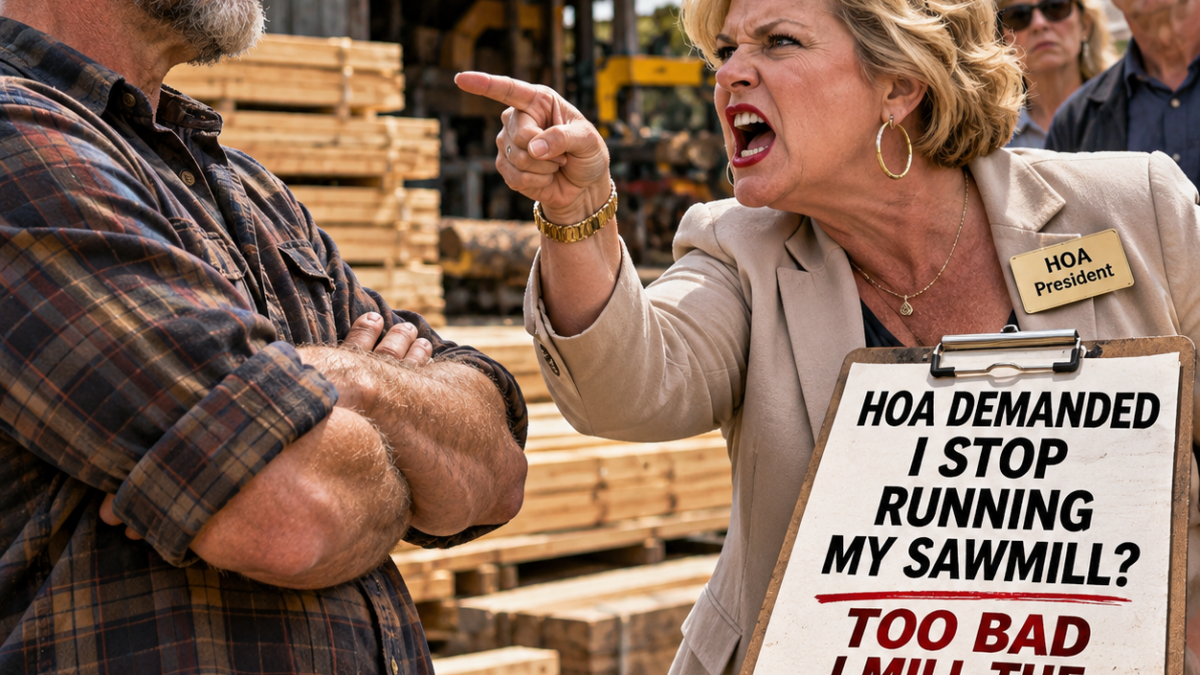
PART 2
My dust collection system was operating.
The sawdust pile she was pointing at was waiting for pickup by a commercial nursery that used it for mulch and animal bedding.
There was nothing abandoned, hazardous, or chaotic about the place.
Karen didn’t care.
This was not about sawdust.
It wasn’t about noise.
It wasn’t even about property values.
It was about obedience.
I had learned to recognize power games long before I came home to run the mill.
For thirty years, I had served in the Army Corps of Engineers.
I had built bridges in places where men shot at the construction crews.
I had worked under conditions where mistakes could kill people.
I understood pressure.
I understood intimidation.
And more importantly, I understood what happened when someone mistook calm for weakness.
Karen took my silence as surrender.
“I’ve prepared an agreement,” she said. “If you sign voluntarily, the board may consider reducing the penalties.”
“Penalties for what?”
She frowned.
“I’ve just explained that.”
“No. You’ve listed accusations.”
“They’re violations.”
“Of rules governing property I never agreed to join?”
Her cheeks flushed.
“You don’t get to exist beside a community and ignore its standards.”
“My family existed here before your community existed.”
“That doesn’t give you the right to destroy our quality of life.”
I turned and looked toward the flatbed.
The largest beam on it was almost thirty feet long.
Beautiful grain.
Clean edges.
Custom milled.
The kind of work you couldn’t buy from a big-box store.
“Karen,” I said, “move your vehicle.”
Her eyebrows rose.
“Excuse me?”
“That truck has a delivery.”
“This conversation isn’t finished.”
“It is for today.”
“I am giving you a legal notice.”
“You’re standing in my driveway blocking a commercial vehicle.”
Her mouth opened.
I continued.
“If your concern is noise, forcing a diesel truck to idle while you make a speech seems counterproductive.”
The driver covered his mouth to hide a smile.
Karen noticed.
Her face went red.
“I wouldn’t be laughing if I were you.”
He looked toward me.
I shook my head.
Don’t engage.
Karen stepped closer.
“You think this is a joke.”
“No.”
I lowered my voice.
“I think you came here believing a clipboard made you more powerful than a deed.”
She stared at me.
“You’ll receive formal notice.”
“Send it.”
“And when you lose this property, remember that I gave you the opportunity to cooperate.”
I almost laughed.
Instead, I looked straight into her eyes.
“I’ll remember everything.”
Something about the way I said it made her pause.
Then she walked to her Lexus.
Before getting inside, she turned.
“Thirty days, Mr. Peterson.”
I nodded toward the gate.
“Drive safely.”
Her tires threw gravel as she pulled away.
The flatbed driver climbed down from his cab.
“You know who that is?”
“I’ve had the pleasure.”
“She serious?”
“Yes.”
“You going to shut down?”
I looked toward the old mill.
The main building still contained timbers my father had cut and fitted by hand.
A faded pencil mark near one post showed where he had measured my height when I was twelve.
On another wall, my grandfather had carved his initials.
I could still remember my father standing beside me on my first day home after retirement.
He had looked around the yard and said, “You spent your life building things for other people. Maybe now you can build something here.”
He died less than a year later.
“No,” I said.
The driver nodded.
“Good.”
Then he climbed back into the truck and drove away.
That night, Sarah knew something was wrong before I spoke.
She had spent years as an Army nurse.
She could read a room before most people had noticed there was anything to read.
I came through the kitchen door, washed my hands, and sat down.
She placed a glass of iced tea in front of me.
“What happened?”
“Karen.”
“That narrows it down very little.”
I told her.
The sawdust.
The noise.
The thirty-day shutdown threat.
The claim that the HOA could have the property condemned.
Sarah listened without interrupting.
When I finished, she looked toward the back window.
From there, she could see the top of the mill roof above the trees.
“Can she?”
“Can she what?”
“Shut us down.”
I leaned back.
“She can make trouble.”
“That wasn’t my question.”
“No.”
I paused.
“Not if our records are what I think they are.”
“What does that mean?”
“It means I’m going to verify before I brag.”
Sarah nodded.
That was one of the reasons our marriage worked.
She never needed false confidence.
She preferred facts.
Three days later, Karen’s formal notice arrived.
Certified mail.
Five pages.
Single-spaced.
Legal language stacked so densely that I could almost see the intimidation strategy.
Unapproved commercial operation.
Noise nuisance.
Airborne particulate concerns.
Improper waste storage.
Visual blight.
Traffic impact.
Potential environmental contamination.
And at the bottom:
Failure to cease operations within thirty days could result in fines of five hundred dollars per day, legal action, liens, and referral to county authorities.
Karen had signed it with a huge looping signature.
Sarah read over my shoulder.
“Five hundred a day?”
“That’s what it says.”
“That’s fifteen thousand a month.”
“Assuming they have authority.”
“Which?”
“Is what I’m about to find out.”
The next morning, I shaved, put on clean jeans and a collared shirt, and drove into town.
Whispering Pines HOA maintained a small office in a strip mall between a nail salon and a vape shop.
The whole place smelled like burnt coffee and artificial lemon.
Karen sat behind a particleboard desk.
When I entered, her expression changed immediately.
There was surprise first.
Then satisfaction.
“Mr. Peterson.”
She leaned back.
“Have you come to sign the cessation agreement?”
“No.”
Her smile vanished.
“I need certified copies of the HOA articles of incorporation, full recorded covenants, all amendments, bylaws, and the original subdivision plat.”
She stared at me.
“What for?”
“Records.”
“You’re not an association member.”
“I’m the person you’re threatening under association rules.”
“That doesn’t entitle you to confidential documents.”
“Recorded covenants and plats aren’t confidential.”
She didn’t answer.
“I also want copies of any document you contend gives Whispering Pines jurisdiction over parcel 7B.”
She shifted slightly.
“That will take time.”
“I have time.”
“There are copying fees.”
“I brought money.”
I placed cash on the desk.
“Please provide a receipt.”
For the next hour, Karen made a performance out of retrieving paperwork.
Drawers slammed.
Cabinets opened.
Pages were dropped onto the copier with unnecessary force.
She sighed repeatedly.
I sat quietly and wrote down the time each document was produced.
Finally, she shoved a thick stack toward me.
A rolled plat map followed.
“There.”
“Thank you.”
“I hope this little stunt was worth your time.”
I stood.
“So do I.”
Back home, I spread everything across our dining room table.
That table had once been an oak tree growing fifty yards from the house.
A storm brought it down.
My father and I milled it.
I dried the slabs for two years before building the table.
It seemed appropriate that I was using something created by the mill to defend the mill.
Sarah brought coffee.
“Find anything?”
“Not yet.”
For nearly three hours, I cross-referenced deeds, maps, amendments, and recorded covenants.
Then I found it.
1998 subdivision plat.
I unrolled the map and flattened the corners with coffee mugs.
Whispering Pines was outlined in detail.
Lots.
Roads.
Common spaces.
Drainage easements.
Then, along the western boundary, my property.
Parcel 7B.
Clearly separated.
And beneath the legend:
EXEMPT — PRE-EXISTING AGRICULTURAL/LIGHT INDUSTRIAL USE.
I read it twice.
Then a third time.
Sarah saw my expression.
“What?”
I pointed.
She leaned over the map.
“Exempt?”
“Yes.”
“Meaning?”
“Meaning the developer knew the sawmill existed before Whispering Pines.”
“And?”
“They legally carved it out.”
She looked at me.
“So Karen can’t enforce HOA rules here?”
“No.”
“Any of them?”
“Not through the HOA.”
Sarah slowly smiled.
“That seems important.”
“It is.”
“So send her a copy.”
I rolled the map back up.
“Not yet.”
She frowned.
“Why?”
“Because I want to know how far she’ll go.”
“Jack.”
“I’m not provoking her.”
“You’re letting her keep digging.”
“Yes.”
Sarah crossed her arms.
“That sounds remarkably like provoking her.”
“It’s evidence.”
“You retired from the Army, not from being impossible.”
“I’m aware.”
Her smile disappeared.
“Just be careful.”
That part stayed with me.
Because Sarah understood something I was beginning to understand too.
Karen wasn’t acting rationally.
Rational people correct course when they discover risk.
People addicted to control often double down.
The first fine arrived a week later.
Then another.
Then another.
Within days, I was supposedly thousands of dollars in debt to an HOA I did not belong to.
Karen also sent a community newsletter.
The front page carried a cheerful title:
KEEPING OUR COMMUNITY BEAUTIFUL.
Underneath it was a warning about a “neighboring industrial operation” that threatened property values, air quality, peace, and family safety.
No name.
No address.
None needed.
Everyone knew.
The effect was immediate.
People who used to wave while walking dogs past my fence stopped.
Some stared.
A few crossed the road rather than walk close to the property.
One morning, Sarah found a plastic bag of dog waste tossed over the fence.
A note was tied around it.
KEEP YOUR FILTH OUT OF OUR COMMUNITY.
She brought it to me.
Her face looked different.
Not angry.
Hurt.
“They believe her.”
“Some do.”
“They don’t know us.”
“No.”
“They don’t even know what the sawmill does.”
“No.”
She looked toward the neighborhood.
“We never bothered anybody.”
“I know.”
“That almost makes it worse.”
I put the note into a plastic evidence sleeve.
Sarah stared at me.
“You’re filing that?”
“Yes.”
She laughed once.
“Of course you are.”
Then, on a Saturday afternoon, an old sedan came slowly up the drive.
I shut down the saw.
An elderly man stepped out.
Thin.
Bent slightly at the shoulders.
Hands thickened by decades of manual work.
I recognized him from Whispering Pines.
George Henderson.
He held Karen’s newsletter in one hand.
I expected an argument.
Instead, he extended his hand.
“Jack Peterson?”
“Yes.”
“George Henderson.”
We shook.
He lifted the newsletter.
“This is garbage.”
I looked at him.
“Would you like some iced tea?”
“Very much.”
We sat on the porch.
George had been a carpenter for more than forty years.
When I mentioned my father, his face changed.
“I bought maple from your dad.”
“You did?”
“Late nineties. Custom cabinets. He could read a board like some men read music.”
I smiled.
“That sounds like him.”
George looked toward the mill.
“This place matters.”
Then his expression hardened.
“That woman doesn’t understand that.”
He told me about Whispering Pines.
The basketball hoop.
The clover lawn.
The widow threatened with fines.
A family punished because their child’s play equipment didn’t match an approved color palette.
Board members mysteriously escaping penalties that ordinary residents received.
People afraid to speak publicly.
“Karen doesn’t enforce rules,” George said.
“What does she do?”
“She uses them.”
“For?”
“Control.”
He looked toward the development.
“She wants everyone remembering who can make their life expensive.”
“Why does the board tolerate it?”
“Some are her friends. Some enjoy the power. Some are scared of her.”
“And the homeowners?”
George gave a bitter laugh.
“Most people just want to live their lives.”
“That isn’t an answer.”
“It is.”
He leaned closer.
“They pay because fighting costs money. They comply because fighting takes time. She knows that.”
I looked toward the trees.
That was the first moment I realized this fight might be bigger than my mill.
George continued.
“The Millers paid nearly two thousand dollars over a basketball hoop.”
“I saw that in county records.”
His eyes narrowed.
“You’ve been looking.”
“Yes.”
“Good.”
“Mrs. Gable?”
His jaw tightened.
“Widow. Late seventies.”
“The clover?”
“She and her husband planted it years ago because he loved bees.”
“And Karen?”
“Called it a weed infestation.”
George shook his head.
“She threatened foreclosure if the fines weren’t paid.”
I sat back.
“That seems aggressive.”
“Aggressive?”
He laughed.
“You Army boys have polite words for everything.”
“Habit.”
George tapped the newsletter.
“You’re the first person she’s picked on who might actually have the resources to stand up.”
“That doesn’t make me special.”
“No.”
He looked directly at me.
“It makes you responsible.”
That bothered me.
Not because he was wrong.
Because I suspected he was right.
After he left, I told Sarah.
She listened quietly.
“So now it’s not just our fight.”
“I didn’t say that.”
“You didn’t have to.”
The next week, I started documenting everything.
Noise readings at the property line.
Photos of storage areas.
Equipment maintenance records.
Environmental controls.
I sent sawdust samples for laboratory testing.
The report came back exactly as expected.
Organic wood fiber.
No hazardous contamination.
I reviewed county permits.
Every building.
Every electrical upgrade.
Every kiln modification.
Everything current.
Then I went through county property records.
George had been right.
Violation after violation.
But the interesting part wasn’t only who had been cited.
It was who had not.
One board member had an unapproved shed.
No fine.
Another had fencing that clearly violated material restrictions.
Nothing.
A committee member had decorative structures visible from the road.
No violation.
Karen herself had exterior modifications that would have generated penalties if a regular homeowner had installed them.
The pattern was obvious.
Selective enforcement.
Rules for enemies.
Exceptions for friends.
By then, the fines against me were approaching ten thousand dollars.
That was when I called David Chen.
David and I had served together overseas.
He had been JAG.
I had been engineers.
He was one of the few lawyers I trusted enough to tell me when I was wrong.
His office looked exactly like I expected.
Glass.
Steel.
No clutter.
He read the HOA notice.
Then the plat.
Then my evidence.
When he reached the exemption on parcel 7B, he looked up.
“You’re kidding.”
“No.”
“This is recorded?”
“Yes.”
He leaned back.
“Jack, their case against your mill is dead.”
“I know.”
“No. I mean completely dead. They don’t have a weak argument. They have no argument.”
“That’s why I’m here.”
“Then why haven’t you sent this to them?”
“Because I wanted to understand the broader pattern first.”
David stared at me.
Then slowly smiled.
“I remember why working with you was exhausting.”
“I didn’t ask for nostalgia.”
He looked through the selective enforcement records.
“George gave you these?”
“Public records gave me most of it.”
“And the residents?”
“Some are willing to talk.”
David closed the file.
“We could shut Karen down with one cease-and-desist letter.”
“I know.”
“But you don’t want to.”
“I want the harassment stopped.”
“That’s not the same answer.”
I remained silent.
He nodded.
“Good.”
“Good?”
“She’s done this before.”
“Yes.”
“She’ll do it again.”
“Probably.”
“So you don’t just want your property protected.”
“No.”
David stood.
“Then we need records.”
“What records?”
“All of them.”
He started pacing.
“Board minutes. Fine histories. Forgiven penalties. Vendor contracts. Legal bills. Email correspondence. Financial statements.”
“You think there’s money involved?”
“I think someone who abuses one kind of power is worth auditing for the others.”
That afternoon, David’s office prepared two packages.
The first was a cease-and-desist letter.
It cited the recorded exemption.
County zoning.
Pre-existing use.
Property rights.
It demanded that all HOA threats against my property stop immediately.
The second package was more dangerous.
Financial records requests.
Board records.
Violation histories.
Fine forgiveness.
Contracts.
Legal expenses.
David mailed everything certified.
Then we waited.
For one week, nothing happened.
No fines.
No letters.
No Karen.
The silence felt wrong.
Sarah noticed too.
“She’s planning something.”
“Probably.”
“You say that like weather.”
“It’s easier if you think of her as a storm system.”
“Storm systems don’t hire lawyers.”
“Some probably would if they could.”
Sarah laughed.
Then the county code enforcement truck arrived.
The inspector, Bill, stepped out.
He had inspected my kiln years earlier.
“Morning, Jack.”
“Bill.”
He sighed.
“Complaint about unpermitted commercial buildings and illegal dumping.”
“Let me guess.”
“I’m not allowed to discuss complainants.”
“That’s a yes.”
He almost smiled.
I walked him through everything.
Original mill permit.
Electrical permits.
Kiln approvals.
Storage documentation.
Then the sawdust pile.
“This is illegal dumping?”
“That’s what the complaint says.”
I picked up a handful.
“It gets collected for mulch and bedding.”
“Contract?”
I handed it over.
Bill read it.
Then looked at the pile.
Then checked a box.
Complaint unfounded.
As he left, he lowered his voice.
“Keep your paperwork close.”
“Why?”
“This isn’t the first complaint.”
“I know.”
“No. I mean to us.”
He climbed into his truck.
“She’s persistent.”
Two days later, an environmental inspector arrived.
The allegation:
Hazardous runoff entering the creek.
I walked her through my drainage and settling system.
My father had built the original version decades ago.
I upgraded it.
Quarterly water testing.
Sediment control.
Organic filtration.
The inspector stared at the records.
“You test this voluntarily?”
“Yes.”
“How often?”
“Four times a year.”
She looked toward the creek.
“You know a facility your size isn’t required to maintain this level of documentation?”
“I like knowing what leaves my property.”
She took samples.
A week later, the report came back clean.
Then OSHA arrived.
That was the one that annoyed me.
Someone had alleged exposed blades, missing guards, and employees without protective equipment.
The inspector spent nearly an hour inside the mill.
Emergency stops.
Blade guards.
First aid.
Fire suppression.
Protective equipment.
Lockout procedures.
Training logs.
He closed his notebook.
“I have nothing.”
“That’s good.”
“No, Mr. Peterson.”
He looked around.
“I mean I have nothing. Not even something minor to write up.”
I shrugged.
“Safety matters.”
He took a photo of one of my guard assemblies.
“What for?”
“I want to show another operation what right looks like.”
When he left, I stood alone in the mill.
The blade hummed.
For years, that sound meant work.
Then peace.
Now it meant something else.
Defiance.
Karen had tried to use government agencies as weapons.
Instead, she had accidentally created independent reports proving that the mill was safe, compliant, properly permitted, and environmentally responsible.
I sent everything to David.
His response was immediate.
She’s building your case for you.
But the biggest discovery had nothing to do with law.
It came from my own invoices.
One Sunday afternoon, I started reviewing customer records.
Seven years.
Builders.
Contractors.
Delivery addresses.
Custom orders.
Whispering Pines had expanded in phases.
Phase Three was still under construction.
Forty luxury homes.
I recognized the builder names immediately.
Harrington Homes.
Blue Ridge Builders.
Apex Construction.
Three of my largest customers.
I pulled the delivery records.
Cedar trim.
Decking.
Structural joists.
Roof trusses.
Decorative timber porticos.
Long custom beams.
The more I looked, the clearer it became.
My sawmill wasn’t merely near Whispering Pines.
It was part of Whispering Pines.
Not legally.
Structurally.
Economically.
The new houses Karen wanted to protect depended on materials coming from the business she was trying to destroy.
I called Mark Harrington first.
“Mark.”
“Jack.”
“How did the cedar look?”
“Beautiful. Crew loved it.”
“Good.”
“Why do you sound like someone died?”
“I have a problem that could affect your next order.”
Silence.
“What problem?”
“The Whispering Pines HOA is trying to shut my mill down.”
Another silence.
Longer.
“The HOA where I’m building?”
“Yes.”
“You’re serious.”
“Yes.”
I explained everything.
No dramatics.
No request for help.
Just the business risk.
Mark’s voice changed.
“Jack, I have contractual deadlines.”
“I know.”
“If your cedar stops, I can’t replace that order quickly.”
“I know.”
“The porticos alone could delay closings.”
“That’s why I’m calling.”
“Who at the HOA?”
“Karen.”
He swore.
“Of course.”
“You know her?”
“I know enough.”
Then he said something that changed the balance of the entire conflict.
“If they attack my supplier, they attack my project.”
Blue Ridge reacted the same way.
So did Apex.
Two days later, three contractors sat around my oak dining table.
Mark Harrington.
Dave from Blue Ridge.
Paul Jessup from Apex.
Mud on their boots.
Contracts on the table.
Numbers on paper.
I showed them the exemption.
The fines.
The inspector reports.
Mark tapped the map.
“She has no authority.”
“Correct.”
Paul frowned.
“She doesn’t need authority to cost us money.”
“Exactly.”
Dave looked at me.
“What does your lawyer want?”
“Karen has called a special town hall.”
“For what?”
“She wants the board authorized to pursue a major lien against my property.”
Mark laughed once.
Not because it was funny.
Because it was absurd.
“A lien on exempt property?”
“Yes.”
“She wants this public?”
“Yes.”
He leaned back.
“Then let’s make it public.”
The meeting was scheduled two weeks later.
Karen promoted it aggressively.
Emails.
Notices.
Newsletters.
A final confrontation over the “Peterson Industrial Nuisance.”
Sarah read one of the announcements at breakfast.
“She really thinks she’s going to humiliate you.”
“Yes.”
“Does that bother you?”
“No.”
“That answer worries me more.”
On the night of the meeting, the Whispering Pines community center was full.
People stood along the walls.
Karen’s supporters occupied the front rows.
George sat farther back.
The Millers were beside him.
Mrs. Gable attended with her daughter.
Sarah walked in next to me.
The conversation softened immediately.
Eyes followed us.
Some angry.
Some curious.
Then Mark Harrington entered.
Suit.
Tie.
Behind him came Dave and Paul.
Also in suits.
They sat in the front row.
Karen noticed.
Her expression flickered.
She knew them.
She just didn’t know why they were there.
She struck the gavel.
“Tonight, we are here to protect the peace, safety, and investment of every homeowner in Whispering Pines.”
She launched into her presentation.
Industrial noise.
Toxic dust.
Heavy trucks.
Property values.
She showed carefully framed photographs of my yard.
One angle made stacked logs look chaotic.
Another made a sawdust pile look enormous.
“This is about one individual’s commercial greed,” she said, “versus the rights of two hundred families.”
Some people applauded.
Sarah looked at me.
I remained still.
Karen continued.
“We have attempted cooperation.”
That almost made me laugh.
“We have attempted reasonable enforcement.”
George shook his head.
“We have been met with hostility.”
Mark Harrington looked back at me.
I gave the slightest nod.
Karen finished.
“Tonight, the board seeks authorization to pursue all available legal remedies, including a lien sufficient to recover accumulated fines and costs.”
She looked toward me.
“Mr. Peterson has asked to respond.”
I stood.
Carried a laptop to the front.
Connected it.
The first image appeared.
The 1998 plat map.
No dramatic graphics.
No slogans.
Just a legal document.
“My name is Jack Peterson.”
I pointed toward parcel 7B.
“This is the recorded plat that legally created Whispering Pines.”
People leaned forward.
“My family’s land is here.”
I highlighted the notation.
“Exempt. Pre-existing agricultural and light industrial use.”
The room shifted.
Karen stood.
“That doesn’t mean—”
I raised one hand.
“You’ll have time.”
She sat.
Barely.
I continued.
“The HOA has no authority to enforce its private covenants against my parcel.”
A man in the audience called out.
“Then why are we voting on a lien?”
I looked toward Karen.
“That is an excellent question.”
Murmurs.
Next slide.
County code enforcement.
Complaint unfounded.
Next.
Environmental inspection.
No violation.
Next.
OSHA.
No violation.
“Over the past several weeks,” I said, “your HOA president has repeatedly reported my operation to government agencies.”
Someone spoke from the side.
“Did she file all those?”
“I cannot speak to confidential complainant records.”
I paused.
“But each investigation concerned the exact accusations contained in HOA correspondence.”
That was enough.
The room understood.
“Every agency found my mill compliant.”
I turned toward Karen.
“So if this meeting were only about my sawmill, we could stop here.”
She stared at me.
“But it isn’t.”
I looked toward Mark.
“Mr. Harrington?”
Mark stood.
He walked to the podium.
Karen tried to interrupt.
“Why is he speaking?”
Mark turned to her.
“Because your actions affect my contracts.”
The room became quiet.
He faced the homeowners.
“My company is building part of Phase Three.”
Everyone knew that.
“What most of you do not know is that Jack Peterson’s sawmill supplies a significant portion of the specialty lumber for those homes.”
Whispers.
Mark continued.
“Cedar exterior work.”
He pointed toward Dave.
“Structural materials.”
Toward Paul.
“Custom trusses.”
Then back to me.
“Timber framing.”
He paused.
“If Mr. Peterson’s mill is disrupted, our construction schedules are disrupted.”
A woman near the front raised her hand.
“How badly?”
Mark looked at her.
“Potentially months.”
The room erupted in questions.
He held up one hand.
“Sourcing custom material is not the same as buying standard lumber.”
He looked toward Karen.
“These are specialized orders.”
Dave stood.
“My company has standing purchase commitments with Jack.”
Paul stood beside him.
“So does mine.”
Mark faced the board.
“If this HOA continues interfering with a critical supplier, our companies will suspend construction activities in Whispering Pines while our legal teams evaluate claims for interference with contractual relationships.”
The room exploded.
Someone shouted:
“You’re stopping construction?”
Another:
“What happens to Phase Three?”
Another:
“What about home values?”
Karen hammered the gavel.
“Order!”
Nobody cared.
A man who had applauded her ten minutes earlier stood.
“Karen, what have you done?”
Her face went pale.
“This is intimidation.”
Mark turned.
“No.”
His voice was flat.
“This is business.”
Karen pointed toward me.
“He put you up to this!”
“No,” Mark said. “He notified us of a supply-chain risk.”
“I’m protecting the community!”
“From the supplier building it?”
The room went silent for one perfect second.
Then the shouting resumed.
I returned to my seat beside Sarah.
She leaned toward me.
“You knew he was going to say that?”
“More or less.”
“More or less?”
“He improvised the last line.”
“That was the best part.”
I almost smiled.
But the meeting wasn’t finished.
David Chen stood.
He had been sitting quietly two rows behind the builders.
“May I have the floor?”
Karen glared at him.
“Who are you?”
“David Chen. Counsel for Mr. Peterson.”
Groans rippled through Karen’s supporters.
David walked forward carrying a thick binder.
“If the membership is concerned about the financial consequences of the board’s conduct regarding Mr. Peterson, it may also wish to consider a broader issue.”
Karen’s attorney stood.
“I object.”
David looked at him.
“To what?”
“This is not on the agenda.”
David lifted the binder.
“The board proposed a legal action requiring association funds. The financial conduct of the board is directly relevant.”
George stood.
“I want to hear him.”
“So do I,” someone else said.
Then another.
Karen looked around.
For the first time, I saw fear.
David opened the binder.
“Records produced after formal demand reveal several financial irregularities.”
The room changed.
Money does that.
Noise disappeared.
“Over the past three years, this association paid more than ninety thousand dollars in legal fees to Abernathy and Finch.”
A few people nodded.
They had seen the name on letters.
David continued.
“One of the principals of that firm is related by marriage to the HOA president.”
The room reacted immediately.
Karen jumped up.
“That is not illegal.”
David nodded.
“Correct.”
She looked relieved for half a second.
He continued.
“Failure to properly disclose conflicts, however, can raise serious fiduciary questions.”
Her relief vanished.
“And those legal bills include significant sums spent pursuing violation cases that produced little or no benefit to the association.”
He clicked a remote.
The Miller basketball hoop appeared.
“Approximately twelve thousand dollars in association legal expense was generated around this dispute.”
Mr. Miller stood.
“You spent twelve thousand dollars fighting my son’s basketball hoop?”
Karen pointed.
“That is misleading!”
David ignored her.
“Records also show more than forty thousand dollars paid for aesthetic compliance consulting.”
He changed the slide.
COMMUNITY SOLUTIONS LLC.
“No meaningful public-facing operations.”
Another click.
“Post-office box.”
Another.
“Ownership connected to the HOA president.”
A woman gasped.
Karen stood rigidly behind the table.
David continued.
“We also identified a pattern in which fines against certain residents were aggressively collected while fines against board members and associates were reduced or forgiven.”
George shouted from the back.
“I knew it.”
David raised his voice slightly.
“This is preliminary.”
That mattered.
He wasn’t making claims beyond the records.
“But the pattern is sufficiently serious that we recommend an immediate independent forensic audit.”
Karen’s attorney whispered to her.
She ignored him.
“This is a coup!”
George stood.
“No.”
His voice filled the room.
“This is accountability.”
Applause.
Mrs. Gable stood slowly.
“I paid you thousands because my lawn had clover.”
Karen looked toward her.
“You were in violation.”
“My husband planted that clover.”
Karen said nothing.
“He planted it because we kept bees.”
Mrs. Gable’s voice trembled.
“He died, and you threatened to put a lien on my house because I wouldn’t tear out the last thing he planted.”
The room became completely silent.
Karen looked down.
Mrs. Gable continued.
“You called me irresponsible.”
Her daughter placed a hand on her arm.
“I was scared of losing my home.”
Karen said, “The rules—”
“No.”
Mrs. Gable’s voice suddenly strengthened.
“Don’t say that.”
Karen stopped.
“Don’t hide behind rules.”
That sentence changed the room more than any legal document.
George stood.
“I move for a vote of no confidence in the current president.”
Mr. Miller immediately raised his hand.
“Second.”
Karen struck the gavel.
“You cannot just invent procedure!”
David’s expression remained calm.
“Check Article Eight.”
Her attorney was already reading.
His face told her the answer before he spoke.
The motion was permitted.
Karen stared at him.
“You’re supposed to represent us.”
“I represent the association.”
“Then stop this.”
“I cannot stop a lawful membership motion.”
That was the moment her power broke.
Not when I showed the plat.
Not when the builders threatened to suspend construction.
Not even when David revealed the financial records.
It broke when Karen turned to the lawyer she believed existed to protect her and discovered that the institution did not belong to her.
The vote proceeded.
Hands went up.
Dozens.
Then more.
People who had spent years looking down when Karen approached were now raising their hands where she could see them.
George.
The Millers.
Mrs. Gable.
Former supporters.
Even people who had applauded Karen at the start of the meeting.
The result was overwhelming.
No confidence.
Karen stood behind the podium gripping both sides.
“You’re all making a mistake.”
No one responded.
“You’ll regret this.”
Still nothing.
Then George spoke.
“I think we already regret waiting this long.”
Karen gathered her papers.
A few fell to the floor.
She left them there.
She walked out through the crowd.
Nobody stopped her.
Nobody followed.
Nobody applauded.
That silence was more devastating than cheering would have been.
The next morning, Karen resigned.
The email was short.
She claimed harassment had made it impossible for her to continue serving.
Within a week, a FOR SALE sign appeared in front of her house.
The old board collapsed soon after.
A special election was scheduled.
George resisted running.
“I’m too old for this nonsense.”
“That may be your strongest qualification.”
He glared at me.
“You’re enjoying this.”
“No.”
“You are.”
“Maybe a little.”
“I’m a carpenter, Jack.”
“Retired.”
“I don’t want to run an HOA.”
“Good.”
He frowned.
“What does that mean?”
“People who desperately want power are often the last people who should have it.”
Sarah laughed from the kitchen.
“He’s got you there, George.”
George eventually agreed.
He won with more than ninety percent of the vote.
Mr. Miller joined the board.
So did several other residents who had previously avoided HOA politics entirely.
Their first meeting produced two resolutions.
The first ordered a full independent forensic audit.
The second concerned me.
George drove to the mill personally.
He handed me an envelope.
“Official.”
I opened it.
The new board apologized for the previous harassment.
It recognized the grandfathered legal status of my property.
It declared every HOA fine against me void.
Every violation notice was rescinded.
Every threat withdrawn.
I read it twice.
George watched me.
“Well?”
I folded the letter.
“It’s good.”
“Good?”
“What do you want, fireworks?”
“I risked public office for you.”
“No one asked you to.”
“You did.”
“I suggested it.”
“You manipulated an elderly man.”
“You’re surprisingly energetic for a victim.”
George laughed.
Then he looked toward the mill.
“Peace?”
“Peace.”
We shook hands.
A week later, Mark Harrington called.
“Ready for work?”
“Always.”
“Good, because Phase Three is behind schedule.”
“That sounds like a you problem.”
“It becomes a you problem when I order enough cedar to keep your mill busy for three months.”
“That’s different.”
“How soon can you start?”
“Tomorrow.”
The sawmill became busy again.
Not defensive busy.
Productive busy.
Trucks came and went.
Logs arrived.
Finished beams left.
Orders increased.
Phase Three restarted.
The builders pushed hard to recover lost time.
For the first time in months, the sound of the saw blade returned to what it had always been.
Work.
One Saturday, Sarah and I hosted a barbecue.
Not a victory party.
At least, that was what we told everyone.
George came.
The Millers.
Mrs. Gable and her daughter.
Mark, Dave, and Paul.
Several families from Whispering Pines.
Kids wandered near the mill until I drew a line they weren’t allowed to cross.
Mr. Miller’s son brought a basketball.
At one point it rolled toward me.
I picked it up.
“Careful.”
He grinned.
“Why?”
“This thing caused twelve thousand dollars in legal fees.”
His father nearly dropped his drink laughing.
I tossed the ball back.
Mrs. Gable brought potato salad.
She looked different.
Lighter.
“You look happy,” Sarah told her.
“I sleep now.”
That sentence hit me harder than expected.
“You weren’t sleeping?”
Mrs. Gable shook her head.
“Every time the mail came, I wondered if there was another letter.”
She looked toward George.
“Now I get newsletters about community cleanup days.”
George groaned.
“Don’t remind me.”
She laughed.
“You’re doing fine.”
He pointed toward me.
“His fault.”
I raised my hands.
“I’m not in your HOA.”
Everyone laughed.
That mattered.
Months earlier, Whispering Pines had felt like a place on the other side of a border.
Their side.
My side.
Karen had built that division deliberately.
Now people moved back and forth between the neighborhood and the mill without thinking about it.
The independent financial audit continued.
The findings were serious enough that prosecutors began reviewing Karen’s financial dealings.
I stayed out of it.
David handled anything related to the old legal dispute.
The HOA handled its own recovery.
I had gotten what I needed.
My land was protected.
My business was safe.
And the people Karen had frightened had stopped being afraid.
Then autumn arrived.
The trees along the property turned red and gold.
One afternoon, my crew was loading a forty-foot oak beam.
It was beautiful.
Straight.
Dense.
Nearly perfect.
The tree had grown on our land for more than a century before storm damage forced us to take it down.
Instead of turning it into firewood, I had saved the trunk.
Months of drying.
Careful milling.
Final planing.
Now it would become the central ridge beam in one of the largest houses in Phase Three.
I stood near the flatbed directing the loading process.
“Easy.”
The crane operator lowered it.
“Six inches.”
The beam settled into its cradle.
“Perfect.”
Chains came out.
Straps.
Blocks.
Then I heard tires on the road.
A white Lexus stopped outside my gate.
I recognized it immediately.
Karen.
I hadn’t seen her since the town hall.
She stepped out.
For a second, I barely recognized her.
The posture was gone.
No clipboard.
No performance.
No audience.
She looked tired.
A FOR SALE sign had already been standing in front of her house for weeks.
Rumor said they had accepted an offer.
Karen remained on the public side of the gate.
I continued checking the load.
Eventually, she spoke.
“You happy?”
I turned.
“What?”
“You got what you wanted.”
I walked toward the fence but stayed several feet inside my property.
“What do you think I wanted?”
She laughed bitterly.
“You destroyed me.”
“No.”
“You turned everyone against me.”
“I showed them documents.”
“You humiliated me.”
“You scheduled the meeting.”
Her jaw tightened.
“You brought those builders.”
“I told my customers their supply was at risk.”
“You knew what they would do.”
“Yes.”
She stared at me.
“At least you admit it.”
“I’ve never denied defending my business.”
“You could have handled this privately.”
“I tried to tell you my property wasn’t under your authority.”
“You never showed me that map.”
“You never checked the map before threatening to condemn my land.”
Her face twisted.
“That sawmill never belonged next to a residential community.”
I looked toward the mill.
“It was here first.”
“That doesn’t make it right.”
“Doesn’t it?”
“No.”
She gestured toward the subdivision.
“People paid good money to live there.”
“So?”
“They deserve peace.”
“And I deserve my property.”
“You could have sold.”
I almost laughed.
“My great-grandfather bought this land.”
“That doesn’t mean you have to keep living in the past.”
I looked toward the oak beam on the truck.
For a moment, I didn’t answer.
Karen continued.
“You ruined this neighborhood.”
There it was.
The last version of the story she needed to believe.
Not that she abused authority.
Not that she selectively enforced rules.
Not that she wasted community money.
Not that she attacked a legal business she had no jurisdiction over.
I ruined the neighborhood.
I walked toward the truck.
Placed one hand against the oak.
The grain ran beneath my palm.
I thought about my father.
My grandfather.
The generations who had stood in this same yard.
I thought about the homes already containing lumber from our mill.
Families eating dinner beneath beams we had cut.
Children sleeping under roofs framed with our wood.
People walking through doorways supported by materials that began as trees on this property.
Karen saw noise.
I saw continuity.
She saw industrial ugliness.
I saw craftsmanship.
She saw something to eliminate.
I saw something being built.
I turned back.
“Do you know where this beam is going?”
She didn’t answer.
“Whispering Pines.”
Her eyes moved toward the truck.
“Phase Three.”
Still nothing.
“It will support the roof of a house your HOA approved.”
Karen’s face hardened.
“So?”
“So the thing you spent months trying to destroy is literally building the neighborhood you claimed you were protecting.”
She looked away.
“That’s not the point.”
“It’s exactly the point.”
“No.”
Her voice cracked.
“You think because you won, you’re right.”
I shook my head.
“I was right before I won.”
That stopped her.
“My property was exempt before you sent the first letter.”
I continued.
“My permits were valid before you called code enforcement.”
Another step.
“My environmental systems were compliant before you filed complaints.”
Another.
“My workers were safe before OSHA arrived.”
Karen’s eyes dropped.
“You didn’t lose because I had more power.”
I pointed toward the mill.
“You lost because you never bothered to learn the truth before trying to control it.”
She looked up.
For a second, I saw anger again.
The old Karen.
“You ruined my reputation.”
“No.”
I shook my head.
“Your reputation was just the distance between what people thought you were and what the records showed.”
She said nothing.
Chains clinked behind me as my crew tightened the load.
The driver climbed into the cab.
Karen looked toward the truck.
Then toward Whispering Pines.
“You really think you’re some kind of hero?”
“No.”
“What are you then?”
That question was easier.
“A sawmill operator.”
Her face twisted with contempt.
“That’s it?”
I smiled slightly.
“That’s enough.”
I turned toward the beam.
“My father taught me something about wood.”
She remained silent.
“A bad sawyer looks at a log and sees what he wants it to be.”
I ran my hand along the oak.
“A good one pays attention to what it actually is.”
Karen stared at me.
“Grain.”
“Stress.”
“Knots.”
“Direction.”
“You don’t force the wood to become what you imagined.”
I met her eyes.
“You work with the truth that’s already there.”
The truck engine started.
I stepped away.
The massive oak beam began moving slowly toward the gate.
Karen moved back toward her Lexus.
As the flatbed passed, she watched the beam.
I wondered if she finally understood the irony.
Months earlier, she had blocked this same gate while threatening to shut down my mill.
Now she stood beside the road while one of the largest pieces we had ever produced passed directly in front of her.
Destination:
Whispering Pines.
I looked at her one final time.
“I didn’t ruin your neighborhood, Karen.”
She said nothing.
“I helped build it.”
The truck turned onto the road.
I watched until it disappeared between the trees.
When I looked back, Karen was getting into her Lexus.
I didn’t watch her leave.
Her part of the story was finished.
I returned to the mill.
The next log was already positioned.
One of my younger workers called out.
“Ready?”
I put on my hearing protection.
“Start it.”
The blade came alive.
That familiar sound filled the yard.
For my grandfather, it had been opportunity.
For my father, it had been craftsmanship.
For me, after everything Karen had tried to do, it had briefly become defiance.
But standing there that afternoon, I realized I didn’t want defiance to be the mill’s legacy.
Defiance means someone else is still controlling the meaning of your work.
I wanted the sawmill to mean what it had meant before Karen ever arrived.
Creation.
A tree entered one end.
A beam came out the other.
Something wild became something useful.
Something that could hold weight.
Carry a roof.
Frame a doorway.
Become part of a family’s home.
That was what Karen had never understood.
Destroying things gives you an immediate feeling of power.
Building takes patience.
You can write a violation notice in five minutes.
A tree takes a century to grow.
You can frighten a homeowner with one letter.
A community takes years to earn trust.
You can order something torn down with a vote.
Putting it back together requires people.
That winter, the new HOA board invited Sarah and me to the opening of the first completed Phase Three home.
I almost didn’t go.
“You’re going,” Sarah said.
“Why?”
“Because I said so.”
“That seems authoritarian.”
“I learned from Karen.”
I stared at her.
She smiled.
“Get your coat.”
The house was enormous.
Timber-frame entrance.
Cedar detailing.
Exposed beams inside.
I recognized our work everywhere.
Mark Harrington met us at the door.
“Look up.”
Above the great room stretched one of our beams.
Not the forty-footer.
Another.
Still beautiful.
“You remember that one?” Mark asked.
“White oak.”
“Good.”
“Thirty-two feet.”
“Very good.”
“From the south ridge.”
He laughed.
“You’re ridiculous.”
A family would move in the following week.
Parents.
Two children.
A dog already running circles around the backyard.
The mother came over.
“Are you Mr. Peterson?”
“Yes.”
“Mark told us the wood came from your property.”
“Some of it.”
She looked up.
“It’s beautiful.”
“Thank you.”
“My husband said we could have used steel in the great room.”
I nodded.
“But this feels warmer.”
“That’s why people keep using wood.”
Her daughter, maybe eight years old, pointed toward the ceiling.
“Did you make that?”
I crouched slightly.
“I cut it.”
“From a tree?”
“Yes.”
“A real tree?”
“The realest.”
She looked amazed.
“How old?”
“Older than me.”
She looked at her mother.
“That’s really old.”
Sarah laughed so loudly she had to turn away.
I pointed toward her.
“She’s no longer invited.”
The girl giggled.
Then she ran toward the backyard.
I looked around the room.
George stood near the fireplace talking with Mr. Miller.
Mrs. Gable sat nearby.
Mark was arguing with another builder about trim.
Sarah slipped her hand into mine.
“You okay?”
“Yes.”
“You look strange.”
“I was thinking.”
“That is usually when you look strange.”
I ignored that.
“You know what’s funny?”
“What?”
“Karen kept saying the mill didn’t belong beside Whispering Pines.”
Sarah looked around.
Our wood was everywhere.
“Seems like the mill is inside Whispering Pines now.”
I smiled.
“Yes.”
The audit eventually concluded.
Some of the preliminary suspicions became formal matters for investigators.
Others were resolved internally.
The HOA recovered what it could.
New conflict-of-interest rules were adopted.
Financial reports became available to homeowners.
Violation hearings required clear documentation.
Board members could no longer quietly erase penalties for friends.
George complained constantly about meetings.
That was how I knew he was doing a good job.
People who enjoy every second of governing should be watched carefully.
He called me one morning.
“You owe me.”
“For what?”
“I have a three-hour budget meeting tonight.”
“That sounds terrible.”
“It is.”
“Thoughts and prayers.”
“I hate you.”
“No, you don’t.”
“Sarah still makes those biscuits?”
“Yes.”
“I’ll be there Saturday.”
That became normal.
And normal was the victory.
Not newspaper coverage.
Not legal letters.
Not Karen resigning.
Normal.
Mrs. Gable kept her clover.
Bees returned in spring.
The Miller boy’s basketball hoop stayed exactly where it was.
George learned more about HOA reserve funding than any retired carpenter should ever know.
Phase Three finished.
New families moved in.
And my sawmill kept running.
Sometimes new residents complained about the noise.
That was fair.
A sawmill is noisy.
George would explain that the property predated the development and that operating hours were already limited voluntarily.
Usually that ended the issue.
Once, a new homeowner came directly to me.
He looked nervous.
“I don’t want to be difficult.”
“Then you’re already doing better than the last person.”
He didn’t understand the joke.
“My baby sleeps around noon.”
“What time?”
“Usually twelve-thirty to two.”
I thought about our schedule.
“We can shift the big planer runs.”
His eyes widened.
“You can?”
“Probably.”
“I thought you’d say I knew what I was buying next to.”
“You did.”
He looked embarrassed.
“But being legally entitled to make noise doesn’t mean I have to make unnecessary noise.”
He thanked me.
We changed the schedule.
That was another lesson Karen had missed.
Compromise only works when nobody begins by pretending they own the other person.
Years later, I still had the original HOA cease-and-desist notice.
Sarah once asked why I kept it.
“Sentimental value.”
“That is the least sentimental object in this house.”
“It reminds me.”
“Of what?”
I looked toward the mill.
“That being right isn’t enough.”
She waited.
“You need records.”
She laughed.
“I knew you were going to say that.”
But that wasn’t the whole truth.
The notice reminded me of something larger.
Karen’s power had never come from the HOA covenants.
Not really.
It came from the assumption that nobody would check.
Nobody would read.
Nobody would challenge.
Nobody would stand beside the person she targeted.
Once people started asking for documents, her power weakened.
Once they compared stories, it weakened further.
Once they stood in the same room together, it collapsed.
The sawmill survived because my grandfather built it well.
My father maintained it.
I kept the paperwork straight.
David knew the law.
George spoke up.
The Millers stopped being embarrassed.
Mrs. Gable found her voice.
The builders understood their leverage.
Sarah kept me from becoming so obsessed with winning that I forgot why we were fighting.
Nobody won alone.
That may be the part I remember most.
One evening, years after the whole mess, I sat on the porch with Sarah.
The mill had shut down for the day.
Everything was quiet.
From somewhere beyond the eastern trees came the sound of children playing in Whispering Pines.
Sarah looked toward the neighborhood.
“Remember when they used to glare at us?”
“Yes.”
“Now half of them buy firewood from you.”
“I charge fairly.”
“You overcharge George.”
“That’s different.”
“Why?”
“He complains for free.”
She laughed.
The sun dropped lower.
Light moved through the pine trees.
I thought about the beam Karen had watched leave my property that final afternoon.
By then, it was inside a house.
Hidden beneath finished surfaces.
Holding weight.
Nobody living there probably knew its story.
That seemed right.
Good structural work rarely gets attention.
It simply stands.
That was my family’s legacy.
Not conflict.
Not lawsuits.
Not defeating an HOA president.
Building things strong enough to carry weight without needing applause.
I looked toward the mill.
Then toward Whispering Pines.
Karen had once threatened to erase us because she thought we were an ugly piece of the past.
Instead, the future of her neighborhood had been built with lumber from that past.
There was something satisfying about that.
Not because she lost.
Because the mill remained.
The blade still turned.
The trucks still rolled.
Families still built homes.
And every time one of those trucks left my gate carrying a load toward Whispering Pines, I remembered the afternoon Karen stood in the same driveway and told me I had thirty days left.
She had been wrong.
Not by thirty days.
Not by thirty years.
By generations.
The mill had survived my grandfather.
My father.
Wars.
Recessions.
Storms.
Changing markets.
And one very angry HOA president with a clipboard.
I doubted she would be the last person who ever looked at something old and decided it had no place in a newer world.
But as long as the sawmill kept turning trees into beams, I knew exactly how I would answer them.
I would point toward the houses.
And say:
Look at what’s holding them up.








