PART 2: HOA Ordered Me to Remove My Rusty Root Cellar Door—Then the Utility Companies Revealed It Was Keeping 212 Homes Safe
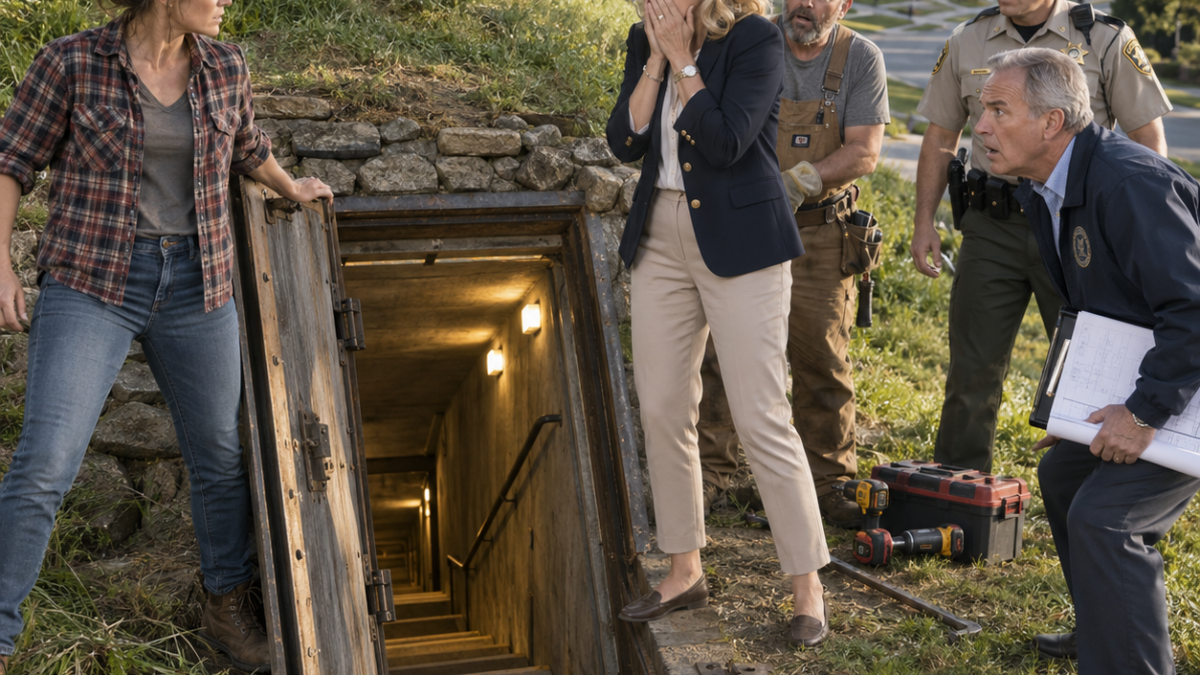
The HOA president gave me fourteen days to rip the old steel door out of my front hillside, fill the opening with dirt, and cover everything with fresh sod so the neighborhood would finally look “respectable.”
She threatened me with daily fines, a lien on my farmhouse, and a contractor who would do the work whether I agreed or not, all because a weathered gray hatch offended her idea of suburban beauty.
What she didn’t know was that removing that door wouldn’t just damage my property—it would expose a secret buried beneath Oak Meadows that could put every homeowner on the hook for a disaster they never saw coming.
“I don’t care what’s underneath it, Frank,” Karen snapped, stabbing one manicured finger toward the heavy slanted door built into the grassy rise beside my farmhouse. “That rusty thing is an eyesore, and it’s going to be gone by Friday.”
I rested both hands on the top rail of my fence and looked at the door.
Battleship gray.
Weathered.
Solid.
Definitely not decorative.
It had been there when Sarah and I bought the old farmhouse nearly twenty years earlier, long before Oak Meadows wrapped itself around our five acres with rows of new roofs, perfect lawns, and matching mailboxes.
The root cellar had been one of the reasons I bought the property.
My wife and I canned tomatoes, beans, peaches, and apples every year. We stored tools, emergency supplies, bottled water, batteries, and enough preserved food to get through a serious storm without depending on a grocery store.
Karen saw an ugly piece of steel.
I saw part of my home.
“Send me the violation in writing,” I said.
Her eyebrows rose.
“I’m standing here telling you.”
“I heard you.”
“Then remove it.”
“I said send the order in writing. Cite the exact section of the covenants you believe it violates, and send it certified.”
Her face darkened.
Most people probably argued with Karen.
Some apologized.
Some promised to fix whatever offended her.
I did neither.
Twenty-five years in the Army Corps of Engineers had taught me that shouting rarely settled anything important.
Documentation did.
Karen folded her arms.
“Exterior structures require Architectural Review Committee approval.”
“That door predates the HOA.”
“That doesn’t matter.”
“It might.”
She gave me the kind of smile people use when they’ve mistaken confidence for authority.
“You people with old properties always think you’re special.”
“You people?”
“You know what I mean.”
“No, actually.”
She exhaled sharply.
“Fourteen days, Frank. After that the fines start at two hundred fifty dollars, then fifty dollars every day. If you still refuse, we’ll remove it ourselves and charge you for the work.”
I looked at her carefully.
“You intend to enter my property and physically remove that door?”
“If necessary.”
“Please include that in the letter too.”
For the first time, she hesitated.
Only for a second.
Then she turned and marched toward her golf cart.
“You’re going to regret making this difficult.”
I watched her drive away.
Sarah came outside carrying two glasses of iced tea.
“What was Hurricane Karen complaining about this time?”
“The cellar door.”
Sarah stopped.
“What about it?”
“She wants it removed.”
Her eyes went toward the hill.
“Removed how?”
“Apparently permanently.”
“That would leave a hole.”
“She wants it filled and covered with sod.”
Sarah stared at me.
“She can’t seriously think she has the authority to order that.”
“I think she seriously thinks she has authority over anything she can see.”
Three days later, the certified envelope arrived.
Violation: Unapproved External Structure.
Section 7, Paragraph C.
Aesthetic Harmony.
Fourteen days to remove the steel hatch, close the opening, and restore the lawn.
I read the notice twice.
Then I pulled out the original Oak Meadows covenants.
Sarah sat across from me at the kitchen table.
“What does Section Seven actually say?”
I found the paragraph.
It said exterior features should maintain a harmonious appearance with the neighborhood.
Nothing about root cellars.
Nothing about steel hatches.
Nothing about structures that existed decades before Oak Meadows.
Sarah watched me turn another page.
“You’re smiling.”
“No.”
“You are.”
I closed the binder.
“Karen made a mistake.”
“What kind?”
“The kind that becomes much more interesting after a trip to the county records office.”
The next morning, I drove downtown.
Two hours later, I was standing over an old plat map with my finger pressed against a black square marked directly beneath my property.
Beside it were three letters.
E.A.P.
Emergency Access Point.
And when the county clerk handed me the original easement agreement, I finally understood what Karen Miller was actually trying to remove.
That rusty cellar door wasn’t merely protecting my canned vegetables.
It was protecting Oak Meadows.
PART 2
I stood in the county records room for nearly a minute without moving, staring at the plat map spread across the oversized table beneath the fluorescent lights.
The document was dated 1978, long before Oak Meadows existed, long before rows of quarter-acre lots replaced the soybean fields and cattle pastures surrounding my farmhouse. A thick black line cut through the old agricultural parcel, continued beneath what were now neighborhood streets and residential lots, passed directly beneath my five acres, then continued toward the commercial district north of the subdivision. The legend identified it as a fifty-foot multi-utility corridor easement, and right where my root cellar sat was the square marked E.A.P.—Emergency Access Point. I had spent twenty-five years reading engineering drawings, construction plans, utility schematics, and infrastructure specifications, so I knew immediately that the symbol mattered. What I did not yet understand was just how much.
“Can I get the document attached to this easement?” I asked the clerk.
She was a woman named Denise who had probably watched thousands of homeowners discover things about their properties they should have learned before closing. She adjusted her glasses, typed the book and page number into her computer, and disappeared into the archive room.
Ten minutes later she returned with several scanned records.
The original landowner had granted a permanent, irrevocable utility easement to the county and three utility providers for water, sewer, natural gas, and telecommunications infrastructure. The easement language was dense, but one provision was impossible to misunderstand.
A permanent emergency-access opening had to remain at the coordinates now occupied by my root cellar.
Minimum clear opening: four feet by four feet.
Accessible to utility personnel.
Not permanently obstructed.
Not sealed.
Not filled.
Not modified in a manner that prevented emergency entry.
I read the paragraph again.
Then again.
The old farmhouse cellar had apparently been incorporated into the access design because it already provided a secure underground entrance. The slanted steel door Karen hated was not merely an architectural feature of my property. Beneath it, past the shelves where Sarah and I stored jars of green beans and peaches, a reinforced service corridor led to a utility chamber containing shutoff points and junctions for infrastructure serving the subdivision.
I turned another page.
Natural gas.
Twelve-inch water main.
Legacy telephone conduit later converted to fiber.
I felt the hairs rise on my arms.
If Karen got what she wanted and filled that opening with soil, concrete, landscaping, or permanent structural material, she would be sealing one of the utilities’ legal emergency-access points.
Possibly the only practical one for Oak Meadows.
I looked at Denise.
“Can I get certified copies of all of this?”
She glanced at the pile.
“That’s going to be a few dollars.”
“I’ll survive.”
I also requested the original subdivision plat, all recorded easement amendments, and the incorporation documents for the Oak Meadows HOA.
By lunch, I had a thick manila envelope.
But I wasn’t finished.
The Army taught me that finding one important fact usually raises three more questions.
The first was obvious.
Did the HOA know?
I drove home and pulled out my copy of the CC&Rs.
The Oak Meadows governing documents were almost two hundred pages of repetitive restrictions, architectural provisions, parking rules, maintenance obligations, and enough poorly defined aesthetic language to keep a small law firm employed indefinitely.
I turned to the appendices.
There it was.
INCORPORATION OF EXISTING LIENS, EASEMENTS, RIGHTS-OF-WAY, AND ENCUMBRANCES.
Oak Meadows expressly acknowledged every pre-existing recorded utility easement.
A few pages later I found something even better.
The association had accepted responsibility for conducting annual visual inspections of utility easements and designated access points located within the development boundaries.
The board was supposed to certify those inspections to county Public Works.
Once every year.
I leaned back in my chair.
Sarah walked in carrying a laundry basket.
“What?”
I pointed at the page.
She set the basket down.
“What am I looking at?”
“The HOA is supposed to inspect the cellar access.”
“Your door?”
“Their documents call it an emergency access point.”
“Every year?”
“Yes.”
“And Karen is trying to destroy it?”
“Yes.”
Sarah stared at me for several seconds.
“That seems… bad.”
“That is the technical term.”
“You’re enjoying this.”
“I’m not enjoying anything.”
“You have the same face you made when the contractor renovating the kitchen claimed he didn’t need a permit.”
“That contractor eventually needed three permits.”
“Exactly.”
I made another trip downtown the following morning.
This time I went to Public Works.
I requested copies of Oak Meadows’ emergency-access inspection certifications for the previous ten years.
The clerk typed.
Stopped.
Typed again.
Then looked at me.
“I don’t see any.”
“Maybe they’re under the management company?”
She searched.
Nothing.
“Board president?”
Nothing.
“Previous association name?”
Still nothing.
“How far back do your electronic records go?”
“Longer than ten years.”
“So Oak Meadows has never filed one?”
She shrugged apologetically.
“Nothing I can find.”
I asked for written confirmation.
That afternoon I left Public Works carrying another certified record.
My dispute had changed completely.
Karen thought we were arguing about whether an old metal door was attractive.
We weren’t.
She was demanding the removal of legally protected emergency infrastructure while running an HOA that had apparently failed to inspect that infrastructure for years.
And because Oak Meadows had more than two hundred homes, the potential consequences were not small.
If there were a gas leak and utility workers couldn’t reach a shutoff point quickly, people could be injured.
If a major water main ruptured and couldn’t be isolated, homes could flood.
If emergency communications fiber was damaged and crews couldn’t access the junction efficiently, service disruptions could extend well beyond our neighborhood.
Suddenly Karen’s fifty-dollar-a-day fines looked very small.
Her next letter arrived two days later.
She had ignored every question I sent.
The letter began:
Mr. Miller,
The board is not obligated to provide you with a history lesson regarding community standards.
I laughed aloud.
Sarah looked up from the other side of the kitchen.
“What?”
“She wrote ‘history lesson.’”
“That sounds like her.”
Karen continued by calling the door plainly unsightly, repeating the demand for removal, imposing the initial $250 fine, and threatening additional penalties and possible lien proceedings.
Not one word addressed the fact that the feature predated the HOA.
Not one word cited an actual Architectural Review Committee standard.
Nothing answered my request for meeting minutes.
Nothing addressed grandfathering.
It was pure authority theater.
I scanned the letter.
Printed another copy.
Filed it.
Then I wrote my reply.
I did not reveal the easement yet.
That was deliberate.
I wanted to know how far Karen would go when she believed she was dealing only with a stubborn homeowner.
I paid the $250 under protest because I did not want her using nonpayment as a distraction later.
On the memo line I wrote:
PAID UNDER PROTEST — VIOLATION DISPUTED.
Then I sent another certified letter stating that the board’s refusal to identify a valid standard, approval requirement, or governing basis led me to conclude that the violation had been improperly issued.
I told them further enforcement without a documented legal basis would be treated as targeted harassment.
Three days later Karen drove past my house twice in her golf cart.
The second time, she stopped at the road and photographed the cellar door.
I waved.
She drove away.
That evening, Sarah found me at the dining-room table with three envelopes.
“Who are those for?”
“Piedmont Gas.”
She looked at the second.
“Tri-County Water Authority.”
Third.
“OmniCom Fiber.”
She pulled out a chair.
“Are you finally telling them?”
“Yes.”
Each packet contained the recorded easement, the original plat, photographs of the hatch, Karen’s violation notices, and the written threat to force removal.
My letters were intentionally boring.
No accusations.
No complaints about Karen.
No emotional language.
I simply informed each company that the Oak Meadows HOA was actively attempting to compel the permanent removal and obstruction of the emergency access point identified in their recorded easement.
I included the proposed deadline.
Then I wrote:
As the property owner, I believe I have a responsibility to notify your organization that compliance with the HOA directive may interfere with access to infrastructure subject to your easement and could create safety or service risks. I am providing this information so your office may determine whether further action is necessary.
Sarah read the gas-company letter.
“You don’t even ask them to help.”
“I don’t need to.”
“You’re sure?”
I sealed the envelope.
“If somebody sent me documentation that another person planned to bury my emergency shutoff valve under four feet of landscaping, they wouldn’t need to ask me to care.”
I sent all three packages with signature tracking.
Then I waited.
That was the hardest part.
People imagine strategy as action.
Often it is restraint.
For six days, nothing happened.
Karen’s daily fines continued to accumulate.
I received an account statement showing $550.
Then $650.
Then $800.
Sarah pretended not to worry.
I pretended to believe her.
One night, she sat beside me on the porch while the sun disappeared behind the subdivision roofs.
“You know we could just replace the old door with something prettier.”
“That isn’t what she ordered.”
“I know.”
“She ordered removal and closure.”
“I know.”
“If we redesign it before this is resolved, she’ll claim we admitted the violation.”
“I know.”
She looked toward the cellar.
“I hate that stupid door now.”
I smiled.
“You loved it when we bought the house.”
“I loved the root cellar.”
“The door is how you get into the root cellar.”
“There are prettier doors.”
“It’s an industrial hatch.”
“That sentence proves my point.”
I laughed.
Then she became serious.
“Frank, what happens if they put a lien on the house?”
That was the part I had been avoiding.
The farmhouse was more than real estate to us.
We had raised our children there.
We had planted the orchard together.
Sarah had painted the kitchen three times.
I built the back porch with my father before he died.
The property was supposed to be the place we kept after years of military moves.
“I won’t let that happen.”
“You can’t guarantee it.”
“No.”
I looked at her.
“But I can make sure they understand exactly what they’re risking before they try.”
The first phone call came the next morning.
“Mr. Miller?”
“Yes.”
“My name is David Chen. I’m senior counsel with Piedmont Gas.”
His tone was the verbal equivalent of a locked steel cabinet.
Precise.
Cold.
Serious.
“I’m calling regarding the documents you sent concerning the Oak Meadows emergency access point.”
“Yes, sir.”
“Can you confirm that the HOA is still directing you to permanently remove the access hatch?”
“As of their last written notice, yes.”
“And fill the opening?”
“Yes.”
“Do you have that instruction in writing?”
“Yes.”
“Would you forward the latest notice directly to me?”
“Immediately.”
I heard typing.
Then he said:
“Mr. Miller, I want to be unequivocal. You should not remove or obstruct that hatch.”
“I wasn’t planning to.”
“That opening is part of our emergency-response access for the main serving that corridor. Alteration without written approval from the easement holders would be unacceptable.”
“I understand.”
“Has the HOA contacted us?”
“Not that I know of.”
“They will be hearing from us.”
Two hours later, Tri-County Water called.
The next morning OmniCom sent a letter by overnight courier.
Their language was even stronger.
The easement would be enforced.
Access could not be obstructed.
Unauthorized modification could expose responsible parties to extensive civil liability.
I placed all three responses into my binder.
Then something else happened.
I started talking to neighbors.
Not because I needed witnesses.
Because I had begun wondering how many other people Karen had treated the same way.
My first stop was Dave Henderson.
Dave had retired from the Marines and lived two streets over.
He was polishing his Harley in the garage when I walked up.
“Army,” he said without looking up.
“Marine.”
“We done?”
“For today.”
“What do you want?”
“Heard Karen’s giving you trouble about the flagpole.”
That got his attention.
He straightened.
“That woman has been measuring my pole.”
“That sounds like a sentence you should never say outside this neighborhood.”
He laughed.
Then frowned.
“She says it’s a foot too tall.”
“How long has it been there?”
“Twenty years.”
“Before her presidency?”
“Before half these houses existed.”
“What does she want?”
Dave pointed toward a catalog on his workbench.
“Eight-hundred-dollar fiberglass replacement. Approved community model.”
I showed him my root-cellar violation.
He read it.
“She wants you to remove the whole thing?”
“Yes.”
“That’s idiotic.”
“You don’t know the interesting part.”
I told him about the easement.
Dave slowly lowered the letter.
“Oh, she is spectacularly screwed.”
“We’re not celebrating yet.”
“I am.”
My next conversation was with Maria Alvarez.
Maria was seventy-six and had lived in Oak Meadows since the first phase opened.
Her yard contained flowers in every color, two birdbaths, wind chimes, and nine ceramic garden gnomes.
Karen hated every one of them.
Maria kept her violation notices in a kitchen drawer.
“You want coffee?” she asked.
“Yes.”
“You want to see the letters?”
“Yes.”
“You are my favorite visitor.”
Karen had cited Maria repeatedly for “excessive decorative objects.”
There was no specific numerical limit in the covenants.
One letter called the gnomes “visually distracting.”
Another described them as “inconsistent with the upscale identity of Oak Meadows.”
Maria touched a little blue gnome sitting on the windowsill.
“My granddaughter brought this one from Germany.”
“What did Karen say?”
“That it looks cheap.”
Maria’s mouth trembled.
“My husband died seven years ago. My children live in three different states. Those silly things are gifts from my grandchildren. They come here and look for where I put them. Why does she care?”
I had no good answer.
The Millers—another family with my last name but no relation—were being fined because their children’s wooden swing set had supposedly been stained the wrong shade of cedar.
The set was behind their house.
Barely visible.
Twenty-five dollars a day.
The mother, Jennifer, looked embarrassed when she showed me the letters.
“We were going to repaint it.”
“You don’t have to justify that.”
“I know, but we don’t want trouble.”
That phrase followed me home.
We don’t want trouble.
That was Karen’s real power.
Not the CC&Rs.
Not the board.
Exhaustion.
People complied because resistance consumed time and energy.
A fifty-dollar problem became cheaper than an argument.
A hundred-dollar problem became cheaper than a lawyer.
Paint the swing set.
Remove the gnome.
Replace the flagpole.
Stop asking whether the rule was legitimate.
Saturday morning, Dave, Maria, Jennifer and her husband, and retired corporate lawyer Arthur Henderson sat in my living room.
I laid out everything.
The easement.
The plat.
The HOA inspection obligation.
The missing county certifications.
Karen’s orders.
The utility-company responses.
Arthur read the easement twice.
Then he looked at me.
“How many homes?”
“Two hundred twelve.”
He removed his glasses.
“Frank, do you understand what this means?”
“Yes.”
“I don’t think you do.”
He pointed at the access provision.
“If there is a serious gas incident and this access is unavailable because the HOA compelled you to close it, the association could face catastrophic liability.”
“I know.”
“No. I mean homeowners.”
The room quieted.
He continued.
“If reserves are exhausted, assessments follow. Everyone sitting here could be writing five-figure checks because Karen didn’t like the appearance of a steel hatch.”
Jennifer went pale.
“That can happen?”
Arthur nodded.
“Depending on the event, yes.”
Dave leaned back.
“So what do we do?”
I looked around.
“We document.”
Maria raised her hand.
“This sounds less exciting than I hoped.”
Everyone laughed.
Then I explained.
We would not harass Karen.
No threats.
No social-media pile-on.
No screaming at board meetings.
We would request records.
Challenge violations properly.
Attend meetings.
Use the bylaws.
If Karen’s authority depended on nobody understanding the rules, then understanding the rules would be enough.
Ten days later, Karen escalated.
A bright pink flyer appeared on the community bulletin board.
SPECIAL EXECUTIVE HEARING.
Resident at Lot 1 — 128 Old Farm Road.
My property.
The board would consider forced remediation.
Contractor removal.
A lien.
Recovery of attorney fees.
Karen had turned our dispute into public theater.
Dave texted me a photograph.
SHE PICKED THE BATTLEFIELD.
Arthur sent a more useful message.
Public hearing is advantageous. Call the utilities.
I called David Chen.
“The HOA scheduled a formal vote.”
“For what?”
“To authorize forced removal of the emergency hatch.”
Silence.
Then:
“They’re voting to do what?”
“Hire a contractor to remove it, fill the opening, and place a lien on my property for refusing.”
“What date?”
I told him.
“What time?”
Seven.
“Location?”
Oak Meadows clubhouse.
Another pause.
“Mr. Miller, somebody from Piedmont Gas will attend.”
Tri-County Water said the same.
OmniCom said they would send regional counsel.
I did not tell Karen.
That would have been impolite.
For the next week, Arthur and I prepared.
We built twelve slides.
Nothing flashy.
County plat.
Emergency-access designation.
Recorded easement.
HOA incorporation of easements.
Annual inspection requirement.
County certification showing no inspection records.
Utility letters.
Relevant state codes.
Arthur insisted we include one slide describing potential financial exposure.
I resisted.
“I don’t want to scare people.”
“They should be scared.”
“I want facts.”
“Liability is a fact.”
He was right.
Sarah laminated the key documents the night before the meeting.
She held up the plat map.
“This is deeply unromantic.”
“You married an engineer.”
“I know. I have spent thirty years living with the consequences.”
I smiled.
Then she asked:
“What if Karen backs down before you present?”
“Then we win quietly.”
“And if she doesn’t?”
“Then she finally learns what’s under the door.”
The clubhouse filled slowly.
About thirty homeowners.
More than usual.
Karen sat behind the front table wearing a red blazer.
Bob, the treasurer, sat to her right.
Brenda, secretary, to her left.
Dave sat behind me.
Maria sat beside Jennifer.
Arthur positioned himself near the aisle.
At the back were three strangers in business clothing.
Karen never looked at them.
Her attention stayed on me.
The meeting began.
Minutes.
Landscaping.
Pool repairs.
Then Karen cleared her throat.
“We now move to the special hearing concerning the persistent violation at 128 Old Farm Road.”
She looked at me.
“For months, this board has attempted to work cooperatively with Mr. Miller regarding an unsightly, unapproved exterior structure.”
Months was generous.
“We have provided opportunities for voluntary compliance.”
Meaning threats.
“We have explained the importance of neighborhood standards.”
Meaning her preferences.
“Unfortunately, Mr. Miller has responded with obstruction, excessive correspondence, and refusal to acknowledge the board’s lawful authority.”
I heard Dave mutter behind me.
“Excessive correspondence.”
Sarah touched my elbow.
Karen unveiled a poster board.
Photographs of my root-cellar hatch.
She had chosen angles that made it look particularly industrial.
One shot made it resemble something from a military bunker.
“This,” Karen announced, “is what Mr. Miller insists residents must look at.”
Maria whispered:
“I like it.”
I almost laughed.
Karen continued.
“We have standards for a reason. We cannot allow one resident’s refusal to cooperate to degrade property values for everyone.”
Then the motion.
Hire contractor.
Remove hatch.
Close opening.
Install sod.
Charge me.
Lien property if necessary.
Brenda immediately seconded.
Karen leaned back.
Triumph.
“Association procedure requires that we permit the homeowner to respond before voting.”
She smiled.
“Mr. Miller, you have the floor.”
I stood.
No anger.
No hurry.
I walked to the lectern.
“My name is Frank Miller, 128 Old Farm Road.”
I looked at the residents.
“Tonight I’m not going to argue about whether the door is attractive.”
Karen smirked.
I continued.
“Because aesthetics are irrelevant.”
The first slide appeared.
County plat.
“This map was recorded in 1978.”
I traced the utility corridor.
“Before Oak Meadows existed.”
Second slide.
The EAP marker.
“This symbol is located precisely at my root cellar.”
Someone asked:
“What does EAP mean?”
“Emergency Access Point.”
The room shifted.
Karen’s expression changed slightly.
I displayed the easement.
“The landowner granted this permanent easement to utility providers. Section Four requires an unobstructed emergency opening of no less than four feet by four feet.”
I read the language.
Then looked toward Karen.
“The steel hatch the board intends to remove is the required cover for that emergency opening.”
Bob looked at Karen.
Karen whispered something.
I kept going.
Next slide.
HOA documents.
“The association itself accepted these prior easements.”
Next page.
Inspection requirement.
“It also agreed to inspect designated access points annually.”
Next.
County letter.
“No inspection certification has been filed.”
Bob whispered:
“Ever?”
“According to Public Works, no record exists.”
Karen interrupted.
“This is irrelevant to the aesthetic violation.”
I looked at her.
“It becomes relevant when you understand what is beneath the hatch.”
Next slide.
Utility schematic.
The gas main.
“The first system is a high-pressure natural-gas trunk serving Oak Meadows and part of the commercial district.”
The room became very quiet.
“The second is the twelve-inch water main serving all two hundred twelve homes.”
A murmur.
“The third is a regional fiber conduit supporting residential service, business networks, and emergency communications.”
Jennifer looked at her husband.
Dave crossed his arms.
I turned toward the room.
“If this board carries out tonight’s motion, it will not be removing an ugly door. It will be obstructing the emergency access used to isolate and service these systems.”
Karen’s face was losing color.
I showed the utility letters.
Piedmont Gas.
Tri-County Water.
OmniCom.
“All three easement holders have been notified of the board’s proposed action.”
Karen’s head snapped toward me.
“You contacted them?”
“Yes.”
“Without board authorization?”
“They own the infrastructure.”
“This is an HOA matter.”
A voice came from the back.
“No, ma’am.”
Everyone turned.
David Chen stood.
He walked forward slowly.
“My name is David Chen. Senior counsel, Piedmont Gas.”
Karen stared at him.
I stepped away from the lectern.
David took my place.
“I am here because Piedmont Gas received written notice that this association intends to remove and obstruct our emergency access point.”
Karen shuffled papers.
“There has been a misunderstanding.”
“No.”
David’s voice was calm.
“We reviewed the easement.”
Karen forced a smile.
“The board’s concern is aesthetic.”
“Our concern is pipeline safety.”
She stopped smiling.
David continued.
“The access beneath Mr. Miller’s property provides emergency entry to infrastructure associated with a high-pressure gas main. The easement is enforceable. The access must remain openable and unobstructed.”
He looked at the board.
“If you approve a motion authorizing permanent obstruction after receiving notice of our rights, Piedmont Gas will pursue immediate legal remedies and make appropriate regulatory referrals.”
Karen swallowed.
“What kind of referrals?”
“That would depend on the conduct.”
He paused.
“But I would strongly advise every director sitting at this table to consult independent counsel before voting.”
Bob leaned away from Karen.
Brenda stared at her notes.
Then the woman beside David stood.
“Eleanor Vance. Operations director, Tri-County Water Authority.”
She walked forward.
“Our position is the same.”
She displayed a diagram.
“The valve accessible from the Miller site is the practical isolation point for a significant portion of Oak Meadows. In the event of a main break, timely access can mean the difference between a manageable repair and widespread flooding.”
Someone called:
“How widespread?”
Eleanor turned.
“In a worst-case event, multiple streets.”
The room erupted in nervous conversation.
She waited.
Then continued.
“We are also extremely concerned that required annual access inspections do not appear to have been conducted.”
Karen interrupted.
“Previous boards were responsible for those.”
Eleanor looked at her.
“You are the current board.”
Silence.
Then the third stranger stood.
“Mark Peterson, regional counsel, OmniCom Fiber.”
He didn’t bother approaching the lectern.
“The fiber facilities accessed through this easement carry traffic for thousands of customers. Unauthorized obstruction will not be tolerated.”
Karen looked as if she wanted the floor to open.
Mark continued.
“We will cooperate with the county and other utility operators in a comprehensive inspection of the corridor.”
Bob raised one hand weakly.
“Who pays for that?”
David Chen answered.
“That question will depend on the governing agreements and findings.”
Arthur Henderson stood.
“May I clarify what that means for homeowners?”
Karen snapped:
“No.”
Dave immediately said:
“Point of order.”
Karen turned.
Dave held up the bylaws.
“Members may speak on motions before the board.”
Karen looked toward Bob.
He refused eye contact.
Arthur walked into the aisle.
“I practiced corporate law for thirty-seven years. I am not representing anyone here, but I believe homeowners deserve to understand potential exposure.”
He faced the residents.
“If the association has failed mandatory safety duties and knowingly votes to obstruct critical infrastructure after receiving formal notice, the financial consequences could be substantial.”
Maria asked:
“How substantial?”
Arthur chose his words carefully.
“Potentially far beyond the reserve fund.”
Jennifer whispered:
“So special assessments.”
“Yes.”
“How much?”
“No one can know.”
Arthur looked toward Karen.
“But the most extraordinary part is that none of this risk existed because of a gas leak, a flood, or a broken fiber line.”
He pointed at the photograph of my cellar door.
“It exists because the president wanted that door removed.”
The room exploded.
“You knew about this?”
“Why were there no inspections?”
“Who authorized these fines?”
“Are we going to get sued?”
Karen struck the gavel.
“Order!”
Nobody listened.
“Order!”
Dave stood.
“Resign.”
The room quieted.
Karen stared at him.
“What did you say?”
“You heard me.”
He looked around.
“This whole mess happened because you couldn’t stand a metal door.”
“Sit down.”
“No.”
Dave opened the bylaws.
“Section Four permits a motion of no confidence from the membership if seconded by five members.”
Karen’s expression changed.
“You cannot introduce that during an executive hearing.”
Arthur said calmly:
“It is not an executive session. You publicly noticed it as a membership meeting.”
Karen looked down at her own pink flyer.
Her mistake.
Dave raised his voice.
“I move that the membership adopt a vote of no confidence in President Karen Whitmore and request her immediate removal as board president.”
Jennifer stood.
“Second.”
Her husband:
“Second.”
Maria raised one hand.
“Second.”
Three more voices.
Karen’s face went white.
“This is ridiculous.”
Arthur spoke.
“Motion is properly before the membership.”
“I am chair.”
“Yes.”
“I refuse to recognize it.”
Dave smiled without humor.
“Then we can follow the removal procedure without you.”
Bob leaned toward Karen.
“Maybe we should table everything.”
She turned on him.
“Excuse me?”
He looked terrified.
“We need legal advice.”
“I am not letting him win.”
That sentence did more damage than anything I could have said.
The room went quiet again.
Not letting him win.
Not protecting property values.
Not safeguarding the community.
Winning.
Arthur looked at the residents.
“I believe we just heard the issue summarized.”
Karen realized too late what she had admitted.
“I didn’t mean—”
Dave called:
“All in favor of directing a formal recall vote?”
Hands rose.
Nearly every hand.
Karen stared.
Bob slowly lifted his own hand.
Karen turned toward him.
“You?”
He looked at her.
“I didn’t know any of this.”
“I told you the door violated standards.”
“You didn’t tell me it was over a gas main.”
“I didn’t know!”
“That,” Arthur said, “is precisely the problem.”
The meeting never returned to the original demolition motion.
No vote removed my hatch.
No contractor arrived.
No sod was installed.
Instead, Karen left the clubhouse before the meeting officially ended.
She walked past me without speaking.
At the door she stopped.
“This is not over.”
I looked at her.
“For the sake of two hundred twelve homes, I hope it is.”
She walked out.
The recall petition reached the required number of signatures in less than twenty-four hours.
Three days later, the HOA held another emergency meeting.
Karen attended.
Barely.
She sat at the front table looking like she had not slept.
She gave a prepared speech.
She said she had always acted in good faith.
She said infrastructure information had never been properly disclosed to her.
She blamed prior boards.
The management company.
The developer.
The county.
Then me.
She called my contacting the utility companies “an unnecessary escalation.”
David Chen, who attended by video, responded:
“Notifying an easement holder that someone intends to obstruct its easement is generally considered prudent.”
Karen did not answer.
The recall vote was overwhelming.
She was removed.
Bob and Brenda resigned immediately afterward.
For approximately six minutes, Oak Meadows had no functioning board.
Then Arthur stood.
“We need interim directors.”
Someone nominated him.
Dave was nominated.
Then somebody yelled my name.
I looked at Sarah.
“No.”
She smiled.
“Yes.”
“I don’t want this job.”
“Exactly.”
“That makes no sense.”
“It makes perfect sense.”
I served ninety days.
No more.
Our first act was to rescind every fine related to my root cellar.
My $250 was refunded.
The next act froze discretionary aesthetic enforcement until each outstanding violation could be reviewed.
Maria’s gnomes survived.
Dave’s flagpole stayed.
The Millers’ swing set remained whatever shade of cedar it already was.
Then the real work started.
Utility crews arrived.
Gas company.
Water authority.
Fiber technicians.
County engineers.
Ground-penetrating radar.
Inspection cameras.
Safety equipment.
For almost a month, Oak Meadows looked like a construction staging area.
Karen had spent years obsessed with appearance.
The irony would have killed her.
My root cellar received the most detailed inspection.
Three engineers climbed through the old steel door.
I followed.
Past our shelves, behind a reinforced interior partition, was the utility service corridor I had never had reason to enter.
The original documentation was correct.
Gas infrastructure.
Water isolation hardware.
Telecommunications access.
The chamber itself was sound.
But the ladder showed corrosion.
Ventilation no longer met current safety expectations.
Several markings were faded.
A secondary light had failed.
Eleanor Vance stood beside me beneath the farmhouse.
“This should have been caught years ago.”
I nodded.
“That annual inspection.”
“Yes.”
“How serious?”
“Not catastrophic yet.”
Yet.
That word mattered.
She continued.
“The hatch itself is old but functional. We could refurbish it.”
I thought about Karen.
“No.”
Eleanor raised an eyebrow.
“No?”
“Replace it.”
“With what?”
“The safest thing you can legally install.”
Sarah was less enthusiastic when I told her the color.
“Safety yellow?”
“That’s what they recommend.”
“In our lawn?”
“Yes.”
“Bright yellow?”
“Yes.”
She closed her eyes.
“Karen is going to spontaneously combust.”
The replacement hatch was magnificent.
Heavy industrial steel.
Modern seals.
Gas-assisted opening mechanism.
Reinforced concrete collar.
Drainage improvements.
Locking hardware accessible to authorized crews.
And bright yellow paint visible from space.
Bolted beside it was a brass plaque.
CRITICAL UTILITY ACCESS
DO NOT OBSTRUCT
AUTHORIZED PERSONNEL ONLY
The original gray door Karen hated had been subtle by comparison.
Dave stood beside the new hatch when installation finished.
He took a photograph.
“Can I send this to her?”
“No.”
“Why do you hate joy?”
“No harassment.”
“You’re boring.”
“I’m board treasurer for another fifty-four days. Boring is desirable.”
The utility audit cost money.
A lot of it.
But not nearly as much as Arthur had feared.
Because the interim board cooperated immediately, several threatened penalties were reduced or avoided.
Still, Oak Meadows had to fund safety remediation.
Some came from reserves.
Some through a modest temporary assessment.
Nobody was happy.
But people understood what they were paying for.
At the town hall, I stood in front of more than a hundred residents and explained every line.
Inspection.
Ladder replacement.
Ventilation.
Markings.
Access improvements.
Legal review.
I expected anger.
A man in the third row raised his hand.
“How much would this have cost if Karen had actually filled the hatch?”
Arthur answered.
“No one wants to know.”
People laughed.
The laughter was different from before.
Not fearful.
Not bitter.
Relieved.
Then came the financial audit.
We hired an independent accounting firm because nobody trusted the previous board’s numbers anymore.
I expected sloppy bookkeeping.
We found more.
Karen had used association landscaping funds for a sprinkler upgrade at her private residence.
A koi pond had been partially billed as “drainage beautification.”
HOA legal fees included letters concerning disputes that had never been formally approved by the board.
Office subscriptions included magazines delivered to Karen’s home.
Catered “committee meetings” sometimes matched no committee calendar.
It was not millions.
There were no offshore accounts.
No glamorous criminal empire.
Just petty misuse.
A few hundred dollars.
A thousand.
Then another thousand.
Repeated often enough to become more than fifteen thousand dollars.
Arthur called Karen.
I sat in the room.
He was direct.
“The audit identifies expenses that appear personal.”
Karen’s voice came through the speaker.
“That is defamatory.”
“We have invoices.”
“You don’t understand the classification system.”
“Then explain the koi pond.”
Silence.
“It was part of a neighborhood water-management initiative.”
Dave covered his mouth.
I stared at the wall.
Arthur remained calm.
“The pond is behind your house.”
“It controls runoff.”
“Into your yard.”
Karen hung up.
Her attorney called two hours later.
A week later, a certified check arrived.
Just over fifteen thousand dollars.
No apology.
No explanation.
We used the recovered money to offset utility remediation costs.
The permanent board election happened three months later.
Arthur remained president.
Dave refused every nomination.
“I served my country. I refuse to serve the landscaping committee.”
Maria joined the architectural committee.
I considered that poetic justice.
The committee itself changed.
Clear written standards.
Published meeting minutes.
Appeal rights.
No invented restrictions.
No aesthetic violations based solely on somebody’s personal taste.
Serious penalties required documented board review.
The neighborhood gradually changed.
Not visually.
Emotionally.
People stayed outside longer.
They talked.
Maria’s grandchildren started visiting more often.
Each brought another gnome.
Her collection reached fifteen.
Dave put a small spotlight on his flag.
The Millers built a sandbox beside the swing set.
No civilization collapsed.
Property values remained healthy.
Children continued making noise.
Grass grew.
Trash cans occasionally stayed visible for an extra day.
The republic survived.
Then one Saturday afternoon, I saw a moving truck outside Karen’s house.
Sarah brought me iced tea while I worked in the garden.
We stood beside the tomato rows.
Karen and her husband carried boxes.
Her beautiful landscaping still looked immaculate.
The HOA-funded sprinkler heads clicked across the lawn.
A FOR SALE sign stood near the mailbox.
Sarah nodded toward the yellow hatch.
“You know, technically she got what she wanted.”
“What?”
“The ugly gray door is gone.”
I looked at the bright industrial replacement.
“She did.”
“The new one is much uglier.”
“It is.”
“Bigger.”
“Yes.”
“Brighter.”
“Extremely.”
She smiled.
“I find that satisfying.”
I did too.
Karen never came over.
She never apologized.
I didn’t need her to.
That surprised me.
For months, I thought the perfect ending would involve Karen standing at my gate admitting she had been wrong.
Real life rarely gives you the exact speech you imagine.
Sometimes justice is quieter.
A refunded check.
A valid inspection.
A safer gas main.
A widow keeping her garden decorations.
A Marine flying his old unit flag.
A family leaving its swing set alone.
A board meeting ending before nine.
Karen’s house sold six weeks later.
A family with three children moved in.
Their oldest boy put a basketball hoop beside the driveway.
It remained there.
No notice.
No fine.
No emergency session.
One evening, several months after Karen left, a summer storm rolled through.
Hard rain.
Lightning.
Wind strong enough to bring down branches.
At 9:17 p.m., Sarah and I were sitting in the kitchen when the lights flickered.
Then my phone rang.
Unknown number.
“Mr. Miller?”
“Yes.”
“This is Tri-County Water operations. We have a pressure-loss alarm in your district.”
I stood.
“What do you need?”
“We may need access to the emergency isolation valve on your property.”
The room changed.
All those months of paperwork suddenly became real.
“How soon?”
“Crew is eight minutes out.”
I put on boots.
Rain hammered the porch roof.
Sarah looked at me.
“Cellar?”
“Yes.”
We went outside.
The yellow hatch gleamed under the security light.
Within minutes, a utility truck arrived.
Two workers in rain gear opened the hatch.
One looked at me.
“Good thing this was upgraded.”
I almost laughed.
“What happened?”
“Probable rupture near Meadow Lane.”
They disappeared underground.
Twenty minutes later they isolated the damaged section.
Water service to three streets was interrupted.
The rest of Oak Meadows stayed online.
The next morning, crews excavated the break.
A tree root had stressed an old joint.
No catastrophe.
No flooded neighborhood.
No dramatic rescue.
Exactly the kind of boring emergency good infrastructure is designed to make possible.
At noon, Arthur called.
“Thought you’d enjoy knowing the hatch got used.”
“I was standing beside it.”
“Oh.”
He laughed.
“How did it go?”
“Exactly the way it was supposed to.”
That sentence stayed with me.
Exactly the way it was supposed to.
That was the real value of rules.
Not punishment.
Not control.
Not making every mailbox identical.
Rules exist so important things work when they are needed.
The inspection requirement Karen ignored had a purpose.
The utility easement had a purpose.
The access hatch had a purpose.
Even an HOA could have a purpose.
Shared maintenance.
Common expenses.
Reasonable standards.
Community coordination.
But once people forgot the purpose and started worshiping authority itself, rules became weapons.
Karen had turned a safety system into an aesthetic battle because she never asked the simplest engineering question.
What does this thing do?
Years later, the yellow hatch remains beside my farmhouse.
The paint has faded slightly.
Still ugly.
Still useful.
Every year, crews inspect it.
Every year, the HOA submits certification.
Arthur eventually stepped down.
Maria served one term as president.
Her first newsletter contained exactly one paragraph about enforcement and two pages about the neighborhood picnic.
Dave became famous for refusing all committees while attending every meeting.
Sarah expanded the garden.
We still store canned vegetables in the cellar.
Peaches.
Tomatoes.
Green beans.
Pickles.
Emergency water.
Batteries.
Flashlights.
Our grandchildren think the underground utility corridor is the most exciting thing in the world.
They are not allowed inside it.
That makes it even more exciting.
One afternoon, my grandson asked:
“Grandpa, why is the door yellow?”
“So people know it’s important.”
“Wasn’t it gray before?”
“Yes.”
“Why did you change it?”
I looked toward the neighborhood.
“Long story.”
“Tell me.”
So I did.
I told him about Karen.
Not cruelly.
I didn’t call her names.
I said she was HOA president.
She believed the door was ugly.
She ordered me to remove it.
Then we discovered what was underneath.
My grandson listened with the seriousness only an eight-year-old can bring to an absurd adult story.
When I finished, he asked:
“Did she go to jail?”
“No.”
“Did she get arrested?”
“No.”
“Did you beat her?”
I laughed.
“No.”
“Then how did you win?”
I considered that.
The childish version of victory needed a villain defeated dramatically.
Real victory was harder to explain.
“I didn’t have to beat her.”
He frowned.
“I proved the door mattered.”
“That’s it?”
“That was enough.”
He looked disappointed.
Then he pointed toward the plaque.
“Can I polish that?”
“Sure.”
He ran inside for a rag.
I stood alone for a moment.
Sarah joined me.
“You told him?”
“Yes.”
“Did you make yourself sound heroic?”
“I made myself sound devastatingly handsome.”
She nodded.
“So completely fictional.”
We watched our grandson return with a towel and begin rubbing the brass plaque.
The same neighborhood Karen once wanted to make visually perfect had become something more useful.
Lived in.
Children’s bicycles.
Flags.
Gardens.
Gnomes.
Swing sets.
Different flowers.
Different doors.
Different people.
The farmhouse still looked older than every other house.
Good.
It was older.
The root cellar still interrupted the clean sweep of lawn.
Good.
It had a job.
I had spent decades in the Army Corps of Engineers learning something that applied far beyond engineering.
Everything strong has a purpose.
A bridge does not need to look like a sculpture to carry weight.
A retaining wall does not need approval from someone who dislikes concrete.
A utility hatch does not need to be beautiful.
It needs to open when a gas crew, water crew, or emergency technician needs it.
Karen never understood that.
She looked at the surface.
The neighborhood eventually learned to look underneath.
That was the lasting change.
Years after the fight, another board member suggested replacing the yellow hatch with a green one so it would blend into the landscaping.
He wasn’t malicious.
Just new.
The entire room went silent.
Dave slowly raised one eyebrow.
Maria started laughing.
The young board member looked around.
“What?”
Arthur, who happened to be attending, said:
“You’re about to hear a story.”
I leaned back.
“No.”
Everybody looked at me.
“Not again.”
Sarah smiled.
“I’ll tell it.”
She did.
By the time she finished, the new board member withdrew the suggestion.
Not because green paint would necessarily have been dangerous.
Because Oak Meadows had developed a strange cultural attachment to that ugly yellow door.
It had become a reminder.
Ask before ordering.
Research before threatening.
Understand before judging.
And never assume something has no value just because you don’t know what it does.
Karen wanted the door gone because it offended her vision of a perfect neighborhood.
Instead, her crusade exposed a decade of neglected safety obligations, triggered a complete utility audit, forced upgrades that made the subdivision safer, dismantled arbitrary HOA enforcement, uncovered misuse of association money, removed a president who had forgotten the limits of her authority, and gave residents the confidence to participate in their own community again.
The old gray hatch disappeared.
In that narrow sense, Karen won.
But what replaced it was heavier, stronger, safer, brighter, legally protected, professionally inspected, and impossible to ignore.
Every time I walk past it, I still find that funny.
Sarah calls it the most expensive piece of yellow metal in the county.
Dave calls it Karen’s Memorial Door.
Maria wanted to put a ceramic gnome beside it wearing a hard hat.
I vetoed that.
She did it anyway.
The gnome stayed.
Some battles are worth fighting because of what you might lose.
Others become important because of what everybody else discovers along the way.
Mine started with a woman standing in my yard pointing at a rusty cellar door.
She thought she was defending property values.
I thought I was defending my home.
Neither of us understood the full truth yet.
That door was protecting all of us.
Two hundred twelve homes.
Gas.
Water.
Communication.
Emergency access.
A system nobody noticed because it quietly worked beneath our feet.
That may be the best metaphor for community I have ever encountered.
The most important things are often invisible until somebody threatens to break them.
Trust.
Responsibility.
Due process.
Infrastructure.
Neighbors willing to stand beside one another.
Karen saw an ugly door.
The rest of us eventually saw what it protected.
And that was why, in the end, I never needed revenge in the dramatic sense.
I didn’t need to ruin her.
I didn’t need to shout.
I didn’t need to humiliate her outside her house.
I simply asked her to put her order in writing.
She did.
Then I followed the line on an old county map.
That line led beneath my farmhouse, beneath the neighborhood, through gas pipes, water mains, fiber conduits, forgotten easements, missing inspections, board bylaws, utility legal departments, and finally into a clubhouse where Karen discovered that authority works very differently when everyone else finally reads the paperwork too.
She wanted me to remove the door.
Instead, she opened one.
And once the residents of Oak Meadows walked through it, nobody was willing to go back to the way things had been.
Years later, when storms roll across the neighborhood and the rain beats against that bright yellow steel, I sometimes stand at the kitchen window with a cup of coffee and look at it.
It isn’t attractive.
It never will be.
And I wouldn’t change a thing.
Because beauty is optional.
Function is not.
Safety is not.
Accountability is not.
And peace—the kind Sarah and I wanted when we bought that old farmhouse—isn’t created by making every property look identical.
It comes from knowing that the systems beneath your feet work, the people governing your community understand their limits, and the neighbor next door will speak up when something important is threatened.
Karen never learned that before she left Oak Meadows.
The rest of us did.
And the ugliest door in the neighborhood became the one thing everyone agreed should never, ever be removed.
[END OF FULL STORY]








