PART 2: HOA Ordered Me to Remove My CB Tower—Then Learned I Run Emergency Comms for Three Counties
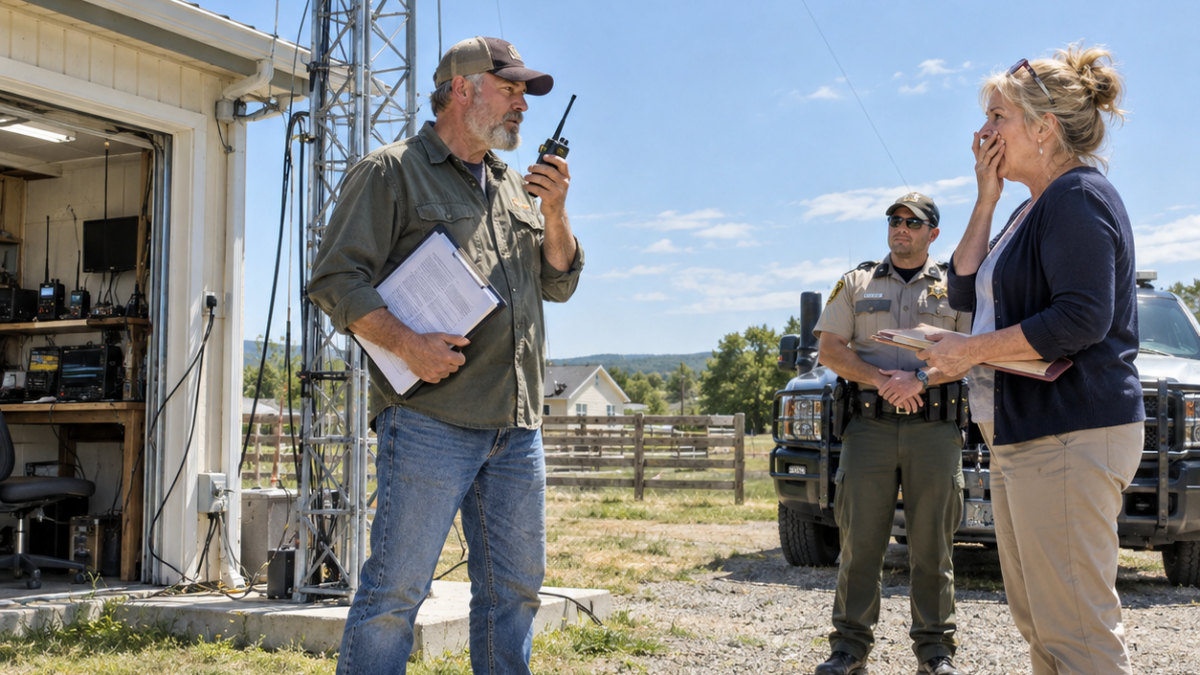
PART 2
That evening, I turned our half-unpacked home office into something I hadn’t expected to need during retirement.
A war room.
Sarah watched from the doorway as I stacked HOA documents on my grandfather’s old oak desk.
“You really think this is going that far?” she asked.
“I think she already told us how far she’s willing to go.”
Sarah unfolded the violation notice again.
“Five hundred dollars every day is insane.”
“The money is the point.”
“What do you mean?”
“She doesn’t need the fine to be reasonable. She needs it to be painful.”
I opened the binder containing the Harmony Creek covenants.
“If it hurts enough, most people obey before they ever ask whether she has the authority to do it.”
That bothered Sarah more than I wanted it to.
We had bought this house because retirement was supposed to be quieter.
For years, our family life had been measured by assignments, deployments, temporary duty, midnight phone calls, and the strange instability that comes from knowing Dad might be home for dinner or might suddenly be troubleshooting a communications problem hundreds of miles away.
Harmony Creek was supposed to be different.
Ben had jokingly called it my “final duty station.”
Now we had been there less than a month and our HOA president was already threatening our house.
I found the clause Karen had cited.
She had quoted it accurately.
The language was broad, giving the architectural committee sweeping authority over structures installed outside a home.
But I had spent enough of my career around government regulations to know that a rule did not become invincible merely because somebody printed it in a binder.
I began assembling everything relevant to amateur communications installations, federal communications rules, local requirements, my license, engineering documentation for the tower, and records relating to my emergency volunteer work.
By midnight, the desk was covered.
Ben wandered in carrying two mugs of coffee.
“Mom says one of these is decaf.”
“Which one?”
“She wouldn’t tell me.”
I took the larger mug.
He pulled up a chair.
“You’re really going after them.”
“I’m answering them.”
“Looks like going after them.”
“That comes later if they don’t listen.”
He smiled.
I didn’t.
Because I already suspected Karen wouldn’t listen.
The next morning, I wrote my response.
It was polite.
Deliberately polite.
No insults.
No accusations about her personality.
No emotional language.
I acknowledged receiving the notice, identified myself as a licensed amateur-radio operator, described the tower’s function, explained its connection to emergency communications, cited the legal protections my research and consultation supported, and invited the board to discuss any specific safety concern.
Then I included one sentence I knew Karen would hate.
Complete removal of the installation was not an acceptable resolution.
I sent the package by certified mail.
Signature required.
That part mattered.
In the Air Force, I had learned something that seemed almost comically simple until the day you needed it:
If it isn’t documented, someone will eventually pretend it never happened.
Karen received my letter Thursday morning.
She called me Thursday afternoon.
No greeting.
No small talk.
“Mr. Corrigan, I received your package.”
“Good.”
“I see you’ve been busy.”
“I wanted the board to have complete information.”
“What you sent changes nothing.”
Her tone sounded different now.
In my driveway, she had been condescending.
On the phone, she was angry.
“This is a private community,” she continued. “You signed the covenants when you bought your home.”
“I’m aware of that.”
“Then you are aware the architectural committee must approve structures before installation.”
“I’ve explained why this situation involves additional legal considerations.”
“No, you copied things from the internet.”
“I provided the actual authorities.”
“Our attorney says they don’t apply.”
That caught my attention.
“Which attorney?”
Silence.
Then she said, “You do not need to know that.”
“If legal counsel reviewed my letter, I’d be happy to speak with counsel directly.”
“You will not speak to our lawyers.”
I leaned back in my chair.
That answer told me plenty.
“You will speak to me,” she continued. “And I’m telling you the deadline remains Friday at five.”
“So the board is refusing to reconsider the removal demand?”
“We are enforcing the rules.”
“And the $500 daily fine?”
“Begins at 5:01.”
I reached for a pen.
“What happens after that?”
She paused just long enough to make sure I understood the next words were intentional.
“We can eventually place a lien against your property.”
There it was again.
My house.
Our retirement.
The place Sarah had already begun turning into the first permanent home we had expected to keep for the rest of our lives.
“You were provided written notice that I dispute the validity of this action,” I said.
“You can dispute whatever you like.”
“If the board attempts to cloud my title through an improper lien, I’ll contest it immediately.”
“You’re very confident for someone who moved here three weeks ago.”
“This isn’t about how long I’ve lived here.”
“You have no idea how this community works.”
“I’m beginning to.”
Her voice dropped.
“Then understand this. People who fight the association usually regret it.”
I stopped writing.
“What does that mean?”
“You’ll find out.”
The call ended.
For several seconds, I sat there holding the phone.
Then I wrote down exactly what she had said.
Time.
Date.
Number.
Every phrase I could remember.
People who fight the association usually regret it.
Sarah found me doing that.
“What happened?”
I told her.
She sat on the edge of the desk.
“Jack, maybe we should lower the tower temporarily.”
I looked at her.
“Just until this gets sorted out,” she said quickly. “I’m not saying she’s right.”
“I know.”
“We finally bought this place. I don’t want our retirement turning into lawsuits.”
Neither did I.
That was what made the decision difficult.
Standing up to somebody sounds noble when nothing meaningful is at risk.
It feels different when your wife is sitting beside you worried that a stranger with a clipboard might drag your home into litigation.
I reached for her hand.
“If I thought lowering it would end this, I’d consider it.”
“But you don’t.”
“No.”
“Why?”
“Because she never asked me to make it safer. She never asked me to reduce the height. She never asked whether there was another location.”
I tapped the violation notice.
“She wants obedience.”
Sarah stared at the paper.
“And if we give it?”
“Next time it’ll be something else.”
Friday arrived.
At 4:45 p.m., I walked outside.
The tower stood exactly where it had stood all week.
At 4:52, Karen’s golf cart appeared at the far end of the street.
She drove slowly past our property.
She did not stop.
She did not need to.
At 5:01, I looked at my watch.
Nothing happened.
No thunder.
No sirens.
No bolt of lightning from the HOA gods.
I almost laughed.
Then I imagined someone in an office entering a number beside my name.
$500.
Saturday.
$1,000.
Sunday.
$1,500.
Monday morning, the certified letter arrived.
NOTICE OF ACCRUED FINES AND INTENT TO LIEN.
The amount due was exactly $1,500.
Karen Miller had signed it.
So had Vice President Gerald Slate and Treasurer Beatrice Little.
The letter gave me ten business days to remove the tower and pay the fines.
If I refused, it warned, the association would begin lien proceedings and add legal costs.
I read it twice.
Then I handed it to Sarah.
She turned pale.
“They actually did it.”
“They threatened to do it.”
“Is there a difference?”
“For now.”
I added the letter to my binder.
Then I called someone I hadn’t spoken to in years.
“Dave?”
A pause.
Then a voice laughed.
“Jack Corrigan? I heard you retired. Already bored?”
“Not anymore.”
“What happened?”
“I bought a house with an HOA.”
“Oh, God.”
“They’re coming after my antenna tower.”
The laughter stopped.
“How hard?”
“Five hundred a day and threat of lien.”
“You document everything?”
“Of course.”
“That’s why I still like you.”
I told him the rest.
When I finished, he said, “There’s another ham in your neighborhood. Retired Marine. Marcus Thorne. I know him through regional emergency nets.”
“Think he’d talk to me?”
“He’ll probably feed you first.”
Marcus opened his door before I finished knocking.
“You’re Corrigan.”
“I am.”
“Dave said you’re fighting the dragon.”
He stepped aside.
“Come in.”
His living room told me exactly who he was.
No staged military memorabilia.
No need to advertise.
A shadow box on one wall.
A folded flag.
A Marine Corps photograph.
And in one corner, a compact radio station arranged with the clean efficiency of somebody who still believed cables should be routed correctly even if nobody else would ever see them.
“She went after my flagpole,” Marcus said after I explained my problem.
“Seriously?”
“Called it an unauthorized structural modification.”
“What happened?”
“I mailed her federal law and told her, in more polite language than I wanted to use, to find another hobby.”
“She backed off?”
“On the flagpole.”
He handed me iced tea.
“Not on me.”
“What does that mean?”
“I get inspected.”
“For what?”
“Everything.”
He began counting on his fingers.
“Trash cans. Lawn height. Driveway edge. Porch furniture. She once sent me a warning because my garage door stayed open while I changed my oil.”
“How long?”
“Forty-three minutes.”
I thought he was joking.
He wasn’t.
“Karen doesn’t forget resistance,” he said.
Then he looked toward my binder.
“But she may have chosen the wrong guy this time.”
Marcus told me about Gerald and Beatrice.
Gerald Slate was a retired insurance salesman who loved sitting beside Karen at HOA meetings and echoing whatever she said.
Beatrice Little was different.
Widowed.
Quiet.
Conflict-averse.
Marcus believed Karen had recruited her because she rarely challenged anything.
“That’s the board?”
“Mostly.”
“Three people?”
“Three people can do a lot of damage when everybody else is too tired to fight them.”
He gave me another name.
Sarah Beth Cummings.
“Rose lady,” Marcus said.
“What does that mean?”
“You’ll know when you see the yard.”
I did.
Her property looked like someone had spilled every color in nature across a suburban lot.
Red roses climbed trellises.
Pink blossoms framed the walkway.
Yellow flowers exploded along the side fence.
It was alive in a neighborhood where every other yard seemed afraid of offending a ruler.
Mrs. Cummings was kneeling beside a bed when I approached.
“You’re the tower man.”
I stopped.
“News travels.”
“Karen travels.”
She clipped a dead bloom.
“She talks about you like you installed a missile silo.”
I laughed.
Mrs. Cummings didn’t.
“She measured my roses.”
I thought I had misheard.
“She did what?”
“Brought a tape measure.”
She stood slowly.
“Apparently certain shrubs may not exceed an approved height near property boundaries. Then she decided my heirloom varieties were ‘aggressive vegetation.’”
I looked around.
“This garden is incredible.”
“My husband planted the first rose with me thirty-seven years ago.”
Her voice changed.
“He died six years ago.”
She touched the stem beside her.
“Some of these plants are older than half the people telling me what I’m allowed to grow.”
That hit me harder than the story about Marcus’s flagpole.
Because suddenly Karen’s behavior wasn’t ridiculous.
It was cruel.
“What happened?” I asked.
“Letters. Warnings. Threatened fines.”
“Did you fight?”
Mrs. Cummings smiled.
“You’re standing in the roses, aren’t you?”
I smiled back.
Then she became serious.
“But I’m tired, Mr. Corrigan.”
“Jack.”
“Jack. That’s what she counts on.”
She wiped dirt from her gloves.
“She doesn’t need to defeat everybody. She only needs to exhaust them.”
That sentence stayed with me.
Over the next several days, I talked to more neighbors.
Not as an organizer.
Not yet.
I listened.
The Garcias had been fined because a welcome mat with a cartoon dog was supposedly inconsistent with community appearance standards.
Another family received repeated warnings about children’s chalk drawings.
One man repainted his door three times because the approved beige apparently had invisible theological divisions only Karen understood.
A widow had been ordered to remove stones from a memorial garden she had built after her husband died.
Everyone told the stories the same way.
First with embarrassment.
Then anger.
Then a glance over the shoulder.
That glance bothered me the most.
These were adults living in homes they owned.
Yet many behaved as though the principal might catch them misbehaving.
By the time my formal HOA hearing notice arrived, I understood something.
My radio tower was not the problem.
It was simply the latest battlefield.
The hearing was scheduled for Wednesday evening at the clubhouse.
The stated purpose was to confirm my violations and authorize additional enforcement, including lien action.
I called an attorney.
Not because I suddenly doubted myself.
Because confidence without competent review is just ego.
His office was forty minutes away.
He specialized in property disputes and communications matters.
I brought the binder.
He opened it.
Then another section.
Then another.
About fifteen minutes into our meeting, he looked at me over his glasses.
“You military?”
“Retired Air Force.”
“I can tell.”
“Why?”
“Civilians rarely tab exhibits like this unless somebody is paying them by the hour.”
For the first time in days, I laughed.
We went through the case.
The HOA documents.
My correspondence.
Their fine notice.
Their lien threat.
The tower specifications.
My license.
My emergency communications role.
He warned me that communications law, private covenants, state property law, and association enforcement could intersect in complicated ways.
But he also said something that mattered more immediately.
“They are being reckless.”
“How reckless?”
“They received a detailed legal objection and instead of responding substantively, they escalated to financial threats.”
He tapped Karen’s certified letter.
“Courts dislike people who behave as if process is optional.”
“So what do we do?”
“We let them create the record.”
He drafted a cease-and-desist letter.
Then he prepared a civil complaint we could file if necessary against the association and, depending on what further evidence developed, potentially against board members individually.
I stared at the names printed across the first page.
Karen Miller.
Gerald Slate.
Beatrice Little.
“This will scare them.”
“It should cause them to seek competent legal advice.”
“That’s lawyer language for scare them.”
He almost smiled.
“Do not serve this before the hearing.”
“Why?”
“Because right now they can claim misunderstanding. Let them hear your objection again. Let them vote.”
“And if they authorize the lien?”
He slid three envelopes toward me.
“Then you hand them these.”
Wednesday evening, Marcus came with me.
Sarah wanted to attend.
I asked her not to.
She hated that.
“So you can go face three people threatening our house, but I’m supposed to sit here?”
“I’m not protecting you from them.”
“Sounds like it.”
“I’m protecting my ability to concentrate.”
She folded her arms.
“That’s worse.”
Then her expression softened.
“Come home with the house still ours.”
“That’s the plan.”
The clubhouse smelled like artificial lemon.
Karen sat at the center of a long folding table.
Gerald sat to her right.
Beatrice sat to her left.
No other residents were there.
Just Marcus and me.
“Mr. Corrigan,” Karen said, “thank you for attending.”
She made it sound as though I had been invited to my own execution.
I set my binder down.
Gerald looked at it.
Karen pretended not to.
She began reading the violation.
When she finished, I said, “Before the board takes action, I want to place my formal objection into the record.”
“That won’t be necessary.”
“It is necessary to me.”
“We already received your materials.”
“Then this should be easy.”
Her jaw tightened.
“I said it will not be necessary.”
I placed my phone on the table.
I had confirmed recording requirements beforehand.
“So the board is refusing to hear the homeowner’s response before voting?”
Gerald leaned forward.
“You’ve responded plenty.”
“I’m asking a simple question.”
Karen slapped her palm on the table.
“We are not here to debate federal regulations.”
Beatrice flinched.
I looked at her.
She avoided my eyes.
Karen continued.
“The question is whether you obtained architectural approval.”
“My position is that the board cannot require removal under these circumstances, and I’m asking that my complete legal objection be incorporated into the minutes.”
“No.”
“Noted.”
Gerald smirked.
“You think that binder makes you a lawyer?”
“No.”
“Then maybe you should stop acting like one.”
“I have one.”
The smirk faded slightly.
Karen recovered.
“All in favor of confirming the violation, maintaining the fines, and authorizing legal counsel to proceed with collection and lien remedies?”
Gerald immediately said, “Aye.”
Beatrice hesitated.
Karen looked at her.
That moment told me everything I needed to know about their board.
Beatrice whispered, “Aye.”
Karen smiled.
“Aye.”
She looked directly at me.
“Motion carries unanimously.”
I felt strangely calm.
“Anything else?”
Karen gathered her papers.
“Our attorney will proceed.”
“Good.”
Her hands stopped.
“Excuse me?”
I opened my binder and removed the three envelopes.
“Karen Miller.”
I slid one across the table.
“You’ve been served with a formal cease-and-desist demand and notice of anticipated litigation.”
Her expression changed.
“Gerald Slate.”
Another envelope.
“Same.”
His face went blank.
“Beatrice Little.”
The third envelope moved across the table.
Her hands began trembling before she even touched it.
Karen looked inside hers.
“What is this garbage?”
“A draft civil complaint prepared by my attorney.”
Gerald started reading faster.
I continued.
“It documents the warnings you received, your refusal to consider them, the fines, the lien threat, the telephone statements made to me, and tonight’s vote.”
Karen’s eyes snapped toward my phone.
“Are you recording us?”
“For documentation.”
“You can’t do that.”
“My attorney and I addressed that question before I came.”
She stared at me.
I stood.
Marcus stood beside me.
“You came here expecting me to leave frightened,” I said. “Instead, you just gave my attorney the clearest record we’ve had so far.”
“This board has immunity.”
“Then your attorney can explain that defense to mine.”
“You’re threatening us.”
“No.”
I put my binder under my arm.
“I’m responding to your threat against my home.”
Beatrice finally looked at me.
There was real fear in her face.
For a second, I felt sorry for her.
Then I remembered she had just voted to put a lien on my property.
Karen tried one last time.
“You think because you wore a uniform you can come into this community and intimidate people?”
That stopped me.
I turned around.
“My service has nothing to do with whether you’re right.”
“You keep mentioning the Air Force.”
“Because communications was my profession.”
“You think that makes you special.”
“No.”
I pointed toward the envelopes.
“That’s why I hired someone whose profession is the law.”
Marcus coughed to hide a laugh.
Karen’s face burned.
I walked out.
For forty-eight hours, Harmony Creek became unusually quiet.
No golf cart.
No new letters.
No phone calls.
Friday passed.
Saturday morning, Marcus sat at our kitchen table.
“They’re scared.”
“You don’t know that.”
“I haven’t seen Karen patrol in two days.”
“Maybe the golf cart broke.”
“Then there is justice.”
Sarah poured coffee.
“I don’t want them scared,” she said. “I want them to stop.”
Marcus nodded.
“They won’t stop until everybody else stops being scared of them.”
He looked at me.
“That’s the part we haven’t fixed.”
He was right.
Even if the board withdrew my fines tomorrow, nothing would prevent another homeowner from becoming the next target.
Mrs. Cummings had said the same thing differently.
Karen survived by exhausting people individually.
So we decided to let people discover they weren’t individual anymore.
Mrs. Cummings offered her backyard.
We avoided making the invitation sound political.
No accusations.
No recall language.
No dramatic headline.
Just neighbors, lemonade, cookies, and conversation.
Ben helped deliver invitations door to door.
Saturday afternoon, eleven people came.
Then eighteen.
Then twenty-seven.
By three o’clock, nearly thirty neighbors were standing among the roses.
At first nobody mentioned Karen.
People discussed schools.
Property taxes.
A broken sprinkler.
Someone complained about the heat.
Mrs. Cummings eventually tapped a spoon against her glass.
“I did not invite everyone here to discuss my lemonade.”
People laughed nervously.
She looked around.
“I have lived in Harmony Creek for forty years.”
The laughter disappeared.
“I remember when people borrowed ladders from each other. I remember when neighbors watched your house because they cared, not because they were measuring your grass.”
A few heads nodded.
She continued.
“I’m tired of being afraid of a clipboard.”
Silence.
Then Mr. Garcia spoke.
“We got fined for a welcome mat.”
Someone chuckled.
He didn’t.
“It had a cartoon dog on it.”
The chuckling stopped.
A woman raised her hand.
“They made me remove my husband’s memorial stones.”
Mrs. Cummings looked toward her.
Another man spoke.
“Three notices over my basketball hoop.”
“Door color,” somebody said.
“Trash cans.”
“Christmas lights.”
“Satellite dish.”
“Fence stain.”
“Planter boxes.”
“Chalk.”
The stories began overlapping.
People who had entered the garden whispering were suddenly comparing letters.
One woman had brought an entire folder.
Another man went home and returned with photographs.
I watched the most important thing happen without anybody announcing it.
Embarrassment became recognition.
Recognition became anger.
And anger became courage.
Then Mrs. Cummings nodded toward me.
“Jack.”
I stood.
Most of them already knew who I was.
“The tower guy,” someone said.
“That’s me.”
A few people laughed.
I held up my binder.
“The board has ordered me to remove my radio tower. They have fined me. They have threatened a lien.”
I paused.
“But I want everyone here to understand something.”
I looked around that garden.
“My tower is not why we’re standing here.”
I gestured toward Mr. Garcia.
“His welcome mat is not why.”
I looked at the widow.
“Her memorial garden is not why.”
Then toward Mrs. Cummings.
“Those roses are not why.”
People became completely quiet.
“The problem is a board that has stopped asking whether a rule serves the community and started using rules to make the community serve the board.”
That landed.
I explained what had happened at my hearing.
I did not show them the recording.
My attorney had advised me to preserve it.
But I showed them the fine notices.
The lien threat.
The legal objection.
Then I told them something several had not considered.
“If this becomes prolonged litigation, HOA money pays HOA lawyers.”
An accountant named Daniel Reeves stood near the back.
“Our money?”
“Yes.”
“Our dues?”
“Yes.”
He frowned.
“What about directors-and-officers coverage?”
“Coverage questions depend on the circumstances, but my attorney has already raised issues concerning intentional conduct after notice.”
Daniel’s face hardened.
“So we could pay for them to fight a lawsuit they created by refusing to listen.”
“That is one possibility.”
The mood changed again.
People can tolerate bullies longer than they tolerate seeing their own money used to finance the bullying.
Mrs. Cummings had already read the bylaws.
She lifted a clipboard.
Unlike Karen’s clipboard, hers did not threaten anybody.
It contained a petition.
“The covenants allow homeowners to call a special meeting if enough members request one.”
A voice asked, “How many?”
“Twenty-five percent.”
Marcus stepped forward.
“We’re not asking anyone to sign tonight because they’re angry.”
He placed the petition on a table.
“Read it. Think about it. Ask questions. Then decide.”
Mr. Garcia walked to the table first.
He signed.
His wife signed next.
Then the widow with the memorial garden.
Then another homeowner.
Then another.
By sunset, we had more signatures than I expected.
Within forty-eight hours, we had over forty percent of the neighborhood.
The petition went to the management company.
A special recall meeting became unavoidable.
Karen responded exactly as Marcus predicted.
She became louder.
A letter appeared in homeowners’ mailboxes warning about “outside agitators,” misinformation, legal threats against the association, and attempts to destabilize community governance.
She did not mention my name.
She didn’t have to.
Everybody knew.
When I read it, I expected to be angry.
Instead, I laughed.
Sarah looked up.
“What?”
“She called me an outside agitator.”
“You do technically come from outside.”
“I bought property.”
“Very sneaky infiltration.”
Ben leaned over the kitchen island.
“Dad, you should get a shirt made.”
I pointed at him.
“Do not encourage your mother.”
The humor helped.
Because underneath it, the pressure was real.
My attorney was communicating with association counsel.
The fines remained.
The lien threat had not formally disappeared.
The recall process was accelerating.
And my emergency communications responsibilities had not stopped simply because neighborhood politics had become ridiculous.
That week, I received an email confirming our upcoming Simulated Emergency Test.
ARES and RACES volunteers across three counties would be participating.
The scenario involved a severe storm system causing widespread communications failures.
My station had been assigned a major role.
Net control.
That meant if the exercise were real, messages from shelters, hospitals, emergency management, public-safety agencies, and field operators could be routed through stations like mine.
My tower wasn’t decorative.
It wasn’t a toy.
It was a tool designed to reach beyond local infrastructure when local infrastructure failed.
I called Tom Henderson at the Tri-County Office of Emergency Management.
Tom had spent decades in fire service before moving into emergency management.
He had the voice of someone who had given instructions while buildings were burning and therefore saw no reason to become excited about lesser problems.
“Corrigan.”
“Tom.”
“Your HOA still trying to invade Poland?”
“Feels like it.”
I explained the latest developments.
He became quiet.
“They’re threatening a lien?”
“Yes.”
“Over the station we’re assigning net control to Saturday?”
“Correct.”
Another pause.
Then he said, “Send me everything.”
I emailed him the relevant documents.
Twenty minutes later, he called again.
“We’re modifying the exercise.”
“How?”
“Mobile command will stage at your location.”
I sat straighter.
“That necessary?”
“For the drill? Absolutely.”
His voice remained perfectly dry.
“For anything else it might accomplish? Pure coincidence.”
“Tom.”
“Jack.”
I could hear him smiling.
“Sheriff’s office already has personnel participating in the exercise. We’ll coordinate.”
I looked toward the window.
My tower rose above the yard.
“What exactly are you planning?”
“Emergency preparedness.”
“That sounded suspiciously like something else.”
“Then your radio must have interference.”
Saturday morning began before sunrise.
By eight, two ARES volunteers were helping me check equipment.
A portable generator sat ready beside the garage.
Backup power cables were secured.
Radios were tested.
Message forms were stacked beside the operating position.
At nine, we began checking into the regional net.
At 9:47, I heard Ben from outside.
“Dad.”
Something in his voice made me remove my headset.
“What?”
He pointed down the street.
Pink tracksuit.
Golf cart.
Karen.
She was parked beneath an oak tree pretending not to watch us.
Marcus, who was helping with the exercise, looked through the garage.
“She’s subtle.”
“Like a marching band in a library.”
We went back to work.
At 10:03, the exercise officially began.
The first simulated reports came in.
Storm damage.
Cell service disrupted.
Shelter request.
Hospital traffic.
All fictional.
All treated professionally.
That was the point.
You train seriously when lives are not at risk so you are ready when they are.
At 10:11, I heard a siren chirp.
Not part of the drill.
A sheriff’s cruiser turned onto the street.
Its lights were flashing.
Everyone looked up.
The cruiser stopped in front of my driveway.
A deputy stepped out.
Young.
Alert.
His hand rested near his belt, not threateningly, but cautiously.
“Jack Corrigan?”
“That’s me.”
“We received a report concerning unauthorized radio transmissions and suspicious activity.”
Before I could respond, I heard the electric whine of Karen’s golf cart.
Of course.
She came racing toward us like a general arriving after the battle had already been won.
“Officer!”
The deputy turned.
“I’m Karen Miller. HOA president. I made the call.”
My stomach dropped.
She had called 911.
Not the management company.
Not her attorney.
Not the FCC.
911.
Karen pointed toward my garage.
“He has been operating this unauthorized facility despite association orders. There are strangers, generators, radio equipment. We don’t know what he’s transmitting.”
The deputy looked at me.
I kept my hands visible.
“We’re conducting a scheduled emergency communications exercise.”
Karen laughed sharply.
“Of course he says that.”
Then everything changed.
A large white vehicle rounded the corner.
TRI-COUNTY OFFICE OF EMERGENCY MANAGEMENT.
Official seal.
Mobile command unit.
The truck slowed.
Turned.
And stopped directly beside the sheriff’s cruiser.
For the first time since I met her, Karen had absolutely nothing to say.
Tom Henderson stepped from the passenger side.
He looked at the deputy.
Then Karen.
Then me.
“Morning, Jack.”
“Morning, Tom.”
Karen stared between us.
Tom approached.
“Deputy, problem?”
The deputy explained the call.
Tom listened without interrupting.
Then he turned toward Karen.
“Ma’am, you reported an illegal transmission operation?”
Her confidence returned slightly.
“Yes. This man has erected an unauthorized tower in violation of our community rules, and now he’s running some sort of operation out of his garage.”
Tom looked at my tower.
Then at the ARES banner.
Then at the emergency-management truck behind him.
His expression remained so neutral it became devastating.
“This is Master Sergeant Jack Corrigan, United States Air Force retired.”
Karen opened her mouth.
Tom continued.
“He is also one of the amateur-radio operators supporting our emergency communications capability across this region.”
He pointed toward my station.
“This location is participating in today’s scheduled tri-county emergency exercise.”
Nobody moved.
Tom’s voice grew firmer.
“We train for failures in commercial power, cellular systems, public-safety infrastructure, internet service, and other communications resources.”
Several neighbors had begun coming outside.
Doors opened.
People stood on sidewalks.
Karen noticed them.
Tom did too.
He did not raise his voice.
He didn’t need to.
“When regular communications fail, amateur-radio volunteers can provide a redundant pathway for shelters, emergency managers, relief organizations, and other agencies.”
He gestured toward the tower.
“This station is part of that capability.”
Karen looked at me.
Something shifted in her face.
Not apology.
Calculation.
“That doesn’t change HOA rules.”
Tom nodded once.
“HOA rules are outside my lane.”
For half a second, she looked relieved.
Then he continued.
“Emergency communications are not.”
The deputy looked toward Karen.
“You called 911 because of the tower?”
“I called because he’s conducting suspicious transmissions.”
“Did you know there was an emergency-management exercise today?”
“No.”
“Did you ask him?”
“He has been ordered to stop.”
“That wasn’t my question.”
Her face reddened.
The deputy’s tone changed.
“Did you observe any crime before calling?”
“He is violating our covenants.”
“That is not a 911 emergency.”
“I told dispatch there were unknown people and equipment.”
Tom folded his arms.
“They’re volunteers.”
Karen pointed toward me.
“He’s deliberately doing this to intimidate the HOA.”
I finally spoke.
“I didn’t schedule a tri-county drill to upset you, Karen.”
She glared at me.
“This tower wouldn’t exist if you obeyed the rules.”
“And if a storm knocks down the cell network?”
“Don’t be dramatic.”
That sentence changed the mood.
Mrs. Cummings had walked down the sidewalk.
Marcus stood beside my garage.
The Garcias were watching from their lawn.
More neighbors had gathered.
Tom Henderson stared at Karen.
“I spent thirty-two years in fire service.”
His voice remained calm.
“I’ve watched people stand in parking lots holding phones that couldn’t connect because the system they assumed would always exist suddenly didn’t.”
Karen said nothing.
“So no, ma’am. Redundant emergency communications are not dramatic.”
The deputy gestured toward his cruiser.
“I need your identification.”
Karen blinked.
“Mine?”
“You made the call.”
“I’m HOA president.”
“I understood you the first time.”
That line traveled through the crowd like electricity.
Karen’s face went white.
The deputy began taking her statement.
The drill continued.
That was almost the best part.
While Karen stood beside a sheriff’s cruiser explaining why she had used emergency dispatch to report a scheduled emergency communications exercise, I put my headset back on.
“Tri-County Net, this is Whiskey Five Juliet Juliet Charlie, net control returning.”
A station answered through static.
“W5JJC, loud and clear.”
Loud and clear.
I looked through the garage toward Karen.
For the first time since this began, I didn’t feel angry.
I felt something better.
Certain.
The truth had finally become visible.
The incident spread through Harmony Creek faster than anything I could have invented.
By that evening, people were calling it “the 911 tower emergency.”
By Sunday, someone had placed a tiny toy radio tower beside their welcome mat.
By Monday, there were three.
I told Ben not to encourage it.
He denied involvement with the expression of a young man who was absolutely involved.
No criminal charges were ultimately pursued against Karen over the call.
Tom preferred to keep the focus on preparedness rather than punishment.
The deputy’s report, however, existed.
So did the witness statements.
So did the growing perception among residents that Karen had become so consumed by winning that she could no longer distinguish a neighborhood dispute from an actual emergency.
Then came the letter that broke the board.
It did not arrive with sirens.
It arrived in an envelope.
My attorney called first.
“Check your email.”
I opened the attachment.
It concerned the communications complaint and the HOA’s antenna restrictions.
The language was dense.
Formal.
Bureaucratic.
But the significance was simple.
The association was now facing serious regulatory scrutiny over how it had handled protected communications equipment and the restrictions it had attempted to enforce.
I read the key paragraphs twice.
Then a third time.
Sarah stood beside me.
“Is that good?”
“For us?”
“Yes.”
“For Karen?”
“No.”
“How not good?”
I looked at her.
“Very not good.”
The association’s legal position was collapsing.
Worse for the board, the record showed they had escalated after receiving repeated written objections.
Their own correspondence became evidence against them.
Their own hearing minutes became evidence.
Their own vote became evidence.
Their own threats became evidence.
The thing Karen trusted most—the paper trail of her authority—had become the paper trail of her recklessness.
Gerald Slate resigned first.
His letter was short.
Personal reasons.
Effective immediately.
Beatrice resigned the same evening.
Her letter was longer.
She apologized for allowing herself to be pressured into decisions she did not fully understand.
I believed her.
That did not erase what she had done.
But I believed her.
Karen was now alone.
For twelve years, she had sat at the center of Harmony Creek like the neighborhood revolved around her.
Now the vice president was gone.
The treasurer was gone.
The residents had submitted a valid recall petition.
The association’s legal exposure was growing.
My fines had become indefensible.
And the community she had controlled through isolation was finally talking to itself.
The recall meeting was held the following Wednesday.
The same clubhouse.
The same long table.
But everything else was different.
The room was packed.
People stood against the walls.
Extra folding chairs filled the aisles.
Neighbors who once whispered about violation notices now carried copies openly.
Mrs. Cummings stood at the front.
Someone had nominated her to chair the special meeting.
She wore a blue dress patterned with small roses.
I suspected that was intentional.
Karen entered at exactly seven.
No pink tracksuit.
Dark business suit.
Clipboard.
Still the clipboard.
The room became quiet.
She walked to the front.
Nobody applauded.
Nobody booed.
That silence was worse.
She sat alone.
Mrs. Cummings called the meeting to order.
Karen immediately raised a procedural objection.
Then another.
She challenged the petition.
The signatures.
The notice period.
The chair.
The agenda.
The authority of the management company.
For twenty minutes, she tried to construct a wall from technicalities.
A year earlier it probably would have worked.
People would have become confused.
Then nervous.
Then silent.
Not anymore.
Daniel, the accountant, calmly addressed the financial questions.
Marcus addressed the board vacancies.
Mrs. Cummings had the bylaws open in front of her.
When Karen interrupted for the fourth time, Mrs. Cummings removed her glasses.
“Karen.”
The room went still.
“You measured my roses.”
Somebody near the back coughed.
Karen stared at her.
Mrs. Cummings continued.
“You threatened a young family over a welcome mat.”
Karen’s lips tightened.
“You ordered a widow to dismantle a memorial garden.”
“That is not relevant to procedure.”
“It is relevant to why this room is full.”
Applause erupted.
Mrs. Cummings lifted one hand.
The room quieted.
“We are going to follow the rules tonight.”
She looked directly at Karen.
“All of them.”
That line received even louder applause.
The vote proceeded.
One by one, ballots went into the box.
I stood in the back beside Sarah.
Ben was on my other side.
“You nervous?” he whispered.
“A little.”
“Why? She can’t win.”
I looked at him.
“Never assume an outcome before the count.”
“That another Air Force thing?”
“That’s a life thing.”
The ballots were counted twice.
Mrs. Cummings received the paper with the result.
For the first time all night, her hands trembled.
She looked over the crowd.
“Ninety-eight votes in favor of recall.”
Nobody breathed.
“Two opposed.”
The room exploded.
People applauded.
Some stood.
Mr. Garcia hugged his wife.
The widow with the memorial garden began crying.
Marcus closed his eyes for a second.
Sarah squeezed my arm.
I watched Karen.
She did not move.
Twelve years.
Whatever else anyone thought about her, twelve years was a long time to build an identity around being the person in charge.
Now that identity had disappeared in one sentence.
Ninety-eight to two.
Mrs. Cummings waited until the room settled.
“The recall passes.”
Karen finally stood.
She picked up her purse.
Then the clipboard.
For a moment, I thought she was going to make a speech.
Part of me expected one last threat.
Instead, she looked across the room.
At the people she had fined.
Warned.
Measured.
Lectured.
Intimidated.
Nobody said anything.
She walked toward the door.
When she passed me, she stopped.
Sarah stiffened beside me.
Karen looked at the tower paperwork under my arm.
Then at me.
“You destroyed this community.”
Her voice was almost a whisper.
I could have humiliated her.
I could have reminded her about the 911 call.
The fines.
The lien.
The hearing.
The recall vote.
I could have given her the speech I had imagined a dozen times while lying awake at night.
Instead I said, “No, Karen.”
She waited.
“You finally made the community talk to each other.”
Her face tightened.
Then she walked out.
That was the last conversation we ever had.
The meeting continued.
Marcus Thorne was elected interim president.
Mrs. Cummings became vice president.
Daniel Reeves accepted the treasurer position only after making everyone promise he would never have to measure a shrub.
The room laughed harder than the joke deserved.
People needed to laugh.
They had spent too long being tense.
Then Marcus took his first official action.
He looked toward me.
“Jack Corrigan.”
I raised a hand.
“Unfortunately present.”
More laughter.
Marcus smiled.
“I move that all outstanding fines associated with Mr. Corrigan’s radio installation be rescinded immediately.”
“Second,” Mrs. Cummings said.
The vote was unanimous.
“Next,” Marcus continued, “I move that all lien proceedings or collection activity related to those fines terminate immediately.”
Unanimous.
My shoulders dropped.
I had not realized how tightly I had been carrying them.
Sarah leaned her head against me.
That was the moment I understood the fight had affected her more than she had admitted.
The tower had been mine.
The fear had belonged to both of us.
Marcus wasn’t finished.
“I further move that the interim board begin reviewing enforcement actions issued under the former board and establish a process for residents to request reconsideration.”
People began applauding before the motion even reached a vote.
Unanimous again.
The widow with the memorial garden covered her mouth.
Mr. Garcia lifted his little boy into his arms.
Mrs. Cummings looked down for a moment.
Her eyes were wet.
This was the revenge I hadn’t known I wanted.
Not Karen losing money.
Not Karen being embarrassed.
Not some dramatic punishment.
It was every person she had made feel small discovering they were no longer required to feel small.
Over the next month, Harmony Creek changed.
Not physically at first.
Psychologically.
Garage doors stayed open while people worked.
Children drew chalk animals on sidewalks.
A basketball hoop remained beside a driveway overnight and civilization somehow survived.
Bright welcome mats appeared.
One had a cartoon dog wearing sunglasses.
I knew exactly whose house that was.
Mrs. Cummings added another rose trellis.
Marcus told her it exceeded regulations.
She told him where he could put the regulations.
He laughed for five straight minutes.
The new board began a complete covenant review.
Not to eliminate standards.
Most residents still wanted reasonable maintenance rules.
They wanted lawns cared for.
They wanted dangerous structures addressed.
They wanted abandoned vehicles removed.
They wanted the neighborhood to remain pleasant.
What they did not want was government by personal irritation.
Meetings became open.
Agendas were posted.
Homeowners could speak.
Enforcement decisions required documentation.
Appeals became real appeals rather than performances.
And communications equipment received careful review consistent with applicable law instead of blanket hostility.
My tower remained.
Something strange happened after that.
People stopped calling it ugly.
Maybe it still was.
Beauty is subjective.
But meaning changes what people see.
One evening, Mr. Garcia found me checking the mailbox.
His son was riding a small bicycle in circles around him.
He pointed toward the tower.
“You know something?”
“What?”
“I kind of like that thing now.”
“You need better taste.”
He laughed.
“I’m serious.”
He looked up.
“When I first saw it, I thought, wow, that’s a big antenna.”
“That is generally what people think.”
“Now I see it and remember the day the emergency truck pulled up.”
His expression became more serious.
“And I remember we didn’t have to be scared.”
He walked away.
I stood there longer than necessary.
A week after the recall, a FOR SALE sign appeared in Karen’s yard.
She moved soon afterward.
There were rumors about whether she lost money on the house.
I never checked.
By then I had stopped caring.
Beatrice sent me a letter.
A real one.
Handwritten.
She apologized.
She said Karen had convinced her that opposing enforcement would destroy property values and expose the board to lawsuits from other homeowners.
She admitted she knew some of the actions felt wrong but told herself the president understood the rules better than she did.
One sentence stayed with me.
“I thought being afraid of conflict made me a peaceful person, but sometimes it only makes you useful to the person causing the conflict.”
I read that line twice.
Then I wrote back.
I told her I appreciated the apology.
I told her I hoped she would come to a neighborhood meeting someday without sitting behind a board table.
Three weeks later, she did.
Nobody shouted at her.
Nobody humiliated her.
Mrs. Cummings gave her lemonade.
That mattered.
Because if all we had done was change who got to punish whom, then nothing would really have changed.
Autumn came slowly to Texas.
One evening, Ben sat beside me in the radio room.
He would be returning to college soon.
The station lights glowed softly.
Outside, the tower’s small red obstruction light blinked against the darkening sky.
I adjusted the receiver.
Static.
Then a voice.
“Whiskey Five Juliet Juliet Charlie, this is net control. Good signal tonight, Jack.”
I keyed the microphone.
“Net control, W5JJC. Good evening. All quiet at Harmony Creek.”
Ben laughed.
“That might be the biggest lie you’ve ever told on radio.”
“Currently quiet.”
“Better.”
I checked into the net.
When I finished, he remained in the chair beside me.
“You really thought she could take the house?”
The question surprised me.
“At first?”
“Yeah.”
I looked toward the window.
“I knew we had options.”
“That’s not what I asked.”
He had grown up.
Sometimes I still spoke to him like a kid.
He noticed.
“Yes,” I said. “There were moments I was afraid.”
He seemed almost relieved.
“I thought you weren’t.”
“Courage isn’t the absence of fear.”
He groaned.
“Dad.”
“What?”
“That sounds like something printed on a coffee mug.”
“It does.”
We both laughed.
Then I became serious.
“I was afraid your mom would spend our retirement dealing with lawyers. I was afraid a lien would complicate the house. I was afraid I had misunderstood something. I was afraid that even if I won, we’d become the family everybody hated for blowing up the neighborhood.”
“But you kept fighting.”
“I kept checking.”
“Checking what?”
“Whether I was right.”
He frowned.
“There’s a difference?”
“A huge one.”
I turned toward him.
“The dangerous person isn’t always the one who’s wrong.”
He waited.
“It’s the person who stops checking.”
He looked outside at the tower.
“Like Karen.”
“Yes.”
“She thought being president made her right.”
“Eventually.”
“And you?”
“I had lawyers, emergency managers, documents, other operators, neighbors. Every time new information came in, I had to be willing to discover I was wrong.”
“But you weren’t.”
“Not about the thing that mattered.”
“What thing?”
“That nobody should be able to threaten your home simply because they expect fear to end the conversation.”
We sat quietly.
A call sign broke through the radio.
I answered.
Several months later, the tower finally performed the job Karen never believed mattered.
A violent spring storm crossed the region after midnight.
Wind tore branches down.
Power failed across multiple communities.
A cellular site lost backup power.
Another became overloaded.
For most people, communications were inconvenient.
In several places, they became unreliable.
At 1:17 a.m., my emergency radio came alive.
“W5JJC, activate emergency net.”
I was out of bed before the message finished.
Sarah turned on the lamp.
“Real?”
“Real.”
No panic.
That was the advantage of practice.
I pulled on jeans and a sweatshirt.
The generator was ready.
Backup batteries were charged.
Message forms were where they belonged.
At 1:24, I checked into the emergency network.
At 1:31, I was helping route traffic.
Shelter status.
Road conditions.
A request related to medical resources.
Reports from field stations.
Information moving through the static because people had prepared long before anyone needed it.
At 2:03, someone knocked on the radio-room door.
Sarah stood there holding coffee.
Behind her was Marcus.
His hair was wet.
“You need another operator?”
“Always.”
He sat down.
At 2:20, another knock.
Mr. Garcia.
“Power’s out at our place,” he said. “Saw your lights.”
“We’re on generator.”
He looked toward the radios.
“This is real?”
“Yes.”
His expression changed.
“Need anything?”
“Check on Mrs. Cummings.”
“Already did. She has a battery lantern and enough stubbornness to power the county.”
Marcus laughed.
Mr. Garcia turned to leave.
Then he looked through the window at the tower moving slightly in the wind.
“The ugly thing earns its keep.”
“Apparently.”
By dawn, the worst had passed.
Nobody would write headlines about our station.
There was no dramatic rescue in my driveway.
No helicopter landed.
No child was pulled from floodwater because of one magical radio message.
Real emergency communications usually isn’t cinematic.
It is mundane.
A report arriving.
A request being acknowledged.
A message being relayed accurately.
One small failure prevented from becoming a larger failure.
That was enough.
At approximately seven, the emergency net stood down.
I removed my headset.
Marcus stretched.
Sarah brought more coffee.
Then we heard another knock.
Mrs. Cummings stood outside in rubber boots.
She carried a foil-covered tray.
“You people look terrible.”
“Good morning to you too,” Marcus said.
“I brought breakfast.”
She looked at me.
“Tower still standing?”
I glanced outside.
“Still standing.”
“Good.”
She set the tray down.
“Karen would be disappointed.”
We all laughed.
Later that morning, after the power returned, I walked outside.
Broken leaves covered the yard.
Small branches lay across the driveway.
The air smelled washed clean.
The tower stood above everything.
No longer new.
No longer controversial.
Just useful.
Ben called from college after seeing storm reports.
“Everything okay?”
“Fine.”
“Tower survive?”
“Of course.”
“Emergency traffic?”
“Several hours.”
He was quiet.
Then he said, “So she really tried to tear down something people needed.”
I looked toward the antenna.
“She didn’t know what it was.”
“She could’ve asked.”
“That’s the lesson.”
“What?”
“Questions are cheaper than certainty.”
He laughed.
“That one actually belongs on a coffee mug.”
“Maybe I’ll retire again and start a business.”
“You’re terrible at retirement.”
He wasn’t wrong.
The storm became another piece of Harmony Creek history.
At the next HOA meeting, Daniel proposed allocating a small amount for community preparedness education.
Smoke alarms.
Weather radios.
Emergency contacts.
Backup power awareness.
And, after several residents asked, an amateur-radio demonstration.
I stood in the clubhouse where months earlier Karen had refused to let me present my case.
Now nearly fifty neighbors listened as Marcus explained what amateur radio could do when conventional systems failed.
A teenager asked whether radios still mattered with satellites and smartphones.
“Most days?” I said. “You probably won’t think about them.”
“And bad days?”
“Bad days are why backups exist.”
Mrs. Cummings raised her hand.
Everyone looked at her.
“Can the antenna detect whether my roses are above regulation height?”
The room erupted.
I pointed at Marcus.
“Only the HOA president can operate that feature.”
He shook his head.
“I resign.”
More laughter.
That sound was the final victory.
Not the recall.
Not the attorney letters.
Not watching Karen explain herself to a sheriff’s deputy.
Laughter.
People were comfortable enough to joke about the institution that had once frightened them.
The HOA still existed.
Rules still existed.
Meetings still occasionally became tedious.
People disagreed about budgets, fences, landscaping, parking, and whether a particular shade of exterior paint was gray, blue-gray, or gray-blue.
That was normal.
A community without disagreement is usually a community where somebody is afraid to speak.
Harmony Creek finally learned the difference.
Years of military service had taught me to respect legitimate authority.
That experience also taught me something equally important.
Authority is strongest when it accepts accountability.
A commander who cannot be questioned becomes dangerous.
A regulation that cannot be reviewed becomes doctrine.
A system that treats every disagreement as insubordination eventually protects itself instead of the people it exists to serve.
Karen never understood that.
She thought power meant being the person who ended the argument.
The strongest leaders I had known did something different.
They listened long enough to discover whether the argument revealed a problem.
One evening, months after the storm, Sarah and I sat on our back porch.
The sun was setting beyond the ranch land.
My tower cast a narrow shadow across the yard.
“You know,” she said, “I hated that thing for about two weeks.”
I stared at her.
“You never told me that.”
“You were emotionally fragile.”
“I was a retired master sergeant preparing litigation.”
“Exactly.”
I laughed.
She rested her feet on the porch rail.
“I thought we had moved here for peace.”
“So did I.”
“Then you nearly started a revolution.”
“I did not start a revolution.”
She raised an eyebrow.
“Jack.”
“Fine. A small administrative correction.”
“Ninety-eight to two.”
“Very small.”
She smiled.
Then she became quiet.
“Do you regret buying here?”
I looked across the neighboring roofs.
A child rode a bicycle along the sidewalk.
Someone had left a basketball hoop near a driveway.
Mrs. Cummings’ roses were visible two streets away whenever the light hit them.
Marcus’s flag moved slowly above his porch.
Mr. Garcia’s ridiculous cartoon-dog welcome mat was still there.
“No.”
“Even after everything?”
“Especially after everything.”
She looked at me.
“Why?”
“Because now it feels like a neighborhood.”
The red light on the tower blinked.
Once.
Twice.
Steady.
A few minutes later, I went inside and turned on the radio.
Static filled the room.
Then distant voices.
Texas.
Louisiana.
Oklahoma.
People I might never meet.
Stations separated by hundreds of miles connected through invisible signals crossing the darkness.
I keyed the microphone when my turn came.
“Net control, this is Whiskey Five Juliet Juliet Charlie.”
A burst of static.
Then the reply.
“W5JJC, strong and clear.”
I looked through the window.
For years, that was what I had wanted from retirement.
A good station.
A quiet home.
A clear signal.
I got something else too.
I learned that peace is not always what exists before conflict.
Sometimes real peace is what remains after people finally confront something that should never have been allowed to continue.
Karen Miller had ordered me to tear down my tower because she saw aluminum, cables, and disobedience.
She never bothered to see the network behind it.
She never saw the emergency volunteers.
The county agencies.
The backup plans.
The families who might one day need a message delivered when modern systems failed.
More importantly, she never saw the people living behind the doors she spent years policing.
The widow preserving her husband’s memory.
The young parents trying to raise their child.
The retired Marine flying his flag.
The elderly gardener protecting roses planted with the man she loved.
She saw violations.
The rest of us eventually saw neighbors.
That was why she lost.
The tower remained standing long after the fines disappeared.
Long after the lien threat vanished.
Long after the board was recalled.
Long after the FOR SALE sign appeared in Karen’s yard.
And every evening, when that small red light blinked above Harmony Creek, I remembered the afternoon she stood beneath it with her clipboard and told me I had until Friday.
She thought she was giving me a deadline.
Instead, without knowing it, she had started a countdown on her own twelve-year reign.
The radio crackled again.
I adjusted the dial.
Outside, the neighborhood settled into the Texas night.
No golf cart patrol.
No frightened glances through curtains.
No clipboard waiting at the end of somebody’s driveway.
Just porch lights, children being called inside, a dog barking somewhere down the street, and the soft rustle of trees beneath the tower.
I pressed the microphone.
“W5JJC clear.”
Then I leaned back in my chair and listened to the quiet.
For the first time since we moved to Harmony Creek, it truly felt like home.








