PART 2: HOA Ordered Me to Pay $32,000 for Their Sewer—Then a Judge Learned the Pipe Was Buried on My Land
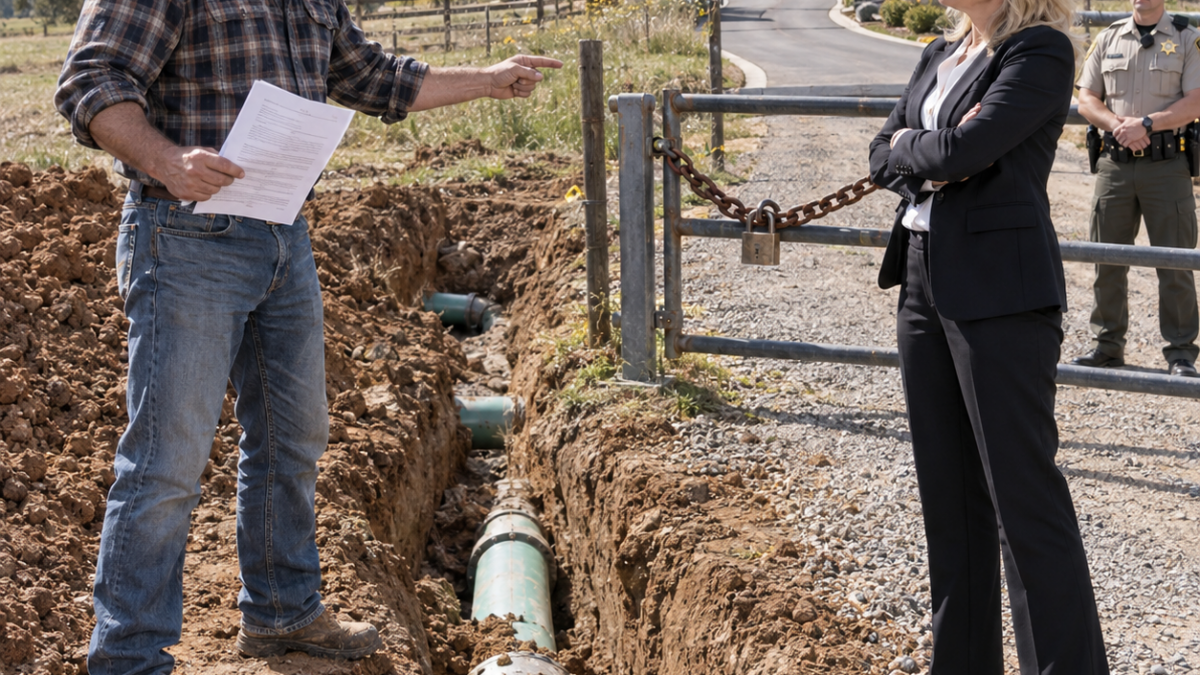
PART 2
I didn’t call Karen.
That was the first smart decision I made after finding the sewer line.
The second was making copies.
Every map.
Every plat.
Every development filing.
Every utility drawing.
Every document connected to my grandfather’s parcel.
The county clerk helping me that morning was a woman named Marge who wore glasses on a chain and a hairstyle that looked like it had survived several presidential administrations.
She watched me feed the last oversized survey sheet into the copier.
“You found something, didn’t you?”
I looked at the black line cutting through the old boundary.
“I think they buried half their neighborhood’s sewer on my land.”
Marge stared at the plan.
Then at me.
“Well.”
“That good or bad?”
“For you?”
She smiled.
“Depends how much you like lawyers.”
I did not like lawyers.
But I liked losing my grandfather’s land even less.
I carried the documents to my truck in a rigid map tube and drove home slowly.
For months, Karen had controlled the fight because every weapon belonged to her world.
Covenants.
Violation notices.
Fines.
Board votes.
Approved vendors.
Architectural committees.
I had been reacting to rules she interpreted, procedures she controlled, and deadlines she invented.
The sewer line changed the battlefield.
Property boundaries were different.
Surveys didn’t care who held the HOA gavel.
An eight-inch sewer main buried beneath private land either had a legal easement or it didn’t.
And according to every record I could find, it didn’t.
Sarah was waiting at the kitchen table when I came in.
She had spent that morning going through our finances because Karen’s latest letter threatened escalating penalties.
There were numbers written across a legal pad.
Mortgage.
Savings.
Retirement.
Property tax.
Attorney estimates.
Everything we might lose if this got ugly enough.
She looked at the map tube.
“What did you find?”
I spread the surveys across the table.
“This is Grandpa’s original boundary.”
She leaned over.
“And this?”
“The sewer.”
I traced the line.
Sarah followed my finger until it crossed the dogleg.
Then she looked at me.
“Is that inside our property?”
“For about six hundred feet.”
“How deep?”
“Plans say around ten feet.”
“And they have permission?”
“I can’t find any.”
She stared at the map.
“So Karen is threatening to take our home because we won’t pay to connect to a pipe they put under our land?”
“That appears to be the situation.”
For several seconds she said nothing.
Then Sarah started laughing.
Not because it was funny.
It was the kind of laughter people make when reality becomes too absurd for any other response.
“Oh, she is going to lose her mind.”
“Not yet.”
Sarah stopped.
“What do you mean?”
“We need to make sure I’m right.”
“You’re an engineer.”
“Engineers are wrong every day.”
“You spent six hours checking it.”
“That only means I can be wrong thoroughly.”
She folded her arms.
“What are you going to do?”
“Find somebody whose job is being right about deeds.”
That somebody was Elizabeth Albright.
I found her through a veterans legal network.
Retired Marine JAG officer.
Thirty years of civilian property litigation.
She had a reputation for taking cases other attorneys called unpleasant.
One online review from an opposing party described her as “a vindictive little shark in expensive shoes.”
That was the review that convinced me to call.
Her office was downtown on the fourth floor of an old brick building.
I arrived carrying three binders and the map tube.
Elizabeth was in her early sixties, maybe five foot four, silver-gray hair cut neatly at her jaw.
She shook my hand once.
Firmly.
“Major Miller.”
“Retired.”
“So am I. Sit.”
No small talk.
I liked her immediately.
I laid everything out.
The property history.
The annexation language.
Karen’s mailbox notice.
The meadow demand.
The septic ultimatum.
The $32,000 approved contractor quote.
The daily fines.
Then the sewer drawings.
Elizabeth stopped me there.
“Go back.”
“To what?”
“The sewer line.”
I overlaid the maps again.
She leaned close.
“Your survey predates the development?”
“1952.”
“Recorded?”
“Yes.”
“And this dogleg appears on the legal description?”
“Yes.”
“The developer’s drawing eliminated it.”
“Apparently.”
“Any easement in your title?”
“No.”
“Utility deed?”
“No.”
“Condemnation?”
“No.”
“License?”
“No.”
“Recorded consent from your grandfather?”
“Nothing.”
She sat back.
For the first time, she smiled.
It wasn’t a friendly smile.
“Major Miller, do you know what my favorite kind of opponent is?”
“No.”
“Confident and wrong.”
I almost laughed.
She picked up Karen’s septic demand.
“This is extraordinary.”
“That bad?”
“For them.”
She turned it toward me.
“They are allegedly occupying your land without permission, and they are using that infrastructure as the basis for ordering you to pay them thirty-two thousand dollars.”
“That was my understanding.”
“And threatening foreclosure if you refuse.”
“Yes.”
She tapped the page.
“This is why arrogant people should never put their threats in writing.”
I asked the question that mattered.
“Can they claim they’ve used the line so long they own an easement?”
“They’ll try.”
“Prescriptive easement?”
“Probably.”
“That worries me.”
“It should worry them more.”
She pulled the old map closer.
“Prescriptive rights have elements they must establish. One problem for them is visibility. A sewer main buried ten feet underground is not exactly a driveway everyone watched them use for fifteen years.”
“So they lose?”
“Never use that sentence before a judge signs something.”
Fair.
“What do we do?”
Elizabeth looked at the maps.
“We notify them.”
“That’s it?”
“No.”
She smiled again.
“We notify them carefully.”
Her cease-and-desist letter went out three days later.
It was six pages long.
No insults.
No threats that sounded emotional.
Just facts.
My legal description.
The recorded survey.
The development drawings.
The conflict between those drawings.
The sewer line’s approximate route.
The absence of a recorded utility easement.
The continuing occupation of my land.
Then the demand.
Whispering Pines had forty-five days to submit a plan to remove and relocate the sewer main.
During those forty-five days, I would temporarily tolerate continued operation so residents weren’t harmed.
That part was my condition.
Elizabeth initially suggested thirty days.
I asked for forty-five.
“Why?”
“Because a hundred families flush into that pipe.”
“You are not actually making them remove it in forty-five days.”
“No.”
“Then why care?”
“Because residents aren’t Karen.”
She studied me.
“That distinction may save you later.”
We sent the letter by certified mail.
Not only to the HOA office.
To every board member individually.
Five signatures came back.
Including Karen Peterson’s.
She knew.
From that moment forward, whatever happened with the sewer line was no longer an old developer mistake nobody understood.
The current HOA board had direct notice.
Then we waited.
Two weeks later, their attorney responded.
Elizabeth forwarded the letter with no comment.
I opened it at the kitchen table.
The tone was exactly what I expected from somebody writing on expensive letterhead.
My claim was “frivolous.”
My survey was “obsolete.”
The sewer infrastructure had operated continuously for years.
The HOA allegedly possessed a prescriptive right.
If I continued making “defamatory accusations,” they reserved the right to seek damages.
And, as if none of that were strange enough, the letter concluded by reminding me that my deadline to pay the $32,000 connection fee remained in effect.
I called Elizabeth.
“They still want the thirty-two grand.”
“I know.”
“And they’re admitting the sewer is there.”
“Read paragraph four.”
I did.
Whispering Pines had maintained and operated the line continuously since construction.
“They admitted operation.”
“Correct.”
“They’re claiming a prescriptive right.”
“Correct.”
“They’re still threatening me.”
“Correct.”
I waited.
Elizabeth said, “They took the bait.”
“You enjoy this too much.”
“Occupational hazard.”
She explained why.
Before the notice, the HOA could argue ignorance.
Maybe the developer made the mistake.
Maybe current board members genuinely believed a valid easement existed.
But after our certified letter, they knew the basis of my ownership claim.
They had copies of the surveys.
They had an opportunity to investigate.
Instead, they refused correction and continued fining me.
That made everything after notice much harder for them to explain.
Elizabeth filed two things.
A quiet-title action asking the court to confirm my ownership free of the HOA’s claimed sewer rights.
And a request for permanent injunctive relief.
In ordinary English:
We asked the judge to establish that the HOA had no legal right to occupy that strip of my land and to order them to stop.
Karen responded by measuring my trash cans.
I wish I were exaggerating.
Three days after the lawsuit was filed, I found a violation notice taped to the door.
TRASH RECEPTACLE IMPROPERLY STORED.
According to the notice, the can had remained visible from the road outside authorized collection hours.
I measured the location.
It sat beside my workshop, forty-three yards from the road.
The next notice concerned Sarah’s vegetable garden.
Unapproved agricultural use.
Then my workshop.
Architectural nonconformity.
Then an oil stain on concrete poured before Whispering Pines existed.
Then my porch flag.
Two inches too large.
Then grass height.
Then a garden hose.
Then “outdoor storage” because a wheelbarrow sat behind the shed for one afternoon.
Sarah arranged the pink slips chronologically across our dining table.
“You know what this looks like?”
“A paper factory?”
“Obsessive.”
She was right.
Elizabeth agreed.
“Document everything.”
So I did.
I installed motion-activated cameras covering my driveway, porch, workshop, and perimeter.
Nothing pointed into anyone else’s windows.
Everything stayed on my land.
Karen’s golf cart appeared constantly.
Monday, 10:14 a.m.
Tuesday, 1:15 p.m.
Wednesday, 9:42 a.m.
Friday, 4:03 p.m.
She would slow down.
Lift her phone.
Take pictures.
Sometimes circle back.
The compliance officer came onto my property twice.
Both times the camera recorded him walking up the driveway, photographing the workshop, and attaching notices to the door.
Elizabeth told me not to confront them.
“Let people behave naturally when they think their behavior helps them.”
I started recording my own phone calls too, where legally permitted.
Karen gave us material I could never have written convincingly myself.
One afternoon she called regarding $4,700 in accumulated penalties.
I asked her to explain how a mailbox installed before the HOA existed could suddenly violate rules.
Her answer:
“Because the rules are whatever this board determines them to be.”
Another call:
“Your survey doesn’t override community standards.”
Another:
“You can waste money on your attorney if you want, Major. At the end of this, you’ll either comply or you won’t own the property anymore.”
Sarah heard that one on speaker.
When Karen hung up, my wife sat very still.
“She really thinks she can take this place.”
“Yes.”
“Can she?”
“Not if Elizabeth is half as mean as her reviews.”
Sarah smiled weakly.
But I knew she was frightened.
So was I.
Anybody who tells you he never feared losing something he loved has either never loved much or is lying.
That land contained a century of my family.
Grandpa’s oak trees.
My childhood.
My father’s hands in the workshop.
My mother hanging laundry behind the house.
Sarah and I watching thunderstorms from the porch after twenty years of moving from base to base.
You don’t need to believe a threat will succeed for the threat to hurt.
Karen understood that.
Fear was her tool.
And I started realizing I wasn’t the only person she used it against.
My neighbor Dave taught me that.
I found him repainting his children’s swing set one evening.
It had been red, yellow, and blue.
Now he was coating it a muted brown.
“Looks cheerful,” I said.
He glanced over.
“HOA-approved cedar tone.”
“You hate it.”
“My kids hate it.”
“Then why?”
He showed me a violation letter.
Three hundred dollars.
“The old colors were ‘visually disruptive.’”
I stared at him.
“Primary colors?”
“Apparently civilization cannot survive them.”
“Fight it.”
Dave gave me a tired look.
“You’ve met Karen.”
“Yes.”
“Then you know.”
He lowered his voice.
“She can bury you in fees.”
“She’s trying.”
“You’re different.”
“How?”
“You know this stuff.”
“Knowing doesn’t make threatening your house fun.”
He looked at mine.
“You really think you can beat her?”
“I think I can prove where a sewer pipe is.”
He laughed.
“What does that mean?”
“Nothing yet.”
I kept walking.
The next person who changed my view of Whispering Pines was Mrs. Gable.
She was seventy-eight and lived alone after her husband died.
Her yard had small garden statues tucked among flowers.
Mostly gnomes.
Dozens.
Apparently her husband collected them during road trips.
Karen hated them.
Mrs. Gable showed me a certified letter threatening a lien if she did not remove “excessive decorative objects” and pay several hundred dollars in penalties.
“He bought one every place we traveled,” she said.
She touched a faded ceramic fisherman.
“This one was Maine.”
“Why not remove them temporarily?”
Her face fell.
“Because then it feels like I’m packing him away.”
That sentence stayed with me.
I had been thinking about property rights as lines.
Surveys.
Easements.
Deeds.
But property is emotional.
A workshop is not lumber when your grandfather taught you there.
A garden gnome isn’t ceramic when your dead husband bought it on a vacation.
A swing set isn’t wood when your children laugh on it.
Karen saw objects.
Violations.
Control points.
People saw memories.
The HOA annual meeting arrived six weeks after our lawsuit began.
Elizabeth had been waiting for it.
Under the bylaws, residents could request agenda time.
I submitted mine.
Topic:
Utility Infrastructure and Pending Property Litigation.
Karen tried to reject it.
Elizabeth sent one email.
The agenda item reappeared.
“You’re coming?” I asked her.
“No.”
“Why?”
“This is your neighborhood.”
“You’re the lawyer.”
“And I’ll be the lawyer in court. Tonight you need to be Mark Miller.”
“What do I say?”
“The truth.”
“That’s unusually cheap legal advice.”
“I’ll bill you for it.”
The clubhouse was packed.
Karen loved annual meetings.
You could see it in her face.
She wore a sequined navy blazer and stood behind the podium as if giving a State of the Union address.
There were slides.
Budget numbers.
Landscaping achievements.
Pet-waste policies.
Approved front-door colors.
People listened because refusing to listen to Karen usually created another meeting.
Then came enforcement.
My house appeared on the screen.
A photograph taken from the road.
“There remains,” Karen announced, “an unfortunate ongoing compliance situation at 12 Riverbend Road.”
People turned toward me.
I stayed seated.
“Despite repeated opportunities to cooperate, Major Miller continues to violate community standards relating to landscaping, exterior structures, sanitation, and utility conformity.”
Next slide.
My septic cover.
She called it hazardous.
Illegal.
A threat to health.
None of that had been established by the county.
Then she showed the connection demand.
“The board has required Major Miller to connect to Whispering Pines’ sewer system.”
She paused dramatically.
“He has refused.”
Murmurs.
“Accumulated fines now exceed ten thousand dollars.”
More murmurs.
“If he continues refusing compliance, foreclosure remedies may be pursued next month.”
Sarah sat beside me.
I felt her hand close around mine.
Karen smiled.
“Are there questions?”
I stood.
“I have one.”
Her smile tightened.
“Major Miller, your dispute is already in litigation.”
“Correct.”
“This is not an appropriate venue.”
“You just spent ten minutes discussing it.”
A few people laughed.
Karen did not.
“What is your question?”
“Can I use the projector?”
“No.”
I held up the agenda.
“My presentation is next.”
Somebody near the front said, “Let him speak.”
Dave joined.
“He’s on the agenda.”
Karen hesitated.
Then stepped aside.
I plugged in my laptop.
First slide.
Grandpa’s 1952 survey.
“My name is Mark Miller.”
I looked around.
“Most of you know me as the man with the wrong mailbox.”
Laughter.
Even Mrs. Gable smiled.
“I’m also a retired Army engineer.”
Second slide.
Whispering Pines utility plan.
“I want to show you why I have not connected to the HOA sewer.”
Karen folded her arms.
I overlaid the maps.
Then enlarged the eastern boundary.
The room became quiet.
“This is the property line used on the subdivision engineering drawings.”
Click.
“This is the recorded property line from my family’s earlier survey.”
Click.
Red highlight.
“This fifteen-foot jog appears in the legal description.”
Click.
Black sewer line.
“And this is your primary sewer trunk.”
I let them look.
“For approximately two hundred yards, it is located inside my property.”
People leaned forward.
Some whispered.
Karen stood.
“That is not established.”
I continued.
“I searched county records for a utility easement.”
Next slide.
NO RECORDED EASEMENT FOUND.
“No easement exists in the records we identified.”
A man asked, “What does that mean?”
“It means the HOA’s sewer is occupying my property without a recorded right-of-way.”
The room erupted.
Karen grabbed the microphone.
“This is misleading!”
I clicked again.
Our certified notice.
Then the receipt.
“Six weeks ago, my attorney notified every board member.”
I showed the signatures.
Karen’s included.
“They were asked to investigate and relocate the line or resolve the property issue.”
Click.
The HOA attorney’s response.
“They refused.”
Dave stood.
“You knew?”
Karen pointed toward the screen.
“This is pending litigation. Nobody should draw conclusions from Mr. Miller’s one-sided presentation.”
Mrs. Gable called out from the third row.
“Did you get the letter?”
Karen glared.
“That is privileged board business.”
“That wasn’t the question.”
More people started talking.
I raised my hand.
“Let me finish.”
The room slowly quieted.
I looked around at families who depended on that pipe.
“I am not turning off anybody’s sewer.”
That mattered.
Faces changed.
“I filed a lawsuit because the HOA threatened to take my home while its infrastructure sits on my land without an easement.”
I looked directly at Karen.
“They ordered me to pay thirty-two thousand dollars to connect to the same pipe.”
A stunned laugh moved through the crowd.
Dave said, “You’re kidding.”
“I have the quote.”
Karen grabbed the microphone again.
“This man is attempting to extort the association!”
I stared at her.
“I have asked you for zero dollars.”
She froze.
“I asked you to stop trespassing.”
The room broke open.
Questions came from everywhere.
“How long has the line been there?”
“Who approved it?”
“Did the developer know?”
“What happens to our houses?”
“Can the sewer be shut down?”
“What did the lawyer say?”
“Why were we never told?”
Karen slammed the gavel.
“Order!”
Nobody listened.
“ORDER!”
Mrs. Gable stood.
“What else haven’t you told us?”
That was the question that destroyed Karen’s meeting.
Not my maps.
Not the sewer.
Not even the lawsuit.
Trust.
Once homeowners asked what else the board might be hiding, Karen could no longer govern through certainty.
She adjourned the meeting.
Nobody left.
People surrounded me.
I answered what I knew.
And when I didn’t know, I said so.
The sewer was still functioning.
No immediate shutdown had been ordered.
The case was pending.
I did not want anyone harmed.
I wanted my land respected.
Dave pulled me aside.
“You could ruin this neighborhood.”
“I could.”
He looked startled by the answer.
“Will you?”
“No.”
“Then what do you want?”
“To be left alone.”
He looked toward Karen.
“That might be the only thing she doesn’t know how to give anybody.”
The courthouse phase got uglier.
Karen stopped smiling.
The HOA attorney started working.
Motions arrived.
Requests to dismiss.
Claims that my ownership challenge was untimely.
Prescriptive easement arguments.
Equitable easement arguments.
Implied dedication.
Reliance.
Necessity.
Elizabeth handled them without drama.
“Most litigation,” she told me, “is two people building piles of paper until a judge decides which pile contains law.”
Discovery began.
That was where Karen’s confidence turned into evidence.
Her deposition lasted almost six hours.
I sat beside Elizabeth.
Karen sat across from us with two attorneys.
A court reporter typed every word.
Elizabeth started gently.
“Ms. Peterson, when were you elected president?”
Karen answered.
“When did you first communicate with Major Miller concerning his mailbox?”
She answered.
“Why was the mailbox noncompliant?”
“Uniformity.”
“Had it changed?”
“No.”
“So the mailbox itself had existed unchanged before your presidency?”
“Yes.”
“And no prior board had fined him?”
“I can’t speak to prior boards.”
Elizabeth nodded.
Then:
“What changed?”
Karen started explaining enforcement priorities.
Elizabeth let her talk.
Good attorneys are patient when witnesses are digging.
Then she played a recording.
Karen’s voice filled the conference room.
“The rules are whatever this board says they are, Major.”
The real Karen looked toward her attorney.
Elizabeth stopped the audio.
“Was that you?”
Karen swallowed.
“Yes.”
“Were you accurately describing Whispering Pines governance?”
“I was frustrated.”
“So rules are not whatever you say?”
“Of course not.”
“Good.”
Next topic.
The golf cart surveillance.
Elizabeth displayed a timestamped frame.
Karen photographing my workshop.
“Why were you there?”
“Compliance inspection.”
“What violation?”
“Power equipment use.”
“What time restriction applied?”
Karen hesitated.
Her attorney shifted.
Elizabeth handed her the covenants.
“Please identify it.”
Karen flipped pages.
Nothing.
Elizabeth waited.
The silence became painful.
Finally Karen said, “There were noise concerns.”
“The photograph is timestamped 1:15 p.m.”
No answer.
“Any resident complaint?”
“I don’t recall.”
“Any written complaint?”
“I don’t recall.”
“Any decibel reading?”
“No.”
“So you drove past his home taking photographs without any documented complaint or rule specifying prohibited tool use at that hour?”
Karen’s attorney objected to characterization.
Elizabeth moved on.
Then came the sewer.
Her voice changed.
Still calm.
Sharper.
“Ms. Peterson, I’m showing you Exhibit 42.”
Our certified letter.
“Have you seen this?”
“Yes.”
“You signed for it?”
“Yes.”
“It notified you that the main sewer line crossed the Miller property?”
“That was the allegation.”
“With survey documents attached?”
“Yes.”
“What investigation did you order?”
“Our counsel reviewed it.”
“Did you hire a surveyor?”
“No.”
“Civil engineer?”
“No.”
“Title examiner?”
“I don’t know.”
“Did you search for the claimed easement?”
“Our lawyers handled legal matters.”
“So you do not know?”
“No.”
Elizabeth placed Karen’s septic demand beside the notice.
“After receiving notice that your sewer infrastructure may be occupying Major Miller’s land without an easement, did the HOA continue demanding that he pay thirty-two thousand dollars to connect to that same infrastructure?”
Karen shifted.
“Yes.”
“And continue daily fines?”
“Yes.”
“And threaten foreclosure?”
“We followed our governing documents.”
Elizabeth looked at her.
“Thank you.”
That was all.
No dramatic speech.
No insult.
She didn’t need one.
The board members were worse.
Not because they were cruel.
Because most had no idea what Karen was doing.
One admitted he voted on violations in batches without reading details.
Another had never seen the old survey.
A third said Karen told them I was “militia-minded” and “potentially dangerous.”
That angered me.
Elizabeth touched my arm.
Don’t react.
So I didn’t.
Each board member had received our certified letter.
Each admitted seeing enough of it to know the sewer issue existed.
None had insisted on an independent survey before continuing enforcement against me.
Fear runs downhill.
Karen intimidated residents.
But she also dominated her own board.
They had surrendered judgment to avoid conflict.
Now the entire neighborhood was paying for their silence.
Summary judgment was scheduled for a rainy Thursday morning.
Sarah came with me.
So did Dave.
Mrs. Gable wanted to come but her knees were acting up.
She made Dave promise to call immediately.
Judge Carmichael entered at 9:02.
Older man.
Gray hair.
Reading glasses low on his nose.
No patience for performance.
Elizabeth presented our case first.
Chain of title.
1952 survey.
Legal description.
Development drawings.
Utility route.
Absence of easement.
Certified notice.
HOA refusal.
Retaliatory violation history.
She argued that no genuine dispute existed regarding where the pipe sat.
The HOA attorney stood next.
He argued long use.
Prescriptive rights.
Reliance.
Equity.
The cost of relocation.
Community impact.
Judge Carmichael stopped him.
“Counsel.”
“Yes, Your Honor?”
“You are asking me to recognize a prescriptive easement?”
“Yes.”
“For an underground sewer main?”
“Yes, Your Honor.”
“Buried approximately ten feet below grade?”
“That is our understanding.”
The judge removed his glasses.
“And how was that use open and notorious to the landowner?”
The attorney began discussing construction records.
The judge interrupted.
“Was Major Miller’s grandfather expected to have X-ray vision?”
Someone behind us coughed to hide a laugh.
The attorney tried another route.
Long-term operation.
Necessity.
Development reliance.
Judge Carmichael listened.
Then he looked at the maps.
Then the title records.
Then our notice letter.
“What troubles me most,” he finally said, “is not the original construction error.”
My stomach tightened.
He continued.
“Construction mistakes happen.”
Karen looked almost relieved.
“Developers misread surveys. Contractors place facilities incorrectly. Those situations can be resolved.”
Then the judge looked directly at the HOA table.
“What is more difficult to excuse is what happened after actual notice.”
Karen’s relief vanished.
“The association received written notice supported by recorded documents. Rather than obtaining an independent survey, negotiating an easement, or suspending enforcement while title rights were investigated, it continued imposing penalties against the landowner and threatening foreclosure.”
The courtroom was silent.
Judge Carmichael turned to Karen.
“Ms. Peterson, a homeowners association is not a municipal government.”
Her face went pale.
“It does not acquire sovereignty merely because its board prints rules in a binder.”
He looked back at counsel.
“Covenants do not create title to property the association does not own.”
Then came the ruling.
Summary judgment for me on the trespass and title issue.
No valid recorded easement.
The HOA’s claimed prescriptive right failed.
Permanent injunction granted.
All HOA access to and maintenance of the sewer infrastructure on my property would be legally prohibited after the court’s compliance period.
Whispering Pines had ninety days.
Ninety days to remove or lawfully resolve approximately six hundred feet of main sewer infrastructure.
The judge ordered remediation of my land.
Then he addressed the fines.
All outstanding violation penalties tied to the disputed enforcement campaign against my property were voided.
Liens prohibited.
Foreclosure action terminated.
My mailbox.
My meadow.
Sarah’s garden.
The septic demand.
Gone.
Judge Carmichael struck the gavel.
Sarah squeezed my arm so hard it hurt.
I looked toward Karen.
She sat perfectly still.
For months she had been threatening to take my home.
Now a judge had told her organization it was ninety days away from losing the legal right to maintain the sewer line serving roughly half the subdivision.
I expected to feel victorious.
Instead, I thought about toilets.
A hundred homes.
Children.
Elderly residents.
People who had nothing to do with Karen’s behavior.
Elizabeth leaned toward me.
“Don’t look so miserable. You won.”
“Did I?”
She followed my eyes toward the HOA residents.
Then she understood.
“Now comes the important part.”
The emergency HOA notice arrived the next afternoon.
The preliminary engineering estimate to reroute the line was enormous.
Several million dollars.
Construction would involve trenching around existing roads, utility conflicts, temporary pumping, new permits, environmental review, and restoration.
Even the lower estimates would devastate the association’s reserves.
Homeowners received proposed special-assessment figures in the thousands.
Some households faced roughly twelve thousand dollars depending on the final bid and allocation.
The clubhouse meeting that followed was unlike anything Karen had ever controlled.
People weren’t afraid anymore.
They were furious.
Dave called me afterward.
“You should see this.”
“I don’t need to.”
“She’s blaming you.”
“I expected that.”
“People aren’t buying it.”
Good.
I heard shouting through the phone.
Then Dave said, “Hold on.”
His voice disappeared.
A roar followed.
Minutes later he came back.
“We removed her.”
“Who?”
“Karen.”
“Tonight?”
“Whole board.”
I sat down.
“Unanimous?”
“Close enough that nobody asked for a recount.”
“What happens now?”
“Apparently I’m interim president.”
I laughed.
“What?”
“Stop laughing.”
“You?”
“I made a motion.”
“That was your mistake.”
“Mrs. Gable nominated me.”
“Then you never had a chance.”
He became serious.
“Mark.”
“Yeah?”
“People are scared.”
“I know.”
“Some can’t pay this.”
“I know.”
“Mrs. Gable definitely can’t.”
I looked through the kitchen window toward Grandpa’s oaks.
“Come by tomorrow.”
“Why?”
“Bring the new board.”
Sarah smiled before I hung up.
“You finally going to tell him?”
“Yes.”
“Elizabeth ready?”
“The documents are ready.”
The next evening, Dave arrived with two interim board members.
They looked like men walking into a funeral home.
I brought them to the porch.
Nobody touched the coffee Sarah poured.
Dave placed the rerouting estimates on the table.
“First, I owe you an apology.”
“You don’t owe me one.”
“I do.”
He looked toward my meadow.
“We all saw what Karen was doing.”
“Not everything.”
“Enough.”
He rubbed his face.
“It was easier to stay out of it.”
“That’s usually how people like her stay powerful.”
He nodded.
“We’re sorry.”
I accepted it.
Then he pushed the estimates toward me.
“If we reroute, some people are going to have to borrow money just to pay the assessment.”
“I know.”
“We don’t have another option.”
“You do.”
Three heads lifted.
I reached beside my chair and picked up a folder.
Elizabeth had drafted the settlement after the judge’s ruling.
The cover page contained three conditions.
I slid copies across the table.
“Read.”
Dave started.
His eyebrows rose almost immediately.
Condition One:
My five-acre parcel would be permanently and irrevocably removed from Whispering Pines HOA jurisdiction.
Recorded legally.
No dues.
No architectural review.
No enforcement authority.
No future annexation without my written consent.
The land would return to the independent status Grandpa always believed he had protected.
Condition Two:
The HOA would publicly rescind every violation issued against me during Karen’s campaign.
Then the new board would establish a review process for punitive fines imposed during her presidency.
Where enforcement had been arbitrary, unsupported, retaliatory, or procedurally defective, those fines would be canceled or refunded.
Mrs. Gable’s gnomes.
Dave’s swing set.
The vegetable gardens.
The petty penalties people had paid because fighting cost more than surrendering.
Condition Three:
I would grant Whispering Pines a permanent utility easement for the existing sewer line.
Price:
One dollar.
Dave stopped reading.
He looked at me.
“One dollar?”
“One.”
“You’d let the sewer stay?”
“With a proper recorded easement defining access, maintenance, damage repair, and limits.”
The woman beside him whispered, “Then we don’t have to relocate.”
“No.”
“No special assessment?”
“No.”
Dave looked back at the page.
“This saves millions.”
“That’s the idea.”
He stared at me.
“What’s the catch?”
“I just told you.”
“You get out of the HOA.”
“Forever.”
“And residents get old fines reviewed.”
“Yes.”
“And then you let us keep the sewer.”
“Yes.”
He leaned back.
“That’s all you wanted?”
I looked at the workshop.
The old metal mailbox.
The wild meadow moving in the evening wind.
Grandpa’s oak trees.
“That’s all I ever wanted.”
Dave covered his face with both hands.
When he lowered them, his eyes were wet.
“Mrs. Gable thought she might have to sell.”
“She won’t.”
“You could have demanded anything.”
“Probably.”
“Why didn’t you?”
“Because Karen’s mistake doesn’t belong to two hundred families.”
Nobody spoke for several seconds.
Then Dave stood.
He held out his hand.
“We accept.”
“Your attorney needs to review it.”
“We accept emotionally.”
I laughed.
“Then let the attorneys ruin the moment tomorrow.”
The legal work took longer than one day.
Of course it did.
Property lawyers can turn a handshake into fifty pages.
But three weeks later, we met at the county recorder’s office.
The carve-out document was signed.
My five acres legally separated from HOA governance.
The utility easement was recorded.
Whispering Pines obtained exactly what it should have obtained when the subdivision was built.
A lawful, permanent right to keep and service the sewer line.
I received one dollar.
Dave insisted on paying in cash.
He brought a crisp bill and placed it on the conference table.
I framed it later.
Not because it was worth anything.
Because it reminded me what the fight had not been about.
The special assessment was canceled.
The rerouting contract was canceled.
The judge approved the settlement framework.
Whispering Pines’ sewer kept flowing.
Nobody’s toilet became decorative porcelain.
Mrs. Gable kept her house.
And her gnomes.
All twenty-seven of them.
Dave repainted his kids’ swing set red, yellow, and blue.
He sent me a picture.
I replied:
GARISH.
He wrote back:
COME FINE ME.
The old HOA violations began getting reviewed.
Some were legitimate.
Most rules weren’t evil simply because Karen had abused them.
One homeowner really had blocked a fire lane.
Another had ignored a dangerous fence.
Those cases remained.
But dozens of minor fines were rescinded.
Refund checks went out.
Mrs. Gable received hers on a Wednesday.
She walked over to my house carrying an envelope and one small garden gnome.
I saw her coming up the driveway and met her halfway.
“What’s this?”
“You.”
She handed me the gnome.
It wore a green hat and held a tiny shovel.
“I don’t collect gnomes.”
“You do now.”
“Mrs. Gable—”
“My husband bought that one in Vermont.”
“Then you should keep it.”
“I have twenty-six others.”
“That doesn’t make this less sentimental.”
She looked at the workshop.
“Your grandfather mattered to you.”
“Yes.”
“George mattered to me.”
“I know.”
“This one is for somebody who understands that.”
I took it.
“Thank you.”
She smiled.
“Put him somewhere Karen could have seen him from the road.”
So I did.
Right beside the mailbox.
Karen sold her house several months later.
I only saw her once after the settlement.
I was checking the fence near the east meadow when her golf cart stopped on the road.
She wasn’t president anymore.
She wasn’t in the golf cart because of official business.
I think she just wanted to talk.
She got out.
For the first time since I had known her, she didn’t carry a clipboard.
“Happy?” she asked.
“About what?”
“You got everything.”
“No.”
She looked toward the meadow.
“You’re out of the HOA.”
“Yes.”
“The sewer stays.”
“Yes.”
“You made us apologize.”
“The board agreed to apologize.”
“You humiliated me.”
I studied her.
“No, Karen.”
“Don’t.”
“You asked.”
“You set me up.”
“No.”
“You knew about that sewer and waited.”
“I discovered it after you demanded thirty-two thousand dollars.”
“You could have come to me privately.”
“My first communication was private.”
She had nothing to say to that.
Certified letter.
Forty-five days.
Copies of the survey.
An offer to resolve it.
She remembered.
“I was trying to protect this community.”
“I believe you thought you were.”
Her face changed.
That answer unsettled her more than an insult.
“You don’t know what it takes.”
“To run an HOA?”
“To keep standards. To stop people from letting things slide.”
She pointed at my meadow.
“If everybody lived like this place—”
“What?”
“Nothing would match.”
I almost smiled.
“That’s what bothers you?”
“You think rules are stupid because you don’t need them.”
“No. I spent twenty years under rules.”
“Then why fight me?”
“Because rules have limits.”
She folded her arms.
“I had authority.”
“You had responsibilities.”
“I did what the board elected me to do.”
“You threatened an elderly widow over garden gnomes.”
“That was a covenant.”
“You tried to make Dave repaint a swing set.”
“It violated standards.”
“You threatened to foreclose on my grandfather’s home while your sewer was under my ground without permission.”
Her jaw tightened.
“That was the developer’s mistake.”
“Yes.”
“Then why was I punished?”
“You weren’t punished for the mistake.”
I looked directly at her.
“You were punished by your own decision to keep threatening people after you learned the truth.”
She looked away.
That was the closest Karen ever came to hearing me.
Maybe she understood.
Maybe she didn’t.
A moving truck arrived at her house the following week.
She left Whispering Pines before winter.
The neighborhood changed slowly after that.
Not perfectly.
People like neat endings.
Real communities aren’t neat.
There were still arguments.
Fence colors.
Parking.
Pools.
Noise.
Dogs.
Someone proposed allowing backyard chickens and nearly started a civil war.
But the fear changed.
Meetings stopped being performances.
Homeowners spoke.
Board minutes became detailed.
Legal opinions were shared when appropriate.
Major infrastructure documents were audited.
And Dave insisted that every board member receive training on fiduciary duties.
“You created a monster,” Sarah told me.
“What?”
“Dave knows parliamentary procedure now.”
“That is dangerous.”
“He carries bylaws.”
“God help us.”
Our five acres became quiet again.
Truly quiet.
Not the brittle silence that comes from waiting for another violation notice.
Actual peace.
I kept Grandpa’s mailbox.
I kept the meadow.
Sarah expanded her vegetable garden.
The workshop stayed exactly where it had stood for decades.
One afternoon I restored the old sign above its door.
MILLER WORKSHOP.
Grandpa had painted those letters.
Time had faded them almost white.
I traced them carefully and repainted the same font.
Sarah stood behind me.
“He’d like this.”
“Which part?”
“All of it.”
“He hated lawyers.”
“He’d make an exception for Elizabeth.”
Probably.
I called Elizabeth after the final easement recording.
“You got your dollar?” she asked.
“Yes.”
“Deposit it.”
“I framed it.”
“Of course you did.”
“How much do I owe you?”
“More than one dollar.”
“I was afraid of that.”
She laughed.
Then became serious.
“You handled this well.”
“You did the legal work.”
“You could have made a fortune.”
“How?”
“Once you had the injunction leverage, you could have demanded a very expensive easement.”
“I didn’t want their money.”
“I know.”
“You sound disappointed.”
“I am a lawyer.”
I smiled.
Then she said something I remembered.
“Restraint is easiest to praise when you have no leverage. Yours mattered because you did.”
That hit me.
Karen always assumed power meant forcing people to comply.
The court gave me enormous leverage.
For ninety days, a hundred homes depended on what happened beneath my meadow.
I could have demanded six figures.
Maybe more.
I could have forced relocation simply because the law allowed it.
I could have watched Karen’s former neighbors suffer and told myself they should have stopped her sooner.
But that would have made the sewer line another weapon.
Exactly the kind Karen would have used.
Grandpa didn’t leave me that land so I could control other people.
He left it because he valued independence.
There is a difference.
The following spring, Whispering Pines held a neighborhood picnic.
Dave invited us.
Technically, Sarah and I were no longer HOA residents.
That made attending much more enjoyable.
Mrs. Gable had a table displaying homemade cookies.
Her gnomes had somehow become neighborhood celebrities.
Someone printed shirts with a tiny gnome and the words:
NOT AN APPROVED DECORATION.
I told Dave that was how civilizations collapsed.
He handed me one.
The swing set at his house was visible from the park.
Bright red.
Blue.
Yellow.
Children played on it.
Nobody’s property value fell.
At one point, a young couple approached.
I barely knew them.
The husband held out his hand.
“You’re Major Miller?”
“Mark.”
“We moved in last year.”
“Welcome.”
He smiled.
“Dave told us the sewer story.”
“I’m sorry.”
“No, it’s why we bought here.”
I raised an eyebrow.
“That seems like poor judgment.”
His wife laughed.
“He means we liked how the community changed.”
She pointed toward the clubhouse.
“The board puts every contract online now. Financial statements too.”
“That’s probably healthier.”
“Dave said it started because you fought Karen.”
“No.”
They both looked confused.
“It started because enough people stopped being afraid of her.”
That was more accurate.
I found Mrs. Gable later sitting under a tree.
Her husband’s Vermont gnome now guarded my mailbox.
She asked about it every time she visited.
“He behave himself?”
“Mostly.”
“Any HOA complaints?”
“None.”
“Shame.”
We watched children playing.
After a while she said, “I was going to remove them.”
“The gnomes?”
“All of them.”
“Why?”
“When Karen threatened the lien.”
She looked down.
“I had boxes ready.”
I didn’t know that.
“I wrapped each one in newspaper.”
Her voice softened.
“George used to joke they were our vacation pictures because he hated cameras.”
She smiled.
“I almost packed thirty years of him into cardboard because one woman made me scared of losing my house.”
I swallowed.
“I’m sorry.”
“For what?”
“That nobody stopped it sooner.”
She looked at me.
“You did.”
“No.”
“We did.”
She thought about that.
Then nodded.
“We did.”
That was the lesson I carried longer than the court order.
Bullying systems survive because every victim experiences the pressure privately.
Dave thought his swing set problem belonged to him.
Mrs. Gable thought the gnomes were her problem.
Sarah and I thought the septic demand belonged to us.
But the same behavior connected everything.
Isolation was the real power.
Once people compared stories, Karen became smaller.
Not physically.
Structurally.
Her authority depended on everyone believing nobody else would resist.
The sewer line just gave us a reason to look under the surface.
Literally.
Years passed.
The easement remained boring.
Exactly how easements should be.
Utility crews occasionally accessed the line for inspection.
They notified me first.
Used the designated corridor.
Repaired any disturbed ground.
No drama.
No surprise excavation.
No HOA golf cart.
The first time a maintenance crew came after the settlement, the supervisor knocked.
“Mr. Miller?”
“Yeah.”
“We need access to manhole 17.”
“Your easement map?”
He held it up.
I laughed.
“What?”
“Nothing.”
“You want to inspect it?”
“I absolutely want to inspect it.”
The map was perfect.
Recorded.
Signed.
Legal.
I opened the gate.
“Go ahead.”
That interaction took thirty seconds.
That was all this should have required from the beginning.
A lawful document.
Respect.
Communication.
Instead, Karen turned a fixable survey error into a neighborhood crisis because she could not tolerate someone questioning her authority.
One autumn evening, Sarah and I sat on the porch watching deer move through the meadow.
Whispering Pines lights glowed beyond the trees.
Close enough to see.
Far enough to feel separate.
Exactly how Grandpa would have liked it.
Sarah handed me a beer.
“You ever miss the letters?”
I stared at her.
“What letters?”
“Violations.”
“No.”
“The pink paper was festive.”
“You need hobbies.”
She smiled.
“I kept one.”
“You what?”
She disappeared inside.
Returned with a framed violation notice.
It was the one about the meadow.
UNMANICURED VEGETATION.
She had put it beside a photograph of the same meadow in spring, full of wildflowers.
I laughed until my stomach hurt.
“Where are you hanging that?”
“Workshop.”
“Absolutely not.”
“Too late.”
She leaned against me.
“Grandpa would laugh.”
“He might.”
Then I thought about his last instruction.
Don’t ever let anybody pave over your peace and quiet.
For years, I had interpreted that as stubbornness.
Hold the line.
Never surrender.
But I understood it differently now.
Protecting peace doesn’t mean refusing every compromise.
Sometimes peace needs paperwork.
Sometimes you grant an easement.
Sometimes you forgive neighbors who were too afraid to speak sooner.
Sometimes you let an eight-inch sewer main remain under your land because moving it would hurt innocent people.
The line Grandpa wanted me to protect wasn’t every inch of dirt.
It was the right to choose freely what happened on it.
That was what Karen tried to take.
That was what the judge restored.
And that was what the one-dollar easement proved I still possessed.
Choice.
Years later, when Dave finally stepped down as HOA president, Whispering Pines held a small ceremony.
He served two terms.
No scandals.
No dictatorships.
No foreclosure threats over swing sets.
Mrs. Gable nominated a younger homeowner to replace him.
Before voting, Dave stood and said:
“Remember, we manage property. We don’t own people.”
I caught his eye from the back.
He winked.
The motion passed.
Afterward, he came over.
“You know where that line came from?”
“No.”
“You.”
“I never said that.”
“You said something longer and more boring.”
“Sounds right.”
We walked outside.
The old swing set was gone.
His kids had outgrown it.
But he kept one board from it.
Bright blue.
He had mounted it in his garage.
“Why?”
He shrugged.
“Reminder.”
“Of Karen?”
“Of me.”
That answer impressed me.
“I paid the first three fines.”
“So?”
“I complained privately and complied publicly.”
He looked toward the clubhouse.
“I kept telling myself somebody should stop her.”
He smiled without humor.
“Turns out I was somebody.”
That might have been the most important thing anyone said during the entire fight.
People often imagine tyranny arrives dramatically.
Boots.
Sirens.
Orders.
Sometimes it arrives as paperwork.
A $25 fine.
Then fifty.
Then five hundred.
A threat nobody challenges because challenging it seems exhausting.
Most people aren’t cowards.
They’re busy.
Jobs.
Children.
Bills.
Illness.
Grief.
They pay because peace costs less than resistance.
A person like Karen learns that.
Then every unchallenged demand becomes proof she can make the next one bigger.
Mailbox.
Grass.
Workshop.
Septic.
Home.
She didn’t begin by threatening foreclosure.
She worked up to it.
And I almost let her.
Not because I believed she was right.
Because fighting was exhausting.
What saved us wasn’t anger.
It was curiosity.
One question.
Where does the sewer line run?
That question led me to a county archive.
The archive led me to a map.
The map led me to a boundary.
The boundary led me to a buried pipe.
The buried pipe led us to court.
And the court forced everyone to finally answer the question Karen spent months avoiding:
Who actually had the right to control my land?
The answer was never Karen.
A few years after everything ended, we replaced the septic system.
Not because the HOA told us to.
Because it was old.
Forty-plus years had been a good run.
The contractor gave me options.
“Could connect you to sewer now.”
I looked at Sarah.
She started laughing.
The contractor looked confused.
“What?”
“Long story.”
I chose a modern septic system.
He installed it a few yards from the old one.
Fully permitted.
Efficient.
Independent.
When the county inspector signed off, I took a picture of the approval and sent it to Dave.
He replied:
NONCOMPLIANT.
I sent:
$500 A DAY?
He wrote:
COMPOUNDING WEEKLY.
Some scars become jokes after enough time.
That one did.
Others remained heavier.
I never forgot the look on Sarah’s face when Karen first threatened our home.
I never forgot Mrs. Gable describing wrapping her husband’s gnomes in newspaper.
I never forgot the board members admitting they stopped questioning Karen because disagreement was unpleasant.
Those were the real costs.
The legal fees mattered.
The maps mattered.
The injunction mattered.
But fear leaves marks no county recorder can file.
That was why the public apology mattered to me almost as much as the carve-out.
The new board mailed it to every home.
It acknowledged improper enforcement.
Apologized to affected residents.
Promised transparent procedures.
Mine arrived folded in an ordinary white envelope.
No embossed pine trees.
No threatening bold print.
Sarah read it at the kitchen table.
Then she placed it beside Grandpa’s handwritten will.
Two very different documents.
One represented power trying to expand.
The other represented a man asking his grandson to protect something simple.
Peace.
In the end, Grandpa won.
Not because I destroyed Whispering Pines.
I didn’t.
Not because I shut down their sewer.
I didn’t.
Not because Karen lost her presidency.
Though she did.
He won because his land remained what he intended.
Independent.
Quiet.
Ours.
The meadow still grows wild.
The mailbox still stands in Grandpa’s concrete.
Mrs. Gable’s Vermont gnome watches it from below.
Sarah’s garden gets bigger every year.
The workshop smells like oil, sawdust, and old metal.
On summer evenings, I open the doors and work on the pickup Grandpa once taught me to repair.
Sometimes I hear children laughing from Whispering Pines.
Sometimes lawn mowers.
Sometimes the distant thump of a basketball.
Ordinary neighborhood sounds.
No war.
No threats.
No golf cart slowing outside my gate.
And about ten feet beneath the eastern edge of my land, an eight-inch sewer line still carries wastewater from more than a hundred homes.
Legally now.
One dollar bought them the easement.
But the paper recorded beside it says exactly what matters.
The land belongs to Miller.
The utility may enter only for defined purposes.
The HOA has no broader jurisdiction.
No architectural authority.
No right to fine.
No right to annex.
No right to threaten.
That line in the document is my favorite.
Not because I enjoy winning.
Because freedom sometimes looks remarkably boring when written correctly.
A legal description.
A signature.
A county stamp.
No fireworks.
No revenge speech.
Just a boundary that says:
This is yours.
That is theirs.
Respect both.
Every once in a while, somebody new moves into Whispering Pines and hears an exaggerated version of the story.
According to one version, I personally threatened to dig up the sewer with an excavator.
Never happened.
Another says I shut down every toilet in the subdivision for three days.
Definitely never happened.
Mrs. Gable’s favorite version claims Elizabeth walked into court wearing combat boots and made the HOA attorney cry.
Elizabeth enjoys that one enough that she refuses to deny it.
The truth is less cinematic.
I found a map.
My lawyer filed papers.
A judge read them.
The HOA lost.
Then I chose not to use the victory to hurt people who had nothing to do with the original wrongdoing.
That last part matters most.
Karen thought victory meant somebody else losing.
My grandfather taught me something better without ever saying it directly.
Real ownership means responsibility.
Real strength means having the ability to hurt somebody and choosing a better outcome.
Real revenge, if you insist on calling it revenge, was watching Karen’s system disappear while everybody she had bullied got to keep living their lives.
Mrs. Gable kept her house.
Dave’s children got their colorful swing set.
Whispering Pines families avoided a crushing special assessment.
The sewer stayed.
My land became free of the HOA.
And Karen’s name disappeared from every piece of authority that once made people afraid.
She wanted control.
I ended with peace.
I know which one aged better.
One evening, long after the lawsuits were closed, I walked to the eastern boundary.
There was no visible sign of the pipe underground.
Just grass.
Trees.
A few wildflowers.
That struck me as fitting.
The thing that almost destroyed our peace had always been invisible.
Not just the sewer.
The deeper problem.
Entitlement.
Fear.
Silent compliance.
All buried beneath ordinary suburban life until somebody finally looked closely enough to see where the line really ran.
I stood there until sunset.
Then walked back toward the house.
Grandpa’s oaks cast long shadows across the yard.
Sarah had left the porch light on.
The old steel mailbox waited beside the road.
The little Vermont gnome stood underneath it with his shovel.
I touched the mailbox as I passed.
Forty years old.
Rustproof.
Heavy.
Still standing.
Karen once told me it was a threat to property values.
I think about that sometimes and laugh.
Because the thing she called ugly survived her entire presidency.
So did the meadow.
So did the workshop.
So did Grandpa’s land.
And sometimes that is the most satisfying ending a man can ask for.
Not watching your enemy lose everything.
Watching everything they tried to take remain exactly where it belongs.








