PART 2: HOA Ordered Me to Demolish My 150-Year-Old Springhouse—Then the County Revealed What Was Flowing Through It
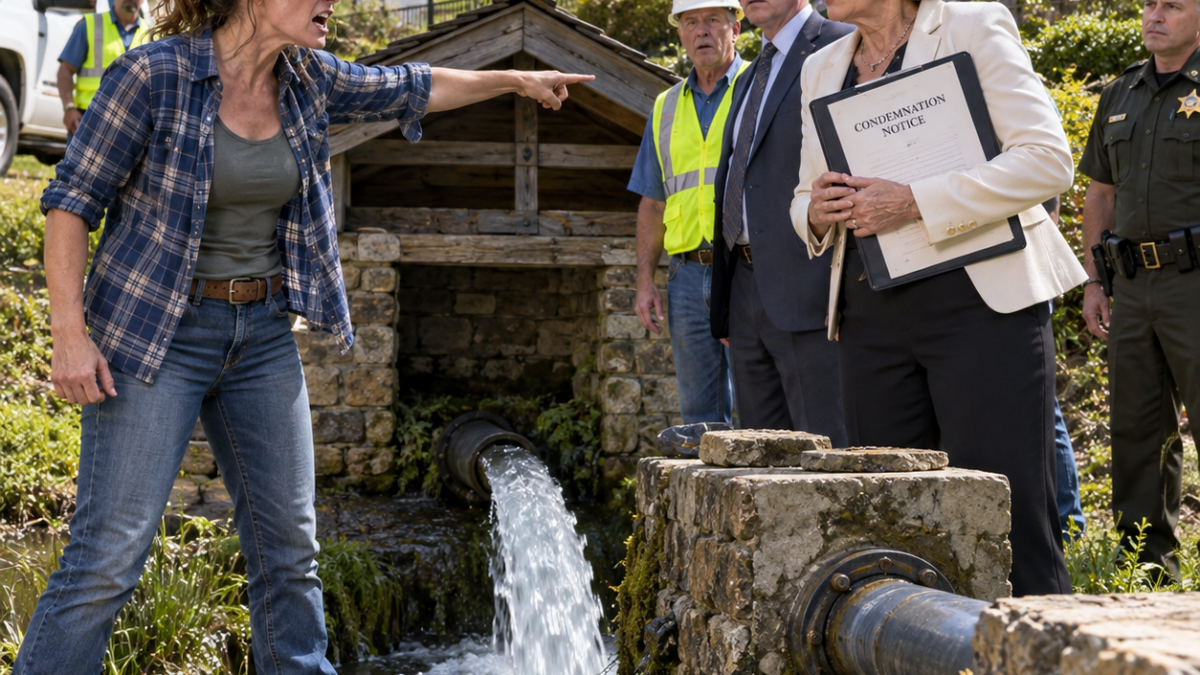
The HOA president stood in my driveway and gave me thirty days to destroy the oldest building on my land.
She smiled as if the argument were already over, unaware that I had spent twenty-five years learning what happens when people issue orders before checking the map.
By the time she finally understood what she had threatened to erase, half the neighborhood was staring at her like they had never known her at all.
“That structure is an undeclared, noncompliant outbuilding.”
Karen Peters tapped the laminated HOA regulations against her clipboard like a judge striking a gavel.
She was standing ten feet from my mailbox in expensive walking shoes, oversized sunglasses pushed into her hair, and the expression of someone delivering a verdict she expected me to obey without question.
Behind me, down a narrow path through the meadow, stood the structure she was talking about.
Calling it an outbuilding was almost insulting.
The springhouse had been there for roughly a century and a half.
Its walls were made of hand-laid fieldstone. Moss softened the northern side. A heavy oak door sat beneath a weathered slate roof, and cold spring water had been moving beneath those stones since long before Oakidge Estates existed.
Karen saw decay.
I saw history.
“We voted last night,” she continued. “You have thirty days to remove it at your own expense. If you refuse, the association will hire a contractor, demolish it, and place a lien on your property for the cost.”
She pulled a notice from beneath her clipboard and held it toward me.
I looked at the page but didn’t take it immediately.
“My property isn’t part of the HOA.”
Her smile tightened.
“Your parcel was excluded from the original development plat. That doesn’t mean you get to damage the appearance of the neighborhood.”
“That sounds different from what you just said.”
“Excuse me?”
“You said the HOA voted to order me to demolish something on land the HOA doesn’t control.”
Her face hardened.
“Take the notice, Mr. Miller.”
I finally accepted it.
For a moment, neither of us spoke.
The only sound was water running faintly somewhere behind the springhouse and bees moving through the clover beside my driveway.
Then I folded the paper once.
“You’ve made a serious mistake, Karen.”
She laughed.
Not nervously.
Confidently.
“The serious mistake was allowing this property to remain outside our authority for so long.”
She turned toward the sidewalk.
“Thirty days.”
I watched her walk back toward Oakidge Estates, where five hundred nearly identical homes spread across the valley below my five acres.
I didn’t shout after her.
I didn’t threaten her.
After twenty-five years with the Army Corps of Engineers, I’d learned something valuable about people who confuse confidence with competence.
You don’t interrupt them too early.
Sometimes the smartest thing you can do is let them keep talking.
Inside my house, I went straight to the oak flat-file cabinet in my study.
I pulled out the documents from my closing two years earlier.
County surveys.
Title records.
Old plats.
The original farm records.
I carried everything to the dining room table.
The paper smelled faintly of dust and aging ink as I spread it beneath the overhead light.
The first document that caught my attention was dated 1888.
There, drawn beside the spring, was the small rectangular footprint of the stone building.
I traced the handwritten notation with my finger.
Then I noticed another line.
An easement.
Granted in perpetuity.
Access.
Maintenance.
Protection.
Water source.
I sat back slowly.
The 1957 county survey showed the same thing.
So did my title report.
Whatever Karen thought that springhouse was, somebody in county government had cared enough about it to preserve permanent access rights across my property for more than a century.
That changed everything.
I picked up my phone and called a retired infrastructure consultant named Tom Abernathy, an old friend who had spent years navigating state and federal public-works regulations.
When I explained the notice, he stopped joking.
“You said permanent county water easement?”
“That’s what the title says.”
“Jack, don’t touch anything.”
“I wasn’t planning to.”
“I mean anything. Don’t repair it, don’t alter it, and definitely don’t let the HOA near it until you know exactly what that easement protects.”
He gave me the number of Marcus Thorne, chief engineer for the Tri County Water Authority.
I called immediately.
I left my parcel number, the historic designation from the survey, and the easement reference.
Then I waited.
Two days later, my phone rang.
“Mr. Miller?”
“This is Jack.”
“Marcus Thorne. Water Authority.”
Paper rustled on his end.
A keyboard clicked.
Then he became very quiet.
“I’m looking at your property now.”
Another pause.
“Spring Source 73A.”
“Yes.”
His tone changed.
“Mr. Miller, before we discuss anything else, I need you to listen carefully.”
I straightened in my chair.
Because whatever he had just found on that screen had frightened a man who managed public water infrastructure for a living.
PART 2
“Under no circumstances,” Marcus said, “is anyone to touch that springhouse.”
I stood beside my dining room table with one hand resting on the 1957 survey.
“How serious are we talking?”
“Very.”
He paused, and I heard another keyboard click.
“Source 73A is not abandoned infrastructure. It is active.”
I looked through the window toward the meadow.
The old stone roof was barely visible between two sycamores.
“Active how?”
“It feeds the North Sector reservoir.”
For several seconds, I genuinely thought I had misunderstood him.
“The reservoir?”
“Yes.”
“The municipal reservoir?”
“Yes.”
I pulled out a chair and sat down.
Marcus continued.
“The spring on your parcel is one of three primary gravity-fed sources feeding that system. On average, depending on rainfall and seasonal flow, Source 73A accounts for close to thirty percent of daily replenishment.”
Thirty percent.
The number sat strangely in my mind.
I had lived beside that springhouse for two years.
I had drunk coffee on my porch while water moved silently beneath the hill.
I had restored a section of trail near it.
I had occasionally stepped inside simply because the air was cooler there in July.
And all that time, water beginning beneath my five acres had been traveling into a system serving thousands of people.
“How many homes?”
“Approximately twelve thousand households across the North Sector, plus commercial users.”
“What kind of commercial users?”
“Several large facilities.”
He hesitated.
“Mr. Miller, that includes a hospital and two schools.”
I looked again toward the springhouse.
Karen’s demolition notice was lying six inches from my hand.
Thirty days.
Demolish at my expense.
Failure to comply would result in forced removal.
I almost laughed.
Not because anything was funny.
Because the scale of her mistake had become absurd.
“She thinks it’s an abandoned shed.”
“Well, it isn’t.”
Marcus sounded angry now.
“The structure protects the collection point from surface contamination. It also stabilizes the intake area and gives our technicians access to the control assembly beneath the floor.”
“Your technicians still go inside?”
“Twice a year.”
“When was the last inspection?”
More clicking.
“Five months ago.”
I rubbed my forehead.
“So if somebody demolished it—”
“Best case?”
“Yes.”
“We shut down Source 73A immediately, isolate the feed, bring in emergency supply capacity, inspect for contamination, and rebuild the protective structure.”
“And worst case?”
His answer came more slowly.
“Debris enters the collection system. Bacterial contamination forces an extended shutdown. The North Sector reservoir drops below operating reserve. We begin emergency transfers and potentially issue conservation or boil-water notices while repairs are underway.”
He paused.
“And that’s before we discuss criminal liability.”
That got my attention.
“Criminal?”
“Interference with a protected public water source can become a felony offense. I am not your attorney, so I won’t give you legal advice. But I can tell you what my office would do.”
“What?”
“We would seek an emergency injunction before the first piece of equipment crossed the easement boundary. If anyone damaged the structure anyway, our legal division would pursue every remedy available.”
I looked at Karen’s signature at the bottom of the HOA notice.
“She’s planning to send a contractor.”
“Then I’m sending you something today.”
“What?”
“An official utility-status letter. I’m also dispatching a survey crew tomorrow morning.”
“For what?”
“To reestablish the easement corners and post protected-utility notices.”
I leaned back.
“Is that necessary?”
“Five minutes ago, I would have said no.”
“And now?”
“Now I have a homeowners association threatening in writing to demolish one of my water sources.”
That was the first moment I understood that the conflict had stopped being mine.
Karen didn’t know it yet.
But she had invited the county into the fight.
And unlike me, the county had attorneys, engineers, inspectors, emergency powers, and absolutely no concern for the architectural preferences of Oakidge Estates.
I thanked Marcus and hung up.
Then I called Tom.
He answered on the second ring.
“Well?”
“You were right.”
“That bad?”
“The spring supplies about thirty percent of the North Sector reservoir.”
There was silence.
Then Tom said, “Oh, no.”
“That’s what I thought.”
“How many customers?”
“Twelve thousand households. Hospital. Two schools.”
Tom exhaled slowly.
“Jack, that woman didn’t step on a land mine.”
“No?”
“She climbed onto an artillery shell and started hammering the fuse.”
Despite myself, I laughed.
“Marcus is sending a survey crew.”
“Good.”
“And a formal letter.”
“Better.”
“What would you do?”
Tom knew what I meant.
Not what was legally necessary.
What would he do strategically?
He thought for several seconds.
“I wouldn’t tell her everything.”
I smiled.
“That was my instinct.”
“You’ve already warned her she’s making a mistake. If you hand her the whole file now, she retreats, hires a lawyer, and pretends the misunderstanding was administrative.”
“She’ll say she never intended to actually demolish it.”
“Exactly.”
“So I let her continue.”
“Within reason.”
“I won’t let anyone touch the springhouse.”
“Obviously.”
“But I let her keep putting things in writing.”
Tom chuckled.
“Twenty-five years in engineering really did turn you into a patient old bastard.”
“It taught me documentation.”
“That too.”
The next morning, somebody put a two-hundred-dollar violation notice beneath the windshield wiper of my Ford.
FAILURE TO MAINTAIN COMMUNITY AESTHETICS.
I stared at it.
My truck was parked forty feet inside my property.
My property was not inside Oakidge Estates.
The HOA had no authority over it.
Apparently that detail no longer mattered to Karen.
Attached to the notice was a grainy nighttime photograph of the springhouse.
The flash had turned the wet stone nearly black.
The building looked like something from an old ghost story.
I carried the notice inside and pinned it to the corkboard in my study beside the demolition demand.
Then I wrote the date and time beneath it.
That afternoon, county code enforcement arrived because someone had reported an “unlicensed commercial truck” on my land.
The inspector looked at my Ford F-250.
Then at me.
Then back at the truck.
“Is this used commercially?”
“No.”
“Registered personally?”
I handed him the registration.
He checked it.
“Looks fine.”
“I figured.”
He lowered his clipboard.
“Neighbor complaint?”
“I assume.”
He glanced toward Oakidge Estates.
“Been getting a few of those around here lately.”
“I’d appreciate a copy of your disposition.”
He gave me a curious look.
“Building a file?”
“Yes.”
That earned a small smile.
“Good idea.”
Two days later came a second county complaint.
Overgrown vegetation.
Karen was referring to my meadow.
I maintained five acres of native grasses and flowering plants partly because I liked them and partly because the slope drained toward the spring.
I didn’t want fertilizer, herbicide, and lawn chemicals anywhere near the water.
The county inspector walked the property, looked at the maintained firebreak, checked the setback, and closed the complaint.
Another document went into my file.
I answered the HOA only once.
Registered mail.
Three paragraphs.
I acknowledged receipt of the notices.
I stated that my property was not governed by the association’s covenants.
And I wrote that the matter was currently being reviewed with the appropriate county authorities because of longstanding recorded easements and public-utility requirements.
I did not explain further.
Karen received the letter on Thursday.
I knew because I had delivery confirmation.
Friday morning, she sent another notice.
Two hundred fifty dollars.
CONTINUED NONCOMPLIANCE.
I pinned that one beside the others.
Then I made coffee.
At nine fifteen, the Tri County Water Authority truck arrived.
Two technicians stepped out wearing yellow safety vests.
One carried survey equipment.
The other carried four steel posts and a post driver.
They greeted me professionally.
“Mr. Miller?”
“Jack is fine.”
“Marcus briefed us.”
One technician pointed down the hill.
“That the springhouse?”
“Yes.”
“Mind if we start?”
“Be my guest.”
Within an hour, they had located the permanent easement corners.
Each steel post received a white sign.
TRI COUNTY WATER AUTHORITY
CRITICAL PUBLIC UTILITY
AUTHORIZED ACCESS ONLY
The effect was immediate.
Curtains moved in several houses across the road.
A man walking his Labrador slowed almost to a stop.
Two women paused beside a stroller.
Then Karen appeared.
She marched from the direction of the clubhouse with her phone already in her hand.
“What are you doing?”
The technicians continued working.
Karen stopped at my property line.
“Excuse me!”
One technician finally looked over.
“Ma’am?”
“You can’t install those.”
“Yes, ma’am, we can.”
“This is a residential community.”
He nodded.
“Yes, ma’am.”
“I am the president of the homeowners association.”
He looked at the second technician.
Then back at Karen.
“Okay.”
I almost felt sorry for her.
Karen was accustomed to titles producing obedience.
President.
Board.
Violation.
Assessment.
Lien.
Those words worked beautifully when everyone around her agreed to treat them as weapons.
But this technician wasn’t one of her residents.
Her title meant nothing to him.
She pointed at the nearest sign.
“Who authorized this?”
“Tri County Water Authority.”
“On his land?”
“On our recorded easement.”
She turned toward me.
“What did you do?”
I took a sip of coffee.
“Exactly what I told you I was doing.”
Her face reddened.
“You’re deliberately escalating this.”
“No, Karen. I’m verifying the facts.”
“These signs make the neighborhood look industrial.”
The technician stopped driving the post.
He stared at her.
For the first time, his expression changed.
Not anger.
Disbelief.
“Ma’am, that sign marks a protected drinking-water facility.”
Karen’s mouth opened.
Then closed.
She had heard the words.
But I could tell she hadn’t absorbed them.
Not fully.
Because people like Karen rarely process information that interferes with a conclusion they’ve already reached.
She took several photographs with her phone and walked away.
An hour later, an HOA email reached nearly every homeowner in Oakidge Estates.
Sarah Mitchell showed it to me that evening.
Sarah lived three houses inside the HOA boundary and had two young children.
I knew her only casually.
She approached while I was checking my mailbox.
“Mr. Miller?”
“Jack.”
“I’m Sarah.”
“I know. Blue house.”
She smiled nervously.
“That’s us.”
She held up her phone.
“Can I ask you something?”
“Sure.”
“Are those signs real?”
I looked toward the springhouse.
“Yes.”
“Karen sent an email saying you’d erected fake utility signs to intimidate the HOA board.”
I stared at her.
“Fake?”
Sarah turned the screen toward me.
There it was.
Karen’s message.
She described me as a “hostile noncompliant neighboring property owner.”
She claimed I had placed “official-looking signage” near the disputed structure in an apparent effort to interfere with legitimate HOA enforcement.
I read it twice.
Sarah watched my face.
“They’re actually from the water authority?”
“Their employees installed them yesterday.”
Her expression changed.
“Why?”
“Because the springhouse protects part of the county water system.”
She blinked.
“What does that mean?”
“The spring beneath my property feeds the North Sector reservoir.”
Sarah stared at me.
“Our reservoir?”
“Yes.”
“The one our neighborhood gets water from?”
“Yes.”
She turned slowly and looked downhill.
“That old building?”
“That old building.”
“How much water are we talking about?”
“Enough that the county considers it critical infrastructure.”
Her face tightened.
“And Karen wants to demolish it?”
“That’s what the notice says.”
Sarah gave a quiet, incredulous laugh.
“She fined us five hundred dollars last month.”
“For what?”
“My son’s playset.”
I thought I’d misheard.
“The playset?”
“Wrong color.”
“You’re serious.”
“We ordered cedar. The board said natural wood wasn’t on the approved palette. Karen threatened a lien if we didn’t paint it beige.”
She looked embarrassed as she said it.
Not because she had done anything wrong.
Because arbitrary authority has a strange way of making reasonable people ashamed for objecting to unreasonable treatment.
“We painted it.”
“I’m sorry.”
“She came back three days later to make sure.”
Something in Sarah’s voice had changed.
Anger was replacing embarrassment.
“She stood in our backyard and took pictures.”
I glanced toward Karen’s house.
“Has this happened to other people?”
Sarah laughed bitterly.
“You really don’t know?”
“No.”
“Mr. Henderson got fined because his trash cans were visible forty minutes after collection. The Parkers had to remove landscaping because their mulch was too red. Greg Walters got fined for a basketball hoop. Another family got three warnings over Christmas lights.”
“And everyone just accepts it?”
“Most people have mortgages. Kids. Jobs. They don’t want legal trouble.”
She lowered her voice.
“She makes everything sound terrifying. Liens. Attorneys. Collections.”
I understood.
Fear doesn’t need to be enormous to be effective.
It just needs to be expensive.
Sarah hesitated.
“There’s something else.”
“What?”
“Special HOA meeting Tuesday night.”
“For what?”
She handed me her phone again.
The agenda read:
SPECIAL ASSESSMENT — LEGAL AND DEMOLITION EXPENSES RELATED TO ADJACENT NONCOMPLIANT PROPERTY.
I felt something inside me become very still.
“How much?”
“Karen hasn’t said. She’s telling people your refusal could cost the community thousands.”
I looked at Sarah.
“She intends to make homeowners pay for tearing down the springhouse.”
“That’s what it sounds like.”
That changed the strategy.
Until then, Karen had been harassing me.
Now she was preparing to collect money from other people to finance an action she had no authority to take against infrastructure protected by the county.
“Thank you for showing me.”
“Are you going?”
“Oh, yes.”
Sarah studied my expression.
“You don’t look worried.”
“I was worried three days ago.”
“And now?”
“Now I’m prepared.”
Inside, I called David Chen.
David had served as a JAG officer before building a private practice focused on property disputes, municipal law, and regulatory litigation.
Tom had recommended him after my second HOA notice.
He answered after one ring.
“Jack.”
“We have movement.”
“What kind?”
“Special assessment meeting Tuesday.”
“For demolition?”
“Yes.”
There was a pause.
Then David said, “Send me the agenda.”
I did.
He called back ten minutes later.
“This is much better.”
“That sounds disturbing coming from my lawyer.”
“You know what I mean.”
“I do.”
“If she simply threatened you, we had harassment and possibly an ultra vires HOA action.”
“But?”
“If she solicits money from the membership by representing that the HOA has legitimate authority to demolish the structure after you’ve put them on written notice about county easements…”
He let the sentence hang.
“How bad?”
“Potentially very bad for the board.”
“Can we stop the vote?”
“Of course.”
“Don’t.”
Another silence.
David understood immediately.
“You want them to take it.”
“I want Karen to state the purpose publicly.”
“And get approval.”
“Yes.”
“She may back down.”
“I don’t think she will.”
“Why?”
“Because she thinks the signs are fake.”
David laughed once.
“She actually wrote that?”
“I have the email.”
“Forward it.”
I did.
Thirty seconds later he said, “Oh, Jack.”
“What?”
“She’s doing half my job for me.”
Over the next four days, Karen sent three more community emails.
Each was worse.
She described me as reckless.
Uncooperative.
Hostile.
She claimed the springhouse endangered property values.
She called the county signs a “provocative stunt.”
And she warned residents that failure to act decisively against me might encourage “further disregard for community standards.”
The irony was almost painful.
She had never walked inside the springhouse.
Never checked the county recorder’s office.
Never called the water authority.
Never asked why an easement existed.
She had decided what the building was by looking at it.
Then she constructed an entire reality around that assumption.
Tuesday evening arrived.
I wore jeans, a blue collared shirt, and work boots.
No suit.
No military memorabilia.
No folder thick enough to look threatening.
Just one envelope tucked inside my jacket.
Marcus’s letter.
David told me to sit in the back.
“Don’t interrupt.”
“What if she lies?”
“Let her.”
“What if residents start attacking me?”
“Let them talk.”
“You’re enjoying this.”
“Professionally.”
I walked to the clubhouse just before seven.
The room was crowded.
More than a hundred people had shown up, far more than attended normal HOA meetings.
Karen sat at a folding table at the front beside Treasurer Gary Pinter and board member Brenda Coats.
Gary looked like a man who hadn’t slept properly in years.
Brenda wore the determined expression of someone who had chosen her side long ago and no longer wanted facts interfering with it.
Karen saw me enter.
For half a second, surprise crossed her face.
Then she smiled.
It was a confident smile.
She thought my presence meant surrender.
I took a chair in the last row.
Mr. Henderson sat near the front.
He turned slightly.
Our eyes met.
He nodded once.
Sarah sat three seats from him.
She looked nervous.
At exactly seven, Karen called the meeting to order.
Routine minutes.
Budget note.
Pool-maintenance update.
Then she stood.
“Now we come to the primary reason for tonight’s special session.”
The lights dimmed.
A photograph appeared on the projector screen.
My springhouse.
The same ugly nighttime picture.
Karen stepped beside it.
“As many of you know, the association has spent several weeks attempting to resolve an ongoing compliance issue concerning the deteriorated structure located along our western boundary.”
Western boundary.
Interesting.
When she wanted authority, my property was part of the community.
When ownership became inconvenient, suddenly I was only “along the boundary.”
She continued.
“The owner has refused every reasonable opportunity to cooperate.”
A woman in front turned to look at me.
I remained silent.
Karen clicked the remote.
Another slide.
PROPERTY VALUE PROTECTION.
“Our duty as your elected board is to protect the visual character and financial security of Oakidge Estates.”
Mr. Henderson raised his hand.
Karen ignored him.
“The structure in question poses aesthetic, safety, and potential liability concerns.”
That was new.
Safety.
She had added safety.
Again, no inspection.
No engineer.
No report.
Just a word on a screen.
Karen gestured toward the photograph.
“We issued proper notice.”
My hand tightened around my notebook.
Proper notice to someone outside the HOA.
She continued.
“The property owner has responded by installing intimidating signs and claiming outside agencies are involved.”
Sarah spoke from the second row.
“Are outside agencies involved?”
Karen stopped.
For one second, annoyance flashed across her face.
“We are not here to debate rumors.”
“They aren’t rumors,” Sarah said.
A murmur moved through the room.
Karen raised her voice.
“This meeting will follow proper procedure.”
Mr. Henderson finally spoke.
“Then answer the question.”
People turned.
Karen stared at him.
“Walter, please.”
“Did the Tri County Water Authority install those signs?”
Karen’s jaw tightened.
“The origin of those signs has not been independently verified by the board.”
I nearly smiled.
Not verified.
She had had four days.
The water authority’s phone number was public.
The county easement was public.
She had simply chosen not to verify anything that might prove her wrong.
Karen turned back toward the crowd.
“What has been verified is that the owner continues refusing compliance.”
I wrote the sentence down.
So did Sarah.
Karen moved to the next slide.
SPECIAL ASSESSMENT.
“Demolition estimates have been obtained.”
Gary shifted uneasily beside her.
Karen continued.
“We have received a preliminary quote of ten thousand dollars for removal and disposal.”
Whispers spread across the room.
“In addition, the association must prepare for legal expenses related to recovery of those costs.”
A man shouted, “Why should we pay for his shed?”
Karen smiled sympathetically.
“Exactly why decisive enforcement is necessary.”
She let the room settle.
“The board proposes a fifty-dollar one-time assessment per household. The funds will support demolition, legal enforcement, and future compliance protection.”
My heart began beating faster.
This was it.
David had warned me that patience feels different when you’re sitting ten yards from someone publicly misrepresenting you.
He was right.
Every instinct told me to stand.
Correct her.
End it.
But I stayed seated.
Karen called for a motion.
One of her allies raised a hand.
“So moved.”
“Second?”
Another hand.
“Second.”
“All in favor?”
Hands rose.
Forty.
Fifty.
More.
Some reluctantly.
Some confidently.
Some because Karen had frightened them.
“All opposed?”
My hand went up.
So did Sarah’s.
Henderson’s.
Maybe twenty others.
Not enough.
Karen counted.
Then smiled.
“The motion carries.”
The room murmured.
She looked directly at me.
“The assessment is approved. Demolition will be scheduled for next Wednesday.”
My phone vibrated.
One message.
David.
NOW.
The clubhouse doors opened.
A man wearing a dark suit entered carrying three large envelopes.
Karen frowned.
“This is a private association meeting.”
The man walked to the front.
“Karen Peters?”
“I am the association president.”
He extended an envelope.
“You’ve been served.”
Everything changed at once.
The room went silent.
Karen stared at the packet.
The process server turned.
“Gary Pinter?”
Gary’s face went white.
“Me?”
Another envelope.
“Brenda Coats?”
Brenda snatched hers.
“What is this?”
The process server didn’t answer.
He left.
Nobody spoke.
Karen ripped open the envelope.
Her eyes moved quickly across the first page.
Then stopped.
She flipped to the second.
Her breathing changed.
“What is this?”
I stood.
Every head turned toward me.
I walked slowly down the center aisle.
“It’s formal notice to cease and desist.”
Karen’s eyes narrowed.
“From you?”
“From my attorney.”
I reached the front.
“And there’s another letter you should probably read before hiring that demolition contractor.”
I removed Marcus Thorne’s envelope from my jacket.
Karen stared at it.
I turned toward the residents.
“The building you’ve been asked to pay to demolish is not an abandoned shed.”
Nobody moved.
“It is a registered part of the Tri County public water system.”
Confusion rippled through the room.
I continued.
“The spring beneath my property is identified in county infrastructure records as Source 73A.”
Gary was reading faster now.
His hands had started trembling.
“The county holds a permanent easement around the springhouse for access, maintenance, and protection.”
Karen found her voice.
“This is ridiculous.”
I looked at her.
“No, Karen. What’s ridiculous is threatening to destroy infrastructure before checking who owns the rights to it.”
“You’re outside the HOA.”
“Exactly.”
“That doesn’t mean—”
“It means your board had no authority to fine me in the first place.”
Someone in the audience said, “Wait.”
Another voice.
“What does the spring actually do?”
I turned toward them.
“It feeds the North Sector reservoir.”
Silence.
Sarah stood.
“Our reservoir?”
“Yes.”
“How much?”
I looked at Karen before answering.
“According to the chief engineer, approximately thirty percent of its normal daily replenishment.”
The reaction was immediate.
People began talking over one another.
“Thirty percent?”
“You’re kidding.”
“The reservoir?”
Karen slapped her hand on the table.
“Order!”
Nobody listened.
I raised my voice slightly.
“That reservoir serves roughly twelve thousand households.”
The room quieted again.
“And major facilities.”
Someone asked, “What facilities?”
“The hospital.”
Every face changed.
“And two schools.”
A woman near the wall covered her mouth.
Gary whispered, “Oh, God.”
Karen shook her head violently.
“No. No, this is some kind of trick.”
“You could have discovered everything I’ve said by calling the water authority.”
“I don’t accept this.”
“You don’t need to.”
I placed Marcus’s letter on the table.
“The law doesn’t require your acceptance.”
The clubhouse doors opened again.
David Chen entered first.
Behind him walked Marcus Thorne.
And behind Marcus came a uniformed sheriff’s deputy.
Karen’s face went completely still.
The deputy remained near the door.
Marcus walked to the front.
“Good evening.”
His voice wasn’t loud.
It didn’t need to be.
“My name is Marcus Thorne. I’m chief engineer for the Tri County Water Authority.”
Karen stared at him.
Marcus pointed at the springhouse photograph still projected behind her.
“That structure is a protected utility asset.”
He turned toward the room.
“It shields the primary collection works for Spring Source 73A.”
Someone asked, “Does it really supply our water?”
“Yes.”
“How much?”
“Seasonally variable. Annual average contribution is approximately thirty percent of North Sector reservoir replenishment.”
Now the number wasn’t coming from me.
It was coming from the man responsible for the system.
Marcus faced the board.
“Our technicians inspected that springhouse five months ago.”
Karen whispered, “Nobody told us.”
Marcus’s expression didn’t change.
“You didn’t ask.”
A few people laughed.
Not because it was funny.
Because the absurdity had finally become visible.
Karen pointed at me.
“He deliberately hid this.”
I felt my anger rise.
Before I could respond, David stepped beside me.
“My client informed your board in writing that the property was subject to longstanding public-utility easements and that he was consulting county authorities.”
He opened a folder.
“Certified delivery.”
Karen glared at him.
“You’re his attorney?”
“David Chen.”
He looked toward the audience.
“For clarity, Mr. Miller had no legal obligation to teach the HOA board how to perform a title search before it attempted to demolish something on property outside its jurisdiction.”
That sentence landed hard.
Marcus continued.
“If your contractor had damaged that structure, we would have isolated the source immediately.”
A resident asked, “Would we lose water?”
“Potentially.”
The word moved through the room like electricity.
Marcus explained the contamination risk.
Emergency supply.
Reservoir reserves.
Repairs.
Water-quality testing.
Then he said something that destroyed whatever confidence remained on Karen’s side.
“Our preliminary liability estimate for significant interference begins in seven figures.”
Gary dropped his papers.
“What?”
Marcus looked at him.
“Depending on damage.”
Gary turned toward Karen.
“You told us ten thousand dollars.”
“That was demolition,” she snapped.
“You said this was routine.”
“It is.”
“No,” Gary said.
For the first time, his voice carried anger.
“It obviously isn’t.”
Karen looked around as though searching for someone still willing to confirm her version of reality.
Brenda avoided her eyes.
A resident stood.
“My house could have been liable for this?”
David answered carefully.
“The HOA itself could have faced significant liability. The exact exposure of individual owners would depend on governing documents, insurance, judgments, and state law.”
The man turned toward Karen.
“You told us we were protecting our property values.”
Another homeowner stood.
“You asked us to fund this.”
Then Sarah.
“You lied about the signs.”
Karen pointed at her.
“Sit down.”
Sarah didn’t.
“You told everyone he made those signs himself.”
“I said they weren’t verified.”
“You said they were fake.”
Voices rose.
“She did.”
“I have the email.”
“So do I.”
Mr. Henderson stood.
He didn’t shout.
That made everyone listen.
“Karen.”
She looked at him.
“How many times did residents ask you to slow down before issuing fines?”
“This isn’t relevant.”
“How many?”
She said nothing.
Henderson continued.
“You fined my neighbor for mulch.”
Someone laughed bitterly.
“You fined the Mitchells because their child’s playset was the wrong shade of brown.”
“Community standards—”
“You measured Robert Lane’s grass.”
More voices.
“Yes, she did.”
“She photographed mine.”
“She threatened a lien over my basketball hoop.”
Years of resentment started pouring into the room.
Karen tried to regain control.
“This meeting is adjourned.”
“No,” Gary said.
Everyone stopped.
Karen slowly turned toward him.
“What?”
Gary stood.
His knees visibly shook.
But he stood.
“This meeting isn’t adjourned.”
“I am the president.”
“And I’m the treasurer.”
“You will sit down.”
Gary looked at the packet in front of him.
Then at Marcus.
Then at the hundred homeowners whose money he was responsible for.
“No.”
It may have been the bravest word Gary Pinter had spoken in years.
He swallowed.
“I move to rescind tonight’s special assessment.”
Applause exploded.
Karen hit the table.
“You can’t do this.”
Brenda raised a trembling hand.
“I second.”
Karen stared at her.
“Brenda.”
Brenda didn’t look back.
Gary called the vote.
“All in favor of rescinding the special assessment?”
Nearly every hand rose.
Even several people who had voted for it minutes earlier.
“Motion carries.”
Cheers broke out.
Karen stood.
“This board is being intimidated.”
David spoke calmly.
“No one has threatened you.”
She pointed toward the deputy.
“Then why is he here?”
The deputy finally stepped forward.
“Ma’am, the water authority notified the sheriff’s office about a documented threat to protected infrastructure. I’m here to prevent a breach of the peace and ensure nobody attempts access to the restricted easement.”
Karen’s face twitched.
“You think I’m going to demolish something tonight?”
“You approved demolition tonight.”
That shut her up.
Gary took another breath.
“I resign.”
Karen turned.
“You what?”
“Effective immediately.”
He removed his HOA badge from his lanyard and placed it on the table.
“I should’ve checked the documents myself. I didn’t. That’s on me.”
He looked at the residents.
“I’m sorry.”
Brenda stood.
“I resign too.”
She picked up her purse.
Karen looked from one to the other.
“You cowards.”
“No,” Brenda said quietly.
“I was a coward when I kept agreeing with you.”
Then she walked away from the table.
Karen stood alone.
I had imagined this moment several times.
I expected satisfaction.
Maybe triumph.
Instead I felt something heavier.
Karen’s power had never really come from regulations.
It had come from everyone else’s belief that resisting her would cost more than surrendering.
That belief was dying in front of me.
Henderson stepped forward.
“I move that the association formally withdraw every notice, fine, or enforcement action issued against Mr. Miller.”
Someone immediately seconded.
Karen screamed, “You cannot hold a vote without the board!”
David lifted one finger.
“You still have a president.”
Everyone looked at Karen.
For perhaps the first time in years, her title worked against her.
Henderson asked, “Will you call the vote?”
“No.”
“Then we’ll follow the emergency-vacancy procedure in the bylaws.”
Karen froze.
Henderson smiled faintly.
“You aren’t the only person who can read them.”
A few people actually laughed.
Karen looked at me.
Her expression was filled with fury.
“You planned this.”
I answered honestly.
“I prepared for it.”
“You humiliated me.”
“No.”
I stepped closer.
“I told you on my driveway that you were making a serious mistake.”
Her lips tightened.
“You could have explained everything.”
“I told you county authorities were reviewing it.”
“You set me up.”
“You fined me after receiving that letter.”
She looked away.
“You reported my truck.”
Silence.
“My meadow.”
Still nothing.
“You told these people the utility signs were fake.”
Her eyes flashed back toward me.
“And tonight, after being warned repeatedly that public infrastructure was involved, you asked five hundred families to finance its destruction.”
I lowered my voice.
“I didn’t make you do any of that.”
The truth hurt her more than any insult could have.
Because she knew it.
She had built the trap herself.
I had simply refused to stop her.
Karen grabbed a sheet of paper.
She wrote something quickly.
Then she threw the pen onto the table.
“I resign.”
Nobody applauded.
That surprised me.
They simply watched her walk toward the doors.
A path opened through the crowd.
She passed Sarah.
Passed Henderson.
Passed Gary.
Then she stopped beside me.
“You think you’ve won.”
I looked at her.
“No.”
She waited.
“I think the springhouse is still standing.”
For once, she had nothing to say.
She walked outside.
The doors closed.
For several seconds, the clubhouse remained silent.
Then Henderson picked up Karen’s resignation.
He looked at the room.
“Well.”
A few people chuckled nervously.
Henderson adjusted his glasses.
“It appears we have a homeowners association to rebuild.”
That was when the applause finally came.
Not for me.
Not against Karen.
For the possibility that something could change.
The following week was messy.
Real change usually is.
An interim board was appointed under the association’s bylaws.
Henderson reluctantly agreed to serve as temporary president.
Sarah joined him.
So did a retired accountant named Rebecca Lawson.
Their first act was simple.
No enforcement decisions without documented authority.
Their second act was painful.
Review everything.
Years of fines.
Complaints.
Legal threats.
Payments.
Letters.
Records.
The association office contained filing cabinets full of petty battles.
Trash cans.
Door colors.
Garden edging.
Flags.
Basketball equipment.
Holiday decorations.
Mailboxes.
Planters.
One homeowner had received four violation letters because a child’s bicycle had been visible from the street.
Another had paid eight hundred dollars in accumulated fines over landscaping stones.
The more the interim board reviewed, the angrier the community became.
But Henderson insisted on something important.
“No revenge.”
That came up at the first open meeting.
A man stood and demanded they sue Karen personally for every questionable fine.
Another wanted her barred from all community facilities.
Someone suggested publishing a list of every enforcement decision she had made.
Henderson shook his head.
“We’re not replacing one kind of abuse with another.”
The room settled.
“We correct what was wrong. We refund what legally should be refunded. We change the rules. We protect the association. And then we move forward.”
I respected him for that.
Because revenge feels good for an evening.
Reform protects people after the anger is gone.
David and I met in his office two days after the meeting.
He placed our civil complaint on the table.
Harassment.
Abuse of process.
Improper enforcement.
Potential defamation issues from the HOA emails.
“We can file this tomorrow,” he said.
I looked at the document.
“What happens if we do?”
“Best case? They settle.”
“And who pays?”
“Insurance, potentially the association, potentially individual directors depending on coverage and findings.”
“So homeowners could still end up paying.”
“Possibly.”
I leaned back.
“That isn’t what I want.”
David studied me.
“I thought you’d say that.”
“What do I want?”
“A clean resolution.”
“Yes.”
He folded his hands.
“We can send a settlement demand.”
“What terms?”
“Formal withdrawal of every violation. Written acknowledgment that your parcel is outside HOA jurisdiction. Written recognition of the utility easement. Reimbursement of any direct legal costs. Noninterference agreement.”
“And?”
He smiled.
“You tell me.”
I thought about Sarah’s playset.
Henderson’s trash cans.
All the people who had admitted they were afraid to challenge the board.
“Governance reform.”
David raised an eyebrow.
“That’s not technically your dispute.”
“I know.”
“So?”
“I don’t need their money.”
He leaned back.
“You want the lawsuit suspended in exchange for institutional changes.”
“Transparent meetings. Independent financial review. Revised enforcement policy. No liens without attorney review.”
David slowly smiled.
“Jack.”
“What?”
“You are incapable of having a simple property dispute.”
“Occupational defect.”
The settlement letter went out that afternoon.
The interim board accepted every term within forty-eight hours.
I withdrew the suit before it was filed.
Some neighbors told me I was too generous.
I didn’t see it that way.
Karen had wanted a war.
I wanted peace with guardrails.
Those are different things.
Marcus Thorne returned the following Monday with a preservation specialist.
We inspected the springhouse together.
Inside, the temperature dropped at least fifteen degrees.
Water whispered beneath the stone floor.
An old iron access plate sat near the rear wall.
Marcus opened it with a specialized key.
Below was the collection chamber.
Clear water flowed through a protected channel toward an underground pipe.
“You’ve been living above this without knowing what it does?” the preservation specialist asked.
“I knew it was a spring.”
Marcus laughed.
“That’s like saying Hoover Dam is a wall.”
I knelt beside the chamber.
The engineering fascinated me.
No pumps.
No computers at the source.
Gravity did most of the work.
The men who built the first system had used elevation, stone, and water pressure.
Modern equipment had been added farther downstream, but the principle remained remarkably simple.
Marcus pointed at the interior masonry.
“We need mortar repair here.”
“Can it be preserved?”
“Absolutely.”
“I don’t want it turned into something new.”
“Neither do we.”
That mattered to me.
The springhouse wasn’t beautiful because it looked perfect.
It was beautiful because it had survived.
Marcus arranged county-funded stabilization.
Specialists repointed failing joints using historically compatible mortar.
They repaired the oak door.
They replaced rusted hardware with forged iron that matched the original style.
A small telemetry sensor was installed inside.
From then on, the authority could monitor flow and water quality remotely without changing the exterior appearance.
One afternoon, Henderson walked down while the crew was working.
He rested both hands on the top of his cane.
“My grandfather used to talk about this place.”
I looked at him.
“You weren’t kidding?”
“No.”
He nodded toward the building.
“His father helped haul stone here.”
“That would have been around the original construction.”
“That’s what the family story said.”
He smiled.
“Of course, family stories are free to exaggerate.”
“County records show the spring was developed in the late nineteenth century.”
“Then maybe the old man wasn’t lying.”
We stood together listening to the water.
Henderson became quiet.
“You know what bothered me most about Karen?”
“The fines?”
“No.”
He looked toward the houses.
“She made neighbors afraid of one another.”
I knew exactly what he meant.
“People stopped talking.”
“Yes.”
“If someone stood outside your house with a clipboard, you wondered what you’d done wrong.”
He shook his head.
“That’s no way to live.”
“No.”
He looked at the springhouse again.
“Funny thing.”
“What?”
“She wanted to destroy this because she thought it lowered property values.”
“And?”
“I suspect saving it might do the opposite.”
He was right.
The local historical society became interested after the utility authority reviewed the records.
They didn’t take control of the property.
I wouldn’t have wanted that.
But they documented the structure.
A small bronze plaque was approved near the trail.
It identified the Old Miller Farm Spring and explained that the spring had supplied water to the valley for generations and remained part of the public system.
When Marcus showed me the wording, I laughed.
“What?”
“Karen wanted it demolished as an eyesore.”
Marcus looked at the plaque.
“Now it’s an educational landmark.”
“I appreciate the symmetry.”
He grinned.
“Engineering has a sense of humor.”
Meanwhile, the HOA changed faster than I expected.
The ridiculous playset-color rule disappeared first.
Sarah personally made the motion.
“All in favor?”
Every hand rose.
She looked almost emotional when the vote passed.
The grass-height policy was rewritten into a basic nuisance standard.
Decorative restrictions were simplified.
The mulch-color requirement vanished completely.
So did several landscaping rules nobody could explain the reason for.
At one meeting, Henderson held up a twenty-page architectural guideline.
“Does anyone here know why flowerpots are limited to three approved shades?”
Silence.
A man in the back said, “Because somebody twenty years ago hated blue?”
The room laughed.
Henderson nodded.
“Motion to allow people to own blue flowerpots.”
Unanimous.
That became the tone.
Not chaos.
Not the elimination of every community standard.
Just proportionality.
Rules had to serve a recognizable purpose.
Safety.
Shared maintenance.
Actual nuisances.
Not personal taste disguised as law.
The accountant, Rebecca, found another problem.
Legal spending.
Karen’s board had spent thousands on warning letters and collection consultations.
Not illegal.
But wasteful.
A large percentage of disputes could have been resolved with a conversation.
The new board adopted a three-step system.
Talk first.
Written notice second.
Formal enforcement only if necessary.
Within two months, violation disputes dropped sharply.
Ironically, compliance improved.
People took better care of common areas because they no longer felt like the association was their enemy.
One Saturday, Sarah brought her children to my property.
Her son stopped when he saw the springhouse.
“Is that the water building?”
I smiled.
“That’s one name for it.”
“Does our sink come from there?”
“Some of the water reaching your house probably passed through the system this spring helps feed.”
He stared at the stone walls.
“So that’s like the neighborhood’s water factory?”
His mother laughed.
“Close enough.”
He crouched beside the small channel where overflow moved away from the structure.
“Can I touch it?”
“The water out here, yes. Stay away from the utility equipment.”
He dipped two fingers into the flow.
“It’s freezing!”
“Comes from underground.”
His younger sister crouched beside him.
For ten minutes they asked questions.
Why doesn’t it stop?
Where does underground water come from?
Who built the house?
Why is there moss?
How old are the rocks?
Sarah finally apologized.
“They’re curious.”
“That’s a good problem.”
She looked toward the bronze plaque.
“I still can’t believe we almost paid to demolish this.”
“You almost paid fifty dollars.”
She laughed.
“Don’t remind me.”
Then she became serious.
“Thank you.”
“For what?”
“Not suing all of us.”
“I wasn’t interested in hurting the neighborhood.”
“Karen told us you hated the neighborhood.”
“I barely knew the neighborhood.”
“That might be worse.”
“How?”
Sarah smiled sadly.
“She managed to turn someone we barely knew into an enemy.”
That sentence stayed with me.
Because it described exactly what fear-based leadership does.
It simplifies people.
Neighbor becomes offender.
Question becomes insubordination.
Disagreement becomes threat.
Once you’ve reduced someone to a label, mistreating them becomes much easier.
That summer, Oakidge held its first community barbecue in several years.
I almost didn’t attend.
Large neighborhood gatherings weren’t my natural habitat.
Henderson came to my door personally.
“You’re coming.”
“That an HOA order?”
“I can issue a violation.”
“For what?”
“Excessive stubbornness.”
I went.
Tables covered the green beside the clubhouse.
Children ran through sprinklers.
Someone burned the first tray of hamburgers.
A retired teacher organized a pie contest with rules more complicated than necessary.
Sarah’s cedar playset had been repainted again.
Not beige.
Bright green and blue.
Her son had chosen the colors.
Nobody fined them.
At sunset, Henderson stood with a microphone.
Several people groaned.
“I’ll be brief,” he promised.
“No speeches longer than three minutes,” someone shouted.
“That’s a good bylaw amendment.”
Laughter.
Henderson looked around.
“A few months ago, many of us came into this building because we were told we had a serious problem.”
He glanced toward me.
“Turns out we did.”
The crowd chuckled.
“But it wasn’t the problem we thought.”
His tone became quieter.
“A community isn’t strong because every mailbox matches.”
People listened.
“It isn’t strong because every lawn is the same height.”
He paused.
“It is strong when neighbors can disagree without becoming enemies.”
That hit me harder than I expected.
“When somebody asks a question, we answer it.”
Henderson continued.
“When someone makes a mistake, we correct it.”
He looked toward the older residents.
“When rules stop serving people and people start serving rules, something has gone wrong.”
Then he pointed toward the hill.
“And sometimes an ugly old stone building turns out to be carrying something the whole neighborhood needs.”
There was scattered applause.
Henderson grinned.
“I mean water, people. Don’t make this sentimental.”
Everybody laughed.
I looked toward the dark outline of the springhouse beyond the trees.
For years, I had associated community with obligation.
Meetings.
Committees.
Rules.
Politics.
I had bought my five acres precisely because I didn’t want much of it.
But somewhere between Karen’s demolition notice and Henderson’s barbecue speech, I understood something.
Solitude and isolation are not the same thing.
You can protect your boundaries without building walls around your life.
That realization surprised me more than the water easement had.
Karen’s house went on the market six weeks after her resignation.
I found out because David called.
“Thought you’d enjoy this.”
“What?”
“Your former adversary is moving.”
“I don’t have a former adversary.”
“Karen Peters.”
“Oh.”
“That’s disappointingly mature.”
“What do you want me to do, throw a parade?”
“I was hoping for at least a villainous laugh.”
I looked out my study window.
A real-estate sign had appeared three blocks away.
“She made her choices.”
“She did.”
“Where’s she going?”
“No idea.”
“Probably somewhere without an HOA.”
David laughed.
“That would be the greatest irony.”
The sale took longer than expected.
Rumors spread that local buyers knew about the clubhouse meeting.
I didn’t enjoy that part.
Karen had behaved recklessly.
She had abused authority.
But I didn’t need her life ruined forever.
Justice, to me, meant ending the behavior and repairing what it damaged.
Humiliation can be a consequence.
It shouldn’t become a hobby.
The last time I saw Karen was on a gray morning in November.
A moving truck sat outside her house.
I was driving home from the hardware store.
She stood beside the curb holding a cardboard box.
Our eyes met.
For a second I considered continuing.
Then I stopped.
I lowered my window.
“Karen.”
She looked suspicious.
“What?”
“I hope things go better wherever you’re headed.”
She stared at me.
“Do you?”
“Yes.”
Her face hardened.
“You destroyed my reputation.”
“No.”
She laughed bitterly.
“Still pretending?”
I kept my voice calm.
“You received a demolition notice from your own board?”
Her eyes narrowed.
“No.”
“You filed false county complaints against yourself?”
Silence.
“You sent those emails?”
She looked away.
“You called the vote?”
Her jaw tightened.
“I made mistakes.”
“Yes.”
That was the first time I had heard her admit it.
I nodded.
“We all do.”
She looked back at me.
“You’re enjoying this.”
“No.”
And I meant it.
“I enjoyed stopping you.”
That surprised her.
“But this?”
I gestured toward the moving truck.
“No.”
For a moment, Karen looked older than I remembered.
Tired.
Not defeated.
Just emptied of the energy she had once spent controlling everyone around her.
“You could have warned me.”
“I did.”
She closed her eyes briefly.
“I didn’t believe you.”
“I know.”
Another silence.
Then I said, “That’s the part worth remembering.”
She didn’t answer.
I drove home.
I never saw her again.
Winter came early.
The first snow covered the meadow in a thin white sheet.
The springhouse roof turned silver.
Steam rose faintly where the warmer spring water met freezing air.
One morning, I carried coffee down the new path.
Yes, there was a new path.
That had been Henderson’s idea.
The HOA wanted residents to be able to visit the historical plaque without wandering across random parts of my property.
They came to me with a map.
Asked permission.
Offered to pay.
The difference between that conversation and Karen’s first visit to my driveway couldn’t have been clearer.
Henderson unfolded the plan.
“We’d like a gravel walking path from the public sidewalk to the plaque.”
“Across my land.”
“Yes.”
“And you’re asking.”
“Yes.”
I looked at him.
“That’s refreshing.”
He laughed.
“We’re trying a radical new governance model.”
“What’s that?”
“Manners.”
I approved it.
Twenty residents showed up for the workday.
Nobody was required.
Nobody was fined for failing to attend.
They simply came.
Wheelbarrows.
Shovels.
Landscape timbers.
Coffee.
Donuts.
Sarah’s husband helped grade the slope.
Gary showed up too.
I hadn’t seen him since the clubhouse meeting.
He approached awkwardly.
“Mr. Miller.”
“Jack.”
“Right.”
He looked thinner and more relaxed.
“I’ve wanted to apologize.”
“You already did that night.”
“Not properly.”
He stared toward the springhouse.
“I knew Karen could be difficult.”
I waited.
“But I kept telling myself it was easier to go along.”
He rubbed his hands together.
“I was the treasurer. I should’ve demanded documentation before approving any legal spending.”
“Yes.”
He seemed surprised by my answer.
Maybe he expected me to rescue him from responsibility.
I didn’t.
“But you resigned when it mattered.”
“Late.”
“Still mattered.”
Gary nodded.
“I joined the parks committee.”
I smiled.
“That sounds dangerous.”
“Sarah runs it.”
“Then you’re doomed.”
He laughed.
For the first time, I saw why Gary had probably been a decent neighbor before fear turned him passive.
“We’re expanding the playground.”
“Let me guess. Beige?”
“Absolutely not.”
We shook hands.
Forgiveness doesn’t mean pretending something didn’t happen.
It means refusing to chain the future to it.
By noon, the walking path was finished.
It curved gently through the trees and ended beside the bronze plaque.
Children immediately tested it.
Adults stood around admiring work that probably would have taken a professional crew three hours.
It had taken us five.
Nobody cared.
We had built something together.
That mattered more.
The following spring, the permanent HOA election was held.
Henderson refused the nomination for president.
Then Sarah circulated a petition.
He accepted.
“One term,” he warned.
People applauded.
“And someone under seventy better learn this job.”
More applause.
The new board was elected almost unanimously.
Their first formal resolution concerned the springhouse.
I tensed when Henderson announced it.
Then he smiled.
“The association formally recognizes the recorded Tri County Water Authority easement and the historic significance of Spring Source 73A.”
He looked toward me.
“And promises never to attempt demolition with a bulldozer, chainsaw, wrecking ball, tactical missile, or strongly worded architectural-review letter.”
The room erupted.
I laughed harder than anyone.
Later, Henderson shook my hand.
“You took the first hit.”
“You stood up before most people did.”
“I had less to lose.”
“That’s not true.”
He shrugged.
“I’m eighty-one. What was Karen going to do? Fine me into an early grave?”
I laughed.
Then he grew serious.
“You reminded people they were allowed to say no.”
That meant more than he probably realized.
The years I spent with the Corps taught me that infrastructure is mostly invisible when it works.
Water systems.
Drainage.
Bridges.
Levees.
People notice them only when something fails.
Community works the same way.
Trust is infrastructure.
Fairness is infrastructure.
A shared belief that the rules apply honestly is infrastructure.
Karen had spent years weakening those systems because the damage didn’t show on a balance sheet.
Then one day she tried to destroy a physical piece of infrastructure.
And the whole hidden structure around her collapsed too.
My restoration work on the springhouse continued slowly.
I didn’t restore it into perfection.
That would have defeated the point.
I replaced failing mortar.
Repaired drainage around the foundation.
Cleared invasive vines.
Preserved the moss.
Kept the stones scarred and uneven.
They had earned those scars.
One afternoon, I sat inside listening to the water.
The sound echoed softly against the stone.
No motors.
No voices.
Just water.
For months, people had argued over that place.
Violation.
Easement.
Demolition.
Liability.
Authority.
Felony.
Assessment.
Lawsuit.
But the spring had ignored us all.
It had kept flowing.
Before Karen.
During Karen.
After Karen.
That thought humbled me.
We spend enormous amounts of energy trying to control things.
Land.
People.
Appearances.
Rules.
Reputations.
Then you sit beside water that has been moving through rock for centuries and realize how temporary most human authority really is.
Marcus visited one afternoon with his son.
The boy was about sixteen.
“This is Evan,” Marcus said.
Evan looked at the springhouse.
“This is the famous building?”
I laughed.
“Unfortunately.”
Marcus shook his head.
“He’s heard the story at least fifty times.”
“Dad uses it in presentations.”
Marcus looked embarrassed.
“What presentations?”
“Utility outreach.”
I stared at him.
“You turned my HOA nightmare into educational material?”
“It has everything.”
He counted on his fingers.
“Source protection. Easements. Infrastructure awareness. Public communication. Preventing unauthorized excavation.”
Evan added, “And an evil HOA president.”
Marcus sighed.
“We don’t use that phrase professionally.”
I showed Evan the gravity-feed system.
He asked good questions.
Flow rates.
Contamination.
Pressure.
Why the collection point was placed where it was.
How engineers mapped groundwater in the nineteenth century.
Eventually he stood outside studying the slope.
“This is actually pretty cool.”
Marcus looked triumphant.
“You hear that?”
“Don’t ruin it, Dad.”
When they left, Marcus shook my hand.
“You know something?”
“What?”
“You probably did more for public understanding of this water system than our last five outreach campaigns.”
“I almost did nothing.”
“Exactly.”
He gestured toward the neighborhood.
“People turn on a faucet and water appears. They don’t think about where it starts.”
I looked at the spring.
“Now they do.”
“That’s valuable.”
A year after the confrontation, I found Gary in the hardware store.
We were both standing in front of irrigation fittings.
He spotted me first.
“Jack.”
“Gary.”
He held up two pieces of PVC.
“Do you know which one of these I need?”
“You resigned as treasurer and immediately forgot how pipes work?”
“I was an accountant.”
“Fair.”
We figured out his problem.
Before leaving, he said, “The neighborhood’s different.”
“I’ve noticed.”
“My wife wants to move.”
“Why?”
“Bigger house.”
“And?”
“I don’t.”
He smiled.
“First time in years I actually like living there.”
That might have been the best outcome of all.
Not Karen leaving.
Not the vote.
Not the legal victory.
People wanted to stay.
People who had once avoided one another now stopped to talk.
The HOA meetings became boring.
That was excellent.
Healthy governance should often be boring.
Budgets.
Pool repairs.
Tree trimming.
Insurance.
Reserve studies.
Occasional arguments over parking.
No public enemies.
No dramatic speeches.
No homeowners trembling over an envelope in the mailbox.
Henderson once told me attendance had dropped by almost half.
“Should we be worried?”
I asked.
He smiled.
“Nope.”
“Why?”
“People don’t come because they’re not afraid anymore.”
That said everything.
One evening, near the second anniversary of Karen’s original visit, I found the old demolition notice in my study.
I had kept it.
Not framed.
Not displayed.
Just stored with the property documents.
I unfolded it.
The language now seemed ridiculous.
UNDECLARED NONCOMPLIANT OUTBUILDING.
THIRTY DAYS.
DEMOLITION AT OWNER’S EXPENSE.
LIEN.
I carried the notice down to the springhouse.
The bronze plaque caught the evening light.
Water moved beneath the floor.
I stood where Karen had once wanted a contractor to arrive with demolition equipment.
Then I looked downhill.
Lights were appearing in the windows of Oakidge Estates.
Five hundred homes.
Families making dinner.
Children doing homework.
Showers running.
Dishwashers humming.
Someone watering a garden.
Someone filling a glass at the kitchen sink.
Not every drop came from the spring beneath my feet.
But enough did.
Enough to matter.
That was the lesson Karen had missed from the beginning.
She looked at something old and assumed it was worthless.
She saw moss and called it neglect.
She saw rough stone and called it ugly.
She saw land outside her authority and called it a problem.
She never asked what any of it did.
She cared more about whether the springhouse matched the neighborhood than whether the neighborhood depended on the springhouse.
And in the end, that blindness cost her everything she actually valued.
Her position.
Her influence.
Her reputation.
Her ability to frighten people into obedience.
I didn’t destroy those things.
Facts did.
The truth simply arrived slower than her arrogance.
But once it arrived, it stayed.
I folded the notice again.
For a moment, I considered throwing it away.
Instead, I put it inside a small waterproof box with copies of the original easement and the 1957 survey.
Not as a trophy.
As a record.
Because history matters.
The springhouse had taught me that.
The following weekend, a new family walked down the public path.
Parents and a little girl.
They had moved into Oakidge recently.
The father stopped at the bronze plaque and read it aloud.
His daughter looked at the springhouse.
“That gives us water?”
“Part of it,” he said.
She walked closer to the stone wall.
“It’s really old.”
“Very.”
“Why didn’t they build a new one?”
Her father laughed.
“Because the old one still works.”
I was sitting on my porch far enough away that they didn’t know I could hear them.
The girl placed her palm against one of the stones.
Then she said something that made me smile.
“So old doesn’t mean bad.”
Her mother answered.
“No, sweetheart.”
Sometimes the simplest people in a story understand the lesson better than everyone who fought over it.
I went inside.
Filled a tall glass from the kitchen tap.
Walked back onto the porch.
The sun was dropping behind the ridge.
Oakidge Estates glowed below me.
The springhouse stood beneath the trees, exactly where it had stood long before any HOA existed.
I took a drink.
Cold water.
Clean.
Ordinary.
Something most of us never think about until someone threatens to take it away.
Two years earlier, Karen Peters had stood in my driveway and ordered me to destroy a crumbling old building because she believed it made her community look less valuable.
She had been wrong about almost everything.
The property.
The law.
The easement.
The signs.
The authority.
The people she thought would always obey her.
But her greatest mistake was simpler.
She thought value was something you could measure from the curb.
The springhouse proved otherwise.
Sometimes the most important thing in a community is the thing everyone has stopped noticing.
Sometimes the oldest structure is still doing the hardest work.
Sometimes the quiet neighbor at the edge of town is the one who finally says no.
And sometimes a person trying to protect property values comes dangerously close to destroying the very source that keeps the whole neighborhood alive.
The water kept flowing.
The springhouse kept standing.
And Oakidge Estates finally learned the difference between being controlled by rules and being held together by people.
As for me, I got the quiet life I had wanted.
Just not in the way I expected.
I had bought five acres because I wanted distance.
Instead, an old stone springhouse connected me to twelve thousand households, a county water system, and five hundred neighbors who had spent too long being afraid of one woman with a clipboard.
Funny how life works.
I came looking for solitude.
I ended up guarding a source.
And somewhere along the way, while I was defending that source for everyone else, I found a little of my own peace there too.
Every evening, the water still moves beneath those old stones.
No speeches.
No arguments.
No permission from an HOA.
It simply keeps flowing.
And after everything that happened, I can’t imagine a better ending than that.








