PART 2: HOA Ordered Me to Bulldoze My 100-Year-Old Corn Crib—Then the County Revealed What Was Hidden Inside
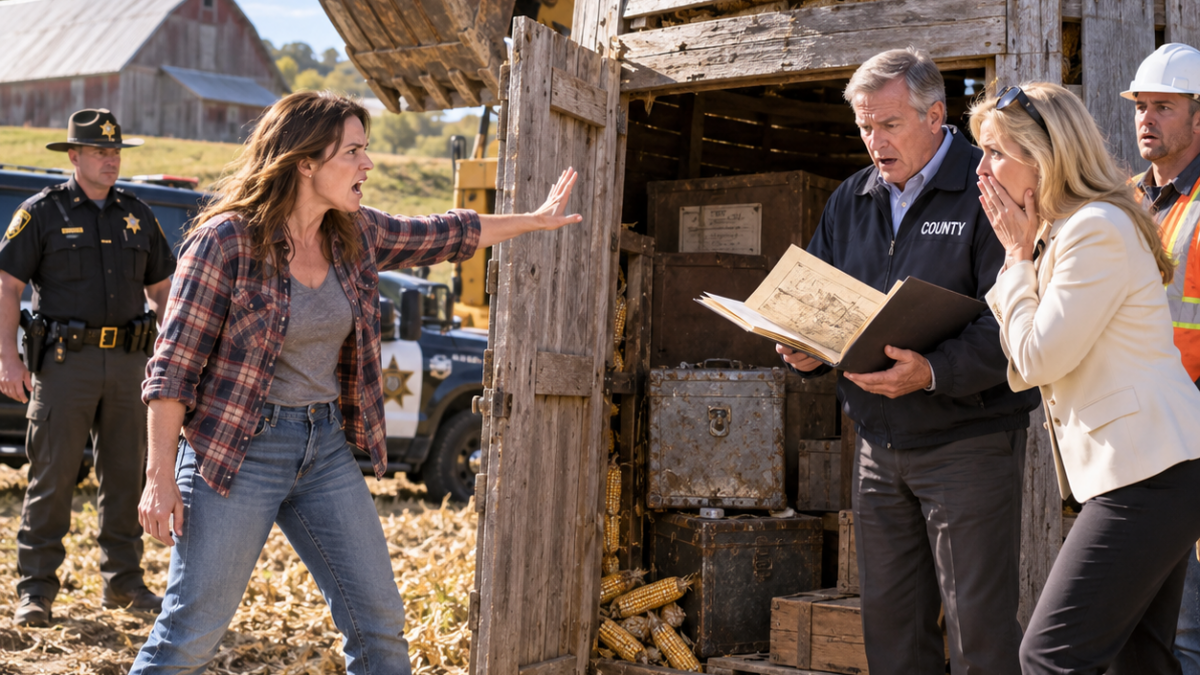
The HOA president gave me thirty days to bulldoze a century-old corn crib on my own land—or she would send a contractor to destroy it and bill me for the privilege.
She stood at my property line with a $500 fine in one hand and a smile that told me she expected me to surrender before sunset.
What she didn’t know was that one phone call to the county would turn her little demolition order into the most expensive mistake of her life.
“Thirty days, Mr. Davies,” Karen Miller said, tapping the violation notice with one manicured fingernail. “After that, the association will act.”
I looked past her toward the old corn crib standing near the edge of my field.
Its oak slats had turned silver with age. The roof leaned just enough to make it look tired, but the frame was solid. It had survived storms, droughts, and generations of hard winters. To Karen, it was an eyesore. To my wife, Sarah, and me, it was one of the reasons we had bought the last ten acres of the old Thompson farm.
I looked back at the paper.
“Five hundred dollars?”
“That’s the preliminary fine.”
“Preliminary?”
Her smile widened.
“If you fail to comply, additional penalties apply. Demolition costs. Administrative fees. Possibly a lien.”
The retired Army logistics officer in me noticed details automatically. Her pearl-white SUV was still running. The notice looked freshly printed. My parcel number had been typed correctly, but the description read “unapproved agricultural accessory structure,” as if the building had appeared last weekend instead of standing there for more than a hundred years.
“Did the board inspect it?” I asked.
Karen folded her arms. “We can see it from the subdivision.”
“That wasn’t my question.”
Her expression hardened.
“Covenants are covenants.”
For twenty years in the Army, I had dealt with supply chains, contracts, inspections, manifests, emergency plans, and people who believed volume could substitute for authority. I had learned that the person waving the most paper was not always the person who had read it.
So I didn’t argue.
I folded the notice once, then again, slid it into my back pocket, and said, “I’ll review it.”
Karen blinked. I think she had expected yelling. Maybe threats. Maybe begging.
Instead, I opened the gate.
“Is that all?”
Her cheeks tightened.
“You should take this seriously, Mr. Davies.”
“I do.”
She gave the corn crib one last disgusted look.
“That pile of rotting wood lowers everyone’s property values.”
Then she climbed into her SUV and drove away.
I stood in the dust until the sound of her engine faded.
Sarah came out from the house carrying two glasses of iced tea.
“What did she want?”
I handed her the notice.
She read the first page, then the second. By the time she reached the demolition language, her face had gone pale.
“They can’t actually do this, can they?”
I looked toward the crib.
When we bought the land two years earlier, the realtor had warned us that a developer had dragged the parcel into the Willow Creek HOA during a late expansion of the subdivision. The arrangement had seemed harmless. We paid dues. We kept our fences repaired. We didn’t bother anyone.
Then Karen Miller won the HOA presidency on a promise to “restore standards.”
Suddenly mailboxes were measured, roof colors questioned, trash cans photographed, and warning letters multiplied.
Until that afternoon, we had escaped her attention.
Sarah lowered the papers.
“Jack?”
I walked toward the corn crib.
Near the foundation, partly hidden by tall grass, a small metal plaque was bolted into the timber. Karen had stood less than forty feet from it.
She had never bothered to walk close enough to read it.
I brushed dirt from the plaque with my thumb, then checked the heavy padlock on the door.
Still secure.
Inside, a low climate-control unit hummed steadily.
Rows of sealed containers sat exactly where they had been inventoried at the last inspection.
Sarah stopped beside me.
“You’re smiling.”
“Am I?”
“Yes. And I know that smile.”
I reached for my phone.
“Who are you calling?”
I scrolled to a county number I had saved months earlier.
“The person Karen should have called before she threatened to send a bulldozer onto this property.”
Sarah stared at me.
“What exactly are you going to tell them?”
I pressed CALL and listened to the first ring.
“That the president of the Willow Creek HOA just put in writing what she plans to destroy.”
On the second ring, someone answered.
And before the afternoon was over, I understood one thing very clearly:
Karen Miller had no idea what she had just declared war on.
PART 2
The voice that answered belonged to Henry Henderson, the agricultural extension officer who had inspected the corn crib eighteen months earlier.
“County Extension. Henderson speaking.”
“Henry, it’s Jack Davies.”
There was a pause.
“Jack. Everything all right with the reserve?”
“That depends on how you define all right.”
Sarah watched me from beside the crib while I unfolded Karen’s notice and read the relevant paragraphs aloud.
At first Henry said nothing.
Then I heard his chair creak.
“Read that demolition sentence again.”
I did.
Another silence.
Longer this time.
“Does she know what’s stored there?”
“She should. There’s a county plaque bolted to the foundation, and the contract is public record.”
“That wasn’t my question.”
I smiled despite myself.
“No. I don’t think she bothered to find out.”
Henry exhaled slowly.
“Jack, nobody touches that building.”
“I know.”
“No contractor. No HOA representative. Nobody.”
“I know.”
“That reserve inventory is under county stewardship.”
“I know that too.”
“Then why do I have the feeling you’re enjoying this?”
Sarah covered her mouth to hide a laugh.
“Because,” I said, “I think Mrs. Miller just handed us a very useful piece of paper.”
Henry chuckled once.
“Send me a copy.”
I photographed every page and emailed it before we hung up.
Then I opened the crib.
The heavy oak door resisted for half an inch before the old hinges gave their familiar groan.
Cool, dry air touched my face.
People imagined seed storage as burlap sacks piled in dusty barns. Ours was nothing like that.
The county had installed sealed food-grade containers on raised pallets, temperature and humidity sensors, rodent barriers, fire detection, and a small backup power system. Each container was labeled by variety, harvest year, germination rate, and rotation schedule.
Corn.
Beans.
Squash.
Wheat.
Several regional vegetable varieties selected because they grew well in our soil and climate.
Enough seed, under the county’s emergency plan, to help plant more than five hundred acres if normal supply chains failed after a major disaster.
The program had started after a sequence of floods, ice storms, and transportation interruptions exposed how dependent our region had become on deliveries from hundreds or thousands of miles away.
Nobody believed a wooden building on my acreage would magically feed an entire county.
That wasn’t the point.
Resilience was about layers.
Backup water.
Backup communications.
Local fuel.
Medical caches.
Seed reserves.
The ability to begin again if the system everyone assumed would always function suddenly didn’t.
I understood that instinctively.
For most of my Army career, I had been a logistics officer.
Hollywood liked to show war as helicopters, gunfire, and heroic speeches.
What kept people alive was often far less dramatic.
Fuel arriving before the generators went dry.
Water reaching a unit before noon.
Replacement parts being in the right container.
Medical supplies being inventoried correctly.
One forgotten pallet could matter more than a dozen shouted orders.
After retirement, I wanted nothing to do with convoys, manifests, or emergency operations.
Then I bought the Thompson place.
And somehow an old corn crib had given me a quieter version of the same responsibility.
Sarah stepped inside and ran her fingers over one of the sealed containers.
“You really think Karen would send people here?”
“Yesterday? No.”
“And today?”
I looked at the violation notice in my hand.
“Today she put it in writing.”
That changed everything.
My instinct was to confront her immediately.
Twenty years earlier, I might have.
Age had taught me something better.
Never interrupt an arrogant person while they are creating evidence.
So the next morning I sat at the kitchen table with coffee, a yellow legal pad, the HOA covenants, our property records, and the county contract.
Sarah came downstairs at seven and stopped when she saw the table.
“Oh no.”
“What?”
“That look.”
“What look?”
“The one where you’re about to turn breakfast into a military operation.”
I slid a mug toward her.
“Coffee?”
She sat.
“Am I going to regret asking what you’re doing?”
“Probably.”
I had divided the issue into four columns.
HOA authority.
County authority.
Property history.
Documentation.
Sarah studied them.
“You color-coded it.”
“I had highlighters.”
“You retired from the Army, Jack.”
“The highlighters didn’t.”
She laughed, but the worry never completely left her face.
That mattered to me.
It was easy to treat Karen as an irritating problem when I was the target.
It stopped being funny when Sarah started wondering whether a contractor might arrive while I was away.
So my first goal wasn’t revenge.
It was certainty.
I wanted documentation strong enough that Sarah could look out the window and know no bulldozer was coming through our gate.
I began with the deed.
The corn crib appeared on a survey from 1924.
An even older farm ledger in county archives referenced a “new slatted corn house” built by the Thompson family before World War I.
The HOA itself had not existed until the subdivision was created generations later.
Then I read the covenants line by line.
Karen had cited a section requiring architectural approval for new agricultural outbuildings.
New.
That word mattered.
So did another section buried twenty-seven pages deeper.
Pre-existing lawful structures were grandfathered unless abandoned, substantially reconstructed, or declared unsafe by an appropriate public authority.
The crib had never been abandoned.
It had been maintained continuously.
The county had inspected it.
And the county certainly hadn’t declared it unsafe.
Quite the opposite.
By noon, I had enough to make Karen’s violation look ridiculous.
I still didn’t call her.
I wrote.
The letter was calm enough to be framed.
I identified the violation number.
I disputed the fine.
I explained the age and grandfathered status of the corn crib.
Then I explained its present function under my contract with the Williamson County Emergency Agricultural Reserve Program.
I attached the contract.
The inspection report.
The property survey.
A photograph of the county plaque.
And a copy of the covenant language Karen had apparently never read.
My final paragraph contained no threat.
Just a request.
“In light of the enclosed documentation, please confirm in writing that Violation 24-117 has been withdrawn and that no demolition action will be taken.”
Sarah read it twice.
“That’s it?”
“That’s it.”
“You’re not going to tell her she’s an idiot?”
“No.”
“Not even politely?”
“Especially not politely.”
“Why?”
“Because if she fixes her mistake now, we’re done.”
Sarah studied my face.
“And if she doesn’t?”
“Then I want the record to show that she was given every chance.”
I sent the package certified mail with return receipt.
Three days later, the tracking page showed delivery.
A week after that, the green card came back.
Someone had signed it in looping black ink.
K. Miller.
I pinned it to the corkboard in my office.
For several days, nothing happened.
I started to believe common sense might have prevailed.
Then a thick white envelope appeared in our mailbox.
Sarah brought it inside.
“From your girlfriend.”
I looked at the return address.
Estates at Willow Creek Homeowners Association.
“Jealous?”
“Terrified.”
I opened it.
The first page showed a balance of $1,600.
Original fine: $500.
Late fee: $100.
Failure to remediate: $1,000.
Behind it was a letter on HOA stationery.
I read it once.
Then again.
Sarah watched my expression.
“Well?”
I handed it to her.
She read aloud.
“Mr. Davies, the board has reviewed your correspondence. A contract between a homeowner and third party does not supersede the legally binding covenants of the Estates at Willow Creek Homeowners Association…”
She stopped.
“Third party?”
“That would be the county.”
She continued.
“The board declines your request for exemption. The offending structure remains subject to removal. Continued noncompliance may result in additional fines, recovery of legal and enforcement expenses, and all remedies available under the governing documents.”
Sarah set the letter on the table.
“Did she even read what you sent?”
“Oh, she read it.”
“How do you know?”
“Because she signed for it.”
“That’s insane.”
“No.”
I looked at Karen’s signature on the certified receipt.
“It’s useful.”
Sarah stared at me.
Sometimes my wife disliked it when I became calm.
She knew anger would eventually cool.
Calm meant I had started planning.
“What happens now?” she asked.
I picked up my phone.
“Now I call Mark.”
Mark Rylance had served with me years earlier before leaving the Army and going to law school.
He was the sort of attorney who could sound friendly while explaining to someone precisely how much danger they were in.
He answered on the fourth ring.
“Jack Davies. Either you miss me or somebody finally sued you.”
“Not yet.”
“Give it time.”
“I have an HOA problem.”
He groaned theatrically.
“I’m hanging up.”
“County emergency seed reserve.”
Silence.
“What?”
I told him the story.
By the time I reached Karen’s second letter, Mark wasn’t joking anymore.
“Send me everything.”
“I already made a folder.”
“Of course you did.”
“Indexed.”
“Of course it is.”
“Electronic copies too.”
“Jack.”
“Yes?”
“I love you.”
“Sarah would object.”
“Professionally, idiot.”
I emailed him the file.
He called back less than an hour later.
“She actually signed for the county contract?”
“For my package containing it.”
“And then issued a second violation?”
“Yes.”
“Do you have proof the structure predates the HOA?”
“Surveys back to 1924. County archive material older than that.”
“Inspection?”
“Current.”
“County designation?”
“Current.”
“Your fees?”
“Paid.”
“Any other HOA violations?”
“None that I know of.”
He went quiet.
Then I heard the tone I remembered from overseas whenever Mark had spotted a flaw in somebody else’s plan.
“Don’t call her.”
“I wasn’t going to.”
“Don’t threaten her.”
“I won’t.”
“Don’t post about it online.”
“Wasn’t planning to.”
“And don’t remove one nail from that building without talking to me.”
“I wouldn’t.”
“Good. We’re going to give them one more formal opportunity to correct this.”
“And if they don’t?”
Mark laughed softly.
“Then Mrs. Miller is going to learn the difference between having authority and merely feeling important.”
His letter went out two days later.
It was more forceful than mine but equally controlled.
He disputed the fines.
Demanded suspension of enforcement.
Requested a formal board hearing under the bylaws.
And advised the HOA that continued threats toward a county-designated emergency facility could expose both the association and individual decision-makers to liability.
Henry Henderson supplied a county letter of his own.
His was only one page.
That page was enough.
The corn crib, it stated, was an active contracted component of the county’s emergency agricultural reserve.
Its contents were county-supervised emergency resources.
Unauthorized interference with the facility could compromise a government preparedness program.
The county “strongly advised” the HOA to cease any action that might damage, obstruct, or interfere with the structure.
We sent everything by certified mail and email.
Then we waited.
The hearing request was acknowledged by Cynthia Bell, the board secretary.
One sentence.
“Your request has been received and will be scheduled in due course.”
In due course turned out to mean almost two months.
Meanwhile, the statements kept arriving.
$1,600 became $2,100.
Then $2,600.
The charges were marked disputed but remained on the account.
Every envelope caused Sarah’s shoulders to tighten.
One evening, I found her sitting at the kitchen table staring at the newest statement.
“What is it?” I asked.
She tapped the line that mentioned lien remedies.
“They can’t take the house, can they?”
The question hit me harder than anything Karen had said.
This wasn’t a game anymore.
Sarah had spent enough years waiting through deployments and moving from one temporary home to another.
This land was supposed to be permanent.
I pulled out the chair beside her.
“Listen to me. We are not losing this property.”
“You can’t promise that.”
“I spoke to Mark this morning.”
“And?”
“He believes their position is extremely weak.”
“Believes.”
“Sarah.”
She looked at me.
There were tears in her eyes, though she was trying hard not to let them fall.
“I’m tired of opening the mailbox and wondering what she’s done to us now.”
I took her hand.
That was the moment my objective changed.
Until then, I wanted Karen to withdraw the violation.
Now I wanted something larger.
I wanted to know why a neighborhood organization had been allowed to make decent people afraid of their own mailboxes.
So I started walking.
Every evening after dinner, I took a route through Willow Creek.
At first it was simple curiosity.
Karen claimed she was defending strict, uniform standards.
I wanted to see how uniformly those standards were applied.
It took less than twenty minutes to find the first answer.
Section 7.04 required trash containers to be hidden from street view except on collection day.
Three houses on Karen’s own cul-de-sac had visible bins.
Photograph.
Address.
Date.
Section 9.02 limited front-yard ornaments to twenty-four inches.
A board member had a concrete flamingo almost three feet tall.
Photograph.
Address.
Date.
Another covenant restricted commercial trailers overnight.
A landscaping trailer sat beside a house three streets over for four consecutive nights.
Photograph.
Address.
Date.
Satellite dishes.
Basketball hoops.
Fence colors.
Decorative sheds.
Parking.
Within one week, I had documented fifty-two apparent violations.
Some were trivial.
That was the point.
Karen had built her presidency on punishing trivial things.
Yet many of the homes I photographed belonged to board members, their relatives, or people displaying campaign signs from Karen’s HOA election.
I sent Mark the spreadsheet.
He called almost immediately.
“You made a spreadsheet.”
“It seemed efficient.”
“There are filters.”
“Yes.”
“Categories.”
“Yes.”
“Board affiliation?”
“Yes.”
“Jack, you were born sixty years too early. You should have been a compliance algorithm.”
“Do you see anything useful?”
He became serious.
“Potentially very useful. Selective enforcement can matter. But photographs alone don’t show who received notices and who didn’t.”
“So we need people.”
“We need records. And people.”
I found the first person by accident.
Her name was Evelyn Gable.
She was seventy-nine, widowed, and trying to use a string trimmer along the edge of her driveway when the machine jammed.
I was walking past.
“Want a hand?”
She eyed me suspiciously.
“I can do it.”
“I believe you.”
The machine coughed and died.
She looked down at it.
“Eventually.”
I smiled.
“I’m Jack. Thompson property.”
Her expression changed.
“The barn man.”
“Corn crib.”
“That’s what I meant.”
I fixed the tangled line and finished the edge for her.
She brought me lemonade.
We sat beneath a maple tree.
When I mentioned Karen’s name, Mrs. Gable’s pleasant face tightened.
“That woman fined me two hundred dollars because my mailbox leaned.”
I thought I had misunderstood.
“Leaning mailbox?”
She pointed.
The new mailbox stood perfectly straight.
“The old one tilted after twenty-five years. Maybe two inches. She sent me three notices in six weeks.”
“Did she give you time to repair it?”
“I tried. My nephew was going to come from Tennessee the next month. She said the violation couldn’t wait.”
“What did replacement cost?”
“Four hundred and seventeen dollars.”
Her eyes dropped to the lemonade glass.
“I live on Social Security and what my husband left me. Four hundred dollars matters.”
I felt my jaw tighten.
“Do you still have the letters?”
She looked up.
“Why?”
I told her about my corn crib.
Not everything.
Just enough.
For the first time in our conversation, she smiled.
“She finally picked on somebody who keeps paperwork.”
“I keep a little.”
Mrs. Gable laughed so hard she coughed.
Then she went inside.
She returned with a folder.
Every notice.
Every payment.
The contractor invoice.
Even photographs.
“You can copy these,” she said.
“Only if you’re comfortable.”
“I wasn’t comfortable when she threatened a lien over my mailbox.”
That night, Mrs. Gable became page one in a new binder.
The next family was the Martinezes.
Their son had once had a treehouse behind their home.
Professionally built.
Safe.
Painted to match the house.
Karen had ordered it removed because the covenants prohibited an unapproved detached structure.
Miguel Martinez showed me pictures of his son standing beside a stack of lumber after it came down.
“He saved allowance for part of it,” Miguel said.
“How old was he?”
“Twelve when we built it. Thirteen when they made us tear it down.”
His wife, Elena, folded her arms.
“Meanwhile, one of Karen’s friends has a gazebo twice the size.”
“Do you have the notices?”
Miguel disappeared upstairs.
He returned with them.
Another family.
Another folder.
The Lees had been pursued for months because their expensive new roof was allegedly a shade darker than the approved charcoal gray.
The Bakers had been fined because a work truck remained in their driveway while Mr. Baker recovered from surgery.
A young couple had been cited for a wheelchair ramp installed for an injured parent, even though they had documentation showing it was temporary and necessary.
Not every dispute made Karen wrong.
Some violations were legitimate.
What disturbed me was the pattern.
People connected to Karen received warnings, favors, extensions, or nothing at all.
People she disliked seemed to receive fines immediately.
And everyone was afraid to challenge her.
“Why didn’t anybody vote her out?” I asked Miguel during one of our meetings.
He laughed bitterly.
“Because until recently, most people didn’t know what was happening to everybody else.”
That was the genius of petty intimidation.
It felt private.
Your mailbox.
Your roof.
Your treehouse.
Your problem.
People felt embarrassed.
They paid.
They stayed quiet.
Then the next household was targeted.
Karen didn’t control Willow Creek because everyone supported her.
She controlled it because everyone believed they were standing alone.
So we changed that.
Our first meeting took place at my dining-room table.
Seven families came.
The second week, eleven.
By the third meeting, we needed folding chairs.
Sarah made coffee.
Mrs. Gable brought cookies.
Miguel brought a cardboard box filled with HOA correspondence.
The atmosphere was strange.
Half support group.
Half evidence room.
People who had lived three streets apart for years were meeting properly for the first time because of the woman who had spent years convincing them to fear one another.
I stood beside a whiteboard.
“We’re not going after anybody personally,” I said.
Several people laughed.
“I’m serious. No social media attacks. No threats. No trespassing. No screaming matches. We document facts.”
Mrs. Gable raised her hand like a schoolgirl.
“Can I call her awful in my own house?”
“That remains constitutionally protected.”
The room laughed.
That laughter mattered.
Fear was starting to break.
Mark joined one meeting by video.
He explained what documentation we needed.
Original notices.
Proof of payment.
Photographs.
Emails.
Meeting minutes.
Requests for hearings.
Responses.
Anything showing inconsistent treatment.
“Do not exaggerate,” he told everyone. “An accurate boring fact is more powerful in court than an exciting fact we can’t prove.”
I liked that sentence.
So did Mrs. Gable.
She wrote it down.
By the time the HOA finally scheduled my hearing, my original folder had become a three-inch binder.
Mark had his own copy.
So did I.
Henry Henderson had been receiving updates from me throughout the process.
When I told him the hearing date, he went silent.
Then he said, “I’m coming.”
“You don’t have to.”
“Yes, I do.”
“You already sent the letter.”
“They ignored it.”
“That seems to be a pattern.”
“Then perhaps they need the letter read to them by the man whose name is at the bottom.”
Two days before the hearing, another county official called.
Robert Evans, the agricultural commissioner.
Henry had briefed him.
Commissioner Evans asked three questions.
Was the HOA still threatening demolition?
Yes.
Had they received written county notice?
Yes.
Was the reserve currently active?
Yes.
“All right,” he said.
“All right what?”
“I’ll attend.”
That changed the temperature.
Karen apparently had no idea.
The hearing was scheduled for seven o’clock in the Willow Creek clubhouse.
Sarah and I arrived twenty minutes early.
The room was beige.
Of course it was beige.
Beige carpet.
Beige walls.
Beige curtains.
Even the folding chairs seemed to have surrendered.
Mark stood beside the entrance holding a leather briefcase.
“You look disappointed,” I said.
“I expected armed guards.”
“Give Karen time.”
Sarah hugged him.
“Please tell me this ends tonight.”
Mark’s expression softened.
“I can’t promise the entire dispute ends tonight. But I can promise something important.”
“What?”
“By the time we leave, every board member in that room will understand the risk Karen created.”
Residents began entering.
Mrs. Gable.
The Martinezes.
The Lees.
The Bakers.
Others I recognized from our meetings.
Then people I didn’t know.
Thirty chairs filled.
Then forty.
The board members entered from a side room.
Five of them.
Karen sat in the center.
Her face changed when she saw Mark.
Then she noticed Commissioner Evans and Henry Henderson sitting near the back.
For the first time since I met her, Karen looked uncertain.
Only for a second.
Then the mask returned.
The meeting began.
Minutes.
Treasurer’s report.
Pool maintenance.
Landscaping.
I watched Karen control each agenda item with the confidence of someone accustomed to never being challenged.
Then she adjusted her papers.
“Item four. Continuing covenant violation, Lot 114, Davies property.”
The room quieted.
Karen looked directly at me.
“The association has made repeated good-faith attempts to secure voluntary compliance concerning a deteriorated agricultural structure visible from common areas and neighboring properties.”
I heard Miguel whisper behind me.
“Good-faith?”
Sarah touched my arm.
Wait.
Karen continued.
“The owner has responded with extensive correspondence disputing the association’s authority and claiming various exemptions the board does not recognize.”
Various exemptions.
Not one mention of the county.
Not one mention of the seed reserve.
Not one mention of the grandfather clause.
She described the corn crib as hazardous.
Unsightly.
A threat to property values.
Then she held up my letters.
“Mr. Davies has unfortunately chosen confrontation rather than cooperation.”
That almost made me laugh.
She concluded with a motion authorizing the association to obtain demolition estimates, assess all related costs against my property, and pursue a lien if necessary.
One board member seconded.
Karen turned toward me.
“Mr. Davies, you requested an opportunity to address the board. You have ten minutes.”
Mark stood.
“As counsel—”
Karen raised a hand.
“The homeowner has ten minutes.”
Mark looked at me.
I smiled.
Ten minutes would be enough to start.
I carried the binder to the front.
When I set it on the lectern, the thud echoed through the room.
“My name is Jack Davies. Lot 114.”
I looked at each board member.
Then Karen.
“Mrs. Miller has described this as a dispute over an unapproved deteriorating agricultural structure. That description leaves out three important facts.”
I held up one finger.
“The structure is more than a century old and predates this association.”
Second finger.
“It has passed county inspection and is structurally maintained.”
Third.
“It is a contracted component of the Williamson County Emergency Agricultural Reserve.”
Murmurs.
I opened the binder.
“Every member of this board has had access to that information for more than a month.”
Cynthia, the secretary, looked sharply at Karen.
That was interesting.
I placed a large copy of the county contract on an easel.
Karen interrupted.
“Your private agreement with—”
“Please let him finish,” Cynthia said.
Karen stared at her.
Cynthia looked nervous but held her ground.
I continued.
“This contract authorizes the county to use the corn crib as a secure reserve site. The building currently stores inspected emergency seed inventory intended for agricultural recovery following a major disaster or supply disruption.”
The murmuring grew.
A man near the aisle leaned toward his wife.
“Seed?”
I showed the inspection report.
The county designation.
The photographs.
The survey.
Then the covenant clause grandfathering lawful pre-existing structures.
“I sent this documentation by certified mail.”
I held up the signed receipt.
“Received and signed for by Karen Miller.”
Several heads turned toward her.
Karen’s jaw tightened.
“I also sent a county letter warning the board against interference with the reserve.”
I held up the delivery confirmation.
“At no time did I receive a substantive response addressing that letter.”
I looked toward the other board members.
“Did all of you receive copies?”
Silence.
Then Cynthia spoke.
“I didn’t.”
Karen whipped around.
“That correspondence was reviewed by the executive committee.”
“There is no executive committee,” Cynthia said.
The room changed.
I glanced at Mark.
His eyebrow rose.
That was new.
The treasurer leaned toward Karen.
“I never saw the county letter either.”
Karen’s cheeks flushed.
“This is not the appropriate—”
“It seems extremely appropriate,” someone called from the audience.
A few people clapped.
Karen struck the table with her palm.
“Order.”
I waited until the room settled.
“Perhaps this was simply a communication failure.”
I saw Mark suppress a smile.
“But there’s a second issue.”
I turned the easel page.
On it was a photograph of a concrete flamingo.
People laughed immediately.
Karen looked confused.
I read the covenant.
“Section 9.02. Decorative lawn objects exceeding twenty-four inches require written approval.”
Next photograph.
Trash containers.
“Section 7.04.”
Next.
Commercial trailer.
“Section 8.05.”
Next.
Unapproved basketball goal.
Fence.
Satellite dish.
Shed.
I didn’t shout.
I didn’t editorialize.
I gave dates.
Addresses.
Covenant numbers.
Then I showed the landscaping trailer.
“This trailer was photographed overnight on four separate dates. The property belongs to Mrs. Miller’s brother-in-law.”
The room erupted.
Karen stood.
“This is a personal attack.”
“No,” I said. “It’s a consistency question.”
“You have been spying on residents.”
“From public streets.”
“This has nothing to do with your violation.”
“It has everything to do with enforcement.”
I showed another photograph.
The treasurer’s satellite dish.
He looked as though he wanted to crawl under the table.
“I’m not asking that any of these homeowners be fined,” I said.
That quieted people.
“In fact, I hope they aren’t. Most of these things are harmless. What I’m asking is why harmless conditions are ignored at some homes while other families receive aggressive fines for similar or smaller issues.”
I gestured toward Mrs. Gable.
“She paid more than four hundred dollars to replace a mailbox because she was threatened with escalating penalties.”
Mrs. Gable stood slowly.
“My husband put that mailbox in twenty-three years ago.”
Karen closed her eyes briefly.
Miguel stood next.
“My son’s treehouse was ordered down.”
Elena rose beside him.
“The approved gazebo behind Karen’s friend’s house is bigger than the treehouse was.”
Then Mr. Lee stood.
Then Mrs. Baker.
Karen tried to regain control.
“This hearing is about Lot 114.”
“No,” Cynthia said quietly.
Everyone looked at her.
The board secretary had tears in her eyes.
“I think it’s about us now.”
Karen stared at her.
“You’re out of order.”
“I’m a board member.”
Cynthia turned toward the audience.
“I received Mr. Davies’s hearing request. I did not receive the county letter he says was included.”
“It went to the president’s office,” Karen snapped.
“And then?”
Karen didn’t answer.
Cynthia looked toward me.
“Do you have another copy?”
“I do.”
I carried it forward.
Cynthia took it.
She read the first paragraph.
Then the second.
Her face changed.
She handed it to the treasurer.
Karen reached for it.
He moved it away from her.
That tiny motion told me her control was breaking.
I glanced toward the back.
Commissioner Evans stood.
He was tall, gray-haired, and wore a county polo shirt beneath a dark jacket.
He didn’t need a uniform.
Authority looked different when it came from someone who didn’t have to advertise it.
“My name is Robert Evans,” he said. “Agricultural Commissioner for Williamson County.”
The room became silent.
He walked forward.
Karen swallowed.
“Commissioner, this is an internal association—”
“No, Mrs. Miller.”
His voice wasn’t loud.
It didn’t need to be.
“It stopped being solely an internal association matter when your board threatened to demolish a contracted county reserve facility after receiving written notice of its status.”
Karen looked toward the other board members.
Nobody rescued her.
Commissioner Evans faced all five.
“The corn crib at Lot 114 currently contains strategic seed inventory maintained under county emergency preparedness protocols. Mr. Davies is the contracted custodian. The facility is inspected. Its contents are inventoried. The county has invested public resources in maintaining that site.”
He paused.
“If your association damages it, obstructs access to it, or knowingly interferes with its operation, the county will seek immediate injunctive relief.”
The treasurer’s face drained.
Commissioner Evans continued.
“And because you were formally notified before tonight, no board member should leave this room believing continued action is based on ignorance.”
Karen finally found her voice.
“You’re saying an HOA has no right to enforce its covenants because someone stores seeds in a shed?”
Evans looked at her for several seconds.
“I’m saying calling it a shed does not change what it is.”
A few people laughed.
He didn’t.
“Nor does calling a century-old grandfathered structure ‘new’ make it new.”
Karen’s fingers tightened around her pen.
“We have counsel.”
“Good,” Evans said. “I recommend you call them.”
He returned to his seat.
For perhaps three seconds, nobody moved.
Then Mark stood.
He lifted his briefcase.
Karen looked at it.
Something in her expression told me she understood before he opened it.
“Madam President,” Mark said, “since the board’s proposed motion includes authorizing demolition expenses and lien remedies against my client’s property, I need to address the association’s legal exposure.”
“You were not given the floor.”
One of the other board members spoke.
“I want to hear him.”
Karen turned sharply.
“Excuse me?”
The man shifted nervously.
“If we’re being threatened with a county injunction, I want to hear the attorney.”
“So do I,” Cynthia said.
Karen looked down the table.
Her majority was disappearing in real time.
Mark stepped forward.
“My name is Mark Rylance. I represent Jack and Sarah Davies.”
He placed one packet on the table.
“This is a draft complaint prepared for filing in Williamson County Superior Court.”
The room became completely still.
“I emphasize the word draft because my clients have repeatedly attempted to resolve this matter without litigation.”
He placed another packet beside the first.
“The complaint documents the association’s threatened interference with a county contract, the disputed fines, the board’s notice of the facility’s status, and evidence suggesting a broader pattern of inconsistent covenant enforcement.”
Karen stared at the packets.
“You’re threatening us.”
“No.”
Mark’s voice remained mild.
“I’m informing you.”
He gestured toward the residents.
“Several homeowners have provided documentation of their own disputes. If litigation becomes necessary, my clients will seek appropriate declaratory and injunctive relief, recovery of damages and fees where available, and discovery concerning the board’s enforcement practices.”
The word discovery landed harder than shouting could have.
Anyone who has ever dealt with a lawsuit knows why.
Discovery means records.
Emails.
Invoices.
Bank statements.
Minutes.
Things people assumed would remain private.
Karen’s face changed.
Not much.
Just enough.
Mark noticed too.
I saw him file it away.
The treasurer leaned toward Cynthia.
“How much could this cost?”
Mark answered without being asked.
“That depends almost entirely on what the association does next.”
Karen slammed both hands onto the table.
“I will not allow one disgruntled homeowner to bully this board.”
Mrs. Gable stood.
“He’s not the bully.”
A ripple went through the room.
Karen pointed toward her.
“You are out of order.”
Mrs. Gable’s voice trembled.
But she kept speaking.
“You made me choose between groceries and fixing a mailbox that worked perfectly well.”
The room went silent.
Karen lowered her hand.
Miguel stood.
“You made my boy watch us tear down something he helped build.”
Mr. Lee rose.
“You threatened legal action over roof shingles your architectural committee had already approved.”
Another woman stood.
“You fined us because my mother’s medical ramp was visible from the street.”
Then another.
And another.
People weren’t screaming.
That made it stronger.
One story at a time.
Karen had spent years reducing each family to a violation number.
Now those numbers had faces.
The meeting dissolved.
The proposed demolition motion was never voted on.
One board member moved to table it.
Another seconded immediately.
Karen objected.
Nobody cared.
At 9:18 p.m., Cynthia adjourned the meeting.
Residents remained in the room talking.
Karen gathered her papers with stiff, violent movements.
When she passed me, she stopped.
“This isn’t over.”
Sarah stepped closer to me.
I looked Karen directly in the eyes.
“You’re right.”
She seemed startled.
I continued.
“Because you still haven’t withdrawn the fines.”
Her face twisted.
“You think you’re clever.”
“No.”
I glanced toward Commissioner Evans.
“I think I’m documented.”
Karen walked away.
Outside, Mark joined us beside my truck.
Sarah hugged him.
“That was terrifying.”
Mark smiled.
“You did well.”
“I sat in a chair.”
“You didn’t strangle anyone. That’s often half the legal strategy.”
Commissioner Evans came outside.
He shook my hand.
“I hope they come to their senses.”
“So do I.”
Mark looked toward the clubhouse doors.
“I’m less optimistic.”
He had noticed what I noticed.
Karen had been embarrassed publicly.
People like her often treated embarrassment as an injury requiring retaliation.
We were right.
At 7:12 the next morning, my phone started buzzing.
Not Karen.
Miguel.
“Check your email.”
The HOA treasurer had resigned.
His message had gone to the entire community.
He wrote that after reviewing information presented at the hearing, he could no longer support the current leadership and had serious concerns about the association’s legal and financial exposure.
By noon, another board member resigned.
Two days later, a third.
The five-member board lost its quorum.
Without enough directors, it couldn’t lawfully conduct normal board business.
Karen remained president in title.
But the machine she had used to intimidate residents had stalled.
That should have ended it.
Instead, the management company sent a letter that detonated the neighborhood.
Their attorney had reviewed the dispute.
Until coverage questions could be resolved, the company warned, the HOA’s directors-and-officers insurer might reserve or deny coverage for conduct found to be intentional, dishonest, or outside protected board duties.
The letter did not say coverage was definitely gone.
It didn’t need to.
Every homeowner understood the risk.
If the HOA spent tens of thousands defending Karen’s conduct and insurance refused to pay, whose money would be used?
The homeowners’.
Suddenly the corn crib wasn’t Jack Davies’s problem.
It was everyone’s checking account.
The recall petition appeared that evening.
Within forty-eight hours, it had far more signatures than required.
An emergency membership meeting was scheduled.
This time Karen wasn’t sitting behind the board table.
She was sitting in the audience.
I almost felt sorry for her.
Almost.
The clubhouse was packed.
People stood along the walls.
Cynthia, serving temporarily as meeting chair because the board lacked a quorum, explained the recall procedure.
Karen was allowed to speak.
She walked to the front holding several pages.
She began with the same argument she had made from the beginning.
Standards.
Property values.
Order.
Rules.
Then her voice changed.
“I have volunteered hundreds of hours to this association. I have sacrificed my own time to preserve this community while others complained from the sidelines.”
Some residents shifted uncomfortably.
Not everything she said was false.
HOA board work could be thankless.
Karen had probably spent many nights answering emails no one else wanted to answer.
For a few minutes, I saw something more complicated than the caricature she had become.
Maybe she had started with sincere intentions.
Maybe she truly believed uniformity protected value.
Maybe each small victory had convinced her that more control meant better leadership.
Power rarely announced the exact moment it became abuse.
Karen finished.
Then residents spoke.
Mrs. Gable went first.
She carried her old mailbox notice.
“My husband died three years before Mrs. Miller became president. He installed that mailbox with his own hands.”
Her voice cracked.
“I knew it leaned. I also knew it still worked. I asked for one month so my nephew could help me. Instead, I was threatened with another fine.”
She looked at Karen.
“You called that protecting our community. I called it crying in my kitchen because I couldn’t afford to keep up with your letters.”
Nobody moved.
Miguel spoke next.
Then the Lees.
Then the family with the wheelchair ramp.
Finally Cynthia stood.
She looked directly at Karen.
“I served on your board, and I should have asked more questions.”
Karen’s eyes hardened.
Cynthia continued.
“I trusted that when correspondence came to the president, the rest of us would be informed. I learned at the last meeting that important government correspondence had not been shared with me.”
Karen shook her head.
“That is a distortion.”
“Then the records can show that.”
That sentence drew murmurs.
The vote was conducted by written ballot.
Sarah squeezed my hand while volunteers counted.
I wasn’t nervous about the outcome.
I was nervous about what came after.
Removing one person didn’t automatically fix a culture.
Cynthia returned to the microphone.
“Two hundred nineteen eligible votes were cast.”
Karen stared straight ahead.
“For removal: two hundred and three.”
A sound moved through the room.
Not cheering at first.
More like a collective exhale.
“Against removal: sixteen.”
Karen closed her eyes.
“For appointment of an interim board pending a special election—”
I stopped listening.
Sarah rested her head against my shoulder.
“It’s over.”
“No,” I whispered.
“What?”
“This part is.”
Karen rose before the meeting ended.
Nobody stopped her.
Nobody applauded.
Nobody shouted.
She simply walked alone through the clubhouse doors.
For someone who had once entered every room as though it belonged to her, that quiet exit felt heavier than humiliation.
The next morning, the interim board voted unanimously to withdraw the corn crib violation and erase every related fine.
At 10:14 a.m., the email arrived.
Sarah read it first.
Then she walked outside to where I was replacing a fence board.
“Jack.”
I looked up.
She held her phone.
“They dropped it.”
I set down the hammer.
“All of it?”
“All of it.”
She crossed the yard and wrapped her arms around me.
For months, I had told her we would win.
Only when I felt her crying against my shoulder did I understand how badly she had needed the fight to end.
“I’m sorry,” I whispered.
“For what?”
“That our peaceful place stopped feeling peaceful.”
She pulled back.
“You didn’t do that.”
“No. But I kept telling myself it was just paperwork.”
“It wasn’t.”
“I know.”
She wiped her face.
“Can we go one week without discussing covenants?”
“Absolutely.”
“Or Karen?”
“Yes.”
“Or injunctions?”
“Deal.”
“Or binders?”
I hesitated.
Sarah narrowed her eyes.
“One week.”
“Fine.”
We got three days.
On Thursday, Mark called.
“Remember how you wanted this finished?”
“That sounds dangerous.”
“The interim board gave us access to records voluntarily.”
“And?”
“And we have a problem.”
I went inside and closed the office door.
“What kind?”
“The kind that explains why Karen looked nervous when I said discovery.”
The new board had hired an independent accountant to review legal exposure and financial practices.
Several payments didn’t make sense.
For three years, the HOA had paid unusually high landscaping invoices to Miller Outdoor Services.
The company wasn’t owned by Karen.
It belonged to her brother-in-law.
The same brother-in-law whose commercial trailer I had photographed.
That alone wasn’t illegal.
Related-party contracts could be legitimate if disclosed, competitively priced, and properly approved.
But the invoices were strange.
“Seasonal enhancement.”
“Executive grounds maintenance.”
“Special landscape materials.”
No addresses.
No detailed labor.
No work descriptions.
The accountant compared them to actual maintenance records.
The numbers didn’t align.
Then somebody found photographs attached to one vendor email.
Landscaping work.
Beautiful work.
Stone edging.
Mature shrubs.
Irrigation.
Flowering trees.
At Karen Miller’s private house.
Paid through invoices submitted to the HOA.
I leaned back in my chair.
“How much?”
“We don’t know yet.”
“Does the board?”
“They know enough to keep digging.”
I felt no excitement.
That surprised me.
For months I had imagined the satisfaction of proving Karen wrong.
This was different.
A covenant dispute was one thing.
Taking neighbors’ money for private benefit, if that was what the records ultimately showed, was another.
“Mark.”
“Yeah?”
“Make sure this is real before anybody accuses her publicly.”
“That’s exactly what we’re doing.”
More records emerged.
Catered lunches billed as committee expenses.
There was nothing necessarily wrong with buying food for legitimate board meetings.
Except several dates matched no scheduled HOA meetings.
One invoice listed twelve meals.
Cynthia recognized the date.
Karen had hosted her private bridge group that afternoon.
Then the accountant found duplicate maintenance charges.
Credit-card reimbursements.
Fuel purchases.
A decorative stone delivery.
The interim board stopped handling it internally.
They referred the records to the association’s attorney.
Then to law enforcement.
I stayed out of that part.
So did Mark, except where our civil claims overlapped.
Our lawsuit had not yet formally been filed when the board withdrew the corn crib violation.
Several of the families wanted to proceed.
Not because they wanted millions.
They wanted restitution.
Mrs. Gable had paid fines.
The Martinezes had paid demolition costs.
The Lees had paid attorney consultation fees.
Others had lost money and sleep because of enforcement practices that now looked increasingly indefensible.
Mark organized mediation.
The HOA’s new board agreed.
The insurer participated while reserving certain coverage questions.
For once, everybody in the room wanted a solution.
I sat across from Cynthia during the mediation.
She looked exhausted.
“I’m sorry, Jack.”
“You didn’t send the notice.”
“I sat on the board.”
“You also spoke up when you learned what was happening.”
“Too late.”
“Late isn’t the same as never.”
She nodded.
That distinction mattered to me.
If our entire goal became punishment, we wouldn’t be much better than the people we complained about.
By evening, we had the framework of an agreement.
Every disputed fine connected to the plaintiffs would be reviewed and, where improperly imposed, refunded or canceled.
Documented out-of-pocket losses would be compensated.
Reasonable legal expenses would be addressed.
The HOA would adopt an independent enforcement-review process.
Pre-existing agricultural structures would receive explicit protection.
Government-designated facilities would be exempt from aesthetic enforcement inconsistent with their public function.
No more one-person pipeline from complaint to punishment.
Future violation notices would require evidence and review.
Homeowners would receive a meaningful opportunity to be heard before major penalties.
The association would issue a written apology.
I had one additional request.
The mediator looked at me.
“What is it?”
“Mrs. Gable’s mailbox.”
Everyone turned toward me.
“She replaced it because of the association’s enforcement. She should be reimbursed.”
Mrs. Gable, sitting beside me, whispered, “Jack.”
The mediator nodded.
“Already included.”
Mrs. Gable started crying.
Not dramatically.
Quietly.
She pressed a handkerchief to her face.
Four hundred dollars wasn’t a fortune to everyone in that room.
To her, it represented the moment she had felt powerless.
Getting it back mattered.
My own settlement share was larger than I expected.
Sarah and I discussed what to do with it.
Pay down the mortgage.
Travel.
Invest it.
Instead, part of it went straight back into the corn crib.
The old climate-control system worked, but the county had wanted an upgrade.
We installed a modern unit.
Backup monitoring.
Better insulation that didn’t alter the historic exterior.
New seals.
A more reliable generator connection.
Then I created a maintenance account so future repairs wouldn’t depend entirely on us.
When Henry came for the next inspection, he stood inside and whistled.
“This is nicer than my office.”
“It smells better too.”
He looked at the new monitoring panel.
“Humidity?”
“Forty-one percent.”
“Backup?”
“Automatic.”
“Remote alarm?”
“My phone, Sarah’s phone, your office.”
Henry shook his head.
“Remind me never to threaten one of your sheds.”
“Corn crib.”
“Right. Sacred corn crib.”
The fight had changed the neighborhood faster than I expected.
The new board announced a six-month pause on punitive fines for ordinary correctable issues.
Instead, residents would receive a courtesy notice and reasonable time to fix genuine problems.
Anonymous complaints alone would no longer trigger punishment.
Three directors had to review serious enforcement actions.
Meeting minutes became detailed and public.
Budgets were posted.
Vendor relationships had to be disclosed.
Nobody called it revolutionary.
That was the point.
Good governance was mostly boring.
Within a few months, the quarterly newsletter contained more information about barbecues and pool schedules than violations.
It was wonderful.
The concrete flamingo remained in the front yard where I had photographed it.
One evening, Sarah and I walked past.
She pointed.
“Still illegal?”
“Technically.”
“Are you reporting it?”
“Absolutely not.”
She smiled.
“You’re getting soft.”
“No. I’m developing respect for large concrete birds.”
The Martinezes rebuilt their son’s treehouse.
This time they submitted an application.
The new board approved it in five days.
Miguel invited me over when the first beam went up.
His son, Mateo, was older now and trying very hard to act uninterested.
“You helping?” I asked.
He shrugged.
“Maybe.”
Miguel handed him a drill.
Five minutes later he was measuring boards like an engineer.
Mrs. Gable got her reimbursement check.
She brought it to my house before depositing it.
“I wanted you to see this.”
She held it as though it were a certificate.
“Four hundred and seventeen dollars.”
“That was the replacement cost?”
“Every penny.”
“What will you do with it?”
She smiled.
“Something irresponsible.”
A week later, she bought a bright red patio umbrella and two chairs for her front porch.
Karen would have hated them.
That made Mrs. Gable love them more.
The criminal investigation continued quietly.
Karen’s house went on the market.
The pearl-white SUV disappeared first.
Then contractors began removing items from the house.
I never knew whether she was selling because of legal expenses, embarrassment, or simply because living in Willow Creek had become unbearable.
One afternoon I drove home and saw her standing beside a moving truck.
For a moment, neither of us looked away.
Months earlier, I had imagined that moment.
I thought I would feel victorious.
I didn’t.
She looked smaller.
Not physically.
Just stripped of the office, the paperwork, the authority, the board table, and the people who had once nodded whenever she spoke.
I pulled into my driveway.
She walked toward the property line.
Sarah saw her from the porch and came outside.
Karen stopped several feet away.
“I suppose you’re happy.”
I considered the question.
“I’m relieved.”
“You destroyed my reputation.”
“No.”
Her mouth tightened.
“You turned everyone against me.”
“I showed them documents.”
“Same thing.”
“No, Karen. It isn’t.”
She stared at the corn crib.
“That building started all of this.”
“No.”
I shook my head.
“The demolition notice started it.”
“You could have simply cooperated.”
“With destroying a county reserve?”
“You know what I mean.”
“I honestly don’t.”
Her face flushed.
“You wanted to embarrass me.”
“At first, I wanted you to withdraw a $500 fine.”
“You built an entire campaign.”
“After you ignored the county and kept escalating.”
She looked toward our house.
Then toward hers.
For a moment the anger disappeared.
What replaced it was exhaustion.
“I worked harder for this neighborhood than any of them.”
“I believe you probably did.”
That surprised her.
I continued.
“But working hard doesn’t make every decision right.”
“You think Cynthia will do better?”
“I hope so.”
“They’ll learn. Everyone complains until they sit in that chair.”
“Maybe.”
She looked down.
Then she said something I never expected.
“I thought if I let one thing go, everything would go.”
I waited.
She gestured vaguely toward the subdivision.
“People paint what they want. Park what they want. Build whatever they want. Then values fall. The neighborhood looks neglected. Somebody has to draw a line.”
“There’s a difference between drawing a line and enjoying punishment.”
Her eyes snapped back to mine.
“You don’t know what I enjoyed.”
“That’s fair.”
I paused.
“But I know Mrs. Gable asked for time and you said no.”
Karen looked away.
“I know Miguel asked you to reconsider the treehouse.”
Silence.
“And I know you received a county letter and didn’t share it with the full board.”
Her shoulders sagged slightly.
“You won.”
“That wasn’t supposed to be the point.”
She laughed without humor.
“It always is.”
“No.”
I looked at the old crib.
“The point was that it would still be standing when this was over.”
Karen followed my gaze.
The afternoon light came through the slats.
For once, she didn’t call it ugly.
She turned away.
“I hope you enjoy it.”
“I do.”
She walked back toward the moving truck.
That was the last conversation we ever had.
Months later, the district attorney’s office announced the resolution of the financial case.
Karen pleaded guilty to an embezzlement-related felony charge tied to HOA funds.
The final amount she was ordered to repay was more than fifty thousand dollars.
She received probation, community service, and restitution rather than prison.
Some residents complained the punishment was too light.
Others said public disgrace and financial ruin were enough.
I didn’t celebrate.
Accountability was necessary.
Humiliation didn’t need an audience.
The restitution check eventually arrived at the HOA.
That created another debate.
What should they do with money that had been taken from the community?
Reduce dues?
Rebuild reserves?
Return it proportionally?
Miguel, who had since been elected board president, proposed something unexpected.
A playground.
Karen had repeatedly rejected proposals for one, citing insurance costs and maintenance.
Now the board obtained estimates, worked through the liability questions, and put the decision to residents.
It passed overwhelmingly.
They built it near the clubhouse.
Swings.
Slides.
Climbing structures.
Benches beneath shade trees.
When someone suggested naming it Miller Park as a joke, Miguel immediately said no.
“We’re not building monuments to grudges.”
Instead they called it Freedom Park.
At the dedication, Mrs. Gable sat beneath her bright red umbrella hat.
Mateo Martinez helped younger kids onto the climbing wall.
Sarah stood beside me.
Miguel stepped to the microphone.
“This park was paid for with money returned to this community,” he said. “I think the best thing we can do with it is turn something that divided us into something that brings people together.”
He kept the speech short.
Kids don’t care about speeches when a new playground is waiting.
The moment he finished, they ran.
The sound of them laughing carried across the grass.
Sarah slipped her hand into mine.
“Now that,” she said, “is revenge.”
I looked at her.
“I thought you didn’t believe in revenge.”
“I believe in poetic accounting.”
I laughed.
She nodded toward the playground.
“She wanted everything quiet, controlled, and beige.”
A child screamed happily from the top of the slide.
Sarah smiled.
“This seems better.”
It did.
The corn crib became a local curiosity after that.
People walking through the neighborhood would stop near the edge of our property.
Some knew the story.
Others only knew it as the old farm building that had somehow defeated an HOA president.
I corrected them when I could.
“The building didn’t defeat anybody.”
One teenager asked, “Then what did?”
“Certified mail.”
He looked disappointed.
A local newspaper eventually wrote about the county reserve program.
The reporter asked me to stand beside the crib for a photograph.
I almost refused.
Then Henry pointed out that public awareness helped justify funding.
So I agreed.
The article focused less on the HOA dispute and more on emergency preparedness.
That was fine with me.
The reserve was always more important than the fight.
The county expanded the program.
Two farms and a cooperative garden added reserve facilities.
I joined a volunteer food-security task force.
My military logistics background became useful again in ways I hadn’t expected.
At our first meeting, a rancher looked at my name tag.
“You’re the corn crib guy.”
“I’m afraid so.”
He laughed.
“My HOA doesn’t know I’m here.”
“You have an HOA on a ranch?”
“No. I just wanted to make you nervous.”
We became friends.
The task force worked on practical things.
Seed rotation.
Emergency fuel.
Local distribution.
Backup communications.
Partnerships with schools and farmers.
It wasn’t glamorous.
That made me happy.
Life began to feel ordinary again.
Sarah planted tomatoes.
I repaired fence.
The HOA sent dues notices without threats.
Mrs. Gable waved from her red chair.
Mateo’s treehouse acquired a rope ladder that technically hadn’t been included in the approved plan.
Nobody cared.
One autumn morning, a dusty pickup came slowly up our driveway.
I recognized the driver before he stepped out.
Earl Thompson.
The man who had sold us the property.
He was eighty-two then, thin and stooped, with hands that looked carved from the same old oak as the crib.
I hadn’t seen him since the closing.
He leaned against the truck.
“Heard you had some trouble.”
I smiled.
“Word travels slowly.”
“I don’t get out much.”
He looked past me.
The corn crib stood in the autumn sun.
Earl started walking toward it.
I followed.
He placed one palm against a vertical timber.
For a long time, he said nothing.
“My granddaddy built most of this.”
“I found a record from around 1912.”
“Sounds right.”
He rubbed the wood.
“Cypress low. Oak up high. He said if you put good wood where the rain could get to it, the building would outlive the fool who wanted to tear it down.”
I laughed.
“Apparently.”
Earl looked at the new electrical conduit.
“What’s all that?”
I opened the door.
He stepped inside.
Cool air touched us.
He stared at the sealed containers.
“What in the world?”
I explained the reserve.
The county program.
The seeds.
The rotation schedule.
The emergency plan.
Earl walked between the pallets.
His eyes filled with tears.
I pretended not to notice until he wiped them himself.
“My father stored seed corn right there.”
He pointed toward the back wall.
“Every winter.”
He moved a few steps.
“Beans there.”
Then he laughed softly.
“You people put computers in it.”
“One sensor.”
“Computer.”
“Fine.”
He turned slowly.
“My granddaddy would think we’d lost our minds.”
“Probably.”
“But he’d understand the seeds.”
I nodded.
Earl walked back outside.
He sat on an overturned bucket.
“You know why he built it?”
“To store corn?”
“That’s what it did.”
He looked across the fields.
“But he used to tell my father a farm without saved seed was a farm living on borrowed time.”
The wind moved through the dry grass.
“He’d lived through years when money couldn’t buy what people needed because there wasn’t any to buy. So he stored enough to plant again.”
Earl looked back at the crib.
“That building was his promise that one bad season wouldn’t be the last season.”
I had spent months describing the corn crib in legal language.
Pre-existing structure.
County-designated facility.
Contracted reserve site.
Emergency asset.
Earl explained it better in one sentence.
A promise that one bad season wouldn’t be the last.
He looked at me.
“They tell me you stood up to some woman who wanted it gone.”
“It was more complicated than that.”
“Usually is.”
“She was HOA president.”
“Don’t know what that is.”
“Consider yourself fortunate.”
He smiled.
Then his expression became serious.
“You did right.”
I looked away.
Coming from Earl, those three words meant more than the settlement.
More than the public apology.
More than seeing Karen recalled.
He had trusted Sarah and me with the last piece of his family farm.
For the first time, I knew he believed we had earned that trust.
Before leaving, Earl asked if he could take one photograph.
Not of himself.
Of the crib.
I offered to print one for him.
He shook his head.
“Got a phone.”
He pulled out an ancient flip phone.
I stared at it.
“That has a camera?”
“Supposedly.”
The photograph was terrible.
Half his thumb covered the lens.
He loved it anyway.
A few months later, Sarah had a professional photograph taken at sunset.
The corn crib stood against an orange sky, every weathered board glowing.
She framed it and hung it over our fireplace.
Beside it, months later, we placed a tiny handmade model that arrived anonymously in the mail.
I knew immediately who had sent it.
The handwriting on the note belonged to Mrs. Gable.
“Thank you for helping me feel safe in my own home again.”
That note nearly broke me.
Because in the end, the story wasn’t really about seeds.
Or covenants.
Or Karen.
It was about safety.
The kind Sarah had wanted when we bought the land.
The kind Mrs. Gable had lost when every HOA envelope frightened her.
The kind a community should provide rather than threaten.
A year after the confrontation, Willow Creek held its summer barbecue beside Freedom Park.
Someone set up tables.
Children ran between the playground and the field.
Miguel handled the grill until he burned three hamburgers and I relieved him of command.
“You’re enjoying this way too much,” he said.
“Logistics.”
“It’s meat.”
“Supply-chain management.”
Mrs. Gable sat under her red umbrella.
The Lees brought desserts.
Cynthia, no longer on the board, brought potato salad.
Henry Henderson arrived carrying a box.
“What’s that?” I asked.
He opened it.
Small envelopes of sweet-corn seed.
“Public education.”
“You brought seeds to a barbecue?”
“You brought a corn crib to an HOA.”
“Fair.”
We gave packets to families who wanted to try growing a few rows at home.
Nothing from the emergency inventory.
Just ordinary seed.
Mateo took one.
“So this is what caused all the trouble?”
“No,” I said.
“Adults caused the trouble.”
Sarah heard me.
“Accurate.”
Commissioner Evans arrived later.
He held a paper plate in one hand and looked toward my property.
“You know what county staff calls your reserve now?”
“I’m afraid to ask.”
“The Fort.”
“Absolutely not.”
“The Seed Fort.”
“Worse.”
He smiled.
“You should hear what Mark calls it.”
“What?”
“The most expensive building nobody demolished.”
That evening, after everyone left, Sarah and I carried folding chairs back toward the house.
The field smelled like cut grass and charcoal.
Freedom Park was empty.
The clubhouse lights were shutting off one by one.
At the corn crib, I stopped.
Sarah did too.
The new control system hummed quietly inside.
“You know,” she said, “Karen was right about one thing.”
I looked at her.
“What?”
“It doesn’t match the subdivision.”
I laughed.
“No.”
“It’s old.”
“Yes.”
“Uneven.”
“Yes.”
“Silver instead of beige.”
“Definitely.”
She rested her hand against the timber.
“And it’s the most beautiful building here.”
I looked at my wife.
“You may be biased.”
“I survived six months of certified mail for it. I’ve earned bias.”
We stood there in silence.
The building had outlasted generations.
It would probably outlast me.
That thought no longer made me feel small.
It made me feel connected.
Earl’s grandfather built it because he wanted his family to be able to plant another season.
Earl’s father stored seed there.
Earl inherited it.
Then he sold the land to me.
The county filled it with another generation’s promise.
Different people.
Same idea.
Preserve what matters.
Prepare for what might come.
Leave something useful behind.
Several years later, Earl died peacefully.
His daughter called me.
She said he had kept the terrible flip-phone picture of the corn crib on a table beside his chair.
At his memorial, she asked if I would say a few words.
I stood in a small country church filled with farmers, grandchildren, old friends, and people who had known Earl far longer than I had.
I didn’t mention Karen.
I didn’t mention the lawsuit.
I talked about timber.
Seed.
Land.
Promises.
I told them what Earl had told me.
A farm without saved seed was a farm living on borrowed time.
Then I described the last afternoon we had spent beside the crib.
Afterward, Earl’s daughter hugged me.
“Dad said selling you that property was the hardest thing he ever did.”
“I didn’t know that.”
“He was terrified somebody would tear everything down.”
I swallowed.
“He never told me.”
“He didn’t have to after he saw what you did.”
That night, I went home and stood outside the corn crib alone.
The stars were sharp overhead.
The old slats clicked quietly in the wind.
I ran my palm over the timber.
“You were right, Earl.”
Nobody answered.
I didn’t need an answer.
Years passed.
The fight became neighborhood folklore.
New residents heard exaggerated versions.
In one, Karen arrived with three bulldozers and the sheriff blocked them at gunpoint.
Never happened.
In another, the corn crib supposedly contained millions of dollars in government supplies.
Also nonsense.
One child told me it housed “secret apocalypse corn.”
That one I allowed.
The truth was less spectacular.
A woman with too much confidence issued a bad order.
A homeowner kept records.
A county official showed up.
Neighbors realized they weren’t alone.
And eventually, the rules were forced to serve people again instead of frightening them.
That truth mattered more than any exaggerated version.
The greatest change wasn’t Karen’s downfall.
It was Mrs. Gable sitting on her front porch without worrying about her mailbox.
Mateo building something in his backyard without feeling that a stranger was waiting to punish him.
Families attending HOA meetings because they believed their voices mattered.
Board members asking questions before voting.
People saying hello on evening walks.
Freedom Park full of children.
And Sarah opening our mailbox without going pale.
Years after the original dispute, a young couple stopped at my driveway.
They were considering buying a home in Willow Creek.
They had heard about the old HOA problems.
“Is it really different now?” the woman asked.
I looked across the road.
A basketball hoop stood in a driveway.
Two trash bins were visible beside a garage.
A child’s bicycle lay in somebody’s grass.
Nothing looked neglected.
It looked lived in.
“Yes,” I said.
“How?”
“People started talking to each other.”
They waited for something more complicated.
There wasn’t anything.
The man pointed toward the corn crib.
“Is that the building?”
“That’s it.”
“What was inside?”
I opened the gate and walked them close enough to read the plaque.
Williamson County Emergency Agricultural Reserve.
He frowned.
“Seeds?”
“Seeds.”
“That’s what the HOA tried to bulldoze?”
“Along with about a century of history.”
He stared at the structure.
“I expected something more dramatic.”
I laughed.
“That was Karen’s mistake too.”
They bought the house.
Months later, I saw them at the summer barbecue.
Their little girl was playing at Freedom Park.
Sometimes victory looked like a courtroom order.
Sometimes it looked like a family deciding a neighborhood was safe enough to call home.
By the time I stepped down from the county food-security task force, the reserve network had expanded to several sites.
No single site was indispensable.
That was intentional.
Resilience meant not depending on one place.
But the old Thompson corn crib remained the original.
At my final meeting, Henry presented me with a plaque.
“Please tell me you’re not putting another plaque on my building.”
“This one is for you.”
It read:
FOR SERVICE TO WILLIAMSON COUNTY AGRICULTURAL RESILIENCE.
I stared at it.
“Too many words.”
Henry smiled.
“We’re government.”
“Fair.”
I hung it in my office.
Not on the crib.
The crib already had everything it needed.
Wood.
Seeds.
History.
And a door Karen Miller never managed to bulldoze.
One evening, years after all of it, Sarah and I sat on our porch while fireflies moved over the lower field.
Freedom Park was barely visible through the trees.
Children’s laughter carried faintly from the subdivision.
The corn crib stood between our house and the fading light.
Sarah looked at me.
“Do you ever think about that first afternoon?”
“Sometimes.”
“What would you have done differently?”
I considered it.
“I might have cut the grass around the county plaque.”
She laughed.
“Seriously.”
“I don’t know.”
“Would you still fight?”
“Yes.”
“No hesitation?”
I looked at the crib.
“No.”
She nodded.
“Neither would I.”
The answer surprised me.
At the beginning, Sarah had wanted peace badly enough that part of her wished I would simply find a way to make the problem disappear.
Now she understood what I had learned.
Peace obtained by surrendering to intimidation isn’t really peace.
It is only quiet.
Real peace required boundaries.
Accountability.
People willing to say no when no was justified.
I reached for her hand.
“We did all right.”
“You made a binder.”
“We did all right because I made a binder.”
“There it is.”
“What?”
“The part of the story where you become unbearable.”
She rested her head on my shoulder.
We watched the sun disappear.
The HOA newsletter had arrived that afternoon.
The biggest controversy was whether next year’s summer barbecue should start at four or five.
I had never appreciated boring government more.
The last light caught the silver boards of the corn crib.
For a moment, they looked almost gold.
Karen had once stood at my property line and called that building a pile of rotting wood.
She saw age and assumed decay.
She saw difference and assumed disorder.
She saw authority and assumed obedience.
What she never saw was the history inside those boards.
Or the public trust behind that padlock.
Or the neighbors who had been waiting for somebody else to speak first.
She thought she was threatening one retired soldier over one old farm building.
Instead, she exposed years of selective enforcement, brought the county government into the room, united residents who had been isolated from one another, triggered scrutiny of her own financial conduct, lost her office, repaid the community, and watched the money she misused become a playground filled with the exact kind of joyful disorder she had spent years trying to control.
That was satisfying.
But it wasn’t the part I carried with me.
The part I remembered most was Earl placing his hand against the old timber.
You did right.
That was enough.
The corn crib still stands.
Inside, the climate-control system still hums.
The county still rotates the seed inventory.
Every container is dated.
Every seal checked.
Every variety recorded.
If the worst day ever comes, those seeds may help farmers plant another season.
And if that day never comes, even better.
They will still have served another purpose.
They taught an entire neighborhood something worth remembering.
A rule can protect a community.
It can also become a weapon.
Authority can maintain order.
It can also hide arrogance.
The difference is accountability.
The difference is people speaking up.
The difference is whether the person holding the rulebook remembers that there are human beings on the other side of it.
Karen forgot.
The rest of us finally remembered.
Sometimes, on cold autumn evenings, I stand beside that old building before going inside for dinner.
I can smell wood smoke from the neighborhood.
I can hear children at Freedom Park.
Light spills from our kitchen window, where Sarah is usually waiting for me.
And I think about all the people who stood in that beige clubhouse years ago.
Mrs. Gable with her trembling voice.
Miguel remembering his son’s treehouse.
Cynthia admitting she should have asked more questions.
Commissioner Evans telling the board exactly what they had threatened to destroy.
Mark setting that legal packet on the table.
Sarah squeezing my hand.
None of us saved the corn crib alone.
The truth saved it.
Documentation saved it.
Neighbors saved it.
A county program saved it.
And, in a strange way, Karen saved it too.
Because if she had simply asked what the structure was, none of what followed would have happened.
Instead, she arrived with a $500 fine and thirty days of certainty.
She never imagined that her own letter would become the first page in the evidence file that ended her presidency.
I still have that original notice.
It sits in the bottom drawer of my office.
Folded twice.
Red circle around the fine.
DEMOLITION REQUIRED printed across the top.
I keep it beside Earl’s photograph and Mrs. Gable’s handwritten note.
Not as a trophy.
As a reminder.
Never mistake someone else’s confidence for authority.
Never assume a small injustice will remain small if nobody challenges it.
And never underestimate an old building simply because its boards have turned gray.
Some things survive because they are stronger than they look.
Some survive because generations of people decide they are worth preserving.
And some survive because one arrogant person threatens to destroy them without bothering to find out what’s inside.
The old corn crib had survived more than a century before Karen Miller came along.
Storms.
Drought.
Hard winters.
Economic crashes.
Families coming and going.
By comparison, one HOA president was a very short season.
The building endured.
The seeds endured.
The community endured.
And every spring, when the fields around us turn green again, I look at that weathered structure and remember Earl’s words.
One bad season doesn’t have to be the last season.
That was true for farms.
It turned out to be true for neighborhoods too.
And after everything we went through, Willow Creek finally got another season.
A better one.
The corn crib is still there to see it.
[END OF FULL STORY]








