PART 2: HOA Ordered Me to Bulldoze a 100-Year-Old Corn Crib—Then the County Revealed Why It Had to Survive
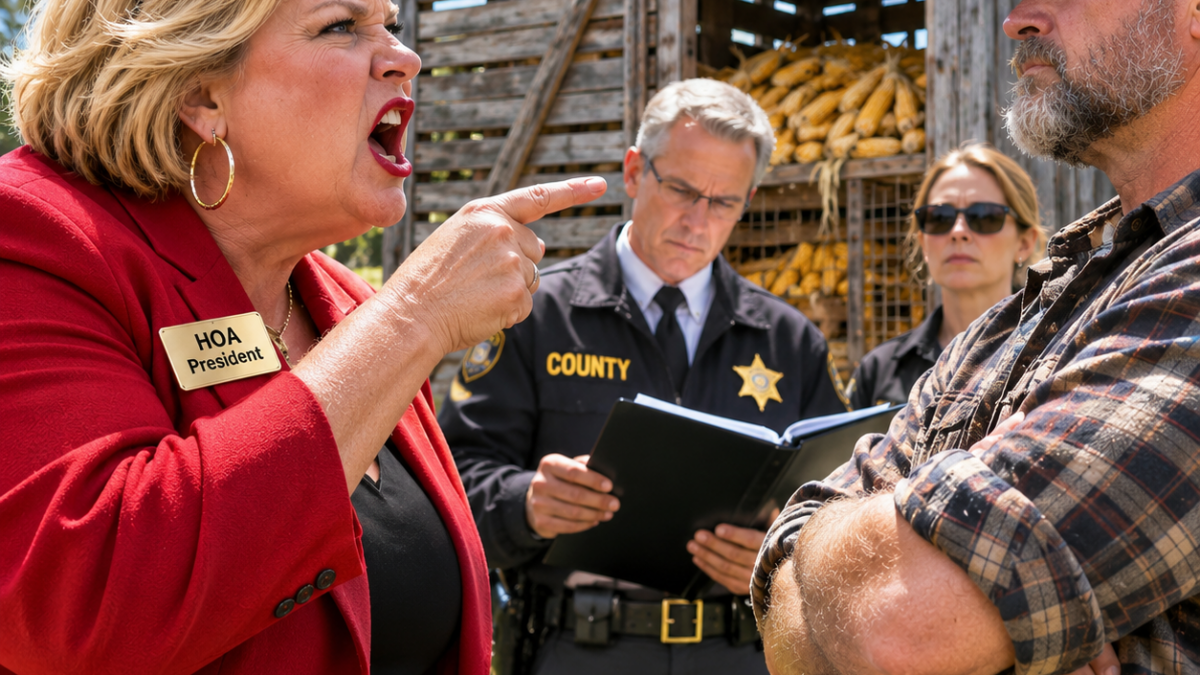
PART 2
The first person I told was my wife.
Sarah was kneeling in the garden tying tomato vines to wooden stakes when I found her.
She looked up once and immediately frowned.
“What happened?”
“What makes you think something happened?”
“You have that face.”
“What face?”
“The one you used to have when a colonel gave you an impossible supply deadline and you were deciding whether to argue or make him regret asking.”
I handed her the violation notice.
She wiped the dirt from her fingers before taking it.
For almost a minute, she read in silence.
Then she looked toward the corn crib.
“Demolition?”
“That’s what she said.”
“She knows what’s inside?”
“I told her to look at the plaque.”
Sarah lowered the paper.
“That is not the same thing as telling her.”
“She wouldn’t have listened.”
“You don’t know that.”
“I have a working theory.”
She gave me a look.
“Jack.”
“Yes?”
“Please tell me you’re not enjoying this.”
“I’m not.”
“You’re smiling.”
“That’s concern.”
“That is absolutely not concern.”
I took the notice back.
My smile disappeared when I looked at the dollar amount again.
The money itself didn’t worry me.
What bothered me was the assumption behind it.
Karen believed she had authority to order the destruction of something she had never investigated.
That was dangerous.
Not because she was particularly intelligent or powerful.
Because she was confident.
Confident people with incomplete information can do remarkable damage.
Sarah seemed to read my thoughts.
“Can the HOA actually do it?”
“Not lawfully.”
“That wasn’t what I asked.”
I looked at her.
She had spent much of her own career as an Army nurse.
Sarah understood the difference between what people were authorized to do and what they might try anyway.
“If they follow normal procedure,” I said, “there will be notices, hearings, appeals, legal review.”
“And if Karen decides procedure is whatever she says it is?”
“Then we document everything.”
Sarah sighed.
“Of course we do.”
That evening, I sat at our kitchen table and prepared my response.
The first rule of any dispute is simple.
Do not write angry.
Anger feels good when you type it.
It rarely looks good when someone reads it six months later in a courtroom.
So I kept the letter boring.
Violation number.
Property address.
Date.
Relevant covenant.
Then facts.
The corn crib was over one hundred years old.
It predated the subdivision.
It had existed on the old Thompson farm long before Willow Creek had roads, lawns, or an HOA.
More importantly, it currently served as a designated facility within the Williamson County Emergency Agricultural Reserve Program.
That sentence deserved documentation.
So I attached documentation.
Our contract with the county.
Inspection records.
Photographs.
The official designation.
The maintenance requirements.
The county plaque.
I highlighted the sections that mattered.
Then I explained what the reserve actually did.
The program had been created because modern food systems are efficient but fragile.
A severe storm.
Flood.
Long-term power failure.
Transportation disruption.
Disease affecting commercial seed supply.
Any one of those could create problems much faster than most suburban residents realized.
The county wanted locally stored seed varieties that could be planted quickly if normal systems failed.
Not enough seed to magically feed everyone overnight.
Enough to restart production.
Enough to create options.
Enough to buy time.
My background made that idea immediately attractive to me.
For two decades I had lived inside supply chains.
People tend to think logistics is trucks.
It isn’t.
Logistics is consequences.
A truck arriving one day late can mean a bridge crew sits idle.
A missing replacement part can disable a vehicle.
A lost fuel shipment can stop an entire operation.
And food?
Food is the most unforgiving supply chain of all.
When Sarah and I bought our ten acres, I had wanted peace.
The last parcel of the Thompson farm gave us that.
Creek on one boundary.
Oak woods on another.
Open land.
A garden.
Space to breathe.
And that old corn crib.
Earl Thompson had been the seller.
He was in his late seventies then, shoulders bent but hands still powerful from a lifetime of farm work.
During our first walk through the property, he stopped at the corn crib and placed one hand against the weathered wood.
“My granddaddy helped build this.”
I had looked up at the rafters.
“When?”
“Long enough ago that nobody in my family agrees on the year.”
He smiled.
“Early 1900s. Somewhere in there.”
“What did they store?”
“Corn mostly. Sometimes seed. Whatever had to stay dry.”
He touched one of the oak posts.
“This building kept people and animals fed through some bad winters.”
Something in his voice stayed with me.
It wasn’t nostalgia.
It was respect.
Later, when I learned about the county reserve program, the connection felt obvious.
The old structure had been built to protect harvests.
Why shouldn’t it protect future ones?
The county inspected it.
The agent walked every inch.
He expected rot.
Instead, he found old-growth timbers so dense they made modern lumber look temporary.
We reinforced a few sections.
Installed climate control.
Added security.
Improved drainage.
Then the county brought in the first inventory.
That was when the corn crib became more than history.
It became responsibility.
Now Karen wanted it gone because she didn’t like how it looked.
I finished my letter shortly after midnight.
Sarah read it the next morning.
“You didn’t call her unreasonable.”
“No.”
“Authoritarian?”
“No.”
“Power-drunk?”
“No.”
“Beige dictator?”
I looked at her.
“That one was difficult to leave out.”
She smiled.
“Good.”
I mailed it certified with return receipt.
Seven days later, the green receipt came back.
Signed:
**K. Miller.**
I filed it.
Then I waited.
For almost two weeks, nothing happened.
I began to believe maybe someone else on the board had intervened.
Maybe Karen had shown them the paperwork.
Maybe a board member had looked at the county contract and said what any reasonable person would say.
This is not worth fighting.
Then Sarah came inside holding another envelope.
“You should sit.”
“I’m fine.”
“You should sit anyway.”
I opened it standing.
The original five-hundred-dollar fine was now overdue.
One hundred dollars late fee.
Then another line.
**FAILURE TO COMPLY WITH REMEDIATION ORDER — $1,000.**
Behind the statement was a letter signed by Karen.
I read it slowly.
The association had “reviewed” my submission.
A contract with what they called a “third party” did not supersede HOA covenants.
My request for exemption was denied.
Demolition was still required.
Fines would continue.
I sat down.
Sarah leaned against the counter.
“She called Williamson County a third party?”
“Yes.”
“Did she mention the reserve?”
“No.”
“The plaque?”
“No.”
“The seed?”
“No.”
“Anything?”
“She says rules are binding.”
Sarah folded her arms.
“What are you going to do?”
I picked up my phone.
“What I should have done the first day.”
“Which is?”
“Call Mark.”
Mark Rylands had been my executive officer during one of my deployments.
He had possessed two unusual talents.
First, he could remain calm while everyone else panicked.
Second, he enjoyed complicated rule systems in a way that made normal people uncomfortable.
After leaving the Army, he went to law school.
Property litigation.
Association law.
Land disputes.
Contracts.
Exactly the type of person you wanted when someone mailed you five pages of confident nonsense.
He answered.
“Davies.”
“Mark.”
“That tone means I’m not getting a friendly call.”
“HOA issue.”
“I’m hanging up.”
“They want to bulldoze a county emergency seed reserve.”
Silence.
“Say that again.”
I did.
Then I emailed him everything.
Ten minutes later, he called back.
“Is this real?”
“Yes.”
“Your corn crib is under contract with the county?”
“Yes.”
“They were notified?”
“Certified mail.”
“And this woman increased the fine?”
“Yes.”
Mark went quiet.
Then he asked, “Do you only want this stopped?”
“No.”
“I thought so.”
“There are other people.”
“What other people?”
“I don’t know yet.”
He laughed softly.
“You haven’t changed.”
“That’s not always a compliment.”
“No. It is not.”
He told me not to contact Karen directly.
Everything in writing.
Everything retained.
Every envelope.
Every email.
Every meeting notice.
Then he gave me an assignment.
“Read the covenants.”
“I already have.”
“All of them?”
“Not recently.”
“Read them like you’re trying to break them.”
That was language I understood.
Over the next several nights, I worked through the HOA documents.
Karen’s authority appeared broad if you read quickly.
It appeared much narrower if you read carefully.
There were notice requirements.
Hearing rights.
Appeal provisions.
Consistency standards.
Recordkeeping obligations.
Board voting procedures.
Conflict-of-interest provisions.
And, buried among everything else, repeated language about good faith.
Good faith matters because power exercised maliciously does not look nearly as impressive under fluorescent courtroom lighting.
I formally requested a hearing.
Then I asked the county agricultural extension office for stronger written clarification.
Robert Evans, the county agricultural commissioner, called me personally.
“I read the HOA letter.”
“What do you think?”
“I think somebody over there has confused neighborhood covenants with sovereignty.”
That made me laugh.
Then his voice hardened.
“This facility is part of our emergency plan.”
“I know.”
“We inspected it.”
“I know.”
“We rely on it.”
“Yes.”
“So why is anyone still discussing demolition?”
“Karen says the county contract doesn’t override HOA covenants.”
Evans was silent for several seconds.
Then:
“I’m going to write them.”
His letter arrived three days later.
Official letterhead.
County seal.
No ambiguity.
The corn crib was a contracted facility.
It housed a strategic seed reserve.
Interference could threaten a public preparedness program.
The county strongly advised the HOA to cease demolition efforts.
He cited the relevant authority.
Mark read it and said one word.
“Beautiful.”
I mailed it certified.
Also emailed it.
The HOA secretary replied.
Not Karen.
A woman named Cynthia.
**Your request for a hearing has been received and will be scheduled in due course.**
I showed Sarah.
“In due course,” she said.
“Translation?”
“Whenever Karen thinks we’re exhausted.”
“That was my interpretation too.”
The fines continued appearing.
Disputed.
But present.
Karen was trying to create pressure.
If the amount became large enough, maybe we would decide preserving an old building wasn’t worth the stress.
She misunderstood something fundamental.
I wasn’t defending the corn crib because I liked looking at it.
I was defending an obligation.
That difference matters.
Sentimental people can sometimes be pressured into letting go.
People protecting a responsibility tend to become difficult.
Especially retired logistics officers with filing cabinets.
While we waited for the hearing, I began walking through Willow Creek.
At first, it really was exercise.
Then I started noticing things.
Trash cans visible from the street.
A fence in the wrong material.
A basketball hoop where the covenants restricted them.
A lawn ornament far taller than permitted.
A commercial trailer parked overnight.
Political signs well past the deadline.
I began photographing them.
Address.
Date.
Covenant section.
Sarah caught me one evening loading pictures onto my computer.
“What are you doing?”
“Research.”
“You took thirty-seven pictures of garbage cans.”
“Evidence.”
“You need a hobby.”
“I have a corn crib.”
She shook her head.
But the pattern was becoming impossible to ignore.
Some homeowners received brutal enforcement for tiny issues.
Others appeared immune.
I cross-referenced names against board rosters and committee lists.
That was when things became interesting.
A giant concrete flamingo belonged to a board ally.
No fine.
An oversized satellite dish belonged to the treasurer.
No enforcement.
A commercial landscaping trailer routinely parked at the home of Karen’s brother-in-law.
Nothing.
Meanwhile, other homeowners were being fined for much smaller violations.
The rules were not the problem.
Karen’s discretion was.
One evening I met Mrs. Gable.
She was struggling with a string trimmer beside her driveway.
She looked about seventy-eight and weighed maybe one hundred ten pounds.
The trimmer looked angry enough to win.
I stopped.
“Need a hand?”
“I’m fine.”
The machine stalled.
We both stared at it.
She sighed.
“Fine. Maybe.”
I finished the edging.
She brought lemonade.
We sat on her porch.
When she learned where I lived, she frowned.
“You’re the corn crib fellow.”
“I’m apparently famous.”
“Karen talks about you.”
“I’m sure warmly.”
Mrs. Gable snorted.
Then I mentioned the violation.
Her entire expression changed.
“Be careful.”
“Why?”
“That woman doesn’t stop.”
“How do you know?”
She pointed toward her mailbox.
It was new.
Straight.
Expensive-looking.
“She fined me because the old one leaned.”
“How much?”
“Two hundred.”
“Could it have been repaired?”
“Probably.”
“Then why replace it?”
“She said I had to.”
Mrs. Gable looked down at her hands.
“My husband used to take care of all this.”
“How long has he been gone?”
“Six years.”
“I’m sorry.”
She nodded.
“When those letters started coming, I didn’t know what to do.”
“What did they threaten?”
“More fines.”
She hesitated.
“A lien.”
The word came out quietly.
That told me everything.
Karen’s real weapon was not the rulebook.
It was fear.
Most people do not have lawyers on speed dial.
Most people do not have time to read governing documents after work.
Most people see words like lien and legal fees and think one thing:
**I could lose my home.**
Karen understood that.
And apparently used it.
Mrs. Gable told me about the Martinez family.
They had built a treehouse for their son.
Professionally designed.
Safe.
Beautiful.
Karen ordered it removed as an unauthorized detached structure.
Then the Lees.
Their roof replacement used expensive charcoal shingles.
Karen decided the shade was too dark.
Not unsafe.
Not defective.
Too dark.
Months of notices followed.
I visited the Martinez family first.
Mr. Martinez was hesitant.
His wife was not.
When I explained what was happening with the corn crib, she disappeared into another room and returned with a folder.
“Everything.”
Inside were notices.
Photos.
Invoices.
Correspondence.
Their son came through the room while we were talking.
Maybe nine years old.
He heard the word treehouse.
“You mean my old one?”
His father’s face tightened.
“Yes.”
The boy looked at me.
“Dad built it really good.”
“I saw the pictures.”
“Why did they make him break it?”
Nobody answered quickly.
Finally his mother said, “Sometimes adults use rules badly.”
The boy shrugged and walked away.
Mr. Martinez stared at the floor.
“I took it apart while he watched.”
His voice dropped.
“I kept telling him we didn’t have a choice.”
He looked at me.
“Maybe we did.”
That became his reason for joining us.
The Lees joined next.
Then others.
Every family had a story.
Nothing enormous by itself.
That was the genius of Karen’s system.
Each injury was small enough to make resistance feel disproportionate.
A mailbox.
A roof.
A treehouse.
A work vehicle.
Landscape edging.
But when you put the stories together, a pattern appeared.
Selective enforcement.
Retaliation.
Favoritism.
Intimidation.
I sent everything to Mark.
He called me less than an hour later.
“This is no longer a corn crib case.”
“I know.”
“This is potentially a bad-faith enforcement case against the association.”
“I know.”
“And possibly against Karen personally.”
That got my attention.
“Personally?”
“If we can establish willful misconduct.”
He sounded almost cheerful.
I knew that tone.
“What did you find?”
“The HOA’s directors and officers insurance.”
“And?”
“There’s an exclusion.”
“For?”
“Willful and malicious misconduct.”
I leaned back.
Mark continued.
“If Karen knowingly ignores county warnings, selectively punishes residents, and acts outside legitimate association authority, coverage could become a serious issue.”
“So if the association gets sued…”
“Insurance may fight.”
“And residents could be exposed.”
“Yes.”
“That gives the board an incentive to stop her.”
“It gives a rational board an incentive.”
“Karen controls the board.”
“Then we give the other members an opportunity to choose whether they want to go down with her.”
Mark drafted a lawsuit.
He did not file it.
Yet.
“Why wait?”
“Because we want them to make the next mistake voluntarily.”
“That sounds sinister.”
“It’s polite litigation.”
“There is no such thing.”
“There is when the documents are ready.”
The hearing remained unscheduled for almost two months.
During that time, our informal coalition grew.
Mrs. Gable.
The Martinez family.
The Lees.
Several more.
We started meeting at our house.
Sarah served coffee.
Documents covered our dining table.
People told stories they had never told each other.
That alone changed the atmosphere.
Karen’s strength had depended on isolation.
Each homeowner thought the problem was theirs.
Once everyone saw the same pattern, shame turned into anger.
One evening Mrs. Gable held up one of my photographs.
“Whose house is this?”
“Board member.”
“And that flamingo is allowed?”
“No.”
She stared at the picture.
“It’s three feet tall.”
“Correct.”
“My mailbox leaned an inch.”
“Yes.”
Mrs. Gable looked toward Mr. Martinez.
Then she laughed.
Not because anything was funny.
Because the absurdity had finally broken through the fear.
“You’ve got to be kidding me.”
Mr. Martinez smiled.
“Welcome to the resistance.”
Sarah pointed at him.
“Do not call it that. We are already dramatic enough.”
The group laughed.
That laughter mattered.
Fear shrinks when people can laugh at the person who caused it.
We prepared notarized statements.
Dates.
Amounts.
Exact language.
Photographs.
Copies.
Mark built the case.
Then, finally, the hearing date arrived.
Robert Evans called me two days beforehand.
“What time?”
“Seven.”
“I’ll be there.”
“You don’t have to.”
“Yes, I do.”
He paused.
“They ignored my office.”
His voice became very calm.
“I dislike being ignored.”
I smiled.
“You’ll enjoy Karen.”
“I doubt that.”
The evening of the hearing, Sarah and I walked into the Willow Creek clubhouse together.
Sterile beige walls.
Folding chairs.
A faint chlorine smell from the pool.
Five board members sat behind a long table.
Karen was in the center.
She wore navy this time.
I assumed beige had been retired for combat operations.
Mark sat beside me.
His leather briefcase rested at his feet.
Inside were copies of the complaint.
I looked at him.
He gave the smallest nod.
Ready.
Karen moved through the opening agenda.
Minutes.
Treasurer’s report.
Maintenance.
Then:
“Item Four. Ongoing covenant violation at Lot 114.”
She looked toward me.
“Mr. Jack Davies.”
Her tone suggested she was announcing a criminal defendant.
For ten minutes, Karen controlled the story.
I was uncooperative.
Defiant.
Hostile.
The corn crib was hazardous.
Dilapidated.
A visual blight.
She talked about property values.
Community expectations.
Fairness.
Then she held up my correspondence.
“Mr. Davies has attempted to overwhelm the board with unnecessary paperwork rather than comply.”
I almost admired the sentence.
She never mentioned the county reserve.
Never mentioned Robert Evans.
Never mentioned the emergency seed.
Never mentioned the building predated Willow Creek.
That omission told me something important.
The other homeowners might not know.
Maybe even the other board members didn’t know the full story.
Karen finished dramatically.
“The board has been more than patient.”
One ally nodded.
“We therefore move to assess the cost of demolition against Lot 114 and authorize a lien until all outstanding fines, legal fees, and costs are satisfied.”
A board member immediately seconded.
Karen looked at me.
“You may speak.”
I carried my binder to the lectern.
It landed with a solid thud.
A few people shifted in their seats.
“Good evening.”
I looked at the board.
Then the residents.
“Mrs. Miller just gave you her version of this dispute.”
I opened the binder.
“I’m going to give you the documented one.”
I began with history.
Photographs of the corn crib.
Property records.
Its approximate age.
The Thompson farm.
Structural assessments.
Then the county contract.
I displayed a large copy.
“This structure is a designated site within the Williamson County Emergency Agricultural Reserve.”
Whispers started immediately.
Karen’s eyes narrowed.
I continued.
“It houses strategic heritage seed stock intended for agricultural recovery after a major disaster or significant supply-chain interruption.”
Someone in the audience called out.
“What kind of seed?”
“Corn, beans, squash, grains, and other locally selected varieties.”
“How much?”
“Enough to plant more than five hundred acres.”
The room became quiet.
I held up the certified receipt.
“The board was informed.”
Then another.
“Twice.”
Karen interrupted.
“That does not eliminate HOA jurisdiction.”
I turned toward her.
“The county warned you specifically not to interfere.”
“It offered an opinion.”
“No.”
A voice came from the back.
“It did not.”
Everyone turned.
Robert Evans stood.
Karen froze.
Evans walked slowly down the aisle.
County polo.
County seal.
No theatrics.
He stopped in front of the board.
“My name is Robert Evans. I serve as Agricultural Commissioner for Williamson County.”
Karen adjusted papers.
Evans looked directly at her.
“Mrs. Miller, did you receive the formal letter from my office?”
“I receive numerous correspondence items.”
“It was certified.”
Silence.
“Did you receive it?”
Karen’s jaw tightened.
“Yes.”
The audience reacted.
Evans continued.
“That letter explained that the corn crib on Mr. Davies’ property is a contracted component of our emergency agricultural reserve.”
Karen tried to answer.
“We respect the county’s—”
Evans cut her off.
“This is not a question of respect.”
His voice remained even.
“That facility contains county-designated strategic seed.”
One of the board members looked sharply toward Karen.
Evans continued.
“The county inspected the facility.”
Another.
“Approved it.”
Another.
“Contracts for its maintenance.”
He leaned slightly toward the table.
“And relies upon its continued operation.”
Karen’s ally shifted in his chair.
Evans looked down the row.
“If this association attempts to demolish, damage, disable, seize, or materially interfere with that facility, my office will seek an immediate injunction.”
The treasurer stared.
“A court injunction?”
“Yes.”
“And the matter will be referred for review regarding interference with a county program and government contract.”
Karen finally snapped.
“This is absurd. It’s an old corn shed.”
Evans looked at her.
“No, ma’am.”
He paused.
“That is exactly the assumption your office was warned not to make.”
The room was silent.
He continued.
“You threatened demolition after receiving documentation.”
Karen said nothing.
“You continued fines after receiving documentation.”
Still nothing.
“And tonight, after receiving that documentation, you proposed charging this homeowner for demolishing the facility.”
One board member turned toward Karen.
“You told us the county letter was just support for his exemption request.”
Karen glared at him.
“That is what it was.”
Evans answered instead.
“No.”
The board member looked toward him.
“Our office advised the association to stop.”
The man’s face changed.
That was when Karen began losing the board.
I could see it physically.
Shoulders moving away from her.
Eyes dropping to documents.
People recalculating.
But the hearing was not finished.
I returned to the lectern.
“Mrs. Miller has repeatedly described this as consistent enforcement of community standards.”
I changed documents.
“So let’s examine consistency.”
Photograph one.
Trash bins.
Violation section displayed beside it.
No enforcement.
Photograph two.
Oversized lawn ornament.
Board ally.
No enforcement.
Photograph three.
Commercial trailer.
Karen’s brother-in-law.
No enforcement.
Photograph four.
Satellite dish.
Treasurer’s house.
The treasurer turned red.
Then Mrs. Gable’s mailbox notice.
Then photos of comparable mailboxes belonging to allies.
Then the Martinez treehouse.
Then photos of larger structures that had been ignored.
Then the Lees’ roof.
Then similar unapproved colors elsewhere.
The room grew louder with every image.
Someone shouted, “You fined me for exactly that!”
Another voice: “That house belongs to her friend!”
Another: “Why didn’t they get notices?”
Karen hit the table.
“This is irrelevant!”
I looked at her.
“No.”
My voice carried clearly.
“This is the issue.”
“You are avoiding your violation.”
“I am showing that enforcement under your presidency has been selective.”
“That is a personal accusation.”
“It is a documented pattern.”
“You’re attacking me.”
“No.”
I held up the binder.
“I’m showing your work.”
The room reacted.
Karen’s hands tightened.
I continued.
“An association board has duties to its members. Fairness. Good faith. Consistency.”
I looked down the table.
“If some residents are punished while friends of leadership receive exceptions, that is not neutral enforcement.”
Then I looked back at Karen.
“That is power being used personally.”
Mrs. Gable stood.
She was shaking.
Karen looked at her.
“What?”
Mrs. Gable held up a photograph of her old mailbox.
“You threatened my house over this.”
Karen frowned.
“You were fined for a maintenance violation.”
“It leaned.”
“Yes.”
“One inch.”
“The degree is irrelevant.”
Mrs. Gable looked toward the board member’s giant satellite dish on the screen.
“That isn’t?”
Karen said nothing.
Mrs. Gable’s voice strengthened.
“I paid because I thought you could take my home.”
“You were informed of your appeal rights.”
“I was seventy-seven years old and alone.”
The room became completely silent.
Mrs. Gable’s eyes filled.
“My husband handled things like that. He was dead.”
Karen’s expression shifted for just a second.
Not remorse.
Discomfort.
Mrs. Gable continued.
“You knew I was scared.”
Karen looked away.
“You liked that I was scared.”
That sentence broke something.
Residents started speaking at once.
The Martinez family stood.
Then the Lees.
Karen slammed her hand down.
“This meeting is about Lot 114!”
Mark stood.
“No.”
Every head turned.
He picked up his briefcase.
“This meeting became something else when the board proposed placing a lien against my client after receiving repeated notice that its underlying action was unlawful and potentially dangerous.”
Karen stared at him.
“Who are you?”
“Mark Rylands.”
He walked toward the front.
“Counsel for Mr. Davies.”
I moved slightly aside.
Mark placed the briefcase on the table.
“Before the board votes, it should understand what happens if it proceeds.”
Karen folded her arms.
“Is that a threat?”
“No.”
Mark opened the case.
“It’s service.”
He removed five thick packets.
Placed one before Karen.
“One for you.”
Another.
“One for the treasurer.”
Another.
“Secretary.”
Then the others.
“And one for the association record.”
Cynthia stared at the document.
Mark faced the room.
“The Estates at Willow Creek Homeowners Association and Karen Miller, individually, have been named as defendants in a civil action filed this afternoon in Williamson County Superior Court.”
The room erupted.
Karen looked at the cover page.
Her face changed so quickly it was almost startling.
“You’re suing me personally?”
“Yes.”
“You can’t do that.”
Mark remained calm.
“We already did.”
She stood.
“This is harassment!”
Mark did not raise his voice.
“The complaint alleges selective enforcement, bad-faith conduct, tortious interference with Mr. Davies’ government contract, breach of fiduciary duties, and related claims.”
He gestured toward the residents.
“Mr. Davies is not the only plaintiff.”
The Martinez family stood.
Then the Lees.
Others followed.
Karen looked around.
Mark continued.
“We are seeking restitution of wrongfully assessed fines, compensatory damages, punitive relief where available, legal fees, injunctive relief, and court oversight sufficient to prevent further unlawful enforcement.”
The treasurer leaned toward him.
“What about association insurance?”
That was the question Mark had been waiting for.
“Your policy contains exclusions that may apply to willful or malicious misconduct.”
The treasurer’s face drained.
Karen snapped.
“It’s covered.”
Mark looked at her.
“I would strongly advise against making representations on behalf of the carrier.”
Cynthia whispered.
“Could the association have to pay this?”
“Potentially.”
“And homeowners?”
Karen turned.
“Stop asking him questions.”
Cynthia stared at her.
“Why?”
“Because he represents the enemy.”
Mrs. Gable spoke from behind us.
“We’re the enemy?”
Karen looked around.
Wrong sentence.
Wrong room.
Wrong moment.
Mr. Martinez stood.
“Are we?”
Karen tried to recover.
“That’s not what I meant.”
He stepped into the aisle.
“You fined my family until we tore down our son’s treehouse.”
Another homeowner stood.
“You threatened my work van.”
Another.
“You fined my mother.”
Another.
“You forgave your friend’s violations.”
Karen began to speak louder.
“I enforced the rules!”
The crowd answered louder still.
Then one of the board members turned toward her.
“Did you withhold the county letter from us?”
Karen stopped.
“What?”
“Did you show us the whole letter?”
“I summarized it.”
“Did you tell us the county threatened an injunction?”
Silence.
He repeated:
“Did you?”
Karen’s mouth tightened.
“It was an exaggerated legal position.”
Robert Evans stood near the back.
“No, ma’am.”
The board member closed his eyes.
The treasurer pushed the proposed lien paperwork away.
“I’m not voting on this.”
Karen stared at him.
“What?”
“I said I’m not voting.”
“You seconded the motion.”
“I didn’t know this.”
“You knew enough.”
“No.”
He looked toward Evans.
“Apparently I didn’t.”
Karen’s carefully arranged public execution collapsed in less than fifteen minutes.
The lien vote never happened.
The meeting dissolved into arguments.
Residents demanded financial records.
Board members demanded legal advice.
Karen tried to adjourn.
Nobody cared.
Sarah took my hand.
“You okay?”
I looked toward Mrs. Gable.
She was crying while Mrs. Martinez hugged her.
“Ask me tomorrow.”
The next morning, the treasurer resigned.
His email went to every homeowner.
He cited incomplete disclosures by leadership and unacceptable legal exposure.
Two more board members resigned within the week.
Without enough members, the board lost quorum.
Karen’s ability to act collapsed.
Then the management company sent a letter that changed everything.
Their attorney had reviewed the lawsuit.
Insurance coverage was uncertain.
If misconduct was found intentional, portions of the claim might not be covered.
Translation:
Karen’s private vendetta might reach every homeowner’s wallet.
Fear changes direction quickly.
People who had ignored her treatment of Mrs. Gable suddenly became very interested when special assessments became possible.
A recall petition appeared.
It gathered the required signatures in less than two days.
The emergency recall meeting was packed.
I attended.
I did not speak.
I didn’t need to.
Mrs. Gable did.
So did Mr. Martinez.
Mrs. Lee.
People I had never met before.
One man stood and said:
“I supported Karen because I thought strict enforcement protected property values.”
He looked embarrassed.
“I didn’t ask who was being hurt.”
Then he looked toward Mrs. Gable.
“I should have.”
Another woman stood.
“She made us afraid of each other.”
That was perhaps the most accurate description I heard all night.
Karen sat at the front.
No allies beside her.
No dramatic presentation.
No clipboard.
When the recall vote was counted, removal passed overwhelmingly.
Karen was no longer president.
No longer a board member.
She sat motionless for several seconds.
Then stood.
Her chair scraped against the floor.
She looked at me once.
I did not smile.
I did not nod.
This was not my moment.
It belonged to the people she had intimidated for years.
Karen walked through the room alone.
The door closed behind her.
For a few seconds, nobody spoke.
Then Mrs. Gable whispered:
“Is it over?”
Mark, standing beside me, answered quietly.
“Her presidency is.”
He looked at me.
“The rest is just beginning.”
Discovery was brutal.
Once attorneys had subpoena power, whispers became documents.
Vendor contracts.
Invoices.
Expense reports.
Bank records.
Meeting reimbursements.
Emails.
Landscaping contracts became interesting first.
One vendor received unusually generous HOA payments.
The owner was Karen’s brother-in-law.
The same man whose commercial trailer I had photographed in violation of HOA rules.
That alone was not proof of wrongdoing.
The invoices were.
Some work billed as common-area maintenance appeared to correspond with extensive landscaping improvements at Karen’s private home.
Then catered meals.
Association funds paying for “special committee meetings.”
Residents identified several as Karen’s weekly social gatherings.
The interim board hired an independent accountant.
The preliminary report used cautious language.
Potential self-dealing.
Questionable reimbursement.
Unsupported expenditure.
Possible misuse.
The effect was not cautious.
They turned everything over to the district attorney.
When I told Sarah, she stared at me.
“All because of the corn crib.”
“No.”
She waited.
“All because someone believed power meant nobody would look.”
Sarah nodded.
“That sounds more accurate.”
The civil lawsuit eventually moved toward settlement.
The association wanted certainty.
Residents wanted restitution.
Mark wanted reforms.
I wanted protection for the reserve.
The agreement we reached was broader than I expected.
Every fine against me disappeared.
Wrongful penalties against the other plaintiffs were refunded or compensated.
Legal fees were covered.
The HOA issued a public apology.
Not a vague statement about “misunderstandings.”
An apology.
It acknowledged inconsistent enforcement.
It acknowledged the harm caused.
It recognized the corn crib’s status.
The bylaws were amended.
Pre-existing agricultural structures gained explicit protection.
Government-designated facilities required independent legal review before enforcement.
Major violations needed multiple board members to approve them.
Evidence requirements were strengthened.
Conflict-of-interest disclosures became mandatory.
Appeals were separated from the person who initiated the violation.
Karen’s entire system depended on one person controlling the accusation, narrative, and consequence.
That system no longer existed.
My settlement share was enough to do something I had wanted to do anyway.
Upgrade the corn crib.
The new climate system was quieter.
More precise.
Remote monitoring.
Backup power.
Fire protection.
Improved security.
The outside remained almost unchanged.
Silver timber.
Old slats.
Weathered roofline.
Inside, it became one of the most sophisticated seed-storage facilities in the county.
The contractor stood beside me after commissioning the equipment.
“You know this place is weird.”
“How?”
“Outside, 1910.”
He opened the door.
“Inside, space program.”
“That’s the idea.”
I established a maintenance fund too.
The building had survived a century before me.
I wanted to give it a chance at another.
By then, Karen’s house was for sale.
The pearl-white SUV disappeared.
The last time I saw her living in Willow Creek, she was standing beside a moving truck.
She looked smaller.
Not physically.
Authority changes posture.
When people believe you can hurt them, you occupy more space.
When that belief disappears, sometimes so does the person you appeared to be.
Karen saw me across the street.
For a second, I wondered if she would come over.
She didn’t.
Neither did I.
Revenge is satisfying in imagination.
Reality is stranger.
Watching someone lose power doesn’t always feel like victory.
Sometimes it feels like watching consequences arrive late.
The neighborhood began healing almost immediately.
The new board declared a temporary moratorium on fines.
Actual safety issues still mattered.
But cosmetic violations were given reasonable correction periods.
Anonymous complaints required evidence.
Multiple board members reviewed major actions.
The quarterly newsletter became boring.
I loved it.
**Community Potluck — Saturday.**
**Pool Closing Date.**
**Volunteers Needed for Fall Cleanup.**
Nothing about war.
Nothing about enforcement campaigns.
Nothing about restoring order.
Just neighborhood life.
The concrete flamingo remained standing.
Three feet tall.
Technically still offensive under an old provision.
I passed it one evening with Mrs. Gable.
She pointed.
“Aren’t you going to document that?”
“I already have.”
“What are you going to do?”
“Nothing.”
She smiled.
“Good.”
Then came the barbecue.
Sarah organized most of it.
I pretended I had equal responsibility because I bought charcoal.
Tables went up beside the corn crib.
The Martinez family came early.
Their son carried rolled-up plans.
“Mr. Davies!”
He spread them across a table.
A new treehouse.
Larger.
Better.
Small covered platform.
Window.
Rope ladder.
I looked at his father.
“Approved?”
Mr. Martinez smiled.
“The new board created a simple application.”
“How revolutionary.”
“Two pages.”
Sarah nearly dropped a bowl laughing.
Mrs. Gable brought potato salad.
The Lees brought dessert.
Robert Evans arrived carrying iced tea.
Mark brought nothing.
I reminded him of that.
“I brought legal counsel.”
“This is a barbecue.”
“Legal counsel is expensive.”
“Potato chips are four dollars.”
Mark ignored me.
As sunset colored the field, Evans looked toward the corn crib.
“You know what they call that at the county now?”
“I’m afraid to ask.”
“The apocalypse pantry.”
Mark laughed.
I stared at Evans.
“Absolutely not.”
“It’s already spreading.”
“I hate all of you.”
Mrs. Gable overheard.
“No, you don’t.”
She was right.
Later, when the crowd began thinning, I stood near the corn crib listening to children run through the grass.
Months earlier, this place had felt like a battlefield.
Now the same building that Karen said damaged community values stood beside neighbors laughing together.
Sarah leaned against the old timber.
“What are you thinking?”
“That she almost got away with it.”
“With demolishing this?”
“No.”
I looked toward Mrs. Gable.
“With making everyone believe they were alone.”
Sarah nodded.
That was the greater damage.
Karen’s rules had divided people.
Fear turned neighbors into potential informants.
The new board began reversing that.
Community events returned.
People talked.
Small conflicts were solved directly.
The clubhouse stopped feeling like a courtroom.
Then, eighteen months after the civil case settled, I received a letter from the district attorney.
Karen had pleaded guilty to felony embezzlement.
Probation.
Community service.
Restitution.
More than fifty thousand dollars eventually came back to the HOA from liquidated assets.
The new board had to decide what to do with it.
Mr. Martinez proposed a playground.
Apparently Karen had rejected playground proposals repeatedly.
Insurance liability.
Noise.
Maintenance.
Children being children.
This time, the proposal passed.
They called it Freedom Park.
I thought the name was too dramatic.
Sarah thought it was perfect.
At the opening, children waited behind a ribbon while parents gathered around.
Mr. Martinez gave a short speech.
“This money once represented mistrust.”
He looked toward the playground.
“Now it will create something useful.”
He didn’t say Karen’s name.
He didn’t have to.
“This community should never again be a place where people fear each other because of rules.”
Mrs. Gable wiped her eyes.
Mr. Martinez continued.
“It belongs to all of us.”
They cut the ribbon.
Children rushed toward the slides.
I stood beside Sarah.
She nudged me.
“What?”
“Look.”
Mrs. Gable was on a bench laughing as two children argued over a swing.
“She looks happy.”
“Yes.”
“That’s worth more than the lawsuit.”
“Yes.”
It was.
The county reserve program grew too.
Evans nominated me for the food-security task force.
I initially refused.
“I retired.”
“So did half the committee.”
“I want to be left alone.”
“You sued your HOA with fourteen other families.”
“That was temporary.”
“You collect violations recreationally.”
“That was evidence.”
Sarah interrupted.
“He’ll do it.”
I looked at her.
“Why do you keep volunteering me?”
“Because when you have too much free time, you photograph garbage cans.”
I joined.
The work gave me a new appreciation for the corn crib.
It became a model for other reserve sites.
Old barns.
Warehouses.
Cold-storage buildings.
Unused agricultural structures.
The county learned from our dispute.
Contracts became clearer.
Legal protections stronger.
Emergency designations more visible.
Nobody wanted another HOA president claiming ignorance.
Our little fight created ripples far beyond Willow Creek.
Then, one crisp autumn morning, Earl Thompson returned.
I was fixing fence when his dusty pickup rolled down the driveway.
He climbed out slowly.
Age had taken more from him.
But his smile remained.
“Heard you caused some trouble.”
“Depends who tells the story.”
“County fellow tells it pretty well.”
We walked toward the corn crib.
Earl stopped and placed his hand against one of the original timbers.
“My granddaddy built this.”
“I remember.”
“Some wood came from down by the creek.”
He looked up.
“Did I tell you that?”
“Yes.”
“Old men repeat themselves.”
“I’m approaching that category.”
“Not yet.”
He stood quietly.
Then:
“What’s inside now?”
I unlocked the door.
He stepped into the controlled air.
Looked at the seed containers.
Read labels.
Corn.
Beans.
Squash.
Regional grain varieties.
His eyes moved slowly around the room.
“This whole thing is county?”
“Partnership.”
“How much seed?”
“Enough for more than five hundred acres, depending on crop mix.”
Earl removed his cap.
He didn’t say anything for a while.
Then he laughed softly.
“My granddaddy would get a kick out of this.”
“I hope so.”
“He built it because they needed to protect the harvest.”
“I know.”
“And now you’re protecting harvests that haven’t happened yet.”
The sentence hit me harder than I expected.
Earl turned.
“He would’ve liked you.”
I looked away.
Compliments make me uncomfortable.
Especially the ones that matter.
“You understand what this place is.”
“What is it?”
Earl rested his hand on the timber.
“A promise.”
He looked toward the fields.
“You keep something safe so somebody else can use it when they need it.”
Then he looked back at me.
“You did right by the land.”
That meant more than winning.
More than Karen losing.
More than the settlement.
Earl had trusted Sarah and me with the last piece of his family’s farm.
For the first time, I felt that I had fully earned that trust.
Earl died a few years later.
His children asked me to speak at his memorial.
I told the story of the corn crib.
Not the HOA story.
The older story.
A family building a structure to protect food through winter.
Generations maintaining it.
Earl selling the land to two people he hoped would respect it.
I talked about stewardship.
Ownership sounds permanent when printed on a deed.
It isn’t.
You get time.
Then somebody else gets time.
The question is whether you leave the thing better.
After the memorial, Earl’s daughter hugged me.
“Dad said you understood the dirt.”
“That sounds like him.”
“He meant it as the highest compliment.”
“I know.”
Years passed.
Freedom Park became the center of Willow Creek.
Kids played.
Parents talked.
The HOA changed leadership several times.
No dictators.
Mostly ordinary neighbors trying to keep the pool open and the budget balanced.
Exactly what it should have been.
The corn crib became a local landmark.
New homeowners sometimes stopped to ask.
“Is that the building?”
“Yes.”
“The one the HOA tried to demolish?”
“Yes.”
“What’s inside?”
I would show them.
Not because I enjoyed retelling Karen’s humiliation.
Because context matters.
People should know how easily power can drift when everyone assumes somebody else will watch it.
One young couple considering a home in Willow Creek came to see me before buying.
The woman looked nervous.
“We read about the lawsuit.”
“Internet?”
“Yes.”
“That usually makes everything sound worse.”
“Was it?”
I thought about that.
“No.”
She laughed.
I explained the reforms.
The board.
The hearings.
The county program.
By the end, they looked relieved.
They bought the house.
Months later, they stopped beside my fence while pushing a stroller.
The man waved.
“We love it here.”
That felt important.
We had not merely removed a bad president.
We had made the community trustworthy again.
Mark turned our case into a running joke at legal seminars.
He called it the Davies Doctrine.
I hated the name.
“Three steps,” he told me one night over whiskey.
“Don’t.”
“Document.”
“Mark.”
“Organize.”
“Stop.”
“Expose hypocrisy.”
“That isn’t a doctrine.”
“It should be.”
“It sounds like something printed on a coffee mug.”
“I can arrange that.”
“If you do, I’m ending this friendship.”
He laughed.
Then became serious.
“You know why I use your case?”
“Because lawyers enjoy embarrassment?”
“Because most people think standing up for themselves means getting louder.”
He swirled the whiskey.
“You didn’t.”
“I got organized.”
“Exactly.”
That stayed with me.
The victory never came from shouting louder than Karen.
She was better at shouting.
It came from evidence.
Receipts.
Records.
Witnesses.
Neighbors.
Procedure.
And patience.
One winter afternoon, a package appeared at the house.
No return address.
Inside was a hand-carved miniature corn crib.
Every slat.
Tiny roof shingles.
A little door.
Even a small metal plaque.
Underneath was a handwritten note.
Five words.
**Thank you. You saved my home.**
I recognized the shaky handwriting.
Mrs. Gable.
I sat holding the little model longer than I care to admit.
Sarah found me.
“What happened?”
I handed her the note.
She read it.
Then sat beside me.
“That’s why.”
“Why what?”
“Why this mattered.”
I looked at her.
“You always talk about the building.”
She touched the miniature crib.
“Or the seed.”
Then the note.
“But this was the real thing you were protecting.”
Mrs. Gable’s home.
The Martinez family.
The Lees.
People without lawyers.
People who paid because fear was cheaper than fighting.
Karen’s system had made them small.
Our fight reminded them they weren’t.
The model went onto our mantel.
Beside a photograph Sarah had taken of the real corn crib at sunset.
Silver wood glowing gold.
Past and future in the same frame.
As the years moved on, I thought more often about whoever would own the land after us.
I wanted a custodian.
Not just a buyer.
Someone who would understand the reserve.
The old wood.
Earl.
The responsibility.
Someday I imagined walking them to the crib.
Putting a hand on the door.
Saying:
“This isn’t yours.”
They would probably look confused.
Then I would explain.
“It isn’t mine either.”
We only get our turn.
That is what stewardship means.
You protect something long enough to pass it forward.
One evening, Sarah and I sat on the porch watching fireflies.
Lights from Willow Creek glowed beyond the trees.
Children could be heard faintly from Freedom Park.
The corn crib stood against the darkening sky.
Sarah leaned against my shoulder.
“Do you ever miss the fight?”
“No.”
“That was immediate.”
“I miss nothing.”
“You enjoyed beating Karen.”
“I enjoyed stopping her.”
“Different?”
“Very.”
Sarah waited.
I thought about it.
“Revenge makes a good story.”
“And?”
“Peace makes a better life.”
She smiled.
For years, I had mistaken peace for isolation.
After the Army, I wanted land because land did not demand anything complicated.
Soil.
Fence.
Garden.
Maintenance.
But the fight with Karen had taught me something I hadn’t expected.
A peaceful community is not one where nothing happens.
It is one where people trust one another enough to handle what happens.
Karen had created silence.
People were afraid to speak.
That was not peace.
Willow Creek eventually became noisy again.
Children.
Barbecues.
Arguments at meetings.
People disagreeing about pool hours.
Someone always complaining about clubhouse paint.
That was healthy.
People had voices again.
Before we went inside that evening, I walked to the corn crib.
Checked the monitor.
Temperature normal.
Humidity normal.
Backup power ready.
I placed my hand against one of the original oak posts.
The building had survived more than one hundred years.
Storms.
Droughts.
Depressions.
Wars.
Development.
Generational change.
And one extraordinarily determined HOA president.
Inside were seeds waiting for a future nobody could predict.
That was what made them valuable.
Preparedness is an act of humility.
It means admitting that something may happen you cannot control.
Karen’s entire worldview had been the opposite.
Control the lawn.
Control the mailbox.
Control the roof.
Control the treehouse.
Control the building.
Control the neighbor.
But eventually, reality refuses to fit inside somebody’s rulebook.
I locked the door.
Then I looked toward the glow of Freedom Park.
That playground had been funded with money recovered after Karen’s conviction.
There was almost painful irony in that.
She had spent years trying to create a neighborhood where everything stayed orderly, quiet, and approved.
Her final financial contribution bought a place where children climbed, shouted, fell down, got dirty, laughed, and occasionally ignored the rules.
I could not have invented a more fitting ending.
Sarah called from the house.
“Jack!”
“I’m coming.”
“Dinner’s getting cold.”
I started toward the porch.
Halfway there, I turned once more.
The corn crib stood exactly where Karen had wanted it erased.
Weathered.
Uneven.
Unfashionable.
Useful.
That last word mattered most.
Karen had looked at the building and asked whether it matched her vision.
Earl’s grandfather had looked at it and asked whether it would protect food.
The county asked whether it could protect a future harvest.
Those questions produced very different answers.
Years later, people still occasionally asked me whether I felt satisfied about what happened to Karen.
The answer was complicated.
I was satisfied that she was stopped.
Satisfied that money was recovered.
Satisfied that residents were reimbursed.
Satisfied that the system changed.
But her downfall was never the part that stayed with me.
What stayed with me was Mrs. Gable laughing without fear.
A boy showing me plans for his new treehouse.
Earl touching the timber his grandfather had raised.
Sarah hanging the sunset photograph above our fireplace.
Children playing in a park built from restitution.
Seed sleeping safely in cool darkness.
Those were the victories.
Karen thought punishment was power.
She had spent years proving it.
We learned something better.
Protection is power.
Community is power.
Documentation is power.
Standing beside someone who believes they are alone is power.
And sometimes the strongest revenge is not destroying the person who tried to destroy what mattered to you.
Sometimes it is letting them watch while everything they tried to tear down becomes stronger.
The corn crib survived.
The reserve expanded.
The neighborhood healed.
The families she frightened became leaders.
The money she misused became a playground.
And the ugly old structure she wanted ground into mulch became a symbol across the county of what responsible preparedness could look like.
Karen wanted thirty days.
She got years of consequences.
The corn crib got another generation.
That seemed fair.
I reached the porch.
Sarah held the screen door open.
“You done talking to the building?”
“I wasn’t talking.”
“You always talk to it.”
“That is slander.”
She smiled.
“Come eat.”
I stepped inside.
Warm light filled the kitchen.
The smell of roasted chicken and herbs drifted through the house.
Behind us, the fields darkened.
Beyond them, Willow Creek settled into another ordinary evening.
No threatening letters.
No emergency meetings.
No neighbors checking the mailbox with dread.
Just homes.
Families.
Dinner.
Children.
A community finally allowed to be one.
I had spent twenty years moving supplies through places where peace was fragile.
It took retirement for me to understand how fragile peace could be at home too.
You do not preserve it by pretending conflict will never come.
You preserve it by making sure people know they do not have to face conflict alone.
That was the real legacy of the corn crib.
Not wood.
Not seed.
Not even survival.
Solidarity.
The willingness to stand next to somebody else’s problem until it becomes impossible for a bully to isolate them.
Someday, long after I am gone, the corn crib may finally reach the end of its useful life.
Wood does not last forever.
Neither do people.
Maybe the county will preserve it.
Maybe someone will rebuild it.
Maybe only photographs and the little hand-carved model will remain.
That will be all right.
Because buildings are not legacies by themselves.
What people learn from them is.
And if one lesson survives, I hope it is this:
Never confuse quiet people with powerless people.
Never assume an official title makes you right.
Never destroy something simply because you have not taken the time to understand its value.
And when somebody uses fear to convince good people that they are alone, the most important thing anyone can do is make sure they look around and see otherwise.
Karen stood at my property line all those years ago and called the corn crib rotting wood.
She promised she would bulldoze it.
She promised she would fine me until I surrendered.
She promised the HOA would win.
The building is still here.
The seeds are still here.
Sarah is still here.
The neighborhood is better than it was before.
Mrs. Gable kept her home.
The Martinez boy got his treehouse.
Freedom Park is full of children.
And every evening when the sun drops low enough to turn that silver wood gold, I remember the day Karen Miller told me I had thirty days.
I smile.
Then I check the lock.
Check the temperature.
And walk home.
Because the promise inside that old building is still safe.
And that, more than anything that happened to Karen, is the ending I wanted.








