PART 2: HOA Officers Raided My Company Because I Refused to Join—They Had No Idea My Cameras Were Recording Everything
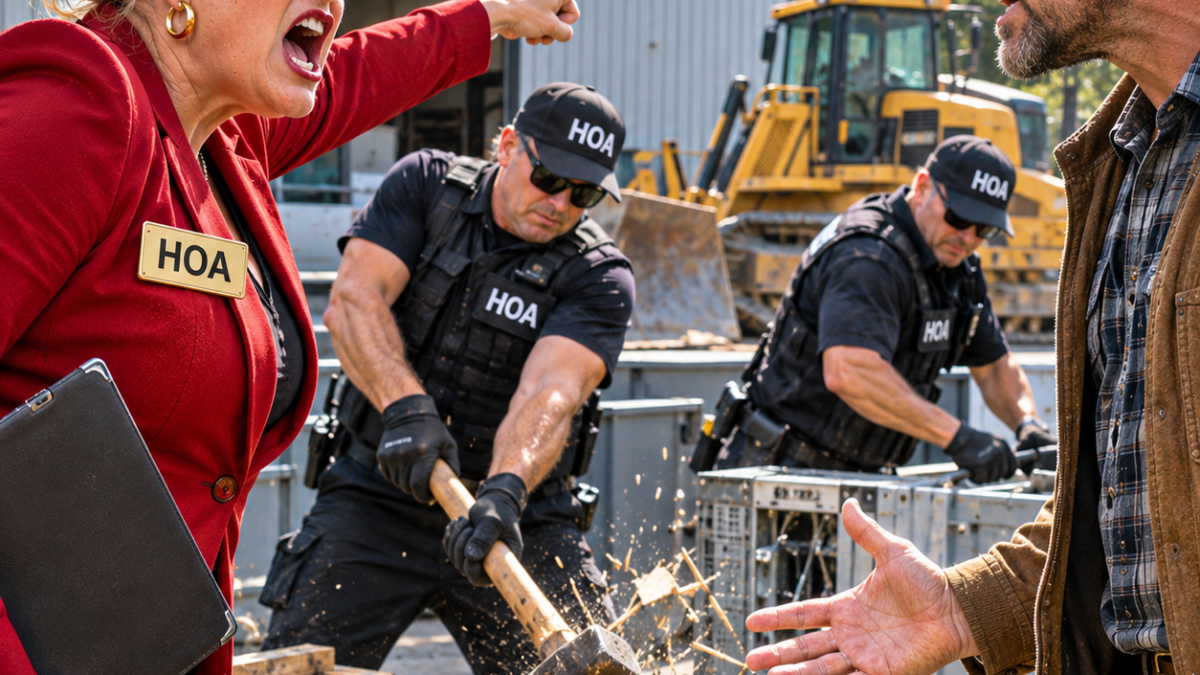
PART 2
For about thirty seconds, I couldn’t make myself step farther into the workshop.
I had expected harassment.
Letters.
Threats.
Maybe another ridiculous fine.
I had not expected someone to break into my company.
There is something uniquely violating about standing inside a place that belongs to you and realizing strangers have been through it without permission.
My workshop had never been fancy.
But every shelf represented something.
The soldering station I had bought with money from my first independent contract.
The diagnostic equipment I had saved six months for.
The tool chest my father had given me when I finally stopped talking about starting a company and actually did it.
The folders on the floor contained client information.
Nothing classified.
Nothing dramatic.
But contracts.
Network diagrams.
Invoices.
Equipment serial numbers.
Information people had trusted me to protect.
And someone had treated all of it like junk.
I took one careful step inside.
Then stopped again.
My first instinct was to start picking things up.
That would have been a mistake.
So I backed out.
Pulled the door closed as far as the damaged frame allowed.
Then called the police.
“Non-emergency or emergency?” the dispatcher asked.
“Burglary. Commercial property. Suspects are gone.”
“Has anything been taken?”
“Yes.”
“Do you know who entered?”
“I think so.”
“Are you inside the building?”
“No.”
“Stay outside until officers arrive.”
That was easy.
I didn’t want to touch anything.
Two patrol cars arrived fifteen minutes later.
One officer was named Alvarez.
The other, Bennett.
Alvarez examined the front lock.
Then the rear workshop door.
“Definitely forced,” he said.
Bennett photographed the pry marks.
“Missing items?”
“At least two tool cases.”
“Value?”
“Maybe three thousand combined.”
“Anything else?”
“I don’t know yet.”
Alvarez looked through the open doorway.
“Any cameras?”
That was when I finally felt something besides anger.
“Yes.”
“How many?”
“Five.”
He looked at me.
“Interior?”
“Three.”
“Cloud storage?”
“Yes.”
Bennett smiled slightly.
“That makes today easier.”
I pulled out my phone.
The security system had already uploaded everything.
I had installed it three weeks earlier.
Not because I expected a burglary.
Because Richard’s behavior had made me uncomfortable.
The first camera covered the front entrance.
The second covered reception.
One watched the workshop.
Another faced the side lot.
And one covered the rear service door.
Every camera recorded movement.
Every recording uploaded automatically.
Alvarez stood beside me while I opened the app.
I selected the previous afternoon.
Nothing.
Evening.
Nothing.
Then—
4:47 a.m.
Motion detected.
The side-lot camera opened.
A dark SUV entered the property.
Then another vehicle.
My stomach tightened.
Richard stepped out.
Same polo shirt.
Same clipboard.
Four other people followed.
Bennett leaned closer.
“You know them?”
“Yes.”
“Who?”
“The HOA.”
He looked at me.
“The homeowners association?”
“Yes.”
“This is a business.”
“I know.”
The video continued.
Richard walked to the workshop door.
One of the men carried a tool bag.
Another had a flashlight.
They spoke for several minutes.
The camera didn’t capture every word, but enough.
Then the man with the tool bag began working on the lock.
Bennett stared at the screen.
“They broke in.”
“Yes.”
“They know there are cameras?”
“Apparently not.”
The rear camera showed the door open.
One by one, they entered.
I switched feeds.
Workshop camera.
Richard walked through my company at 4:58 in the morning like he owned it.
He opened cabinets.
Pointed at equipment.
Another man pulled open desk drawers.
A woman from the HOA board photographed documents.
One of the compliance officers removed my company sign from an interior shelf and dropped it onto the concrete.
Another man picked up a network tester.
He examined it.
Set it down.
Then knocked another unit from the bench.
The screen cracked.
I felt my jaw tightening.
Officer Alvarez noticed.
“Stay with me.”
“I’m fine.”
“Good.”
At 5:11, Richard opened the cabinet where I stored client folders.
He began pulling them out.
The woman beside him flipped through several.
My anger became something colder.
At 5:16, one of the men carried my tool case toward the door.
At 5:19, another did the same.
Alvarez paused the video.
“Did they have permission to remove anything?”
“No.”
“To enter?”
“No.”
“Any court order?”
“No.”
“Warrant?”
“They’re an HOA.”
“That’s not what I asked.”
“No.”
He nodded.
“Good.”
Good.
Strange word.
But I understood what he meant.
The footage was clear.
Very clear.
At 5:24, Richard looked directly toward the workshop camera.
For half a second, I thought he had noticed it.
Then he turned away.
They left at 5:31.
Forty-four minutes.
That was how long it took them to transform a property dispute into a criminal investigation.
Alvarez asked me to email copies immediately.
I did.
Then the officers entered and documented the scene.
Fingerprints.
Damage.
Missing property.
Opened files.
Every broken item.
Every disturbed cabinet.
I stood outside until nearly eight.
Employees from neighboring businesses started arriving.
The owner of the coffee shop two units down walked over.
“What happened?”
“Break-in.”
“You okay?”
“Yeah.”
“Anything I can do?”
“Not right now.”
He looked toward the patrol cars.
“Was it random?”
I stared at the damaged door.
“No.”
By nine, I had called my attorney.
Her name was Melissa Grant.
She had helped me review the lease when I opened the company.
When she answered, I said:
“I need a different kind of help today.”
“What happened?”
“The HOA broke into my workshop.”
Silence.
Then:
“Say that again.”
I explained.
When I reached the part about the cameras, Melissa interrupted.
“You have footage?”
“Clear footage.”
“Do not contact the HOA.”
“I wasn’t planning to.”
“Do not respond to emails.”
“Okay.”
“Do not post anything online.”
“Wasn’t planning to.”
“And do not tell anyone how much evidence you have.”
That one surprised me.
“Why?”
“Because I want to hear what they claim first.”
I smiled.
It was the first time I had smiled that morning.
“I like the way you think.”
“Send me everything.”
By lunchtime, my phone rang.
Richard.
I watched it ring.
Didn’t answer.
He called again.
Then texted.
**We need to discuss this morning’s compliance inspection.**
Compliance inspection.
I stared at the words.
Then forwarded the message to Melissa.
She responded:
**Perfect. Don’t reply.**
Ten minutes later, another text.
**Some property may have been temporarily removed pending review. We can resolve this without involving outside parties if you cooperate.**
I forwarded that too.
Melissa called.
“He actually wrote that?”
“Yes.”
“He admitted removing property?”
“Looks like it.”
She laughed.
Not loudly.
More like disbelief escaping.
“Please continue doing absolutely nothing.”
“Best assignment I’ve had all week.”
Richard called four more times.
Then an email arrived.
Subject:
**URGENT NOTICE OF ASSOCIATION ENFORCEMENT ACTION**
It stated that the HOA had conducted a “lawful administrative inspection” due to my continued refusal to comply with community standards.
It claimed the association had authority to enter “properties operating within the neighborhood impact zone.”
Neighborhood impact zone.
I had never heard that phrase before.
Neither had Melissa.
The email continued.
Certain equipment had allegedly been “secured” because it violated unspecified safety rules.
Documents had been reviewed to “confirm operating compliance.”
Damage to the locks was characterized as an “unfortunate consequence of denied access.”
I read that sentence three times.
They were blaming me for making them break my door.
Then came the final paragraph.
If I signed the membership agreement, paid outstanding assessments, and provided future inspection access, the association was prepared to “resolve the matter amicably.”
Melissa called again.
“I want you to save that email in three places.”
“Already done.”
“Good.”
“What happens now?”
“Now?”
Her voice became very calm.
“Now they learn what authority actually looks like.”
At 2:30, Officers Alvarez and Bennett returned.
They had another detective with them.
Detective Harris.
He asked me to replay the footage.
Then the texts.
Then Richard’s email.
Harris took notes.
Finally, he asked:
“How many people entered?”
“Five.”
“Can you identify them?”
“Yes.”
I named Richard.
Two board members.
Two compliance officers.
Harris looked at Alvarez.
Then back at me.
“Do you know where the HOA office is?”
“About half a mile away.”
He nodded.
“We do too.”
They left.
I wanted to follow.
Melissa told me not to.
“Your job is to document your losses.”
“That’s less interesting.”
“You don’t need interesting. You need accurate.”
So I spent the afternoon making a list.
Broken lock.
Damaged door frame.
Network tester.
Monitor.
Two tool kits.
Damaged storage cabinet.
Client file remediation.
Emergency locksmith.
Lost billable hours.
Potential data exposure.
By six, the number was already larger than I expected.
Then the coffee-shop owner called.
“You might want to come outside.”
I stepped into the parking lot.
Three police vehicles were parked near the association office down the street.
Neighbors stood outside.
Somebody was filming.
Twenty minutes later, I saw Richard escorted from the building.
Hands behind his back.
For the first time since I had met him, there was no clipboard.
One of the compliance officers came out next.
Then another.
I didn’t celebrate.
I thought I would.
Instead, I just felt tired.
Really tired.
The kind of tired that comes after adrenaline finally lets go.
My phone rang.
Melissa.
“Don’t say anything publicly.”
“I know.”
“I mean it.”
“I know.”
“No victory lap.”
“I’m literally standing in my parking lot.”
“Go inside.”
“My door is broken.”
She paused.
“Fair point.”
That made me laugh.
The criminal charges didn’t happen all at once.
Real cases rarely unfold as neatly as stories make them sound.
There were interviews.
Evidence reviews.
Arguments over intent.
Questions about exactly what each person had done.
Who touched the locks?
Who removed tools?
Who ordered the entry?
Who believed they had authority?
What did Richard tell the others?
But one thing became clear quickly.
The HOA had no lawful right to enter my company.
Their “neighborhood impact zone” appeared nowhere in my deed.
Nowhere in municipal zoning.
Nowhere in their recorded governing documents.
It was language Richard had invented.
Or, more accurately, language he had convinced himself carried authority because he said it confidently enough.
The most damaging evidence came from inside the HOA itself.
A board member named Susan asked to speak with police.
She had been present outside my property the morning before the break-in but had not joined the raid.
According to her, Richard had been furious after I refused the inspection.
“He said you were making the association look weak.”
I stared at her.
“Weak?”
“That was the word.”
“Why would a commercial business refusing to join make the HOA look weak?”
Susan looked embarrassed.
“Because other owners had started asking questions.”
“What questions?”
“Whether they were required to pay certain fees.”
I looked at Melissa.
She was writing.
Susan continued.
“Richard was worried that if you publicly refused and nothing happened, residents would realize the board couldn’t force compliance outside its authority.”
There it was.
This had never really been about my business sign.
Or parking.
Or safety.
It was about precedent.
Richard needed people to believe the HOA’s power extended wherever he said it extended.
My refusal was dangerous because it revealed a boundary.
Susan told investigators that Richard called an emergency board discussion the night before the break-in.
Not a legally noticed meeting.
A private conversation.
He argued the HOA had “administrative inspection rights.”
Susan disagreed.
So did another board member.
Richard went anyway.
“He said the lawyers would sort it out later.”
Melissa stopped writing.
“He said that?”
Susan nodded.
“Exactly.”
That sentence appeared in the civil complaint.
So did the video.
The emails.
The texts.
The invented fines.
The lien threats.
The earlier zoning documents I had repeatedly sent them.
Melissa’s complaint was brutal precisely because it wasn’t emotional.
It laid out the chronology.
Commercial property excluded from HOA jurisdiction.
Repeated notice to HOA.
Repeated assertion of nonexistent authority.
Threats.
Attempted unauthorized inspection.
Forced entry.
Property damage.
Removal of equipment.
Inspection of company records.
Then written admissions afterward.
Richard’s attorney responded with the phrase **good-faith enforcement action**.
Melissa read it aloud in her office.
Then stared at me.
“Good faith.”
“Apparently.”
“After you gave them the zoning records?”
“Several times.”
“After you explicitly told them not to enter?”
“Yes.”
“After police were threatened if they entered?”
“Yes.”
She placed the document down.
“This is going to be an interesting deposition.”
The HOA’s insurance company got involved next.
That changed the tone immediately.
Insurance companies are not impressed by HOA titles.
They care about coverage.
Exclusions.
Risk.
Intentional acts.
The insurer sent its own lawyer.
He asked for every piece of correspondence.
When he saw Richard’s email saying the locks were damaged because I had denied access, his expression became almost painful.
“You received this after the break-in?”
“Yes.”
“And this is authentic?”
“Yes.”
“He sent it from the official association account?”
“Yes.”
The lawyer leaned back.
He looked at the HOA’s attorney.
Then at Richard.
We were in mediation.
Richard looked smaller than usual.
Still angry.
Still convinced something unjust had happened to him.
“I was enforcing community standards.”
The insurance lawyer said:
“Mr. Coleman, the property is commercial.”
“It affects residential values.”
“That is not the question.”
“It sits beside our subdivision.”
“Also not the question.”
Richard looked toward me.
“He deliberately refused to cooperate.”
Melissa spoke.
“My client was under no obligation to cooperate with an organization that had no jurisdiction over his parcel.”
Richard slammed his hand down.
“That is exactly the attitude that caused this.”
Silence.
Even his own lawyer closed his eyes.
Melissa didn’t react.
“What caused what, Mr. Coleman?”
He realized too late.
“The conflict.”
“What conflict?”
“The ongoing compliance dispute.”
Melissa leaned forward.
“There was no compliance dispute.”
Richard laughed bitterly.
“Of course there was.”
“No.”
She slid the parcel map across the table.
“There was an HOA attempting to exercise authority over a property legally outside the HOA.”
“We disagree.”
“With the county?”
Silence.
“With the zoning office?”
Silence.
“With the deed?”
Richard looked away.
Melissa continued.
“You received these documents six times before entering my client’s company.”
His attorney interrupted.
“We’re not going to litigate intent during mediation.”
“Excellent.”
Melissa closed the file.
“Then make a serious offer.”
The first offer covered repairs.
Nothing more.
Melissa rejected it immediately.
The second included repairs and some legal expenses.
Rejected.
The third was larger.
Still rejected.
People sometimes assume lawsuits are about greed.
Mine wasn’t.
If they had broken a lock by accident, apologized, paid the repair, and returned what they took, I would have wanted the entire situation gone.
But that wasn’t what happened.
They had spent weeks trying to make me surrender rights they knew they didn’t possess.
Then they broke into my business.
Then they blamed me for forcing them to do it.
Then they attempted to use the stolen equipment as leverage to make me join.
The settlement needed to do more than buy a door.
It needed to close the door permanently.
So we demanded written terms.
The HOA would acknowledge it had no jurisdiction over my property.
It would permanently withdraw all claimed dues, fines, and liens.
It would waive any future claim based on the current subdivision documents.
It would reimburse repairs.
Replace damaged equipment.
Compensate for missing tools.
Cover forensic review of potentially exposed client information.
Pay legal fees.
Pay additional damages.
And issue written notice to every board member that commercial parcels outside the recorded declaration were not subject to HOA enforcement.
Richard refused.
“This makes us look incompetent.”
Melissa looked at him.
“I’m not responsible for how facts make you look.”
He stood.
“This is extortion.”
His lawyer pulled him back down.
The mediation ended without agreement.
That turned out to be fortunate.
Because three weeks later, we learned the break-in was not Richard’s biggest problem.
The association’s financial records had entered the case.
At first, only because Melissa wanted to know whether HOA money had paid the compliance officers involved in the raid.
Perfectly reasonable.
Simple question.
Who hired them?
Who paid them?
What contract authorized their actions?
The HOA produced invoices.
Melissa noticed something strange.
Several payments were rounded.
Exactly $5,000.
$7,500.
$10,000.
Always just below internal thresholds requiring additional approval.
She asked for supporting documentation.
The HOA resisted.
She asked again.
Then subpoenas followed.
The insurer also started reviewing records.
Then Susan called me.
“Can we talk?”
I invited Melissa.
Susan brought a cardboard box.
Inside were years of old association financial statements.
“I kept copies.”
“Why?”
“Because things never added up.”
Melissa immediately became interested.
Susan pointed to landscaping contracts.
Security consulting.
Emergency maintenance.
Administrative services.
Several companies had unfamiliar names.
One company appeared repeatedly:
**Coleman Community Solutions LLC.**
I stared at the page.
“Coleman?”
Susan nodded.
“Richard’s brother.”
Another.
**RKC Property Services.**
Richard Kenneth Coleman.
His initials.
Another listed a registered mailing address connected to his cousin.
Melissa looked at Susan.
“How long have you known?”
“I didn’t know.”
“You suspected.”
“Yes.”
“Why didn’t the board stop him?”
Susan’s eyes filled.
That surprised me.
“Because every time someone asked questions, Richard made it miserable.”
She explained.
People were removed from committees.
Violations suddenly appeared.
Requests were delayed.
Social pressure.
Rumors.
Some board members eventually resigned.
Others stopped asking.
“Why are you talking now?”
She looked at me.
“Because I stood outside your property that morning.”
I said nothing.
“I didn’t go inside.”
“I know.”
“But I went there.”
Her voice cracked.
“I knew it was wrong.”
“Why did you go?”
“Because Richard said if I didn’t support the board, he’d tell everyone I was sabotaging the community.”
She wiped her eyes.
“I was afraid of being hated by people I have lived beside for twenty years.”
That was the first moment I felt the story shift.
Until then, I had seen the HOA as Richard and a group of willing accomplices.
Susan reminded me that bad systems often contain frightened people.
Not innocent.
But not equally guilty either.
“What do you want from me?” I asked.
“Nothing.”
She pushed the box toward Melissa.
“I want it stopped.”
The financial investigation expanded.
Local detectives brought in an investigator who specialized in financial crimes.
Then state authorities became involved.
The pattern was worse than Susan had suspected.
Association money had allegedly been routed through vendors connected to Richard.
Invoices were inflated.
Some work appeared never to have been completed.
Emergency expenditures bypassed normal votes.
Reimbursements lacked receipts.
Security funds had been used for “compliance projects” that primarily targeted residents Richard disliked.
The same certainty that had driven him through my workshop door had apparently governed everything else.
**I can do this because no one will stop me.**
That was Richard’s real philosophy.
The board suspended him.
He refused to resign.
Then investigators executed search warrants.
Watching actual law enforcement enter the HOA office was surreal.
No fake authority.
No clipboards waved like badges.
No invented “administrative inspection.”
Real warrant.
Real judge’s signature.
Real officers.
Richard complained loudly enough that several neighbors heard him from outside.
“They’re taking association property!”
Detective Harris reportedly answered:
“Yes, sir. Under warrant.”
That sentence spread around the neighborhood within an hour.
People loved the irony.
I didn’t.
Not anymore.
By then, the joke had worn off.
The entire thing felt sad.
Not sad for Richard exactly.
Sad for how much damage one person could do simply because everyone else became too tired to challenge him.
Residents began coming forward.
One couple had paid thousands in fines they now believed were improper.
An elderly homeowner had been threatened with a lien after questioning a special assessment.
A contractor said Richard insisted on a “consulting fee” before recommending his company for HOA work.
Former board members had emails.
Former employees had invoices.
One discovery led to another.
My company break-in had not created Richard’s misconduct.
It had exposed it.
That mattered.
People kept calling me a hero.
I hated it.
I hadn’t uncovered some grand conspiracy.
I refused to sign paperwork that didn’t apply to me.
Then I installed cameras.
That was it.
The real heroes, if you wanted to use that word, were the people who finally decided to tell the truth once they realized somebody might listen.
Susan testified.
So did former board members.
Residents compared records.
The financial case moved forward separately from mine.
Meanwhile, my business struggled through the immediate aftermath.
That part rarely makes it into satisfying revenge stories.
Clients don’t stop having deadlines because your office gets raided by idiots.
I lost almost a week of work.
One customer temporarily paused a project because confidential paperwork had been accessed.
I didn’t blame them.
Trust is my business.
If a customer gives me network information, system credentials, device inventories, or internal diagrams, they expect me to protect it.
I paid for professional data-risk review.
Changed locks.
Reconfigured access systems.
Replaced storage cabinets.
Moved certain records offsite.
Installed additional cameras.
For a while, every sound outside made me look toward the monitor.
That bothered me.
This was supposed to be my place.
My company.
My independence.
Yet Richard had managed to make me feel like a guest inside it.
One evening, I stayed late after everyone else in the neighboring businesses had left.
The workshop was quiet.
I sat beside the repaired workbench.
My father’s old tool chest was beside me.
He had given it to me years earlier.
When I first told him I wanted to leave my salaried job and start consulting, he thought I was insane.
Not because he doubted me.
Because he had spent his life believing a steady paycheck was the closest thing ordinary people got to security.
“You sure about this?” he had asked.
“No.”
“Good.”
I laughed.
“Good?”
“Anybody completely sure about starting a business is too stupid to understand the risk.”
That was Dad.
Not inspirational.
Accurate.
Before I opened the company, he helped me move that tool chest into the workshop.
He stood near the door afterward and looked around.
The place was nearly empty then.
One desk.
Two shelves.
Used chairs.
He nodded.
“Yours?”
“Mine.”
“Then protect it.”
I had assumed he meant financially.
That evening, after the break-in, I understood it differently.
Protecting something does not mean preventing every bad thing from happening.
Sometimes you can’t.
It means deciding what happens after.
I ran my hand across the scratched tool chest.
Then looked toward the camera in the corner.
For the first time since the burglary, the workshop felt like mine again.
Not because Richard was losing.
Because I had stayed.
That became important later.
The criminal and civil cases stretched on for months.
Eventually, the HOA’s position collapsed.
Its insurer refused to defend certain intentional actions attributed personally to Richard.
The association itself wanted distance.
The new temporary board opened settlement negotiations.
This time the offer was serious.
Very serious.
Enough that when my accountant saw the final numbers, he removed his glasses.
Read the document again.
Then looked at me.
“That’s substantial.”
“Melissa says it’s fair.”
“It’s more than fair.”
Money was part of it.
I won’t pretend otherwise.
Damage has value.
Lost business has value.
Stress has consequences.
Lawyers cost money.
But the settlement language mattered more to me.
The HOA formally acknowledged my company property was outside its jurisdiction.
All assessments void.
All claimed fines withdrawn.
No liens.
No inspections.
No enforcement.
No future entry.
No attempt to compel membership.
The agreement stated plainly that any future HOA representative entering the parcel without permission would be treated like any other unauthorized visitor.
That paragraph felt better than the check.
I signed.
Melissa signed.
The new board signed.
Richard didn’t.
He no longer represented them.
When it was finished, Melissa closed the folder.
“Congratulations.”
“Is that what people say?”
“Usually.”
“Feels weird.”
“It always does.”
“I expected something bigger.”
“Like what?”
“I don’t know.”
“Fireworks?”
“Maybe.”
She smiled.
“Real consequences are mostly paperwork.”
She was right.
The settlement arrived by bank transfer.
The acknowledgement came in a plain envelope.
The damaged door was replaced on a Wednesday.
No music.
No dramatic speech.
Just a contractor installing stronger hardware.
That was justice.
Boring.
Expensive.
Final.
Richard’s case took longer.
Fraud investigations always do.
Records.
Bank accounts.
Vendor testimony.
Contracts.
Tax documents.
Eventually, charges were filed related to association funds.
I did not attend every hearing.
I had a company to run.
But news traveled.
Richard resigned officially only after he had already lost every meaningful piece of authority.
Several other officers stepped down.
Some had participated in bad decisions.
Others were simply exhausted.
The association held new elections.
For the first time in years, more than half the homeowners voted.
Susan ran for a board seat.
I was surprised.
When I asked why, she said:
“Because leaving people like Richard alone with power clearly didn’t work.”
Fair.
She won.
At the first reorganized meeting, the board adopted policies requiring detailed financial disclosures.
Competitive bids.
Conflict-of-interest declarations.
Formal limits on compliance officers.
Written legal review before attempting enforcement against disputed parcels.
Several residents joked that the last rule should simply say:
**CHECK THE DEED BEFORE COMMITTING A FELONY.**
Susan did not put that wording into the bylaws.
Probably wise.
The two compliance officers who had entered my workshop faced their own legal consequences.
One cooperated early.
According to his statement, Richard told them the board had legal authority.
He believed him.
That did not excuse forcing entry.
But I understood how it happened.
People often outsource judgment to whoever sounds most confident.
The other man had personally removed one of my tool cases.
Police recovered it from his garage.
That detail still makes me angry if I think about it too long.
This wasn’t an inspection.
You don’t take tools home after an inspection.
He eventually returned everything that could be returned.
Some items were damaged.
Some missing pieces were compensated through restitution.
I never spoke with him directly.
I didn’t need to.
One afternoon almost a year after the break-in, I received a letter from the first compliance officer.
Handwritten.
He apologized.
Not elegantly.
He admitted he should have questioned Richard.
He wrote:
**I kept telling myself I was there as an HOA officer, so entering couldn’t be burglary. I understand now that I was using a title to avoid thinking about what I was actually doing.**
That line stayed with me.
A title to avoid thinking.
That might have described the entire mess.
HOA president.
Compliance officer.
Board authority.
Inspection.
Community standards.
All those labels.
Remove them and the situation became painfully simple.
Five people entered a property they did not own after the owner explicitly denied permission.
They broke a lock.
They went through private files.
They damaged equipment.
They took property.
Everything else was vocabulary designed to make the obvious seem complicated.
I kept the letter.
Not because I forgave him immediately.
Because it was the first evidence that somebody involved had actually learned something.
Richard never apologized.
At least not to me.
During one court appearance, we passed each other in a hallway.
He looked older.
Anger ages people quickly.
He stopped.
His attorney tried to keep him moving.
Richard looked at me.
“You destroyed that association.”
I almost kept walking.
Then I stopped.
“No.”
“You started all of this.”
“You broke into my company.”
“You could’ve joined.”
There it was.
After everything.
Police.
Lawsuit.
Settlement.
Fraud investigation.
He still believed the original demand had been reasonable.
I stared at him.
“You still think this happened because I wouldn’t join?”
“It wouldn’t have happened if you had.”
His attorney murmured:
“Richard.”
I shook my head.
“That’s like saying a robbery wouldn’t happen if the victim just handed over the money before the robber asked.”
His face tightened.
“You think you’re clever.”
“No.”
I looked toward the courtroom doors.
“I think I understood the word no.”
Then I walked away.
I never spoke to him again.
The criminal case eventually ended with convictions and negotiated resolutions relating to financial misconduct and the break-in conduct.
Assets were seized or used toward restitution where legally available.
The exact financial damage Richard caused the association was debated for months.
Homeowners were furious.
Assessments increased temporarily because years of mismanagement had to be corrected.
Some residents blamed Richard.
A few blamed me.
That surprised me at first.
Then it didn’t.
One homeowner came into my office.
His name was Paul.
I barely knew him.
He stood near reception and said:
“My dues went up because of this.”
“I don’t set your dues.”
“You opened the can of worms.”
I leaned against the desk.
“The money was already missing.”
“But nobody knew.”
I stared at him.
“That’s your argument?”
“No.”
He sighed.
“I’m saying maybe there was a way to handle this quietly.”
“They broke into my business.”
“I know.”
“They stole equipment.”
“I know.”
“They were already misusing HOA funds.”
Paul rubbed his forehead.
“I just want things normal again.”
That softened me.
Because I understood that.
He didn’t actually support Richard.
He was tired.
Scared.
Probably financially stretched.
Truth is expensive.
Sometimes the person who exposes a problem gets blamed for the cost of repairing it.
I said:
“I didn’t make the damage, Paul.”
He looked at me.
“I know.”
“I just stopped pretending it wasn’t there.”
He nodded.
Then left.
Months later, he sent me an email.
Two sentences.
**You were right. Sorry I blamed you.**
That was enough.
My business grew after the settlement.
Not because of publicity.
I actively avoided publicity.
A local reporter called twice.
I declined both interviews.
I did not want to become **THE BUSINESS OWNER WHO DESTROYED AN HOA**.
I wanted to be the guy clients hired because I solved technology problems.
The settlement money helped.
I upgraded equipment.
Added better security.
Hired another technician.
Improved our backup systems.
Then rented the adjoining unit when it became available.
For the first time, the company had room to grow.
One Friday evening, after everyone had left, I stood in the expanded workshop.
Two years earlier, I could touch both walls if I stretched enough.
Now we had separate benches.
Inventory storage.
A client staging area.
Conference room.
Secure records room.
The company had become something real.
I thought about the morning I found the lock broken.
For a while, I had considered moving.
Melissa even suggested it.
“You don’t have to prove anything by staying.”
She was right.
But leaving would have meant abandoning a property I liked because someone else had violated it.
So I stayed.
Not out of stubbornness.
Because I wanted the final memory attached to that building to be something other than Richard.
A few weeks later, my father visited.
He was older.
Moved slower.
He had followed the legal fight from a distance.
Mostly because every time he asked for details, I told him not to worry.
Parents know that phrase means the opposite.
I showed him the expanded workshop.
He walked slowly between the benches.
Ran his hand across the repaired wall.
Stopped beside the old tool chest.
“You kept this?”
“You gave it to me.”
“Thought you’d upgrade.”
“I did.”
I pointed toward the expensive rolling cabinets.
“That’s the good one.”
He looked offended.
“So mine is decorative now?”
“Sentimental.”
“Worse.”
We laughed.
Then he saw the new security cameras.
“More cameras.”
“More cameras.”
“Good.”
We stood quietly.
Finally, he asked:
“You ever wish you’d just signed their damn papers?”
I looked at him.
“No.”
He nodded.
“Good.”
“That’s it?”
“What do you want?”
“I thought you’d give me some wisdom.”
He thought.
Then said:
“People usually tell you who they are the first time you say no.”
I stared at him.
“That’s actually pretty good.”
“Write it down.”
I did.
Years later, that sentence remains taped inside my desk drawer.
**People usually tell you who they are the first time you say no.**
Richard certainly did.
The first time I refused HOA membership, his smile disappeared.
Everything afterward was just escalation.
He had never wanted cooperation.
Cooperation requires two people with choices.
He wanted compliance.
Those are different things.
That became the lesson I carried forward.
Not **fight everyone**.
Not **never compromise**.
Not **HOAs are evil**.
Something simpler.
Pay attention to how people respond to boundaries.
Reasonable people ask questions.
They negotiate.
They explain.
They accept limits.
Dangerous people treat boundaries as insults.
The rewritten HOA board became almost boring.
That was the best outcome possible.
They stopped sending officers to commercial properties.
They stopped inventing authority.
Minutes were published.
Financial statements were audited annually.
Susan became treasurer.
She was almost obsessive.
Every expense had documentation.
Every vendor relationship was disclosed.
One afternoon, she came into my office carrying a folder.
I looked at it.
“No.”
She laughed.
“You haven’t even seen it.”
“I’ve had enough HOA folders for one lifetime.”
“It’s not membership paperwork.”
“Then what?”
“A written acknowledgment of the boundary map.”
“I already have that.”
“This is the updated association map.”
She opened it.
My commercial parcel was shaded gray.
Next to it:
**NOT PART OF ASSOCIATION — NO ENFORCEMENT AUTHORITY.**
I laughed.
“That seems aggressive.”
“We wanted it idiot-proof.”
“Nothing is idiot-proof.”
“Fair.”
She put the map down.
“I wanted you to see it.”
I studied it.
For years, Richard had blurred the boundary because ambiguity gave him leverage.
Now the boundary was impossible to miss.
“Looks good.”
Susan smiled.
Then hesitated.
“I owe you something.”
“You already testified.”
“Not that.”
She looked toward the workshop.
“I owe you an apology.”
“You apologized.”
“Not properly.”
I waited.
“That morning when we came for the inspection, I knew we shouldn’t be there.”
I didn’t say anything.
“I told myself I was only observing.”
“You stayed outside.”
“Because I was scared.”
She looked down.
“I wish I could tell you I stayed out because I had principles. I stayed out because breaking a lock scared me.”
“At least you didn’t go inside.”
“That’s a low bar.”
“Yes.”
She smiled sadly.
“I spent a lot of time thinking about that.”
“Good.”
She looked surprised.
I continued.
“Guilt is useless if it only makes you miserable.”
“What should it do?”
“Change what you do next.”
She nodded.
“I’m trying.”
“I know.”
That was as close to forgiveness as either of us needed.
Years passed.
My company outgrew the original unit.
We eventually purchased a larger building in another commercial district.
When people heard I was moving, several assumed the HOA had finally driven me out.
It hadn’t.
We simply needed more room.
Before moving day, I spent one final evening alone in the old workshop.
Most equipment had been packed.
The shelves were empty.
Cameras still watched from the ceiling.
I stood in the exact place where I had stopped that morning and seen files across the floor.
The memory was still vivid.
Broken monitor.
Muddy footprints.
Open cabinets.
That strange feeling of violation.
But it no longer owned the room.
Other memories had replaced it.
My first major client signing a contract.
The day we hired our first employee.
Late nights fixing impossible systems.
Pizza boxes during product launches.
My father complaining that his tool chest had become sentimental decoration.
Susan placing the corrected boundary map on my desk.
People think places remember what happened in them.
Maybe they do.
But we choose which memories get the final word.
I walked to the old tool chest.
Opened the top drawer.
Inside was a spare copy of the original HOA membership packet.
I had forgotten I kept it.
I pulled it out.
The first page still said:
**VOLUNTARY COMMUNITY MEMBERSHIP AGREEMENT.**
Voluntary.
I laughed.
All that destruction because one man could not tolerate the meaning of that word.
I considered throwing it away.
Instead, I kept the first page.
Not as evidence.
The case was finished.
As a reminder.
When we moved into the new building, I framed it.
Small frame.
Nothing dramatic.
Underneath, I added Dad’s sentence.
**PEOPLE USUALLY TELL YOU WHO THEY ARE THE FIRST TIME YOU SAY NO.**
Clients occasionally ask about it.
I tell them the short version.
“A very expensive lesson about boundaries.”
That’s enough.
Richard eventually disappeared from local news.
I heard he moved after completing the legal consequences of the case.
I don’t know where.
I never searched.
That was important.
For a long time, his name could change my mood instantly.
Then one day it couldn’t.
That was when I knew the story was actually over.
Not when police put handcuffs on him.
Not when the settlement cleared.
Not when the fraud charges became public.
When I stopped caring where he was.
Revenge stories usually end with the villain losing everything.
That makes for a satisfying final sentence.
Real life is more complicated.
Richard lost his position.
He faced criminal consequences.
His reputation collapsed.
The association rejected the system he created.
But none of that repaired my company.
I did that.
My employees did that.
My clients who stayed did that.
The neighboring business owners who brought coffee while I replaced locks did that.
My attorney did that.
The people who eventually told the truth did that.
And I did it every morning I unlocked the door and came back to work.
That was the part of the story I valued most.
They broke into my company because I refused to let them claim authority they never had.
For one morning, they made that building look like they had won.
Drawers open.
Equipment broken.
Door destroyed.
My work scattered across the floor.
But they misunderstood what ownership meant.
Ownership isn’t just having your name on paperwork.
It is responsibility.
You repair what gets broken.
You protect what matters.
You decide who enters.
And when someone crosses that boundary, you don’t have to scream louder than they do.
Sometimes the most effective response is much quieter.
Call the police.
Save the footage.
Preserve the emails.
Hire the lawyer.
Read the deed.
Follow the money.
Then let people explain, under oath if necessary, why they thought your property belonged to them.
That was the mistake Richard never understood until it was too late.
He thought calm meant weak.
He thought professional meant afraid.
He thought my refusal to fight him in the parking lot meant I wouldn’t fight at all.
He was wrong.
I simply chose a battlefield where shouting didn’t matter.
Evidence did.
Several years after everything ended, I was working late at the new building.
Most of the staff had gone home.
Rain tapped against the windows.
I was reviewing a proposal when the security system notified me that the rear door had opened.
For half a second, my body reacted before my brain did.
Heart faster.
Shoulders tight.
That old morning flashed back.
Then I checked the camera.
My operations manager, Kevin, had come back because he forgot his laptop.
He looked directly at the camera and waved.
I laughed.
Then realized something.
Years earlier, that notification would have sent me walking through the building checking every lock.
Now I simply went back to work.
That was healing.
Not forgetting.
Not pretending it never happened.
Knowing it happened and no longer living as though it were about to happen again.
A few minutes later, Kevin knocked on my office door.
“Sorry.”
“For what?”
“Setting off the security notification.”
“You’re authorized.”
“Still.”
He looked at the framed HOA membership page.
“I’ve always wanted to ask.”
“Go ahead.”
“Did they really break into your company because you wouldn’t join?”
“Yes.”
He stared.
“That’s insane.”
“Correct.”
“And cameras caught them?”
“Every minute.”
“And the president got arrested?”
“Eventually.”
“And then they found the money thing?”
“Yes.”
Kevin shook his head.
“All because you wouldn’t sign?”
I leaned back.
“No.”
He waited.
“All because he couldn’t accept that I had the right not to.”
Kevin looked at the frame again.
“That’s worse.”
“Yes.”
It was.
Because the real danger was never an HOA form.
It was a person who thought another human being’s refusal was something to overcome.
I had encountered people like that before.
I probably would again.
But now I recognized them faster.
They smiled while handing you paperwork.
They called demands “cooperation.”
They called boundaries “attitude.”
They called unauthorized entry an “inspection.”
They called stolen property “secured equipment.”
They called consequences unfair.
Language was always their first weapon.
Evidence was mine.
Eventually, the old commercial building got a new tenant.
A small architectural firm.
The owner called me before moving in.
“I heard there was some HOA issue here years ago.”
“There was.”
“Anything I should worry about?”
“No.”
“Association claims?”
“No.”
“Restrictions?”
“Normal city zoning. That’s it.”
He paused.
“So the HOA really has no authority?”
I smiled.
“None.”
“How sure are you?”
“I have a settlement agreement, recorded boundary documents, two attorneys, several police reports, and a folder thick enough to stop a bullet.”
He laughed.
“I’ll take that as certain.”
“Very.”
A month after he moved in, he sent me a picture.
The new HOA boundary map was posted inside the association office.
My old parcel still had the gray shading.
**NO HOA JURISDICTION.**
I stared at it.
Then deleted the message.
I didn’t need to save everything anymore.
That may sound small.
It wasn’t.
For a year, I had archived every email.
Every text.
Every notice.
Every voicemail.
Documentation had protected me.
But living forever like evidence might be needed tomorrow would have meant Richard still controlled part of my life.
So I stopped.
I kept the legal records.
The important files.
The rest I let disappear.
One final thing did remain.
Dad’s tool chest.
It sits in the new workshop now.
Still scratched.
Still old.
Still not the best tool storage we own.
My father passed away a few years after the case ended.
When we cleaned out his garage, I found a notebook.
Inside were pages of measurements.
Parts lists.
House repairs.
Phone numbers.
Near the back, one page had my company name at the top.
Underneath, he had written:
**Kid finally built his own place. Proud of him. Worry he works too much.**
That was it.
No speech.
No deep wisdom.
Classic Dad.
I brought the page to the office.
It sits inside the top drawer of his tool chest.
Sometimes, when I think about the break-in, that is what I remember now.
Not Richard.
Not the damaged lock.
Not police cars.
Dad standing inside my nearly empty first workshop asking:
“Yours?”
And me saying:
“Mine.”
That was why I fought.
Not because an HOA annoyed me.
Not because I needed to win.
Because I had spent years building something that belonged to me, and someone had decided my ownership meant less than his title.
He was wrong.
And eventually, the law, his own board, his insurance company, his financial records, and every camera in my workshop proved it.
The business survived.
Then grew.
The HOA survived too.
But changed.
The people who remained learned that authority has boundaries.
So did I.
Because there was another side to that lesson.
Having rights doesn’t mean every disagreement deserves war.
Having proof doesn’t mean humiliation should be the goal.
Being right doesn’t give you permission to become cruel.
I could have posted the videos online.
I didn’t.
I could have stood outside the HOA office when Richard was arrested and filmed him.
I didn’t.
I could have spent years making sure everyone remembered his name.
I didn’t.
Consequences were enough.
That mattered to me.
Richard had treated power as permission to hurt people.
I didn’t want victory to turn me into the same kind of person.
So when it ended, I let it end.
The company moved forward.
The neighborhood moved forward.
Susan helped rebuild the association.
Even some of the people who had been afraid to challenge Richard learned to speak.
That was enough.
More than enough.
Sometimes people ask me whether the settlement was satisfying.
Yes.
I would be lying if I said otherwise.
Watching people who had spent weeks threatening me suddenly sit across a mediation table discussing how much their decisions were going to cost was satisfying.
But the most satisfying moment came much later.
No courtroom.
No police.
No settlement.
Just an ordinary Monday morning at the new office.
I arrived early.
Turned on the lights.
Made coffee.
Walked through the workshop.
Everything exactly where I had left it.
No damaged locks.
No scattered files.
No strangers pretending they had authority.
One of my employees arrived.
Then another.
Phones started ringing.
A client called.
The day became busy.
Normal.
At lunch, I realized I had gone the entire morning without thinking about the HOA once.
That was when I knew I had won.
Not because Richard lost.
Because I had my life back.
And that, in the end, was worth far more than revenge.








