PART 2: HOA Officers Ordered Me to Unlock My Gate — 10 Minutes Later, the Sheriff Gave Them One Choice
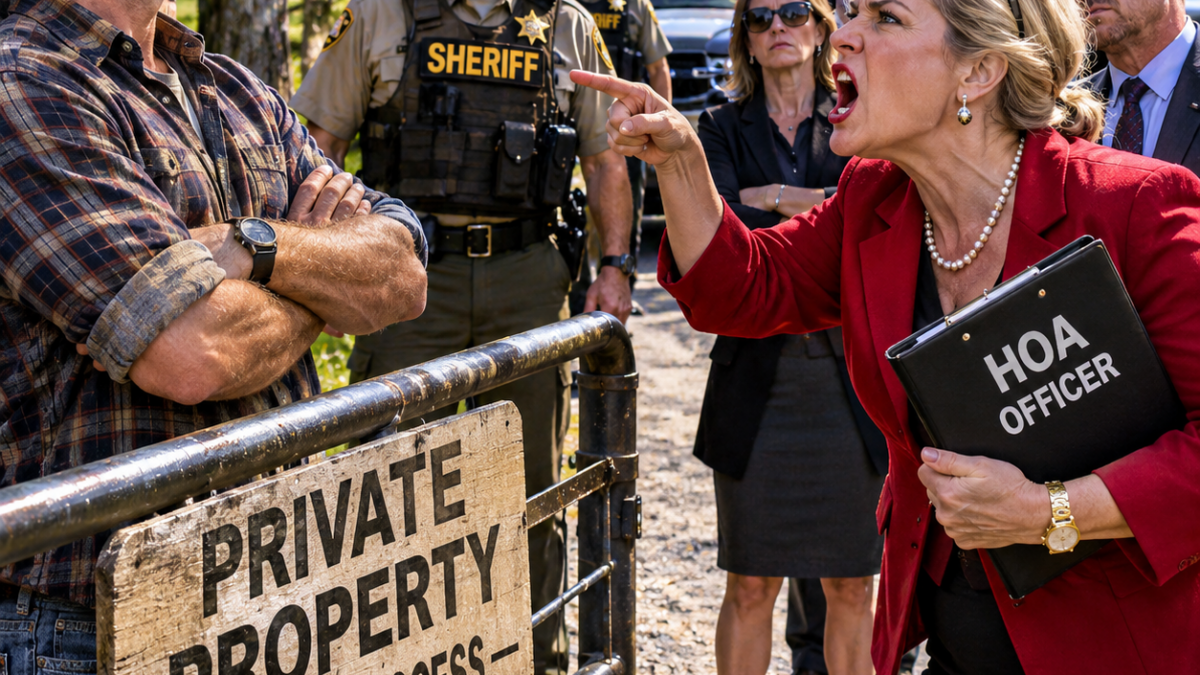
PART 2
I walked back into my barn.
I could still hear Darlene outside.
Click.
Click.
Click.
Her shoes moving across the gravel.
At one point she rattled papers.
At another, I heard her talking on the phone.
I didn’t go back out.
Five minutes later, the Buick started.
Its tires sprayed gravel as she left.
I should have felt victorious.
I didn’t.
Because there is a dangerous difference between believing you are right and knowing you can prove it.
I knew my grandfather’s property predated Cedar Brook.
I knew I had never joined the HOA.
But Darlene had official-looking paper, an office, letterhead and a board behind her.
I had an old deed inside a desk drawer.
So that afternoon, I drove into town.
Desmond Faraday’s law office sat above a hardware store on Main Street.
The staircase smelled faintly of dust and lumber.
Desmond had practiced property law in the county for more than twenty years.
He was the kind of lawyer I trusted immediately because he didn’t perform confidence.
He simply had it.
I placed the HOA letters on his desk.
Then Grandpa Eli’s deed.
Then my survey.
Desmond put on his glasses and read.
For almost ten minutes, the only sounds in the room were traffic outside and paper turning.
Finally, he leaned back.
“This overlay district they’re referencing…”
“Yes?”
He tapped the document.
“It isn’t a county district.”
“What is it?”
“Language created by Cedar Brook’s developer.”
“So?”
“So writing something into an HOA document does not automatically place neighboring property under HOA authority.”
I felt the tension in my shoulders loosen slightly.
“Then I’m right.”
“Based on what I’m seeing, yes.”
“Definitely?”
Desmond gave me a look.
“I’m an attorney, Garrett. We avoid that word before lunch.”
I laughed.
He didn’t.
Then he smiled.
“But your deed is not burdened by their covenants. I see no recorded consent. No annexation agreement. No HOA membership declaration.”
“So Darlene has no authority over me.”
“I see no legal basis for the authority she is claiming.”
That sentence was good enough.
Desmond drafted a letter.
Nothing emotional.
Nothing threatening.
That was his style.
He identified my parcel.
Referenced the deed.
Referenced the survey.
Stated that I was not a member of Cedar Brook Estates.
Demanded that all enforcement activity cease.
Then he mailed it certified.
Darlene signed for it on Thursday.
By Monday, she had mailed me another notice.
Fine balance:
$1,200.
The amount would increase every thirty days.
I stood beside my mailbox reading it twice.
Then I started laughing.
Not because $1,200 was funny.
Because Desmond had warned me.
“If she continues after receiving formal notice,” he had said, “keep everything.”
I carried the notice into my office.
I taped it to the wall.
Then I called him.
“She doubled down.”
“Good.”
“Good?”
“Paper trails are gifts, Garrett.”
“She says I owe twelve hundred dollars.”
“Do you?”
“No.”
“Then we now possess written evidence of what she is doing.”
That changed the way I looked at Darlene.
Until then, I had been trying to convince her to stop.
Desmond taught me to stop convincing.
Document.
That became the strategy.
Every letter.
Every voicemail.
Every date.
Every photograph.
Everything went into a folder.
Three weeks later, Darlene changed tactics.
A county code enforcement truck came up my road.
The man who stepped out was young.
Maybe thirty.
His name was Prescott.
He looked uncomfortable before he even reached the gate.
“Mr. Whitfield?”
“That’s me.”
“We received a complaint regarding possible property violations.”
“From Cedar Brook?”
He hesitated.
“I don’t normally identify complainants.”
“Fair enough.”
He looked through the gate.
“The complaint mentions unregistered structures, vegetation concerns, zoning issues.”
“You have a warrant?”
That surprised him.
“No, sir.”
“Then you’re welcome to look at whatever is visible from the public road.”
His shoulders relaxed.
“Appreciate that.”
He wasn’t my enemy.
He was a county employee who had been handed paperwork.
That distinction mattered.
He inspected the property from the road.
The barn.
The fencing.
The house.
He checked records on his tablet.
The barn was registered.
Its age made it grandfathered under later setback requirements.
My house was fine.
The fence was fine.
Vegetation presented no violation.
Twenty minutes later, Prescott closed his notebook.
“I’m not seeing anything significant.”
“Neither am I.”
He almost smiled.
“I’ll file my report.”
“Thank you.”
Before leaving, he paused.
“Off the record?”
“Sure.”
“If you’re dealing with an HOA dispute, keep your paperwork.”
“I already am.”
He nodded.
“Good.”
That visit told me something.
Darlene had realized she couldn’t enforce her rules directly.
So she was trying to bring government authority into the argument.
I requested Prescott’s report.
Zero substantive violations.
I added it to the folder.
Then I went further.
I filed a public records request.
Every communication between Cedar Brook HOA officers and county departments for the previous two years.
Emails.
Complaints.
Requests.
Attachments.
I didn’t know what I would find.
I only knew Darlene had taught me not to assume.
While I waited, another man came to my gate.
Unlike Darlene, he didn’t demand entry.
He knocked on the steel post and held up a thermos.
“Garrett Whitfield?”
“Yes.”
“Winslow Prudom.”
I recognized the name.
He lived inside Cedar Brook.
Two lots down from the entrance.
Retired contractor.
Gray beard.
Hands permanently marked by forty years of work.
“You know who I am?” he asked.
“I’ve seen your truck.”
He nodded toward the gate.
“You mind talking?”
“Depends.”
He lifted the thermos.
“I brought coffee.”
“That improves your odds.”
I unlocked the pedestrian section and let him through.
We sat on the porch.
Winslow poured coffee into two metal cups.
Then he placed a manila folder on the table.
“You’re fighting Darlene.”
“Apparently.”
“She’s been waiting for someone to do that.”
“Why haven’t you?”
He looked toward Cedar Brook.
“Same reason most people haven’t.”
“Which is?”
“It’s easier to pay one stupid fine than become her next project.”
That sentence stayed with me.
Winslow opened the folder.
Inside were HOA financial disclosures.
Annual budgets.
Expense statements.
Account summaries.
He pointed toward a line.
“Compliance discretionary account.”
I read.
Thousands of dollars.
Then more the following year.
And more.
“What is this paying for?”
“That’s the question.”
“No invoices?”
“Not in the member packets.”
“Board minutes?”
“Nothing specific.”
“Who controls it?”
“Darlene and Clifton Barr.”
Clifton was Cedar Brook’s HOA president.
Winslow leaned back.
“About forty-seven thousand dollars has moved through that account over three years.”
“For what?”
“Nobody knows.”
“And nobody asked?”
“I’m asking now.”
“Why me?”
“Because you told her no.”
I looked at him.
He smiled without humor.
“That may not sound like much, Garrett, but inside Cedar Brook, it was.”
I thought about Burl Sanchez.
Winslow told me about him.
Retired machinist.
Fined for a wind chime Darlene called “acoustically disruptive.”
Then Georgette Holloway.
Retired nurse.
Fined because her sunflowers exceeded an approved height.
Then the Ashfords.
Young couple.
Warning notices because their boat trailer sat in their driveway one Sunday.
“All legal under the HOA rules?” I asked.
“Some technically. Some stretched.”
“Then why didn’t people vote Darlene out?”
“Because until somebody sees the pattern, every homeowner thinks their fight is individual.”
That was the clever part.
One person thought the wind chime issue was silly.
Another thought the flowers were silly.
Another complained about a trailer fine.
But each assumed everyone else was satisfied.
Darlene’s power depended on keeping their frustration separated.
I called Desmond.
He reviewed the financial pages.
His tone changed.
“Where did you get these?”
“HOA member.”
“Legally obtained?”
“Yes.”
“Send me full copies.”
“What do you see?”
“I see enough that I want someone qualified to examine them.”
“Fraud?”
“Don’t use that word yet.”
“What word should I use?”
“Questions.”
Desmond was very good at making questions sound dangerous.
A week later, Darlene realized I had started asking them.
Every Cedar Brook homeowner received a letter titled:
COMMUNITY SAFETY NOTICE.
Winslow brought me a copy.
It did not use my name.
It didn’t need to.
It warned about a “neighboring parcel” containing questionable structures.
Unmanaged vegetation.
Possible fire risks.
Then came the line that changed everything.
“Recent unauthorized contact with community residents has raised concerns regarding intent.”
I read it again.
“Intent?”
Winslow nodded.
“She’s talking about me having coffee with you.”
“She’s trying to make you sound dangerous.”
“No.”
I folded the paper.
“She’s trying to make everyone afraid of talking to me.”
That failed.
Spectacularly.
Burl Sanchez called.
“Mr. Whitfield?”
“Garrett.”
“This is Burl from Cedar Brook.”
“The wind chime?”
There was silence.
Then he laughed.
“Winslow told you.”
“He did.”
“I just wanted you to know I’m not afraid of you.”
“That’s comforting.”
“Darlene’s letter made it sound like you were lurking around our houses.”
“I’ve never been farther inside Cedar Brook than the entrance road.”
“I know.”
He paused.
“She’s losing it.”
Then Georgette reached out.
Then the Ashfords.
Then people I had never met.
The safety letter was supposed to isolate me.
Instead, it created a conversation.
Darlene had finally given the residents something they all had in common.
Her.
I still didn’t confront her.
I went to work.
First, I hired a licensed surveyor.
Not because my old survey was wrong.
Because I wanted current stakes.
Bright orange.
Impossible to misunderstand.
Every property corner.
Every gate line.
Every important boundary.
Second, I installed four security cameras.
Visible ones.
One faced the gate.
One faced the road.
One covered the turnaround.
One covered the fence line.
Everything time-stamped.
Backed up automatically.
Third, I replaced the old front gate.
Grandpa’s original gate had sagged.
I had been meaning to rebuild it for years.
Now I had motivation.
Steel pipe frame.
Strong hinges.
Heavy chain.
Serious lock.
Not hostile.
Not theatrical.
Simply clear.
Closed meant closed.
Then I installed a flagpole.
Eight-foot cedar post set in concrete near the front boundary.
Tennessee flag on top.
Below it, an old reproduction flag Grandpa Eli had kept folded in a trunk.
By Sunday morning, Darlene had left a voicemail.
“Mr. Whitfield, the unauthorized installation of a structure near the community boundary may violate applicable setback provisions.”
I played it twice.
Then called Desmond.
“She’s complaining about the flagpole.”
He sighed.
“I was wondering how long that would take.”
“Legal?”
“Your location is fine.”
“I’m not calling her.”
“Excellent.”
“What should I do?”
“Nothing.”
I looked outside.
The flag moved gently over the gate.
Nothing felt wonderful.
Then my public records request arrived.
Desmond and I reviewed hundreds of pages.
Most were boring.
Routine messages.
Permit questions.
Scheduling.
Then we found Darlene.
Emails to county planning employees.
Emails about me.
One asked that complaints concerning the Whitfield property be “prioritized.”
Another described my refusal to cooperate as a potential threat to community development.
One employee responded carefully:
The county could not take enforcement action without an independent legal basis.
That message mattered.
Darlene had tried to accelerate county pressure.
The county employee had refused.
I sat in Desmond’s office staring at the page.
“She knew.”
“Knew what?”
“That the HOA itself couldn’t force me.”
Desmond nodded.
“So she tried another route.”
I felt my anger rising.
He noticed.
“Don’t.”
“Don’t what?”
“Get emotional now.”
“She’s been trying to push government employees into harassing me.”
“That’s why we document it.”
“I want to confront her.”
“That would help her.”
I knew he was right.
That made it worse.
Desmond leaned forward.
“Garrett, people who misuse authority often depend on one thing.”
“What?”
“The other person becoming angry enough to make a mistake.”
I sat back.
“So what do we do?”
“We make fewer mistakes than she does.”
That became another rule.
Then came the call that changed our entire strategy.
Late September.
I was on the porch watching the ridge turn orange when Desmond called.
“Come in tomorrow.”
“Why?”
“Chain of title review is finished.”
“Good news?”
“For you.”
“And Darlene?”
“Bring Winslow.”
That was all he said.
The next morning, Winslow and I sat across from him.
Documents covered his desk.
Old plats.
Development maps.
Deeds.
Covenants.
Desmond placed one page in front of me.
“This is Holt Brightwell’s preliminary Cedar Brook map from 2006.”
I looked.
Forty-one lots.
Clubhouse.
Roads.
Utility areas.
And along the northern boundary:
My land.
All forty-three acres.
Marked:
FUTURE ANNEXATION PARCEL.
I looked at Desmond.
“What does that mean?”
“Exactly what it says.”
“Brightwell planned to buy Grandpa’s land?”
“Or hoped to.”
“But he didn’t.”
“No.”
“What about annexation?”
“Never happened.”
“Consent?”
“None.”
“Covenant?”
“No.”
Desmond tapped the map.
“This is where Darlene’s overlay claim comes from.”
Winslow leaned forward.
“So the developer drew Garrett’s land on a planning map…”
“Yes.”
“And the HOA later treated the drawing as though annexation actually happened?”
“That appears to be what occurred.”
I stared at the paper.
All those notices.
All the fines.
The inspections.
The threats.
Built on the legal equivalent of a developer writing “maybe someday” on a map.
“That’s it?”
“That’s it.”
“Every fine?”
“Void if the court agrees with our title analysis.”
“Every compliance order?”
“Same.”
I should have felt relief.
Instead, I felt something colder.
Because Desmond wasn’t finished.
He opened another folder.
“This is Petra Szymanski’s report.”
“Who?”
“Forensic accountant.”
Winslow sat straighter.
Desmond continued.
“She reviewed the financial documents.”
He handed us a summary.
The discretionary compliance account had made repeated payments to:
Pruitt Advisory Services LLC.
I read the name.
Then read it again.
“No.”
Winslow whispered it before I could.
“Darlene.”
Desmond nodded.
“Registered owner: Darlene Pruitt.”
The office went silent.
“How much?” I asked.
“Thirty-one thousand four hundred dollars over approximately three years.”
“For what?”
“Compliance consulting.”
“She was the compliance director.”
“Yes.”
“So she hired her own company to consult the HOA on the job she already held?”
“That is one interpretation.”
“Was the board told?”
“Petra found no conflict disclosure in the records she reviewed.”
Winslow rubbed both hands over his face.
“I knew something was wrong.”
Desmond continued.
“The board minutes contain no clear authorization for several of the payments.”
I looked at him.
“Now can I use the word fraud?”
“No.”
I almost smiled.
“What can I use?”
“Undisclosed self-dealing.”
“Doesn’t sound as satisfying.”
“It sounds excellent in court.”
He handed us another document.
The HOA’s directors-and-officers liability insurance policy.
A clause excluded certain protections where an official concealed personal financial conflicts.
Desmond explained it carefully.
“If Petra’s findings are accurate and the conflict was undisclosed, Darlene may have a serious problem if residents pursue recovery.”
Winslow looked out the window.
For years, Darlene had controlled Cedar Brook by making everyone think she had protection.
Board authority.
HOA rules.
Insurance.
County relationships.
Now each shield was beginning to disappear.
“So what happens next?” Winslow asked.
Desmond folded his hands.
“We stop chasing her.”
I frowned.
“What does that mean?”
“It means we build the table.”
“What table?”
“The one she will eventually sit down at because she thinks she controls the room.”
That was Desmond.
Always calm.
Always three moves ahead.
The strategy had three fronts.
Legal.
Financial.
Community.
Legally, Desmond filed for a declaratory judgment.
We asked the circuit court for a simple ruling:
My property was not part of Cedar Brook.
The HOA had no authority over it.
The fines were invalid.
He also sought attorney’s fees based on the HOA continuing enforcement after being formally notified.
Financially, Petra finished her report.
Every payment.
Every date.
Every missing disclosure.
Every meeting minute.
Every related company registration.
She calculated $31,400 in payments requiring explanation and possible repayment, plus interest depending on what the review determined.
Desmond prepared a complaint for state authorities.
He did not file it immediately.
Not yet.
Community was Winslow’s battlefield.
Cedar Brook’s bylaws allowed a percentage of homeowners to force a special membership meeting.
Winslow started knocking on doors.
Quietly.
No shouting.
No dramatic campaign.
He simply showed people documents.
The sunflower fine.
The wind chime fine.
The financial account.
My invalid enforcement notices.
Darlene’s “community safety” letter.
Within a week, fourteen homeowners were prepared to sign.
Then fifteen.
Then seventeen.
Out of forty-one.
Enough.
More than enough.
The agenda was simple.
Independent audit.
Review of enforcement actions.
Removal vote.
Darlene responded exactly as Desmond predicted.
She went after Winslow.
He called me one afternoon laughing.
“She sent somebody to measure my flower bed.”
“What?”
“Begonias.”
“What about them?”
“Apparently they’re encroaching on a common easement.”
“How much?”
“She says four inches.”
“And?”
“The guy measured twice.”
“Why twice?”
“First time he got two and three quarters.”
I started laughing.
Winslow laughed harder.
That was when I realized something had changed inside Cedar Brook.
People were no longer ashamed of being targeted.
They were comparing notes.
Control based on isolation cannot survive that.
Then Darlene sent me another cease-and-desist notice.
Remove the cameras.
Remove the survey stakes.
Remove the flagpole.
Stop interfering with “community infrastructure.”
Desmond answered with one paragraph.
The items were lawful.
They sat on private property.
Any attempt to remove them without authorization could create additional legal consequences.
Clifton Barr called me the next morning.
His voice sounded tired.
“Mr. Whitfield, I think maybe we should talk.”
“About what?”
“Finding a reasonable resolution.”
“Great.”
He relaxed slightly.
Then I continued.
“Has the HOA withdrawn every fine against my property?”
Silence.
“Has the board acknowledged in writing that my land is outside HOA jurisdiction?”
More silence.
“Has the board authorized an independent financial audit?”
“Garrett, these things take time.”
“You’ve had months.”
“We need to lower the temperature.”
“I’m calm.”
“You know what I mean.”
“I do.”
He sighed.
“Darlene believes—”
“I’m not asking what Darlene believes.”
That shut him up.
I continued.
“You called because you know this is bigger than my barn now.”
Clifton didn’t answer.
“That’s what I thought.”
I ended politely.
No yelling.
No threats.
Just a boundary.
It became the theme of the entire fight.
A few days later, Winslow filed the special-meeting petition.
The board ignored it.
Twenty-one days passed.
Then twenty-two.
Under the bylaws, that allowed the petitioning members to schedule the meeting themselves.
Winslow did.
First Saturday in November.
Cedar Brook clubhouse.
Removal of board members.
Financial audit.
Review of enforcement decisions.
Four days before that meeting, my security cameras sent an alert.
Motion at gate.
I was inside the barn sealing a loft window.
I looked at my phone.
White Buick.
Gray Suburban.
Third vehicle.
I placed the caulking gun down.
I had known this was coming.
Weeks earlier, I had contacted the sheriff’s office.
Not to demand protection.
Not to accuse anyone of a crime.
I simply explained that private HOA representatives had repeatedly claimed a right to enter my land despite an active title dispute.
I gave them my name.
Address.
Attorney information.
Court case number.
The duty sergeant took notes.
That was all.
Then I prepared the gate.
Documents in a legal folder.
Deed.
Survey.
Attorney letter.
Court filing.
One-page summary.
Cameras checked.
Batteries charged.
And, because I had developed a sense of humor about the whole thing, I kept a folding chair near the gate with a thermos of coffee.
Now Darlene had arrived.
I walked down from the barn.
Cold leaves cracked under my boots.
The November air smelled like dry pine and rain.
Darlene was already outside the Buick.
Dark yellow blazer this time.
Clifton stood behind her.
The third man was Warren Tull, Cedar Brook’s property manager.
I stopped inside my boundary.
Twenty feet from the gate.
Darlene spoke first.
“Mr. Whitfield.”
“Darlene.”
“We are here to conduct an official compliance inspection.”
“No.”
Her face tightened.
“We have authority under Cedar Brook governing documents.”
“My property is not part of Cedar Brook.”
“That issue remains disputed.”
“It is before the circuit court.”
“That does not prevent us from enforcing community standards.”
“On HOA property, perhaps.”
She stepped closer.
“This parcel falls within the planned community overlay.”
“You have already received the title evidence.”
“Our counsel disagrees with your interpretation.”
“Then let your counsel speak to Desmond.”
“We are coming onto the property.”
“No, you are not.”
Clifton shifted behind her.
“Darlene…”
She ignored him.
“Open the gate.”
“No.”
“Mr. Whitfield, you are obstructing an authorized inspection.”
“No.”
Her voice rose.
“I am directing you to unlock this gate.”
“And I am telling you that you do not have permission to enter.”
She reached for the chain.
The cameras captured everything.
Her fingers wrapped around the metal.
She shook it.
Once.
Twice.
The sound echoed across the road.
Clifton stepped forward.
“Darlene, leave the gate alone.”
She spun toward him.
“We have a right to inspect.”
“I’m not sure—”
“We do.”
She turned back to me.
“Open it.”
I stared at her.
For months, she had used paper.
Then fines.
Then complaints.
Then reputation.
Now she stood physically holding the chain that separated her authority from my property.
I reached into my jacket.
Her eyes followed my hand.
I took out my phone.
“I’m calling the sheriff.”
Her confidence flickered.
“For what?”
“Potential trespass.”
“This is ridiculous.”
“Maybe.”
I dialed.
The duty sergeant recognized my name.
I kept the report simple.
“Three HOA representatives are at my gate claiming authority to enter. The jurisdiction issue is in active litigation. One individual is physically handling the gate. Nobody is injured. I’m not in immediate danger. I would like a deputy to respond and document the situation.”
The sergeant asked whether I was armed.
“No.”
Whether anyone else was.
“Not that I can see.”
“Stay on your property. Don’t escalate.”
“I won’t.”
“We’ll send someone.”
I put the phone away.
Then we waited.
That was the strangest ten minutes of the entire dispute.
No shouting.
No dramatic music.
Just four adults standing in Tennessee cold air separated by a locked gate.
Two crows landed on the fence.
Clifton pulled out his phone.
Warren looked increasingly interested in his shoes.
Darlene stared at me.
“You’re making a spectacle of this.”
“I’m standing on my own land.”
“You know what I mean.”
“Actually, I don’t.”
“This could have been handled cooperatively.”
“You sent me fines for a barn built before your subdivision existed.”
“You refused every attempt at resolution.”
“I refused every attempt to pretend you owned authority you didn’t have.”
“You’re poisoning relations with the community.”
“Your residents are the ones calling me.”
That hit her.
“You have no business involving yourself in Cedar Brook affairs.”
“I didn’t.”
I pointed toward her hand.
“You brought Cedar Brook affairs to my gate.”
She stepped away from the chain.
Then we heard tires.
A sheriff’s cruiser appeared at the bend.
It came slowly.
No siren.
No lights.
Just the quiet arrival of somebody whose authority didn’t depend on a letterhead.
Sergeant Grover Fitch stepped out.
Big man.
Gray at the temples.
Calm enough to make everyone else feel louder than they actually were.
He adjusted his hat.
Looked at Darlene.
Looked at me.
Then at the locked gate.
“Afternoon.”
“Sergeant,” I said.
He approached Darlene first.
“Ma’am, identification?”
She handed it over.
“Darlene Pruitt, Cedar Brook HOA compliance director. We are conducting an authorized inspection.”
He listened.
Then walked toward me.
“Mr. Whitfield?”
“Yes.”
“You have paperwork regarding the dispute?”
I slid Desmond’s one-page summary through the bars.
Fitch read it.
Property owner.
Deed reference.
Pending case number.
Attorney contact.
He looked at Darlene.
“Do you have a court order authorizing entry?”
“No court order is required. HOA governing documents—”
“Is this gentleman an HOA member?”
“The property is located within—”
“That wasn’t my question.”
Her jaw tightened.
“We consider the property part of the planned community.”
Fitch lifted the paper.
“And that exact issue is already in circuit court?”
“Yes, but—”
“Then I’m not deciding it here.”
Darlene looked almost relieved.
Until he continued.
“But without an order or other clear legal authority, he does not have to open his private gate for you.”
“We have inspection rights.”
“Show me.”
She opened her folder.
Passed him several pages.
Fitch read.
Slowly.
Then handed them back.
“Ma’am, this appears to be your association document.”
“Yes.”
“It does not establish for me that he consented to association membership.”
“Our attorney—”
“Then your attorney can argue that in court.”
Her face flushed.
“We need access.”
“He has denied access.”
“This is obstruction.”
“Of what?”
She opened her mouth.
Nothing came out.
Sergeant Fitch remained polite.
That somehow made it worse for her.
“Here’s what I’m going to recommend. You folks return to Cedar Brook and allow the court to resolve the property issue.”
Darlene stared at him.
“We have a right to be here.”
Fitch nodded toward the county road.
“You have a right to use that road.”
Then he pointed toward my side of the gate.
“You do not have permission to enter there today.”
She looked at me.
Then at him.
For one second, I thought she might continue.
Clifton whispered:
“Darlene. Enough.”
She turned sharply.
Walked toward her Buick.
Warren was already halfway to his vehicle.
Clifton followed.
The engines started.
One by one, the cars backed around.
Sergeant Fitch stood beside the road until all three disappeared.
Only then did he turn to me.
“Anything else?”
“No, sir.”
He handed back the property summary.
“Keep letting your attorney handle it.”
“That’s the plan.”
He glanced at the cameras.
“Those working?”
“All four.”
“Good.”
Then he nodded toward the thermos.
“Coffee still warm?”
“Probably.”
He smiled.
“You have yourself a quiet evening.”
The cruiser left.
I stood at the gate for another minute.
The orange survey stakes glowed against the brown grass.
The Tennessee flag moved gently above me.
I should have celebrated.
Instead, I locked the document folder back inside the barn.
Picked up my caulking gun.
And finished the loft window.
Because that was the point.
I didn’t want a war.
I wanted to work on my barn without strangers ordering me to unlock my gate.
But four days later, the fight moved inside Cedar Brook.
The special meeting filled the clubhouse.
Thirty-seven of forty-one households were represented.
I had never seen that many Cedar Brook residents together.
Folding chairs covered the floor.
People stood along the walls.
Two teenagers were streaming from their phones.
The atmosphere felt less like an HOA meeting and more like a courtroom waiting for a verdict.
Desmond sat beside me.
We were not voting members.
We were guests.
Darlene objected within four minutes.
“This individual is not a member of Cedar Brook.”
Desmond did not even stand.
“Mr. Whitfield is an invited guest of multiple members, as am I. Unless the membership votes otherwise under a valid provision of the bylaws, we will remain.”
Darlene looked toward Clifton.
He stared at the floor.
That told me everything.
Temporary meeting chair Harlan Voss called the room to order.
Harlan was a retired civil engineer.
Quiet.
White-haired.
Impossible to intimidate.
“First agenda item,” he said. “Authorization of an independent financial audit.”
Darlene raised her hand.
“I object to the legitimacy of this meeting.”
Harlan looked at the petition.
“The required membership threshold was exceeded. The board did not schedule the meeting within the required period. The petitioning members therefore exercised their bylaw authority.”
“This meeting is procedurally defective.”
“Your objection is noted.”
That phrase must have hurt her.
For years, Darlene had been the one noting everyone else’s objections.
The vote proceeded.
Twenty-nine in favor.
Three against.
Audit authorized.
The room murmured.
Darlene wrote something on her clipboard.
Second item.
Review of enforcement actions.
Winslow stood.
He held three pages.
He began reading.
Wind chime.
Sunflowers.
Boat trailer.
Door color.
Flower-bed encroachment.
Satellite dish.
My barn.
My fence.
My grass.
My flagpole.
My cameras.
The longer he read, the quieter the room became.
Each person had thought their violation was isolated.
Now they heard them in sequence.
A pattern sounded very different from a single complaint.
Georgette stood.
“I paid three hundred dollars over the sunflowers.”
Darlene replied immediately.
“The landscaping standards were clear.”
Georgette’s voice shook.
“My husband planted those with me before he died.”
The room changed.
Darlene hesitated.
“They exceeded approved height.”
“That’s all you have to say?”
Darlene’s face tightened.
“Personal circumstances cannot override uniform enforcement.”
Georgette sat down.
Her neighbor put a hand on her shoulder.
Burl stood next.
“The wind chime belonged to my father.”
Darlene exhaled.
“Mr. Sanchez—”
“I took it down because you threatened another fine every week.”
“The sound complaint came from a resident.”
“Who?”
“Complaints are confidential.”
“Does the complaint exist?”
Darlene said nothing.
Burl nodded slowly.
“That’s what I thought.”
Then came the financial presentation.
Petra Szymanski stood at the front.
Laptop.
Projector.
Three slides.
Nothing dramatic.
That was why it worked.
Slide one:
Payments from Cedar Brook HOA compliance account.
Slide two:
Recipient: Pruitt Advisory Services LLC.
Slide three:
Ownership: Darlene Pruitt.
Total reviewed payments:
$31,400.
The room made a low sound.
Not shouting.
More like the air leaving something punctured.
Darlene stood.
“These payments were authorized.”
Harlan looked at Petra.
“Were they approved in board minutes?”
“I found no recorded approval for multiple disbursements.”
Darlene snapped:
“I had compliance authority to engage outside consultants.”
Petra nodded.
“You engaged a company you owned.”
“Yes. Because it provided services.”
“Was your ownership disclosed?”
“It was common knowledge.”
Petra looked toward the residents.
“Was it documented?”
Darlene’s expression changed.
Petra continued calmly.
“I found no conflict-of-interest disclosure in the records provided.”
Clifton’s face went pale.
Harlan looked at him.
“Mr. Barr, were you aware Pruitt Advisory Services was owned by Darlene?”
Clifton swallowed.
“I…”
Everybody waited.
“I knew she had consulting experience.”
“That wasn’t the question.”
“No.”
Darlene spun toward him.
“Clifton.”
He shook his head.
“I didn’t know those checks were going to your own LLC.”
“You signed account summaries.”
“I did not see vendor ownership.”
“You should have known.”
The moment those words left her mouth, the room turned against her completely.
Not because of the money.
Because she had just blamed another board member for failing to discover what she had failed to disclose.
Winslow stood again.
He held one sheet.
“Before we vote, I want the membership to know something.”
Darlene looked at him.
“What now?”
“This is the cover page of a complaint prepared for state review concerning possible misuse of association funds and undisclosed self-dealing.”
The color drained from her face.
“You have no authority to make criminal accusations.”
“I didn’t make one.”
Winslow lifted the paper.
“I said a complaint has been submitted for review.”
The distinction was pure Desmond.
I almost smiled.
Darlene looked at me.
“You did this.”
I shook my head.
“Your own records did.”
She pointed at me.
“You came into this community and stirred up people who were perfectly satisfied.”
Burl laughed.
“Perfectly satisfied?”
Georgette stood again.
“Don’t speak for me.”
Another resident shouted:
“Or me.”
Another:
“You fined my daughter for chalk on the sidewalk.”
Darlene raised both hands.
“This is exactly what happens when enforcement breaks down. People forget why rules exist.”
Harlan banged the gavel once.
“Order.”
She turned toward him.
“I have maintained standards here for years.”
“No one disputes that you enforced rules,” Harlan said.
“The question before us is whether you exercised that authority appropriately.”
“I did.”
Winslow held up Petra’s report.
“Then the audit will prove it.”
Darlene stared at him.
The removal vote began.
Thirty-one voted to remove her.
One voted to retain her.
Her own vote.
Several members abstained.
Harlan announced the result.
“Darlene Pruitt is removed from the Cedar Brook Estates board and from her compliance position effective immediately.”
Nobody moved.
Darlene sat frozen.
Then:
“No.”
Harlan looked at her.
“The vote is complete.”
“This meeting is invalid.”
“The membership has voted.”
“You have no authority to remove me.”
“The bylaws do.”
“I will appeal.”
“That is your right.”
She stayed seated.
Clifton stood.
His face looked ten years older than it had that morning.
“I resign.”
Darlene stared at him.
“What?”
“I resign as president.”
“You cannot leave now.”
He looked at her.
“I think I should have left a long time ago.”
Then he walked toward the door.
Darlene remained.
Harlan gave her several minutes.
Finally:
“Darlene, your board position has ended. We need you to surrender association records in your possession and leave the chair.”
“I am not going anywhere.”
Winslow leaned toward me.
“Here we go.”
Harlan picked up his phone.
He called the sheriff.
I almost laughed at the symmetry.
This time, it wasn’t my call.
It was Cedar Brook’s.
Sergeant Grover Fitch arrived twelve minutes later.
When he stepped into the clubhouse and saw Darlene, his eyebrows rose.
“Ma’am.”
She stood.
“This is an internal association matter.”
“So I’ve been told.”
“This meeting is illegal.”
Harlan handed him the bylaws, petition and vote record.
Fitch read enough to understand one thing.
The newly recognized meeting chair wanted a removed officer to leave the facility.
He approached Darlene.
“Ma’am, they’ve asked you to leave.”
“I am the compliance director.”
“Not according to the vote they just recorded.”
“I’m appealing.”
“You can appeal from somewhere else.”
The room was silent.
Darlene’s hands shook.
Not much.
Just enough to notice.
“You don’t understand what these people are doing.”
Fitch’s voice stayed gentle.
“Maybe not.”
He gestured toward the door.
“But I understand what I’m asking you to do.”
She gathered her clipboard.
Slowly.
Every eye followed her.
At the doorway, she turned.
For a moment I thought she would say something to me.
She didn’t.
She looked at the residents.
The people she had fined.
Lectured.
Warned.
Managed.
People who had once avoided challenging her because one violation could become five.
Nobody looked away.
Darlene walked out.
The door closed.
Silence.
Then Winslow leaned toward me.
“That’s it.”
“Maybe.”
“You don’t think so?”
“The court case is still open.”
He nodded.
“You always have to ruin the moment.”
Then somebody started clapping.
I never learned who.
One person.
Then another.
Then nearly the entire room.
Georgette cried.
Burl hugged his wife.
The Ashfords laughed like teenagers.
Winslow sat back and closed his eyes.
I didn’t clap at first.
I just watched.
This wasn’t my victory.
Not really.
My gate had been the spark.
But Cedar Brook’s residents had done the hard part.
They had stopped whispering separately.
Then I saw Georgette.
She was still crying.
So I clapped too.
The following months were quieter.
The circuit court issued its ruling in February.
Four pages.
Clear language.
My property had never been legally annexed into Cedar Brook Estates.
The HOA had no jurisdiction.
All fines against me were void.
The court also awarded most of my legal expenses.
I drove to Desmond’s office with the order.
He handed me a copy.
“Congratulations.”
“That’s it?”
“That’s it.”
“No dramatic courtroom speech?”
“Life is disappointing.”
I laughed.
“Darlene?”
“Not your problem.”
That was harder to accept than I expected.
For months, she had occupied space in my head.
Every engine on the gravel road made me check the window.
Every letter made my stomach tighten.
Every unfamiliar vehicle made me wonder what she had tried next.
Now the court had ended my part of the dispute.
I realized I didn’t know how to stop fighting.
Desmond must have seen it.
“Garrett.”
“What?”
“Go fix your barn.”
I looked at him.
“That legal advice?”
“Yes.”
“Expensive?”
“Extremely.”
So I went home.
And fixed the barn.
The state investigation into Cedar Brook finances continued separately.
I stayed out of the speculation.
Petra’s documents spoke for themselves.
The new HOA board commissioned an outside audit.
They rewrote their governance procedures.
Conflict disclosures became mandatory.
The strange “planned community overlay” language disappeared from their rules.
Compliance enforcement was reduced.
Not eliminated.
That mattered.
Communities still needed rules.
What they didn’t need was someone treating every rule as an opportunity to remind people who held power.
Harlan Voss became board president.
Winslow joined the board reluctantly.
He complained constantly.
Which probably made him ideal.
Burl Sanchez rehung the wind chime.
I went to see it.
It was smaller than I imagined.
Plain metal tubes.
Weathered wood.
It made a soft sound in the breeze.
“That thing caused all the trouble?” I asked.
Burl smiled.
“Dangerous instrument.”
Georgette replanted her sunflowers.
The following summer, they grew taller than before.
I asked whether they met the landscaping specification.
She laughed.
“Come measure them.”
“No.”
“Coward.”
The Ashfords parked their boat trailer in the driveway the morning after the special meeting.
They didn’t even need the boat.
They just wanted to look at the trailer.
People are funny that way.
Freedom becomes most visible in small things after somebody tries to control them.
As for my forty-three acres, I finally did what I should have done years earlier.
I protected them.
Not with anger.
Not with a bigger gate.
Legally.
I worked with a land trust to create a conservation easement.
The process took months.
Surveys.
Environmental review.
Documents.
More documents.
But when it was finished, the land could not simply become another subdivision after I died.
The pond would remain.
The ridges.
The barn.
The orchard.
The cedar line.
My grandfather’s land would stay land.
One evening, Winslow came over.
We sat on the porch.
He looked across the field.
“You know what Holt Brightwell probably saw when he looked at this?”
“What?”
“Forty-three future lots.”
“Probably.”
“What do you see?”
I thought about it.
“The same thing Grandpa saw.”
“What’s that?”
“Enough.”
Winslow nodded.
Then he handed me an envelope.
“What’s this?”
“New board recovered some funds.”
“So?”
“They voted to put part toward community restitution and goodwill.”
“I don’t need HOA money.”
“I know.”
“Then why are you giving me this?”
“Because they asked whether you wanted to suggest something useful.”
I opened the envelope.
The amount wasn’t huge.
But enough to matter.
“What are you thinking?”
He asked.
I looked toward the barn.
Grandpa Eli had never attended college.
Neither had I.
He believed a good mechanic, carpenter, welder or electrician could walk anywhere with a skill and feed a family.
“Scholarship.”
Winslow smiled.
“I thought you’d say that.”
The Eli Whitfield Vocational Scholarship launched the next spring.
Two graduating seniors.
Five hundred dollars each toward trade school or a community-college technical program.
Small beginning.
The first recipients came to my place before graduation.
One wanted to become a diesel technician.
The other was studying welding.
I took them into Grandpa’s barn.
His old tools still hung along one wall.
Wood-handled hammers.
Levels.
An ancient vise.
A framing square with his initials scratched into it.
The welding student ran a finger over the square.
“Your grandfather built this place?”
“With help.”
“When?”
“1964.”
She looked around.
“It’s still solid.”
“Exactly.”
That was all I wanted the scholarship to mean.
Build something solid.
Not something flashy.
Not something that gives you authority over somebody else.
Something that remains useful after you’re gone.
By summer, I stopped checking the security cameras every hour.
Then every day.
Eventually, only when the system notified me.
The gate stayed locked.
Some people assumed that meant I was still angry.
I wasn’t.
Anger had burned itself out.
The gate stayed locked because a gate means something.
It marks the line between invitation and entitlement.
Friends came through.
Neighbors came through.
Sheriff Fitch came through once when I invited him for coffee.
Even Harlan Voss visited.
He stood beside the gate and looked at the heavy chain.
“This famous thing?”
“Apparently.”
“Doesn’t look like much.”
“It’s a gate.”
“News around Cedar Brook made it sound like the Berlin Wall.”
“I disappoint people constantly.”
He laughed.
Then became serious.
“Garrett, I owe you an apology.”
“For what?”
“I lived there when Darlene started.”
“So?”
“I saw what she was doing.”
“You eventually stopped it.”
“Eventually.”
He looked toward Cedar Brook.
“I kept telling myself it wasn’t my business until my property got targeted.”
I understood that.
Most people don’t choose conflict while life is tolerable.
“That doesn’t make you a bad person.”
“No.”
He looked at me.
“But it made her stronger.”
That was true too.
We stood quietly.
Then he asked the question I had asked myself a hundred times.
“What if you had just opened the gate?”
I looked at the road.
“Probably nothing dramatic.”
“No?”
“She would’ve inspected the barn.”
“Then fined you.”
“Probably.”
“And then?”
“Another inspection.”
“More letters.”
“Maybe.”
“And eventually?”
I shrugged.
“People who don’t respect one boundary rarely become more respectful after you remove it.”
Harlan nodded slowly.
That was the lesson I kept.
Not that every HOA is bad.
Not that every compliance officer is corrupt.
Not that you should turn every neighbor dispute into a courtroom fight.
The lesson was simpler.
Authority should survive questions.
Real authority can show you where it comes from.
Real authority can explain its limits.
Real authority does not need you confused.
Darlene needed confusion.
She needed residents to believe nobody else was being treated badly.
She needed me to believe official-looking stationery made her claims legitimate.
She needed county workers to believe her complaints deserved priority.
She needed Clifton to believe signing summaries was enough.
She needed Cedar Brook residents to believe challenging her would cost more than quietly paying.
Once people started comparing documents, everything changed.
A few months after the court ruling, I saw Darlene again.
Completely by accident.
Hardware store.
Plumbing aisle.
I was holding two brass fittings when she turned the corner.
We stopped.
For a moment, neither of us spoke.
She looked different.
Not physically.
Smaller somehow.
Maybe because there was no clipboard.
No board title.
No audience.
Just two people standing between shelves of PVC fittings.
She looked at the parts in my hand.
“Still working on that old place?”
“Yes.”
“You could sell it for a fortune.”
“I know.”
“Developers would pay.”
“I know.”
She gave a short laugh.
“Of course you do.”
I started to walk past.
Then she said:
“You destroyed my reputation.”
I stopped.
I didn’t turn around immediately.
When I did, she looked angry.
But underneath it, something else.
Maybe hurt.
Maybe embarrassment.
Maybe both.
“I didn’t write the checks,” I said.
“You encouraged them.”
“Who?”
“The residents.”
“To look at their own financial statements?”
“You know what you did.”
“Yes.”
I held her eyes.
“I kept my gate closed.”
Her jaw tightened.
“You could have handled things privately.”
“I tried.”
“No, you hired a lawyer.”
“After you ignored me.”
“You humiliated me.”
“Darlene, you came to land that wasn’t yours and ordered the owner to obey rules he never agreed to.”
She looked away.
I continued.
“You sent fines after being told the property wasn’t yours to regulate. You pushed county complaints. You wrote a safety letter implying I was dangerous because residents were talking to me.”
“I was protecting Cedar Brook.”
“From a barn?”
She didn’t answer.
I softened my voice.
Not because she deserved comfort.
Because I didn’t want to become the man I had spent a year fighting.
“You know what the worst part was?”
She looked at me.
“You made ordinary people afraid to ask you questions.”
For the first time, Darlene had nothing ready.
No citation.
No bylaw section.
No threat.
She just stood there.
I walked away.
That was the last conversation we ever had.
I didn’t feel victorious afterward.
Mostly tired.
Revenge sounds satisfying when you imagine it.
In reality, the best ending rarely comes from watching someone else suffer.
It comes from no longer needing them to suffer for you to feel whole.
My satisfaction came later.
The day the first Eli Whitfield Scholarship checks were handed out.
The morning I saw Georgette’s sunflowers above her fence.
The afternoon Burl’s wind chime moved in the breeze.
The first fall after the conservation easement was recorded.
And one particular evening at my gate.
The sun was dropping behind the ridge.
Orange light caught the survey stakes.
I had left them there.
Not because I needed them anymore.
Because they reminded me of the year I learned exactly where my boundaries were.
Not just property boundaries.
Personal ones.
Legal ones.
Emotional ones.
The flagpole still stood.
The cameras still worked.
The gate was locked.
Then an old pickup came down the road.
Winslow.
He stopped outside.
I walked over.
“You planning to stand there or open up?” he asked.
“You HOA?”
“Board member.”
“Absolutely not.”
He laughed.
I unlocked the gate.
That was the difference.
He waited to be invited.
We drove up to the porch.
He brought coffee.
I brought two chairs.
The trees were turning again.
Exactly like they had the previous year.
“Hard to believe it started with a letter,” Winslow said.
“It started before the letter.”
“When?”
“Probably the first time everybody assumed somebody else would deal with her.”
He considered that.
“Fair.”
Then he looked toward the gate.
“You ever think about taking that thing down?”
“No.”
“Why?”
I smiled.
“Because it works.”
Years from now, somebody else may own this land.
Maybe family.
Maybe not.
They may replace the house.
They may modernize the barn.
The pond may need dredging.
The apple trees I planted may outlive me.
But the conservation documents will remain.
And so will the story.
My grandfather worked underground and poured concrete on weekends so he could buy forty-three acres without owing anybody.
He didn’t leave me wealth in the way people normally mean it.
He left me ground.
Trees.
Water.
A barn.
And something harder to value.
The ability to say no.
For a long time, I thought property ownership meant possessing land.
I was wrong.
It means accepting responsibility for a boundary.
Sometimes the boundary keeps animals in.
Sometimes it keeps strangers out.
Sometimes it protects history.
Sometimes it protects the person you are becoming.
When Darlene first arrived, I was still rebuilding myself after a marriage that had ended badly and years of living away from everything familiar.
I had come back to Eli’s place because I wanted peace.
For months, Darlene made me feel like defending that peace had destroyed it.
Letters on the table.
Lawyer appointments.
Camera alerts.
Phone calls.
Financial records.
Court filings.
I started waking before sunrise again, not because I felt rested, but because my mind was already running through the next problem.
Then one morning after the ruling, I woke at six.
No alarm.
No anxiety.
Just birds.
I walked onto the porch.
Mist sat over the pond.
The barn roof I had finally replaced was dark with dew.
A deer stood near the south fence.
Nothing needed my immediate attention.
No letters.
No inspections.
No threats.
No deadlines.
I poured coffee.
Sat down.
And realized my peace had returned.
Different than before.
Stronger.
Because this time I knew what it cost.
That is why the locked gate never became a symbol of anger to me.
It became a symbol of consent.
Who enters.
Who doesn’t.
Who gets to decide.
Darlene thought the lock was the obstacle.
It wasn’t.
The obstacle was the fact that for once, someone on the other side knew she had no authority to demand the key.
Ten minutes after she grabbed that chain, the sheriff arrived.
He did not arrest anyone.
He did not shout.
He did not create some dramatic scene.
He simply asked the question Darlene had spent months avoiding:
What gives you the right to enter?
She couldn’t answer it.
And once that question was asked out loud, the entire structure around her began to collapse.
Four days later, Cedar Brook residents asked their own questions.
Where did the money go?
Who approved the payments?
Why were residents being targeted?
Why was a board official paying her own company?
Why had nobody disclosed it?
Questions did what anger never could.
They separated authority from intimidation.
Facts from letterhead.
Rules from ego.
The court handled my land.
The residents handled their HOA.
The investigators handled the finances.
And I finally went back to handling the things I actually cared about.
The barn.
The pond.
The orchard.
My grandfather’s legacy.
The first twelve apple trees I planted along the south fence struggled through their first summer.
Two nearly died.
I considered replacing them.
Then spring came.
Small green buds appeared.
By the third year, several produced fruit.
Not much.
A few crooked apples.
Winslow picked one.
Took a bite.
Made a face.
“That is terrible.”
“They’re young.”
“That apple offended me personally.”
“Give them time.”
He threw the rest toward the field.
“Maybe the deer have lower standards.”
The next year, the apples were better.
That became another lesson Eli would have understood.
Some things need time after being planted.
The scholarship grew too.
Local contractors contributed.
Then a welding company.
Then a diesel shop.
Five hundred-dollar awards became thousand-dollar awards.
Two students became four.
One of the first recipients eventually came back to Cedar Brook as a licensed electrician.
He rewired part of the clubhouse.
I found that funny.
A scholarship born from an HOA dispute helped improve the HOA clubhouse.
That was the kind of revenge I could live with.
Not destruction.
Replacement.
Replace fear with transparency.
Replace arbitrary fines with clear rules.
Replace resentment with something useful.
Replace the threat of development with protected land.
Replace years of fighting with a gate you only opened for people you wanted to welcome.
One Saturday, I found Grandpa Eli’s old ledger in a box.
He had recorded nearly everything.
Fence wire.
Feed.
Roof nails.
Diesel.
Concrete.
Property taxes.
In 1961, one entry read:
LAND — PAID IN FULL.
Underneath, he had drawn a line.
That was it.
No speech.
No explanation.
I sat at his old desk staring at those words.
Paid in full.
He had worked years for that sentence.
Maybe that was why Darlene’s first letter bothered me so deeply before I could even explain it.
She wasn’t simply telling me to repaint a barn.
She was acting as though generations of work could be overwritten because somebody had added my property to a map decades later.
Grandpa had paid for the right to determine what happened here.
Then he left that responsibility to me.
I almost framed the ledger.
Instead, I placed it inside a protective sleeve and stored it with the conservation easement.
Deed.
Survey.
Court order.
Grandpa’s ledger.
Four documents telling one story in different ways.
This land was his.
Then mine.
But never theirs.
The final orange survey stake eventually faded from the sun.
One afternoon I pulled it from the ground.
The plastic cracked in my hand.
I considered throwing it away.
Instead, I carried it into the barn.
I mounted it beside Grandpa’s framing square.
Below it, I installed a small metal plaque.
BOUNDARIES ONLY WORK WHEN SOMEONE RESPECTS THEM.
Winslow saw it later.
“That’s dramatic.”
“I learned from Darlene.”
He laughed.
Then he looked serious.
“You ever miss the excitement?”
“No.”
“Not even a little?”
“No.”
“You’re lying.”
“Maybe the sheriff part.”
“That was pretty good.”
“It was.”
We both laughed.
Then the barn doors opened to the evening air.
Outside, the hills were quiet.
The same hills Grandpa Eli had watched.
The same land Darlene once insisted belonged under her rules.
No compliance trucks.
No white Buick.
No strangers measuring my fence.
Just forty-three acres exactly where they had always been.
And a locked gate at the end of the road.
I still open it.
For neighbors.
For friends.
For scholarship kids.
For delivery drivers who call ahead.
For Sergeant Fitch when he wants coffee.
For Winslow, though sometimes I make him wait just to annoy him.
But nobody enters because they shake the chain hard enough.
Nobody enters because their letterhead looks official.
Nobody enters because they tell me resistance would be easier if I simply cooperated.
They enter because they have permission.
That distinction saved my property.
It also changed Cedar Brook.
And it changed me.
Darlene arrived believing the locked gate was an insult to her authority.
She never understood that it was simply a boundary.
Ten minutes later, Sergeant Fitch gave her the only option that had been available from the beginning.
Respect it.
She drove away.
The court eventually confirmed what my grandfather’s deed had said all along.
The residents reclaimed their HOA.
The financial records were opened.
The rules were rewritten.
The land was permanently protected.
And the barn Darlene once labeled an “unapproved outbuilding” still stands where Eli Whitfield built it in 1964.
Some mornings I work there with both doors open.
The scent of cedar and engine oil drifts across the yard.
Wind moves through the apple trees.
The pond catches the first light.
And when I look down the gravel road toward that locked steel gate, I don’t remember Darlene’s face anymore.
I remember my grandfather’s ledger.
LAND — PAID IN FULL.
He earned the land.
My job was simply to make sure nobody with a clipboard convinced me to give it away.








