PART 2: HOA Mocked My Collapse Warnings and Backed 34 Luxury Townhomes—Then the Ground Started Taking Them Back
PART 2
The buried system was larger than I remembered.
That was the first thing that bothered me.
The second was that nobody else appeared bothered at all.
The original county drawings showed drainage arriving from three directions.
Keer Street.
Aldrich Road.
The northern cul-de-sac.
All of it had once moved through the fifteen-acre parcel behind us before eventually reaching the larger municipal system downhill.
The biggest lines were eighteen inches in diameter.
Corrugated steel.
Old.
Abandoned.
Not excavated.
Not filled.
Not structurally abandoned in a way I would’ve accepted on one of my own projects.
They had simply been capped and left underground.
Maybe they were mostly intact.
Maybe sections had collapsed years ago.
Maybe voids had formed around deteriorated metal.
Maybe not.
That was exactly why the 1994 report had recommended subsurface investigation before future construction.
It wasn’t predicting catastrophe.
It was saying:
**Before you put weight here, look underneath.**
Simple.
Responsible.
Boring.
The kind of sentence nobody pays attention to until ignoring it becomes expensive.
I spent that night mapping the old lines against the preliminary Crest Haven site plan.
Darlene came into my office around midnight.
“You’re still at it?”
“Look.”
She leaned over my shoulder.
I placed the two drawings together.
The eastern row of proposed townhomes sat almost directly over the old primary drainage corridor.
“How bad?”
“I don’t know.”
“That sounds worse coming from you.”
“It means exactly what it means.”
I pointed.
“They need borings.”
“Did they do them?”
“I can’t find a report.”
“Maybe the county has one.”
“Maybe.”
Darlene straightened.
“Then ask.”
I did more than ask.
The next morning, I wrote a formal objection.
No emotional language.
No accusations.
No predictions that houses were going to disappear into the earth.
I cited the 1994 decommission report by file number.
Included the pipe drawings.
Referenced the proposed foundation area.
Requested that approval be conditioned on subsurface investigation by a qualified geotechnical engineer.
Three copies.
Crest Haven Capital Partners.
Franklin County Planning.
Milhaven Pines HOA.
Certified mail.
Return receipt.
When the green cards came back, I put them in a manila folder.
On the tab I wrote one word:
**RECORD.**
Darlene saw it.
“You’re naming folders now?”
“I always name folders.”
“You’ve never looked happier.”
“I am deeply concerned.”
“Of course.”
She kissed my head and went back to hemming a wedding dress.
Two weeks later came the May HOA meeting.
Philippa sat in the same chair.
Same controlled smile.
Same cream-toned blazer.
She spoke for ten minutes about landscaping.
Five about mailbox maintenance.
Then:
“The board has reviewed concerns raised regarding the Crest Haven development.”
She never looked at me.
“We have determined that construction permitting falls within county jurisdiction and outside the association’s authority.”
Fair enough.
That part was true.
Then she continued.
“The board believes Crest Haven Commons represents a positive investment in the long-term strength of our community.”
I sat forward.
One board member introduced a formal endorsement motion.
Four votes yes.
One no.
Clive Osterhouse.
Retired pharmacist.
Quiet man.
Always sat near the end of the table.
Clive didn’t make a speech.
Just:
“No.”
Then lowered his hand.
The endorsement passed.
The following week it appeared in Crest Haven’s permit package.
An HOA letter praising the project.
I sat at home reading it.
Darlene came in.
“They don’t have jurisdiction over construction,” I said.
“Right.”
“But apparently they have enough jurisdiction to endorse it.”
Darlene took the paper.
Read.
Set it down.
“She wants it.”
“The development?”
“Yes.”
“Why?”
“Property values maybe.”
“Maybe.”
She looked toward the backyard.
“Or something else.”
“What are you finding?”
“Old records.”
“How old?”
“Older than the drainage report.”
“Useful?”
“Maybe.”
I waited.
She didn’t elaborate.
My wife had worked alterations for twenty years.
She knew that pulling the wrong thread before finding where it ended could ruin an entire garment.
I let her work.
Crest Haven broke ground in June.
The first excavator arrived just after seven one morning.
I was watering tomatoes.
The bucket bit into the field.
Clay came up in heavy chunks.
Diesel hung in the air.
Hydraulics groaned.
I watched from my fence.
Didn’t interfere.
Didn’t enter the site.
Just watched.
Then the bucket hit something.
**CLANG.**
Not rock.
Metal.
Hollow.
Every instinct I had sharpened.
The operator stopped.
A supervisor walked over.
They looked into the excavation.
Talked.
Ninety seconds, maybe.
Then a laborer climbed down.
Another man brought gravel.
They placed material around whatever had been exposed.
The excavator started again.
I pulled out my phone.
Recorded everything.
The supervisor noticed me.
“What’re you doing?”
“Recording from my property.”
“We’ve got permits.”
“I know.”
“Then we’re good.”
“Did you hit an abandoned pipe?”
He stared.
“No idea.”
“You should find out.”
“Sir, we’re permitted.”
He turned away.
I sent the video to my own email that afternoon.
Timestamp.
Backup.
Then I wrote a memo.
Date.
Time.
Approximate location.
Observed event.
No speculation.
That distinction mattered.
Engineers get in trouble when observation becomes assumption.
I knew the sound.
But knowing wasn’t proving.
So I wrote:
**Excavator encountered apparent metallic subsurface object at approximately six feet. Work paused approximately ninety seconds before continuing.**
Darlene texted from downtown.
**Recorder’s office. Found something from 1961. Not ready yet.**
I replied:
**Don’t tell me until you’re sure.**
She sent:
**That’s why I married you.**
By August, twelve structures were framed.
By October, twenty-two.
Marketing started before the dust settled.
Glossy mailers.
Stone porches.
Granite kitchens.
Families walking dogs beside a fountain that did not yet exist.
Prices from $340,000 to nearly $400,000.
Neighbors started talking about the value of their own houses.
At the mailbox, Doug Sherman from across the street said:
“This thing might add fifty grand to everybody’s value.”
“Maybe.”
“You still against it?”
“I’m against building without knowing what’s under it.”
“They’ve got permits.”
“Permits aren’t magic.”
He laughed.
“Retirement made you cheerful.”
“Always been delightful.”
The ribbon cutting happened in late August.
Philippa appeared in the HOA newsletter beside Donovan Sharf, Crest Haven’s regional vice president.
Oversized scissors.
Hard hats.
Banner.
**A GENERATIONAL INVESTMENT IN OUR COMMUNITY’S FUTURE.**
I showed Darlene.
“Do you own scissors that size?”
“No.”
“Shame.”
“She looks happy.”
“She usually does.”
“You don’t.”
“I usually don’t.”
Then I called Wendell Pruitt.
No relation despite the surname.
We had worked together years earlier.
Geotechnical engineer.
Semi-retired.
Meticulous to the point of irritation.
Which is exactly what you want in someone evaluating ground.
He came Saturday.
Walked the fence line.
Twice.
No talking.
He looked at grades.
Construction.
Storm inlets.
Old contour map.
Finally he stopped near the eastern end.
“Garrett.”
“What?”
“Where does Keer Street drain now?”
“Municipal inlet at the low point.”
“And historically?”
I pointed toward the development.
“Through the old field.”
He nodded.
“That’s what I thought.”
He took out his notebook.
“The development grade is pushing flow east.”
“Surface?”
“And likely subsurface.”
“Can you prove it?”
“Not without site access.”
“What can you do?”
“Professional assessment from public data and observable conditions.”
“How much?”
“Twelve hundred.”
I wrote the check that afternoon.
Darlene saw the amount.
“Twelve hundred?”
“Yes.”
“You like Wendell that much?”
“I like stamped paper.”
She nodded.
“Fair.”
Wendell’s letter was careful.
Not sensational.
He described the historical drainage network.
The altered site grading.
Potential impact of building loads on abandoned subsurface structures.
Observed drainage direction toward Keer Street.
Recommended formal geotechnical investigation and verification of abandoned piping conditions.
Stamped.
Signed.
Professional.
I sent it to county planning as a supplement to my objection.
Certified.
Eleven days later, I received a form letter.
The permit had been issued under applicable requirements.
No further action indicated.
I read it.
Then reread Wendell’s report.
Then the form letter.
Darlene leaned against the counter.
“Say it.”
“What?”
“The thing you’re thinking.”
“Somebody is going to regret that letter.”
She smiled.
“There it is.”
Philippa called at 7:15 on a Thursday night.
Pleasant tone.
“Garrett, I wanted to speak neighbor to neighbor.”
“I didn’t realize we were at that stage.”
“I respect your passion.”
“That’s never the first sentence of anything good.”
She ignored it.
“Several residents are becoming anxious because of your continued objections.”
“I’ve filed engineering concerns.”
“Crest Haven has legal permits.”
“Yes.”
“Your continued interference could affect contracts and sales.”
“I haven’t interfered with anything.”
“I’m only saying that one should be careful not to cross into conduct that could be viewed as tortious interference with business relationships.”
There it was.
Not a threat.
A thought.
Delivered gently.
I looked at the clock.
7:15.
“I appreciate the warning.”
“I’m glad.”
“Goodnight, Philippa.”
I hung up.
Then immediately wrote down her exact words as best I remembered them.
Sent the memo to myself.
Printed it.
Added it to the folder.
Darlene walked in carrying two mugs.
“You look angry.”
“No.”
“That’s your angry face.”
“She warned me about tortious interference.”
“Did she?”
“Hypothetically.”
“Of course.”
Darlene put down her coffee.
Then placed an old photocopy beside it.
Yellowed paper.
Typed legal language.
Handwriting in the margin.
“1961.”
I looked at her.
“What is it?”
“I think it’s an easement.”
“For?”
“Drainage.”
I leaned over.
“Recorded?”
“I need the original.”
“So you don’t know.”
“I know enough to go back tomorrow.”
I looked at the document.
“Who benefits?”
“That is the interesting part.”
“Darlene.”
“Tomorrow.”
She walked away.
There are moments in a marriage when love looks like romance.
Flowers.
Anniversaries.
Hands held in hospital rooms.
Then there are moments when love looks like your wife refusing to tell you what she found because she hasn’t verified the deed book yet.
Both count.
October arrived wet.
Not violent storms.
Ohio rain.
Gray.
Slow.
Steady.
The kind that makes every lawn darker and every low spot gradually reveal what it really is.
The storm drain on Keer Street started clearing more slowly.
At first, subtle.
Water used to disappear in under an hour.
Now two.
Then three.
One moderate storm left water at the curb nearly five hours.
I started a log.
Date.
Rainfall total.
Duration.
Photograph.
Time to drainage.
Same camera angle.
Same mailbox.
Same curb.
I pulled rainfall numbers from official weather data.
Darlene watched me come inside one night dripping wet.
“You know there are hobbies.”
“This is a hobby.”
“No.”
“Golf is expensive.”
“So is Wendell.”
“Wendell is more useful.”
I filed a complaint with the county Soil and Water Conservation District.
Not the planning department.
Different office.
Different responsibility.
Included:
1994 report.
Historic drainage plans.
Wendell’s letter.
Rain log.
Photographs.
A field inspector named Rosario Thibault came three weeks later.
She was quiet.
No promises.
Walked the perimeter.
Photographed standing water.
Looked at grades.
Asked questions.
Her report flagged observable drainage changes consistent with subsurface disruption and recommended further review.
Finally.
Someone official had written something other than:
**Permit approved.**
Crest Haven responded quickly.
Their land-use attorney sent the county a four-page letter describing my complaints as harassment by a disgruntled neighbor.
Then Philippa submitted an affidavit supporting them.
Not a newsletter.
Not meeting minutes.
A notarized affidavit.
I got a copy through the record.
Sat at the kitchen table.
Read it.
She described me as a resident with no relevant professional expertise whose repeated objections lacked technical foundation.
I stopped.
Read that line again.
Then walked into my office.
Opened the steel filing cabinet.
Pulled out my Ohio professional engineering license.
Active.
Current.
Twenty-eight years of infrastructure experience.
Placed it beside Philippa’s sworn statement.
Darlene walked in wearing her winter coat.
She was holding another photocopy.
She saw the two documents.
“What happened?”
I pointed.
“She put it under oath.”
Darlene read the affidavit.
Raised an eyebrow.
“Oh.”
“Yeah.”
“That was unwise.”
“That’s one word.”
Then she placed her photocopy beside it.
“Page 847.”
“What?”
“Deed Book 1961-C.”
She took off her gloves.
“I had the clerk pull the original.”
I forgot about Philippa for a moment.
“What does it say?”
“It grants drainage rights across the fifteen-acre parcel.”
“To the county?”
“No.”
“Who?”
“Adjacent property owners.”
I stared.
“How many?”
“Ours and fourteen others.”
My chair scraped the floor as I sat.
“Permanent?”
“In perpetuity.”
Silence.
Darlene sat opposite me.
Outside, rain tapped the window.
I picked up the page.
Typed legal description.
Property boundaries.
Rights of surface and subsurface water management across the tract for benefiting neighboring properties.
Recorded.
Never released.
Never extinguished.
Never amended.
Crest Haven had purchased land already burdened by drainage rights belonging to fifteen surrounding properties.
Then built across the drainage function.
I looked at Darlene.
“How did their title company miss this?”
“I don’t know.”
“Maybe they didn’t.”
“Maybe.”
“We need a lawyer.”
“Definitely.”
The next morning, I called Marisol Hendricks.
Real estate attorney in Columbus.
Clive had recommended her.
Her office looked like someone had designed it specifically to discourage nonsense.
No motivational plaques.
No decorative scales of justice.
Just files.
Books.
A conference table.
I brought everything.
1994 report.
Certified receipts.
Wendell’s assessment.
Rain logs.
Rosario’s report.
Philippa’s affidavit.
My license.
1961 easement.
Marisol read quietly.
She reached page 847.
Stopped.
Started again from the top.
Then leaned back.
“Garrett.”
“Yes?”
“They built a very expensive development across an easement they apparently didn’t clear.”
“How expensive?”
“Doesn’t matter.”
“Humor me.”
“Probably tens of millions.”
“Can we stop construction?”
“Maybe.”
“That’s encouraging.”
“It shouldn’t be.”
She pointed at the easement.
“This gives affected property owners standing.”
“To do what?”
“Seek injunctive relief if development materially impairs the drainage rights.”
“So all fifteen?”
“Potentially.”
“What about the HOA?”
“Different issue.”
She picked up the endorsement letter.
“They endorsed the project.”
“Yes.”
“Did they review title?”
“Not that I know.”
“Easement?”
“No.”
“Did you tell them about the drainage risk before endorsement?”
“Yes.”
She looked at Philippa’s affidavit.
“Interesting.”
“Lawyers keep saying that.”
“We like expensive adjectives.”
She read a little longer.
“Your HOA may have its own problem if board leadership endorsed a development affecting member property rights without adequate review.”
“Can we sue them too?”
“That’s not our first move.”
“What is?”
“Neighbors.”
I spent the next two weeks knocking on doors.
Fifteen benefited properties.
Not everyone wanted a fight.
Understandable.
People had mortgages.
Jobs.
Families.
One couple had their home listed and didn’t want litigation attached to anything.
Another homeowner was ninety-one.
She listened politely.
Read the easement.
Then said:
“Honey, I hope you beat them, but I am too old for court.”
She handed me butter cookies.
I left her alone.
Twelve households signed on.
Frederick Baumgartner was the hardest.
Retired contractor.
Big hands.
Suspicious eyes.
He opened the door halfway.
“Garrett.”
“Frederick.”
“You selling something?”
“A lawsuit.”
He almost shut the door.
“Wait.”
I held up page 847.
“You own drainage rights across Crest Haven.”
That reopened the door.
We sat at his kitchen table.
He read the document three times.
Then got bourbon.
It was five-thirty.
“Bit early.”
“Not for easements.”
We talked until eleven.
By the end, Frederick signed.
Marisol filed two actions.
First:
Request for injunctive relief against Crest Haven based on impairment of the 1961 drainage easement.
Second:
Formal demand to the Milhaven Pines HOA over its endorsement and potential breach of duty to members.
The HOA’s directors-and-officers insurer became involved.
That changed Philippa’s world.
Until then, she had controlled the board’s strategy.
Now an insurance carrier had lawyers reading everything.
Minutes.
Emails.
Votes.
Affidavits.
The paper trail she’d helped create was no longer hers to curate.
Meanwhile, I did something much cheaper.
Orange stakes.
Twenty of them.
Painted rebar survey markers.
I placed them along my fence line.
Not on Crest Haven land.
Mine.
Measured distances from a fixed concrete utility-vault benchmark.
Then every two weeks I checked elevation with a laser level.
Same benchmark.
Same sequence.
Same notebook.
Date.
Initials.
Measurement.
At first:
Nothing meaningful.
Then a few hundredths.
Then more.
Eastern stakes began dropping.
Small amounts.
Invisible by eye.
But consistent.
I called Wendell.
“I’m getting movement.”
“How much?”
I told him.
“Keep measuring.”
“Is that it?”
“That’s it.”
“You aren’t excited?”
“Ground movement isn’t a sporting event.”
“Right.”
He came out later with professional equipment.
Checked my measurements.
We were within a tenth of an inch.
He looked at me.
“Don’t get smug.”
“I wasn’t.”
“You are.”
The stakes became my morning ritual.
Coffee.
Fence.
Notebook.
Measure.
Darlene started calling them my orange children.
“How are the babies?”
“Stake twelve dropped again.”
“I shouldn’t have asked.”
The lawsuit attracted attention.
Not press yet.
Neighbors.
Philippa responded in the December HOA newsletter.
A small group of residents, she wrote, had chosen adversarial legal action over constructive community dialogue.
The lawsuit could hurt property values.
No names.
Didn’t need them.
Then came a proposed HOA amendment.
Any member suing an HOA-endorsed development would be required to post a “community impact bond.”
Money deposited as a condition of challenging the project.
I stared at the notice.
Called Marisol.
“Can they do that?”
“Not the way they’re trying.”
“What do we do?”
“Keep it.”
“That’s becoming your answer to everything.”
“Because they keep mailing you evidence.”
Clive voted no.
Again.
Four to one.
Then Crest Haven approached Frederick.
Donovan Sharf himself.
Eight thousand dollars.
Called it a community liaison consulting fee.
Condition?
Frederick would write a statement saying he had no concerns about construction practices.
Frederick told him he’d think about it.
Then called me.
Then Marisol.
He saved the voicemail.
Wrote a contemporaneous memo.
Signed.
Dated.
Marisol forwarded the information through appropriate channels.
I asked what would happen.
“Maybe nothing criminal.”
“Why?”
“Intent and evidentiary thresholds.”
“So why report it?”
“Because it belongs in the record.”
There was that word again.
Record.
The binder grew.
Two inches thick.
Maybe more.
Darlene bought stronger rings.
“My contribution to justice,” she said.
The stakes kept moving.
Four-tenths of an inch cumulative differential.
Then five.
Then seven-tenths.
Wendell upgraded his work.
No longer just an opinion letter.
Formal geotechnical report.
Methodology.
Survey results.
Historic pipe network.
Drainage changes.
Observed settlement.
Three professional engineer signatures.
Three stamps.
Three people staking their licenses on the conclusion that eastern Crest Haven was moving and required immediate investigation.
We filed it.
Then a public-records response arrived from the county.
I had requested communications between the HOA and planning department.
Most were boring.
Scheduling.
Road resurfacing.
Routine questions.
Then one email chain.
February 2021.
Three months before the development had been publicly announced.
Philippa to county planner Devon Kolshaw.
Asking about expedited review pathways for Crest Haven’s application.
Kolshaw replied with procedural guidance.
Philippa thanked him and wrote that the board looked forward to “continuing our working relationship.”
I read the date again.
Before the public announcement.
Before my April warning.
Before the HOA claimed development permitting wasn’t its concern.
I called Marisol.
She read the chain.
Underlined:
**working relationship.**
Then underlined:
**February 2021.**
“What does this prove?”
“Not corruption.”
“Good.”
“Do not call it corruption.”
“I wasn’t going to.”
“It proves prior involvement.”
“And?”
“And it raises questions about the neutrality of later responses.”
“That’s enough?”
“Enough to ask questions.”
I put the email in the binder.
January arrived.
Cold.
Wet.
Freeze.
Thaw.
Rain.
The worst possible cycling for saturated clay and compromised subgrade.
One morning I stood by stake fourteen.
The grade looked different.
Barely.
But I saw it.
Once you’ve spent a career looking at grade, your eyes pick up lines other people don’t.
The rear parking area behind units one through six had developed a faint tilt.
I photographed it.
Same lens.
Same position.
Then unit three cracked.
Diagonal.
Upper corner of a front window.
Down through the brick veneer.
Hairline.
But unmistakable.
Darlene came outside when she saw me staring through binoculars.
“What?”
I handed them over.
She found the crack.
“Bad?”
“Potentially.”
“Cosmetic?”
“Diagonal cracking usually means differential movement.”
She lowered the binoculars.
“Will they stop?”
“They should.”
“Will they?”
I didn’t answer.
A prospective buyer posted a photo in Crest Haven’s Facebook group.
Asked whether the crack was normal.
The construction manager replied publicly.
**Normal curing behavior in new masonry. Nothing to worry about.**
I stared at the screenshot Vern sent me.
Then forwarded it to Wendell.
His response arrived thirty seconds later.
**That’s not curing.**
I printed both.
Side by side.
Binder.
Philippa censured me at the January HOA meeting.
Official motion.
My “media contacts.”
My alleged campaign to undermine community confidence.
Four to one.
Clive no.
The notice arrived certified mail.
I signed the green card.
Darlene watched.
“Do you see the irony?”
“Yes.”
“She is literally paying postage to document retaliation.”
“Don’t say retaliation yet.”
“You sound like Marisol.”
“Good influence.”
February brought court.
Preliminary injunction hearing.
Crest Haven had expensive lawyers.
They argued the 1961 easement did not prohibit all construction.
Technically, they had a point.
An easement for drainage rights isn’t automatically a permanent building ban over fifteen acres.
Marisol didn’t overreach.
She focused on impairment.
Historic drainage.
Current changes.
Three-engineer report.
Stake measurements.
Rain logs.
Visible cracking.
The judge declined to halt the entire development.
Then imposed a temporary restriction on new certificates of occupancy for units one through twelve while the evidence received further review.
That was huge.
Twelve units.
Pre-sold.
Closings paused.
No buyers moving in.
No families sleeping in them.
I didn’t know then how important that last part would become.
After the hearing, Marisol caught me outside.
“Do not celebrate.”
“I wasn’t.”
“You’re smiling.”
“I’ve been accused of that before.”
“This isn’t over.”
“I know.”
“They may fix the drainage and beat us on the broader claim.”
“I’d be happy.”
She looked at me.
“You mean that.”
“I don’t want houses to fail.”
“Good.”
That was the truth.
By then, I’d spent nearly two years fighting.
People assumed I wanted the development humiliated.
I didn’t.
I wanted the engineering checked.
If Crest Haven dug everything up the next morning, restored drainage, stabilized foundations and proved me wrong about the danger, I would’ve slept better than I had in months.
Then February rained.
Four inches over three days.
Cold rain.
Constant.
The kind that makes soil stop behaving like soil and start behaving like weight.
The first morning, stake fourteen dropped.
The second, stake sixteen.
The third morning, Darlene woke me at five.
“Garrett.”
I opened my eyes.
“What?”
“You need to see the street.”
Water stood deep at the Keer Street curb.
Not dangerous.
But wrong.
I pulled on clothes.
Rain jacket.
Boots.
Walked to the fence.
Flashlight.
The eastern parking lot lights glowed through rain.
Something looked off.
I waited for daylight.
By seven, I could see it.
Unit one.
Eastern corner low.
Unit two.
Same.
Unit three’s crack had widened.
Unit four’s rear slab line looked wrong.
I called Wendell.
“Come.”
He didn’t ask why.
Forty minutes later, he was beside me.
He raised binoculars.
Lowered them.
“Damn.”
“How much?”
“Can’t tell from here.”
“Failure?”
“Active settlement.”
I called Marisol.
Then the county.
Then Rosario.
Then Breckett Vane, the television reporter who had been reviewing the documents for weeks.
“Something happened.”
“How bad?”
“Enough.”
“I’ll be there.”
Over the next seventy-two hours, the ground moved.
Not like an earthquake.
No dramatic collapse.
No building disappearing.
That almost made it worse.
Slow.
Uneven.
Relentless.
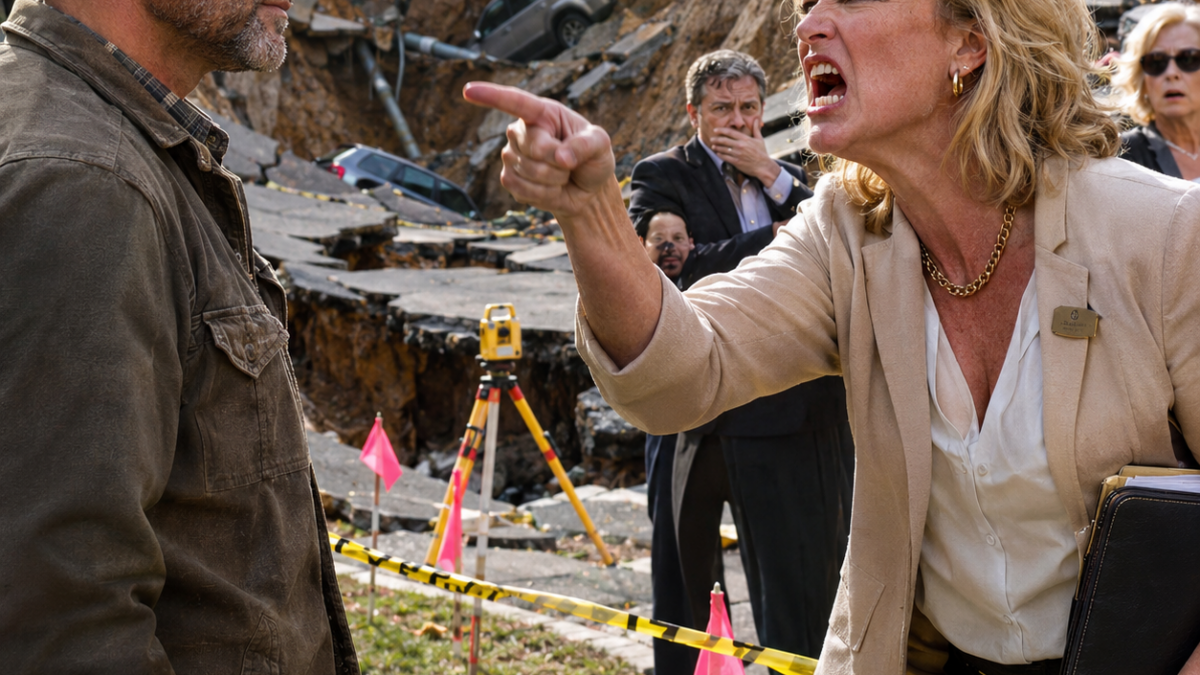
Six units settled at their eastern corners.
The parking area behind them formed a depression.
Eight inches at the deepest point.
Four feet wide in places.
Long enough to track much of the building line.
Asphalt split.
Clay pushed upward at one edge.
Water collected in the center.
Unit three’s diagonal crack widened until I could fit the edge of a credit card into it.
The decorative brick entrance column leaned.
Twelve degrees at first.
Then more.
The orange stakes remained along my fence.
Bright against gray rain.
Still there.
Still measurable.
Still telling the same story.
Nobody was living in the affected units.
That mattered more than every lawsuit.
The court restriction had stopped closings.
No one was hurt.
I stood behind my fence in a soaked jacket.
Darlene came out with an umbrella.
She didn’t say:
I told you so.
Neither did I.
We just watched.
Finally:
“How do you feel?”
I thought.
“Sad.”
She nodded.
“Me too.”
“I thought I’d feel vindicated.”
“Do you?”
“A little.”
“And?”
“I keep thinking about the families who put deposits down.”
Darlene slid her arm through mine.
“You tried.”
“I know.”
“Remember that.”
Breckett and his camera crew arrived before Crest Haven’s public-relations people.
They filmed what was there.
No commentary needed.
Cracked asphalt.
Standing brown water.
Tilted column.
Unit three.
The orange markers.
Wendell explaining differential settlement without dramatics.
Then Breckett interviewed me.
“Did you predict this?”
“No.”
He looked surprised.
“I warned there was a risk.”
“Difference?”
“Engineering doesn’t predict exact dates.”
I pointed toward the development.
“We identified buried infrastructure, drainage impairment and measurable movement. We asked for investigation.”
“When?”
“Beginning before construction.”
“Did anyone listen?”
“Some people did.”
“County?”
“They received the documents.”
“HOA?”
“They received the documents.”
“Developer?”
“They received the documents.”
“What do you want now?”
“Stabilize the site.”
“Anything else?”
“Find out why the warnings weren’t enough.”
His station aired four minutes that evening.
The online version spread far beyond Milhaven Pines.
Suddenly reporters were calling.
I stopped answering.
Marisol handled legal questions.
Wendell handled technical ones.
I handled my tomatoes, which had long since died for winter.
Three days later, Franklin County commissioners called an emergency session.
I was invited.
I brought the binder.
Darlene sat beside me.
“Are you nervous?”
“No.”
“Liar.”
“A little.”
“What are you going to say?”
“Dates.”
“That’s it?”
“Dates.”
The hearing room filled.
Residents.
Reporters.
County staff.
Crest Haven representatives.
Philippa sat three rows back.
Cream blazer.
I noticed because of course it was cream.
When my turn came, I placed the binder on the table.
Didn’t open with a speech.
April 2021.
First HOA warning.
Date certified objection delivered to planning.
Date delivered to Crest Haven.
Date delivered to HOA.
Date of board endorsement.
Date construction encountered apparent buried metal.
Date Wendell’s assessment filed.
Date county acknowledgment.
Date Soil and Water inspection.
Date Philippa’s affidavit.
Date easement discovered.
Date injunction petition.
Date three-engineer report.
Date temporary occupancy restriction.
Date first documented structural crack.
Date failure.
Eleven minutes.
Just chronology.
Then I looked at the commissioners.
“My name is Garrett Wolson.”
I placed my license on the table.
“I am a licensed professional engineer in Ohio.”
No raised voice.
“I spent twenty-eight years working in drainage and underground infrastructure.”
I pointed toward the binder.
“I began providing documented warnings about this parcel before foundations were installed.”
I paused.
“The county issued approvals anyway.”
“The HOA endorsed the development anyway.”
“The developer continued construction anyway.”
“And today, people who agreed to spend roughly three hundred fifty thousand dollars on homes are waiting to learn whether those homes can safely stand.”
Silence.
“I’d like to know what failed before the ground did.”
Then I sat.
Darlene squeezed my hand under the table.
Philippa approached during public comment.
Same posture.
Same controlled pace.
She spoke about good-faith reliance.
Community growth.
Professional permitting.
Reasonable board judgment.
Commissioner Julia Marsh interrupted.
“Ms. Drummond.”
Philippa stopped.
“Can you describe your relationship with county planner Devon Kolshaw?”
Philippa’s eyes shifted.
“Professional acquaintance.”
“Before Crest Haven’s public announcement?”
“I don’t recall exact dates.”
Commissioner Marsh lifted the email.
“February 2021.”
Silence.
“You requested expedited review guidance.”
“Yes.”
“So the board had involvement before the project was publicly announced.”
“We were discussing potential development opportunities.”
“Did homeowners know?”
“I can’t speak to what individual homeowners knew.”
“Did the board conduct an independent title review?”
Philippa’s mouth tightened.
“We relied on the developer.”
“Did the board check easements before endorsing the project?”
Silence.
Long.
Not dramatic.
Worse.
Finally:
“We relied on Crest Haven’s representations.”
Marisol wrote something on her pad.
I didn’t need to ask what.
Commissioner Marsh continued.
“When did you first become aware of the 1961 drainage easement?”
“After litigation began.”
“You endorsed a project affecting fifteen neighboring properties without confirming whether those properties held recorded rights over the parcel.”
“We acted on information available to us.”
That was when I stood.
Not angry.
I asked permission to submit two exhibits.
Granted.
First:
Philippa’s notarized affidavit.
Her statement that I lacked relevant professional expertise.
Second:
My current PE license.
Commissioner Marsh compared them.
Looked at Philippa.
“Why did you make this statement?”
Philippa answered:
“I was referring to his role in this specific project.”
“That’s not what the affidavit says.”
Philippa’s composure changed.
Not shattered.
Bent.
Just slightly.
But everybody saw it.
Commissioner Marsh set the documents down.
“We’ll refer this matter for ethics review.”
I sat.
Darlene whispered:
“You waited a long time for that.”
“No.”
“Yes.”
“Maybe a little.”
She smiled.
Crest Haven’s position changed after the failure.
Fast.
Independent engineers arrived.
Not internal marketing people.
Actual field crews.
Borings.
Ground-penetrating work.
Excavation.
Old pipes exposed.
Some crushed.
Some partially collapsed.
Voids.
Water pathways.
Saturated subgrade.
Exactly the kind of conditions the 1994 report had warned future developers to investigate.
The eastern six units required major remediation.
Foundations had moved.
Drainage had to be restored.
Subsurface material removed and rebuilt.
The final engineering estimate was approximately $2.1 million.
Insurance negotiations lasted months.
Lawyers argued.
Experts argued.
No one argued that the ground hadn’t moved.
That’s the useful thing about physical evidence.
It simplifies certain conversations.
The easement case settled eight months later.
Crest Haven agreed to remediate the compromised eastern units.
Restore drainage.
Rebuild foundations as needed.
Provide independent certification before occupancy.
Disclose the easement and litigation history in future sales.
The remaining units could proceed only after engineering review.
Donovan Sharf disappeared from neighborhood events.
No more oversized scissors.
No more hard-hat photographs.
Frederick’s alleged payment offer went to prosecutors for review.
No criminal case ultimately resulted.
Marisol explained why.
“High threshold.”
“Still bothers me.”
“I know.”
“Eight thousand dollars for a favorable statement.”
“Documentation still mattered.”
“At least that.”
Philippa resigned from the HOA board in September.
Personal reasons.
Always personal reasons.
The board’s insurance carrier resolved the homeowners’ fiduciary-duty claims sufficiently to cover legal costs and related losses.
Nobody got eighteen months of sleep back.
Nobody reimbursed Darlene for all the evenings she spent at the recorder’s office.
Nobody paid me for mornings standing in rain with a laser level.
Some costs don’t appear in settlements.
Clive Osterhouse became HOA president.
Unopposed.
His first letter to homeowners was two paragraphs.
No photograph.
No grand title.
No “executive voice.”
He wrote:
**We failed to ask enough questions before endorsing a project with direct consequences for members. Going forward, title and easement review will precede any formal HOA position on major development matters.**
I read it.
Handed it to Darlene.
“That may be the most beautiful HOA letter ever written.”
“Low bar.”
“Still.”
The governing rules changed.
Independent legal review before development endorsements.
Conflict disclosures.
Title and easement analysis.
Better public records.
Board members required to identify exactly what information they relied upon when voting.
Boring.
Glorious.
County officials opened a separate review into the planning process and Devon Kolshaw’s involvement.
I stayed out of that.
By then, I was tired of investigations.
I wanted dirt to be dirt again.
The six eastern units became a complicated engineering project.
Some structural elements were rebuilt.
Drainage restored.
The portion of the parcel determined unsuitable for additional load-bearing development was transferred for permanent stormwater management.
That became the ending I hadn’t expected.
Not abandoned dirt.
Not a fenced scar.
A restored drainage corridor.
Franklin County partnered with a local conservation organization.
Native grasses.
Wetland plants.
Shallow constructed basins.
Trees where appropriate.
Water pathways designed instead of buried and forgotten.
The old steel pipes were no longer being asked to perform a job they’d been abandoned from decades earlier.
The new landscape worked with the low ground instead of pretending it wasn’t low.
Frederick built a bench.
Solid oak.
Overbuilt by at least fifty percent.
Naturally.
At the dedication, I sat down beside him.
“This thing could hold a truck.”
“Probably.”
“Why?”
“Didn’t want it moving.”
I stared at him.
He stared back.
Then we both laughed.
Darlene came carrying a thermos.
“Are you two done admiring yourselves?”
“No.”
“Coffee?”
“Yes.”
The restored field smelled like wet clay and fresh grass.
Spring sun.
Red-tailed hawk circling high above.
Families walked the small path.
Nobody called it luxury.
Nobody needed to.
The twelve plaintiff households decided to create a scholarship.
Civil engineering.
Environmental engineering.
Infrastructure.
We named it after Wendell Pruitt.
He hated that.
“Absolutely not.”
“Already filed.”
“Garrett.”
“Community vote.”
“You weaponized democracy.”
“Yes.”
The first award ceremony was at Columbus State Community College.
Wendell showed up.
Of course.
Sat in the back.
Pretended he didn’t care.
The student who won wanted to work in municipal stormwater systems.
Afterward, she approached him.
“Mr. Pruitt?”
He sighed.
“Yes?”
“Can I ask about the Crest Haven case?”
He looked at me.
“This is your fault.”
I smiled.
She asked about drainage modeling.
He talked for forty minutes.
That was the real scholarship.
Not the check.
The conversation.
Months later, Darlene and I sat on Frederick’s bench.
No ceremony.
Coffee.
Cold morning.
The field had turned brown for winter.
Water moved slowly through the constructed wetland.
Exactly where water wanted to go.
She rested her head on my shoulder.
“Do you remember the first meeting?”
“Unfortunately.”
“The hobbyist perspective?”
“I remember.”
“You were furious.”
“I was composed.”
“You nearly broke the steering wheel driving home.”
“Unrelated.”
She laughed.
Then:
“Was it worth it?”
I looked across the field.
That question had followed me through the whole fight.
Worth twelve hundred for Wendell?
Worth lawyers?
Worth arguments with neighbors?
Worth board meetings?
Worth cameras?
Worth becoming the person people avoided at mailboxes because nobody wanted a drainage lecture?
“Define worth.”
Darlene groaned.
“Engineer.”
I thought again.
“If the court hadn’t stopped those closings…”
She nodded.
“Families would’ve been living there.”
“Maybe.”
“You helped prevent that.”
“The judge did.”
“Because you documented it.”
“Wendell documented it.”
“Because you called him.”
“Marisol filed.”
“Because you found the easement.”
“You found the easement.”
She smiled.
“Fine.”
“What?”
“We did something.”
“That’s better.”
She drank her coffee.
“I like ‘we.’”
So did I.
The orange stakes stayed in my garage afterward.
I kept three.
The rest went to scrap.
One still had red clay dried around the bottom.
Darlene found me holding it one afternoon.
“You’re not framing that.”
“No.”
“You framed the license.”
“Different.”
“You framed the 1994 report.”
“Historic.”
“You have a problem.”
I put the stake back.
A few months later, she gave me a birthday gift.
Shadow box.
Inside:
One orange stake.
A photocopy of page 847.
A green certified-mail receipt.
Small brass plate:
**HOBBYIST PERSPECTIVE**
I laughed until I cried.
It hangs in my office.
Philippa and I crossed paths about a year after her resignation.
Hardware store.
Of course.
I needed furnace filters.
She was looking at paint samples.
We saw each other.
Both considered escape.
Then she said:
“Garrett.”
“Philippa.”
She looked older.
So did I.
“How’s Darlene?”
“Good.”
“Her alterations business?”
“Still busy.”
She nodded.
Silence.
Then:
“I owe you an apology.”
I didn’t expect that.
“For what part?”
She almost smiled.
“Probably several.”
I waited.
“I shouldn’t have called you a hobbyist.”
“That was rude.”
“I shouldn’t have put that affidavit in.”
“That was more than rude.”
“I know.”
She looked down at the paint cards.
“I believed Crest Haven had done the technical work.”
“Why?”
“They told us they had.”
“Did you ask for it?”
“No.”
“Why not?”
She exhaled.
“Because I wanted the project.”
There it was.
Simple.
“Property values?”
“Partly.”
“What else?”
“Legacy.”
I frowned.
“Legacy?”
“I’d been president six years.”
She looked embarrassed saying it.
“I wanted something big to show for it.”
I thought about the ribbon cutting.
Scissors.
Newsletter.
Generational investment.
“You wanted your project.”
“Yes.”
“So when I objected…”
“You felt like an obstacle.”
She nodded.
“I made you one.”
“That wasn’t your job.”
“No.”
We stood beside paint samples.
No courtroom.
No reporters.
No board.
Just two older people surrounded by eighteen shades of beige.
She said:
“When you kept bringing documents, I thought you were trying to undermine me.”
“I was trying to stop foundations from going on unknown subsurface conditions.”
“I know that now.”
“You could’ve known then.”
“I know.”
That mattered.
Not because it erased anything.
Because she said it without a defense.
I nodded.
“Thank you.”
“Do you forgive me?”
I thought.
“I don’t wake up angry at you.”
She smiled sadly.
“Darlene would say that’s not an answer.”
“Darlene would be right.”
“Some things don’t change.”
“No.”
We parted.
I never became friends with Philippa.
Didn’t need to.
Reconciliation doesn’t require pretending trust was never broken.
The development survived.
That’s another part people misunderstand when they hear the story.
Crest Haven Commons wasn’t swallowed whole.
Twenty-eight units ultimately stood after proper review and remediation.
Families moved in.
Children rode bicycles.
People planted flowers.
The buildings didn’t remain symbols of corruption forever.
They became homes.
I’m glad.
One family from unit eleven invited Darlene and me to a barbecue two years later.
At first I thought the invitation was a joke.
It wasn’t.
The husband, Matt, met me at the door.
“Mr. Wolson.”
“Garrett.”
“I’m Matt.”
“I know.”
“You probably saved us from buying a bad house.”
“I probably annoyed enough people to cause a review.”
“Same thing.”
His wife came out.
Two kids behind her.
They had purchased after the independent engineering certification.
Full disclosure.
They knew the history.
Matt showed me the basement.
“Want to inspect it?”
“No.”
He laughed.
“Come on.”
“No cracks?”
“None.”
“Then enjoy your barbecue.”
He handed me a beer.
For the first time, I stood inside Crest Haven without feeling angry.
That mattered.
The six remediated units took longer.
Some buyers walked away.
Others returned after repairs.
Unit three—the one with the first diagonal crack—was ultimately rebuilt enough that you couldn’t find the original fracture.
I still knew where it had been.
Engineers are cursed that way.
We see ghosts of failures inside repairs.
But seeing the repair also taught me something.
Failure isn’t always the end of a structure.
If you acknowledge it early enough.
Understand it.
Correct the cause.
Rebuild properly.
That’s true of neighborhoods too.
Milhaven Pines became less political after Clive took over.
Meetings got shorter.
That’s the highest achievement available to an HOA.
People stopped attending unless something mattered.
Perfect.
Darlene’s alteration business kept growing.
Eventually she hired an assistant.
I started helping with invoices because retirement does strange things to a man.
One afternoon, she caught me reorganizing fabric orders into a spreadsheet.
“Get out.”
“Your columns are inconsistent.”
“Get out of my business.”
“You have three different entries for navy.”
“There are different navies.”
“That’s irrational.”
She pointed toward the door.
I left.
Marriage survived.
I returned to consulting occasionally.
Not big developments.
Reviews.
Drainage.
A county engineer once asked me to speak to younger staff about documentation.
I gave them one rule.
“Write down what you saw, not what you wish it proved.”
A young engineer raised her hand.
“What about professional judgment?”
“Separate it.”
“Why?”
“Because someday somebody will attack your conclusion.”
I showed them one of my old field notes.
**Stake 14: 0.42-inch elevation change relative to fixed vault benchmark.**
Not:
**Developer’s project is collapsing because they ignored me.**
“Facts first.”
Then:
**Movement trend consistent with differential settlement; recommend professional instrumentation.**
“Opinion second.”
That difference protected me.
Because when the ground moved, nobody could say I’d manipulated the data to fit a grudge.
The numbers had been boring long before they became dramatic.
That’s another thing about truth.
People think truth arrives with a spotlight.
Usually it arrives as repetition.
Same measurement.
Same photograph.
Same rain gauge.
Same green certified-mail card.
Again.
Again.
Again.
Until eventually something happens that makes everybody want to know what was written before.
Then boring becomes priceless.
The county’s final review eventually produced new procedures too.
Old decommissioned infrastructure had to be better documented in parcel data.
Developers working on historically drained or filled land faced clearer requirements for subsurface investigation.
Not because of me alone.
Crest Haven embarrassed enough institutions that everyone wanted a fix.
Fine.
I’ll take institutional embarrassment if it produces better checklists.
A planning employee asked me privately:
“Do you think the county caused this?”
“No.”
He looked surprised.
“You spent two years criticizing us.”
“I think multiple systems failed.”
“That’s diplomatic.”
“No.”
I counted.
“Historic records not connected to modern permit review.”
“Developer due diligence.”
“HOA endorsement without title review.”
“Planning response that treated warnings as settled questions.”
“Communication problems.”
“Drainage.”
“Construction decisions.”
I shrugged.
“Big failures are usually team sports.”
He laughed.
“Can I quote that?”
“No.”
He did anyway.
Darlene loved it.
Frederick’s bench became my favorite place.
Sometimes Wendell joined me.
One morning we sat watching geese.
He said:
“You know your stake measurements weren’t technically survey-grade.”
“I know.”
“I still hate that you tell people they were useful.”
“They were useful.”
“They were screening measurements.”
“Useful screening measurements.”
“You make it sound like anyone with an eighty-dollar laser can become a geotechnical engineer.”
“No.”
“Good.”
“Anyone with an eighty-dollar laser can notice something changed and call one.”
He considered.
“Acceptable.”
“High praise.”
He sipped coffee.
“Stake sixteen was your best one.”
“I know.”
“Stable reference.”
“I know.”
“Stop saying you know.”
I smiled.
Wendell died six years after the settlement.
Heart attack.
Quick.
Unexpected.
The scholarship committee asked me to speak at the next award ceremony.
I didn’t want to.
Darlene told me I would.
So I did.
I told the students about the first time I worked with Wendell in 2003.
County culvert replacement.
Everyone wanted to assume existing soil conditions matched the design sheet.
Wendell insisted on another test.
Delayed the job one day.
Found unsuitable material.
Saved weeks later.
People complained about him that morning.
Thanked him afterward.
“That was Wendell,” I said.
“He would rather annoy you with a measurement than comfort you with an assumption.”
I looked at the students.
“That is a very good quality in an engineer.”
The award recipient laughed.
I didn’t.
I meant it.
After the ceremony, Darlene and I drove home.
Passed Crest Haven.
Lights in windows.
Cars in driveways.
Ordinary.
Then Milhaven Pines.
Our ranch.
Oak tree bigger.
Sidewalk cracks still unrepaired.
Perfect.
We stood in the backyard.
The restored drainage field beyond.
No luxury townhomes on the eastern protected section.
Wetland grasses.
A few young trees.
Orange evening light.
“Do you miss the empty field?” Darlene asked.
“Sometimes.”
“It wasn’t actually empty.”
“No.”
“That’s the whole story, isn’t it?”
I looked at her.
“What?”
“Everybody thought it was empty.”
I looked across the wetland.
She was right.
Developers saw empty land.
The HOA saw opportunity.
County maps saw a parcel.
Neighbors saw weeds.
Underneath?
Pipes.
Water.
Old rights.
History.
Function.
Nothing empty about it.
I put my arm around her.
“You should’ve been the engineer.”
“No.”
“Why?”
“Engineers marry people with better records.”
Fair.
Years later, people still occasionally called me about the story.
Reporters.
HOA groups.
Property owners.
Mostly they wanted the exciting lesson.
How do I fight?
How do I expose them?
How do I win?
I always disappointed them.
“First, verify you’re right.”
Not popular.
“What if the HOA is corrupt?”
“Verify.”
“What if the developer is lying?”
“Verify.”
“What if the county ignores me?”
“Document.”
“What if they laugh?”
“Doesn’t change the data.”
People want revenge to feel like action.
Sometimes the most powerful action is creating a record while somebody else keeps talking.
I never sabotaged Crest Haven.
Never touched their site.
Never altered drainage.
Never damaged foundations.
Never planted anything on their land.
The orange stakes were on my side of the fence.
The rain was rain.
The clay was clay.
The buried pipes were there long before any of us.
The 1961 easement had been sitting in the deed book for sixty years.
The 1994 report had been sitting in county files for decades.
I didn’t create the facts.
I stayed long enough to collect them.
That’s why the failure felt different from revenge.
I didn’t make the ground sink.
I just refused to let anybody later say:
**Nobody could have known.**
They knew.
Maybe not everything.
Nobody ever knows everything.
But enough to stop.
Enough to test.
Enough to ask.
Enough to take the warning seriously.
And they chose speed instead.
That’s what accountability meant to me.
Not punishment for failing to predict the future.
Responsibility for refusing to investigate a known risk.
There is a difference.
A big one.
I thought about that difference one rainy February morning almost a decade later.
Darlene and I were drinking coffee on Frederick’s bench.
The constructed wetland was full.
Not flooding.
Full.
Doing exactly what it had been designed to do.
Water spread through shallow basins.
Native grasses slowed flow.
Overflow entered controlled drainage.
No ponding on Keer Street.
No hidden pressure against foundations.
A red-tailed hawk landed on a dead branch.
Darlene pointed.
“Same one?”
“Probably not.”
“How do you know?”
“I don’t.”
“Then why answer?”
“Professional judgment.”
She laughed.
I looked at the water.
February used to make me anxious after Crest Haven.
Rain on saturated soil.
Freeze-thaw.
I would wake and check the curb.
Years later, the anxiety was gone.
Because the system had been rebuilt properly.
Not perfect.
Nothing is.
But understood.
That is what engineering really gives you.
Not certainty.
A way to deal honestly with uncertainty.
Test.
Measure.
Design.
Monitor.
Change course when evidence changes.
Philippa’s biggest failure wasn’t that she lacked engineering knowledge.
She wasn’t supposed to have it.
Her failure was treating expertise as a threat to authority.
Good leaders do the opposite.
They borrow expertise.
Ask.
Check.
Let someone who knows more about one thing speak.
Then make the decision.
Bad leaders hear:
**You might be wrong**
and translate it into:
**You are challenging me.**
That’s how a drainage report becomes a personal enemy.
That’s how a concern becomes “hobbyist.”
That’s how a board endorsement becomes identity.
Then retreat becomes impossible because admitting new information feels like losing.
The ground doesn’t care about any of that.
That may be why I spent my career liking infrastructure more than politics.
Gravity isn’t insulted by correction.
Water doesn’t defend old meeting minutes.
Clay doesn’t care who has the nicer blazer.
It responds to conditions.
Always.
One evening, Clive came by our house.
He was older.
Walking slower.
He brought an envelope.
“What’s this?”
“Last HOA meeting.”
“I retired from caring.”
“Read it.”
I opened the minutes.
Routine.
Budget.
Tree maintenance.
Clubhouse roof.
Then one motion:
**Board adopts mandatory engineering and title review checklist for any future development endorsement.**
Unanimous.
I looked at Clive.
“You came over to show me a checklist?”
“Best thing this board has ever done.”
I laughed.
“You might be right.”
He nodded toward my office.
“You still have the binder?”
“Yes.”
“Why?”
“Habit.”
“You ever open it?”
“Not really.”
“Good.”
He turned to leave.
“Clive?”
“Yeah?”
“Thanks for voting no.”
He shrugged.
“Wasn’t hard.”
“It was four to one.”
“Still wasn’t hard.”
Then he walked home.
That sentence stayed with me.
Sometimes courage isn’t dramatic.
It’s being the one raised hand that doesn’t move with the others.
Clive never stopped Crest Haven.
He never made speeches.
He just created a record that not everyone agreed.
That mattered later.
Darlene’s contribution mattered.
Wendell’s.
Frederick’s.
Marisol’s.
Rosario’s.
Commissioner Marsh’s.
Breckett’s.
Mine.
That’s why I reject the version of the story where one retired engineer “defeated” a development.
No.
One engineer noticed something.
His wife found something.
Another engineer verified something.
Neighbors joined.
A lawyer gave structure.
A judge slowed occupancy.
A reporter showed what happened.
Officials finally asked harder questions.
A system that had failed one step at a time was corrected one step at a time.
That’s less heroic.
More useful.
The protected eastern section eventually developed wildlife.
Frogs first.
Then ducks.
Then herons.
Kids from a nearby school came to study wetland function.
One spring, a teacher asked me to talk to the class.
I stood beside the water.
Twenty fourth-graders.
Terrifying audience.
I asked:
“What do you think used to be here?”
“Swamp!”
“Field!”
“Houses!”
One kid said:
“A sinkhole?”
I laughed.
“Sort of.”
I told them water had always moved through this low ground.
People once used pipes.
Then forgot the pipes.
Then tried buildings.
Now the land had another job.
A girl raised her hand.
“So the ground won?”
I thought about it.
“No.”
She looked disappointed.
“What won?”
“We finally listened.”
That satisfied her less than “ground won.”
But it was the truth.
The dedication plaque near Frederick’s bench doesn’t mention Philippa.
Doesn’t mention Crest Haven.
Doesn’t mention lawsuits.
It says:
**MILHAVEN STORMWATER CONSERVATION CORRIDOR**
**Restored for drainage, habitat, and public benefit.**
That’s enough.
Conflicts don’t need monuments.
Solutions do.
The original orange markers?
One in my shadow box.
One went to Wendell before he died.
He kept it beside his drafting table.
The third I buried halfway into the soil near my garden.
Not as a marker of danger.
Just because Darlene got tired of tripping over it in the garage.
Every spring I see the orange top beside the tomatoes.
Makes me smile.
One year our grandson asked:
“What’s that?”
“Long story.”
“Tell me.”
So I gave him the ten-year-old version.
“Some people built houses where Grandpa thought they should check the ground first.”
“Did they check?”
“Not enough.”
“What happened?”
“The ground moved.”
“Did you save them?”
“No.”
He frowned.
“Then what did you do?”
“I wrote things down.”
He looked disgusted.
“That’s boring.”
“Yes.”
“Then what?”
“Other people read what I wrote.”
“And?”
“They fixed it.”
He considered.
“Still boring.”
I smiled.
“That’s engineering.”
He ran away.
Maybe someday he’ll understand.
Maybe not.
You don’t need to.
Most people shouldn’t spend their lives thinking about what happens under pavement.
They should be able to trust somebody else did.
That’s the contract infrastructure makes with the public.
You get to drive.
Sleep.
Flush a toilet.
Walk across a bridge.
Buy a home.
Without personally calculating load capacity.
Someone else checked.
Someone else documented.
Someone else accepted responsibility.
When that chain breaks, ordinary people pay for decisions they never knew were being made.
That’s what angered me most.
Not that Philippa embarrassed me.
Not the hobbyist comment.
Not even the affidavit.
The buyers.
Families looked at beautiful renderings and assumed someone had done the invisible work.
They weren’t foolish.
They were trusting the system.
That’s why professional responsibility matters.
That’s why due diligence matters.
That’s why a twenty-seven-year-old decommission report can matter more than a new marketing brochure.
The brochure promises what might be.
The old report remembers what already is.
Groundwater doesn’t care which is prettier.
A few years after everything ended, Matt from Crest Haven invited me over again.
His kids were older.
We sat on his back patio.
The restored wetland visible beyond the fence.
He said:
“Property value is good.”
“Glad.”
“You know what the funniest part is?”
“What?”
“The wetland increased it.”
I laughed.
“People like views.”
“We paid more for this unit because it backs to protected green space.”
I stared at him.
“You’re telling me Crest Haven’s best amenity is the land they couldn’t build on.”
“Pretty much.”
Darlene nearly choked laughing when I told her.
Life has jokes no engineer could design.
The thing developers originally saw as wasted acreage eventually became a selling feature.
The drainage corridor protected the remaining homes.
The wetland added habitat.
The open space improved the neighborhood.
Everybody got something better than six more units.
Except maybe Crest Haven’s original spreadsheet.
I’m comfortable with that.
Donovan Sharf never returned.
I heard he moved to another region.
Don’t know.
Don’t care.
The construction manager who called diagonal cracking “curing behavior” left Ohio.
Also don’t care.
Philippa stayed in Milhaven Pines for several years.
She became quieter.
I saw her walking sometimes.
We’d nod.
Nothing more.
Then one spring a moving truck came.
Darlene watched from the window.
“She’s leaving.”
“Looks like.”
“You going to say goodbye?”
“No.”
“Why?”
“We already said what needed saying.”
She nodded.
The truck left.
Another family moved in.
Young couple.
Baby.
They knew nothing about Philippa.
Good.
A community shouldn’t make newcomers inherit grudges.
At their first HOA meeting, the husband asked why the board had such an elaborate development-review policy.
Clive looked at me.
I shook my head.
He said:
“Historical reasons.”
Perfect.
That is how conflicts become history.
Not erased.
Integrated.
Policies improve.
People move on.
Years later, my PE license came up for renewal again.
I was older.
Truly retired.
No consulting.
Darlene asked:
“You renewing?”
I looked at the form.
“For what?”
“You tell me.”
“I don’t need it.”
“No.”
“Continuing education is annoying.”
“Yes.”
“Fee went up.”
“Yes.”
I signed.
She smiled.
“Thought so.”
“Habit.”
“Of course.”
Maybe I’ll keep it until they stop letting me.
Not because I expect another Crest Haven.
Because identity is strange.
You spend decades learning how to see something.
Then retirement doesn’t turn it off.
I still notice water standing too long.
Cracks.
Settlement.
Bad grading.
Darlene hates driving through new subdivisions with me.
“That driveway slopes toward the garage.”
“Garrett.”
“Bad detail.”
“Garrett.”
“Look at that retaining wall.”
“I’m turning the radio up.”
Fair.
But Milhaven Pines cured me of one thing.
I don’t assume being right means people will listen.
That’s not cynicism.
It’s practical.
If something matters, communicate it in a form that survives you leaving the room.
A spoken warning evaporates.
A stamped letter stays.
A phone call becomes memory.
A memo becomes chronology.
A concern becomes data when measured consistently.
That is why the binder mattered.
Not because paper is magical.
Because organizations have short memories.
People leave.
Staff changes.
Meetings blur.
Years later, everyone remembers:
“We didn’t know.”
A record answers:
“Here’s when you were told.”
That’s accountability without theater.
The binder now sits in the bottom drawer of my office.
Two inches thick.
Labels faded.
I opened it recently.
First green card.
1994 report.
Wendell’s first letter.
Photos.
Philippa affidavit.
License.
Page 847.
Stake logs.
Email chain.
Court order.
News clippings.
I expected anger.
Didn’t feel any.
Mostly gratitude.
That surprised me.
Grateful Darlene kept looking.
Grateful Clive voted no.
Grateful Wendell took the concern seriously.
Grateful the judge froze occupancy.
Grateful nobody was inside those six units.
Grateful the ground moved before certificates were issued rather than after families moved furniture in.
That’s a strange thing to say.
But timing saved people.
The failure was expensive.
Two-point-one million dollars.
Legal fees.
Insurance.
Lost sales.
Stress.
But no funerals.
No injuries.
No children waking up in a tilted bedroom.
Money can be repaired.
People can’t always.
That became the line I cared about most.
No one was hurt.
When television stories replayed the sinking parking lot, that’s what I wanted first.
No one was hurt.
Everything else comes second.
Another February rain came yesterday.
Not four inches.
Maybe one and a half.
I stood by the kitchen window.
The restored field held water exactly where designed.
Darlene was sewing in the garage.
Steam iron hissing.
Coffee on the counter.
Same house.
Same smells.
Older people.
I walked outside.
No notebook.
No rain log.
No laser.
Just a coat.
I went to Frederick’s bench.
Sat.
Water moved through the wetland.
Slow.
Visible.
Honest.
A red-tailed hawk crossed the gray sky.
For a moment I could hear the old construction site again.
Excavator.
Metal clang.
Supervisor:
**We have a permit.**
Philippa:
**Your concerns are noted and dismissed.**
I used to replay those words angrily.
Now they just sound sad.
A permit isn’t knowledge.
Authority isn’t expertise.
Confidence isn’t evidence.
And dismissing a warning doesn’t remove the condition that created it.
The ground beneath Crest Haven had kept every piece of history we forgot.
Old pipes.
Old water routes.
Clay.
Voids.
Pressure.
A sixty-year-old easement.
A twenty-seven-year-old county warning.
None of it disappeared because a new site plan had cleaner lines.
That was the lesson.
Not revenge.
Memory.
Ground has memory.
Water has memory.
Paper has memory.
People are the ones who forget.
Darlene walked down the path carrying two coffees.
She sat beside me.
“Cold.”
“Little.”
“You thinking?”
“Dangerous habit.”
She handed me a cup.
We looked at the wetland.
After a while she said:
“You know what I still hate?”
“What?”
“They laughed.”
I knew exactly what she meant.
The first HOA meeting.
Hobbyist perspective.
Polite laughter.
“I used to hate that too.”
“Used to?”
“Yeah.”
“What changed?”
I looked at the water.
“The laugh didn’t alter the report.”
“No.”
“Didn’t alter the easement.”
“No.”
“Didn’t alter the pipe.”
“No.”
“Didn’t alter the clay.”
“No.”
“So it doesn’t matter.”
She thought.
“Still rude.”
“Very.”
We sat quietly.
Then I smiled.
“What?”
“Nothing.”
“Garrett.”
I pointed toward the restored corridor.
“The ground got the last word.”
Darlene laughed.
“There you are.”
Maybe that is the closest I’ll come to revenge.
Not watching Philippa resign.
Not seeing Crest Haven spend millions.
Not putting my license beside her affidavit.
Not watching commissioners ask questions she couldn’t answer.
Those were consequences.
The satisfying part came later.
A functioning wetland.
Families living safely in the homes that remained.
A scholarship in Wendell’s name.
An HOA that finally reads attachments.
A county checklist that now asks about decommissioned subsurface infrastructure before approving development.
The ground didn’t “take back” Crest Haven.
It forced everyone to respect what had always been there.
Six units were damaged.
They were repaired.
A bad section became protected land.
The rest became homes.
That’s better than destruction.
Because revenge ends with somebody losing.
Accountability should end with something working.
The first time I stood at that fence, I wanted somebody to stop the excavator.
Nobody did.
The last time I stood there, years later, there was no excavator.
No ribbon-cutting banner.
No cream blazer.
No cameras.
Just water moving through grass.
Exactly where it needed to go.
I think that’s a better ending.
Philippa had treated my warnings like an obstacle.
Crest Haven treated old drainage records like history that no longer mattered.
The county treated a professional letter like another document to acknowledge and file.
I couldn’t force any of them to listen.
So I did the only thing left.
I kept the records.
I measured the movement.
I found the easement.
I let qualified people verify what I saw.
And when the eastern ground finally settled beneath six luxury units, nobody could rewrite the story afterward.
They couldn’t say the problem came without warning.
They couldn’t say nobody knew.
They couldn’t say the risk was invisible.
The orange markers had been standing beside my fence the entire time.
The letters had signatures.
The reports had stamps.
The deed had been recorded since 1961.
The county warning had existed since 1994.
And the truth had been waiting underground long before any of us arrived.
They ignored my markers and built anyway.
Weeks later, the ground moved.
But the real victory came years afterward, when the same land they tried to force into a project was finally allowed to do the job it had been doing all along.
Carry water.
Protect homes.
Hold life.
And stay exactly where it belonged.








