PART 2: HOA Karen’s Son Took Over My Lake Cabin for a Party — Then His Mom Learned I Was the Police Chief
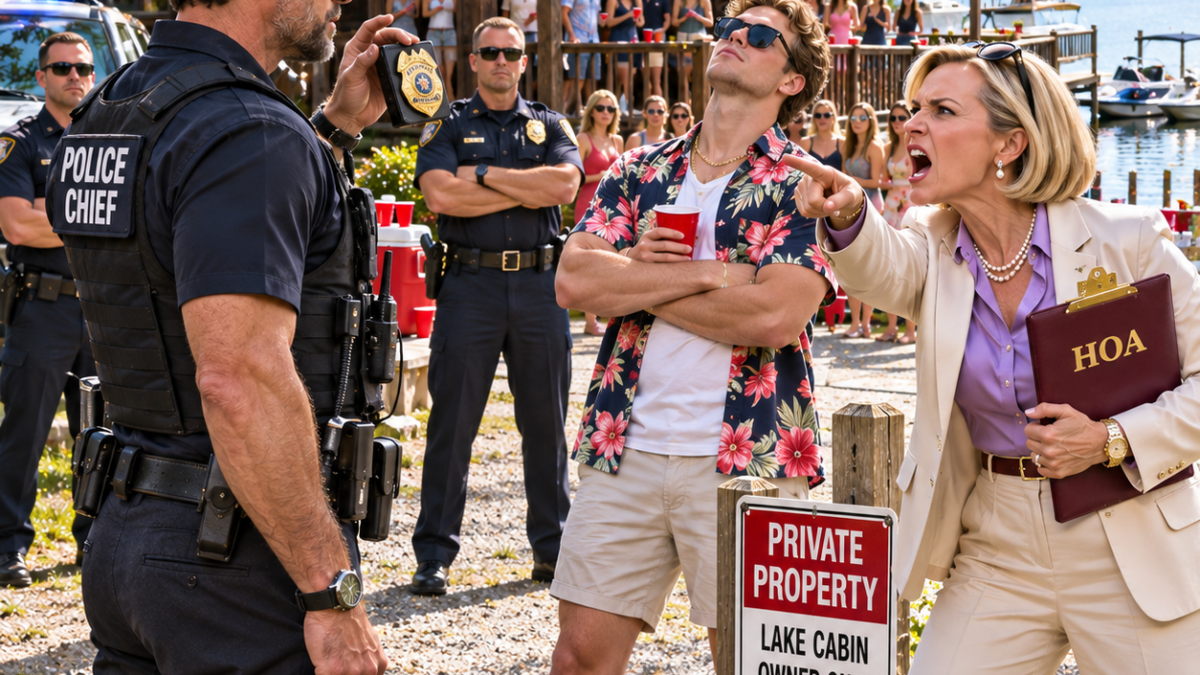
A seventeen-year-old kid stood on my private dock, wearing my dead father’s fishing hat, and told me my lake cabin belonged to his mother’s HOA now.
His mother had spent six months threatening me with fake fines, invented rules, and documents that looked official enough to scare almost anyone into surrendering.
What neither of them understood was that I had spent most of my adult life dealing with people who thought confidence could turn a lie into the truth.
My name is Brian Nelson.
I was fifty-three years old when this happened, and I had served as chief of police in our county for just over twenty years.
Most people around Crystal Pines didn’t know that.
That was intentional.
I bought the cabin because I wanted one place where nobody called me Chief.
No radio.
No department meetings.
No city council arguments.
No reporters.
No late-night phone calls asking me to explain why somebody’s nephew had gotten a speeding ticket.
Just cedar walls, a weathered dock, pine trees, and a long stretch of lake that turned orange every evening when the sun dropped behind the ridge.
The cabin had belonged to an elderly couple before me. It sat beyond Ridge Creek Road, outside the legal boundary of the Crystal Pines Homeowners Association.
That detail mattered.
I had checked it before signing the papers.
After spending decades enforcing rules for a living, the last thing I wanted was to spend my weekends arguing with someone about what color I was allowed to paint my own porch.
For the first two weeks, the place was exactly what I had hoped for.
Then Grace Moore discovered me.
My first introduction to her arrived in the mail.
The envelope had an embossed gold logo and the words CRYSTAL PINES HOMEOWNERS ASSOCIATION across the top.
Inside was a “Notice of Property Noncompliance.”
Apparently, my cedar-brown cabin violated the approved color palette.
I had three acceptable options.
Lake Sand.
Pebble Mist.
Tranquil Taupe.
I laughed so hard I spilled coffee on the letter.
Then I called the HOA office and explained that they had made a mistake.
Two hours later, Grace called me personally.
Her voice was pleasant in the way expensive hotel lobbies are pleasant—polished, controlled, and designed to make you forget somebody was charging you for everything.
“Mr. Nelson, this is Grace Moore, president of the Crystal Pines Homeowners Association.”
“I figured.”
“I understand you have questions about your compliance notice.”
“I have one question. Why are you sending HOA violations to property that isn’t in your HOA?”
There was a brief pause.
Then she laughed.
Not because anything was funny.
Because Grace used laughter the way other people used warning shots.
“You may not be aware,” she said, “but the lakeside parcels were incorporated into the community improvement zone last year.”
“That’s interesting.”
“It was part of our neighborhood expansion.”
“Also interesting.”
“You’ll need to select a compliant exterior color.”
“I’ll check the county records first.”
Her voice cooled.
“I don’t think that will be necessary.”
“I do.”
I hung up.
County records confirmed exactly what my closing documents said.
My land was outside the HOA.
Half a mile outside it, in fact.
There had been no annexation.
No revised zoning.
No community improvement zone covering my property.
Nothing.
I ignored Grace’s letter.
She did not ignore me.
Over the next few months, I received complaints about my porch lights, my boat trailer, the height of my grass near the road, and a small American flag attached to the dock.
Every notice went into the same drawer.
Then one Tuesday morning, everything changed.
I was drinking coffee on the porch when I heard voices near the water.
Three teenagers were walking across my dock.
One of them wore a designer hoodie, mirrored sunglasses, and the expression of someone who had never seriously considered the possibility that another human being might tell him no.
He picked up my father’s old fishing hat from the chair beside the dock.
That hat was faded, stained, and probably worth fifteen dollars.
To me, it was priceless.
My dad had worn it on the morning he taught me to fish.
He’d worn it during the last trip we took together before cancer made those trips impossible.
The kid put it on backward.
Then he smiled at his friend’s phone camera.
I walked down slowly.
“You want to take that off?”
He looked at me.
“This?”
“Yes.”
He removed the hat, but instead of handing it back, he looked around at the cabin.
“Pretty nice place.”
“It is.”
“We’re having my graduation party here Friday.”
I thought I’d misheard him.
“Excuse me?”
“My mom already approved it.”
“Your mother doesn’t approve anything on my property.”
That made him grin.
“You don’t know my mom.”
“Apparently not.”
“She’s Grace Moore.”
I said nothing.
His grin widened.
“She runs the HOA.”
“I know who she is.”
“Then you know how this works.”
He gestured toward my cabin as though presenting something he had just purchased.
“My mom’s the HOA president, dude. This cabin’s basically community property now.”
I looked at the kid.
Then at my father’s hat in his hand.
Then back at him.
“What’s your name?”
“Ethan.”
“Ethan Moore?”
“Yeah.”
I held out my hand.
“My father’s hat.”
Something in my voice finally reached him.
He handed it over.
Then he shrugged.
“Whatever. Friday. Six o’clock. Mom said everything’s handled.”
He walked away with his friends.
I stood at the end of my dock holding that old fishing hat against my chest.
And for the first time since moving to Crystal Pines, I stopped treating Grace Moore like an annoying HOA president.
Because annoying people send letters.
Dangerous people teach their children that other people’s property belongs to them.
Three days later, an official HOA email arrived.
It announced that my cabin had been “secured” for Ethan’s graduation celebration.
At the bottom were five words that made me smile.
**PLEASE LEAVE THE PROPERTY UNLOCKED.**
That was when I knew Grace had finally gone too far.
And I decided that if she wanted to show the entire community exactly how much power she believed she had, I wasn’t going to stop her from demonstrating it.
I was simply going to make sure there were witnesses.
**— END OF FACEBOOK OPENING —**
The first thing I did was call my attorney.
Jim Wallace had represented the police department through enough strange lawsuits that very little surprised him anymore.
But after I forwarded Grace’s email, he remained silent for several seconds.
Then he said, “She actually wrote that?”
“She actually wrote that.”
“Leave the property unlocked?”
“Friday by five.”
Jim exhaled.
“Well, Brian, I’ve dealt with aggressive HOAs before.”
“I know.”
“I have never seen one schedule a home invasion.”
I leaned back in my kitchen chair.
“You’re saying I shouldn’t put that description in writing?”
“I’m saying let me have the fun of putting it in writing.”
Twenty minutes later, Jim drafted a formal notice.
It stated that my property was not within Crystal Pines HOA jurisdiction.
The HOA possessed no ownership interest, easement, lease, license, or temporary-use right.
Neither Grace nor Ethan nor any HOA representative had permission to enter.
Any unauthorized entry would be treated as trespassing.
Any forced entry would be documented and referred to law enforcement.
Jim sent it by email and certified mail.
Grace received both.
At 9:14 the following morning, she called me.
“Mr. Nelson.”
“Good morning, Grace.”
“I received your attorney’s little letter.”
“Good.”
“I’m afraid he doesn’t understand the community charter.”
“He understands property law.”
“The association has rights over community-adjacent recreational assets.”
I smiled.
“That’s not a legal term.”
“It appears in our revised charter.”
“Your charter doesn’t control property outside your association.”
“You’re being difficult.”
“No. I’m saying no.”
Grace hated that word.
I could hear it in the silence.
Then she changed tactics.
“Do you understand how much this event means to Ethan?”
“I’m sure it means a lot.”
“He’s graduating.”
“Congratulations.”
“He and his friends have grown up together in Crystal Pines. This celebration is important to the entire neighborhood.”
“Then use your clubhouse.”
“It’s under renovation.”
“Use your house.”
“That’s inappropriate.”
I almost laughed.
“My house is inappropriate, but mine isn’t?”
“You own a lakeside recreational property. Community cooperation is expected.”
“Grace, listen carefully. Nobody is using my cabin.”
Her voice sharpened.
“You may regret being this hostile toward your neighbors.”
There it was.
Not quite a threat.
Just enough to sound like one.
I lowered my voice.
“Is there something specific you think I should be afraid of?”
She paused.
“I’m simply suggesting cooperation makes life easier.”
“For whom?”
She hung up.
I wrote down the exact time and summarized the conversation.
Twenty years in law enforcement had taught me something simple.
Memory becomes argument.
Documentation becomes evidence.
That afternoon, I installed two additional security cameras.
I already had exterior cameras covering the porch and driveway, but I added one facing the dock and another covering the gate.
Motion activated.
Cloud backup.
Audio.
Time stamps.
I also photographed every lock, window, gate, and piece of outdoor furniture.
Not because I wanted trouble.
Because I was starting to believe trouble had already put my address into its GPS.
Then I began looking into the HOA itself.
Grace had mentioned “community cooperation” too many times.
I wanted to understand what she meant.
Crystal Pines published basic annual financial summaries for its residents.
I found several years online.
At first, nothing looked unusual.
Landscaping.
Insurance.
Road maintenance.
Clubhouse expenses.
Security.
Then I noticed a line item in the current budget.
COMMUNITY YOUTH ENGAGEMENT INITIATIVE — $12,000.
I called a resident I knew casually named Helen Graves.
Helen was a retired accountant in her seventies who lived three streets inside Crystal Pines.
We had met when her car battery died near the lake.
“Have you ever heard of the youth engagement initiative?” I asked.
Silence.
“The what?”
“Exactly.”
She laughed.
“Brian, the closest thing this neighborhood has to youth engagement is yelling at teenagers for riding bicycles on the sidewalk.”
“Any summer program? Scholarships? Sports fund?”
“Not that I know about.”
“Graduation events?”
Another pause.
“Grace mentioned something at the last meeting.”
“What?”
“She said the HOA was funding a youth celebration.”
“How much?”
“She didn’t say.”
Interesting.
The next afternoon, Grace appeared at my cabin.
She drove a white luxury SUV so clean it looked almost artificial.
Ethan sat in the passenger seat.
Grace stepped out wearing a pink blazer, pearl earrings, white pants, and heels completely inappropriate for a gravel driveway.
She carried a clipboard.
Of course she did.
Ethan climbed out behind her.
He wasn’t wearing my father’s hat anymore.
That improved my mood slightly.
Grace stopped at the bottom of my porch.
“Mr. Nelson.”
“Grace.”
“I thought speaking face-to-face might eliminate some unnecessary hostility.”
“Good idea.”
She smiled.
“The event will proceed Friday.”
“Then apparently the conversation isn’t working.”
Her smile tightened.
“The HOA has already allocated funds.”
“From the youth engagement account?”
The change in her expression lasted perhaps half a second.
But I saw it.
“Excuse me?”
“The twelve-thousand-dollar youth engagement initiative.”
Ethan looked at his mother.
Grace adjusted one pearl earring.
“That is association business.”
“You’re standing on my property telling me HOA money is being used for a party at my cabin. I’d say it became my business.”
“The fund supports community morale.”
“Do you have receipts?”
Her eyes hardened.
“You’re not an HOA member.”
“Exactly.”
“Then our finances are none of your concern.”
“Probably not.”
I smiled.
“Unless your money is being used to trespass on my land.”
Ethan stepped forward.
“Mom, why are we even arguing with this guy?”
Grace lifted one hand.
“Ethan.”
“No, seriously. You said the HOA could use it.”
She looked embarrassed.
That was revealing.
Grace had apparently been telling her son something stronger than she was willing to say in front of me.
I looked at Ethan.
“Your mother cannot give you permission to use property she doesn’t own.”
He rolled his eyes.
“You’re really going to ruin graduation over some cabin?”
“No. I’m going to spend Friday evening peacefully at my own home.”
“You’re such an—”
“Ethan.”
Grace’s tone stopped him.
Then she turned back to me.
“Six o’clock Friday.”
“No.”
“Think carefully.”
“I already did.”
She snapped her clipboard closed.
As they walked away, Ethan muttered something.
Grace hissed at him to be quiet.
Then they got into the SUV.
I watched them disappear down the road.
Five minutes later, I called Captain Miguel Rodriguez at the county sheriff’s office.
Miguel and I had known each other for seventeen years.
He had worked homicide with me before moving to the sheriff’s department.
“I need a favor,” I said.
“That tone usually means paperwork.”
“Potential trespass. Large gathering. Possibly minors with alcohol.”
“Your cabin?”
“Friday night.”
“The HOA thing?”
“You heard?”
“Chief, there are three things that travel faster than light. Bad news, gossip, and HOA complaints.”
I explained everything.
When I finished, Rodriguez said, “You know you’re personally involved.”
“I know.”
“So you stay out of enforcement decisions.”
“Agreed.”
“We handle the scene.”
“Exactly.”
“You record. You remain the property owner and complainant.”
“That’s the plan.”
He whistled softly.
“Grace Moore picked a strange cabin.”
“She doesn’t know who I am.”
Rodriguez laughed.
“Oh, this should be educational.”
“I’m serious, Miguel.”
“So am I.”
“No theatrics.”
“Understood.”
“If something happens, we do it clean.”
“We always do.”
I also contacted County Investigator Linda Hayes.
Hayes handled financial crimes and public corruption cases.
I didn’t accuse Grace of embezzlement.
I simply gave her the documents I had located.
“There’s a twelve-thousand-dollar account with no obvious program,” I said.
“Could be legitimate.”
“Absolutely.”
“You have anything else?”
“Not yet.”
Hayes studied me.
“But you think I will.”
“I think you’re better at finding it than I am.”
She smiled.
“That was almost flattering.”
“Don’t get used to it.”
She took the file.
Wednesday morning, one of my cameras sent an alert.
Ethan.
Two friends.
A drone.
They walked through my property as casually as people touring a rental venue.
One friend filmed the dock.
Another measured the porch with his footsteps.
Ethan picked up my father’s fishing hat again.
This time he wore it for a video.
I watched from inside.
Every instinct I had wanted to walk outside and take it from him.
Instead, I saved the recording.
Anger was immediate.
Evidence lasted.
They left twenty minutes later.
That afternoon, a delivery truck arrived carrying three folding tables, strings of outdoor lights, and boxes of disposable cups.
The driver showed me the address.
Mine.
“Who ordered these?”
“A Grace Moore.”
I gave him directions to the HOA office instead.
“Did she say she owned this property?”
The driver checked his tablet.
“She said it was the Crystal Pines event cabin.”
Of course she did.
I wrote down his name and company.
Thursday, the HOA newsletter appeared online.
There, between an article about lawn irrigation and a reminder about trash cans, was a full-color announcement.
YOUTH GRADUATION CELEBRATION.
FRIDAY — 6 P.M.
LAKESIDE CABIN.
COURTESY OF CRYSTAL PINES HOA AND SUPPORTIVE COMMUNITY PARTNERS.
Underneath was a photograph.
My cabin.
My deck.
My boat.
I stared at the screen for nearly a minute.
Then I called Jim.
He opened the newsletter while we were on the phone.
“Oh, wow.”
“Professional opinion?”
“She’s insane.”
“Legal opinion?”
“She’s creating beautiful exhibits for us.”
Thursday evening, vehicles began arriving.
Teenagers carried speakers and folding chairs toward my gate.
The gate was chained.
A large PRIVATE PROPERTY sign was attached at eye level.
One boy read it.
Then laughed.
“Mrs. Moore said ignore it.”
I stepped onto the porch.
“Evening.”
They froze.
“You boys setting up for something?”
One looked at the others.
“The party.”
“Not here.”
“Mrs. Moore said—”
“Mrs. Moore is wrong.”
The boys exchanged glances.
I pointed toward their truck.
“Take everything with you.”
They did.
I didn’t yell.
I didn’t threaten them.
They were teenagers following an adult’s instructions.
The adult was the problem.
At 11:18 that night, my motion camera activated again.
Grace walked up my porch.
Alone.
She tried the front door.
Locked.
She tried it again.
Then she looked directly toward the small camera mounted under the roof.
“He’ll regret this.”
She walked away.
I saved three copies.
Friday morning arrived hot and bright.
The lake was almost perfectly still.
I spent most of the day doing normal things.
I cleaned the porch.
Made coffee.
Checked the boat cover.
Repaired one loose step near the dock.
But beneath the routine was an unmistakable tension.
At 4:30, Rodriguez texted.
Units available. Awaiting probable cause / complaint.
At 5:05, Investigator Hayes called.
“Brian.”
“Linda.”
“That youth engagement account is interesting.”
“How interesting?”
“I’m not discussing an active investigation over the phone.”
“Understood.”
“But keep your cameras running.”
That told me enough.
At 5:47, I heard engines.
Not one.
Several.
A BMW.
Two Jeeps.
A pickup.
A large SUV.
Then another.
Teenagers piled out.
Music was already playing.
Ethan emerged from the first vehicle.
And on his head was my father’s fishing hat.
I felt something cold settle in my chest.
He had taken it from the dock the previous day.
This time he hadn’t put it back.
He walked toward the gate.
The chain was still locked.
One of his friends produced bolt cutters.
I could have stepped outside.
I could have stopped them before anything happened.
Instead, I called Rodriguez.
“They’re at the gate.”
“Are they entering?”
“Stand by.”
The cutters closed.
Metal snapped.
The chain fell.
“They entered.”
“Copy.”
“I want them given every opportunity to leave voluntarily.”
“Understood.”
“I’m going outside.”
“Brian.”
“I’m not making arrests.”
“Good.”
“Your people handle everything.”
“Exactly.”
I slipped my phone into my pocket and walked onto the porch.
Ethan looked up.
“Oh, hey.”
“Ethan.”
He spread his arms.
“Relax. Mom handled it.”
“You just cut my lock.”
“It’s getting replaced.”
“Leave.”
He laughed.
“Come on, man.”
“I am asking you one time. Take your friends and leave my property.”
His smile faded.
“My mom said we’re allowed.”
“I am the property owner. I’m telling you that you are not.”
A girl near him whispered, “Ethan, maybe we should go.”
He shook his head.
“No. We already paid for everything.”
“You didn’t pay for this cabin.”
He looked toward the arriving cars.
Then at me.
“You’re not ruining this.”
I stared at him.
“This is your chance to make a better decision.”
He chose not to.
He turned his back on me.
That mattered.
For the next hour, the party grew.
Speakers appeared near the dock.
Coolers opened.
Lights were strung from trees.
Teenagers jumped into the lake.
I saw beer.
Hard seltzer.
Liquor.
Several guests appeared clearly under twenty-one.
I contacted Rodriguez again.
“Alcohol present. Minors likely involved.”
“Units staged.”
“Wait.”
“You sure?”
“I want Grace here.”
At 7:03, her white SUV turned into my driveway.
She arrived wearing her pink blazer.
She was carrying a champagne flute.
That image told me everything I needed to know about how seriously she regarded my warnings.
Grace stepped from her SUV and looked around approvingly.
“Wonderful!”
Ethan hugged her.
She kissed his cheek.
Then she noticed me standing on the porch.
“Mr. Nelson.”
“Grace.”
“See? Everyone’s having a lovely time.”
“On property you broke into.”
Her smile remained fixed.
“Please don’t create a scene.”
“I told them to leave.”
“This is Ethan’s graduation.”
“I know.”
“He only graduates once.”
“And I only own this cabin once.”
She sighed dramatically.
“You really need to develop a sense of community.”
“I have one.”
“You certainly don’t behave like it.”
“My definition of community doesn’t involve cutting locks.”
She glanced toward the gate.
“Oh, that.”
“Yes. That.”
“We’ll replace it.”
“You knew they were going to do it?”
Grace took a sip of champagne.
“Brian, this constant fixation on technicalities is exhausting.”
I almost admired the sentence.
Breaking into private property was a technicality.
“Why don’t you host everyone at your house?”
“This venue is better.”
“It isn’t yours.”
“Tonight it is.”
I raised my phone.
“Say that again.”
Her eyes flicked toward the camera.
“Stop recording me.”
“No.”
“You don’t have permission.”
I smiled.
“You’re standing on my property telling me I need permission to record you?”
Her face reddened.
Behind us, Ethan shouted.
“Turn it up!”
Music exploded across the lake.
Grace walked away.
I checked the time.
7:11.
At 8:00, the party was loud.
At 8:30, it was reckless.
At 9:00, it became dangerous.
Someone launched fireworks from the dock.
Another teenager poured liquor into plastic cups.
Beer cans rolled across my lawn.
One boy stood on the roof of my small boat shed.
I ordered him down.
He laughed.
Then he saw my expression and reconsidered.
At 9:42, somebody vomited beside my grill.
At 9:51, I saw a fuel container beside the dock.
That was enough.
I called Rodriguez.
“Move in.”
“Copy.”
I stayed on the porch.
Five minutes later, Grace approached me.
She was no longer perfectly composed.
Her speech had softened around the edges.
“Brian.”
“What?”
“You’re making people uncomfortable.”
“I haven’t done anything.”
“You keep filming.”
“Yes.”
“I’m asking you to stop.”
“No.”
“This is a private community event.”
“You finally got something right.”
She blinked.
“It is private.”
I stepped closer.
“Private because it’s happening on private property.”
Her jaw tightened.
“Do not start this again.”
“Call the police.”
She stared at me.
“What?”
“You’ve threatened to do it several times.”
“I will.”
“I think you should.”
Her eyes narrowed.
Something about my tone finally bothered her.
Behind her, several teenagers continued laughing.
She lifted her chin.
“Fine.”
Grace took out her phone.
I heard her begin describing an aggressive homeowner interfering with an authorized community event.
I let her talk.
Then the first siren appeared in the distance.
Grace stopped.
“What did you do?”
“Nothing you didn’t ask for.”
Blue and red light appeared between the trees.
One cruiser.
Then another.
Then a sheriff’s SUV.
The music continued for several seconds.
Then someone screamed, “Cops!”
The speakers went silent.
Every face turned toward the driveway.
Deputies stepped out.
Rodriguez came first.
He looked at me.
“Mr. Nelson.”
Not Chief.
That had been intentional.
For the moment, I was the property owner.
Grace rushed toward him.
“Officer, thank God. This man has been harassing our guests all evening.”
Rodriguez looked around.
“Who owns the property?”
“I do,” I said.
Grace pointed at me.
“He refuses to recognize HOA authority.”
Rodriguez turned toward her.
“Do you have documentation showing ownership or legal access?”
“We have community rights.”
“I asked for documentation.”
“I don’t carry the charter with me.”
I reached into the cabin and brought out a folder.
“My deed. County boundary map. Attorney notice confirming no permission. Certified delivery receipt showing Mrs. Moore received it.”
Grace stared at the papers.
Rodriguez examined them.
Then he looked toward the broken gate.
“Who cut the lock?”
Silence.
One teenager looked at Ethan.
Ethan looked at his mother.
Grace said, “It was necessary to access the event location.”
Rodriguez’s eyebrows lifted.
“Event location?”
“Yes.”
“Who authorized the event?”
“The HOA.”
“Who authorized the HOA to enter this property?”
Grace opened her mouth.
Closed it.
Then tried again.
“It’s complicated.”
“No, ma’am. Ownership usually isn’t.”
A second deputy began checking identification.
Another spoke with teenagers near the alcohol.
Several started calling parents.
Grace’s composure began cracking.
“This is absurd. They’re children.”
Rodriguez replied calmly.
“That’s exactly why the alcohol is a problem.”
“You can’t treat them like criminals.”
“We’re determining what happened.”
“This is my son’s graduation!”
“That doesn’t suspend state law.”
Ethan moved toward his mother.
“Mom.”
She waved him away.
“Not now.”
Rodriguez turned toward me.
“Anything else we need to know?”
I looked at Ethan.
My father’s hat was still on his head.
“Yes.”
I pointed.
“That hat was taken from my property without permission.”
Ethan froze.
Grace stared at him.
“It’s a hat,” she said.
I looked at her.
“It belonged to my father.”
That shut her up for perhaps the first time all evening.
Rodriguez approached Ethan.
“Son, remove the hat.”
Ethan did.
Rodriguez took it and handed it to me.
I brushed dirt from the brim.
Something about touching it changed my anger.
The entire night had become noise.
Sirens.
Music.
Arguments.
But suddenly I could remember my father sitting beside me on a wooden dock thirty-five years earlier.
He had pointed toward another fisherman’s tackle box.
“You never touch what isn’t yours, Brian.”
I had been maybe eighteen.
“Even if it looks abandoned?”
“Especially then. You don’t know what it means to somebody.”
I looked at Ethan.
“This hat probably looks worthless to you.”
He swallowed.
“I was just messing around.”
“My dad wore it.”
His face changed slightly.
“He’s dead.”
Ethan looked at the ground.
“I didn’t know.”
“No.”
I held the hat.
“You didn’t ask.”
That was the whole problem.
None of them had asked.
Not about the hat.
Not about the dock.
Not about the cabin.
Not about the law.
They had simply decided wanting something created a right to take it.
Grace stepped toward Rodriguez.
“I demand to speak to whoever is in charge.”
He looked at me.
I sighed.
There was no point hiding it anymore.
I went inside.
On a hook beside the hallway closet hung the dark department jacket I sometimes kept at the cabin.
I put it on.
My badge was clipped to the front.
When I stepped outside again, several deputies looked toward me.
“Chief,” one said automatically.
Grace went completely still.
Ethan looked at his mother.
Then at me.
Then back at her.
“No way.”
I walked down the porch steps.
Grace’s face had lost every bit of color.
“You’re…”
“Brian Nelson.”
Rodriguez finished it for her.
“Chief Nelson.”
Nobody spoke.
The lake lapped against the dock.
Somewhere in the yard, a plastic cup rolled through the grass.
Grace looked like someone had opened a trapdoor under her entire world.
“You’re the police chief?”
“Yes.”
“Why didn’t you tell me?”
I almost laughed.
“You never asked.”
Her eyes widened.
“You did this intentionally.”
“Did what?”
“Let this happen.”
“I told you repeatedly not to come here.”
“You knew who you were.”
“I generally do.”
“You set us up.”
“No.”
I looked around at the broken lock, alcohol, fireworks, and litter.
“I gave you every opportunity to stay away.”
Grace’s voice rose.
“This is an abuse of power!”
I nodded toward Rodriguez.
“That’s why the sheriff’s department is handling the enforcement response. I’m the victim and property owner here, Grace. Not the arresting officer.”
She turned toward Rodriguez.
“This is political.”
“No, ma’am.”
“This man hates me.”
Rodriguez glanced at me.
“I’ve known Brian seventeen years. He hates paperwork.”
A few deputies almost smiled.
Grace didn’t.
Then Investigator Linda Hayes arrived.
Unmarked sedan.
Gray jacket.
Portfolio case.
When Grace recognized that another official had appeared, her expression changed again.
Hayes walked directly to Rodriguez.
Then to me.
“Chief.”
“Linda.”
She turned toward Grace.
“Mrs. Moore.”
“Who are you?”
“County investigator.”
Grace looked at me.
“What now?”
Hayes opened her folder.
“Financial records.”
The party suddenly became the smaller problem.
Grace folded her arms.
“I don’t know what you’re talking about.”
“The Community Youth Engagement Initiative.”
“I manage dozens of accounts.”
“Twelve thousand dollars was allocated.”
“For programming.”
“What programming?”
“This event, among other things.”
Hayes glanced around at the teenagers.
“Do you have board approval to spend HOA funds on this private party?”
“It isn’t private.”
Hayes looked toward me.
“Who owns the cabin?”
“I do.”
She looked back at Grace.
“Then it appears fairly private.”
Grace’s voice became shaky.
“You have no right to interrogate me here.”
“I’m not interrogating you.”
Hayes closed the folder.
“I’m informing you that your financial records are already under review.”
For the first time, I saw genuine fear.
Not anger.
Fear.
Ethan saw it too.
“Mom?”
Grace ignored him.
Hayes continued.
“We have questions regarding several payments from the youth engagement account.”
“This is harassment.”
“We also have questions about invoices submitted under beautification and community outreach.”
Grace looked at me.
“You did this.”
I shook my head.
“You did.”
A deputy approached Rodriguez and quietly spoke to him.
Rodriguez looked toward the dock.
Then at Grace.
“We have open alcohol containers involving minors, fireworks discharged near fuel, criminal damage to the gate, and multiple individuals stating they were told the HOA had permission to use the property.”
Grace pointed at me.
“He’s manipulating them.”
Rodriguez’s expression hardened.
“Mrs. Moore, this would be a good time to stop talking.”
She didn’t.
People like Grace rarely did.
“I want my attorney.”
“That is absolutely your right.”
“And my son is leaving with me.”
Rodriguez looked toward Ethan.
“That depends on what investigators determine regarding the damaged lock, alcohol, and property taken from the cabin area.”
Grace moved between them.
“You will not touch my son.”
I stepped forward.
“Grace.”
She spun toward me.
“What?”
“Stop.”
The word came out quietly.
But everyone heard it.
“Stop trying to solve every problem by pretending you have more authority than everyone else.”
Her eyes burned.
“You think that badge makes you better than me?”
“No.”
I pointed toward my property.
“It makes me understand exactly how dangerous power becomes when somebody forgets its limits.”
For the first time all night, Grace had no answer.
The next two hours were less dramatic than television makes police work look.
Parents arrived.
Statements were taken.
Most of the teenagers were released to responsible adults after documentation and appropriate referrals.
Nobody was lined up and hauled away just to create a spectacle.
I didn’t want that.
A lot of those kids had been told by adults that the party was legitimate.
Some had made bad decisions once they arrived.
They needed accountability.
They did not all need their lives destroyed.
Ethan faced more serious consequences.
He had participated in cutting the gate lock.
He had entered after being personally told to leave.
He had taken my father’s hat.
And several witnesses identified him as one of the main organizers.
When Rodriguez asked me whether I wanted to pursue the property complaint, I looked at Ethan.
His swagger was gone.
He looked seventeen now.
Not powerful.
Not entitled.
Just scared.
“I want it documented,” I said.
Ethan looked up.
Grace stared at me.
“You vindictive bastard.”
I ignored her.
Rodriguez asked, “And the hat?”
I looked down at it.
“Recovered.”
“You want to pursue theft?”
I thought about my dad.
Then Ethan.
“No.”
Grace seemed surprised.
Ethan did too.
I looked at him.
“Don’t make me regret that.”
He nodded.
“I won’t.”
Grace scoffed.
“He doesn’t owe you anything.”
Ethan turned toward his mother.
“Mom.”
Something in his voice stopped her.
It was the first time I heard him speak to her without absolute confidence.
By midnight, the cabin was quiet.
Beer cans filled several trash bags.
The broken gate chain lay on my porch.
Burned cardboard from fireworks floated near the shoreline.
Rodriguez stood beside me while the last cruiser pulled away.
“Hell of a graduation.”
I stared at the lake.
“I hate this.”
He looked surprised.
“You won.”
“This isn’t winning.”
I pointed toward the mess.
“A bunch of kids watched adults teach them that rules only matter when someone stronger is around.”
Rodriguez nodded.
“Grace made her choices.”
“So did Ethan.”
“He’s young.”
“So were we once.”
Rodriguez smiled.
“I was never that stupid.”
“Yes, you were.”
“Fair.”
He started toward his vehicle.
Then turned around.
“Your dad’s hat okay?”
I looked at it.
“Dirty.”
“Washable?”
“Probably.”
He nodded.
“Good night, Chief.”
“Good night.”
Saturday morning, I went to the station.
By eight o’clock, the evidence room contained copies of video recordings, photographs, witness statements, invoices, and a surprising amount of paperwork related to one party.
I reminded everyone that because I was personally involved, charging decisions had to be reviewed independently.
The prosecutor agreed.
That mattered to me.
Grace had spent years confusing personal power with official authority.
I was not going to become the thing I was accusing her of being.
Around ten, Investigator Hayes walked into my office.
She dropped a thick folder onto the desk.
“Your twelve thousand dollars got bigger.”
“How much bigger?”
“Forty-eight thousand seven hundred and sixteen.”
I stared at her.
“Misappropriated?”
“That’s our preliminary figure.”
“From the HOA?”
“Yes.”
“Where did it go?”
“Personal credit cards. Spa charges. Home remodeling. Luxury purchases. Vehicle-related expenses.”
I leaned back.
“Does the board know?”
“Not yet.”
“Does Grace?”
“She knows we’re investigating.”
Hayes flipped another page.
“There’s also a forty-thousand-dollar short-term loan taken against HOA assets.”
“Board approved?”
“We haven’t found approval.”
“Signature?”
“Grace Moore.”
I rubbed my face.
The cabin wasn’t the story anymore.
It had only opened the door.
“What about the graduation account?”
“Some party expenses were paid through HOA funds. Catering. Rentals. Decorations.”
“Alcohol?”
“We’re still tracing purchases.”
“And the charter change?”
Her eyes narrowed.
“What charter change?”
I showed her the revised bylaw Grace had emailed me.
The added line claimed the HOA could temporarily use “community-adjacent property” for approved resident activities.
Hayes read it twice.
“Where did this come from?”
“Grace.”
“Have you compared it to the filed version?”
“Yes.”
“And this language isn’t there?”
“No.”
She closed the page.
“Brian.”
“Yeah?”
“This just became much worse.”
By noon, Grace had retained attorneys.
By two, local reporters were outside the station.
By four, Crystal Pines had become the only thing anyone in town wanted to discuss.
I walked through the parking lot toward my truck.
“Chief Nelson!”
I kept moving.
“Did you deliberately set up the HOA president?”
I stopped.
That question mattered.
I turned.
“No.”
The reporter held out a microphone.
“Then why were deputies waiting nearby?”
“Because the property owner had documented repeated threats of unauthorized entry and requested lawful assistance.”
“You were the property owner.”
“Yes.”
“And also police chief.”
“Yes.”
“Isn’t that a conflict?”
“That’s why an independent agency handled the enforcement response and the county prosecutor is reviewing all charging decisions.”
“Do you consider this personal?”
I looked toward the cameras.
“Someone broke into my property, so yes, I’m personally affected. But the evidence will be evaluated like any other case.”
“Do you think Grace Moore targeted you because she didn’t know you were police chief?”
I thought about that.
“No.”
“What do you mean?”
“I think she targeted me because she believed I was ordinary.”
Several reporters went quiet.
“That’s the problem.”
I got into my truck.
On Monday morning, the Crystal Pines HOA board held an emergency meeting.
Grace was suspended before lunch.
By evening, she was removed as president.
Helen Graves called me shortly afterward.
“We voted unanimously.”
“I heard.”
“We also voted for an independent forensic audit.”
“Good.”
Helen was quiet.
“Brian, I owe you an apology.”
“You personally?”
“I was on the finance committee two years ago.”
I didn’t know that.
“I questioned one of Grace’s reimbursements.”
“What happened?”
“She made my life miserable.”
Helen’s voice tightened.
“She accused me of trying to undermine the board. Suddenly I had landscaping violations. Parking violations. My grandson’s car was cited every time he visited.”
“So you backed off.”
“Yes.”
She sounded ashamed.
“I should have fought harder.”
“No.”
“I should have.”
“Helen, intimidation works because it makes reasonable people decide a fight isn’t worth the cost.”
“That doesn’t excuse me.”
“No. But it explains how people like Grace accumulate power.”
She took a breath.
“We’re going to fix this.”
“Then fix it.”
“Will you help?”
“I’m not joining your HOA.”
For the first time, she laughed.
“I wouldn’t ask something that cruel.”
“I’ll help where I can.”
The next blow came from Grace’s husband.
Robert Moore had stayed almost entirely invisible during the chaos.
I had seen him twice since moving to the lake.
Quiet man.
Worked in commercial insurance.
Never attended most HOA events.
Three days after Grace lost the presidency, Robert contacted Investigator Hayes.
He brought records.
Bank statements.
Emails.
Copies of credit card bills.
And information about accounts investigators had not yet discovered.
According to Hayes, Robert had confronted Grace months earlier.
She told him not to interfere.
He stopped asking questions.
Now he was filing for divorce.
When Hayes told me, I felt no satisfaction.
A marriage was ending.
A teenager’s family was collapsing.
Residents had lost money.
People had been intimidated.
That wasn’t victory.
It was the bill finally arriving.
Two weeks after the party, I attended the courthouse as a witness.
Grace sat beside her lawyer.
No pink blazer.
No pearls.
Navy suit.
Hair pulled back.
She looked smaller.
Her attorney argued that the property dispute had been a misunderstanding.
He described Grace as an “overzealous community advocate.”
Then the prosecutor displayed the county map.
My cabin sat clearly outside the HOA.
Next came my attorney’s certified warning.
Then the security footage.
Grace trying my door.
Grace saying, “He’ll regret this.”
Ethan’s group cutting the lock.
Grace arriving.
Grace telling me the cabin was “community property tonight.”
The room was silent.
Then the financial evidence began.
Invoices.
Transfers.
False reimbursements.
Signatures.
One signature belonged to Helen.
Except Helen testified she had never signed the document.
Another belonged to a board member named Christopher Lane.
He denied signing it.
The prosecutor asked Grace’s attorney whether he wanted to continue describing the situation as overenthusiasm.
He did not answer.
After the hearing, I stepped into the courthouse corridor.
Ethan was waiting there.
I almost didn’t recognize him.
Plain T-shirt.
Jeans.
No sunglasses.
No designer hoodie.
No attitude.
“Chief Nelson?”
I stopped.
“Ethan.”
“Can I talk to you?”
“Sure.”
He looked toward the courtroom doors.
“My mom says you destroyed our family.”
I said nothing.
“She says none of this would’ve happened if you’d just let us have the party.”
“Do you believe that?”
He looked down.
“No.”
That answer surprised me.
He rubbed his palms together.
“I didn’t at first.”
“What changed?”
“Dad showed me the bank records.”
I waited.
“She was taking money.”
“Yes.”
“I thought she was rich.”
“Maybe she wanted people to think she was.”
He looked embarrassed.
“I thought the HOA owned everything.”
“I know.”
“She always said people complained because they didn’t understand leadership.”
“That sounds like Grace.”
“She used to say rules are what keep people from becoming selfish.”
I almost smiled at the irony.
Ethan looked at me.
“Then she broke all of them.”
“Yes.”
His eyes were wet now.
“I’m sorry about your cabin.”
“Okay.”
“And the lock.”
“Okay.”
“And the hat.”
I studied him.
“That one bothered me.”
“I know.”
“No. I don’t think you did.”
I leaned against the wall.
“My father gave me that hat.”
Ethan swallowed.
“He died?”
“Nine years ago.”
“I’m sorry.”
“Thank you.”
He stared at the floor.
“I wore it because I thought it looked stupid.”
I nodded.
“And because you knew it mattered to me.”
His face reddened.
“Yeah.”
“That was cruel.”
“I know.”
I let the silence sit between us.
Then he said, “I don’t want to be like her.”
There it was.
Not an excuse.
Not a demand.
Fear.
“You don’t have to be.”
He looked at me.
“How?”
“One decision at a time.”
“That sounds too easy.”
“It isn’t.”
I pointed toward the courthouse.
“Your mother didn’t become Grace Moore in one afternoon. She made thousands of small decisions that taught her she was always entitled to one more thing.”
Ethan wiped his eyes quickly.
“So what do I do?”
“Start by accepting consequences without blaming somebody else.”
He nodded.
“Then repair what you can.”
“I can pay for the lock.”
I almost laughed.
“That would be a start.”
His mouth twitched into a nervous smile.
“And maybe don’t steal any more dead men’s hats.”
“Yeah.”
“That would also help.”
For the first time since meeting him, Ethan laughed without arrogance.
Just a kid laughing because he needed to.
Three weeks later, the HOA held another emergency meeting.
This time Helen invited me.
The community hall was packed.
People stood along the walls.
Some residents held old violation letters.
Others carried financial statements.
Helen took the microphone.
“We are here because trust was broken.”
The room quieted.
“Our former president used the association’s authority in ways that were inconsistent with both our governing documents and the law.”
A man shouted, “She stole from us.”
Helen nodded.
“Yes.”
Another voice called, “She fined me nine hundred dollars over a fence she approved herself!”
Others started talking.
Helen raised a hand.
“One at a time.”
For nearly two hours, residents spoke.
A retired teacher named Martha had paid two hundred dollars because her trash bin remained visible after collection day.
A single mother named Denise had been threatened with legal action because her children left bicycles beside the garage.
An elderly veteran had been fined for placing a small flagpole in his front yard.
A couple had spent thousands repainting their house after Grace suddenly claimed the previously approved color violated revised standards.
The stories were different.
The pattern was not.
Rules when convenient.
Threats when challenged.
Humiliation when questioned.
Money when possible.
Eventually Helen called my name.
“Chief Nelson, would you say a few words?”
I stood.
I hadn’t prepared anything.
I looked around at the residents.
Six months earlier, many of them had avoided eye contact when Grace walked by.
Now they were angry.
But anger wasn’t what they needed next.
“You all know what happened at my cabin.”
A few people laughed softly.
“I could stand here and tell you Grace Moore was uniquely terrible.”
The room went silent.
“But that would let everyone else off too easily.”
Several faces changed.
“Grace abused authority. That’s on her.”
I paused.
“But systems fail when nobody checks authority.”
Nobody moved.
“A title isn’t permission to stop asking questions.”
I looked toward the board.
“Rules should protect people. They should not be weapons used against people who disagree with whoever happens to be president.”
Helen nodded.
“You don’t need a ruler.”
I looked around the room.
“You need a board.”
Someone clapped.
Then another.
Soon the room filled with applause.
I raised my hand.
“More important than applauding me—change the system.”
That quieted them again.
“Require multiple approvals for major spending.”
Helen was taking notes.
“Publish the financial records.”
More notes.
“Require independent legal review before the HOA makes claims against property outside its established jurisdiction.”
A few people laughed.
“Make appeal procedures fair.”
I looked toward Martha.
“And stop making elderly residents hire lawyers over trash cans.”
That received louder applause.
After the meeting, Helen found me near the door.
“You realize you just wrote half our reform package.”
“Send my invoice.”
She smiled.
“How much?”
“One lifetime exemption from HOA membership.”
“Granted.”
The criminal and financial cases moved forward over the next several months.
Grace eventually faced charges involving fraud, misappropriation of funds, document falsification, and criminal trespass.
Some initial accusations were narrowed as evidence was reviewed.
Others became stronger.
Her final plea agreement required restitution, probationary supervision following incarceration, and a custodial sentence.
When the judge asked whether she wanted to speak before sentencing, Grace stood.
I was seated in the back.
Ethan sat several rows ahead of me.
Grace looked tired.
Not humiliated.
Not broken.
Just exhausted.
“I wanted Crystal Pines to be beautiful,” she said.
Her voice trembled.
“I wanted it organized.”
The judge listened.
“People complained about everything. Dogs. Parking. Landscaping. Noise. I thought someone had to be strong.”
She glanced toward the residents.
“At some point, I stopped asking whether I had the right to do something.”
Then she looked at me.
“I only asked whether anyone could stop me.”
Nobody moved.
Grace lowered her eyes.
“That was my mistake.”
The judge responded quietly.
“It was more than a mistake, Mrs. Moore.”
Grace nodded.
“Yes, Your Honor.”
She received three years, with one year to serve and the remainder suspended under conditions including probation and restitution.
Nearly forty-eight thousand dollars in HOA funds had to be repaid.
Additional financial liabilities were handled separately.
When the bailiff approached, Ethan covered his face.
That was the moment I finally felt sorry for him.
Not because he had been innocent.
He hadn’t.
But because children eventually discover their parents are human.
Sometimes flawed.
Sometimes weak.
And sometimes responsible for terrible choices.
That discovery can hurt more than punishment.
Outside the courthouse, Rodriguez joined me.
“Feel better?”
I thought about it.
“No.”
He nodded.
“I figured.”
“I wanted her stopped.”
“She is.”
“I never wanted that kid watching his mother go to prison.”
“That part wasn’t your decision.”
“I know.”
We stood quietly.
Then Ethan emerged.
He looked lost.
Rodriguez glanced toward him.
“You want me to leave?”
“No.”
I walked over.
Ethan saw me.
He wiped his face.
“Chief.”
“Hey.”
“She got a year.”
“I know.”
“I thought I’d be happy when it was finally over.”
“You’re allowed to love someone and still know they did something wrong.”
He nodded.
“I’m angry at her.”
“That’s allowed too.”
“And I’m angry at myself.”
“That can be useful if you don’t let it become an excuse to hate yourself.”
He looked at me.
“You really don’t hate me?”
“No.”
“After what I did?”
“You were an arrogant idiot.”
He almost smiled.
“But you’re seventeen.”
“Eighteen now.”
“Congratulations. You’re an adult arrogant idiot.”
He laughed despite himself.
Then the laugh disappeared.
“What happens now?”
“Now you decide what kind of man you become.”
A week later, I saw Ethan beside the lake.
Orange community-service vest.
Trash bag.
Gloves.
Deputy Carter supervised a small group of teenagers assigned to clean a public shoreline area.
Ethan was working harder than most.
He saw me approaching.
“Chief.”
“How’s the glamorous life?”
He held up a bag of wet garbage.
“Living the dream.”
I nodded toward the shoreline.
“You missed a bottle.”
He looked.
“Seriously?”
“Attention to detail.”
He retrieved it.
When he came back, he asked, “Do you think people will forgive my mom?”
“I don’t know.”
“Do you?”
I considered that.
“Forgiveness and trust aren’t the same thing.”
He waited.
“I don’t want to spend my life angry at Grace.”
“So you forgive her?”
“Maybe eventually.”
“What about trust?”
“That has to be rebuilt.”
He nodded slowly.
“Same for me?”
“Same for everybody.”
Ethan looked across the lake toward my cabin.
“Can I ask something?”
“Sure.”
“Why didn’t you charge me for taking the hat?”
I looked at him.
“Because I got it back.”
“That’s it?”
“No.”
I put my hands in my pockets.
“Because I wanted you to understand that mercy isn’t weakness.”
He didn’t say anything.
“You had already learned that rules have consequences.”
I continued.
“You also needed to learn that someone can have the power to hurt you and choose not to.”
His eyes lowered.
“My mom never taught me that.”
“No.”
“I think she thought mercy made people take advantage of you.”
“Sometimes it does.”
“So why do it?”
“Because if you let the worst people decide who you become, they still control you.”
Ethan thought about that.
Then nodded.
“Thanks.”
“Don’t thank me.”
I pointed toward the trash.
“Finish the shoreline.”
He smiled.
“Yes, sir.”
Crystal Pines slowly changed.
Helen became the new HOA president.
Under her leadership, board meetings stopped resembling royal audiences.
Financial reports went online.
Large expenditures required multiple signatures.
Homeowners received a formal appeal process.
Enforcement rules were rewritten so that fines couldn’t be invented overnight.
Residents whose violations had been improperly assessed were reviewed for refunds.
The infamous youth engagement fund disappeared.
In its place came an actual youth program.
That part made me laugh.
Helen called me one afternoon.
“We’re creating a small scholarship for local students who volunteer.”
“Using real money this time?”
“Very funny.”
“Receipts?”
“Every penny.”
“Board approval?”
“Unanimous.”
“Then I’m proud of you.”
She was quiet.
“Brian?”
“Yeah?”
“Thank you.”
“You did the work.”
“You started it.”
“No.”
I looked out toward my dock.
“Grace started it.”
Helen laughed.
“Fair enough.”
Months passed.
The news cameras disappeared.
Grace’s name stopped appearing in headlines.
Crystal Pines became a neighborhood again instead of a scandal.
Ethan got a part-time job.
Then another.
He began volunteering at a local youth center.
One afternoon, I found a handwritten letter under my cabin door.
Chief Nelson,
I don’t know if you’ll think this is stupid, but I wanted to tell you something.
I used to think being respected meant people were afraid to tell you no.
That’s how Mom lived.
That’s how I started acting.
I thought getting what I wanted proved I mattered.
The night of the party was the first time someone told me no and actually meant it.
At first, I hated you for it.
Now I’m grateful.
I’m saving money to help with Mom’s restitution. Dad says it isn’t my debt, but I think I need to do something.
I also started helping at the youth center.
Turns out I’m pretty good with kids who think they’re too cool to listen.
Probably because I was one.
I’m sorry about the cabin.
And I’m especially sorry about your dad’s hat.
Ethan Moore
I read the letter twice.
Then I placed it beside the hat.
For a long time, I sat at the kitchen table looking at both.
My father had been a mechanic.
He never carried a badge.
Never held elected office.
Never ran anything bigger than a three-bay repair shop.
But he understood authority better than most officials I had met.
When I was a boy, one of his employees accidentally destroyed an expensive engine part.
I expected Dad to fire him.
Instead, he made the man stay late and help fix the damage.
I asked why.
Dad said something I never forgot.
“Punishment tells a man he did wrong. Responsibility teaches him how to do right.”
That was what I wanted for Ethan.
Not humiliation.
Responsibility.
Six months after Grace’s sentencing, Crystal Pines held its first community picnic in years.
Helen invited me as a guest.
I tried to decline.
She ignored me.
So Saturday afternoon, I walked into a park filled with folding tables, children, barbecue smoke, music, and neighbors who seemed genuinely happy to see one another.
No pink blazer.
No clipboard.
No threats.
Just people.
Helen caught me near the lemonade stand.
“You came.”
“You threatened to send violation notices.”
“I learned from the best.”
“Careful.”
She laughed.
At the far side of the park, Ethan was stacking chairs.
Plain gray T-shirt.
Work gloves.
No designer sunglasses.
He noticed me.
We exchanged a nod.
Nothing more.
That was enough.
Later, Helen took the microphone.
“I promise this will be brief.”
The crowd laughed.
“Crystal Pines spent too many years believing a strong community required one strong person.”
She glanced at me.
“We were wrong.”
Then she looked at the residents.
“A strong community requires strong principles.”
Applause.
“Transparency.”
More applause.
“Accountability.”
Stronger applause.
“And enough common sense to understand that somebody else’s cabin is not an event venue.”
The place erupted in laughter.
I shook my head.
Helen smiled.
“Too soon?”
“Never speak again.”
She laughed.
Then her expression softened.
“We’re also announcing a community integrity grant.”
I frowned.
That wasn’t in anything she’d told me.
“The grant will fund youth projects involving public service, responsibility, and neighborhood improvement.”
People applauded.
Helen continued.
“And because certain people around here apparently enjoy embarrassing our police chief, the board voted to name it the Nelson Integrity Grant.”
I stared at her.
“You didn’t.”
She grinned.
“Unanimous.”
I pointed at her.
“This is abuse of authority.”
The crowd laughed.
For once, I didn’t mind being the joke.
That evening, I returned to the cabin.
The sun was setting.
The lake glowed gold.
I sat at the edge of the dock with coffee.
Behind me, my father’s hat hung from its usual hook.
I thought about the night Ethan had taken it.
About the broken lock.
The flashing lights.
Grace shouting that the cabin belonged to the community.
The fear on her face when she finally discovered who I was.
At the time, that moment had felt satisfying.
I won’t pretend otherwise.
There was something almost poetic about watching a woman who had spent years weaponizing authority discover she had chosen to intimidate someone who actually understood the law.
But months later, that wasn’t the part I remembered most.
I remembered Ethan apologizing.
I remembered Helen admitting she’d been afraid.
I remembered residents standing in the community hall holding years of unfair fines.
I remembered Grace in court saying she had stopped asking whether she had the right to do something.
And I understood something I had spent twenty years in law enforcement learning again and again.
Power doesn’t usually announce the moment it becomes corruption.
There isn’t a bell.
Nobody sends a letter saying:
Congratulations. You have officially crossed the line.
It happens quietly.
One exception.
One shortcut.
One rule applied differently because you believe your reasons are special.
Then another.
Eventually, you stop recognizing the boundary at all.
Grace had reached that point long before she arrived at my cabin.
The party simply made it visible.
A month later, Ethan showed up carrying a bucket, several trash grabbers, and a folded sign.
“Morning, Chief.”
I looked at the equipment.
“What did you do now?”
He smiled.
“Nothing.”
“Suspicious.”
“We’re doing a cleanup day.”
He unfolded the sign.
RESPECT & RESPONSIBILITY — CRYSTAL PINES YOUTH PROJECT.
I raised an eyebrow.
“You came up with that?”
“Mostly.”
“Needs a shorter name.”
“I know.”
He looked embarrassed.
“I started helping organize volunteer events.”
“I heard.”
“Helen talks too much.”
“Yes.”
He looked toward the lake.
“My mom wrote me.”
I waited.
“She’s working in the prison laundry.”
“Okay.”
“And helping some women study for their GED.”
“That’s good.”
“She said she feels useful.”
There was a long pause.
“She also said she finally understands what you meant.”
“About what?”
“Authority.”
I didn’t say anything.
Ethan rubbed the back of his neck.
“She said when she ran the HOA, she thought helping people meant deciding what was best for them.”
“That sounds familiar.”
“She said prison is the first place she’s ever been where she can’t rewrite the rules when she doesn’t like them.”
I almost smiled.
“That will clarify things.”
Ethan looked at me.
“Do you think she can change?”
“Yes.”
He seemed surprised.
“You really think that?”
“People can change.”
“Even her?”
“Change isn’t a prize reserved for people we like.”
He stared at the water.
“I want her to come home different.”
“So does she, probably.”
He nodded.
Then he picked up the bucket.
“I should go.”
“Ethan.”
He stopped.
“I’m glad you’re doing this.”
The smile he gave me was small.
But genuine.
“Thanks, Chief.”
He walked down the shoreline toward the other volunteers.
I watched him go.
That kid was not the boy who had stood on my dock six months earlier and said his mother owned my cabin.
Same face.
Same name.
Different understanding of the world.
Maybe that was the best outcome I could have asked for.
Not that Grace went to prison.
Not that the HOA changed.
Not that everyone finally learned I was police chief.
But that one seventeen-year-old boy discovered entitlement wasn’t inheritance.
He could refuse it.
Nearly a year after the party, Helen came to my cabin carrying an envelope.
“I have something for you.”
“What now?”
“No plaques.”
“Good.”
“No awards.”
“Better.”
She handed me the envelope.
Inside was a letter.
The handwriting was careful.
Dear Chief Nelson,
I have rewritten this letter six times because every version sounded like an excuse.
So I won’t make one.
You were right.
The cabin wasn’t mine.
The HOA did not have authority over your property.
I knew you had objected.
I knew you had documents proving your position.
I convinced myself that because I believed the party was good for the community, your rights mattered less than my plan.
That is how I justified many things.
I told myself residents needed discipline.
I told myself the HOA needed strong leadership.
I told myself borrowing money temporarily wasn’t stealing.
I told myself intimidating critics protected stability.
Every lie began with the same idea:
I believed my intentions made me an exception.
They did not.
I am sorry for trespassing.
I am sorry for using HOA money dishonestly.
I am sorry for what I taught my son.
And I am sorry for touching a peaceful place with so much conflict.
Ethan told me about the work he is doing.
That is the one part of this story that gives me hope.
I do not expect forgiveness.
If I ever earn it, I want to earn it through what I do after I leave here.
Grace Moore
I finished reading.
Helen stood quietly.
“Well?”
I folded the letter.
“It’s a start.”
“That’s all?”
“What do you want me to do? Frame it?”
She laughed.
Then she grew serious.
“She sounds different.”
“Maybe she is.”
“Do you believe her?”
“I believe she wrote the letter.”
“That wasn’t my question.”
I looked toward the lake.
“I’ve spent too many years as a cop to confuse remorse with proof of change.”
Helen nodded.
“But?”
“But everyone deserves the chance to prove it.”
She smiled.
“I knew there was a soft heart under that badge.”
“Tell anyone and I’ll deny it.”
She left shortly afterward.
I carried Grace’s letter inside.
I placed it beside Ethan’s.
Above them hung Dad’s old fishing hat.
Three objects.
Three different lessons.
The hat reminded me that ownership isn’t always about monetary value.
Ethan’s letter reminded me that people can outgrow what they were taught.
Grace’s letter reminded me that accountability isn’t the end of a person’s story unless they choose to make it the end.
I walked back outside.
The evening air had cooled.
Across Crystal Pines, porch lights appeared one by one.
I could hear a guitar somewhere near the community park.
Kids laughing.
A dog barking.
Someone calling their children inside for dinner.
Normal sounds.
For months, Grace had insisted she was protecting the neighborhood.
But this was what community actually sounded like.
People living.
Disagreeing.
Laughing.
Making mistakes.
Respecting boundaries.
Nobody needed a queen.
Nobody needed someone measuring every lawn with a ruler.
Nobody needed a woman with a clipboard deciding which people deserved exceptions.
They needed fairness.
They needed rules that applied to the people enforcing them too.
They needed the freedom to tell leaders no.
I thought about the first conversation I’d had with Grace.
She had told me the HOA lines had changed.
She had said my cabin belonged to a new community improvement zone.
She had spoken with such confidence that another homeowner might have believed her.
That was always her greatest weapon.
Certainty.
Not law.
Not authority.
Not ownership.
Just certainty.
And certainty can intimidate people until someone asks the simplest question in the world.
Show me.
Show me the deed.
Show me the rule.
Show me the vote.
Show me the receipt.
Show me where the money went.
Show me why you believe you have the right.
Grace’s empire collapsed because eventually people stopped accepting confidence as evidence.
That lesson stayed with Crystal Pines.
It stayed with Ethan.
And it stayed with me.
Because being police chief didn’t make me immune to abusing authority.
If anything, it made the responsibility greater.
The badge gave me power.
The law gave that power boundaries.
Character was respecting those boundaries even when ignoring them would make life easier.
That had always been the difference between Grace and me.
Not that I had authority and she didn’t.
We both had authority in different places.
The difference was what we believed authority meant.
Grace believed authority meant getting the final word.
I believed authority meant being accountable for every word you gave.
One warm Saturday nearly eighteen months after that ridiculous graduation party, I sat on my dock with Ethan.
That sentence alone would have sounded impossible when this story began.
He was nineteen now.
Working part-time.
Taking community college classes.
Still volunteering.
His mother would be released within several months.
“You nervous?” I asked.
“About Mom coming home?”
“Yeah.”
He looked across the lake.
“Terrified.”
“Why?”
“What if she goes back to who she was?”
“Then you decide what boundaries you need.”
“What if everybody hates her?”
“Some probably will.”
“What if she can’t handle it?”
“That’s her responsibility.”
He nodded.
“You always say that.”
“Because it’s usually true.”
He smiled.
Then his expression changed.
“Chief?”
“Yeah?”
“You know that first day?”
“When you stole my hat?”
“Borrowed.”
I looked at him.
“Stole.”
“Okay. Stole.”
He laughed.
“When I told you my mom owned your cabin?”
“I remember.”
“I genuinely believed it.”
“I know.”
“That’s crazy.”
“It is.”
“She told me the HOA could take temporary control of properties whenever the community needed them.”
“That isn’t remotely how private property works.”
“Yeah. I know that now.”
He scratched the side of his face.
“You know what scares me?”
“What?”
“How easy it was to believe something stupid when it benefited me.”
I looked at him.
There it was.
Maybe the most mature thing he’d ever said.
“Remember that feeling.”
“Why?”
“Because you’ll encounter it your entire life.”
He waited.
“The easiest lies to believe are the ones that give us what we already wanted.”
Ethan nodded slowly.
“That’s good.”
“I’m old. Occasionally I say something useful.”
He laughed.
Then he stood.
“I should get going.”
“Work?”
“Volunteer meeting.”
“Don’t become HOA president.”
He pointed at me.
“Never.”
“Smartest thing you’ve said all day.”
He walked toward the driveway.
At the edge of the dock, he turned.
“Hey, Chief?”
“What?”
“Thanks for telling me no.”
I smiled.
“Anytime.”
He left.
I remained there until sunset.
The lake turned gold.
Then orange.
Then deep blue.
Lights flickered on inside the houses across the water.
Crystal Pines looked peaceful.
But it wasn’t the fake peace Grace had created.
That peace had depended on silence.
This peace had survived the truth.
There was a difference.
Grace had once believed my cabin belonged to her because she had enough confidence to say it.
Her son believed he could take my father’s hat because nobody had taught him that wanting something was not the same as having a right to it.
The HOA believed one powerful woman could decide everything because questioning her seemed more exhausting than obeying her.
Then one night, all of those beliefs collided with a boundary they could not talk their way around.
My property.
The law.
The truth.
People later joked that Grace Moore made the worst mistake of her life when she tried taking over the police chief’s cabin.
I understood why the story sounded satisfying when told that way.
The arrogant HOA president picked the wrong homeowner.
The spoiled son picked the wrong cabin.
The party became evidence.
The woman who loved threatening people with rules finally discovered rules applied to her too.
But that wasn’t the real lesson.
Grace’s biggest mistake wasn’t choosing the police chief.
It was believing she had the right to do it to anyone.
If I had been a retired teacher, she still would have been wrong.
If I had been a mechanic, she still would have been wrong.
If I had been an eighty-year-old widower too frightened to hire an attorney, she still would have been wrong.
My badge didn’t create my rights.
It simply meant I recognized what she was doing sooner than some people might have.
That truth changed how I thought about the entire experience.
I wasn’t proud because Grace finally met someone powerful enough to beat her.
I was proud because once the truth came out, ordinary residents realized they had power too.
Helen asked questions.
Martha challenged her fines.
Parents demanded records.
Board members refused to sign blank approvals.
Residents voted.
Auditors checked the books.
Ethan chose a different path.
None of that required a badge.
It required courage.
That was what finally destroyed Grace’s little kingdom.
Not me.
Truth did.
Accountability did.
People refusing to remain afraid did.
I finished my coffee.
Then I stood and walked toward the cabin.
Before going inside, I looked at the hook beside the door.
My father’s hat hung there.
Faded.
Bent.
Still stained around the brim.
Perfect.
I touched it once.
“Dad,” I said quietly, “I think we handled that one okay.”
The lake moved gently behind me.
For a second, I could almost hear his answer.
You never touch what isn’t yours.
Simple rule.
Grace had needed a courtroom to learn it.
Ethan had needed consequences.
Crystal Pines had needed a scandal.
I had needed a reminder that justice wasn’t really about winning.
Justice was about restoring boundaries after someone decided they no longer mattered.
I switched off the porch light.
The neighborhood across the lake remained bright.
Somewhere in the distance, people were laughing.
Nobody was afraid.
Nobody was waiting for a threatening HOA letter.
Nobody was wondering whether a woman with a clipboard might decide their home belonged to her tomorrow.
And my cabin?
My cabin was exactly what I had bought it to be.
Quiet.
Private.
Mine.
Grace Moore had wanted one night on my property.
Instead, she lost the position she’d spent years abusing.
She lost access to the money she’d treated like her personal account.
She lost the illusion that being HOA president made her untouchable.
But somewhere along the way, something unexpected happened.
Her son found a conscience.
Her neighbors found their voices.
And eventually, even Grace found enough humility to admit what she had become.
That mattered more to me than revenge ever could.
Because the best ending wasn’t watching Grace lose everything.
It was watching everyone she had hurt rebuild something better.
And every evening when the sunset touched Crystal Pines Lake, the same thought returned to me.
Power can force people to obey for a while.
Fear can keep them quiet even longer.
But neither one survives once ordinary people stop confusing authority with ownership.
Grace Moore learned that lesson the hardest way possible.
Ethan learned it early enough to change his life.
And I learned something too.
Sometimes the most powerful thing a man can say isn’t,
“I’m the chief of police.”
Sometimes it’s simply,
“No.
This is mine.
You don’t have permission.
And your title doesn’t change that.”
That was where the whole story began.
And in the end, that was all it ever needed to be.
**THE END**








