PART 2: HOA Karen’s Son Claimed My Lake Cabin for His Graduation Party — His Mother Made One Huge Mistake
PART 2
The date was only twelve days old.
My first written objection to Grace had been sent almost three months earlier.
I leaned back from the kitchen table and stared at the two documents side by side.
The county-filed charter was boring, bureaucratic, and perfectly ordinary.
Grace’s version looked almost identical.
That was the point.
Someone had taken enough care to preserve the margins, section numbering, footer, HOA logo, and most of the original formatting. If a homeowner received it in an email and didn’t know where to find the official copy, there was a good chance they would simply believe it.
The added sentence was broad enough to sound legal to someone who didn’t deal with property law.
Community-adjacent property.
It was nonsense.
An HOA couldn’t transform somebody else’s land into community property by inventing a phrase.
But people didn’t always comply because a rule was legal.
Sometimes they complied because the letter looked official enough to frighten them.
I printed both versions.
Then I checked the metadata on the PDF Grace had sent me.
Created by: G. Moore.
Modified: Tuesday, 10:41 p.m.
I sat very still.
That was the moment this stopped being an obnoxious dispute over a graduation party.
Someone had manufactured a document to support a claim against my property.
I made three copies.
One went into the safe.
One went into a folder in my truck.
The third went into an envelope.
Then I made a phone call.
“Jim Wallace.”
“You busy?”
“My receptionist says I’m always busy. My bank account says she’s lying.”
I smiled despite myself.
Jim had been my attorney for years. He was the kind of man who could make a threat sound like a weather forecast.
“I need you to compare two HOA documents.”
“That sentence has ruined more afternoons than adultery.”
“I’m serious.”
“So am I.”
I emailed him both copies.
His joking disappeared within five minutes.
“Brian.”
“Yeah?”
“Where did you get the second one?”
“Grace Moore emailed it to me.”
“And the first?”
“Certified copy from the county.”
A pause.
“Has she tried using the altered version against anybody else?”
“I don’t know.”
“You need to find out.”
“That was my thought.”
“And don’t confront her with this yet.”
I glanced toward the window.
Across the lake, sunlight flashed against the white railings of expensive homes lining Crystal Pines.
“Wasn’t planning to.”
Jim exhaled.
“You have that tone.”
“What tone?”
“The one you had during the Grayson land-fraud investigation.”
“That was a long time ago.”
“You still sound exactly the same.”
I didn’t answer.
Jim knew enough about my job to understand what silence meant.
“Keep your professional role separate from the property dispute,” he said. “You’re the victim here. Don’t become the investigator unless something falls inside your actual jurisdiction.”
“I know.”
“I mean it.”
“So do I.”
I was chief of police in Hartwell, the largest town in the county.
My cabin sat outside Hartwell city limits.
That distinction mattered.
I had spent more than twenty years carrying a badge, but the badge didn’t turn my private disputes into police matters wherever I happened to stand. Out at Crystal Pines, primary law enforcement belonged to the county sheriff’s office.
I preferred it that way.
If Grace wanted to accuse me later of using my office to win a property argument, I wanted every official decision made by someone other than me.
I called Sergeant Miguel Rodriguez at the sheriff’s office.
He picked up on the second ring.
“Please tell me you’re inviting me fishing.”
“Not exactly.”
“That’s disappointing.”
“I may have a planned trespass Friday night.”
“Planned?”
“HOA president says she’s throwing a graduation party at my cabin.”
He laughed once.
Then realized I wasn’t joking.
“You’re serious.”
“Unfortunately.”
I explained the emails, Ethan’s visit, the county records, and the altered charter.
Rodriguez became quieter as I spoke.
When I finished, he said, “Send me everything.”
“I will.”
“You expecting alcohol?”
“They’re seventeen and eighteen and ordering beer-pong tables.”
“So yes.”
“Probably.”
“Property damage?”
“Hopefully not.”
“And you want us to what? Sit nearby?”
“I want a report made now. I want my written notice that nobody has permission to enter attached to that report. If they come anyway, I want you making the enforcement decisions.”
There was a pause.
“Because it’s your property.”
“Exactly.”
“And because you don’t want Grace telling reporters the police chief arrested her son over a lawn dispute.”
“Now you’re getting it.”
Rodriguez laughed.
“You always did know how to ruin the fun.”
“I’m trying to make sure the fun survives court.”
By Wednesday afternoon, I had cameras covering the driveway, dock, front porch, rear entrance, and gate.
They weren’t hidden.
I wanted anyone approaching the property to see them.
I also mounted a new PRIVATE PROPERTY — NO TRESPASSING sign beside the gate.
Underneath it, I posted a weatherproof notice:
NO HOA OR COMMUNITY ACCESS RIGHTS EXIST ON THIS PARCEL.
NO EVENT HAS BEEN AUTHORIZED.
It wasn’t subtle.
At 10:13 the next morning, my phone alerted.
Motion detected.
I opened the camera feed.
Ethan was back.
He had two friends with him.
One held a phone.
The other controlled a drone.
They were walking around my cabin filming.
I felt my jaw tighten.
I could have driven straight home.
Instead, I sat in my office and watched.
Ethan pointed toward the deck.
“DJ goes there.”
His friend turned the camera toward the dock.
“What about the keg?”
“Mom says keep it behind the cabin.”
Then Ethan noticed my father’s hat through the porch window.
He tried the screen door.
Locked.
He looked at his friends and shrugged.
“Old guy’s paranoid.”
I saved the clip.
They walked to the dock and began taking measurements.
One of them said, “Are you sure he’s cool with this?”
Ethan snorted.
“He doesn’t have to be cool with it.”
That sentence told me more about his upbringing than anything else.
They weren’t plotting some secret teenage break-in.
Ethan genuinely believed permission was irrelevant.
His mother had taught him that ownership flowed from authority.
If she controlled the board, she controlled the neighborhood.
If she controlled the neighborhood, then everything around it was available to her.
I understood why Jim had warned me not to confront her too soon.
Grace wasn’t improvising anymore.
She believed her own system.
At lunchtime, I received a text from an unknown number.
PLEASE HAVE PORCH FURNITURE REMOVED BY FRIDAY 4 PM. CATERING REQUIRES CLEAR ACCESS.
I replied:
NO EVENT IS AUTHORIZED. ENTRY WILL CONSTITUTE TRESPASS. DO NOT ENTER MY PROPERTY.
Three dots appeared.
Disappeared.
Appeared again.
Finally:
YOUR OBJECTION HAS BEEN NOTED.
I stared at those four words.
Not respected.
Not accepted.
Noted.
That afternoon, a delivery truck rolled up to my gate carrying three folding tables, strings of outdoor lights, and four large plastic tubs.
The driver called me.
“Mr. Nelson?”
“Yes.”
“I’ve got party equipment for this address.”
“I didn’t order it.”
“A Grace Moore did.”
“Please don’t unload anything.”
He hesitated.
“She told dispatch the owner approved it.”
“The owner is speaking to you now.”
There was a pause.
“Got it.”
I drove out to meet him anyway.
The driver showed me the work order.
Customer: Crystal Pines HOA.
Event location: Nelson Lake Cabin.
Property authorization: Grace Moore, HOA President.
I photographed it.
“Mind if I get your name?”
“Kevin Brooks.”
“Kevin, did anyone tell you this was HOA property?”
He nodded.
“She said the association owns recreational rights.”
I handed him one of my cards.
He looked down.
Then looked back at me.
His eyebrows rose.
“You’re Chief Nelson?”
“I am.”
He glanced at my cabin.
Then at the work order.
“Oh.”
“Exactly.”
He loaded everything back up.
An hour later Grace called.
“You embarrassed our vendor.”
“No. You sent your vendor onto private property under false pretenses.”
“He was performing an authorized delivery.”
“Authorized by whom?”
“The association.”
“The association doesn’t own my driveway.”
“Brian.”
It was the first time she used my first name.
Her voice softened.
That worried me more than the threats.
“I think we started off poorly.”
“Did we?”
“You’re new here. Crystal Pines has traditions. Families depend on the association to maintain a sense of community.”
“I’m not stopping you from having a community.”
“Then stop obstructing a harmless celebration.”
“Have it somewhere you own.”
“The lakefront makes it special.”
“There are thirty-seven HOA-owned acres around the clubhouse.”
“The clubhouse has restrictions.”
I almost laughed.
“So your solution is to ignore mine?”
She sighed as if I were the unreasonable one.
“You’re making enemies over a technicality.”
“My deed isn’t a technicality.”
“You know what I mean.”
“I’m beginning to.”
Her tone hardened.
“You don’t want to be isolated out here.”
That sentence landed differently.
I looked toward the tree line.
“Is that another piece of advice?”
“I’m telling you communities remember who cooperates.”
“And property owners remember who trespasses.”
She hung up.
I saved the call log and wrote down the exact language while it was fresh.
Then I went fishing.
That surprised even me.
For two hours I sat at the end of the dock with my father’s old rod, watching the lake darken under a line of afternoon clouds.
Dad had taught me to fish when I was nine.
He had also taught me something more useful.
Never make an important decision while angry enough to enjoy it.
He had been gone six years.
The fishing hat Ethan kept touching had been his.
It was sun-faded, stained at the brim, and worth almost nothing to anyone else.
To me, it was the last thing Dad had worn during our final trip together.
I had nearly lost my temper when Ethan put it on.
That bothered me.
Not because Ethan deserved gentleness.
Because anger made people careless.
Grace was already being careless.
I didn’t intend to join her.
When I returned inside, there was an email from a woman named Linda Hayes at the county investigator’s office.
Subject: DOCUMENT REVIEW.
Jim had forwarded the two charters with my permission.
I called her.
“Chief Nelson?”
“Linda.”
“I remember you from the Grayson case.”
“That makes one of us with a good memory.”
She laughed.
“I’ve looked at the files. I can’t tell you yet that a crime occurred, but I can tell you I’m interested.”
“In the altered clause?”
“In that and something else.”
“What?”
“Have you looked at Crystal Pines’s financial reports?”
“Not closely.”
“Do that.”
The line went quiet.
“Linda.”
“I’m not giving you investigative information. I’m telling a property owner to read publicly available records.”
I understood.
“I appreciate the civic education.”
“I’m generous that way.”
The HOA’s annual financial summaries were posted online.
I printed three years.
Most of it was exactly what you would expect—landscaping, insurance, pool maintenance, clubhouse repairs, legal fees.
Then I found a category called COMMUNITY YOUTH ENGAGEMENT INITIATIVE.
Twelve thousand dollars had been budgeted to it that year.
No description.
No list of programs.
No published receipts.
The prior year had another $8,500.
The year before that, $7,000.
I searched the HOA newsletters.
No youth program.
No scholarships.
No camps.
No tutoring.
No sports grants.
Nothing.
I called a neighbor named Tom Avery, a retired electrician who had lived in Crystal Pines for fifteen years.
“Tom, you ever heard of the Community Youth Engagement Initiative?”
He went quiet.
“The what?”
“Exactly what it sounds like.”
“No.”
“HOA budget says twelve grand this year.”
Tom gave a low whistle.
“Ask Grace.”
“I plan to.”
“Good luck.”
“Why?”
“Because last year Bill Foster asked about legal expenses at a board meeting. Grace fined him two weeks later for having the wrong mailbox post.”
“Coincidence?”
“Brian, his mailbox was installed by the HOA.”
That told me enough.
The next afternoon, Grace’s white Escalade came up my driveway.
She didn’t come alone.
Ethan climbed out of the passenger side.
Grace wore a pale pink blazer, pearl earrings, and the expression of someone arriving to correct a subordinate.
She carried a burgundy clipboard.
“Mr. Nelson.”
“Mrs. Moore.”
“I thought we should settle this face-to-face.”
“Good idea.”
She glanced around.
Her gaze paused on the cameras.
Then the warning sign.
“Those are rather aggressive.”
“They’re cameras.”
“The signs.”
“They say no trespassing.”
“Yes. Aggressively.”
I almost smiled.
Ethan leaned against the SUV.
His confidence had returned.
Grace opened her clipboard.
“The graduation event will proceed Friday at six. We’ve already paid deposits.”
“Then you should find another venue before you lose them.”
She exhaled through her nose.
“This property falls within a community-adjacent recreational zone.”
“No such legal designation exists.”
“Our charter says otherwise.”
“The charter filed with the county doesn’t.”
For the first time, she hesitated.
Barely.
But I saw it.
Her hand stopped halfway through turning a page.
I let the silence sit.
Then I asked, “Which charter are you using, Grace?”
She snapped the clipboard shut.
“The current one.”
“Filed where?”
“The association maintains its own records.”
“That wasn’t my question.”
Ethan pushed away from the SUV.
“Mom, why are we even arguing with him?”
Grace raised one finger without looking at him.
He stopped talking.
Interesting.
Her authority worked at home, too.
She looked back at me.
“Brian, I have tried to be diplomatic.”
“So have I.”
“No, you’ve been obstructive.”
“Because I won’t surrender my house?”
“Nobody is taking your house.”
“You told your son my cabin was community property.”
Her eyes flicked toward Ethan.
He looked at the ground.
That was the first time I realized he might have said more than she wanted him to.
Grace recovered quickly.
“Teenagers exaggerate.”
“You emailed me instructions to leave my door unlocked.”
“For a community function.”
“On land you don’t own.”
Her cheeks flushed.
I changed subjects.
“Which account is paying for the party?”
She frowned.
“What?”
“The party. Which HOA account?”
“That is none of your concern.”
“You’ve charged expenses to a property owner who isn’t part of your HOA. I’m curious.”
“The community engagement account.”
“You mean the youth initiative?”
Her face changed.
Not much.
But enough.
“What do you know about that?”
I shrugged.
“Public budget.”
For the first time since arriving, Grace looked genuinely unsettled.
She adjusted her pearl necklace.
“The fund supports morale and youth programming.”
“What programs?”
“We don’t have to provide internal accounting to nonmembers.”
“That’s true.”
She studied me.
I could almost see the question forming.
Why did he ask?
I stepped back toward my door.
“Friday, nobody has permission to enter.”
Grace’s mouth tightened.
“You’re forcing this.”
“No. I’m preventing it.”
She turned away.
Ethan opened the passenger door.
Before climbing in, Grace looked over her shoulder.
“Six o’clock.”
I met her eyes.
“If you come through that gate, whatever happens after that belongs to you.”
She stared at me for a long second.
Then she got into the SUV.
I watched the Escalade disappear through the trees.
My phone rang before the dust settled.
Rodriguez.
“You free?”
“What’s up?”
“We got your documents reviewed.”
“And?”
“County attorney says your ownership is clean. No HOA easement. No recreational covenant. Nothing.”
“Good.”
“Also, Linda Hayes wants to talk to you.”
“She already did.”
“Of course she did.”
His voice became serious.
“Brian, we need to establish something before Friday.”
“Go ahead.”
“If people enter after notice, my deputies handle it. You stay homeowner.”
“Agreed.”
“If alcohol shows up, we handle it.”
“Agreed.”
“If Grace provokes you?”
“I drink coffee.”
“That wasn’t what I asked.”
“It was my answer.”
Rodriguez laughed.
“God help us.”
Friday morning arrived hot and bright.
I was awake before six.
I checked every camera.
Changed every battery.
Copied the memory cards.
Placed the certified deed and county plat on the kitchen table.
Then I locked the cabin and drove to Hartwell for work.
At 8:30, I briefed my deputy chief.
Not about the party.
About my recusal.
“If anything from Crystal Pines touches our department, you make the call.”
He looked at me.
“You expecting trouble?”
“I’m expecting entitlement.”
“That’s usually trouble with paperwork.”
“Exactly.”
At 11:14, my security system alerted me.
Ethan and two friends were standing outside the gate.
They read the sign.
One friend shook his head.
The camera microphone picked up his voice.
“Dude, he’s serious.”
Ethan grabbed the chain.
“Mom said we’re good.”
“You sure?”
“Yes.”
He didn’t cut it.
Not yet.
They left.
At 2:07, a catering company called.
At 2:31, a DJ called.
At 3:12, a portable restroom vendor called.
Each had been given my address.
Each had been told Crystal Pines controlled the site.
I denied access.
At 4:05, Grace emailed me.
Your continued obstruction of an approved association function will be documented for legal action.
I replied with one sentence.
Please do.
At 4:40, Rodriguez called.
“We have units nearby.”
“I don’t want a show of force.”
“You’re not getting one. Two marked units are staged off Ridge Creek. Another deputy is available if needed.”
“Thank you.”
“Brian?”
“Yeah?”
“Do not do anything stupid.”
“You’ve known me seventeen years.”
“That is exactly why I said it.”
I went home.
At 5:30, I made coffee.
At 5:46, I heard the first engine.
A black Jeep appeared beyond the trees.
Then another.
Then a BMW.
Then an SUV packed with teenagers.
My driveway filled faster than I expected.
Music thumped through open windows.
Kids climbed out carrying coolers, folding chairs, speakers, bags of ice, and cases wrapped in brown paper.
They stopped when they saw the chain.
For a few seconds nobody moved.
Then Ethan arrived.
He walked straight to the gate carrying bolt cutters.
I stood on the porch.
“Ethan.”
He looked up.
“You have no permission to enter.”
He glanced at his friends.
Then back at me.
“Mom said this is happening.”
“I’m telling you it isn’t.”
He lifted the cutters.
One of his friends grabbed his arm.
“Man, don’t.”
Ethan pulled away.
“It’s an HOA gate.”
“No,” I said. “It’s my gate.”
He placed the jaws around the chain.
“Last warning.”
He looked directly at me.
Then squeezed.
The chain snapped.
Nobody cheered.
That surprised me.
Several teenagers looked genuinely uncomfortable.
Ethan pushed the gate open anyway.
“Come on.”
Some followed.
Some stayed near the road.
I stepped inside my cabin.
Not because I was afraid.
Because I had already made the report.
Rodriguez needed the violation documented before deputies intervened.
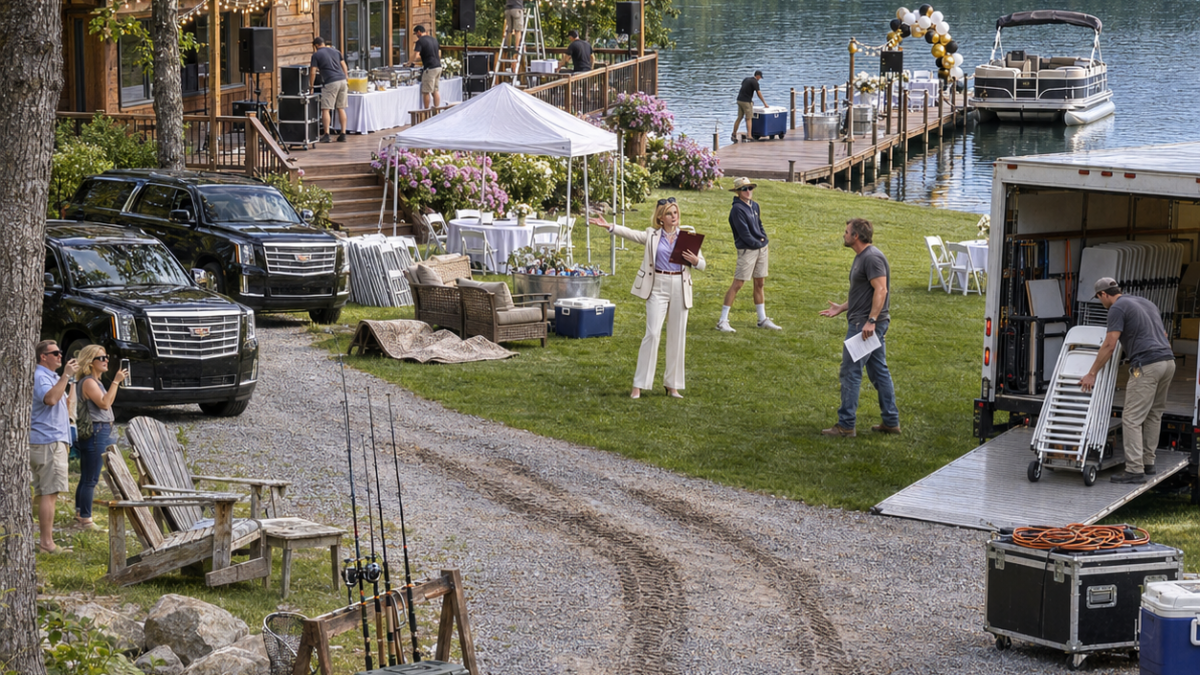
Within fifteen minutes, the lawn looked like a festival site.
Speakers appeared near the dock.
Coolers lined the side porch.
Someone strung lights between two trees.
A portable beer-pong table opened beside my grill.
I photographed the cut chain from inside.
At 6:38, I texted Rodriguez.
ENTRY CONFIRMED. GATE DAMAGED. ALCOHOL VISIBLE. I AM INSIDE RESIDENCE.
His reply came immediately.
COPY.
At 6:52, Grace arrived.
Her Escalade rolled through my broken gate.
She stepped out holding a champagne flute.
That detail almost made me laugh.
She had walked into a documented trespass carrying alcohol like she was arriving at a fundraiser.
Parents followed behind her.
That bothered me.
Some clearly had no idea there was a dispute.
One woman waved toward my window.
“Beautiful place!”
Grace smiled.
“We’re so fortunate the association could secure it.”
Secure it.
I opened the front door.
Grace spotted me.
Her smile grew wider.
“Brian! There you are.”
“Grace.”
“Come join us.”
“Everybody needs to leave.”
A few conversations stopped.
Grace gave a theatrical little laugh.
“Oh, don’t start.”
“You cut my gate.”
“Ethan said the lock malfunctioned.”
Ethan was ten feet away.
He looked at his shoes.
I pointed toward the cut chain lying on the grass.
“Interesting malfunction.”
Grace’s smile tightened.
“Send me an invoice.”
“This isn’t about a chain.”
She moved closer and lowered her voice.
“You’re making yourself look ridiculous in front of the entire neighborhood.”
“This isn’t your neighborhood.”
Her eyes flashed.
“Do you enjoy being difficult?”
“Do you enjoy taking things that aren’t yours?”
For one second, the pleasant mask disappeared.
Then she noticed several people watching.
The smile returned.
“Everyone, please continue. Mr. Nelson and I are discussing a minor administrative misunderstanding.”
I almost admired the speed.
“Grace.”
She leaned closer.
“What?”
“You have been formally told to leave.”
She stared at me.
Then took a sip of champagne.
“No.”
One word.
Clear.
Recorded.
I went back inside.
At 7:14, a teenager jumped off my dock holding a beer.
At 7:22, somebody tossed an empty can into the lake.
At 7:36, two boys dragged one of my porch chairs into the grass.
At 7:51, Ethan entered the screened porch.
He had no reason to be there.
I watched from the kitchen doorway.
He looked at me.
“What?”
“Get out.”
“Need a bottle opener.”
“You don’t have permission to be inside.”
He saw Dad’s hat hanging on a peg.
I knew what would happen before his hand moved.
“Don’t.”
He took it anyway.
“Relax.”
Something inside me tightened.
“Put it back.”
He laughed.
“It’s a hat.”
“It was my father’s.”
Maybe there was something in my voice he hadn’t heard before.
His smile weakened.
But outside, one of his friends shouted his name.
Ethan put the hat on backward.
“Looks better on me.”
I took one step toward him.
Then stopped.
Dad’s voice seemed almost audible.
Never decide while you’re angry enough to enjoy it.
I raised my phone and photographed Ethan wearing the hat.
“Thank you.”
He frowned.
“For what?”
“Making another decision on camera.”
His face changed.
He yanked off the hat.
“You’re weird.”
Then he shoved it into the pocket of his hoodie and walked outside.
The theft hurt more than I expected.
Not because I thought I would lose the hat.
Because Ethan had heard exactly what it meant to me and taken it anyway.
That was no longer ignorance.
It was cruelty performed for an audience.
At 8:10, Rodriguez texted.
WE HAVE ENOUGH. READY?
I looked out the window.
Grace was laughing beside the dock.
Ethan had climbed on top of a cooler.
Teenagers were drinking openly.
A parent was pouring something from a bottle into plastic cups.
I typed:
COME IN.
Then I walked onto the porch.
Ethan raised both arms.
“Speech!”
His friends cheered.
“This is our lake now!”
More laughter.
“HOA rules!”
Grace applauded.
I stood quietly near the cabin door.
A minute later, Grace saw me.
She came toward the porch.
Her steps weren’t perfectly straight anymore.
“Brian.”
“Grace.”
“You’re still filming.”
“Yes.”
“You need to stop.”
“No.”
“This is a private community event.”
“On my private property.”
Her voice dropped.
“Why can’t you just let them have one night?”
“Because you broke into my property to get it.”
“Nobody broke into anything.”
I pointed toward the chain.
She waved dismissively.
“We’ll replace it.”
“And my hat?”
“What hat?”
“Ask Ethan.”
She rolled her eyes.
“For heaven’s sake.”
Then she gave me a slow smile.
“You know, I’m starting to think you enjoy pretending you’re important.”
That almost made me smile back.
“Maybe.”
“You stand there documenting everything, making threats, quoting property records. Who do you think you are?”
I heard engines in the distance.
Not sirens.
Not yet.
I looked past her toward the driveway.
“Somebody who gave you every opportunity to leave.”
Grace followed my gaze.
Two sheriff’s cruisers rolled through the broken gate.
Conversation died in waves.
The first cruiser stopped near the lawn.
Then the second.
Deputies stepped out.
Rodriguez was first.
Grace stared at him.
Then at me.
“What did you do?”
“I reported a trespass.”
She laughed.
A nervous, disbelieving sound.
“You called the police?”
“Sheriff’s office.”
Her expression sharpened.
“Oh, this is perfect.”
She turned toward Rodriguez.
“Officer, I’m Grace Moore, president of the Crystal Pines Homeowners Association. This man has been harassing our community event all evening.”
Rodriguez looked at me.
“Evening, Chief.”
Silence fell so completely that I could hear water tapping against the dock posts.
Grace slowly turned her head.
Ethan stopped moving.
I reached inside the cabin, took my badge wallet from the table, and clipped it to my belt.
“I’m Brian Nelson,” I said. “Chief of Police for Hartwell.”
Grace’s champagne glass slipped from her fingers.
It struck the wooden step and shattered.
Ethan stared at me.
“You’re a cop?”
“Yeah.”
His face drained.
“You never said that.”
“You never asked.”
Grace recovered first.
“This is an abuse of authority.”
Rodriguez shook his head.
“No, ma’am. Chief Nelson is the complainant. This is county jurisdiction, which is why he asked our office to handle it.”
“You work together.”
“We work in neighboring agencies.”
“He planned this.”
Rodriguez looked toward the broken gate.
“Did he make your son cut that chain?”
Grace’s mouth opened.
Closed.
Rodriguez continued.
“Did he make everyone enter after written notice?”
Nobody answered.
“Did he supply the alcohol?”
A few teenagers quietly put their cups down.
Grace crossed her arms.
“The HOA authorized this event.”
“No,” I said. “You did.”
“Same thing.”
“That may be your problem.”
Rodriguez raised one hand.
“Chief, let us handle it.”
I nodded and stepped back.
That mattered.
From that moment forward, I was a homeowner standing on my own porch.
Deputies began separating minors from adults.
Nobody was thrown to the ground.
Nobody needed to be.
Most of the teenagers became remarkably cooperative the moment they realized the situation was real.
Names were taken.
Parents were called.
Alcohol was photographed and secured.
The broken gate was documented.
Rodriguez approached Ethan.
“Were you the person who cut the chain?”
Ethan looked at his mother.
Grace immediately said, “He had permission.”
Rodriguez didn’t look at her.
“I asked him.”
Ethan swallowed.
“Yeah.”
“Did the property owner give you permission?”
“My mom did.”
“That wasn’t my question.”
“No.”
“Where is Mr. Nelson’s hat?”
Ethan froze.
I hadn’t said anything to Rodriguez about it yet.
One of the cameras must have captured enough.
Ethan touched his hoodie pocket.
Rodriguez held out his hand.
“Give it to me.”
Ethan pulled out Dad’s hat.
The brim had been bent.
Rodriguez took it and brought it to me.
“Yours?”
I ran my thumb along the faded stitching.
“Yeah.”
“Want theft documented?”
I looked at Ethan.
His swagger was gone.
He suddenly looked exactly what he was.
Seventeen.
Scared.
Over his head.
“Yes,” I said. “Document it.”
Grace exploded.
“For a hat?”
I looked at her.
“For taking something after being told it belonged to my dead father.”
Ethan flinched.
Grace didn’t.
“That is vindictive.”
“No. Vindictive would be me deciding what happens next. I’m not.”
Rodriguez nodded toward another deputy.
“Photograph it and return it to the owner.”
Ethan stared at me.
For the first time that night, I saw shame.
Not fear.
Shame.
That gave me a little hope for him.
Grace had none.
She marched toward Rodriguez.
“I demand that you remove Brian Nelson from this property.”
Rodriguez blinked.
“Ma’am.”
“He’s creating a hostile environment.”
“This is his house.”
“According to the association charter—”
“Stop.”
Rodriguez’s voice wasn’t loud.
It didn’t need to be.
“We verified ownership before coming here. The HOA has no interest in this parcel. You have been formally trespassed.”
Grace’s face reddened.
“You don’t understand our community structure.”
“I understand a deed.”
“You people think a badge lets you bully anyone you want.”
I actually felt Rodriguez’s patience thinning.
“Mrs. Moore, you are currently standing on another person’s land after being told repeatedly to leave. I am giving you one final opportunity to walk to your vehicle.”
She pointed at me.
“He manipulated you.”
“No, ma’am.”
“He hates the HOA.”
Rodriguez looked at the lawn littered with cans.
“I’m developing mixed feelings.”
A few parents lowered their heads to hide smiles.
Grace noticed.
Humiliation changed her.
Her voice rose.
“You think this is funny?”
Nobody answered.
She turned toward the crowd.
“This man orchestrated all of this because he refused to participate in his own community!”
A woman near the driveway spoke up.
“Grace, you told us he donated the cabin.”
Grace froze.
I looked toward the woman.
She was in her forties, wearing jeans and a blue cardigan.
“What did she tell you?”
The woman hesitated.
“That the homeowner volunteered the property.”
Grace snapped, “Melissa, this is not the time.”
Melissa looked at the broken chain.
“I brought my daughter because you said this was approved.”
“It was.”
“By him?”
Grace didn’t answer.
Melissa’s face changed.
“Oh my God.”
Another parent spoke.
“You told us the same thing.”
Then another.
“You said the HOA had a recreational agreement.”
The balance shifted.
Grace could argue with me.
She could accuse Rodriguez.
But she hadn’t expected her own people to begin comparing stories.
“Everyone is emotional,” she said.
Melissa shook her head.
“You lied to us.”
“I simplified the situation.”
“You brought our kids onto somebody’s property.”
“For a graduation celebration!”
“You told us it was legal.”
Grace’s hand tightened around her clipboard.
Rodriguez stepped between them.
“Folks, please stay where the deputies can get your information.”
Then headlights appeared at the gate.
An unmarked county vehicle entered slowly.
Grace looked relieved.
For some reason, she seemed to think reinforcement had arrived for her.
Linda Hayes stepped out.
Dark slacks.
Gray jacket.
Leather folder under one arm.
Grace’s relief disappeared.
Linda came up the driveway and nodded at Rodriguez.
“Sergeant.”
Then at me.
“Chief.”
Grace looked from one of us to the other.
“Who is this?”
Linda answered.
“County investigator Linda Hayes.”
“For what?”
“Mrs. Moore?”
“Yes.”
“I need to speak with you.”
Grace’s eyes narrowed.
“About this ridiculous trespassing complaint?”
“No.”
That one word changed the air.
Linda opened her folder.
“I’m investigating financial irregularities involving the Crystal Pines Homeowners Association.”
Grace stopped moving.
Ethan whispered, “Mom?”
Grace didn’t look at him.
“This is outrageous.”
Linda continued calmly.
“We have obtained preliminary records concerning expenditures from the Community Youth Engagement Initiative.”
I watched Grace’s fingers tighten around the clipboard.
“You have no authority to inspect association finances.”
“We do when the association’s bank provides records pursuant to legal process.”
Grace went pale.
Linda didn’t mention the forged charter.
Not yet.
Instead, she held out a business card.
“I am not arresting you on the financial matter tonight. I am instructing you not to destroy, alter, conceal, or remove any HOA financial records.”
Grace stared at the card.
“Brian did this.”
Linda’s expression stayed neutral.
“Several people brought concerns to our office.”
That was news to me.
Grace looked around at her neighbors.
For the first time, she didn’t know where the threat was coming from.
Good investigations often worked that way.
Truth rarely arrived from one witness.
It accumulated.
One receipt.
One email.
One person who had finally had enough.
Grace looked back at me.
“You planned this.”
“I planned to spend Friday night drinking coffee on my own dock.”
“You set a trap.”
“No, Grace.”
I looked around at the broken gate, the alcohol, the deputies, the parents, and the county investigator.
“I set a boundary.”
She crossed it.
There was a difference.
By 10:30, most of the teenagers had been released to their parents.
Several received juvenile citations.
Others were documented as witnesses.
Nobody’s life was destroyed over a beer.
But Ethan’s situation was more serious.
He had cut the lock after being warned.
He had entered my screened porch.
He had taken my property.
Rodriguez detained him long enough to complete the report and release him to his father, who arrived shortly before eleven.
That was the first time I met Robert Moore.
He looked nothing like Grace.
No performance.
No anger.
Just exhaustion.
He parked near the gate, stepped out, and stared at the scene.
Then at his son.
Then at his wife.
“Grace.”
She folded her arms.
“Don’t start.”
Robert looked at the broken chain.
“What did you do?”
“She did nothing,” Ethan said quickly.
Robert turned to him.
“I wasn’t asking you.”
Grace raised her chin.
“Brian engineered this.”
Robert looked toward me.
I expected hostility.
Instead, he walked over.
“You’re Chief Nelson?”
“Yes.”
He closed his eyes.
“Of course you are.”
I almost asked what that meant.
He answered before I could.
“I told her to leave you alone.”
Grace snapped, “Robert.”
He ignored her.
“For months,” he said. “I told her the lake parcels weren’t part of the HOA.”
That caught everyone’s attention.
Grace’s voice became dangerously quiet.
“Get Ethan in the car.”
Robert looked at Linda Hayes.
“Are you investigating the HOA accounts?”
Grace moved toward him.
“Robert.”
Linda said, “Sir, if you have information, I can give you my card.”
Grace grabbed his sleeve.
“You are not speaking to her.”
Robert looked down at her hand.
Something passed across his face.
Not anger.
Decision.
He removed her fingers one by one.
Then he took Linda’s card.
“I think I should.”
Grace stared at him.
The queen had just lost her first ally.
By midnight, everybody was gone.
The lawn looked terrible.
Cans.
Mud.
Broken plastic cups.
A damaged chair.
Grass torn up near the driveway.
The gate hung open.
The lake itself had gone quiet again.
Rodriguez stood beside me while I locked a temporary chain around the damaged latch.
“You okay?”
“Ask me tomorrow.”
He handed me Dad’s hat.
“I think this matters more than the gate.”
I looked down at it.
“Yeah.”
“Kid seemed sorry.”
“He seemed caught.”
“Sometimes that’s where sorry starts.”
I smiled faintly.
“When did you become philosophical?”
“Third divorce.”
“That’ll do it.”
He climbed into his cruiser.
Before leaving, he lowered the window.
“Brian.”
“Yeah?”
“Grace isn’t finished.”
“I know.”
“You sound happy about that.”
“I’m not.”
He gave me a look.
“Maybe a little.”
I watched his taillights disappear.
Then I went inside.
Dad’s hat sat on the table beside the altered HOA charter.
One represented something I had inherited.
The other represented something Grace had invented.
And for the first time, I understood that the real fight had never been over a graduation party.
The party was simply the moment Grace became reckless enough for everybody else to see what she had been doing quietly for years.
Saturday morning, Crystal Pines woke up angry.
Not at me.
At her.
My phone began ringing before seven.
The first call came from Melissa, the mother who had challenged Grace during the party.
“I’m sorry.”
“You didn’t know.”
“She told us you’d agreed.”
“I figured.”
“She said you were an older retiree who liked helping the kids.”
I looked around my kitchen.
“I’m fifty-seven.”
There was a pause.
“I didn’t say I believed the older part.”
That made me laugh.
Then her voice became serious.
“There’s something you need to know.”
“What?”
“Grace has done this before.”
My smile disappeared.
“Used someone’s property?”
“Not exactly. But she changes rules.”
“What do you mean?”
Melissa told me that two years earlier, the HOA board had voted against a new landscaping surcharge.
A month later, residents received letters saying the assessment had passed.
When Melissa asked for meeting minutes, Grace told her the vote had been corrected during an executive session.
“Did you ever see those minutes?”
“No.”
“Anyone?”
“Not that I know of.”
Another call came from Tom Avery.
Then another from a retired teacher named Ellen Park.
By noon I had heard six different stories.
A fine doubled after someone challenged it.
A board vote changed after the meeting.
A contractor supposedly chosen through competitive bidding turned out to be Grace’s cousin.
An elderly resident paid $1,800 in penalties over a fence that had existed twenty years before the HOA subdivision expanded.
Individually, some might have been incompetence.
Together, they looked like a system.
I forwarded names to Linda Hayes.
Then I went outside and started cleaning my lawn.
Around two, a pickup stopped at the gate.
Robert Moore got out.
Alone.
I set down the trash bag.
“You here as Grace’s husband or Ethan’s father?”
He winced.
“Fair question.”
“Which?”
“Ethan’s father.”
I opened the gate.
Robert walked toward the dock.
For a while, neither of us said anything.
Then he pulled an envelope from his jacket.
“Restitution for the lock and chair.”
“I haven’t calculated anything.”
“I guessed.”
I didn’t take it.
“Keep it until the sheriff finishes the property report.”
He nodded.
Then looked at the water.
“I owe you an apology.”
“You didn’t cut my chain.”
“No. I just spent years pretending I didn’t see what Grace was becoming.”
That was harder to answer.
Robert rubbed both hands over his face.
“She wasn’t always like this.”
“Most people aren’t.”
“When she first joined the board, she fixed things. The pool contract was a mess. Landscaping company was overbilling. Nobody attended meetings. Grace came in and actually cared.”
“What changed?”
Robert gave a humorless laugh.
“She got results.”
I understood immediately.
“People started rewarding the control.”
“Exactly.”
“She solved problems, so they gave her more power.”
“And when somebody disagreed, she decided they were the problem.”
Robert stared across the lake.
“At home, everything became about the association. Dinners. Vacations. Ethan’s school. She’d spend hours talking about who challenged her, who embarrassed her, who needed to be taught a lesson.”
“Did you know about the finances?”
His face tightened.
“I knew we had more money than we should.”
“That’s not the same question.”
“No.”
“Robert.”
He met my eyes.
“I suspected.”
That was enough.
“Tell Linda.”
“I already did.”
He looked back toward the driveway.
“Grace thinks I betrayed her.”
“Did you?”
“I think I stopped helping her betray everybody else.”
Before he left, I asked about Ethan.
Robert’s expression changed.
“He’s terrified.”
“Good.”
Robert looked surprised.
“Not permanently. But fear is sometimes useful when someone has spent seventeen years believing consequences are for other people.”
He considered that.
“He wants to apologize.”
“Not today.”
“I understand.”
“I’m still angry.”
“I understand that too.”
Monday morning, local reporters were waiting outside Hartwell Police Headquarters.
I had expected them.
What I hadn’t expected was Grace.
She had given an interview.
The headline on one station’s website read:
HOA PRESIDENT ACCUSES POLICE CHIEF OF STAGING RAID OVER PROPERTY FEUD.
By eight-thirty, the mayor was in my office.
Walter Peters was a decent man whose courage usually arrived twenty minutes after it was needed.
He closed the door.
“This looks bad.”
“What part?”
“The optics.”
I pushed the sheriff’s incident report across my desk.
“The optics are documented.”
“She says you used law-enforcement resources to intimidate teenagers.”
“County resources. Requested through a civilian complaint. The sheriff’s office made every enforcement decision.”
“She says officers were lying in wait.”
“Deputies responded after trespass and property damage were documented.”
Peters rubbed his forehead.
“She says she’s suing.”
“She can.”
“You sound very relaxed.”
“I have seven cameras.”
That helped.
By ten, the sheriff released a brief statement confirming that my agency had not conducted the operation and that I had no command role in the county deputies’ response.
By eleven, the first camera clip reached the press.
Not from me.
Melissa gave a reporter her phone video.
It showed Grace raising her champagne glass and announcing that the HOA had secured the property.
Then it showed me telling her to leave.
Then Grace refusing.
The story changed.
By lunchtime, reporters stopped asking whether I had staged a raid.
They started asking whether the HOA president had knowingly trespassed.
At 1:15, Linda Hayes called.
“Things are moving.”
“How fast?”
“Fast enough that you should stay out of the way.”
“Gladly.”
“Brian.”
“Yes?”
“You asked about the youth fund.”
“I did.”
“You were right to ask.”
“How right?”
“Forty-eight thousand dollars right.”
I went silent.
“Over how long?”
“Three years.”
“Personal account?”
“I didn’t say that.”
“You didn’t need to.”
“Also, please stop guessing accurately. It annoys investigators.”
She hung up.
The first search warrant was served Tuesday morning.
Not at my cabin.
At the HOA office.
Linda’s team seized financial records, laptops, invoices, and bank statements.
Helen Graves called me that afternoon.
I barely knew Helen then.
She had served as HOA treasurer two years earlier before resigning.
“Chief Nelson?”
“Yes.”
“My name is Helen Graves.”
“I know the name.”
“I think I can explain the youth fund.”
I sat down.
“Go ahead.”
“I kept copies.”
“Of what?”
“Everything.”
Helen had been an accountant for forty-one years.
Grace had hated that.
During Helen’s time as treasurer, she had repeatedly questioned reimbursements that lacked receipts.
Grace told the board Helen was “creating paralysis through excessive scrutiny.”
Eventually, Grace pushed through a restructuring that removed the treasurer’s independent signature authority.
Helen resigned.
But she kept copies of every financial report she had legally possessed while serving.
“Why didn’t you go to authorities?”
“I wasn’t sure.”
“What changed?”
“Your party.”
“My party?”
“That’s what everyone calls it now.”
I sighed.
“Wonderful.”
Helen almost laughed.
“Grace lied so confidently about your property that I wondered what else she had lied about.”
She brought three bankers’ boxes to Linda the next morning.
That was the beginning of the end.
The records showed payments labeled beautification, youth engagement, emergency maintenance, and professional consulting.
Some went to legitimate vendors.
Others went nowhere near HOA business.
Luxury handbags.
Spa weekends.
Interior renovation.
Her son’s auto insurance.
A $6,400 resort charge.
Payments to a credit card in Grace’s name.
Then investigators found a short-term loan.
Forty thousand dollars secured against HOA assets.
No recorded board approval.
The proceeds had been transferred into an account Grace controlled.
By Friday, the board suspended her.
She still refused to resign.
Instead, she sent every resident a twelve-paragraph email.
I received a forwarded copy from Tom.
It accused unnamed political actors of attacking “a strong female community leader.”
It called the financial investigation “administrative confusion.”
It described the cabin incident as “a misunderstanding regarding evolving community-use rights.”
And it accused me of holding a personal vendetta.
The last paragraph said:
I WILL NOT BE SILENCED BY THOSE WHO FEAR EFFECTIVE LEADERSHIP.
Tom added one line above it.
She fined me $200 for wind chimes.
I laughed harder than I should have.
Then Jim called.
“Enjoying yourself?”
“Apparently that’s illegal now.”
“Grace filed suit.”
“For what?”
“Defamation, harassment, interference with HOA operations, intentional infliction of emotional distress.”
I leaned back in my chair.
“She sued me because she trespassed?”
“She also wants an injunction preventing you from discussing the case.”
“Good luck.”
“Exactly.”
“Anything serious?”
“The lawsuit is serious because lawsuits cost money even when they’re stupid. But her evidence is weak.”
“What about the altered charter?”
“That’s where this gets interesting.”
Jim paused.
“The digital file was created under Grace’s account, but she’s claiming an administrative assistant prepared it.”
“Which assistant?”
“Apparently she hasn’t decided yet.”
Two days later she did.
She blamed a woman named Cheryl Dunn, the HOA’s part-time office manager.
Cheryl lasted four hours under that accusation.
Then she hired a lawyer.
By sunset, she was cooperating with investigators.
According to Cheryl, Grace had personally dictated the community-adjacent clause.
Cheryl objected.
Grace told her it was only “temporary language” to support ongoing negotiations.
There had been no negotiations.
Grace then edited the document herself.
Cheryl had an email proving it.
PLEASE INSERT THE NEW LANGUAGE BEFORE SENDING TO NELSON. WE NEED HIM TO UNDERSTAND THE BOARD’S POSITION AS BINDING.
The email was signed Grace.
Jim read it twice.
Then looked at me across his conference table.
“People always think corruption fails because investigators are brilliant.”
“Sometimes it does.”
“Mostly it fails because corrupt people email instructions.”
I smiled.
“You going to enjoy the deposition?”
“Immensely.”
Grace’s civil lawsuit quietly disappeared three days later.
Her criminal problems did not.
Ethan came to my cabin the following Saturday.
He didn’t drive.
Robert brought him and waited at the road.
Ethan wore jeans and a plain gray T-shirt.
No sunglasses.
No designer hoodie.
No swagger.
I stayed on the porch.
He stopped ten feet away.
“Chief Nelson.”
“Ethan.”
He looked toward the repaired gate.
“I’m sorry.”
I said nothing.
“For cutting the lock.”
Still nothing.
“For coming onto your property.”
He swallowed.
“And for taking your dad’s hat.”
That was the one.
“Why did you take it?”
He looked embarrassed.
“I don’t know.”
“Yes, you do.”
He stared at the ground.
“My friends were watching.”
“Try again.”
His shoulders lowered.
“I wanted to show you I could.”
There it was.
Not complicated.
Not flattering.
But true.
“You heard me say it belonged to my father.”
“Yeah.”
“And you took it because?”
“Because you told me not to.”
I nodded.
“Better answer.”
His eyes were wet now, though he tried to hide it.
“I thought you were just some guy trying to embarrass my mom.”
“I wasn’t.”
“I know.”
“What do you know now?”
He gave a short, unhappy laugh.
“That my mom lies.”
I didn’t respond.
He rubbed his palms against his jeans.
“She told me the cabin belonged to the HOA. She told me you were refusing to follow rules because you thought you were better than everybody.”
“And you believed her.”
“She’s my mom.”
That answer I understood.
Children don’t begin by questioning the map their parents give them.
They begin by believing it.
“You’re responsible for what you did,” I said. “Even if she lied.”
“I know.”
“Do you?”
He nodded.
“I have community service. I’m paying for the gate. Dad took my car for the summer.”
“That sounds like a start.”
He looked toward the lake.
“Are you going to press charges over the hat?”
“The report already exists.”
His face tightened.
“But what happens from here depends on the prosecutor and juvenile court. Not me.”
He nodded again.
I walked inside.
When I returned, I carried Dad’s hat.
Ethan stared at it.
“This was his.”
“I know.”
“No. You know it was a hat he owned. You don’t know what it was.”
I sat on the porch step.
After a moment, Ethan sat on the lower one.
“My dad worked construction most of his life,” I said. “Never made much money. Never wanted much. That hat went everywhere with him.”
Ethan listened.
“The last morning we fished together, he wore it.”
“What happened?”
“Cancer happened.”
“Oh.”
“He was weak. Could barely get into the boat. I told him we should go home.”
“Did you?”
“No.”
I smiled faintly.
“He told me he wasn’t dead yet and I needed to stop scheduling it.”
Ethan almost smiled.
“That sounds like something my grandpa would say.”
“He caught one fish that day. Smallest bass I’ve ever seen.”
I looked down at the hat.
“He acted like he’d landed a marlin.”
Ethan’s face changed.
“I’m really sorry.”
This time, I believed him.
I handed him the hat.
His eyes widened.
“I don’t want—”
“Hold it.”
He took it carefully.
“Feel powerful?”
He looked at me.
“No.”
“Why?”
“Because it isn’t mine.”
I nodded.
“Now you’re learning.”
He gave it back.
That was the first conversation Ethan Moore and I ever had instead of a confrontation.
The legal process moved slower than the gossip.
It always does.
Grace hired two lawyers.
Then a third.
She challenged the warrants.
She challenged the accounting methodology.
She claimed reimbursements had been authorized verbally.
She claimed signatures were electronic.
She claimed the board had approved the loan during informal discussions.
Then Robert turned over bank records.
Everything tightened.
The $40,000 loan had paid down Grace’s personal credit-card balance.
The youth fund had financed vacations, clothing, and household purchases.
Three board signatures on approval documents were forged.
One belonged to a man who had been in Arizona on the date he supposedly signed.
Another belonged to Helen Graves.
Helen looked at the signature and laughed.
“That’s not even how I write my G.”
The altered charter became another count in a growing file of falsified records.
Grace was arrested six weeks after the party.
No dramatic raid.
No screaming.
No handcuffs beside the lake.
She reported to the county courthouse with her attorney and surrendered.
That somehow felt more appropriate.
The woman who had spent years making everybody else report to her finally had an appointment she couldn’t control.
I testified at the preliminary hearing.
Grace sat at the defense table wearing a navy suit.
No pink blazer.
No pearls.
She looked smaller.
Not physically.
Socially.
The room no longer rearranged itself around her.
Her lawyer tried to portray the cabin dispute as ambiguous.
He put the altered charter on a screen.
“Chief Nelson, you were aware that the HOA believed it possessed temporary recreational rights, correct?”
“I was aware Mrs. Moore claimed that.”
“So there was a disagreement.”
“No.”
He frowned.
“No?”
“A disagreement would require two legally supportable positions. The county record showed one owner and no HOA easement.”
“Yet the association had this language.”
“The association president created that language after I challenged her.”
Grace’s attorney looked toward the judge.
“Move to strike the witness’s characterization.”
The prosecutor stood.
“We have metadata and email evidence supporting the statement.”
The judge looked at me.
“Chief, answer only what you personally know unless asked about later-discovered evidence.”
“Yes, Your Honor.”
Grace’s lawyer tried again.
“Did you personally watch Mrs. Moore alter the document?”
“No.”
“So you cannot know she created it.”
“I know she emailed it to me and represented it as binding.”
“That wasn’t my question.”
“No, I did not watch her type it.”
He seemed pleased.
Then the prosecutor called Cheryl Dunn.
She testified that Grace dictated the clause.
Then Linda Hayes introduced Grace’s email.
Her lawyer stopped looking pleased.
The financial testimony was worse.
Helen explained the missing approvals.
A bank representative traced the loan.
A forensic accountant walked through transfers totaling $48,716 in misappropriated HOA money.
Grace stared straight ahead.
When the hearing ended, Ethan was waiting outside.
He stood near the courthouse steps with his hands in his pockets.
“Chief.”
“Hey.”
He looked toward the doors.
“She’s going to prison, isn’t she?”
“I don’t know.”
“You know more than I do.”
“I know she has serious charges.”
He swallowed.
“Dad filed for divorce.”
I had heard.
“I’m sorry.”
“Are you?”
“Divorce hurts people who didn’t create the problem.”
He nodded slowly.
“Mom says Dad betrayed her.”
“What do you think?”
“I think he stopped lying for her.”
That sounded almost exactly like Robert.
Ethan looked older every time I saw him.
Consequences were doing what birthdays couldn’t.
“She hates you,” he said.
“That’s her right.”
“She says you destroyed our family.”
“Did I?”
He looked back at the courthouse.
“No.”
I let him answer his own question.
He wiped his eyes quickly.
“I keep thinking about the party.”
“What part?”
“How sure I was.”
“About the cabin?”
“About everything.”
He shook his head.
“I walked into somebody’s house and took his stuff because I thought my mom could make it okay.”
“That’s what unchecked authority does.”
“What?”
“It confuses permission with power.”
He looked at me.
“I don’t want to become her.”
“Then don’t.”
“That simple?”
“No.”
I shook my head.
“It’s a decision you’ll probably have to make more than once.”
The new HOA board elected Helen Graves president.
She accepted under three conditions.
Monthly financial reports.
Two signatures for major expenditures.
Independent legal review before any claim affecting property rights.
The vote was unanimous.
At her first meeting, the community center was packed.
Helen invited me.
I almost declined.
Then Tom Avery called.
“You owe us.”
“For what?”
“Entertainment.”
“I already provided a raid.”
“Exactly. Now come watch adults read a budget.”
I went.
The atmosphere surprised me.
People argued.
Openly.
One man wanted cheaper landscaping.
Another wanted better lake maintenance.
A woman complained about parking.
Nobody looked terrified.
Nobody got threatened with a fine for disagreeing.
That was healthier than the silence Grace had called order.
Helen stood at the microphone.
“We have confirmed that the previous administration misappropriated $48,716.”
Murmurs filled the room.
“We are pursuing full restitution.”
A man in the third row shouted, “What about all the fines she collected?”
“We’re reviewing them.”
“She made me repaint my house twice!”
Several people laughed.
Helen raised one hand.
“We’re reviewing those too.”
Then she looked toward me.
“Chief Nelson, would you like to say anything?”
Every head turned.
I stood reluctantly.
“I’m not a member of your HOA.”
That got a few laughs.
“And after recent events, I’m very interested in keeping it that way.”
More laughter.
Then I became serious.
“What happened here wasn’t caused by bylaws.”
The room quieted.
“It happened because too many people were taught that questioning authority was the same thing as attacking the community.”
Helen nodded.
“You can have rules. You can enforce contracts. You can disagree. But the moment one person becomes more important than the process, you stop having governance.”
I glanced around the room.
“You have enough accountants, lawyers, retired engineers, teachers, contractors, parents, and professional complainers in this neighborhood to keep each other honest.”
Tom raised his hand.
“I accept the appointment.”
The room laughed.
I sat down.
That was all I needed to say.
Grace eventually accepted a plea agreement.
Fraud.
Misappropriation of funds.
Falsification of association records.
Criminal trespass.
The more serious charges carried enough exposure that her attorneys advised against trial.
At sentencing, the courtroom filled with Crystal Pines residents.
Some came for closure.
Some came for revenge.
Those are not the same thing.
Grace stood before the judge.
She looked tired.
The judge asked whether she wished to speak.
She hesitated.
Then stood.
“I wanted order.”
Nobody moved.
“When I became president, the association was failing. Bills were unpaid. Meetings were chaos. Nobody wanted responsibility.”
Her voice shook.
“I fixed things.”
The judge waited.
Grace looked toward the residents.
“And people kept asking me to fix more.”
For the first time, I heard something honest in her explanation.
Not an excuse.
A beginning.
“I started believing that if people disagreed with me, they were getting in the way.”
She lowered her eyes.
“I told myself everything I did was for the community.”
The judge leaned forward.
“Did taking HOA money for personal expenses serve the community?”
Grace closed her eyes.
“No.”
“Did falsifying documents?”
“No.”
“Did entering Mr. Nelson’s property after he denied permission?”
“No.”
The judge nodded.
“Good intentions do not create legal authority, Mrs. Moore.”
Grace’s shoulders lowered.
“You were entrusted with limited power. Instead of respecting those limits, you repeatedly expanded them whenever they became inconvenient.”
The sentence was three years, with one year to serve, the remaining two suspended subject to probation, plus full restitution and financial restrictions after release.
Grace didn’t scream.
She didn’t blame me.
She simply nodded.
As the bailiff approached, she looked toward Ethan.
He was sitting beside Robert.
For a moment, her face broke.
Not the HOA president.
Not the woman from the Escalade.
Just a mother realizing her son was watching her be taken away.
Ethan began crying.
Grace mouthed something to him.
I couldn’t hear it.
Later, he told me.
She had said, “Do better.”
Three weeks after sentencing, I found Ethan in an orange safety vest beside the lake.
Community service.
He and several other teenagers were collecting trash along the shoreline.
Deputy Carter supervised from a picnic table.
Ethan noticed me and straightened.
“Chief.”
“Moore.”
He held up a half-full trash bag.
“Apparently my criminal empire now specializes in beer cans.”
“Diversification is important.”
He laughed.
That was the first easy laugh I had heard from him.
I pointed toward the bag.
“How many?”
“Too many.”
“Some yours?”
He looked at the ground.
“Probably.”
“Then keep going.”
I started walking away.
“Chief?”
I turned.
“Do you think my mom can come back from this?”
It was a serious question.
I took a moment.
“She can come home.”
“That’s not what I asked.”
No.
It wasn’t.
“Coming back from something is different.”
“How?”
“You can serve a sentence because a judge orders you to. Changing requires doing things nobody can order.”
Ethan nodded.
“Do you forgive her?”
“That’s not really my job.”
“Do you hate her?”
I thought about the altered document.
The broken gate.
Dad’s hat.
The threats.
The lies.
“No.”
He seemed surprised.
“I was angry. I’m still angry about parts of it. But hate would mean giving her more space in my life than she already took.”
Ethan looked toward the water.
“I think I’m angry at her.”
“You’re allowed.”
“I also miss her.”
“You’re allowed that too.”
He nodded.
Then went back to work.
Crystal Pines changed slowly.
Not dramatically.
That was how I knew it was real.
The new board reviewed old fines.
Some were upheld.
Many were refunded.
The landscaping contract went out for competitive bid.
Meetings were streamed online.
Financial records became accessible to residents.
The ridiculous mailbox rule disappeared.
Tom kept his wind chimes.
The world survived.
Property values dipped for a while because nobody enjoys having their neighborhood appear on television beside the words FRAUD INVESTIGATION.
Then they recovered.
Families stopped whispering when Grace’s name came up.
People began making jokes.
That was recovery too.
One evening, Helen called.
“We’re planning the first community picnic in ten years.”
“Why are you telling me?”
“You’re invited.”
“I’m not joining the HOA.”
“Brian.”
“I want that in writing.”
She laughed.
“Just come eat a hamburger.”
The picnic was held in the lakeside park the HOA actually owned.
That detail mattered to me.
Kids played near the water.
Parents grilled burgers.
A local band played old rock songs under a small pavilion.
Nobody had broken a chain to get there.
Nobody had forged a charter.
Nobody needed a sheriff’s report.
Ethan worked at the lemonade stand.
When he saw me, he raised a hand.
I raised mine back.
Later, Helen tapped a microphone.
“I promised Chief Nelson there would be no long speeches.”
I called from the crowd, “You promised there’d be no speeches.”
People laughed.
Helen ignored me.
“Six months ago, this community had forgotten the difference between rules and respect.”
The crowd became quieter.
“We’ve spent those six months repairing finances, policies, and trust. The last one has been the hardest.”
She looked toward Ethan.
He was stacking cups with his head down.
“We’ve also learned that accountability should not end with punishment.”
Then she announced a new scholarship and youth volunteer program funded through recovered money and private donations.
Ethan had helped design it.
The program focused on community service, civic responsibility, and mentoring teenagers who had gotten into minor legal trouble.
Afterward, I found him carrying folding chairs.
“You did this?”
“Some of it.”
“Not bad.”
He smiled.
“I figured if I was going to be famous for the worst party Crystal Pines ever had, I should balance the record.”
“That may take a while.”
“I know.”
He set down the chairs.
“I got a job too.”
“Doing what?”
“Marina maintenance.”
“Honest work.”
“Very wet work.”
I laughed.
He hesitated.
“Dad and I are okay.”
“Good.”
“He sold the Escalade.”
“That must have hurt.”
“Mom wrote him three pages about it.”
“Sounds like Grace.”
Ethan smiled faintly.
“She’s different in the letters.”
“How?”
“She asks questions now.”
That was more significant than it sounded.
“Before, she mostly gave instructions.”
He nodded.
“Exactly.”
A month later, I received my own letter.
No return address I recognized.
The handwriting was careful.
Chief Nelson,
I have rewritten this letter six times because every version sounded like another argument.
That sentence made me smile despite myself.
Grace continued.
For the first few weeks here, I blamed you.
Then Robert.
Then Helen.
Then the board.
Then the prosecutor.
Then the judge.
Blaming people gave me something to do besides think.
Eventually I ran out of people.
She wrote that prison had stripped away the little rituals she once used to measure status.
No reserved parking spot.
No board agenda.
No special table.
No title.
Nobody cared that she had once controlled Crystal Pines.
She worked in the laundry unit.
She helped two women prepare for their GED exams.
The first time one of them passed a practice test, Grace felt proud in a way she hadn’t felt after winning an HOA vote in years.
Then came the paragraph that made me stop.
I kept telling myself I wanted people to respect me.
I did not.
I wanted them to obey me.
Those are not the same thing.
I looked toward Dad’s hat hanging on the wall.
Grace wrote:
What I did to you was wrong before I knew your job, and it remained wrong after I learned it.
That sentence mattered.
She wasn’t apologizing because I carried a badge.
She was apologizing because the cabin wasn’t hers.
I continued.
I told Ethan that your property belonged to us because I wanted him to see me as powerful.
Instead, I taught him that other people’s boundaries disappeared when they became inconvenient.
I am ashamed of that more than the money.
I don’t expect forgiveness.
I intend to repay what I owe and spend whatever life I have left proving that I understand the difference between leadership and control.
Please tell Ethan I am proud of the man he is trying to become.
And please accept my apology for your father’s hat.
That was cruelty I allowed because I had made disrespect look normal.
Grace Moore.
I read the letter twice.
Then I folded it.
I didn’t write back immediately.
Some apologies need space more than answers.
Instead, I carried the letter onto the dock.
The lake was flat.
Evening sunlight stretched across the water in long orange lines.
Dad’s old fishing boat was tied to the post.
For years, police work had taught me to think in outcomes.
Arrest.
Conviction.
Sentence.
Case closed.
But standing there, I realized cases end much faster than consequences.
Grace’s sentence would eventually finish.
Ethan’s memory of watching his mother arrested would not.
Robert’s marriage would not repair itself because a judge signed paperwork.
The residents would remember how easily they had allowed one person to accumulate authority.
And I would probably check every HOA boundary twice for the rest of my life.
Justice could stop wrongdoing.
It couldn’t rewind it.
Maybe that was why what happened next mattered so much.
Six months after Grace’s sentencing, I was repainting the end of my dock when a familiar voice came from behind me.
“Hey, Chief.”
I turned.
Ethan stood there carrying a bucket, work gloves, and a folded sign.
He had changed.
Not magically.
Not completely.
But visibly.
The designer clothes were gone.
He wore a gray T-shirt from a local youth center.
His hair was shorter.
His posture was different.
Less performance.
More purpose.
“What’s the sign?”
He unfolded it.
COMMUNITY CLEANUP DAY
RESPECT & RESPONSIBILITY PROJECT
I raised an eyebrow.
“Subtle.”
He grinned.
“I had help.”
“What is it?”
“A volunteer thing. Shoreline cleanup, tutoring, some workshops for kids who get community service.”
“Kids like you?”
“Exactly like me.”
I leaned against the railing.
“Whose idea?”
“Started as mine.”
That surprised me.
“We had to complete service hours, and most of the kids treated it like punishment. I kind of did too.”
“What changed?”
He looked toward the lake.
“I realized cleaning up the same shoreline I helped trash felt different.”
He shrugged.
“So I kept going after my hours were finished.”
That was the kind of change nobody could order.
“How’s your mom?”
He took a moment.
“She works in the laundry.”
“I heard.”
“She’s tutoring people too.”
“I heard that.”
Ethan smiled.
“She tell you?”
“She wrote.”
His eyebrows rose.
“To you?”
“Once.”
“What did she say?”
“That’s between your mother and me.”
He nodded.
“I get it.”
Then he looked nervous.
“There’s something else.”
“What?”
He reached into the bucket and pulled out a small framed photograph.
I took it.
It showed my cabin on the night of the raid.
Red and blue light reflected across the lake.
Deputies stood near the driveway.
The broken gate was visible at the edge.
“Why would I want this?”
“Turn it over.”
On the back, Ethan had written:
THE NIGHT I LEARNED A BOUNDARY DOESN’T DISAPPEAR JUST BECAUSE YOU DON’T LIKE IT.
I stared at the words.
“I made copies for our workshop,” he said. “We talk about peer pressure, alcohol, trespassing, stuff like that.”
“You use my disaster as educational material?”
“Basically.”
I handed it back.
“Good.”
He blinked.
“Really?”
“Really.”
“Thought you might be mad.”
“I spent twenty years wishing teenagers would learn from somebody else’s mistake.”
He laughed.
We spent the afternoon helping volunteers pull trash from the shoreline.
At one point, I noticed Ethan correcting a younger boy who wanted to cross a fence to retrieve a plastic bottle.
“It’s right there,” the boy said.
“Doesn’t matter.”
“Nobody cares.”
Ethan pointed toward a nearby house.
“Not ours.”
Four words.
Not ours.
I turned away before he noticed me smiling.
Helen’s reforms held.
A year after the party, the HOA books were clean.
Every missing dollar had either been repaid through restitution, insurance recovery, or court-ordered asset liquidation.
The unauthorized loan was settled.
The forged records were archived as evidence instead of policy.
A new board handbook required independent legal review before any document affecting non-HOA property could be issued.
Somebody jokingly called it the Nelson Rule.
I told them to remove my name.
They changed it to the Boundary Rule.
Much better.
I stayed outside the HOA.
That became an ongoing joke.
At the annual picnic, Tom handed me a fake membership application.
I tore it in half without reading it.
The table erupted in laughter.
Helen pointed at me.
“You didn’t even see the dues.”
“Too high.”
“They’re blank.”
“Still too high.”
Life became ordinary again.
That was the best ending I could have asked for.
The cabin became what I had purchased it to be.
Quiet.
Most mornings I carried coffee down to the dock before sunrise.
Some evenings Rodriguez came by to fish.
He usually brought terrible bait and better stories.
One Saturday, he looked across the lake toward Crystal Pines.
“Ever miss the drama?”
“No.”
He waited.
“Maybe one percent.”
“I knew it.”
I threw a bottle cap at him.
A few months later, Grace was approved for supervised release after serving the required portion of her sentence.
She didn’t return to Crystal Pines immediately.
She moved into a small apartment in Hartwell and found administrative work with a nonprofit.
The irony was not lost on anybody.
One afternoon, I came out of a grocery store and saw her.
She saw me too.
For a moment, neither of us moved.
Grace looked different without the armor.
No pink blazer.
No pearls.
No clipboard.
Just jeans, a blue sweater, and a grocery bag.
She could have walked away.
So could I.
Instead, she crossed the parking lot.
“Brian.”
“Grace.”
Her hands tightened around the grocery bag.
“I didn’t know whether you’d want me to speak to you.”
“I wasn’t sure either.”
She almost smiled.
“How’s the cabin?”
“Still mine.”
That actually made her laugh.
Quietly.
“I deserved that.”
“Yes.”
We stood there in the afternoon sun, two people connected by one of the strangest chapters of either of our lives.
“I’m sorry,” she said.
“I read your letter.”
“I meant it.”
“I know.”
She looked toward the ground.
“I used to imagine this conversation.”
“How did it go?”
“Usually I was much more eloquent.”
“Reality does that.”
She smiled faintly.
Then became serious.
“Is Ethan doing okay?”
“You should ask Ethan.”
“I do.”
“He’s doing well.”
Her eyes filled.
“He talks about you.”
“That concerns me.”
“He says you treated him more fairly than I did.”
I didn’t know what to say to that.
Grace swallowed.
“I thought protecting him meant making consequences disappear.”
“A lot of parents make that mistake.”
“I taught him the world would move for him.”
“And then it didn’t.”
“No.”
She looked directly at me.
“Thank you for not using your position to crush him.”
That mattered too.
I could have wanted Ethan destroyed.
For a night, part of me probably did.
But destroying a seventeen-year-old would never have repaired my gate or honored my father.
“He did something stupid,” I said. “Then he decided not to build a life around it.”
Grace nodded.
“I’m trying to do the same.”
I held out my hand.
She stared at it.
Then shook it.
No reporters.
No applause.
No courtroom.
Just two people standing beside a row of shopping carts.
Sometimes closure is embarrassingly ordinary.
That summer, Crystal Pines held another graduation party.
Helen called me two months beforehand.
“I need legal advice.”
“I’m not your attorney.”
“Fine. I need common-sense advice.”
“That may cost more.”
“We’re hosting graduation at the community park.”
“The one you own?”
“Yes.”
“Excellent start.”
“We’re hiring security.”
“Good.”
“No alcohol.”
“Better.”
“And nobody is using your cabin.”
“Now you’re showing real leadership.”
She laughed.
The night of the party, music drifted across the water.
I could see lights between the trees.
For half a second, the sound pulled me backward.
The broken chain.
Grace’s champagne glass.
Ethan wearing Dad’s hat.
Cruiser lights reflected on the lake.
Then I heard laughter.
Different laughter.
No trespassing.
No fear.
No one pretending another person’s property belonged to them.
I sat back in my chair.
Dad’s hat rested beside me.
A few minutes later, a small boat crossed the lake.
Ethan was at the motor.
He slowed near my dock.
“Chief!”
“What?”
“You coming over?”
“Am I invited?”
He laughed.
“Yes.”
“Is it in writing?”
“Seriously?”
“I’ve learned to be careful.”
He shook his head.
“Come on.”
I looked toward the community park.
Then at my quiet cabin.
“Maybe later.”
He started to pull away.
“Ethan.”
He turned.
I picked up Dad’s hat.
For a second, I considered putting it on.
Instead, I tossed it toward him.
His eyes went wide.
He caught it against his chest.
He stared at me.
“You serious?”
“Wear it correctly.”
He slowly put it on.
Brim forward.
He touched the edge almost reverently.
“How do I look?”
“Like somebody wearing a hat that isn’t his.”
He laughed.
“I’ll bring it back.”
“I know.”
That was the point.
A year earlier, he had taken that hat because he believed wanting something was enough.
Now I could hand it to him because I trusted him to return it.
The boat pulled away.
I watched him cross the lake beneath strings of warm lights.
People called his name when he reached the park.
He waved.
For a moment, Dad’s faded hat was just visible under the lights before Ethan disappeared into the crowd.
I sat alone on the dock.
Not lonely.
Alone.
There’s a difference.
The water moved softly beneath the boards.
Behind me, the cabin stood exactly where it had always stood.
Still cedar brown.
I had never repainted it Tranquil Taupe.
That made me smile.
Grace had once tried to claim the cabin because she believed authority meant ownership.
Ethan had once taken my father’s hat because he believed confidence meant permission.
I had nearly made my own mistake too.
For a while, I had believed justice would feel best when they lost.
It didn’t.
The arrests mattered.
The restitution mattered.
The sentence mattered.
But none of those were the part I remembered most.
I remembered Ethan standing at my fence telling another teenager, “Not ours.”
I remembered Grace meeting my eyes in a grocery-store parking lot without trying to win.
I remembered Crystal Pines holding a party on property it actually owned.
I remembered hearing laughter from across the lake and feeling absolutely no need to check a security camera.
Close to midnight, Ethan’s boat returned.
He tied up beside the dock.
“Party’s winding down.”
“Any arrests?”
“Zero.”
“Disappointing.”
He grinned.
Then he removed Dad’s hat.
Instead of tossing it, he handed it to me with both hands.
“Thanks.”
I looked at the hat.
Then at him.
“For what?”
“Trusting me with it.”
I nodded.
“You earned that.”
He stood there for another moment.
Then started toward the path.
“Good night, Chief.”
“Good night, Ethan.”
He walked away.
I put Dad’s hat on.
The brim still carried the same crease his hands had made years earlier.
Across the lake, the last of the party lights began going dark one by one.
No sirens followed.
No engines raced up my driveway.
No clipboard appeared at my door.
Just the soft sound of water against wood and a cabin that belonged to exactly the person whose name was on the deed.
I leaned back, looked across the lake, and smiled.
Dad would have liked that.
[END OF STORY]








