PART 2: HOA Karen Walled Off My Lake Access—So I Closed the Only Road to Her Mansion
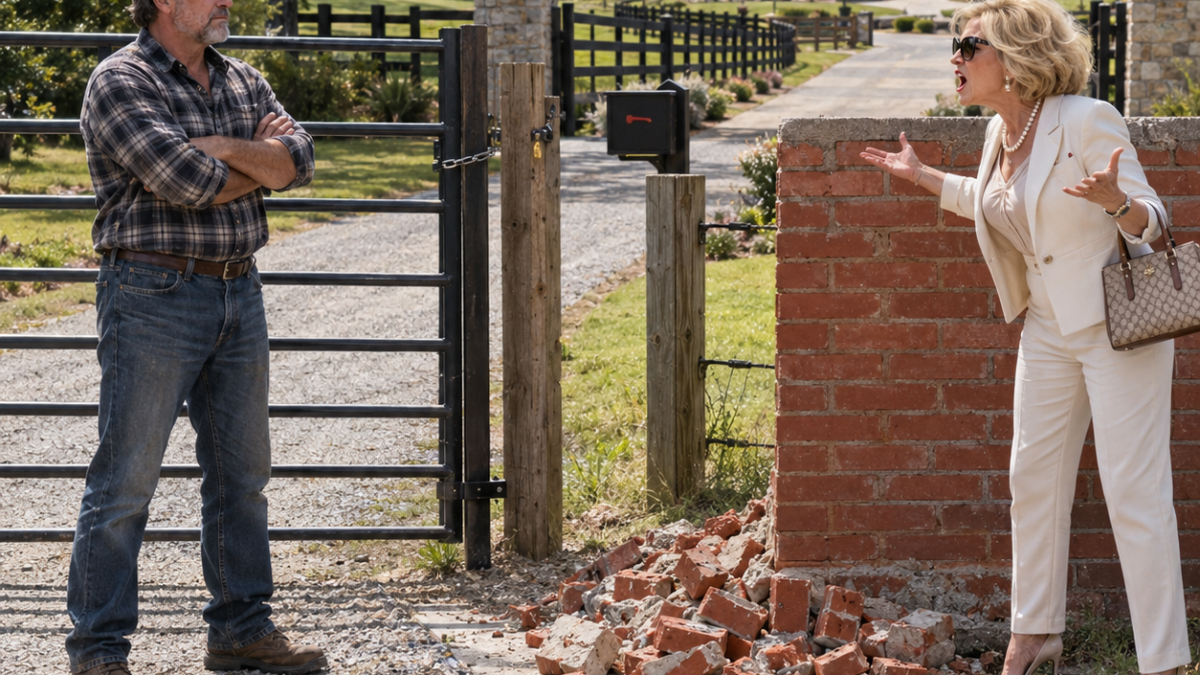
PART 2
I read the paragraph three times.
Not because it was complicated.
Because it was so simple.
Fifteen years earlier, when the developer of Harmony Creek had wanted to build the final phase of the subdivision, he had come to my kitchen personally.
His name was Robert Henderson.
Unlike Karen, Henderson understood the difference between asking and demanding.
He had spread a set of topographic maps across the same oak table where I was now sitting and pointed toward the bluff beyond the eastern edge of my property.
“We want to put twelve estate homes up here,” he had said.
I remembered Linda setting coffee beside him.
I remembered the concern in her eyes when she saw the proposed road.
The bluff was beautiful.
Higher than the rest of Harmony Creek, with mature hardwoods and a distant view of the lake.
It was exactly the kind of land a developer could turn into seven-figure houses.
There was only one problem.
Access.
The practical route to that bluff crossed my property.
Henderson offered to buy a strip of my acreage.
I refused.
I had spent too many years being transferred from post to post while I served. When I finally retired, I wanted one piece of ground that nobody could carve apart.
“I’ll give you twice market value,” Henderson had said.
“It isn’t about value.”
“What is it about?”
“Keeping my land intact.”
He had studied me for a moment, then nodded.
“All right. What if you keep ownership?”
That conversation eventually produced the document now sitting in front of me.
I had granted access across a narrow strip of my land.
The residents of the future estate cul-de-sac could use the paved lane.
Henderson paid me one dollar a year.
Symbolic consideration.
The arrangement gave the future homeowners reliable access without forcing me to sell the underlying property.
But my lawyer at the time had insisted on one protection.
I ran my finger beneath the sentence.
**The easement may be revoked by the grantor for any reason upon ninety days’ written notice to the grantees.**
I leaned back in my chair.
Outside, I could still see the top of Karen’s wall.
The estates had one road.
Estates Lane.
And beneath the asphalt of Estates Lane was my land.
Karen’s mansion sat at the end of that road.
For fifteen years, nobody had caused a problem.
Nobody had needed to.
The people living up there drove quietly through my property, waved if they saw me, and generally behaved like neighbors.
Then Karen moved in.
And now she had built a wall across my recorded lake access while standing on my property and telling me I should learn that Harmony Creek’s rules applied to me.
I closed the folder.
I wasn’t smiling.
Revenge made people stupid.
Anger made them careless.
I didn’t want revenge.
Not yet.
I wanted facts.
So I spent the rest of the afternoon building a file.
Every photograph went into labeled folders.
I scanned the deed.
I scanned the original plat.
I scanned the recorded lake-path right-of-way.
I scanned the easement.
Then I called my old surveyor.
“Jack Caldwell,” I said when he answered.
“Colonel. Been a while.”
“I need you to verify some markers.”
“That usually means somebody built something where they shouldn’t.”
I looked through the window.
“You could say that.”
He came the next morning.
By noon, he had confirmed exactly what I expected.
The western end of Karen’s so-called boundary enhancement crossed onto my property.
Not by inches.
By more than three feet at the widest point.
The wall also obstructed the recorded access corridor leading toward the lake.
My surveyor pulled off his cap.
“Who approved this?”
“The HOA.”
He looked at the wall.
Then at me.
“You’re not in the HOA.”
“Karen has a flexible relationship with details.”
He laughed once.
“I’ll have a certified survey to you tomorrow.”
I thanked him.
Then I began walking through Harmony Creek.
I wanted to know whether Karen’s behavior toward me was isolated.
It wasn’t.
My first stop was Sam and Ruth Goldstein’s house.
They had lived there almost as long as I had lived on my acreage.
Sam was kneeling beside his roses when I approached.
He looked toward the trees where Karen’s wall was visible.
“I was wondering when you’d come asking about that Berlin Wall.”
I smiled.
“Boundary enhancement feature.”
Sam stared at me.
“She actually called it that?”
“Twice.”
He stood slowly, rubbing one knee.
“That woman needs a hobby.”
Then his expression changed.
“You planning to fight her?”
“I’m planning to understand her first.”
Sam nodded toward the porch.
“You better sit down.”
Ruth brought lemonade.
The two of them told me how Karen had ordered them to remove a stone birdbath Ruth’s mother had given her nearly thirty years earlier.
The birdbath wasn’t obscene.
It wasn’t dangerous.
It was a small weathered stone basin with two carved sparrows.
Karen decided it wasn’t on the architectural committee’s approved ornament list.
The Goldsteins received a $200 fine.
Then another $50 every week.
Sam fought at first.
Then Ruth developed heart trouble.
Doctor visits became more important than arguing about landscaping.
They removed the birdbath.
“It’s in the garage,” Ruth said softly. “I couldn’t throw it away.”
Something tightened in my chest.
Karen probably had no idea what that object meant to Ruth.
Worse, she probably never cared enough to ask.
My next conversation was with Maria Lopez.
Maria worked long shifts as a nurse and raised two children by herself.
Karen had spent almost a year fighting with her over the color of her house.
“Beige,” Maria said when I asked what color it was.
“What was wrong with it?”
“Wrong beige.”
I thought she was joking.
She wasn’t.
The previous owner had painted the house.
Karen decided the shade was slightly darker than an approved HOA color.
The dispute generated warnings, hearings, penalties, late fees, and threats.
Eventually Maria borrowed money and paid almost five thousand dollars to repaint the entire house.
“What color?”
She pointed toward it.
“Beige.”
I looked.
It appeared nearly identical to the original beige.
Maria folded her arms.
“I stopped fighting because every letter scared me. They kept adding fees. I worried they’d put a lien on the house.”
“Did Karen ever come speak to you?”
“She came once.”
“What did she say?”
Maria gave a humorless laugh.
“She said rules protect property values.”
Her eyes shifted toward the house.
“I nearly missed two mortgage payments paying to repaint it.”
By the time I left, my anger had changed.
Karen’s wall was no longer just about me.
I had spent enough of my life around institutions to know what happens when people gain authority without accountability.
They begin believing procedure makes cruelty respectable.
My final stop was two houses down from the Goldsteins.
A large American flag moved gently above Dave Rourke’s lawn.
Dave was a retired Marine gunnery sergeant.
His yard looked as though each blade of grass had received written orders.
He was cleaning golf clubs in his garage.
“Colonel,” he said.
“Gunner.”
He nodded toward the wall.
“You here about Fort Karen?”
“That name’s better than hers.”
“What does she call it?”
“Boundary enhancement feature.”
Dave stared at me for two seconds.
Then he laughed so hard he had to set down the golf club.
When he recovered, he pointed toward a folding chair.
“You’re going to need coffee for what I have to tell you.”
His battle with Karen concerned his flagpole.
Twenty feet tall.
Professionally installed.
Illuminated at night.
Karen had ruled that the pole was an unapproved structure.
She demanded its removal.
Dave refused.
She fined him.
He appealed.
She chaired the committee hearing his appeal.
Unsurprisingly, the committee agreed with Karen.
“She told me my attitude was insubordinate,” Dave said.
I raised an eyebrow.
“She used that word?”
“Exactly that word.”
“What did you say?”
“I reminded her she wasn’t my commanding officer.”
I looked at the flag.
“Then?”
“I hired a lawyer.”
Dave disappeared into his house and returned carrying a thick binder.
Tabs divided every letter, fine, photograph, email, meeting notice, and legal response.
I smiled for the first time all day.
“You kept everything.”
He looked offended.
“I’m a Marine.”
“Fair point.”
We spent two hours comparing records.
The pattern became obvious.
Karen rarely targeted clear safety violations.
She targeted resistance.
Anyone who challenged her received extra scrutiny.
Anyone who embarrassed her found another violation in the mailbox.
Anyone who quietly surrendered was left alone until she needed another demonstration of authority.
That was when Dave asked the question that changed the scope of everything.
“What are you going to do about the wall?”
“I haven’t decided.”
“You’re lying.”
I looked at him.
He leaned back.
“You’ve got that expression.”
“What expression?”
“The one officers get when they already know where the artillery goes.”
I laughed.
Then I told him about the old easement.
Not every detail.
Just enough.
His smile disappeared.
“You own Estates Lane?”
“The land underneath it.”
“And the access agreement?”
“Revocable.”
Dave slowly set down his coffee.
“Oh.”
“Exactly.”
He whistled.
“Does she know?”
“I doubt it.”
“What are you waiting for?”
“Verification.”
That was something Karen never understood.
Power is not what you say you can do.
Power is what still works after lawyers, surveyors, judges, and public records inspect it.
The following morning, I drove to the county records office.
For two days, I went through everything I could find.
The original Harmony Creek plat.
HOA incorporation records.
Amendments.
Road dedications.
Parcel maps.
Meeting filings.
Developer agreements.
And there it was.
Estates Lane had never been dedicated to the county.
It was not a municipal road.
It was not county property.
The asphalt crossed my parcel under a private recorded agreement.
The revocation language remained unchanged.
I ordered certified copies.
Then I kept digging.
I found the amendment Karen had cited when she built her wall.
Article Seven.
Section B.
Subsection Four.
The famous boundary enhancement provision.
It had been approved months earlier at a poorly attended HOA board meeting.
The notice appeared technically compliant but almost comically obscure.
The paperwork didn’t prove misconduct.
It proved something more useful.
Karen knew how to use procedural technicalities when they benefited her.
I wondered how she would feel when somebody else did the same thing with a document far stronger than an HOA bylaw.
A county clerk named Brenda helped me locate several additional HOA records.
“You should look at vendor contracts,” she said quietly.
“Why?”
She shrugged.
“Sometimes the money tells the story better than meeting minutes.”
I did.
Harmony Creek had paid substantial sums to one company again and again.
Prestige Outdoor Solutions LLC.
Landscaping.
Retaining walls.
Drainage.
Fencing.
Repairs.
The invoices seemed high.
Some seemed very high.
I wrote down the business information.
At home, I checked the company registration.
Owner: Gerald Pawlowski.
The name bothered me.
I had heard it before.
Then I remembered Karen mentioning a Gerald at a Christmas function.
A little more digging confirmed it.
Gerald was her brother-in-law.
I sat motionless in front of my computer.
The wall was a Prestige Outdoor Solutions job.
Harmony Creek residents had paid Karen’s brother-in-law to build the wall Karen ordered across my access.
That didn’t automatically prove fraud.
Families can legally do business with associations if conflicts are disclosed and procedures are followed.
So I resisted the temptation to turn suspicion into fact.
Instead, I added another tab to my binder.
**Vendor Contracts.**
Then I called an attorney.
Her name was Evelyn Reed.
She had practiced property law for more than twenty years and had served as a JAG officer before entering private practice.
Her office was spare, organized, and almost aggressively free of clutter.
I placed my binder on her desk.
She looked at its thickness.
“You came prepared.”
“I don’t like wasting attorneys’ time.”
“I wish more clients felt that way.”
I gave her the situation in chronological order.
My property.
The recorded lake access.
The wall.
The survey.
The HOA fine.
The road easement.
The vendor relationship.
She asked precise questions and made very few comments.
When I finished, she returned to the easement.
“Show me the revocation provision.”
I did.
She read it once.
Then again.
“Has this been modified?”
“Not according to the county record.”
“Any later permanent easement?”
“No.”
“Any county dedication?”
“No.”
She leaned back.
“Then this is potentially very significant.”
“Potentially?”
“I don’t promise outcomes before I examine title, local law, the full chain of documents, and every relevant fact.”
That answer was exactly why I had hired her.
A person who promises certainty before doing the work is usually selling confidence rather than competence.
She studied the photographs of the wall.
“Did you ask the HOA to remove this before coming here?”
“Verbally.”
“We’ll do it properly.”
Three days later, Karen and every HOA board member received a formal cease-and-desist letter.
It demanded removal of the wall.
It disputed the fine.
It cited my survey and recorded access rights.
It preserved claims for damages.
And near the end, Evelyn included one restrained sentence stating that we were also reviewing possible undisclosed conflicts involving HOA vendors.
No accusations.
No drama.
Just notice.
They had thirty days to respond.
Karen needed seven.
Her email arrived at 6:14 in the morning.
I read it over coffee.
She called our claims baseless.
She called my attorney’s letter intimidation.
She insisted the wall complied with HOA authority.
Then she announced an additional $1,000 penalty against me.
The stated reason was harassment of HOA officials and threatening conduct through legal counsel.
I read that paragraph twice.
Then I forwarded the email to Evelyn.
My message contained five words.
**I believe we have our answer.**
She called twenty minutes later.
“She fined you for hiring me?”
“Apparently.”
There was a pause.
Then Evelyn laughed.
Not loudly.
Just once.
“You understand that people normally become more careful after getting a lawyer’s letter.”
“Karen has never suffered from excessive caution.”
“Do you still want to exercise the easement revocation?”
I looked through the kitchen window toward the wall.
This was the moment.
Until then, everything had been preparation.
Revoking access would affect more than Karen.
Ten households depended on Estates Lane.
Some of those people had never done anything to me.
I understood that.
I also understood that the original agreement gave them ninety days.
Enough time to negotiate.
Enough time to solve the wall dispute.
Enough time to pursue alternatives.
I didn’t want families trapped.
I wanted the people who had benefited from my goodwill to understand that goodwill could not be treated as an entitlement while their association trampled my rights.
“Yes,” I said.
“Then we do it exactly.”
Evelyn drafted the notices.
Each homeowner received one individually.
The HOA received one.
Its registered agent received one.
The letter quoted the easement.
It identified the termination date.
It explained that after ninety days, the legal permission to cross my property would end.
Every copy went by certified mail.
Return receipt requested.
Then we waited.
For about a week, nothing happened.
After that, cars began slowing in front of my house.
Drivers stared.
A few photographed my property.
One man stopped beside my mailbox.
“Are you Caldwell?”
“Yes.”
“You’re closing our road?”
“I’ve served notice terminating the easement.”
“That’s the same thing.”
“Not yet.”
He ran a hand over his face.
“My wife thinks this is a bluff.”
“I recommend she read the document.”
“Karen says you can’t do it.”
“I recommend Karen read the document too.”
He drove away.
Two nights later, Harmony Creek announced an emergency meeting.
Dave and I arrived early and sat in the last row.
The clubhouse filled rapidly.
Most of the estate homeowners were there.
Karen stood behind the podium in a navy blazer, several folders arranged before her like stage props.
Her husband sat near the side wall, looking deeply uncomfortable.
Karen struck the gavel.
“This emergency meeting concerns a malicious attempt by one disgruntled resident to hold part of our community hostage.”
Several people turned toward me.
I remained seated.
Karen lifted my termination notice.
“Mr. Caldwell claims he can unilaterally close Estates Lane.”
Claims.
Interesting word.
“Our legal counsel believes his position is without merit.”
A man in the second row raised his hand.
I knew him by sight.
Peterson.
An attorney who lived near the end of the estate cul-de-sac.
“Karen, have counsel reviewed the original recorded easement?”
“They’ve reviewed the situation.”
“That isn’t what I asked.”
The room became quieter.
Karen frowned.
“Our attorneys are exploring all relevant options.”
“Have they read the easement?”
“I don’t appreciate being interrogated during a board meeting.”
Peterson didn’t sit down.
“I have a copy.”
That changed the atmosphere instantly.
Karen blinked.
“I pulled it from the county records office.”
He turned slightly so the room could hear him.
“The revocation language appears explicit.”
A woman behind him whispered, “What?”
Karen gripped the podium.
“Our attorneys believe we may have acquired prescriptive rights through long-term use.”
Peterson shook his head.
“Long-term use under a written permission agreement is not the same thing as adverse use.”
Karen’s face hardened.
“Are you representing Mr. Caldwell now?”
“No. I’m representing my family by asking whether we can still drive to our house in three months.”
Applause broke out.
Not much.
But enough.
Karen struck the gavel.
“Order!”
I looked at Dave.
He leaned slightly toward me.
“First crack in the dam.”
I said nothing.
We didn’t need to fight Karen in that room.
The document was doing it for us.
The HOA filed for an injunction eleven days later.
They wanted a judge to prevent me from closing Estates Lane.
Evelyn sounded almost cheerful when she called.
“They’ve asked a court to interpret the agreement.”
“Is that good?”
“If the documents are as we understand them, it gives us an opportunity to get judicial clarity before your deadline.”
The hearing came during a brutal July heat wave.
Karen entered the courthouse with two attorneys.
She looked confident.
I had learned by then that confidence was her armor.
It didn’t necessarily mean she believed she was right.
It meant she believed everyone else would be more frightened than she was.
The HOA attorney argued first.
He described severe hardship.
Families unable to reach homes.
Emergency access.
School transportation.
Deliveries.
Property values.
Community reliance.
Some of those concerns were real.
That was why I listened without resentment.
Then he described my conduct as retaliatory and unreasonable.
That part I knew differently.
Evelyn rose when it was our turn.
“Your Honor, before discussing equities, I think the court should begin with the instrument that created the access.”
She handed the judge a certified copy.
The courtroom became silent.
The judge read.
Not hurriedly.
He read the first page, turned it, then studied the second.
Finally, he looked toward the HOA attorney.
“This appears to say the grantor may revoke the easement upon ninety days’ written notice.”
“Yes, Your Honor, but—”
“For any reason.”
“Yes, but we contend—”
“And your clients have used the road pursuant to this written agreement?”
“For approximately fifteen years.”
“So their use began permissively.”
The attorney shifted.
“Yes.”
The judge continued questioning both sides.
He asked about emergency access.
He asked about alternative routes contemplated during development.
He asked whether the road had ever been publicly dedicated.
It had not.
He asked whether I had complied with the notice provision.
Evelyn produced certified-mail receipts.
Then he reviewed the wall dispute.
“That is a separate matter,” he said, “but it certainly provides context for why the parties are here.”
Karen whispered urgently to her lawyer.
The judge noticed.
“Ma’am, please allow counsel to argue.”
Karen stopped.
The HOA requested temporary relief.
The judge denied it.
He did not cheer for me.
He did not insult Karen.
He simply ruled that the HOA had not established grounds at that stage to prevent me from exercising the contractual revocation provision.
Outside the courthouse, Karen caught up to me.
“This isn’t over.”
I turned.
People moved around us on the courthouse steps.
“No,” I said. “It isn’t.”
“You’re hurting innocent families.”
“I gave everyone ninety days.”
“Because of a wall?”
“Because you decided my property rights mattered only when they inconvenienced you.”
Her eyes narrowed.
“You think you’re teaching me a lesson?”
“No, Karen.”
I stepped closer, lowering my voice.
“I think you’re still assuming this is about you.”
I walked away.
The countdown continued.
Sixty-three days.
Then sixty.
Then fifty-eight.
That morning, a Prestige Outdoor Solutions truck turned onto my property.
Gerald Pawlowski climbed out with three men.
They unloaded asphalt bags and tools.
I walked down my driveway recording on my phone.
“Morning.”
Gerald looked at me.
“We’re doing road maintenance.”
“Who authorized you?”
“The HOA.”
“The HOA does not own this property.”
“It’s a community road.”
“A judge reviewed that issue last week.”
He smirked.
“Judge didn’t say we can’t maintain it.”
“I am.”
His men stopped working.
I kept my voice level.
“This is private property. I am directing your company to leave.”
Gerald took several steps toward me.
He was larger than I was and probably thought that mattered.
“You really want to play tough guy with me?”
“No.”
I held up the phone.
“I want a clear record showing that the property owner instructed you to leave.”
His expression changed slightly.
“You threatening me?”
“No. I’m documenting you.”
That sentence bothered him more.
People like Gerald understand arguments.
Documentation makes them nervous.
I had installed private-property signs after the court hearing.
They stood clearly at the boundaries.
Gerald looked at one.
Then at the phone.
Then toward his workers.
“Pack it.”
Before leaving, he spat onto the gravel beside my driveway.
I looked down at it.
Then back at him.
“Have a good morning, Gerald.”
His face turned red.
The truck left.
I saved the video in three separate places.
That night, Dave came over.
He brought beer.
“Could’ve told me Gerald was visiting.”
“You’re not my bodyguard.”
“No, but I would’ve enjoyed watching.”
We sat on my porch.
The wall stood dark between the trees.
“You ever think maybe this has gone far enough?” Dave asked.
I looked at him.
He nodded toward the estates.
“Not because Karen deserves mercy. Because those families are going to pay for what she did too.”
“I think about it every day.”
“What happens on day ninety?”
“If they resolve the underlying problem, maybe it never reaches day ninety.”
“And if they don’t?”
“Then I close my road.”
Dave studied me.
“You mean it.”
“Yes.”
He was quiet for a while.
Then he said, “Good.”
I laughed.
“That was a fast moral struggle.”
“I just wanted to make sure you’d had one.”
During those weeks, another pressure point developed.
A local investigative reporter named Sarah Mitchell had heard about the dispute.
Dave knew someone at the station and had passed along public records.
Sarah called me.
“I’ve seen the wall photographs.”
“Okay.”
“I’ve seen the easement.”
“Public record.”
“I’ve also seen HOA invoices involving Prestige Outdoor Solutions.”
That caught my attention.
“What do you want from me?”
“An interview.”
I hesitated.
I had no interest in becoming television entertainment.
But Karen’s conduct had affected far more people than me.
So I agreed under one condition.
“Stick to documents.”
Sarah laughed.
“That’s usually the safest way to make powerful people angry.”
Her report aired four days later.
It included the wall.
The Goldsteins’ birdbath dispute.
Maria’s repainting expense.
Dave’s flagpole fight.
The recorded road agreement.
And the vendor relationship between Prestige Outdoor Solutions and Karen’s brother-in-law.
Sarah was careful.
She did not call it fraud.
She said residents were questioning whether potential conflicts had been properly disclosed and whether contracts had been competitively priced.
Karen provided a written statement calling the accusations politically motivated.
Politically motivated.
We were an HOA in a suburban development.
Apparently we had become a nation-state.
The report changed everything.
Neighbors who had stayed silent began contacting Dave.
Dozens of them had files.
Violation letters.
Fees.
Denied appeals.
Photographs.
Emails.
Some complaints were minor.
Some were probably legitimate violations.
I had no interest in pretending every person fined by the HOA was automatically a victim.
But a pattern emerged.
Karen exercised discretion aggressively against residents she disliked.
The board rarely challenged her.
Prestige Outdoor Solutions had received substantial work.
And ordinary homeowners had stopped attending meetings because they believed the outcome was predetermined.
The board began fracturing.
One member resigned.
Another sent a community-wide email claiming she had repeatedly objected to Karen’s methods.
Karen responded with an email accusing unnamed people of betrayal.
That one made Dave laugh for almost five minutes.
Forty-one days remained.
Then thirty.
Then twenty.
Still, the wall stood.
One afternoon Peterson came alone.
He parked near my driveway rather than entering Estates Lane.
We spoke beside my mailbox.
“I’m not here as the HOA’s lawyer,” he said.
“You’ve never been the HOA’s lawyer.”
“Just making it clear.”
“All right.”
He looked tired.
“My neighbors are panicking.”
“I know.”
“Karen keeps telling them there will be another court action.”
“Evelyn hasn’t received anything.”
“She says the board will never agree to remove the wall because doing so would admit liability.”
I glanced toward it.
“That sounds expensive.”
Peterson rubbed his jaw.
“What do you actually want?”
“The wall removed.”
“That’s all?”
“No.”
He waited.
“I want the fines against the people Karen targeted reviewed. I want the vendor contracts audited. I want reforms that prevent one president from controlling enforcement and appeals.”
“You’re using our road as leverage to reform the whole HOA.”
“I’m using ownership of my road to stop an association from using my goodwill while ignoring my property rights.”
Peterson looked toward the estates.
“If you close it, people are going to hate you.”
“Some already do.”
“Doesn’t bother you?”
“Of course it bothers me.”
That surprised him.
I continued.
“I know families live up there. I know children live up there. I know people have jobs. I know what this is going to do.”
“Then don’t do it.”
“You’re asking the wrong person.”
His expression hardened.
“How?”
“You have ten estate households with expensive homes and significant voting power. Why are you standing beside my mailbox asking me to surrender a contractual right instead of standing in the boardroom demanding that Karen take down an illegal wall?”
He opened his mouth.
Then stopped.
I waited.
Finally, he nodded.
“That’s fair.”
“Twenty days, Peterson.”
He left.
Seventeen days before termination, the HOA board scheduled another emergency meeting.
This one was uglier.
Karen had lost control of the room before it started.
Residents shouted questions.
Board members whispered among themselves.
Peterson introduced a motion demanding immediate negotiation with me and removal of the wall pending legal review.
Karen ruled the motion out of order.
Three board members overruled her.
She shouted that they couldn’t.
They did.
The motion passed.
For the first time, I felt the whole thing might end without the gates.
Then Karen did something I still struggle to understand.
She claimed the board vote was invalid because the wall had been approved under her authority as chair of the architectural committee.
She refused to authorize payment for demolition.
The board attorney warned her that the issue could expose the association to greater liability.
She refused again.
“I will not let one man blackmail this community.”
I was standing near the back.
Before I could stop myself, I spoke.
“Karen.”
The room quieted.
She pointed at me.
“You are not recognized.”
“I’m not asking to speak to the board.”
“Then leave.”
“I’m speaking to you.”
Her face tightened.
“You have seventeen days.”
A murmur moved through the room.
I continued.
“Take down the wall.”
“No.”
“Then whatever happens on day ninety belongs to the decisions made in this room.”
“You’re threatening us.”
“No.”
I shook my head.
“I’ve been warning you for seventy-three days.”
I walked out.
The wall remained.
Day eighty-nine arrived.
I barely slept.
At four in the morning, I sat at my kitchen table with Linda’s old coffee mug in front of me.
I hadn’t used it since she died.
A small blue flower was painted on one side.
She used to say I could turn mowing the lawn into a military operation.
She would have hated the conflict.
Not because she feared Karen.
Because Linda believed neighbors should always leave one another a path back to decency.
I wondered if I had left one.
Then I thought about Ruth’s birdbath.
Maria’s loan.
Dave’s flagpole.
The wall.
The fines.
The board meetings.
The courtroom.
The crew trespassing after the hearing.
Ninety days had been a path back.
Karen had spent every one of them walking in the opposite direction.
At 6:45 the next morning, I went outside.
A contractor I had hired was already waiting.
At seven, installation began.
Two steel gates.
One at each end of the portion of Estates Lane crossing my property.
Heavy posts.
Concrete footings.
Clear signage.
Emergency services had been contacted in advance through my attorney, and arrangements had been made for emergency access while the broader civil dispute remained unresolved.
I wasn’t going to gamble with somebody’s life to make a point.
By eight-thirty, the gates were closed.
I threaded a chain through the first one.
Dave stood beside me.
He looked unusually serious.
“You sure?”
I thought about Linda again.
Then I locked the padlock.
“Yes.”
We sat on my porch.
The first car appeared eleven minutes later.
A dark BMW.
Peterson.
He stopped.
Got out.
Walked to the gate.
Read the sign.
Then looked toward me.
I raised one hand.
He didn’t wave back.
He pulled out his phone.
Within minutes, another vehicle arrived.
Then another.
A delivery driver stopped, reversed, and left.
Horns began.
Doors opened.
People gathered.
Voices rose.
And then Karen came.
Her white SUV raced down Estates Lane before braking hard near the gate.
The horn blasted.
Long.
Continuous.
She climbed out.
“CALDWELL!”
Dave took a sip of coffee.
“I believe diplomacy has arrived.”
I almost smiled.
Karen grabbed the gate.
“OPEN THIS!”
I stood slowly.
“Good morning.”
“Open the damn gate!”
“Your easement expired at midnight.”
“You cannot trap people in their homes!”
“There are attorneys handling that issue.”
“This is illegal!”
“The court has already reviewed the agreement.”
“I’m calling the police.”
“That’s your right.”
She stared at me.
Then she made the call.
A sheriff’s deputy arrived shortly afterward.
By then, vehicles crowded the road behind Karen.
The deputy walked first to her.
She began talking immediately.
Fast.
Loud.
Pointing at me.
Pointing at the gate.
Pointing toward the estate houses.
The deputy eventually raised a hand.
“Ma’am. I need to speak with the property owner.”
“He’s a criminal!”
The deputy looked toward me.
“Mr. Caldwell?”
I walked down carrying the folder Evelyn had prepared.
“Morning, Deputy.”
“You own this parcel?”
“Yes.”
I handed him the survey, the recorded agreement, proof of termination, and the prior court order.
He read carefully.
Karen interrupted twice.
Both times he told her to wait.
Finally, he handed the documents back.
“This appears to be a civil property matter.”
“Yes, sir.”
He looked at the gate.
“Is it on your parcel?”
“Yes.”
The survey stakes were clearly visible.
He nodded.
Then turned toward Karen.
“Ma’am, based on the documents I’ve been shown, Mr. Caldwell owns the property where the gate is installed. I’m not ordering him to remove it.”
Her mouth fell open.
“You’re siding with him?”
“I’m not siding with anybody. I’m telling you what I can and cannot enforce.”
“We need to get out!”
“You’ll need to address access through counsel and the property owner.”
“This is kidnapping!”
“No, ma’am.”
“I want him arrested.”
“For what?”
She stopped.
The deputy waited.
Karen looked around at the residents behind her.
For perhaps the first time since I had met her, she had no answer ready.
The deputy then instructed everyone to stop blocking the gate area and remain off portions of my property not covered by any remaining lawful access.
Karen’s entire body seemed to vibrate with rage.
“You did this to humiliate me,” she said.
I walked closer to the gate.
“No.”
“Liar.”
“You had ninety days.”
Her eyes flashed.
“You think you won?”
I looked beyond her.
At Peterson.
At the worried homeowners.
At one woman holding a phone to her ear.
At another man arguing with someone inside his car.
Nothing about the scene felt like victory.
“No,” I said quietly. “I think everybody lost because you couldn’t take down one wall.”
That silenced her.
Only for a second.
But I saw it land.
Then a television van appeared near the entrance.
Sarah stepped out.
Karen saw the camera.
That was when she finally left.
She climbed into her SUV, turned around with difficulty, and drove back toward her mansion.
The estate homeowners remained.
Some were furious with me.
I understood.
One man called me vindictive.
Another told me I had destroyed his property value.
A woman asked how her daughter would get to school.
I answered the same way each time.
“Have your attorney contact Ms. Reed. We are available to negotiate immediately.”
That afternoon, the HOA board met without Karen.
By evening, they had removed her as president.
The vote was unanimous.
They also removed her from the board.
When Dave called me with the news, I sat quietly for a moment.
“That fast?”
“Apparently landlocking rich people is an effective way to increase meeting attendance.”
“Dave.”
“What?”
“Those people are our neighbors.”
“Rich neighbors.”
I sighed.
“You’re impossible.”
“So I’ve been told.”
The next morning, three people stood outside my gate.
Peterson.
Another estate homeowner named William Hart.
And a woman named Claire Donovan.
No shouting.
No horns.
No threats.
I walked out.
Peterson spoke first.
“Mr. Caldwell, Karen has been removed.”
“I heard.”
“We owe you an apology.”
I waited.
He glanced at the other two.
“We allowed her to run the association however she wanted because it was easier than getting involved. Most of us didn’t care when she targeted other residents.”
His face tightened.
“Then her decisions affected us.”
Claire looked toward the wall through the trees.
“I’m embarrassed to admit that.”
William nodded.
“So am I.”
Peterson continued.
“We want to resolve this.”
“All right.”
“What will it take to reopen the road?”
I had already discussed that question with Evelyn.
My answer was simple.
“My attorney has terms.”
“Can you tell us what they are?”
“She’ll send them this morning.”
“Are they negotiable?”
“Some details might be. The principles are not.”
He nodded.
“We understand.”
Within an hour, Evelyn delivered the proposal.
First, the wall would be removed completely at HOA expense by a licensed contractor unrelated to Karen or her family.
Second, my fines would be rescinded.
Third, disputed penalties issued during Karen’s administration would be independently reviewed, and improperly imposed charges would be refunded with appropriate interest.
Fourth, the HOA would commission an outside financial audit examining vendor selection, related-party transactions, and reserve expenditures.
Fifth, governance procedures would be reformed.
No HOA president should be able to accuse a resident, dominate enforcement, control the appeal process, and then punish criticism without meaningful review.
Sixth, the association would issue a public written apology to residents whose documented complaints had been mishandled.
Finally, the road.
I would not recreate the old arrangement.
No more revocable handshake-style goodwill.
If access was restored permanently, I wanted the roadway interest transferred or dedicated through proper legal procedures so future residents would never again depend on the personality of one landowner or one HOA president.
The estate homeowners would pay the surveying, filing, engineering, and legal costs necessary to accomplish that.
There would also be compensation for the land interest.
We eventually agreed on fifty thousand dollars.
I had already decided where mine would go.
A veterans’ charity.
When I told Dave, he stared at me.
“You’re giving away fifty grand?”
“I never wanted to make money from the road.”
“Still fifty grand.”
“Linda would haunt me.”
He considered that.
“Fair.”
The board accepted the framework within forty-eight hours.
The wall came down first.
I watched from my porch as a contractor—not Prestige Outdoor Solutions—arrived with demolition equipment.
A worker set a hydraulic breaker against the first section.
The machine hammered.
Gray block cracked.
A piece fell.
Then another.
For almost three months, that wall had looked permanent.
It took less than a day to reduce it to rubble.
That stayed with me.
Bullies depend on the appearance of permanence.
They want every rule, fine, threat, committee decision, and hostile letter to feel immovable.
But sometimes power is only a wall nobody has yet tested.
By sunset, the gravel path reappeared.
I walked toward it.
The ground was scarred.
Grass had been destroyed.
Dust covered everything.
But the path was there.
Ruth Goldstein was standing behind me.
I hadn’t heard her approach.
“Oh,” she whispered.
I turned.
She looked past me toward the lake trail.
“I forgot how pretty that view was.”
I smiled.
“You want to walk down?”
Her eyes filled.
“My knees aren’t what they used to be.”
“We’ll go slow.”
We walked together.
Halfway to the lake, she said, “Sam put my birdbath back yesterday.”
I stopped.
“He did?”
“Right in the same spot.”
“What did the HOA say?”
She smiled.
“Nothing.”
That might have been the most satisfying word I heard all year.
Nothing.
No warning.
No violation letter.
No demand.
No committee citation.
Nothing.
Maria received a refund after the independent review concluded that the handling of her paint dispute had been improper.
When she showed me the check, she laughed and cried at the same time.
“It doesn’t undo what happened.”
“No.”
“But it pays off the loan.”
“That matters.”
She nodded.
“It matters a lot.”
Dave’s flagpole remained exactly where it had always been.
One afternoon, Karen drove past while Dave and I were standing beneath it.
She did not slow down.
Dave watched her SUV disappear.
“You think she still considers me insubordinate?”
“I hope so.”
The forensic audit took longer.
Months.
The findings were more serious than I expected.
The report identified repeated related-party contracting involving Prestige Outdoor Solutions, weaknesses in competitive bidding, inadequate conflict documentation, and expenditures that auditors concluded required further review.
State authorities became involved.
I stayed away from that investigation.
It wasn’t my job to decide guilt.
My fight had always been about the wall and the rights Karen believed she could ignore.
The financial consequences became a matter for auditors, lawyers, regulators, the HOA, and Karen herself.
Eventually, the association recovered a substantial amount of money through settlement and repayment arrangements.
Prestige Outdoor Solutions stopped receiving Harmony Creek contracts.
Karen rarely appeared outside.
Without the presidency, she seemed smaller somehow.
That surprised me.
I had grown accustomed to her entering every room as if trumpets should announce her arrival.
Now she drove straight to her garage.
Closed the door.
Stayed behind the walls of the mansion she had once treated like a royal palace.
And because the permanent road arrangement was still being finalized, she experienced one final irony.
She listed the mansion for sale.
Potential buyers immediately asked about access.
Title attorneys asked questions.
Lenders asked questions.
Nobody wanted uncertainty.
The house sat.
Weeks passed.
Then months.
Karen, who had created this entire fight because she wanted to block my access, could not escape until mine was permanently resolved.
I took no joy in seeing her trapped.
At least, that’s what I told Dave.
He didn’t believe me.
“You smiled when you said her closing got delayed.”
“I had something in my eye.”
“For ten minutes?”
“Persistent irritation.”
He laughed.
Eventually, every requirement was completed.
The revised HOA rules were adopted.
The independent review procedures were established.
Financial controls tightened.
New board members were elected.
Peterson somehow became president despite repeatedly saying he did not want the job.
I teased him about that.
“You know how this happens,” I said.
“No.”
“You demonstrate basic competence in public.”
He groaned.
“Never making that mistake again.”
The permanent access documents were finally ready on a cool October morning.
The county recorded them.
The road would no longer exist because one old retired colonel allowed it.
Its future would not depend on me.
That was important.
I didn’t want the next generation inheriting our fight.
That afternoon, neighbors gathered near the steel gate.
Sarah’s station sent a camera crew.
I would have preferred they didn’t, but public attention had helped force accountability, so I accepted it.
Evelyn handed me a folder.
“Recorded.”
I looked at the stamp.
“You’re sure?”
She gave me a look.
“Jack.”
“Had to ask.”
“No, you didn’t.”
I smiled.
Dave stood nearby.
Ruth and Sam were there.
Maria came straight from work in scrubs.
Peterson and several estate homeowners waited on the other side.
Even the deputy who had responded on closure day stopped by off-duty.
I walked to the gate.
The same padlock hung from the chain.
For months, people had called that lock everything from justice to blackmail.
To me, it had never been either.
It was a boundary.
A painful one.
Sometimes necessary.
I put in the key.
The lock opened.
I removed the chain.
Then I pulled the steel gate back.
Nobody moved for a second.
Finally, Peterson walked toward me.
He extended his hand.
“Thank you.”
I shook it.
“Don’t make me regret it.”
He laughed.
“We rewrote enough bylaws to make regret administratively difficult.”
Cars began using Estates Lane again.
Slowly at first.
Neighbors waved.
One woman rolled down her window.
“Thank you, Mr. Caldwell.”
I nodded.
Maria hugged me.
Ruth cried.
Dave pretended he had dust in his eye.
The local reporter asked whether I felt victorious.
I looked toward the gravel lake path.
“No.”
She seemed surprised.
“You shut down an HOA president, got your path restored, forced reforms, and reopened the road on new terms. Why doesn’t that feel like victory?”
“Because neighbors shouldn’t have to go through this to make one another listen.”
She waited.
I continued.
“A community isn’t healthy when somebody wins every argument. It’s healthy when people know where their authority ends.”
That evening, after everyone left, I walked to the lake alone.
The gravel crunched under my boots.
It was the same sound I remembered from all those years with Linda.
I could almost see her ahead of me.
Summer dress.
Hair moving in the breeze.
Turning around because I was walking too slowly.
I reached the shoreline.
Dave was already there.
He sat on an old bench with two coffees.
“You following me now?” I asked.
“Marine reconnaissance.”
“On my property?”
“Community path now.”
I sat beside him.
For a while, neither of us spoke.
Across the water, the sunset turned the clouds orange.
Eventually Dave said, “It was never really about the wall, was it?”
I shook my head.
“No.”
“The road?”
“No.”
“The money?”
“Definitely not.”
He sipped his coffee.
“Then what?”
I thought about Karen standing beside that wall on the first morning.
Her binder.
Her smile.
The certainty that a title made her untouchable.
Then I thought about Ruth putting her mother’s birdbath back outside.
Maria paying off her loan.
Dave’s flag still flying.
Neighbors attending meetings again.
Board members asking questions.
People reading documents before surrendering to threats.
“It was about permission,” I said.
Dave frowned.
“How?”
“People kept giving Karen permission.”
“To do what?”
“Whatever she wanted.”
I stared across the lake.
“Not legal permission. Human permission. Everybody knew she went too far, but nobody wanted the headache of confronting her. So Sam removed the birdbath. Maria repainted the house. You hired a lawyer. Other people paid fines. Board members stayed quiet. Estate owners didn’t care because she wasn’t bothering them.”
“Until she bothered you.”
“Until she built the wall.”
Dave nodded.
“And you happened to own the road.”
“I happened to own the road.”
He laughed softly.
“Bad target selection.”
“Very.”
A fish broke the surface near the reeds.
Ripples spread outward.
After a moment Dave said, “You ever regret closing it?”
I considered lying.
Then didn’t.
“Every morning it was closed.”
He turned toward me.
“Really?”
“Those families didn’t all deserve it.”
“But you’d do it again.”
“I’d give them every chance first.”
“You did.”
“I know.”
“That wasn’t my question.”
I looked at him.
“Yes.”
He nodded.
“Me too.”
We finished our coffee as the light disappeared.
Three weeks later, Karen’s house finally sold.
The moving truck arrived on a Saturday.
I happened to be trimming branches near my driveway when her white SUV passed for the last time.
It slowed.
The passenger window lowered.
Karen sat behind the wheel.
For a moment, neither of us spoke.
She looked tired.
Not defeated.
Not monstrous.
Just tired.
It would have been easy to say something cruel.
I had imagined plenty of lines during the previous months.
Enjoy your new HOA.
Watch out for walls.
Need directions to the public road?
Dave would have loved any of them.
But standing there, I realized I didn’t need the last word.
Karen did.
“You ruined my life,” she said.
I rested one hand on the branch trimmer.
“No, Karen.”
Her mouth tightened.
I continued quietly.
“You built a wall on somebody else’s land after being asked not to. Then you spent ninety days refusing every opportunity to fix it.”
“You wanted to destroy me.”
“I wanted my path back.”
“You humiliated me.”
“You kept choosing public fights.”
“You took everything.”
“No.”
I shook my head.
“You lost a position on an HOA board. Your house sold. You’re leaving. You still have your family, your future, and whatever you choose to do next.”
Her eyes flickered.
I don’t know whether she expected anger from me.
Maybe anger would have been easier.
“You think you’re better than me?”
“No.”
“Then why are you talking to me like that?”
“Because this is the last time we’ll probably speak.”
She stared ahead through the windshield.
I added one more thing.
“Wherever you go next, Karen, try being somebody’s neighbor before you try being their president.”
Her face changed.
Just slightly.
Then she rolled up the window.
The SUV moved forward.
At the intersection, its turn signal blinked.
Then she disappeared.
Dave came out from behind his hedge almost immediately.
I stared at him.
“How long were you standing there?”
“Long enough.”
“You were spying.”
“Reconnaissance.”
“You have to stop using that word.”
He walked toward me.
“What’d you tell her?”
“Nothing dramatic.”
“Missed opportunity.”
“You wanted me to yell?”
“No.”
He smiled.
“I was hoping for the wall line.”
“What wall line?”
“I had six prepared.”
“Of course you did.”
He followed me toward the porch.
Harmony Creek changed after that.
Not overnight.
And not into some perfect neighborhood where nobody disagreed.
People still complained about lawns.
People still argued about parking.
Someone started a six-week war over whether holiday lights could remain up until February.
Peterson called me one evening and said, “I understand Karen better now.”
I told him to stay strong.
But the difference was that people participated.
Meetings filled.
Minutes were circulated clearly.
Residents asked where money went.
Contracts were compared.
Appeals went before people who had not issued the original violation.
Discretion had explanations attached to it.
And when a homeowner challenged the board, nobody called that insubordination.
One Saturday, Harmony Creek held a community picnic beside the lake.
I almost didn’t go.
Maria threatened to send Dave after me.
That was enough.
Children ran along the restored path.
Someone had set folding tables near the water.
Ruth’s potato salad disappeared immediately.
Dave wore a shirt with a tiny embroidered flag just to provoke whoever still cared.
Peterson stood over a grill looking terrified by hamburgers.
I took over the spatula.
“You negotiate million-dollar contracts for a living.”
“Burgers have less documentation.”
“Move.”
He surrendered.
Later that afternoon, I stood apart from the crowd for a moment.
My grandson came down the path carrying a fishing rod.
“Grandpa!”
I turned.
He ran toward me.
I hadn’t seen him in several months.
He pointed toward the gravel trail.
“Mom said somebody blocked this.”
“Somebody did.”
“What happened?”
“They unblocked it.”
He looked at the road.
“Why?”
I considered giving him the long version.
Instead, I said, “Because grown-ups occasionally need reminders to share.”
He looked suspicious.
“That sounds like something Mom says when I fight with Tyler.”
“Your mother is a wise woman.”
He studied me.
“Did you fight?”
“A little.”
“Did you win?”
That question followed me everywhere.
Reporter.
Neighbors.
Dave.
Now my grandson.
I crouched slightly so we were eye level.
“You know what winning is?”
“Beating the other person.”
“That’s one kind.”
“What’s another?”
“When everybody gets something better than what they had before.”
He thought about it.
“Did that happen?”
I looked around.
Ruth laughing beside her husband.
Maria talking with another nurse.
Dave helping a child untangle a fishing line.
Peterson burning my second batch of hamburgers.
The path open.
The road secure.
The HOA accountable.
Even Karen, wherever she had gone, free of the ridiculous little throne that had seemed to bring out the worst in her.
“Yeah,” I said.
“I think it did.”
My grandson accepted that.
Then he handed me a fishing rod.
“Can we go?”
We walked toward the water.
As we passed the exact place where the wall had once stood, I noticed something beside the path.
Small green shoots.
Native switchgrass.
Growing back through the damaged soil.
I stopped.
My grandson turned around.
“What?”
“Nothing.”
I looked at the grass Karen had once called weeds.
She had fined me five hundred dollars for refusing to remove it.
Construction equipment had crushed it.
Cement dust had covered it.
Workers had trampled it.
For months, the wall had blocked the sun from part of the ground.
And still it had returned.
I smiled.
“Just looking at something.”
He shrugged.
We continued toward the lake.
Behind us, Estates Lane remained open.
Ahead of us, the water caught the afternoon sun.
And the place called Harmony Creek finally felt a little closer to earning its name.
Karen believed authority meant building a wall and daring someone else to challenge it.
I learned something different.
Real strength was knowing exactly where your rights ended, where another person’s began, and being willing to defend that line without becoming the kind of person you were fighting.
I never wanted her mansion.
I never wanted her position.
I never wanted her humiliation.
I wanted the path my wife and I had walked.
I wanted neighbors to stop living in fear of envelopes taped to their doors.
I wanted a board that remembered homeowners were people before they were parcel numbers.
And when Karen refused every reasonable chance to give those things back, I used the one thing she never bothered to check.
The deed beneath her road.
She built the wall because she thought ownership was power.
She learned too late that ownership also comes with boundaries.
And sometimes the most satisfying revenge isn’t destroying the person who tried to push you around.
It’s forcing the system they abused to work properly again—then opening the gate when the job is finished.








