PART 2: HOA Karen Voted to Bulldoze My 190-Year-Old Stone Mill—Then She Learned It Was Already on the National Register
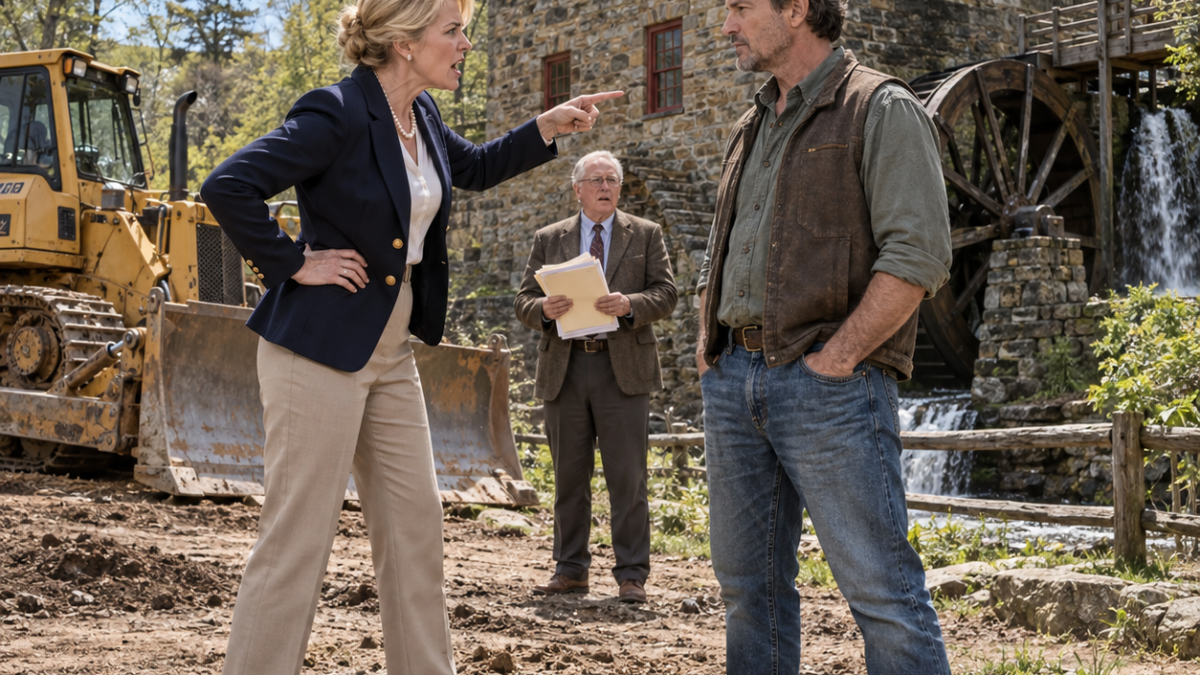
Karen gave me thirty days to bulldoze the stone mill my family had protected for generations, then smiled as if two hundred years of history could be erased with one HOA vote.
She called it an “eyesore,” promised to send demolition equipment onto my five acres if I refused, and began stacking fines against me before anyone on her committee had even stepped inside the building.
What she didn’t know was that a bronze plaque was sitting unopened in my desk drawer, waiting for exactly the moment when her confidence became impossible to take back.
“That pile of rocks is coming down, Mr. Caldwell.”
Karen Miller sat behind the steering wheel of her golf cart at the edge of my driveway, oversized sunglasses pushed high on her nose and a clipboard balanced across her lap.
I looked past her toward the old mill.
Three stories of hand-cut granite stood beside Oak Creek beneath ancient trees, its thick walls silver-gray in the afternoon light.
The Caldwell Mill had been there since the 1830s.
Long before Oak Creek Estates.
Long before Karen.
Long before anyone decided every mailbox, shutter, lawn ornament, and flowerpot in this neighborhood needed somebody’s permission.
My ten-year-old daughter, Sarah, called the mill her castle.
She spent hours inside sketching the giant wooden gears, the worn millstones, and the heavy beams blackened by nearly two centuries of dust and weather.
My wife, Emily, loved the creek behind it.
I loved something harder to explain.
After twenty years in the Army Corps of Engineers, I had spent a good portion of my life building things under pressure and occasionally tearing things down when there was no other choice.
The mill was different.
It had endured.
That mattered to me.
Karen tapped her clipboard.
“The Beautification Committee voted unanimously.”
“Who’s on the committee?”
Her lips tightened.
“That’s irrelevant.”
“It becomes relevant when you’re voting to demolish something on my property.”
“The bylaws are clear. Derelict structures that damage community aesthetics may be removed.”
“My five acres are exempt from architectural oversight.”
“You live inside Oak Creek.”
“The subdivision was built around this parcel.”
“You’re still subject to community standards.”
I almost laughed.
The mill stood more than a hundred yards from the nearest neighboring home and was hidden behind mature oaks from most of the street.
“This isn’t a broken shed beside the clubhouse,” I said. “It’s a historic grist mill.”
Karen gave the stone walls a dismissive glance.
“History does not exempt you from maintenance.”
“It’s maintained.”
“It looks abandoned.”
“It hasn’t operated commercially in more than a century.”
“Exactly.”
“That doesn’t make it derelict.”
Karen smiled.
“You have thirty days to arrange professional removal. If you refuse, the association will contract the demolition itself and assess the cost against your property.”
“And if I tell you no?”
“The first fine is five hundred dollars.”
She leaned forward.
“After that, it becomes expensive.”
I felt something inside me go very still.
It was the same calm that used to settle over me when a job became complicated enough that anger was useless.
“Put it in writing.”
Karen blinked.
“What?”
“The demolition order. The fine. Your claim of jurisdiction. Put every word in writing.”
“You think paperwork frightens me?”
“No.”
I looked at the clipboard in her hand.
“I think paperwork remembers.”
Her smile vanished.
Twenty minutes later, I stood inside my home office holding the formal notice Karen had taped to my front door.
Thirty days.
Five-hundred-dollar initial fine.
Threatened demolition.
I photographed it before removing it.
Then I opened a fresh file.
My property deed went in first.
The HOA exemption clause went behind it.
County maps followed.
And then, from the locked drawer beside my desk, I removed the letter I had received three months earlier from the historic preservation authorities.
The Caldwell Mill had completed a nearly two-year nomination process and had been formally listed on the National Register of Historic Places.
I had never told Karen.
I had barely told anyone.
Beside the letter sat a bronze plaque I had planned to install quietly with Emily and Sarah.
I ran my thumb over the engraved words.
Then I placed it back in the box.
Karen wanted a public fight.
She was going to get one.
Just not on the terms she expected.
PART 2
The first thing Emily asked when I told her about the demolition order was whether we needed a lawyer.
The second thing she asked was whether Karen was actually stupid enough to try it.
The third was whether Sarah knew.
“No,” I said.
Emily folded her arms.
“She was in the mill this afternoon.”
“I know.”
“You know she’s going to notice if we start acting strange.”
“I’m not acting strange.”
“You labeled a folder ‘HOA Project Millstone.’”
I looked toward the file cabinet.
“That’s organization.”
“That’s a declaration of war.”
“She declared it first.”
Emily stared at me for another second, then looked at the letter on the kitchen table.
Thirty days.
The number bothered her.
I could tell.
It bothered me too, though not because I believed Karen could legally destroy the mill.
Deadlines create pressure even when the person setting them has no right to do so.
That was why Karen loved deadlines.
Forty-eight hours.
Ten days.
Thirty days.
Immediate correction.
Final warning.
She understood that most people did not have time to spend their lives fighting an HOA.
People had jobs.
Children.
Mortgages.
Aging parents.
Illness.
One ugly letter could ruin an evening.
Five letters could ruin a month.
Eventually people gave in simply to make the noise stop.
Karen had built her authority on exhaustion.
I intended to make exhaustion work in the other direction.
I carried my file into the home office.
The room overlooked the back five acres.
From my desk, I could see the upper section of the mill through the trees.
The waterwheel had been removed decades before I bought the property, but the channel where water once fed it was still visible.
The stone foundation sat partly into the creek bank.
The walls were almost three feet thick at the base.
The mill had survived flooding, neglect, storms, and one fire in the 1890s.
It was not going to lose to a woman in a golf cart.
My property had a strange history.
The original Caldwell family—no direct relation to me despite sharing the surname, something I found mildly eerie when we bought the land—had established the mill around 1835.
Farmers once came from miles away with corn and wheat.
At its peak, the place had been the center of the valley.
Then railroads changed everything.
Larger mills opened.
The Caldwell Mill declined.
By the early twentieth century, it had stopped commercial operations.
The surrounding farmland changed hands several times.
By the 1980s, developers were buying everything they could.
Oak Creek Estates went up around the old homestead.
One original parcel remained.
Five acres.
House.
Creek.
Mill.
When the HOA was created, the parcel was specifically exempted from most architectural controls because of the preexisting historic structures and land-use conditions.
That exemption was in my deed.
It was also referenced in the HOA’s founding documents.
Karen knew.
I knew she knew because this was not our first disagreement.
The first came four days after we moved in.
Grass.
She measured a patch near my mailbox and informed me it exceeded the preferred height.
I showed her the exemption.
She left.
Then mailbox color.
Same result.
Then my Ford F-250.
She tried calling it an unauthorized commercial vehicle because I used it for civil engineering consulting work.
Again I showed her the exemption.
She retreated.
Each time, the argument should have taught her where her authority ended.
Instead, it taught her something else.
She hated boundaries she could not control.
The mill was the biggest boundary of all.
There was another reason she disliked it.
People loved it.
Children stopped on walks and stared through the trees.
Older residents remembered when the area was farmland.
Local photographers occasionally asked permission to take pictures.
Sarah’s classmates called it the castle.
Karen called it “inconsistent with the visual language of the community.”
The first time she said that, Emily asked whether Karen had swallowed an interior design magazine.
I had laughed.
That was before the demolition order.
Now I read every page of the governing documents again.
The language Karen cited said the HOA could act against derelict, unsafe, or aesthetically incompatible structures “within the community.”
But elsewhere, the recorded founding declaration specifically excluded my parcel from architectural review.
The conflict was not subtle.
My next move was simple.
Force Karen to document her interpretation.
I wrote a formal response requesting:
The minutes from the Beautification Committee meeting.
Names of members present.
The specific legal authority allowing demolition on an exempt parcel.
Any structural report supporting her claim that the mill was unsafe.
Any appraisal supporting the claim that the mill negatively affected surrounding property values.
Any opinion from HOA counsel supporting demolition.
I attached my deed.
The exemption clause.
County parcel map.
I did not mention the National Register.
Then I sent the packet certified mail.
Emily watched me place the green receipt into the folder.
“You enjoy this part.”
“No.”
“You absolutely enjoy this part.”
“I enjoy records.”
“You enjoy being able to prove people received records.”
“That too.”
Two days later, Karen drove by slowly.
Didn’t stop.
Didn’t wave.
Her sunglasses were pointed directly at our house.
Sarah was beside me helping clear ivy away from the old mill race.
“Why does Mrs. Miller hate us?”
The question caught me off guard.
“She doesn’t hate us.”
“She hates the mill.”
“She doesn’t understand it.”
“That’s different?”
“Yes.”
Sarah thought.
“Can somebody destroy something because they don’t understand it?”
Not the question I wanted from a ten-year-old.
“They shouldn’t.”
“But can they?”
“Sometimes people try.”
Sarah ran her hand across one of the granite blocks.
The surface had been worn soft in places by almost two centuries of weather.
“I don’t want them to.”
“Neither do I.”
She looked up.
“You won’t let them?”
I wanted to promise.
I had learned enough in the Army to dislike promises based on things outside my control.
Instead I said:
“I’m going to do everything I can.”
She nodded.
Apparently that was enough.
The fines started a week later.
One thousand dollars for continued noncompliance.
Then one hundred dollars per day.
Karen sent a neighborhood-wide email.
The subject line read:
**IMPORTANT BEAUTIFICATION UPDATE**
It described “an abandoned stone structure” that posed a threat to neighborhood aesthetics and property values.
My name was not included.
The address was.
That was enough.
She wrote that the board had “repeatedly attempted to work cooperatively with the owner.”
False.
She said I had refused “reasonable improvement proposals.”
Also false.
She implied neighbors had complained.
Maybe they had.
More likely Karen had.
The social effect was immediate.
A woman who used to wave when jogging past our house stopped.
Mr. Henderson, our elderly neighbor, suddenly became fascinated by his flower bed whenever I walked outside.
Someone drove past one evening and shouted:
“Clean up your property!”
Sarah heard it.
Emily found her crying in her bedroom.
That was when the fight stopped being interesting.
I can tolerate somebody coming after me.
Watching a child absorb adult hostility is different.
Emily came into my office after Sarah went to sleep.
“This is hurting her.”
“I know.”
“Then end it.”
“I’m trying.”
“No.”
She closed the door.
“I mean end it.”
She knew about the National Register process because she had lived through it with me.
Two years of research.
Historical consultants.
Archaeological review.
Photographs.
Maps.
Architectural descriptions.
State review.
Nomination board.
Correspondence.
More correspondence.
Then the final letter.
She knew Karen’s demolition dream was about to run into something much larger than the HOA.
“Tell everyone,” Emily said.
“Not yet.”
“Why?”
“Because she can still retreat.”
Emily stared at me.
“You want her to keep going.”
“Yes.”
“Why?”
“Because if we stop only the mill issue, she moves on.”
“To someone else.”
“Yes.”
Emily walked to the window.
The mill stood in moonlight.
“I hate that this is becoming bigger.”
“So do I.”
“No, you don’t.”
I looked at her.
“You get that engineer look.”
“What look?”
“The one where you stop seeing a problem and start seeing a system.”
She was right.
Karen was not simply wrong about the mill.
She represented a governance system that had trained decent people to stay quiet.
I had begun hearing stories.
Maria Alvarez brought lasagna one afternoon.
She stood in our driveway whispering like Karen had installed microphones in the oak trees.
“My children love the mill.”
“Thank you.”
“They call it the castle.”
“So does Sarah.”
Maria smiled.
Then looked toward the street.
“She came after us last year.”
“Karen?”
“Our swing set.”
“What about it?”
“Blue.”
I thought she was joking.
She wasn’t.
“Apparently blue isn’t an approved earth tone.”
“What did you do?”
“Painted it beige.”
The humiliation in her voice was obvious.
“It was easier.”
That phrase again.
Easier.
A thousand tiny surrenders.
After Maria left, I called David Chen.
David and I had met more than twenty years earlier at Fort Leonard Wood.
He eventually left the Army, used the GI Bill, and became an attorney.
Veterans.
Property.
Administrative law.
He had a reputation for being calm until calm stopped being useful.
I explained everything.
He asked one question twice.
“She threatened demolition in writing?”
“Yes.”
“Not just a fine?”
“Demolition.”
“And she has your exemption documents?”
“Signed receipt.”
David laughed.
I waited.
“What?”
“This woman is very generous.”
“With what?”
“Evidence.”
I told him about the National Register listing.
He stopped laughing.
“When?”
“Three months ago.”
“Final listing?”
“Yes.”
“State historical office confirmation?”
“Yes.”
“Any local preservation overlays or recorded preservation restrictions from the nomination or grant process?”
“We have the state review package, and the county historic-resource file recognizes it.”
“Good.”
He became quiet.
“Do not tell Karen yet.”
Emily, who was listening on speaker, raised both hands in disbelief.
“Why does every man in this story want to make this longer?”
David heard her.
“Because, Emily, if she’s given an opportunity to retract before she commits publicly, she later claims misunderstanding.”
“And?”
“If she signs a demolition contract after receiving notice that Jack disputes jurisdiction and after ignoring his deed, then the record looks different.”
Emily sighed.
“You two deserve each other.”
David continued.
“Jack, start looking at the HOA itself.”
“I already am.”
“Financials?”
“Not yet.”
“Do it.”
So I did.
I requested five years of records.
Budgets.
Bank statements.
Contracts.
Minutes.
Legal invoices.
Vendor payments.
The law required access within a defined period.
Karen responded:
**These records are extensive. The board will address your request as volunteer schedules permit.**
Then reminded me my mill fines had reached $3,200.
I forwarded her email to David.
His reply:
**Keep it.**
While Karen stalled, I called Dr. Alistair Finch.
Professor emeritus.
Local historian.
The man who had turned my interest in the mill into a full National Register nomination.
Alistair was seventy-four and permanently offended by historical ignorance.
When I told him the HOA wanted to demolish the mill, there was silence.
Then:
“Who?”
“HOA president.”
“On what basis?”
“She thinks it’s ugly.”
Another silence.
Longer.
Finally:
“Jack, I have spent forty-three years trying to persuade people that this county possessed a history before strip malls.”
“I know.”
“And this woman wishes to destroy an 1830s grist mill because it is not sufficiently suburban?”
“That’s the short version.”
His voice rose.
“The masonry alone is extraordinary!”
“I know.”
“The surviving gearing—”
“I know.”
“The wheel pit—”
“Alistair.”
“I am furious.”
“I called because I suspected that.”
He volunteered immediately.
Expert letter.
Public testimony.
Historical commission contacts.
Newspaper contacts.
He was ready to march on Karen’s house with a lecture on nineteenth-century agricultural infrastructure.
I convinced him not to.
For now.
Our first real breakthrough came from former residents.
Maria quietly connected me with two families who had moved away.
One had endured thousands of dollars in fines over a basketball hoop.
The second had been targeted over a backyard vegetable garden.
Selective enforcement.
Escalating fines.
Threats.
Legal letters.
The same pattern.
David joined the calls.
Afterward he said:
“This isn’t just ugly anymore.”
“What does that mean?”
“We may have a broader fiduciary-duty case.”
“Against Karen?”
“Against the association depending on what records show.”
Then he added:
“And if there’s money misconduct, this gets worse.”
There was.
But we didn’t know that yet.
Karen’s next letter arrived on expensive stationery.
Her tone had changed.
Not softer.
More official.
The board had “affirmed its intent” to remove the mill.
She claimed community-wide authority.
She accused me of intimidation through “irrelevant historical claims.”
I stared at that phrase.
Irrelevant historical claims.
Regarding a historic mill.
I almost admired it.
David sent a cease-and-desist.
Ten pages.
My exemption.
Applicable property law.
Bad-faith enforcement.
Demand to rescind fines.
Demand to halt demolition.
Warning of personal exposure if directors knowingly acted outside authority.
Then a records-demand letter.
Forty-eight-hour final deadline.
Karen signed for both.
Nothing changed.
Then the email arrived.
**DEMOLITION APPROVED**
The board had selected Gus’s Demolition and Hauling.
Date:
Three weeks away.
Contract approved.
Karen ended with:
**We appreciate residents’ patience as we finalize the beautification of Oak Creek Estates.**
I read the message twice.
Emily found me smiling.
“That look again.”
“She signed a demolition contract.”
“She’s actually doing it?”
“Yes.”
“Then tell her.”
“Not her.”
I looked up the contractor.
Gus answered.
His voice sounded like gravel.
“Gus’s.”
“My name is Jack Caldwell.”
“Okay.”
“I own 112 Oak Creek Lane.”
Pause.
“The mill?”
“Yes.”
Another pause.
“What about it?”
“I understand the HOA hired you to demolish it.”
“That’s correct.”
“Did they tell you I consented?”
“No. Said board enforcement.”
“Did they tell you my parcel is exempt from architectural control?”
Nothing.
“Did they tell you the mill dates to the 1830s?”
“She said old ruin.”
“Did they tell you it has been formally listed on the National Register of Historic Places and is documented with state and county preservation authorities?”
Silence.
Long silence.
Finally:
“Come again?”
I gave him the registration information.
Then explained that David could provide the applicable preservation documentation and recorded property restrictions relevant to the site.
“I’m not threatening you, Gus.”
“That’s comforting.”
“I’m telling you before you move a machine onto my land.”
More silence.
“You got paperwork?”
“Yes.”
“Send it.”
I emailed everything.
National Register confirmation.
County records.
My deed.
David’s legal notice.
Photographs.
Gus called back forty-seven minutes later.
“My lawyer says we’re out.”
“Good.”
“He also said several words I’m not repeating.”
“I can imagine.”
“I had no idea.”
“I believe you.”
“Karen told us the HOA owned enforcement rights.”
“It doesn’t.”
“I’m sending termination letters to the whole board.”
“Thank you.”
“We’re not touching that thing.”
The first domino.
Karen’s community email three days later claimed Gus had failed to meet Oak Creek’s “professional quality expectations.”
Emily read it aloud.
Then looked at me.
“She fired him?”
“He quit.”
“Does she know we know?”
“Yes.”
“Does she know we know she knows?”
I stared.
“Marriage has changed you.”
“She deserves it.”
Karen called three other demolition contractors.
Every one declined after seeing the records.
That information came from Tom Bennett.
HOA treasurer.
He called me at 9:40 one evening from an unknown number.
“Mr. Caldwell?”
“Yes.”
“Tom Bennett.”
I knew the name.
Quiet man.
Rarely spoke.
“What can I do for you?”
“I’m on the board.”
“I know.”
“I need to tell you something.”
His voice was barely above a whisper.
“Karen lied to us.”
“About what?”
“The National Register.”
“She only learned recently.”
“No.”
I went still.
“What do you mean?”
“She received a notice months ago.”
I sat down.
Apparently the state historic preservation office had sent informational notice to several local entities during the final listing process, including county offices and the HOA address because the subdivision surrounded the parcel.
Karen had seen it.
Tom continued.
“She said it didn’t matter because the HOA still had authority.”
That changed the picture.
She had not merely discovered the listing after hiring Gus.
She may have known historic recognition was pending or final and pushed anyway.
Then Tom said:
“There’s more.”
“What?”
“Money.”
He told me about the landscaping contracts.
Consulting.
Karen’s brother-in-law.
Repeated payments.
No competitive bids.
Reserve funds.
Missing authorizations.
“I’m treasurer.”
“How did this happen?”
“I signed what she presented.”
“You didn’t review?”
“I trusted her.”
His voice broke.
“I know how that sounds.”
I said nothing.
“I started checking after Gus quit.”
“And?”
“Some payments don’t match board approvals.”
“How much?”
“More than fifty thousand to one company alone.”
“Owned by family?”
“Yes.”
“Do you have records?”
“Yes.”
“Talk to David Chen.”
“Your attorney?”
“Yes.”
“Will he protect me?”
“He’ll tell you what he can and can’t do. Get your own counsel too.”
Tom agreed.
The next day David received copies.
Bank records.
Invoices.
Vendor contracts.
Checks signed by Karen.
Meeting minutes with no corresponding approval.
One company connected to her brother-in-law.
The financial issue turned the story from absurd to serious.
David became very careful.
“No public accusations yet.”
“Why?”
“Because suspicious records are not convictions.”
“Understood.”
“We verify.”
He brought in a forensic accountant.
Numbers were checked.
Company ownership confirmed.
Payments cross-referenced.
Services compared.
Enough irregularities existed to warrant formal investigation.
Meanwhile, Karen kept sending fines.
That was the remarkable thing.
Her world was beginning to collapse and she was still mailing me hundred-dollar daily penalties over a mill she had no authority to touch.
It was like standing in a burning kitchen complaining about someone’s shoes.
Dr. Finch finally got his moment.
He called Jessica Riley, a regional newspaper reporter.
She came to the house with a photographer.
I almost refused.
I did not want Sarah in newspapers.
Did not want our house becoming entertainment.
David convinced me.
“Public records matter. Public accountability can matter too.”
We set ground rules.
No photographs of Sarah without permission.
No publishing private family details.
Focus on property and governance.
Jessica spent two hours at our table.
I gave her documents.
Karen’s notices.
My exemption.
Certified receipts.
National Register letter.
Gus’s termination.
She interviewed Dr. Finch separately.
Then Tom, anonymously at first.
The photographer walked around the mill near sunset.
When I saw the images later, even I was stunned.
The mill did not look like a ruin.
It looked monumental.
Stone walls glowing gold.
Dark windows.
Creek water reflecting beneath the trees.
Sarah sitting on a distant rock with her sketchbook, almost too small to notice.
Jessica went to Karen for comment.
Karen slammed the door.
Sunday front page.
**VETERAN FIGHTS HOA PLAN TO DEMOLISH HISTORIC CALDWELL MILL**
The article did not call Karen a criminal.
Good journalism rarely gives you the emotional words you want.
It gave facts.
Property exemption.
Historic listing.
Demolition contract.
Escalating fines.
Records dispute.
Vendor concerns.
Karen’s refusal to comment.
The public did the rest.
Phones exploded.
Local TV.
Preservation groups.
Former residents.
Oak Creek homeowners.
The state historic preservation office issued a statement confirming the mill’s listing and warning that demolition or alteration could implicate preservation review, applicable recorded protections, and other state or local requirements.
The county confirmed there was no demolition permit.
That alone made every contractor disappear.
Karen’s narrative collapsed.
For weeks she had told people:
Ugly ruin.
Uncooperative homeowner.
Simple enforcement.
Now television cameras showed a nearly two-hundred-year-old grist mill listed in the National Register.
People felt deceived.
Mr. Henderson came to my door.
Hat in hand.
Literally.
“I owe you an apology.”
“You don’t.”
“I avoided you.”
“I noticed.”
He looked embarrassed.
“I believed her emails.”
“Lots of people did.”
“I should’ve asked.”
“Yes.”
He nodded.
No defensiveness.
That mattered.
“I’d like to help.”
“With what?”
“The mill.”
I smiled.
“First help with the neighborhood.”
He did.
The emergency town hall was Karen’s last attempt.
She scheduled it herself.
The email blamed “misinformation.”
She called me disgruntled.
Claimed historic status had been “weaponized.”
Claimed the board had acted responsibly based on information available at the time.
Tom read that and almost laughed.
“She had the notice.”
“Do you have proof?”
He did.
Email metadata.
Karen had forwarded the preservation notice to another board member months earlier with the comment:
**More historic bureaucracy. It does not change HOA standards.**
David printed it.
The clubhouse filled beyond capacity.
Residents lined walls.
News cameras stood in back.
Jessica sat front row.
Dr. Finch arrived in a tweed jacket despite ninety-degree weather.
Twelve members of my VFW post came together.
That almost broke me.
I had not asked them.
One of them, Earl, squeezed my shoulder.
“You don’t have to ask.”
Karen stood at the podium.
For fifteen minutes she attacked.
She showed moss on stone.
Peeling window paint.
A cracked wooden sill.
Called the mill unsafe.
Called me deceptive.
Said I had hidden information.
Technically true.
I had not told her directly about the final listing.
But she had received notice independently.
Then she made the mistake I needed.
“This board has acted in good faith from the beginning.”
Tom closed his eyes.
When she finished, I stood.
No shouting.
No insults.
Projector.
First slide.
My deed.
Exemption clause.
Second.
Her certified receipt after I challenged authority.
Third.
Her reply dismissing my claim.
Fourth.
County mill documentation.
Fifth.
National Register certificate.
Gasps.
I let them look.
Then the email.
Karen’s message acknowledging the historic bureaucracy before demolition was approved.
The room changed.
Karen’s face changed too.
“You knew,” someone shouted.
Another:
“She knew!”
Karen grabbed the microphone.
“I knew there was an application—”
The email date proved otherwise.
David spoke from the wall.
“The final confirmation predates the demolition contract.”
Karen looked toward Tom.
He stared at the table.
Then stood.
This was the moment.
Not mine.
His.
“I’m the treasurer.”
Everyone quieted.
Tom carried a folder to the front.
“For years, I signed financial documents because Karen told me they were routine.”
Karen whispered:
“Tom.”
He kept going.
“That was irresponsible.”
“Tom, sit down.”
“No.”
There it was.
That word again.
No.
The word Karen could never tolerate.
“I reviewed the books after the demolition contractor withdrew.”
Tom’s hands shook visibly.
“I found payments I cannot reconcile with board approvals.”
Karen lunged verbally.
“This has nothing to do with the mill.”
Tom looked at her.
“It has everything to do with whether people should trust us.”
He projected vendor payments.
More than fifty thousand dollars to a consulting company connected to Karen’s brother-in-law.
No proper bidding.
Missing approvals.
Repeated checks.
Karen tried to interrupt.
Residents shouted her down.
Then Dr. Finch stood.
He did not need a microphone.
His academic voice carried naturally.
“For those who have been told that the Caldwell Mill is worthless, I would like to clarify what you nearly lost.”
He described the mill.
1830s.
Regional agricultural economy.
Original masonry.
Surviving milling machinery.
Rare construction techniques.
Cultural landscape.
Then he looked at Karen.
“To call this structure an eyesore is not merely subjective bad taste.”
Laughter.
“It is evidence that the people making preservation decisions possessed no meaningful understanding of the resource before them.”
Karen’s face became crimson.
I almost felt sorry for her.
Almost.
The final slide showed the demolition contract.
Signed.
Approved.
Date.
Contractor.
Then Gus’s cancellation citing the mill’s protected historic status and legal risk.
I turned toward the residents.
“This was never about whether you personally like the mill.”
Silence.
“It was about whether five people sitting at a table could decide they had authority they did not possess.”
I looked toward Karen.
“It was about whether the board would stop when shown documents proving its limits.”
Then toward Tom’s spreadsheets.
“And now it’s about whether this community trusts the people handling its money.”
I stepped away.
No grand speech.
No threat.
Facts were enough.
Maria stood.
The same Maria who once whispered in my driveway because she was afraid of Karen.
Her hands trembled.
Her voice didn’t.
“I move for an immediate vote of no confidence in Karen Miller as president.”
Somebody in back shouted:
“Second!”
The room erupted.
Not uncontrolled chaos.
Release.
People who had spent years whispering were finally speaking in normal voices.
Board members panicked.
One demanded legal counsel.
Another asked for recess.
Karen refused.
She still believed staying at the microphone meant staying in power.
The bylaws allowed removal.
David confirmed procedure.
The vote happened.
Overwhelming.
Karen lost.
Cameras recorded everything.
She gathered her purse and clipboard.
Someone asked if she wanted to respond.
She didn’t.
She pushed through the aisle.
A TV cameraman stepped aside.
The clubhouse door closed behind her.
That was the end of Karen’s presidency.
Not her consequences.
But her power.
Tom remained long enough to turn over records and cooperate with the investigation, then resigned as treasurer.
“I failed.”
He told me that privately.
“You came forward.”
“Late.”
“Yes.”
He looked at me.
“You’re not going to tell me that makes everything okay?”
“No.”
He nodded.
“Good.”
People do not need fake absolution.
They need a path forward.
Maria became interim president.
Her first motion:
Rescind every fine against my property.
Passed.
Second:
Formally acknowledge the mill’s exempt and historic status.
Passed.
Third:
Issue written apology.
Passed.
Fourth:
Independent forensic audit.
Passed.
Fifth:
Freeze nonessential vendor payments until review.
Passed.
Karen’s financial problems became real quickly.
The audit confirmed substantial self-dealing and misuse of association funds.
Contracts to relatives.
Questionable consulting fees.
Improper expenditures.
Records turned over to authorities.
Karen and her brother-in-law eventually faced charges.
The criminal case moved slowly.
Longer than television audiences would tolerate.
Subpoenas.
Interviews.
Motions.
Audits.
Eventually convictions followed on fraud-related charges.
Karen served time under the outcome described in the original account, not for “hating a mill,” but for financial misconduct tied to her abuse of the HOA.
That distinction mattered.
I did not want history rewritten in my favor any more than I wanted Karen rewriting it against me.
She lost the presidency because residents rejected her governance.
She faced criminal consequences because evidence established financial wrongdoing.
The mill remained because her claimed authority to demolish it collapsed under property records, historic documentation, preservation restrictions, and public scrutiny.
Different problems.
Different remedies.
That was how institutions were supposed to work.
The civil claims came next.
Families Karen had harassed came forward.
Some had moved.
Some had paid questionable fines.
Some wanted nothing except an apology.
The HOA insurer participated in settlements.
Then increased premiums dramatically.
The new board learned quickly that bad leadership leaves bills behind long after the leader disappears.
Maria hated telling residents dues would rise temporarily.
At the meeting, she stood at the same podium Karen used.
No theatrics.
“The truth is that we have liabilities.”
People listened.
“We also have deferred maintenance and legal expenses.”
A man shouted:
“Why should we pay for Karen?”
Maria nodded.
“Fair question.”
She did not attack him.
“We shouldn’t have had to.”
Then she projected the numbers.
Every dollar.
Every expected cost.
Every recovery.
Every settlement reserve.
“This is what happened.”
She looked around.
“This is what it costs.”
Then:
“And this is what we change so it doesn’t happen again.”
The special assessment passed.
Reluctantly.
That was governance.
Not making people happy.
Making reality visible enough that people could decide responsibly.
Tom helped the forensic accountants until their work ended.
Then left Oak Creek.
Before moving, he came to see me.
The mill was being stabilized.
Scaffolding lined one wall.
Historic mason crew repointing mortar.
Tom stood looking up.
“I never came back here.”
“To the mill?”
“No.”
“Why?”
“Embarrassed.”
“Of what?”
“I voted for demolition.”
“Yes.”
“You really don’t make forgiveness easy.”
“I forgive you.”
He looked at me.
“But?”
“But I’m not going to pretend you didn’t vote.”
He nodded slowly.
“That’s fair.”
He touched one granite block.
“How old?”
“Nearly two hundred years.”
“We almost destroyed this.”
“Yes.”
Tom looked sick.
I softened.
“You stopped.”
“Late.”
“Late is still before the bulldozer.”
That made him smile.
“Thanks.”
He left a month later.
Sent a Christmas card every year.
Never joined another HOA board.
Smart man.
Dr. Finch helped secure a preservation grant.
Not enormous.
Enough for roof repairs.
Masonry stabilization.
Window restoration.
Drainage improvements.
We did not transform the mill.
That was important to me.
No gift shop.
No ticket booth.
No fake waterwheel installed for tourists.
We preserved what remained.
Stabilized.
Protected.
Documented.
Once a year, during the county heritage weekend, we opened it to small guided groups.
Sarah became the unofficial junior guide.
She grew older.
Stopped calling it her castle.
Started calling it “the mill” like a serious historian.
At twelve, she corrected a visitor who said the stones were stacked randomly.
“They’re dressed granite.”
I looked at Emily.
“Dr. Finch has infected her.”
“Too late.”
Sarah began drawing the machinery more precisely.
The great gears.
Shafts.
Millstones.
Channels.
She wanted to know how everything worked.
Not just what it looked like.
One afternoon she asked:
“Dad, why did you want to be an engineer?”
I laughed.
“My father wanted me to be a dentist.”
“That’s not an answer.”
“I liked bridges.”
“Why?”
“Because a bridge solves a problem you can see.”
She looked toward the mill.
“This solved a problem too.”
“Yes.”
“Food.”
“Yes.”
“So engineers built it?”
“Craftsmen. Millwrights. Stonemasons. People who understood forces even if they didn’t use the same equations we do.”
Sarah touched one timber.
“They were smart.”
“Very.”
That became the heart of my attachment.
Not nostalgia.
Respect.
People with fewer tools than we had built something that endured almost two centuries.
My Army career had taught me how temporary human plans could be.
Bases went up.
Missions ended.
Bridges washed out.
Governments changed priorities.
The mill simply stood.
That first year after Karen, Oak Creek changed socially.
People talked.
Not online only.
Actually talked.
Mr. Henderson stopped avoiding me.
He volunteered every Saturday during restoration.
Retired accountant.
Terrible with tools.
Excellent at scraping old paint.
Maria organized a community garden.
Karen would have hated it.
Vegetables in visible raised beds.
Children painted signs.
Bright colors.
Not beige.
A little boy painted one sign purple.
Nobody fined him.
The first harvest produced too many zucchini, because community gardens always produce too many zucchini.
Mrs. Henderson—no relation to Mr. Henderson—left bags on doorsteps.
Emily banned zucchini bread after August.
The neighborhood began to feel human.
Maria’s leadership style was almost aggressively unremarkable.
Meetings began on time.
Ended early.
Financial statements posted.
Committees rotated.
No president automatically chaired architectural review.
Major contracts required multiple bids.
Conflict disclosures.
Records requests tracked publicly.
Fines capped.
Appeals independent.
Power divided.
Karen’s greatest legacy, ironically, was teaching Oak Creek exactly what not to build.
Years later, Maria told me:
“I used to think good leadership meant making the right decision.”
“And now?”
“Building a system that survives when the wrong person makes one.”
That was smarter than anything I had learned in officer school.
The mill’s bronze plaque went up one year after the town hall.
I had waited.
Some part of me wanted the moment to feel private again.
We held a picnic on the creek bank.
Nothing formal.
Neighbors brought folding chairs.
Kids ran everywhere.
The VFW guys grilled hamburgers.
Dr. Finch gave a speech anyway because stopping Dr. Finch from giving a speech required more authority than anyone possessed.
He talked about mills as centers of early communities.
Farmers once came there not only to grind grain.
They exchanged news.
Helped one another.
Built relationships.
Then he looked around.
“Perhaps,” he said, “this building has performed that function one more time.”
I had not thought of it that way.
The mill nearly got destroyed.
Instead it brought the neighborhood together.
History repeating itself in a strange form.
Sarah installed the plaque with me.
Two screws.
Bronze.
Simple.
**CALDWELL MILL**
**CIRCA 1835**
**NATIONAL REGISTER OF HISTORIC PLACES**
She stepped back.
“Crooked.”
“It is not.”
“It’s crooked.”
I checked.
One-sixteenth low on the right.
“You’re impossible.”
“Engineer’s daughter.”
Emily laughed.
We fixed it.
A newspaper photographer captured the moment.
That photo became my favorite.
Not because of the plaque.
Because Sarah was looking at me like she had won an argument.
She had.
Karen’s house went on the market during the criminal proceedings.
The first asking price was unrealistic.
Then reduced.
Then reduced again.
Eventually sold.
The new family had two teenagers and a Labrador that escaped weekly.
Their first architectural request was for a backyard pergola.
Maria approved it.
Second request:
Dark green shutters.
Approved.
Third:
A small free-library box by the sidewalk.
Approved.
Somebody joked Karen could feel it from wherever she lived.
I laughed.
Then felt guilty.
Not because Karen deserved sympathy for what she did.
Because permanent hatred is another kind of control.
For months, I had thought about her constantly.
What would she do?
What did she file?
What did she say?
What was our next move?
After she was gone, I realized I did not want her occupying that much space in my head forever.
So I stopped following updates unless David called.
Stopped reading online comments.
Stopped searching her name.
When the conviction came, I read the court summary.
Then closed the file.
Emily noticed.
“That’s it?”
“That’s it.”
“You waited years.”
“For accountability.”
“You don’t want to celebrate?”
I looked toward the mill.
“Let’s take Sarah for ice cream.”
That was our celebration.
Three cones.
Sarah got chocolate on her shirt.
Emily laughed.
Normal life.
The most underrated victory.
Time moved.
Sarah became a teenager.
Then college.
Architecture.
Not engineering.
I pretended to be disappointed.
She specialized in historic preservation and adaptive reuse.
Dr. Finch claimed credit.
I disputed that.
Her senior thesis included the Caldwell Mill.
Of course.
She interviewed me like I was a primary source.
“Dad, when did you first understand the conflict wasn’t about aesthetics?”
“Immediately.”
She stared.
“What?”
“That sounds self-serving.”
“You’re my daughter.”
“I’m an academic.”
“God help us.”
She asked again.
I thought seriously.
“The meeting.”
“Which?”
“The first board meeting. When I showed Karen the records.”
“Why?”
“Because if it had been about aesthetics, evidence would have changed the discussion.”
Sarah wrote that down.
“When evidence didn’t matter…”
“I knew the objective was obedience.”
She stopped writing.
“That’s good.”
“I charge consulting rates.”
“You paid my tuition.”
“Fair.”
Her thesis argued that preservation disputes often become proxy conflicts over ownership, identity, development pressure, and local power.
I read it twice.
Proud beyond words.
Did not tell her how many times.
Emily did.
Betrayal remains central to marriage.
Dr. Finch died at eighty-three.
His memorial was held at the university.
Students.
Professors.
Preservationists.
Family.
Sarah spoke.
She told the story of an angry retired historian who treated her childhood castle as if it were a cathedral.
People laughed.
Then she said:
“He taught me that buildings are not valuable merely because they are old. They are valuable when they help us remember who we were, understand who we are, and choose what we want to carry forward.”
I had to look at the floor.
Afterward, Finch’s daughter gave me a folder.
Inside were copies of letters he had written during the mill fight.
One to the preservation office.
One to the newspaper.
One to David.
One unsent draft addressed to Karen.
That one began:
**Madam, your aesthetic judgment is exceeded only by your historical ignorance.**
I laughed until I cried.
He never sent it.
Probably wise.
I framed the first sentence in my office.
Not all historical documents deserve public display.
Oak Creek eventually installed a walking path near the creek on HOA-owned land.
It stopped well before my property.
No boundary disputes.
Maria made sure.
The path included a small interpretive panel explaining the area’s milling history.
The mill could be seen through trees from one point.
Visitors learned the site was private.
Most respected that.
A few did not.
Humanity remains imperfect.
One afternoon, a man climbed my fence to photograph inside.
I caught him.
“Private property.”
“But it’s on the National Register.”
“Yes.”
“So the public owns it?”
“No.”
He looked disappointed.
That misconception came up often.
Historic recognition did not mean strangers got to walk into my yard.
Preservation did not erase ownership.
That distinction reminded me of Karen in reverse.
She thought community interest gave her unlimited authority.
Some visitors thought national recognition gave them access.
Both mistakes came from the same place.
Caring about something does not mean owning it.
Important lesson.
I grew older.
Retired from consulting.
The mill required less work after restoration.
Routine inspection.
Drainage.
Mortar monitoring.
Roof.
Pest control.
Every few years Sarah came home and inspected it more aggressively than the professionals.
“Dad, this lintel needs attention.”
“Inspector said it’s stable.”
“I disagree.”
“You’re an architect.”
“Exactly.”
“Architects draw pretty pictures. Engineers decide if they stand.”
She threatened to put me in assisted living.
Family traditions continued.
Emily and I spent more time on the creek bank.
One evening she asked:
“Do you ever regret buying this place?”
“Never.”
“Not even during Karen?”
I considered.
“No.”
“Really?”
“If we hadn’t bought it, someone else would’ve had to fight.”
“Maybe they would’ve sold.”
That thought bothered me.
Not because sale was inherently bad.
Because Karen would have interpreted surrender as confirmation.
Her system might have continued for years.
Another family.
Another target.
Another ridiculous violation.
Sometimes one conflict exposes a weakness everyone has learned to ignore.
That does not make conflict noble.
It makes the response important.
We sat quietly.
Then Emily said:
“I hated you a little during the first month.”
“What?”
“You were enjoying strategy too much.”
“I was not.”
“You absolutely were.”
“Documentation is satisfying.”
“You made a corkboard map.”
“Useful.”
“With red lines.”
“Boundary visualization.”
“You wrote ‘PHASE 1 — RECON’ on a sticky note.”
I had forgotten that.
“You kept that?”
“For evidence.”
She was laughing now.
Good.
Years later, when my knees began giving me trouble, I walked less frequently to the mill.
Sarah installed a bench halfway.
I objected.
She ignored me.
“Accessibility,” she said.
“I’m fine.”
“Sit.”
I sat.
She had inherited Emily’s command voice.
From the bench, you could see the west wall through the trees.
The stones looked nearly black after rain.
One afternoon, my grandson Ethan sat beside me.
He was eight.
Sarah had two children.
Ethan loved machines.
His younger sister loved bugs.
We walked into the mill together.
He stared at the great gears.
“Does it work?”
“No.”
“Can we make it work?”
“Maybe some parts.”
“Why don’t we?”
“Preservation sometimes means not forcing old things to do jobs they no longer need to do.”
He frowned.
That was too abstract.
“The wood could break.”
“Oh.”
Better.
He pointed to a millstone.
“How heavy?”
“Very.”
“Could I lift it?”
“No.”
“What if I get strong?”
“No.”
He considered this a personal challenge.
Children improve stories by refusing symbolism.
The bronze plaque had weathered.
I polished it occasionally.
Not obsessively.
Okay, somewhat obsessively.
One day Ethan asked who Karen was.
I nearly dropped the cloth.
“What?”
“Mom said a lady wanted to knock this down.”
I looked at Sarah.
She was across the creek pretending not to listen.
“Karen was the HOA president.”
“Why did she want to knock it down?”
“She thought it was ugly.”
Ethan stared at the mill.
“She was wrong.”
“Reasonable conclusion.”
“Did you beat her?”
I paused.
Kids love winners and losers.
“She lost an election.”
“Because of you?”
“Because a lot of people stopped trusting her.”
“Did you fight?”
“With paperwork.”
He looked deeply disappointed.
“That’s boring.”
“It worked.”
He kicked a pebble.
“Did the police come?”
“Later.”
Now he was interested.
“Did she go to jail?”
“For money crimes.”
His eyes widened.
Sarah shouted:
“Dad!”
“What?”
“He’s eight!”
“You told him the story.”
“Not the felony part!”
Ethan was thrilled.
I lost storytelling privileges temporarily.
The mill survived another major storm when I was seventy-two.
Oak Creek flooded higher than I had ever seen.
For twelve hours, water pounded the old race.
Trees fell.
A section of newer retaining wall downstream failed.
The mill stood.
Water entered the lower floor.
We cleaned mud for days.
Neighbors arrived without being asked.
Buckets.
Pumps.
Generators.
Food.
Maria, older now, brought coffee.
Mr. Henderson’s son came because his father had died years earlier but had apparently told him:
“If that mill ever floods, help Jack.”
I stood inside the muddy ground floor watching thirty neighbors work.
Once, some of their parents had been afraid to wave at me because Karen sent an email.
Now their children were shoveling silt from a building that belonged to one family but somehow mattered to everyone.
That was community.
Not authority over one another.
Responsibility toward one another.
Sarah photographed the flood damage for the preservation office.
Later she said:
“The wall moved less than a quarter inch.”
“Good masonry.”
“Built without modern engineering.”
“Don’t sound so happy.”
“I enjoy when history humbles engineers.”
“Get out.”
She smiled.
The repairs took months.
No arguments.
No HOA fight.
Grant support.
Volunteers.
Professionals.
Permits.
Boring competence.
Beautiful.
Maria eventually retired from the board.
Her replacement was Leo Garcia.
Maria’s son.
The kid whose blue swing set had once been forced beige.
He was thirty by then.
A physical therapist.
He ran for HOA president because he believed boards should be boring.
His campaign slogan, unofficially:
**NO DRAMA. POST THE BUDGET.**
Won easily.
At his first meeting, he called me.
“Mr. Caldwell?”
“You’re thirty. Stop calling me mister.”
“Jack.”
“Better.”
“I need advice.”
“Resign.”
He laughed.
“Seriously.”
“So am I.”
He asked how to handle a dispute between two homeowners over a hedge.
I told him:
“Read the covenant.”
“I did.”
“Talk to both.”
“I will.”
“If the rule is unclear, don’t pretend it isn’t.”
Silence.
“That’s it?”
“Yes.”
“You made this sound harder when I was a kid.”
“That’s because Karen was involved.”
He laughed.
Leo became a good president.
Not famous.
No newspaper stories.
No lawsuits.
The highest compliment leadership can earn.
When the mill’s bicentennial approached, Sarah wanted an event.
I resisted.
She won.
By then I was old enough that resistance was mostly ceremonial.
Historians came.
Neighbors.
Former VFW members’ families.
County officials.
Preservation professionals.
Children.
We displayed old photographs.
Mill receipts from the 1800s.
Maps.
The original nomination packet.
One case displayed the HOA demolition notice.
That surprised me.
“Why is that here?”
Sarah looked at me.
“It’s part of the history.”
“I hate that.”
“History doesn’t care.”
Dr. Finch would have been proud.
Beside Karen’s notice sat Gus’s termination letter.
Then the newspaper front page.
Then the new board apology.
Visitors lingered there.
People love conflict.
But Sarah arranged the exhibit so the final object was not about Karen.
It was one of her childhood sketches.
Ten years old.
Crayon and pencil.
The mill drawn as a castle.
Above it, in childish handwriting:
**MY FAVORITE PLACE**
I stood in front of it longer than anything else.
Emily came beside me.
“You okay?”
“No.”
“Good.”
She took my arm.
Sarah had understood something I hadn’t.
The mill mattered before Karen.
It mattered after Karen.
The fight was an interruption, not its identity.
Too often, conflict becomes the story because conflict is loud.
But life is everything on either side.
The farmers who used the mill.
The craftsmen who built it.
Sarah drawing gears.
Dr. Finch arguing about stonework.
Neighbors cleaning flood mud.
Ethan asking impossible questions.
Emily sitting by the creek.
Those were the mill’s real history.
Karen deserved one display case.
Not the building.
Not the whole story.
That evening, after the bicentennial crowd left, I walked to the creek.
Slowly.
My cane annoyed me.
The mill rose beside the water.
Lights installed discreetly for the event cast a warm glow across the granite.
Sarah came up behind me.
“Beautiful.”
“Yes.”
“You know what Karen said?”
“I remember.”
“Pile of rocks.”
I smiled.
“People are allowed to have bad opinions.”
“She almost demolished it.”
“Different issue.”
Sarah sat on the bench.
I joined her.
For a while, we listened to the water.
Then she asked:
“Dad, what would you have done if the mill hadn’t been listed?”
Good question.
I thought.
“Still fought.”
“Because of the deed exemption?”
“Yes.”
“What if you lost?”
“I don’t know.”
That was honest.
“You always sound like you knew you’d win.”
“Stories sound cleaner afterward.”
Sarah nodded.
“I remember Mom being scared.”
“I was too.”
She looked surprised.
“You never acted scared.”
“Parenting is partly controlled deception.”
She laughed.
Then I said:
“Courage isn’t knowing the ending.”
Sarah turned toward me.
“It’s deciding what deserves your effort before you know the ending.”
She was quiet.
“That’s going in a lecture.”
“Royalty fee.”
“You’re expensive.”
I looked up at the mill.
“Historic.”
She laughed.
Emily died before me.
Cancer.
Quick enough to feel unfair.
Slow enough to say goodbye.
During her last months, we spent many mornings by the creek.
She had never loved the mill the way I did.
Her attachment was to what happened around it.
Sarah.
Picnics.
Neighbors.
Restoration days.
Coffee.
Arguments.
Life.
One morning she said:
“You know what I’m glad about?”
“What?”
“You didn’t turn it into a tourist attraction.”
“That’s romantic.”
“I’m serious.”
She leaned against me.
“It still belongs to our life.”
That stayed with me.
After she died, the mill became harder to visit for a while.
Every place held a memory.
Grief makes geography dangerous.
Eventually Ethan dragged me back.
He was fourteen then.
Needed help with a school project.
“What project?”
“Local history.”
“Your mother put you up to this.”
“No.”
“She absolutely did.”
We spent three hours inside.
He recorded me explaining the mill.
Halfway through, he asked about the HOA fight.
I told him the full version.
Not the legend.
Not Karen the cartoon tyrant.
The real sequence.
Exemption.
Fines.
Propaganda.
Records.
National Register.
Gus.
Tom.
Money.
Newspaper.
Town hall.
Vote.
Investigation.
Repair.
When I finished, Ethan asked:
“So Karen was just evil?”
I surprised myself.
“No.”
He frowned.
“But she did all that.”
“Yes.”
“Then?”
“People become dangerous when they start believing their goals justify whatever they do.”
He waited.
“Karen probably told herself she was protecting Oak Creek.”
“But she stole money.”
“Yes.”
“Then she knew that was wrong.”
“I imagine she did.”
“So evil.”
I smiled.
“You want the simple version.”
“I’m fourteen.”
“Fair.”
I looked around the old mill.
“Call what she did wrong. Don’t spend too much time deciding what she was.”
“Why?”
“Because labels make it easy to think only monsters do bad things.”
Ethan stopped recording.
“That’s depressing.”
“History usually is if you pay attention.”
He turned the recorder on again.
That school project won first prize.
He gave me no credit.
Family tradition.
Near the end of my life, the original Karen file still sat in my office.
A thick binder.
Every fine.
Every certified receipt.
Photos.
Emails.
Board minutes.
Gus’s letter.
National Register certificate copy.
Press clippings.
Audit summaries.
I thought about throwing it away.
Didn’t.
Sarah eventually asked why.
“For records.”
“Everything is digitized.”
“Paper survives.”
“The mill survived two hundred years. Your Epson printouts are not beating it.”
Fair.
The last time I read Karen’s first notice, I noticed something I had forgotten.
At the bottom:
**FAILURE TO COMPLY MAY RESULT IN ASSOCIATION DEMOLITION AT OWNER EXPENSE.**
Thirty days.
She wrote it with absolute confidence.
That line once kept Emily awake.
Made Sarah cry.
Made neighbors avoid us.
Now it was just ink.
Authority can feel enormous while you are under it.
Later you see how fragile it was.
Karen’s power depended on assumptions.
That people would not read deeds.
Would not request records.
Would not compare stories.
Would not call contractors.
Would not contact historians.
Would not ask where money went.
Would not stand together.
Fear filled every gap left by silence.
Once people started talking, the structure failed quickly.
Faster than the mill ever had.
There was poetry in that.
Karen called the mill unstable.
Her power was the unstable structure.
The mill had foundations.
Her authority had habits.
The mill had stone.
Her authority had fear.
The mill could withstand storms.
Her authority could not survive questions.
One autumn evening, decades after the golf-cart confrontation, I sat outside with Sarah.
She was in her fifties.
I was ancient.
Ethan had children.
The mill stood exactly where it always had.
Sarah held Karen’s old demolition notice.
“I found this in your desk.”
“You were snooping.”
“I was organizing.”
“Same crime with better branding.”
She smiled.
“Do you want this buried with you?”
“No.”
“Good.”
She folded it.
“What should I do with it?”
“Keep the first page.”
“Why?”
I looked toward the mill.
“So when people tell the story, they remember something.”
“What?”
“She put it in writing.”
Sarah waited.
“People think strength is shouting louder.”
I shook my head.
“Sometimes strength is asking the other person to write down exactly what they think they have the right to do.”
Sarah looked at the notice.
“Paperwork remembers.”
I smiled.
“You remember that?”
“You said it all the time.”
“Good line.”
“Annoying line.”
She tucked the paper back into the binder.
We watched the creek.
The bronze plaque caught the evening light.
For most of my career, I thought engineers were people who built structures.
Bridges.
Roads.
Foundations.
Drainage systems.
But age taught me a broader definition.
We build systems too.
Processes.
Checks.
Boundaries.
Sometimes the most important structure you create is not physical.
Oak Creek became stronger because of the controls added after Karen.
Independent committees.
Transparent budgets.
Competitive contracts.
Appeals.
Records.
No single president able to act alone.
Those things were invisible.
They mattered as much as stone.
Karen taught us that accidentally.
Her reign collapsed because it had no redundancy.
No oversight.
No load distribution.
Everything depended on one person.
Bad engineering.
The mill survived because its builders understood load.
Each wall carried part.
Arches transferred pressure.
Timbers distributed force.
Foundations spread weight.
Oak Creek eventually learned the same principle.
No one person should carry—and therefore control—everything.
Years passed.
The mill remained.
People changed.
Boards changed.
Rules changed.
Names changed.
The National Register plaque weathered.
We replaced its mounting hardware once.
Not the plaque.
One afternoon, one of my great-grandchildren ran her fingers over the letters.
“Was this always here?”
“No.”
“Who put it up?”
“Your grandmother Sarah and I.”
She stared at the date.
“1835.”
“Approximately.”
“That’s older than you.”
“Barely.”
She laughed.
“Mom says a mean lady wanted to smash it.”
I sighed.
The legend survived.
“She wanted it removed.”
“Why?”
“She didn’t understand it.”
My great-granddaughter looked up at the enormous stone wall.
“Did you explain?”
“I tried.”
“She still wanted to?”
“Yes.”
“Then what happened?”
I considered all possible answers.
Lawyers.
Historic listing.
Demolition contractor.
Financial records.
Newspaper.
Vote.
Criminal case.
Community reform.
Instead, I said:
“Enough people finally looked at the facts.”
She nodded as if that made perfect sense.
Maybe it did.
She ran off toward the creek.
I rested my hand on the stone.
Cold.
Rough.
Permanent by human standards.
Not actually permanent.
Nothing is.
Mortar fails.
Timber rots.
Water wins eventually.
Preservation is not freezing time.
It is choosing to care repeatedly.
That was another lesson Karen never understood.
She thought protecting property values meant forcing everything into one aesthetic forever.
Real stewardship is different.
You inspect.
Repair.
Adapt.
Respect.
Know what deserves preservation and what deserves change.
Karen’s system needed demolition.
The mill needed maintenance.
We eventually figured out which was which.
The final picnic I attended beside the mill felt nothing like the first one.
I was too old to help set tables.
Sarah did everything.
Ethan grilled.
Kids ran.
Leo, now gray-haired himself, represented the HOA board.
No one wore a clipboard.
I appreciated that.
Someone placed a chair for me near the plaque.
People came by.
Talked.
Asked questions.
A young couple had just moved into Oak Creek.
They had heard the story.
The husband asked:
“Are you the guy who beat the HOA?”
I shook my head.
“No.”
He looked confused.
“But this is your mill.”
“Yes.”
“And Karen—”
“People beat the bad system.”
He nodded uncertainly.
Maybe not the answer he wanted.
But it was the one I had come to believe.
I protected my property.
David used law.
Tom exposed records.
Maria organized neighbors.
Dr. Finch gave history a voice.
Jessica made information public.
Gus refused to participate.
Residents voted.
Authorities investigated money.
The new board rebuilt governance.
No single hero.
That is how durable things are built.
The old mill taught us that too.
Stone by stone.
Beam by beam.
Person by person.
As evening settled, Sarah sat beside me.
She held two paper cups.
Lemonade.
“Remember Karen’s golf cart?”
“Unfortunately.”
“She looked so confident.”
“Yes.”
“You were scared?”
“Yes.”
She smiled.
“You never admitted that back then.”
“You never asked correctly.”
She leaned her head against my shoulder.
Children’s laughter echoed off the stone walls.
Water moved through Oak Creek.
The mill’s old windows reflected sunset.
I thought about the first day.
Karen saying:
**That pile of rocks is an eyesore.**
Thirty days.
Demolition.
Five-hundred-dollar fine.
Absolute certainty.
Then I thought about everything that came after.
Gus refusing the contract.
Tom’s late-night phone call.
Dr. Finch’s fury.
The newspaper headline.
The National Register certificate glowing on the projector screen.
Maria standing up.
Hundreds of homeowners voting.
The restoration.
The flood.
Sarah’s thesis.
Ethan’s school project.
Generations of children touching the same stones.
Karen had wanted the mill gone because she believed it did not fit Oak Creek.
In the end, Oak Creek changed to fit the truth.
The mill had been there first.
It did not need the subdivision’s permission to exist.
History rarely does.
And maybe that was what frightened Karen most.
The mill was evidence of a world she did not control.
A reminder that her rules were recent.
Her title temporary.
Her authority limited.
The stones had seen owners come and go before.
They would see more.
Her thirty-day deadline disappeared.
The mill remained.
Her fines disappeared.
The mill remained.
Her board disappeared.
The mill remained.
Her reputation collapsed.
The mill remained.
Years later, even anger disappeared.
The mill remained.
That was the ending I eventually came to love.
Not Karen losing.
Something worth saving lasting long enough that her attempt to destroy it became a footnote.
She voted to bulldoze my stone mill.
She thought five raised hands could erase almost two centuries of work.
Instead, those five hands started a chain of events that exposed her finances, shattered her control, awakened an entire neighborhood, and turned the building she called an eyesore into the place where that community finally learned how much its own history—and its own voice—was worth.
The plaque still stands beside the entrance.
The creek still moves behind the wall.
Children still call the mill a castle.
And whenever somebody asks me what finally defeated Karen, I never say the National Register certificate.
I never say the newspaper.
I never say the lawsuit.
Those things mattered.
But Karen’s real defeat began the moment people stopped accepting her confidence as proof of her authority.
She had a clipboard.
We had records.
She had threats.
We had patience.
She had a vote.
We had the truth.
And in the end, the strongest structure in Oak Creek was not Karen’s HOA.
It was the one she wanted to tear down.








