PART 2: HOA Karen Used My Garage as Her Free Warehouse—Then Fined Me for Her Own Mess, So I Emptied It Overnight
PART 2
I didn’t call Constance immediately.
That surprised even me.
Ten years earlier, I would have.
Twenty years earlier, I would’ve been at her front door before my coffee cooled.
But thirty years in the trades teaches you the difference between anger and leverage.
Anger feels good for five minutes.
Documentation can still be useful five months later.
So I put down the coffee.
Went inside.
Got my phone.
Then I started taking pictures.
Not dramatic ones.
Useful ones.
Wide shot of the garage.
Seventeen boxes.
Elliptical.
Clothes rack.
Rolled rug.
Tool chest partially blocked.
My Ranger’s empty parking space occupied by her things.
Close-up of every label.
Every scratch.
Every dent.
The cracked plastic on the elliptical handle.
The tape already peeling from two cardboard boxes.
The frayed end of the rug.
I photographed everything in the condition I had received it.
Then I screenshotted the two messages I had sent months earlier.
**Hey Constance, any idea when you’ll be ready to pick this stuff up? Starting to get tight in here.**
Read.
No response.
Then the second.
**Checking in again. I need the garage space back soon. Please let me know your timeline.**
Read.
No response.
I photographed the violation notice beside that second message.
Then I found the blue notebook.
Walgreens.
Eighty-nine cents.
Spiral bound.
Nothing special.
Sat at my kitchen table and wrote:
**CONSTANCE / GARAGE TIMELINE**
Then the dates.
Cookie tray Sunday.
Moving van Monday.
Seventeen boxes.
Elliptical.
Clothes rack.
Rug.
Month one.
First text.
Month four.
Second text.
Month five.
Started parking Ranger at Hank’s.
Sixty dollars.
Month six.
Sixty.
Month seven.
Sixty.
Month eight.
Sixty.
Then:
**HOA fine – $150 – signed by Constance Whitfield.**
I stared at the number.
Four hundred eighty dollars in outside parking.
One hundred fifty dollars in a fine.
Six hundred thirty dollars in direct costs.
And eight months of storage.
Free.
I underlined six hundred thirty.
Then I made one more entry.
**She fined me for the condition her property created.**
That sentence changed the whole thing in my head.
Until then, I’d thought I had been inconvenienced.
Now I realized I’d been used.
I typed a one-page letter.
Kept it polite.
Constance,
The property currently occupying my garage was placed there at your request approximately eight months ago under an understanding that the storage would last two to three weeks.
Because that property remains in my garage, I have incurred vehicle storage expenses and have now received an HOA violation relating directly to the condition created by your belongings.
Please arrange removal within fourteen days.
I am also requesting reimbursement of the $150 HOA fine and documented vehicle-storage costs.
Thank you.
Derek Callaway.
No insults.
No threats.
No:
**Come get your garbage before I launch it into orbit.**
Just dates.
Request.
Deadline.
I hand-delivered it.
Constance’s response arrived two hours later.
Not to me.
To the entire HOA board.
I was copied.
**Board Members,**
**I regret to advise that homeowner Derek Callaway has become increasingly hostile and uncooperative regarding a verbal community arrangement previously extended as a courtesy between neighbors. His behavior has become disruptive and may require formal board intervention.**
Disruptive.
She used the word twice.
Nothing about eight months.
Nothing about the money.
Nothing about her signed violation.
Nothing about my unanswered messages.
Nothing about seventeen boxes.
I printed the email.
Blue notebook.
Date.
Time.
Then I looked through my kitchen window toward Constance’s house.
Ron Whitfield stood in his backyard trimming roses.
Forty degrees outside.
Heavy jacket.
Gloves.
Pruning shears.
Focused on those roses with the peaceful determination of a man who had found the one part of life nobody else was allowed to manage.
I respected Ron.
He looked up once.
Saw me.
Raised two fingers.
I did the same.
Neither of us mentioned his wife.
The next HOA meeting was circled on my calendar.
I’d lived in Maple Crest Estates eleven years.
Never attended one.
That changed Wednesday night.
The community center smelled exactly how community centers always smell.
Burnt coffee.
Old carpet.
Cleaning fluid.
Fifteen homeowners scattered through folding chairs.
Five board members at a long table.
Constance in the middle.
Linen blazer.
Gary Ostrouski sat at the far end.
Sixty-seven.
Retired electrician.
Hands big enough to crush a breaker box.
Gary had a reputation for voting against Constance just often enough to annoy her but not often enough to change anything.
He noticed me.
Small nod.
Constance did not look at me.
Treasurer’s report.
Pool maintenance.
Landscaping contract.
Mailbox repair.
Then public comments.
I stood.
I had one sheet.
“I’m Derek Callaway, 184 South Maple.”
Constance kept looking at her agenda.
“Eight months ago, HOA President Constance Whitfield asked to store several personal items temporarily in my garage for approximately two to three weeks.”
Her eyes came up.
I continued.
“Seventeen boxes, one exercise machine, one rug, one clothes rack and related items remain there today.”
No one moved.
“The property has displaced my vehicle for five months, resulting in four hundred eighty dollars of documented off-site parking expenses.”
Someone in the audience turned toward Constance.
“Last week, I received a one-hundred-fifty-dollar HOA fine for garage aesthetics.”
Now Gary leaned forward.
“The violation was signed by President Whitfield.”
Silence.
“The condition cited in the violation is caused by President Whitfield’s property.”
Three seconds.
Maybe four.
Long enough to hear the coffee maker drip.
I continued.
“I have given Ms. Whitfield fourteen days to remove the property and requested reimbursement of my direct costs.”
I placed copies on the board table.
“I would like the record to reflect this statement.”
Then sat down.
Gary looked at the paper.
Then slowly looked at Constance.
Not angry.
That was what made it better.
He looked like a man who had just watched a chess piece move exactly where he’d been waiting for it.
Constance smiled.
“Thank you, Derek, for bringing your concerns to the board.”
Concerns.
“We’ll review the matter internally.”
Then:
“Next item.”
Pool fence repainting.
That was it.
Glacial.
Perfect.
No crack.
Not until the parking lot.
I was almost at my Ranger when Constance appeared beside me.
“Derek.”
I turned.
Cold air.
Visible breath.
Her smile stayed pleasant.
“I’d hate for a property like yours to come up for county reassessment.”
I stared at her.
“What does that mean?”
She adjusted one sleeve.
“Oh, nothing specific.”
“Then why mention it?”
“These things happen.”
“Randomly?”
“Sometimes.”
There were only three cars left in the lot.
She leaned slightly closer.
“You’ve lived here a long time.”
“Eleven years.”
“A man in your position should understand that cooperation tends to make neighborhood life easier.”
There it was again.
**A man in your position.**
I wondered exactly what position she meant.
Retired pipe fitter?
South-side ranch owner?
Guy with an old truck?
I smiled.
“Good to know.”
Her expression suggested she thought she’d won something.
She walked to the Cadillac.
I drove home thinking about another vehicle.
The moving van.
Eight months earlier.
Big commercial van.
Logo.
I hadn’t paid attention at the time.
Why would I?
But suddenly I remembered the side panel.
**Whitfield Interiors.**
I sat at the kitchen table.
Opened the Ohio business registry.
Search.
Whitfield Interiors LLC.
Active.
Owner:
Constance A. Whitfield.
I leaned back.
Read it again.
Interior design.
Property staging.
Consulting.
That morning eight months ago had not been a bonus-room remodel.
At least not entirely.
I went to my photographs.
Zoomed in on box labels.
One:
**STAGING – MASTER SUITE – LOT 14**
Another:
**FARNSWORTH – LIVING**
My stomach tightened.
I walked into the garage.
Looked at the rug.
Framed artwork.
Decorative pillows visible through one damaged box seam.
Furniture samples.
The elliptical.
The clothes rack.
This wasn’t random household junk.
At least some of it was business inventory.
Her business inventory.
Constance hadn’t asked me for a neighborly favor because her home was temporarily cluttered.
She had turned my garage into overflow commercial storage.
Without telling me.
Without paying me.
While I paid Hank to store my own truck.
Then fined me because my garage was cluttered.
I went back inside.
Blue notebook.
Capital letters:
**WHITFIELD INTERIORS LLC**
Double underline.
Then I called Pete Drummond.
High-school friend.
Paralegal.
The kind of person who answers at 9:15 p.m. when you begin with:
“I actually need you.”
“Who died?”
“Nobody.”
“Then this better be interesting.”
“It is.”
I explained.
There were four seconds of silence.
Then:
“Derek.”
“Yeah?”
“That is genuinely interesting.”
“Good interesting?”
“For me.”
“That doesn’t help.”
He laughed.
“Send me everything.”
Pete called the following morning.
Seven forty-five.
I was already on coffee number two.
“Okay,” he said.
“Okay good?”
“Okay complicated.”
“That’s worse.”
“Listen first.”
He explained what remedies he believed might apply to abandoned or stored property in a situation like mine, including a potential possessory claim connected to documented storage-related costs.
I wrote everything down.
I wasn’t going to pretend I was a lawyer because I’d read something online.
That was how people get hurt.
“So what do I actually do?”
“Formal notice.”
“Already gave fourteen days.”
“Good.”
“Certified?”
“No.”
“Do it again.”
“With what?”
“Every cost.”
“Fine?”
“Yes.”
“Parking?”
“Yes.”
“Storage?”
“We can discuss reasonable value, but keep the cleanest demand focused.”
“What about her stuff?”
“You do nothing until the notice period runs and we’ve confirmed your position.”
“Nothing?”
“Nothing.”
I looked through the window toward the garage.
“Pete.”
“What?”
“I’ve been doing nothing for eight months.”
“You can manage two more weeks.”
I hated when he was right.
Pete drafted the letter.
Professional letterhead.
Precise.
Eight months of unauthorized storage.
Commercial-use concerns.
Four hundred eighty dollars vehicle displacement.
One hundred fifty dollars HOA fine.
Demand for removal.
Demand for reimbursement.
Fourteen calendar days.
Notice that further remedies regarding the stored property would be evaluated if she failed to comply.
Certified mail.
Return receipt.
Constance signed for it.
I taped the green card into the notebook.
Three days later, Gary texted.
**Emergency board meeting tonight. Not properly noticed. I’m going.**
So did I.
No homeowner notice.
No normal forty-eight-hour posting.
No public agenda.
Just Constance and enough board members to vote.
She introduced an emergency resolution authorizing the HOA president to negotiate and resolve property disputes involving community interests.
Gary raised his hand.
“Point of procedure.”
Constance’s jaw tightened.
“This meeting has been called to address urgent association business.”
“That’s not my objection.”
Gary opened the bylaws.
“Section four requires advance notice unless a documented emergency involving health, safety or immediate property loss exists.”
“This is a property matter.”
“Immediate property loss?”
Constance didn’t answer directly.
Gary continued.
“The agenda was not circulated.”
“The board has authority—”
“Not without procedure.”
Three members avoided eye contact.
Constance called the vote anyway.
Four to one.
Gary:
No.
Afterward, in the parking lot, he held up his phone.
“I recorded it.”
“You always record?”
“Every meeting for two years.”
“Why?”
He put on his coat.
“Figured she’d eventually do something worth keeping.”
No smile.
No celebration.
Just patience.
I added the audio file to my folder.
Two days after Constance signed for Pete’s letter, she came to my door.
No cookies.
Ron sat in the Cadillac.
Engine running.
Constance wore the blazer.
“Derek.”
“Constance.”
“We need to end this nonsense.”
“Agreed.”
“My property is legally protected.”
“I didn’t say it wasn’t.”
“You don’t have a right to hold it hostage.”
“I’m asking you to remove it.”
“You are threatening disposal.”
“I’m following advice.”
“From whom?”
“A legal professional.”
She smiled.
“An actual attorney?”
There was something about the word actual.
I almost laughed.
“Someone qualified to advise me.”
She folded her arms.
“If you continue, my actual attorney will become involved.”
“I understand.”
“Then drop it.”
“No.”
Her smile disappeared.
“Excuse me?”
“I’d like my garage back.”
“You agreed to store the items.”
“For two or three weeks.”
“There was no expiration in writing.”
“I asked twice.”
“You were doing a favor.”
“Yes.”
“A neighborly favor.”
“Yes.”
“Then why are you trying to profit?”
I stared.
“Constance, I paid someone else to store my truck while your business used my garage.”
The word **business** landed.
Her eyes changed.
Barely.
But enough.
“I don’t know what you’re implying.”
“I didn’t imply anything.”
She took a step backward.
“Be careful, Derek.”
Then left.
My phone had recorded the conversation.
I went inside.
Listened.
Clear.
Filed.
That same week, Gary sent me the full HOA governing documents.
Sixty-two pages.
Dry enough to sedate livestock.
I read every word.
Page after page.
Architectural committees.
Assessments.
Voting procedures.
Board duties.
Then Section 9.
Paragraph 4.
I stopped.
Read it again.
**No board member or officer shall initiate, escalate, or adjudicate any dispute in which that member holds a direct personal or financial interest.**
I sat up.
Constance had personally signed the violation against me.
The violation concerned conditions caused by property she owned—or inventory linked to her business.
She was both the complaining authority and a direct party.
I called Gary.
“Section nine, paragraph four.”
He was quiet.
Then:
“You found it.”
“You knew?”
“I knew it existed.”
“Why didn’t you tell me?”
“Wanted you to read the documents yourself.”
“You’re annoying.”
“Yes.”
“So the fine?”
“Looks like a textbook conflict issue to me.”
“Void?”
“That’s for proper review.”
Good answer.
I wrote in the notebook:
**SECTION 9 ¶4 – CONFLICT**
Triple underline.
Then I looked at the table.
Certified receipt.
Photos.
Texts.
Business registration.
Audio.
Parking receipts.
Violation.
Board recording.
CC&R clause.
For the first time in months, I felt calm.
Not because I’d won.
Because I finally understood the shape of the problem.
Constance’s power depended on one thing.
Nobody else reading as carefully as she pretended to.
The fourteen-day deadline arrived.
Nothing.
No truck.
No check.
No apology.
Day thirteen.
11:20 p.m.
Text.
**Derek, I’ll be in touch soon.**
That was it.
I screenshotted it.
Wrote the time.
Then:
**She thinks this is still her game.**
The following morning Pete called.
“The cure period is done.”
“Now what?”
“Now we decide which remedy you actually use.”
“Can I clear my garage?”
“Based on the notice history and the situation we’ve documented, I believe you have a defensible path to dispose of the stored property toward the claim, but I want you documenting every second.”
“Meaning?”
“Condition before removal.”
“Already have it.”
“Fresh video too.”
“Fine.”
“Don’t damage anything.”
“Obviously.”
“Don’t keep anything for yourself.”
“Wasn’t planning to.”
“And Derek?”
“Yeah?”
“Do not turn this into a stunt because you’re angry.”
I thought about Constance’s face when she signed that violation.
“No promises.”
“Derek.”
“I’m kidding.”
Mostly.
But I waited.
Trades taught me another lesson.
If the other side has a habit of making mistakes, sometimes the best thing you can do is stop interrupting them.
At the next properly noticed HOA meeting, Constance introduced a new proposal.
**Community Property Standards Initiative.**
Sounded harmless.
Wasn’t.
Under it, homeowners would be required to obtain board approval before hosting certain outdoor gatherings or events.
Barbecues.
Graduation parties.
Large birthday gatherings.
The board would decide whether temporary parking, decorations or outdoor equipment met community standards.
Constance explained:
“This is simply a small administrative step to protect everyone’s investment.”
Gary stared straight ahead.
When public comment opened, I stood.
“One question.”
Constance smiled.
“Of course.”
“Does Section 9, paragraph 4 require a board officer with a direct personal or financial interest in a dispute to recuse herself?”
The room changed.
I read the clause.
Slowly.
Then:
“Does that recusal requirement apply to matters connected to an active dispute involving that officer?”
One of Constance’s usual allies, Paul, looked down at his agenda.
Constance’s smile stayed.
Her eyes did not.
“Thank you for your procedural observation.”
Then she pushed the vote.
Four to one.
Gary:
No.
But I saw Paul hesitate before voting yes.
First crack.
Two weeks later, my phone rang.
County assessor’s office.
Routine property reinspection.
I stood at the kitchen window.
Remembered Constance in the parking lot.
**I’d hate for a property like yours to come up for county reassessment.**
Coincidence?
Maybe.
Then Burl Hutchkins mentioned something over the fence.
Burl was seventy-one.
Retired rural mail carrier.
Thirty-one years.
A mail carrier sees a neighborhood differently.
Cars.
Schedules.
Who is home.
Who isn’t.
What changes.
He wasn’t nosy.
He simply noticed everything.
“Saw Constance downtown last week.”
“Where?”
“County municipal building.”
“When?”
“Thursday. Ten twenty-three.”
“You remember the time?”
“I was at the pharmacy.”
Of course he remembered.
I called the assessor’s office back.
Asked whether my review resulted from a third-party request.
The woman said:
“Routine flagging.”
But paused first.
Half a second.
Nothing you could prove.
Still worth writing down.
Date.
Time.
Name.
Burl observation.
Constance’s recorded statement.
Assessor call.
I didn’t accuse her of causing it.
I documented the sequence.
Paper trails run both ways.
People think documentation only protects authority.
Not true.
Every official action generates dates.
Every threat creates context.
Every email creates a timestamp.
Every rushed vote leaves minutes.
By mid-November, my side of the table looked like this:
Eight months of storage.
Commercial business registration.
Business-labeled boxes.
Four hundred eighty dollars parking.
One hundred fifty dollars fine.
Fourteen-day certified demand.
No compliance.
Conflict-of-interest clause.
Improper emergency meeting.
Audio.
Recorded parking-lot threat.
Assessor timeline.
Meanwhile, Constance had:
**I’ll be in touch soon.**
Then Burl gave me another piece.
He stopped by one afternoon carrying coffee.
“You’re going to like this.”
“That sentence worries me.”
“Constance was talking to Phyllis.”
“So?”
“Front yard. Voices carry in November.”
“What’d she say?”
“Needs the staging inventory back before Thanksgiving.”
I stared.
“Staging inventory?”
“Her words.”
“You’re sure?”
“I delivered mail for thirty-one years.”
“That doesn’t answer the question.”
“Yes, Derek. I’m sure.”
He sipped coffee.
“She was looking at rental vans on her phone too.”
“When?”
“This morning.”
The picture became obvious.
Constance planned to wait out my threats, then arrive when it suited her, load everything and leave.
No reimbursement.
No acknowledgment.
No consequence.
That night I opened Facebook Marketplace.
Then closed it.
Not yet.
Pete was still researching Whitfield Interiors.
He called Tuesday.
“Those box labels.”
“What about them?”
“Definitely business-related.”
“You confirmed?”
“Public listings. Property staging work.”
I went into the garage.
Pete continued.
“Master suite lot fourteen matches one of the properties connected to her staging portfolio. Farnsworth appears to be a client account.”
I looked at the rug.
The prints.
Throw pillows.
“Bonus room remodel.”
“Doesn’t look that way.”
“So she lied.”
“I’m saying the evidence supports commercial inventory.”
“You lawyers are exhausting.”
“I’m not a lawyer.”
“Legal people.”
“Better.”
He explained that the business-use distinction strengthened the unjust-enrichment side of my claim.
Commercial storage has value.
Someone benefited.
I bore the cost.
Still, Pete kept emphasizing the same thing.
“Don’t treat this like internet revenge.”
“I know.”
“I’m serious.”
“So am I.”
“Good.”
We reviewed everything again.
Notice.
Delivery.
Cure period.
Costs.
Inventory documentation.
Then Pete said:
“If you’re doing it, document the condition immediately before anything leaves.”
“I will.”
“Timestamp.”
“Yes.”
“Video.”
“Yes.”
“Witness access.”
“I’ll call Gary.”
“Don’t let people enter the house.”
“Garage only.”
“Don’t accept money.”
“Free.”
“Don’t take anything yourself.”
“I don’t want the rug.”
“Nobody wants the rug.”
“You haven’t smelled it.”
That afternoon, I filed a clean small-claims action for the direct amount I could document easily.
Six hundred thirty dollars.
Parking.
Fine.
No dramatic inflated demand.
No punitive fantasy.
Just money I had spent.
Confirmation printed.
Blue notebook.
Then I called Gary.
Explained my plan.
Long silence.
Finally:
“I’ll keep my phone on.”
That was Gary’s version of waving a flag.
Texted Burl.
**Tonight. Clearing garage.**
Four minutes later:
**Already in chair. Got coffee.**
I laughed.
At 8:45 p.m., I recorded the garage.
Ninety seconds.
Full sweep.
Every object.
Every existing mark.
Every box.
Every label.
Then photographs.
Uploaded to cloud storage Pete could access.
At 9:17 p.m., I posted:
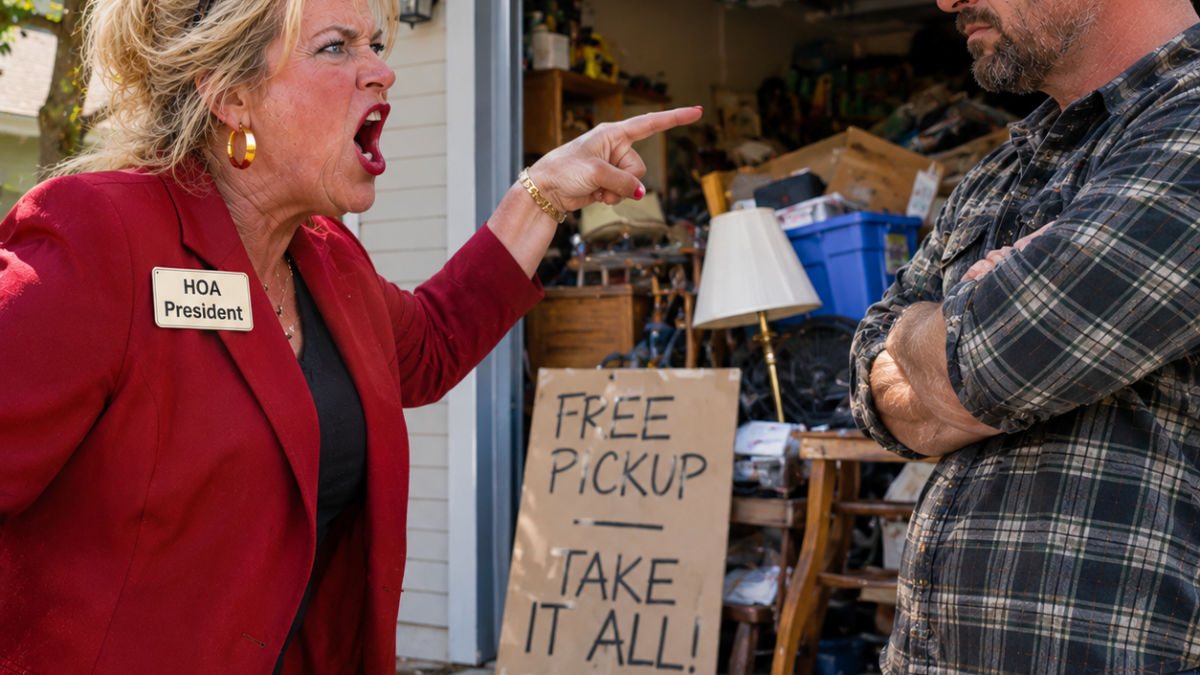
**FREE PICKUP TONIGHT**
Miscellaneous household and staging items.
Boxes.
Framed art.
Decorative pillows.
Area rug.
Exercise equipment.
Clothing rack.
First come, first served.
No holds.
Pickup tonight.
Gone by morning.
Eleven minutes.
Twenty-three messages.
The first truck arrived at 9:45.
Two college students.
They wanted the rug.
I nearly hugged them.
One said:
“This is free?”
“Yes.”
“Seriously?”
“Please take it before I change my mind.”
They rolled it.
Dragged it into the pickup.
One shook my hand.
Four minutes.
Eight months of smelling that thing.
Gone in four minutes.
The elliptical went next.
A woman named Tina had recently had knee surgery and wanted exercise equipment.
Her nephew came.
Nineteen maybe.
Didn’t say six words.
Lifted like somebody had assembled him for moving furniture.
Eight minutes.
Gone.
The clothes rack went to a young couple.
The framed artwork disappeared.
Pillows.
Boxes.
One woman held up a watercolor lighthouse.
“This is actually nice.”
“It is.”
“Why are you giving all this away?”
“Long story.”
She smiled.
“Divorce?”
“No.”
“Worse?”
“HOA.”
Her face changed.
“Oh.”
Apparently that was explanation enough.
The final couple left a handwritten thank-you note in my screen door.
At 11:35 p.m., the garage was empty.
I stood under the bare bulb.
Cold concrete.
Pegboard.
Workbench.
Tool chest.
Space where my Ranger belonged.
I inhaled.
No cedar.
No cat hair.
No stale perfume from the rug.
WD-40.
Sawdust.
A little grease.
My garage.
I hadn’t realized how much I missed the smell.
Eleven years creating it.
Eight months losing it.
Two hours reclaiming it.
I turned off the light.
Went inside.
Made tea.
Stood at the kitchen window looking at the dark garage.
Somewhere across Maple Crest, Constance was probably sleeping.
Maybe she had the rental van booked.
Maybe she had a client delivery scheduled.
I did not enjoy imagining the panic.
Not exactly.
What I enjoyed was knowing that for the first time in eight months, her schedule was no longer my problem.
At 7:22 the next morning:
Burl.
**She just arrived.**
Coffee in my hand.
Blue notebook open.
Then:
**Cadillac 7:23.**
Then:
**Side gate.**
Then:
**Garage open.**
Three minutes.
Nothing.
I pictured Burl in his chair near the window.
Coffee.
Binoculars probably unnecessary.
Then:
**Still standing there.**
Another minute.
**Back to car. On phone. Typing hard.**
Then:
**Back in garage.**
Then:
**She picked up one of your tools. Put it back.**
I almost smiled.
Finally:
**Leaving.**
At 7:33:
**She didn’t look good, Derek.**
I finished my coffee.
7:44.
First text from Constance.
**Derek, what has happened to the items stored in your garage?**
Then:
**I expect an immediate response.**
Then:
**Those items were not yours to dispose of.**
Then:
**You have created a serious legal problem for yourself.**
By message seven, capitalization.
By message nine:
**I WILL HAVE YOU ARRESTED.**
Then again.
Then once more.
Eleven messages.
Nine minutes.
I answered none.
Screenshots.
Pete.
His reply:
**Beautiful. Do not answer.**
At nine, police knocked.
Non-emergency response.
Officer was polite.
Tired.
Had the expression of someone expecting a neighbor dispute involving either a fence or a dog.
“Mr. Callaway?”
“Yes.”
“We received a complaint regarding personal property.”
“Come in.”
I offered coffee.
He declined.
I put the blue notebook on the table.
Then the certified letter.
Return receipt.
Photos.
Texts.
Fine.
Business registration.
Parking receipts.
My small-claims filing.
Fresh walkthrough.
I explained the sequence.
No speeches.
The officer reviewed it carefully.
Made a phone call.
Came back.
“This appears to be a civil dispute.”
“Understood.”
“You’ll want to continue dealing with counsel or the courts.”
“That’s the plan.”
He handed me a card.
I thanked him.
Through the window, Constance’s Cadillac sat across the street.
After the officer drove away, it remained for four minutes.
Then left.
Slowly.
I felt no rush of triumph.
Just the particular satisfaction of a man whose paperwork had been read and had not fallen apart.
By noon, Constance posted on the neighborhood Facebook page.
No name.
“A neighbor” had abused “a vulnerable situation.”
Valuable property removed without consent.
Predatory conduct.
She used **predatory** twice.
Gary entered the comments.
Calm.
Six sentences.
He said there was substantial documented history the community had not yet seen.
He offered to provide context privately to anyone interested.
No accusations.
No insults.
Just:
**There are two sides to this story, and the side that has not been told yet is the more complete one.**
Nine people clicked interested.
Constance deleted the post.
Too late.
Gary had screenshots.
So did I.
So did several neighbors.
I sat in my garage.
Clean.
Empty.
And laughed.
Not cruelly.
More like pressure escaping from a pipe.
Six days later, an attorney letter arrived.
Harold Frink.
Heavy cream paper.
Real-estate and closing law.
Demand:
$4,200 replacement value.
Threatened lawsuit.
“Conversion.”
“Legal remedies.”
“Without further delay.”
I scanned it.
Sent to Pete.
Nine minutes later:
“Derek.”
“Yeah?”
“Harold mostly does closings.”
“So?”
“Purchase agreements. Title work.”
“Can he sue me?”
“Anybody can file a suit.”
“That’s not what I asked.”
“He hasn’t handled a civil litigation case in this county in years.”
“So this?”
“Theater.”
“Expensive theater?”
“Probably.”
“What do I do?”
“Nothing yet.”
“That seems to be your favorite advice.”
“It keeps working.”
I wrote in the notebook:
**Attorney demand – $4,200.**
Then:
**Constance is spending money now.**
Fear changes people.
Constance had spent eight months acting as if time belonged to her.
Now every day created another expense.
Another record.
Another person asking questions.
I spent ten days building the binder.
Not metaphorical.
Actual three-ring binder.
Tabs.
Tab 1:
Photographs.
Day one through clearance night.
Tab 2:
Texts.
My unanswered requests.
Her eleven-message explosion.
Tab 3:
Certified demand.
Green return receipt.
Tab 4:
Parking receipts.
Fine.
Small-claims filing.
Tab 5:
Audio transcript of parking-lot conversation.
Tab 6:
Gary’s emergency-board recording.
Tab 7:
Section 9, paragraph 4.
Highlighted.
Tab 8:
Whitfield Interiors LLC.
Business registration.
Box-label photographs.
Tab 9:
Assessor correspondence and timeline.
Tab 10:
Facebook post.
Gary’s response.
Deletion screenshots.
Forty-seven pages by the end.
Fresh printer ink.
Finished business.
Then the annual homeowners meeting was announced.
First week of December.
Board elections.
Gary checked the bylaws.
Any homeowner with a documented governance complaint could present it to membership during the election process.
I was attending.
Four days before the meeting, Constance came to my house.
Ron stood behind her.
Hands in jacket pockets.
No roses to tend in December.
He looked like a man who missed having somewhere else to look.
Constance held an envelope.
“Derek.”
“Constance.”
“I think this has gone far enough.”
“Agreed.”
She extended the envelope.
“Three hundred dollars.”
I looked at it.
“What for?”
“To resolve the misunderstanding.”
“Which misunderstanding?”
Her smile tightened.
“Both sides could have handled things differently.”
That phrase.
**Both sides.**
I looked at Ron.
He stared at the sidewalk.
Constance continued.
“I’d like us to move forward as neighbors.”
“Three hundred?”
“Cash.”
“My direct claim is six hundred thirty.”
“That’s excessive.”
“It’s receipts.”
“I’m offering goodwill.”
I took a second.
“I’ll think about it.”
She relaxed slightly.
I closed the door.
Did not accept the envelope.
Went to the blue notebook.
**Offered $300. Direct documented claim $630.**
Then:
**She knows the meeting matters.**
That evening, I called Shelby Ames.
Reporter at the Westerville Courier.
She had covered local HOA governance disputes.
I didn’t ask her to write an exposé.
I gave her the timeline.
Then documents.
She asked:
“Annual meeting public?”
“Yes.”
“When?”
Tuesday.
“I may attend.”
“Fine.”
“You comfortable being quoted?”
“On documents.”
“Meaning?”
“If I say something, I want it tied to something I can show.”
There was a pause.
“I wish more people said that.”
The annual meeting drew forty-one people.
Out of eighty-seven homes.
Normally fifteen showed.
People stood against the wall.
Someone brought a folding chair from home.
Burnt coffee.
Fluorescent lights.
Winter coats.
Shelby sat in row two.
Notebook.
Recorder.
Constance saw her.
“Who invited the press?”
Gary answered:
“It’s a public meeting.”
Constance straightened the linen blazer.
December.
Still linen.
I almost respected the commitment.
She ran the meeting normally.
Treasurer.
Pool.
Snow removal.
Maintenance.
Smooth.
Controlled.
If you didn’t know anything, you’d think nothing was wrong.
Then election business.
Governance comments.
I stood.
Binder in my hands.
“I’m Derek Callaway.”
Someone in the back said:
“We know.”
A little laughter.
Helped.
“I have a governance complaint I want entered into the membership record before elections.”
Constance moved toward the microphone.
“We’ve already addressed Mr. Callaway’s private dispute.”
Gary spoke.
“He has the floor.”
Constance looked at him.
Then me.
I opened the binder.
Started with the easiest part.
Not the Marketplace listing.
Not the attorney letter.
The cookie tray.
“Eight months ago, President Whitfield asked to store a few items in my garage for approximately two to three weeks.”
Date.
Moving van.
Seventeen boxes.
Elliptical.
Clothes rack.
Rug.
First unanswered text.
Second unanswered text.
Five months of displaced parking.
Four hundred eighty dollars.
Then the fine.
One hundred fifty.
Signed by Constance.
I held up the violation.
“That’s when I started keeping the notebook.”
I showed it.
Not waved dramatically.
Just held it.
“Everything after that has a date.”
I explained the fourteen-day written notice.
Certified mail.
Receipt.
No removal.
Then Whitfield Interiors LLC.
Business registration.
I put one photograph on the projector.
Box label:
**STAGING – MASTER SUITE – LOT 14**
Another.
**FARNSWORTH – LIVING**
People murmured.
A woman near the wall said:
“That’s business stuff.”
I continued.
“That’s what the records indicate.”
No overstatement.
Then the emergency board meeting.
Gary stood.
“May I?”
I nodded.
He connected his phone.
Thirty seconds.
Constance’s voice.
Gary citing the notice requirement.
Constance overruling him.
Vote proceeding anyway.
When the recording stopped, nobody spoke.
Three people looked at one another.
Constance said:
“That recording lacks context.”
Gary replied:
“It is the meeting.”
Nothing else.
I continued.
Section 9, paragraph 4.
Read it aloud.
No officer may adjudicate a dispute in which they have a direct personal or financial interest.
Then the violation.
Signed by Constance.
About conditions created by her property.
Then the parking-lot conversation.
I did not play all of it.
Only the relevant portion.
Her voice:
**I’d hate for a property like yours to come up for county reassessment. These things happen, sometimes randomly.**
Then the assessor call.
I was careful.
“I am not claiming I can prove who initiated the review.”
Constance looked at me.
“But I am asking that the timeline be reviewed as part of the governance complaint.”
That mattered.
Truth is strongest when you don’t stretch it.
Then the attorney demand.
$4,200.
Then her $300 offer four days before the meeting.
Someone whispered:
“Seriously?”
I closed the binder.
“I don’t want anybody thrown out of their home.”
I looked at the room.
“I don’t want revenge.”
That surprised a few people.
“I don’t even want anyone personally humiliated.”
Constance crossed her arms.
“I want the fine reversed.”
I continued.
“I want my documented claim satisfied.”
“And I want an independent governance review so that no board member can use HOA authority to fight a personal dispute again.”
Then I sat down.
Applause.
Not roaring.
No standing ovation.
Just forty-one neighbors clapping because something they had suspected had finally been organized into a shape they could understand.
Constance stood.
“This presentation is a personal vendetta.”
Nobody interrupted.
“It selectively characterizes procedural irregularities as misconduct.”
She used **community standards** twice.
Then Paul spoke.
Paul.
Insurance salesman.
Two years voting with Constance.
Every time.
He looked down at the three-page summary I had placed in front of him.
Then at her.
“I think we should table the election and conduct a governance review.”
Constance stared.
“What?”
Seven words.
That was it.
Foundation cracking.
Gary immediately:
“I second.”
Motion.
Discussion.
Vote.
Passed.
Election tabled.
Independent review authorized.
Shelby wrote the entire time.
I went home.
Pulled the Ranger into the driveway because the garage was still waiting for its proper return.
Then sat in the driver’s seat for a while.
No celebration.
I was tired.
Three weeks later, small-claims court entered judgment on my documented $630 claim plus filing costs after Constance failed to appear.
I printed the judgment.
Blue notebook.
Last section.
It was the least exciting six hundred thirty dollars I had ever earned.
Also one of the most satisfying.
Because it wasn’t a windfall.
It was recognition.
You used my space.
Your property cost me money.
You don’t get to pretend the cost never existed.
The governance review took six weeks.
Independent reviewer.
Meeting records.
Binder.
CC&Rs.
Recordings.
Emails.
The final report was dry.
Almost painfully dry.
That’s why it hit so hard.
Three main findings.
The emergency meeting had not been properly convened.
Actions taken through it were void.
The violation against me involved a direct conflict under the HOA’s own governing language and was invalid.
The board needed a written conflict-of-interest and recusal policy.
No adjectives.
No:
**Constance behaved like a tyrant.**
No:
**Derek was heroically vindicated.**
Just findings.
That’s better.
Shelby published her story.
Fair.
Sourced.
No tabloid language.
A regional outlet picked it up.
Then another.
One headline:
**HOA President Fined Neighbor for Clutter Created by Her Own Business Inventory**
Accurate.
Not gentle.
Constance declined comment.
January board meeting.
She arrived in the linen blazer one last time.
Read a statement.
“I have decided to step back from my board responsibilities in order to focus on my business and personal priorities.”
No apology.
No mention of me.
No mention of the review.
No mention of the fine.
She folded the paper.
Left before the meeting ended.
Ron sat near the back.
He waited five seconds.
Then stood.
He looked at me.
Small nod.
Followed his wife out.
That was all.
Whitfield Interiors LLC dissolved the following spring.
Gary became interim HOA president by acclamation.
His first official act?
Send every homeowner the complete governing documents.
All sixty-two pages.
He included a note:
**Please read them. They belong to you too.**
Second change:
Minor administrative violation fee reduced.
Seventy-five dollars became twenty-five.
More importantly:
Mandatory courtesy call before a written notice for ordinary minor issues.
Gary called me after the rule passed.
“Happy?”
“It’s twenty-five dollars.”
“That’s not what I asked.”
“Yes.”
“Good.”
“Why?”
“Because people should talk before they certify-mail each other.”
He grunted.
“Radical idea.”
February.
Saturday morning.
I drove to Hank’s.
My Ranger sat where it had spent nine months.
Old red paint.
Rust beginning near the rear wheel.
Hank tossed me the keys.
“About time.”
“Yeah.”
“You owe me for the last week?”
“I paid through Friday.”
“I know.”
He smiled.
“Just checking if the famous documentation guy was slipping.”
I drove home.
Garage door went up.
I stopped at the threshold.
Eleven years of organization.
Pegboard.
Workbench.
Engine stand.
Clean floor.
Space.
I eased the Ranger inside.
Parked it exactly where it had always belonged.
Engine off.
Silence.
I stayed behind the wheel.
Hands on the steering wheel.
For months I’d imagined this moment as victory.
It wasn’t.
It felt more emotional than that.
My youngest had helped me paint those tool outlines years earlier.
Bad outlines.
Crooked.
I had never fixed them.
My father had given me the first socket set on the left wall.
The workbench came from a pipefitting buddy who died before retirement.
The garage wasn’t important because it was clean.
It was important because pieces of my life lived there.
Constance had seen empty square footage.
I had seen eleven years.
That’s why eight months bothered me so much.
Not the rug.
Not even the money.
I had let someone treat something meaningful to me as unused capacity.
I opened the Ranger door.
Stepped onto the concrete.
Smelled sawdust.
WD-40.
Old truck.
Home.
I made coffee.
Opened the garage door.
Sat on a stool.
Burl walked over.
“Truck fits.”
“Observant.”
“Thirty-one years Postal Service.”
“I remember.”
Gary came by twenty minutes later.
Then Hank.
Then another neighbor.
Someone brought chili.
Someone else brought donuts.
Nobody planned a gathering.
It just happened.
Burl looked around.
“You know what we should do?”
Everybody groaned.
“Whenever an old man says that,” Gary said, “somebody ends up volunteering.”
Burl ignored him.
“Skills exchange.”
“What?”
“People know things.”
He pointed at me.
“Engines. Pipe.”
Gary.
“Electrical.”
Hank.
“Welding.”
Then toward the street.
“Jean does canning. Martha repairs furniture. Leon knows computers.”
“So?”
“So neighbors teach neighbors.”
I smiled.
“In garages?”
“Rotate.”
Gary shrugged.
“Could be useful.”
Hank said:
“Could be terrible.”
Burl:
“Same thing.”
That became the Maple Crest Skills Exchange.
First session:
Nine people.
Basic small-engine diagnostics.
I taught them how to tell the difference between fuel problems, spark problems and compression problems before buying parts they didn’t need.
Second session:
Sixteen.
Gary taught electrical safety.
Nobody was allowed to call him Gary the Electrician because he threatened to leave.
By April, waiting list.
HOA contributed five hundred dollars for materials.
Under Gary.
The same HOA that had once mailed me a fine because someone else’s business inventory cluttered my garage was now paying for neighbors to use garages to teach each other practical skills.
Life has a sense of humor if you give it enough time.
Burl suggested a scholarship.
Of course.
“Trade school.”
“Who funds it?”
“Us.”
“How?”
“Voluntary.”
“Amount?”
“Whatever we get.”
First year:
Five hundred dollars.
Not huge.
Enough for tools.
Books.
Certification fees.
Recipient:
Caleb.
Seventeen.
Wanted to become an HVAC technician.
At the little presentation, I shook his hand.
He had the same kind of hands I had at seventeen.
Not strong yet.
But used.
Small cuts.
Grease under one nail.
He said:
“Mr. Callaway, thank you.”
“Don’t thank me.”
“Why?”
“Half the neighborhood paid.”
He looked at the garage.
“My dad said this all started because someone left junk here.”
I laughed.
“That’s the short version.”
“What happened to the junk?”
“Columbus has it now.”
He didn’t understand.
Better that way.
That night, after everyone left, I opened the filing cabinet.
Blue notebook.
The cheap one.
Bent cover.
Coffee stain near the bottom.
I flipped through.
Cookie tray.
Seventeen boxes.
Sixty dollars.
Fine.
Meeting.
Threat.
Business registration.
Certified letter.
Green card.
11:20 p.m.
Marketplace.
Police.
Attorney.
Annual meeting.
Judgment.
Governance findings.
So much trouble contained in eighty-nine cents worth of paper.
I thought about throwing it away.
Didn’t.
Not because I planned to fight Constance again.
That was finished.
I kept it because the notebook represented something I’d learned too late in life.
You don’t have to become loud to stop being easy to push around.
For years, I had confused being reasonable with absorbing things quietly.
Transmission fine?
Pay it.
Someone needs storage?
Sure.
Extra month?
Fine.
Three extra months?
Don’t make a scene.
Park my own truck somewhere else?
Okay.
HOA president ignores messages?
Be patient.
Eventually, being “easygoing” becomes free labor for people who notice you don’t push back.
The notebook was the line.
Not anger.
A line.
This happened.
On this date.
It cost this much.
You received notice.
You made this decision.
No shouting required.
That was what Constance never understood.
She kept expecting me to fight her personality.
I didn’t.
I fought her timeline.
Personalities are slippery.
Timelines aren’t.
Did she hate me?
Maybe.
Did I insult her?
No.
Did she misuse authority?
Look at the meeting record.
Was the property business inventory?
Look at the registration and labels.
Did I ask for removal?
Read the messages.
Did she receive formal notice?
Green card.
Did she threaten reassessment?
Listen to the recording.
Did the review find a conflict?
Read the report.
Once everything was written, the dispute stopped depending on who sounded more confident.
That was the beginning of the end for Constance.
Confidence had always been her best tool.
The linen blazer.
The perfect smile.
The “Derek, darling.”
The official letterhead.
The belief that if she spoke like the decision was already made, everybody else would behave as though it was.
Most did.
I did, once.
Paid seventy-five dollars for the truck without arguing.
That taught her something about me.
The wrong thing.
She thought I wouldn’t bother.
That was her only real mistake.
Everything else came from it.
The following summer, the Skills Exchange held a plumbing session in my garage.
Twenty-two people.
Too many.
I told Burl.
He said:
“Good problem.”
“No. Fire code is a good problem?”
Gary counted people.
“We’re fine.”
I pointed.
“Don’t make me become Constance.”
Everybody laughed.
That surprised me.
A year earlier, her name created tension.
Now it was a joke.
That’s what happens when somebody’s power evaporates.
The person becomes ordinary again.
I didn’t hate that.
I didn’t hate her either.
That surprised me more.
For a while, I thought I would.
Then months passed.
The Ranger came home.
Gary ran boring meetings.
Nobody sent me certified letters.
The garage filled with neighbors instead of business inventory.
My life got normal.
Hatred takes maintenance.
I had engines to rebuild.
One Saturday, Ron walked past.
Not drove.
Walked.
He slowed at the open garage.
We hadn’t really spoken.
Ever.
I raised a hand.
“Morning.”
He looked at the group.
Gary teaching a younger couple how to test a circuit safely.
Burl pouring coffee.
Caleb helping Hank sort tools.
Ron smiled.
Small.
“Looks good.”
“Thanks.”
He continued walking.
Then stopped.
Turned.
“She shouldn’t have used your garage.”
I said nothing.
He looked down the street.
“She shouldn’t have fined you either.”
“I know.”
He nodded.
“I know you know.”
Then he walked home.
That was the closest thing to an apology I ever needed.
It wasn’t his apology to give.
But somehow it mattered.
Maybe because Ron had watched the whole thing from beside the roses.
Marriage can make a person witness to battles they never chose.
I was glad he didn’t try to defend her.
I was also glad he didn’t ask me to forgive her.
Some things can simply end.
The HOA changed under Gary.
Not dramatically.
No revolution.
No giant victory banner.
Meetings became twenty minutes shorter.
Courtesy calls replaced several formal notices.
A woman whose trash can stayed out too long got a phone call.
She brought it in.
Problem solved.
A teenager’s basketball hoop violated a setback by eighteen inches.
Gary went over.
Talked to the father.
They moved it Saturday.
No fine.
No certified letter.
No one called a lawyer.
It’s amazing how cheap functional human communication is.
Paul stayed on the board.
The insurance guy.
I had expected him to resign after breaking from Constance.
He didn’t.
One afternoon at the mailbox, he stopped me.
“Derek.”
“Paul.”
“I should’ve spoken up earlier.”
“You did eventually.”
“Not enough.”
I shrugged.
“I paid the first transmission fine without asking questions.”
He looked confused.
“What does that have to do with me?”
“We both learned late.”
He smiled.
“Fair.”
The governance review produced another boring change that probably mattered more than any headline.
Recusal forms.
If a board member had a financial, family or personal interest in a matter, it went into the minutes.
They left the room for discussion and vote.
No exceptions because somebody was president.
Gary hated forms.
Implemented them anyway.
He told me:
“Good rules should survive people who don’t need them.”
I liked that.
Because someday Gary wouldn’t be president.
Someday another Constance could be.
Maybe nicer.
Maybe worse.
Governance shouldn’t depend on personality.
That was the entire point.
The small-claims money eventually arrived.
Six hundred thirty dollars plus costs.
I put four hundred eighty back into savings to replace what I’d spent at Hank’s.
The rest?
Bought a better shop light.
The bare bulb had survived long enough.
When I switched the new LEDs on, the garage looked almost too bright.
Every flaw visible.
Every scratch.
Every grease mark.
I liked it.
Hank came over.
“Fancy.”
“Judgment money.”
“You bought lights with lawsuit money?”
“Small claims.”
“Still.”
He looked around.
“Should’ve bought beer.”
“Lights last longer.”
“Debatable.”
The old bare bulb went into a drawer.
I don’t know why.
Sentimental about a light bulb.
Maybe because it had been hanging over me the night I finally reclaimed the garage.
Some objects become witnesses without asking.
The blue notebook.
The bulb.
The Ranger.
The pegboard.
Nothing expensive.
Everything meaningful.
That winter, Caleb stopped by.
He’d started his HVAC program.
Needed help understanding a flare fitting.
We worked at the bench.
He asked:
“You really gave everything away?”
“Yes.”
“Like free?”
“Yes.”
“Wasn’t it worth money?”
“Probably.”
“Then why free?”
I looked at him.
“Because I wasn’t trying to run a store.”
He laughed.
“No, seriously.”
I thought about it.
“The point was getting my space back after the notice period and the advice I’d received.”
“Did you want Constance mad?”
“Yes.”
Honest answer.
Caleb smiled.
“At least you admit it.”
“I also wanted the garage empty.”
“More?”
“Much more.”
He nodded.
Then:
“Would you do it again?”
I set down the fitting.
That question deserved care.
“In that exact situation, with the same documentation and legal advice?”
“Yes.”
“With random stuff someone left in my garage?”
“No.”
“Why?”
“Because being angry doesn’t make you right.”
He thought.
“That’s disappointing.”
“Growing up is mostly disappointing.”
He laughed.
Then I showed him the fitting.
That’s the thing about stories.
People remember the dramatic picture.
Empty garage.
Constance standing there.
Her inventory gone.
But the dramatic picture wasn’t the lesson.
If I’d simply posted her belongings online the day I got angry, the whole story could have been different.
No notice.
No timeline.
No documentation.
No advice.
No cure period.
No record.
Just a guy giving away somebody else’s stuff.
Instead, eight months of her confidence had given me time to build something stronger than a temper.
A file.
I never used the Skills Exchange to tell people:
“Do what I did.”
I told them:
“Document first.”
Then:
“Get proper advice.”
Because laws vary.
Facts matter.
Ownership matters.
Contracts matter.
What worked in one dispute is not a universal recipe.
Gary especially insisted on that.
At the beginning of every session that touched on permits or electrical work, he’d say:
“We are teaching principles, not issuing licenses.”
Then glare at everyone until somebody laughed.
The scholarship grew.
Five hundred the first year.
Seven hundred fifty the second.
Local hardware store contributed.
Then a plumbing supply company.
Caleb returned after completing certification.
Brought his own tools.
Taught a basic home HVAC-maintenance class.
I stood at the back.
He was good.
Better at explaining than I was.
At the end, he held up a dirty filter.
“Most of the time, expensive problems start as cheap maintenance somebody ignored.”
Burl leaned toward me.
“Sounds familiar.”
“What?”
“Garage.”
I groaned.
“Everything isn’t about the garage.”
“For you it is.”
Maybe.
The garage had become community space.
Not every Saturday.
I still needed quiet.
But often enough.
Neighbors brought broken things.
Sometimes repaired them themselves.
Sometimes learned.
Nobody asked Constance for permission.
Nobody needed to.
And because Gary’s board had actually read the governing documents, they knew the Skills Exchange didn’t violate anything.
Imagine that.
Reading before regulating.
Revolutionary.
Constance remained in Maple Crest for a while after stepping down.
I saw her Cadillac.
Saw Ron with the roses.
Never saw her come toward my house again.
Whitfield Interiors disappeared from the state registry the next spring.
I didn’t celebrate.
Businesses end for all kinds of reasons.
I had no interest in monitoring the rest of her life.
That’s another thing documentation taught me.
A dispute needs boundaries too.
Once your issue is resolved, stop turning the other person’s existence into your hobby.
Fine reversed.
Judgment entered.
Garage clear.
Governance fixed.
Board changed.
Done.
Anything beyond that would’ve made me what I claimed to dislike:
someone using power because he enjoyed having it.
So I let it end.
One afternoon, maybe a year later, I saw Constance at the grocery store.
She had a basket.
I had motor oil and coffee.
Because apparently that’s all men my age buy.
We ended up in the same checkout line.
She noticed me.
I noticed her.
Neither moved.
Finally:
“Derek.”
“Constance.”
That was it.
The cashier scanned her groceries.
Then she said without looking at me:
“I shouldn’t have issued the fine.”
I wasn’t expecting that.
I waited.
She added:
“The board should’ve handled it differently.”
Still not:
**I was wrong.**
But closer.
I said:
“Okay.”
She looked at me.
“That’s all?”
“What do you want me to say?”
“I don’t know.”
“Then okay works.”
For a moment, the old smile almost appeared.
Not the weaponized version.
Human.
Then she took her bags and left.
I never told Gary.
Never told Burl.
Never wrote it in the notebook.
Some things don’t need evidence once the case is over.
I think about that now and then.
Constance wasn’t a movie villain.
She wasn’t born wearing a linen blazer and issuing citations.
She had spent years in county zoning.
Rules.
Forms.
Compliance.
Maybe over time she began confusing knowing rules with owning them.
Then became HOA president.
People deferred.
Three board members voted with her.
Neighbors paid fines rather than argue.
I did.
Once.
That’s how small authority grows.
Not through one dramatic seizure.
Through thousands of little moments where everyone decides:
Not worth the trouble.
Pay it.
Move it.
Sign it.
Let it go.
Most of the time, that’s healthy.
Life would be unbearable if every trash-can notice became a constitutional trial.
But people with authority need to know there’s a line.
Mine happened to be seventeen boxes, an elliptical, a clothes rack, a bad rug and one hundred fifty dollars.
Funny-looking line.
Still a line.
The Skills Exchange entered its third year.
We added welding demonstrations.
Furniture refinishing.
Food preservation.
Basic plumbing.
Computer maintenance.
One Saturday, an elderly widow named Joan brought in a table lamp.
“It stopped working.”
Gary opened it.
Bad socket.
Ten-minute repair.
She asked:
“How much?”
“Nothing.”
“No.”
She pulled out cash.
Gary pointed at the coffee tin.
“Scholarship.”
She put twenty dollars in.
That became a tradition.
People didn’t pay instructors.
If they wanted, they dropped something in the scholarship fund.
Five dollars.
Twenty.
Whatever.
The fund grew.
The garage that had once been used as free commercial storage became a place where neighbors voluntarily gave money to help somebody else learn a trade.
That irony never got old.
Burl mentioned it constantly.
“Constance created this, technically.”
“No.”
“Cause and effect.”
“No.”
“If not for the rug—”
“Burl.”
He smiled into his coffee.
Retired mail carriers enjoy being annoying because nobody can transfer their route anymore.
My daughter came home one Christmas.
She stood in the garage doorway.
Looked around.
“You changed the lights.”
“Judgment money.”
She laughed.
“Dad.”
“What?”
“Mom would’ve thought this whole thing was ridiculous.”
That hit me.
Her mother had died years before.
We didn’t talk about her often enough.
“What part?”
“Keeping an eighty-nine-cent notebook until you destroyed an HOA president.”
“I didn’t destroy anyone.”
“You know what I mean.”
“She would’ve kept a better notebook.”
My daughter smiled.
“She would’ve color-coded it.”
“She would’ve put tabs in before I did.”
We stood together.
She touched one of the crooked tool outlines she had drawn as a teenager.
“You never fixed this.”
“No.”
“It’s terrible.”
“Yes.”
“Why?”
“Because you drew it.”
Her face softened.
That was when I finally understood why losing control of the garage had bothered me beyond the money.
The space wasn’t perfect because every line was straight.
It was perfect because I knew where everything came from.
My father’s sockets.
My daughter’s outlines.
My old workbench.
The Ranger.
Years of fixing things.
Constance couldn’t see any of that.
She didn’t need to.
But she needed to respect that the space wasn’t hers.
That’s the simplest version.
My house doesn’t have to mean anything to you.
My garage doesn’t have to look valuable to you.
My truck doesn’t have to impress you.
My tools don’t need your approval.
But boundaries aren’t based on whether outsiders understand why something matters.
They exist because it isn’t theirs.
That lesson applies in both directions.
When I agreed to store Constance’s things, I became responsible for treating them carefully.
Which I did.
Photographed.
Protected.
Warned.
Documented.
I didn’t get to destroy them because I disliked her.
She didn’t get unlimited use of my space because I initially said yes.
Permission has limits.
So does authority.
That’s the heart of it.
Several years later, Gary finally stepped down.
He had said from day one he never wanted the job.
Nobody believed him because he was too good at it.
His farewell meeting lasted thirty-seven minutes.
He considered that his greatest achievement.
The new president was a woman named Denise Alvarez.
Teacher.
Practical.
First thing she did was ask Gary for every procedure he’d created.
Second thing:
Asked homeowners what could be simplified.
That’s how you know an institution is improving.
The next person doesn’t have to reinvent integrity from scratch.
Conflict forms stayed.
Courtesy calls stayed.
Governance documents remained online.
Skills Exchange stayed.
Nobody cared who had invented them.
Good.
Policies that only survive because one hero guards them are weak policies.
I liked knowing Maple Crest could function without Gary.
Without me.
Even without Constance as a cautionary story.
At one meeting, a newer homeowner asked:
“Who is Constance?”
I almost laughed.
Exactly.
History had become history.
That’s healthy.
My Ranger eventually needed an engine rebuild.
Of course.
I refused to replace it.
Hank told me I had spent more keeping that truck alive than a newer one would cost.
“Not the point.”
“Then what is?”
“It’s mine.”
He rolled his eyes.
We rebuilt the engine in the garage.
Three weekends.
Caleb helped one Saturday.
Gary another.
Burl mostly drank coffee and criticized.
At one point, the truck sat half-disassembled with parts neatly arranged.
I received no violation.
No certified letter.
Denise walked past.
Looked in.
“You planning to have that running?”
“Yes.”
“When?”
“Eventually.”
She smiled.
“Good luck.”
Kept walking.
I stood there holding a wrench.
Then started laughing.
Hank asked:
“What?”
“Nothing.”
That was progress.
Reasonable rules hadn’t disappeared.
If I’d left a dead truck outside for six months, I’d expect someone to say something.
But conversation had returned before punishment.
That was all I’d ever wanted.
The annual scholarship eventually reached one thousand dollars.
Then fifteen hundred.
A local union matched it one year.
Another student entered welding.
Another electrical.
One young woman became an automotive technician despite her guidance counselor suggesting something “less physical.”
She gave the counselor a copy of her first certification.
I liked her immediately.
At each award, Burl told the origin story.
Every time he exaggerated more.
By year five, apparently Constance had stored an entire furniture warehouse in my garage and I had cleared it using a convoy of thirty trucks while police helicopters circled.
I finally said:
“You are banned from telling this.”
He ignored me.
“Seventeen boxes,” I corrected.
“That’s what the official record says.”
“You were there.”
“History evolves.”
Gary looked at me.
“This is why we keep documents.”
Perfect.
The blue notebook remained in my filing cabinet.
Not displayed.
Not sacred.
Just there.
Once a year, when doing taxes, I’d see it.
I could open to any page and remember exactly how I felt.
Angry.
Embarrassed.
Used.
Then gradually calmer.
There is something powerful about watching emotion become information.
First entry:
**$150 FINE. HER STUFF.**
Big letters.
Later entries:
Dates.
Times.
Dollar amounts.
Less emotion.
More clarity.
By the last pages, the handwriting was steady.
**Judgment entered.**
**Governance report received.**
**Fine reversed.**
Done.
That transformation was probably more important than anything Constance lost.
I learned I didn’t need to win by becoming harder than the other person.
I needed to become clearer.
Clearer boundaries.
Clearer records.
Clearer demands.
Clearer outcomes.
That served me in everything afterward.
Customers.
Neighbors.
Family.
When somebody asked to store something?
“How long?”
Written date.
When I repaired equipment?
Estimate.
Scope.
When HOA sent a notice?
Read it before reacting.
Clarity isn’t hostile.
It prevents hostility.
The whole garage fight began because two people had radically different understandings of one sentence.
**Two weeks, maybe three.**
I treated it as a limit.
Constance treated it as permission until she no longer needed the space.
Nothing written.
That gap became eight months.
Then everything else followed.
If I could redo one thing, I wouldn’t refuse the favor.
I’d still help.
I would simply say:
“Sure. Pickup date three weeks from Monday. I’ll text it to you.”
That’s all.
No war.
No Marketplace.
No binder.
Maybe no scholarship either.
Life is strange.
I don’t believe bad things happen for a reason.
That’s too easy.
But people can build reasons afterward.
The rug didn’t create the Skills Exchange.
We did.
Constance’s overreach didn’t create better governance automatically.
Gary, Paul, forty-one homeowners and a reviewer did.
The fine didn’t create the scholarship.
Neighbors chose to turn a repaired garage into something useful.
Bad events don’t contain hidden gifts.
People make good things from what remains.
That’s different.
One spring Saturday, I opened the garage at seven.
Coffee brewing.
Ranger inside.
Caleb setting up an HVAC demonstration.
Gary carrying extension cords.
Burl arriving with donuts.
Someone had brought chili even though it was breakfast.
Don’t ask.
The air smelled like sawdust, motor oil, coffee and food.
I stood outside for a second.
Years earlier, the garage had smelled like someone else’s rug.
Someone else’s business.
Someone else’s entitlement.
Now it smelled like neighbors.
Voluntary.
Nobody forced.
Nobody fined.
Nobody issued permission slips.
I looked at the pegboard.
Every tool in place.
Then at all the people temporarily making a mess.
Funny.
I had fought to reclaim a perfectly organized garage.
Then willingly filled it with people.
That’s the difference.
Choice.
That’s what Constance took for granted.
Not square footage.
Choice.
She assumed because I had said yes once, she controlled when the arrangement ended.
She assumed because she was HOA president, she controlled how the dispute would be judged.
She assumed because I’d paid a previous fine, I would pay this one.
She assumed because I was quiet, I was weak.
Every assumption depended on me continuing to cooperate without conditions.
Then I stopped.
Not violently.
Not loudly.
I simply started writing.
That is why, if you ask me what moment finally beat Constance Whitfield, I won’t say the night her inventory disappeared.
That was satisfying.
I won’t say the morning she stood in the empty garage.
I didn’t even see it myself.
Only Burl’s texts.
I won’t say the annual meeting when Paul broke ranks.
Or the small-claims judgment.
Or the governance report.
Or the day she stepped down.
The moment that mattered happened alone.
Cold November morning.
Violation notice in one hand.
Coffee in the other.
I looked at seventeen boxes occupying my garage and realized I was done reacting.
I put the coffee down.
Picked up my phone.
Took the first photograph.
Then bought an eighty-nine-cent notebook.
That’s it.
Nothing viral.
Nothing dramatic.
A man deciding that from now on, every move would have a date.
Constance’s power had always depended on people forgetting.
Forgetting who said what.
Forgetting whether a courtesy warning happened.
Forgetting why a fine was issued.
Forgetting which meeting was properly noticed.
Forgetting whether a rule actually existed.
Forgetting who benefited.
The notebook didn’t forget.
Neither did the photographs.
Neither did certified mail.
Neither did Gary’s recording.
Neither did the business registry.
Neither did the CC&Rs.
Once memory stopped being negotiable, her authority started shrinking.
That’s why the final image I keep isn’t really Constance’s Cadillac driving away.
It isn’t the empty garage at 11:35 p.m.
It’s the Ranger coming home in February.
Old engine rattling.
Garage door open.
I pulled forward slowly.
Centered the truck between the workbench and storage shelves.
Stopped exactly where I’d parked it for years.
Shut off the ignition.
Silence.
The smell of WD-40.
Sawdust.
Cold Ohio air.
Everything where it belonged.
I sat there with both hands on the wheel and realized something I wish I’d learned younger.
Protecting your space doesn’t always mean shutting people out.
Sometimes it means deciding the terms under which you let them in.
I had let Constance in because I wanted to be a good neighbor.
I don’t regret that.
I regret not remembering that generosity still needs boundaries.
Today, that same garage opens for neighbors every month.
People borrow tools.
Learn skills.
Drink my coffee.
Make a mess.
Sometimes they leave sawdust everywhere.
Sometimes somebody forgets a toolbox.
Difference is simple.
They ask.
I say yes.
And when the day ends, they understand the garage still belongs to me.
That shouldn’t be revolutionary.
Neither should an HOA president recusing herself from a personal dispute.
Neither should reading the bylaws before issuing fines.
Neither should talking to a neighbor before sending certified mail.
But apparently ordinary respect sometimes has to be relearned the expensive way.
Constance taught Maple Crest that lesson.
Gary helped write it down.
And an old Ford Ranger, an eighty-nine-cent notebook, and one very unfortunate rug made sure none of us forgot it.
The rug is somewhere in Columbus now.
Hopefully in a room where it smells better.
The elliptical may still be helping Tina’s knee.
The lighthouse watercolor is probably hanging on somebody’s wall.
The clothes rack is holding laundry.
Seventeen boxes scattered through homes I will never see.
I don’t know.
I don’t need to.
They stopped being the story the moment my garage became mine again.
The real story was what replaced them.
A truck.
Tools.
Neighbors.
A scholarship.
A kid headed into HVAC.
A board that learned how to make a phone call before issuing a fine.
And one cheap blue notebook in a filing cabinet, reminding me that sometimes the quietest form of revenge is simply making sure the person who counted on you never keeping track discovers that you kept track of everything.








