PART 2: HOA KAREN Used My Driveway as His Private Boat Parking — I Had It Towed 25 Times Until His Own Bylaws Took Him Down
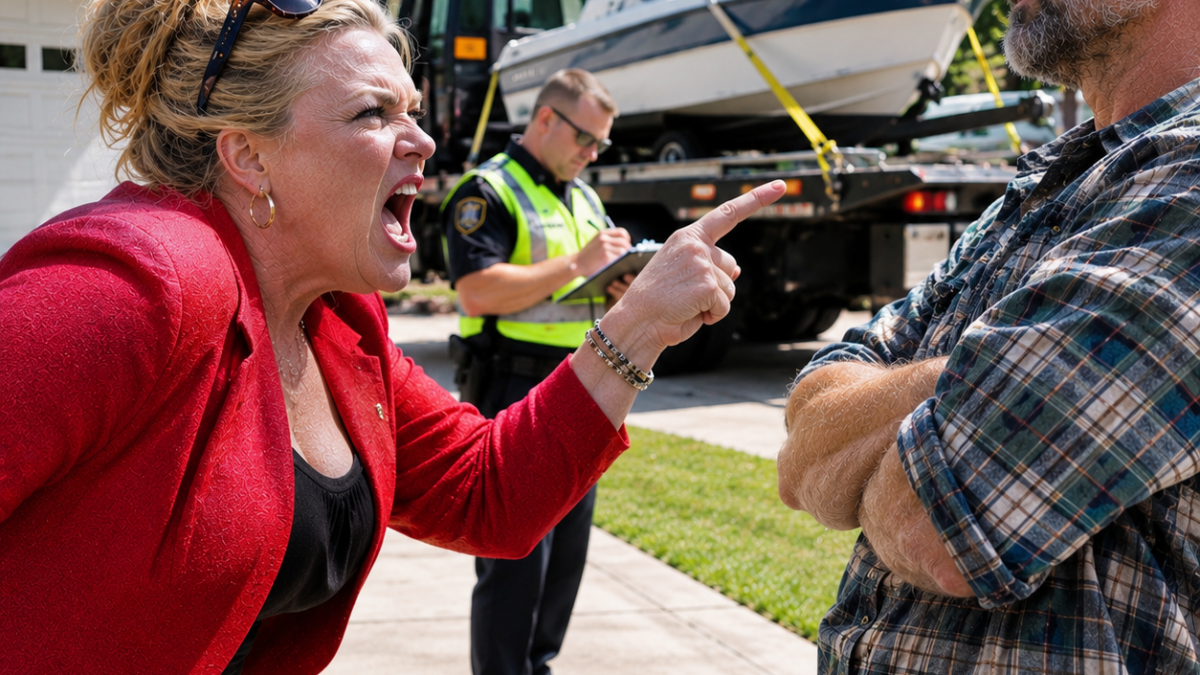
PART 2
## THE FIRST CERTIFIED LETTER
I began politely.
That matters.
People hearing the story later always ask why I didn’t tow the boat immediately.
Because normal adults usually try conversation first.
Then writing.
Then process.
I texted Clifton.
**Please move the boat. I need full access to my garage.**
Read receipt.
No answer.
I called.
Voicemail.
I knocked.
Sandra answered.
She was Clifton’s wife, a thin, tired-looking woman who always seemed one apology away from explaining her entire marriage.
“Clifton home?”
She glanced behind her.
“He’s out back.”
“Can you tell him I need the boat moved?”
“I will.”
“Today.”
She nodded.
“I’ll tell him.”
The boat stayed.
So I wrote a letter.
Not emotional.
Not threatening.
I quoted the HOA covenant.
Article Four, Section Seven.
No recreational vehicle, watercraft, or trailer could be stored on another homeowner’s property without written consent from the property owner.
I highlighted it.
Denise signed as co-owner.
I signed.
Certified mail.
Return receipt.
Clifton personally signed for it Thursday.
Sunday evening, I heard the trailer again.
Denise looked up from the couch.
“No.”
I walked to the front window.
Powder-blue boat.
Same location.
She came beside me.
“He signed for the letter.”
“I know.”
“He read it?”
“I assume.”
“What now?”
I looked at Clifton’s house.
“Now I stop asking him.”
## THE MAN WHO ENFORCED HIS OWN RULES
The problem with complaining about the HOA president to the HOA was obvious once I tried.
My complaint went to the board.
Clifton was president.
Wanda Ellis was a retired teacher who usually supported him.
Phil Mercer was an accountant who always looked like every HOA meeting had interrupted something more important.
I submitted the complaint.
Two days later, I received an email.
**Matter reviewed. No board action necessary.**
Signed:
**Clifton Draper, President
Laurel Creek Estates HOA**
I showed Denise.
She read it.
Then looked at me.
“He reviewed the complaint against himself?”
“Apparently.”
“And found himself innocent?”
“Very efficient system.”
She shook her head.
“That man is going to regret annoying an engineer.”
She knew me too well.
## THE DRIVEWAY DAMAGE
The trailer did more than block me.
Its tongue jack kept landing in roughly the same place.
Our driveway was sealed aggregate.
Smooth.
Level.
Every time Clifton dropped that trailer, the jack left a small circular depression.
One.
Then two.
Then three.
I started photographing them.
Denise caught me kneeling with a tape measure.
“What are you doing?”
“Documenting.”
“They’re dents.”
“Divots.”
“Garrett.”
“Terminology matters.”
By late October, I had nine.
That was the first moment I stopped treating the boat as merely inconvenient.
He was physically damaging my property.
Maybe only a little.
But little damage repeated deliberately is still damage.
## DARLENE AT COUNTY CODE
The Savannah County non-emergency office transferred me to a property-code officer named Darlene.
Not my wife Denise.
Different Darlene.
That caused confusion once.
After I explained the situation, she sighed.
Not at me.
At humanity.
“Is the boat registered to your neighbor?”
“Yes.”
“Your property?”
“Yes.”
“Do you have a written trespass notice?”
“I sent him a certified letter refusing permission.”
“That helps.”
“Can the county tow it?”
“Private HOA road?”
“Yes.”
“Probably not under ordinary parking enforcement.”
My shoulders dropped.
Then she continued.
“But if it’s physically obstructing access to your garage, you may be able to authorize a private-property tow through a licensed company.”
“Who pays?”
“The registered owner usually pays recovery and storage under the towing arrangement, assuming everything is done properly.”
I became very still.
“Can you repeat that?”
She laughed softly.
“I figured that part would interest you.”
## PELHAM AND SONS
Eight miles away.
Small towing yard.
Three wreckers.
Two flatbeds.
Office with a coffee machine that looked older than my marriage.
Reese Pelham owned it.
Mid-fifties.
Baseball cap.
Calm eyes.
I explained the boat.
He asked:
“You own the driveway?”
“Yes.”
“Name on deed?”
“Yes.”
“Written notice to owner?”
“Yes.”
“Boat blocks your garage?”
“Yes.”
He nodded.
“We keep authorization on file. You call. We verify. We remove it.”
“What does it cost me?”
“If it qualifies under the authorization, owner pays recovery.”
He quoted the base fee.
$185.
I signed the paperwork.
Then I drove home.
I did not call immediately.
I wanted Clifton to make the next choice without me nudging him.
Sunday evening.
6:57.
Truck engine.
Backup lights.
Crunch.
Hitch.
Boat.
Denise looked through the curtains.
“You smiling?”
“No.”
“You are.”
“Probably indigestion.”
Monday morning, 7:04.
I called Reese.
## TOW NUMBER ONE
7:41.
Flatbed rolled into Laurel Creek.
Reese inspected.
Photographed.
Verified registration.
Hooked the trailer.
Loaded it.
Professional.
Quiet.
No drama.
I watched through the kitchen window with coffee.
When the Ranger disappeared around the corner, I experienced a level of satisfaction normally reserved for fixing a machine that has been making the same irritating noise for six months.
At 9:15, Clifton noticed.
I was raking actual leaves.
His front door flew open.
He stared at the empty driveway.
Then at me.
“Where’s my boat?”
I kept raking.
“Probably the tow yard.”
His eyes widened.
“You had my boat towed?”
“You parked it on my property.”
“You can’t do that.”
“I did.”
“Do you have any idea who I am?”
That line.
Of course.
I leaned on the rake.
“Yeah.”
He waited.
“You’re the guy who owes Reese Pelham one hundred eighty-five dollars.”
His face turned dark red.
“You think this is funny?”
“No.”
That was mostly true.
He got the boat.
Paid the fee.
For six glorious days, my driveway remained empty.
I actually believed he had learned.
Denise did not.
“You’re adorable.”
“What?”
“You think this is over.”
“Normal person pays $185 once.”
“Clifton is not a normal person.”
Sunday night.
Crunch.
Hiss.
Boat.
Denise looked at me.
“Normal person?”
I picked up my phone.
## TOW NUMBER TWO
Monday.
7:03.
Reese answered.
“Morning, Garrett.”
“You busy?”
He laughed.
“Same boat?”
“Same boat.”
Twenty-eight minutes later, gone.
This time Clifton didn’t yell from the yard.
He went political.
## THE PARKING ACCOMMODATION POLICY
Emergency HOA meeting.
Clifton called it himself.
I attended.
Wanda.
Phil.
Three residents.
Clifton sat at the head table holding a freshly typed page.
“Temporary Parking Accommodation Policy.”
He read it aloud.
According to his new policy, HOA board members engaged in “community-related duties” could temporarily use “community-adjacent residential parking areas” when their own parking capacity was unavailable, provided verbal notification had been given to the affected homeowner.
I raised my hand.
Clifton sighed.
“Garrett.”
“You told me.”
“Yes.”
“I said no.”
“The policy requires notice.”
“Not consent?”
“It says notice.”
“You wrote it.”
“The board approved it.”
Phil stared at the table.
Wanda looked uncomfortable.
I said:
“You created a policy giving yourself permission to store your boat on my driveway.”
“It applies to all board members.”
“Does Phil have a bass boat?”
Phil looked up.
“No.”
People laughed.
Clifton’s face tightened.
“This is serious.”
“So is trespassing.”
The meeting ended badly.
For him.
The following morning, I called an attorney.
## WALLACE FITCH
Real estate lawyer.
Macon.
Twenty-minute consultation.
$150.
Worth every dollar.
I explained Clifton’s policy.
Wallace went quiet.
Then:
“He wrote himself a rule allowing him to use your private property?”
“Yes.”
“Without consent?”
“Yes.”
“And he thinks that overrides your ownership rights?”
“Yes.”
Wallace made a sound.
“Are you laughing?”
“Professionally, no.”
“Personally?”
“Absolutely.”
He explained the obvious.
An internal HOA policy did not magically create a property right over my driveway.
He advised me to keep everything documented and continue using lawful towing procedures if the boat kept returning.
Then:
“Save his messages.”
“What messages?”
“You’ll get them.”
He was right.
## TOWS THREE THROUGH FIVE
Tow three.
Monday.
Tow four.
Next Sunday.
Tow five.
Wednesday.
By number five, Clifton left voicemail.
“Garrett, this petty campaign stops now.”
Saved.
Second voicemail.
“You’re creating a hostile environment.”
Saved.
Third.
“You don’t understand what kind of trouble an HOA board can make for an uncooperative resident.”
Saved.
Fourth:
“You are making a very dangerous enemy.”
That one I replayed.
Then sent to Wallace.
He called.
“He actually said that?”
“Word for word.”
“Keep the original.”
“Already backed up.”
Wallace laughed.
“He’s doing half my work for me.”
## TOW SIX
Clifton changed the schedule.
Wednesday morning.
Maybe he assumed I only checked after weekends.
I walked outside.
Boat.
Called Reese.
Gone.
## TOW SEVEN
Reese answered:
“Frequent flyer?”
“Unfortunately.”
“Same Ranger?”
“Yep.”
“I’m thinking loyalty program.”
“If I get ten, is the eleventh free?”
“The tow is already free to you.”
“Fair point.”
Reese began enjoying the absurdity.
I did too.
That worried Denise.
## TOW EIGHT AND THE HARMONY VIOLATION
Clifton finally retaliated through the HOA.
Certified violation.
**Conduct Detrimental to Community Harmony.**
Fine:
$75.
Instruction:
Cease antagonistic conduct toward board leadership.
I read it.
Walked to my office.
Found an empty frame.
Hung it.
Denise stood in the doorway.
“You framed the violation?”
“Yes.”
“You need hobbies.”
“I had hobbies before a boat occupied them.”
I formally appealed.
Certified copies to all board members.
Wallace helped write the response.
I challenged the notice as retaliatory.
More importantly, the HOA’s own dispute procedures required a hearing involving the board.
That brought Phil into the situation.
He called me.
“Garrett.”
“Hey, Phil.”
“I didn’t vote for that notice.”
“I figured.”
“He told Wanda and me it was routine.”
“It says I’m damaging community harmony by removing unauthorized property from my driveway.”
Silence.
Then:
“How many times?”
“Eight when he issued it. Nine now.”
Another silence.
“He’s not going to stop.”
“Neither am I.”
Phil exhaled.
“You have counsel?”
“Yes.”
“Good.”
Click.
Something had changed.
For the first time, somebody inside Clifton’s board had acknowledged the problem.
## TOWS NINE AND TEN
Nine.
Monday.
Ten.
Friday.
At tow ten, Clifton went after Reese.
He called Pelham and Sons.
Told Reese that the HOA president had not authorized towing from “HOA-controlled residential areas.”
Reese asked one question.
“Do you own Mr. Hollis’s driveway?”
Clifton apparently said the association had jurisdiction.
Reese explained that he had a signed authorization from the deeded property owner.
Clifton threatened lawyers.
Then actually contacted one.
The lawyer apparently told him exactly what Wallace had told me.
The towing continued.
## THE DRIVEWAY SENSOR
Clifton switched to nighttime.
Midnight.
Two-thirty.
Three in the morning.
He would park the boat, apparently hoping to retrieve it before I woke.
I bought a wireless driveway sensor.
Forty-five dollars.
Simple infrared unit.
Receiver on my nightstand.
The first night it went off at 2:17, Denise sat straight up.
“What?”
“Driveway.”
She looked at me.
“If that is a raccoon, I’m divorcing you.”
I checked the camera.
Powder-blue Ranger.
I called Reese’s after-hours number.
Tow eleven.
## TWELVE
1:38 a.m.
Gone before dawn.
## THIRTEEN
3:04 a.m.
Reese’s night driver knew my address without asking.
## FOURTEEN
Sunday.
11:20 p.m.
Gone.
## FIFTEEN
By fifteen, I had a whiteboard in the garage.
Tows.
Dates.
Fees.
At $185 minimum each:
$2,775.
Denise walked in while grading papers.
She stared.
“You are keeping a scoreboard.”
“Financial analysis.”
“It says ‘Clifton’s Poor Decisions’ at the top.”
“Working title.”
She laughed.
Then something sad happened.
Brody came over.
## CLIFTON’S SON
Brody was seventeen.
JV baseball.
Good kid.
He stood on my porch with his hands in his sweatshirt pockets.
“Mr. Hollis?”
“Garrett is fine.”
He looked across the street.
“Can I ask you something?”
“Sure.”
“Can this stop?”
I knew exactly what he meant.
I hated that he had to ask.
“Brody, I’m sorry you’re in the middle.”
“My dad’s kind of…”
He stopped.
“Losing it?”
He looked embarrassed.
“A little.”
I nodded.
“There is one person who can stop every tow.”
“He says you’re doing it to humiliate him.”
“I don’t call Reese until the boat is in my driveway.”
Brody stared at the porch floor.
“I told him that.”
I believed him.
“None of this is your fault.”
He nodded.
Then went home.
That night I told Denise.
She became quiet.
“Poor kid.”
“Yeah.”
“Does that change anything?”
I hated the question.
“No.”
“Why?”
“Because feeling bad for Brody doesn’t give Clifton my driveway.”
She nodded slowly.
“I know.”
Sunday evening:
Crunch.
Tow sixteen.
Brody did not come back.
## THE COMMENT THAT CHANGED EVERYTHING
Thursday afternoon.
I stopped by Denise’s school.
She was finishing grading.
Her colleague Ruth Ann was there.
Civics teacher.
Local history addict.
We were drinking terrible faculty-room coffee when she said:
“Clifton’s been running that HOA forever, hasn’t he?”
“Six years.”
“He was involved before incorporation too.”
“I know.”
She stirred her coffee.
“I remember hearing he got himself some arrangement in the original covenants.”
I looked up.
“What arrangement?”
“Something about dues and the entrance landscaping.”
Denise saw my face.
“Oh no.”
Ruth Ann frowned.
“What?”
“He’s going to read the entire declaration tonight.”
She was almost right.
It took two nights.
## SEVENTY-THREE PAGES
Original declaration.
Founding covenants.
Plat maps.
Amendments.
Not Clifton’s summaries.
Original recorded documents.
Seventy-three pages.
Page forty-one.
Section Eight.
Common Area Usage and Maintenance Obligations.
I stopped.
Read it.
Then read it again.
The HOA president received a reduced monthly assessment in exchange for personally maintaining landscaping around the subdivision entrance.
Not inherently scandalous.
But the discount had a condition.
The president had to remain in good standing under all covenants.
Including vehicle-storage provisions in Article Four.
Article Four.
The same provision Clifton had been violating every time he stored his boat on my property without written consent.
My pulse increased.
I calculated.
His discount was roughly forty dollars per month.
Six years.
Depending on when noncompliance voided eligibility, there could be thousands in back assessments.
More important:
A president not in good standing could face removal procedures under the governing documents.
I called Wallace.
Read the section.
Silence.
“Wallace?”
“I’m here.”
“You see it?”
“Yes.”
“What does it mean?”
“Send me the entire recorded declaration.”
“I already did.”
More silence.
Then:
“Garrett.”
“Yeah?”
“You may have found the lever.”
## THE RULE CLIFTON WROTE FOR HIMSELF
That was the beauty.
Clifton had helped draft the documents.
The dues discount benefited him.
But whoever wrote the provision attached compliance requirements.
Maybe a lawyer insisted.
Maybe another founder.
Maybe Clifton himself never imagined future Clifton would violate them.
Whatever the reason, the rule existed.
The same man who had spent years weaponizing covenants against everybody else had left his own position dependent on compliance with those covenants.
I sat at my desk staring at the framed “community harmony” violation.
Then laughed.
Denise came in.
“What?”
“He wrote his own problem.”
She read the clause.
“Can this remove him?”
“Potentially.”
Her expression changed.
“Then don’t get excited.”
“I’m not.”
“You’re vibrating.”
## PHIL
I called him.
Asked to meet privately.
We sat in his kitchen.
His accounting brain understood the numbers instantly.
He read Section Eight.
Then Article Four.
Then tow receipts.
“How did we miss this?”
“You never needed to look.”
He rubbed his forehead.
“If the discount was conditional…”
“That’s what Wallace thinks.”
Phil looked miserable.
“Clifton handles dues adjustments.”
“Of course he does.”
“He may have effectively been certifying his own discount.”
“Also convenient.”
Phil looked at me.
“What are you going to do?”
“Follow the covenants.”
For the first time, Phil smiled.
“Good.”
## WANDA
Wanda surprised me even more.
I expected resistance.
Instead, after reading the documents, she walked into another room.
Returned carrying a folder.
A thick one.
“I’ve been waiting.”
“For what?”
“For somebody else to finally notice.”
Inside were meeting notes.
Emails.
Votes.
Three situations involving Marcus and Alicia Washington.
The Washingtons were the only Black family on one stretch of Laurel Creek.
Three mailbox violations.
Their mailbox post was supposedly noncompliant.
I had already noticed six nearly identical posts that had never been cited.
Wanda had noticed too.
“Why didn’t you stop him?”
“I tried.”
She showed me written objections.
Clifton overruled.
Meeting minutes sanitized the disagreements.
She looked ashamed.
“I should have spoken louder.”
I didn’t answer immediately.
Then:
“You’re speaking now.”
She nodded.
That folder changed the fight.
It was no longer about my driveway.
## THE WASHINGTONS
I called Marcus.
Carefully.
I did not want to drag his family into a dispute they hadn’t chosen.
He already had records.
Of course he did.
Three notices.
Photographs.
Comparison photos of other mailboxes.
Dates.
Attorney correspondence.
Marcus was quieter than I expected.
No anger in his voice.
That made it worse.
“Why didn’t you challenge the board publicly?”
“We did.”
He paused.
“Then the next notice came.”
I understood.
“And then another.”
“Yes.”
“Would you be willing to speak if there’s a homeowner meeting?”
Another pause.
“Yes.”
That was when the story stopped being petty.
A boat had started it.
A pattern of power had been underneath the whole time.
## THE PETITION
Laurel Creek had eighty homes.
Founding documents allowed homeowners representing more than forty percent of the community to demand a special meeting without board approval.
I needed thirty-three.
I did not campaign dramatically.
I visited neighbors.
Showed documents.
Explained the boat dispute only when necessary.
Then the dues clause.
Then Wanda’s concerns.
Then the retaliatory enforcement examples.
People started telling me their own stories.
Fence notices.
Holiday decorations.
Basketball hoops.
Trash cans.
Selective enforcement.
Nothing alone spectacular.
Together:
A culture.
By the end of the second weekend, I had forty-one signatures.
Fifty-one percent of the neighborhood.
Clear majority.
I mailed the petition certified.
Clifton signed.
Forty minutes later, my phone rang.
His voice was different.
No bluster.
“What do you think you’re doing?”
“Reading the bylaws.”
“You don’t know what you’re messing with.”
“I know what Section Eight says.”
Silence.
Long.
Then:
“We can work something out.”
That almost made me sad.
After sixteen tows.
After threats.
After Brody.
After the Washingtons.
Now we could work something out.
“The meeting’s scheduled.”
“Garrett.”
“November fourteenth.”
“You’re making a mistake.”
“Talk to a lawyer.”
I hung up.
## TOW SEVENTEEN
Sunday.
Boat.
I stared at it.
Even I could not believe it.
Denise stood beside me.
“He knows about the meeting.”
“Yes.”
“He knows the clause.”
“Yes.”
“He still parked there.”
“Yes.”
She shook her head.
“Tow it.”
I called Reese.
## CLIFTON GOES SCORCHED EARTH
Forty-four violation notices.
Twenty-six properties.
Two weeks.
All after the petition.
Fences suddenly wrong.
Holiday lights excessive.
Basketball hoops dangerous.
Bushes overgrown.
Trash cans visible.
Mailboxes.
Of course mailboxes.
The pattern was so obvious it became almost self-parody.
Wallace sounded delighted.
“He’s documenting retaliation for us.”
I created a shared digital folder.
Homeowners uploaded notices.
I named it:
**DRAPER GIFTS**
Denise saw.
“You are getting petty.”
“File naming is not a crime.”
## THE REPORTER
Clifton contacted the Macon Telegraph.
Tried to frame the story as an HOA president being harassed by a disgruntled homeowner abusing a towing company.
A reporter named Cecily Oaks called me.
I expected hostility.
Instead:
“Mr. Hollis, do you have receipts?”
“All of them.”
“How many?”
“Eighteen now.”
Pause.
“Eighteen?”
“Long story.”
“I have time.”
I showed her.
Certified notice.
Tow authorizations.
Receipts.
Covenants.
Retaliatory violations.
Washington records with Marcus’s permission.
Then voicemails.
She listened to:
**You are making a very dangerous enemy.**
She stopped writing.
“Can I quote that?”
“I’ll send the audio.”
She smiled.
“Please do.”
Clifton had tried to weaponize the newspaper.
He accidentally sent me a reporter who liked documents.
## REESE GETS A VISIT
Tow nineteen had not happened yet when Reese called.
“You’re going to like this.”
“What?”
“Your friend visited.”
“Clifton?”
“Black truck. HOA placard.”
“What did he want?”
“To make a business arrangement.”
I went silent.
Reese continued.
“He offered a ‘contribution’ if I stopped accepting your calls.”
“You record it?”
A pause.
“Garrett.”
“Right. Stupid question.”
He had.
Phone audio.
Security camera.
Reese had already contacted his attorney.
“What’d you tell him?”
“That I tow legally authorized vehicles from private property.”
“And?”
“He said I’d regret taking sides.”
I closed my eyes.
“Sorry.”
“Don’t be. This is the best entertainment I’ve had in years.”
Three days later:
Tow eighteen.
Then nineteen.
## THE WHITEBOARD
$3,515 and climbing.
Denise looked.
“Is it wrong that I’m proud?”
“Probably.”
“Still proud.”
We stood there staring at the board.
Then she said:
“This stopped being funny a while ago.”
“I know.”
“Why are we still laughing?”
“Because the alternative is screaming.”
She kissed my shoulder.
“That’s fair.”
## TOW TWENTY
Clifton dropped it at 1:13 in the morning.
Sensor went off.
Reese’s night driver arrived.
Gone by two.
## TWENTY-ONE
Saturday afternoon.
Broad daylight.
Maybe he wanted confrontation.
I did not give it.
Called.
Tow truck.
Gone.
## TWENTY-TWO
The week before the special meeting.
At that point his minimum recovery fees alone had crossed four thousand dollars once after-hours and incidental charges were added across the run.
He was paying real money to prove a philosophical point about a driveway he did not own.
Engineers have a term for systems that continue consuming resources after the objective has become irrational.
Failure.
## THE EMERGENCY AMENDMENT
Four days before our meeting, Clifton called another emergency board session.
Phil voted no.
Clifton and Wanda—
No.
This time Wanda voted no too.
That forced Clifton to lean on procedural maneuvering and whatever authority he claimed remained under prior board practice.
A notice appeared at the subdivision entrance.
Special meeting threshold changed from forty percent to sixty.
Effective immediately.
Our forty-one signatures would no longer qualify.
I stood at the bulletin board reading it.
Then took a photograph.
Called Wallace.
“He changed the threshold.”
“When?”
“Tonight.”
“For a petition already submitted?”
“Yes.”
“How much notice?”
“Bulletin board.”
Wallace went silent.
Then laughed.
“He changed the rules after the game started?”
“Yes.”
“With four days’ notice?”
“Yes.”
“Does he own a calendar?”
Apparently not.
Wallace drafted a legal memo.
According to his reading of the governing framework and applicable notice rules, the change could not retroactively erase a properly filed petition, and amendments required proper homeowner notice before taking effect.
He emailed all eighty homes.
I included the commission case number from the governance complaint we had already filed.
Then, against Denise’s better judgment, I attached Clifton’s voicemail.
**You are making a very dangerous enemy.**
Subject:
**Context for November 14 Meeting**
Forty-three replies.
Seven from people I had never approached.
One from Marcus Washington:
**Garrett, I’ve been waiting for somebody to read the documents. Count us in.**
I saved that email.
Still have it.
## THE NAILS
Thursday morning.
Roofing nails scattered across my driveway.
Too evenly spread to be accidental.
I stood there staring.
Denise came out.
“What is that?”
“Nails.”
She went very still.
“Did you drive over any?”
“No.”
I photographed everything.
Bagged the nails.
Filed a report.
Installed more cameras.
Denise held the plastic bag.
“He’s scared.”
“I know.”
She handed it back.
“Good.”
Then went inside.
She surprised me sometimes.
## THE NIGHT BEFORE
I organized the binder.
Tow receipts 1 through 22.
Driveway photos.
Certified notice.
Voicemails.
Violation notices.
Section Eight.
Article Four.
Wallace’s memos.
Wanda’s folder.
Washington records.
Governance complaint.
Nail report.
Reese’s recording.
Reporter contact.
Three inches thick.
I closed it.
Sunday night—
Silence.
No boat.
For the first time in months.
I stood at the front window.
Driveway empty.
Denise joined me.
“Think he finally stopped?”
“No.”
“Me neither.”
## NOVEMBER 14
Tuesday evening.
Community center.
Converted two-car garage near subdivision entrance.
Sixty chairs.
By 6:45, people were standing.
Seventy-one of eighty homeowners.
I had never seen that room so full.
Clifton arrived at 6:58.
Button-down shirt.
Khakis.
Manila folder.
Sandra beside him.
Brody in the rear.
Clifton walked to the president’s chair.
Habit.
Phil stopped him politely.
“I’ll chair tonight.”
Clifton stared.
“As president—”
“This meeting concerns your status and compliance.”
Phil’s voice was calm.
“You’ll have an opportunity to respond.”
For once, Clifton sat where somebody told him.
## WANDA SPEAKS
She went first.
Six years.
Overruled objections.
Selective enforcement.
Washington family.
She used careful language.
No accusations she could not document.
Then:
“I believe there were enforcement decisions whose disparate treatment cannot be reasonably explained by the written standards alone.”
The room went silent.
Marcus sat in the third row.
Alicia beside him.
Clifton stared straight ahead.
Wanda continued.
“I participated in this board.”
Her voice shook.
“And I should have done more sooner.”
That mattered.
Accountability without self-exemption.
The first thing Clifton never understood.
## MY TURN
I carried the binder to the table.
Did not give a speech.
Dates.
Documents.
Tow one.
Tow two.
Certified notice.
Tow five.
Threat voicemail.
Retaliation notice.
Tow ten.
Attempted interference with towing company.
Tow sixteen.
Section Eight.
Article Four.
Dues discount.
Compliance condition.
Back-assessment calculation.
Tow twenty-two.
Forty-four retaliatory notices after petition signatures.
I laid them out.
Then I played the voicemail.
Clifton’s voice filled the room:
**You are making a very dangerous enemy.**
Someone behind me whispered:
“Lord have mercy.”
Clifton shifted.
Phil said:
“You’ll have time to respond.”
Then Cecily Oaks walked in.
Reporter.
Photographer.
Clifton saw the camera.
Something in his expression changed.
For six years, he had controlled the narrative inside Laurel Creek.
Now the story had witnesses outside it.
## CLIFTON RESPONDS
He stood.
“I have served this community faithfully.”
Nobody interrupted.
“Every enforcement action I took was intended to protect property values.”
Marcus raised a hand.
Phil recognized him.
“My mailbox?”
Clifton stiffened.
“What about it?”
“Why mine?”
“It was noncompliant.”
Marcus pointed through the window toward the street.
“There are six identical posts.”
Clifton said nothing.
Marcus continued:
“Why mine three times?”
Silence.
That was more damaging than shouting.
Clifton finally said:
“I don’t recall the individual circumstances.”
Marcus nodded.
“I do.”
Then sat.
## THE DUES DISCOUNT
Clifton attacked my interpretation.
He claimed the good-standing clause was never intended to apply to temporary vehicle storage.
Wallace had prepared for that.
He stood.
Explained that intent did not erase recorded language.
The condition was written.
The violations were documented.
The board and homeowners had authority to address compliance according to the documents.
Clifton snapped:
“This is about a boat.”
I finally answered.
“No.”
He turned toward me.
“It was about a boat in September.”
I pointed toward Wanda’s folder.
“Then it became this.”
Toward Marcus.
“And this.”
Toward the forty-four violation notices.
“And this.”
Clifton’s jaw tightened.
“You made this personal.”
“No.”
I shook my head.
“You made everybody’s property personal to you.”
That was the closest thing I gave him to a dramatic line.
I didn’t need more.
## THE BALLOTS
Written.
Anonymous.
Counted by Phil and two neutral homeowners.
Motion:
Remove Clifton Draper as HOA president for covenant noncompliance, conflicts in governance, and retaliatory enforcement.
Certify applicable back assessments.
Restructure board oversight.
Phil counted.
Then recounted.
He stood.
“Sixty-three votes for removal.”
Nobody moved.
“Eight to retain.”
Silence.
No cheering.
That surprised me.
Then the room exhaled.
Not metaphorically.
I heard it.
One long collective release.
Six years of people calculating whether disagreement was worth the next violation notice.
Gone in one breath.
Clifton stood.
Looked around.
Marcus.
Wanda.
Phil.
Me.
Sandra.
Brody.
He gathered his folder.
Walked out.
Sandra followed.
As she passed me, she stopped.
Only one second.
Then whispered:
“I’m sorry.”
I nodded.
Nothing else.
Brody walked behind her.
He never looked at me.
I understood.
## REESE IN THE PARKING LOT
I walked outside.
November cold.
Reese leaned against his truck.
Thermos in hand.
I laughed.
“What are you doing here?”
“Wanted to see democracy.”
“Expensive hobby.”
He raised the thermos.
“Twenty-three?”
“Twenty-two before tonight.”
He smiled.
“Think we get twenty-three?”
“I hope not.”
He looked toward Clifton’s truck leaving the parking lot.
“Keep my number.”
I did.
## TOW TWENTY-THREE
The source story could have ended there.
Mine didn’t.
Three nights after the vote, at 12:36 a.m., driveway sensor.
I opened the camera.
Ranger.
I stared at the screen.
Denise sat up.
“No.”
“Yes.”
“He was removed.”
“Yes.”
“He parked it anyway?”
“Yes.”
She pulled the blanket over her head.
“Tow it.”
I called Reese.
Twenty-three.
The next morning, Clifton did not come yell.
He retrieved the boat quietly.
That was somehow more unsettling.
## THE INTERIM BOARD
Phil became acting president.
Wanda vice president.
Desmond Carter, retired contractor, filled the third seat after unanimous homeowner approval.
First action:
Dismiss forty-four retaliatory notices.
Every one.
Second:
Rescind the Washington mailbox violations.
Third:
Begin financial and enforcement review.
Fourth:
Notify Clifton formally that board removal did not alter his obligations as a homeowner and that further unauthorized vehicle storage would continue to be handled through lawful property procedures.
Clifton received the letter.
Then did something astonishing.
## TOW TWENTY-FOUR
Sunday.
5:40 p.m.
He backed the Ranger into my driveway while I stood on my porch.
He looked directly at me.
We were maybe forty yards apart.
No words.
Just the truck.
Trailer.
Hitch.
He drove home.
Denise came outside.
“Did he just—”
“Yes.”
“While you watched?”
“Yes.”
She looked at me.
“What are you going to do?”
I pulled out my phone.
“What I have done twenty-three times.”
Reese answered.
“Don’t tell me.”
“Sorry.”
Twenty-four.
Clifton stood across the street while the boat left.
For the first time, I did not feel satisfaction.
Only sadness.
A sixty-one-year-old man was spending money he did not need to spend because moving on felt like admitting that his neighbors had the right to tell him no.
That is a terrible prison to build for yourself.
## TOW TWENTY-FIVE
Two days later.
Final one.
Tuesday morning.
6:21.
I woke before the sensor.
Maybe I had trained myself.
Looked outside.
Boat.
Denise was still asleep.
I stood in the kitchen.
Coffee.
Quiet.
Then called Reese.
Twenty-five.
He arrived at 6:58.
We did not joke.
He hooked the trailer.
Pulled it away.
I watched.
Something in me knew it was the last time.
Not because Clifton had learned.
Because everything around him had changed.
His board position.
His authority.
His legal exposure.
His reputation.
His ability to reinterpret the rules alone.
The boat had not changed.
The system had.
That was what mattered.
## THE BACK ASSESSMENT
Wallace helped the interim board calculate the amount.
Not punishment.
Contractual accounting.
Clifton’s reduced assessment had depended on compliance.
The final certified back amount, with interest and related adjustments:
$3,180.
Phil sent the notice.
Clifton paid within thirty days.
No lawsuit.
Probably advice from his attorney.
The HOA reserve fund received money it should have had.
I updated my whiteboard.
Then erased it.
Denise watched.
“No picture?”
“I have enough documents.”
“You’re growing.”
“Don’t exaggerate.”
## THE GOVERNANCE FINDING
The regulatory complaint regarding Clifton’s emergency attempt to change the meeting threshold was reviewed.
The finding concluded that the notice and procedure did not satisfy the requirements applicable to the change.
Public record.
Permanent.
Clifton had tried to change the rules four days before a vote.
Instead, he created another document showing exactly why the vote was necessary.
## THE FORTY-FOUR NOTICES
Dismissed.
Residents received letters.
No violation.
No fine.
No retaliation.
The Winn family put their holiday decorations back up.
The basketball hoop returned.
Fences remained.
The neighborhood did not collapse.
Property values did not evaporate.
Turns out civilization can survive a basketball hoop.
## MARCUS WASHINGTON
I saw him at the mailbox cluster a week later.
He held the rescission letter.
“Got it.”
“Good.”
He looked at me.
“Thank you.”
Two words.
That was all.
Then:
“You know what bothered me most?”
“What?”
“I started wondering if maybe we were doing something wrong.”
I understood.
“That’s how selective enforcement works.”
He nodded.
“My wife kept saying, ‘There are six posts just like ours.’”
He looked down the street.
“But when somebody with authority keeps telling you that you’re the problem…”
He stopped.
I knew the rest.
You start borrowing their doubt.
That stayed with me longer than Clifton’s boat ever did.
## WANDA
She apologized publicly at the next meeting.
Not for everything Clifton had done.
For what she had allowed.
“I thought voting against him privately was enough.”
She looked around the room.
“It wasn’t.”
Nobody attacked her.
Nobody needed to.
Accountability is powerful when it is volunteered.
She stayed on the board long enough to help build the reforms.
Then stepped down.
## PHIL
He turned out to be an excellent acting president precisely because he did not enjoy being president.
Meetings started on time.
Financial reports clear.
No HOA placard on his car.
No gavel.
No speeches.
He once told me:
“I want this job to be boring.”
“Best campaign promise I’ve heard.”
## COMMUNITY EQUITY REVIEW
Desmond proposed an annual enforcement audit.
Compare notices.
Addresses.
Types of violations.
Outcomes.
Appeals.
Look for patterns.
Not because every disparity proves bias.
Because patterns should at least be visible.
The board approved it.
Marcus agreed to serve on a resident review group.
Nobody called it revolutionary.
It was just due diligence.
The kind Laurel Creek should have had before Clifton accumulated six years of unchecked discretion.
## THE SCHOLARSHIP
Harriet Collins was a retired teacher.
Seventy-two.
Had lived in Laurel Creek from the beginning.
During the petition drive she told me:
“I asked Clifton twice about a neighborhood scholarship.”
“What happened?”
“Tabled.”
“Reason?”
“He never gave one.”
The new board approved it in January.
$1,000 annually.
Graduating senior from Laurel Creek or the immediate community.
Essay about civic responsibility.
Part of the initial funding came from the back-assessed dues.
That felt poetic.
Not because we took Clifton’s money.
Because money associated with six years of concentrated control became money helping somebody leave home and build a future.
## THE FIRST RECIPIENT
A girl named Jasmine Brooks.
Headed to Georgia Southern.
Studying civil engineering.
I served on the selection panel.
When I saw “engineering,” I accused the others of trying to manipulate me.
Jasmine’s essay was about infrastructure.
Not glamorous infrastructure.
Storm drains.
Sidewalk ramps.
Street lighting.
Her argument was simple:
Communities become fair when ordinary systems work for everybody.
I read the final paragraph twice.
Denise looked over my shoulder.
“Crying?”
“No.”
“Engineer allergies?”
“Severe.”
## CLIFTON’S HOUSE
February.
FOR SALE sign.
I saw it while drinking coffee.
No satisfaction.
No celebration.
Just awareness.
Sandra loaded boxes.
Clifton kept mostly inside.
Brody was already at college.
I hoped he was okay.
One Saturday, Sandra walked over.
First time in months.
Denise and I were on the porch.
“I wanted to say something before we leave.”
I stood.
She looked embarrassed.
“Clifton wasn’t always like this.”
I didn’t know what to say.
She continued.
“The board changed him.”
Maybe.
Or maybe it revealed something.
I did not tell her that.
She said:
“I should have pushed harder.”
Denise answered before I could.
“You were living with it.”
Sandra’s eyes watered.
“Still.”
Denise hugged her.
I stepped back.
Some conflicts have collateral damage nobody sees from outside.
Sandra did not park the boat.
Brody did not park the boat.
They lived inside Clifton’s war too.
## THE MOVING DAY
Truck.
Boxes.
Ranger boat.
For the first time, it was parked in Clifton’s own driveway.
I almost laughed.
He saw me.
We looked at each other.
Then he walked over.
I braced.
He stopped at the property line.
“Happy?”
Not angry.
Tired.
I thought carefully.
“No.”
He seemed surprised.
“You got what you wanted.”
“I wanted you to stop parking in my driveway.”
“You destroyed my reputation.”
I shook my head.
“I didn’t leave the voicemails.”
His jaw tightened.
“I didn’t issue forty-four notices.”
Silence.
“I didn’t write Section Eight.”
He looked away.
“I didn’t make you park the boat twenty-five times.”
That one landed.
He looked back.
“You could have let it go.”
“So could you.”
Neither of us spoke.
Then he said:
“It was just a boat.”
There it was.
The first sentence.
The last one too.
“No, Clifton.”
I looked toward my driveway.
“It never was.”
He walked home.
That was the last conversation we had.
## THE NINE DIVOTS
Concrete contractor.
December.
$65.
Filled.
Sealed.
Repaired.
I considered framing the invoice.
Denise forbade it.
She was right.
Probably.
## THE FRAMED HARMONY NOTICE
I kept that.
Still hangs in my office.
**Conduct Detrimental to Community Harmony.**
Sometimes visitors ask.
I tell the short version.
“Boat.”
“How many times?”
“Twenty-five.”
They assume I’m exaggerating.
I show them the binder.
Then they believe me.
## THE THREE-INCH BINDER
Tow receipts.
Voicemails.
Letters.
Petition.
Notices.
Meeting records.
Wallace’s memos.
Wanda’s documents.
Regulatory correspondence.
I keep it.
Not because I expect Clifton back.
Because memory edits.
Documents don’t.
One day maybe my kids will find it.
They’ll throw it out.
That’s fine.
By then, its work will be done.
## REESE PELHAM
I took him to lunch after everything settled.
“You made a lot of money off Clifton.”
“Paid for tires.”
“Twenty-five tows.”
“Never had a repeat customer like him.”
We laughed.
Then he got serious.
“You know what’s strange?”
“What?”
“Every time I came, I expected him to stop.”
“So did I.”
“After ten, I thought no human being would do eleven.”
“Engineer lesson.”
“What?”
“Never underestimate a system committed to failure.”
He raised his glass.
“I’ll drink to that.”
## THE BASEBALL SOUND
The neighborhood became quieter after Clifton left.
Not silent.
Better.
Kids played.
Dogs barked.
Lawnmowers.
Basketballs.
Baseballs.
That thwack of ball into glove.
The sound I had loved when we first moved in came back into focus.
For months, the dominant sound of Laurel Creek had been:
Truck reversing.
Trailer wheels.
Tow chains.
My phone ringing.
Once those stopped, I realized how much conflict changes the soundscape of a home.
Peace has noises too.
You just stop hearing them when stress gets loud.
## DENISE
One evening we sat on the porch.
She had a stack of science papers.
I had nothing.
Retirement had finally begun to feel real.
She asked:
“Would you do anything differently?”
“Yes.”
“What?”
“I’d tow it sooner.”
She laughed.
“Seriously.”
I thought.
“I’d talk to the neighbors sooner.”
She stopped grading.
“Why?”
“I spent months thinking it was me versus Clifton.”
“And?”
“It never was.”
That was the truth.
If the conflict had only been about my driveway, twenty-five tows would have solved it eventually.
But the deeper problem was that everybody had a separate Clifton story and nobody had assembled them.
Wanda had a folder.
Marcus had records.
Pearl—wrong neighborhood, I caught myself; there was no Pearl here.
That was another story.
Here, Harriet had proposals.
Phil had doubts.
Sandra had years of exhaustion.
Brody had fear.
Everybody held one piece.
Clifton stayed powerful because the pieces stayed separate.
## WHAT I LEARNED ABOUT SMALL POWER
People imagine abuse of power requires huge institutions.
It doesn’t.
Sometimes it is one volunteer president.
One binder.
One email list.
One key to the clubhouse.
A few neighbors who do not want conflict.
That can be enough.
Especially when everybody has jobs.
Kids.
Health problems.
Bills.
Nobody wakes up wanting to spend six months reading HOA documents.
That is what people like Clifton count on.
Exhaustion.
## WHY HE KEPT PARKING
I have thought about it.
It stopped being about storage after tow two.
By tow five, he was paying money to assert dominance.
By tow ten, the boat was symbolic.
By tow fifteen, stopping probably felt like losing.
By twenty-five, the cost was irrelevant to the psychological point.
That is why boundaries need consequences early.
The longer bad behavior becomes identity, the harder people fight to preserve it.
## THE RULE BOOK
Clifton believed he owned the rules because he knew them better than everyone else.
Then I read them.
That was the shift.
Not towing.
Reading.
Seventy-three pages.
Boring.
Dry.
Powerful.
The founding documents did not magically favor me.
They simply applied to him too.
That was the principle he could not tolerate.
## THE DUES DISCOUNT
Forty dollars per month.
Small number.
That is what makes the story funny.
Clifton nearly destroyed his presidency over small numbers.
$40 discount.
$75 retaliation fine.
$185 towing fee.
None looked enormous alone.
But systems compound.
Twenty-five towing events.
Years of discounted dues.
Forty-four notices.
Three mailbox citations.
A pattern emerges through accumulation.
Engineers understand accumulation.
A tiny tolerance error repeated across a production line becomes a million-dollar problem.
A tiny abuse repeated across a neighborhood becomes governance.
## THE REFORMS
No president could independently approve their own financial benefits.
Enforcement complaints reviewed by more than one board member.
Conflict disclosures.
Clear appeal procedures.
Homeowner meeting thresholds preserved according to recorded documents.
Financial summaries distributed.
Annual enforcement equity review.
Nothing sexy.
Nobody wrote newspaper headlines about two-signature rules.
Those rules mattered more than the headline.
## THE MACON TELEGRAPH STORY
Cecily’s article ran the week after the meeting.
Measured.
Documented.
No cartoon villain language.
She quoted the voicemail.
Discussed the boat dispute.
Founding covenants.
Retaliatory notices.
Washington family.
Governance problems.
Two Atlanta outlets picked it up.
Then a property-law blog.
Clifton hated the publicity.
I understood.
But publicity was not the goal.
Visibility was.
## MY KIDS
My daughter called after seeing the article online.
“Dad.”
“Hi.”
“Twenty-five times?”
“Yes.”
“Mom said twenty-three.”
“She missed two.”
“She lives with you.”
“She has a job.”
My son got on speaker.
“You know normal people install a gate?”
“Against HOA rules.”
Silence.
Then:
“Okay, this is actually your natural habitat.”
They teased me for months.
Still do.
## THE GATE RULE
Funny enough, the new board later revised the architectural policy to allow certain driveway gates under defined standards.
I did not install one.
Denise asked why.
“Don’t need it.”
“After all that?”
I looked at the empty driveway.
“No.”
That was when I realized trust had returned.
## SANDRA’S CARD
Christmas after they moved, Denise received a card.
No long message.
Just:
**Thank you for being kind to Brody.**
Signed Sandra.
I never knew whether Clifton knew she sent it.
Didn’t matter.
Denise put it in a drawer.
## BRODY
Years later, I saw him at a gas station outside Macon.
Older.
College sweatshirt.
He recognized me.
“Mr. Hollis.”
“Brody.”
Awkward pause.
Then:
“Dad still has the boat.”
I laughed.
“Good.”
“He stores it at a marina now.”
I laughed harder.
Brody smiled.
“Yeah.”
Then he said:
“He talks about you sometimes.”
“I can imagine.”
“No.”
Brody looked at me.
“He knows.”
“Knows what?”
“That he screwed up.”
That surprised me.
“Did he tell you that?”
“Not exactly.”
Of course.
Brody shook my hand.
Then left.
That was enough.
## HARRIET’S SCHOLARSHIP
It grew.
$1,000 became $1,500 after local donors contributed.
Students studying trades.
College.
Public service.
One recipient wrote an essay about conflict resolution.
Another about neighborhood accessibility.
A third about community trust.
Every year, I read them.
That was the thing I was proudest of.
Not the boat.
Not the vote.
Not Clifton’s $4,000-plus tow bill.
Something productive existed because the neighborhood finally started asking what dues should do besides finance enforcement letters.
## MARCUS JOINS THE REVIEW COMMITTEE
He never wanted a board seat.
Smart man.
But he joined the equity review panel.
First annual review showed violations were more evenly distributed and most were minor.
No unexplained clusters around people who spoke at meetings.
Marcus looked at the report.
“This is boring.”
“Good.”
He smiled.
“Very good.”
## THE PRESIDENT AFTER PHIL
Desmond eventually became president.
Retired contractor.
Practical.
His first rule for meetings:
No meeting longer than sixty minutes unless there was an emergency.
His second:
No board member gets a special parking privilege.
That one got laughter every year.
I pretended not to enjoy it.
## COMMUNITY HARMONY
The phrase became a joke.
Someone proposed printing T-shirts.
I vetoed it unofficially.
I already had the framed notice.
Enough.
But I thought about the phrase.
What is community harmony?
Not everybody agreeing.
That was Clifton’s definition.
Real harmony includes disagreement.
Boundaries.
Appeals.
Questions.
A system that can survive somebody saying no.
If your version of harmony requires silence, it is not harmony.
It is obedience.
## THE BOAT ITSELF
Beautiful boat.
Honestly.
Powder blue.
Chrome.
Ranger builds good equipment.
The boat never did anything wrong.
Sometimes I felt bad for it.
Dragged between my driveway and Reese’s yard twenty-five times because its owner needed to prove something.
Reese once said:
“That trailer suspension has seen more of Georgia than most tourists.”
Probably true.
## WHY I NEVER DAMAGED IT
I could have blocked it.
Flattened tires.
Locked the trailer.
Done something stupid.
People suggested things.
Never.
Clifton’s property deserved the same protection I wanted for mine.
That distinction mattered.
My entire argument was:
My driveway is mine.
His boat was his.
Respecting ownership both ways kept the case clean.
The second I damaged his property, he would gain a legitimate grievance.
I refused to give him one.
## THE NAILS
We never proved who scattered them.
Important.
I had a theory.
That is not proof.
The report stayed a report.
No accusation in the meeting beyond documented facts.
That restraint frustrated some neighbors.
But accuracy matters most when you dislike somebody.
Especially then.
## THE DIFFERENCE BETWEEN SUSPICION AND EVIDENCE
Clifton probably benefited for years from people blending the two.
He would say:
“I believe this violates standards.”
Then act as if belief created fact.
I learned the opposite.
If I suspected something:
Document.
Verify.
Ask.
Do not inflate.
That was why the evidence became hard to dismiss.
## THE FINAL PAYMENT TO REESE
Tow twenty-five.
Clifton paid.
I asked Reese later:
“Total?”
He showed me his ledger.
Base fees plus some after-hours and administrative costs pushed the cumulative damage well past four thousand dollars.
I whistled.
“All because he wouldn’t rent a marina space.”
Reese nodded.
“What does that cost?”
“Less.”
Of course it did.
That is entitlement economics.
Spend more defending the right to inconvenience somebody than solving your original problem.
## MY OLD JOB
Engineering had taught me another principle.
Never redesign around a bad assumption.
Clifton’s assumption:
My driveway was available.
Everything after that was him redesigning reality to preserve the assumption.
Policy.
Violation notice.
Threats.
Odd-hour parking.
Changing the bylaws.
Retaliatory notices.
He could have changed the assumption instead.
**Garrett’s driveway is not mine.**
Problem solved.
Sometimes the most expensive failures are caused by the simplest sentence nobody is willing to reconsider.
## DENISE RETIRES
A few years later.
Students sent cards.
We held a backyard party.
Marcus and Alicia came.
Phil.
Wanda.
Desmond.
Reese even showed.
Somebody joked:
“Where do we park the boat?”
I pointed toward the street.
Everybody laughed.
Denise rolled her eyes.
“You people need new material.”
They did not find any.
## THE STORAGE POD
Clifton’s old storage pod disappeared when the house sold.
I remember seeing the empty driveway.
Truck gone.
SUV gone.
Pod gone.
I thought:
There was room for the boat after all.
That was almost too perfect.
## NEW NEIGHBORS
A couple named Rachel and Sam bought Clifton’s house.
First weekend, Sam came over.
“Quick question.”
I tensed out of habit.
“We’re thinking about getting a camper.”
I stared at him.
He looked worried.
Then I laughed so hard Denise came outside.
“What?”
I eventually explained.
Sam said:
“So… street?”
“Check the rules.”
“Driveway?”
“Your driveway.”
He smiled.
“Definitely my driveway.”
We became friends.
## THE ANNIVERSARY
Five years after the final tow, Reese texted me.
**Happy Tow 25 Day.**
I called him.
“You need hobbies.”
“You’re one to talk.”
Fair.
## THE WHITEBOARD RETURNS
My grandson found it in the garage.
Old whiteboard.
Faint marker stain:
**CLIFTON’S POOR DECISIONS**
He asked:
“Who’s Clifton?”
I said:
“Long story.”
Denise yelled:
“No.”
I said:
“Your grandmother says short story.”
The kid insisted.
So I told him.
He asked:
“Why didn’t the man just stop?”
That is the question.
Children see it instantly.
Adults build entire identities around not seeing it.
## THE MOST IMPORTANT VOTE
People say 63–8.
Big number.
But the important number was 41.
The petition.
Before the newspaper.
Before the meeting.
Before everyone knew which side would win.
Forty-one households put names on paper while Clifton was still president.
That required courage.
Once seventy-one people filled the room, the momentum was obvious.
The first signatures were not.
Remember the people who sign early.
## WANDA’S FOLDER
After she eventually left the board, she gave her original folder to the HOA archive.
With a note:
**Dissent should be recorded, not merely remembered.**
Good rule.
Minutes were revised going forward.
Board disagreements documented.
No more pretending unanimous harmony when it did not exist.
That small reform might have prevented another Clifton by itself.
## PHIL’S ACCOUNTING CHANGE
Every financial benefit to a board member had to be separately disclosed.
No self-certifying discounts.
No quiet adjustments.
Phil loved this.
Accountants enjoy controls.
He once gave a fifteen-minute presentation on segregation of duties.
Half the room nearly died.
I loved every second.
Boring safeguards.
Beautiful.
## CLIFTON’S ARGUMENT
Even years later, I sometimes heard secondhand that Clifton believed residents turned on him because I manipulated them.
Maybe he needed that story.
The alternative was admitting seventy-one neighbors had independent memories.
He could blame me.
Easier.
I stopped caring.
You cannot force someone to understand a lesson if their identity depends on misunderstanding it.
## THE EMPTY DRIVEWAY
Every morning, I still glance.
Habit.
No boat.
Sometimes Denise catches me.
“Checking?”
“No.”
“You looked.”
“Security awareness.”
“Trauma.”
“Engineering.”
She laughs.
Maybe both.
## WHAT THE STORY IS NOT
It is not:
Man spends six months obsessively towing neighbor’s boat for fun.
Although I admit that sentence has energy.
It is:
A homeowner said no.
The HOA president decided no did not apply to him.
The homeowner used legal process.
The president escalated.
Then documents exposed a broader pattern.
The community acted.
That difference matters.
## WHAT THE STORY IS
Boundaries.
Simple word.
Hard practice.
Your title does not expand your property line.
Your frustration does not create an easement.
Your rules do not apply only downward.
Authority without reciprocal accountability becomes entitlement very quickly.
Clifton forgot that.
## THE LAST TIME I SAW THE RANGER
Brody’s gas-station comment had been true.
Years later, Denise and I drove past a marina near Lake Oconee.
I saw a powder-blue Ranger.
Could have been his.
Maybe not.
I smiled anyway.
Marina.
Perfect place for a boat.
Amazing technology.
## MY FINAL CONVERSATION WITH WALLACE
At a chamber event.
He saw me.
“Boat man.”
“Please don’t call me that.”
“You’re famous.”
“Locally unfortunate.”
He laughed.
Then:
“Still reading covenants?”
“No.”
“Good.”
I asked what he remembered most.
“Not the tows.”
“What?”
“The discount clause.”
“Why?”
“Because people who write rules for themselves always assume they’ll be the one interpreting them.”
That was true.
Clifton liked written power until written power stopped agreeing with Clifton.
Then suddenly context mattered.
Intent mattered.
Flexibility mattered.
Funny how that happens.
## THE SCHOLARSHIP ESSAY
Years later, one student wrote:
**Civic responsibility means following rules you would still consider fair if your opponent controlled them.**
I underlined that sentence.
Sent it to Phil.
He replied:
**Put that on the clubhouse wall.**
We did.
Not my framed harmony notice.
That stayed home.
The student’s sentence went up.
Better legacy.
## WHEN DENISE ASKED ABOUT REVENGE
We were sitting outside.
Sunset.
She asked:
“Did you want revenge?”
“Yes.”
Immediate answer.
“When?”
“After tow five.”
“Only five?”
“Maybe two.”
She smiled.
“What did revenge look like then?”
“I wanted him embarrassed.”
“And later?”
“I wanted him removed.”
“And now?”
I looked down the street.
Marcus walking his dog.
Kids playing catch.
Rachel and Sam unloading groceries.
“Now I’m glad the rules changed.”
Denise nodded.
“That’s healthier.”
“Less entertaining.”
“True.”
## REVENGE IS SHORT
Clifton’s face after tow one.
Satisfying.
Tow five.
Satisfying.
Tow ten.
Absurdly satisfying.
But satisfaction fades quickly.
The reforms stayed.
The scholarship stayed.
The Washington notices were expunged.
The review system stayed.
That is why consequences built into a better system matter more than humiliation.
## THE REASON I DIDN’T FEEL TRIUMPHANT
At the removal vote, I expected victory.
Instead:
Tired.
Correct.
I kept using those words.
Because the room contained Brody.
Sandra.
Wanda’s regret.
Marcus’s years of being singled out.
Forty-four households who had spent two weeks fearing new fines.
Real accountability is rarely pure celebration.
Somebody’s failure has collateral.
The goal is not to enjoy all of it.
## TOW TWENTY-FIVE FELT DIFFERENT
Tow one:
Victory.
Tow twenty-five:
Closure.
I watched the Ranger leave.
Did not smile.
Did not photograph it beyond ordinary documentation.
Did not update the whiteboard.
I simply finished my coffee.
The conflict had already been won somewhere else.
In a room with paper ballots.
That last tow was only Clifton’s final refusal to accept the reality everybody else already had.
## THE ONLY NUMBER THAT MATTERED
Not 25.
Not $4,000.
Not $3,180.
Not 63–8.
The number was one.
One driveway.
Mine.
That was the original boundary.
Everything that followed happened because one man could not accept that one other homeowner had the right to say:
No.
## IF HE HAD ASKED
Here is the strange part.
If Clifton had come over the first Wednesday and said:
“Garrett, I’m in a bind. Can I park the boat here until Saturday?”
Would I have said yes?
Probably.
Once.
Maybe twice.
That is what makes his behavior so unnecessary.
He did not lose access because I was selfish.
He lost access because he treated courtesy like an entitlement.
There is a difference between a favor and a right.
The quickest way to kill a favor is pretending it is a right.
## THE FIRST SUNDAY WITHOUT THE BOAT
Months after he moved.
Sunset.
I stood outside.
No truck.
No trailer.
Nothing.
I could hear somebody grilling.
A kid calling for his dad.
Leaves moving.
Denise walked up.
“What are you waiting for?”
I looked at the driveway.
“Nothing.”
“Then come inside.”
I did.
## HOME
That word became clearer through the whole fight.
A house is walls.
A home is where you do not need permission to access your own garage.
Where your neighbor understands the edge of your driveway means something.
Where a volunteer board serves people instead of training them.
Where the sound of a baseball matters more than a president’s truck.
That was what we almost lost.
Not property value.
Normalcy.
## THE FINAL BOARD DOCUMENT
Years after I was done with all of it, Phil sent me a PDF.
Updated Laurel Creek governance policy.
At the bottom:
**Board officers are subject to the same use, parking, architectural, enforcement, and financial requirements as all other members unless a recorded provision explicitly provides otherwise.**
I called him.
“Was this necessary?”
“Yes.”
“Sad.”
“Very.”
“Good sentence.”
“Thank you.”
That sentence was Clifton’s real legacy.
Nobody got to assume titles created exemptions.
## THE FRAMED NOTICE TODAY
Still in my office.
Sometimes I look at it.
**Conduct Detrimental to Community Harmony.**
Maybe he was right.
I did damage the kind of harmony Clifton wanted.
The harmony where everybody stays quiet.
Where selective enforcement goes unchallenged.
Where the president can create a parking policy for himself.
Where a Black family gets three notices while identical properties are ignored.
Where forty-four people can be punished for signing a petition.
That harmony deserved damage.
What replaced it was noisier.
Questions.
Arguments.
Votes.
Appeals.
Transparency.
Real community.
I prefer that.
## THE FINAL MORNING
I am older now.
Retired for real.
Denise is retired too.
Kids graduated.
One grandchild.
Driveway resurfaced.
Oak trees taller.
The morning routine is simple.
Coffee.
Front porch.
Check weather.
Look at driveway.
Empty.
One morning, Denise caught me staring.
“What?”
“Nothing.”
“You’re smiling.”
“I like the driveway.”
“You’ve always liked the driveway.”
“More now.”
She shook her head.
“You’re strange.”
Maybe.
But there is something beautiful about an empty driveway after somebody spends months telling you that your ownership does not matter.
## THE LAST THING I WANT TO SAY ABOUT CLIFTON
I do not hate him.
That surprises people.
I hated what he did.
I hated the arrogance.
The retaliation.
The way he treated Marcus’s family.
The way Brody had to come apologize for a grown man.
But hate becomes another form of unpaid rent.
Somebody lives in your head.
I stopped collecting.
I hope Clifton found a place where he learned boundaries.
I hope Sandra found peace.
I hope Brody grew into the kind of man who hears the word no the first time.
I mean that.
## BUT I WOULD TOW THE BOAT AGAIN
Every single time.
That part has not changed.
Because forgiveness does not mean surrendering boundaries.
Compassion does not mean giving someone your driveway.
Understanding somebody’s flaws does not require volunteering to become their victim.
That is another lesson age taught me.
You can wish someone well from the other side of a very clearly marked property line.
## WHY THE ENDING SATISFIED ME
Clifton did not go to prison.
Did not lose everything.
Did not get dragged from the clubhouse.
That would have made a louder story.
The real ending was better.
He lost the office he abused.
Paid what the documents required.
Paid towing costs created by his own stubbornness.
His retaliatory notices disappeared.
The Washington family’s record was corrected.
The board changed.
Homeowners began reading.
A scholarship began.
Then Clifton left.
No explosion.
No revenge fantasy.
Consequences.
## THE BOAT DIDN’T DEFEAT HIM
This matters.
The boat was visible.
The problem underneath was invisible.
Selective power.
Self-exemption.
Retaliation.
Small administrative threats.
Clifton could have moved the boat after the first tow and remained president.
He probably would have.
The towing did not destroy him.
His reaction to being told no exposed the system he had built.
That is why every escalation mattered.
## THE BYLAW DIDN’T DEFEAT HIM EITHER
Not alone.
A page cannot vote.
People do.
Section Eight gave neighbors something concrete.
But Wanda still had to speak.
Phil had to chair the meeting.
Marcus had to be willing to show his notices.
Forty-one homeowners had to sign.
Seventy-one had to show up.
Sixty-three had to vote.
Rules matter because people enforce them fairly.
Otherwise they are paper.
## THE REAL TURNING POINT
Brody.
Oddly.
When he came to my door, I saw what Clifton’s obsession was doing inside his own family.
Before that, I still enjoyed the tows.
Afterward, I understood the fight needed an ending.
Not just another tow.
That was when I became serious about the deeper documents.
The goal changed.
Stop the behavior.
Fix the system.
That change probably saved everyone another year of nonsense.
## THE BEST THING AN ENGINEER CAN DO
Read the manual.
Nobody likes that answer.
They want the clever hack.
The perfect revenge move.
The trap.
The dramatic confrontation.
No.
Read.
Measure.
Document.
Verify.
Then act.
That is what I did with machines.
That is what worked with Clifton.
The answer was sitting on page forty-one.
He had probably not read it in years.
Maybe ever.
## AND THAT IS HOW IT ENDED
Clifton Draper parked his bass boat in my driveway because his own driveway was inconvenient.
I asked him to move it.
He refused.
I wrote.
He ignored me.
I towed it.
He returned it.
Again.
Again.
Again.
Twenty-five times.
He wrote himself policies.
Threatened me.
Fined me.
Changed schedules.
Tried late-night parking.
Went after the tow company.
Retaliated against neighbors.
Tried changing the voting rules.
And all the while, every single choice was building the record that eventually exposed the larger problem.
The man who spent six years telling Laurel Creek residents that covenants had to be obeyed had forgotten one detail.
They applied to him.
Too.
## EPILOGUE
One summer evening, years after the story ended, I sat on the porch with Denise.
Kids were playing baseball farther down the street.
I heard the ball hit a glove.
That familiar rubbery thwack.
Exactly the sound I remembered from 2019.
A pickup drove past towing a boat.
Not Clifton’s.
The driver waved.
I waved back.
He kept going.
Denise looked at me.
“Triggering?”
“No.”
“Sure?”
I smiled.
“Boat’s on the road.”
She laughed.
The pickup disappeared beneath the oak trees.
I looked at my driveway.
Empty.
Clean.
Mine.
That was enough.
Clifton once told me to relax because it was “just a boat.”
He was right about one thing.
The boat itself never mattered.
What mattered was whether a person with a title could decide that someone else’s boundaries disappeared whenever they became inconvenient.
For a while, Clifton believed they could.
Twenty-five towing receipts, one three-inch binder, forty-one signatures, seventy-one homeowners, sixty-three removal votes, and the very covenants he had helped write eventually taught him otherwise.
But the part I remember most is not the tow trucks.
Not the vote.
Not the money.
It is Marcus Washington standing beside the mailbox cluster holding the letter that erased three violations that never should have existed.
It is Wanda admitting silence was not enough.
It is Phil deciding an HOA presidency should be boring.
It is Brody getting the chance to grow up without inheriting his father’s war.
It is a student using scholarship money created partly from the dues Clifton owed to study how communities should work.
And it is Denise calling me inside on that first quiet Sunday evening when there was no boat, no sensor alarm, no phone call, and nothing left for me to fight.
That was when I finally understood something I wish I had understood at the beginning.
Winning is not making the other person suffer longer.
Winning is reaching the point where their bad behavior no longer controls your morning.
I stopped listening for Clifton’s truck.
Stopped checking the driveway sensor.
Stopped calculating towing fees.
Stopped wondering what notice would arrive next.
The neighborhood went back to being a neighborhood.
And that is why, when somebody asks me whether towing the same HOA president’s boat twenty-five times was worth it, I never answer with the money he lost.
I answer with the sound of a baseball hitting a glove beneath the oak trees.
Because that was the sound Laurel Creek made before Clifton turned every disagreement into a power struggle.
And it was the sound the neighborhood made again after everybody finally remembered that no volunteer board president owns the people he was elected to serve.
Twenty-five tows made a good story.
The empty driveway made a better ending.








