PART 2: HOA Karen Turned My Private Pool Into Her Personal Club—So I Let Her Trespassing Expose Everything
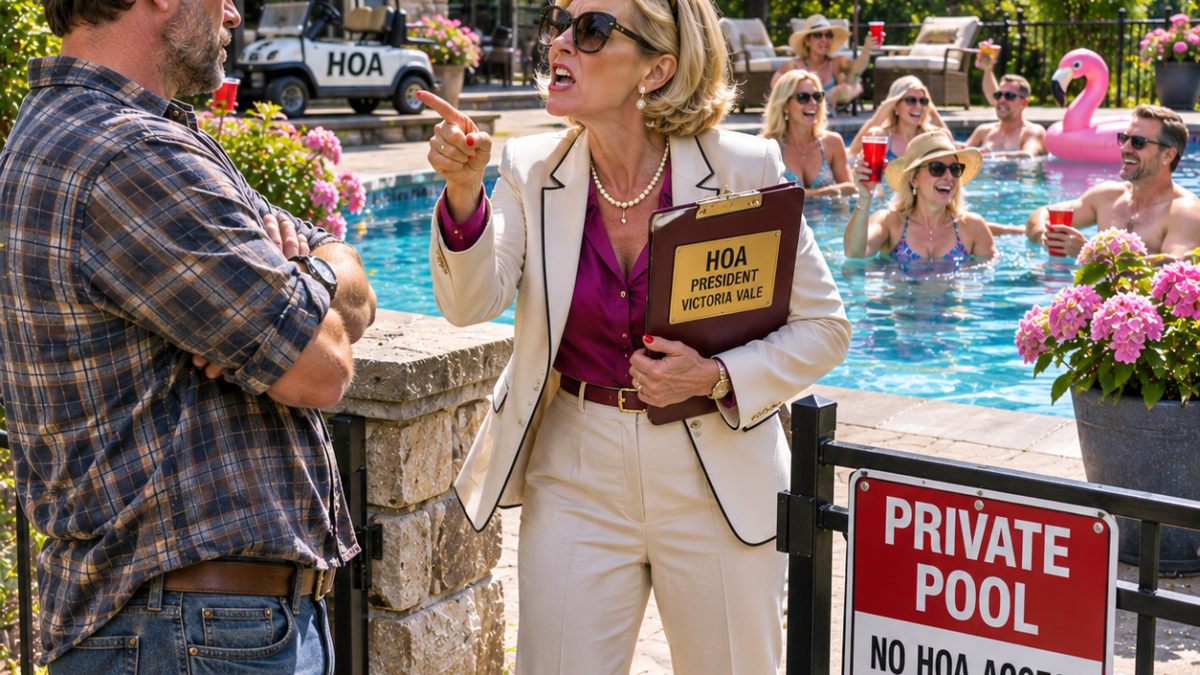
I woke up to women laughing in my backyard, and when I pulled open the bedroom curtains, I saw three strangers floating in the private pool I had spent twenty years working toward, drinking from plastic cups and playing music like they had rented the place for the weekend.
The woman in the wide-brimmed hat didn’t apologize when I confronted her—she lifted her sunglasses, informed me that my pool was a “community amenity,” and calmly produced a key to a gate whose locks I had supposedly changed before moving in.
What unsettled me most wasn’t that she had entered my property without permission; it was the confidence in her voice when she promised I would soon learn who really controlled the neighborhood.
My name is Tom Harding, and two months earlier I had thought buying that house was the beginning of the quietest chapter of my life.
I was forty-eight, single, and tired of apartments, landlords, shared walls, and neighbors who believed two in the morning was an appropriate time to move furniture. I had spent most of my career managing large commercial projects, which meant long hours, constant travel, and years of putting off the idea of having a place that actually felt permanent.
Then I found the house on Willow Ridge Drive.
Two stories. Mature trees. A fenced backyard.
And the pool.
It wasn’t enormous or extravagant. Just a clean rectangular pool bordered by stone decking, a small patio, and enough privacy that I could sit outside after work without seeing another person.
That privacy was one of the reasons I bought the place.
Which was why seeing three women in the water that Saturday morning felt so absurd that my brain initially refused to accept it.
I walked outside barefoot.
“Excuse me.”
One woman stopped laughing.
Another lowered her drink.
The one wearing the sun hat remained stretched across a white inflatable swan.
“Yes?”
“This is private property.”
She smiled.
“Sweetheart, this is the community pool.”
“No, it isn’t.”
Her friends exchanged glances.
I pointed toward the house.
“I own this property. I bought it two months ago.”
The woman sat up slowly.
She was probably in her mid-fifties, carefully styled even in swimwear, with oversized sunglasses and the kind of expression that suggested she had spent years watching other people back down.
“I wasn’t notified of any change in access.”
“Access?”
“The HOA has historically used this pool.”
“That has nothing to do with me.”
She laughed.
“You must be new.”
“I just told you I am.”
“Well, then you should probably read your community documents before making accusations.”
“I read every page before closing.”
Her smile thinned.
“Section Nine.”
“What about it?”
“Common recreational access.”
I knew the section.
It covered the clubhouse lawn, tennis court, walking trail, and playground.
Not my backyard.
“Section Nine doesn’t include this property.”
Her friends were no longer smiling.
“Karen,” one of them murmured.
So that was her name.
Karen stood in the shallow end and walked toward the steps.
Water ran from her floral cover-up as she climbed onto my deck.
“I have a key,” she said.
“That doesn’t make it yours.”
“It means someone thought I had a right to be here.”
“Not me.”
She stopped close enough that I could smell expensive coconut sunscreen.
“Then perhaps you should call Paul.”
“Who’s Paul?”
“The HOA president.”
She put her sunglasses back on.
“Tell him Karen Pemberton said hello.”
I folded my arms.
“You and your friends need to leave.”
Her expression hardened.
For the first time, the pleasant neighborhood mask disappeared.
“Be careful, Tom.”
I had never told her my name.
Before I could ask how she knew it, she turned toward her friends.
“Ladies, apparently our new neighbor is confused.”
They gathered their towels without arguing.
Karen walked to the side gate.
I expected her to struggle with the latch.
She didn’t.
She reached into her beach bag, pulled out a silver key, unlocked it, and stepped through.
Then she looked back at me.
“We’ll see who really owns this pool.”
The gate clicked shut behind her.
I stood there staring at the lock.
Then I looked at the water.
Three abandoned plastic cups floated near the edge.
One of the white lounge chairs had been dragged across the deck.
And beside it lay a laminated card I had never seen before.
I picked it up.
Across the top, beneath the Willow Ridge HOA logo, were four words:
AUTHORIZED COMMUNITY POOL ACCESS.
At the bottom was Karen Pemberton’s signature.
PART 2
I stared at that card long enough for the sunlight reflecting off the plastic to start hurting my eyes.
Authorized Community Pool Access.
My address was printed beneath it.
Not the clubhouse.
Not a lot number somewhere else.
My address.
And under that, in smaller letters:
Access coordinator: Karen Pemberton.
For several seconds, all I could hear was the pool filter humming.
I turned the card over.
There was no date.
No board approval number.
No management company stamp.
Just the HOA logo and Karen’s signature.
That made it worse.
Because it didn’t look accidental.
It looked official enough to fool anyone who wanted to believe it.
I carried the card inside, dried my hands, and opened the binder I had received at closing.
The deed was clear.
The plat map was clearer.
My property line ran along the fence.
The pool, deck, patio, pump equipment, side gate, and every square foot Karen had been occupying belonged to me.
I found Section Nine.
Common recreational access applied only to properties owned or maintained by the Willow Ridge Homeowners Association.
My house had never been one of them.
At least not according to anything I had signed.
I called the HOA office.
A receptionist answered.
“Willow Ridge Homeowners Association. How can I help you?”
“I need to speak with Paul.”
“May I ask what this concerns?”
“Karen Pemberton and three women swimming in my backyard.”
Silence.
Then a careful little intake of breath.
“Your backyard?”
“My pool.”
Another pause.
“I’ll see if he’s available.”
The hold music lasted almost four minutes.
Paul finally came on.
“Tom! Welcome to Willow Ridge.”
He sounded too cheerful.
“Karen told me to call you.”
That erased some of the cheer.
“Karen?”
“She and two friends were in my pool this morning.”
“Ah.”
That single syllable told me he already knew more than I did.
“She said it was a community pool.”
Paul laughed weakly.
“Well, there’s some history there.”
“My deed doesn’t mention history.”
“No, of course.”
“She had a key.”
“Yes.”
“Why?”
He sighed.
“Tom, why don’t you stop by the HOA office this afternoon? It’ll be easier to explain.”
“I think you can explain it now.”
“It’s complicated.”
“Someone entered my fenced property and used my pool.”
“I understand.”
“No. You understand enough to keep saying that instead of answering me.”
Silence.
Then his voice dropped.
“The previous owner had an informal arrangement.”
“What arrangement?”
“The pool was occasionally used for neighborhood social events.”
“Occasionally?”
“Yes.”
“Did that arrangement transfer with the sale?”
“Not formally.”
“Then it ended.”
“That would be my interpretation.”
“Good.”
“But—”
There it was.
“But what?”
“Karen may have a different interpretation.”
“Karen’s interpretation doesn’t matter.”
“She’s on the budget committee.”
I actually pulled the phone away from my ear and stared at it.
“What does that have to do with my swimming pool?”
“Nothing legally.”
“Then why mention it?”
Paul exhaled.
“Because you’re new, Tom, and I don’t want this becoming your introduction to Willow Ridge.”
“I woke up to strangers in my pool. I think that ship sailed.”
He was quiet.
“Come by at three.”
I almost refused.
Instead, I said, “Fine.”
The HOA office was inside a small brick building attached to the clubhouse.
Paul met me in a conference room.
He was in his early sixties, silver hair, navy polo, expensive watch, professionally friendly smile.
The smile faded when I put Karen’s laminated card on the table.
“Where did you get that?”
“She left it on my pool deck.”
He picked it up.
His eyes moved across the text.
“This isn’t current.”
“That wasn’t my question.”
“No.”
“Did the HOA issue it?”
“Years ago.”
“To Karen?”
“Apparently.”
“For my property?”
He leaned back.
“The previous owner was a man named Harold Benton.”
“I know.”
“Harold traveled constantly. He rarely used the pool.”
“And?”
“Karen helped coordinate some summer events.”
“So Harold gave her permission.”
“For certain occasions.”
“Not permanent access.”
“I don’t believe so.”
“You don’t believe?”
Paul rubbed his forehead.
“There wasn’t a formal contract.”
“Good. Then this is easy.”
“I wish it were.”
I looked at him.
“Why isn’t it?”
“Karen has been in Willow Ridge for fifteen years.”
“So?”
“She has relationships with a lot of residents.”
“Still not hearing anything about my pool.”
“She can be difficult when she feels challenged.”
I laughed once.
“So your solution is to let her trespass?”
“No.”
“That’s exactly what you’re suggesting.”
“I’m suggesting you give this a little time.”
“She had friends in my backyard this morning.”
“She probably thought the old arrangement continued.”
“I told her it didn’t.”
“Good.”
“And she told me we’d see who really owns the pool.”
Paul’s mouth tightened.
“She said that?”
“Yes.”
He looked toward the closed conference-room door.
Then back at me.
“I’ll speak with her.”
“I’ll change the locks.”
“That would be reasonable.”
“And I want written confirmation that my pool is not an HOA amenity.”
Paul hesitated.
That was the first moment I genuinely stopped trusting him.
“Why is that difficult?”
“It isn’t.”
“Then write it.”
He opened a drawer, pulled out HOA letterhead, and stared at the blank page.
I watched him.
Finally, he typed.
The private swimming pool located at 1847 Willow Ridge Drive is situated entirely within the privately owned lot and is not designated as a Willow Ridge HOA common amenity.
He printed it.
Signed it.
I took the letter.
“Thank you.”
Paul nodded.
“Tom?”
I stopped at the door.
“Pick your battles.”
I turned.
He gave me an apologetic smile.
“Karen has a way of making small issues consume entire neighborhoods.”
“That sounds like a reason someone should have stopped her years ago.”
His smile disappeared.
I went home.
The first thing I did was change the gate lock.
The second was install a better latch.
The third was photograph everything.
I had spent too many years managing construction projects to trust memory when documentation was available.
Dates.
Receipts.
Photos.
Serial numbers.
The HOA letter.
The access card Karen had dropped.
I put all of it in a folder.
Then I poured myself a drink and sat beside the pool.
The water looked completely normal again.
That should have helped.
It didn’t.
A private space feels different after someone enters it without permission.
You begin noticing sight lines.
Fence gaps.
How easily someone could reach a latch.
Every noise behind you becomes an interruption.
I hated that.
It was my home.
I had worked twenty years to stop feeling temporary.
And within two months of buying the place, a woman I had never invited had made me feel like a guest.
For four days, nothing happened.
Then my phone buzzed while I was at work.
Motion detected.
I had installed the first camera the night after Karen’s visit.
The live feed opened.
Karen sat on one of my lounge chairs.
Alone.
Sun hat.
Sunglasses.
Drink beside her.
She wasn’t swimming.
She was reading.
I stared at the screen.
She looked directly toward the camera.
Raised her drink.
And smiled.
I called Paul.
No answer.
I called the police non-emergency line.
The dispatcher asked whether she was currently inside the property.
“Yes.”
“Did she force entry?”
“I don’t know. I’m not home.”
“Any threats?”
“She’s trespassing.”
“We can send an officer if one becomes available.”
“How long?”
“I can’t give you a time.”
Karen stayed forty-seven minutes.
By the time I got home, she was gone.
Nothing appeared damaged.
The new lock was intact.
That bothered me more than if it had been broken.
I checked the camera footage.
At 12:18, Karen approached the gate.
She inserted a key.
The gate opened.
I replayed it.
Then again.
Impossible.
The lock was new.
I had installed it myself.
I removed the cylinder and took it to a locksmith the next morning.
Ray Mercer had worked on several commercial jobs for me over the years.
He examined it.
“No damage.”
“She opened it with a key.”
“You give anyone a copy?”
“No.”
“Installer?”
“Me.”
He looked at me.
“Then either she has the right key or somebody swapped something.”
“Can you rekey everything?”
“Sure.”
“I mean everything.”
He grinned.
“Bad divorce?”
“HOA.”
The grin vanished.
“Worse.”
By noon, the gate, side door, shed, exterior storage, and rear entry all had new locks.
Ray handed me two sets.
“That’s all.”
“No master copy?”
“Not from me.”
“Good.”
I showed him the video.
Karen opening the previous lock.
He watched closely.
“Where’d she get that key?”
“That’s what I want to know.”
He rewound.
The keychain had a bright pink plastic tab.
KP.
Karen Pemberton.
Ray handed back my phone.
“She’s comfortable.”
“That’s what bothers me.”
“People who know they’re trespassing usually look around.”
“She does.”
“Not much.”
He was right.
Karen didn’t behave like someone afraid of being caught.
She behaved like someone convinced she could explain away being caught.
Thursday afternoon, another motion alert appeared.
Karen stood outside the new gate.
She tried one key.
Then another.
Then a third.
Nothing.
For the first time since I had met her, she looked confused.
Then angry.
She grabbed the gate and shook it.
The camera microphone picked up her voice.
“You can’t lock me out forever.”
She leaned toward the lens.
“I know you’re watching.”
Then she walked away.
I saved the clip.
Friday morning, I emailed it to Paul.
His response came twenty minutes later.
Tom,
I have spoken with Karen and reminded her that the prior informal access arrangement no longer applies. Please avoid escalating the matter.
I read the last sentence twice.
Please avoid escalating.
I wrote back.
Paul,
I changed my locks. She returned and attempted to use multiple keys. She then told my security camera I “can’t lock her out forever.”
I am not escalating. I am locking my gate.
Do not characterize basic property security as escalation again.
He didn’t answer.
Saturday passed quietly.
Sunday did not.
I had two coworkers over for lunch.
We were on the patio when my friend Melissa pointed toward the side yard.
“Tom?”
I turned.
Karen was walking toward us.
No hat this time.
No friends.
Just Karen carrying a clipboard.
I stood.
“How did you get in?”
She smiled.
“Good afternoon.”
“How did you get through the gate?”
“I’m conducting an HOA inspection.”
“No, you’re not.”
She looked toward Melissa and Dave.
“Guests?”
“Yes.”
“Interesting.”
“Karen, leave.”
She opened the clipboard.
“There have been concerns about improper pool maintenance.”
“From whom?”
“Residents.”
“Which residents?”
“Complaints are confidential.”
“What maintenance issue?”
“Water clarity.”
I looked at the pool.
It was crystal clear.
Dave coughed into his hand, badly hiding a laugh.
Karen noticed.
“This is official HOA business.”
I walked toward her.
“No HOA business authorizes you to enter my fenced backyard.”
“The association retains inspection authority.”
“Not without notice.”
Her expression hardened.
“You’re making this unnecessarily hostile.”
“You entered my property.”
“You moved into a community, Tom. You didn’t buy an island.”
“I bought this lot.”
She looked at Melissa and Dave.
“You see what I’ve been dealing with.”
Melissa blinked.
“What exactly have you been dealing with?”
Karen hadn’t expected that.
Melissa continued.
“Because from where I’m sitting, you walked into his backyard without permission.”
Karen’s cheeks reddened.
“I’m a board member.”
“So?”
Karen turned back to me.
“You should be careful about the kind of people you encourage to interfere with neighborhood matters.”
Dave stood.
“Are you threatening us now?”
“I’m advising.”
I pointed toward the gate.
“Leave.”
Karen stepped closer.
“You think because you have cameras and paperwork you can embarrass me.”
“I think because I own the house I can decide who uses my pool.”
“You don’t understand how things work here.”
“I’m beginning to.”
“You’ll regret this.”
I held her gaze.
“Maybe.”
Then I pointed toward the gate again.
“But you’ll regret staying.”
She left.
Melissa watched her disappear.
Then she looked at me.
“You weren’t exaggerating.”
“No.”
Dave shook his head.
“That woman thinks your backyard is a government building.”
The joke helped.
For about ten minutes.
Then I walked to the gate.
It was locked.
No damage.
I checked the fence line.
Near the rear corner, one board had fresh scratches.
A small garden bench on the other side had been moved.
Karen had climbed over.
That was the moment the whole thing stopped feeling ridiculous.
A person willing to climb a fence after being repeatedly told to stay out was not confused.
She was obsessed.
Monday morning, I went back to Paul.
I didn’t call first.
His assistant looked uncomfortable when I walked in carrying my folder.
“Is he available?”
“He’s in a meeting.”
“I’ll wait.”
Paul emerged twelve minutes later.
He saw me.
Closed his eyes briefly.
“Tom.”
“We need to talk.”
Inside his office, I laid out the latest photographs.
Karen trying keys.
Karen shaking the gate.
Karen telling the camera I couldn’t lock her out forever.
Karen inside the yard during my barbecue.
The scratched fence.
Paul watched the video.
When it ended, he leaned back.
“That’s bad.”
I stared at him.
“That’s your professional assessment?”
“What do you want me to say?”
“I want you to do your job.”
“Karen isn’t an employee.”
“She’s on your board.”
“She’s on a committee.”
“Then remove her.”
“I can’t just remove someone.”
“You can issue a violation.”
He hesitated.
I finally understood.
“You’re afraid of her.”
His jaw tightened.
“No.”
“Yes, you are.”
“Tom—”
“You told me she’s influential. You told me to pick my battles. You keep asking me not to escalate while she keeps entering my property.”
“That’s not fair.”
“It’s exactly fair.”
Paul looked toward his door.
Then lowered his voice.
“She controls three votes on the board.”
“How?”
“She has allies.”
“That’s what boards have.”
“She also has a lot of support among older residents.”
“Then show them the video.”
“It’s not that simple.”
“Why?”
Paul rubbed his temples.
“Karen has been threatening a recall vote against me for months.”
I sat back.
There it was.
“So you won’t discipline her because you’re afraid she’ll take your job.”
“That is not what I said.”
“It’s exactly what you said.”
“I’m trying to keep this association functioning.”
“By sacrificing whichever homeowner she decides to bully.”
“That’s unfair.”
“You already used that word.”
He looked exhausted.
I almost felt sorry for him.
Almost.
Then I remembered Karen standing beside my pool telling me she owned access because she had spent fifteen years teaching everyone around her that resistance was inconvenient.
“I want a formal violation notice sent to her.”
Paul sighed.
“I can send a warning.”
“No. Violation.”
“I don’t have unilateral authority.”
“Then call a board meeting.”
“That would create a war.”
I stood.
“Paul, the war is already happening. You just decided only one side should be allowed to fight.”
I left.
That night, I sat beside the pool until almost midnight.
The neighborhood was quiet.
A few porch lights glowed beyond the fence.
The water reflected the moon.
I should have felt lucky.
Beautiful house.
Beautiful yard.
Everything I had worked for.
Instead, I had begun checking my cameras before I checked the weather.
That realization made me angrier than Karen ever had.
She was taking something more expensive than pool access.
She was taking the feeling of safety.
I called Mason Alder.
We had not spoken in almost three years.
Mason had been my roommate in graduate school before our careers went different directions. He became a chemistry professor. I moved into project management.
He answered on the fourth ring.
“Tom Harding.”
“Still alive?”
“Against several predictions.”
“I need advice.”
“That sentence has historically cost me sleep.”
I told him the story.
He laughed at first.
Then stopped.
“She’s climbing fences?”
“Yes.”
“And the HOA won’t act?”
“No.”
“What are you thinking?”
“I want something visible.”
“Visible how?”
“If she trespasses again, I want it impossible for her to deny.”
“You have cameras.”
“She denies those.”
“People deny sunrise if they think it helps them.”
“Exactly.”
Mason went quiet.
“I’m going to say this before you get creative. Don’t put anything dangerous in a pool.”
“I’m not trying to hurt her.”
“Good.”
“I want embarrassment, not an ambulance.”
“Better.”
“What if there were a harmless temporary color marker?”
He paused.
“For what purpose?”
“To document unauthorized use.”
“You’re talking about some kind of pool-safe theatrical effect?”
“Something like that.”
“No homemade chemistry.”
“Agreed.”
“No reactive recipe you found online.”
“Agreed.”
“No irritants.”
“Agreed.”
“And if you use anything, it needs to be a commercially approved, pool-compatible temporary marker with safety documentation.”
“That’s why I called you.”
He laughed.
“Finally, adulthood.”
Mason helped me identify a temporary water-safe color product used for demonstrations and visual tracing.
No secret formula.
No dangerous reaction.
No poison.
No skin damage.
The effect was temporary and washable.
More importantly, the paperwork existed.
Safety documentation.
Manufacturer information.
Handling instructions.
I cared about that more than the color.
“If anyone gets in that water unexpectedly,” Mason said, “you disclose exactly what you used.”
“I will.”
“If children show up, you stop the whole thing.”
“Immediately.”
“And honestly?”
“What?”
“Maybe just call the police.”
“I did.”
“Again.”
“I will.”
He sighed.
“I know that tone.”
“What tone?”
“The one where you already decided.”
He wasn’t wrong.
But I also knew I needed the plan to be more than revenge.
So I changed it.
I contacted the police non-emergency line and filed another report documenting Karen’s repeated trespass.
I sent certified notices to Karen and the HOA.
PRIVATE PROPERTY.
NO POOL ACCESS.
NO PERMISSION TO ENTER.
I installed another camera facing the gate.
I had Ray reinforce the fence.
And I asked Jim Collins, a retired teacher who lived two houses away, whether he would serve as a witness if Karen returned.
Jim listened carefully.
“You’re serious.”
“Very.”
“You think she’ll come back?”
“I know she will.”
He looked toward Karen’s house.
“What do you need me to do?”
“Nothing dramatic. If you see her entering, record from your property and call me.”
“Police?”
“If she refuses to leave.”
Jim nodded.
Then smiled.
“My wife has hated that woman since 2019.”
“Why?”
“She fined us because our Christmas wreath was up on January sixth.”
“That’s a crime now?”
“Apparently Christmas expires at midnight.”
For the first time in days, I laughed.
The next Saturday dawned warm and clear.
I checked the pool.
Checked the cameras.
Checked the gate.
Then I documented the harmless temporary color marker Mason had helped me source.
I followed the product’s directions and did not alter or improvise anything.
The pool still looked blue.
Normal.
Peaceful.
I almost abandoned the entire idea.
I stood on the deck staring at the water.
Maybe this was childish.
Maybe the smarter move was simply another police report.
Another certified letter.
Another camera.
Then I remembered Karen climbing the fence.
“You can’t lock me out forever.”
The problem was not that she didn’t understand.
The problem was that she wanted to prove my boundaries were meaningless.
I went inside.
At 11:43, Jim texted.
White SUV.
I opened the camera feed.
Karen’s vehicle stopped near the corner.
She got out wearing a white sun hat and carrying an oversized beach bag.
Two women followed.
One carried towels.
The other carried a pink inflatable flamingo.
My stomach tightened.
Jim texted again.
She’s going toward your gate.
I watched.
Karen tried the latch.
Locked.
She looked toward the house.
Then toward the fence.
One friend said something.
Karen pointed.
They walked toward the rear corner.
The camera angle switched.
Karen climbed onto the small bench outside the fence.
She lifted herself over.
Then opened the gate from inside for the other two women.
I stared at the screen.
There it was.
No confusion.
No old key.
No misunderstanding.
She had climbed my fence and let her friends in.
I called the police.
Then I started recording locally.
Karen spread her towel across my lounge chair.
One friend inflated the flamingo.
The other opened a cooler.
Karen looked directly toward the camera.
Then raised both hands.
As if asking what I planned to do about it.
I walked outside.
All three women turned.
Karen smiled.
“Morning.”
“Police are on the way.”
Her friends stopped moving.
Karen laughed.
“For what?”
“Trespassing.”
She removed her sunglasses.
“Seriously?”
“Yes.”
“You called the police because three neighbors are swimming?”
“You climbed my fence.”
“I used access that should never have been revoked.”
“There is no access.”
“I disagree.”
“I have written confirmation from the HOA.”
“Paul doesn’t own this neighborhood.”
“No. Neither do you.”
Her jaw tightened.
One friend whispered, “Karen, maybe we should go.”
Karen did not look at her.
“No.”
I pointed toward the gate.
“You’re all being asked to leave.”
The second woman grabbed her towel.
Karen turned.
“Sit down.”
The woman hesitated.
That told me something important.
These weren’t fearless trespassers.
They were followers.
Karen needed the audience.
Without it, she was just one woman standing in somebody else’s backyard.
“I’m leaving,” the brunette said.
Karen stared at her.
“Seriously?”
“Tom asked us to.”
Karen laughed bitterly.
“Oh, now Tom is in charge?”
I couldn’t resist.
“Of my backyard? Yes.”
The brunette left.
The blonde lingered.
Karen dropped her cover-up.
“I’m swimming.”
“Karen.”
She walked toward the pool.
“If you enter that water after being expressly told to leave, the cameras will record it.”
“Good.”
She turned toward the camera.
“Get my good side.”
Then she jumped.
The splash hit the deck.
For a few seconds, nothing happened.
Karen surfaced.
Smiled.
“See?”
Then she looked at her arm.
A faint temporary tint had appeared where product residue and sunscreen met the water’s visual marker.
Her expression changed.
“What is this?”
The blonde stepped backward.
“Karen?”
Karen rubbed her arm.
The color smeared lightly across the surface.
“What did you put in the water?”
“A pool-safe temporary marker.”
Her face went white.
“You poisoned me!”
“No.”
“You poisoned me!”
“It’s documented and non-toxic. Get out of the pool.”
She started shouting.
The blonde ran toward the gate.
Karen climbed out, staring at her arms.
The temporary color looked dramatic in sunlight.
That was the whole point.
Visible.
Unmistakable.
Washable.
She grabbed her phone.
“I’m calling 911.”
“I already called the police.”
“You attacked me!”
“You entered after being told to leave.”
She started filming herself.
“This man put chemicals in the pool knowing I would be here.”
That sentence was extraordinary.
I stared at her.
“You just admitted you expected to trespass.”
She froze.
Only for a second.
Then went back to the performance.
“I need an ambulance.”
“Do you feel sick?”
“I don’t know!”
“Difficulty breathing?”
“No.”
“Burning?”
“No.”
“Pain?”
“No.”
“Then rinse with the hose while we wait.”
She glared at me.
“You think this is funny?”
“No.”
“You humiliated me.”
“You climbed my fence.”
“This neighborhood has used this pool for years.”
“Not since I bought it.”
“You can’t erase history.”
“I can close my gate.”
Neighbors had begun appearing beyond the fence.
Jim stood near his driveway recording from a distance.
Mrs. Alvarez leaned over her back fence.
A teenager across the street held up a phone.
Karen realized people were watching.
Her panic turned into fury.
“You’ll lose this house.”
I stared at her.
“What?”
“I’ll make sure of it.”
That was not a joke.
Not in her voice.
“You’re threatening me?”
“I’m telling you there are consequences.”
“For stopping you from using my pool?”
“For attacking an HOA board member.”
Sirens approached.
Karen smiled.
She genuinely believed they were coming for me.
Officer Ruiz arrived first.
He was tall, calm, maybe early forties.
His partner followed.
Karen rushed toward them.
“He poisoned the pool.”
Ruiz raised a hand.
“Ma’am, slow down.”
“He intentionally exposed me to chemicals.”
“Do you need medical attention?”
“Yes.”
“What symptoms?”
Karen hesitated.
“My skin is green.”
Ruiz looked at her arms.
“Pain?”
“No.”
“Burning?”
“No.”
“Difficulty breathing?”
“No.”
“Dizziness?”
“No.”
Ruiz looked at me.
“Sir?”
I handed him the product documentation.
“Temporary pool-safe visual marker. Commercial product. I used it according to manufacturer instructions.”
“Why?”
“To document unauthorized use after repeated trespassing.”
Karen exploded.
“He set a trap!”
Ruiz turned toward her.
“How did you enter the yard?”
Silence.
“She climbed the fence,” Jim called from outside.
Karen spun.
“Stay out of this!”
Ruiz looked toward Jim.
“You have video?”
“Yes, officer.”
Karen’s face changed.
Ruiz turned back.
“Ma’am, were you told you did not have permission to use this pool?”
“He doesn’t have the right to revoke community access.”
“That’s not what I asked.”
She folded her arms.
“This is an HOA matter.”
Paul arrived fifteen minutes later.
Someone had called him.
He looked like he wanted the earth to open beneath him.
Ruiz asked, “Is this pool an HOA common area?”
Paul looked at me.
Then at Karen.
Then at the cameras.
“No.”
Karen stared at him.
“Paul.”
He swallowed.
“It is private property.”
“Paul.”
“And you were told not to access it.”
Her face hardened.
“You coward.”
Ruiz wrote something in his notebook.
Karen pointed at me.
“You hear this? He poisoned a board member and everyone’s blaming me.”
Paul looked exhausted.
“Karen, you climbed his fence.”
“You’re supposed to protect the association.”
“I’m trying to.”
“From him!”
“No.”
That word landed harder than any speech could have.
No.
Paul had finally said it.
Karen stared at him.
He continued.
“From this.”
She stepped toward him.
“This association existed before he arrived.”
“His deed existed before your access card.”
Karen’s mouth opened.
Paul kept going.
“I checked the old records.”
I looked at him.
“What records?”
He rubbed his forehead.
“Harold Benton allowed limited pool use during three HOA events years ago.”
Karen shook her head.
“That’s not true.”
“It is.”
“I managed access.”
“For those events.”
“I had permanent authority.”
“No.”
She looked around.
For the first time, the certainty cracked.
Ruiz asked Paul for copies.
Paul nodded.
Karen looked at me.
“This isn’t over.”
I believed her.
The police report documented the trespass.
Nobody arrested me.
Nobody rushed Karen to the hospital.
The temporary color washed away.
But the footage did not.
By sunset, clips were spreading through Willow Ridge’s neighborhood group.
I did not post them.
Jim did not post them.
Somebody else had filmed from the street.
The worst clip for Karen was not the moment she emerged tinted.
It was the moment before she entered.
My voice could be heard clearly.
You are being asked to leave.
And Karen’s answer.
I’m swimming.
That five-second exchange did more damage to her credibility than anything I could have written.
She tried to fight back online.
She posted a long statement accusing me of a “premeditated chemical attack.”
Someone replied with a screenshot of her climbing over the fence.
She deleted the comment.
Another person posted Paul’s signed letter stating the pool was private.
She deleted that one too.
Then a third resident uploaded an old photograph.
Karen at my pool.
Years earlier.
A banner behind her read:
WILLOW RIDGE SUMMER FUNDRAISER — HOSTED BY HAROLD BENTON.
The caption under the photograph read:
Special thanks to Harold for allowing the HOA one-day access to his private pool.
One-day access.
Karen’s story collapsed in public.
But that was only the beginning.
Three days later, the HOA held an emergency meeting.
I arrived early.
The clubhouse was packed.
Karen sat in the second row rather than at the board table.
That alone told me something had changed.
Paul called the meeting to order.
“We are here to address concerns regarding unauthorized property access, historical access keys, and board conduct.”
Karen raised her hand.
“I want the record to reflect that I object to the characterization.”
Paul looked at her.
“The record will reflect your objection.”
She wasn’t used to that tone from him.
Neither was I.
Paul held up a file.
“After reviewing archived records, the association has confirmed that 1847 Willow Ridge Drive has never been designated as common property.”
A murmur moved through the room.
Karen sat rigid.
“The prior owner permitted limited recreational use on specific dates.”
Paul continued.
“The access authorization card currently held by Ms. Pemberton was issued for event coordination and was never intended to create permanent access rights.”
Karen stood.
“That’s false.”
Paul looked at her.
“Sit down.”
The room went completely silent.
Karen stared at him.
“Excuse me?”
“You’ll have a chance to speak.”
“I’m on the budget committee.”
“Not tonight.”
She sat.
Barely.
Paul continued.
“The board has also learned that multiple duplicate access keys may have remained in circulation after the property was sold.”
I leaned forward.
“How many?”
Paul hesitated.
“We don’t know.”
That answer angered the room.
A man behind me said, “You don’t know who has keys to private homes?”
Paul raised both hands.
“We are auditing all historical access records.”
Karen stood again.
“This is ridiculous. Nobody has keys to homes. We had amenity access.”
My voice came out before I planned it.
“My backyard is not an amenity.”
Applause broke out.
Not everyone.
Enough.
Karen turned toward me.
“You enjoyed humiliating me.”
I stood.
“No.”
“You planned it.”
“I planned to document you entering after being told not to.”
“You altered the pool.”
“With a harmless temporary marker.”
“You knew I would swim.”
“No. I knew you might trespass because you had repeatedly done it.”
She pointed toward me.
“You wanted me embarrassed.”
I looked around the room.
“I wanted her to stop coming into my yard.”
Then I looked at Karen.
“You had a gate.”
Her mouth tightened.
“You had a warning.”
Silence.
“You had cameras.”
More silence.
“You had written notice.”
Paul looked down.
“You had police reports.”
Karen’s face reddened.
“And you climbed the fence anyway.”
Someone in the back said, “That’s the whole story.”
Karen turned.
“No, it isn’t.”
A woman I didn’t know stood.
“My name is Rita Caldwell.”
Paul recognized her.
“Rita?”
She held up a folder.
“I think Karen’s right.”
Karen’s expression changed instantly.
Hope.
Rita continued.
“There is more to the story.”
Then she looked directly at Karen.
“I want to know why HOA money paid for pool maintenance at Tom’s address for three years.”
The room froze.
Even I didn’t understand.
“What?”
Rita walked toward the front.
“My husband used to be on the finance committee.”
Karen went pale.
Rita placed invoices on the table.
“Blue Horizon Pool Service. Monthly charges. Paid from the HOA discretionary maintenance account.”
Paul grabbed the top invoice.
I stepped closer.
The service address was mine.
1847 Willow Ridge Drive.
The dates began long before I purchased the house.
And continued until one month before closing.
Karen stood.
“That was approved.”
“By whom?” Rita asked.
“The board.”
Paul looked through the invoices.
“I never approved these.”
“You weren’t president when it started.”
“But I’ve been president six years.”
Karen’s jaw tightened.
Rita pulled out another page.
“Here’s the interesting part.”
She handed it to Paul.
The vendor address matched a post-office box.
The company no longer existed.
But the payment authorization signature remained.
Karen Pemberton.
Budget Committee.
My anger shifted.
This wasn’t just entitlement anymore.
This was money.
Paul looked sick.
“How much?”
Rita answered.
“Those invoices alone total almost nineteen thousand dollars.”
The room erupted.
Karen shouted over everyone.
“This is completely unrelated.”
Rita laughed.
“You’ve been using HOA funds to maintain a private pool you treated like your personal club.”
“It was used for community events.”
“Three events?”
Karen froze.
Rita held up the archived event calendar.
“Three documented pool events in eleven years.”
Paul stared at the invoices.
I watched his face change.
Fear became anger.
“Karen.”
She looked at him.
“Where did these payments actually go?”
“To Blue Horizon.”
“The company dissolved four years ago.”
“That’s not my responsibility.”
Paul lifted another invoice.
“This one is from last year.”
Silence.
The room became so quiet I could hear someone’s phone vibrating.
Karen looked toward the exit.
Paul noticed.
“Don’t leave.”
“You have no authority to detain me.”
“No. But if you walk out now, the meeting continues without you.”
She sat.
Rita wasn’t finished.
“There are more.”
She produced landscaping invoices.
Event supply invoices.
Gate repair invoices.
Pool chemical invoices.
Several appeared inflated.
Some referenced work no resident remembered seeing.
One vendor address traced to a mailbox rented by Karen’s cousin.
Paul ended the meeting early.
Not because the discussion was over.
Because the HOA’s attorney had called him from the back of the room and told him to stop talking publicly.
Karen left through a side door.
Nobody followed.
The next morning, the HOA announced an independent financial audit.
Paul called me personally.
“I owe you an apology.”
“Yes.”
He went quiet.
I almost laughed.
“At least argue.”
“I don’t have one.”
“What happens now?”
“We open everything.”
“You should have done that years ago.”
“I know.”
“Why didn’t you?”
Another silence.
Then he said, “Because Karen made herself useful.”
I sat down.
“That’s not an answer.”
“It is, unfortunately.”
He told me Karen volunteered for every task nobody wanted.
Budgets.
Vendor coordination.
Events.
Maintenance approvals.
Access lists.
She remembered names.
Deadlines.
Rules.
She solved problems.
Then, over time, people stopped checking how.
“She was difficult,” Paul said. “But things got done.”
“So you let her build a system nobody understood.”
“Yes.”
“And then you became afraid of challenging her.”
“Yes.”
I appreciated the honesty.
It didn’t make me less angry.
The audit took six weeks.
During that time, Karen’s public behavior became unpredictable.
One day she posted apologies.
The next day legal threats.
She accused the HOA of scapegoating her.
She accused me of manipulating residents.
She accused Rita of falsifying invoices.
She accused Paul of incompetence.
That last one was at least partially true.
Her friends began disappearing.
The blonde who had stayed by the pool sent me a handwritten note.
Tom,
I’m sorry.
Karen told us your pool remained open to certain longtime residents because of an old agreement.
I should have asked you directly.
I won’t enter your property again.
—Melissa Grant
I believed her.
The brunette, Dana, stopped by in person.
“I should have left the first time.”
“You did eventually.”
“That doesn’t excuse the earlier visits.”
“No.”
She looked embarrassed.
“Karen makes certainty contagious.”
That phrase stayed with me.
“What does that mean?”
“She says things like they’re already decided.”
I understood immediately.
“That’s exactly what she does.”
“If you question her, she acts like you’re too uninformed to understand.”
“Also accurate.”
Dana looked toward Karen’s house.
“I think a lot of us went along with things because arguing was exhausting.”
There it was again.
The same excuse Paul had given.
The same mechanism.
Karen didn’t need everybody to agree.
She only needed disagreement to feel more expensive than surrender.
The audit report arrived on a Monday.
Paul asked me to attend a closed homeowner briefing.
I sat beside Rita.
The independent accountant summarized the findings.
Nearly sixty thousand dollars in HOA funds could not be properly supported by legitimate invoices or verifiable services.
Some expenses were careless.
Some were unauthorized.
Others appeared deliberately routed through questionable vendors.
Karen’s name appeared repeatedly in approvals.
She had not stolen sixty thousand dollars in cash and hidden it under her mattress.
Reality was more complicated.
Inflated service contracts.
Reimbursements with weak documentation.
Duplicate charges.
Payments for work tied to private properties.
Event expenses that could not be verified.
Pool maintenance.
Landscaping.
Equipment.
A pattern.
The accountant looked at Paul.
“I recommend referral to counsel and appropriate authorities.”
Karen attended with her attorney.
She did not speak until the end.
Then she stood.
“For fifteen years, I carried this community while everyone else complained.”
Nobody answered.
“I organized events.”
Silence.
“I negotiated vendors.”
Rita said quietly, “That’s what we’re worried about.”
Karen ignored her.
“I saved this HOA money.”
Paul finally spoke.
“Then you should have no problem explaining the records.”
Karen looked at him.
“You would have lost three elections without me.”
His face changed.
Maybe because it was true.
Maybe because she said it in front of everyone.
“You controlled who ran,” he said.
“I supported competent people.”
“You threatened anyone who disagreed.”
“I protected stability.”
Paul laughed.
Not kindly.
“That’s what you call it?”
Karen’s attorney touched her arm.
She pulled away.
Then she looked at me.
“This started because he couldn’t share a swimming pool.”
I stared at her.
“No.”
Her voice rose.
“Yes. This entire neighborhood is being torn apart because one selfish man bought a property that had always been part of the community.”
I stood slowly.
“Karen.”
She pointed at me.
“You don’t belong here.”
That hurt more than I expected.
Not because I believed her.
Because I suddenly understood how many times she had probably said versions of that sentence to other people.
Different lawns.
Different fences.
Different mailboxes.
Different families.
You don’t belong unless you accept my rules.
I looked around the room.
Then back at her.
“I bought a house.”
She laughed bitterly.
“You bought walls and paperwork.”
“Yes.”
“And you think that makes you part of Willow Ridge?”
“No.”
That surprised her.
I continued.
“The people who checked on me when you kept breaking in made me part of Willow Ridge.”
Jim nodded.
“Rita digging through records made her part of Willow Ridge.”
Rita looked down.
“Melissa apologizing when she realized she was wrong made her part of Willow Ridge.”
Melissa’s eyes filled.
“Paul finally admitting he was afraid of you might even make him part of Willow Ridge.”
A few people laughed.
Paul actually smiled.
Then I looked directly at Karen.
“A community isn’t whatever you can force people to tolerate.”
Nobody spoke.
Karen’s attorney whispered something.
She sat.
That was the last HOA meeting she attended.
Law enforcement reviewed the financial records.
Civil claims followed.
The HOA removed Karen from every committee.
Paul resigned two months later.
His resignation letter was short.
He admitted he had prioritized avoiding conflict over protecting residents.
I respected him more for that sentence than for anything he had done while president.
The county case involving Karen’s finances ended without the cinematic courtroom explosion people online had predicted.
There were negotiated consequences.
Restitution.
Probation.
Financial restrictions.
Civil judgments.
The HOA recovered a substantial portion of the unsupported funds.
I received reimbursement for documented property interference, security work, legal costs, and damaged gate components.
A restraining order required Karen to stay away from my property.
The day it became effective, I stood beside the pool reading the paperwork.
Mason called.
“So?”
“She can’t come within five hundred feet.”
“Congratulations.”
“I feel weird.”
“Why?”
“I thought I’d feel better.”
“You wanted peace.”
“Yes.”
“Paperwork doesn’t feel like peace.”
“No.”
“It feels like paperwork.”
I laughed.
Then he said, “Give it time.”
He was right.
Peace arrived slowly.
The first Saturday after the restraining order, I woke at seven thirty.
No laughter.
No music.
No motion alert.
I made coffee.
Walked outside.
Sat beside the pool.
That was it.
Nothing happened.
And because nothing happened, I almost cried.
For months, I had treated silence like an interval between attacks.
Now it was simply silence.
The pool became blue again.
Ordinary.
Mine.
Jim came over that afternoon.
He stood at the gate.
“Am I allowed in?”
I laughed.
“You are.”
“Written permission?”
“Don’t push it.”
His wife joined us later.
Then Rita.
Then Paul, surprisingly.
I hesitated when I saw him.
He raised both hands.
“I was invited.”
“By whom?”
Jim pointed toward himself.
I sighed.
“Fine.”
We sat around the pool drinking lemonade.
Nobody swam.
For almost an hour, nobody mentioned Karen.
That felt like progress.
Then Paul looked at the water.
“I really failed you.”
The conversation stopped.
I looked at him.
“You did.”
Jim nearly choked on his drink.
Paul nodded.
“I deserve that.”
“I’m not trying to hurt you.”
“I know.”
“You kept asking me to be reasonable because asking Karen to be reasonable was harder.”
He looked down.
“Yes.”
“That’s how people like her grow.”
“I know.”
I watched the water.
“I don’t think you’re a bad person, Paul.”
He looked up.
“I think you were tired.”
“That sounds generous.”
“It isn’t.”
He laughed quietly.
“Fair.”
He eventually sold his house too.
Not because anybody forced him.
He said he wanted a smaller place without an HOA.
I told him that sounded wise.
Karen’s house went on the market in early fall.
The FOR SALE sign appeared one morning without ceremony.
She had already moved out temporarily while the legal restrictions were being sorted.
Nobody threw a party.
Nobody vandalized the sign.
Nobody stood outside cheering.
That was important to me.
A neighborhood correcting itself should not become another mob.
The new owners were Evan and Rachel Morris.
They had two kids.
The first week they moved in, Rachel came to my gate.
I saw her through the camera and walked outside.
“Hi.”
She smiled nervously.
“We’re the new people from across the street.”
“I noticed.”
“I heard there’s some history.”
I laughed.
“That’s one word.”
Her son, maybe nine, stood beside her staring at the pool.
Rachel touched his shoulder.
“We wanted to make sure the kids understand your yard is private.”
I looked at her.
That simple sentence hit me harder than she could have known.
“Thank you.”
“We have a pool at my sister’s place. They’ll survive.”
Her son looked disappointed.
Then Rachel smiled.
“But maybe if Mr. Harding ever invites us…”
I looked at him.
“You know how to cannonball?”
His face lit up.
“My dad says I’m banned.”
“Excellent.”
Two weeks later, I invited them over.
Jim came.
Rita brought brownies.
Rachel’s kids turned the pool into absolute chaos.
Water everywhere.
Plastic toys.
Screaming.
Running that I had to repeatedly stop.
And I loved every second.
Because they were invited.
That was the difference Karen never understood.
A pool filled with people did not violate my peace.
People deciding they were entitled to it did.
Around sunset, Rachel sat beside me.
“I heard the whole story from Rita.”
“That was your first mistake.”
“She told me about the green water.”
I groaned.
“Of course.”
“She also told me you documented everything.”
“Yes.”
“And that you never tried to hurt anybody.”
“That mattered.”
Rachel watched her children.
“Did you ever regret it?”
I thought about Karen’s face that day.
The panic.
The humiliation.
The neighbors filming.
“Yes.”
Rachel looked surprised.
“Really?”
“I regret that it got to the point where something theatrical felt necessary.”
“That’s not the same as regretting stopping her.”
“No.”
“Would you do it again?”
I considered the question longer.
“No.”
“Why?”
“I’d call the police sooner. Hire the attorney sooner. Force the HOA into writing sooner.”
She smiled.
“That sounds less exciting.”
“It is.”
“Probably smarter.”
“Definitely.”
The internet version of the story loved the color.
The real version taught me to love paperwork.
Months later, the HOA elected a new board.
Rita became president.
She resisted for weeks.
Finally, Jim nominated her during a meeting.
Rita glared at him.
“I hate you.”
“That’s the spirit.”
She won.
Her first rule was transparency.
Every board vote posted.
Every vendor listed.
Every contract available to homeowners.
No private access keys without written authorization.
No board member allowed to enter a private lot except in an emergency or under the procedures already provided by law and governing documents.
No informal arrangements continuing after property transfers unless the new owner expressly agreed.
The rule packet was boring.
I read every page.
I loved it.
The pool access card Karen had dropped that first morning remained in my desk drawer.
For a long time, I kept it as evidence.
Eventually, the legal cases ended.
I thought about throwing it away.
Instead, I framed it.
Not prominently.
It hung inside my garage beside the workbench.
AUTHORIZED COMMUNITY POOL ACCESS.
Karen Pemberton.
Below it, I placed Paul’s signed letter.
PRIVATE PROPERTY. NOT AN HOA AMENITY.
Mason saw them when he visited.
“You built a museum.”
“Two pieces is not a museum.”
“It’s an exhibit.”
“What’s the theme?”
“Read your paperwork.”
He nodded.
“Very moving.”
“Get out.”
He laughed.
We walked outside.
The pool was empty.
Late afternoon sun turned the water gold.
Mason sat on the edge.
“You know what’s funny?”
“What?”
“Karen thought chemistry beat her.”
“It didn’t.”
“No.”
He looked toward the framed documents inside the garage.
“Her records did.”
“That’s what I keep telling people.”
“The color just made everyone look.”
Exactly.
Karen had survived complaints because people considered them isolated.
My pool.
Someone else’s fine.
Rita’s invoice.
Paul’s election.
A missing vendor.
A duplicate key.
One strange event at a time.
The spectacle made people compare notes.
Once they did, the pattern appeared.
That was her real undoing.
Not green water.
Visibility.
A year passed.
Willow Ridge became boring.
Beautifully boring.
The newsletter contained yard-sale dates.
Movie nights.
Lost pets.
A reminder not to park in front of fire hydrants.
Nobody issued manifestos about “community values.”
Rita used the phrase once.
Jim immediately raised his hand.
“Dangerous language.”
She threw a pen at him.
The neighborhood laughed.
I stopped checking cameras constantly.
The motion alerts remained on, but I no longer felt adrenaline when my phone buzzed.
Usually it was a delivery driver.
A squirrel.
Rachel’s son retrieving a basketball after asking permission.
Normal life.
Then one afternoon, I received a letter.
The return address belonged to an attorney.
Inside was a short handwritten note from Karen.
Not a legal demand.
Not a threat.
Just a note.
Tom,
I am not writing to ask you to forgive me.
That seemed like a promising start.
I sat at the kitchen table.
She continued.
I spent a long time believing you destroyed my life because you embarrassed me over a pool.
I know now that the pool was only where people finally started looking.
I stopped.
Read that sentence again.
She wrote that her financial consequences had forced her to sell the house.
Her marriage had survived, barely.
She and her husband had moved to another county.
She was working part-time at a garden center.
The idea of Karen Pemberton being told by a manager where to place bags of mulch was so surreal I almost laughed.
Then the letter changed.
She admitted Harold Benton had never promised permanent pool access.
She knew the card was limited.
She kept using it because no one challenged her.
The first time I used that pool after you bought the house, I knew I should ask.
I didn’t because I thought asking gave you the option to say no.
I sat back.
There it was.
The entire story in one sentence.
She had not misunderstood permission.
She had avoided requesting it.
Because requests create the possibility of refusal.
Karen didn’t like refusal.
She wrote:
I told myself I had earned access because I had organized events there for years.
Then I told myself the HOA had rights.
Then I told myself you were selfish.
I needed each new explanation because the simple truth was embarrassing.
It wasn’t mine.
I placed the page down.
Outside, the pool shimmered beyond the glass door.
The letter continued.
She apologized for entering.
For bringing friends.
For using old keys.
For pressuring Paul.
For threatening me.
She did not discuss every financial allegation in detail.
Those were still painful.
Maybe legally complicated.
Maybe emotionally.
But near the end, she wrote:
I thought influence meant people respected me.
I understand now that many of them were simply tired of fighting.
That line stayed with me.
Then:
I spent fifteen years making myself impossible to ignore.
I never noticed that eventually everyone wanted me gone.
I folded the letter.
I did not write back.
Not immediately.
Three weeks later, I did.
Karen,
I received your letter.
Thank you for telling the truth about the pool.
I don’t need you to agree with everything that happened afterward.
I only needed you to understand one thing.
I wasn’t trying to keep you out because I hated you.
I was trying to keep my home mine.
I hope wherever you live now feels like yours.
—Tom
I mailed it.
Then I forgot about it.
That was the beginning of the real ending.
Not revenge.
Not court.
Not restitution.
Forgetting to think about Karen every day.
Two summers after she left, Rita proposed a neighborhood pool day.
Not at my house.
At the municipal aquatic center ten minutes away.
Jim immediately said, “Tom has a pool.”
Rita stared at him.
“You want to die?”
He raised his hands.
“Kidding.”
I surprised myself.
“We could do one here.”
Everyone turned.
Rita blinked.
“What?”
“One afternoon.”
Jim leaned forward.
“Voluntarily?”
“Yes.”
“Do you need medical attention?”
“Keep talking and you’re banned.”
The event was small.
Twenty people.
Families.
Kids.
Rachel brought food.
Jim controlled the music terribly.
Rita set a donation jar for the local animal shelter.
People came through the front gate.
Not the side.
I greeted every one.
Some asked where they could put towels.
Some asked whether drinks were allowed near the pool.
Some asked whether their children could use the floats.
Every question made me smile.
Permission.
Such a small thing.
Karen had treated it like surrender.
Everyone else treated it like respect.
At one point, I stood inside the kitchen looking through the glass doors.
The backyard was fuller than it had ever been.
People were everywhere.
Laughter.
Music.
Water splashing over the deck.
Exactly the kind of scene that had made me furious the first morning I saw Karen.
Yet I felt completely peaceful.
Mason stood beside me.
“You okay?”
“Yeah.”
He followed my eyes.
“Kind of ironic.”
“What?”
“You fought a war to keep people out, and now half the neighborhood is in your pool.”
I shook my head.
“No.”
He looked at me.
“I fought a war to decide who came in.”
He smiled.
“That’s annoyingly profound.”
“I’ve had practice.”
Near sunset, Mrs. Alvarez helped collect cups.
Rachel’s children argued about who could take the flamingo float home.
Jim tried to steal leftover brownies.
Rita caught him.
“This is why we need an HOA.”
“No,” I said. “This is why we need police.”
Everyone laughed.
The last guests left around nine.
I locked the gate.
Not because I was afraid.
Because gates are supposed to lock.
I walked around the pool collecting towels.
The water was cloudy from sunscreen, kids, and an entire afternoon of people enjoying themselves.
It looked nothing like the pristine pool I had once guarded like a fortress.
And somehow I loved it more.
On one lounge chair, someone had left a plastic cup.
For a moment, I remembered the first morning.
Karen’s cup.
Karen’s friends.
That strange laminated card.
We’ll see who really owns this pool.
I carried the cup to the trash.
Then I sat beside the water.
My phone buzzed.
A message from Rita.
Thanks for hosting.
Then another.
Jim.
Your brownies are safe with me.
I smiled.
A third message arrived.
Unknown number.
For a second, my stomach tightened from an old reflex.
Then I opened it.
It was Karen.
Paul had apparently given her my number years ago.
I hadn’t known she still had it.
The message contained a photograph.
A small backyard.
A modest above-ground pool.
Two folding chairs.
A garden.
Underneath, Karen had written:
Bought our own.
No HOA.
No borrowed keys.
I stared at it.
Then laughed.
I typed:
Looks peaceful.
Three dots appeared.
Then disappeared.
Then appeared again.
Finally:
It is.
I set the phone down.
That was the last direct conversation I ever had with her.
Another year passed.
The framed access card eventually came down from the garage wall.
Not because I wanted to forget.
Because I no longer needed the reminder.
I put it in a storage box with the police reports, the HOA audit summary, Paul’s letter, the restraining order, and Karen’s apology.
On the lid I wrote:
WILLOW RIDGE — FIRST YEAR.
Then I laughed at how ridiculous that sounded.
My first year in the home had included more drama than my previous ten.
But the years after were different.
Quiet.
Ordinary.
Good.
Rachel’s children grew tall enough to swim without floaties.
Jim became vice president of the HOA despite swearing he never would.
Rita remained president for one term and then stepped down voluntarily.
That alone became a neighborhood joke.
“Look,” Jim announced at her final meeting, “a peaceful transfer of power.”
Rita threw another pen at him.
Paul occasionally visited friends in the neighborhood.
The first time I saw him after he moved, he stopped by.
“How’s the pool?”
“Private.”
He laughed.
“Still giving me nightmares.”
“You earned them.”
“Fair.”
Then he looked serious.
“I’m glad you stayed.”
That surprised me.
“Why?”
“I thought you’d sell.”
“I considered it.”
“I know.”
“How?”
“You told the attorney.”
“Right.”
Paul looked around the street.
“Would’ve been a shame if Karen’s final victory was making you leave.”
I had never thought about it that way.
I looked toward my house.
The maple tree.
The fence.
The backyard beyond it.
“No,” I said. “I’m not going anywhere.”
He nodded.
“Good.”
When he walked away, I realized something.
The house finally felt permanent.
Not because I had won a case.
Not because Karen moved.
Not because the HOA changed.
Because I had stopped imagining an exit.
I belonged there.
One summer evening, almost four years after the first incident, I woke from a nap to laughter outside.
For half a second, my body reacted before my mind did.
Heart racing.
Shoulders tight.
That old memory.
Strangers in my pool.
I stood and walked toward the window.
Then I laughed.
Rachel’s kids were swimming.
I had told them they could come over after school while I worked.
Jim stood near the grill.
Rita sat beneath an umbrella.
Mason was opening a cooler.
They had started without me.
I walked outside.
Jim raised his drink.
“Look who finally showed up.”
“This is my house.”
“So possessive.”
I pointed toward the gate.
“Want to test that theory?”
Everyone laughed.
Rachel’s son shouted from the pool.
“Mr. Harding, cannonball!”
Before I could answer, he jumped.
Water hit me from six feet away.
My shirt was soaked.
He surfaced laughing.
Years earlier, I would have looked at the wet deck, the cups, the towels, the noise, and remembered invasion.
Now I saw something else.
People I trusted.
People who had asked.
People who understood that an invitation could be generous precisely because it was mine to give.
I took off my shoes.
Jim stared.
“What are you doing?”
“Getting revenge.”
I jumped into the pool fully dressed.
The splash hit everyone.
Rita screamed.
Mason nearly dropped his drink.
The kids cheered.
I surfaced laughing harder than I had in years.
The sunset lit the water orange.
For a second, as everyone shouted and splashed around me, I thought about Karen’s old line.
We’ll see who really owns this pool.
She had been asking the wrong question.
Ownership was never the best part.
Choice was.
The right to open the gate.
The right to close it.
The right to sit alone in silence.
The right to fill the backyard with friends.
The right to say yes.
And the right to say no without having to defend the word.
Later, after everyone went home, I walked the perimeter once.
Old habit.
The gate locked cleanly.
The cameras showed nothing unusual.
The fence stood exactly where it always had.
I turned off the patio lights.
The pool became dark blue beneath the moon.
No green tint.
No cameras flashing.
No police.
No Karen.
Just water.
I sat on the edge and let my feet hang in.
When I bought the house, I thought the pool was the symbol of everything I had worked for.
Money.
Success.
Privacy.
A permanent place.
I had been partly right.
But after everything that happened, it came to mean something simpler.
A boundary is not a wall built because you hate people.
Sometimes it is the thing that makes trust possible.
Because when someone respects the closed gate, opening it for them actually means something.
I looked toward the side entrance where Karen had once walked in carrying a key that no longer belonged to her.
The metal latch reflected moonlight.
I smiled.
Then I went inside.
Behind me, the water settled until the surface became completely still.
For the first time, I didn’t check the camera before going to bed.
I didn’t need to.
My pool was finally just a pool again.
And that was all I had wanted from the beginning.
[END OF STORY]
:::








