PART 2: HOA Karen Turned My Private Farm Into Her Picnic Ground — Then 35 Bulls Came Through the Gate
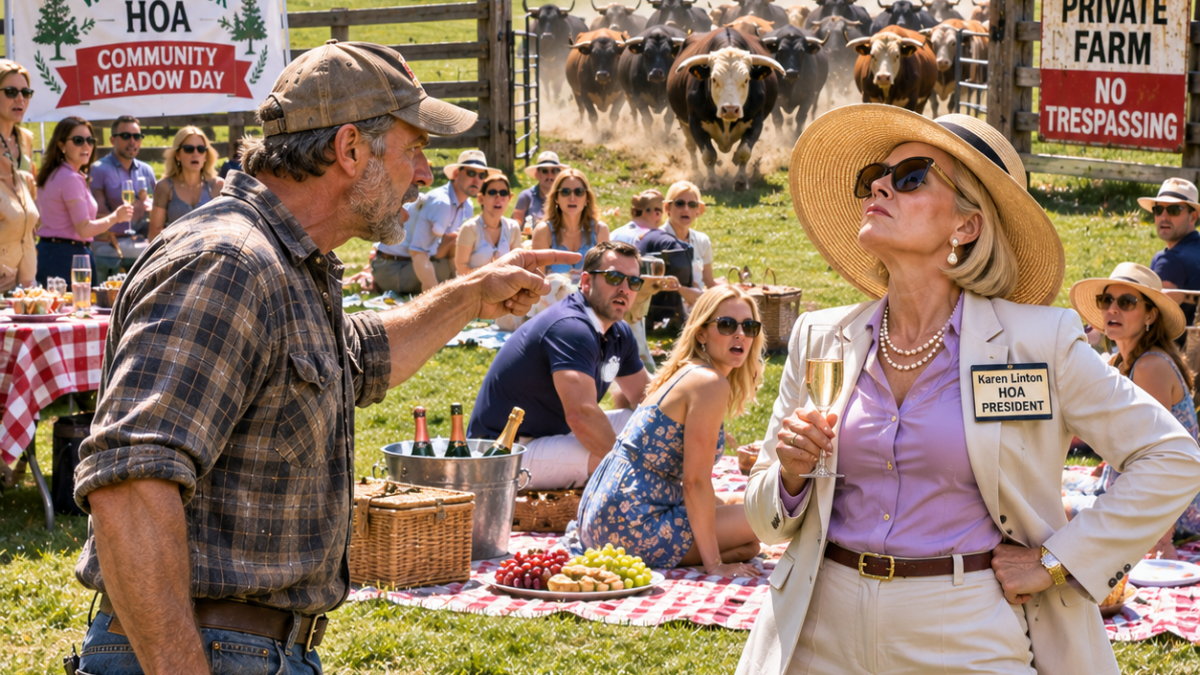
I knew something was wrong the moment I came over the rise and saw more than twenty people spread across my east pasture with picnic blankets, champagne bottles, folding tables, a Bluetooth speaker, and a white banner announcing WILLOWBROOK COMMUNITY MEADOW DAY on forty acres that had belonged to my family longer than their subdivision had existed.
Standing in the middle of them was HOA president Karen Linton, smiling beneath a wide sun hat as children ran toward my livestock fence and one of her friends dropped an empty beer can beside a cattle trough, and when I told her she was trespassing she lifted her glass and said, “Relax, Cole—we’re finally putting this empty land to good use.”
What Karen had no way of knowing was that the thirty-five Angus-Charolais bulls watching all that noise from the adjoining pasture were the least complicated part of the problem she had created, because her picnic was about to expose something Willowbrook had been pretending about my farm for years.
My name is Cole Patton.
I’m fifty-two, a widower, and I run the forty-acre farm my father spent most of his adult life building.
The farmhouse isn’t impressive. White siding, tin roof, porch boards that complain in winter. The barn is older than I am and smells permanently of hay, diesel, and dust.
I like it that way.
My late wife, Laura, used to say our place never needed to look expensive because it already looked honest.
Then Willowbrook Estates appeared beyond my north fence.
Perfect houses.
Perfect lawns.
Perfect decorative trees.
And an HOA that seemed determined to regulate everything except its own sense of entitlement.
Karen introduced herself three years earlier by leaning across my fence and telling me the association could help me “modernize the rustic aesthetic.”
I told her my rustic aesthetic had survived tornadoes, recessions, drought, and my father’s opinions.
It would survive Willowbrook too.
After that, complaints became routine.
My tractor started too early.
Barn lights were too bright during calving season.
My old Ford supposedly damaged neighborhood property values even though it sat entirely on my land.
Then Karen began treating the boundary itself like a disagreement.
Once she led an HOA children’s nature walk through my south gate without permission and left the latch open.
I caught it before the livestock did.
After that, I installed heavier chains, better locks, cameras, and signs:
PRIVATE PROPERTY.
NO TRESPASSING.
LIVESTOCK GRAZING.
ASK BEFORE ENTERING.
Karen called the signs “hostile.”
I told her that was easier to survive than being stepped on by fifteen hundred pounds of livestock.
A week before the picnic, a neighbor inside Willowbrook sent me screenshots from the HOA page.
COMMUNITY MEADOW SUNDAY.
BRING BLANKETS AND WINE.
SCENIC BARN VIEWS.
One comment asked whether permission had been arranged.
Karen replied:
Everything is handled.
Nothing had been handled with me.
So that Sunday, when I found her crowd inside my fence, I walked across the pasture and stopped ten feet from the nearest blanket.
“Afternoon.”
Several people smiled.
Karen raised her wine.
“See? Cole’s here. I told everyone you’d come around.”
“I didn’t.”
Her smile slipped.
I pointed toward the gate.
“You’re on private property.”
A man in a salmon-colored polo laughed.
“Come on, buddy. It’s just a picnic.”
“On my farm.”
Karen rolled her eyes.
“It borders Willowbrook. This area has always functioned as open community space.”
“No, it hasn’t.”
“Cole—”
“Who cut the chain?”
That quieted them.
Karen glanced toward the gate.
Nobody answered.
Then a little boy sprinted toward the interior livestock fence carrying a red balloon.
Thirty-five bulls raised their heads.
Every one of them.
The adults didn’t notice.
I did.
“Everybody away from that fence.”
Karen laughed.
“They’re cows.”
“They’re bulls.”
The boy stopped.
So did Karen.
One bull blew hard through his nostrils.
Another stepped forward.
The mood changed instantly.
I took the boy gently by the shoulder and walked him back toward his parents.
Then I faced Karen.
“You have ten minutes to clear my pasture.”
She lowered her glass.
“And if we don’t?”
I looked toward the herd, then toward the broken chain hanging from my gate.
I pulled out my phone and started recording.
“If you stay,” I said, “the next conversation isn’t going to be about whether this land belongs to me.”
Karen’s smile returned.
Smaller this time.
“What’s it going to be about?”
I looked at the Willowbrook banner hanging from my fence.
“Why your HOA has been telling people it doesn’t.”
PART 2
Karen stared at me over the rim of her wineglass.
For the first time that afternoon, she stopped performing.
“What is that supposed to mean?”
“You heard me.”
Behind her, conversations had gone quiet.
The man in the salmon polo—Greg, I later learned—looked from Karen to me.
“Wait. She said this field was part of the neighborhood.”
“It isn’t.”
Karen snapped around.
“Cole is being dramatic.”
I held up my phone.
“Then say it clearly.”
She narrowed her eyes.
“Say what?”
“That you had permission from the owner to host this event.”
Silence.
I kept recording.
Karen lowered the glass.
“We don’t need to turn this into some legal confrontation.”
“Good.”
I pointed toward the gate.
“Then leave.”
A woman sitting beside a wicker picnic basket stood up.
“Karen?”
Karen didn’t look at her.
“Everyone just relax.”
“No,” I said. “Everybody needs to pack up.”
Greg frowned.
“You really didn’t give permission?”
“No.”
He looked toward the banner.
Then toward the cut chain.
“What the hell?”
Karen stepped closer to me.
“You are intentionally embarrassing me.”
“No.”
“You knew we were coming.”
“Because somebody sent me screenshots.”
“And you could have called.”
“I shouldn’t have to call people planning to trespass.”
She crossed her arms.
“Your field is unused.”
I looked past her at hoof prints, water lines, mineral feeders, and forty years of work.
“That’s because you don’t know what farming looks like.”
Her jaw tightened.
I continued.
“This pasture rotates. The bulls use it depending on weather, grass condition, and breeding schedule.”
“They’re not in it now.”
“They’re behind that interior fence because I moved them after seeing your online announcement.”
For a second, Karen seemed pleased.
“As I said, you knew.”
“I knew enough to make sure no child wandered into thirty-five bulls.”
A few parents looked toward the herd.
Suddenly the country aesthetic wasn’t so charming.
The bulls weren’t charging.
They weren’t even particularly upset.
But thirty-five large animals staring in the same direction has a way of helping people understand scale.
A mother called her daughter away from the fence.
Greg started folding a chair.
Karen turned on him.
“What are you doing?”
“Leaving.”
“We’re not leaving.”
“You said the farmer was okay with this.”
“He was informed.”
I laughed.
“Informed?”
Karen looked at me.
“You saw the posts.”
“A Facebook post isn’t a property agreement.”
Greg shook his head.
“I’m not getting arrested over potato salad.”
That started it.
Once one person packed, others followed.
Nobody wants to be the last trespasser standing.
Karen watched her event collapse.
Blankets rolled.
Wine recorked.
Children gathered.
Coolers closed.
The speaker shut off.
Within fifteen minutes, only a few of her closest friends remained.
I walked the field after them.
Two plastic cups.
Three beer cans.
A broken disposable plate.
One trampled mineral tub.
The cut chain.
About forty yards of damaged grass from vehicles that had somehow crossed my service lane.
It wasn’t catastrophic.
That wasn’t the point.
Trespass doesn’t have to destroy your land to tell you the person doing it believes your consent is optional.
Karen remained by the banner.
“You happy?”
“No.”
“You ruined a community event.”
“You held it on my farm.”
“You made everyone uncomfortable.”
“I wanted everyone off my property.”
She stepped closer.
“I have spent three years trying to build a relationship between Willowbrook and the surrounding rural community.”
“No.”
Her eyebrows rose.
“No?”
“You’ve spent three years trying to make the rural community look like Willowbrook.”
Her face hardened.
“That farm is an eyesore.”
There it was.
Not community.
Not harmony.
Not appreciation.
Control.
I took the banner off my fence.
Karen grabbed one end.
“Don’t.”
“It’s attached to my post.”
“That belongs to the HOA.”
“Then take it.”
I handed it to her.
She stumbled half a step because she wasn’t expecting me to let go.
I almost smiled.
Almost.
“Get off the pasture.”
She gathered the banner against her chest.
“This isn’t finished.”
“It could be.”
“I’m going to the county.”
“Good.”
“To the HOA attorney.”
“Even better.”
“You can’t isolate forty acres in the middle of a growing community and expect everyone to pretend it doesn’t exist.”
I looked around.
“My farm is older than every house behind you.”
“Things change.”
“Ownership didn’t.”
Her lips tightened.
Then she walked out.
I followed and locked the gate behind her.
That click felt good.
Too good.
Laura would have noticed.
She had always been the one to warn me when satisfaction started looking too much like spite.
You can’t fight crazy with anger, Cole.
You’ll just lose twice.
I could almost hear her.
That evening, I sat at the kitchen table and reviewed the camera footage.
Karen entering through the damaged gate.
Guests carrying tables.
Cars using my service path.
Children approaching livestock.
Karen repeatedly describing the pasture as community space.
I created three copies.
One on my desktop.
One cloud backup.
One external drive.
Then I called Sheriff Ben Mercer.
Ben and I had known each other since high school.
He answered:
“If this is about your rooster, I’m resigning.”
“It’s not the rooster.”
“Karen?”
“Karen.”
He sighed.
“What’d she do?”
“Held a picnic on my pasture.”
Pause.
“Meaning near your pasture?”
“On it.”
Another pause.
“Permission?”
“No.”
“How many?”
“Twenty-ish.”
“Jesus.”
“I have video.”
“Damage?”
“Cut chain. Some minor field damage. Trash.”
“Anybody hurt?”
“No.”
“Livestock involved?”
“Behind interior fencing.”
“Good.”
His voice changed.
Professional.
“Send me the video. We’ll document trespass and property damage. Don’t confront anybody if they come back.”
“I already confronted them.”
“I mean after today.”
“I know.”
“Cole.”
“Ben.”
“Do not get clever.”
I looked toward the east pasture.
“I’m never clever.”
“That sentence is why I’m worried.”
I sent everything.
The following morning Karen posted photographs.
That was when my irritation became something colder.
A collage appeared on the Willowbrook page.
Children in front of my barn.
Wine glasses.
Picnic blankets.
Karen posing beside one of my old tractors.
Caption:
A WONDERFUL FIRST COMMUNITY MEADOW DAY!
Huge thanks to Farmer Cole for sharing this beautiful space with Willowbrook.
Sharing.
I had ordered them off the property.
One comment read:
We should make this annual.
Another:
Perfect location for weddings!
Then:
Could we do outdoor yoga here?
My friend inside Willowbrook sent screenshots before Karen deleted anything.
I printed them.
At ten that morning, I drove to the HOA office.
I did knock.
Despite what the source version of my temper might suggest, Laura had raised me better.
Karen opened the door herself.
“Cole.”
“We need to talk.”
She smiled.
“Come to thank us for the publicity?”
“No.”
I put the printed Facebook post on her desk.
“This is false.”
“What part?”
“The part where I shared my farm.”
She sat.
“Oh, come on.”
“You were told to leave.”
“And we did.”
“You cut my chain.”
“I did no such thing.”
“Then who?”
“No idea.”
“You organized the event.”
“That doesn’t mean I personally altered your fence.”
Fair distinction.
I hated when she made one.
I said:
“Then help identify who did.”
She leaned back.
“You’re taking this too seriously.”
“You brought twenty people onto an active farm.”
“Nobody was harmed.”
“That’s luck.”
Her eyes sharpened.
“Are your animals dangerous?”
“They’re livestock.”
“That wasn’t my question.”
“And that’s because you’re trying to create a different argument.”
She smiled faintly.
Maybe I was learning.
I placed the county property map on her desk.
“My forty acres.”
Then the deed.
“My deed.”
Then a printed photograph of the PRIVATE PROPERTY sign.
“My sign.”
Karen barely looked.
“You know what your problem is?”
“I’m sure you’ll tell me.”
“You don’t understand community.”
“No.”
I shook my head.
“You don’t understand consent.”
That stopped her.
I gathered the papers.
She said:
“There will be another picnic.”
I turned.
“What?”
“People loved it.”
“Not on my farm.”
“The board is considering designating the north meadow as a community-adjacent recreational space.”
I actually laughed.
“A what?”
“Community-adjacent recreational space.”
“That phrase means nothing.”
“It means Willowbrook has a legitimate interest in maintaining neighborhood access to neighboring open areas.”
“No.”
“You don’t make county planning policy.”
“Neither do you.”
Her smile disappeared.
“We’ll see.”
I drove home furious.
Not because I believed she could magically rezone my pasture.
Because she believed language could substitute for permission.
Call a farm a meadow.
Call trespass community use.
Call a boundary hostile.
Then act as if reality had changed.
That afternoon, I called Edna Shaw.
My attorney.
Edna was sixty-one, five feet tall, and capable of making grown men apologize to furniture.
She read Karen’s phrase twice.
“Community-adjacent recreational space?”
“Yep.”
“That’s adorable.”
“Can she do anything?”
“Not based on what you’ve shown me.”
“What should I do?”
“Send a formal no-trespass notice to the HOA.”
“Already told her.”
“Your mouth is not certified mail.”
“I hate you.”
“Pay your invoice.”
Edna sent formal notice.
The HOA.
Karen personally.
The management company.
No authorization to enter.
No easement.
No recreational license.
No implied consent.
All prior access revoked.
Do not advertise or schedule events.
Then Edna added one sentence I loved:
Any representation that Mr. Patton has donated, shared, licensed, or otherwise made his farm available for Willowbrook recreational use is false.
Karen received it Tuesday.
Wednesday, the HOA page announced:
WILLOWBROOK SUMMER PICNIC — SATURDAY.
SAME BEAUTIFUL MEADOW.
I called Edna.
“She did it again.”
“I see.”
“You sound happy.”
“I enjoy clear evidence.”
“What do I do?”
“Call the sheriff.”
“I already did.”
“Then stay boring.”
“I hate boring.”
“Boring wins lawsuits.”
Sheriff Mercer sent a deputy to the HOA office.
Karen told him the event would occur on “open-access border space.”
The deputy asked her for documentation.
She had none.
He warned her.
Edna sent another letter.
I posted larger signs.
Then Friday night, my interior camera caught two people near the north gate.
They did not cross fully onto the property.
One photographed the signs.
The other measured the opening.
I sent it to Ben.
He called.
“Cole.”
“I know.”
“Don’t do anything stupid.”
“I haven’t done anything.”
“You’re thinking loudly.”
I sat on my porch.
The bulls grazed beyond the east interior fence.
“Ben.”
“Yeah?”
“What happens if they come anyway?”
“We remove them.”
“And if they interfere with livestock?”
“We document that too.”
I looked at the animals.
“I’m moving the herd tomorrow.”
“Where?”
“East rotation pasture.”
“Is that near where they picnicked?”
“Yes.”
Silence.
“That normal?”
“Yes.”
It was.
That was important.
The east pasture was due for use.
The animals needed rotation.
I wasn’t going to use thirty-five bulls as a weapon.
Even angry, I knew better.
A bull doesn’t understand revenge.
A bull understands space, herd pressure, food, fear, noise.
Using one to frighten people intentionally would be reckless and cruel to the animal as much as the person.
But I also wasn’t rearranging my entire farming operation because Karen had scheduled another illegal event.
Ben finally said:
“Keep them separated.”
“I will.”
“Secure your interior gates.”
“I will.”
“Call us the second people cross.”
“I will.”
“And Cole?”
“What?”
“Don’t lock trespassers in with livestock.”
I almost laughed.
“Wasn’t planning to.”
“Good.”
The source version of this story would probably sound better if I told you I spent Friday constructing some elaborate trap.
I didn’t.
I spent Friday doing what farmers do.
Checking fence.
Water.
Mineral.
Interior gates.
Camera batteries.
A loose hinge on the north service entrance.
I replaced the cut chain.
Miguel, my weekend pasture manager, helped move the bulls into the east rotation field.
He looked toward Willowbrook.
“They still coming?”
“Apparently.”
He shook his head.
“People are strange.”
“You want Saturday off?”
He looked offended.
“Why?”
“Could get messy.”
“I like messy.”
“Laura liked you for a reason.”
He smiled.
“She liked anyone who worked.”
“True.”
At dusk, I stood by the pasture fence.
Thirty-five bulls moved through tall grass.
Angus and Charolais crosses.
Big animals.
Not monsters.
Not movie villains.
Livestock.
Diesel, my oldest black bull, lifted his head.
Laura had named him because he used to follow my tractor whenever it idled nearby.
I scratched the fence post.
“You boys ignore whatever nonsense happens over there tomorrow.”
Diesel chewed.
Sound advice ignored.
Saturday started hot.
By nine, vehicles lined the Willowbrook cul-de-sac.
At nine fifteen, I called the sheriff.
“They’re assembling.”
“We have a unit nearby.”
At nine forty, the first people approached my north boundary.
They stopped at the new signs.
Some turned around.
Most did not.
One man filmed himself walking past the warning.
“Welcome to the meadow!”
My camera caught it.
At nine fifty-three, a woman lifted the chain.
Not Karen.
Another board member named Diane.
The chain had not been cut this time.
It was looped while I was moving feed equipment earlier that morning, and I had not yet padlocked the outer access because Miguel still needed to cross.
Diane lifted it.
Opened the gate.
Karen waved people through.
That detail mattered later.
I watched from the barn.
Phone in hand.
Thirty-one people crossed.
Children.
Adults.
Coolers.
A rented catering van stayed on Willowbrook property.
Someone carried balloons.
Someone else hauled a portable speaker.
I called Ben.
“They’re inside.”
“Deputy’s two minutes out.”
“Good.”
“Stay back.”
“I’m at the barn.”
Karen saw me.
She raised her megaphone.
“Good morning, Farmer Cole!”
I didn’t answer.
Miguel walked toward me.
“They opened your gate?”
“Yes.”
“You want me to move the bulls farther east?”
I looked toward the herd.
They were separated from the picnic by a stout interior livestock fence and a closed service gate.
“Yes.”
“Safer.”
He started toward the ATV.
Then a child’s scream cut across the field.
Not fear.
Excitement.
A beach ball had blown toward the interior fence.
Three kids chased it.
One climbed onto the lower rail.
I shouted:
“GET OFF THAT FENCE!”
Parents turned.
One child jumped down.
Another reached through.
Diesel raised his head.
Miguel sprinted.
Karen shouted through the megaphone:
“Cole, stop scaring people!”
I ran.
“Get the kids away from the livestock!”
“They’re fine.”
“No, they’re not.”
A woman grabbed the nearest child.
Another boy ran after the ball.
Then the worst possible thing happened.
The interior gate moved.
Not because I opened it.
Because someone had tied a picnic banner to it.
A banner.
To a livestock gate.
The wind caught the fabric.
The loose decorative cord pulled repeatedly against the latch.
I saw it half a second before Miguel did.
“Gate!”
He ran.
The latch lifted.
The gate swung inward.
Diesel stepped through.
Not charging.
Walking.
Behind him came another bull.
Then three more.
Karen stopped speaking.
The megaphone lowered.
Miguel shouted:
“EVERYBODY MOVE TO THE NORTH EXIT! WALK! DO NOT RUN!”
Some people listened.
Most didn’t.
Someone screamed.
Then everybody ran.
That was the moment control vanished.
Thirty-five bulls did not pour into the picnic at once.
A half dozen came through before Miguel reached the gate.
But six large bulls walking toward overturned chairs and food is more than enough to turn entitled confidence into panic.
I ran to the north outer gate.
Not to lock it.
To open it fully.
“THIS WAY!”
Parents grabbed children.
Greg—the salmon-shirt guy from the first picnic—lifted a little girl and carried her.
Diane tripped over a blanket.
Someone dropped a cooler.
A champagne bottle broke.
I shouted:
“STOP SCREAMING! WALK TO THE GATE!”
Nobody stops screaming because a farmer asks politely.
Diesel trotted toward a table covered in hamburger buns.
A balloon popped.
He jumped sideways.
Two other bulls reacted.
Now they were agitated.
Dust lifted.
Miguel got between the herd and the crowd at a safe distance, using the feeding call they knew.
“HEY! BOYS! HAH!”
I grabbed the feed bucket kept by the service shed and rattled it.
Diesel turned.
Thank God.
One bull followed him.
Then another.
Herd instinct worked for us.
Karen didn’t.
She was standing beside the interior fence screaming:
“YOU DID THIS!”
“GO TO THE NORTH GATE!”
“You released them!”
“Karen, MOVE!”
A bull swung its head toward the noise.
Karen froze.
For the first time since I had known her, she obeyed instantly.
She moved.
Fast.
Not dignified.
But alive.
Everyone reached the outer field.
Nobody was gored.
Nobody was trampled.
One man twisted an ankle.
Diane scraped her hand.
A child cried so hard he threw up.
That was enough.
Far too much.
Once the people were clear, Miguel and I redirected the bulls through the service gate and secured it.
My hands shook afterward.
Not triumph.
Adrenaline.
Fear.
I looked at the picnic wreckage.
Blankets.
Food.
A collapsed folding table.
Broken glass.
A white banner hanging from the gate that had opened.
COMMUNITY MEADOW DAY.
The irony made me sick.
Sirens arrived.
Deputy Nolan crossed the field.
Sheriff Mercer behind him.
Ben looked at me.
Then at the bulls.
Then at the crowd.
“Anyone hurt?”
“Minor injuries.”
“Animals contained?”
“Yes.”
“Who opened the interior gate?”
I pointed.
“Banner was tied to it. Wind worked the latch loose.”
Karen shouted:
“Liar!”
Ben raised one hand.
“Mrs. Linton, I will speak to everyone.”
“He did this intentionally.”
“No.”
I looked directly at him.
“My cameras have the gate.”
Ben nodded.
“Good.”
Karen stepped toward him.
“He threatened us last week.”
“What threat?”
“He said the bulls were dangerous.”
I almost laughed.
Ben didn’t.
“That’s a warning, Karen.”
“He moved them next to us.”
“I rotated livestock onto my own pasture.”
“You knew we were coming.”
“You were told not to.”
“You set us up.”
Ben’s expression hardened.
“No.”
He pointed toward the outer boundary.
“Your group crossed posted private property after this office warned you yesterday.”
Karen’s mouth opened.
He continued.
“Someone in your group attached an event banner to an active livestock gate.”
Silence.
Greg looked at Karen.
“You said everything was approved.”
She turned.
“Not now.”
“No.”
His face reddened.
“Now.”
Another woman joined.
“You said Cole agreed.”
Karen pointed toward me.
“He’s manipulating all of you.”
I stared at her.
The thing about consequences is that sometimes you spend weeks waiting for them to arrive, and then suddenly they multiply faster than you can process.
Parents were angry.
Board members were angry.
Sheriff deputies were photographing signs.
My cameras had recorded everything.
And thirty-five bulls were twenty yards away eating grass as if they had never participated in the most chaotic HOA picnic in county history.
Ben pulled me aside.
“Cole.”
“Yeah?”
“Tell me exactly what you did this morning.”
I did.
Livestock rotation.
Interior gate secured.
Outer gate temporarily looped for farm access.
Trespassers opened it.
Banner tied to interior gate.
Wind and repeated tension compromised latch.
Miguel witnessed.
Cameras recorded.
Ben asked:
“Did you intentionally allow livestock into the picnic?”
“No.”
“Did you intend to frighten people with bulls?”
I thought about every angry thing I had said.
Every fantasy of Karen learning the hard way.
Then I answered honestly.
“I wanted them to understand the farm was active livestock property.”
“That’s not what I asked.”
“No.”
I met his eyes.
“I did not release bulls onto them.”
He nodded.
“Good.”
The old title people would eventually give the story made it sound cleaner.
HOA Karen Had a Picnic on My Farm, So I Locked the Gate and Released My Bulls.
That wasn’t what happened.
Reality was messier and, frankly, scarier.
Karen trespassed.
Her people ignored warnings.
Someone interfered with a livestock gate.
Animals entered.
We evacuated everyone.
And for about three minutes, I understood exactly why farmers put up signs city people sometimes call unfriendly.
Because signs are cheaper than ambulances.
By afternoon, statements had been taken.
Deputies collected copies of my footage.
Karen demanded I be arrested for reckless endangerment.
Ben did not arrest me.
He also did not congratulate me.
Before leaving, he stood on my porch.
“Could’ve gone bad.”
“I know.”
“You’re lucky.”
“I know.”
“Don’t enjoy this.”
That irritated me.
“I’m not.”
He stared.
Then looked toward the broken picnic area.
“Good.”
After he left, I sat on the porch.
Miguel joined me.
For ten minutes, neither of us said anything.
Finally:
“That boy was too close.”
“Yeah.”
“Diesel looked at him.”
“I saw.”
Miguel rubbed his hands together.
“You ever seen a bull decide somebody’s a threat?”
“Yes.”
“So have I.”
Silence.
“That woman’s stupid.”
“Yes.”
“But stupid people still bleed.”
I looked at him.
He wasn’t accusing me.
He was reminding me.
Laura would have said the same thing.
I went inside and poured the whiskey I had planned to drink in celebration.
Then poured it down the sink.
Nothing about that day deserved a toast.
The next morning, the story was everywhere anyway.
Not nationally.
Not yet.
Locally.
Videos from picnic guests.
My camera clips shared after they became part of the public dispute.
One showed Karen shouting that it was “community property.”
Another showed the banner tied to the livestock gate.
Another showed the gate swinging.
Another showed Miguel and me opening the exit and directing people out.
The county paper headline:
WILLOWBROOK PICNIC ON PRIVATE FARM ENDS IN LIVESTOCK SCARE.
Fair.
Online comments were less fair.
BULLS OF JUSTICE.
KAREN MEETS COUNTRY LAW.
ONE HOA MEETING SHORT OF A RODEO.
I didn’t share them.
Karen did something worse.
She posted:
FARMER DELIBERATELY RELEASES DANGEROUS ANIMALS ON CHILDREN.
That brought the sheriff back.
Not because the post was persuasive.
Because Karen filed a formal criminal complaint.
Ben sat across from me at the old cedar porch table.
Karen sat beside a deputy ten feet away.
She wore black.
No sun hat.
No wine.
Binder on her lap.
Ben opened his notebook.
“Mrs. Linton alleges you intentionally created a dangerous livestock encounter.”
Karen jumped in.
“He locked us in.”
“No,” I said.
Ben raised one hand.
“I’ll ask.”
He turned to me.
“Did you lock the north exit after the event began?”
“No.”
Video confirmed it.
“Did you open the interior livestock gate?”
“No.”
Video confirmed it.
“Was the interior gate secured beforehand?”
“Yes.”
Video confirmed it.
“Who attached material to that gate?”
Camera footage showed two Willowbrook volunteers tying the banner.
Karen said:
“They didn’t know it was functional.”
I answered:
“That’s why you ask before attaching things to farm infrastructure.”
Ben reviewed property maps.
Formal trespass notice.
Edna’s certified letters.
The deputy’s warning to the HOA office.
Karen’s public advertisement.
Then he looked at her.
“You were explicitly told not to hold this event on his land.”
She said:
“We believed access rights were unresolved.”
“Based on what?”
“The HOA’s understanding.”
“Whose understanding?”
“The board.”
That would come back to hurt her.
Ben closed the folder.
“We’re referring the trespass and property-damage issues for review.”
Karen’s eyes widened.
“What about him?”
“At this point, the evidence does not support your claim that Mr. Patton deliberately released livestock on you.”
“He knew they were there.”
“He owns livestock.”
“He moved them closer.”
“He rotated them onto a livestock pasture.”
“He hates us.”
Ben leaned back.
“That is not a crime.”
She looked toward me.
“You’ll regret this.”
Edna, who had arrived halfway through, spoke from the porch door.
“I strongly recommend you stop threatening my client while law enforcement is documenting the conversation.”
Karen’s head snapped around.
“Who are you?”
“Edna Shaw.”
“My attorney,” I said.
Edna smiled.
“Good morning.”
Karen left shortly afterward.
Ben stayed.
“You hired Edna?”
“Years ago.”
“She terrifies me.”
“She should.”
He stood.
“County will review animal-control issues too.”
“That’s fine.”
“You’re confident?”
“Yes.”
“Good.”
Animal control inspected the bulls.
Fences.
Water.
Handling procedures.
No cruelty.
No evidence animals had been intentionally agitated.
Miguel’s records showed normal pasture rotation.
The veterinarian confirmed the herd’s management schedule.
The county closed that portion.
Then the HOA began unraveling.
Not because of the bulls.
Because Karen had said the board authorized the picnic.
Three board members said they hadn’t.
Dan Holloway, the quiet retired postal worker who would later become president, had been treasurer.
He called me.
“Cole.”
“Dan.”
“I think we need to talk.”
“About?”
“The meadow.”
“My pasture.”
“Exactly.”
He came over that evening.
Stayed outside the fence until I opened it.
I noticed.
“Learned something?”
He smiled awkwardly.
“Apparently.”
We sat on the porch.
Dan carried a folder.
“When Willowbrook was developed, the sales materials showed open green space along the north side.”
“I know.”
“People assumed it was ours.”
“Sales brochure doesn’t change county records.”
“I know that now.”
“Karen?”
“She kept calling it anticipated community access.”
“Meaning?”
“She claimed the developer was negotiating an easement.”
“With me?”
“Yes.”
“No one ever contacted me.”
Dan looked miserable.
“I believe you.”
“That sounds like there’s more.”
“There is.”
He handed me minutes from a board meeting eighteen months earlier.
Karen:
Update on North Meadow recreational access. President reports owner cooperation remains promising.
I read it twice.
“Promising?”
Dan nodded.
“She told us you were difficult but open.”
“I told her no every time.”
“There are more.”
Meeting twelve months earlier:
President reports informal permission for low-impact HOA activities.
Six months:
President recommends establishing community use through regular programming.
I looked at Dan.
“She was trying to create a pattern.”
“That’s what our counsel thinks.”
“Prescriptive access?”
“Maybe not legally viable here, especially under these circumstances.”
“But she was trying to make it look normal.”
“Yes.”
That explained the nature walk.
The picnic.
The online posts thanking me.
Again.
Shared.
Community meadow.
If enough photographs existed of Willowbrook residents using my pasture, future arguments could become messier.
Maybe Karen thought she was building leverage.
Maybe she simply wanted residents to believe an amenity she had promised actually existed.
Either way, she had used my silence as consent.
Laura always said silence was dangerous around people who only hear what benefits them.
I called Edna.
She read the minutes.
Then said:
“Oh.”
“What?”
“I’m irritated.”
“You usually sound happier when irritated.”
“Because this is stupid.”
“Karen?”
“The board.”
“They didn’t know.”
“They didn’t verify.”
Edna filed a civil action.
Not dramatic.
Declaration of no easement.
Trespass damages.
Fence repairs.
Cleanup.
Legal costs.
Injunctive relief against further HOA entry or advertising.
The HOA’s insurer got involved immediately.
So did its outside counsel.
Karen hired separate counsel.
That told me everything.
The first mediation lasted four hours.
Karen sat across from us beside a young attorney named Bryce Fallon.
Perfect hair.
Perfect tie.
Shoes worth more than my first tractor payment.
Bryce began:
“My client believed the property had longstanding community-access status.”
Edna slid the deed across.
“No.”
“She relied on representations from the original developer.”
“Show them.”
Bryce slid a brochure forward.
Green shaded area.
NORTH COMMUNITY MEADOW — FUTURE CONNECTION.
Edna stared.
“This says future.”
“Yes.”
“Future is not now.”
Karen crossed her arms.
“The developer promised access.”
“To you?”
“To the community.”
“Did Mr. Patton sign?”
“No.”
“Then the developer promised something it didn’t own.”
Karen leaned forward.
“This farm depresses our development potential.”
I stared.
There it was again.
More honest when angry.
Edna asked:
“How?”
Karen’s attorney touched her arm.
Too late.
“Our northern lots are marketed around rural views and access.”
I laughed.
“You sold access to my farm?”
“I didn’t sell anything.”
“You advertised it.”
“The developer did.”
“And you tried to make it true afterward.”
Karen stood.
“This is ridiculous.”
Edna remained seated.
“Sit down, Mrs. Linton.”
“You don’t order me around.”
“No.”
Edna smiled.
“But your lawyer is trying very hard to.”
Bryce whispered something.
Karen sat.
Settlement failed.
Two days later, an HOA emergency meeting was announced.
Dan invited me.
I almost declined.
Edna said:
“Go.”
“Why?”
“Listen.”
“I have better things to do.”
“Go.”
So I went.
Willowbrook clubhouse looked exactly like I expected.
Gray carpet.
Fake plants.
Framed photographs of community events.
One photograph was from my farm.
Karen holding wine beside my barn.
I stopped.
Dan saw me.
“I thought that was removed.”
“It wasn’t.”
He took it off the wall himself.
Karen entered five minutes later.
The room changed.
People avoided her eyes.
Greg sat near the front.
The woman whose son had approached the bull fence sat with her arms crossed.
Karen called the meeting to order.
“We are here because Mr. Patton has chosen to attack Willowbrook financially.”
People murmured.
Dan said:
“No.”
Karen looked at him.
“Excuse me?”
“We’re here because our insurance counsel asked for a governance review.”
“I’m president.”
“You’re one vote.”
Karen’s lips tightened.
Dan continued.
“We need to establish who authorized both meadow events.”
“I did.”
“Under what authority?”
“Community programming.”
“On property we don’t own?”
“We believed we had access.”
“Who is we?”
Karen stared.
Dan opened the minutes.
“You repeatedly reported owner cooperation.”
“He cooperated informally.”
I raised my hand.
Dan recognized me.
I stood.
“No.”
Karen snapped:
“You are not a member.”
Dan said:
“He’s the property owner under discussion.”
I looked around the room.
“I never gave Karen permission to hold any Willowbrook event on my land.”
A man asked:
“Never?”
“Never.”
Karen said:
“He allowed the first picnic to continue.”
“I ordered you out.”
“You didn’t call police.”
“I was trying not to turn potato salad into a criminal matter.”
Several people laughed.
Karen slapped the table.
“This is serious.”
“Yes.”
I nodded.
“It became serious when children got within feet of livestock after you ignored written no-trespass notices.”
The mother in the front row stood.
“You told us the animals were harmless.”
Karen looked startled.
“I said they were fenced.”
“You called them decoration.”
Murmurs.
Another resident said:
“You said Cole approved the picnic.”
Karen responded:
“I said it was arranged.”
“That means approved.”
“I never used that word.”
Greg stood.
“You let us believe it.”
Karen’s face reddened.
“I created something for this community.”
Dan asked:
“Using his land?”
Silence.
Karen looked around.
“You people loved those picnics.”
Nobody answered.
She pointed toward Greg.
“You posted photos.”
He said:
“Because you told me it was legal.”
She turned toward the board.
“You all knew about the meadow plan.”
Dan said:
“We knew what you told us.”
Then the association attorney stood.
His name was Martin Webb.
He looked tired.
“Mrs. Linton, I need to ask whether you ever received written authorization from Mr. Patton.”
“No.”
“Verbal?”
Karen hesitated.
“He never physically stopped the earlier nature walk.”
“That is not permission.”
“He knew we were interested.”
“That is not permission.”
“He benefited from visibility.”
I nearly laughed again.
Martin didn’t.
“Did you receive permission?”
Karen looked at me.
Then said:
“No.”
The room went quiet.
That was the moment she lost Willowbrook.
Not the bulls.
Not the video.
One word.
No.
Everything else had been built on pretending that word didn’t exist.
Dan made a motion.
Suspend Karen Linton from HOA presidency pending legal and financial review.
Seconded.
Vote.
Five to one.
Karen’s was the one.
She stared at the board.
“You can’t do this.”
Dan replied quietly.
“We just did.”
She gathered her papers.
Then looked at me.
“This is what you wanted.”
“No.”
I meant it.
“I wanted you to stay off the farm.”
She laughed bitterly.
“Same thing.”
“No, Karen.”
I looked around the clubhouse.
“That’s the problem. You think every boundary is a personal attack.”
She left.
The HOA audit followed.
Most of it was boring.
Good.
Boring meant nobody was being chased by livestock.
The board found Karen had not embezzled thousands or operated some criminal empire.
Her abuse was more ordinary.
Unauthorized event spending.
Printing costs.
Rental equipment.
A portion of community funds spent promoting events on land the HOA did not control.
She had also signed a small contract with a photography company to market Willowbrook using “community meadow lifestyle imagery.”
My barn appeared in promotional drafts.
My tractor.
My pasture.
No release.
No permission.
That added another layer to the civil case.
Edna loved it.
“I’m going to invoice someone until they develop manners.”
“Can we put that on your business card?”
“No.”
We settled before trial.
Willowbrook’s insurer covered verified property damage and legal expenses.
The HOA paid additional money to resolve the unauthorized promotional use and cleanup costs.
The amount was less dramatic than online rumors claimed.
Enough to rebuild the east fence properly.
Enough to replace the damaged gate.
Enough to cover attorney fees and repairs.
I refused money for “livestock emotional distress.”
Edna had proposed a documented husbandry cost category based on disruption.
I looked at Diesel grazing.
“He seems emotionally stable.”
Edna stared.
“You are ruining my profession.”
The agreement included something I cared about more.
Recorded acknowledgment:
No Willowbrook easement.
No recreational access.
No community meadow.
No event use.
No implied permission from prior trespasses.
The county land records remained exactly what they had always been.
Mine.
Karen fought the settlement until her own lawyer told her the alternative was worse.
She resigned from the board permanently.
Technically, the homeowners had already suspended her.
The resignation saved everyone another meeting.
Then she sent me a letter.
Not an apology.
You humiliated me in front of everyone.
I hope you’re proud.
You used those animals to terrorize families because you couldn’t stand sharing a little grass.
I read it twice.
Then put it in a drawer.
The source version of me might have pinned it to the refrigerator like a trophy.
I didn’t.
Laura’s photograph was on that refrigerator.
Somehow placing Karen’s anger beside my wife’s face felt wrong.
The new HOA president came by a week later.
Dan.
He stopped at the gate.
Called from outside.
“Cole?”
“Come in.”
“You sure?”
“Yes.”
He walked to the porch carrying a basket.
“My wife baked.”
“Bribery?”
“Diplomacy.”
Inside was banana bread.
Good banana bread too.
Dan handed me a letter.
Formal apology.
The Willowbrook Homeowners Association acknowledges that events were held on the Patton property without authorization and regrets the disruption, property damage, and livestock safety risks resulting from those events.
I nodded.
“Better.”
“We’re rewriting policies.”
“Don’t rewrite them because of me.”
“We’re rewriting them because we were stupid.”
“That’s healthier.”
He laughed.
“We also removed every reference to ‘community meadow.’”
“Excellent.”
“And the original developer’s brochure.”
“Even better.”
Dan looked toward the bulls.
“Are they really as dangerous as everyone says?”
“No.”
He relaxed.
Then I added:
“They’re more dangerous than everyone thinks.”
He stiffened again.
I smiled.
“Want coffee?”
“Please.”
Dan was different from Karen.
He asked questions.
If he didn’t know, he said so.
If the answer was no, he did something extraordinary.
He accepted it.
Willowbrook changed slowly.
People started waving.
Not everyone.
Some residents blamed me.
One woman sent an email saying I had destroyed neighborhood unity.
I replied:
Your neighborhood remains welcome to invite me to events held on your property.
She never answered.
Greg came by one afternoon.
Stayed outside the gate.
“I owe you.”
“For what?”
“First picnic.”
“You left.”
“Eventually.”
“You didn’t cut the chain.”
“No.”
“Then what?”
He looked embarrassed.
“I laughed when you told us to leave.”
I remembered.
“You did.”
“I thought you were some angry farmer.”
“I am some angry farmer.”
He smiled.
“Still.”
He pointed toward the field.
“My daughter was at the second picnic.”
“Which one?”
“Red shirt. Nine years old.”
I remembered a little girl crying near the north exit.
My stomach tightened.
“She okay?”
“Yeah.”
He looked at the ground.
“I spent that night thinking about what could’ve happened.”
“So did I.”
That surprised him.
“You?”
“I own the animals.”
“You didn’t open that gate.”
“Doesn’t matter. Someone could’ve died on my farm.”
Greg swallowed.
“Karen said you’d planned it.”
“I didn’t.”
“I know that now.”
He took a breath.
“My wife wants us to move.”
“Because of the bulls?”
“Because we realized how easily we believed somebody who sounded confident.”
That was heavier than I expected.
“You don’t have to move for that.”
“Maybe not.”
He smiled weakly.
“Anyway, I’m sorry.”
I opened the gate.
“Coffee?”
His eyebrows rose.
“That safe?”
“Depends how you feel about old coffee.”
He came in.
That was the first Willowbrook resident besides Dan I voluntarily invited onto the property.
It felt different.
Permission changes everything.
The local sheriff’s office later asked whether they could use short clips from the incident for rural-property safety training.
Ben called.
“Before you get excited, it is not called Bulls of Justice.”
“Should be.”
“It’s called Livestock Property Incidents and Trespass Risk.”
“That is terrible.”
“It’s training.”
“Exactly.”
They used the footage of the banner attached to the livestock gate.
The children approaching.
The evacuation.
Miguel redirecting the herd.
The point wasn’t to mock Willowbrook.
It was to show how quickly a recreational assumption can become a livestock emergency.
Ben asked me to speak at one session.
I refused.
He asked again.
I refused.
Then Miguel volunteered me.
Traitor.
So I went.
County meeting room.
Farmers.
Deputies.
Property managers.
Even two HOA representatives from other developments.
I stood beside the screen.
The video froze on Diesel stepping through the open interior gate.
I said:
“This frame is where everybody online thinks the story gets funny.”
Nobody laughed.
“Six seconds later, I thought a kid might get hurt.”
That got their attention.
I pointed at the banner cord.
“This shouldn’t have been tied here.”
Then the outer property sign.
“This shouldn’t have been ignored.”
Then footage of the crowd crossing.
“And this should never have happened.”
A property manager asked:
“So you don’t think the bulls taught them a lesson?”
I thought about it.
“No.”
“What did?”
“The risk.”
I looked at the frozen screen.
“The bulls didn’t know they were teaching anybody anything.”
That mattered to me.
“They were livestock behaving like livestock after people entered livestock space.”
I paused.
“Fences aren’t there because farmers are antisocial.”
“They’re there because animals don’t understand brochures.”
Afterward, a woman from another HOA approached.
“I manage three communities.”
“My condolences.”
She laughed.
“I used to think rural neighbors were overly defensive about access.”
“And now?”
“I’m updating our staff training.”
“Good.”
That felt better than a viral video.
The internet version of my story kept growing anyway.
Someone uploaded a shortened clip.
It looked much worse.
Bulls entering.
People running.
Karen screaming.
Cut.
No footage of the banner.
No warning signs.
No prior trespass.
No evacuation instructions.
Half the comments called me a hero.
Half called me a psychopath.
Both annoyed me.
A reporter asked:
“Were you seeking revenge?”
“No.”
“Did part of you enjoy seeing Karen’s picnic fail?”
I hesitated.
Laura would’ve hated dishonesty.
“Yes.”
The reporter smiled.
“Really?”
“Yes.”
“I was angry.”
“Does that mean you wanted people endangered?”
“No.”
“Were you happy afterward?”
“No.”
That confused him.
I explained.
“You can want somebody humbled and still realize reality went farther than your imagination.”
He stopped writing.
I continued.
“The thing everyone wants is the funny version.”
“Karen trespasses.”
“Bulls show up.”
“Everybody learns a lesson.”
“That’s tidy.”
I looked toward the pasture.
“But there were kids there.”
He nodded slowly.
The article came out under a better title than I expected.
WHEN A “COMMUNITY MEADOW” IS ACTUALLY A WORKING FARM.
Not viral.
Accurate.
I kept that clipping.
Not the memes.
Not the fake “35 Bulls of Justice” T-shirt somebody mailed me.
Though Miguel stole that one.
Karen disappeared from Willowbrook about two months later.
House listed.
Then sold.
A rumor said she joined another HOA board.
That rumor turned out false.
Dan later heard she had moved near her sister in another county.
No HOA position.
No community committee.
Nothing.
For almost a year, that was the last I knew.
Life became ordinary again.
Beautifully ordinary.
Feed deliveries.
Vet visits.
Fence repair.
Hay prices making me question every decision since birth.
Miguel complaining about my tractor.
Me complaining about Miguel’s music.
Dan occasionally calling before Willowbrook events to confirm they would remain inside Willowbrook.
The first time he did, I laughed.
“You don’t need to call.”
“I know.”
“Then why?”
“Trauma.”
“Fair.”
They built a small actual picnic area inside their common park.
Tables.
Shade structure.
Play area.
Dan invited me to the opening.
I went.
Stayed an hour.
Nobody crossed my fence.
A little boy stood beside the boundary sign and pointed toward Diesel.
“Is that the famous bull?”
His mother looked mortified.
I said:
“That’s Diesel.”
“Can I pet him?”
“No.”
The boy nodded.
“Okay.”
That was it.
No argument.
No disappointment weaponized into entitlement.
Just no.
Then he asked:
“Can I see him?”
“You’re looking at him.”
He smiled.
Best conversation I had with Willowbrook in years.
One evening after that, I sat alone on the porch.
Laura’s chair beside mine.
I hadn’t moved it since she died.
Eight years.
People told me that was unhealthy.
Maybe.
But some objects stop being furniture.
Her coffee mug sat on the shelf inside.
Her gardening gloves in the mudroom.
Her old wind chime above the porch.
I thought about something she used to tell me during our marriage.
A fence doesn’t mean I hate the person on the other side.
It means I know where my work ends and yours begins.
At the time I thought she was talking about livestock.
She was usually talking about me.
Laura had better emotional intelligence than I did.
By several counties.
I said aloud:
“You would’ve handled Karen better.”
Wind moved through the oaks.
No answer.
“You definitely would’ve stopped me from saying half the things I said.”
Wind chime moved.
I took that as confirmation.
A month later, a letter came.
No return name.
Different handwriting from Karen’s earlier angry note.
Inside:
Cole,
I have rewritten this four times.
I am not asking you to forgive me.
I still believe you enjoyed embarrassing me.
That line almost made me stop reading.
Then:
But I also understand now that I had no right to be there.
I told myself your pasture was wasted space because I had promised Willowbrook access to something I could not provide.
The original developer marketed a rural amenity that was never secured.
When residents complained, I was afraid to admit I had been repeating something that wasn’t true.
So I tried to make it true.
That was new.
Honest.
She continued.
The first picnic made me feel powerful because everyone believed me.
When you ordered us out, I felt humiliated.
Instead of admitting I was wrong, I scheduled another event because I thought backing down would prove I had lied.
I kept telling myself you were selfish.
It was easier than admitting I was trespassing.
The day the bulls came through that gate was the most frightened I have ever been.
For months I blamed you.
Now I understand the gate opened because one of our people tied the banner to it.
I understand you opened the exit.
I understand the footage does not show what I told myself happened.
I am sorry.
Not for losing the presidency.
Not for being embarrassed.
For bringing children onto land where I had no right to bring them.
For lying about your permission.
For treating your “no” like an obstacle instead of an answer.
Karen.
I read it twice.
Then a third time.
The last paragraph:
I still hate your signs.
That made me laugh.
Actually laugh.
First time Karen Linton ever made me laugh without ruining my day.
I wrote back.
Karen,
Thank you for saying what you said.
I’m glad nobody was seriously hurt.
The signs are staying.
Cole.
No friendship.
No reunion.
No dramatic forgiveness scene.
That was enough.
By the second anniversary of the picnic, the grass had erased nearly every physical trace.
You couldn’t see where the tables stood.
Where the champagne broke.
Where Diane fell.
Where Diesel first stepped through the gate.
Nature doesn’t care about stories.
That is one of the things I love about farming.
The internet remembers.
Grass doesn’t.
One autumn morning, I took a shovel and replaced the old north-gate post.
The original had been damaged when the chain was cut at the first picnic.
I had repaired it twice.
Could’ve kept repairing it.
Finally decided to replace it.
Miguel held the new post while I tamped soil.
“You sure?”
“About?”
“Old one’s historic.”
“It’s rotten.”
“Internet would pay money for it.”
“Internet can buy firewood somewhere else.”
We set the new post straight.
Mounted the gate.
Checked the swing.
Then I reached for the warning sign.
PRIVATE PROPERTY.
NO TRESPASSING.
ACTIVE LIVESTOCK.
Miguel said:
“You going to add the bull line?”
“What bull line?”
“Thirty-five bulls still live here.”
“No.”
“Why?”
“Because the sign shouldn’t be funny.”
He considered that.
Then nodded.
“Probably right.”
I mounted the plain sign.
No threat.
No joke.
No “trespassers will be chased.”
Just information.
The truth was enough.
That afternoon Dan walked over from Willowbrook.
Stopped at the boundary.
“Cole?”
“Gate’s open.”
He came through.
Looked at the new post.
“End of an era.”
“Rotten wood.”
“You ruin everything.”
“Coffee?”
“Always.”
We sat on the porch.
Dan told me Willowbrook was planning its fall festival.
“Inside the park?”
He stared.
“I’m leaving.”
I laughed.
“Sorry.”
“No, you’re not.”
“No.”
We sat quietly.
Diesel grazed in the distance.
He was older now.
Slower.
Still broad.
Gray showing around his muzzle in the strange way cattle age around the face.
Dan pointed.
“That him?”
“Yep.”
“He doesn’t look terrifying.”
“He’s eating.”
“Does he remember?”
“Remember what?”
“The picnic.”
I looked at Diesel.
“I doubt it.”
“Funny.”
“What?”
“Half our neighborhood will tell that story forever.”
I nodded.
“He probably cared for ten minutes.”
Dan smiled.
“Maybe there’s a lesson there.”
“Don’t.”
“What?”
“Don’t turn my bull into a philosopher.”
We laughed.
Then Dan became serious.
“You know, Willowbrook is better now.”
“Good.”
“Not because Karen left.”
I looked at him.
“Because people stopped assuming the board was always right.”
“That sounds exhausting.”
“It is.”
“Democracy.”
“Unfortunately.”
He drank coffee.
“People ask questions now.”
“That’s good.”
“They read documents.”
“Terrible.”
“They challenge me.”
“Excellent.”
Dan sighed.
“You’re enjoying this.”
“A little.”
When he left, he stopped at the gate.
Closed it behind him.
Didn’t latch it because he knew I was outside.
Small thing.
I noticed.
That evening, I walked the pasture alone.
The light went gold over the barn.
Exactly the color Laura loved.
She used to call those last fifteen minutes before sunset God’s apology for summer heat.
I reached the north fence.
On one side:
My pasture.
On the other:
Willowbrook.
Children were playing in their actual park.
Someone grilled hamburgers.
Music played low.
A dog barked.
No conflict.
No one trying to annex anybody else’s peace.
Just neighbors separated by a fence.
I rested my hands on the top rail.
For years, I had thought boundaries were about keeping things out.
Cattle.
Trespassers.
Noise.
Problems.
Laura had understood them better.
A good boundary tells everyone what is theirs to care for.
That’s why it protects both sides.
Willowbrook didn’t need my farm to become a community.
My farm didn’t need Willowbrook to disappear for me to have peace.
We only needed the same simple thing my father taught me when I was a boy.
Ask first.
Step second.
A few minutes later, a little girl approached the Willowbrook side of the fence with her father.
I recognized her.
Greg’s daughter.
Older now.
She pointed at Diesel.
“Mr. Cole?”
“Yeah?”
“Can I take a picture?”
Her father immediately added:
“From this side.”
I smiled.
“Sure.”
She lifted her phone.
Diesel raised his head at the exact moment she took the picture.
“Perfect!”
She showed her father.
Then looked at me.
“Thank you.”
“You’re welcome.”
They walked away.
No drama.
No lawsuit.
No sheriff.
No stampede.
A request.
An answer.
Respect.
I stood there until the sun disappeared.
Then I went to close the north gate.
The new hinge moved smoothly.
No scrape.
No sticking.
I swung it shut and slid the latch into place.
Not because I was angry.
Not because I expected Karen to come back.
Not because thirty-five bulls needed a stage.
Because a gate has one simple job.
It marks the point where permission matters.
Behind me, Diesel gave one deep, lazy bellow from the pasture.
I looked back.
“Yeah, yeah.”
He lowered his head to the grass.
I locked the gate.
Then walked home.
[END OF STORY]








