PART 2: HOA Karen Turned My Cattle Crossing Into VIP Parking—So the Judge Sent 120 Cows Down Her Luxury Resort Road
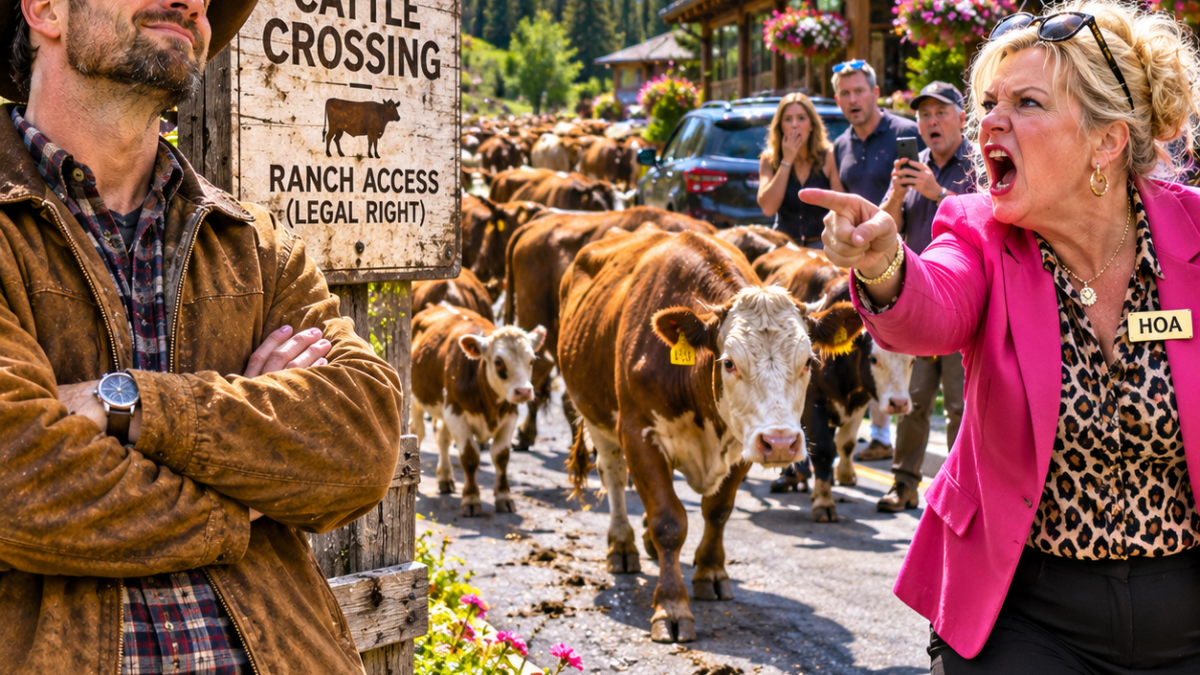
PART 2
Five days earlier, none of this had looked inevitable.
Silver Quill Resort was preparing for its biggest launch weekend yet.
The expanded luxury wing had taken nearly two years to build.
Three hundred VIP guests.
Investors.
Future buyers.
Travel writers.
Local officials.
People Jolene wanted photographed drinking champagne under the Silver Quill logo.
The problem was parking.
Ethan Bellamy, the resort’s operations director, had apparently raised that problem during a planning meeting.
I learned the details later.
He spread the site map across a conference table.
“The existing lots won’t hold the guest count.”
Jolene asked:
“How many spaces short?”
“More than half.”
“What’s the closest open area?”
Ethan pointed at Hollow Creek Crossing.
Then immediately added:
“That strip has a livestock easement.”
Jolene never even looked down.
“A hundred cows should not stand in the way of a multi-million-dollar resort.”
That sentence became the beginning of everything.
Within twenty-four hours, contractors were dumping crushed rock onto the corridor.
A grader flattened hoof ruts.
Guide fence came down.
Steel posts went up.
Private security arrived.
I confronted the first crew.
They showed me an HOA work order.
I told them the easement was recorded.
They called Jolene.
She told them to keep working.
That afternoon, I received a formal notice.
**NOTICE OF PERMANENT LIVESTOCK ACCESS TERMINATION**
Signed:
Jolene Prescott.
No court order.
No easement amendment.
No alternative route.
Just a deadline.
Forty-eight hours.
Stop using Hollow Creek.
I read it at my kitchen table.
Then laughed.
Not because it was funny.
Because the arrogance was almost impressive.
Jolene did not own my grazing rights.
She did not create the easement.
She did not have unilateral authority to erase it.
I called the HOA office.
Demanded a meeting.
They made me wait outside Jolene’s glass-walled conference room for forty minutes while she entertained two investors.
I watched her point at renderings.
Smile.
Pour sparkling water.
When I was finally allowed in, I put my land records on her desk.
She did not open the folder.
“Your ranch is the past.”
“My deed is current.”
“My resort is the future.”
“Then your future had better fit inside your property rights.”
Her smile sharpened.
“You people always hide behind old paper.”
“Recorded easements are old paper.”
“Exactly.”
“And they still count.”
She leaned back.
“No judge in Montana is going to derail a resort opening over cattle.”
“We’ll see.”
I picked up my folder.
As I reached my truck, footsteps came fast behind me.
Ethan Bellamy.
He looked over his shoulder toward the office windows.
“You need to check the original development agreement.”
“What?”
“Not the HOA handbook.”
He lowered his voice.
“The original resort agreement.”
“Why?”
He glanced back again.
“Just read it.”
Then walked away.
That night, I pulled old land boxes from my hall closet.
My father had kept everything.
Yellowed plats.
Fence agreements.
Water records.
Grazing maps.
Survey notes.
Receipts for posts bought before I was born.
Near the bottom of the last box, I found the 2002 resort development plat.
I spread it across the kitchen table.
Hollow Creek Crossing appeared exactly where it should.
Then something else caught my eye.
Small type along Silver Quill Boulevard.
Faded.
Almost forgotten.
**ALTERNATE LIVESTOCK CORRIDOR — SUBJECT TO OBSTRUCTION PROVISION**
I read it again.
Then a third time.
I did not yet understand what it meant.
But I knew it was important.
Two days before launch weekend, I heard machinery from the north pasture.
A bulldozer.
When I reached Hollow Creek, it was pushing dirt beyond even the illegal parking footprint.
Twenty feet of guide fence crushed.
Wire twisted around steel track.
I raised my hand.
“Stop!”
The operator paused.
Jolene’s SUV arrived minutes later.
Security chief beside her.
She marched toward me.
“This project is final.”
“This blade is on ranch property.”
“It’s part of the parking expansion.”
“No.”
I stood on my side of the boundary.
“The machine does not cross this line.”
The operator looked uncertain.
Jolene gave him a signal.
He inched forward.
I pulled out my phone.
Called the sheriff.
One of her guards grabbed for the phone.
I twisted away.
Vera was fifty yards uphill.
I did not know she was recording too until later.
Jolene shouted:
“Finish the parking lot.”
I said:
“My deed puts that ground on my side.”
Then she made the mistake.
The one sentence that changed everything.
“I don’t care what his deed says. Finish the parking lot.”
I looked at her.
“Say that again.”
She did.
Louder.
“We’ll pay whatever fine the county dreams up. Silver Quill has more money than you’ll ever see.”
Vera’s camera captured every word.
Twenty minutes later, Deputy Wyatt Mercer arrived.
Lean.
Calm.
Unimpressed.
Jolene demanded my arrest.
Wyatt ignored the demand.
He read my documents.
Photographed the dozer.
Fence.
Boundary markers.
Then said:
“I’m not deciding a contested easement beside a bulldozer.”
Jolene snapped:
“Then remove him for interfering with private development.”
Wyatt looked at her.
“Until legal authority is clarified, nobody moves the disputed boundary.”
The contractor shut down his engine.
That was the first time one of Jolene’s hired people stopped obeying her.
I handed her a written notice.
Reopen Hollow Creek by Saturday.
Stop encroachment.
Otherwise, I would seek emergency relief and exercise every recorded passage right available to the ranch.
She read it.
Smiled.
Then tore it into pieces.
Right in front of me.
“You’ll be hearing from our lawyers.”
I knelt.
Picked up every scrap.
Put them in a clear evidence bag.
Vera watched.
“You’re really going to fight them?”
“Yes.”
“They have money.”
“I noticed.”
“Maybe swallow this one.”
I looked toward the boulevard.
“No.”
“You sure?”
“No.”
She blinked.
I smiled slightly.
“But tomorrow we’re going to find out who really owns the right to use that road.”
The next morning, I met Dana Hollis.
Land surveyor.
She had spent more time in county archives than most clerks.
I showed her the old plat.
She pulled the 2002 agreement.
Twenty minutes later, she stopped.
“Oh.”
“What?”
“There are two corridors.”
“I saw the label.”
“No.”
She turned the agreement toward me.
“I mean legally described.”
Hollow Creek was the primary livestock corridor.
Then:
Silver Quill Alternate Corridor.
Twenty-eight feet wide.
Roughly 1.4 miles.
Running straight along the resort’s main boulevard.
Dana read the obstruction clause.
“If the primary crossing is deliberately made unusable by the landowner or managing association, the alternate corridor may be activated.”
I stared.
“Runs with the land?”
“Yes.”
“Still valid?”
“Unless there’s a recorded release or amendment.”
“Is there?”
She searched.
“No.”
Then she unrolled the corridor map.
Red pen.
She traced it.
Main gate.
Boulevard.
Guest arrival plaza.
Signature restaurant.
Event square.
South gate.
Back to my pasture.
I laughed once.
Dana looked at me.
“What?”
“Nothing.”
She circled the route.
“She didn’t just block your cattle.”
“No.”
“She may have activated the one route she never wanted you using.”
I looked at the red line.
Then thought about launch weekend.
Three hundred VIP guests.
Cars.
Investors.
Champagne.
And my herd.
I did not want chaos.
That mattered.
I had no interest in stampeding cattle through a crowd just to embarrass someone.
So I called an attorney.
Filed to protect the easement.
Dana completed a current survey.
Then Vera and I built a livestock movement plan.
Groups.
Riders.
Support vehicles.
Traffic control.
No animals near pedestrians.
No improvisation.
Water first.
Safety second.
Humiliation?
If it happened naturally, that was Jolene’s problem.
Dana kept digging.
Then found something better than the old easement.
Silver Quill had borrowed heavily six months earlier for the resort expansion.
The lender required an easement-status certificate.
Jolene signed it personally.
Near the bottom:
**Existing alternate livestock access easement acknowledged.**
I stared at her signature.
“So she knew.”
Dana said:
“She certified that she knew.”
My anger changed.
Until then, Jolene could have claimed ignorance.
Bad legal advice.
Confusion.
Now?
No.
When she needed bank money, the easement existed.
When she wanted parking revenue, it disappeared.
Same road.
Same documents.
Different answer depending on what benefited her.
I folded the certificate.
Put it in my jacket.
“I’m done asking her to move the cars.”
Friday evening, Ethan Bellamy contacted me.
Roadside diner.
Fifteen miles away.
He arrived carrying a thick envelope.
Sat across from me.
Looked exhausted.
“I should have said something sooner.”
“What’s in the envelope?”
“Everything I can lawfully provide.”
Site plan.
Parking layout.
Emails.
The county engineering letter Jolene had used internally.
VIP revenue spreadsheet.
He told me Jolene ordered the cattle corridor removed from investor presentations.
“Her exact words?”
“Make it disappear.”
I looked at the supposed county letter.
Flat signature.
No recording number.
Wrong reference format.
Dana checked.
No file.
No decision.
No approval.
County engineer called back before closing.
“I never signed this.”
That moved the issue beyond easement interference.
Possible forged document.
Then Ethan showed me the money.
Seventy-six spaces.
$3,000 each.
VIP parking.
Valet.
Champagne welcome.
Total:
$228,000.
Recipient:
Prescott Events LLC.
Not the HOA.
Not Silver Quill Resort.
Jolene’s private company.
I did not call it theft.
Did not call it fraud.
Not my job.
I gave the records to my attorney and authorities.
Let them decide.
Jolene found out I was digging.
Within hours, barricades appeared across the alternate corridor’s south gate.
**NO LIVESTOCK ACCESS UNDER ANY CIRCUMSTANCES**
She was now blocking both routes.
Primary.
Alternate.
Then word came that if I brought cattle onto resort property, private haulers would seize them.
My attorney filed an emergency petition before sunset.
The cattle needed water.
Court scheduled Saturday morning.
I sent one message to the HOA:
**Open Hollow Creek or the alternate corridor will be enforced.**
Jolene deleted it.
That night, she hosted investors.
Champagne.
String quartet.
Fine dining.
She announced the ranch problem was handled.
Then a courier delivered our emergency petition.
Inside:
**PROPOSED LIVESTOCK MOVEMENT THROUGH SILVER QUILL RESORT ROAD**
I heard later that she stopped reading halfway through and went pale.
Saturday morning returned me to the scene where this story began.
Seventy-six SUVs.
Gold sign.
Barricades.
My cattle waiting.
By noon, Jolene was on a stage preparing a welcome speech.
I drove to the resort entrance.
Survey under my arm.
She saw me.
Abandoned the microphone.
Marched down.
“I warned you.”
“I remember.”
“Not one hoof on my pavement.”
I unrolled Dana’s survey across the hood of my truck.
Pointed.
“Then you should have kept Hollow Creek open.”
She looked at the red corridor line.
Her face changed.
“You think you can bring cattle through here?”
“I think your own development agreement says I can when you obstruct the primary route.”
“This is private property.”
“Burdened private property.”
“You’re trespassing.”
“No.”
She signaled security.
I stayed on the public shoulder.
Called Wyatt.
“Need you to keep the peace.”
He answered:
“Court issue?”
“Yes.”
“I’m on standby.”
Across town, the emergency hearing had been running since morning.
Judge reviewed:
Recorded easements.
Dana’s survey.
Photographs.
Vera’s video.
Cattle water needs.
Safety plan.
HOA counsel objected.
Called it economic sabotage.
My attorney asked:
“Where is the recorded termination of Hollow Creek?”
None.
“Where is the amendment eliminating the alternate route?”
None.
“What document gives the HOA unilateral power to extinguish either easement?”
None.
Early afternoon, the order came.
Alternate corridor authorized under controlled safety plan.
HOA prohibited from obstruction.
At 2:00 p.m., Wyatt’s cruiser rolled through the Silver Quill gate.
Behind him came traffic safety.
Orange cones appeared across the VIP lane.
One.
Then another.
Then another.
The most polished entrance in the county suddenly looked like road construction.
Jolene ran across the lawn.
“What are you doing?”
Wyatt held the certified order.
“This road is private property!”
“Yes.”
“I decide who uses it!”
“No.”
He unfolded the order.
Read the relevant language aloud.
Guests listened.
Owning or managing the road did not eliminate recorded easement rights.
Jolene looked at me.
“You wouldn’t dare.”
I walked to the edge of the resort.
There, hidden beneath chokecherry and old wire, was a rusted steel gate.
Most Silver Quill employees had never noticed it.
It matched the survey.
I cut brush.
Pulled out an old key.
Worked the rusted padlock.
It opened.
The hinges groaned.
I swung the gate wide.
Then looked across the cones at Jolene.
“You closed the short way.”
I pointed down the boulevard.
“Now they take the long way.”
She screamed at security.
“Close that gate!”
Nobody moved.
Wyatt said:
“Court order is in effect.”
Silence.
Then came the sound.
Low at first.
A distant vibration.
Hooves.
One hundred twenty sets.
The first red cow stepped through the gate.
Then another.
Then another.
I was mounted on my bay gelding at the front.
Vera and two riders held the flanks.
Support truck behind.
Traffic stopped.
Guests lifted phones.
The herd entered Silver Quill Boulevard.
Manicured maples.
Iron lanterns.
Luxury signs.
Black asphalt.
And cattle.
Hooves clattered against the road.
Slow.
Controlled.
Steady.
It sounded almost like applause.
Jolene stood beside the VIP sign with her mouth open.
Guests whispered:
“Is this legal?”
“Why are cattle here?”
“Why did they put parking on a livestock trail?”
A young event coordinator touched her headset.
“Ma’am, the road is temporarily under livestock traffic control.”
Jolene snapped:
“I own this road.”
Wyatt said:
“The court just told you which rights you have to respect on it.”
She stepped into the corridor.
I stopped the lead cattle at a safe distance.
Looked down at her.
“Move your parking lot and my cattle won’t need your road.”
“You’ll pay for every cleaning crew.”
I said nothing.
“Every canceled reservation.”
Nothing.
“Every dollar of commercial damage.”
I finally answered:
“Send the bill to your lawyer.”
Then:
“Put it next to the deed you ignored.”
Someone laughed.
Jolene heard it.
That hurt her more than anything.
The grand opening stalled.
Cars lined toward the highway.
VIPs waited.
Some left.
One investor turned around.
The performance was postponed.
Then postponed again.
My herd passed the lobby.
Restaurant.
Event square.
One hundred twenty cattle walking legally through the resort’s showcase boulevard.
Dozens of people recorded it.
By evening, the footage was everywhere locally.
Jolene climbed the marble lobby steps.
“This is humiliating.”
I looked at her.
“No.”
She glared.
“You humiliated yourself when you decided the law didn’t apply to you.”
Then the lobby doors opened.
Ethan Bellamy came out.
Folder in hand.
He walked past Jolene.
Straight to Wyatt.
“I have records connected to the engineering letter and the parking money.”
Jolene went white.
“Ethan.”
He ignored her.
“Get back inside.”
He turned.
For the first time, he did not look scared.
“I won’t lie for you anymore.”
The last cow crossed the south gate.
Green grass.
Creek water.
The herd spread out.
Safe.
That should have been the end.
For Jolene, it was the beginning.
Wyatt opened Ethan’s folder.
Turned a page.
Then asked:
“Mrs. Prescott, why did your private company receive the VIP parking fees?”
Emergency HOA meeting that night.
Packed clubhouse.
Ethan laid everything out.
Seventy-six spaces.
$228,000.
Prescott Events LLC.
Internal warnings.
Deleted corridor.
False engineering letter.
One retired banker on the board asked:
“Did we authorize this?”
No.
“Did we authorize her private company?”
No.
Dana produced the loan certificate.
Jolene had acknowledged the alternate easement six months earlier.
Jolene said:
“I sign hundreds of pages.”
Dana held up the document.
“You initialed the livestock clause.”
Blue ink.
Her initials.
Right beside it.
Silence.
The county engineer formally denied signing the letter.
Emails showed Jolene directing staff to create material that made the cattle trail “disappear.”
Nobody declared her guilty of a crime that night.
But the questions had become serious.
The resort damage spread.
VIP refund demands.
Investor pause.
Lender inquiry.
The board suspended Jolene’s operating authority.
She threatened to sue them all.
I asked for three things.
Hollow Creek restored.
Actual damages paid.
Both livestock corridors formally recognized.
That was it.
I did not demand the resort close.
Did not demand punitive nonsense from innocent homeowners.
Did not ask for money beyond real losses.
Jolene could have stopped there.
She didn’t.
That night, she hired a hauling company.
Cash.
Heavy box truck.
Before sunrise Sunday, the truck was parked across the alternate corridor gate.
Security vehicles beside it.
Court order still active.
Vera called me.
“You’re not going to like this.”
I drove out.
Jolene leaned against the bumper.
Long wool coat.
Arms folded.
“Your little victory is over.”
I held up the order.
“You already lost the right to block this.”
She signaled two contractors.
They hesitated.
One had heard Wyatt read the order the day before.
I said:
“Do not move anything. Let the deputy document it.”
They stepped back.
Jolene snapped at them.
“Do your job!”
They did not.
Wyatt arrived with another deputy.
He examined the truck.
Checked the corridor.
Then said:
“Mrs. Prescott, have the vehicle moved.”
“No.”
“This is inside the protected corridor.”
“I don’t care.”
He looked at her.
“Have it moved.”
“I will not let some cow herder destroy the future of this resort.”
Wyatt remained calm.
Then he directed the situation to be documented.
When Jolene shoved past the deputies toward the truck driver, they stopped her.
She tried again.
They took her by the arms.
She resisted.
Not dramatically.
Enough.
She was arrested for obstructing officers in the performance of their duties.
The forged letter investigation remained separate.
That mattered.
I did not want a story where every accusation magically became one arrest.
Real law is slower.
Cleaner.
Better.
Residents gathered.
Robes.
Running clothes.
Coffee cups.
Watching.
Jolene turned at the cruiser.
“You ruined everything I built!”
I stood beside the ranch gate.
“No.”
Then:
“You ruined it the moment you decided everyone else’s rights were yours to erase.”
The hauling company moved the truck.
Riders passed.
Water tanks passed.
No celebration.
I went to the south pasture.
Checked cattle.
Checked legs.
Checked water.
Went back to work.
That afternoon, the HOA board removed Jolene as president.
Interim management appointed.
Her authority over security ended.
Her office ended.
Her title ended.
Then came the expensive part.
Hollow Creek had to be restored.
Illegal parking removed.
Crushed rock excavated.
Guide fence rebuilt.
Gate restored.
Trail repaired.
Final restoration cost:
$96,000.
My documented damages were handled separately.
Receipts.
Labor.
Fence.
Water hauling.
Veterinary checks.
Legal expenses where recoverable.
The audit of Prescott Events created another problem.
VIP guests wanted refunds.
Jolene’s company had collected the money.
Civil settlement required reimbursement arrangements and a personal contribution from her toward restoration costs tied to her decisions.
Criminal questions about the forged engineering letter stayed with the prosecutor.
No civil agreement erased them.
That was important.
The new board sent me a letter.
Formal apology.
Acknowledged Hollow Creek as a recorded easement.
Acknowledged alternate corridor.
Proposed scheduling cooperation while repairs continued.
I agreed.
Then added one sentence:
“My cattle do not need special permission to use a right they already have.”
For the first time, Silver Quill treated me like a neighbor instead of an obstacle.
A gray afternoon weeks later, Jolene returned to collect belongings from her old office.
No guards.
No staff calling her Madam President.
Brass nameplate gone.
Four screw holes in the door.
She carried a cardboard box down the lobby steps.
Then she heard hooves.
Hollow Creek was still under repair.
So the herd was using the alternate corridor under the temporary schedule.
She stopped.
Looked up.
One cow.
Then another.
Then the whole line.
The same boulevard.
The same road where she swore not one hoof would ever touch.
She stood there holding her box.
I rode at the front.
We did not speak.
No need.
The road said enough.
A few weeks later, Hollow Creek reopened.
Parking lot gone.
Fence rebuilt.
Gate restored.
Trail surface back to livestock use.
The new board installed a permanent sign along Silver Quill Boulevard:
**AUTHORIZED LIVESTOCK CROSSING — YIELD WHEN ACTIVE**
I stared at it.
Ethan, now acting general manager, walked out.
“Well?”
“Well what?”
“Are you satisfied?”
I looked at the sign.
Then the resort entrance.
Then Hollow Creek.
I smiled.
“She wanted a parking lot so badly…”
Ethan waited.
“…she turned her own resort road into my cattle trail.”
He laughed.
I rode home.
For a while, people told the story as if I had planned some elaborate revenge.
I didn’t.
I never wanted cattle on Silver Quill Boulevard.
Hollow Creek was shorter.
Safer.
Familiar.
The alternate route existed as protection in case someone obstructed the primary route.
Jolene activated it herself.
That was the irony.
She created the very consequence she hated.
Months passed.
The board audit became deeper.
Some expenses were legitimate.
Some questionable.
Prescott Events had to account for its role.
The lender demanded answers.
Investors reviewed Jolene’s representations.
Her legal problems grew.
But I stopped following every development.
I had a ranch.
That sounds obvious.
Yet legal fights make you forget normal life.
You start thinking in exhibits.
Invoices.
Maps.
Statements.
Eventually, I wanted to think about cattle again.
One morning, Vera rode with me along Hollow Creek.
Fence new.
Trail restored.
She said:
“Still think I should have told you to swallow the loss?”
“Yes.”
She laughed.
“I was trying to save you a headache.”
“You almost saved Jolene.”
“Fair.”
We rode quietly.
Then she said:
“Watching those cattle walk through the resort was one of the funniest things I’ve ever seen.”
“It wasn’t funny from the saddle.”
“You were smiling.”
“I was not.”
“You were.”
“Wind.”
“No wind.”
I shook my head.
Maybe I smiled.
A little.
Not because guests were inconvenienced.
Because my herd reached water.
That mattered most.
People forget animals were at the center.
One hundred twenty cattle do not understand easements.
They understand thirst.
They were restless because a human ego had blocked their route.
That angered me more than the luxury parking.
A bad property decision becomes real when living things depend on the land.
Jolene saw dirt.
I saw water.
She saw parking revenue.
I saw herd movement.
She saw a resort entrance.
I saw an easement designed before her tenure to make sure ranching could coexist with development.
That was the original beauty of the agreement.
The developers in 2002 understood something Jolene forgot.
Land uses can coexist if rights are respected.
Primary cattle route.
Alternate corridor.
Resort boulevard.
Everyone gets what they need.
Until someone decides their need is more important than everyone else’s.
The new board understood.
We built a schedule.
Not permission.
Coordination.
When I planned a cattle move that might use the alternate route during repairs, I notified them.
They adjusted guest traffic.
No drama.
When they had a major wedding weekend, they notified me.
I shifted movement by a few hours when practical.
Not required.
Neighborly.
People confuse cooperation with surrender.
They are not the same.
I can respect your plans without giving up my rights.
That was the relationship Silver Quill should have had from the start.
Ethan became good at that.
One afternoon, he called.
“Coulter, we have a delivery convoy tomorrow.”
“What time?”
“Seven to nine.”
“I was planning moving thirty pairs around eight.”
“Can we work around each other?”
“Yes.”
We changed sequence.
Done.
No lawyer.
No sheriff.
No confrontation.
That simple call cost nothing.
Jolene spent nearly $100,000 forcing people to relearn the same lesson.
One winter, I attended a county land-use meeting.
Not because I enjoy meetings.
I do not.
Dana was presenting on legacy easements.
She used Silver Quill as an anonymized example.
“Recorded rights may burden property generations after original development.”
I sat in back.
She explained alternate access clauses.
One developer asked:
“Why would anyone put an alternate livestock route through a resort boulevard?”
Dana smiled.
“Because someone anticipated that the primary route might become blocked.”
I almost laughed.
Someone forty years ago was smarter than Jolene.
A lawyer asked:
“Couldn’t the HOA terminate it?”
“Not unilaterally.”
“What if use is inconvenient?”
Dana shrugged.
“Inconvenience is not extinguishment.”
That phrase stayed with me.
Inconvenience is not extinguishment.
So much HOA abuse starts from inconvenience.
Cattle are inconvenient.
Old fences are inconvenient.
Private parcels are inconvenient.
Recorded access is inconvenient.
Owners saying no is inconvenient.
Then someone with authority decides inconvenience means invalid.
It does not.
I wrote that phrase inside my ranch records folder.
Years later, a younger rancher asked me for advice.
His property sat beside a new subdivision.
He said:
“The HOA president keeps telling me my easement is outdated.”
I laughed.
“What?”
“Nothing.”
“What should I do?”
“Get the recorded instrument.”
“Then?”
“Get the plat.”
“Then?”
“Verify amendments.”
“And if they still ignore it?”
“Document.”
He sighed.
“That’s it?”
“No.”
“Then what?”
“Don’t let anger make you stupid.”
He frowned.
“What does that mean?”
“It means cameras are cheaper than assault charges.”
He laughed.
I was serious.
The day Jolene’s guard grabbed for my phone, I could have hit him.
Would have felt good for five seconds.
Then the whole story changes.
Suddenly, I am the violent rancher.
Jolene becomes the victim.
Evidence becomes secondary.
Restraint is not weakness.
Sometimes it is strategy.
That lesson came from my father.
He used to say:
“If you own the truth, don’t rent trouble.”
I never understood that sentence until Silver Quill.
The truth was:
I had the easement.
She blocked it.
I had the alternate route.
She knew it existed.
She signed acknowledgment.
That was enough.
Everything else was noise.
The forged county letter made things worse for her.
Investigators eventually traced how it was created.
I was not involved in every interview.
Authorities handled it.
What mattered publicly was that the county engineer denied issuing it and records showed no approval.
Jolene had used it to convince employees and contractors that Hollow Creek had been legally modified.
That deception damaged people besides me.
Ethan carried guilt for months.
He visited the ranch one evening.
We sat on the tailgate.
“I should have spoken earlier.”
“Yes.”
He nodded.
“You’re not going to make me feel better?”
“No.”
He laughed.
“Fair.”
He looked toward the cattle.
“I knew the letter looked wrong.”
“Why didn’t you stop it?”
“Job.”
“Good reason?”
“No.”
“Common reason.”
“Yes.”
Silence.
Then he said:
“I thought somebody above me had verified it.”
“That’s how bad systems work.”
“What do you mean?”
“Everybody assumes the next person checked.”
He nodded.
“And nobody did.”
“Exactly.”
Ethan became acting general manager after Jolene.
Later, permanent.
He implemented verification rules.
Any easement.
County order.
Property claim.
Legal restriction.
Independent check.
No one document accepted because an executive says so.
That mattered.
The resort improved.
Not because I wanted it to fail.
Because people finally managed it like adults.
Jolene’s removal became final.
Her private company settlement took time.
Some VIPs received refunds quickly.
Others had disputes.
The board clawed back certain expenditures.
Insurers argued over coverage.
Lawyers billed everyone.
I learned a phrase from Tessa—different lawyer from other stories, though mine was named Matthew Keene.
“Litigation is a machine that eats everyone’s time.”
Accurate.
I stopped attending meetings unless needed.
The cattle did not care about discovery deadlines.
Spring calves arrived.
Fence needed repair.
Life returned.
One afternoon, my nephew Cole came out to help.
He was nineteen.
He had seen the cattle-resort video online.
He said:
“Uncle Coulter, people think you’re a legend.”
“That is unfortunate.”
“You rode one hundred twenty cattle through a luxury resort.”
“I moved cattle to water.”
“Same thing.”
“No.”
He laughed.
“Did you really tell her ‘send the bill to your lawyer’?”
“I don’t remember.”
“That means yes.”
“Probably.”
He grinned.
Then asked:
“Did you plan the whole thing once you found the alternate route?”
“No.”
“Come on.”
“I planned a safe cattle move.”
“Through her resort.”
“Because she blocked Hollow Creek.”
“So yes.”
I looked at him.
“Never create danger for revenge.”
He stopped smiling.
“I didn’t.”
“But you could have.”
“No.”
I pointed toward the road.
“Cattle can kill people.”
He nodded.
“You plan because animals don’t understand your drama.”
That mattered to me.
The viral clips showed cows and luxury SUVs.
Funny.
What they did not show:
Riders rehearsing turns.
Safety officers controlling lanes.
Cattle split into manageable groups.
Vehicles stopped.
Pedestrians moved.
Support crew.
Water.
Contingency plan.
That is why nobody got hurt.
If you are going to exercise a right that affects others, do it responsibly.
Otherwise, you become another version of Jolene.
Years passed.
Silver Quill eventually expanded again.
New phase.
This time, plans showed both livestock corridors clearly.
No deletion.
No clever redesign.
Investors received disclosures.
Lender files matched county records.
The resort even incorporated the history into staff orientation.
Ethan told me that.
I laughed.
“What do they say?”
“Do not park on the cattle crossing.”
“Good.”
“That’s literally on a slide.”
“Better.”
“Photo of the herd on the boulevard.”
“You’re kidding.”
“No.”
“What does the caption say?”
He smiled.
**EASEMENTS ARE NOT OPTIONAL**
I liked that.
The alternate corridor sign became permanent.
Visitors sometimes stopped to photograph it.
One morning, I found a tourist posing beside:
**AUTHORIZED LIVESTOCK CROSSING — YIELD WHEN ACTIVE**
He asked:
“Do cows really come through here?”
“Sometimes.”
“Through the resort?”
“Yes.”
“Why?”
“Because the road is part of an old easement.”
He looked amazed.
“That’s wild.”
“It’s paperwork.”
He laughed.
People find land law boring until one hundred twenty cows appear at a hotel lobby.
Jolene returned to Silver Quill only once that I saw.
She was collecting some final property from storage.
No title.
No guards.
No command.
I was moving forty head through the alternate route because Hollow Creek was temporarily flooded.
Legal.
Scheduled.
Safe.
She saw me.
We both stopped.
She looked at the cattle.
Then at me.
“Still enjoying this?”
“What?”
“Humiliating me.”
I looked around.
No crowd.
No cameras.
Just cattle.
“I’m moving livestock.”
“You know what this road means to me.”
“It means something different to my family.”
She crossed her arms.
“You could use another route.”
“No.”
“You have trucks.”
“No.”
“You always have to prove a point.”
I shook my head.
“That’s the difference between us.”
“What?”
“You still think the road exists to make a point.”
I pointed ahead.
“It exists to move cattle.”
Her face tightened.
“Your animals cost me everything.”
“No.”
“You know they did.”
“No.”
Then I said:
“You blocked a legal crossing. You signed a document acknowledging the alternate route. You sold parking on the blocked ground through your own company. You ignored the court order. That cost you.”
She looked away.
“You made sure everyone saw.”
“You invited three hundred VIPs.”
Silence.
For a second, the old Jolene returned.
Cold eyes.
Tense jaw.
Then it faded.
“I built that resort.”
“No.”
She looked at me.
“A lot of people built it.”
Workers.
Investors.
Homeowners.
Staff.
Contractors.
Landowners whose agreements made development possible.
She had mistaken leadership for ownership.
I think that was the deepest flaw.
She believed being president meant every success belonged to her and every obstacle had to obey her.
That is not leadership.
That is possession.
She left.
We moved the cattle.
No drama.
The last steer passed.
The road reopened.
That was the final time I spoke to her.
One summer, the new HOA asked whether we could modify Hollow Creek to improve drainage and make livestock passage safer.
They came with an engineer.
Surveyor.
Written proposal.
They asked.
I reviewed.
Made changes.
Approved.
Work happened.
Hollow Creek got better.
Wider culvert.
Better surface.
Stronger gate.
Improved cattle footing.
Nobody lost rights.
Nobody invented documents.
Progress and ranching coexisted.
Imagine that.
Vera stood beside me when the work finished.
“You know what’s funny?”
“What?”
“If Jolene had done this in the first place, you probably would have cooperated.”
“Yes.”
“She could’ve had extra parking somewhere else.”
“Probably.”
“No lawsuits.”
“Yes.”
“No arrest.”
“Yes.”
“No cows through the resort.”
“Probably not.”
Vera laughed.
“All because she couldn’t hear no.”
That was it.
Simple.
No is information.
It tells you:
Find another solution.
Negotiate.
Adjust.
Wait.
Jolene heard no as disrespect.
That made every next decision worse.
She wanted seventy-six parking spaces.
Then she needed a fake termination.
Then a questionable county letter.
Then erased maps.
Then security.
Then barricades.
Then a box truck.
Each lie required infrastructure.
Eventually, the infrastructure collapsed.
Truth is cheaper.
That became my favorite lesson.
One fall afternoon, I rode both routes.
Hollow Creek first.
Fence line.
Water.
Then the alternate corridor.
Silver Quill Boulevard.
Guests waved.
Some staff recognized me.
A valet stepped aside.
No tension.
I stopped near the permanent crossing sign.
Read it again.
**AUTHORIZED LIVESTOCK CROSSING**
A resort guest asked:
“Are you Coulter?”
“Yes.”
“You’re the cattle guy.”
“I’m a rancher.”
“Same thing.”
“No.”
He laughed.
“My wife showed me the video.”
“I’m sorry.”
“It was amazing.”
“It was inconvenient.”
“For Jolene.”
“For everyone.”
He nodded.
“Still, she deserved it.”
I looked at the sign.
“Maybe.”
He seemed surprised.
“You don’t think so?”
“I think the right was enforced.”
“That’s not the same?”
“No.”
He waited.
“Deserving humiliation is about emotion.”
I pointed to the road.
“This is about property rights.”
He thought.
Then said:
“You’re less fun than the internet version.”
“Much.”
He laughed and walked away.
That conversation stayed with me.
The internet likes revenge.
Real life needs boundaries.
If I had wanted revenge, I could have pushed to destroy Silver Quill.
I did not.
It employed people.
Homeowners lived there.
Families depended on the resort.
I wanted lawful access restored.
That is why my final demands were narrow.
Restore Hollow Creek.
Pay real damages.
Respect the alternate route.
Done.
The new board later thanked me for not trying to bankrupt the association.
I told them:
“You weren’t the one who parked cars on my crossing.”
They appreciated that.
Collective punishment is lazy.
Hold responsible people responsible.
Do not punish the whole community because one president abused authority.
That also made my settlement stronger.
Reasonable demands are harder to paint as revenge.
One spring, a young HOA board member named Melissa asked:
“What would you have done if Jolene just offered to rent Hollow Creek for launch weekend?”
I thought.
“For parking?”
“Yes.”
“No.”
She laughed.
“Why?”
“Cattle needed it.”
“What if different weekend?”
“Maybe.”
“Really?”
“Yes.”
She looked surprised.
“You would have negotiated?”
“Of course.”
“I thought you hated Silver Quill.”
“I hated being told my rights didn’t exist.”
That difference mattered.
People build permanent wars out of temporary disputes because they assume disagreement equals hatred.
It does not.
Silver Quill and the ranch could coexist.
They did for years before Jolene.
They did again after.
The problem was one person trying to erase coexistence in favor of control.
Years later, Dana retired.
She gave me a rolled copy of the 2002 plat.
“Frame it.”
“Everyone keeps telling me to frame legal documents.”
“It deserves it.”
“Why?”
“Because that little line saved your herd.”
She pointed at:
**Alternate livestock corridor, subject to obstruction provision.**
I smiled.
“No.”
She frowned.
“No?”
“The easement didn’t save the herd.”
“What did?”
“People who wrote it down.”
She smiled.
“Fair.”
Recorded rights matter because memory fails.
People change.
Boards change.
Presidents change.
Land remains.
Without paper, Jolene could say:
Nobody remembers cattle crossing.
With paper?
It did not matter what she remembered.
That was why her threat at the beginning became so ironic.
“By tomorrow, nobody will even remember cattle ever crossed here.”
She thought forgetting history would erase it.
The record remembered.
The survey remembered.
The bank file remembered.
Her own initials remembered.
She could delete a line from a presentation.
Not from the truth.
My father would have liked that.
He hated HOAs on principle.
Probably too much.
When Silver Quill first broke ground, he said:
“One day somebody up there will tell you cows aren’t allowed to look at the resort.”
I laughed then.
Years later, I stood at his grave.
“Close.”
That was all I said.
He would have loved the boulevard cattle drive.
Maybe too much.
My grandfather helped negotiate early access arrangements before the resort existed.
He believed in written agreements.
“Handshake is good,” he used to say.
“Survey is better.”
Also true.
I added copies of the final court orders to the family land box.
Not as trophies.
As protection for whoever comes after me.
Someday, I will not run the ranch.
Someone else will.
Maybe my nephew.
Maybe another buyer.
The easement should not depend on them remembering my fight.
That is the point.
Rights run with land.
Not personalities.
The final restoration of Hollow Creek was completed before winter.
I walked it alone.
New guide fence.
Gate.
No crushed rock.
No parking lines.
The ground was already beginning to show hoof marks again.
I liked that.
Seventy-six painted parking spaces vanished.
Hoof prints returned.
Not because one was primitive and one modern.
Because one was lawful there.
One was not.
That is the whole story.
Jolene called the crossing outdated.
It was not outdated.
It was inconvenient to her plan.
Those words are not synonyms.
Modern development does not require erasing older rights.
It requires designing around them.
The resort eventually did.
Silver Quill remained successful.
Maybe more successful.
Investors appreciated cleaner governance.
The lender stayed after explanations and corrective measures.
Ethan rebuilt trust.
VIP parking was relocated.
More shuttle service.
Fewer valet promises.
People adapted.
The catastrophic future Jolene warned about never came.
Her removal did not destroy Silver Quill.
Respecting cattle access did not destroy Silver Quill.
The only thing that collapsed was her control.
That was the part she could never imagine.
She thought she was the resort.
She wasn’t.
No leader is the institution they lead.
The board survives.
Staff survives.
Homeowners survive.
Land survives.
Arrogance does not.
I learned that too.
One year after the cattle drive, Ethan invited me to the resort’s anniversary event.
I said no.
Vera said:
“You have to go.”
“Why?”
“For the buffet.”
“That’s not enough.”
“Free steak.”
I went.
The irony was not lost on me.
At the entrance, valet signs directed cars to new parking areas.
Hollow Creek remained open.
The alternate corridor sign stood beside the boulevard.
Ethan raised a glass during his speech.
No mention of Jolene.
Good.
He thanked staff.
Homeowners.
Local ranchers.
Then said:
“Silver Quill learned this year that growth works best when it respects what was here before it.”
People applauded.
Vera elbowed me.
“He means you.”
“He means the lawsuit.”
“Same thing.”
I laughed.
A man from the investment group approached.
“You’re Mr. Rains?”
“Yes.”
“We were here that launch weekend.”
“Sorry.”
He laughed.
“No. It was memorable.”
“I bet.”
“I thought the cattle drive would ruin the project.”
“It didn’t.”
“No.”
He looked around.
“In some ways, it exposed problems early.”
“Better early than after another expansion.”
“Exactly.”
Then:
“Did you know Jolene had certified the alternate easement to us?”
“I found out.”
“She told us later she misunderstood it.”
“You believe that?”
He smiled.
“No.”
We shook hands.
Then I left before dessert.
Ranchers have reputations to maintain.
Years later, tourists still sometimes call Silver Quill Boulevard “the cattle road.”
Ethan hates that.
I enjoy it.
Only a little.
One afternoon, a child standing near the crossing sign asked his mother:
“Why do cows get to use the hotel road?”
She said:
“Because they were here first.”
Not legally precise.
But close enough.
I rode past.
The kid waved.
I tipped my hat.
No conflict.
No barricades.
No guards.
That is what a good ending looks like.
Not enemies forever.
Not one side destroyed.
Rules clear.
People adapt.
Normal life returns.
The last legal matter involving my damages closed quietly.
No courtroom speech.
No dramatic verdict.
Documents signed.
Payments resolved.
Restoration complete.
My lawyer called:
“That’s it.”
“What do you mean?”
“We’re done.”
“Nothing else?”
“Nothing unless they violate again.”
I sat there.
Months of calls.
Emergency hearings.
Evidence.
Interviews.
Then:
Nothing.
Silence.
I loved it.
I went outside.
Checked cattle.
That was victory.
The internet would probably prefer a final showdown.
Jolene screaming.
Me delivering some perfect line.
Handcuffs.
Explosions.
But my favorite ending was cattle drinking from Hollow Creek.
Heads down.
Water moving.
Sunlight.
No one watching.
They never knew there was a lawsuit.
Good.
Animals should not have to carry human arrogance.
I stood beside the creek.
Vera rode up.
“Everything done?”
“Everything.”
“Feel different?”
“Yes.”
“How?”
I thought.
“Quiet.”
She nodded.
“That’s worth a lot.”
“Yes.”
We looked toward Silver Quill in the distance.
You could see the boulevard.
Small from there.
Maples.
Lanterns.
A road that had once seemed like the center of the world.
Now just pavement.
That perspective helped.
Jolene had made the fight feel enormous.
My family versus resort.
Past versus future.
Ranch versus luxury.
It never needed to be.
It was a forty-foot crossing.
A recorded easement.
A bad decision.
People inflate conflicts because dramatic stories give them power.
Strip away the performance and the question becomes simple:
Did she have the right to block it?
No.
Once that was answered, everything else followed.
The final time I inspected the alternate corridor, I stopped beside the gold-lettered Silver Quill sign.
Below it, the permanent livestock marker remained.
Two signs.
One luxury.
One practical.
Both legal.
That felt right.
The resort did not need to disappear for my ranch to survive.
My cattle did not need to disappear for the resort to thrive.
Both could exist.
That is what the original agreement was designed to accomplish.
I ran my hand over the livestock sign.
Then looked at the road.
I remembered Jolene saying:
“Not one hoof on my pavement.”
She had been right about one thing.
It was her pavement.
Her HOA managed it.
Her guests used it.
Her resort maintained it.
But ownership was never absolute.
The easement existed.
That was the lesson.
You can own land burdened by someone else’s right.
You can own a road someone else may lawfully cross.
Property is not always simple.
Good leadership accepts complexity.
Bad leadership pretends it does not exist.
Jolene tried to erase the complexity.
The law put it back.
I mounted my gelding.
Turned toward home.
Behind me, a Silver Quill employee raised the crossing arm for a delivery truck.
Ahead, cattle grazed.
No barricades.
No VIP SUVs.
No crowd.
Just land being used the way agreements said it could be used.
People still ask me:
“Did you plan to embarrass her?”
No.
“Did you enjoy it?”
A little.
I am human.
“But was it revenge?”
No.
Revenge would have been driving cattle through Silver Quill when Hollow Creek was open.
I never did.
The alternate route exists because the primary might be obstructed.
Once Hollow Creek was repaired, we went back to it.
That is the difference.
I used the right because I needed it.
Not because I wanted her to suffer.
Jolene’s humiliation came from the audience she had invited.
Her guests.
Her investors.
Her sign.
Her launch.
Her decision to block the crossing.
She built the stage.
I just moved cattle to water.
And if I had to summarize everything in one sentence, it would be this:
She wanted seventy-six VIP parking spaces for one weekend.
To get them, she tried to erase a cattle crossing that had survived for generations.
Instead, she activated a 1.4-mile legal corridor straight through the center of her resort.
One hundred twenty cattle walked down the most expensive road in the county.
Her guests recorded it.
Her board investigated it.
Her bank records exposed what she already knew.
Her private parking money came under scrutiny.
Her authority disappeared.
Her barricades came down.
Hollow Creek was restored.
And the road where she once swore not one hoof would ever touch now carries a permanent sign reminding every future Silver Quill president exactly what she forgot:
**AUTHORIZED LIVESTOCK CROSSING — YIELD WHEN ACTIVE.**
Sometimes the best revenge is not taking anything from the person who tried to take from you.
Sometimes it is making them live with the right they tried to erase.
Jolene wanted my cattle gone.
Instead, she gave them a second road.
And every time that herd crosses Silver Quill Boulevard, the pavement tells the same story.
She blocked my cattle crossing for parking.
Then her own resort road became the herd route.








