PART 2: HOA KAREN Tried to Throw Me Off My Own Land—She Never Expected Me to Bring the Deed
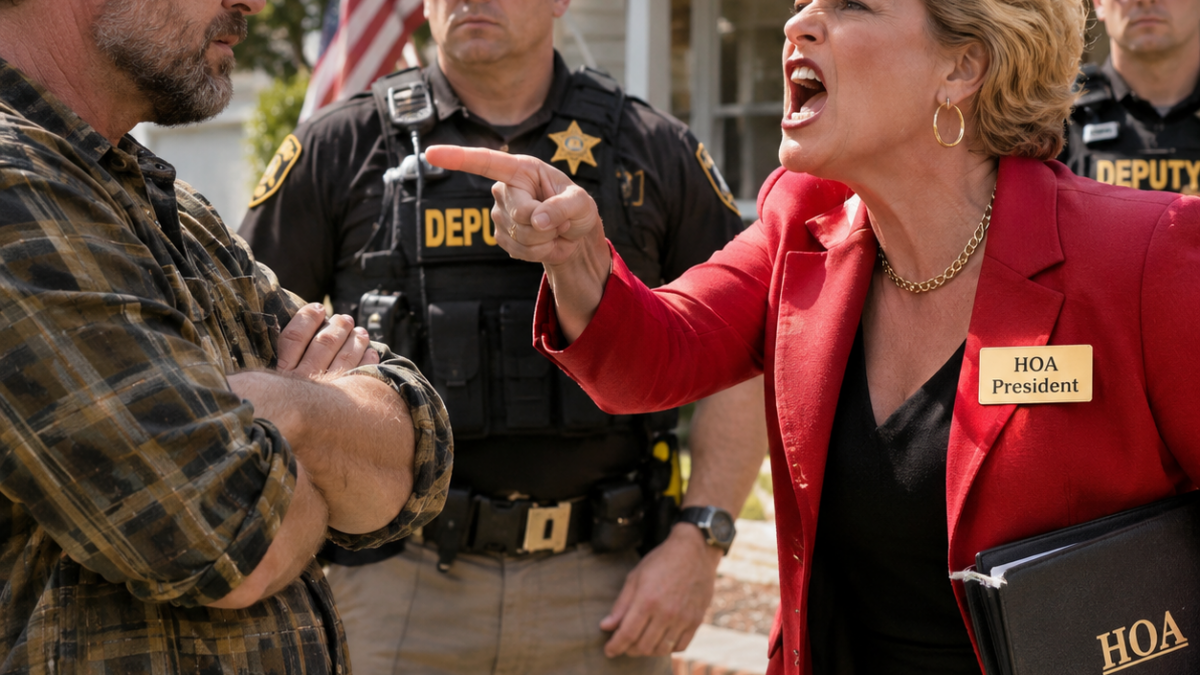
PART 2
Victoria remained in my driveway as if she expected me to apologize.
I flipped through the packet she had handed me.
Landscaping requirements.
Exterior paint restrictions.
Fence height.
Trash containers.
Parking rules.
Shed placement.
Mailbox specifications.
There was even a section regulating decorative flags.
I closed the packet.
“Victoria, none of this applies to my parcel.”
She gave a small laugh.
“Mr. Carter, your property is surrounded by Willow Creek.”
“No. It’s beside Willow Creek.”
“That’s essentially the same thing.”
“No, it isn’t.”
Her jaw tightened slightly.
“Your home will affect the appearance and value of our community.”
“I understand why you’d care about that.”
“Good.”
“But caring isn’t the same as having authority.”
She stared at me.
I could almost see her deciding whether I was worth arguing with.
Then she reached into the folder and pulled out another sheet.
“This is the current dues schedule. You’re behind from the beginning of the calendar year, but I’m prepared to waive the late charges if you submit payment promptly.”
I didn’t take the paper.
“How much?”
“Annual assessments are $1,480.”
I almost laughed.
Not because the amount was funny.
Because she was standing on land that wasn’t governed by her association and offering to forgive penalties on a debt that didn’t exist.
“Victoria, show me the recorded document that places my parcel in Willow Creek.”
Her expression changed.
Only slightly.
But enough.
“The neighborhood boundaries are obvious.”
“That’s not what I asked.”
“I’ve been president for seven years.”
“That’s also not what I asked.”
Her voice cooled.
“Are you always this difficult?”
“No. Usually people asking me for almost fifteen hundred dollars can show me why I owe it.”
For several seconds, neither of us spoke.
A circular saw buzzed from inside the unfinished house.
One of the framers glanced toward us.
Victoria noticed.
Her posture stiffened.
I realized then that she didn’t like being challenged where other people could see it.
She lowered her voice.
“Every homeowner in Willow Creek pays.”
“I’m not a Willow Creek homeowner.”
“You live at the entrance to the community.”
“My driveway connects to the county road.”
“Visually, your property is part of the neighborhood.”
“Legally, it isn’t.”
She closed her folder sharply.
“I’ll have our records reviewed.”
“Please do.”
“I think you’ll find you’re mistaken.”
“If you find a recorded covenant attached to my parcel, send it to me.”
She put her sunglasses back on.
“I will.”
Then she walked to her SUV.
Before opening the door, she looked back.
“You might want to reconsider your attitude, Mr. Carter. We try to maintain a cooperative community.”
I smiled politely.
“So do I.”
She drove away.
I watched the white SUV disappear behind the stone entrance pillars.
At that point, I still believed the disagreement would end once she checked the documents.
That was my first mistake.
### **The First Notice**
Three days later, an envelope appeared in the mailbox at my rental.
The return address read:
**WILLOW CREEK ESTATES HOMEOWNERS ASSOCIATION**
Inside was a formal notice.
**DELINQUENT ASSESSMENT.**
Balance due: $1,480.
Administrative penalty: $150.
Document-processing charge: $75.
Total: $1,705.
I read it twice.
Then a third time.
At the bottom was a warning:
**Failure to resolve the outstanding balance may result in additional enforcement action.**
I stared at those words for a long moment.
Then I pulled out my property file.
Deed.
Title commitment.
Survey.
County parcel map.
Recorded declaration for Willow Creek Estates.
I compared everything again.
Nothing had changed.
My parcel was outside the HOA boundary.
I called the number on the letter.
Victoria answered.
“Willow Creek Association, Victoria Hayes speaking.”
“Victoria, it’s Ethan Carter.”
A pause.
“Yes, Ethan.”
“I received a delinquency notice.”
“I’m glad it reached you.”
“You said you were going to review the records.”
“I did.”
“And?”
“And the board agrees that your property benefits from proximity to Willow Creek and should be contributing.”
I leaned back in my chair.
“That’s not a legal answer.”
“It’s the board’s position.”
“Show me the document.”
“We’ve already discussed this.”
“No, you told me everyone around me pays. I asked for a recorded document tying my parcel to the HOA.”
“You are being unnecessarily confrontational.”
“I’m asking for proof before paying a bill.”
She exhaled loudly.
“Your property impacts ours.”
“That still doesn’t make me a member.”
“You use the neighborhood.”
“No, I don’t.”
“You drive past the entrance.”
“On a county road.”
“You benefit from our landscaping.”
I actually had to pull the phone away from my ear for a second.
“Victoria, I’m not paying an HOA because I can see its flowers.”
Her voice turned sharp.
“You should be careful about making jokes.”
“I’m not joking.”
“You’ve moved into an established community.”
“I bought property next to an established community.”
“Semantics.”
“Property law isn’t semantics.”
Silence.
Then she said, “We’ll proceed accordingly.”
The call ended.
That evening, I drove to the property.
The framing crew had gone home.
The sun was low behind the trees.
I sat on the unfinished front steps and stared across the field.
For the first time since I’d purchased the land, I didn’t feel excited.
I felt invaded.
Not physically.
Not yet.
But there was something deeply unsettling about receiving a bill from a group I had never joined and being told my refusal to pay was some kind of moral failure.
I’d worked too hard for this place.
I wasn’t going to surrender because somebody had printed an official-looking letter.
But I also wasn’t stupid enough to treat it casually.
The next morning, I called an attorney.
### **Daniel Mercer**
Daniel Mercer had represented the construction company I worked for on several property disputes.
He was in his late forties, calm almost to the point of being annoying, and he had a habit of reading entire documents before offering opinions.
That was exactly what I needed.
I brought everything to his office.
He spread the paperwork across a conference table.
For nearly twenty minutes, he said almost nothing.
Then he tapped the survey.
“Your boundary is here.”
“Yes.”
“And the recorded HOA boundary ends here.”
“Right.”
He studied the declaration.
“Your parcel number isn’t listed.”
“No.”
He flipped through the title documents.
“No covenant referencing Willow Creek.”
“That’s what I found.”
Daniel sat back.
“Then based on what you’ve shown me, you’re not a member.”
Relief washed through me.
Not because I had doubted the documents.
Because hearing an attorney say it made the situation feel solid again.
“So I can ignore them?”
Daniel shook his head.
“Don’t ignore anything.”
“Why?”
“Because people who are wrong can still create expensive problems.”
That sentence stayed with me.
He continued.
“Respond in writing. Keep it professional. Attach copies of the deed and survey. Ask them to identify the recorded instrument they believe binds your property.”
“I already asked Victoria.”
“Now ask formally.”
He drafted a letter.
Short.
Clear.
No insults.
No threats.
The important paragraph read:
**My client disputes any claim that his parcel is subject to Willow Creek Estates Homeowners Association. Please provide the recorded declaration, covenant, annexation instrument, or other document establishing HOA authority over Parcel 17-442-B. Until such documentation is produced, my client denies liability for any assessment, fee, penalty, or enforcement action.**
Daniel handed me a copy.
“From this point forward, document everything.”
“Everything?”
“Every letter. Every email. Every time she comes onto the property. Every conversation.”
“You’re expecting trouble.”
“I’m expecting someone who already ignored the survey to keep ignoring it.”
He was right.
### **The Campaign Begins**
The HOA didn’t respond to Daniel’s letter with documentation.
Instead, Victoria sent another bill.
Then another.
The balance increased each time.
$1,705 became $1,930.
Then $2,205.
Apparently, I now owed penalties for refusing to pay penalties attached to money I didn’t owe.
Then the violation notices started.
**UNAPPROVED EXTERIOR MATERIALS.**
**NONCOMPLIANT DRIVEWAY SURFACE.**
**UNAUTHORIZED CONSTRUCTION VEHICLE PARKING.**
The last one almost made me laugh.
My construction crew was being cited for parking construction vehicles on an active construction site outside the HOA.
Victoria wasn’t trying to prove jurisdiction anymore.
She was behaving as though repeating the claim often enough would make it true.
Daniel sent another letter.
Then another.
No evidence came back.
Instead, one afternoon, I arrived at the property and found Victoria standing beside my contractor.
She had a clipboard in her hands.
My contractor, Mike Reynolds, looked furious.
“What’s going on?”
Mike pointed at Victoria.
“She says we need to stop work until some architectural committee approves the plans.”
Victoria stepped forward.
“Mr. Carter, your contractor has refused to cooperate.”
Mike laughed.
“Because you’re not the county.”
I held up a hand.
“Victoria, leave my contractor alone.”
“Your roof pitch violates Willow Creek standards.”
“My property isn’t in Willow Creek.”
“You’re building something visible from Willow Creek.”
“So is the sky.”
Mike coughed to hide a laugh.
Victoria’s face reddened.
“This isn’t funny.”
“No,” I said. “It’s becoming harassment.”
Her eyes narrowed.
“You should be very careful using that word.”
“You should be careful walking onto private property after you’ve been told your association has no authority here.”
She stared at me.
Then at Mike.
Then she gathered her papers.
“The board will hear about this.”
“I’m sure they will.”
As she walked toward her SUV, I called after her.
“Victoria.”
She stopped.
“From now on, communicate through my attorney.”
She turned slowly.
“You really think hiring a lawyer changes the facts?”
“No.”
I looked toward the survey stake near the edge of my property.
“The facts were already there.”
### **The Board Meeting**
A week later, I received an email from a man named Robert Ellison.
He introduced himself as the HOA treasurer.
His tone was different.
Polite.
Almost apologetic.
He said the board would be discussing “the Carter parcel matter” at its monthly meeting.
I forwarded the email to Daniel.
He called me.
“Go.”
“I thought you said to avoid unnecessary confrontation.”
“This isn’t unnecessary.”
So the following Tuesday, I walked into the Willow Creek clubhouse carrying one folder.
Victoria sat at the center of a long table.
Six board members were beside her.
About twenty homeowners sat in folding chairs facing them.
The moment I entered, conversations became quieter.
Victoria looked surprised.
“Mr. Carter.”
“Mrs. Hayes.”
She leaned toward the microphone.
“This is a closed association matter.”
Robert Ellison looked at her.
“He was invited.”
Victoria’s head turned.
“You invited him?”
Robert nodded.
“I thought he should be able to address the board.”
Something flashed across her face.
Anger.
Not at me.
At him.
I sat in the front row.
For twenty minutes, they discussed landscaping budgets and pool maintenance.
Then Victoria cleared her throat.
“Next item. Noncompliance involving the Carter residence.”
I stood.
“Before we begin, I’d like one point clarified.”
Victoria sighed.
“Mr. Carter—”
I held up the survey.
“Can anyone on this board identify the recorded instrument that places Parcel 17-442-B inside Willow Creek Estates?”
Silence.
Victoria spoke first.
“We have already established—”
“Not verbally. Recorded.”
Robert looked toward the association’s binder.
Another board member, Susan Patel, flipped through documents.
Victoria’s voice hardened.
“This property sits directly adjacent to Willow Creek and clearly affects our neighborhood.”
Susan looked up.
“Victoria, that’s not what he’s asking.”
I noticed several homeowners glance at one another.
Victoria turned toward Susan.
“I understand perfectly well what he’s asking.”
“Then answer it,” someone in the audience muttered.
Victoria ignored the comment.
She looked at me.
“The board has an obligation to protect property values.”
“I agree.”
“Your refusal to participate undermines that.”
“No. Your attempt to charge a nonmember undermines it.”
Her eyes sharpened.
I continued.
“My attorney has asked twice for documentation. Nothing has been provided. Instead, I’ve received more than two thousand dollars in fees and multiple violation notices.”
I placed copies on the table.
Susan picked one up.
“Architectural violation?”
“Yes.”
She looked at Victoria.
“Do we have jurisdiction over his architectural plans?”
Victoria straightened.
“We have an obligation to prevent incompatible development at our boundary.”
“That’s not the same thing.”
Robert spoke quietly.
“We should probably have counsel review this.”
Victoria turned on him.
“We don’t need outside counsel to understand our own neighborhood.”
That was the moment I realized something important.
Victoria wasn’t simply mistaken anymore.
She had tied her authority to being right.
Backing down in front of the board would mean admitting that she’d spent weeks threatening someone over land she didn’t control.
And she couldn’t tolerate that.
The meeting ended without resolution.
But as people stood to leave, Robert approached me.
“Mr. Carter.”
“Ethan is fine.”
He lowered his voice.
“I wasn’t aware those notices had been sent.”
I looked toward Victoria.
“You might want to ask who authorized them.”
His expression told me that question had already occurred to him.
### **The Threat**
Two days later, I received the letter that changed everything.
It wasn’t from an attorney.
It was printed on HOA letterhead.
The heading read:
**FINAL DEMAND FOR COMPLIANCE.**
It claimed that my continuing refusal to recognize HOA authority represented “intentional interference with community governance.”
It ordered me to cease “unauthorized occupancy and development activities” until the matter was resolved.
I read that line three times.
Unauthorized occupancy.
On my own land.
At the bottom, someone had written in blue ink:
**Failure to comply may result in referral to law enforcement.**
I photographed the letter and sent it to Daniel.
He called less than five minutes later.
“Don’t respond.”
“That’s new.”
“I’m responding.”
“Can they actually call the police?”
“Anybody can call the police.”
“And say what?”
“Apparently, whatever Victoria decides.”
I looked through my office window.
“Could deputies actually remove me?”
Daniel paused.
“Not lawfully based on these documents.”
The word *lawfully* bothered me.
“But?”
“But when law enforcement gets called, you stay calm. You have your deed and survey ready. You don’t argue. You don’t make threats. You call me.”
I leaned back.
“I can’t believe we’re even having this conversation.”
“Neither can I.”
That night, I barely slept.
Not because I thought Victoria owned my land.
Because I had finally begun to understand that evidence didn’t stop people from creating chaos.
It only gave you a way through it.
### **The Day the Deputies Came**
It happened on a Saturday morning.
I was at the property installing shelving in the workshop.
The house was about three months from completion.
Most of the exterior was finished.
The porch posts were wrapped.
Windows were installed.
The first coats of interior paint had gone on.
I heard tires on gravel.
At first, I assumed it was Mike.
Then I looked through the open workshop door.
Two county sheriff’s vehicles were turning into my driveway.
My stomach dropped.
Behind them came a white SUV.
Victoria.
“Unbelievable,” I whispered.
The deputies stepped out.
One was a man in his late thirties.
The other was a woman maybe ten years older.
Victoria was out of her SUV before either deputy reached the house.
She hurried toward them.
“Thank you for coming. He’s been repeatedly told he has no authorization to continue occupying this property under our community regulations.”
I could hear every word.
The male deputy looked toward me.
“Sir, are you Ethan Carter?”
“Yes.”
“I’m Deputy Nolan. This is Deputy Ramirez.”
“Morning.”
Victoria stepped between us slightly.
“I’ve provided documentation showing—”
Deputy Ramirez raised a hand.
“Ma’am, we’ll speak with everyone.”
Victoria stopped.
For the first time since I’d known her, someone else had interrupted her and she couldn’t punish them for it.
Deputy Nolan looked at me.
“We received a complaint involving a property dispute.”
“I assumed that’s why you’re here.”
“Do you have identification?”
“Yes.”
I handed it over.
“Do you own this property?”
“Yes.”
Victoria made a noise behind him.
“That isn’t the issue.”
Deputy Ramirez looked at her.
“Ma’am.”
One word.
Victoria fell silent.
I walked into the house and returned with the folder Daniel had told me to keep ready.
Deed.
Survey.
Title documents.
County parcel map.
Copies of every HOA letter.
Daniel’s correspondence.
Deputy Nolan looked surprised.
“You’ve been expecting us?”
“I’ve been expecting her to do something like this.”
Victoria folded her arms.
Deputy Nolan began examining the deed.
Ramirez studied the survey.
“Where are the markers?” she asked.
“I can show you.”
We walked toward the eastern edge of the property.
Victoria followed.
The original surveyor had placed iron pins and marked several locations with stakes during construction.
I pointed toward one.
“That’s the northeastern corner.”
Ramirez looked at the survey.
“And Willow Creek begins east of this line?”
“Correct.”
Victoria shook her head.
“The HOA maintains the entire entrance area.”
“Maintenance doesn’t equal ownership,” I said.
She turned toward me.
“Would you stop pretending to be a lawyer?”
“I’m not.”
I looked at Deputy Ramirez.
“That’s why I hired one.”
Deputy Nolan looked up.
“You have counsel?”
“Yes.”
“Name?”
“Daniel Mercer.”
Victoria’s expression changed again.
Small.
But visible.
They walked the boundary.
Slowly.
Marker by marker.
Then we returned to the driveway.
Deputy Nolan looked at Victoria.
“Mrs. Hayes, what specific authority are you saying the HOA has over this parcel?”
Victoria immediately opened her folder.
“Our covenants establish standards throughout Willow Creek.”
“Is this parcel included in those covenants?”
“It’s geographically connected to the neighborhood.”
“That’s not what I asked.”
For half a second, I almost smiled.
It was nearly the same conversation I’d had with her the first afternoon.
Victoria flipped through several pages.
“The community map clearly indicates—”
Deputy Ramirez took the paper.
“This map doesn’t show parcel numbers.”
“It’s an HOA planning map.”
“We’re looking at a county survey.”
Victoria’s face tightened.
“Our attorney can clarify.”
Deputy Nolan nodded.
“That’s probably where this needs to go.”
Victoria stared at him.
“I’m asking you to remove him until the dispute is resolved.”
The words landed heavily.
Even though I had known that was probably why she had called, hearing her actually say it was different.
Remove me.
From my own property.
Deputy Nolan looked toward the unfinished house.
Then at the deed.
Then back at Victoria.
“Ma’am, based on what we’re seeing, Mr. Carter appears to be the record owner.”
“He is refusing HOA authority.”
“That’s a civil issue.”
“He is trespassing against community regulations.”
Deputy Ramirez frowned.
“On property titled in his name?”
Victoria’s mouth opened.
Then closed.
I said nothing.
Daniel had told me not to turn the moment into a performance.
So I stood quietly.
Let the documents speak.
Victoria tried another angle.
“The HOA has spent thousands maintaining roads and landscaping that benefit this property.”
“My driveway exits to the county road,” I said.
Nolan looked at the map again.
“It does.”
Victoria looked toward me with genuine hatred.
Not irritation.
Not frustration.
Hatred.
Because the deputies were seeing what she had refused to see.
Her position wasn’t collapsing because I had outshouted her.
It was collapsing because she had nothing.
### **Daniel Arrives**
I had texted Daniel the moment the patrol cars arrived.
Twenty-five minutes later, a dark sedan turned into my driveway.
Daniel stepped out holding a leather briefcase.
Victoria saw him.
Her face went pale.
“Mr. Mercer,” Deputy Nolan said.
Daniel nodded.
“We’ve met?”
“No, but your client gave us your name.”
Daniel shook both deputies’ hands.
Then he looked at me.
“You okay?”
“So far.”
He turned toward Victoria.
“Mrs. Hayes.”
“Mr. Mercer.”
Her voice had lost its confidence.
Daniel opened his briefcase.
“I brought certified copies of the deed, survey, and recorded HOA declaration.”
Victoria stared at him.
“That wasn’t necessary.”
Daniel looked at the deputies.
“I think it might be.”
He placed the documents on the hood of his car.
“The relevant point is simple. Willow Creek Estates was recorded under Declaration Book 842, Page 117. The legal description ends at the eastern line of Mr. Carter’s parcel. His property has never been annexed into the association.”
Deputy Ramirez nodded.
“That’s consistent with what he showed us.”
Daniel continued.
“There is no assessment obligation. There is no architectural authority. There is no association lien authority. There is no basis for treating Mr. Carter as an HOA member.”
Victoria crossed her arms.
“That is one interpretation.”
Daniel finally looked directly at her.
“No, Mrs. Hayes. That’s the recorded legal description.”
Her cheeks reddened.
She turned toward the deputies.
“Surely you can at least require him to stop construction until the dispute is resolved.”
Deputy Nolan shook his head.
“Not based on what we have.”
“So you’re doing nothing?”
“We’re not removing a property owner from land that appears to belong to him.”
Victoria stared at him.
Then she pointed toward my house.
“This affects dozens of families.”
Deputy Ramirez’s voice remained calm.
“Then the HOA can address it through its attorney and the appropriate civil process.”
Victoria looked at me.
“You think you’ve won something.”
I finally spoke.
“No.”
She gave me a bitter smile.
“Really?”
“I think you called the sheriff to have me removed from land you knew you couldn’t prove you controlled.”
Her expression froze.
I continued.
“And now there are witnesses.”
Daniel glanced at me.
Not disapprovingly.
More like he was realizing I’d understood exactly what had just happened.
Victoria didn’t respond.
### **The Report**
Before leaving, Deputy Nolan took copies of several documents.
He gave me an incident number.
“This is not a determination of property title,” he said carefully. “We’re not a court.”
“I understand.”
“But based on what was presented today, there’s no basis for us to remove you.”
“Thank you.”
He looked toward Victoria.
“I recommend both parties communicate through counsel.”
Daniel nodded.
“That’s already been our request.”
The deputies left.
Victoria remained beside her SUV.
For several seconds, she stared at my house.
Then at me.
I expected anger.
Instead, she looked almost frightened.
“You’re trying to embarrass me,” she said.
I was stunned.
“You brought two sheriff’s deputies to my property.”
“You refused to cooperate.”
“Cooperate with what?”
“With the neighborhood.”
“I’m not in the neighborhood.”
She shook her head.
“You could have handled this differently.”
That finally made something inside me snap.
Not enough to yell.
But enough to stop being polite.
“I asked you for one document.”
She stared at me.
“One.”
I held up a finger.
“The first day you came here, I asked you to show me what gave your HOA authority over my land. You couldn’t. My attorney asked you. You couldn’t. Your own board asked questions. You still couldn’t.”
Her lips tightened.
“And instead of admitting you were wrong, you billed me, threatened me, interfered with my contractor, and called law enforcement.”
I stepped closer.
Not threatening.
Just enough that she couldn’t pretend not to hear me.
“So no, Victoria. You don’t get to stand here and tell me I should have handled this differently.”
Her eyes flicked toward Daniel.
He said nothing.
Victoria opened her SUV door.
“This isn’t over.”
Daniel finally spoke.
“Actually, Mrs. Hayes, that’s something we need to discuss.”
She stopped.
He pulled an envelope from his briefcase.
“This is a formal demand that the association cease all collection and enforcement activity against Mr. Carter. It also requests preservation of board emails, correspondence, meeting minutes, billing records, and communications relating to his parcel.”
Her hand remained on the car door.
“Preservation?”
“For potential litigation.”
The color drained from her face.
That was the moment the balance shifted.
For weeks, Victoria had treated me like a homeowner she could pressure.
Now she was being treated like a defendant who needed to preserve evidence.
Daniel held out the envelope.
She didn’t take it.
So he placed it beneath the windshield wiper of her SUV.
“Have association counsel contact me.”
Victoria got inside.
The SUV backed out quickly.
Daniel and I watched until it disappeared.
Then he looked at me.
“Now it gets interesting.”
### **What the Board Didn’t Know**
Three days later, Daniel received a call from the HOA’s attorney.
Her name was Laura Bennett.
Unlike Victoria, she didn’t waste time.
She asked for the parcel information.
Daniel sent it.
She asked for the survey.
He sent that too.
Then silence.
Two days later, Laura called again.
According to Daniel, her first words were:
“Your client is correct.”
That should have ended everything.
It didn’t.
Because once the HOA attorney started reviewing the file, she discovered something worse.
Victoria had never obtained legal approval for the collection notices.
She had never asked association counsel whether my parcel belonged to the HOA.
She had told the board that counsel had “confirmed jurisdiction.”
Counsel had done no such thing.
Robert called me personally.
His voice sounded exhausted.
“Ethan, I owe you an apology.”
“You personally don’t owe me anything.”
“I was on the board.”
“You also invited me to the meeting.”
He sighed.
“We should have stopped this sooner.”
I didn’t argue.
He continued.
“We’re holding an emergency board meeting Thursday night.”
“Okay.”
“Victoria won’t be chairing it.”
That got my attention.
“Why?”
Another pause.
“Because we voted this morning to temporarily suspend her authority pending review.”
I sat down.
This was the same woman who, less than a week earlier, had stood in my driveway demanding that deputies remove me.
Now her own board had stripped her of power.
And Daniel wasn’t finished.
### **The Counterattack**
I had never been interested in revenge for the sake of revenge.
I wanted peace.
But there is a point where allowing someone to walk away without consequences simply teaches them that intimidation works until they pick the wrong target.
Daniel explained my options.
We had evidence of repeated demands after the HOA had been notified of the boundary issue.
We had interference with construction.
We had written threats.
We had the sheriff’s incident report.
We had documentation showing Victoria had continued representing that the HOA had authority despite failing to produce any legal instrument supporting that claim.
“Could we sue?” I asked.
“Yes.”
“Would we win?”
Daniel gave the answer attorneys always give.
“Litigation is never guaranteed.”
I smiled.
“Of course.”
“But your position is strong.”
“What would you recommend?”
He folded his hands.
“Give the board a chance to correct it.”
That surprised me.
“Why?”
“Because your goal is to build your house, not spend two years in court.”
He was right.
So we sent demands.
Not outrageous ones.
Not emotional ones.
Specific.
The HOA had to withdraw every assessment.
Remove every claimed violation.
Send written confirmation that my property was not subject to Willow Creek covenants.
Reimburse the attorney fees I’d incurred responding to unauthorized collection and enforcement activity.
Issue a written directive prohibiting board members and association agents from entering my property without permission except for legitimate emergency reasons.
And provide written confirmation that no lien had been recorded against my parcel.
The last part mattered most.
If they had tried to cloud my title, I was prepared to go to court immediately.
Three days later, Laura responded.
No lien had been filed.
Good.
All assessments were withdrawn.
All violation notices were canceled.
The board agreed to recognize the recorded boundary.
They also offered to reimburse a large portion of my legal expenses.
Daniel called.
“They want confidentiality.”
“About what?”
“The settlement.”
I thought about Victoria standing in my driveway.
About the deputies.
About the letters.
About months of anxiety.
“No.”
Daniel laughed softly.
“I thought you’d say that.”
“I don’t need to advertise it.”
“That’s different from agreeing you can never discuss what happened.”
“Exactly.”
The HOA eventually accepted.
But there was still one unresolved issue.
Victoria.
### **The Emergency Meeting**
Robert asked if I would attend.
At first, I said no.
Then Daniel changed my mind.
“You don’t have to speak.”
“Then why go?”
“Because sometimes closure matters.”
So I went.
The clubhouse was packed.
Far more people than the previous meeting.
Word had spread.
Victoria sat near the end of the board table.
Not in the center.
Her expression was rigid.
Robert chaired the meeting.
He began without ceremony.
“We have completed a preliminary review regarding the Carter parcel.”
The room became quiet.
He continued.
“The parcel is not and has never been part of Willow Creek Estates Homeowners Association.”
A murmur moved through the room.
Victoria stared straight ahead.
Robert continued.
“Assessments and violation notices sent to Mr. Carter were not authorized by recorded governing documents.”
Someone behind me whispered, “You’ve got to be kidding.”
Robert looked toward Victoria.
“Certain representations were made to the board regarding legal authority that were inaccurate.”
Victoria finally spoke.
“I acted in the interest of the community.”
Robert’s jaw tightened.
“You told this board legal counsel had confirmed jurisdiction.”
“I said counsel would support our position.”
“No. You said counsel had confirmed it.”
“It was a reasonable interpretation.”
Laura Bennett, the HOA attorney, sat two seats away.
She leaned toward the microphone.
“For the record, my office was not consulted before enforcement began.”
The room exploded in whispers.
Victoria turned toward her.
“We had discussed boundary properties before.”
“Not this parcel.”
“You knew we were concerned about development around the perimeter.”
“Concern does not establish jurisdiction.”
Victoria looked around the room.
For the first time, she seemed to understand that nobody was following her lead.
A homeowner stood.
“My name is Frank Miller. Did we pay for the sheriff to go out there?”
Robert answered.
“The sheriff’s office was contacted by Mrs. Hayes.”
“On behalf of the HOA?”
Robert hesitated.
“That is part of what we’re reviewing.”
Another homeowner spoke.
“Did our dues pay legal fees for this?”
Laura answered carefully.
“Some association funds have been used responding to the dispute.”
The mood changed instantly.
People who had been mildly curious were suddenly angry.
Victoria stood.
“This is absurd. I was protecting every homeowner in this room.”
Frank shook his head.
“You tried to collect money from a guy who doesn’t live here.”
“You don’t understand the full situation.”
“I understand our lawyer just said he doesn’t live here.”
Another homeowner called out.
“And you sent cops?”
Victoria turned toward the crowd.
“His conduct was disruptive.”
I almost couldn’t believe what I was hearing.
I had barely entered their neighborhood.
I hadn’t used their pool.
I hadn’t used their clubhouse.
I hadn’t attended a meeting until invited.
Yet somehow I was disruptive because I refused to pay them.
Robert struck the gavel.
“Order.”
Victoria sat down.
Then Robert announced the motion.
Removal of Victoria Hayes as HOA president.
The vote passed five to one.
Victoria was the only vote against it.
### **After the Vote**
I expected to feel triumphant.
Instead, I felt strangely sad.
Not for Victoria exactly.
For the waste of it.
Months of hostility.
Thousands of dollars in legal work.
Sheriff’s deputies pulled away from real responsibilities to settle a dispute that should have ended the first time someone looked at a survey.
All because one person couldn’t say:
*I was wrong.*
As people began leaving, Victoria approached me.
I could see homeowners watching.
Daniel stood several feet away.
Victoria stopped in front of me.
“Happy?”
“No.”
She looked almost offended.
“Don’t pretend.”
“I’m not.”
“You humiliated me.”
I shook my head.
“I didn’t make those decisions.”
“You challenged me in front of my board.”
“I asked for proof.”
“You brought an attorney.”
“After you sent bills for money I didn’t owe.”
“You made this personal.”
I stared at her.
“Victoria, you called law enforcement and asked them to remove me from my own land.”
Her face twitched.
“Because you refused to respect the community.”
“There it is.”
“What?”
“That’s what this was always about.”
She frowned.
I continued.
“You didn’t care whether my deed included your HOA. You cared that I said no to you.”
Her eyes flashed.
“You think you’re better than everyone here because you aren’t subject to the rules.”
“No.”
I looked around the clubhouse.
“I think those people agreed to those rules when they bought their homes. I didn’t.”
She said nothing.
“That’s the difference.”
For a moment, the anger drained from her face.
She looked tired.
Older.
Then she turned away.
I thought that was the last time we’d speak.
I was wrong.
### **One Final Move**
Two weeks later, Mike called me early in the morning.
“You need to get out here.”
“What happened?”
“Just come.”
I drove to the property.
A bright orange construction fence had been erected near the eastern edge.
At first, I assumed Mike had put it there.
Then I saw the signs.
**WILLOW CREEK PROPERTY — NO ACCESS**
My stomach dropped.
“Who did this?”
Mike shook his head.
“Wasn’t us.”
One of the fence posts sat nearly six feet inside my surveyed boundary.
I called Daniel.
He told me not to touch anything until we documented it.
We photographed every post.
Every sign.
Every measurement.
Then I called the sheriff’s office using the nonemergency number.
Deputy Ramirez returned.
She recognized me immediately.
“Mr. Carter.”
“Deputy.”
She looked at the fence.
“You’ve got to be kidding.”
“That’s roughly how I feel.”
She photographed it too.
We checked the boundary markers.
There was no question.
Someone had placed HOA signage and fencing on my property.
The question was who.
The answer came faster than expected.
A security camera mounted on the corner of my workshop had recorded everything.
At 6:18 the previous evening, Victoria’s white SUV had pulled onto the gravel shoulder.
A maintenance truck followed.
Victoria got out.
She pointed.
Two workers unloaded fencing.
The video showed her directing them where to place it.
I watched the footage twice.
Then I called Daniel.
His response was short.
“Save copies in three places.”
This time, I didn’t want a warning letter.
Neither did Daniel.
### **The Lawsuit**
We filed for injunctive relief and damages.
The complaint was narrow.
Trespass.
Interference with use of property.
Costs associated with removing unauthorized structures.
And a request for declaratory judgment confirming, once and for all, that my parcel was outside the HOA.
The HOA moved quickly.
Laura called Daniel the same day.
The board hadn’t authorized the fence.
The maintenance crew had been told by Victoria that she still had authority to direct them regarding a “boundary safety issue.”
The board immediately terminated her remaining committee access.
Then something happened I hadn’t expected.
The HOA joined me in seeking a final boundary declaration.
Not because they suddenly loved me.
Because they wanted the dispute dead forever.
Victoria hired her own attorney.
Her position was that she had acted in good faith.
The security footage made that argument difficult.
During mediation, her attorney asked whether I would dismiss the claim against her personally if she apologized and paid the costs associated with the fence.
Daniel looked at me.
It was my decision.
I thought about all the months I’d spent angry.
Then I thought about what I actually wanted.
My home.
My land.
Peace.
“I want the boundary order.”
Daniel nodded.
“I want my fees covered.”
He nodded again.
“And I want a written acknowledgment that she had no authority to enter my property.”
“Anything else?”
I thought about it.
“No.”
Not humiliation.
Not revenge.
Accountability.
There was a difference.
### **Victoria’s Written Statement**
The mediation agreement required Victoria to sign a statement.
It wasn’t dramatic.
That made it better.
It read:
**I acknowledge that the property owned by Ethan Carter, Parcel 17-442-B, is not part of Willow Creek Estates Homeowners Association and that I had no authority to impose HOA assessments, restrictions, enforcement actions, or access controls upon that property. I further acknowledge that future entry onto the property requires the owner’s permission except as otherwise provided by law.**
When Daniel slid the signed copy across the table, I stared at it for a long time.
“This is what she could’ve said the first day,” I said.
“Pretty much.”
“Instead we spent months doing this.”
Daniel smiled faintly.
“Some people pay a very high price to avoid admitting they’re wrong.”
The court later entered the agreed boundary order.
It was now impossible for any future HOA board to revive the claim casually.
The recorded documents were clear before.
Now there was also a court order.
Crystal clear.
### **Finishing the House**
The first night I slept in the completed house, I didn’t have much furniture.
A mattress.
A folding table.
Two chairs.
Coffee maker.
That was about it.
But the place was mine.
The living room smelled like fresh wood and paint.
The kitchen lights reflected off countertops I’d selected almost a year earlier.
Outside, the porch faced west.
I carried a mug of coffee out there before sunrise.
The sky was still dark.
For several minutes, I simply listened.
Crickets.
Wind moving through the trees.
A truck far off on the county road.
No letters.
No arguments.
No threats.
No one telling me my own property needed their permission.
I thought about my father.
He had died years before I bought the land.
When I was a kid, he used to drive me past open countryside and say, “Someday I’d like enough land that I can stand in the middle of it and not owe an explanation to anybody.”
He never got there.
But sitting on that porch, I finally understood what he’d meant.
It wasn’t about isolation.
It wasn’t about hating neighbors.
It was about dignity.
The ability to build something with your own hands and know that someone else’s ego couldn’t simply take it from you.
### **A Different HOA**
Willow Creek changed after Victoria.
Robert became interim president.
Then Susan Patel was elected permanently.
The first time Susan came to my property, she stopped at the edge of the driveway.
She didn’t drive in.
She called my phone.
“Hi, Ethan. It’s Susan from Willow Creek.”
“Everything okay?”
“Yes. I wanted to ask something, but I didn’t want to enter without permission.”
That alone told me things had changed.
I walked down.
She was holding a folder.
For half a second, I laughed.
She looked embarrassed.
“Bad choice of accessory?”
“A little.”
She laughed too.
Then she explained that a large oak limb on HOA property was leaning toward my fence line.
They wanted permission for a tree crew to access part of my land safely.
“Absolutely.”
“Thank you.”
That was it.
No power struggle.
No assumption.
No threat.
Just one property owner asking another.
The way it should have been from the beginning.
Before leaving, Susan hesitated.
“I also wanted to apologize.”
“You didn’t do anything.”
“I was on the board.”
“You were also one of the first people to question what was happening.”
“We should’ve questioned it sooner.”
I nodded.
“Probably.”
She gave a small smile.
“Fair enough.”
Then she walked away.
### **Victoria’s Last Visit**
Nearly a year after the first confrontation, I saw Victoria again.
I was staining the porch rail when a car stopped along the county road.
Not the white SUV.
A smaller sedan.
Victoria stepped out.
She remained near the road.
She didn’t walk onto my property.
That mattered.
I set the brush down and walked toward her.
She looked different.
No clipboard.
No folder.
No sunglasses.
“I won’t come closer,” she said.
“Okay.”
For a few seconds, neither of us spoke.
Then she looked at the house.
“It’s beautiful.”
“Thank you.”
“You finished the workshop too.”
“Last month.”
She nodded.
“I heard.”
I wondered who had told her.
Then she looked at me.
“I was angry with you.”
“I know.”
“I thought you were deliberately trying to undermine me.”
“I wasn’t.”
“I know that now.”
There was no dramatic apology.
No tears.
No transformation.
Life rarely works that neatly.
But she said something I didn’t expect.
“When you asked me for the document that first day, I didn’t have it.”
“I know.”
“I should’ve stopped.”
I waited.
She looked toward Willow Creek.
“I had been president so long that I started thinking being responsible for the neighborhood meant being responsible for everything near it.”
I didn’t answer.
She looked back at me.
“That’s not an excuse.”
“No.”
“I know.”
Another silence.
Then she said, “I’m sorry for calling the deputies.”
That was the part that mattered most.
Not because I needed the apology.
Because she’d finally named what she’d done.
“I accept that.”
She nodded.
Then she got into her car.
Before leaving, she lowered the window.
“Your father would’ve liked the place.”
I froze.
“How do you know about my father?”
“Robert told me why the property meant so much to you.”
I looked back toward the house.
“Yeah.”
My throat tightened.
“I think he would have.”
Victoria drove away.
That was the last time she came to my property.
### **The Boundary Stone**
The following spring, I had a mason install a small stone marker near the eastern boundary.
Not a warning sign.
Not something hostile.
Just a simple rectangular stone.
On it, I had four words engraved:
**CARTER FAMILY PROPERTY — 2026**
Mike saw it and laughed.
“That’s your revenge?”
I looked at the stone.
“No.”
“Sure looks like one.”
“If I wanted revenge, I’d put Victoria’s name on it.”
He laughed harder.
I shook my head.
“The best revenge is that the house is still here.”
And that was true.
She had sent bills.
The house was still here.
She had sent violations.
The house was still here.
She had tried to stop construction.
The house was still here.
She had called deputies and asked them to remove me.
The house was still here.
She had placed fencing over my boundary.
The house was still here.
Not because I was louder.
Not because I had more influence.
Not because I knew the right people.
Because I had taken the time before buying the land to understand exactly what I owned.
The documents had been clear from the beginning.
Victoria’s greatest mistake was believing authority came from confidence.
It doesn’t.
A title like “HOA president” only gives you the power granted by actual governing documents.
Nothing more.
### **The Real Victory**
A few months after I moved in, my younger sister Rachel visited.
She walked through every room.
She inspected the kitchen.
The workshop.
The porch.
Then she stood under the oak tree where I had called her after closing.
“You really did it,” she said.
I smiled.
“Took long enough.”
She looked toward Willow Creek.
“So that’s where the infamous HOA lives?”
“Yep.”
“Which house was hers?”
“Doesn’t matter.”
Rachel glanced at me.
“You’re not going to tell me?”
“No.”
“Why not?”
“Because I don’t want the story of this place to be about her.”
She looked at me for several seconds.
Then she smiled.
“Dad definitely would’ve liked that answer.”
We sat on the porch until sunset.
For once, I wasn’t thinking about surveys.
Or court orders.
Or attorneys.
Or HOA boards.
I was thinking about the fifteen years it had taken to get there.
All the lunches packed instead of bought.
All the weekends worked.
All the times I had looked at houses I couldn’t afford and wondered whether I’d ever have one.
That’s what Victoria had never understood.
She thought she was fighting over rules.
I was fighting for something much more personal.
I was protecting fifteen years of my life.
### **The Final Lesson**
People sometimes ask me why I didn’t just pay the first fee.
It would’ve been cheaper than hiring Daniel.
At least initially.
Maybe I could’ve written the HOA a check for $1,480 and avoided months of conflict.
But paying would’ve meant accepting something that wasn’t true.
And once I accepted that, what came next?
Approval for my fence?
Permission for my workshop?
Restrictions on my truck?
Architectural fees?
Special assessments?
You don’t solve an illegitimate claim by rewarding it.
You establish the truth.
Then you defend it.
That’s what I did.
And in the end, Victoria didn’t lose because I destroyed her.
She lost because every time she escalated, she moved farther away from the one thing that could have saved her.
The records.
The deed showed who owned the property.
The survey showed where the boundary ran.
The HOA declaration showed where its authority stopped.
The sheriff’s report documented what happened when she tried to use law enforcement.
The security footage documented what happened when she crossed the line again.
And the court order ended the argument permanently.
Paperwork isn’t dramatic.
Until someone with a lot of confidence discovers that paperwork doesn’t care how important they think they are.
### **Epilogue**
Two years later, I still live in the same house.
Willow Creek is still next door.
Their entrance flowers bloom every spring.
Their landscapers trim the hedges.
Their homeowners pay their dues.
And I pay none.
Not because I’m special.
Because I’m not a member.
Sometimes I see Susan driving through the entrance and we wave.
Sometimes Willow Creek residents walk along the county road and compliment the house.
Most of them never cared about the dispute.
A few have become friends.
The boundary is still there.
But it doesn’t feel hostile anymore.
It’s simply a line showing where one person’s rights end and another person’s begin.
One Saturday morning, I stood near the stone marker while replacing a section of fence.
A man walking his dog stopped.
He looked at the marker.
“You’re the guy who fought the HOA, right?”
I smiled.
“I wouldn’t put it that way.”
He laughed.
“Everyone else does.”
“What would you call it?”
I leaned on the fence post.
“I checked my paperwork.”
He stared at me for a second.
Then he laughed.
“That’s it?”
“Pretty much.”
Of course, we both knew there had been more to it.
Months of pressure.
Threatening notices.
Attorney bills.
Deputies.
Board meetings.
A lawsuit.
But underneath all of it, the answer had always been simple.
The land was mine.
The HOA had no authority over it.
And no amount of confidence could redraw a recorded boundary.
I looked toward the house.
Sunlight was hitting the front windows.
My truck sat beside the workshop.
The porch chairs Rachel bought me were under the oak tree.
Everything looked exactly the way I had imagined it years earlier when I first stood on that empty field.
That’s when I realized something.
Victoria had once believed sending deputies to my property would frighten me into surrendering.
Instead, it became the moment her entire claim began collapsing.
She wanted law enforcement to prove she controlled my land.
Instead, the deputies asked for documents.
She wanted the board to punish me.
Instead, the board discovered she’d misled them.
She wanted to stop my construction.
Instead, the house was completed exactly where the survey said it belonged.
She wanted the boundary to disappear whenever it became inconvenient.
Instead, that boundary ended up becoming clearer than ever.
And that was the most satisfying ending I could have imagined.
I never had to stand in the driveway screaming, “Get off my land.”
I never had to threaten anyone.
I never had to become the kind of person I was fighting.
All I had to do was refuse to surrender something that wasn’t theirs to take.
Victoria came to my property believing her title gave her power over me.
But titles don’t override deeds.
Confidence doesn’t override surveys.
And intimidation doesn’t override ownership.
In the end, she sent deputies to remove me from my own land.
The deputies walked the boundary.
They checked the paperwork.
They looked at her.
Then they looked at me.
And without anyone needing to raise their voice, the truth finally said everything I had been trying to tell her from the very beginning:
**Her authority ended exactly where my property line began.**
And my home is still standing on the other side of it.








