PART 2: HOA karen Tried to Shut Down My Private Shooting Range—Then the ATF Turned Their Investigation on Her
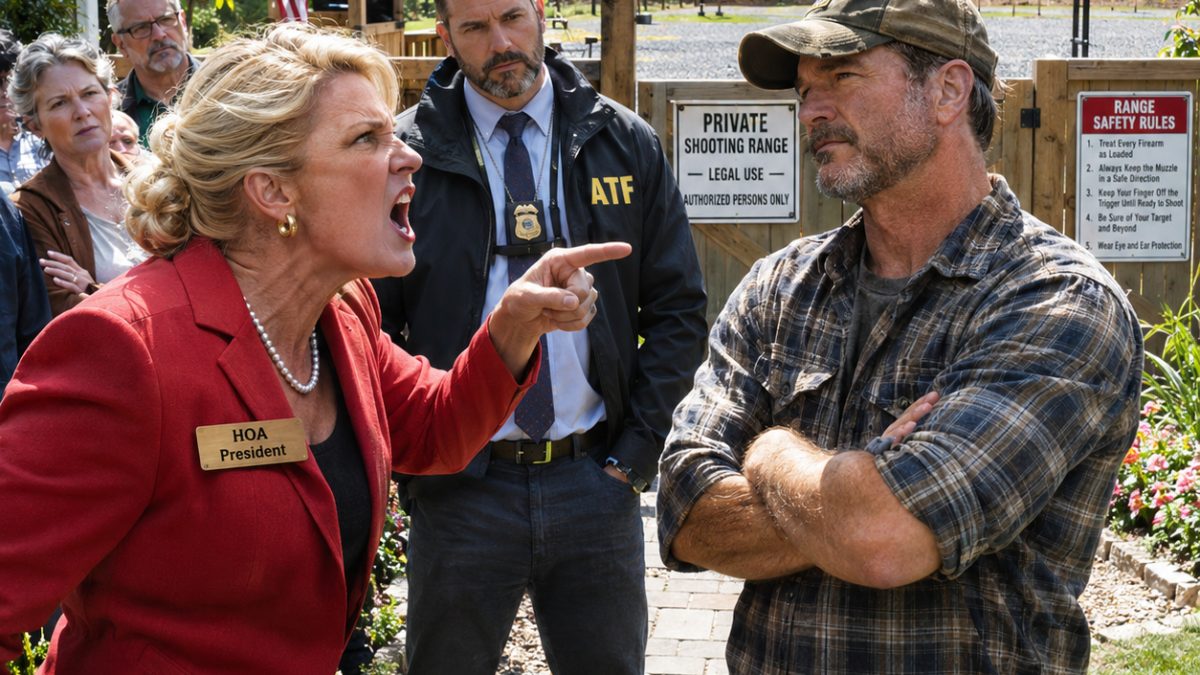
When Karen stood at the edge of my property with a clipboard pressed against her chest and announced that she would personally have bulldozers tear down the private shooting range I’d spent six months designing on my own fifteen acres, I didn’t argue with her because after twenty-five years as an Army combat engineer, I had learned that the people most confident in their authority are often the ones who have never bothered to check whether that authority actually exists.
She thought she was confronting a retired soldier who would eventually surrender once the fines grew large enough, the threatening letters sounded official enough, and the neighborhood began whispering loudly enough, but what she didn’t understand was that my deed predated Lakeside Meadows, my land had never joined her HOA, every part of the range had been permitted and documented, and the thick binder she carried around like a weapon had no more jurisdiction over my property than it did over the moon.
What happened after that would eventually involve county records, an illegal lien, frightened neighbors, sheriff’s deputies, federal agents, emails Karen never imagined anyone else would read, and a room full of homeowners finally discovering just how much of their fear had been built on one woman’s ability to make a lie sound official.
My name is Jack Caldwell.
For twenty-five years, I served in the United States Army, much of that time working in engineering, base construction, fortification, and infrastructure.
When I retired, I wanted space.
Not luxury.
Not status.
Space.
My wife Sarah and I had spent most of our marriage adapting to whatever place the Army sent us next.
Government quarters.
Rentals.
Temporary housing.
Boxes that stayed taped because another set of orders might arrive before we needed whatever was inside.
Our son Mark had grown up around that rhythm.
By the time he was old enough to understand what home meant, he had already lived in more houses than some people occupy in a lifetime.
So when I found fifteen acres of rolling woodland in North Carolina, bordered on one side by a state-owned creek and sitting far enough from the road that I could barely see passing traffic, I knew immediately what I wanted to build there.
A permanent home.
A place for Sarah.
A place Mark could always return to.
And eventually, a private shooting range.
The land was unusual because I bought it before Lakeside Meadows existed.
The developer owned the surrounding acreage and intended to subdivide it, but my parcel was carved out separately.
My attorney at the time, Silas, had gone through the deed with me.
He tapped the survey map and said:
“Jack, your land is an island.”
“What does that mean?”
“It means they can build houses around you, form an HOA, elect a king, crown a queen, sacrifice goats at board meetings if they want—but unless you voluntarily join, none of it reaches this parcel.”
I never joined.
Years passed.
The subdivision grew.
Beige houses marched gradually toward my property line.
Lakeside Meadows formed its homeowners association.
Then Karen became president.
For a while, I barely noticed.
Her kingdom stopped where my woods began.
The range came later.
Mark was preparing to follow me into military service, and I wanted a place where the two of us could practice marksmanship safely and responsibly before he left.
I spent six months designing it.
Twenty-five yards.
Massive earthen backstop.
Heavy side berms.
Located inside a natural depression more than half a mile from the nearest Lakeside house.
I consulted a sound professional.
Reviewed county requirements.
Met with local officials.
Obtained every permit required.
I wasn’t building some improvised backyard setup.
I was building something engineered.
Safe.
Controlled.
Private.
Then one humid morning, while I was inspecting the finished berm, Karen appeared at the property line.
Floral dress.
Clipboard.
Expression already offended.
“This entire monument to your inadequacy is coming down, Mr. Caldwell.”
I stared at her.
“Excuse me?”
“The board has determined this facility violates Lakeside Meadows covenants.”
“My property isn’t in Lakeside Meadows.”
“It affects Lakeside Meadows.”
“That isn’t the same thing.”
She smiled.
“We’ll see what the association’s attorney says.”
Then she pointed toward the range.
“I will have that demolished, and you will pay every cent.”
I looked past her toward the perfectly matched rooftops of her subdivision.
Then back toward the range I’d built for my son.
I felt something old settle into place.
Not anger.
Clarity.
“Karen,” I said quietly, “before you start this fight, you should check where your authority actually ends.”
She laughed.
That laugh told me she wouldn’t.
PART 2
The first certified letter arrived a week later.
Five pages.
Heavy paper.
Gold Lakeside Meadows logo.
Karen’s signature at the bottom.
She had listed four separate violations.
My range was an unapproved structure.
My range created excessive noise.
My range constituted a hazardous activity.
And my personal favorite:
The range was an aesthetic eyesore visible from the community walking trail.
I stood in my kitchen reading that one twice.
Sarah came in carrying a basket of laundry.
“What?”
I handed her the letter.
She read.
Then looked toward the woods.
“The walking trail?”
“Apparently.”
“You can’t see the range from our house.”
“I know.”
“Our house is closer than their walking trail.”
“I know.”
She held up the letter.
“Then how is this possible?”
“Advanced suburban optics.”
She didn’t laugh.
Then she reached the fine.
Five hundred dollars per day.
Retroactive.
Seven thousand already due.
Sarah’s expression changed.
“Jack.”
“I see it.”
“That isn’t funny.”
“No.”
She sat across from me.
“Can they do this?”
“No.”
“You’re sure?”
“Completely.”
“Then why does this scare me?”
That was a good question.
Because official-looking paper works.
That’s why.
People see a logo.
A law firm.
A fine.
A deadline.
And suddenly something legally meaningless feels dangerous.
Karen understood that instinct.
She had spent years weaponizing it.
I pulled out Silas’s old file.
Deed.
Plat.
Closing documents.
Then I started building my answer.
Not a letter.
A package.
Certified deed showing my land had been purchased before the HOA existed.
County plat identifying my parcel separately.
Lakeside Meadows Master Declaration listing every parcel subject to HOA authority.
Mine wasn’t there.
Then Silas gave me a sworn affidavit confirming what he’d told me years ago.
I assembled everything in a clean binder.
Cover letter:
Professional.
Brief.
No insults.
No mention of Karen’s floral wardrobe.
I stated that Lakeside Meadows possessed no jurisdiction over parcel 75-83-04-B.
I cited the governing state law described in the source documents concerning voluntary accession of parcels not included in the original association.
Then:
**Accordingly, all fines, demands, and threats relating to my property are rejected in full.**
I sent it registered mail.
Karen signed for it.
Two weeks passed.
Nothing.
For half a moment, I believed somebody on the board had finally called a lawyer.
Then envelope number two arrived.
No legal argument.
No rebuttal.
No explanation.
Just an updated invoice.
Fourteen thousand dollars.
And a warning:
**Failure to remit payment within thirty days will result in a lien against the property.**
I read that sentence standing in the kitchen.
Again.
Then again.
Sarah knew before I said anything.
“They doubled down?”
“Yes.”
“How bad?”
“Lien threat.”
Her face lost color.
A fine is irritating.
A lien is different.
A lien touches title.
Home equity.
Refinancing.
Inheritance.
It was an attempt to contaminate the thing I’d spent most of my adult life trying to build for my family.
That made the conflict feel different.
Personal.
Deep.
For the first time, I was angry enough that my hands shook.
Sarah noticed.
“Jack.”
“I know.”
“Don’t do something stupid.”
“I won’t.”
“What are you going to do?”
I folded the letter.
“Find out exactly what kind of machine she’s using against us.”
## **Reconnaissance**
I requested everything.
Budgets.
Bank statements.
Meeting minutes.
Architectural committee records.
Reserve reports.
Five years.
The HOA resisted initially.
Then its management company complied.
A large box arrived.
Sarah found me at the dining table surrounded by documents.
“You’re smiling.”
“No.”
“You are.”
“I found something.”
Meeting minutes.
Three years earlier.
Agenda item:
**Community Boundary Harmonization.**
Harmless phrase.
Then I read the motion.
Karen had proposed that the HOA claim jurisdiction over nearby parcels—including mine—to maintain community aesthetics and property values.
Vote:
Three to two.
Approved.
I sat back.
There it was.
Proof she knew.
She knew my land wasn’t part of the association.
She had tried to manufacture authority through a board vote.
It was legally meaningless without my consent and proper recorded changes.
But strategically?
Gold.
This wasn’t confusion.
Karen had been waiting for an excuse.
The shooting range gave her one.
## **The Neighbors**
I started walking Lakeside Meadows.
Not to recruit.
Not yet.
To listen.
The first person I met was David Garcia.
He was trimming hedges.
Friendly until I introduced myself.
Then:
“Oh.”
“The gun range guy?”
“That’s me.”
His expression softened.
“For what it’s worth, my boys think it’s cool.”
“Thanks.”
“Karen doesn’t.”
“I’ve noticed.”
He laughed nervously.
Then I asked:
“You ever have trouble with the board?”
That changed him.
David and his wife had spent six months fighting for permission to install a wooden swing set.
Karen wanted a particular recycled-plastic model.
Color:
Prairie Taupe.
Their chosen set was natural wood.
Hundreds in fines.
Threats.
Appeals.
He said:
“We just wanted something for the boys.”
Next:
Mrs. Henderson.
Widow.
Garden.
Empty patch near her porch.
I asked about it.
She told me about Bartholomew.
A garden gnome her late husband had given her thirty years before.
Karen fined her for “unapproved statuary.”
Fifty dollars per month.
Mrs. Henderson eventually put Bartholomew in the garage.
“My husband loved that silly thing.”
Her voice broke.
That hit me harder than any fine against my range.
Because the pattern became clear.
Karen wasn’t protecting property values.
She was proving obedience.
## **The HOA Records**
I spent nights reading.
Karen dominated every meeting.
Motion after motion.
Her loyalists seconded.
Three-to-two votes.
The same two members often opposed her.
Frank, an accountant.
Brenda, young mother.
Outnumbered.
The association’s reserve fund was weaker than it should have been.
Legal and consulting expenses unusually high.
Enforcement everywhere.
Karen had built a system that required conflict to justify itself.
I scanned everything.
Copied.
Tabbed.
The binder grew.
Sarah stopped calling it “your file.”
She called it:
“The Karen Binder.”
## **Anne Davies**
I found Anne through a veteran network.
Property law.
HOA disputes.
Ten years in practice.
Her father had been a Marine Master Gunnery Sergeant.
Her office looked exactly like I hoped.
Clean.
No nonsense.
I sat.
Opened the binder.
“Everything is chronological.”
She read.
Twenty minutes.
No interruptions.
Then she reached the boundary-harmonization vote.
Her mouth tightened.
She closed the binder.
“Mr. Caldwell.”
“Jack.”
“Jack.”
She leaned back.
“This is one of the most legally baseless HOA campaigns I’ve ever seen.”
“Good.”
“Good?”
“I was worried I’d missed something.”
“You didn’t.”
She tapped the deed.
“They have no authority.”
Then the lien threat.
“And if they file this after being warned?”
She smiled.
“They’re going to regret it.”
## **Cease and Desist**
Anne wrote it.
Formal notice.
Immediate rescission of fines.
Stop harassment.
No lien.
Written apology.
She cited state statutes and case law.
Then warned that any attempt to encumber my title could result in litigation for slander of title, damages, punitive damages, and attorney fees.
Courier delivered it.
I thought that was enough.
Anne didn’t.
“Prepare for her to do something irrational.”
“How irrational?”
She looked at Karen’s prior records.
“Very.”
## **They Filed the Lien**
One week later Anne called.
“They did it.”
“What?”
“The lien.”
I went cold.
“Recorded?”
“This morning.”
“How much?”
“Twenty-one thousand five hundred, plus filing.”
I couldn’t speak.
Karen had received a direct legal warning.
She filed it anyway.
Anne said:
“Jack?”
“I’m here.”
“Now we sue.”
That night, I stood on my back porch.
The woods were dark.
Range invisible beyond them.
Lien.
Such a small word.
But it felt like a hand around the deed to my home.
Sarah came outside.
Wrapped her arms around me from behind.
“We’re going to fix it.”
“I know.”
“You don’t sound like you know.”
“I know legally.”
“What about here?”
She touched my chest.
That took longer.
## **The Lawsuit**
HOA.
Karen personally.
Board members who voted with her.
Slander of title.
Harassment.
Damages.
Punitive claims.
Attorney fees.
Anne didn’t bluff.
She filed.
Once the lawsuit existed, Karen’s fight got dangerous for everybody else.
Their dues.
Their reserves.
Their insurance.
Their property values.
Ironically, Karen had transformed her campaign to “protect” Lakeside into a direct financial threat against Lakeside.
But she wasn’t finished.
## **The Sheriff Calls**
Saturday.
Mark was home.
He was only weeks away from leaving for basic training.
We spent the afternoon at the range.
Nothing dramatic.
Basic marksmanship.
Safety.
Discipline.
The kind of time I’d dreamed of when I designed the place.
Then we heard a siren.
Deputy arrived.
“Noise complaint.”
“What kind?”
“Automatic gunfire.”
I looked at Mark.
He looked at the bolt-action rifle on the bench.
Then back at me.
I almost laughed.
I didn’t.
I showed the deputy the situation.
The range.
Distance.
Firearm.
He quickly understood.
“Sorry, sir.”
“No problem.”
He left.
A few days later, another deputy.
Then another.
Then a fourth.
Each complaint more dramatic.
Rapid fire.
Dangerous activity.
Threat to residents.
The last responding officer was an older sergeant.
He shook his head.
“We know who keeps calling.”
“Karen?”
“You said it.”
“Anything I should do?”
“Keep doing what you’re doing.”
Then:
“She complains about everything.”
That wasn’t comforting.
Because when one weapon fails, Karen escalates.
And I knew what she would use next.
## **The Federal Cars**
Tuesday morning.
Two dark sedans.
Government plates.
They drove slowly up my long driveway.
Sarah saw them through the window.
“Jack.”
“I see them.”
Two men stepped out.
Suits.
Purposeful.
I knew immediately.
Federal.
They knocked.
I opened the door.
“Mr. Jack Caldwell?”
“Yes.”
Credentials.
“Special Agent Miller, ATF. This is Special Agent Evans.”
My stomach tightened despite everything.
“Can we speak?”
“Of course.”
Sarah moved quietly toward the back hall.
She wasn’t leaving.
She was listening.
## **The Allegations**
Agent Miller didn’t waste time.
Anonymous reports.
Illegal militia training.
Manufacture of prohibited firearms.
Improper storage of explosive materials or reloading components.
My heart didn’t race.
That surprised me.
Maybe because I’d predicted this.
Maybe because I knew what was behind my own doors.
I let him finish.
Then:
“Agent Miller, may I explain some context?”
“Please.”
I told them about Karen.
HOA dispute.
Illegal lien.
Lawsuit.
Repeated sheriff calls.
Then:
“I believe the anonymous source is connected to that dispute.”
Miller watched carefully.
I continued.
“I don’t operate a militia facility.”
I nodded toward the property.
“Private range.”
“My firearms are lawfully possessed.”
“I do basic gunsmithing and handloading as lawful hobbies.”
“All materials are stored in compliance with the requirements I understand apply to them.”
Then:
“I have nothing to hide.”
I stood.
“Would you like to see the relevant areas?”
The agents exchanged a glance.
“Yes.”
## **The Inspection**
I kept it simple.
No performance.
No speeches.
Safe storage.
Records.
Workshop.
Range.
They looked at what they needed.
Asked questions.
I answered.
No unnecessary technical explanations.
The longer the inspection continued, the more their posture changed.
At the range, Agent Miller examined the berm.
“Engineer?”
“Army Corps.”
“What kind?”
“Construction and fortification.”
He looked toward the small range shed.
Saw an old unit plaque.
“Thirty-sixth Engineer Brigade?”
“Yes.”
He smiled.
“I had some of your guys attached in Afghanistan.”
That changed the room, metaphorically speaking.
Not because military service gave me special treatment.
It shouldn’t.
Because he understood the kind of obsessive safety culture I’d come from.
Agent Evans looked around.
“This looks nothing like the complaint.”
“No.”
Miller nodded.
“I think we understand that now.”
## **The Card**
Before leaving, Agent Miller handed me his card.
“Our investigation into the allegations against you is closed based on what we’ve seen and verified.”
I exhaled for what felt like the first time in an hour.
Then his face changed.
“Mr. Caldwell.”
“Yes?”
“We take false reports seriously.”
I said nothing.
“We’ll be looking at the source.”
Sarah appeared in the hallway.
Agent Miller looked toward her.
“Sorry for the disruption, ma’am.”
She nodded.
After they left, she closed the front door.
Then leaned against it.
“Jack.”
“Yeah?”
“I hate that woman.”
I had no answer.
## **The Pivot**
I called Anne.
Told her everything.
Long silence.
Then:
“Oh.”
“What?”
“She’s cooked.”
“Anne.”
“Legally speaking.”
She explained.
The federal complaint was more than harassment.
If investigators concluded Karen deliberately fabricated allegations, that could create separate federal consequences.
Our civil complaint could also expand.
Defamation.
Intentional emotional distress.
Malicious use of process.
Bad faith.
More importantly, insurance.
Willful conduct exclusions.
Potential criminal acts.
Suddenly the association’s insurer had a reason to distance itself.
Karen thought she had launched the federal government at me.
Instead, she had brought another investigator into the record.
## **The Story Spreads**
I met with David Garcia.
Mrs. Henderson.
Told them about the federal visit.
David’s jaw dropped.
“She called the ATF?”
“Someone did.”
“You know it was her.”
“I suspect it.”
“Jack.”
“Suspect.”
Important word.
Mrs. Henderson looked frightened.
“This isn’t normal.”
“No.”
Then David said:
“We have to tell people.”
“Yes.”
“But carefully.”
Facts.
No rumor.
Federal agents visited.
Allegations found unsupported.
Investigation against me closed.
Source under review.
That was enough.
## **Fear Turns**
The story moved through Lakeside.
Parents who had once viewed me as “the gun guy” began asking why the HOA president would cause a federal agency to visit a neighbor over a property dispute.
Residents who had been bullied over trash cans, flowers, swing sets, and garden statues started connecting their own experience to mine.
Karen’s problem became communal.
Then the financial angle landed.
If her conduct wasn’t covered by HOA insurance, homeowners could end up paying for it.
That got attention fast.
## **Special Meeting Petition**
The bylaws allowed homeowners holding more than twenty-five percent support to force a special meeting.
Signatures came quickly.
Purpose:
Review legal dispute with Jack Caldwell.
Legal expenses.
Board conduct.
Karen couldn’t refuse.
The meeting date arrived.
Clubhouse.
Packed.
Not six residents.
Dozens.
Standing room.
Sarah came with me.
Anne had prepared me.
“Let her talk.”
“I know.”
“She will lie.”
“I know.”
“Do not interrupt.”
“I know.”
“Jack.”
“What?”
“You have a face.”
“What does that mean?”
“You make a face when someone says something stupid.”
“I do not.”
Sarah laughed.
Anne said:
“Try not to.”
## **Karen’s Opening Statement**
She sat center.
Gavel.
Two loyalists beside her.
Frank and Brenda at the far ends.
Karen started.
Protecting property values.
Protecting safety.
Dangerous noncompliant outsider.
My range became:
“Paramilitary installation.”
She hinted that “appropriate federal authorities” had been contacted due to disturbing information.
She never mentioned the agents had already closed their inquiry against me.
Then:
“The legal costs are necessary to protect all of you.”
Silence.
No applause.
Karen looked confused.
## **David Garcia Stands**
“How does a six-figure lawsuit protect our property values?”
Karen’s face reddened.
“That matter remains before the court.”
“So we’re paying?”
“Sit down.”
He didn’t.
“Does the HOA actually have authority over Jack’s land?”
“That is for the courts to decide.”
David sat.
He had done his job.
## **Mrs. Henderson**
She stood.
Tiny woman.
Soft voice.
“You made me put away my husband’s garden gnome.”
Karen rolled her eyes.
“This meeting is not about individual grievances.”
“It is to me.”
Silence.
Mrs. Henderson continued.
“My husband gave it to me.”
Karen shifted.
“You called it an eyesore.”
“Mrs. Henderson—”
“Was that protecting my property value?”
Karen banged the gavel.
Wrong move.
People started standing.
## **The Dam Breaks**
Legal spending.
Reserve fund.
Fines.
Appeals.
Swing sets.
Mailboxes.
Landscaping.
People who had stayed silent for years began talking over one another.
Karen hit the gavel harder.
“Order!”
Nobody cared.
Then I stood.
Room quieted.
I held up the binder.
“My name is Jack Caldwell.”
Karen stared.
“For months, the HOA president has fined my property despite having no jurisdiction over it.”
I opened the binder.
“Over twenty thousand dollars.”
Another section.
“She filed a lien against my home after being formally warned that the association had no lawful authority.”
Another.
“Then repeated law-enforcement complaints began.”
I looked around.
“Local deputies investigated and found no violation.”
Then:
“Federal agents arrived at my home based on allegations that I was operating an illegal militia facility and possessing prohibited weapons.”
The room inhaled.
Karen’s face changed.
## **The Emails**
Discovery had begun producing internal communications.
Anne had warned me to use only what was appropriate to present.
I held one page.
“This email was sent by Karen after my attorney’s cease-and-desist letter.”
I read the relevant line.
She had instructed the lien filing despite legal concerns.
And she had referred to me as “soldier boy,” saying she wanted me driven out.
The room went still.
Then the second email.
After the federal complaint.
Karen celebrating the idea that federal agents might put me in handcuffs.
Now there was no plausible story about protecting safety.
No community standards.
No objective concern.
Personal vendetta.
Publicly documented.
## **Karen’s Face**
All the color drained from it.
Her two allies looked down.
Frank stared at her.
Brenda’s expression was almost disbelief.
Karen finally shouted:
“Those emails were taken out of context!”
Anne had told me not to engage.
So I didn’t.
That made it worse.
Because Karen was arguing with her own words.
## **The Motion**
Frank leaned toward his microphone.
“I move for a vote of no confidence.”
Karen turned.
“What?”
“And immediate removal of Karen Jensen from the board pending final legal review.”
Brenda:
“Second.”
Karen stood.
“You can’t do this!”
Frank looked at her.
“We can.”
Her own bylaws.
Her own process.
Her own meeting.
## **The Vote**
Landslide.
Her two loyalists abstained.
That told me everything.
When the authority disappeared, so did loyalty.
Karen gathered papers.
Hands shaking.
Walked out the side door.
No one followed.
The room remained silent for several seconds.
Then people exhaled.
Collectively.
Like they had been holding their breath for eight years.
## **The New Board**
Frank became acting president.
Brenda vice president.
First call:
Anne Davies.
Meeting next morning.
Frank looked exhausted.
“Ms. Davies.”
“Anne.”
He nodded.
“Anne.”
He rubbed his forehead.
“How bad?”
She was honest.
“Bad.”
Illegal lien.
Slander of title exposure.
Harassment claims.
Potential defamation.
Federal investigation related to Karen’s conduct.
Insurance reservations.
Possible punitive damages.
Frank looked sick.
“What do you want?”
Anne glanced toward me.
I answered.
“Fix it.”
“Meaning?”
“Remove the lien.”
“Immediately.”
“Rescind every fine.”
“Yes.”
“Pay my legal expenses.”
He winced.
“Reasonable damages.”
Another wince.
“Publicly admit the HOA had no jurisdiction over my property.”
He nodded.
“And change the rules so one president can never do this again.”
Frank looked toward Brenda.
Then back.
“We can work with that.”
## **Settlement**
Fast.
Because the facts were terrible for them.
HOA paid my legal fees.
Additional damages.
Emotional distress connected to the federal investigation.
Title issue.
Harassment.
The exact number mattered less to me than the lien removal.
County record corrected.
Gone.
Clean title.
When Anne sent me the confirmation, I stared at it.
Sarah looked over my shoulder.
“That’s it?”
“That’s it.”
She hugged me.
That felt like winning.
## **The Public Apology**
Every home received it.
Official HOA letterhead.
The association acknowledged:
My parcel was not subject to Lakeside Meadows covenants.
The fines had been improper.
The lien had been unlawfully pursued.
The former president had acted beyond lawful HOA authority.
The board apologized to me and my family.
Mrs. Henderson called.
“I got the letter.”
“Yeah.”
“I’ve never seen the HOA apologize before.”
“New era.”
## **The Caldwell Clause**
Anne drafted it.
No future lien or major legal action without:
Majority vote of full board.
Written opinion from qualified counsel.
Documentation supporting jurisdiction.
Recorded board action.
Residents nicknamed it the Caldwell Clause.
I hated that.
Sarah loved it.
## **The Federal Side Continues**
While civil settlement moved quickly, the federal investigation did not disappear.
Agents traced digital records.
Anonymous tips weren’t as anonymous as Karen believed.
Email.
Phone.
Account information.
According to the source story, investigators connected the false allegations to her.
Weeks later, Agent Miller returned.
Unmarked vehicle.
I was washing my truck.
“Mr. Caldwell.”
“Agent Miller.”
“Can I speak with you?”
“Sure.”
He kept it careful.
The U.S. Attorney’s Office had moved forward with charges relating to false statements and obstruction based on the investigation described in the source.
Karen now faced federal court.
I looked toward Lakeside.
No celebration came.
Only exhaustion.
## **The News**
Local site ran the story.
Former HOA president.
Federal charges.
False reports.
Ongoing civil fallout.
Her booking photograph appeared.
Karen looked different.
No clipboard.
No gavel.
No audience.
Just fluorescent light.
I closed the article.
Sarah asked:
“Nothing to say?”
“No.”
“You waited months for this.”
“No.”
She looked at me.
“What were you waiting for?”
“Peace.”
That was true.
## **The HOA Turns on Karen**
The new board had its own problem.
Settlement money.
Legal fees.
Potential uncovered losses.
Their lawyers advised they could seek recovery from Karen personally for acts outside her authority.
They did.
The organization she had used as a weapon was now demanding repayment from her.
That was the most complete reversal of the entire story.
Karen had spent years telling homeowners:
The HOA is coming after you.
Now the HOA was coming after her.
## **The House**
Financial problems grew.
Legal fees.
Civil claims.
Federal defense.
The source story eventually described foreclosure and bankruptcy.
By autumn, moving trucks arrived.
I watched from my porch.
Sarah sat beside me.
Karen’s possessions came out piece by piece.
Furniture.
Boxes.
Decorations.
I expected some satisfaction.
There wasn’t much.
Mostly sadness.
Not for what happened.
For the waste.
All of it had been optional.
Every escalation.
Every threat.
Every lie.
She had so many exits.
She took none.
## **Lakeside Changes**
Frank surprised me.
He was good.
Not charismatic.
Good.
Accountant.
Boring.
Perfect.
Rules were reviewed.
Petty restrictions stripped out.
Enforcement narrowed.
Appeals restored.
Residents involved.
Financial records cleaned up.
Reserve fund rebuilt.
Bartholomew returned.
Mrs. Henderson put the gnome back in the flower bed.
First time I saw it, I laughed.
She caught me.
“What?”
“Nothing.”
“Don’t you insult Bartholomew.”
“Wouldn’t dream of it.”
## **The Garcia Swing Set**
Natural wood.
Exactly what Karen had rejected.
David sent me a photo.
Two boys hanging upside down.
Caption:
**PROPERTY VALUES SURVIVING.**
I showed Sarah.
She laughed.
## **The Range Remains**
Nobody bulldozed it.
Nobody fined it.
Nothing dramatic.
It simply remained where it had always been.
On my land.
Quiet most days.
Used occasionally.
Safe.
Private.
The absurd thing was that once Karen disappeared, almost nobody cared about it.
No crisis.
No falling property values.
No militia.
Just a range.
## **Mark Comes Home**
By then Mark had completed basic training and AIT.
He returned on leave before his first major assignment.
Different posture.
Different eyes.
Still my son.
We spent an afternoon together at the range.
Not because of Karen.
Not as a victory lap.
Because that was why I’d built the place.
Father.
Son.
Focus.
Discipline.
Safety.
The things that existed before the HOA fight and mattered more than it.
When we finished, we packed quietly.
Mark looked toward the berm.
“Dad.”
“Yeah?”
“I thought she might win.”
I stopped.
“When?”
“When all the legal stuff started.”
“She couldn’t.”
“You knew that?”
“I hoped.”
He smiled.
“That’s not the same.”
“No.”
We sat on the bench.
He said:
“Was it ever really about this place?”
“The range?”
“Yeah.”
I thought.
“For Karen?”
“No.”
“For you.”
That took longer.
## **The Line**
Finally:
“It was about the right to be left alone.”
Mark nodded.
I continued.
“But it became bigger.”
“How?”
“Mrs. Henderson’s gnome.”
He laughed.
“Seriously?”
“Seriously.”
“David’s swing set.”
“The lien.”
“The false reports.”
“Once you watch somebody misuse power against you, you start seeing where they’ve done it to other people.”
Mark looked toward the woods.
“So you fought for them too.”
“Eventually.”
“Why eventually?”
“Because I’m not as noble as you apparently think.”
He waited.
“I noticed when it reached my house.”
That was the truth.
I could have paid more attention earlier.
## **The Lesson I Didn’t Want to Give Him**
I told Mark:
“Bullies survive through isolation.”
He listened.
“They convince each person the problem is private.”
Mrs. Henderson thinks she’s weak because she doesn’t fight the gnome fine.
David thinks he’s unreasonable for wanting a swing set.
Frank thinks his vote doesn’t matter.
I think I’m the only guy Karen is targeting.
Then everyone starts comparing stories.
“And?”
“The bully gets smaller.”
Mark nodded.
“Sounds simple.”
“It isn’t.”
“Why?”
“Because fear isn’t logical.”
## **The ATF Visit Still Bothered Sarah**
She told me months later.
“Every time a dark sedan comes up the road, I still look twice.”
I felt guilty.
“I should’ve—”
“No.”
She cut me off.
“You didn’t call them.”
“I know.”
“Then don’t take responsibility for her choices.”
I knew that intellectually.
Emotion is slower.
## **What Karen Actually Did**
People sometimes tell the story wrong.
They say:
“The ATF backed Jack.”
Not exactly.
Agents came because they had received allegations they were obligated to evaluate.
I cooperated.
They found the accusations unsupported.
Then, according to the source story, investigators looked into whether false information had been deliberately supplied.
That distinction matters.
Government isn’t supposed to take sides in neighbor feuds.
It’s supposed to evaluate evidence.
That is what made the outcome powerful.
Karen expected authority to become her personal weapon.
Instead, evidence determined where the investigation went.
## **Anne’s Favorite Document**
I assumed it was the federal report.
“No.”
“The lien?”
“No.”
“Karen’s emails?”
“Close.”
“What?”
“The deed.”
Of course.
She held it up during one of our final meetings.
“This case starts and ends here.”
“How?”
“She never had jurisdiction.”
Everything after that was escalation layered over a fact that never changed.
My property was mine.
## **The Range Safety Questions**
After the conflict, the new board asked whether I would voluntarily provide an overview of the range’s general safety and noise-mitigation measures to concerned residents.
Not because they had authority.
Because people were curious.
I agreed.
We met at the edge of my land.
I didn’t turn it into a weapons seminar.
I explained location.
Setback.
Backstop.
Noise reduction.
Scheduling.
Basic safety culture.
Residents relaxed.
That’s what Karen could have done from the beginning.
Ask.
Listen.
Understand.
She chose command.
## **The Neighbors Visit**
David brought his sons once.
No shooting.
Just a look.
The boys were fascinated by the earthwork.
One asked:
“Did you build this to fight Karen?”
I nearly choked.
“No.”
David laughed.
“Tell the truth, Jack.”
“I built it before Karen cared.”
The boy considered.
“So she started the fight?”
David said:
“Yes.”
I said:
“Adults are trying to improve the vocabulary here.”
## **Mrs. Henderson’s Gnome**
Bartholomew became something of a neighborhood celebrity.
People left tiny flags near him.
One Christmas he wore a Santa hat.
The new HOA newsletter included a photo.
Caption:
**Holiday spirit at the Henderson residence.**
I sent the picture to Anne.
She replied:
**Case closed. Civilization restored.**
## **Frank’s Presidency**
He hated ceremonial nonsense.
Meetings lasted forty minutes.
Financial reports clear.
No speeches.
When residents argued, he let them.
Then voted.
Nobody left fearing retaliation.
That’s leadership.
Not universal agreement.
Predictable process.
## **Brenda**
She stayed on the board.
Eventually told me:
“I should’ve stood up sooner.”
“You voted against her.”
“Not enough.”
She was right.
But guilt can become useful if it changes behavior.
Brenda pushed for homeowner appeals and mandatory conflict disclosures.
She became one of the best board members.
## **Karen’s Two Loyalists**
They resigned.
Both claimed they’d been misled.
Maybe.
I didn’t care enough to investigate their souls.
They had voted with her.
Then faced consequences.
They moved on.
## **The Lien Document**
When the county confirmed cancellation, Anne gave me the original release.
I took it home.
Sarah expected it to join the binder.
Instead, I placed it in our property file.
Not Karen file.
Why?
Because Karen didn’t own that document.
It belonged to our home.
## **The Binder Gets Smaller**
Months later, I removed copies.
Kept essentials.
Deed.
Plat.
Lien.
Release.
Settlement.
Federal correspondence where appropriate.
The rest went into storage.
Sarah noticed.
“Retreat?”
“Demobilization.”
She smiled.
“Finally.”
## **The Financial Settlement**
People wanted numbers.
I didn’t share them publicly.
Enough to make us whole.
Enough to compensate for stress and legal costs.
Not enough to destroy every homeowner in Lakeside.
That mattered.
A judgment crushing the entire community would have punished the very people Karen bullied.
Anne understood.
So did I.
## **The HOA’s Lawsuit Against Karen**
Their decision.
Not mine.
They sought reimbursement for losses tied to her conduct.
I didn’t participate beyond documents already produced.
Some neighbors wanted me to enjoy it.
I couldn’t.
By then, I was tired of watching consequences.
## **The Foreclosure**
The source story’s final legal fallout took Karen’s home.
Bank.
Claims.
Legal expenses.
Bankruptcy.
The house eventually changed ownership.
Was that satisfying?
Not really.
A house is still a home.
Even when the person living inside it behaved badly.
But protecting someone from consequences would have meant making innocent homeowners pay instead.
That wasn’t acceptable either.
## **The New Family**
Young couple.
Tom.
He came over while I checked fence posts near the road.
“You must be Caldwell.”
“Jack.”
He shook my hand.
“I heard stories.”
“Most are exaggerated.”
“Was there really an ATF visit?”
“Yes.”
“Okay, maybe not exaggerated.”
I laughed.
He looked toward his new house.
“Realtor said the previous owner had some HOA issues.”
“That is one way to say it.”
Then:
“Everyone says you saved the neighborhood.”
“No.”
“What did you do?”
“Kept paperwork.”
He laughed.
I didn’t.
## **The Quiet**
After Karen left, something strange happened.
Silence stopped feeling suspicious.
No emails.
No notices.
No engines slowing near the property.
No deputies.
No federal sedans.
No lawyers calling urgently.
Birds.
Creek.
Wind.
That’s what I’d wanted from the beginning.
## **Mark Leaves Again**
His leave ended.
We stood beside his truck.
Sarah hugged him first.
Long.
Then me.
I tried not to be dramatic.
Failed internally.
He said:
“Take care of Mom.”
“I was going to tell you the same.”
He smiled.
Then looked toward the range.
“Keep it standing.”
“I intend to.”
He drove away.
For the first time, the range felt less like something I’d built for him and more like something waiting for him.
That hurt.
In a good way.
## **Why I Built It**
Not politics.
Not rebellion.
Not because I wanted to intimidate suburban neighbors.
Because Mark and I had spent his childhood missing time.
Deployments.
Training.
Moves.
The range was a place where we could stand side by side and do something precise together.
It required attention.
Patience.
Respect.
Those were lessons bigger than marksmanship.
Karen never saw that.
She saw only an object she didn’t approve.
## **That’s What Bullies Do**
They flatten meaning.
Mrs. Henderson’s gnome becomes “statuary.”
A swing set becomes “noncompliant structure.”
A private range becomes “hazardous activity.”
A home becomes “parcel.”
A person becomes “violator.”
Once you reduce everything to categories, cruelty gets easier.
## **The Association Nearly Learned the Hard Way**
Frank showed me legal bills later.
Enough to make me wince.
Karen’s campaign had cost residents far more than sensible governance ever would.
Her obsession with property values had endangered property values.
That irony should be taught in management schools.
## **No More President-for-Life**
Term limits.
Residents proposed them.
Passed.
No more one person sitting in power indefinitely.
Committees restored.
Minutes published.
Legal spending disclosed.
Lien procedures tightened.
Karen had unintentionally created the strongest reform movement Lakeside had ever seen.
## **The Federal Case**
I followed only what became public.
Karen’s legal case moved slowly.
Lawyers.
Hearings.
Filings.
The source story ultimately frames her as facing serious federal charges related to false statements and obstruction.
I didn’t attend every proceeding.
Didn’t need to.
That chapter belonged to prosecutors and courts.
Not me.
## **People Ask Whether I Wanted Prison**
No.
I wanted her to stop.
If that could have happened after the first letter, fine.
After the lien?
Maybe harder.
After the false federal accusation?
Consequences had become necessary.
But I didn’t need to choose punishment.
That’s why we have institutions.
## **What I Wanted From the HOA**
Four things.
Leave my property alone.
Remove the lien.
Tell the truth.
Change the rules.
I got all four.
Everything after that was Karen’s problem.
## **Sarah’s Perspective**
One night on the porch:
“You know what bothered me most?”
“The federal visit?”
“No.”
“Lien?”
“No.”
“What?”
“That she made our home feel temporary.”
I understood immediately.
We had moved for twenty-five years.
This house was supposed to end that.
Then Karen put a legal cloud on the title.
For Sarah, that resurrected every temporary address we’d left behind.
I took her hand.
“This one isn’t temporary.”
“I know.”
“Mark will have it if he wants it.”
“I know.”
She looked toward the woods.
“That’s why I was so angry.”
So was I.
## **The Creek**
Our property bordered state-owned creek land.
I walked there often during the lawsuit.
Water doesn’t care about HOAs.
That helped.
Flow.
Rock.
Trees.
Everything Karen believed was huge looked very small beside something that had been moving before Lakeside Meadows existed.
## **The Range Grows Ordinary**
At first, every use felt political.
I hated that.
I deliberately used it less during litigation because I didn’t want to feed Karen’s narrative.
Afterward, normal rhythm returned.
Occasional practice.
Mark when home.
A friend now and then under safe conditions.
Nothing symbolic.
That’s freedom too.
Doing something without it becoming a statement.
## **The First Neighborhood Barbecue**
Frank organized one.
Lakeside invited us.
Sarah wanted to go.
I wasn’t sure.
“You spent months calling them the beige kingdom.”
“I called Karen’s version that.”
“Come eat a hamburger.”
Fine.
David’s boys ran everywhere.
Mrs. Henderson sat beside Bartholomew, who had apparently been temporarily relocated to the picnic table.
Brenda brought potato salad.
Frank stood near grill complaining about budget spreadsheets.
Normal people.
That was important.
Karen had convinced me for a while that Lakeside itself was the enemy.
It wasn’t.
One leader and a few enablers had distorted it.
Communities shouldn’t be judged only by their worst officeholder.
## **David’s Boys**
Their swing set became famous.
Prairie Taupe was never mentioned again.
## **Mrs. Henderson’s Flowers**
Color everywhere.
No approved palette.
Still beautiful.
## **My Land**
Still separate.
Still outside the HOA.
But socially?
We became neighbors.
Better than being enemies.
## **The Greatest Irony**
Karen spent months trying to force my property into her community.
Her actions ultimately made me part of the community in the only way that mattered.
Not legally.
Humanly.
I knew people.
They knew me.
We helped one another.
No covenant required that.
## **The Email About Handcuffs**
I kept thinking about it.
Not because of the insult.
Because she genuinely hoped federal agents would humiliate me.
That crossed something in my mind.
Not a legal line.
A moral one.
Someone willing to weaponize law enforcement for personal satisfaction is dangerous.
That’s why the federal investigation into the source mattered.
Without consequences, false reports become another bullying tool.
## **Agent Miller**
Months later, he called once.
Routine follow-up.
At the end:
“How’s the range?”
“Still there.”
“Good.”
Then:
“Keep it boring.”
Best advice anybody gave me.
## **Boring Is Beautiful**
After military life, after Karen, after lawsuits—
boring became luxury.
## **The Apology Letter**
Anne wrote it.
The HOA signed.
Clear.
No vague “regret that feelings were hurt.”
It said the association had acted without jurisdiction.
Fines improper.
Lien improper.
Former president exceeded authority.
Apology.
Sarah framed a copy.
I objected.
She ignored me.
## **The Caldwell Clause**
Also framed?
No.
Thank God.
## **Karen’s Old House**
Tom and his family changed the landscaping.
Different shutters.
Karen’s former house became just another house.
That felt healthy.
No monument to scandal.
No plaque.
## **One New Resident Asks**
“Where was the dangerous range?”
I pointed toward the woods.
“There.”
He squinted.
“I can’t see it.”
“Exactly.”
## **The Walking Trail Claim**
One day, I actually walked to the spot Karen said had a direct view.
Trees.
Hill.
Nothing.
I laughed alone.
That may have been the moment I stopped being angry.
Her “visible eyesore” literally wasn’t visible.
## **Mark’s First Deployment**
When he deployed, the range became quiet.
I missed him.
Sarah did more.
We’d stand near the kitchen when messages arrived.
Read twice.
Reply carefully.
That season put the HOA fight into perspective.
Karen had felt enormous because she occupied our attention.
Then real life reminded us what enormous actually meant.
## **His Return**
Months later.
Mark came home.
We hugged.
No speeches.
The next morning he asked:
“Range?”
Sarah rolled her eyes.
“Of course.”
We went.
Cold air.
Leaves.
Simple.
Afterward, he said:
“Still here.”
“Yep.”
“Good.”
That one word made every legal bill feel smaller.
## **The Principle**
He had asked before whether I fought for the range.
My answer changed over time.
At first:
My property.
Then:
My family.
Then:
Neighbors.
Eventually:
Process.
Because arbitrary authority harms everyone eventually.
Even people who agree with it today.
## **Karen’s Mistake Wasn’t Hating Guns**
If she’d disliked the range, fine.
People can dislike things.
If she’d raised noise concerns, we could discuss data.
If she’d asked about safety, I’d show the engineering.
If she’d asked county officials whether it was legal, they’d answer.
Her mistake was deciding dislike created jurisdiction.
Then inventing power to match the dislike.
That’s a different problem.
## **The ATF Didn’t Win My Case**
Facts did.
That matters.
No federal agency is supposed to validate someone’s personality.
They evaluated allegations.
Once the allegations didn’t hold up, the inquiry changed.
The story is satisfying because Karen tried to weaponize a system that ultimately cared more about evidence than her HOA title.
## **The Lien Was the Real Turning Point for Me**
The ATF visit was scarier.
But the lien made me fight differently.
Before the lien, I wanted Karen to stop.
After the lien, I wanted a permanent record proving she couldn’t do it again.
That led to Anne.
Lawsuit.
Discovery.
Emails.
Meeting.
Reform.
Karen created the machinery of her own exposure.
## **She Could Have Stopped**
After my first documentation package.
She could have stopped.
After Anne’s cease-and-desist.
She could have stopped.
Before lien.
Stopped.
After lawsuit.
Stopped.
After sheriff visits.
Stopped.
Before federal report.
Stopped.
At every stage, Karen chose escalation.
That’s why I reject the idea that I “destroyed” her.
You can’t blame the guardrail because someone keeps accelerating toward it.
## **Her Power Was Borrowed**
HOA president.
Nothing more.
Residents lent authority through bylaws and elections.
Karen treated borrowed power like personal property.
When homeowners remembered they had given it, they took it back.
That’s democracy at the smallest, messiest scale.
## **Frank’s Last Conversation With Me**
Years later, he stepped down.
“Best decision I ever made.”
“Becoming president?”
“Leaving.”
I laughed.
He said:
“I understand Karen a little better now.”
I stared.
“Careful.”
“Not excusing her.”
“Good.”
“Power is addictive when everyone asks you to solve everything.”
“So don’t.”
“Exactly.”
He had learned.
## **The New Board**
Rotating membership.
Open records.
No drama.
That might be the happiest ending possible for an HOA.
## **Bartholomew Weathers**
Paint fades.
Mrs. Henderson refuses to repaint him.
“Character.”
She’s right.
## **The Swing Set Gets Outgrown**
David’s boys eventually became teenagers.
Swing set unused.
He considered removing it.
His wife said no.
“Why?”
“Principle.”
I laughed when he told me.
## **The Range Berm Gets Grass**
Vegetation stabilizes it.
From a distance, it looks like part of the terrain.
The “monument to inadequacy” eventually became a green hill.
Karen would hate the poetry.
## **Sarah’s Garden**
She planted near our house.
No HOA approval.
No committee.
No fines.
She still asks my opinion.
I know better than to answer incorrectly.
## **The Property Line**
I walk it sometimes.
Not because I fear encroachment.
Because land changes.
Trees fall.
Markers shift visually.
Fences need maintenance.
Boundaries deserve routine attention.
Not obsession.
Attention.
## **The Difference**
Karen obsessed over controlling others.
I learned to pay attention to what I actually controlled.
My land.
My behavior.
My documentation.
My choices.
That’s enough.
## **People Want a Revenge Story**
They hear:
HOA Karen.
Shooting range.
ATF.
Federal charges.
They expect me to say:
Best day of my life.
No.
Best days involve Sarah.
Mark.
Ordinary mornings.
Karen’s downfall was satisfying because it ended danger.
Not because suffering is entertaining.
## **Still, There Was Satisfaction**
I’m not going to lie.
When I saw Bartholomew back outside?
Satisfying.
When the lien disappeared?
Very satisfying.
When the apology arrived?
Extremely.
When the range remained standing?
Absolutely.
When Mark came home and used it with me?
That was the payoff.
## **The Range Was Never the Trophy**
Peace was.
## **What I’d Tell Someone Else**
Don’t assume an HOA letter is valid because it has a logo.
Read your deed.
Know whether you’re actually subject to the association.
Get certified records.
Respond calmly.
Use attorneys when stakes become serious.
Don’t provoke law enforcement.
Don’t hide from legitimate inquiries.
Preserve evidence.
Talk to neighbors.
And never let justified anger become sloppy behavior.
## **What I Would Not Tell Them**
“Fight every HOA.”
No.
Most disputes should be resolved normally.
Conversation.
Appeal.
Compromise.
Karen made normal resolution impossible because control mattered more to her than correctness.
That is when resistance becomes necessary.
## **The House of Cards**
Mark’s phrase stuck with me.
Karen’s power looked solid.
But much of it depended on people believing three things:
She knew the rules.
She could punish anyone.
Nobody else would help.
All three were false.
Once exposed, the structure collapsed quickly.
## **The Final Morning**
Years later.
Mark home again.
Sarah making coffee.
I stood near the edge of the woods.
Range beyond.
Lakeside Meadows visible through trees.
Children laughing somewhere downhill.
No sirens.
No gavel.
No legal envelopes.
Mark walked up.
“You ever miss the fight?”
“No.”
“You answered too fast.”
“I miss being younger.”
He laughed.
“Same thing?”
“Maybe.”
Then he looked toward the range.
“I’m glad you kept it.”
“So am I.”
“Think Karen ever understood?”
“What?”
“That it wasn’t hers to control?”
I thought.
“I don’t know.”
Then:
“But everyone else did.”
## **The Ending**
Karen Jensen believed the shooting range was the problem.
It never was.
The range was only the first thing on my property large enough to offend her sense of control.
If it hadn’t been that, it would have been something else.
A barn.
A fence.
A workshop.
A tree she couldn’t see around.
Because the real conflict wasn’t about firearms.
It wasn’t about noise.
It wasn’t about safety.
It wasn’t even about property values.
It was about one woman looking across a boundary and deciding that her title should matter more than my deed.
That is why the conflict grew.
I showed her the deed.
She sent fines.
I showed her the plat.
She threatened a lien.
My lawyer warned her.
She filed the lien anyway.
I sued.
She called the sheriff.
Sheriff found nothing.
So she escalated again.
Federal agents.
Serious accusations.
Militia.
Illegal weapons.
Explosive materials.
The kind of allegations capable of terrifying any family, no matter how innocent.
Karen expected fear to finish what fines had failed to do.
Instead, two agents walked through my property, examined the facts, closed the investigation against me, and began asking a different question.
Who had sent them there?
That question changed everything.
The lawsuit became more dangerous.
Insurance became uncertain.
Residents became frightened—not of me, but of what Karen’s vendetta could cost them.
Neighbors started talking.
Mrs. Henderson remembered Bartholomew.
David remembered the swing set.
Frank remembered years of losing three-to-two votes.
Brenda remembered every time she’d stayed quiet because she thought opposition was pointless.
Then Karen gave us the final thing we needed.
Her own words.
Emails.
Put the lien on him anyway.
Crush this soldier boy.
Federal agents are coming.
Let’s see how tough he is in handcuffs.
She had spent months claiming she acted to protect Lakeside Meadows.
Her own messages showed something else.
She wanted to punish me.
Once residents heard that, her authority vanished.
Not gradually.
Instantly.
The gavel still sat in front of her.
The title still appeared beside her name.
But power?
Gone.
Because real power in an HOA comes from legitimacy.
And legitimacy disappears when people stop believing you’re acting for them.
Karen was voted out in the same clubhouse where she’d spent years frightening people.
The illegal lien was removed.
Every fine vanished.
My legal costs were paid.
The association apologized publicly.
The bylaws changed.
The range remained.
Then the federal case became Karen’s problem instead of mine.
The HOA pursued her for the financial damage her choices had caused.
Her legal bills mounted.
Her reputation collapsed.
Eventually, the house she had ruled from was no longer hers.
Moving trucks came.
A new family arrived.
And Lakeside Meadows did something Karen had never believed it could do without her.
It continued.
Better.
No collapse in property values.
No lawlessness.
No militia uprising.
Mrs. Henderson put a garden gnome in her flower bed.
David’s sons got their swing set.
Meetings became boring.
That may sound like a small ending after everything that happened.
It isn’t.
Boring governance is a gift.
A community where nobody fears the president is a healthy community.
A home where a certified envelope doesn’t make your wife nervous is a peaceful home.
A private range where a father can spend an afternoon with his son without feeling like every shot is an act of defiance is exactly what I built in the first place.
That’s what I got back.
Not victory.
Normalcy.
Years after the fight, the massive earthen berm is green now.
Grass covers most of it.
Trees around the property have grown.
From Lakeside Meadows, you’d barely know the range exists.
Funny.
The “eyesore” Karen insisted was destroying her community was almost invisible all along.
What wasn’t invisible was what her campaign revealed.
The danger of unchecked authority.
The damage caused when people stay silent because fighting feels inconvenient.
The importance of records.
The value of neighbors comparing stories.
The difference between a person who has power and a person who has earned trust.
Karen thought she had both.
She had neither by the end.
People sometimes ask me whether the ATF saved me.
No.
They did their job.
They evaluated allegations.
The evidence saved me.
The deed.
The plat.
The permits.
The records.
The range’s legitimate design.
The fact that nothing Karen claimed matched reality.
And when her own conduct came under scrutiny, the same standard applied to her.
Evidence.
That’s justice at its best.
Not revenge.
Not favoritism.
Not who shouts louder.
Evidence.
The last afternoon Mark and I spent together at the range before his next assignment, we packed our gear as the sun lowered behind the trees.
He stopped near the bench.
Looked at the berm.
Then at me.
“Dad.”
“Yeah?”
“You know what’s funny?”
“What?”
“She wanted this thing gone.”
I nodded.
“And now?”
“Now what?”
“Now nobody even talks about it.”
I looked around.
He was right.
That was the ending I’d wanted without knowing how to describe it.
The range didn’t need to be famous.
Didn’t need to symbolize my victory.
Didn’t need to prove Karen wrong every day.
It only needed to exist quietly on land where it was lawful.
I picked up my case.
“That’s freedom, son.”
He smiled.
“What is?”
“When something you have every right to do becomes boring again.”
We walked back toward the house.
Sarah had left the porch light on.
Lakeside Meadows glowed below the hill.
Somewhere among those houses, children were playing on a wooden swing set Karen once said would ruin the neighborhood.
Mrs. Henderson’s gnome stood beside a bed of bright flowers.
Frank probably had another spreadsheet open.
Brenda was probably answering some resident’s email.
And the old Karen binder sat closed in a cabinet inside my office.
Exactly where it belonged.
Karen Jensen tried to bulldoze my shooting range because she believed being HOA president made her powerful enough to cross a property line that existed long before her association did.
Then she tried fines.
Then a lien.
Then law enforcement.
Then the federal government.
Every escalation was supposed to make me smaller.
Instead, every one created another record of what she was doing.
By the end, the woman who had threatened to send bulldozers onto my land was fighting to keep her own life from collapsing under the consequences of decisions nobody had forced her to make.
She believed the ATF would arrive at my house and prove she was right.
They arrived.
They looked.
They checked.
And when the facts didn’t support her story, the investigation moved in the one direction Karen never imagined.
Back toward her.
That was when her face finally dropped.
Not because the ATF “took my side.”
Because for the first time in years, Karen had encountered an authority she could not bully, intimidate, fine, vote around, or control with a clipboard.
She had spent her entire presidency demanding everyone else follow the rules.
In the end, the rules were exactly what caught her.
And the range she promised to reduce to dust?
It’s still there.
Quiet.
Legal.
Safe.
Green berm beneath Carolina trees.
Waiting for the next time my son comes home.
**Karen tried to use the federal government to erase me from my own land.**
**Instead, she gave the truth an authority even her HOA couldn’t outrun.**








