PART 2: HOA Karen Tried to Run My Sick Wife Off Our Lakefront—Then I Built a 6-Foot Fence Through Her $15,000 Rose Garden
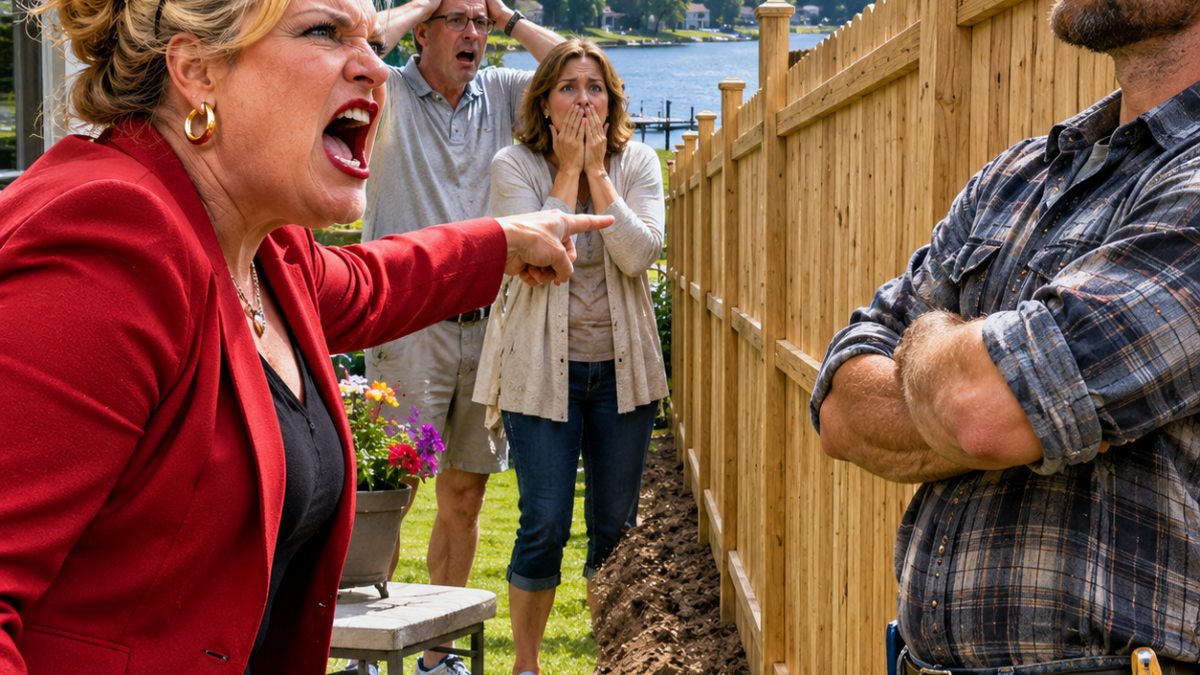
PART 2
He stepped out of his cruiser, adjusted his belt, and looked directly at Claire before he ever looked at me.
That bothered me immediately.
Not because I expected him to take my side.
I expected him to ask what was happening.
Instead, Claire walked toward him like she had ordered delivery.
“Thank goodness,” she said.
Harris nodded.
“Morning, Claire.”
First-name basis.
Great.
She held out her packet.
“The new owners are attempting to restrict established community waterfront access.”
I looked at Emily.
She looked at me.
Nobody had attempted anything.
We had spent our first night unpacking dishes.
I stepped forward.
“Deputy, I’m Mark Hayes. This is my wife, Emily. We closed on the property yesterday.”
He shook my hand.
“Okay.”
I held up our deed.
“The shoreline is included in the parcel.”
Claire laughed behind him.
Harris turned.
“Claire.”
“I’m sorry,” she said. “But these people clearly don’t understand how this community works.”
These people.
We had owned the place less than twenty-four hours.
I kept my voice steady.
“What exactly are you claiming?”
Claire unfolded a document.
“This shoreline has historically been available for HOA members.”
“Where does it say that in my deed?”
“It doesn’t have to.”
“Then where?”
She pointed toward the lake as though geography itself were evidence.
“It has always been that way.”
Emily moved beside me.
“We’re not trying to cause trouble.”
Her voice was soft.
I hated that she felt obligated to say it.
We were standing on our own property.
Claire glanced at her.
“I understand you may be unfamiliar with lake communities.”
Emily’s shoulders tightened.
Claire continued.
“We simply cannot have one homeowner deciding that decades of community tradition suddenly no longer apply.”
I looked at Deputy Harris.
“Tradition isn’t an easement.”
His eyebrows lifted.
I had spent enough years dealing with equipment contracts, property leases, and shop liability to understand one thing: if somebody claimed a legal right, there should be paper.
Claire didn’t like that answer.
“You’re being confrontational.”
“No. I’m asking a question.”
Deputy Harris raised one hand.
“Let’s keep this calm.”
I almost laughed.
I was calm.
Claire was accusing me of stealing access to property I had just bought.
But somehow I was the one being warned.
Harris looked at the deed.
Then at Claire’s paper.
He didn’t study either one very long.
“This sounds like something the HOA and property owners need to work through.”
“It’s not HOA property,” I said.
“Maybe not.”
“Then why am I working it out with the HOA?”
He sighed.
“I’m just suggesting everybody avoid escalating.”
Claire smiled.
That smile told me she considered the encounter a victory.
Before leaving, Harris said, “No one is being arrested. No one is being removed. Just keep things civil.”
I nodded.
Claire waited until his cruiser disappeared.
Then she turned back to us.
“You’ll learn.”
That was all she said.
She walked back toward her house.
Emily stood beside me for almost a minute before speaking.
“Did we make a mistake?”
The question hurt more than anything Claire had said.
We had spent sixteen years building toward that lake.
Emily had endured years of pain.
I had imagined mornings where she could walk down to the water without explaining herself to anyone.
Now she looked frightened on the second day.
I put my arm around her.
“No.”
I said it firmly.
But deep down, I wasn’t sure.
The harassment didn’t arrive like a storm.
That would have been easier.
Storms announce themselves.
Claire worked more like water dripping behind a wall.
Small enough that each incident seemed ridiculous by itself.
Together, they slowly destroyed everything.
The first notice appeared four days later.
Bright orange.
Stapled to our porch railing.
UNAPPROVED WATERFRONT MODIFICATION.
I stared at it.
We hadn’t modified anything.
Then I realized.
Two boards.
Two rotten deck boards I had replaced because one nearly snapped beneath Emily’s foot.
I had used the same dimensions.
Same wood.
Same screws.
I called the zoning office.
Voicemail.
I left my name and number.
No return call.
Two days later came another notice.
UNAUTHORIZED FIRE FEATURE.
The “fire feature” was a thirty-inch metal fire ring from a hardware store.
Half the cabins around the lake had one.
For us it wasn’t decoration.
Heat helped Emily’s hands on cold evenings.
She could sit outside with a blanket and hold them near the fire until the stiffness eased.
I drove to the township office.
A clerk named Nancy sat behind thick glass.
I placed the notice on the counter.
“I’m trying to understand what regulation this violates.”
She typed something.
“Parcel?”
I gave her the number.
Her expression changed almost imperceptibly.
“Oh.”
I noticed.
“Oh what?”
“Nothing.”
She kept typing.
“This property has been flagged for shoreline compliance review.”
“By whom?”
“I don’t have that information.”
“Can I see the rule?”
She printed three pages.
I read them.
Nothing prohibited a portable fire ring.
When I pointed that out, Nancy smiled tightly.
“You would need to discuss interpretation with zoning.”
“I called.”
“They’re busy.”
“When can I make an appointment?”
She hesitated.
“Mr. Bennett handles waterfront matters.”
Bennett.
I looked through the glass.
“Bennett?”
“Yes.”
“Any relation to Claire Bennett?”
Nancy stopped typing.
The silence answered before she did.
“Her husband.”
Of course.
Everything suddenly made more sense.
Claire ran the HOA.
Her husband worked in zoning.
The sheriff knew her personally.
And the realtor had told us she acted like she owned the lake.
She practically did.
I went home and told Emily.
She sat at the kitchen table, rubbing her knuckles.
“So what do we do?”
“Document everything.”
That became our routine.
Every notice got photographed.
Every envelope saved.
Every phone call written down.
Dates.
Times.
Names.
I bought a cheap security camera system.
Then another camera after someone kept leaving trash near our property line.
First it was cigarette butts.
Then fast-food wrappers.
Then dog waste.
We didn’t own a dog.
One morning I found muddy footprints beneath our bedroom window.
That was when I installed motion lights.
Claire never directly threatened us.
That was the genius of it.
She didn’t need to.
She operated through insinuation.
Paperwork.
Phone calls.
Whispers.
One afternoon, Emily returned from the mailbox looking pale.
“What happened?”
She handed me a letter.
It was an anonymous complaint claiming I had behaved aggressively toward female residents.
I stared at it.
“I’ve barely spoken to anyone.”
“I know.”
“You know that.”
“I know.”
But she wasn’t worried about whether the accusation was true.
She was worried about whether people believed it.
That was Claire’s real weapon.
Narrative.
If she could define us before anyone knew us, every reaction afterward would fit her story.
At the grocery store, a woman from two houses down saw me and immediately turned into another aisle.
One morning, I waved at a man walking his dog.
He looked away.
Later, I overheard two women near the community mailboxes.
“That’s him.”
“The one who threatened Claire?”
My jaw tightened.
I wanted to walk over.
I wanted to ask what exactly Claire had said.
Instead, I kept going.
That night, Emily sat beside me on the porch.
“Maybe we should sell.”
I looked at her.
She kept staring at the water.
“We haven’t even been here two months.”
“I know.”
“We saved sixteen years.”
“I know.”
“You love it here.”
Her eyes filled.
“I loved what I thought it would be.”
That sentence nearly crushed me.
The lake had been supposed to give her peace.
Instead, she was afraid to walk to the dock alone.
I reached for her hand.
She flinched slightly because her fingers hurt.
I loosened my grip.
“I’m going to fix this.”
She smiled sadly.
“You’re a mechanic.”
“Exactly.”
“That doesn’t qualify you to fight an HOA.”
“No.”
I looked toward Claire’s glowing house.
“But it qualifies me to notice when something doesn’t fit.”
That evening we built a small fire.
Emily wrapped herself in a blanket.
For maybe twenty minutes, we had the life we had imagined.
Still water.
Moonlight.
Warmth.
Then headlights washed across our yard.
A township truck.
An officer climbed out carrying a clipboard.
“We received a complaint about hazardous burning.”
I looked at the tiny fire.
“You’re serious?”
“Someone reported toxic smoke.”
“From what?”
He checked the page.
“Eucalyptus.”
I stared.
“We’re burning ordinary seasoned firewood.”
He inspected the stack.
He knew it.
I knew it.
He sighed.
“I’m required to respond.”
Emily spoke.
“My doctor recommended heat therapy.”
The officer’s expression softened.
“I understand, ma’am.”
“Are we doing anything illegal?”
He hesitated.
“No obvious violation that I can see.”
“Then why do we keep getting visited?”
He didn’t answer.
As he drove away, I saw movement near Claire’s property.
She was standing behind one of her trees.
Phone raised.
Recording us.
Emily saw her too.
Her hands began to shake.
I stepped toward Claire.
Emily grabbed my sleeve.
“No.”
“I’m just going to talk.”
“No.”
She was crying.
Not loudly.
That made it worse.
“She wants you angry.”
I stopped.
Emily looked across the darkness.
“She’s trying to break us.”
I had no answer.
Because she was right.
The breaking point came on the Fourth of July.
Emily’s arthritis had been bad all week.
Crowds hurt her because getting bumped or standing too long could leave her in pain for hours.
We skipped the town fireworks.
Instead, she asked if we could go down to the lake before sunset.
“Just ten minutes,” she said.
We walked slowly toward our shore.
Then stopped.
There must have been sixty people there.
Tables.
Coolers.
Music speakers.
A portable DJ setup.
Champagne bottles.
Children running across our dock.
Someone had tied two boats to our cleats.
Our property looked like a resort.
And in the middle of it stood Claire.
White dress.
Sunglasses.
Champagne glass in her hand.
She saw us.
Her smile grew.
“Oh, look.”
The music lowered slightly.
“Everyone, these are the new neighbors I told you about.”
Heads turned.
Emily froze.
Claire walked toward us.
“This is Mark.”
She laughed.
“The one who got so emotional when I tried to explain our lake traditions.”
A man beside her chuckled.
I felt heat rising through my neck.
I kept my hands at my sides.
“This is private property.”
Claire lifted one eyebrow.
“Here we go again.”
“You need to move the party.”
A few people laughed.
One man said, “Come on, buddy. It’s the Fourth.”
Another added, “Claire says this has always been community waterfront.”
Emily stepped forward.
“We bought this property because I need access to the water for—”
Claire interrupted.
“We all have reasons to enjoy the lake.”
Emily went silent.
That did it.
Not the party.
Not the trespassing.
Not even Claire’s lie.
The way she dismissed Emily.
Like her pain was an inconvenience.
I looked directly at Claire.
“You have thirty minutes to clear our property.”
Her smile disappeared.
“Are you threatening me?”
“No.”
I looked around at everyone.
“I’m informing you.”
Claire raised her glass.
“You see?”
She turned toward the group.
“This is what I’ve been dealing with.”
I could feel dozens of eyes waiting for me to explode.
So I didn’t.
I turned to Emily.
“Let’s go.”
We walked back to the cabin.
Laughter followed us.
An hour later, the party was still going.
I called the sheriff’s office.
Nobody came.
By midnight, everyone had left.
Our shoreline was covered in cups, broken plastic, food, cigarette butts, and one shattered champagne bottle.
The dock had fresh gouges from a boat.
Emily stood on the porch looking at it.
Then she sat down.
And cried.
I cleaned until almost two in the morning.
When I finished, I sat on the dock alone.
The lake was perfectly calm.
That almost made me angrier.
Emily came down eventually.
She wrapped a blanket around both of us.
For a long time, neither of us spoke.
Then she said:
“You can’t keep letting her do this.”
“I know.”
“She’ll ruin us.”
I looked at her.
There was no anger in her face.
Only fear.
That was the moment the switch flipped.
Not dramatically.
I didn’t make a speech.
I didn’t vow revenge.
I just decided I was done reacting.
The next morning, I drove to the county courthouse.
Not the modern public counter upstairs.
The records archive in the basement.
The room smelled like paper and dust.
Boxes were stacked along the walls.
Behind the counter sat an elderly man with thick glasses.
His name tag said HAROLD.
I slid our deed toward him.
“I need every historical survey, plat, easement, shoreline adjustment, and parcel record connected to this property.”
He looked at me.
Then at the deed.
“Neighbor problem?”
I smiled slightly.
“That obvious?”
“People who come down here looking for old plats are either getting divorced or fighting a neighbor.”
“Neighbor.”
He nodded.
“Usually more expensive.”
For four hours, Harold helped me pull records.
Microfilm.
Old surveys.
Handwritten notes.
Maps from the 1960s.
Maps from the 1980s.
A shoreline adjustment filed after flooding changed part of the lake edge.
Then I saw it.
A line.
Twenty feet east of where the modern landscaping suggested our property ended.
I checked another map.
Same line.
Another.
Same.
“Harold.”
He came over.
I laid the documents together.
He adjusted his glasses.
Then whistled.
“Well.”
“What?”
“You own more land than your current visual boundary suggests.”
“How much more?”
He traced the line.
“About twenty feet here.”
My stomach tightened.
Twenty feet.
I knew what sat twenty feet across that invisible boundary.
Claire’s rose garden.
Part of her stone walkway.
And roughly half of a deck extension.
I stared at Harold.
“Can this be wrong?”
“Anything can be wrong.”
My heart sank.
Then he continued.
“That’s why you hire a licensed surveyor.”
I did.
Not someone local.
I hired a company two counties away.
Nobody connected to Claire.
Nobody connected to her husband.
The surveyor, Alan, spent two days researching before arriving.
The third morning, he drove steel markers into the ground.
One near the road.
One beside the shoreline.
Then another.
And another.
The line crossed straight through Claire’s manicured lawn.
Her rose garden sat largely on my parcel.
Part of her walkway too.
Claire came outside wearing a robe.
Apparently robes were her chosen uniform for losing control.
“What are you doing?”
Alan didn’t look up.
“Survey.”
“I didn’t authorize a survey.”
“You don’t have to.”
“This is my property.”
He checked his equipment.
“Not this section.”
She stared at the marker.
Then at me.
“You manipulated the records.”
I laughed.
I genuinely couldn’t help it.
“Claire, if I had the ability to manipulate county records, I wouldn’t be spending my mornings fixing a thirty-year-old septic pump.”
Her face twisted.
“You think this is funny?”
“No.”
I held up the deed.
“I think this is interesting.”
She marched toward Alan.
“My husband works for zoning.”
He finally looked at her.
“Congratulations.”
“I can have your license reviewed.”
Alan smiled.
“Also congratulations.”
I liked him immediately.
When the final stamped survey arrived three days later, I read it twice.
The result was clear.
The modern visual boundary was wrong.
The historical legal boundary had never changed.
Claire had landscaped onto our land.
Built on our land.
Used our land.
For years.
I could have confronted her immediately.
I didn’t.
Instead, I went back to Harold.
“Anything else?”
He looked over his glasses.
“You’re enjoying this now.”
“No.”
He smiled.
“A little.”
“Maybe a little.”
We searched easements.
Shoreline rights.
Access corridors.
Then we found something even better.
A recorded access easement created decades earlier for utility and maintenance passage.
The easement crossed my parcel.
Then continued directly through what Claire considered her backyard.
Through the rose garden.
The same roses she imported.
The same roses she had once bragged cost more than some people’s cars.
The access corridor was legal.
Recorded.
Still valid.
And under current rules, I could install a boundary fence along my land while preserving the legally required passage conditions.
I hired an attorney before doing anything.
Her name was Rebecca Sloan.
She reviewed every document.
Then she looked at me.
“What do you want?”
“I want Claire off my property.”
“Good.”
“That sounded too easy.”
“It isn’t.”
She tapped the survey.
“You have leverage. Don’t confuse leverage with permission to be reckless.”
“I don’t want reckless.”
“What do you want?”
I thought about Emily crying on the porch.
“I want quiet.”
Rebecca nodded.
“Then we do this cleanly.”
Everything from that point forward was clean.
Permits.
Survey verification.
Written notice.
Certified mail.
Boundary disclosure.
Fence application.
Environmental review.
I followed every rule Claire had used as a weapon.
Except I followed the real ones.
While permits were processing, I looked closer at Claire’s own construction.
Her dock extended unusually far into the lake.
Alan measured it.
Too far.
The underwater lighting illuminated a protected spawning area.
The boat lift had no visible permit tag.
Her shoreline steps disturbed a zone covered under environmental rules.
I didn’t threaten her.
I documented.
Photographs.
Measurements.
Dates.
Copies of statutes.
Then I filed complaints.
One by one.
No emotion.
No anonymous tips.
My name was on everything.
Three days later, a state inspection truck arrived.
Claire came outside smiling.
She knew inspectors.
Or thought she did.
I watched from our porch.
At first, she laughed with them.
Then they measured the dock.
The smile weakened.
They photographed the lights.
The smile disappeared.
They examined the boat lift.
Claire started talking with her hands.
Then one inspector walked toward the rose garden.
He looked at the survey markers.
Then at the easement record.
“This improvement appears to overlap a recorded access corridor.”
Claire’s face went white.
She pointed toward me.
Even from a distance, I knew what she was saying.
He did this.
He’s harassing me.
He’s obsessed.
The inspector didn’t care.
Paper doesn’t care about personality.
Measurements don’t care who you know.
That was the first crack in Claire’s empire.
Two mornings later, the fence crew arrived.
I had ordered a six-foot privacy fence.
Simple.
Legal.
Nothing decorative.
Just a boundary.
Miguel unloaded the first panels.
Claire came running.
“You are not building that!”
Miguel handed her a copy of the permit.
“We are, ma’am.”
She slapped it out of his hand.
I saw his face change.
Not angry.
Cold.
“Don’t touch my documents.”
“You people need to get off my property.”
Miguel looked at the survey marker.
“This is Mr. Hayes’s property.”
“I know zoning.”
“That’s nice.”
“I can make sure your company never works in this county again.”
Miguel pulled out his phone.
“Okay.”
He started recording.
Claire noticed.
Her voice rose.
“Turn that off!”
“No.”
Then she said something ugly.
Something about his accent.
Then immigration.
Then whether his crew was “even legal.”
Several neighbors were outside by then.
Phones appeared.
Claire didn’t realize how much the neighborhood had changed.
People were no longer automatically afraid of her.
They were curious.
And curiosity is dangerous to someone who survives on controlling the story.
Miguel said calmly:
“My crew members are citizens and licensed contractors. Now step away from the equipment.”
Claire disappeared inside.
I thought maybe she had finally listened.
She came back holding bolt cutters.
“Oh, hell,” I muttered.
Miguel stepped away.
“Ma’am.”
She grabbed the guide wire.
“Remove this!”
“Do not cut that.”
She opened the cutters.
Then her slipper caught the hem of her robe.
Claire stumbled.
Her arms flew forward.
She landed chest-first in the soft dirt beside her roses.
For one second, the entire street went silent.
Then a boy riding past on a bicycle shouted:
“THE FENCE WITCH FELL!”
His mother yelled his name.
Someone coughed to hide a laugh.
Claire rose covered in mud.
Her face was bright red.
I almost felt bad for her.
Almost.
The video spread everywhere.
Neighborhood group chats.
Contractor networks.
Local social media pages.
People replayed the moment she threatened Miguel.
Not the fall.
The threats.
Especially the part about immigration.
That destroyed something no survey could measure.
Her reputation.
Contractors stopped answering her.
A landscaper canceled a job.
A pool company suddenly had no openings.
People who had tolerated Claire because she controlled permits started realizing her influence might be weakening.
The fence continued.
Panel by panel.
It ran directly along the verified legal boundary.
Through what Claire had always considered her backyard.
Across the outer edge of the rose garden.
The crew carefully removed anything on my side.
I saved several rose bushes rather than destroying them.
Emily asked why.
“Because the roses didn’t do anything.”
She smiled.
That was the first real smile I had seen from her in weeks.
When the fence was finished, our yard changed instantly.
For the first time since buying the property, I could stand outside without feeling watched.
Emily walked toward the lake.
She stopped near the gate.
“You okay?”
She nodded.
Then she cried.
“What’s wrong?”
“Nothing.”
She looked around.
“That’s why.”
We sat on our dock that afternoon.
Nobody crossed it.
Nobody told us we were stealing community access.
Nobody filmed us.
Emily lowered herself into the water.
Her face tightened briefly from the cold.
Then relaxed.
She floated on her back.
Eyes closed.
For fifteen minutes, she didn’t look like a woman fighting her body.
She looked peaceful.
That alone would have been enough for me.
I thought the story was over.
It wasn’t.
A week later, Nancy from the zoning office called.
“Mr. Hayes?”
“Yes.”
Her voice was low.
“Can you come to the office?”
“Regarding what?”
“I shouldn’t say over the phone.”
That never means anything good.
Rebecca came with me.
Nancy met us after normal hours.
She locked the front door.
Then pulled a stack of files from a cabinet.
“I’ve worked here twelve years.”
She looked terrified.
“I should’ve said something sooner.”
Rebecca leaned forward.
“About what?”
Nancy opened a permit log.
“Mr. Bennett.”
Claire’s husband.
His signature appeared everywhere.
Approvals for Claire.
Approvals for friends.
Accelerated reviews.
Exceptions.
Then there were the other files.
Applications delayed without clear reason.
Permits marked incomplete.
Complaints repeatedly reopened.
My parcel appeared multiple times.
Nancy had records showing submissions we made had been received complete.
Yet later they were coded as incomplete.
“So somebody changed them?”
Rebecca asked.
Nancy nodded.
“Digitally.”
“Who has access?”
“Mr. Bennett.”
“Anyone else?”
“Technically, yes.”
“Practically?”
Nancy stared at the table.
“Mostly him.”
The story stopped being about a fence.
Rebecca contacted state investigators.
We handed over everything.
Our notices.
Emails.
Security footage.
Permit records.
The survey.
The shoreline documents.
Then other residents started talking.
A man named Peter had spent fourteen months waiting for approval to repair a retaining wall.
Claire disliked him.
Another homeowner received approval in four days for a larger project.
She was Claire’s friend.
A widow named Marie had been fined repeatedly over a dock railing.
The same design existed on Claire’s property.
No violation.
A reporter named Jasmine Cole contacted me.
“I’m investigating local zoning irregularities.”
I hated the phrase.
Irregularities sounded like somebody misplaced a stapler.
“Ask Rebecca.”
“I already did.”
“Then why call me?”
“Because paperwork tells me what happened. People tell me what it did.”
That sentence convinced me.
I met her at our picnic table.
Emily joined us.
Jasmine never turned the interview into a circus.
She asked why we bought the property.
Emily explained.
Not dramatically.
Just honestly.
She described mornings when her hands hurt so badly I had to button her shirt.
She described the relief of floating.
Then she explained how harassment made her afraid to use the water.
Jasmine lowered her notebook.
“That’s why you stayed?”
Emily looked at me.
“No.”
Then she looked toward the lake.
“That’s why we almost left.”
The article appeared three days later.
It wasn’t about a feud.
It was about power.
Connections.
Selective enforcement.
A zoning official whose wife controlled the HOA.
A pattern of favorable decisions.
Residents came forward afterward.
Many.
More than I expected.
Some had stories going back ten years.
That was when Claire escalated.
One night, at 2:13 a.m., my motion alarm went off.
I checked the cameras.
Claire was near the shoreline.
Dark clothes.
A container in her hand.
I watched her pour liquid near the water.
I called Rebecca.
Then environmental authorities.
The following morning, samples were taken.
I never confronted Claire.
That was becoming the rule.
Every time she acted emotionally, I responded with documentation.
A week later, two men came onto my property after midnight.
They carried tools.
One started toward our dock.
I turned on every exterior light.
They ran.
The cameras captured license plates.
Police found them.
Both eventually admitted they had been paid to “scare” me.
The payment trail pointed back toward Claire through an intermediary.
Even Deputy Harris looked uncomfortable when he returned to take my statement.
He stood in our kitchen.
“I owe you an apology.”
I looked at him.
“For what?”
“The first day.”
“That’s vague.”
He nodded.
“I treated Claire’s version as credible because I knew her.”
“And mine?”
“I treated yours as a dispute.”
I said nothing.
He looked toward Emily.
“I should’ve listened.”
Emily answered before I could.
“Yes.”
Harris nodded.
“Yes, ma’am.”
He left.
That apology didn’t erase what happened.
But it mattered.
Claire’s final serious attempt came two weeks later.
She called police claiming I had threatened her with a firearm.
I didn’t even own one.
By then, the investigators knew the pattern.
My cameras showed I had been inside our workshop at the time she claimed the confrontation happened.
Rebecca almost smiled when she heard about the report.
“What?”
I asked.
“She’s helping.”
“How?”
“False statements made during an active investigation are rarely helpful to the person making them.”
Claire’s annual Lake Preservation Gala was scheduled for September.
It was her favorite event.
Champagne.
Jazz trio.
White tables beside the water.
Speeches about conservation.
The irony was almost artistic.
By then, everybody knew investigators were active.
Claire refused to cancel.
I think she believed appearing powerful would make her powerful again.
Emily and I did not attend.
Instead, we organized a shoreline cleanup on our side of the lake.
Nothing political.
Trash bags.
Gloves.
Food.
Kids.
Neighbors.
Even Deputy Harris showed up off duty.
At around five that afternoon, black SUVs arrived at Claire’s house.
People stopped picking up trash.
Doors opened.
Investigators stepped out.
State officials.
Then federal agents.
Claire’s husband was approached first.
Even across the water, I could hear her screaming.
Music at the gala stopped.
Guests backed away.
Her husband was placed in handcuffs.
Claire grabbed a microphone.
“This is harassment!”
Her voice blasted through the speakers.
People stared.
“This man has been obsessed with destroying me!”
She pointed across the water.
At me.
Dozens of heads turned.
Emily touched my arm.
“Don’t.”
“I’m not going over there.”
But Claire kept shouting.
“He manufactured evidence!”
“He manipulated property records!”
“He has threatened my family!”
Rebecca happened to be standing nearby.
She sighed.
“Apparently she’s determined to make the government’s case in public.”
Then Claire crossed the lawn toward our side.
She reached the fence.
Couldn’t pass through.
That six-foot boundary stood between us.
For some reason, that image stayed with me more than the arrests.
Claire had spent months crossing boundaries because she believed none applied to her.
Now a literal boundary stopped her.
She gripped the fence.
“You!”
I walked closer but stayed on my side.
“They’re arresting my husband because of you!”
“No.”
“Yes!”
“They’re investigating records he signed.”
“You dug them up!”
“I read public records.”
“You destroyed us!”
I looked at the crowd behind her.
Then at investigators approaching.
“No, Claire.”
She shook the fence.
“This is revenge!”
I thought about Emily.
The Fourth of July.
The notices.
The whispers.
The nights she cried.
The men at my dock.
The false police report.
Then I said the only thing that mattered.
“They’re not here because I hate you.”
Claire stared.
“They’re here because of what you did.”
An agent reached her.
“Claire Bennett?”
She turned.
The microphone slipped from her hand.
The speaker produced a loud burst of feedback.
Then silence.
She was arrested.
There was no cheering.
I’m glad.
Real consequences should not feel like entertainment.
Emily leaned against me.
“Is it over?”
“I don’t know.”
It took months before I could answer yes.
Investigations became charges.
Charges became hearings.
Claire’s husband faced allegations involving zoning fraud, abuse of public authority, falsification of records, and related misconduct.
Claire faced her own charges connected to false reporting, environmental violations, harassment, and conduct investigators tied to efforts against us and other residents.
Some charges changed during prosecution.
Some were negotiated.
Others were dismissed or folded into broader agreements.
That part mattered less to me than people expected.
I didn’t need every possible charge to stick.
I needed the system to stop pretending nothing happened.
The HOA dissolved its existing leadership structure.
New elections were held.
Conflict-of-interest rules were adopted.
Zoning reviews were moved away from individual discretionary control.
Old permits were audited.
Several residents had fines reversed.
Others received hearings they should have received years earlier.
Claire’s house eventually went into foreclosure.
The first time I saw the bank notice attached to the door, I felt almost nothing.
That surprised me.
Months earlier, I would have imagined satisfaction.
Instead, I thought about what revenge actually costs.
Not to Claire.
To me.
I had spent months reading records at midnight.
Months checking cameras.
Months wondering what would happen next.
Months watching Emily tense whenever a vehicle slowed outside.
Winning does not refund the time fear stole.
Her property sat empty.
Without landscapers, the lawn grew wild.
Some of her roses survived.
Most didn’t.
Nature does not respect status.
The perfect lawn became clover.
Weeds pushed between expensive stone pavers.
Reeds slowly returned near sections of shoreline she had altered.
Birds nested near the dock.
The underwater lights were removed.
The lake grew darker at night.
And strangely, more beautiful.
One evening, Emily and I sat by the fire.
The same little metal fire ring Claire had tried to turn into a violation.
Emily held her hands toward the heat.
“How bad?”
I asked.
“Four.”
Out of ten.
That was a good evening.
She looked toward the fence.
“Do you regret it?”
“The fence?”
“Everything.”
I thought carefully.
“I regret how much it cost us.”
She nodded.
“But do you regret fighting?”
“No.”
She smiled.
“Me neither.”
Months later, the new HOA president came to our house.
Her name was Angela Morris.
She was almost aggressively normal.
Jeans.
Sneakers.
No clipboard.
“I need to ask you something.”
I braced myself.
“What?”
“We want to formally remove any claim that your shoreline is common-access property.”
I blinked.
“Formally?”
“Our attorney says the cleanest solution is a resolution acknowledging the deed and survey.”
“That sounds reasonable.”
She smiled.
“I was expecting more resistance.”
“I’m tired.”
“Fair.”
She handed me the proposed language.
Then paused.
“There’s something else.”
Of course.
“What?”
“People want lake access.”
I stared at her.
Angela immediately raised both hands.
“Not your property.”
“Good start.”
She laughed.
“There’s an unused municipal strip on the north side. We’re considering building a small community dock there.”
“That’s a great idea.”
“You’re serious?”
“Why wouldn’t I be?”
“After everything…”
I understood.
“You think I wanted everyone kept off the lake?”
She looked embarrassed.
“I suppose.”
“No.”
I looked toward our shoreline.
“I wanted people kept off property they didn’t own.”
“That’s different.”
“Very.”
I ended up helping with the community dock.
So did Emily.
For the first time, neighbors came to our property because we invited them.
Not because Claire told them they had a right to it.
That difference changed everything.
Emily started spending more time in the water.
At first, she floated alone.
Then a woman named Teresa asked about her exercises.
Teresa had knee replacement surgery.
Emily showed her a few movements.
The next week, two people joined them.
Then four.
By the following summer, Emily was leading an informal water-mobility group twice a week.
No fees.
No organization.
Just neighbors helping neighbors.
Sometimes I stood on the dock and watched.
Emily’s hands still hurt.
Some mornings were terrible.
The lake didn’t cure her disease.
But it gave her something pain had been trying to take away.
Freedom.
Watching that made every ugly meeting feel distant.
One Saturday, a little girl named Sophie came running up our dock.
Her grandmother shouted:
“Sophie! Ask first!”
The girl stopped immediately.
“Mr. Mark?”
“Yes?”
“Can I fish here?”
I looked at Emily.
She smiled.
“Sure.”
Sophie sat on the edge.
Her feet swung above the water.
That tiny moment meant more than I expected.
Claire had acted as though boundaries and kindness were opposites.
They weren’t.
A boundary meant I got to choose.
Consent turned intrusion into welcome.
That was something Claire never understood.
A year after the investigation began, Harold from the courthouse retired.
Emily and I attended his retirement party.
He pointed at me.
“You’re the reason I stopped letting angry homeowners look at maps without supervision.”
I laughed.
“You helped me.”
“I created a monster.”
“You found the survey.”
“You found the survey. I just knew which drawer held the ancient nonsense.”
Emily hugged him.
“Thank you.”
His expression softened.
“For what?”
“For helping us keep our home.”
Harold looked uncomfortable with emotion.
He adjusted his glasses.
“County records did that.”
“No,” she said.
“You took us seriously.”
That stopped him.
After a moment, he nodded.
“Well.”
Then he looked at me.
“Still got that fence?”
“Yep.”
“Good fence?”
“Excellent fence.”
He laughed.
“Best six feet of lumber in the county.”
We eventually modified part of it.
Not because anyone forced us.
Emily wanted to plant flowers along our side.
Not roses.
She chose wildflowers.
Native ones.
The irony wasn’t lost on me.
I built raised beds so she wouldn’t have to bend too far.
We planted coneflowers.
Black-eyed Susans.
Bee balm.
Milkweed.
By midsummer, butterflies covered the fence line.
The barrier that had once symbolized conflict slowly became one of the prettiest parts of our property.
One evening, Emily sat beside it.
“You know what’s funny?”
“What?”
“Claire probably thought the fence was the worst thing you could do to her.”
“It was definitely unpopular.”
Emily smiled.
“But she never understood why you built it.”
“Why did I build it?”
“For me.”
I looked at her.
She reached for my hand.
I held it gently.
“For us,” I said.
She nodded.
“For us.”
That was the truth.
People called it revenge.
Some neighbors still told the story as though I had discovered a technicality just so I could drive a fence through a rich woman’s roses.
I understand why.
It makes a better story.
Man bullied by HOA discovers secret boundary and gets revenge.
Simple.
Satisfying.
But life wasn’t that neat.
I didn’t spend sixteen years saving money so I could win a property dispute.
I spent sixteen years saving because the woman I loved needed someplace where her body hurt a little less.
Claire threatened that.
That was why I fought.
There was another moment, two years after the fence went up, that finally gave the whole thing an ending for me.
A real one.
The Bennett house had been sold.
The new owners were a younger couple named Jason and Natalie.
They had two children.
The day they moved in, Jason came to our door.
I prepared myself for the inevitable conversation.
“Hi.”
“Hi.”
“I’m Jason.”
“Mark.”
He glanced toward the fence.
“So…”
“Yeah.”
“I’ve heard stories.”
“I’m sure.”
He laughed nervously.
“Can we talk about the boundary?”
“Absolutely.”
His shoulders relaxed.
I invited him inside.
I laid out the survey.
The easement.
The updated county records.
Everything.
He studied them carefully.
“So this area is yours.”
“Yes.”
“And that deck extension?”
“Part of it crosses.”
He winced.
“We’ll fix it.”
“You don’t have to panic.”
“I don’t want problems.”
“Neither do I.”
That seemed to surprise him.
We worked with Rebecca to create a clean agreement.
Jason removed the encroaching section.
I allowed temporary access for contractors.
Nobody shouted.
Nobody called the sheriff.
Nobody threatened zoning.
It took three conversations.
That was all.
After the work was finished, Natalie came over with a pie.
Emily whispered to me:
“Is this what normal neighbors do?”
“I think so.”
“I don’t remember.”
That summer, their kids played with Sophie.
Sometimes they asked permission to fish from our dock.
Sometimes Emily invited them to swim.
Jason helped me repair one section of fence after a storm knocked a tree branch across it.
As we worked, he looked at the wood.
“This is the famous fence?”
“Unfortunately.”
“My kids call it the Fence Witch Fence.”
I closed my eyes.
“That nickname survived?”
“Apparently forever.”
“Great.”
He laughed.
Then became serious.
“I read some of the old articles.”
“Sorry.”
“No.”
He tightened a screw.
“I just wanted to say…I understand why you did it.”
I stared at the lake.
“I’m not sure I always do.”
Jason nodded.
“Maybe you don’t need to.”
That stayed with me.
For years, I had replayed every decision.
Could I have walked away sooner?
Could I have handled Claire differently?
Was I too stubborn?
Was the fence necessary?
Was filing every complaint revenge?
At some point, questions like that stop producing wisdom and start producing exhaustion.
I eventually accepted a simpler answer.
I did what I believed was necessary with the information I had.
I followed the law.
I documented.
I protected my wife.
I exposed what needed exposing.
And when it was over, I stopped.
That last part matters.
Revenge can become another prison if you keep fighting after the battle is finished.
I didn’t want Claire living in my head after she was gone.
So I let the lake become a lake again.
Not evidence.
Not property lines.
Not environmental reports.
Water.
On warm mornings, Emily swims.
I sit on the dock drinking coffee.
Sometimes she floats without moving.
Just breathing.
The first time I saw her do that after everything ended, I realized the dream had survived.
Damaged.
Delayed.
But alive.
One evening late in summer, we sat together watching the sunset.
The sky turned orange across the water.
Emily rested her head on my shoulder.
“Do you remember our first night here?”
“Yes.”
“I asked if we made a mistake.”
I nodded.
She was quiet.
Then said:
“We didn’t.”
My throat tightened.
“No.”
“We really didn’t.”
Across the lake, kids were laughing near the new community dock.
A fishing boat moved slowly through the evening light.
Jason’s family was grilling next door.
Somebody waved.
I waved back.
Emily looked at the wildflowers growing beside the fence.
“You know, I hated that fence when you first told me about it.”
I turned.
“You did?”
“Yes.”
“Why didn’t you say anything?”
“You looked so proud.”
I laughed.
“I was very proud.”
“I know.”
“Do you still hate it?”
She thought for a second.
“No.”
“Why?”
“Because it gave us a boundary.”
“That’s generally what fences do.”
She elbowed me.
I winced dramatically.
“Smartass.”
She smiled.
Then her expression softened.
“Before it went up, I felt like Claire could come into our life whenever she wanted.”
I listened.
“Afterward, I could breathe.”
That was the moment I stopped seeing the fence as revenge.
Claire thought it was punishment.
The neighborhood thought it was war.
For Emily, it was safety.
There is a difference.
The criminal cases eventually disappeared from local headlines.
People moved on.
They always do.
Claire and her husband were no longer part of the community.
The old HOA system was gone.
The lake didn’t become perfect.
We still argued about docks.
Noise.
Boats.
Parking.
That was normal.
The difference was that disagreement no longer automatically meant intimidation.
Meetings had minutes.
Conflicts had procedures.
People asked questions.
More importantly, people answered them.
Angela once joked that I had ruined HOAs for everyone because now residents read every page.
“Good,” I said.
She laughed.
“Yeah. Probably.”
One afternoon, I drove past the courthouse and saw Harold’s old basement window.
I thought about the day I walked down there angry and desperate.
I had been looking for a weapon.
What I found was information.
That distinction mattered.
Claire had power because everyone assumed she knew more.
She knew the officials.
She knew the procedures.
She knew which forms frightened people.
Once I learned the same system, her magic disappeared.
That may have been the biggest lesson.
People who abuse authority often depend on confusion.
They need you to believe the rules are too complicated.
The documents too technical.
The process too expensive.
The connections too powerful.
Sometimes fighting back begins with something very boring.
Reading.
Asking.
Saving emails.
Looking at maps.
People like Claire hate records because records have terrible manners.
They don’t flatter.
They don’t get intimidated.
They don’t care who hosts the gala.
A property line is a property line.
A signature is a signature.
A date is a date.
And sometimes twenty forgotten feet on an old county map can change an entire life.
Years later, people still ask about the roses.
Yes.
The fence really crossed the garden.
No.
I didn’t intentionally destroy every plant.
Anything clearly on our side had to be removed or relocated.
Several bushes survived.
One actually ended up in our yard.
I didn’t know what to do with it.
Emily did.
She replanted it near the back corner.
I stared at her.
“You’re keeping Claire’s rose?”
“It’s not Claire’s rose.”
She packed soil around the roots.
“It’s a plant.”
“You’re very philosophical about this.”
“I’m tired of hating things because they remind us of her.”
That sentence hit me.
The rose bloomed the following year.
Deep red.
Beautiful.
Emily cut one flower and placed it in a glass beside the kitchen sink.
I looked at it for a long time.
“You know that came from the enemy garden.”
She rolled her eyes.
“There is no enemy garden.”
“Sounds less dramatic.”
“Good.”
She kissed my cheek.
That became another lesson.
Healing is sometimes terribly undramatic.
No courtroom.
No arrest.
No screaming.
Sometimes healing is your wife planting a flower that used to belong to someone you hated and deciding it doesn’t get to carry that hatred anymore.
The lake taught me that.
Water keeps moving.
You can disturb it.
Throw stones.
Drive boats through it.
Create waves.
Eventually, if you stop interfering, it becomes still again.
Emily once asked me what I would do differently if I could go back.
I thought about it for several days.
Finally, I told her:
“I’d believe you sooner.”
She frowned.
“About what?”
“When you said Claire was trying to break us.”
“You believed me.”
“Eventually.”
I looked at her.
“I spent too long thinking each incident was too small to matter.”
That was true.
One notice.
One rumor.
One phone call.
One fake complaint.
One party.
Bullies rarely begin with the worst thing they will do.
They test.
If you accept one boundary being crossed, they try another.
By the time you react, everyone around you says:
Why are you suddenly so angry?
They didn’t see the hundred small things that came first.
I did.
Emily did.
And eventually the records did too.
That’s why I kept everything.
Somewhere in our garage is a box labeled CLAIRE.
Emily hates the label.
It contains copies of notices, surveys, permits, photographs, correspondence, inspection results, and legal records.
I haven’t opened it in years.
I probably never will.
But I haven’t thrown it away either.
Not because I expect another fight.
Because memory has a way of becoming cleaner than reality.
Years pass and people say:
Maybe it wasn’t that bad.
Maybe you overreacted.
Maybe everyone misunderstood each other.
The box remembers.
So does the fence.
But most importantly, so do we.
On our twentieth wedding anniversary, I asked Emily where she wanted to go.
Hawaii.
Europe.
A resort.
Anywhere.
We could finally afford something nicer than the cheap road trips we used to take.
She looked at me like I was stupid.
“Why would I leave?”
“For vacation.”
She pointed toward the lake.
“This is where I wanted to get to.”
So we stayed home.
I grilled steaks badly.
She criticized them.
We opened a bottle of wine.
At sunset, she went into the water.
I joined her.
I hate cold water.
Always have.
She laughed as I complained.
“You’re such a baby.”
“My feet are numb.”
“The lake is seventy-three degrees.”
“Hypothermia.”
“Drama queen.”
We floated together.
The sky darkened.
For a while, there was no Claire.
No HOA.
No zoning investigation.
No fence.
No illness.
Just my wife and me in the water we had spent sixteen years trying to reach.
I looked at her.
“What?”
she asked.
“Nothing.”
“Why are you staring?”
“I was thinking about something.”
“Dangerous.”
I smiled.
“You remember when you said the lake wasn’t a luxury?”
“Yes.”
“You were right.”
She looked around.
“I know.”
Then she took my hand under the water.
Her fingers were stiff.
They always would be.
But she squeezed.
And I understood why the fight had mattered.
Not because Claire lost.
Because Emily got this.
That distinction is the entire story.
If the ending were only Claire losing her house, it would be empty.
If it were only her husband being arrested, it would be angry.
If it were only a six-foot fence through fifteen thousand dollars’ worth of roses, it would be petty revenge.
And yes, there was a part of me on that foggy morning that enjoyed watching Claire discover the legal boundary.
I’m human.
But that feeling lasted minutes.
What we built afterward lasted years.
The lake healed.
The community healed.
Our marriage survived something that could easily have driven us apart.
And Emily got to use the water without asking anyone’s permission.
That was the victory.
Not the fence.
Not the arrests.
Not the headlines.
Peace.
I still wake early.
Habit from decades as a mechanic.
Most mornings, I make coffee and walk outside before Emily gets up.
Fog often settles over Lake Willamear.
Sometimes it looks exactly like that morning Claire came screaming across the lawn.
The fence is still there.
Six feet tall.
Straight.
Legal.
Wildflowers grow along our side.
The old rose Emily saved grows near one corner.
And when I look at it now, I don’t see Claire.
I see my wife kneeling carefully in the dirt, refusing to let somebody else decide what a thing has to mean.
That may be the best revenge of all.
Not destroying the person who tried to hurt you.
Not spending the rest of your life proving that you won.
Taking back the thing they poisoned.
Making it beautiful again.
And living there peacefully long after they are gone.
One morning last spring, Emily came outside while I was sitting on the dock.
She carried two coffee mugs.
Carefully.
Both hands.
Years earlier, there had been mornings when one mug was too painful.
She handed me mine.
I looked at her hands.
She noticed.
“What?”
“Nothing.”
“Mark.”
“I remember when you couldn’t carry that.”
She looked down at the mug.
Her disease hadn’t disappeared.
Treatment helped.
Water helped.
Good days and bad days came unpredictably.
But that morning was good.
She sat beside me.
Our shoulders touched.
Across the lake, sunlight began cutting through the fog.
“What are you thinking about?”
she asked.
I looked toward the fence.
Then at the water.
Then at her.
“The first morning.”
“With Claire?”
“No.”
“When?”
“The morning we first saw this place.”
Emily smiled.
“You hated the cabin.”
“I did not.”
“You called it structurally questionable.”
“It was structurally questionable.”
“You said the porch looked drunk.”
“It still does.”
She laughed.
Then rested her head against my shoulder.
“But you bought it.”
“For you.”
“For us.”
I nodded.
“For us.”
We stayed there until the coffee went cold.
Behind us stood a house that still needed work.
Beside us stood a fence born from one of the ugliest periods of our lives.
In front of us was the lake.
Still.
Open.
Ours to enjoy.
I used to think fighting back meant making sure Claire regretted what she had done.
I was wrong.
Fighting back meant making sure what she did did not decide the rest of our lives.
Claire tried to turn our dream into something we feared.
She failed.
She tried to make Emily feel unwelcome on her own property.
She failed.
She tried to make the community believe that authority belonged to whoever shouted the loudest and knew the right officials.
She failed.
And the reason she failed was not because I screamed louder.
It was because one night, after watching my wife cry on the porch of the home we had spent sixteen years earning, I stopped arguing with Claire and started looking for the truth.
The truth was sitting quietly in an old county basement.
Twenty forgotten feet.
A recorded easement.
A legal boundary.
Everything she had counted on people never checking.
Claire thought the lake belonged to whoever had the most influence.
She was wrong.
She thought the neighborhood belonged to whoever controlled the HOA.
Wrong again.
And she thought people like Emily and me would eventually get tired, sell our cabin, and disappear.
That was her biggest mistake.
We stayed.
The fence stayed.
The community stayed.
And every evening, when Emily walks down to the water, lowers herself carefully into the lake, and finally feels her joints loosen beneath the surface, I remember exactly why.
Not because I wanted Claire’s backyard.
Not because I wanted revenge.
Not even because I wanted to prove I was right.
I wanted my wife to have the life we had worked sixteen years to reach.
And in the end, she did.
That was worth fighting for.








