PART 2: HOA karen Tried to Remove Our Fire Hydrants — Months Later, the One She Hated Saved the Entire Street
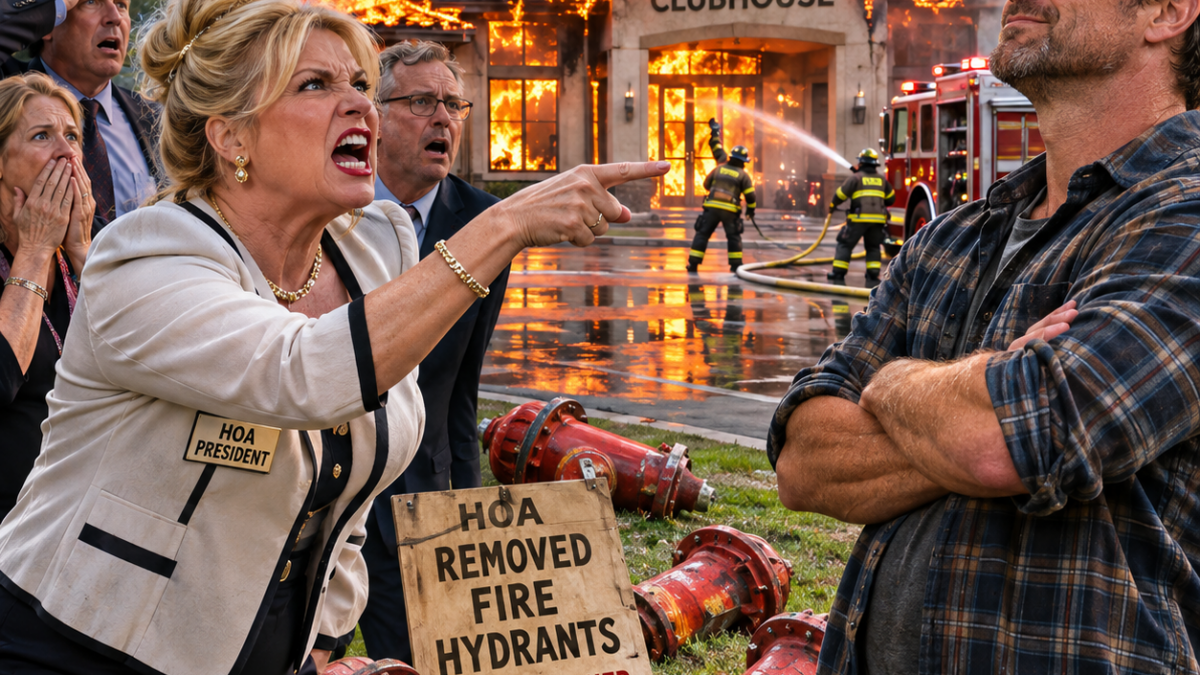
PART 2
I didn’t storm to Naen’s house.
I didn’t post anything online.
I didn’t shout at the next HOA meeting.
That wasn’t how I worked.
For nearly twenty-five years, my career had involved structural engineering—buildings, load paths, failure points, inspections, documentation.
When something looked wrong, emotion came second.
First, you gathered facts.
The commercial vehicle clause Naen cited applied to vehicles parked on community-owned property. My driveway belonged to me.
So I wrote a one-page response.
No insults.
No accusations.
I quoted the relevant paragraph, attached a copy of the governing provision, and politely requested that the violation be withdrawn.
Three days later, another envelope arrived.
**Failure to comply.**
Additional fine: $200.
Delaney found me standing at the kitchen counter with both notices spread beside my coffee.
She looked at my face.
“What?”
I handed her the letters.
She read them.
Then she looked toward the garage, where my van sat legally parked behind the closed door.
“She ignored your response?”
“Completely.”
“What are you going to do?”
I folded the second letter carefully.
“Read.”
Delaney gave me a long look.
She knew exactly what that meant.
When I became angry, I didn’t get louder.
I bought binders.
—
The fire hydrant fight began a few months later.
And strangely enough, it started with color.
In January 2020, the City of Davenport sent the HOA its routine annual notice.
Four of the six hydrants along our neighborhood’s interior streets were scheduled for inspection.
Nothing unusual.
City workers came out regularly, tested water pressure, checked valves, repainted equipment when necessary and made sure firefighters could access everything.
The hydrants had yellow bodies and red caps.
They had looked that way for years.
Nobody cared.
Nobody except Naen.
At the February HOA meeting, she presented what the minutes called an **Aesthetic Alignment Initiative**.
Walt, one of my neighbors, sent me a picture of the notice afterward.
His text contained four words.
**You seeing this, Garrison?**
I was.
According to Naen, the yellow hydrants interfered with Cedarbrook Commons’ “visual harmony.”
She had apparently commissioned mock-ups showing the streets with hydrants painted taupe.
Taupe.
I stared at the photograph for several seconds before calling Walt.
“Tell me this is a joke.”
“Nope.”
“She wants to paint municipal fire equipment taupe?”
“She says yellow clashes with the landscaping.”
I rubbed my forehead.
“What did the board say?”
“Three to zero.”
Of course.
Naen.
Prescott.
Bev.
The same three-person majority that approved practically everything.
“What exactly did they vote on?”
“To ask the city to modify or relocate them.”
I stopped rubbing my forehead.
“Relocate?”
“That’s what the minutes say.”
That word changed everything.
Painting a hydrant was foolish.
Relocating one could affect emergency access.
And before the meeting had even ended, something about the entire situation bothered me professionally.
Infrastructure doesn’t exist where it does by accident.
Hydrant spacing is designed.
Access is designed.
Water pressure is calculated.
Fire departments plan responses around fixed locations.
You don’t move one because it looks bad in photographs.
I opened the first binder.
By then, I had already requested hundreds of pages of city correspondence and HOA records because of the van dispute and Naen’s rule changes.
Most of it was boring.
Maintenance logs.
Meeting minutes.
Development documents.
City correspondence.
But boring documents are often where the important things hide.
Several nights later, I found what I was looking for.
The hydrants didn’t belong to the HOA.
They never had.
They belonged to the city.
And the city retained maintenance and access rights.
I leaned back in my chair and stared at the page.
Delaney walked past carrying folded laundry.
“You found something.”
It wasn’t a question.
“The HOA doesn’t own the hydrants.”
She stopped.
“Then why are they voting on them?”
“That,” I said, “is an excellent question.”
—
I attended the March meeting.
This time I wasn’t alone.
Twelve residents came with me.
That alone nearly quadrupled normal attendance.
The clubhouse meeting room smelled like old carpet and burnt coffee. Forty chairs had been arranged in neat rows, though Naen usually needed fewer than ten.
At the front stood a polished wooden podium.
It looked new.
Later I would discover it had cost the HOA $340.
At the time, I just thought it looked ridiculous.
Naen sat behind the board table with Prescott and Bev.
She wore a cream-colored blazer and the expression I had started thinking of as her public smile.
It wasn’t really a smile.
It was something she wore while waiting for you to stop talking.
When homeowner comments opened, I walked to the podium carrying copies of the records.
“My name is Garrison Weatherbe. Cedarbrook Lane.”
Naen nodded.
“We know who you are, Mr. Weatherbe.”
“I’m sure you do.”
A few people laughed.
I didn’t.
I placed the documents on the podium.
“The fire hydrants the board discussed modifying are municipal property. The city owns them. The association does not appear to have authority to repaint, relocate, obstruct, remove, or otherwise alter them.”
Naen folded her hands.
“We appreciate your interpretation.”
“It isn’t my interpretation.”
I held up the ownership record.
“It’s the city’s.”
Prescott leaned forward slightly.
Bev avoided eye contact.
Naen remained perfectly composed.
“The association has responsibility for maintaining neighborhood appearance.”
“Not city fire equipment.”
“Again, Mr. Weatherbe, we appreciate your input.”
I looked around the room.
Roslyn was sitting near the back.
So was Walt.
The retired Army veteran whose flag had somehow become three inches too large under Naen’s rules stood against the wall.
“These hydrants protect our homes,” I said. “This isn’t about landscaping.”
Naen’s smile tightened.
“The board will take the information under advisement.”
That phrase would become familiar.
It usually meant she had already decided to ignore whatever came next.
—
By April, the HOA had hired Premier Community Solutions for $1,200 a month.
The money came from our reserve fund.
Naen said the company would provide “administrative guidance.”
Their first significant action was sending the city a legal-looking letter arguing that Cedarbrook Commons had aesthetic authority over structures visible from neighborhood streets.
The city responded professionally.
No.
Naen tried again.
This time she cited language from the original development agreement saying the HOA had “input rights” regarding certain infrastructure modifications.
Her argument was that painting or moving hydrants counted as a modification.
Therefore, according to her reasoning, the HOA could effectively block the city unless the city accepted the neighborhood’s aesthetic preferences.
Another response arrived.
Shorter than the first.
Still no.
I printed both letters.
Binder number two.
One evening, Delaney walked into my office and looked at the shelf.
“You have four binders now.”
“Correct.”
“For a neighborhood argument.”
“It stopped being a neighborhood argument.”
She leaned against the door.
“What is it now?”
“A pattern.”
Delaney studied me for a moment.
Then she disappeared into the kitchen.
Five minutes later she returned with coffee.
Dark roast.
No sugar.
She set it beside my laptop.
“You’re going to be up late.”
“Yes.”
“Try to remember you have a family.”
I looked up.
That landed harder than she intended.
Or maybe exactly as hard as she intended.
“I know.”
“Do you?”
I closed the binder.
For the first time in weeks, I actually looked at her instead of the documents.
Delaney wasn’t telling me to stop.
She understood why I was doing it.
But she was reminding me what I was protecting.
Not property values.
Not principles.
Not the satisfaction of proving Naen wrong.
Our home.
Our children.
Our neighbors.
The ordinary life we had moved there to have.
I reached for her hand.
“I know.”
She squeezed my fingers.
“Good.”
Then she nodded at the stack.
“Now find out what she missed.”
—
I did.
But not immediately.
By June, I had read hundreds of pages.
I filed a formal complaint over improperly handled meetings and questionable financial practices.
I didn’t expect an immediate response.
Government agencies move on government schedules.
So I kept documenting.
Then I spent the best $180 of the entire dispute.
I hired a real-estate attorney named Doris Granger for a two-hour consultation.
Doris was sixty-three and had practiced property law for more than three decades.
She wore bifocals, kept sharpened red pencils in a coffee mug, and had a framed cross-stitch behind her desk that read:
**COVENANTS ARE CONTRACTS. ACT LIKE IT.**
I liked her immediately.
She spread my documents across her desk.
For almost forty minutes, she said nothing.
She read.
Circled.
Underlined.
Made notes.
Every few pages, she made a low sound that could have meant anything from mild interest to professional disgust.
Finally she set down the red pencil.
“Three things.”
I sat forward.
“First, your board has been paying management expenses from a reserve fund that appears designated for capital repairs and maintenance.”
“Yes.”
“That may become a fiduciary issue.”
I knew the concept, but hearing an attorney say it changed its weight.
Board members weren’t just neighbors volunteering opinions.
They were entrusted with other people’s money.
“Second,” Doris continued, “the architectural rule change involving flag dimensions appears procedurally invalid.”
I thought about my neighbor.
“Because it needed a membership vote?”
“A substantial one. Not three board members voting among themselves.”
She moved another page aside.
“And third…”
She looked at me over her glasses.
“This one is more serious.”
She turned the governing documents around.
Page forty-seven.
I had read it before.
But I had missed the sentence.
Doris tapped it with her pencil.
The association was prohibited from taking action that impeded, relocated or decommissioned municipal fire-suppression infrastructure without written authorization from the responsible city authority.
I read it again.
Then once more.
“The HOA’s own documents forbid what Naen is trying to do.”
“Yes.”
“And she’s supposed to enforce these documents.”
“Yes.”
“So she’s violating the same covenants she keeps fining everybody else for violating.”
Doris leaned back.
“That is one way of describing it.”
I laughed for the first time in weeks.
Not because it was funny.
Because sometimes absurdity has nowhere else to go.
—
At the July meeting, I came prepared.
Doris had written a summary.
I highlighted page forty-seven.
Sixty-seven residents had signed a petition demanding the board stop interfering with the hydrants.
I placed everything in front of Naen.
She let me speak.
When I finished, she folded her hands.
“The board has received legal guidance of its own and remains confident in our position.”
“What guidance?”
“That is privileged.”
“Does your attorney know about page forty-seven?”
“Our counsel has reviewed all relevant documents.”
That answer was technically impressive because it answered nothing.
Prescott looked uncomfortable.
Bev stared at her notes.
Naen called for a vote.
Three to zero.
Petition rejected.
I stood there watching them raise their hands.
Sixty-seven homeowners.
A city ownership record.
An explicit covenant.
All dismissed by three people.
That night, I sat at my kitchen table with a yellow legal pad.
I wrote four items.
Reserve fund spending.
Invalid rule amendment.
Page forty-seven.
Then one more.
**$4,700.**
A neighbor had photographed the HOA financial statement.
Naen had authorized a $4,700 payment to the city.
For hydrant removal.
The city hadn’t cashed it.
But the check existed.
Her signature was on it.
I called Walt.
“She just handed us another problem.”
“How bad?”
“Potentially very bad.”
“So what do we do?”
I looked at the legal pad.
“We don’t rush.”
“That doesn’t sound like revenge.”
“It isn’t.”
I paused.
“Not yet.”
Walt laughed.
“What does that mean?”
“It means we build the record. Then we let her keep talking.”
—
September changed the neighborhood.
Until then, Naen’s opponents had been scattered.
Roslyn was angry about her wind chime.
The veteran was angry about his flag.
I was angry about my van.
Other residents had their own fines, warnings, landscaping complaints and meeting frustrations.
Naen had survived because every homeowner thought his or her problem was separate.
Then people began comparing letters.
Patterns became visible.
Sixty-three residents attended the September meeting.
The room held forty.
People stood against walls and crowded into the doorway.
The air became hot within minutes.
Delaney had helped one of her graphic-design contacts create a two-page handout explaining the situation.
No dramatic language.
No personal attacks.
Just facts.
Relevant covenant provisions.
Financial numbers.
City correspondence.
I printed sixty-five copies.
When the stack moved from row to row, I watched people’s expressions change.
Confusion.
Surprise.
Then anger.
I went to the podium.
“I’m asking for four things.”
Naen leaned back.
I continued.
“Immediate suspension of all hydrant-related action. An independent audit of HOA finances. A proper membership vote on the architectural rule changes. And a special election for board leadership.”
Murmurs filled the room.
Naen rose.
She was good at public speaking.
I’ll give her that.
She questioned my interpretation.
She said legal opinions differed.
She accused a small group of residents of creating division.
Then she brought up my work van.
Again.
Apparently, during street cleaning, I had moved it temporarily onto the public street.
Naen described that as evidence of “intentional rule provocation.”
I wrote the phrase down.
Walt raised his hand.
“Naen?”
She sighed.
“Yes, Walt?”
“How much did that podium cost?”
The room changed.
It wasn’t silent.
Sixty-three people don’t become truly silent at once.
But attention shifted toward the polished wooden stand in front of me.
Naen’s expression hardened.
“That is not relevant.”
“Three hundred forty dollars,” Walt said.
A few heads turned.
“It’s in the minutes.”
Naen tried to interrupt.
Walt didn’t raise his voice.
“Did the reserve fund pay for it?”
No answer.
“Is a podium a capital repair?”
Someone near the back said, “Good question.”
Naen called a recess.
—
Prescott found me beside the coffee table.
He looked pale.
“I didn’t know about page forty-seven.”
I studied him.
“You voted anyway.”
“Naen said legal review was still ongoing.”
“You voted anyway.”
He looked down.
There wasn’t much else to say.
I handed him a copy of the covenant.
“Read it yourself.”
He did.
When he finished, his jaw tightened.
“She told us the HOA had broad discretion.”
“Do you still believe that?”
He folded the paper.
“No.”
“Then start asking questions before you raise your hand.”
Prescott walked outside.
He returned after recess, but he didn’t look at Naen the same way again.
Naen, however, doubled down.
At the end of the meeting she announced that the board had hired new legal counsel.
She also publicly confirmed the $4,700 payment request related to hydrant decommissioning.
In front of sixty-three residents.
In meeting minutes.
On the drive home, Delaney sat quietly beside me.
Streetlights moved across the windshield.
Finally she said, “She admitted it?”
“Yes.”
“In front of everybody?”
“Yes.”
Delaney looked out the window.
“That isn’t confidence.”
“What is it?”
“She doesn’t know she’s losing.”
I glanced at her.
She was right.
Naen still thought the conflict was about who controlled the room.
It wasn’t.
It was about what existed on paper.
And paper doesn’t care who has the louder title.
—
The document that changed everything came from Walt’s garage.
Not my public-record request.
Not Doris’s office.
Not the HOA files.
A brown accordion folder.
Walt had kept it since buying his house years earlier.
He called me on a Sunday morning.
“You should come over.”
“What did you find?”
“I don’t know.”
That was enough.
Twenty minutes later, we stood at his workbench between a coiled extension cord and a can of WD-40.
Walt unfolded an old document.
The paper had yellowed slightly.
I read the heading.
Then I stopped breathing for a second.
It was an original performance bond agreement between the developer and the City of Davenport.
I knew performance bonds.
Developers often provide financial guarantees promising that essential infrastructure will remain functional and accessible.
Roads.
Drainage.
Utilities.
Fire protection.
I read Schedule B.
Six hydrants.
All six.
Maintenance access.
Minimum twenty-five-year operational period.
Community completion: 2004.
Expiration: 2029.
Then came the part that mattered most.
When the original development company dissolved, responsibility for compliance had transferred to the HOA.
I stared at Walt.
“You understand what this means?”
“I was hoping you would tell me.”
“If Naen actually gets even one hydrant decommissioned before this bond expires, the association could trigger a massive financial problem.”
“How massive?”
I pointed to the figure.
Walt leaned closer.
His eyebrows rose.
“Two hundred eighty thousand dollars?”
“Potentially.”
“For removing a hydrant?”
“For breaching the infrastructure guarantee.”
Walt straightened.
“She knows?”
“No.”
“How can you be sure?”
“Because she sent a $4,700 check trying to make the removal happen.”
I tapped the document.
“If she knew there was a $280,000 exposure attached to it, even she wouldn’t be doing this.”
Walt looked toward the open garage.
A lawn mower droned somewhere down the street.
Children were riding bicycles.
Normal Sunday morning.
Then he looked back at me.
“That means everybody could end up paying for this.”
“Yes.”
That was the moment the hydrant dispute stopped being ridiculous.
It became frightening.
Two hundred fourteen households.
Families.
Retirees.
People living paycheck to paycheck.
People who had nothing to do with Naen’s obsession with “visual harmony.”
If she created a massive association liability, the cost would not stay inside the clubhouse.
It could arrive in every mailbox.
Special assessments.
Higher dues.
Legal fees.
Years of litigation.
All because yellow fire hydrants offended one woman’s landscaping vision.
I called Doris.
She listened without interrupting.
When I finished, her voice changed.
“Send a certified letter to the city.”
“Today?”
“Tomorrow morning. Copy the fire department and city attorney. Put the bond on record.”
“And Naen?”
“Don’t warn her privately.”
That surprised me.
Doris continued.
“You have already warned the board repeatedly. Now protect the association.”
I understood.
There is a point when trying to save someone from the consequences of their own choices becomes helping them avoid accountability.
Naen had crossed it.
—
The next morning, I mailed the documents.
Certified.
Return receipt requested.
Afterward, I sat in my truck outside the post office with both hands on the steering wheel.
Frost covered the parked cars.
The engine idled.
I felt strangely calm.
For months, Naen had controlled the rhythm of everything.
She issued a letter.
We responded.
She created a rule.
We challenged it.
She spent money.
We discovered it afterward.
For the first time, she didn’t know what was coming.
Not because I was hiding anything improper.
Because the facts were finally moving through channels she couldn’t control.
The next six weeks became organized chaos.
During the day, I worked.
At night, I helped build what became the Cedarbrook Commons Residents Alliance.
Doris handled the legal strategy.
A CPA named Henrietta reviewed the finances.
Walt organized neighborhood meetings.
Delaney kept reminding me to eat.
Sometimes I would come downstairs at ten at night and find a covered plate beside my laptop.
Sometimes a cup of coffee.
Sometimes a note.
**Kids asked if you’re coming up.**
Those notes hurt the most.
One night I found my youngest asleep on the sofa waiting for me.
I stood there looking at him.
Suddenly the entire fight felt backward.
I had started because I wanted to protect my family.
But protecting your family means being present for them too.
I closed the laptop.
Carried him upstairs.
Delaney was awake.
“You okay?” she whispered.
“I don’t want this to become the thing they remember about me.”
She looked toward the sleeping child in my arms.
“Then don’t let Naen take that too.”
That sentence stayed with me.
So I changed how I worked.
Meetings ended at nine.
One night a week belonged entirely to family.
No binders at dinner.
No HOA discussions during Saturday breakfast.
It made me better.
Not just as a husband and father.
As an opponent.
Because exhaustion makes you reckless.
Naen was becoming more reckless every week.
I became more patient.
—
Henrietta’s financial review found more than we expected.
The management fees.
The $4,700 hydrant payment attempt.
The reserve fund expenses.
Then another figure.
$11,200.
Miscellaneous board spending.
No clear documentation.
No useful receipts attached.
No membership approval.
Multiple disbursement forms carried Naen’s signature.
When Walt read the number aloud at one of our kitchen meetings, nobody spoke for several seconds.
Roslyn finally asked, “Eleven thousand dollars for what?”
Henrietta shook her head.
“That’s the problem. I can’t tell you.”
Naen had spent months demanding perfect compliance from residents.
A wind chime had required documentation.
A flag had required documentation.
My van had produced multiple letters.
But thousands of dollars in community money?
Apparently details were optional.
Walt leaned back.
“So she needs receipts for Roslyn’s wind chime but not eleven grand?”
Even Henrietta smiled.
The number went into another folder.
—
The kitchen meetings changed Cedarbrook Commons more than any official HOA meeting ever had.
Four households one night.
Eight another.
People brought food.
Children played in basements.
Dogs wandered underneath tables.
There was no podium.
No blazer.
No two-o’clock Wednesday schedule.
Just neighbors talking.
Walt was brilliant at simplifying things.
At one meeting, somebody asked him to explain the bond.
He leaned forward.
“Naen wants to spend your money fighting the city so she can remove something the city owns, even though our own rules say she can’t remove it, and an old agreement says doing it could cost the association hundreds of thousands.”
The homeowner blinked.
“So why is she still doing it?”
Walt shrugged.
“That is the two-hundred-eighty-thousand-dollar question.”
People laughed.
Then they signed.
Forty-one households became sixty-seven.
Sixty-seven became eighty-two.
Then ninety-four.
The association rules and applicable nonprofit procedures gave homeowners a route to force a special membership meeting.
We needed only a small percentage of the neighborhood.
We gathered more than four times that.
The petition was filed November 18.
The meeting had to happen within thirty days.
That was when Naen stopped pretending nothing was wrong.
—
The letters arrived first.
Every household that signed the petition received a warning implying that participation in “procedurally irregular homeowner activity” might violate association rules.
It sounded serious.
It was designed to sound serious.
Three families became nervous and withdrew.
Ninety-one stayed.
Then Premier Community Solutions sent me a collection notice.
Total balance:
$3,400.
Original van fine.
Additional administrative charges.
An alleged violation for improper petition distribution.
And my personal favorite:
**Board consultation costs — $1,200.**
I stared at that line for almost a minute.
Then showed Delaney.
She read it twice.
“They’re charging you because they had to discuss you?”
“That appears to be the theory.”
She handed it back.
“Send it to Doris.”
I did.
Doris responded twenty minutes later.
**Received. Keep original envelope. Do not pay.**
That was all.
By then I understood her well enough to know that when Doris became extremely concise, she was usually extremely pleased.
Naen was creating evidence faster than we could file it.
—
Then came the Facebook campaign.
The HOA’s private group suddenly featured a statement about “outside interests” trying to reduce property values and undermine community standards.
Nobody was named.
Nobody needed to be.
Thirty-six hours later, someone posted a photograph of my work van legally parked on a public street.
The caption suggested it represented the direction certain residents wanted Cedarbrook Commons to take.
Walt screenshotted it before anyone could delete it.
I refused to respond publicly.
That frustrated some people.
“You need to defend yourself,” one neighbor told me.
“No.”
“She’s telling everyone you’re trying to destroy the neighborhood.”
“If I argue with her online, the argument becomes the story.”
“So?”
“The documents are the story.”
He looked unconvinced.
I added, “People will notice the difference.”
They did.
Residents who had stayed neutral began contacting us.
Not because our legal argument suddenly became more interesting.
Because they disliked watching the board attack a neighbor.
Four casseroles appeared at our house in one week.
One had a note taped to the foil.
**We see what they’re doing.**
Delaney held the note for a long time.
Then she put it on the refrigerator.
“That one stays.”
—
Behind the scenes, we prepared for the special meeting.
Doris would explain the legal process.
Henrietta would present the finances.
A retired city official familiar with the development had agreed to discuss the original infrastructure agreements.
Deputy Chief Marcus from the Davenport Fire Department had agreed to attend as an informational resource.
Prescott had signed a statement admitting that he had not been told about page forty-seven or the performance bond before voting.
And then I found something in the October board minutes.
One line.
Easy to miss.
**Board approved preliminary landscape modification plan for hydrant sites N2 and N4. Premier to coordinate with contractor.**
I read it again.
Contractor.
There was an active work order.
I called Deputy Chief Marcus.
“If somebody physically tries to remove a municipal hydrant, what happens?”
He answered immediately.
“Work stops.”
“And after that?”
“Depends on what they did. But nobody should be touching those hydrants without city authorization.”
“I think they’re going to move before the special meeting.”
A pause.
“You have evidence?”
“Board minutes mention a contractor.”
Marcus exhaled.
“Call me if you see anyone working around those hydrants.”
“I will.”
“Garrison?”
“Yes?”
“Don’t interfere physically.”
“I won’t.”
“I mean it.”
“I’m an engineer, Marcus. I argue with paperwork.”
He laughed.
“Good. Keep doing that.”
—
December 8.
Six-thirty in the morning.
My phone lit up.
Walt.
Two words.
**They’re here.**
I was dressed and out the door in less than three minutes.
Frost covered the grass.
My breath showed in front of me.
At the corner of Cedarbrook Lane and Birchwood Drive stood Hydrant N2.
The taupe one.
Naen had managed to get it painted months earlier, despite all the objections, and now it looked almost camouflaged against the winter landscaping.
Beside it sat a pickup and trailer.
Two contractors were marking the ground.
I walked over.
“Morning.”
One man nodded.
“Morning.”
“What are you working on?”
“HOA landscape project.”
“You touching the hydrant?”
He glanced toward it.
“Relocating some infrastructure.”
My stomach tightened.
“Do you have city authorization?”
He looked at me.
“HOA hired us.”
“That wasn’t my question.”
The second contractor stopped working.
The first man frowned.
“Who are you?”
“Resident.”
I took out my phone.
Called Marcus.
He answered on the second ring.
“It’s happening.”
“Which hydrant?”
“N2.”
“Anyone started excavation?”
“Not yet.”
“Stay there. I’m coming.”
I hung up.
Then I called Walt.
Then Doris.
The contractor watched me.
I put the phone away.
“I’m going to tell you this once because I don’t want you caught in somebody else’s dispute. That hydrant belongs to the city. The HOA has been formally warned not to interfere with it. There’s an active performance-bond issue connected to removal. The fire department is on the way.”
The man stared at me.
Then he pulled out his phone.
He walked several feet away.
I could hear only his side.
“No, ma’am.”
Pause.
“No.”
Longer pause.
“I understand what the work order says.”
Another pause.
“No, I’m not doing that.”
His voice became harder.
“Lady, I’m not risking my contractor’s license over a flower bed.”
He hung up.
Looked at his partner.
“Pack it.”
The second man didn’t ask questions.
They removed the survey markers.
Loaded the tools.
Four minutes later, they were gone.
I stood beside N2.
My hands were shaking.
Not from cold.
Walt arrived just as the truck disappeared around the corner.
“Did we miss it?”
“They left.”
“What were they going to do?”
“I want to see the work order.”
Marcus arrived minutes later.
He photographed the disturbed soil and marker locations.
“This is an official incident now.”
Naen had finally crossed the line between talking about interference and paying somebody to begin it.
And unlike an HOA meeting, the city wasn’t interested in her interpretation.
Within hours, emergency legal action was filed to prevent work around the hydrants.
The HOA was named.
So was Naen.
Personally identified as the board president who had signed the authorization.
Premier Community Solutions responded quickly.
According to them, the contractor had misunderstood.
There had never been an intention to remove a hydrant.
Only “adjacent landscaping enhancement.”
That explanation lasted until the contractor turned over his written work order.
I saw the copy later.
The language could not have been clearer.
**Remove and cap hydrant assembly N2. Prepare ground for sod installation.**
Walt read the sentence over my shoulder.
“Well.”
“That’s one word for it.”
“She actually signed this?”
“Yes.”
He whistled softly.
“She finally gave you the one more thing you were waiting for.”
I looked at him.
Months earlier I had told Walt we would build the record and wait.
He remembered.
“So what now?” he asked.
“Now everybody gets to see it.”
—
A local reporter named Gideon had been following pieces of the dispute.
Once the court filing became public, he called me.
I called Doris first.
“Can I talk to him?”
“Tell the truth.”
“That simple?”
“That simple.”
“Should I speculate about why Naen did it?”
“No.”
“Should I discuss the missing expenses?”
“Only what the records support.”
“Should I call her reckless?”
Doris paused.
“Do you need to?”
I looked at the work order.
“No.”
“Then don’t.”
That was one of the best lessons I learned during those two years.
When the facts are strong enough, adjectives make them weaker.
The article ran December 11.
The headline concerned an HOA facing legal action and potential bond exposure over an attempted hydrant removal.
By afternoon, neighbors were sending screenshots faster than I could open them.
Local television called.
Regional outlets picked it up.
My phone rang dozens of times.
I answered only a handful.
That evening, Delaney and I sat at the kitchen table.
A pot of coffee between us.
The binders lined the wall.
Four days until the special meeting.
More than one hundred residents expected.
Delaney poured my coffee.
“Are you ready?”
I looked around the kitchen.
Two years earlier, I had stood in almost the same spot reading a $200 fine over my work van.
At the time, I thought that was the fight.
It wasn’t.
The van had simply been the loose thread.
Naen kept pulling until everything beneath the surface began coming apart.
“I’ve been ready for months.”
Delaney shook her head.
“No.”
I looked at her.
“You were angry for months.”
She slid my cup toward me.
“Now you’re ready.”
I smiled.
She was right again.
—
December 15.
The clubhouse needed chairs borrowed from a nearby church.
By 6:45 p.m., the room was packed.
One hundred forty-three residents.
The building had been designed for forty people.
Neighbors stood against every wall.
The hallway filled.
Someone propped open the front door, letting freezing air pour inside.
Gideon stood near the back with his notebook.
A television crew waited outside because Naen had refused permission for them to record inside.
Deputy Chief Marcus sat in the third row.
Doris had a banker’s box of files.
Henrietta had copies of the financial summary.
Prescott sat several rows behind the board table, looking as though he hadn’t slept.
Walt stood beside me.
“You nervous?”
“Yes.”
“Good.”
I looked at him.
“Good?”
“Means you understand it matters.”
At 6:58, Naen entered.
Cream-colored blazer.
Shoulders straight.
Clipboard.
Same controlled expression.
For a moment, I almost admired her nerve.
Almost.
She walked past one hundred forty-three neighbors knowing many had signed a petition to remove her, took her seat at the front and arranged her papers as though tonight were simply another board meeting she could control.
But there was no polished podium in front of her.
I had moved it aside.
Not intentionally symbolic.
At least that’s what I told myself.
The meeting began at seven.
Doris spoke first.
Five minutes.
No drama.
She explained why the membership had authority to meet and vote.
Then Henrietta stood.
Numbers appeared on one page.
Management expenses.
Questionable reserve withdrawals.
The $4,700 hydrant check.
Undocumented spending.
She passed the sheets through the room.
Paper moved from hand to hand.
You could almost feel the neighborhood understanding itself.
For years, Naen had benefited from isolation.
One homeowner received one fine.
Another received another.
One resident knew about one expenditure.
Another knew about one rule.
Nobody saw the whole machine.
Now they did.
Then it was my turn.
I stood.
No notes.
I didn’t need them.
“I moved here because this was advertised as a safety-conscious community.”
Nobody moved.
“My wife and I thought we were choosing a neighborhood where the association would protect common interests while residents lived their lives.”
I looked toward Roslyn.
“Instead, we watched a widow fined over a wind chime.”
Toward the retired veteran.
“We watched a resident challenged over three inches of flag dimensions.”
Then I looked at Naen.
“And we watched this board spend association money trying to alter city-owned fire infrastructure because the color yellow did not fit its preferred landscaping.”
Naen’s jaw tightened.
I continued.
“We warned them.”
A murmur.
“The city warned them.”
Another murmur.
“The governing documents warned them.”
I held up page forty-seven.
“And an existing infrastructure agreement created potential exposure approaching $280,000 if the hydrants were improperly decommissioned.”
Someone near the back whispered, “Unbelievable.”
I continued.
“Last week, a contractor arrived at Hydrant N2 with a written order.”
I held up the copy.
“Not to repaint it.”
I paused.
“Not to plant shrubs beside it.”
Another pause.
“To remove and cap it.”
Voices erupted.
I waited.
Naen tapped the table.
“Order.”
That made the room louder.
The irony was too much.
Doris lifted one hand.
The room settled.
I looked at Naen.
“This community has spent nearly two years being told that rules matter.”
I lowered the work order.
“I agree.”
Now even Naen looked uncertain.
“Rules matter when they apply to Roslyn’s porch.”
I glanced toward her.
“They matter when they apply to my driveway.”
Then toward the board.
“And they matter when they apply to the people sitting behind that table.”
Applause broke out.
I didn’t smile.
I hadn’t finished.
“This vote isn’t revenge.”
That quieted them.
“If all we wanted was revenge, we could spend another year shouting, posting photographs and trying to embarrass people.”
I looked around the room.
“This is about whether we want Cedarbrook Commons governed by rules or personalities.”
Walt nodded.
“This neighborhood belongs to all two hundred fourteen households. Not three board members. Not one president.”
I sat down.
My knees felt weak.
Delaney caught my eye from the fourth row.
She smiled.
Just slightly.
It was enough.
—
Naen stood.
Her remarks were prepared.
She spoke about community vision.
Property values.
Maintaining standards.
Resistance to change.
The difficulties of volunteer leadership.
She suggested certain residents had misunderstood complicated negotiations.
She accused opponents of creating unnecessary fear.
For three minutes, she sounded almost convincing.
Then Prescott raised his hand.
Naen froze.
Prescott stood slowly.
“I need to say something.”
She stared at him.
“Prescott, this is not—”
“I need to say it.”
The room went quiet.
He faced the residents.
“When I voted on the hydrant requests, I did not know about page forty-seven.”
Naen’s face changed.
Prescott continued.
“I was not shown the performance bond.”
“Prescott—”
“I’m speaking.”
I had never heard him talk to her that way.
He swallowed.
“I voted based on information I was given by the board president and management representatives. I should have read the documents myself.”
His voice roughened.
“I didn’t.”
He looked around the room.
“I’m sorry.”
Nobody interrupted.
“I’m sorry for the votes I cast without knowing what they could cost all of you.”
He sat down.
Naen stared at him.
Then at Bev.
Bev looked at the table.
That was the moment Naen lost.
Not when the article ran.
Not when the contractor left.
Not when we found the bond.
Those things weakened her.
But power built on unquestioned loyalty collapses the moment someone inside the circle says:
**I was wrong.**
—
Voting took eleven minutes.
Eleven minutes after nearly two years.
Ballots were counted at a folding table near the front.
Doris watched.
Two resident volunteers watched.
Naen remained seated.
I stood beside Walt.
My mouth had gone dry.
“You think we have it?” he whispered.
“Yes.”
“How sure?”
“Ask me after the count.”
Finally Doris received the tally.
She looked at the numbers.
Then announced them.
One hundred thirty-nine in favor of removing the sitting board and proceeding with new elections.
Four against.
One abstention.
For a second, nobody reacted.
It was as though the number needed time to travel from one end of the room to the other.
Then someone clapped.
Another person joined.
Then another.
Within seconds the entire clubhouse was shaking with applause.
I didn’t clap at first.
I looked at Naen.
The public smile was gone.
So was the posture.
For the first time since I had known her, she didn’t look like the president of anything.
She looked tired.
Older.
Human.
And unexpectedly, I didn’t feel triumphant.
Not the way I thought I would.
For two years, I had imagined what it would feel like to watch her lose authority.
I expected satisfaction.
Maybe anger finally draining away.
Instead, I felt something closer to sadness.
Not for what had happened to her.
For what she had wasted.
Naen could have been a good board president.
She was organized.
Persistent.
Detail-oriented.
Fearless in conflict.
Those qualities could have served two hundred fourteen families.
Instead, she used them to control people.
She had confused enforcement with leadership.
Winning with governing.
Authority with respect.
She gathered her papers.
No speech.
No accusation.
She walked toward the door.
The television camera outside caught her crossing the sidewalk to her car.
Inside, applause continued.
Walt put a hand on my shoulder.
“You did it.”
I shook my head.
“We did.”
I looked around.
Roslyn.
The veteran.
Prescott.
Doris.
Henrietta.
Marcus.
Delaney.
Neighbors who six months earlier barely knew one another.
That was the victory.
Not humiliating Naen.
Getting the neighborhood back.
—
The aftermath happened quickly.
Once the board collapsed, records became easier to obtain.
The state complaint received renewed attention.
An independent administrator was eventually required to oversee finances and elections for a period.
The questionable architectural amendments were reviewed.
The financial books were examined.
The $4,700 hydrant check, which the city had never deposited, was voided.
The performance bond remained intact.
No $280,000 liability.
No special assessment.
No catastrophic bill arriving in two hundred fourteen mailboxes.
Premier Community Solutions ended its relationship with the HOA.
A later billing review found the association had been overcharged by roughly $400 a month for more than a year.
About $5,600 was returned.
The hydrants were inspected.
Access areas were cleared.
The one Naen had managed to turn taupe was repainted bright municipal yellow.
The HOA received a bill for the work.
$340.
When I saw the amount, I stared at it.
Then laughed.
Walt looked over my shoulder.
“What?”
I pointed.
He read it.
Then started laughing too.
“What are the odds?”
The repainting bill was exactly what Naen’s unnecessary podium had cost.
Three hundred forty dollars.
Some things don’t need commentary.
—
Naen resigned from further HOA involvement the following January.
By spring, she had moved away.
I saw her only once before she left.
I was walking Hector.
She was beside her driveway speaking with movers.
For a second, our eyes met.
I wondered whether she would say something.
I wondered whether I should.
There were hundreds of sentences I had imagined delivering during those two years.
Sharp ones.
Clever ones.
The kind you think of in the shower three hours after an argument.
I could have told her she lost.
I could have reminded her about the hydrants.
The $340 paint bill.
The vote.
The work order.
Instead I nodded.
“Morning.”
She stared at me.
Then nodded back.
“Morning.”
Hector pulled toward a tree.
I kept walking.
That surprised even me.
But by then I understood something.
Real victory isn’t forcing somebody to watch you celebrate their defeat.
Real victory is no longer needing them to.
—
In February, the neighborhood elected a new board.
The chairman was a retired civil engineer named Bartholomew.
At his first meeting, he said something that immediately won me over.
“I would like this board to become extremely boring.”
People laughed.
He didn’t.
“I’m serious. You should not spend your evenings worrying about your HOA.”
More laughter.
He continued.
“We will maintain common property. We will publish financial records. We will follow the covenants. We will ask residents before making major changes. And we will schedule meetings when people with jobs can attend.”
Walt called from the back.
“You’re going to ruin our entertainment.”
Bartholomew smiled.
“I sincerely hope so.”
For the first time in years, an HOA meeting ended early.
Nobody shouted.
Nobody threatened anyone over a vehicle.
No one discussed wind chimes.
It was wonderful.
—
Then March came.
And with it, the night that changed the meaning of everything we had done.
I woke shortly before two in the morning because Hector was barking downstairs.
Not his normal bark.
Short.
Sharp.
Repeated.
I sat up.
Delaney stirred.
“What is it?”
“I don’t know.”
Then I saw orange light moving faintly across the bedroom wall.
For half a second, my mind couldn’t place it.
I went to the window.
Three streets away, beyond the trees, the sky glowed.
“Delaney.”
She was already beside me.
“What is that?”
My phone buzzed.
Walt.
**Clubhouse is on fire.**
We got dressed.
By the time we stepped outside, sirens were approaching.
Neighbors were appearing in doorways.
The cold air carried smoke.
Not thick where we were.
But unmistakable.
The clubhouse.
Later, investigators determined that a space heater in a storage area had malfunctioned.
The installation traced back to the expensive renovation performed during Naen’s term.
Fire had spread inside the wall cavity before alarms provided enough warning to prevent major damage.
By the time crews arrived, part of the roof was already involved.
But they arrived fast.
Four minutes.
I watched the first engine turn onto Cedarbrook Lane.
Firefighters pulled hose.
And then I saw where they were running.
Toward N2.
Hydrant N2.
The same hydrant that had been painted taupe.
The same hydrant Naen wanted gone.
The same hydrant I had stood beside in frozen grass while a contractor prepared to remove it.
A firefighter spun the cap.
Connected the hose.
Water came through immediately.
Strong.
Reliable.
Exactly as designed.
I stood beside Walt on the sidewalk.
Neither of us spoke.
Emergency lights flashed against the houses.
Delaney came up beside me and slipped her arm through mine.
The clubhouse couldn’t be saved.
The roof eventually collapsed inward.
The polished trim.
The expensive renovation.
The wine refrigerator.
The ridiculous $340 podium.
Gone.
But the homes remained untouched.
The nearest houses were protected.
No family lost their home.
No row of residences caught from flying embers.
The water supply held.
The hydrant worked.
Exactly where it had always been.
Exactly where it was supposed to be.
Walt looked at me.
His face flickered red and blue under the emergency lights.
“You know what I’m thinking?”
“Yes.”
He gave a slow nod.
“Good thing we kept the hydrants.”
For once, I had nothing clever to say.
I watched firefighters moving through smoke and steam.
A few months earlier, that hydrant had nearly been replaced by sod.
Sod.
Because someone believed bright yellow equipment damaged curb appeal.
I felt Delaney tighten her grip on my arm.
“You okay?”
I nodded.
But my throat had tightened.
Because suddenly I could see the entire argument from a distance.
The binders.
The meetings.
The threats.
The fines.
The sleepless nights.
The certified letters.
The petition.
The contractor.
The vote.
All of it had seemed exhausting while we lived through it.
Sometimes petty.
Sometimes absurd.
Sometimes I questioned whether I was sacrificing too much time over something that should never have become a fight in the first place.
But standing there at two in the morning, watching water rush from N2 toward a burning clubhouse while children slept safely in houses behind me, I finally had my answer.
Yes.
It had mattered.
Every page.
Every meeting.
Every signature.
Every neighbor who refused to be intimidated.
It mattered.
Not because the clubhouse was lost.
Not because Naen had been removed.
Not because anyone had finally been proven right.
It mattered because somewhere behind me, two hundred fourteen families were sleeping in homes that still had functioning fire protection.
That was the only score that mattered.
—
The insurance company declared the clubhouse a total loss.
For a few weeks, people assumed we would rebuild it.
That’s what the old board would have done.
Probably bigger.
Probably more expensive.
Probably with another podium.
Bartholomew did something different.
He asked.
Three open meetings were held.
A neighborhood-wide survey went to every household.
Residents were asked one simple question:
**What would actually make this community better?**
The answers surprised everyone.
People didn’t want another formal clubhouse.
They wanted somewhere their children could play.
Somewhere neighbors could gather without reserving a room.
Shade in summer.
Flowers.
A small performance area.
Walking space.
Something that felt like it belonged to everybody.
So the insurance money went toward a half-acre community park.
A covered pavilion.
A small outdoor amphitheater.
Benches.
A pollinator garden created with help from a local extension program.
There was no private board office.
No ornamental entrance desk.
No podium.
When the project was almost finished, the board asked residents to propose a name.
Several suggestions came in.
One received overwhelming support.
**Cedarbrook Commons Fire Safety Pavilion.**
I voted for it.
So did Walt.
So did Delaney.
Near the entrance, a small plaque was installed.
Nothing dramatic.
Nothing naming me.
I insisted on that.
It simply recognized the residents who protected the neighborhood’s safety infrastructure.
The first time I saw it, Roslyn was standing nearby.
Her wind chime hung from her porch again by then.
No fine.
No warning.
She read the plaque.
Then looked at me.
“You should have put your name on it.”
“No.”
“Why not?”
“Because ninety-four households signed the petition.”
“You found the documents.”
“Walt found the bond.”
“You hired Doris.”
“Delaney kept me sane.”
Roslyn smiled.
“That must have been the hardest job.”
From behind us, Delaney called, “It was.”
We laughed.
Roslyn touched my arm.
“Still. You said something when people were scared to.”
I looked across the park.
Children were running near the pavilion.
Walt was arguing with Bartholomew over where to place trash cans.
Hector lay in a patch of sunlight.
“I was scared too.”
Roslyn looked surprised.
“You never seemed scared.”
“I’m an engineer.”
“What does that mean?”
“We hide panic behind spreadsheets.”
She laughed so hard she had to wipe her eyes.
—
The park changed the neighborhood.
So did everything that came before it.
Walt became chair of the community liaison committee.
His first rule was simple:
No regular meeting could be scheduled at a time that made attendance unreasonable for working residents.
Nobody objected.
Financial statements became available before meetings.
Major spending required explanations.
Homeowners could speak without being treated like interruptions.
Violations became rare.
When they happened, the first step was usually a conversation rather than a threatening letter.
The neighborhood didn’t fall apart.
Property values didn’t collapse.
Civilization did not end because Roslyn kept her wind chime.
The veteran’s flag remained exactly the same size.
And my work van?
It still sits in my driveway.
Delaney’s business grew.
Eventually she hired two full-time employees.
Her company name is printed across the side of the truck.
Very visible.
Not aesthetically subtle.
Nobody has sent me a letter about it in years.
Sometimes I look at that van and smile.
Not because I’m waiting for another fight.
Because I’m not.
That’s the point.
—
Every summer, Cedarbrook holds a festival at the new pavilion.
Food.
Music.
Children running through sprinklers.
Local firefighters bring an engine for families to tour.
The festival raises money for fire-safety education.
The first year raised around $4,800.
The second did even better.
Deputy Chief Marcus attended the first one.
He found me near the lemonade table.
“You know,” he said, “most fire-safety programs don’t begin with an HOA arguing about paint colors.”
“We like to innovate.”
He laughed.
Then looked toward Hydrant N2.
Bright yellow.
Recently inspected.
Completely unobstructed.
“You ever think about what would’ve happened if they’d removed it?”
“Yes.”
“All the time?”
“Less now.”
He nodded.
“Good.”
I looked at him.
“Do you?”
“Every time I drive past this neighborhood.”
We stood quietly for a moment.
Then he said, “Infrastructure is funny.”
“How?”
“People only notice it when it fails.”
I watched children climbing through the fire engine.
“Or when somebody tries to remove it.”
Marcus smiled.
“That too.”
—
Hector is older now.
Gray around his muzzle.
Slower on stairs.
He no longer conducts exhaustive inspections of every mailbox.
But every morning, we still walk Cedarbrook Lane.
Same route.
Past Roslyn’s house.
Past Walt’s.
Around the park.
And eventually past N2.
Hector still occasionally stops there.
The first time he did it after the clubhouse fire, I actually laughed.
“You remember this thing?”
He sniffed the base.
Tail moving slowly.
Of course he didn’t remember the way I did.
To Hector, it was just another interesting object on his walk.
To me, it had become something else.
Not a monument.
I don’t want to romanticize a piece of municipal equipment.
It was still a fire hydrant.
Metal.
Valve.
Pipe.
Yellow paint.
But it reminded me of something I had nearly forgotten before all of this happened.
Communities don’t usually lose themselves in one dramatic moment.
They lose themselves gradually.
A meeting scheduled when nobody can attend.
A rule changed because nobody reads the notice.
A neighbor fined while everyone else thinks, *Not my problem.*
Money spent because nobody checks.
Authority expanded because challenging it feels inconvenient.
One person decides yellow is ugly.
Everybody laughs.
Then one day a contractor arrives with a work order.
That’s how it happens.
Not because one person becomes powerful overnight.
Because everyone else assumes someone else will eventually stop them.
I had made that mistake too.
I didn’t vote in the election Naen won.
I was busy.
Work.
Kids.
Life.
I assumed the HOA was boring and harmless.
Maybe that was the most important lesson I took from everything.
Good communities are not protected by perfect leaders.
They are protected by ordinary people who are willing to pay attention.
Walt paid attention.
Roslyn did.
Delaney did.
Prescott, eventually, did.
Ninety-four families did.
Doris read the fine print.
Henrietta followed the money.
Marcus protected the infrastructure.
I kept the binders.
Nobody saved Cedarbrook alone.
—
Sometimes people still describe what happened as revenge.
They say Naen tried to remove a hydrant and later the clubhouse she renovated caught fire.
They like the symmetry.
The irony.
I understand why.
If you tell the story quickly, it sounds almost too perfect.
The woman obsessed with curb appeal wanted the bright yellow hydrant gone.
Months later, the clubhouse was lost while that same hydrant supplied the water that protected the surrounding homes.
But I don’t think revenge is the right word anymore.
Revenge would have meant wanting Naen hurt.
I didn’t.
Not by the end.
What I wanted was accountability.
And accountability has a different feeling.
Revenge says:
**I want you to suffer because you made me suffer.**
Accountability says:
**You do not get to make everyone else pay for your choices.**
That was the line we finally drew.
The clubhouse fire didn’t make me happy.
Seeing Naen lose the election didn’t make me happy in the way I had imagined.
What satisfied me was waking up afterward and discovering that life in Cedarbrook had become ordinary again.
Kids rode bikes.
Roslyn’s wind chime moved in the breeze.
Flags flew.
Work vans sat in driveways.
Meetings happened after dinner.
Financial reports were boring.
Fire hydrants remained bright yellow.
Nobody cared.
Which was exactly how it should have been.
—
One evening, years after the first violation letter, Delaney and I walked through the park after dinner.
The pavilion lights had just come on.
Hector moved slowly ahead of us.
A family was packing up after a birthday party.
Some teenagers sat near the amphitheater.
A little girl chased fireflies across the grass.
Delaney slipped her hand into mine.
“You know what I remember most?”
“The fire?”
“No.”
“The vote?”
“No.”
“The contractor?”
She shook her head.
“That first house tour.”
I smiled.
“You drove through three times before telling me.”
“Four.”
“You said three.”
“I didn’t want you to think I was obsessive.”
I laughed.
“What do you remember?”
“The brochure.”
I knew immediately.
“Safety-conscious community.”
She nodded.
For a moment, we watched Hector stop beside a bench.
“You think it finally became one?” she asked.
I looked toward the yellow hydrant at the corner.
Then toward the pavilion.
Then at the families around us.
“Yeah.”
Delaney squeezed my hand.
“I do too.”
We kept walking.
No reporters.
No lawyers.
No petitions.
No emergency meetings.
Just a quiet neighborhood on an ordinary evening.
And after everything we had gone through, ordinary felt like the most beautiful thing in the world.
Near the corner, Hector wandered toward Hydrant N2 and sniffed the grass around it.
Bright yellow.
Solid.
Unremarkable.
Exactly where it belonged.
I waited for him.
Behind us, laughter drifted from the pavilion.
Ahead of us, porch lights came on one by one.
And I thought about the morning Naen’s contractor had arrived with instructions to remove that hydrant and cover the ground with fresh sod.
If nobody had shown up, maybe he would have done it.
If Walt hadn’t texted me, maybe I would have slept another hour.
If Doris hadn’t found the clause, maybe we would have doubted ourselves.
If Walt hadn’t kept an old folder in his garage, maybe nobody would have found the performance bond in time.
If ninety-four households had decided the fight was somebody else’s responsibility, maybe Naen would have remained president.
But that isn’t what happened.
People showed up.
That was the entire difference.
I used to believe winning meant defeating the person standing against you.
Now I think winning is simpler.
Winning is being able to walk through your neighborhood years later and no longer feel angry.
Winning is seeing children playing in a park built where control once lived.
Winning is watching a widow keep her wind chime.
A veteran keep his flag.
My wife keep her business truck in our driveway.
And firefighters keep access to the equipment they need without asking permission from someone holding a clipboard.
Hector finally finished sniffing the hydrant.
He looked back at me impatiently.
“All right,” I said. “I’m coming.”
I caught up with him.
And together we walked home.
Because some things are worth fighting for.
Not because revenge feels good.
Not because watching someone lose is satisfying.
But because there are moments when staying quiet becomes more dangerous than speaking up.
Naen thought that hydrant was ugly.
I thought it was ordinary.
We were both wrong.
It was proof that safety isn’t supposed to be beautiful.
It’s supposed to be there when you need it.
And on the night Cedarbrook Commons needed it most, it was.








