PART 2: HOA Karen Tried to Pave My Family’s 170-Year-Old Lane—Then the Historical Trust Protected It Forever
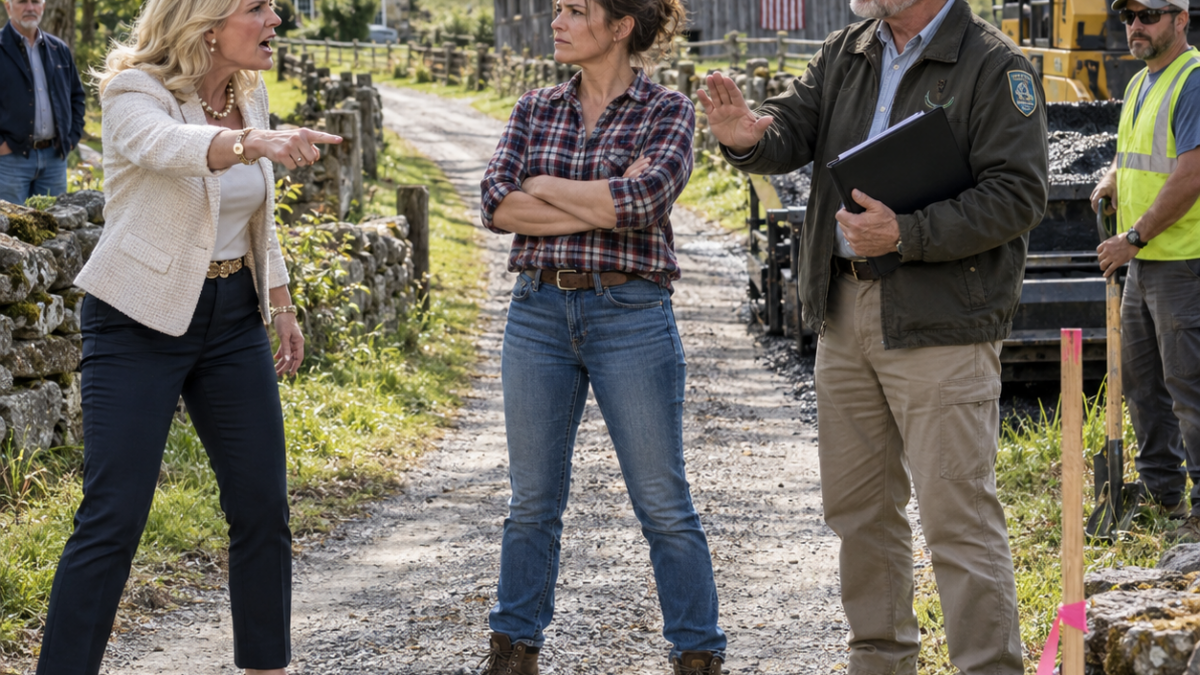
Karen stood in the middle of my family’s dirt lane with a survey crew behind her and told me I owed the HOA $28,000 for the privilege of watching them bury four generations of history beneath asphalt.
She called the old stone walls outdated, the narrow wagon path unsafe, and my refusal to let her widen it proof that I cared more about “sentiment” than the families who had bought five oversized houses at the far end of my land.
What she didn’t know was that the deepest protection on that lane wasn’t written into her HOA covenants at all—it was buried in county history, waiting for somebody stubborn enough to find it.
“This charming little dirt path is finally going to become a proper two-lane road, Mr. Sterling.”
Karen smiled as though she had brought me wonderful news.
Behind her, a nervous young surveyor adjusted the legs of his transit in soil that belonged to me.
I looked down the lane.
Autumn leaves had gathered against the old stone walls my great-grandfather had rebuilt more than a century earlier. The road curved beneath ancient oaks before disappearing toward the farmhouse where I had grown up.
It had never been wide.
That was the point.
Wagons had used it.
Then Model Ts.
Then pickup trucks.
I had learned to ride a bicycle on it, crashed into one of those stone walls at age nine, and walked it beside my grandfather on the evening he told me our family had held that land since 1888.
After twenty years with the Army Corps of Engineers, I had come home because I was tired of building roads in places that never felt like mine.
Now Karen wanted to pave the one road that did.
“You’re trespassing,” I said.
Her smile tightened.
“We have an access easement.”
“For ingress and egress.”
“Our attorney says the HOA also has authority to maintain and improve access.”
I looked at the surveyor.
He avoided my eyes.
Karen continued.
“The board voted unanimously. Two lanes, proper drainage, asphalt surface, reflective markers. Emergency vehicles will have safe access, and everyone’s property values will benefit.”
“My lane is private property.”
“The HOA uses it.”
“That does not mean the HOA owns it.”
She sighed.
“Jack, progress doesn’t stop because one person is emotionally attached to dirt.”
That sentence landed harder than I expected.
Not because she insulted me.
Because she reduced everything I loved about that place to dirt.
The fieldstones.
The wagon ruts.
The shade.
The old culvert my grandfather had taught me never to disturb.
The bend where he had supposedly stopped my grandmother one spring evening and asked her to marry him.
Karen glanced at her clipboard.
“Your share of the improvement assessment is twenty-eight thousand dollars.”
I thought I had misheard.
“My share?”
“You are the primary landowner and principal beneficiary.”
“I’m the landowner whose property you plan to alter.”
“You’ll appreciate it when it’s finished.”
“No.”
Her eyebrows rose.
“No?”
“No paving.”
The surveyor shifted again.
Karen stepped closer.
“This has already been approved.”
“Not by me.”
“You don’t get veto power over community safety.”
“On my land, I get considerably more than veto power.”
Her face flushed.
“You are being unreasonable.”
I looked toward the young man with the transit.
“Pack your equipment.”
Karen snapped:
“He works for us.”
“He is standing on private property without consent.”
The surveyor immediately began collapsing the tripod.
Karen stared at him.
“What are you doing?”
“Ma’am, I think we should verify access authority before continuing.”
Her voice became sharp.
“You were hired to survey.”
He kept packing.
I almost felt sorry for him.
Karen turned back to me.
“You cannot stop this.”
“I can stop you today.”
She shoved a copy of the assessment notice toward me.
“Sixty days.”
I took it.
Twenty-eight thousand dollars.
My name.
My parcel.
Her signature.
I folded it once.
“Karen, your HOA has the right to pass through this lane.”
“Yes.”
“That’s all.”
“We’ll see.”
“We will.”
She marched toward her SUV.
When the vehicles disappeared, I walked the lane alone.
For the first time since retiring, the place didn’t feel peaceful.
I could already imagine bulldozers widening the curves.
Stone walls torn out.
Drainage ditches recut.
Black asphalt reflecting summer heat where packed earth had been for generations.
That night I spread the easement agreement across my dining table and read every word again.
Ingress.
Egress.
Access.
Nothing granting ownership.
Nothing granting permission to widen the road.
Nothing granting the HOA power to fundamentally change its character.
I called my cousin David, a Richmond paralegal.
Then a property lawyer named Silas Croft.
Both told me Karen’s interpretation was aggressive at best.
But Silas said something else.
“Before we fight over what this lane is legally today, Jack, find out what it was before your family owned it.”
I looked at the old road through the dark kitchen window.
“What are you thinking?”
“I’m thinking roads that old usually have stories.”
He paused.
“And sometimes stories come with protections.”
PART 2
I didn’t sleep much that night.
Sarah found me standing at the kitchen window around two in the morning with a mug of coffee that had gone cold in my hand, staring into darkness where the lane disappeared beneath the oaks.
“You’re planning,” she said.
“I’m thinking.”
“That’s what you call planning when you don’t want me to worry.”
I turned.
She was wearing the old blue robe she had owned since my last deployment and had her arms folded against the chill.
“I don’t want this turning into another mission.”
“Neither do I.”
“But?”
“But she’s talking about tearing up something that has survived longer than either of us.”
Sarah walked over and looked outside beside me.
“Can she actually do it?”
“Not if Silas is right.”
“And if he isn’t?”
I didn’t answer immediately.
That was the part bothering me.
An easement can be a deceptively simple thing until people start arguing about scope. The five families at the end of the lane unquestionably had the right to use it. My father had granted that access when medical bills forced him to sell the fifty-acre parcel twenty years earlier. He had been careful, but the developer who eventually built the five houses had added its own covenants, and Karen’s lawyer was trying to use broad HOA language about maintaining and improving common access as a wedge.
I believed they were wrong.
Belief was not enough.
“I’ll know more tomorrow.”
Sarah nodded.
Then she touched the assessment letter on the table.
“Twenty-eight thousand dollars.”
“I’m not paying it.”
“I know.”
“What?”
“I know that face too.”
I almost smiled.
“My face apparently has too many settings.”
“You have three. Hungry, sleeping, and preparing to ruin someone with documents.”
The next morning Silas Croft met me in an office that smelled like old paper, tobacco that had probably been smoked there fifteen years earlier, and coffee strong enough to dissolve a spoon.
Silas was seventy if he was a day, with thick white eyebrows and hands shaped like clubs.
He read the easement twice.
Then he read the HOA’s letter.
Then he looked at me.
“She’s either bluffing or stupid.”
“That your legal opinion?”
“Both can be true.”
He tapped the easement.
“Ingress and egress. The owners of those lots can use the lane to enter and leave. Ordinary maintenance necessary to preserve access might be defensible. Filling a pothole? Fine. Clearing a fallen tree? Sure. Replacing a failed culvert if access would otherwise become impossible? Probably.”
He tapped Karen’s paving plan.
“Converting a historic one-lane dirt road into a two-lane asphalt roadway is not ordinary maintenance. That changes width, drainage, grade, runoff, traffic characteristics, and the physical identity of the burdened property.”
“So we stop them.”
“Yes.”
“How?”
“First we warn them.”
Silas drafted a cease-and-desist letter before lunch.
It cited the deed.
The easement.
Virginia property principles governing excessive use and material alteration.
It informed Oak Creek Estates that no contractor, board member, surveyor, or other agent had permission to enter my property for paving, widening, grading, drainage modification, surveying, or construction beyond the narrow access rights established by the deed.
The language was firm.
The final paragraph was firmer.
Any attempt to begin work after receipt of the notice would be considered knowing trespass and would trigger immediate court action for injunctive relief and damages.
Silas handed me the document.
“Certified mail.”
“Of course.”
“And Jack?”
“Yes?”
“Don’t threaten her yourself.”
“I haven’t.”
“Don’t start.”
“I’m offended you think I would.”
“You’re a retired engineer with a personal attachment to a dirt road and twenty years of military project management. You are exactly the sort of man who might write a forty-page technical rebuttal to a woman with a clipboard.”
I considered it.
“That would be excessive.”
“Thank you.”
“Maybe twenty-five.”
He pointed at the door.
“Go home.”
Karen signed for the cease-and-desist four days later.
Nothing happened for a week.
That worried me more than another angry letter would have.
Then I found the emergency meeting notice nailed to the old oak near the lane entrance.
Oak Creek Estates Homeowners Association.
Emergency Meeting.
Lane Improvement Project.
Legal Strategy.
Mandatory attendance for members.
I stood there reading it while leaves moved above me.
I wasn’t a member.
Karen knew that.
The notice wasn’t meant to invite me.
It was meant to be seen.
I pulled it down carefully, photographed it, then put it back exactly where it had been.
That afternoon I met Sarah Miller walking her dog.
She and her husband lived in the smallest of the new houses. Late twenties. Quiet. They had moved from Fairfax because they wanted what Karen claimed to want—country life.
Except Sarah actually liked country life.
She liked the narrow lane.
The dark nights.
The smell of leaves.
The occasional inconvenience of getting stuck behind my tractor.
“Can I ask you something?” I said.
“Sure.”
“Do you know what Karen told everyone the project will cost?”
Sarah frowned.
“Five thousand each.”
I stopped.
“Five?”
“Yes.”
“She assessed me twenty-eight.”
Her eyes widened.
“What?”
“She said I’m the primary beneficiary.”
“That’s not what she told us.”
There it was.
The first crack.
“What did she tell you?”
“That you own most of the road, so you’d pay the majority. She said the rest of us would each pay five thousand.”
I laughed once.
Not because it was funny.
“She also told us your lawyer threatened to sue every homeowner individually if we pave it.”
“Silas threatened the HOA and board members if they knowingly alter private property. Not random residents.”
Sarah’s face tightened.
“She’s using that to scare people.”
“Yes.”
Sarah looked down the lane.
“I don’t want it paved.”
That surprised me.
“No?”
“That lane is one of the reasons we bought the house.”
“Then why is the vote unanimous?”
She looked embarrassed.
“Because nobody wants to be the person Karen turns on.”
That sentence stayed with me.
I asked if she would tell me what happened at the meeting.
She agreed.
That night, at 9:07, my phone rang.
Sarah spoke quietly.
“She steamrolled everyone.”
“Tell me.”
Karen had waved Silas’s letter in front of the room and described it as an attack by a wealthy landowner determined to block emergency access.
Then her lawyer appeared on speakerphone and argued that their covenants allowed the board to define paving as necessary maintenance.
When one homeowner asked whether the easement actually allowed widening, Karen changed the subject.
Then she announced the cost had increased.
Not five thousand.
Not twenty-eight.
Forty thousand dollars per household.
I sat straighter.
“Forty?”
“She says legal expenses, construction inflation, drainage engineering, and contingency.”
“That would put the project near two hundred thousand.”
“I know.”
“She has a paving contract?”
“Yes.”
“With whom?”
“EconoPave.”
I wrote the name down.
Sarah continued.
“She told everyone that if we don’t approve the assessment, you’ll sue us and we could lose our homes.”
My jaw tightened.
“That is false.”
“I know that now.”
“What happened?”
“They voted yes.”
“All of them?”
“Everyone except me.”
I paused.
“You voted no?”
“Yes.”
“Thank you.”
“I should’ve done it earlier.”
The certified assessment arrived two days later.
$40,000.
Not optional.
Due in sixty days.
My name appeared despite the fact that I wasn’t a member of their association.
That was when anger stopped being useful.
I created a new binder.
KAREN’S WAR.
Sarah laughed when she saw the label.
“You actually named it that?”
“I need categories.”
“You need hobbies.”
“I had a hobby.”
She looked toward the lane.
“Right.”
I photographed everything.
Every curve.
Every section of stone wall.
Every drainage crossing.
Every mature tree.
Every existing rut.
Every place where widening would require excavation.
Then I started visiting old neighbors.
Not HOA neighbors.
People who had been there before Oak Creek Estates existed.
Mr. Abernathy lived two miles down the road on land his family had farmed longer than mine.
He was eighty-seven and moved with the slow stubbornness of an oak tree.
I brought peach preserves.
He made coffee.
I explained the paving fight.
He listened without interruption.
When I mentioned widening the lane, his face changed.
“They can’t pave that.”
“That’s my opinion.”
“No.”
He leaned forward.
“They can’t.”
“Why?”
“That road is older than your family.”
I thought I had misheard.
“What?”
“My granddaddy used to tell me about it.”
I forgot the coffee.
“What did he say?”
“That was part of the old post route.”
I stared.
“What post route?”
“County courthouse to the river crossing.”
He pointed vaguely east.
“Before the highway. Before your people bought the Sterling farm. Mail rider used it. Travelers too.”
My pulse quickened.
“Are you sure?”
“As sure as I am about anything.”
He leaned back.
“My granddaddy said there were old stone culverts along that route. Your Elias Sterling built his walls around them because people said moving them brought bad luck.”
I thought of the two stone-lined drains halfway down the lane.
I had known them my entire life.
Never known who built them.
“Do you have anything written?”
“No.”
“Maps?”
“No.”
“Who would?”
Mr. Abernathy smiled.
“Eleanor.”
Everybody in the county knew who that meant.
Eleanor Finch ran the historical society archive in the basement of the public library.
She was tiny, sharp-eyed, and protective of old documents in the way military armorers are protective of weapons.
I explained the story.
Her expression transformed.
“Old post road?”
“That’s what Abernathy says.”
“Which river crossing?”
I told her.
She disappeared into a back room.
Twenty minutes later she returned with three map indexes.
That began three weeks of research.
County maps.
Surveyor ledgers.
Tax books.
Road commission minutes.
Newspaper fragments.
Microfilm.
Private diaries.
Eleanor loved every minute.
I gradually realized she was having more fun than I was.
The breakthrough came during a thunderstorm.
Rain rattled the basement windows while Eleanor opened a box of uncataloged surveys from the 1870s.
She pulled out a folded linen-backed map.
“Jack.”
Something in her voice made me stand.
We spread it carefully.
The county.
The river.
The courthouse.
Farm parcels.
Then a dotted route.
It ran exactly where my lane ran.
Eleanor checked the legend.
“Postal route.”
I sat down.
She traced it.
“Courthouse to Mill Creek crossing.”
“That’s it.”
“Yes.”
“My lane.”
“A surviving segment of it.”
We kept digging.
County supervisor minutes from 1883 mentioned repairs to the postal road near the Sterling tract.
A travel diary from 1902 described “the execrably muddy heritage track leading toward Sterling’s farm.”
Eleanor smiled.
“Heritage track.”
“That’s not a formal name.”
“No.”
“But it’s good.”
“It is very good.”
The biggest discovery came from an 1856 county road ledger.
Maintenance expenditures.
Stone culvert repair.
Route number.
Location.
The dimensions corresponded almost exactly with one of the stone drains under my lane.
Eleanor sat back.
“You may have one of the best-preserved surviving sections of the old county post route.”
I felt something strange then.
Karen’s fight had started as anger.
Now it felt like responsibility.
The lane wasn’t just mine.
My family had cared for it for generations, but its story began before us.
I called Silas.
Then David.
We met that night.
David spread the photocopies across the dining table.
“This changes everything.”
Silas adjusted his glasses.
“Potentially.”
“What do we do?”
“Historical designation.”
David nodded.
“State Historical Trust.”
Silas pointed at me.
“But we do this correctly. We don’t turn folklore into legal fact. We build the record.”
Eleanor helped.
Mr. Abernathy signed an affidavit documenting family oral history.
Two other old families did the same.
We photographed the walls.
Culverts.
Wagon grooves.
Existing width.
Tree canopy.
We created a chronology from the 1850s forward.
Meanwhile Sarah Miller kept feeding us information from inside Oak Creek Estates.
Karen had signed with EconoPave.
Low bid.
Thirty percent deposit.
Over fifty thousand dollars.
Then Mark Watson called me.
He was another HOA homeowner.
Accountant.
Initially voted for paving.
Now worried.
“I got the contract.”
“How?”
“I asked for financial records.”
“And?”
“No performance bond.”
That was bad.
“How much deposit?”
“Fifty-two thousand.”
“And the permit?”
He exhaled.
“You’ll love this.”
“I doubt it.”
“She filed it as driveway resurfacing.”
I went silent.
“A dirt road?”
“Yes.”
“Two-lane asphalt?”
“Yes.”
“That’s not resurfacing.”
“I know.”
He continued.
“The permit application says gravel refurbishment.”
I almost laughed.
“What gravel?”
“Exactly.”
Karen was cutting corners.
A true road reconstruction would require more review.
Drainage.
Runoff.
Potential environmental effects.
Possibly public comment.
She wanted speed.
So she called a reconstruction a repair.
Every shortcut created another document.
Every document created another problem.
The Historical Trust nomination grew to more than a hundred pages.
Maps.
Photographs.
Affidavits.
Historical narrative.
Site plans.
Easement records.
Evidence of imminent threat.
We also prepared a petition for temporary restraining relief.
Silas surprised me with the strategy.
“Don’t file the full emergency motion yet.”
“Why?”
“We have warning evidence. We have a contract. But imminent physical destruction carries more weight.”
“You want her to start.”
“I want proof she intends to act despite notice.”
“That means damage.”
“A controlled amount, if we’re ready.”
I hated it.
He knew.
“You spent your career working with stop-work procedures.”
“Yes.”
“This is the same idea.”
“Except it’s my lane.”
“I know.”
I walked it that night.
The thought of allowing a bulldozer blade to touch it felt like betrayal.
At the old stone my grandfather called the Old Man, I stopped.
Ran my hand across lichen.
I remembered my grandfather walking beside me when I was thirteen.
“Roads remember,” he once said.
At the time I thought he meant tracks after rain.
Now I understood differently.
Roads remember who used them.
Why they existed.
What changed around them.
What didn’t.
Karen wanted efficiency.
Two lanes.
Asphalt.
Reflectors.
Everything straight.
Everything modern.
She could not understand that inconvenience was sometimes part of value.
The lane forced people to slow down.
If two vehicles met, one backed up.
Neighbors waved.
Delivery drivers learned patience.
Snow lingered longer beneath the trees.
Dust rose in August.
Mud appeared in March.
It was imperfect.
That imperfection was history.
Karen sent the construction announcement Sunday night.
Work begins Monday.
She wrote:
A momentous improvement for our community.
I printed the email.
Exhibit.
Monday morning I woke before five.
Coffee.
Boots.
Jacket.
The air was cold.
At six-thirty Silas parked down the main road with the restraining papers.
David waited in Richmond ready to electronically submit the Historical Trust emergency petition.
Sarah Miller and Mark Watson were prepared to forward every HOA communication proving authorization.
At seven forty-five I sat on the stone wall.
Waiting.
The first engine arrived at eight.
Pickup.
Flatbed.
Bulldozer.
ECONOPAVE.
The foreman climbed out.
Then Karen arrived.
White SUV.
Bright yellow pantsuit.
Clipboard.
I almost admired the theatrical consistency.
She walked toward me.
“Good morning, Mr. Sterling.”
I drank coffee.
“Beautiful day for progress.”
Nothing.
She frowned.
“You can make this difficult or you can accept reality.”
I looked down the lane.
“What reality?”
“That five families live back there now.”
“I know.”
“They deserve a modern road.”
“They deserve access.”
“That is exactly what we’re providing.”
“They already have access.”
She smiled.
“Not for long.”
Then she turned to the foreman.
“Start.”
The bulldozer came down.
Diesel engine.
Black smoke.
Steel blade.
It rolled forward.
The blade touched the lane.
Earth peeled back.
One ancient stone shifted.
I felt it physically.
The cut was perhaps twenty feet long.
Shallow.
But raw.
That was enough.
I raised one hand.
Silas stepped from his car.
The bulldozer paused while the foreman saw him approaching.
Silas handed over the order.
The foreman read.
His face changed.
“Court order?”
“Yes.”
Karen hurried over.
“What is this?”
The foreman kept reading.
Silas said:
“Temporary restraining order.”
Karen snatched at the paper.
The foreman pulled it away.
“Ma’am.”
“You work for us.”
“I work for my company.”
Silas continued.
“The order prohibits further grading, widening, paving, or alteration pending hearing.”
Karen stared at me.
“You filed this?”
“Yes.”
“You cannot stop an approved project.”
Silas answered.
“The judge disagrees.”
Her face flushed.
“Our permit is valid.”
I spoke for the first time.
“No.”
“What?”
“You filed a gravel resurfacing permit.”
She froze.
The foreman looked at her.
“You told us road reconstruction was approved.”
“It is.”
“No county road permit?”
“Our lawyer said—”
The foreman swore under his breath.
Silas looked toward him.
“If you move that machine another inch, you risk contempt.”
The foreman waved to the operator.
Engine off.
Suddenly quiet.
That silence was extraordinary.
Birds.
Wind.
Karen breathing hard.
Then my phone buzzed.
David.
SUBMITTED.
Emergency Historical Trust petition filed.
Timestamped photographs attached.
Karen’s email attached.
Permit attached.
Contract attached.
The trap had closed.
Karen pointed at me.
“This is going to cost you.”
“No.”
I looked toward the scar in the road.
“This is going to cost whoever damaged it.”
She laughed.
“You’re threatening the HOA?”
“I’m documenting.”
That word finally bothered her.
Silas asked me to photograph the damage.
I did.
Every displaced stone.
Blade marks.
Soil.
Bulldozer.
License plates.
Foreman.
Nothing theatrical.
Evidence.
EconoPave left within an hour.
The foreman and Karen argued over mobilization costs beside the truck.
He wanted payment.
She said the contract covered completion only.
He said the stop-work wasn’t his fault.
I didn’t intervene.
Not my circus.
Two days later Dr. Alister Finch arrived from the State Historical Trust.
He was tall, thin, white-haired, and carried a leather satchel.
Karen was waiting.
Navy dress this time.
“Dr. Finch, thank you for coming.”
He nodded.
“There has been a terrible misunderstanding.”
“I’m not here to mediate your dispute.”
Her rehearsed smile faltered.
“I’m here to evaluate the site.”
He turned to me.
“Mr. Sterling?”
We walked.
For two hours.
Stone walls.
Culverts.
Wagon groove.
Old route alignment.
Forest canopy.
Historical maps.
Dr. Finch knelt beside the first culvert and brushed away leaves.
“Mid-century workmanship.”
“Eleanor thought so.”
“She’s right.”
Karen followed behind.
“It floods.”
Dr. Finch ignored her.
“It gets muddy.”
He continued writing.
“Emergency vehicles have difficulty.”
He finally stood.
“Ms. Henderson.”
“Yes?”
“Historical resources are frequently inconvenient.”
She stared.
“That does not reduce their significance.”
“But people live here now.”
“So did people in 1850.”
Karen’s face hardened.
“This is a road.”
“Yes.”
“Roads get improved.”
“Some do.”
He looked around.
“Others get preserved.”
That ended her participation.
The local story appeared the next morning.
HOA PAVING PROJECT HALTED OVER POSSIBLE 19TH-CENTURY POST ROAD.
Photographs.
Maps.
The bulldozer.
Mr. Abernathy’s quote:
“They came here for country living and tried to pave the country.”
That line traveled everywhere.
Karen hated it.
HOA group messages exploded.
Sarah forwarded selected threads with permission.
Residents accused Karen of hiding the history.
Mark posted the EconoPave contract.
Another resident discovered the $52,000 deposit had already cleared.
Someone checked the contractor’s rating.
C-minus.
No performance bond.
No full reconstruction permit.
Karen’s authority began collapsing faster than the project.
Then the state ruling arrived.
Large envelope.
Seal.
I sat at the same dining table where my father had signed farm documents.
Sarah sat beside me.
I opened it.
The language was formal.
Dense.
Then the conclusion.
The surviving route was historically significant.
Verified segment of an original nineteenth-century county post road.
Stone walls and drainage features contributed to integrity.
The State Historical Trust designated the lane:
HERITAGE PATH AT OAK CREEK.
Protected.
Its unpaved surface was part of its historical character.
Widening prohibited.
Paving prohibited.
Material regrading prohibited.
Alteration of stone walls prohibited without review.
In perpetuity.
I read those words again.
In perpetuity.
Sarah put her hand over mine.
“Forever?”
“As long as the law stands.”
“So Karen can’t appeal and pave next year?”
“She can appeal anything.”
“And?”
“She’s not paving this road.”
Sarah smiled.
Then began crying.
That surprised me.
“What?”
She shook her head.
“I know it sounds stupid.”
“No.”
“Your dad would’ve loved this.”
That nearly got me too.
My father had sold those fifty acres because he needed money for medical care.
I knew he carried guilt about it.
He worried new owners would change the land.
He had protected access carefully.
But he could never have imagined an HOA trying to turn the old lane into a suburban boulevard.
Now the lane would outlive all of us.
The ruling included another section.
The damage.
Because the HOA had initiated unauthorized grading during the pending dispute, it was responsible for restoration.
Not standard landscaping.
Historical restoration.
State-approved contractor.
Period-appropriate stone resetting.
Native reseeding.
No modern gravel dumped over the wound.
No asphalt patch.
The money Karen collected for paving would now help undo the paving attempt.
That was justice with a sense of humor.
Sarah Miller called.
“She’s finished.”
“Slow down.”
“Mark called a special meeting.”
“About?”
“Removing her.”
I said nothing.
“The other families are furious.”
“What happened?”
“Mark sent them everything.”
Contract.
Deposit.
Permit.
State ruling.
Legal costs.
Potential EconoPave claim.
Restoration costs.
“They want you there.”
“I’m not an HOA member.”
“You’re the person she tried to assess forty thousand dollars.”
Fair.
The clubhouse was small.
Five-house HOA.
Not much need for elaborate facilities.
Karen and her husband Bob sat alone.
Mark Watson stood at the front.
No gavel.
Spreadsheet.
That was somehow more frightening.
Accountants don’t need gavels.
He began.
“Before tonight’s vote, every member will receive a full financial accounting.”
Karen interrupted.
“I am still president.”
“Not for this meeting.”
“You do not have authority—”
Mark held up the bylaws.
“I do.”
She went silent.
He walked them through numbers.
EconoPave deposit:
$52,000.
Attorney consultations:
Thousands.
Permit fees.
Survey work.
Potential mobilization claim.
Restoration estimate.
Legal defense.
Then my special assessment.
Never legally enforceable against me.
Every number exposed another decision.
Mark turned toward Karen.
“Did the board receive an independent legal opinion on whether Mr. Sterling could be assessed?”
“Our counsel—”
“Did the board receive it in writing?”
“No.”
“Did you disclose the historical concerns before the paving vote?”
“There weren’t historical concerns then.”
“That’s false.”
Her face changed.
Sarah Miller held up an email.
“I told you Jack was researching the old post route.”
Karen glared.
“That was hearsay.”
Mark continued.
“Did you verify the permit category?”
“Our contractor handled permitting.”
“The application has your signature.”
Silence.
“Did you read it?”
“Yes.”
“It says gravel refurbishment.”
“The road contains gravel.”
I almost laughed.
Mark didn’t.
“The contract specifies asphalt.”
Karen shifted.
“Those are administrative details.”
Mark looked around the room.
“Administrative details have cost this association more than sixty thousand dollars so far.”
One homeowner, Peter Lawson, stood.
“You lied to us.”
Karen snapped:
“I protected you.”
“From what?”
“An unreasonable landowner who refused safe access.”
Peter pointed at me.
“He never blocked us.”
Another homeowner spoke.
“My ambulance got down that lane last winter when my son broke his leg.”
Sarah Miller nodded.
“Delivery trucks use it every day.”
Karen raised her voice.
“You people wanted the road too.”
That was true.
At least partly.
That mattered.
Several homeowners looked uncomfortable.
Karen had manipulated them.
But they had voted.
Fear didn’t erase responsibility.
Mark said:
“Yes. We voted.”
He paused.
“And we were wrong.”
That sentence changed the room.
Karen stared.
Mark continued.
“We trusted information you gave us.”
“You’re blaming me to protect yourselves.”
“I’m taking responsibility for my vote.”
Then he pointed at the financial report.
“I’m also holding you responsible for yours.”
The recall motion passed unanimously.
Even Bob did not vote against it.
Karen stared at her husband.
“You too?”
Bob looked down.
“I told you to stop after the lawyer’s letter.”
“No, you didn’t.”
“Yes.”
“You supported me.”
“I supported improving the road. Not this.”
Her face crumpled with rage.
I had seen Karen angry.
Never wounded.
This was different.
Power was one thing.
Betrayal by her husband was another.
I almost felt sympathy.
Almost.
Then Mark made the second motion.
Authorize counsel to pursue recovery from Karen and Bob personally for losses attributable to unauthorized or grossly negligent actions.
Karen stood.
“You are going to sue me?”
Mark’s voice remained calm.
“The association will seek legal advice.”
“After everything I did?”
Silence.
That may have been the saddest sentence of the entire battle.
Karen truly believed years of service purchased immunity from consequences.
She looked at me.
“This is what you wanted.”
“No.”
“You wanted revenge.”
“I wanted my lane left alone.”
“You turned them against me.”
I shook my head.
“The state protected the road.”
“You fed them documents.”
“Yes.”
“You called reporters.”
“Yes.”
“You humiliated me.”
“You signed the permit.”
Her mouth tightened.
“You think you’re better than everyone.”
“No.”
“I think you’re dangerous when you don’t read things.”
Arthur would have liked that answer.
Karen grabbed her purse.
Bob followed.
No dramatic final speech.
No threat.
They simply left.
The next morning Mark came to my house.
He stood at the entrance to the lane.
“I owe you an apology.”
“You already gave one.”
“Not personally.”
He looked down.
“I voted for paving.”
“Yes.”
“I believed her.”
“Yes.”
“You’re not making this easy.”
“I’m not trying to.”
He smiled weakly.
“I should’ve talked to you.”
“That would’ve helped.”
“I bought a house in the country and immediately joined a group trying to make the country look like the suburb I left.”
“That’s more honest than most people manage.”
Mark looked down the lane.
“It is beautiful.”
“Yes.”
“I didn’t see it.”
“You were in a hurry.”
He laughed.
“Story of my life.”
The HOA rescinded the special assessment.
The lien threat disappeared.
Their lawyer sent formal confirmation that I owed nothing.
Then came restoration.
The state selected a specialist crew experienced with historic landscapes.
Watching them repair the bulldozer scar was the opposite of watching EconoPave.
No massive blade.
No tearing.
Small tools.
Hand work.
Soil replaced carefully.
Stone reset according to historic alignment.
Native grasses.
Existing drainage restored.
The foreman spent nearly an hour examining photographs taken before the damage.
“You documented well.”
“Occupational disease.”
“What did you do?”
“Army Corps.”
He smiled.
“That explains it.”
When they finished, I could still see where the blade had struck.
Barely.
Dr. Finch approved the work.
“Give it a year.”
He was right.
By the next autumn, vegetation softened the scar.
Leaves covered it.
Rain settled the soil.
The lane looked itself again.
The civil fight lasted longer.
Karen’s attorney advised settlement.
The evidence was ugly.
Contract.
Permit.
Emails.
State findings.
Financial records.
The settlement required Karen and Bob to repay a substantial portion of the EconoPave loss, legal costs attributable to their decisions, and restoration expenses.
The final number exceeded one hundred thousand dollars.
I didn’t celebrate.
That surprised Sarah.
“You told me you wanted accountability.”
“I did.”
“You got it.”
“Yes.”
“So why do you look miserable?”
“Because nobody wins by losing a hundred thousand dollars.”
Sarah stared.
“Jack.”
“I’m serious.”
“She tried to charge you forty.”
“I know.”
“She tried to tear up your family road.”
“I know.”
“She lied.”
“I know.”
“She deserves consequences.”
“Yes.”
“Then what?”
I looked down the lane.
“I wish she had stopped after the first letter.”
That was the truth.
The perfect revenge fantasy is satisfying because nobody has to live inside it afterward.
Real consequences leave damage.
Karen lost money.
Neighbors lost money.
The lane was scarred.
Relationships broke.
Weeks disappeared into lawyers and archives.
I would have preferred coffee, one conversation, and a woman capable of saying:
I was wrong.
That would have saved everyone.
But sometimes people choose the expensive lesson.
A FOR SALE sign appeared at Karen’s house two months later.
I saw it while walking the lane.
White sign.
Red letters.
Her enormous beige house looked strangely temporary against the trees.
The moving truck came in December.
Cold morning.
No leaves.
Karen stood near the driveway.
I was passing.
She saw me.
I considered turning around.
Instead, I kept walking.
“Jack.”
I stopped.
She looked older.
Not physically much.
Something else.
“You won.”
I shook my head.
“The path won.”
She rolled her eyes.
“Of course.”
“What?”
“You have to make everything noble.”
“I don’t.”
“It’s dirt.”
There it was again.
The first insult.
The last.
“No.”
She sighed.
“You’re still doing this?”
“Doing what?”
“Pretending a road has feelings.”
“I never said it has feelings.”
“Then why does it matter so much?”
I looked toward the stone wall.
“My great-grandfather used it.”
“So?”
“People before him used it.”
“So?”
“My grandfather walked it.”
“So did I.”
“That isn’t ownership of history.”
“You own it.”
“Legally, yes.”
“Then why involve the state?”
“Because ownership isn’t always permission to destroy.”
That surprised her.
She looked down.
“I thought you were using history to protect yourself.”
“I was protecting history.”
Silence.
Then she said:
“I really thought paving it would help.”
I believed her.
That was important.
Karen was not pretending about everything.
She wanted wider access.
She wanted clean edges.
Predictability.
Modernity.
She genuinely believed those were improvements.
The harm began when she assumed her definition of improvement was universal.
“I know.”
She looked up.
“You could’ve told me differently.”
“I did.”
Her mouth tightened.
“Your lawyer told me.”
“I told you before him.”
Silence again.
A mover called her name.
Karen turned.
Then stopped.
“For what it’s worth, I’m sorry about the stone.”
The bulldozer scar.
I nodded.
“Thank you.”
That was the closest we ever came to peace.
She left that afternoon.
The new owners loved the lane.
Of course they did.
Irony has a sense of timing.
A small wooden sign eventually appeared at the entrance.
Not mine.
The Historical Trust installed it.
HERITAGE PATH AT OAK CREEK
ESTABLISHED ROUTE CIRCA 1850
PROTECTED HISTORIC CORRIDOR
Simple.
Brown background.
Cream lettering.
I hated it for about a week.
The lane had never needed a sign.
Then children from the local school started visiting.
Eleanor led the first group.
Twenty fourth-graders.
Clipboards.
Bright jackets.
Too many questions.
One boy touched the stone wall.
“Did Indians build this?”
Eleanor said:
“Some Indigenous routes may have influenced early travel corridors here, but we don’t have evidence that this particular wall is Indigenous construction.”
Good answer.
Evidence first.
Another child asked:
“Why didn’t they pave roads?”
“They did some.”
“When?”
“Different times, different materials.”
Then a girl asked me:
“Why did you save it?”
I looked at Eleanor.
She smiled.
My problem.
“Because once something old is gone, you can’t always put it back.”
The girl considered that.
“But they fixed the bulldozer part.”
“Yes.”
“So you can put it back.”
“Some of it.”
“What can’t you fix?”
I looked at the stones.
“Original context.”
She frowned.
“That sounds like school words.”
Fair.
“Imagine your grandmother gives you an old quilt.”
“Okay.”
“You cut it into pieces.”
Her eyes widened.
“Why would I do that?”
“Exactly.”
She understood.
Mr. Abernathy attended the heritage dedication.
Eighty-eight now.
Dr. Finch invited him to speak.
He stood beside the sign and told the story his grandfather had told him about horseback mail riders.
His voice shook.
Not from nerves.
Age.
“When I was a boy,” he said, “old people told stories and we thought the stories would always be there.”
He looked at the children.
“They won’t.”
The crowd went quiet.
“You have to keep them.”
That line stayed with me.
Sarah Miller organized the first Heritage Path potluck the following spring.
Old residents.
New homeowners.
Farm families.
Teachers.
Kids.
Mark brought barbecue.
Eleanor brought historical photographs.
Dr. Finch brought nothing and ate everything.
The HOA contributed tables.
No permits.
No assessments.
No road project.
Just people.
Mr. Abernathy sat beside Sarah Miller.
Twenty-eight years old beside eighty-eight.
Talking.
That was better than asphalt.
The HOA changed.
Five houses didn’t require much governing.
Snow removal coordination.
Private utility maintenance.
Shared entrance landscaping.
That was about it.
They amended the bylaws to recognize the historical designation.
No alteration to the Heritage Path without Trust review and my written consent where legally required.
They established a small preservation contribution.
At first I refused.
Mark argued.
“You maintain a road we use.”
“You already have access obligations.”
“We should contribute.”
“It’s my land.”
“We wear the road.”
That was fair.
We created a maintenance agreement.
Gravel only where historically appropriate and approved.
Drainage cleared by hand when possible.
No widening.
No asphalt.
Emergency vehicle access plan developed with the county.
That last part mattered.
Karen had used emergency safety as a weapon.
We addressed it honestly.
Fire department reviewed the lane.
They identified two pull-off areas that could be created without damaging historic character.
The Historical Trust approved them.
Emergency markers installed discreetly.
Vegetation clearance maintained.
Safety improved.
History remained.
That was how adults solve problems.
Not by pretending preservation means nothing can change.
Not by pretending progress means everything must.
Balance.
The first ambulance to use the improved emergency plan came eighteen months later.
Sarah Miller’s husband, Tom, had an allergic reaction.
The ambulance reached their house.
No problem.
Later Sarah stopped me.
“Karen would’ve used this as proof.”
“I know.”
“That we needed pavement.”
“I know.”
“But we didn’t.”
“No.”
She smiled.
“Feels good.”
“Yes.”
Silas Croft eventually retired.
He claimed my case was partly responsible.
“Too much excitement.”
“You liked it.”
“Of course.”
He gave me the original restraining order file.
I kept it.
David said I should donate the legal documents to the historical society eventually.
Eleanor immediately agreed.
“Future researchers will want the preservation fight.”
“Future researchers need hobbies.”
She glared.
I donated copies.
The EconoPave scar became nearly invisible.
But I knew where it was.
Sometimes I stopped there.
Not with anger.
Memory.
That small patch represented the moment a threat became permanent protection.
If Karen had stopped before sending the bulldozer, we might never have received emergency designation.
The lane might have remained vulnerable.
Her overreach forced research.
Research produced documentation.
Documentation produced preservation.
That irony never left me.
She tried to pave it.
Instead, she protected it forever.
Years later, Mark and I sat on my porch.
He pointed toward the Heritage Path sign.
“You ever think we should send Karen a picture?”
“No.”
“I do.”
“Don’t.”
“Why?”
“Because that would be petty.”
“You fed her bulldozer project into a historical designation.”
“That was strategic.”
He laughed.
“You military guys have words for everything.”
“Yes.”
“Petty becomes strategic.”
“Correct.”
Sarah overheard.
“You’re both children.”
Also correct.
The historical designation attracted occasional visitors.
Not many.
Local history people.
Cyclists.
Photographers.
Once a travel blogger called it a “hidden colonial lane.”
Eleanor nearly had a stroke.
“It’s nineteenth century, not colonial!”
She demanded a correction.
They changed it.
Never anger an archivist.
My grandchildren grew up with the lane as ordinary background.
That amused me.
To them, history wasn’t fragile.
It was simply there.
My oldest grandson asked:
“Did someone really try to pave it?”
“Yes.”
“Why?”
“They thought asphalt was better.”
He stared.
“That would look terrible.”
“Opinions change.”
“Did you hate her?”
Karen.
I thought.
“At the time?”
“Yes.”
“Probably.”
“And now?”
“No.”
“Why?”
“She’s gone.”
“That’s not a reason.”
Children are relentless.
“Because carrying anger is work.”
He considered.
“Grandma says you like work.”
“That’s different.”
He laughed.
Then asked:
“What happened to her?”
“I heard she moved to Florida.”
“Did she join another HOA?”
I remembered the postcard.
A year after Karen left, an anonymous card arrived.
Florida subdivision.
Palm trees.
Identical houses.
On the back:
Heard you’re doing well. Karen is president of our HOA now. Pray for us.
I had laughed until Sarah came to see what was wrong.
I pinned it in my workshop.
When my grandson asked, I showed him.
He read it.
“Did she learn anything?”
“Apparently not.”
He grinned.
“Some people don’t.”
No.
Some don’t.
That is another reason systems matter.
We like stories where villains transform.
Sometimes they don’t.
So you build boundaries.
Law.
Process.
Oversight.
Historical protection.
Not because everyone becomes wise.
Because not everyone will.
Oak Creek Estates never tried to pave the lane again.
Couldn’t.
Future board.
Future developer.
Future owner of my property.
The Heritage Path designation runs with the place.
That is the part I love most.
I didn’t only win for myself.
Someone I will never meet will benefit.
A child walking there fifty years from now.
A new family.
A historian.
A person who simply prefers the sound of tires on dirt to asphalt.
They won’t know my anger.
They won’t know Karen’s yellow pantsuit.
They won’t know the forty-thousand-dollar assessment.
They may not know Silas.
David.
Sarah Miller.
Mark.
Mr. Abernathy.
Eleanor.
They will know the lane.
That is enough.
The old post road existed before Elias Sterling owned the farm.
My family became stewards.
Not creators.
That changed how I saw inheritance.
When I first came home from the Army, I thought the land was mine because the deed said Sterling.
After the preservation fight, I understood ownership differently.
A deed gives rights.
History gives obligations.
The lane does not belong to my great-grandfather.
Or me.
Not in the deeper sense.
We get a turn.
We maintain it.
Then someone else gets a turn.
Karen’s philosophy was the opposite.
If you control something now, remake it now.
Pave.
Widen.
Standardize.
Improve.
History becomes an obstacle.
But not every inherited inconvenience is a defect.
Sometimes narrowness matters.
Sometimes mud matters.
Sometimes stones matter because hands placed them before anybody alive remembers.
The modern world needs highways.
I built them.
I am not against asphalt.
I spent years designing infrastructure.
That is why I knew the difference between a road that needed modernization and a historic corridor whose value depended on remaining itself.
Engineering taught me that function matters.
History taught me function is not always the only value.
One autumn evening, almost ten years after the bulldozer incident, Sarah and I walked the lane.
Leaves.
Gold light.
Cold air.
She stopped beside the old stone.
“The Old Man,” she said.
“Yes.”
“Your grandfather really called it that?”
“Yes.”
“Why?”
“No idea.”
She touched it.
“I’m glad it’s still here.”
“So am I.”
“You think Karen remembers it?”
“I doubt Karen ever noticed it.”
“That’s sad.”
I looked at her.
“What?”
“She saw the whole lane and only saw what was wrong with it.”
That may have been the best explanation anyone ever gave.
Karen saw mud.
Narrowness.
Old stones.
Bad drainage.
Slow driving.
She did not see continuity.
Heritage.
Restraint.
Memory.
You can’t protect what you refuse to see.
The state saw it.
Eventually the neighbors saw it.
I almost missed parts of it too.
Before Abernathy spoke, I knew the lane mattered to my family.
I didn’t know it mattered to the county.
Karen accidentally taught me more about my own home than I had learned in fifty years.
I hate giving her credit.
But truth is truth.
Her attack forced me into archives.
Those archives introduced me to people who had traveled the road before my family.
Mail riders.
Judges.
Farmers.
Travelers.
People whose wagon wheels cut grooves still faintly visible.
The path got bigger without getting wider.
That is one of the strangest things history does.
One afternoon Dr. Finch visited after retirement.
No state car.
Personal sedan.
Older.
We walked slowly.
“You know,” he said, “this case became a training example.”
“For what?”
“Imminent-threat preservation.”
I groaned.
“What?”
“I don’t need bureaucrats studying Karen.”
He laughed.
“They study you.”
“Worse.”
He explained that the Trust used the case to show why preservation offices need emergency procedures for sites threatened before normal designation timelines can finish.
“Most people think history disappears slowly.”
“Doesn’t it?”
“Often.”
He pointed toward the lane.
“Sometimes a bulldozer arrives Monday.”
Fair.
Dr. Finch stopped at the repaired section.
“Can you still see it?”
“Yes.”
“I can’t.”
“I know where to look.”
“That’s memory.”
He said it casually.
It stayed with me.
Scars become invisible to everyone except people who remember where they were.
Communities too.
Oak Creek Estates looked peaceful by then.
New residents didn’t know how close the five-house development came to financial disaster.
The old members did.
Mark kept the EconoPave contract in HOA records.
Not as shame.
Institutional memory.
The bylaws required two signatures for large contracts.
Independent legal review for major easement changes.
Member access to financial records.
No emergency assessments without documented basis.
Karen had centralized authority.
The new system dispersed it.
Less efficient.
Much safer.
That is another lesson engineers understand.
Redundancy looks wasteful until one component fails.
Good systems assume people make mistakes.
Bad systems assume leaders won’t.
One spring, a huge storm washed out a section of the lane near the creek crossing.
The HOA families needed access.
For the first time since Karen, serious road work was necessary.
Mark called.
“We have a problem.”
I walked out.
Water had cut an eighteen-inch channel through the surface.
Historic culvert clogged.
Vehicle access impossible.
Old me would have panicked about preservation.
New me knew better.
I called the Trust.
Emergency consultation.
Dr. Finch’s successor came.
Engineer.
Historian.
County emergency services.
We designed a repair.
Cleaned the historic culvert.
Stabilized soil.
Added subsurface reinforcement where invisible.
Regraded to original contours.
No asphalt.
Lane reopened in four days.
Mark drove through.
Stopped.
“See?”
“What?”
“We can improve things.”
“I never said we couldn’t.”
He grinned.
“Karen did.”
“No.”
“She said you did.”
We both laughed.
That storm repair may have completed the healing more than anything.
Preservation wasn’t freezing the lane in amber.
It was stewardship.
Use.
Repair.
Adapt.
Respect.
The lane remained alive.
Not a museum object.
That mattered.
My father would have understood.
I sometimes wish he had lived long enough to see the designation.
He would have pretended not to care.
Then told everyone.
He loved that lane.
Selling the fifty acres hurt him.
He did it because he needed treatment.
That is life.
History is full of compromises.
The problem wasn’t his sale.
The problem was later people forgetting the conditions attached to access.
Rights without memory become entitlement.
Karen thought using the road meant owning its future.
The Heritage Trust corrected that forever.
The final irony arrived fifteen years after Karen.
A real-estate brochure for one of the Oak Creek houses came through my mailbox by mistake.
Beautiful photographs.
Stone fireplace.
Five bedrooms.
Wooded views.
Then:
“Private access via historic Heritage Path, a protected nineteenth-century post road offering unparalleled rural character.”
I sat at the table laughing.
Sarah took the brochure.
“What?”
I pointed.
She read.
Then laughed too.
“Property value.”
Exactly.
The thing Karen wanted destroyed to increase property values had become a selling feature.
I photocopied the page.
Not for Karen.
For my workshop.
Beside the Florida postcard.
Human beings are complicated.
History has patience.
The lane remains dirt.
Still muddy after heavy rain.
Still narrow.
Two vehicles still occasionally negotiate who backs up.
Emergency vehicles have a plan.
Delivery drivers learn quickly.
Children ride bicycles.
People walk dogs.
Stone walls collect moss.
Ferns grow between rocks.
The old culverts carry water.
Leaves fall.
Snow covers everything.
Spring turns sections soft.
Summer makes dust.
Perfect.
One evening my grandson drove too fast down it.
I heard the truck before I saw it.
He pulled up.
I crossed my arms.
“What?”
“How fast?”
“Twenty.”
“Try again.”
“Twenty-five.”
“The limit?”
“Fifteen.”
“Why?”
“Historic preservation?”
“No.”
He smiled.
“Because Grandpa said so.”
“Better.”
I pointed back.
“Drive it again.”
He groaned.
“Seriously?”
“Fifteen.”
He reversed.
Drove away.
Returned slowly.
Sarah watched from the porch.
“You’re becoming Karen.”
I stared at her.
“That is the cruelest thing you’ve ever said.”
She laughed for five minutes.
Maybe every authority needs watching.
Even grandfathers.
That is the point.
The day will come when the lane is not mine to manage.
I have documents ready.
Easement.
Designation.
Maintenance agreement.
Historical maps.
Photographs.
Rules.
Not because I distrust my children.
Because memory fades.
Paper lasts longer.
Eleanor taught me that.
Mr. Abernathy taught me that stories matter.
Silas taught me boundaries matter.
Karen taught me, unintentionally, that anything worth protecting should not depend on everyone behaving reasonably.
Build protection before unreasonable people arrive.
That may be the biggest lesson.
Karen walked onto my lane believing a five-house HOA vote outweighed 170 years of history.
For a moment, it almost did.
Not legally.
Practically.
If I had been tired.
If I had paid.
If I had assumed fighting was too expensive.
If Sarah Miller hadn’t spoken.
If Abernathy hadn’t remembered.
If Eleanor hadn’t searched.
If David hadn’t prepared.
If Silas hadn’t acted.
If Mark hadn’t checked the finances.
If Dr. Finch hadn’t responded quickly.
A bulldozer could have destroyed in days what survived generations.
That is how fragile old things are.
Not weak.
Fragile.
There is a difference.
The stone wall was strong enough to survive winters.
Not a modern dozer blade.
History survives when people choose to carry it.
Karen made that choice necessary.
The punishment she received mattered less with time.
The money.
Recall.
Lawsuit.
Move.
All faded.
The designation did not.
That is why I never think the ending is Karen driving away.
The real ending happens every morning.
Sunlight reaches the lane.
Tires crunch over dirt.
Stone walls remain.
A brown heritage sign stands quietly beneath the oak.
People pass without thinking about how close it came to disappearing.
That is preservation at its best.
Invisible success.
Nothing happens.
No bulldozers.
No emergency court orders.
No meetings.
No special assessments.
Just another day.
Sometimes I sit on the stone wall where I waited for EconoPave all those years ago.
The exact place.
Coffee.
Same woods.
Different man.
I think about Karen telling me:
Progress waits for no one.
She was wrong.
Progress can wait.
Sometimes it should.
Long enough to ask what is being lost.
Long enough to open an archive.
Long enough to read an easement.
Long enough to listen to an eighty-seven-year-old man remember what his grandfather told him.
Long enough to discover the dirt under your boots is not ordinary dirt at all.
Karen wanted to bring Oak Creek into the twenty-first century.
Instead, she sent us back into the nineteenth.
That saved the lane.
And once we knew what we had, nobody ever looked at it the same way again.
What she called an outdated road became Heritage Path.
What she called an obstacle became a landmark.
What she tried to assess me $40,000 to destroy became permanently protected.
The bulldozer scar healed.
The stones stayed.
The community changed.
And the path my great-grandfather walked, the path his predecessors used for mail and travel, will remain unpaved long after my own footsteps are gone.
In perpetuity.
Those are the best two words Karen ever forced me to discover.
[END OF FULL STORY]








