PART 2: HOA KAREN Tried to Make Me Pay for Their Easement Road—Then One Storm Exposed What She’d Been Hiding
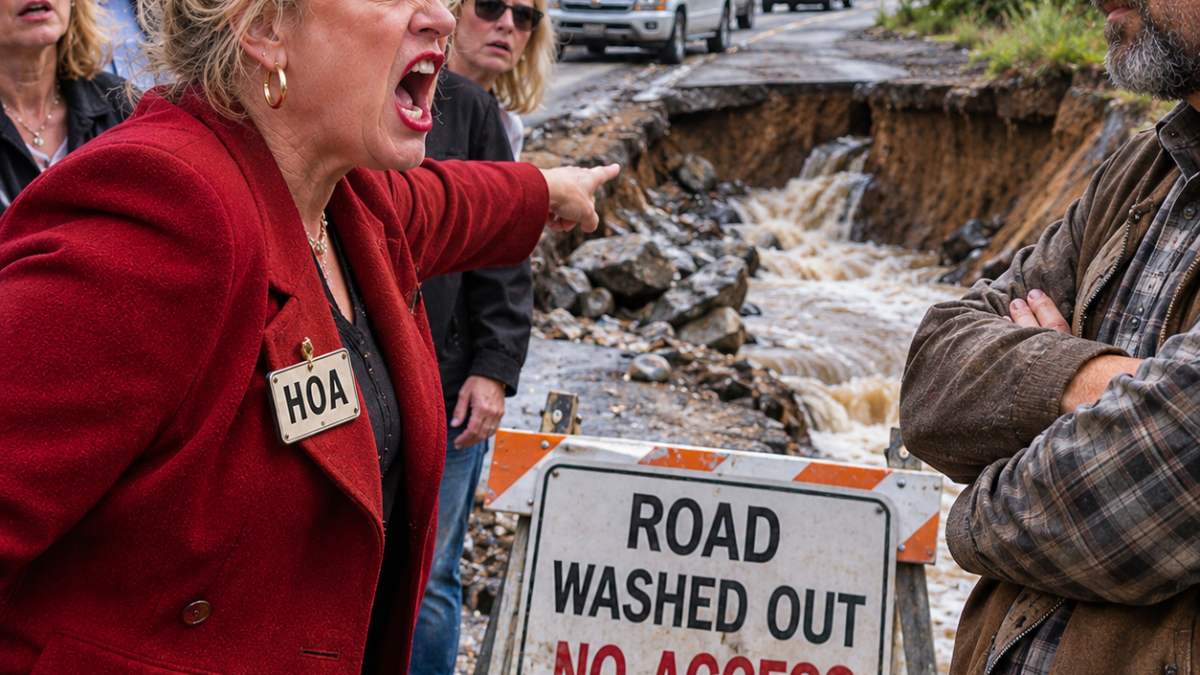
PART 2
Who, exactly, was responsible for keeping that road alive?
For months, Marla had given me an answer.
Me.
When potholes opened, she said they were my problem.
When weeds grew along the shoulder, she said they were my problem.
When runoff damaged the gravel, she said it was my responsibility because the road physically crossed my property.
But whenever I wanted to change anything, improve anything, or question the way the drainage worked, the answer shifted.
Then it was community infrastructure.
Then I supposedly had no right to interfere.
She wanted me to carry the bill while the HOA carried the authority.
The storm had finally made those two positions impossible to hold at the same time.
I poured another cup of coffee.
Marla called before I finished it.
I let the phone ring twice.
Then answered.
“Morning.”
“Do not ‘morning’ me, Elias.”
Her voice was sharp enough that I held the phone slightly away from my ear.
“The road is destroyed.”
“I noticed.”
“What are you doing about it?”
“Nothing yet.”
Silence.
Then:
“What do you mean, nothing?”
“I mean I’m drinking coffee.”
“There are dozens of homeowners who need that road.”
“I understand.”
“Then get equipment down there.”
“No.”
Another silence.
This one lasted longer.
“Excuse me?”
“You heard me.”
“You were explicitly notified that you are responsible for maintaining the road across your property.”
“I was.”
“Then you acknowledge your responsibility.”
“No.”
Her voice rose.
“You cannot have this both ways.”
I looked through the kitchen window toward the scar of red mud below the ridge.
“That’s funny.”
“What?”
“That’s exactly what I was thinking.”
She started speaking again, but I opened the folder and read the easement clause aloud.
“Ordinary maintenance necessary for the continued exercise of the right of passage shall remain the obligation of the benefiting parties.”
Marla stopped.
I continued.
“Your association is the benefiting party.”
“That is not our interpretation.”
“Then send me yours.”
“We have already done so.”
“You’ve sent demands. I asked for the recorded document.”
“You’re playing games while people are stranded.”
“No one is stranded.”
“They cannot reach the county road.”
“They have whatever other access their development documents provide.”
There was a pause.
That pause bothered me.
“Marla?”
“You know perfectly well this is their main road.”
“I know it’s the road they use.”
“You know more than that.”
I sat down.
“What exactly do I know?”
She hung up.
For the first time that morning, I stopped feeling calm.
Not angry.
Uneasy.
There had always been something strange about how aggressively she treated that road.
If it was merely a convenient shortcut, the pressure made no sense.
People do not threaten liens and legal action over a few extra minutes of driving.
I pulled out the subdivision map I had received with my title documents years earlier.
The HOA sat farther uphill.
The easement road crossed my property, climbed the ridge, and entered the subdivision from below.
I traced the development streets with one finger.
Then looked for another connection to the county road.
I found one faint line near the northern edge.
Forest track.
Not a paved road.
Not shown as maintained access.
I called Gideon Pike, the association manager.
He answered after several rings.
“Elias?”
“Is there another vehicle route out of Meridian Ridge?”
There was a pause.
“Why are you asking me?”
“Because Marla just implied there isn’t.”
“I really think you should speak with the board.”
“I’m speaking with you.”
He sighed.
“There was supposed to be a secondary road.”
“Supposed to be?”
“The original development plan showed an emergency connection toward the north.”
“What happened?”
“Never completed.”
“So the easement across my land…”
He did not answer.
“Gideon.”
“Yes.”
“It’s their only road?”
“For most practical purposes.”
“What does that mean?”
“The north track isn’t suitable for normal vehicles.”
“Can an SUV use it?”
“Not safely right now.”
“Ambulance?”
“No.”
“Fire engine?”
“No.”
I stood.
“How many houses are above the washout?”
“All of them.”
The room became very quiet.
“How many residents?”
“I don’t have the number in front of me.”
“But every resident depends on this road.”
“Yes.”
“Why was I never told that?”
“I assumed you knew.”
“I thought it was a shortcut.”
Another pause.
“I need to go.”
He disconnected.
I remained at the kitchen table with the phone in my hand.
This had changed things.
Not legally.
Morally.
People were not just inconvenienced.
They had no practical road out.
For ten minutes, I considered calling a contractor myself.
Then I walked down to the washout.
Daylight made the damage look worse.
A section nearly twenty feet long had collapsed along the downhill edge. The center of the road was still technically there, but the remaining surface was unstable, cracked, saturated, and undercut.
Trying to push even a pickup through would have been reckless.
I stood at the edge and listened to runoff trickle through loose gravel.
There was no quick fix.
A bulldozer could not just shove dirt into the gap.
The slope needed stabilization.
Drainage had to be restored.
Anything temporary could fail under another rain.
I photographed everything.
Then I called the county road department.
The supervisor confirmed what my documents already suggested.
The road was private.
The county maintained no portion across my land.
“Who handles emergency access to Meridian Ridge?” I asked.
“That would be between the HOA and emergency services.”
“So you’re not coming out?”
“Not unless there is a public-road issue.”
I called the fire district next.
They already knew.
Marla had apparently called them before calling me.
The chief sounded irritated.
“We’re developing contingency plans.”
“What kind?”
“Staging an emergency vehicle above the washout if we can get one in from the northern track with specialized equipment.”
“That track is terrible.”
“We know.”
“If somebody needs an ambulance?”
“We’ll coordinate.”
The weight of the situation settled further.
“I don’t want anyone hurt because of this.”
“I understand.”
“I didn’t cause the washout.”
“I didn’t say you did.”
“Marla will.”
The chief was quiet.
Then he said, “Property fights are not my department. Safe emergency access is.”
That was fair.
By nine, homeowners were appearing at the upper side of the washout.
Some stood staring.
Others shouted toward me.
One man yelled, “When are you fixing this?”
“I don’t know.”
“What do you mean you don’t know?”
“The road needs engineering work.”
“My wife has a doctor’s appointment.”
“I’m sorry.”
“You’re sorry?”
His anger was understandable.
He probably knew nothing about easement language or maintenance letters.
He just woke up and discovered the road home had disappeared.
A woman beside him shouted, “This is your land!”
“Yes.”
“Then fix it!”
I almost answered sharply.
Instead, I took a breath.
“The HOA manages your access agreement. You need to speak with them.”
That made nobody happier.
By afternoon, Marla had sent a mass email.
I only saw it because Gideon forwarded it to me without comment.
**ROAD FAILURE CAUSED BY LANDOWNER NEGLECT**
That was the subject.
The message told residents that I had refused routine maintenance for months.
It said the board was pursuing “all legal remedies.”
It said the HOA was working urgently to restore access.
It did not mention the maintenance clause.
It did not mention the drainage system.
It did not mention that the association had repeatedly told me I lacked authority to alter the road without board approval.
I called Gideon.
“Why did you send me this?”
“I thought you should see it.”
“Do you agree with it?”
He was silent.
“Gideon?”
“I manage the association. I’m not legal counsel.”
“That’s not what I asked.”
“I know.”
He ended the call politely.
By evening, the emails started.
Some were furious.
One called me a sociopath.
Another told me if an elderly resident died, it would be on my conscience.
A third threatened to drive across my pasture whether I liked it or not.
That one concerned me enough to call the sheriff.
Deputy patrols increased.
I did not lock people inside.
I did not block a usable road.
But panic makes people irrational, and I did not want somebody trying to create a new path across wet pasture after dark.
At ten that night, I sat alone at my kitchen table.
The storm had moved on.
The house was silent.
I opened Marla’s email from before the storm.
**ANY DAMAGE TO THE EASEMENT ROAD WILL BE YOUR FULL RESPONSIBILITY.**
Then the older letter:
**The roadway is a shared community asset and may not be altered by the underlying property owner without association authorization.**
I placed them side by side.
One said I controlled everything when money was needed.
The other said I controlled nothing when authority was involved.
I took photographs.
Printed both.
Added them to my folder.
The next morning, Marla hired a contractor.
I knew because a road-repair company called me at 8:12.
“Mr. Mercer?”
“Yes.”
“We’ve been asked to mobilize equipment to the easement washout.”
“By Meridian Ridge?”
“Yes.”
“What work?”
“Temporary stabilization, drainage excavation, aggregate fill.”
“Do you have a scope?”
“We’re still finalizing.”
“Insurance certificate?”
“Yes.”
“Engineering plan?”
“Not yet.”
“Who authorized entry onto my property?”
There was a pause.
“The HOA.”
“That’s not what I asked.”
Another pause.
“Are you denying access?”
“I’m saying nobody brings heavy equipment onto unstable ground on my property without a plan, insurance, and written authorization.”
“We were told the association controls the road.”
“They have a right to pass. They do not own the underlying land.”
The contractor was professional.
He did not argue.
“Then we need your written permission.”
“Yes.”
“I’ll tell them.”
Thirty minutes later, Marla called.
“Sign the access authorization.”
“Send me the engineering scope.”
“There isn’t time.”
“Then there isn’t permission.”
“You are deliberately keeping people trapped.”
“No.”
“You know the contractor cannot work without your signature.”
“That sounds like something the HOA should have considered before telling me for months that I had no authority over the road.”
“This is not the time to prove a point.”
“I agree.”
“Then sign.”
“No.”
She inhaled hard.
“Why?”
“Because you want permission for excavators to reshape drainage on my property without telling me what they’re building.”
“It’s an emergency repair.”
“Then get an engineer.”
“That will take time.”
“So will rebuilding the road twice.”
She lowered her voice.
“You’re enjoying this.”
That accusation landed harder than I expected.
I looked out at the washout.
Residents stood beyond it.
A man carried groceries uphill by hand.
An older woman was being helped around a muddy section.
“No,” I said.
Marla laughed bitterly.
“Don’t lie.”
“I’m not.”
“You stood on your porch and watched the road collapse.”
“Yes.”
“You could have stopped it.”
“I don’t know that.”
“You could have tried.”
That was true.
I had chosen not to.
For the first time since the storm, guilt pushed past my anger.
“I could have gone out in a dangerous storm and tried to protect infrastructure you repeatedly told me I had no right to alter.”
“You’re hiding behind words.”
“No. I’m living inside the rules you wrote.”
She hung up.
I stood there a long time afterward.
Was I punishing her?
Maybe part of me was.
I had to admit that.
There had been satisfaction in refusing her first demand.
That did not mean the repair should be careless.
It did mean I needed somebody other than me deciding what was legally and technically responsible.
I called Nadia Sterling.
Nadia and I had known each other long enough that she skipped pleasantries.
“What happened?”
“Road washed out.”
“The easement?”
“Yes.”
“Anyone hurt?”
“No.”
“Good. What did you do?”
“Nothing.”
Silence.
“That is either very smart or very stupid.”
“I was hoping you’d tell me.”
“Send everything.”
I drove to her office with a box of documents.
She spent nearly two hours reading.
The original easement grant.
Appendix.
My title report.
HOA correspondence.
Marla’s demands.
Photographs.
Contractor request.
Subdivision records.
Eventually Nadia removed her glasses.
“First, stop having legal conversations with Marla without me.”
“I enjoy them.”
“That is exactly why.”
“Second?”
“The easement is for passage. The HOA does not own your land.”
“Good.”
“Ordinary maintenance appears to fall on the benefiting users.”
“Better.”
“Do not celebrate.”
“I wasn’t.”
“You were about to.”
She pointed to the washout photograph.
“The emergency-access situation matters. A court will care about reasonableness even if the HOA’s legal position is weak.”
“I’m willing to let repairs happen.”
“Under conditions?”
“Engineering plan. Insurance. No expansion beyond the easement. No drainage changes without approval.”
“Good.”
“Who pays?”
“That is where this becomes interesting.”
She pulled one appendix closer.
“Have you seen this reference?”
I leaned in.
A notation mentioned an original drainage design.
“No.”
“Neither have I. We need the subdivision engineering files.”
“Why?”
“Because if the drainage serving the easement is association infrastructure, we need to know what they changed.”
“What makes you think they changed anything?”
“The language.”
She pointed.
“The original grant assumes distributed runoff management along the slope. Your photographs show concentrated discharge.”
I looked again.
She was right.
Water had not simply crossed the road randomly.
The heaviest erosion started where an upper ditch emptied toward the low point.
“Who do we call?”
“First the county. Then the original engineer if he’s alive.”
That same afternoon, Nadia requested archived plans.
I went home.
Marla came in person the next morning.
Her black SUV stopped at my gate because the washout lay beyond it.
She got out wearing boots instead of her usual heels.
Mud splashed the lower legs of her expensive coat.
For once, she looked less like a president and more like someone who had been walking around a broken neighborhood for two days.
“I need your signature.”
“Good morning.”
“Please, Elias.”
That word stopped me.
Please.
I had never heard Marla use it with me.
I opened the gate but did not invite her farther.
She held out the contractor form.
“Can you authorize them?”
“Not this form.”
Her shoulders dropped.
“Why?”
“It gives them broad authority to reconstruct drainage and road geometry.”
“Because they need to fix it.”
“On my land.”
“Here we go again.”
“Yes. Here we go again.”
She looked past me toward the damage.
“People are carrying groceries half a mile.”
“I know.”
“There are elderly residents.”
“I know.”
“A family has a child with respiratory problems.”
“I know.”
“You can end this.”
“No. I can authorize work. That doesn’t mean I should authorize bad work.”
She stared at me.
I went inside.
Returned with my folder.
Then laid several documents across the hood of her SUV.
The easement grant.
The maintenance clause.
Her own letters.
Her email before the storm.
“Read them.”
“I’ve seen these.”
“Read them.”
Her jaw tightened.
But she did.
I pointed to the easement language.
“Right of passage.”
Then the appendix.
“Maintenance responsibility of the benefiting party.”
Then her letter.
“Road is community property. I may not alter it.”
Then her storm email.
“All damage is my responsibility.”
I looked at her.
“Which one do you want to be true today?”
“This is childish.”
“No. This is the first adult conversation we’ve had about the road.”
She looked down.
I continued.
“You spent years wanting the authority without the cost.”
“That’s not fair.”
“It’s exactly fair.”
“The association has maintained portions of the road.”
“Show me.”
“We have records.”
“Good. Bring them.”
She looked at the washout again.
“What will it take to get your signature?”
“A licensed engineering plan.”
“That could take days.”
“Yes.”
“People can’t wait days.”
“I’ll approve temporary pedestrian access where safe. I’ll cooperate with emergency services. If an engineer proposes a temporary vehicle solution that doesn’t endanger anyone, I’ll review it immediately.”
“You want control.”
“No.”
I tapped the deed.
“I already have control over my land.”
She flinched slightly.
“What I want is not to repair the same failure again because you’re desperate today.”
She picked up the easement.
Her eyes stopped on the maintenance clause.
I watched her read it twice.
Something changed.
Not surrender.
Recognition.
“You knew about this before the storm.”
“Yes.”
“And you didn’t tell me?”
“I asked you repeatedly to show me the maintenance obligation.”
“You could have shown me this.”
“You told me your lawyers had already settled the issue.”
Her lips pressed together.
That had been one of her favorite phrases.
**Our lawyers have reviewed this.**
Apparently they had not.
Or somebody had not read closely.
She gathered the pages.
Then stopped.
“I’m taking copies.”
“They’re yours.”
She looked at me.
“This isn’t over.”
“I know.”
She drove away.
That afternoon Nadia called.
“I found the engineer.”
“Alive?”
“Very.”
“Name?”
“Rowan Bell. Sixty-three. Retired.”
“Will he talk?”
“He already did.”
“What did he say?”
“That the drainage on your photographs is not the drainage he designed.”
I stood.
“What does that mean?”
“It means we need a meeting.”
Rowan came to my property the next morning.
He walked slowly, carrying an old leather field notebook and wearing a faded waterproof jacket.
He spent twenty minutes studying the slope before speaking.
“This isn’t mine.”
I pointed toward the ditch.
“The ditch?”
“The whole discharge pattern.”
He climbed carefully uphill.
I followed.
The association had installed newer concrete channels years earlier. They gathered runoff from several sections of road and landscaping.
All of it eventually narrowed toward one outlet.
That outlet pointed almost directly at the failed section.
Rowan crouched.
“Original design had three dispersal channels.”
“What happened?”
“Somebody consolidated them.”
“Why?”
“Cheaper maintenance, probably. Fewer ditches.”
“Would that cause this?”
He looked downhill.
“It contributed.”
“Contributed or caused?”
He looked at me sharply.
“I don’t testify in absolutes without calculations.”
I liked him immediately.
“What can you say?”
“The original design spread peak runoff. This design concentrates it. Concentrated flow increases erosion. Put enough water into saturated fill at one low point and eventually gravity wins.”
Nadia arrived half an hour later carrying county copies.
Rowan compared them with his notebook.
Then his expression hardened.
“They changed it.”
“When?” Nadia asked.
“Hard to say from this.”
She handed him meeting minutes recovered from the HOA archive.
A drainage modification had been approved years earlier.
Marla’s name appeared beneath the implementation vote.
She had not yet been president.
But she had been a board member.
Rowan kept reading.
“Was engineering review done?”
“We haven’t found one.”
He shook his head.
“It was required.”
“By who?”
“Original approval condition.”
He turned several pages in his notebook.
“There.”
A county note required independent engineering review before substantial drainage modification.
Nadia looked at me.
“This just got bigger.”
I didn’t feel victorious.
I looked toward the washout.
“So the road may have failed because they changed drainage.”
“Potentially.”
“And then they told me to pay.”
“Potentially.”
“Please stop saying potentially.”
Nadia smiled.
“When the evidence becomes final, I’ll stop.”
Gideon became important next.
Apparently Marla had ordered him to search every association record for proof that I had to repair the road.
He found the opposite.
The original easement.
The maintenance obligation.
Drainage minutes.
Budget allocations.
Then he called me.
“I need to talk.”
“About?”
“The road.”
“Bring whatever you’re allowed to bring.”
We met at Nadia’s office.
Gideon looked exhausted.
He placed a binder on the table.
“I’ve worked for this association eleven years.”
Nobody interrupted.
“I believed the road belonged to the HOA in some way.”
“It doesn’t,” Nadia said.
“I know that now.”
He opened the binder.
“Residents have been assessed for road maintenance every year.”
I leaned forward.
“How much?”
“It varies.”
“Was it spent?”
He hesitated.
“Not all of it.”
Nadia’s voice became careful.
“What do you mean?”
Gideon laid out budget statements.
Road maintenance reserve.
Drainage repair reserve.
Easement stabilization.
Then invoices.
A portion had gone to actual road work.
But a substantial amount had been reallocated.
Entrance landscaping.
Decorative stonework.
Security gate upgrade.
Clubhouse lounge renovation.
I stared at the numbers.
“These were road funds?”
“Originally.”
“Who approved the transfers?”
“Board votes.”
“Marla?”
“Some predate her presidency.”
“That wasn’t my question.”
Gideon looked down.
“She supported them.”
“How much should have been available for drainage repair before the storm?”
He gave me the figure.
Enough.
More than enough to have funded the corrective drainage proposal Rowan said had been recommended years earlier.
Nadia asked, “Was there a proposal?”
Gideon pulled another folder.
“Yes.”
The contractor report warned that concentrated runoff could undermine the lower easement section during extreme rain.
Estimated repair cost.
Reasonable compared with what rebuilding would now cost.
Status:
**REJECTED — NONESSENTIAL EXPENDITURE.**
Board vote attached.
Marla’s signature appeared beneath the approval of the rejection.
I sat back.
For months she had told residents I refused to maintain the road.
Meanwhile, the HOA had collected money for maintenance.
It had been warned about drainage.
It had rejected the repair.
Then redirected money elsewhere.
I looked at Gideon.
“Does Marla know you’re here?”
“No.”
“That could cost you your job.”
“I know.”
“Why do it?”
He looked at the binder.
“Because she asked me to find proof you were responsible.”
His voice became quieter.
“I kept finding proof we were.”
The HOA’s attorney sent a formal demand two days later.
Willful neglect.
Obstruction.
Damage to shared property.
Violation of resident obligations.
Nadia read the phrase “resident obligations” aloud.
Then looked at me.
“Are you a member?”
“No.”
“Live inside Meridian Ridge?”
“No.”
“Then this is careless.”
She dictated our response.
I owned the underlying land.
The HOA held a limited easement.
No recorded document imposed maintenance liability on me.
The association had altered drainage without my consent.
Evidence suggested its own modifications contributed materially to the washout.
No contractor would enter without proper engineering, insurance, and written scope.
I remained willing to authorize lawful emergency work.
And any further claim that I had deliberately destroyed the road would be disputed.
Marla answered by calling an emergency community meeting.
This time, residents were angry enough to fill every chair.
I attended with Nadia.
Marla stood at the front.
She looked composed.
Almost like the Marla from before the storm.
“Mr. Mercer has knowingly allowed our only access road to remain unusable.”
People murmured.
“He has refused contractors.”
That was technically true.
“He has exploited this emergency to force the association into a property dispute.”
Less true.
“He watched the road fail and chose not to act.”
True.
That one hurt.
She spoke for almost ten minutes.
She described me as distant.
Uncooperative.
Obsessed with technicalities.
Someone who cared more about being right than about neighbors.
There were moments when I wondered if she had a point.
I had watched the rain.
I had chosen not to intervene.
Maybe nothing I did could have saved the road.
Maybe sandbags would have helped.
Maybe a tractor would have made things worse.
I would never know.
Nadia seemed to sense where my thoughts were going.
She leaned closer.
“Don’t confuse regret with liability.”
I looked at her.
“Did you read my mind?”
“You’re not subtle.”
Marla finished.
The room went quiet.
Nadia stood.
“One question.”
The HOA attorney looked at her.
“Go ahead.”
“Please identify the document requiring Mr. Mercer to maintain the easement.”
The attorney opened his binder.
Turned pages.
Another binder.
More pages.
Finally:
“The association’s position rests on historic practice and shared community obligations.”
“Is there a signed maintenance covenant?”
“No specific covenant has been located.”
“Recorded agreement?”
“Not imposing the obligation in those terms.”
“HOA membership agreement signed by Mr. Mercer?”
“No.”
“Then let’s move on.”
A murmur passed through the room.
Marla interrupted.
“This isn’t a courtroom.”
Nadia looked at her.
“No. Which makes it even more concerning that residents were told the law was settled when apparently nobody had found the document.”
Several homeowners began whispering.
Then Rowan spoke.
He explained the original drainage.
Three dispersal paths.
Reduced flow concentration.
Later alteration.
Single concentrated outlet.
He did not say the HOA “caused” the storm damage.
He was more careful than that.
“The storm supplied the water,” he said. “The modified drainage determined where much of that water went.”
Nadia displayed the original plan.
Then the modified one.
Even I could see the difference from the back of the room.
A resident raised his hand.
“Who approved the change?”
Marla answered quickly.
“A previous board.”
Gideon stood.
“No.”
The room went silent.
Marla turned.
“Excuse me?”
Gideon carried his binder forward.
“The implementation vote occurred while you were on the board.”
“That doesn’t mean I designed it.”
“No.”
“I relied on contractors.”
“I know.”
“You’re making it sound like I personally dug the ditch.”
“I didn’t say that.”
He placed the minutes on the table.
“But your signature is on the approval.”
Marla’s face tightened.
She looked toward her attorney.
He said nothing.
Nadia asked Rowan, “Was independent engineering review required before implementation?”
“Yes.”
“Did you find evidence it occurred?”
“No.”
Then Nadia produced the contractor warning.
The one recommending corrective work.
A homeowner read part of it aloud.
“‘Concentrated drainage may result in progressive erosion of the lower easement roadbed during severe rainfall events.’”
The room changed.
People stopped looking at me.
They started looking at Marla.
A woman near the front asked, “When was this written?”
Gideon gave the date.
“Three years ago.”
Another resident stood.
“Was it fixed?”
“No.”
“Why not?”
Gideon turned toward Marla.
She answered herself.
“The cost was considered excessive at the time.”
“How much?”
Gideon read the amount.
A man laughed bitterly.
“You spent more than that renovating the clubhouse.”
Marla lifted her hand.
“The clubhouse project came from a different budget allocation.”
“Originally,” Gideon said, “some of the funds were transferred from road and drainage reserves.”
That was the moment the room truly broke from her.
Questions came fast.
“How much?”
“Who approved that?”
“Why were we assessed for road maintenance?”
“Where did the money go?”
“Why did you tell us Elias refused to fix it?”
Marla struck the table with her palm.
“Enough.”
Nobody stopped.
She raised her voice.
“This meeting is about restoring access.”
A man in the second row shouted back:
“It should have been about that three years ago.”
Silence followed.
Not because Marla had regained control.
Because everyone understood the sentence.
Nadia waited.
Then placed one final document on the table.
The easement grant.
She read the maintenance language.
The party benefiting from the easement carried ordinary upkeep responsibility.
The HOA benefited.
The residents benefited.
I owned the land underneath.
The association’s right was passage.
Not ownership.
Not unrestricted control.
Not the right to reshape drainage however it wanted.
Marla stared at the page.
I had watched her read that language once before on the hood of her SUV.
Now she had to hear it in front of the residents she had spent months telling a different story.
Nadia continued.
“Our position is straightforward. Mr. Mercer will not fund reconstruction of infrastructure he is not contractually obligated to maintain, particularly where evidence indicates unapproved association drainage modifications contributed to the failure.”
The HOA attorney asked, “Then what does he want?”
Every face turned toward me.
I stood.
For a moment, I thought about saying something cruel.
I had plenty available.
Marla had called me selfish.
Negligent.
Dangerous.
She had sent letters threatening fines.
She had made homeowners believe I was deliberately imprisoning them.
I could have made her humiliation worse.
Instead, I said:
“I want the road fixed.”
People looked surprised.
I continued.
“Properly.”
I pointed toward Rowan.
“Engineered drainage. Stabilized roadbed. Work done by licensed contractors. No more temporary patches.”
I looked at the board.
“The association pays because the easement documents say the benefiting party maintains the access.”
Then at Marla.
“And I want a recorded acknowledgment that the land under the easement remains mine.”
She shook her head immediately.
“There it is.”
“What?”
“The leverage.”
“No.”
“You’re using the road to force us to sign away control.”
“You never had control of my land to sign away.”
Her face reddened.
“This road is the only way residents can reach their homes.”
“That is exactly why it should never have been managed through assumptions.”
A man behind her said:
“He’s right.”
Marla turned.
Then another voice:
“Sign it.”
Another:
“Fix the road.”
Another:
“We’ve already paid maintenance fees.”
Gideon spoke last.
“I recommend the board accept.”
Marla stared at him.
“You work for this association.”
“I do.”
“And you’re siding against it?”
“No.”
His voice remained calm.
“I’m siding with the records.”
She looked around the room.
For perhaps the first time since becoming president, Marla had no procedural trick left.
No bylaw paragraph.
No threat.
No majority prepared to follow her automatically.
Her attorney asked for a recess.
We waited outside.
Rain had begun again.
Light this time.
I stood beneath an overhang.
Rowan came beside me.
“You all right?”
“I think so.”
“You look disappointed.”
“I expected winning to feel better.”
He nodded.
“Engineering is like that.”
I looked at him.
“How?”
“You spend months solving a problem. When it’s solved, you’re mostly tired.”
That made sense.
Twenty minutes later we returned.
The board agreed in principle.
Full engineered reconstruction.
Association funding.
Recorded acknowledgment of my ownership.
No future drainage modification without written landowner consent and required engineering review.
No fines against me over the easement unless supported by an actual recorded obligation.
No contractor access without notice and scope.
Emergency provisions for future storms.
Marla voted no.
Everyone else voted yes.
The motion passed.
That should have ended her presidency.
Instead, it took another week.
Residents circulated a formal petition.
The signatures came quickly.
People were not angry only because they had been without their road.
They were angry because they had paid for maintenance that had not been performed.
Because warnings existed.
Because money had been redirected.
Because their president had blamed an outsider before showing them the records.
At the next board meeting, Marla resigned before the removal vote could occur.
Gideon called me afterward.
“She stepped down.”
I was repairing a fence post.
“All right.”
“That’s it?”
“What do you want me to say?”
“I thought you’d be happy.”
I drove the post deeper.
“I’m glad she can’t use the office against me anymore.”
“But?”
I stopped.
“There are still people walking groceries over a washout.”
Gideon became quiet.
“When do repairs start?”
“As soon as the agreement is recorded.”
“Tomorrow.”
“Then tomorrow.”
The county recorded the acknowledgment the next afternoon.
At 2:17, Nadia emailed me the stamped copy.
At 2:23, I signed the contractor access authorization.
I did not wait another day.
Crews arrived the next morning.
Not one bulldozer.
Several.
Excavator.
Dump trucks.
Survey equipment.
Temporary pumps.
Geotextile fabric.
Aggregate.
Culvert sections.
Rowan was not the project engineer—he was retired—but he consulted on the design history.
The association hired a licensed firm.
They rebuilt the drainage close to the original concept.
Multiple channels.
Properly sized culverts.
Armored outlets.
Runoff distributed rather than aimed at one vulnerable slope.
The failed road section had to be excavated far deeper than anybody expected.
Water had undermined more than the visible edge.
The contractor superintendent showed me the exposed soil.
“If we had just dumped fill in here the first day, you’d probably lose it again.”
I looked toward where Marla had demanded immediate permission.
“How long?”
“Three weeks if weather cooperates.”
Residents hated hearing that.
But this time, they were told the truth.
A temporary pedestrian route was stabilized.
Emergency services maintained contingency arrangements.
The HOA organized grocery deliveries to the lower side, then volunteers carried supplies across.
People adapted.
And something strange happened.
Instead of blaming me, many started helping one another.
Teenagers carried bags for elderly residents.
One homeowner with an ATV transported supplies along a permitted safe section.
A nurse coordinated medication deliveries.
The fire district staged equipment strategically.
The crisis that Marla had used to divide people started making them act like an actual community.
One Saturday, I carried two grocery bags across for an older man named Arthur.
He looked embarrassed.
“I sent you one of those emails.”
“Which one?”
“The bad ones.”
“You’ll have to narrow it down.”
He gave a weak laugh.
“The one where I called you a selfish bastard.”
“Ah. That one.”
“I’m sorry.”
I handed him the bags.
“You were trapped on the wrong side of a collapsed road.”
“That doesn’t excuse it.”
“No.”
He nodded.
“I appreciate you saying that.”
I looked at him.
“Apology accepted.”
He hesitated.
“Why didn’t you fix it yourself?”
“The road?”
“Yes.”
I thought about it.
“Because every time I fixed a problem nobody else wanted responsibility for, I made it easier for them to pretend responsibility belonged to me.”
Arthur looked down at the construction.
“That sounds expensive.”
“It was.”
He nodded slowly.
“For all of us.”
The road reopened twenty-two days after work began.
There was no ribbon cutting.
I refused one when Daniel—another board member—jokingly suggested it.
The first vehicle across was an ambulance doing a dry run with the fire district.
The second was an HOA maintenance pickup.
The third was Arthur’s old sedan.
He stopped beside me.
Rolled down the window.
“Looks better.”
“It should.”
“How much did this cost?”
“You don’t want to know.”
“I’m on the HOA.”
“Then unfortunately you will.”
He laughed and drove on.
Every dollar came from association funds.
Some reserves.
Some emergency assessment.
Some insurance reimbursement for eligible damage.
None came from me.
That point mattered.
Not because I wanted residents punished financially.
Because money creates memory.
If an organization pays for the responsibilities it actually owns, it has an incentive to manage them correctly.
If someone else always rescues it, neglect becomes cheap.
Marla remained in Meridian Ridge.
I saw her SUV occasionally.
She never stopped.
The first time she drove across the repaired road, I was checking a fence near the lower culvert.
She slowed.
We looked at each other.
For a second I expected her to say something.
She didn’t.
She drove on.
Months passed.
Nadia finished the legal cleanup.
The recorded easement acknowledgment was clear.
I owned the underlying property.
The HOA had a right of passage.
Maintenance rested with the benefiting parties under the original grant.
Material changes to drainage or road geometry required my consent and whatever engineering review applied.
Future boards could not pretend otherwise without ignoring language written directly into the county records.
Gideon changed too.
He began attaching full source documents to board packets.
Not excerpts.
Not summaries.
If the board discussed a covenant, residents saw the actual covenant.
If money moved between budget categories, the transfer appeared in the minutes.
He told me once:
“I used to think my job was helping the board function.”
“What do you think now?”
“Making sure the institution remembers what it actually has authority to do.”
“That sounds less fun.”
“It is.”
“Probably healthier.”
“Definitely.”
Rowan came by before the final engineering inspection.
It had rained the night before.
Not a storm.
Just steady rain.
We walked along the easement.
Water moved through the new channels.
One stream entered the first culvert.
Another dispersed farther uphill.
Nothing concentrated at the old failure point.
Rowan stood with his hands in his jacket pockets.
“That’s how it was supposed to work.”
“You sound offended.”
“I’m an engineer. Bad drainage is personal.”
I smiled.
He pointed toward one outlet.
“See that?”
Water flowed cleanly over armored rock.
“No erosion.”
“Exactly.”
He walked several more yards.
“People think roads fail when storms are too large.”
“They don’t?”
“Sometimes.”
He looked uphill.
“But usually failure is a conversation between water and decisions made years earlier.”
I thought about Marla.
“That sounds like more than engineering.”
“Don’t make it philosophical. I hate that.”
He shook my hand before leaving.
“Most disputes like yours end ugly.”
“This wasn’t ugly?”
“You kept your land. They got their road. Nobody got hurt.”
He looked toward Meridian Ridge.
“And somebody finally fixed the drainage.”
“High standard for happiness.”
“At my age, functioning culverts are enough.”
A month later, Marla came to my gate.
On foot.
I saw her from the porch.
No SUV.
No attorney.
No binder.
Just Marla in a raincoat.
I walked down.
“Car break down?”
“No.”
She looked toward the road.
“I parked above.”
“Why?”
“I wanted to walk it.”
I opened the pedestrian gate.
She did not enter.
Instead, she looked at the new drainage.
“It survived last night.”
“Yes.”
“Gideon said we had almost two inches.”
“About that.”
She was quiet.
Then:
“Did you know from the beginning?”
“Know what?”
“That the easement made the HOA responsible.”
“I discovered it before the storm.”
“And you let me keep sending letters.”
“I asked you to show me your authority.”
“You could have corrected me.”
“I tried.”
“No.”
She shook her head.
“You asked questions. That isn’t the same thing.”
I considered that.
“Maybe.”
She looked at me.
That answer seemed to surprise her.
“You admit that?”
“I’m not claiming I handled every part perfectly.”
“You enjoyed watching me be wrong.”
There was no point lying.
“For a while.”
She nodded.
“I knew it.”
“I also hated what happened to residents.”
“That didn’t stop you.”
“No.”
Rainwater dripped from the gate.
“I had spent years fixing little problems because it was easier than fighting you. Every time I did, your letters became more confident.”
Marla looked away.
“I thought you were proving I was right.”
“I know.”
Silence.
“That’s why I stopped.”
She looked toward the road again.
“I lost the presidency.”
“Yes.”
“I know you know.”
“Yes.”
“People barely speak to me at meetings.”
“I don’t go to your meetings.”
“They blame me for the assessment.”
“I didn’t set it.”
“They blame me for everything.”
“Not everything is your fault.”
She looked back sharply.
“You’re defending me?”
“No.”
“Then what?”
“I’m telling you blame needs boundaries too.”
That stopped her.
For a few seconds, the old Marla disappeared.
No board voice.
No certainty.
Just a tired woman standing beside a road that had cost her more than money.
She said:
“I really believed I was protecting the community.”
“I believe you believed that.”
“That sounds insulting.”
“It isn’t.”
She looked down.
“I thought if I kept the budget low, people would be happy.”
“So you rejected drainage work.”
“Yes.”
“And spent road reserves elsewhere.”
“The clubhouse was falling apart.”
“Then tell residents what things cost.”
“We were already raising dues.”
“So you hid the tradeoff.”
She closed her eyes briefly.
“When you say it that way…”
“How should I say it?”
She did not answer.
After a while, she asked:
“Why did you finally authorize the repairs?”
I almost laughed.
“What do you mean?”
“You could have kept refusing.”
“No.”
“You had leverage.”
“I had property rights.”
“Same thing.”
“No.”
I leaned against the gatepost.
“Leverage is something you use to get more than you’re entitled to. I wanted the agreement to reflect what already existed.”
She looked at me.
“So once we admitted it…”
“You got access.”
“Immediately.”
“Yes.”
Her expression changed.
“You weren’t trying to trap us.”
“No.”
She looked embarrassed.
“I thought you were.”
“I know.”
“How?”
“Because that’s what you would’ve done.”
Her eyes met mine.
That hurt her.
I saw it.
But she nodded.
“Yes.”
A light rain began falling.
Not enough to matter.
Marla watched it hit the new pavement.
Water moved toward the channels.
No pooling.
No erosion.
“I used to think rules were how you stopped people from taking advantage.”
“They can be.”
“And then?”
“Then you started using them to take advantage.”
She breathed out slowly.
“That’s fair.”
For perhaps the first time since I had known her, she had no argument.
She started walking back toward her car.
“Marla.”
She turned.
“The road is open.”
“I know.”
“You can drive down next time.”
A tiny smile appeared.
“I wasn’t sure I was welcome.”
“The easement says you are.”
She laughed once.
Then walked away.
That exchange stayed with me.
Not because we became friends.
We didn’t.
But something ended there.
The fight had started with Marla insisting the rules meant whatever she said they meant.
It ended with both of us standing beside the same road, finally governed by words neither of us could bend.
A year after the washout, another storm came.
Weather service called for heavy rain.
The forecast looked almost identical.
I noticed the irony immediately.
So did Gideon.
He emailed me two days before.
**Drainage inspection completed. Culverts clear. Emergency contractor on standby.**
Attached was the report.
Photographs.
Maintenance log.
Contact numbers.
No demand.
No accusation.
Just preparation.
When the rain arrived, I stood on my porch again.
Same place.
Same sound against the roof.
Same ridge disappearing behind sheets of water.
For a moment, I remembered that night a year earlier.
The flashlight.
The cracks.
The grinding sound.
The strange stubbornness that kept me from stepping off the porch.
This time I put on a raincoat.
Walked down.
Not because anybody ordered me to.
Because I wanted to see.
Water rushed along the upper slope.
Then split.
One channel carried part east.
Another moved toward the center culvert.
The third ran safely along the lower shoulder.
At the repaired section, water entered a lined ditch and disappeared through the culvert without touching the roadbed.
I stood in the rain for nearly twenty minutes.
Nothing failed.
No cracks.
No red mud sliding into the ravine.
No phone call from Marla.
No emergency emails.
Just infrastructure doing the job it should have done all along.
Headlights appeared uphill.
Gideon’s pickup.
He stopped.
Rolled down the window.
“You checking our work?”
“My land.”
“Fair.”
“How’s it look?”
“Boring.”
He smiled.
“That’s what we paid for.”
“Exactly.”
He drove on.
I returned to the porch.
Around midnight, the rain became harder.
The road held.
By morning, there were branches down and a few small washouts along the shoulder.
Nothing serious.
The association’s maintenance contractor arrived at eight.
I watched him stop at the boundary.
He called me.
“Mr. Mercer?”
“Yes.”
“We need permission to bring an excavator ten feet beyond the easement to clear debris around the culvert outlet.”
“Send me the location.”
He texted a photo.
I looked.
Reasonable.
“Approved for today.”
“Thank you.”
That was it.
Thirty seconds.
No argument.
No threat.
No board meeting.
Permission requested.
Permission granted.
Responsibility understood.
Around ten, I made coffee and walked toward the road.
The repaired section was damp but solid.
Marla’s car came downhill.
She slowed when she saw me.
Then stopped.
Window lowered.
“Road survived.”
“Looks like it.”
She stared at the drainage.
“You knew I’d be looking.”
“I figured.”
She smiled faintly.
“I checked it at six this morning.”
“Old habits?”
“New ones.”
She looked toward the ridge.
“Do you ever think about that night?”
“Yes.”
“Would you do the same thing?”
That was harder.
I considered it.
“I’d call the fire district sooner.”
She nodded.
“Anything else?”
“I’d probably make sure residents understood the legal dispute before the storm.”
“You wouldn’t save the road?”
“If I could safely prevent immediate damage without assuming responsibility I didn’t owe?”
I paused.
“Maybe.”
Her eyebrows rose.
“That’s different.”
“I learned something too.”
“What?”
“That being legally right doesn’t automatically mean every choice you make is the best one.”
Marla looked at me.
Then smiled.
“That may be the first time I’ve ever heard you admit uncertainty.”
“Don’t tell anyone.”
“I no longer have a newsletter.”
“That helps.”
She drove away.
I stood beside the easement.
For months after the original storm, people called what I did revenge.
Maybe there was a little revenge in it.
I would be lying if I claimed I felt nothing when Marla discovered the HOA had to pay.
Or when the residents demanded records.
Or when the authority she had used against me disappeared.
But revenge was never the part that lasted.
The part that lasted was the road.
Properly built.
Properly maintained.
Paid for by the people who had the right to use it.
Sitting on land everyone now understood still belonged to me.
The old folder of HOA letters remained in my study.
I kept every one.
The first pothole demand.
The brush notice.
The liability letter.
The storm email.
The formal accusation after the washout.
Then, at the end, I kept the recorded acknowledgment.
Sometimes I opened the folder.
Not often.
I no longer needed the reminder.
But I liked seeing the sequence.
At the beginning:
**You are responsible because we say you are.**
At the end:
**The association acknowledges that ownership of the servient property remains vested solely in Elias Mercer and that the easement grants passage only, subject to the maintenance obligations contained in the original grant.**
That difference cost the HOA a great deal of money.
It cost Marla her presidency.
It cost residents weeks of inconvenience.
It cost me legal fees, sleep, and whatever illusion I once had that leaving people alone guaranteed they would leave you alone.
But it also fixed a problem that had been waiting years to fail.
One evening Rowan stopped by unexpectedly.
He was driving through the area.
We sat on the porch with coffee.
The road ran below us.
Cars moved up and down.
No drama.
“You know the best thing about engineering?” he asked.
“I assume you’re going to tell me.”
“When it works, nobody notices.”
A car passed.
He pointed.
“That driver isn’t thinking about drainage.”
“No.”
“Doesn’t know what size culvert is under him.”
“No.”
“Doesn’t know how much aggregate is beneath the surface.”
“Probably not.”
“He just goes home.”
I looked toward Meridian Ridge.
“Maybe that’s the point.”
“Of roads?”
“Of rules too.”
Rowan glanced at me.
“That sounds philosophical.”
“You started it.”
“I regret coming here.”
We laughed.
Darkness settled over the ridge.
Headlights moved through the trees.
One by one, residents went home over the easement.
Nobody needed to call me.
Nobody needed to call Marla.
Nobody needed a board vote.
The road simply worked.
After Rowan left, I remained on the porch.
I thought about the morning after the washout.
Marla standing beside the mud.
Her face drained of color when she realized the road she had treated like a weapon was the same road she depended on to reach her own house.
At the time, that felt like the turning point.
It wasn’t.
The real turning point came later.
When the association finally stopped asking:
**How do we make Elias pay?**
And started asking:
**What does the easement actually require from us?**
That question fixed more than the road.
It fixed the relationship between my property and the people using it.
The rain started again sometime after ten.
Light.
Steady.
I listened from the porch.
Water moved into the ditches.
Through the culverts.
Down the slope.
Exactly where it belonged.
No panic.
No grinding earth.
No phone vibrating on the railing with another demand.
Just rain.
I looked toward the road one last time before going inside.
A pair of headlights climbed safely toward Meridian Ridge.
Then another came down.
For years, Marla had tried to teach me that living beside a community meant accepting whatever responsibility the community decided to assign me.
The storm taught all of us something simpler.
A right to use another person’s property is still a right with boundaries.
Responsibility does not disappear because someone louder decides to hand it to somebody else.
And sometimes the most effective way to stop being blamed for a problem you did not create is not to shout louder.
It is to stop quietly rescuing the people who keep insisting the problem belongs to you.
The road survived the rain.
I finished my coffee.
Then I went inside.
[END OF STORY]








