PART 2: HOA Karen Tried to Force Me Out of My Paid-Off Home—Then the Judge Read Her Records and Went Silent
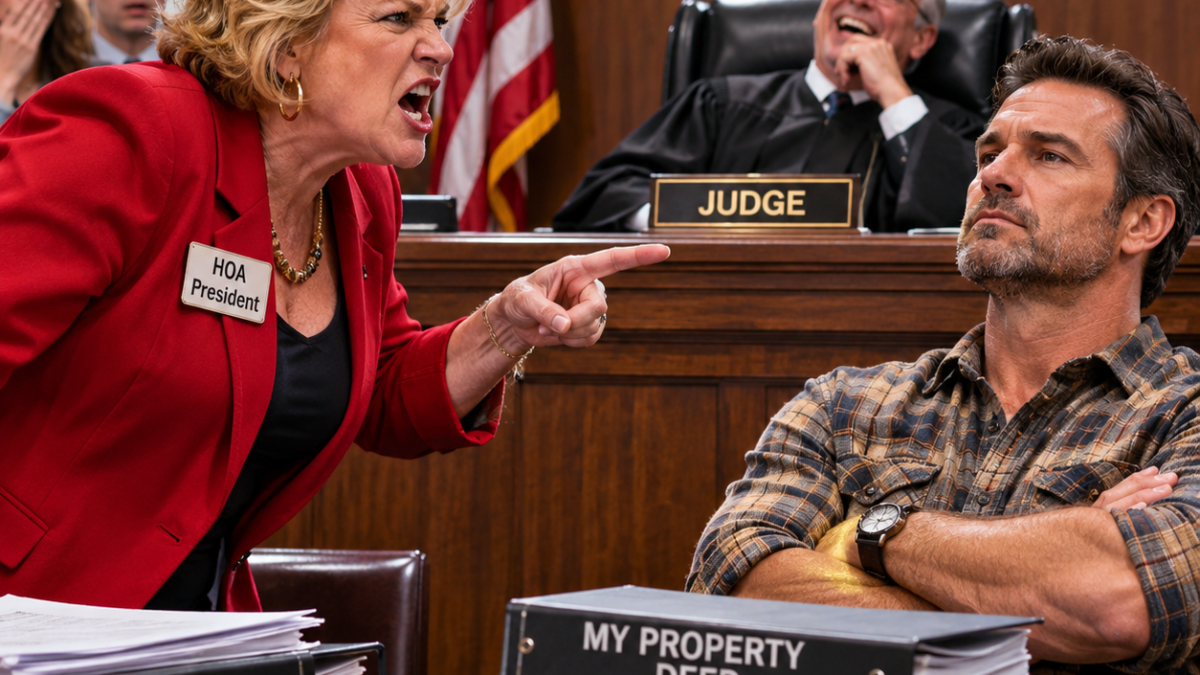
PART 2
“I’m serious,” I told her. “The fence was here when I bought the house.”
Dolores leaned against the doorframe.
The smell of vanilla candles drifted past her.
“Rules change.”
“So the board can suddenly make a forty-year-old structure illegal?”
“The board can establish standards necessary to protect property values.”
“What standards?”
“Architectural standards.”
“Where are they?”
Her eyes narrowed slightly.
“Excuse me?”
“The standards you’re citing. Where are they written?”
That was the first time I saw the smile leave her face.
Only for a second.
Then it returned.
“We aren’t required to provide every internal board document whenever a homeowner becomes emotional.”
I almost laughed.
“Emotional?”
“You’re clearly upset.”
“You put a fine on my door.”
“A modest fine.”
“For a fence that predates your association.”
She folded her arms.
“Mac, I’m sure someone with your background can understand that communities evolve.”
“My background?”
“Aren’t you some kind of handyman?”
There it was.
Thirty years of licensed electrical work reduced to *handyman* because she needed me beneath her in the conversation.
“Electrician.”
“Of course.”
She said it in a tone that meant the opposite.
“Then removing an old fence shouldn’t be difficult.”
“And if I don’t?”
Her smile became almost sympathetic.
“Oh, Mac. You really don’t want to turn this into a fight.”
Then she closed the door.
I stood on the porch holding the violation notice.
There are moments when anger is hot.
Your heart pounds.
Your face burns.
You want to shout.
This wasn’t that kind.
This anger was colder.
I walked home thinking about one sentence.
*You don’t want to turn this into a fight.*
The thing was, I hadn’t.
She had.
I spent that weekend removing only the twenty feet of fence specifically described in the violation notice.
I saved every cedar board.
Electricians have a habit of keeping anything that might someday become useful.
Monday morning, while I was loading my van, Dolores’s Mercedes rolled slowly down the street.
She stopped.
Got out.
Clipboard in hand.
“Morning, Mac.”
“Problem solved.”
I pointed at the section I’d removed.
She walked past me without answering.
Inspected the side yard.
Then the backyard.
Finally she tapped her pen against the remaining fence.
“This won’t do.”
I stared at her.
“What won’t?”
“The remaining section.”
“You cited the front portion.”
“The material itself is noncompliant.”
“Cedar?”
“Yes.”
“This fence was built in 1973.”
“The architectural committee recently established approved materials.”
“What architectural committee?”
She held out another notice.
Fine: $300.
Complete removal required.
“Dolores.”
“Yes?”
“You can’t retroactively make an existing structure illegal just because you don’t like it.”
Her expression hardened.
“I suggest you educate yourself about HOA authority.”
“I intend to.”
I took the notice.
Then I did exactly that.
The county records office was in a low brick building that smelled like paper, dust, and government budgets.
I spent three hours reading.
Formation documents.
Property restrictions.
Covenants.
Amendments.
Minutes.
Then I found it.
One paragraph.
Plain language.
**Structures existing before formation of the association shall remain grandfathered unless voluntarily altered by the property owner.**
I read it three times.
Then made copies.
The next HOA meeting was Tuesday night.
Fifteen homeowners sat in folding chairs beneath fluorescent lights.
Dolores sat at a plastic table in front with two board members.
I waited until general business ended.
Then I stood.
“I’d like to discuss my fence violations.”
Dolores barely looked up.
“The matter has already been decided.”
“No, it hasn’t.”
I placed the recorded covenants on the table.
“Section twelve. Grandfathered structures.”
A few residents leaned forward.
Mrs. Isla put on her glasses.
Dolores glanced at the page.
“Those covenants have been superseded.”
“By what?”
“Updated standards.”
“Show me.”
“The board is not required to debate every technicality in open session.”
“It’s not a technicality. It’s the recorded covenant.”
Her jaw tightened.
“The grandfather provision is no longer applicable.”
“Where does it say that?”
“It’s inherent in the board’s governance authority.”
“So you’re fining me three hundred dollars based on something that isn’t written anywhere?”
Silence.
A phone appeared in someone’s hand.
Recording.
Dolores noticed.
Her tone changed.
“Mac, your aggressive posture is unnecessary.”
“I asked you to show me a rule.”
“You’re raising your voice.”
“I haven’t raised my voice.”
She reached for her coffee.
“I think perhaps you need to calm down.”
Then the cup tipped.
Coffee spilled across the documents I had laid out.
Brown liquid soaked through pages.
Homeowners gasped.
Dolores jumped up.
“Oh my goodness.”
She grabbed napkins.
“How terribly clumsy of me.”
I watched coffee run through three hours of research.
Then I looked at her.
She smiled.
Very slightly.
I smiled back.
“It’s okay.”
Something in her expression changed.
Because she expected rage.
“Really?”
“Sure.”
I gathered the wet pages.
“I made copies.”
Mrs. Isla laughed.
Just once.
Dolores looked at her.
Then at me.
“Meeting adjourned.”
I went home knowing two things.
First, Dolores wasn’t merely controlling.
She was reckless.
Second, she had just confirmed I needed to document everything.
So I started.
Every notice.
Every email.
Every letter.
Every board meeting.
Every photograph.
Every conversation I could legally preserve.
If Dolores came onto my property, I wrote down the date and time.
If a rule changed, I asked for the vote authorizing it.
If someone else received a suspicious violation, I asked for a copy.
Two weeks later, a package arrived containing the supposedly current HOA bylaws.
They were a mess.
Different fonts.
Missing pages.
Sections that referred to provisions that didn’t exist.
Dates that didn’t match.
One amendment appeared to have been inserted after the page numbers had already been printed.
I sat at my kitchen table flipping through them.
This wasn’t governance.
It was improvisation.
Dolores was making rules when she needed them.
The next attack came before sunrise.
I found a yellow citation stuck to my work van.
**COMMERCIAL VEHICLE VIOLATION.**
Fine: $200.
Additional penalty: $50 per day.
I looked at the Ford Transit sitting in my own driveway.
My company name was printed on the side.
Thornfield Electrical.
Inside that van were fifteen thousand dollars’ worth of tools.
Meters.
Testers.
Conduit benders.
Specialty equipment.
Everything I needed to make a living.
Dolores answered when I called.
“Willowbrook HOA.”
“Why is there a citation on my van?”
“Commercial vehicles are no longer permitted overnight.”
“Since when?”
“Emergency board meeting.”
“When?”
“Last night.”
“I didn’t receive notice.”
“Not every policy adjustment requires community participation.”
“My van has been here for two years.”
“Standards evolve.”
“You keep saying that.”
“Park it elsewhere.”
“Where?”
“Maple Street has public parking.”
“Eight blocks away.”
“I’m sure you’ll manage.”
“My tools aren’t insured if the van is left overnight away from my residence.”
A pause.
Then she said, “That sounds like a business problem, not an HOA problem.”
And there it was.
The real point.
She wasn’t trying to improve Willowbrook.
She was trying to make my life expensive.
I researched the issue.
The applicable rules gave licensed tradespeople protections that made Dolores’s new restriction questionable at best.
But before I could formally challenge it, she escalated.
The next morning, a man in a fluorescent vest was kneeling beside my van.
A wheel boot was being attached to the front tire.
I ran outside.
“What are you doing?”
The man stood.
“Enforcement.”
“On my driveway?”
Dolores stepped from behind her Mercedes.
“Morning, Mac.”
I took out my phone.
Started recording.
“Say that again.”
Her eyes flicked toward the screen.
“Your vehicle is in continuing violation.”
“So you’re immobilizing my work vehicle on private property?”
“Correct.”
“Who authorized this company?”
“The HOA.”
“Do you have a court order?”
She laughed.
“We don’t need one.”
The parking contractor looked less confident.
I called the sheriff.
Deputy Rodriguez arrived twenty minutes later.
He looked at the boot.
Then my van.
Then the driveway.
Then Dolores.
“You had this placed here?”
“The HOA did.”
“On his private property?”
“We have enforcement authority.”
Rodriguez crouched beside the boot.
Then stood.
“Ma’am, take it off.”
Dolores blinked.
“Excuse me?”
“Remove the boot.”
“He’s violating community policy.”
“This isn’t a public street.”
“Our governing documents—”
“Do not give you automatic authority to seize or disable property sitting on land he owns.”
The parking contractor was already reaching for his tools.
Dolores turned toward him.
“Don’t touch that.”
He froze.
Rodriguez looked at him.
“You want me to explain criminal mischief while we’re all standing here?”
The man removed the boot.
Fast.
Dolores’s face reddened.
“This is not finished.”
Rodriguez watched her walk away.
Then handed me his card.
“Keep records.”
“I am.”
“Keep better ones.”
“You think this is going somewhere?”
He looked down the street at Dolores’s Mercedes.
“I think people who believe rules only apply to everyone else eventually create evidence.”
That afternoon I installed my first security camera.
The next attack was bigger.
Three weeks later, an envelope appeared under my door.
Heavy paper.
Embossed HOA letterhead.
Fourteen pages.
The title made me read it twice.
**PROPERTY VALUE DEPRECIATION ASSESSMENT**
According to the document, my house had reduced neighborhood property values by roughly thirty thousand dollars.
Reasons included:
Nonconforming architecture.
Commercial activity.
Inappropriate landscaping.
Deferred exterior maintenance.
My house had fresh paint.
The electrical system had been modernized.
The roof was good.
The yard was maintained.
None of it made sense.
Then I reached the demand.
$47,500.
Payable to the association.
Or—
I could sell my house.
To Blackwood Luxury Properties.
For $180,000.
My home had appraised the previous year for approximately $285,000.
The purchase contract was attached.
Already prepared.
Ten-day closing.
Immediate move-out.
I sat at the kitchen table staring at the pages.
The first time I read them, I was angry.
The second time, I became curious.
The assessment was signed by Richard Blackwood.
Certified Property Evaluation Specialist.
Blackwood.
I called Rebecca Martinez.
Rebecca had handled several property issues during my divorce.
She had the kind of laugh that could make bad news feel survivable.
When I emailed the assessment, she called five minutes later.
“Mac.”
“Yeah?”
“Where did you find this?”
“Under my door.”
She started laughing.
“That’s encouraging.”
“No. It’s terrifying.”
“Which part?”
“All of it.”
She calmed down.
“Listen to me. Don’t pay anything. Don’t sign anything. Don’t negotiate with Dolores directly.”
“Can an HOA do this?”
“Not like this.”
“So it’s fake?”
“Parts are certainly questionable.”
“What about the assessor?”
“I’ll check.”
She did.
Richard Blackwood had no valid state appraisal credentials matching what the report claimed.
None.
I hired a legitimate certified appraiser.
James Morrison spent almost three hours inspecting my home.
Two days later, his report came back.
My improvements hadn’t damaged property values.
They had likely helped them.
I called Rebecca.
“So Dolores’s expert isn’t licensed and the real expert says the opposite.”
“Correct.”
“Can I sue?”
“You can always sue.”
“That sounded very lawyerly.”
“Because lawsuits are expensive.”
“What should I do?”
“Look for a pattern.”
That advice changed everything.
I pulled property sales from Willowbrook.
Three homes had sold in the previous eighteen months.
Each had been listed through Blackwood Luxury Properties.
I started calling former owners.
The first didn’t want to speak.
The second did.
He told me Dolores had fined them repeatedly for landscaping, parking, and roof discoloration.
When the penalties became overwhelming, Blackwood Luxury Properties offered to “help” them sell quickly.
Below market.
The third family described almost the same thing.
My stomach turned.
I called Rebecca.
“Pattern found.”
Monday’s HOA meeting was packed.
More than twenty homeowners.
I brought James Morrison’s report.
Dolores stood at the front holding Richard Blackwood’s fake assessment.
“We have a serious property-value concern,” she announced.
I stood.
“Before we discuss that, I’d like the board to explain why its property assessor isn’t licensed.”
Silence.
Dolores looked at me.
“What are you talking about?”
“Richard Blackwood.”
“He’s a qualified consultant.”
“No. He isn’t.”
I held up the verification.
“State records show no appraisal license.”
Murmurs.
I placed Morrison’s report beside it.
“This is from a licensed appraiser.”
Dolores didn’t touch it.
“Your personal appraisal is irrelevant.”
“It specifically rejects the claim that my home is hurting property values.”
“You hired someone to tell you what you wanted to hear.”
“So did you.”
That landed.
Someone laughed.
Dolores’s face changed.
I continued.
“And there’s another question.”
“Sit down, Mac.”
“Why has Blackwood Luxury Properties represented every owner who sold after extended HOA enforcement?”
More murmurs.
Mrs. Isla said, “That’s true.”
Dolores looked toward her.
I continued.
“Three families. Repeated fines. Pressure. Below-market sales. Your company lists the homes afterward.”
“That is an outrageous accusation.”
“I didn’t accuse you of anything.”
“You implied criminal conduct.”
“I described public records.”
Her control snapped.
“This community will not be held hostage by one selfish homeowner!”
People went silent.
Dolores pointed at me.
“If Mac Thornfield hates our standards so much, perhaps he should find somewhere else to live.”
Mrs. Isla spoke from the back.
“Are you telling him to sell his home?”
“I’m saying people who refuse to support property values should consider whether Willowbrook is right for them.”
I looked at Rebecca, who had come to observe.
She was writing something.
After the meeting, neighbors surrounded me.
The Rodriguez family had their own stack of violations.
Mrs. Isla had saved every letter she had ever received.
Another homeowner described receiving an offer from Blackwood Luxury Properties after a sudden wave of fines.
I drove home understanding something I hadn’t understood before.
This wasn’t about me.
I was simply the first person stubborn enough to keep asking questions.
The financial records opened the next door.
I requested HOA filings.
Contracts.
Budgets.
Vendor payments.
What I found looked wrong almost immediately.
Forty-eight thousand dollars annually for landscaping.
Our common landscaping consisted mainly of two entrance areas and a small grass strip.
The landscaping company’s address was linked to one of Dolores’s relatives.
Then snow removal.
Forty-five thousand dollars.
Willowbrook barely saw snow.
That company had family connections too.
Then Neighborhood Watch Solutions.
Thirty-seven thousand dollars for security services and cameras.
There were no HOA security cameras.
Not one.
I spread the pages across my kitchen table.
Numbers circled.
Addresses highlighted.
Names connected.
For thirty years, my job had been finding faults hidden behind walls.
A breaker trips.
You don’t keep resetting it.
You find out what’s shorting the circuit.
I was looking at a short circuit.
Only this one was swallowing people’s money.
Rebecca brought the records to specialists.
Investigators began examining them.
An investigative reporter named Troy Adamson became interested after speaking with several homeowners.
Then more communities appeared.
Similar companies.
Similar contracts.
Similar forced-sale complaints.
The amount involved grew far beyond Willowbrook.
I didn’t know exactly what laws had been violated.
That wasn’t my job.
What I knew was that people with badges and subpoenas had stopped laughing.
Dolores sensed something.
And became dangerous.
At first, the harassment had been administrative.
Paper.
Fines.
Threats.
Then it became physical.
I came home from an overnight hospital emergency and stepped into water.
My basement was flooded.
Several inches.
Boxes floating.
Electrical equipment ruined.
A sprinkler control assembly had been deliberately damaged.
I stood in ankle-deep water staring at tools I’d owned for twenty years.
Some had belonged to my father.
I don’t remember yelling.
I remember feeling hollow.
Then I remembered the cameras.
At 2:47 a.m., two men entered my property.
Dark hoodies.
Tools.
They damaged the system.
The footage caught the vehicle that brought them.
A pickup connected to a landscaping company tied to Dolores’s family network.
I sent everything to Rodriguez and Rebecca.
The next morning, all four tires on my work van were slashed.
That hurt differently.
The basement was personal.
The van was survival.
I was on hospital rotation.
Emergency electrical response.
If I couldn’t drive, I couldn’t work.
I rented a truck.
Transferred tools.
Paid an obscene amount of money.
Then came a licensing complaint.
Someone accused me of dangerous electrical work at the hospital.
Patient endangerment.
Unauthorized modifications.
The investigator who arrived looked apologetic but firm.
“We have to examine the complaint.”
“Do you know who filed it?”
“Confidential.”
“Do you know it’s false?”
“I know we investigate before deciding that.”
My license was temporarily restricted while they reviewed the claims.
Then the hospital suspended my emergency contract.
No work.
No income.
It happened so quickly I couldn’t process it.
One week I was fighting an HOA.
The next, I was worried about whether I could pay legal bills.
Then Rodriguez called.
“Mac.”
“What now?”
“We received an allegation that you’ve been threatening a woman in the neighborhood.”
I closed my eyes.
“Dolores.”
“The complaint doesn’t formally identify the caller.”
“Of course.”
“It alleges stalking and intimidation.”
“I barely go near her house.”
“I know.”
“Then why are you calling?”
“Because I have to investigate.”
I sat at the kitchen table.
My hands were shaking.
This was no longer amusing.
No more clever comeback.
No more satisfying violation reversal.
Dolores was using systems designed to protect people and turning them against me.
My phone rang again that evening.
Sarah.
My ex-wife.
We hadn’t spoken much since the divorce.
“Mac?”
“Yeah?”
“I heard something.”
“That’s becoming a common sentence.”
“Are you okay?”
I looked around the dark kitchen.
“No.”
It was the first time I’d admitted it.
She became quiet.
“What happened?”
I told her.
The license.
The hospital.
The accusations.
The flooding.
The van.
When I finished, she said, “You need to leave for a while.”
“This is my house.”
“Mac—”
“No.”
“I’m not saying give it to her.”
“Then what?”
“Stay somewhere else until this settles.”
I stared at the table.
“If I leave because she makes me afraid to stay, she already owns it.”
“This isn’t about pride.”
“I know.”
“Do you?”
I didn’t answer.
She sighed.
“You always think surviving something means standing in the same place while it hits you.”
“That isn’t fair.”
“Neither was our marriage at the end.”
That shut me up.
She continued more softly.
“I’m not attacking you. I’m worried.”
“I know.”
“Promise me you’ll be smart.”
“I’ll try.”
“That isn’t a promise.”
“It’s the best I’ve got.”
Two days later, a restraining order arrived.
The allegations claimed I had harassed Dolores.
The order created distance restrictions.
The geography of our neighborhood made normal travel extremely difficult without risking accusations that I had violated it.
I sat in my living room reading the pages.
My house felt smaller than it had the day before.
I wasn’t legally evicted yet.
But that was clearly the goal.
Dolores wanted the cost of staying to become unbearable.
The financial attack came next.
A process server arrived Thursday morning.
Half-million-dollar defamation lawsuit.
Five hundred thousand dollars.
She claimed I had destroyed her business reputation.
Caused emotional distress.
Harassed her family.
Spread false accusations.
Buried inside was a request seeking control over assets while the litigation proceeded.
My savings.
My house.
Everything.
I called Rebecca.
“They’re trying to freeze me.”
“I know.”
“Can they?”
“They can ask.”
“That’s not comforting.”
“They’re going to have to support their claims.”
“When?”
“Court hearing.”
My stomach tightened.
“When?”
“Next week.”
I sat down.
“And Dolores has to appear?”
“Yes.”
“Under oath?”
Rebecca paused.
“Yes.”
Something changed in my mind.
For months, Dolores had been strongest outside courtrooms.
HOA meetings.
Driveways.
Private letters.
Anonymous complaints.
Places where confidence mattered more than truth.
A courtroom was different.
Documents mattered.
Dates mattered.
Signatures mattered.
And lies had consequences.
That weekend, rumors spread that I was unstable.
Neighbors were told I had experienced some kind of breakdown after my divorce.
Seventeen homeowners apparently signed a petition expressing concern about my mental condition.
Mrs. Isla brought me a copy.
I read the names.
Several belonged to people who later told me they had been misled about what they were signing.
I looked at Mrs. Isla.
“What do people think?”
“Some are scared.”
“Of me?”
“Of choosing the wrong side.”
I handed the page back.
“That’s worse.”
She sat across from me.
Mrs. Isla was small, elderly, and had the calmest eyes of anyone I knew.
“You think courage means people stop being afraid.”
“Doesn’t it?”
“No.”
She smiled.
“It means they decide something else matters more.”
“What matters more?”
She pointed toward my front window.
Across the street, one of the Rodriguez children was drawing with chalk.
“Home.”
The lawyer’s settlement call came Sunday night.
Dolores would withdraw the lawsuit and stop pursuing my property.
In exchange, I would sell.
Price: $160,000.
Ten-day closing.
Confidentiality agreement.
I nearly laughed.
“Your client wants me to sell a house appraised near two-eighty-five for one-sixty?”
“Given the current disputes, the offer reflects market realities.”
“Market realities she created.”
“I would strongly advise you to think about your financial situation.”
“You mean the financial situation caused by the licensing complaint and hospital suspension?”
“I can’t comment on unrelated matters.”
“Sure.”
“Mr. Thornfield, prolonged litigation could ruin you.”
I stared at the framed photograph on my wall.
My father and me standing beside my first work truck.
I was twenty-three.
He had his arm around my shoulder.
He died before I bought this house.
I wondered what he would have done.
Probably something reckless.
I tried to do something smarter.
“I need forty-eight hours.”
The attorney relaxed slightly.
“That’s reasonable.”
After we hung up, I called Rebecca.
“They think I’m surrendering.”
“Good.”
Then I called the investigators.
By Tuesday, everyone was ready.
But Dolores changed the schedule.
Before the community meeting, the asset hearing happened.
That courtroom is where I finally understood how badly Dolores had misunderstood the difference between power and authority.
I arrived wearing the only suit I owned.
Navy.
Bought for my daughter’s high school graduation.
Rebecca sat beside me.
Dolores entered with two attorneys.
She looked calm.
Expensive gray blazer.
Pearls.
Hair perfect.
She didn’t look at me.
When the judge entered, everyone stood.
Judge Arthur Weller was in his late sixties.
Silver hair.
Reading glasses low on his nose.
A face that gave away almost nothing.
Dolores’s attorney began.
He described me as a disgruntled homeowner waging a campaign against a respected community leader.
He discussed lost real estate clients.
Negative media.
Harassment.
Business damage.
Then he asked the court to protect Dolores’s ability to collect any future judgment.
Judge Weller looked at the papers.
“Counsel, you’re asking me to place substantial restrictions on Mr. Thornfield’s assets.”
“Yes, Your Honor.”
“Including his residence.”
“Yes.”
“Which he owns without a mortgage.”
“That is our understanding.”
“And your client has previously offered to purchase the same property.”
Dolores’s attorney paused.
“That was a separate settlement effort.”
“For substantially below the value reflected in this appraisal?”
Another pause.
“We dispute that appraisal.”
Judge Weller lifted another document.
“Based on the assessment of Richard Blackwood?”
“Yes.”
“Where is Mr. Blackwood’s state license number?”
Silence.
The attorney looked toward his table.
Dolores shifted.
Judge Weller waited.
“I believe his professional qualifications are detailed in the appendix.”
“I have the appendix.”
He looked over his glasses.
“I don’t see a license number.”
Rebecca stood.
“Your Honor, because there isn’t one.”
Dolores turned toward us.
Rebecca handed the clerk a verification report.
Judge Weller read.
Slowly.
Then he looked at Dolores’s attorney.
“Your property valuation was prepared by an unlicensed relative of your client?”
The attorney stood rigid.
“Mr. Blackwood acts as a consultant.”
“He signed himself as a certified evaluation specialist.”
“That’s a private designation.”
“Created by whom?”
No answer.
Judge Weller removed his glasses.
That tiny movement changed the temperature of the room.
He looked at the purchase offer.
Then the appraisal.
Then the HOA notices.
Then the property records Rebecca had submitted.
“You’re asking this court to restrict a man’s control over a house he owns based in part on a disputed valuation produced by a relative of the plaintiff, while the plaintiff’s own company has attempted to purchase that same house at a deeply reduced price.”
Dolores leaned toward her attorney.
Whispered.
The judge noticed.
“Mrs. Blackwood.”
She froze.
“Yes, Your Honor?”
“Did your company offer to purchase Mr. Thornfield’s home?”
Her attorney stood.
“Your Honor—”
“I asked Mrs. Blackwood.”
Dolores swallowed.
“Yes.”
“For one hundred sixty thousand dollars?”
“That was a negotiation.”
“Was the home previously appraised near two hundred eighty-five thousand?”
“I don’t know.”
Rebecca slid another document forward.
Dolores glanced at it.
Judge Weller did too.
He became very still.
That was the reaction I remember.
Not shouting.
Not pounding a gavel.
Silence.
The kind of silence a professional gives you when what he’s reading is worse than anything he expected.
He turned several pages.
“These fine schedules are unusual.”
Dolores said nothing.
“These amendments appear to have inconsistent execution dates.”
More silence.
He looked toward Rebecca.
“Counsel, are any of these documents currently under investigation by another agency?”
Rebecca chose her words carefully.
“Yes, Your Honor.”
Dolores’s attorney shot to his feet.
“This is improper.”
Judge Weller raised a hand.
“I did not ask for details.”
Then he turned back toward the request.
“The motion for emergency asset restrictions is denied.”
I exhaled.
I hadn’t realized I’d been holding my breath.
The judge continued.
“And I am not persuaded that this court should assist either party in transferring ownership or control of Mr. Thornfield’s residence without a full evidentiary record.”
Dolores looked furious.
Judge Weller looked at her.
“Mrs. Blackwood, courts are not collection departments for private organizations that have not established a lawful debt.”
Her face tightened.
He wasn’t finished.
“If the evidence ultimately demonstrates that legal procedures were being used to pressure a homeowner into selling property to an interested party, that will be a considerably more serious matter than a neighborhood dispute.”
No one moved.
The hearing ended.
Outside, reporters waited.
I didn’t speak to them.
Rebecca did.
In the parking lot, I stood beside my truck.
My knees felt weak.
Rebecca walked over.
“You all right?”
“He believed us.”
“He believed the documents.”
“That feels better.”
“It should.”
“But this isn’t over.”
“No.”
She smiled.
“Tonight is going to be interesting.”
The community center meeting was scheduled for six-thirty.
Word had spread that I was prepared to sell.
Dolores believed the courtroom setback had only delayed the inevitable.
Eighty-nine residents packed the room.
Troy’s television crew was there under the explanation that they were covering a neighborhood resolution.
Dolores arrived late.
White Mercedes.
Designer blazer.
Briefcase.
Three loyal board members.
She walked into the room like someone attending her own victory ceremony.
I sat in the front.
Shoulders lowered.
Face tired.
That part wasn’t acting.
I was exhausted.
Dolores took the microphone.
“For months,” she began, “our community has suffered from unnecessary conflict.”
Mrs. Isla sat behind me.
I heard her whisper, “Here we go.”
Dolores continued.
“Fortunately, Mr. Thornfield has finally agreed that peaceful transition may be best for everyone.”
People murmured.
Across the aisle, Rodriguez looked at me.
Not Deputy Rodriguez.
Mr. Rodriguez, the father of the chalk-drawing kids.
His jaw was tight.
Dolores smiled at me.
“Mac, would you like to explain your decision?”
I stood.
Walked toward the microphone.
Every step felt strange.
For months, Dolores had defined me.
Difficult homeowner.
Unstable neighbor.
Financial threat.
Dangerous man.
Now she thought she was about to add one more label.
Former resident.
I reached the podium.
“Thank you, Dolores.”
She smiled wider.
“You were right about one thing.”
Her eyebrows lifted.
“This does need to end.”
I removed a folded document.
Dolores’s smile faded slightly.
The doors behind the audience opened.
Several investigators entered.
The room went silent.
Dolores turned.
One of the agents approached.
“Dolores Blackwood?”
“What is this?”
The agent identified herself.
“I need you to remain where you are.”
Dolores looked at her attorney.
He stood immediately.
“I represent Mrs. Blackwood.”
The agent nodded.
“Then you should advise your client not to make unnecessary statements.”
Cameras moved.
People raised phones.
Dolores looked at me.
“You did this.”
“No.”
My voice surprised even me.
It was calm.
“You did.”
Investigators served paperwork.
The specific allegations had grown from the financial records.
Fraud.
Embezzlement-related counts.
Conspiracy.
Misuse of association funds.
Other charges connected to the broader network.
Dolores started speaking too quickly.
“This is retaliation. He’s obsessed with me.”
An agent said, “Mrs. Blackwood.”
“He’s been stalking me for months.”
“Please stop talking.”
“I have court orders.”
“Mrs. Blackwood.”
“He threatened this community.”
Her attorney grabbed her arm.
“Dolores. Stop.”
Then Troy Adamson stepped forward with his microphone.
“Mrs. Blackwood, investigators have been examining hundreds of thousands of dollars in HOA transactions across multiple communities. Were any association funds routed through companies controlled by members of your family?”
She turned toward the camera.
And for the first time since I’d met her, Dolores Blackwood looked genuinely afraid.
“I don’t know what you’re talking about.”
Troy continued.
“What about the property sales?”
“No comment.”
“Did your company target homeowners who were under HOA enforcement?”
“No.”
Mrs. Isla stood.
“Yes, you did.”
Everyone turned.
Her voice shook.
Not from fear.
From anger.
“You fined people until they were desperate.”
Dolores stared at her.
Mrs. Isla walked into the aisle.
“You fined my garden.”
Another homeowner stood.
“You threatened my house.”
Mrs. Rodriguez rose.
“You fined my children.”
Someone else called out.
“You tried to force my parents to sell.”
Dolores looked around.
The room was changing around her.
For years, she had controlled people individually.
One letter at a time.
One fine at a time.
One frightened family at a time.
Now they were standing together.
She no longer had isolated victims.
She had witnesses.
The agent reached for handcuffs.
Dolores pulled back.
“This is unnecessary.”
“Turn around.”
“I am the president of this association.”
Not *was.*
*Am.*
Even then.
The agent looked at her.
“Turn around.”
The cuffs closed.
A sound barely louder than a tool snapping shut.
Dolores’s face collapsed.
She looked at me.
I expected to feel triumph.
Instead, I thought about my flooded basement.
My sliced tires.
My suspended license.
The nights I had slept three hours.
The moment I considered selling simply because I wanted the pain to stop.
She had come frighteningly close.
Not because she was smarter.
Because systems are exhausting.
Fighting a lie takes more energy than telling one.
Correcting a false record takes longer than creating it.
Defending a house costs more than threatening it.
That’s what people like Dolores count on.
As agents led her away, applause started.
I didn’t clap.
I sat down.
Mrs. Isla touched my shoulder.
“You won.”
“No.”
I looked around the room.
“We survived.”
The difference mattered to me.
The investigation continued for months.
Dolores wasn’t the only person charged.
Financial records connected relatives and associates to contracts involving landscaping, snow services, security work, consulting payments, and other vendors.
Investigators identified hundreds of thousands of dollars in questionable and fraudulent transactions across multiple associations.
Some people cooperated.
Some fought.
Some claimed ignorance.
Some admitted exactly what they had done.
My own case improved quickly once Dolores’s accusations began collapsing.
The licensing board completed its review.
The complaints about my hospital work were unsupported.
My electrical license was fully restored.
The investigator called personally.
“Mr. Thornfield, I’m sorry.”
“You were doing your job.”
“Yes.”
“But?”
He sighed.
“But anonymous complaint systems can be abused.”
“I know.”
“We’re documenting what happened.”
“Good.”
The hospital district restored my emergency contract.
My supervisor asked me to come in.
I sat across from him expecting a lecture.
Instead, he pushed a new contract toward me.
Higher rate.
More responsibility.
I stared at it.
“What is this?”
“You kept our systems running for years.”
“You suspended me.”
“We had to.”
“I know.”
“We also know the allegations were false.”
I didn’t sign immediately.
He looked uncomfortable.
“Mac, what do you want?”
That was an interesting question.
Months earlier, I would have said revenge.
Now?
“Written confirmation that the suspension wasn’t based on any finding of misconduct.”
“Done.”
“And if someone makes another anonymous complaint, I want a review before automatic contract suspension unless patient safety requires immediate action.”
He considered it.
“That’s reasonable.”
“Put it in writing.”
He smiled.
“You’ve become difficult.”
“I’ve had training.”
I signed.
The neighborhood changed too.
Without Dolores, people discovered the HOA did not require constant punishment to function.
Mrs. Isla became interim president.
She hated the title.
Which made her perfect.
At her first meeting, she placed a cardboard box beside the front table.
Someone asked what it was.
She opened it.
Garden gnomes.
Seven of them.
The room erupted in laughter.
“New rule,” she said.
“No one gets fined for being ridiculous unless the ridiculousness is actually dangerous.”
The Rodriguez kids drew an enormous hopscotch course outside the community center.
Nobody cited them.
We hired an independent accountant.
Real one.
Licensed.
No family connection to anyone.
Dues dropped after fake contracts disappeared.
We actually had enough money for legitimate maintenance.
The two entrance signs were repaired for a fraction of what Dolores’s vendor had been charging annually.
At the first transparent budget meeting, homeowners stared at the screen.
Mr. Rodriguez raised his hand.
“So where was all our money going before?”
Mrs. Isla looked at him.
“Apparently into very expensive imaginary snow.”
People laughed.
But beneath the laughter was anger.
It would take time.
Trust doesn’t come back because the criminal leaves.
It comes back because the books stay open.
Because people answer questions.
Because nobody gets punished for asking.
Six months later, Dolores appeared for sentencing.
I almost didn’t go.
Rebecca asked whether I wanted to.
“No.”
Then I thought about Mrs. Isla.
The Rodriguez family.
The former homeowners who had sold under pressure.
I changed my mind.
The courtroom was full.
Dolores looked different.
No designer blazer.
No perfect hair.
No white Mercedes waiting outside.
Just a defendant sitting beside her attorney.
Judge Weller presided.
The same judge from the asset hearing.
He had more evidence now.
Much more.
Victim statements filled a thick folder.
Financial records.
Property transactions.
Contracts.
Communications.
Dolores had entered guilty pleas to multiple federal counts as part of an agreement.
Several related defendants had also resolved cases.
When Judge Weller began speaking, the room became silent.
He looked at Dolores for a long time.
Then he looked at the file.
“I have presided over financial crimes involving larger dollar amounts.”
Dolores stared at the table.
“But numbers alone do not measure harm.”
He lifted one document.
“These offenses were not abstract bookkeeping violations.”
Another page.
“They entered people’s homes.”
Another.
“They entered families’ savings.”
Another.
“They used the fear of losing shelter as leverage.”
I felt Mrs. Isla beside me become very still.
The judge continued.
“A homeowners association exists because residents delegate limited authority for shared purposes.”
He looked directly at Dolores.
“You treated that delegated authority as personal ownership.”
No one moved.
“You used rules as pressure.”
His voice remained calm.
“You used financial penalties as weapons.”
Another pause.
“And according to the record before me, you participated in a system in which that pressure could create private financial opportunities for people connected to you.”
Dolores’s attorney shifted.
Judge Weller wasn’t finished.
“What I find particularly disturbing is the calculated selection of people who were likely to struggle to resist.”
He referred to working families.
Immigrant families.
Older residents.
Homeowners without large legal budgets.
Then he said the sentence I would remember for the rest of my life.
“Mrs. Blackwood, you repeatedly mistook people’s inability to fight you for proof that you were right.”
I felt that sentence in my chest.
Because that was exactly what she had done to me.
Every time I paid a fine rather than fight.
Every time I removed a piece of fence.
Every time someone sold instead of hiring a lawyer.
Every silence had looked like permission.
The judge continued.
“But silence under pressure is not consent.”
Dolores finally looked up.
Judge Weller pronounced the sentence.
Prison.
Probation after release.
Restitution.
Financial restrictions.
Consequences affecting future involvement with associations and related fiduciary roles.
Other defendants faced their own sentences.
It wasn’t a movie.
Nobody cheered.
Nobody applauded.
Courtrooms don’t work like community centers.
The bailiff moved.
Dolores stood.
For a moment, she looked toward the gallery.
Our eyes met.
I thought about the morning she handed me that notice.
Thirty days to vacate.
*Don’t take it personally, sweetie.*
I could have smiled.
I didn’t.
I could have mouthed something cruel.
I didn’t.
I simply looked at her.
And she looked away first.
Outside the courthouse, Troy Adamson approached.
“Mac, can we get a statement?”
I nearly said no.
Then I saw several former Willowbrook homeowners near the steps.
People who had lost money.
People who had moved.
People who deserved the story not to become only mine.
So I faced the camera.
“What does today mean to you?” Troy asked.
I thought about it.
“It means owning a house shouldn’t require being wealthy enough to defend it from the people who are supposed to serve the neighborhood.”
“What do you say to homeowners dealing with abuse from associations?”
I almost repeated the old advice.
Document everything.
Know your rights.
Get help.
All true.
But I had learned something deeper.
“Don’t let them isolate you.”
Troy waited.
“That was Dolores’s real power.”
I looked toward the former homeowners.
“She made everybody think their problem was private. One person’s fence. Another person’s parking. Another person’s garden. Another person’s late fee.”
I shook my head.
“It wasn’t private. It was a pattern.”
The camera remained on me.
“And patterns become visible when people talk to one another.”
That evening, I went home.
My home.
The same ranch house Dolores had valued like garbage when she wanted to buy it.
The porch light was on.
My repaired van sat in the driveway.
No boot.
No citation.
No note under the door.
I unlocked the house.
For months, every time I came home I had looked for damage.
Broken windows.
Legal envelopes.
New notices.
That night, there was nothing.
Nothing had ever felt so good.
The basement had been restored.
Insurance and restitution funds covered much of the damage.
I replaced equipment.
Not everything.
Some tools couldn’t be replaced.
My father’s old analog tester was gone.
Water destroyed it completely.
I kept the casing.
Rebecca asked why.
“Because he used it.”
“It doesn’t work.”
“I know.”
“Then why keep it?”
I looked at the scratched metal shell.
“Not everything valuable needs to work.”
She nodded.
“Fair.”
Sarah began visiting again.
That part surprised me more than anything.
During the investigation, she had called occasionally.
Then she brought dinner.
Then she came to a neighborhood meeting because she wanted to see the people I’d been talking about.
Then one Saturday she helped me reorganize the basement.
At one point we stood beside each other looking at boxes.
She said, “We were pretty terrible at the end.”
I laughed.
“That romantic, huh?”
“You know what I mean.”
“I do.”
She touched the old workbench.
“I thought you didn’t want more.”
“More what?”
“More life.”
I looked at her.
“You thought because I didn’t want a bigger house or a country club, I didn’t want anything.”
“Yes.”
“That hurt.”
“I know.”
“I thought you were embarrassed by me.”
She closed her eyes briefly.
“Sometimes I was.”
At least she was honest.
“And I’m ashamed of that now.”
We stood quietly.
“I wasn’t embarrassed by you because you were an electrician,” she said. “I was embarrassed because I thought people were judging me.”
“That’s not much better.”
“No.”
Then she laughed softly.
“You’ve become very annoying about accepting bad apologies.”
“I’ve had training.”
She smiled.
So did I.
We didn’t suddenly get back together.
That would have felt false.
We had coffee.
Then dinner.
Then another dinner.
We talked about why the marriage failed.
Really talked.
Not the version we’d told lawyers.
Not the version we’d told friends.
The ugly version.
Pride.
Resentment.
Money.
Status.
Silence.
Years of assuming we knew what the other person meant without asking.
Months later, we tried dating again.
Slowly.
The first time she spent the night at the house, I woke at 5:30 and walked into the kitchen.
She was standing near the window.
“What are you doing?”
“Looking at your driveway.”
“For what?”
She smiled.
“Just making sure nobody booted the van.”
I laughed so loudly Mrs. Isla later asked what happened.
Willowbrook became known for the case.
That embarrassed most of us.
Television vans came.
Reporters interviewed residents.
Lawmakers discussed reforms.
I gave testimony about what happened.
Not because I wanted my name attached to legislation.
I didn’t.
I wanted three things.
Clear proof before major fines.
Real appeals.
Financial transparency.
The kind of boring rules nobody appreciates until someone like Dolores discovers the gaps.
A homeowner defense program was eventually created using restitution and community fundraising.
Legal referrals.
Translation support.
Help for elderly residents.
Information on challenging questionable fines.
Mrs. Isla volunteered more hours than anyone.
I told her to slow down.
She told me to mind my business.
“You’re HOA president.”
“Interim.”
“It’s been eighteen months.”
“Still interim.”
“Nobody else wants the job.”
“Exactly.”
She remained president.
The Rodriguez family started monthly block parties.
Their kids became teenagers.
The chalk drawings disappeared.
Not because the HOA banned them.
Because teenagers apparently consider sidewalk chalk beneath their dignity.
One summer afternoon, I saw the youngest Rodriguez boy teaching a smaller kid how to draw a hopscotch grid.
I stood in my driveway watching.
He noticed me.
“What?”
“Nothing.”
“You’re staring.”
“Just remembering.”
He rolled his eyes.
Teenagers.
Some things were more powerful than HOA regulations.
Life returning to normal was one of them.
A year after Dolores’s sentencing, I replaced the last piece of cedar fence I had removed during our first dispute.
I used the original boards.
Sanded them.
Repaired the damaged ends.
Reset the posts.
Sarah helped hold one section while I leveled it.
“You know,” she said, “normal people would buy new lumber.”
“This is good cedar.”
“This is old cedar.”
“Exactly.”
“That doesn’t explain anything.”
“It explains everything.”
Mrs. Isla came outside.
She looked at the fence.
Then at me.
“Approved.”
“I didn’t submit an application.”
“I’m president.”
“That’s exactly the kind of thing we fought against.”
She frowned.
“Fine.”
She disappeared into her house.
Ten minutes later she returned with a form.
“You’re impossible.”
I filled it out.
The application was approved at the next meeting.
Unanimously.
I framed the approval letter in my garage.
Not because it mattered legally.
Because it made me laugh.
My life became ordinary again.
Hospital jobs.
Electrical panels.
Emergency calls at terrible hours.
Coffee too strong.
Neighbors borrowing tools.
Sarah leaving books on my nightstand.
Mrs. Isla bringing food nobody requested.
The white Mercedes disappeared from Willowbrook long ago.
Another family bought Dolores’s house after everything was resolved.
Nice people.
Two daughters.
They planted sunflowers.
Tall ones.
Definitely not compliant with any rule Dolores would have invented.
Nobody complained.
One morning I was drinking coffee on the porch when the mail arrived.
There was an official envelope.
For one awful second, my body reacted before my mind did.
Heart faster.
Jaw tight.
That old expectation.
Another threat.
I opened it.
Property-tax statement.
I laughed.
Sarah came outside.
“What’s funny?”
“Taxes.”
“That’s a concerning sign.”
“I was happy it wasn’t an eviction notice.”
She sat beside me.
“You still think about it?”
“Sometimes.”
“The notice?”
“All of it.”
I looked toward the driveway.
“There were nights I almost sold.”
She didn’t say anything.
“I want people to think I was fearless.”
“You?”
“Very funny.”
“You were terrified.”
“I know.”
She took my coffee.
“Hey.”
“Tastes terrible.”
“Give it back.”
She did.
Then she said, “You stayed anyway.”
“That isn’t the same as not being afraid.”
“No.”
She leaned against me.
“It’s better.”
For years, I had believed courage meant being the person nobody could intimidate.
Dolores taught me that wasn’t true.
She intimidated me.
She scared me badly.
When my license was threatened, I was scared.
When the hospital contract disappeared, I was scared.
When the basement flooded, I was furious and scared.
When legal papers threatened my house, I lay awake wondering whether thirty years of work could disappear because somebody richer understood the system better than I did.
I wasn’t fearless.
Mrs. Isla wasn’t fearless.
The Rodriguez family wasn’t fearless.
The former homeowners weren’t fearless.
Even some of the people who testified had spent months avoiding conflict because they were afraid of retaliation.
Courage didn’t arrive before fear.
It arrived after.
Usually five minutes late.
Usually holding paperwork.
I still own the house.
Free and clear.
The cedar fence is standing.
My van still sleeps in the driveway.
Sometimes I get called out at two in the morning.
Sometimes Sarah complains when I wake her looking for socks.
Sometimes I sit outside after a long job and listen to Willowbrook settle into the night.
Garage doors closing.
Dogs barking.
Kids being called inside.
Televisions behind open windows.
Ordinary sounds.
That was what Dolores never understood.
A home isn’t valuable only because of what an appraiser writes down.
It’s valuable because it’s the place where your life is allowed to happen without someone constantly threatening to take it away.
She looked at houses and saw leverage.
Commissions.
Control.
Numbers.
I looked at mine and saw a second chance.
That was why neither of us could understand why the other wouldn’t quit.
For her, it was business.
For me, it was home.
The judge understood that distinction better than anyone expected.
At the end of the sentencing hearing, after the lawyers had finished and the sentence had been announced, Judge Weller gathered the papers in front of him.
Then he paused.
He looked at Dolores.
Then at the homeowners sitting behind us.
His final words weren’t dramatic.
That’s probably why they stayed with me.
“Community authority is a form of trust,” he said. “Once people begin treating trust as property they personally own, abuse becomes almost inevitable.”
He looked toward the victims.
“The law can punish abuse.”
Then back at Dolores.
“But it cannot return the months and years people spent living in fear.”
The courtroom was silent.
“So the responsibility after today belongs not only to courts.”
He closed the folder.
“It belongs to communities willing to remember how this happened.”
That was it.
No applause.
No movie speech.
Just a judge putting into words what all of us had learned the expensive way.
Dolores had never possessed extraordinary power.
We had handed ordinary authority to someone who kept expanding it because nobody wanted the inconvenience of stopping her.
One homeowner ignored a ridiculous fine.
Another paid because fighting was expensive.
A board member signed something without reading.
Someone assumed a neighbor’s dispute wasn’t their business.
Someone else moved.
Every small surrender became precedent.
Until one morning, Dolores stood on my porch and told a man who owned his house that he needed to leave.
That was the mistake.
Not because I was stronger than everyone before me.
I wasn’t.
Not because I was smarter.
Plenty of people had seen what was happening.
It was a mistake because by then she had done it too many times.
She had created a pattern.
And patterns can be traced.
That’s what electricians do.
A breaker keeps tripping, you trace the circuit.
A light keeps failing, you test the connection.
You don’t insult the wire.
You don’t threaten the outlet.
You follow the problem until you find the source.
Dolores thought she was dealing with a handyman who could be embarrassed into surrendering.
Instead, she gave an electrician months of documentation showing exactly where the system was broken.
I didn’t destroy Dolores Blackwood.
I traced the circuit.
The missing money.
The fake contracts.
The relatives.
The property offers.
The harassment.
The false complaints.
The sabotage.
The legal pressure.
Each wire led back toward the same overloaded box.
Eventually, all I had to do was show people where it was.
The system shut her down.
There was revenge in that.
I’d be lying if I said there wasn’t.
Seeing her real estate signs disappear felt good.
Watching the HOA refund bogus fines felt good.
Seeing Mrs. Isla chair the same meetings where Dolores once humiliated people felt very good.
The best moment wasn’t the handcuffs, though.
It wasn’t the sentencing.
It wasn’t even the judge looking at her fake paperwork like he’d discovered something rotten beneath the courthouse floor.
The best moment happened on a Saturday afternoon.
I was repairing a porch outlet when I heard children laughing.
Across the street, the Rodriguez family had friends over.
Kids everywhere.
Bikes on lawns.
Chalk on sidewalks.
Someone had dragged a basketball hoop partly into the road.
A garden gnome was wearing a cowboy hat.
Mrs. Isla had put it there.
I looked around.
No one was taking photographs for violations.
No one was measuring fences.
No one was checking vehicle decals.
Nobody was afraid of the person walking toward them with a clipboard.
Willowbrook looked slightly messy.
Alive.
Home.
Sarah came outside carrying two glasses of iced tea.
“What are you smiling about?”
“Property values.”
She looked around.
“What about them?”
“They seem fine.”
She handed me a glass.
“You’re strange.”
“Apparently.”
We sat on the porch.
The house behind us was the same house Dolores had tried to take.
Same walls.
Same driveway.
Same creaky hallway floor.
But it no longer felt like proof that I had survived a divorce.
It had become proof of something else.
You can be exhausted and still fight.
You can be frightened and still ask questions.
You can lose income and still refuse a bad deal.
You can stand alone for a while without staying alone forever.
And sometimes the most dangerous thing you can do to someone who survives on intimidation is simply make them explain themselves in front of people who are finally paying attention.
Dolores once told me not to take her eviction threat personally.
She was right about one thing.
In the end, it wasn’t personal.
It became much bigger than me.
It was about Mrs. Isla’s right to put ridiculous statues in her own yard.
It was about children drawing on sidewalks.
It was about working people being allowed to park the vehicles that put food on their tables.
It was about immigrant families being able to question authority without fearing their homes would be targeted.
It was about homeowners knowing where their money went.
It was about board members understanding that elected authority is temporary.
And it was about a system finally remembering the simplest fact Dolores had forgotten.
My house belonged to me.
Her position belonged to the community.
And neither one was hers to steal.
I took another drink of iced tea.
Across the street, one of the Rodriguez kids missed a basketball shot.
The ball rolled into my driveway.
He ran after it.
“Sorry, Mr. Thornfield!”
“You’re fine.”
He grabbed the ball.
Then stopped.
“Hey, aren’t you the guy from TV?”
Sarah started laughing.
I groaned.
“Unfortunately.”
“My dad says you sent the old HOA lady to prison.”
“I did not.”
“He says you did.”
“The justice system did.”
The kid thought about that.
“So you helped?”
“A little.”
He nodded.
“Cool.”
Then he ran back to the game.
Sarah was still laughing.
“What?”
“Nothing, hero.”
“Don’t start.”
She leaned against my shoulder.
I looked down the street.
The sun was dropping behind the roofs.
Porch lights were coming on.
Somewhere a lawn mower shut off.
Someone was grilling.
A dog barked twice.
Nothing dramatic.
Nothing viral.
Nothing worth putting on television.
Perfect.
Dolores spent almost two years trying to convince me that peace meant surrender.
She was wrong.
Peace was what came after people finally stopped surrendering.
And every morning when I walk past that cedar fence, climb into my work van, and back out of the driveway she once tried to control, I remember the notice she handed me at 6:30 a.m.
**Thirty days to vacate.**
I kept it.
It’s framed in my garage beside the approved fence application.
Not because I enjoy thinking about Dolores.
I don’t.
I keep it because sometimes I need the reminder.
A piece of paper is only as powerful as the authority behind it.
A title is only as powerful as the people willing to obey it.
And a bully is only unstoppable until someone starts keeping records.
Dolores tried to remove me from my own home.
Instead, she lost her position.
Her business.
Her freedom.
And the system she had built to frighten everyone else.
I kept the house.
But that wasn’t the victory.
The victory was that everybody else got to keep theirs too.
And that was worth every sleepless night.








