PART 2: HOA KAREN Tried to Evict My Tenants — Too Bad I Own the Strip Mall Where She Works
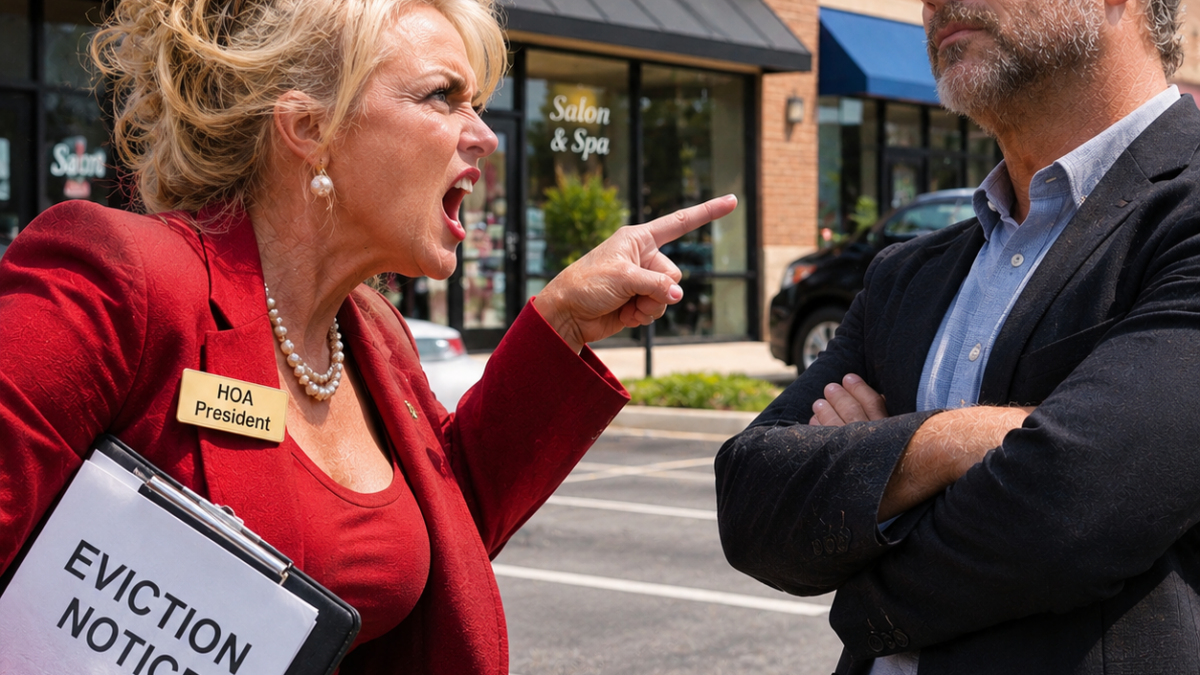
PART 2:
## THE FIRST TIME SHE CAME AFTER MARCUS
Marcus Reed was twenty-six.
He worked overnight at a distribution center about thirty minutes away.
His shift ended around five-thirty in the morning.
Most days he pulled into Cedarwood around six.
His Honda was old.
The muffler had seen better years.
It wasn’t outrageously loud.
It just sounded like a twelve-year-old Honda.
Darlene filed a formal noise complaint.
She described his arrivals as “systematic predawn disturbances.”
That phrase told me everything.
Nobody talks like that because they were awakened once.
They talk like that because they are building a file.
I called Marcus.
“You got anything from the HOA?”
“Yeah.”
He sounded exhausted.
“Am I in trouble?”
“No.”
“Because she told me I’ve had multiple warnings.”
“Have you?”
“No.”
“Then save whatever she sent.”
He hesitated.
“Garrett?”
“Yeah?”
“I can’t afford to move right now.”
That sentence made my stomach tighten.
Marcus sent money to his mother in Fayetteville.
She had health problems.
He worked overtime whenever possible.
He paid rent before the first of the month.
Never caused trouble.
Never asked for favors.
Darlene knew none of that.
She saw an old car returning at six in the morning and decided he was undesirable.
I pulled the county noise rules.
Then I pulled every HOA complaint related to vehicles from the previous year.
Interesting pattern.
Two retirees owned trucks louder than Marcus’s Honda.
No notices.
A family two streets over had teenage sons who played guitar in their garage until nine.
No notices.
Another owner ran a motorcycle before seven most Saturdays.
No notices.
Marcus?
Formal complaint.
I sent a response through Constance Merritt.
Constance had been my real-estate attorney for almost seven years.
She was forty-nine, sharp, patient, and completely uninterested in drama that didn’t produce useful evidence.
She read Darlene’s complaint.
Then my comparative photos.
Then the county ordinance.
“Selective enforcement.”
“Looks like it.”
“Don’t accuse yet.”
“I know.”
“You’re learning.”
“I pay you enough.”
She ignored that.
“Document the comparable cases.”
I did.
Date.
Address.
Behavior.
Complaint filed?
Yes or no.
Marcus went into a spreadsheet.
At the time, I thought it was just good organization.
Eventually that spreadsheet became one of the most important things I owned.
## ROSA
Rosa Martinez had lived in Unit 7 for four years.
Home-health aide.
Twelve-hour shifts.
Sometimes sixteen.
She had a Toyota Camry with a cracked taillight lens.
Not broken.
Not white light exposed.
Cracked plastic.
Darlene sent an HOA violation.
**Unsightly and potentially unsafe vehicle condition.**
Rosa showed me the letter.
“Is that even a rule?”
“No.”
“Can she fine me?”
“No.”
“She said she can fine the unit.”
“I own the unit.”
Rosa gave me a tired smile.
“Then congratulations.”
I laughed.
She didn’t.
“I’m serious, Garrett.”
I stopped.
“My daughter comes over on weekends.”
“I know.”
“I don’t want somebody taking pictures of my car every time she visits.”
That hit differently.
Darlene’s enforcement wasn’t only costing money.
It was changing behavior.
People were shrinking themselves.
I photographed the Camry.
Then walked Cedarwood.
Seven vehicles had visible damage worse than Rosa’s.
Two cracked bumpers.
One missing hubcap.
A work van with rust.
No violation notices that I could find.
Spreadsheet.
Date.
Tenant.
Violation.
Comparable case.
No action.
Constance looked at the file.
“How many now?”
“Eleven complaints against my fourteen units in six months.”
“How many community-wide?”
“Still collecting.”
“Keep going.”
## DESHAUN’S KIDS
Deshaun Price rented Unit 11.
Divorced.
Two children.
Eight and ten.
Good kids.
Loud in the completely normal way children should be loud on Saturday afternoons.
Darlene filed a complaint about “repeated recreational disturbances.”
The disturbance?
A basketball.
At two-thirty in the afternoon.
The first time I saw the complaint, I thought someone was joking.
Then Deshaun called.
“She came over.”
“To your unit?”
“Yeah.”
“What did she say?”
“That my children needed to respect homeowners.”
I felt my jaw tighten.
“What did you say?”
“I told them to come inside.”
That made me angrier than if he had yelled at her.
Because Deshaun was adapting.
He didn’t want trouble.
He told his children to stop playing so a woman with no authority over his lease would leave him alone.
My father used to do that.
Not the exact thing.
But I remembered watching him move trash bins early.
Repaint trim.
Ask tenants to park differently.
Not because the association was right.
Because he wanted one peaceful week.
One peaceful month.
Eventually you make your life smaller to fit inside someone else’s unreasonable rules.
That was the strategy.
I called Constance.
“I’m done.”
“With what?”
“Responding complaint by complaint.”
“Good.”
“I want to go after her.”
“Bad phrasing.”
“You know what I mean.”
“I do. I still don’t like it.”
“What would you call it?”
“Changing the math.”
That phrase stayed with me.
## THE STORAGE SHED
Darlene tried county enforcement next.
She reported an unpermitted storage shed behind the rental buildings.
The shed had existed since 2003.
I knew because it was in my purchase inspection.
County records showed the original permit.
Still, an inspector had to come.
Twelve minutes.
That’s how long he spent proving something I already knew.
He checked his tablet.
Photographed the shed.
“Everything’s good.”
“I know.”
He gave me an apologetic look.
“Complaint has to be investigated.”
“I know.”
He climbed into his truck.
I watched him leave.
Then I thought about the asymmetry.
Darlene had spent maybe five minutes submitting a complaint.
I had spent an hour meeting an inspector.
Before that, I paid Constance to review it.
Before that, I searched records.
Multiply that across a year.
That was the weapon.
Not winning.
Cost.
Make resistance expensive.
Make surrender convenient.
My father had surrendered.
Not because he was weak.
Because exhaustion is powerful.
I sat in my truck and said out loud:
“Not this time.”
## LORRAINE HATCH
Lorraine was sixty-seven.
Retired schoolteacher.
Gray hair.
Yellow legal pad always in hand.
The first time I met her, she had been arguing with Darlene about Christmas decorations.
Darlene had tried to fine her for leaving a wooden reindeer out three days past the approved season.
Lorraine responded by bringing fifteen years of HOA holiday-decoration records to the next board meeting.
I liked her immediately.
She called me one afternoon.
“Garrett.”
“Lorraine.”
“Did you know Darlene used HOA money on her driveway?”
I stopped walking.
“What?”
“Resurfacing.”
“How do you know?”
“I remember the invoice.”
“Lorraine.”
“I wrote it down.”
Of course she did.
She found the meeting date.
Vendor.
Amount.
$4,200.
The expense had been classified as common-area maintenance.
Darlene’s driveway was private.
I called Constance.
She went quiet.
That was always good.
“What else?”
“Don’t know yet.”
“Enough members can require an audit.”
“How many?”
“You have fourteen units.”
“So?”
“So check your voting percentage.”
I did.
Because of how the development’s ownership structure worked, my units represented more than enough voting interest to support a formal demand with other allied owners.
Constance drafted the request.
I signed.
Certified copies went to every board member and the registered agent.
Thirteen envelopes.
That morning at the post office, I felt something shift.
For a year, Darlene had generated paperwork.
Now I was generating some.
## PANIC
The audit demand landed Thursday.
By Friday afternoon, Darlene was calling board members.
Boyd Tillman told me.
Boyd was a retired fire inspector who had recently won a board seat.
He had spent thirty years walking into buildings everybody else was leaving.
Darlene didn’t scare him much.
“She wants us to reject the audit.”
“Can you?”
“No.”
“What’s her argument?”
“You.”
I laughed.
“She says you’re trying to take over the association.”
“I don’t want the association.”
“I know.”
“She know?”
“Doesn’t matter.”
The board allowed the audit to proceed.
Darlene responded by filing more complaints.
Rosa’s taillight.
Marcus’s UPS deliveries.
Apparently three packages in one month indicated a home business.
I added each complaint to the spreadsheet.
My file grew.
Then came the letters.
## FOURTEEN LETTERS
HOA letterhead.
Darlene’s signature.
Each tenant was informed that their continued residency was “under review” due to alleged covenant violations associated with my rental operations.
The board had never authorized such a review.
No eviction process existed.
No HOA authority allowed Darlene to terminate their leases.
But the letter was designed to sound official enough that none of that mattered.
Fear does not wait for legal analysis.
Marcus called.
Rosa cried.
Deshaun’s kids asked whether they would have to leave school.
Priscilla Lee, a nurse who had moved in eight months earlier, sent me a photograph of the letter and one line:
**What do I tell my daughter?**
That was when anger became cold.
Constance read the letter.
Her voice changed.
“This is bad.”
“For her?”
“Yes.”
“How bad?”
“She is interfering directly with your landlord-tenant relationships.”
I listened.
“She is making false representations about tenant residency.”
Another pause.
“And Garrett?”
“Yeah?”
“Your enforcement spreadsheet matters now.”
I sent it.
She spent a day reviewing.
Then asked me to obtain complete enforcement history.
That required work.
Public filings.
HOA records.
Meeting minutes.
Complaint logs.
Eventually the numbers emerged.
My fourteen units represented roughly seven percent of Cedarwood Crossing.
Yet under Darlene, they had received the majority of formal enforcement actions.
Thirty-one complaints against my units.
Seventeen across the other 186 households.
I stared at the spreadsheet.
Marcus was Black.
Rosa Latina.
Deshaun Black.
Priscilla Black.
Other tenants varied.
Darlene’s enforcement seemed disproportionately focused on renters and especially on several tenants of color.
I called Constance.
She did not immediately answer.
When she finally spoke:
“Do not exaggerate this.”
“I’m not.”
“Good.”
“What do we have?”
“Potential fair-housing issues. Potential interference claims. Strong evidence of selective enforcement.”
I looked out my office window.
“So we file.”
“Soon.”
“Why not now?”
“Because the audit is coming.”
Again.
Timing.
## PINEWOOD COMMONS
That night, something clicked.
Darlene had retired from the title company.
But recently she had taken a part-time operations role at Meridian Home Interiors.
Real-estate staging.
Furniture.
Design.
I remembered seeing a congratulatory post.
Meridian operated from Pinewood Commons.
Suite 4B.
I knew that address.
Because I owned Pinewood Commons.
Three years earlier, I had purchased the small strip center as part of an investment package.
Seven suites.
Shared parking.
A cell-tower lease behind the property.
Nothing glamorous.
Steady cash flow.
Managed through a separate LLC.
I had never personally dealt with Meridian beyond lease administration.
I pulled their file.
Month-to-month commercial tenancy.
Twelve hundred square feet.
Good payment history.
Darlene listed as operations manager.
I leaned back.
My heart started beating faster.
Not because I suddenly had the power to fire her.
I didn’t.
She wasn’t my employee.
Not because I could throw Meridian into the street overnight.
I couldn’t and wouldn’t.
But the lease was month-to-month.
I could legally decline renewal with proper notice.
I sat with that card.
For a long time.
Then I closed the file.
Not yet.
## THE AUDIT
Six weeks later, the CPA report arrived.
Lorraine had found one driveway.
The auditors found more.
Darlene’s private driveway resurfacing.
$4,200.
Office furniture apparently purchased through an “administrative supply” expense.
$2,800.
Community catering.
$1,100.
The event had been canceled.
Legal fees without matching documentation.
Vendor costs consistently above comparable rates.
Total questionable spending:
Approximately $14,700.
Not a Hollywood embezzlement scheme.
No offshore accounts.
No bags of cash.
Small things.
That almost made it worse.
She had apparently grown comfortable.
A personal expense here.
A community account there.
People not watching.
Nobody asking.
$14,700 across twenty-two months.
The report described the transactions in accountant language.
“Requires explanation.”
“Insufficient documentation.”
“Potential misclassification.”
Words that sound boring.
Until it is your money.
Three board members privately told Boyd they wanted Darlene gone.
She refused.
Called the audit political.
Hired an attorney.
Threatened procedural challenges.
And because the report remained mostly internal, she still had room to maneuver.
I needed everything visible.
Not rumors.
Evidence.
## MY FATHER’S LESSON
I drove to Greensboro that weekend.
Dad was gone by then.
His old house belonged to another family.
I parked across the street anyway.
I thought about the duplex.
About how tired he looked the year he sold.
He once told me:
“Garrett, sometimes peace is worth losing money.”
At fifteen, I thought he was teaching me wisdom.
As an adult, I understood the sadness inside it.
Sometimes people call surrender peace because the alternative feels impossible.
I sat there for twenty minutes.
Then said:
“I wish you’d had someone help you.”
Maybe that was what this had become.
Not avenging Dad.
Helping people he would have understood.
Marcus.
Rosa.
Deshaun.
Priscilla.
People who worked.
Paid.
Raised families.
And wanted to go home without wondering whether somebody was collecting evidence against them.
I drove back to Raleigh.
The plan came together on the highway.
Four pieces.
## PIECE ONE: THE HOUSING CASE
Constance prepared a federal fair-housing complaint based on the pattern we had documented.
Not emotional language.
Data.
Complaint dates.
Tenant identities.
Comparable enforcement.
Letters.
Board records.
Everything.
The HOA would have to answer.
Darlene’s signature appeared throughout the file.
Constance said:
“Once this is filed, she needs to stop contacting your tenants.”
“Will she?”
“No.”
“At least you’re optimistic.”
“She has not shown much talent for restraint.”
Fair.
## PIECE TWO: THE STORY
I contacted Weston Dale.
Investigative reporter.
Small digital publication called The Capital Current.
He had covered local government and HOA disputes.
I gave him the audit.
Spreadsheet.
Tenant letters.
Meeting records.
He asked:
“Can I verify independently?”
“That’s why I called you.”
He spent two weeks checking everything.
He interviewed residents.
Reviewed records.
Called the CPA.
Spoke with Constance where appropriate.
Then he called.
“Story holds.”
“Good.”
“There’s one weird thing.”
“What?”
“Pinewood Commons.”
I said nothing.
“You own the strip mall where Meridian Home Interiors operates?”
“Yes.”
“And Darlene works there?”
“Yes.”
He laughed.
“What are you doing with that?”
“Nothing yet.”
“That is an ending.”
“I know.”
## PIECE THREE: THE VOTE
The Cedarwood annual meeting was scheduled for the third Saturday in May.
Boyd was vice president.
He added a properly noticed agenda item.
Removal of the HOA president.
Lorraine organized calls.
The Prentices created a neighborhood group.
I knocked on doors.
Not campaigning.
Explaining.
I carried copies of the audit summary.
Enforcement data.
Tenant letter.
At one house, an older man stared at the numbers.
“Your units got thirty-one?”
“Yes.”
“And all the rest got seventeen?”
“Yes.”
“That can’t be accidental.”
“I’m not telling you what to conclude.”
He looked at me.
“You don’t have to.”
## PIECE FOUR: PINEWOOD COMMONS
Meridian’s month-to-month lease required proper notice for non-renewal.
I reviewed everything with commercial counsel.
I wanted no illegal retaliation.
No harassment.
No midnight lockout.
Business only.
We prepared notice.
But Meridian’s owner, Tessa Bramble, had done nothing to me.
That mattered.
So I planned to help her relocate.
Waive the last month’s rent.
Provide referrals.
Darlene had threatened innocent tenants to hurt me.
I was not going to punish an innocent business to hurt her.
Still, I would not renew the lease.
Pinewood Commons was mine.
I had the right to make lawful business decisions about my property.
The irony could take care of itself.
I mailed the notice exactly thirty days before the annual meeting.
## TESSA CALLS
Friday afternoon.
“Mr. Wolf?”
“Yes.”
“This is Tessa Bramble with Meridian.”
“Hi, Tessa.”
“We received non-renewal notice.”
“I expected you might call.”
“Have we done something wrong?”
“No.”
She sounded relieved and confused at once.
“You’ve paid on time. Kept the suite well.”
“Then why?”
I paused.
“I’d rather not pull you into a dispute that isn’t yours.”
Another pause.
“Darlene.”
Not a question.
“I can’t discuss personnel.”
Tessa exhaled.
“She told me she was having trouble with her HOA.”
“I’m offering to help Meridian relocate. I’ll waive your final month here and connect you with two comparable properties.”
“That’s unusually generous for an eviction.”
“Non-renewal.”
“Fair.”
Then she said:
“Does she know you own this place?”
“I don’t think she did.”
Silence.
Then Tessa whispered:
“Oh my God.”
I almost laughed.
## DARLENE FINDS OUT
She arrived at the next HOA board meeting looking like she had not slept.
Boyd texted me:
**She knows something.**
Her behavior changed.
She proposed a new rule preventing owners with unresolved violations from voting.
Convenient.
Most of my supposed violations remained technically open because Darlene herself had refused to close them.
If passed, I could lose voting rights.
The board voted.
Tie.
Then Gerald Oaks spoke.
Gerald was a retired pharmacist.
Quiet.
Moderate.
Had avoided the conflict.
“I’m voting no.”
Darlene stared at him.
“Gerald—”
“No.”
“This is about integrity.”
“No.”
He folded his hands.
“You don’t remove someone’s voting rights because you don’t like how they vote.”
The motion failed.
One vote.
Sometimes democracy is that small.
## SHE GOES TO ROSA’S DOOR
Darlene escalated again.
She visited Rosa.
Then Priscilla.
She told both that attending the annual meeting could cause their “lease situations” to receive additional scrutiny.
Rosa called from a grocery-store parking lot.
Her voice was low.
“She said you might not be able to protect us.”
I closed my eyes.
“Rosa, listen to me.”
“Okay.”
“She has no authority over your lease.”
“She said the HOA—”
“She is wrong.”
“I don’t want problems.”
“You are not the problem.”
Silence.
“I’m sending you written confirmation tonight. Your lease is in good standing.”
“Okay.”
“If she contacts you again, don’t argue.”
“Okay.”
“Call me.”
“Garrett?”
“Yeah?”
“Why is she doing this?”
That question hurt.
Because Rosa was trying to find a rational explanation.
There wasn’t one she deserved.
“She wants control.”
“Over what?”
“Everything.”
Constance sent a warning to Darlene’s attorney.
Do not contact tenants who were now relevant witnesses to active legal complaints.
Darlene finally stopped.
Not because she developed restraint.
Because her own lawyer apparently terrified her.
## THE DEFAMATION SUIT
One week before the meeting, I received court papers.
Darlene sued me.
$75,000 compensatory.
$75,000 punitive.
Defamation.
She claimed I had damaged her reputation by discussing the audit, enforcement data, and tenant letters.
I read it while eating oatmeal.
Constance called.
“You sound calm.”
“I’m eating.”
“Good.”
“What’s the defense?”
“The truth.”
“That simple?”
“For the main allegations? Pretty close.”
Everything I had shared had documentation.
Audit.
Records.
Letters.
Data.
No anonymous gossip.
No invented crimes.
Darlene had filed another lawsuit expecting the process itself to frighten me.
Constance filed a response.
Then a counterclaim alleging misuse of legal process.
I added it to the binder.
The binder was enormous by then.
I thought Dad would have hated it.
Then secretly admired the organization.
## DINNER WITH MARCUS
Two nights before the annual meeting, Marcus invited me over.
“You got plans?”
“Legal documents.”
“That is a sad answer.”
He made ribs.
Brown sugar.
Cayenne.
Slow smoked.
Priscilla brought sweet potato pie.
Deshaun arrived with his kids.
Rosa came after her shift.
We sat outside.
Nobody wanted to talk about Darlene.
So we didn’t.
Deshaun’s children ran across the grass.
Marcus complained about work.
Rosa told a story about an eighty-year-old patient who kept trying to escape home-health supervision to buy lottery tickets.
We laughed.
Normal.
Then I noticed Rosa’s Camry.
Parked farther away.
“Why’d you park over there?”
She shrugged.
“Habit.”
“What habit?”
She didn’t answer.
Marcus did.
“She parks where Darlene can’t see her car.”
I looked at Rosa.
She stared at her plate.
That broke something in me.
Not loudly.
Quietly.
A woman who paid rent on time had reorganized where she parked because she feared being noticed.
Deshaun’s kids played more quietly than they used to.
Marcus had replaced a muffler he could barely afford.
They had all made themselves smaller.
That night, I stopped caring whether people thought my response was too aggressive.
I cared about one thing.
When this ended, these people would live normally again.
## SATURDAY MORNING
Before the annual meeting, I made one phone call.
Ardell Simmons.
Wake County Community Foundation.
I explained an idea.
She said yes in ten minutes.
Then I drove to Cedarwood Crossing.
The clubhouse parking lot was full.
Not normal full.
Election full.
Crisis full.
One hundred fifty people.
Folding chairs.
Coffee.
Whispering.
Phones open to Weston Dale’s article.
It had gone live at eight that morning.
The headline did not exaggerate.
It simply laid out the records.
Questionable HOA spending.
Disproportionate enforcement against fourteen rental units.
False residency letters.
Federal housing complaint.
Darlene entered at 9:53.
Pearl-white Escalade.
Pressed slacks.
Binder.
For two years, she had entered rooms expecting attention.
That morning, attention waited for her.
Different thing.
## TEN O’CLOCK
Boyd called the meeting to order.
Darlene requested opening remarks.
He allowed them.
She stood.
“Over the past several months, Cedarwood Crossing has been subjected to a coordinated effort by outside commercial interests—”
Lorraine raised her hand.
“Point of information.”
Darlene stopped.
Lorraine didn’t wait long.
“Is the audit report currently under review by county authorities?”
The room changed.
Darlene looked at Boyd.
Boyd answered.
“The district attorney’s office confirmed preliminary review.”
Murmurs.
Darlene recovered quickly.
“The audit itself is disputed.”
Lorraine:
“By whom?”
“My counsel.”
“Has the accounting firm withdrawn it?”
“No.”
“Corrected it?”
“No.”
“Then it isn’t disputed by the auditor.”
Somebody laughed.
Darlene glared.
Never underestimate a retired schoolteacher who spent thirty years catching children trying to invent excuses.
## SIXTY-FOUR PERCENT
A man in the back stood.
Older.
Flannel shirt.
“I’ve lived here eleven years.”
Boyd nodded.
“I’ve got one question.”
He held up a copy of Weston’s article.
“Why did Garrett’s fourteen units receive sixty-four percent of enforcement actions?”
Silence.
Darlene began:
“Rental properties create unique compliance—”
“They’re seven percent of the units.”
More murmurs.
Darlene said:
“Density of tenancy—”
“Those units are the same size as everything else.”
A woman added:
“My sons play music louder than Marcus’s car.”
Another voice:
“My truck has been parked on my lawn for three years.”
Another:
“I’ve never gotten a letter.”
The room was slipping away from her.
She knew it.
Then Boyd looked toward me.
“Garrett, do you want the floor?”
I hadn’t planned a speech.
I stood anyway.
## TWO THINGS
“My name is Garrett Wolf.”
Several people laughed softly.
Everyone knew.
“I own fourteen units here.”
I looked around.
“I want to say two things.”
Darlene stared at me.
“First, everything in this morning’s article that came from me is documented.”
I held up a binder.
“Audit report.”
Another section.
“Enforcement records.”
Another.
“The letter sent to my tenants.”
I looked toward Marcus.
Rosa.
Deshaun.
Priscilla.
“Second…”
I stopped.
“This isn’t about me.”
The room quieted.
“It stopped being about me the day people who pay their rent, work their jobs, raise their kids, and follow their leases were told they might lose their homes because somebody wanted leverage against their landlord.”
Darlene shook her head.
“That is a distortion.”
I didn’t engage.
I looked at everyone else.
“Rules only mean something when they apply equally.”
A long silence.
“If a rule protects one person and threatens another based on who has the pen, it isn’t a standard anymore.”
I sat down.
Marcus touched my shoulder.
“Good.”
I whispered:
“I hate speeches.”
“Couldn’t tell.”
## THE VOTE
Paper ballots.
Valid proxies.
Two neutral volunteers counting.
Eleven minutes.
Nobody spoke much.
Darlene remained at the board table.
Her binder closed.
Hands folded.
For the first time since I met her, she looked smaller than the position she occupied.
Boyd received the result.
He read it twice.
Then:
“One hundred thirteen votes in favor of removal.”
The room inhaled.
“Twenty-nine opposed.”
Darlene’s face went still.
“Eight abstentions.”
Three seconds.
Complete silence.
Then the room erupted.
Not everyone cheered.
Some applauded.
Some exhaled.
Some immediately started talking.
Rosa cried.
Deshaun hugged his son.
Marcus leaned backward and stared at the ceiling.
Darlene stood.
Slowly.
She collected the handouts she had never distributed.
Stacked them.
Aligned the corners.
Put them into her folder.
“This isn’t over.”
Boyd looked at her.
“It kind of is.”
Not cruel.
Not triumphant.
Simply factual.
She walked out.
The Escalade disappeared through the parking lot.
Nobody followed.
## MY PHONE
I looked down.
Weston’s article had hundreds of shares.
Constance had confirmed the federal housing complaint was active.
Our response to Darlene’s defamation case had been filed.
And somewhere four miles away, Meridian Home Interiors had less than a month remaining at Pinewood Commons.
Lorraine leaned toward me.
“You’re smiling.”
“A little.”
“Because she lost?”
“No.”
I looked toward Rosa.
“She can park wherever she wants tomorrow.”
Lorraine smiled.
“That’s better.”
## PINEWOOD COMMONS
People later exaggerated what I did.
They said I evicted Darlene from her workplace.
Not exactly.
I owned the building.
Meridian rented a suite.
I chose not to renew the month-to-month commercial tenancy.
Tessa relocated the company.
I helped.
Waived final rent.
Made introductions.
Nobody locked doors.
Nobody seized property.
Nobody lost equipment.
Tessa kept her business.
What happened to Darlene’s job was between Darlene and Tessa.
I learned later that Tessa had reviewed the news coverage, the audit, and the lawsuit.
Darlene stopped working for Meridian shortly before the move.
I never asked whether she was fired or resigned.
I didn’t need to.
The part that mattered to me was simpler.
Darlene had spent two years behaving as if ownership gave her the right to control my tenants.
All that time, she never checked the ownership records of the place she herself depended on.
The difference?
I used my rights lawfully.
She had invented rights she did not possess.
That distinction was everything.
## THE QUIET AFTERWARD
The first Monday after the vote, I drove through Cedarwood.
Nothing happened.
That sounds boring.
It was beautiful.
Marcus’s Honda was parked near his unit.
Rosa’s Camry was back in her usual space.
Deshaun’s kids were outside.
Basketball bouncing.
Loud.
One shot hit the rim and bounced into the parking lot.
Deshaun started to call them inside.
Then stopped.
He saw me.
I shook my head.
He smiled.
“Keep playing!”
One boy yelled:
“Seriously?”
“Seriously.”
That sound—
a basketball hitting pavement—
became one of my favorite sounds in the world.
## THE DISTRICT ATTORNEY
The financial matter moved slower.
Darlene eventually agreed to restitution covering approximately $14,700 in questioned expenditures.
She avoided a larger criminal fight by repaying the funds and accepting restrictions on future HOA leadership under the resolution that followed.
Some residents wanted prison.
Others wanted more public humiliation.
I didn’t care.
The money came back.
The board changed.
The records opened.
That mattered more.
Darlene’s defamation case disappeared.
Voluntarily dismissed.
Constance called me.
“She dropped it.”
“Good.”
“You sound disappointed.”
“I wanted the oatmeal money back.”
“The what?”
“I was eating oatmeal when I got served.”
“Garrett.”
“Ruined breakfast.”
She hung up on me.
## THE FEDERAL HOUSING CASE
The housing investigation took longer.
Federal matters usually do.
Eventually the association, under new leadership, agreed to formal reforms.
Independent review of enforcement.
Written nondiscrimination rules.
Monitoring.
Training.
Recordkeeping.
Most importantly, every one of my tenants received a letter.
Official HOA letterhead.
New signatures.
It stated that prior complaints had been reviewed and that no basis existed for questioning their lawful tenancy.
Marcus framed his.
Actually framed it.
Black frame.
Kitchen wall.
I saw it during dinner.
“You’re kidding.”
“Nope.”
“That’s ridiculous.”
He pointed.
“That thing cost me six months of sleep.”
Fair.
Rosa kept hers in a drawer.
Deshaun showed his children.
Priscilla sent a copy to her mother.
Different people need different proof that a nightmare is over.
## THE NEW BOARD
Gerald Oaks became president.
The quiet pharmacist.
Boyd became treasurer.
Lorraine became secretary.
Her yellow legal pads became an actual part of HOA governance.
The first new-board meeting lasted two hours.
People complained.
Asked questions.
Disagreed.
Nobody threatened anybody.
At the end, Lorraine said:
“This was exhausting.”
I laughed.
“Democracy.”
“I preferred teaching eighth grade.”
## THE FINANCIAL RULES
New policies required clearer vendor bids.
Conflict disclosures.
Member access to financial records.
Enforcement comparisons.
Appeal procedures.
No president could independently threaten anyone’s residency.
That last one should not have needed saying.
But sometimes institutions need written rules for things decent people assume are obvious.
## THE FUND
The call I made before the annual meeting was about Dad.
I had decided that if the legal and financial outcomes returned some of my costs, a portion would become something useful.
The Cedarwood Crossing Neighborhood Opportunity Fund.
Trade-school scholarships.
Electricians.
HVAC.
Plumbing.
Welding.
Technical certifications.
Jobs like Dad’s.
Not because college was bad.
Because I remembered the dignity my father carried in his work.
He built things.
Fixed things.
Kept people’s lights on.
The first scholarship went to Shayla Bennett.
Electrical apprenticeship.
The second to Brendan Cole.
HVAC certification.
The ceremony was held in the Cedarwood clubhouse.
The same room where Darlene had been removed.
Shayla stood at the front.
Nineteen.
Nervous.
She said:
“My grandfather was an electrician.”
I almost laughed.
“Mine too?”
“No, my dad was.”
She smiled.
“Same difference.”
Not really.
But I knew what she meant.
## DAD’S TOOLBOX
I still had Dad’s old electrician’s toolbox.
Heavy metal.
Scratched.
Name written inside:
**WOLF**
I brought it to the first scholarship ceremony.
Shayla asked:
“Was this your father’s?”
“Yes.”
“Can I see?”
She opened it.
Old lineman pliers.
Voltage tester.
Screwdrivers with worn handles.
Nothing museum-worthy.
To me, priceless.
She held the pliers.
“These are ancient.”
“Careful.”
She laughed.
I thought about Dad selling that duplex.
For years, I had viewed it as defeat.
Maybe unfairly.
He did what he had to do to protect our family.
He lost money.
But he gave me the lesson.
The lesson became fourteen homes people got to keep.
Maybe his story hadn’t ended in 1987 after all.
## MARCUS’S MOTHER
A year later, Marcus’s mother died.
He asked whether I could attend the funeral.
Of course.
Afterward he pulled me aside.
“She knew what happened.”
“With the HOA?”
“Yeah.”
He smiled sadly.
“She kept telling everybody her landlord fought a whole neighborhood for me.”
“I did not fight a neighborhood.”
“I tried explaining.”
“What did she say?”
“She liked her version better.”
I laughed.
Marcus looked down.
“She was proud I stayed.”
That hurt in a good way.
“Glad you did.”
He nodded.
“Me too.”
## ROSA BUYS A HOUSE
Three years later, Rosa called.
“I need to talk.”
“Everything okay?”
“I’m moving.”
My stomach dropped automatically.
Old reflex.
“Why?”
“I bought a house.”
I stood up.
“You what?”
She laughed.
“I bought a house.”
“Rosa!”
“Don’t sound so surprised.”
“I’m not.”
“You are.”
“Maybe a little.”
She had saved.
Improved credit.
Built a down payment.
The house was fifteen minutes away.
Small.
Blue shutters.
Backyard.
At move-out, she handed me the old HOA letter.
The one threatening her residency.
“I found this while packing.”
“Burn it.”
“No.”
“Why?”
She folded it.
“Reminder.”
“Of Darlene?”
“No.”
She looked at me.
“That I didn’t leave because somebody scared me.”
I understood.
## DESHAUN
Deshaun stayed.
His oldest eventually started high school.
Then basketball.
Actual team.
One evening Deshaun came into my office.
“My kid got invited to a college summer program.”
“That’s great.”
“Expensive.”
“How expensive?”
He told me.
I put him in contact with the community foundation.
The opportunity fund helped.
At the banquet, his son said:
“Mr. Wolf, my dad says you used to get mad when we played basketball.”
I looked at Deshaun.
He nearly choked.
“I never said that.”
His son smiled.
“Kidding.”
Teenagers.
Terrible people.
## Darlene
I heard things.
She moved.
Found other work.
Stayed away from HOA leadership.
Somebody once sent me a social media screenshot of her complaining about “cancel culture.”
I deleted it.
Years earlier, I would have read every comment.
Saved it.
Sent it to Constance.
Now it was noise.
That was progress.
## PEOPLE ASKED ABOUT THE STRIP MALL
That became everyone’s favorite detail.
Not the audit.
Not the enforcement data.
Not the federal complaint.
The strip mall.
“You owned where she worked the whole time?”
“Yes.”
“And she didn’t know?”
“No.”
“Why didn’t you tell her sooner?”
Because that would have ruined it.
That’s the funny answer.
The true answer?
Because power used too early becomes emotion.
Power used carefully becomes leverage.
If I had stormed into Meridian the day she first fined me and said, “I own your building,” I would have been another angry landlord throwing weight around.
Darlene needed to reveal herself.
The audit needed to happen.
The tenant letters needed to exist.
The enforcement record needed to be clear.
The membership needed to decide.
My ownership of Pinewood Commons wasn’t the case.
It was punctuation.
## WHAT REVENGE LOOKED LIKE AT FIRST
At the beginning, I imagined revenge as Darlene losing.
Her title.
Her status.
Her job.
Her reputation.
I wanted her embarrassed.
I’m not proud of every thought I had.
But anger is honest before it becomes wise.
Then the tenants changed what winning meant.
Marcus didn’t need Darlene humiliated.
He needed sleep.
Rosa needed to park her car without worrying.
Deshaun needed his kids to play outside.
Priscilla needed to believe the word “home” meant something stable.
That changed the objective.
The goal could not simply be remove Darlene.
The goal had to be fix the environment that allowed her to act that way.
## THE HOA MEETING ONE YEAR LATER
I attended.
Gerald opened.
Lorraine read minutes.
Boyd presented finances.
Boring.
Gloriously boring.
Then enforcement report.
Every violation category.
Addresses anonymized for privacy.
Appeals.
Outcomes.
Comparative review.
Gerald said:
“Any questions?”
A woman raised her hand.
“Why do we need this much detail?”
Lorraine answered before anyone else.
“Because we know what happens without it.”
Nobody argued.
## CONSTANCE
Constance and I had lunch after everything settled.
I paid.
She said:
“You’re getting soft.”
“Why?”
“You donated settlement money.”
“Some.”
“You helped Meridian relocate.”
“Tessa did nothing wrong.”
“You didn’t pursue every possible claim against Darlene.”
“I was tired.”
Constance smiled.
“There it is.”
“What?”
“You finally figured it out.”
“What?”
“The objective of litigation is not maximum pain.”
“I knew that.”
“No.”
She drank coffee.
“You learned it.”
Lawyers enjoy being annoying when correct.
## THE COMMUNITY FUND GROWS
Other owners contributed.
Then local businesses.
Pinewood Commons tenants.
Ironically, Meridian donated after relocation.
Tessa sent a check.
Memo line:
**For apprentices who know how leases work.**
I laughed for five minutes.
The scholarship fund grew.
Every year, two or three students received help.
Electricians.
HVAC.
Auto mechanics.
Welders.
One plumber.
Dad would have liked the plumber most.
He always said plumbers had the only trade more important than electricians because people could survive darkness longer than they could survive sewage.
## SHAYLA
Five years after receiving the first scholarship, Shayla returned.
Licensed electrician.
She had started her own small company.
She called:
“You need electrical work at Pinewood Commons?”
“Always.”
“I’m bidding.”
“You expecting special treatment?”
“No.”
“Good.”
She won the contract anyway.
Best price.
Best proposal.
When she arrived with her crew, she still remembered Dad’s toolbox.
“You keep that thing?”
“Of course.”
“You should put it in the fund office.”
“Why?”
“Kids should see where this started.”
She was right.
We built a display.
Not fancy.
Dad’s photo.
Toolbox.
Small plaque.
**Work should build independence, not fear.**
That line came from something he once told me.
Close enough.
## AN OLD MEMORY
I remember the day Dad sold the duplex.
I was fifteen.
He put the keys on the kitchen table.
Mom asked:
“You okay?”
He said:
“I’m free.”
At the time, I thought freedom meant getting rid of property.
Years later, I understood.
He was free from conflict.
But he had paid for freedom by surrendering something he had built.
I wished he could have seen Cedarwood.
Not because I fought better.
Different time.
Different tools.
Different situation.
I just wish he could have seen fourteen families stay.
## ONE TENANT LEAVES FOR THE RIGHT REASON
Priscilla moved after two years.
Got married.
Transferred hospitals.
When she handed me keys, she said:
“This feels different.”
“What?”
“Leaving because I want to.”
That sentence stopped me.
“Yeah.”
She smiled.
“Tell the new board I said thanks for being boring.”
“I will.”
## Darlene’s Old Letter
I kept one.
Not because I was obsessed.
Evidence became history.
The letter threatening tenant residency sat in a file.
Years later, I found it while reorganizing documents.
I read it.
The language seemed almost ridiculous now.
“Residency status subject to review.”
Who had she thought she was?
Then I remembered how frightened people had been.
Authority does not need to be legitimate to create fear.
It only needs to look legitimate long enough.
That lesson stayed with me.
## THE REAL WEAPON
People assume my secret weapon was Pinewood Commons.
Wrong.
My secret weapon was documentation.
Boring answer.
True answer.
If I had owned ten strip malls but kept no records, Darlene could have painted me as vindictive.
If I had retaliated against Meridian without making the HOA case, people might have believed her.
But every complaint she filed created a record.
Every letter she signed created a record.
Every questionable expense created a record.
Every targeted enforcement action created a record.
She thought paperwork was how she controlled people.
She never realized paperwork works both ways.
## BOYD’S RETIREMENT
Boyd eventually left the board.
At his final meeting, Gerald gave him a plaque.
He hated it.
“I already retired once.”
Lorraine said:
“You can retire from retirement.”
He pointed at her.
“This is why teachers scare me.”
Boyd found me afterward.
“You know what I’m proudest of?”
“What?”
“Not the vote.”
“What then?”
“The board doesn’t need people like us anymore.”
I understood.
Healthy systems should not depend on heroes.
They should make abuse difficult regardless of who is in charge.
## CEDARWOOD CHANGES
Property values did fine.
That almost made me laugh.
Darlene had used “property values” to justify almost everything.
Rentals.
Cars.
Children.
Mulch.
Yet after her removal, Cedarwood became more relaxed and remained desirable.
People planted things.
Talked.
Held cookouts.
Violations dropped.
Not because standards disappeared.
Because enforcement became predictable.
Fair systems produce less resistance than arbitrary ones.
Who knew?
## THE STRIP MALL TODAY
I still own Pinewood Commons.
Suite 4B has different tenants now.
A physical therapy clinic.
Good people.
Pay on time.
Sometimes I walk past that suite and remember the afternoon I discovered Darlene worked there.
It felt like fate.
It wasn’t.
It was ownership records.
Still satisfying.
## TESSA
Tessa’s Meridian business did well after moving.
Bigger showroom.
Better parking.
Years later, we had coffee.
She said:
“I was furious when you sent that notice.”
“I know.”
“I thought landlords were all the same.”
“Fair.”
“Then you waived rent and found us space.”
“I didn’t have a problem with you.”
“I know that now.”
She paused.
“Darlene told me you were trying to ruin her life.”
I looked at her.
“What did you think?”
“At first?”
“Yes.”
“I believed some of it.”
“And later?”
“I read the audit.”
There it was again.
Documents.
## IF I HAD FIRED HER
People sometimes ask:
“Why didn’t you just tell Tessa to fire Darlene?”
Because I had no right.
That matters.
Darlene’s central problem was believing proximity to authority gave her powers she didn’t actually possess.
I refused to copy that.
I owned the building.
Not Meridian.
Not Tessa.
Not Darlene’s employment relationship.
I controlled the lease.
So that is where I acted.
Within my authority.
Boundaries matter most when revenge would make crossing them feel satisfying.
## MARCUS MOVES UP
Marcus eventually became a shift supervisor.
Bought a better car.
Quiet exhaust.
Not for Darlene.
Because the Honda died.
When he brought the replacement home, I saw him standing near it.
“Nice.”
“Thanks.”
“What happened to the old Honda?”
“Transmission.”
“Darlene finally got it.”
He laughed.
“She’d be thrilled.”
Then he stopped.
“You ever hear from her?”
“No.”
“Good.”
That was enough.
## A LETTER FROM SHAYLA
The community foundation forwarded me a note.
From Shayla.
She wrote:
**Mr. Wolf, the scholarship didn’t just pay tuition. It made my family believe a trade could be a future instead of a fallback.**
I read that twice.
Dad had lived his whole life in a trade.
He never considered himself less educated.
He knew things no degree taught.
How heat travels through overloaded wire.
How a bad connection smells.
How buildings tell you where the problem is if you listen.
I placed Shayla’s letter beside his toolbox.
## THE DAY I FINALLY UNDERSTOOD DAD
I was fifty-two when it happened.
Driving through Cedarwood.
Rosa gone to her own home.
Marcus still there.
Deshaun’s oldest almost graduating.
I realized Dad had not sold because he lacked courage.
He sold because no one should need courage every day just to own a duplex.
That is exhausting.
The system failed him.
I had blamed him a little.
Silently.
For giving up.
That day I forgave him for something he never needed forgiveness for.
## WHAT I WOULD DO DIFFERENTLY
I would document sooner.
Attend meetings sooner.
Know the financial rules sooner.
Talk to tenants sooner.
Not pay the first stupid mulch fine without challenging the measurement.
That $150 taught Darlene the wrong lesson.
But I would not threaten her.
I would not scream.
I would not vandalize.
I would not lie.
I would not use my commercial property to illegally force her out overnight.
Because the entire story depended on one thing:
I had to remain the person following the rules.
Not because rules are sacred.
Because credibility is.
## THE LAST TIME I SAW HER
Years later.
Grocery store.
Different part of town.
I was pushing a cart.
She was near produce.
Older.
No binder.
No HOA badge.
We saw each other.
She looked away first.
I considered walking over.
For what?
A final line?
A speech?
A chance to ask whether she understood?
No.
I picked up apples.
Kept walking.
That was more satisfying than anything I could have said.
## HOME
One Saturday evening, I visited Deshaun.
Cookout.
Marcus there.
Lorraine.
Boyd.
Gerald.
Rosa came back with her daughter.
Children ran everywhere.
Someone had music too loud.
Nobody filed a complaint.
Deshaun handed me a plate.
“You know what’s weird?”
“What?”
“We’re all friends because of Darlene.”
“Don’t give her credit.”
He laughed.
“Fair.”
Then his son bounced a basketball near us.
It hit my leg.
“Sorry, Mr. Wolf!”
I picked it up.
Shot.
Missed badly.
Everyone laughed.
Deshaun said:
“That was embarrassing.”
“I’m a landlord, not an athlete.”
I looked around.
People talking.
Eating.
Living.
That was the ending.
## REVENGE
Darlene threatened fourteen homes.
In the end, she lost one title.
A lawsuit.
A reputation she damaged herself.
A comfortable position inside a company that later relocated from my property.
She repaid money.
Faced oversight.
Disappeared from neighborhood leadership.
If that sounds like revenge, fine.
But the part I treasure isn’t what she lost.
It is what everybody else kept.
Marcus kept his home until he chose otherwise.
Rosa stayed until she could buy.
Deshaun’s children kept their school.
Priscilla left on her terms.
The neighborhood kept standards without keeping fear.
The HOA kept existing without one person controlling it.
And Dad’s story—
somehow—
kept going.
## THE FUND CEREMONY TEN YEARS LATER
Ten years after the vote, the opportunity fund awarded its twenty-fifth scholarship.
Twenty-five.
Electrical.
HVAC.
Plumbing.
Welding.
Automotive.
Building trades.
I stood at the clubhouse.
Dad’s toolbox on display.
Shayla now served on the scholarship committee.
Gerald had more gray hair.
Lorraine still carried a yellow legal pad.
Of course she did.
Marcus came.
Rosa came.
Deshaun came.
The latest recipient was a seventeen-year-old named Caleb.
He wanted to become an electrician.
At the podium, he said:
“My dad tells me working with your hands is something you do when college doesn’t work out.”
The room became quiet.
Caleb looked toward Shayla.
“But Ms. Bennett came to my school and told us a trade is something you choose because you want to build things people actually need.”
I looked at Dad’s toolbox.
My throat tightened.
Caleb continued:
“So that’s what I’m doing.”
Afterward, I went outside alone.
The same parking lot where I had once sat with an HOA letter in my hands.
Same asphalt.
Same lights.
Different life.
## THE PARKING LOT
I remembered that night.
Fogging windows.
Engine off.
Fourteen letters.
Marcus afraid.
Rosa afraid.
Deshaun’s children afraid.
I had sat there asking myself what kind of fight I was willing to have.
I thought the answer was legal.
Financial.
Strategic.
It was.
But the deeper answer took years.
I was willing to fight until people stopped living smaller.
That was it.
## DAD
I drove to the cemetery the next morning.
Sat near Dad’s grave.
Told him about the twenty-fifth scholarship.
I felt ridiculous.
Then stopped caring.
“Your toolbox is in a clubhouse now.”
Wind.
Nothing.
“Kids stare at it.”
Nothing.
“Apparently it’s historic.”
I smiled.
“You’d hate that.”
I sat there.
Then said:
“I finally understand why you sold.”
That was harder.
“You were tired.”
My eyes burned.
“I’m sorry I ever thought that meant you lost.”
I stayed a while.
Then left.
## THE THING ABOUT BULLIES
People call Darlene a bully.
Fine.
But bully is sometimes too simple.
The dangerous thing was not that she was loud.
It was that she understood systems just enough to abuse them.
Complaints were cheap.
Defending complaints cost money.
Official letterhead created fear.
Most tenants didn’t know the limits of HOA authority.
Most board volunteers didn’t want conflict.
Most owners didn’t attend meetings.
That created space.
She occupied it.
The solution wasn’t a bigger bully.
It was making the space smaller.
Records.
Transparency.
Votes.
Appeals.
Oversight.
Equal rules.
That is less cinematic.
Also more durable.
## THE STRIP MALL WAS NEVER THE POINT
I know.
It makes the title.
It makes people laugh.
The HOA president tried to threaten my tenants and discovered I owned the shopping center where she worked.
Beautiful irony.
But if Pinewood Commons had been my only leverage, I would not have won anything meaningful.
I could have disrupted her workplace.
Then what?
Another HOA president could replace her.
Same vague rules.
Same closed finances.
Same vulnerable tenants.
Nothing fixed.
The strip mall was the card she never saw.
The real game was the system.
## ONE LAST LETTER
Years after everything ended, a new tenant moved into one of my units.
Young mother.
Two children.
At lease signing she asked:
“Is the HOA strict?”
I thought about the question.
“Fair.”
She looked surprised.
“That’s different.”
“Strict is fine if rules are clear.”
“And if they aren’t?”
“You call me.”
She smiled.
“Deal.”
That felt like progress.
## THE FINAL LESSON
My father used to say electricity follows the easiest path unless somebody designs the system properly.
Maybe people do too.
Darlene built a system where the easiest path was silence.
Pay the fine.
Move the car.
Bring the kids inside.
Don’t attend the meeting.
Don’t question the expense.
Don’t ask why.
Sell if you’re tired.
Leave if you’re scared.
That path worked until enough people blocked it.
Lorraine asked questions.
Boyd voted.
Gerald said no.
Constance documented.
Weston verified.
Tenants spoke.
Homeowners showed up.
The system changed direction.
## THE LAST SATURDAY
I was at Cedarwood for a scholarship cookout.
Marcus grilled ribs.
Still excellent.
Deshaun’s oldest had brought his girlfriend.
Rosa drove over from her house.
Lorraine was arguing with Gerald about whether the HOA should allow solar-panel installations without architectural review.
Some things never become peaceful.
I loved it.
A basketball bounced across the pavement.
Music played.
Someone’s truck was parked slightly on the grass.
I looked at it.
Boyd noticed.
“Going to write them up?”
“No.”
“Standards are collapsing.”
“Society may end.”
We laughed.
Then I looked toward the fourteen units.
Same buildings.
Different feeling.
The first time Darlene sent those eviction threats, she believed fear would empty them.
Instead, the letters became the reason people finally looked at what she was doing.
That is the problem with overplaying power.
You can intimidate people one at a time for years.
But one day you threaten too many at once.
They compare notes.
They realize the monster at each door has the same signature.
Then everything changes.
## THE PART SHE NEVER UNDERSTOOD
Darlene believed renters had less stake in Cedarwood because their names were not on deeds.
She was wrong.
Marcus had spent more years there than some homeowners.
Rosa cared for elderly people in the community.
Deshaun’s children went to local schools.
Priscilla worked at the hospital.
They paid rent.
Bought groceries.
Helped neighbors.
Lived.
Home is not created by county recording offices.
Ownership matters legally.
Belonging is different.
She confused the two.
That was part of why she lost.
## IF SHE HAD LEFT THEM ALONE
Sometimes I wonder.
If Darlene had kept the fight between us?
Maybe she would have survived.
Mulch.
Trim.
Shed.
Parking.
I would have kept responding.
Complaining.
Paying lawyers.
She might have worn me down.
Then she touched the tenants.
That created witnesses.
Patterns.
Human stakes.
She forced me to stop asking:
“How do I protect my investment?”
And start asking:
“How do I protect my people?”
That question produces a different kind of stubbornness.
## THE LAST THING MY FATHER TAUGHT ME
He never said it directly.
I learned it from watching him.
There are two kinds of property owners.
People who see buildings as assets.
And people who remember somebody sleeps inside them.
I am a businessman.
I care about rent.
Maintenance.
Vacancy.
Taxes.
Return.
I would be lying if I pretended otherwise.
But spreadsheets do not cry when they think they are getting evicted.
People do.
Darlene forgot that.
Maybe she never understood it.
## SO WHAT DID I REALLY DO?
I did not throw her belongings into a parking lot.
I did not have her fired.
I did not threaten her house.
I did not send fake letters.
I did not invent fines.
I did not harass her family.
I documented.
I demanded an audit.
I filed legitimate complaints through counsel.
I gave verified records to a reporter.
I helped organize a lawful member vote.
And when the month-to-month commercial lease for the business where she worked came up?
I exercised my rights as the property owner.
Proper notice.
No illegal lockout.
No humiliation campaign against Tessa.
No collateral damage I could avoid.
That mattered.
Because revenge feels best when it does not require becoming the person who hurt you.
## THE END I WANTED
The satisfying ending was never Darlene driving away in her white Escalade.
It was Monday morning.
Marcus came home from work.
Parked.
Went inside.
Nobody photographed him.
Rosa parked in front of her own unit.
Not two blocks away.
Deshaun’s children played basketball.
Priscilla slept after a hospital shift.
No threatening letters.
No board president standing across the street.
Just people living.
If you have never lived under constant scrutiny, that ending may sound small.
It isn’t.
Peace feels enormous after somebody has spent months taking pieces of it away.
## YEARS LATER
I still own rental property.
Still own Pinewood Commons.
Still attend the occasional HOA meeting.
More than I used to.
Sometimes I hate myself for that.
The opportunity fund is still active.
Shayla’s company now does electrical maintenance on several of my properties.
Marcus eventually moved into management.
Rosa owns her house.
Deshaun’s oldest went to college.
Priscilla got married.
Gerald retired from the HOA.
Lorraine did not.
I think she plans to die with a yellow legal pad in her hand.
And Cedarwood?
Still there.
Still imperfect.
Still arguing about landscaping.
Still arguing about parking.
But people speak.
That is enough.
## WHEN I DRIVE PAST SUITE 4B
Sometimes I remember the moment I opened Meridian’s lease and saw Darlene’s name.
Operations manager.
I remember sitting there thinking:
You have no idea.
The old version of me wanted that moment to be the victory.
The irony.
The perfect reversal.
You threaten my tenants?
I own your workplace.
But life taught me something better.
Owning somebody’s pressure point is not the same thing as using it cruelly.
Darlene would have used it cruelly.
I didn’t need to.
I only needed to understand where my authority stopped.
That was the lesson she never learned.
She thought being HOA president gave her power over my tenants.
It didn’t.
I knew owning Pinewood Commons gave me power over the lease.
Not over Tessa.
Not over Darlene’s employment.
Not over anyone’s dignity.
Just the lease.
So I stayed inside that line.
And somehow that made the outcome feel cleaner.
## ONE FINAL EVENING
I was sitting outside Cedarwood with Marcus and Deshaun.
We had eaten too much.
Kids were playing.
Sun dropping.
Marcus said:
“You know, I hated you once.”
I looked at him.
“When?”
“First year.”
“Why?”
“Rent went up forty bucks.”
“That was HVAC.”
“Didn’t matter.”
Deshaun laughed.
Marcus continued.
“Then Darlene happened.”
“So now you love me?”
“Absolutely not.”
“Good.”
He looked toward his unit.
“But you showed up.”
That shut me up.
He shrugged.
“That’s rare.”
Maybe.
It shouldn’t be.
Landlords get plenty wrong.
HOAs get plenty wrong.
Tenants get things wrong.
Homeowners do too.
The answer is not worshiping any side.
It is remembering power should come with limits.
## THE LETTER IN MY DESK
I still have the original.
The tenant threat.
Darlene’s signature.
Sometimes I show it during property-management training.
Not as a trophy.
A warning.
A letter can look official and still be wrong.
A title can sound powerful and still have boundaries.
A person can sound certain and still be lying.
Always verify.
Always document.
Always know who actually has authority over what.
That advice would have saved my father years of pain.
Maybe it will save somebody else.
## GARRETT WOLF, LANDLORD
People sometimes treat that word like an insult.
Landlord.
Fine.
I know what bad landlords do.
I worked property management long enough to see them.
I also know what good ones should do.
Fix the heat.
Keep the roof dry.
Honor the lease.
Charge fairly.
Respect privacy.
Show up when something threatens the people living in your building.
That last one was the part I learned from Darlene.
Not because she taught it intentionally.
Because she showed me what happens when nobody does.
## THE LAST TIME I THOUGHT ABOUT REVENGE
I was driving past Pinewood Commons.
Suite 4B lights on.
Physical therapy clinic busy.
Meridian gone.
Darlene long gone.
And suddenly I realized the part of the story everyone loved—the strip mall reversal—barely mattered anymore.
I laughed.
All that planning.
All that dramatic timing.
And what stayed with me?
Rosa parking normally.
Kids playing basketball.
Dad’s toolbox.
Scholarships.
That is probably how revenge matures.
At first, you want somebody else’s life to get worse.
Eventually, if you are lucky, you become more interested in making your own world better.
## THAT IS HOW I WON
Not by owning more property than Darlene knew.
Not by having a better lawyer.
Not because Weston published a damaging story.
Not because an audit exposed questionable spending.
Not because the members voted 113 to 29.
All of those helped.
I won the moment my tenants stopped being afraid.
Darlene spent years confusing fear with respect.
She thought silence meant agreement.
She thought nobody challenging her meant nobody noticed.
She thought renters were easier targets because they had less power.
She thought I would eventually do what my father had done—
get tired.
Sell.
Leave.
Move on.
She was wrong about one thing.
My father did not teach me how to surrender.
He taught me what surrender costs.
So I kept the letters.
I kept the notices.
I kept the dates.
I kept the financial records.
I kept the spreadsheet.
And when Darlene finally threatened fourteen homes at once, all of those small pieces became one large picture nobody could ignore.
She tried to take away their security.
Instead, she lost the authority she had abused.
She tried to use paperwork as a weapon.
Instead, the paper trail exposed her.
She tried to convince renters they did not belong.
Instead, homeowners stood beside them.
She tried to make me sell.
Instead, years later, I still own every one of those units.
And yes—
she tried to come after people living in my buildings without ever realizing that every morning she drove to work, parked her pearl-white Escalade, walked across a sidewalk, and unlocked the office of a business operating inside another building I owned.
That part still makes me smile.
But it is not the ending.
The ending is quieter.
A basketball bouncing.
A car pulling into its normal parking space.
A night-shift worker coming home at sunrise without checking whether somebody is watching him.
A single father telling his children they can stay outside.
A nurse sleeping after work.
A former tenant unlocking the front door of the house she eventually bought for herself.
A young electrician opening the same kind of toolbox my father carried for forty years.
That is the world Darlene tried to make smaller.
We made it larger instead.
And if my father could have seen it, I think he would have understood immediately.
He would have looked at those fourteen units.
At the families.
At the scholarship certificates.
At the toolbox.
Then he probably would have said the same simple thing he used to say whenever a job was finally wired correctly and the lights came on.
“Good.”
Nothing more.
He never needed more words than that.
Neither do I.
Darlene wanted fourteen people afraid enough to leave.
They stayed.
The rules changed.
The money came back.
The board changed.
The neighborhood healed.
And the woman who spent two years acting as if she owned everyone else’s choices finally learned the one rule she should have understood from the beginning:
Power stops at the property line.
Authority stops where the law says it stops.
And nobody gets to decide that someone else’s home matters less simply because their name isn’t on the deed.
That was the fight.
That was the lesson.
And in the end, that was more satisfying than revenge.








