PART 2: HOA Karen Tried to Control My 47-Acre Ranch — So I Built a Gate She Had No Right to Open
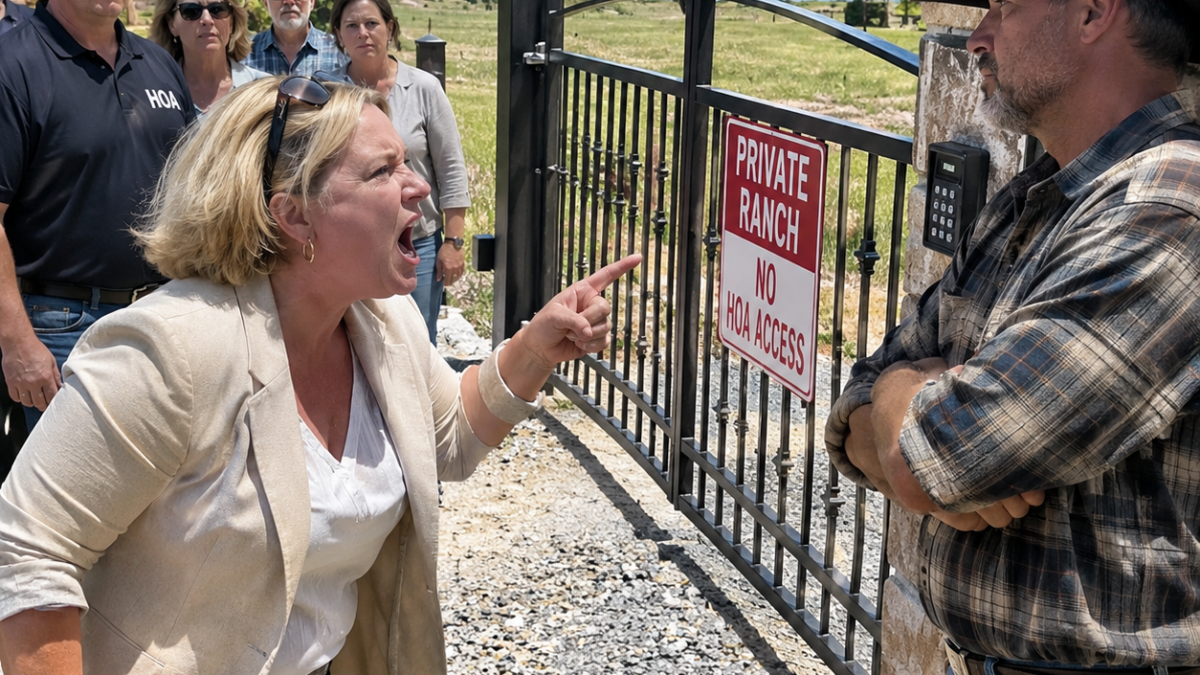
PART 2
I stared at my phone.
“Why?”
“I’m looking at the county plat right now.”
“And?”
“And the version Willowbrook has been relying on is incomplete.”
I walked farther down the gravel drive, turning my flashlight toward the road.
“Maxine, I need that in English.”
“The HOA doesn’t own the portion of access Cordelia keeps claiming authority over.”
I stopped.
“Who does?”
“You do.”
For several seconds, all I heard was the creek beyond the pasture.
Then I laughed.
Not because it was funny.
Because there are moments when reality becomes so ridiculous your brain reaches for the wrong reaction.
“You’re telling me she’s been threatening me over my own road?”
“Part of it, yes. But don’t get excited yet. I need a title company to confirm the old legal description, and we need to distinguish your private ranch access from the public section and the utility easements.”
“That sounded less exciting.”
“That’s because I’m a lawyer.”
I crouched near the iron marker.
The number 1943 had nearly disappeared under rust.
“What was this second marker for?”
“Probably the old ranch access boundary. Send me close-ups.”
I did.
She was quiet for almost a minute.
“Dex?”
“Yeah?”
“Did Bill ever mention Willowbrook residents using your land?”
“He said people sometimes walked the property edge. Joggers. Dog walkers.”
“Anything about vehicles?”
“No.”
“Trails?”
“No.”
“Developers?”
I thought about the last thing Bill had told me.
Don’t let anybody carve her up.
“No,” I said. “But I think I need to call him.”
I called the number on the purchase agreement.
Bill answered on the fourth ring.
His voice sounded tired but happy to hear from me.
“How’s the old place treating you?”
“Better than the neighbors.”
He sighed.
“Cordelia.”
“You know her well?”
“Well enough to move twelve hundred miles away.”
That answer made me straighten.
“Bill, why didn’t you tell me?”
“Tell you what?”
“That she’d been coming after the ranch.”
Silence.
Then I heard him exhale.
“I figured once the sale went through, she’d finally stop.”
“She thinks my property falls under her HOA.”
“It doesn’t.”
“I know that now.”
“She knows too.”
That landed harder.
“You’re sure?”
“Dex, I spent two years showing that woman the county maps.”
“Why?”
“Because she kept trying to get me to sign.”
“Sign what?”
Another silence.
“A development option.”
The flashlight felt suddenly heavier in my hand.
“What kind of development?”
“She said Willowbrook needed room for expansion.”
“How much room?”
“All of it.”
I looked over my forty-seven acres.
The moonlight caught the barn roof and the line of trees beyond it.
“All forty-seven acres?”
“That was the last offer.”
“How much?”
“First one was six hundred thousand. Then seven-fifty. Then nine.”
“You sold to me for three-eighty.”
“I wasn’t selling to her.”
“Bill.”
His voice hardened.
“My father was born in that house. My grandfather died in that house. Cordelia wanted to bulldoze the barn, channel the creek, cut the timber, and build a bunch of luxury boxes on top of it. I’d rather take less money from somebody who might keep the land intact.”
I rubbed my forehead.
“Why didn’t you put that in the disclosure?”
“Because a developer wanting your property isn’t a defect in the property.”
“You could have warned me.”
“You’re right.”
That was all he said.
No excuses.
Just those two words.
Somehow that took the heat out of me.
I sat on the split-rail fence.
“Was she harassing you too?”
“Noise complaints. Fence complaints. Agricultural nuisance complaints. She had people photographing the barn. Somebody reported me for keeping livestock illegally.”
“Did you have livestock?”
“Three chickens.”
I almost smiled.
“Dangerous operation.”
“Those birds were hardened criminals.”
Then his voice changed.
“She wore me down, Dex.”
That admission hurt more than the jokes helped.
“I was seventy-six. My wife had been gone four years. Every time a truck came up the lane, I wondered which agency she’d called. I stopped sleeping right. My blood pressure got bad. My daughter begged me to leave.”
“So you did.”
“Yeah.”
I looked toward the dark outline of Willowbrook.
“Did she know I was buying?”
“I don’t know. But once the deed recorded, she would.”
“She knew my name on moving day.”
Bill went quiet.
“Then she was watching the transfer.”
That night I barely slept.
The next morning, Maxine met me at the county records office.
She arrived carrying a legal pad, two coffees, and the expression of someone who had found a puzzle complicated enough to annoy her professionally.
“Drink this.”
I took the coffee.
“Bad news?”
“Complicated news.”
“That’s lawyer language for bad.”
“It’s lawyer language for stop interrupting me.”
We spent three hours pulling plats, deeds, subdivision maps, easements, and old survey records.
The history slowly took shape.
Meadowlark Lane had begun as a rural farm road decades before Willowbrook existed. The county had later accepted most of it into the public road system, but the final spur leading toward my ranch remained private.
Bill had allowed limited neighborhood use by permission.
Walking.
Jogging.
Occasional maintenance access.
That courtesy had gradually become something Willowbrook treated as an entitlement.
More important, my driveway entrance and the old ranch spur were clearly outside the HOA boundary.
Cordelia could regulate neither.
Maxine laid one document beside another.
“She has absolutely no authority over your barn.”
“Good.”
“Your fence.”
“Better.”
“Your driveway.”
“Excellent.”
“Your moving truck.”
“I may frame this page.”
“But.”
There was always a but.
“What?”
“Willowbrook has utility easements crossing a narrow portion of your frontage. You cannot obstruct authorized utility access.”
“I wasn’t planning to.”
“And emergency vehicles obviously need access.”
“Obviously.”
“So if you build a gate, it needs to preserve those rights.”
I looked at her.
“Who said anything about a gate?”
She smiled.
“You did just now.”
I thought about Cordelia walking onto my driveway with her clipboard.
About her taking pictures of Tyler.
About Bill spending two years being slowly pushed out of his own home.
A gate suddenly seemed less like construction and more like punctuation.
“Could I legally install one?”
“On your ranch entrance? Yes, assuming county setback and emergency-access rules are satisfied.”
“Could Cordelia order me to open it?”
“No.”
“Could her HOA?”
“No.”
“Could Willowbrook residents use my private drive because Bill used to let them?”
“Permission is not ownership.”
That sentence stayed with me.
Permission is not ownership.
I hired a local fabricator named Cal Evans.
I told him I wanted something sturdy, simple, and impossible to mistake for an invitation.
He came out with a measuring wheel and scratched his beard while looking at the entrance.
“What are we keeping out?”
“One HOA president.”
He nodded solemnly.
“Known to climb?”
“I hope not.”
“We should assume worst-case behavior.”
We settled on a steel sliding gate set well inside my property line, away from the public road. It had keypad access, remote access, a fingerprint reader for me, coded access for my kids, and a separate emergency mechanism approved by the local fire district.
No spikes.
No theatrics.
No electric fence.
Just a large, legal, undeniably private gate.
A small sign went beside it.
PRIVATE RANCH
NO THROUGH ACCESS
AUTHORIZED ENTRY ONLY
Tyler stared at it when he came out that weekend.
“This is because of Clipboard Lady?”
“Her name is Cordelia.”
“Clipboard Lady is better.”
Madison stepped up beside him.
“Can we change the code?”
“No.”
“Why?”
“Because you’ll make it something stupid.”
She looked offended.
“I was going to make it 6969.”
“Exactly.”
Tyler laughed so hard he nearly dropped his backpack.
For the first time since the divorce, the three of us stood together laughing without me feeling like I had to manufacture the moment.
That was what I had wanted when I bought the ranch.
Not acreage.
Not privacy.
That.
A place where being together felt natural again.
Cordelia arrived before dinner.
Of course she did.
Her Lexus stopped just outside the gate.
She sat inside for thirty seconds, apparently expecting it to open.
Then she honked.
Once.
Twice.
Five times.
I walked down from the house.
The gate remained closed.
She rolled down her window.
“Open this.”
“Good afternoon.”
“You’ve blocked community access.”
“I blocked my driveway.”
“Residents use this route.”
“They used it because Bill allowed them.”
“This is an established access corridor.”
“Not according to the county.”
“I have HOA maps.”
“I have county records.”
She got out.
Designer jacket.
Perfect hair.
Clipboard.
Always the clipboard.
“This gate violates Willowbrook architectural standards.”
“I’m not in Willowbrook.”
“It is visible from Willowbrook.”
“So are the mountains. Are you fining them too?”
Her nostrils flared.
“You think this is amusing?”
“No. I think it’s private property.”
She walked toward the keypad.
“Don’t touch that.”
She stopped.
“I need administrative access.”
“No.”
“As HOA president—”
“No.”
“You cannot deny me access while there are active community complaints against this property.”
“Watch me.”
She reached toward the keypad anyway.
The camera above the gate turned slightly, following her motion.
She noticed it.
Her hand froze.
“You’re recording me?”
“Yes.”
“You need consent.”
“You’re standing at my posted entrance.”
Her mouth tightened.
Then she leaned toward the camera.
“This is Cordelia Blackthorn, president of Willowbrook Estates. I am documenting an unlawful obstruction of established community access.”
I folded my arms.
“You done?”
“No.”
She looked at me.
“This won’t stay here.”
“I’m pretty sure Cal used concrete.”
Her face went red.
Then she pointed at the gate.
“You’ll remove this within seventy-two hours.”
“Send me the order.”
“I will.”
“From the county, not your HOA.”
She got back into her Lexus.
Before leaving, she lowered the window.
“You have no idea what kind of trouble you’re creating for yourself.”
I watched her drive away.
At the time, I thought the gate had solved the problem.
What it really did was reveal how serious the problem had always been.
The first complaint arrived the next morning.
County planning.
Anonymous report alleging an unpermitted security structure.
I already had the permit.
The inspector looked at it, measured the setback, checked the emergency-access equipment, and shrugged.
“Looks fine.”
“Can I get that in writing?”
He smiled.
“You’ve met your neighbor.”
“Apparently everybody has.”
He signed the inspection.
That afternoon came another complaint.
Fire access.
The fire marshal confirmed compliance.
Then traffic obstruction.
A deputy drove out, took one look at the gate sitting fully inside my property, and left.
Then drainage.
Then wildlife impact.
Then an allegation that the gate created an “unsafe visual distraction.”
That one made even Maxine laugh.
“Unsafe visual distraction?”
“Apparently steel causes accidents now.”
“Keep every notice.”
“I have a folder.”
“Make two.”
My software background had trained me to distrust any system without redundancy.
So I stopped treating Cordelia’s harassment like a neighborhood argument and started treating it like a data problem.
Every complaint got scanned.
Every visit got logged.
Every camera clip was timestamped and copied to two encrypted drives.
Every interaction went into a spreadsheet.
Date.
Time.
Agency.
Complaint.
Outcome.
Known Cordelia involvement.
By the end of the second week, the pattern was obvious.
Seven complaints.
Seven inspections.
Zero violations.
Then Jimmy, the postal carrier, gave me the first glimpse of how deep Cordelia’s reputation went.
He was putting mail into my roadside box when I walked down.
“New guy.”
“That’s me.”
“You surviving?”
“Depends what you mean by surviving.”
He nodded toward Willowbrook.
“Cordelia.”
“Is there a club?”
“More like a support group nobody admits exists.”
I leaned against the fence.
“What did she do before me?”
Jimmy hesitated.
Postal workers hear everything and repeat almost none of it.
Then he said, “You remember the Kowalski place on Juniper?”
“I don’t know anybody here yet.”
“Single mother. Three kids. Bright plastic toys in the front yard.”
“Okay.”
“Cordelia cited her over and over. Toys. Grass. Visitors. Parking. Noise. Eventually the woman sold.”
“Was she actually breaking rules?”
“Some, probably. Everybody breaks something eventually if somebody watches hard enough.”
That sentence bothered me.
Jimmy continued.
“Veteran on Alder had a service dog. Complaints about aggressive animal behavior every week.”
“Was it aggressive?”
“Dog was old enough to qualify for Social Security.”
I frowned.
“Anybody challenge her?”
“A few.”
“What happened?”
“They moved.”
After Jimmy left, I drove into town.
Martinez Hardware smelled like lumber, fertilizer, and old coffee.
I was standing in the battery aisle comparing camera power packs when a man beside me said, “You’re Morrison.”
I looked over.
Late thirties.
Work boots.
Flannel shirt.
Hands scarred from actual labor.
“Depends.”
He grinned.
“Javier Gonzalez.”
We shook hands.
“You’re the ranch guy.”
“I’m starting to feel like I should put that on a business card.”
“You’re the ranch guy Cordelia hates.”
“More specific.”
He laughed.
“Coffee?”
Ten minutes later we were sitting in a diner where the coffee tasted as if it had been passed down through generations.
Javier stirred his without drinking it.
“She fined me five hundred bucks for my work truck.”
“What was wrong with it?”
“Too ugly.”
I waited.
“That was basically the reason.”
“You’re serious.”
“‘Commercial appearance inconsistent with residential character.’”
“What did you do?”
“Fought it.”
“And?”
“Won after four months.”
He looked out the window.
“My cousin works for the landscaping company that handles Willowbrook common areas. They haven’t been paid in four months.”
“Then why are they still working?”
“They’re not. Cordelia told the board they’re behind because of staffing problems.”
I frowned.
“What does the budget say?”
“That’s the interesting part.”
He leaned closer.
“Payments are still listed.”
“To the landscaping company?”
“Every month.”
“You sure?”
“My cousin showed me invoices they never got paid.”
The coffee suddenly tasted worse.
“You think Cordelia is stealing?”
Javier lifted both hands.
“I think accounting is above my pay grade.”
“But?”
“But if somebody is sending money somewhere and the company it belongs to isn’t receiving it, I’d ask where it went.”
That night I searched public records.
Not hacking.
Not breaking into anything.
Just public documents.
Business registrations.
Property transfers.
Campaign contributions.
Planning commission minutes.
Corporate filings.
Cordelia’s name appeared more often than I expected.
So did another name.
Meadowlark Development LLC.
The company had been formed three years earlier.
Its registered address matched a commercial office used by Cordelia’s husband, Drake.
I stared at the screen.
Development.
Bill’s warning returned.
Don’t let anybody carve her up.
I searched county planning records for Meadowlark Development.
One result appeared.
A preliminary inquiry for a residential expansion near Willowbrook.
Location withheld pending land acquisition.
Proposed units: forty.
I sat back slowly.
Forty homes.
Forty-seven acres.
The numbers weren’t proof.
But they were enough to make me uncomfortable.
The next morning, Cordelia’s harassment became personal.
I was drinking coffee on my porch when the Lexus rolled up.
The gate stopped her.
She honked once.
I did not move.
Eventually she got out and walked to the pedestrian side.
“Dex.”
“Cordelia.”
“I want to speak privately.”
“You are speaking privately.”
She looked at the camera.
“Without that.”
“No.”
Her jaw tightened.
Then she changed tactics.
“I know you’re under financial pressure.”
I almost laughed.
“What?”
“Divorce is expensive.”
My coffee cup stopped halfway to my mouth.
“You’ve been looking into me.”
“You moved next to two hundred families. We have a responsibility to know who you are.”
“No, you don’t.”
“You’re unemployed.”
“I’m consulting.”
“You’re living on inherited money.”
I stood.
“You need to leave.”
“And you have a shared custody agreement.”
My stomach tightened.
“What did you say?”
She smiled.
Not warmly.
“Children need stability.”
“Get off my property.”
“I’m not on your property.”
She stood outside the gate.
Technically true.
That made it worse.
“Cordelia.”
“Do you really think a judge would consider a forty-seven-acre property under repeated code investigation a suitable environment?”
The cup in my hand trembled.
Very slightly.
She saw it.
Her smile deepened.
“You don’t get to talk about my kids.”
“Then stop creating problems.”
I walked toward the gate.
Not fast.
Not threatening.
But enough that she took one step back.
“You listen carefully. You can complain about my fence. You can complain about my barn. You can waste every inspector’s time in Oregon if that’s what makes you happy. But you photograph my children, contact their school, interfere with custody, or use them to threaten me again, I will put every second of this campaign in front of a judge.”
Her eyes sharpened.
“Is that a threat?”
“No.”
I pointed toward the camera.
“That’s a promise to document you.”
For the first time, she had no quick reply.
She turned and left.
That afternoon I called my ex-wife, Erin.
We had spent the last year learning how to speak to each other without reopening every wound from our marriage.
Some days we succeeded.
Some days we didn’t.
“I need to tell you something before you hear it from anyone else.”
Her voice immediately changed.
“Are the kids okay?”
“Yes.”
“What happened?”
I explained Cordelia.
The complaints.
The background research.
The custody comment.
Erin was quiet for a long time.
Then she said, “You bought a ranch next to a crazy HOA woman.”
“That’s the short version.”
“Dex.”
“I know.”
“You promised me the ranch would be calmer.”
“I believed that.”
“Are Tyler and Madison safe there?”
“Yes.”
“You’re sure?”
I looked toward the gate.
“Yes.”
Another pause.
“If that changes, you tell me immediately.”
“I will.”
“I mean immediately.”
“I know.”
Then something unexpected happened.
She said, “For what it’s worth, the kids haven’t stopped talking about the place.”
I sat down.
“Good things?”
“Tyler wants a dirt bike.”
“No.”
“Madison says the barn should become an art studio.”
“Also no.”
Erin laughed.
It had been months since I’d heard her laugh with me instead of at something one of the kids had done.
Then she grew serious.
“Don’t let some stranger drag us back into court.”
“I won’t.”
But after we hung up, I sat alone on the porch.
That was when Cordelia’s strategy finally made sense emotionally.
She wasn’t trying to prove I had done something wrong.
She was trying to make my life so exhausting that selling became relief.
It had worked on Bill.
Probably on others.
The gate had not stopped her.
It had only forced her to attack from farther away.
So I added cameras.
Not dozens.
Enough.
The front gate.
Barn.
House.
Well.
Creek crossing.
Driveway.
Backup units hidden where anyone targeting the obvious cameras wouldn’t notice.
I told Tyler and Madison why.
Tyler frowned.
“Are we in danger?”
“No.”
“Then why are there cameras everywhere?”
“Because somebody is lying about what happens here.”
Madison crossed her arms.
“That sounded like a yes.”
She had inherited Erin’s ability to hear the sentence underneath the sentence.
“I don’t think anybody is going to hurt you.”
“You don’t think?”
I sat with them at the kitchen table.
“I’m not going to pretend this woman is harmless. She’s harassing me. I’m dealing with it legally. If either of you ever feels uncomfortable here, you tell me.”
Tyler looked toward the window.
“Can she get through the gate?”
“No.”
Madison asked, “Can we?”
“Yes.”
“Then I vote we keep it.”
That night I changed their access codes anyway.
Week four began with surveillance.
Not hidden surveillance.
Ridiculous surveillance.
A gray sedan parked across from my ranch for six hours.
The next day, a blue SUV replaced it.
The day after that, a pickup.
Every vehicle belonged to a Willowbrook board member.
They sat there with phones, binoculars, notepads.
One photographed me carrying lumber into my barn.
Another timed how long my workshop lights stayed on.
I eventually walked down to the road with a lawn chair and sat facing them.
The man in the pickup lowered his binoculars.
I waved.
He drove away.
Javier nearly fell out of his truck laughing when I told him.
“Cordelia calls it the Community Safety Patrol.”
“You’re joking.”
“Nope.”
“What are they protecting the community from?”
“You.”
“I write software.”
“Terrifying.”
By then, Maxine had filed a formal notice demanding the HOA cease representing that it had jurisdiction over my ranch.
She also sent documentation to the county establishing that every inspection so far had found no violation.
Then we filed a harassment report.
Deputy Luis Martinez came to the ranch.
No relation to the hardware store.
He was in his fifties, broad-shouldered, patient, and carried the tired expression of a man who had already heard too many adults behave like children over property lines.
I handed him a binder.
He flipped through it.
Then another.
“You made an index.”
“I’m a software engineer.”
“That doesn’t explain the tabs.”
“I like tabs.”
He looked through the inspection reports.
“Seven complaints?”
“Nine now.”
“Same person?”
“Mostly anonymous.”
“But you believe Mrs. Blackthorn.”
“I have recordings of her threatening more complaints.”
He watched several clips.
Then he looked toward Willowbrook.
“I’ll speak with her.”
“Will it matter?”
“It creates a record.”
That phrase again.
A record.
Records were not satisfying.
They did not slam doors.
They did not make bullies disappear.
But records survived arguments.
Martinez visited Cordelia that afternoon.
My gate camera caught her returning two hours later.
She did not knock.
She stood outside the gate and stared at the camera.
Then she smiled.
That frightened me more than the shouting.
The following Friday, I understood why.
Tyler and Madison were due at four.
At three-thirty, my gate camera alerted.
Cordelia’s Lexus stopped outside.
She walked to my mailbox.
Opened it.
Then slipped something inside.
I was already on my way down.
“Step away from my mailbox.”
She turned.
“Relax.”
“Don’t touch my mail.”
“It’s information.”
She held up an envelope.
“What information?”
She pushed it through a gap beside the gate.
It landed on the gravel.
“I think you should understand your vulnerabilities.”
My stomach dropped before I opened it.
Copies of my divorce filing.
Custody schedule.
School information.
Photographs.
Tyler getting out of Erin’s car.
Madison walking toward my porch.
One picture had been taken outside their school.
I looked up slowly.
Cordelia was still smiling.
“How did you get these?”
“Public records are remarkably accessible.”
“The photographs aren’t public records.”
“Concerned residents notice things.”
My hands tightened around the envelope.
“What do you want?”
“Cooperation.”
“Say what that means.”
“Remove the gate. Withdraw your attorney’s complaint. Allow the community access that existed before you arrived.”
“And then?”
“Then perhaps these concerns about the suitability of the property don’t need to go any further.”
I stared at her.
“Are you threatening to call child protective services?”
“I’m saying agencies exist for a reason.”
Behind her, I saw Erin’s SUV turning onto Meadowlark Lane.
My chest tightened.
“Leave.”
Cordelia looked over her shoulder.
She saw the kids.
Then she smiled at me one last time.
“Think carefully, Dex.”
She got into her Lexus and drove away before Erin reached the gate.
I shoved the envelope under my jacket.
Too late.
Madison had seen my face.
“What happened?”
“Nothing you need to worry about.”
She looked at me.
“Dad.”
Erin got out.
“Dex?”
I could have hidden it.
Maybe that was the version of me that had helped ruin my marriage—the man who thought protecting people meant deciding which truths they could handle.
Instead, I showed Erin.
She went through the photographs.
Her face changed.
Not fear.
Fury.
“She photographed them at school?”
“Yes.”
“You called the police?”
“Doing it now.”
Erin looked toward Willowbrook.
“I’m not sending them back here tonight.”
That hurt.
I knew it was reasonable.
Still hurt.
Tyler looked at her.
“Mom.”
“No.”
“We’re fine.”
“You don’t know that.”
Madison folded her arms.
“I want to stay.”
“This isn’t a vote.”
“It’s my weekend with Dad.”
“It’s my job to keep you safe.”
I stood there listening to my family fracture along familiar fault lines, and Cordelia wasn’t even present.
That was what she was good at.
She didn’t need to defeat people directly.
She only needed to find an existing crack and push.
I looked at Erin.
“You’re right.”
All three of them stared at me.
“What?” Erin asked.
“Take them tonight.”
Tyler’s face fell.
“Dad.”
“Just tonight. Until Martinez sees this.”
I hated saying it.
But anger was not the same thing as judgment.
Tyler kicked the gravel.
Madison wouldn’t look at me.
Erin quietly said, “Thank you.”
Their SUV disappeared down the lane.
I stood behind the locked gate after they were gone.
For the first time since moving to the ranch, the place felt too big.
I called Martinez.
Then Maxine.
Then I went inside and copied every image Cordelia had given me.
By sunrise, I had made a decision.
I was done reacting.
I was going to find out what she wanted.
The easiest place to begin was money.
Meadowlark Development LLC.
Public corporate records gave me an address.
Business filings gave me names.
Planning records gave me parcel references.
I spent the next two nights building a timeline.
Not breaking into private systems.
Just connecting information anybody could obtain if they had patience.
Cordelia’s husband, Drake Blackthorn, had business ties to a development consultant.
That consultant appeared in meeting minutes connected to a proposed forty-home expansion.
The proposed access concept depended on land matching the shape of my ranch.
Then I found Cordelia’s own name.
Not front and center.
Buried in an amended business filing connected to Meadowlark Development.
She held an ownership interest through another entity.
I called Maxine.
It was 5:40 in the morning.
She answered after five rings.
“Somebody better have confessed.”
“I think Cordelia has money in the company trying to acquire my ranch.”
Silence.
“Send me what you found.”
I did.
She called back twenty minutes later.
“That doesn’t prove illegal conduct.”
“I know.”
“But it proves she has a personal financial interest.”
“I know.”
“And she never disclosed that while using HOA resources against you.”
“That’s what I’m thinking.”
“Stop saying ‘I know.’”
“I know.”
She hung up.
By noon she had requested public planning records.
That same day, Javier called.
“You free?”
“Not really.”
“Get free.”
We met at the diner.
He slid photocopies across the table.
Landscaping invoices.
Monthly payments listed in HOA records.
The vendor names were slightly different from the actual landscaping company.
One letter.
Then another.
A suffix.
A changed address.
Money that looked as if it went to Willowbrook Grounds Maintenance actually went to Willowbrook Grounds Management LLC.
“Who owns this one?” I asked.
Javier shrugged.
“I figured that was your department.”
It took Maxine less than an hour.
The second company traced through a chain of registrations to an address associated with Cordelia’s brother.
My skin prickled.
“How much?”
“Forty-seven thousand over fourteen months.”
“That’s just landscaping?”
“So far.”
I leaned back in Maxine’s office.
“She’s stealing from them.”
“Maybe.”
“Come on.”
“She may be. But ‘looks terrible’ and ‘provable embezzlement’ are not the same sentence.”
“What do we do?”
“We don’t accuse her publicly yet.”
“Why?”
“Because people who think they’re being watched become careful.”
“And?”
“People who think nobody understands what they’re doing keep making mistakes.”
That was the hardest part.
Waiting.
Cordelia made it easier by becoming reckless.
Two nights later, my front gate was spray-painted.
I woke at 2:51 a.m. to a motion alert.
The main camera showed a figure in black standing on a small ladder.
Spray can in hand.
Mask over the lower half of the face.
For a moment, I could not tell who it was.
Then the person turned toward the driveway light.
Cordelia.
She pulled the mask down to wipe sweat from her mouth.
Full face.
High definition.
I sat in bed staring at the screen.
There was something surreal about watching a woman who spent her life preaching community standards vandalize private property in the middle of the night.
She painted one word across the steel.
LEAVE.
I saved the video.
Then I called Martinez.
He arrived before sunrise.
Cordelia was still home when he went to Willowbrook.
This time he did not merely warn her.
He cited the incident, documented the damage, and made it clear another trespass or act of vandalism could lead to arrest.
By noon, the whole neighborhood knew.
By dinner, Cordelia was at my gate again.
She did not shout.
She stood six feet back.
“You embarrassed me.”
I looked through the steel bars.
“You painted my gate.”
“You could have called me.”
“At three in the morning?”
“You knew what I meant.”
“No. I really don’t.”
She stepped closer.
“Withdraw the complaint.”
“No.”
“I’ll pay for the paint.”
“No.”
“You’re enjoying this.”
I thought about Bill.
My kids.
The photographs.
“No.”
“You think you’re morally superior.”
“No.”
“You think because you have cameras you control the story.”
“No.”
That finally broke her rhythm.
“What do you want?”
“You to leave me alone.”
“That’s not possible.”
“Why?”
Her face went still.
For one second, I thought she might actually answer.
Instead, she said, “Because your property affects the future of this community.”
There it was.
The closest she had ever come.
“What future?”
She smiled faintly.
“You’ll find out.”
Then she left.
Maxine found out first.
She called me the next day.
“I’ve got the planning file.”
“And?”
“Meadowlark Development’s conceptual plan covers forty residential lots, a private recreational corridor, and a connection to Willowbrook.”
“Across my land.”
“Almost all of it.”
My mouth went dry.
“How old is the plan?”
“Eighteen months.”
“Bill owned the ranch then.”
“Yes.”
“Did he authorize it?”
“No.”
“Can they plan on land they don’t own?”
“They can sketch whatever fantasy they want. They can’t build without acquiring rights.”
“Cordelia expected to acquire it.”
“That appears likely.”
I remembered the gate.
The complaints.
The custody threat.
The surveillance.
She wasn’t trying to make me conform.
She was trying to make me sell.
“How much money is she in for?”
“We don’t know.”
“Can we find out?”
“Legally.”
“Obviously.”
“You say that now.”
I rubbed my eyes.
“Maxine.”
“I’m working on it.”
That evening I sat by the creek.
No laptop.
No phone.
Just water moving over stones.
The ranch was worth more than what I had paid.
Maybe much more.
I could sell.
Take the profit.
Buy another property far away from Willowbrook.
Erin would probably be relieved.
The kids would adapt.
Cordelia would get what she wanted.
The thought was not cowardly.
Sometimes walking away is intelligent.
Then I pictured Bill handing me the keys.
Don’t let anybody carve her up.
I pictured Tyler and Madison laughing at the gate.
I pictured forty nearly identical houses covering the pasture.
And I realized something uncomfortable.
I cared about the place now.
Not because I had owned it long.
Because it was the first decision I had made after my divorce that felt like building instead of recovering.
I wasn’t ready to let somebody turn that into another thing I had failed to keep.
So I stayed.
And three days later, Cordelia crossed a line none of us could pretend was administrative.
My well alarm went off just after midnight.
I had installed a simple motion sensor near the wellhead after the vandalism.
The camera feed showed three figures approaching from the tree line.
Cordelia was one of them.
The other two carried containers.
I called 911 before I left the house.
Then I watched.
They opened the well enclosure.
One of the men began pouring something into the system.
I felt every part of me go cold.
That well supplied the house.
Tyler drank from it.
Madison filled her water bottle from it.
Cordelia stood beside the men, pointing toward the opening.
I did not go outside.
I wanted to.
God, I wanted to.
Instead, I stayed on the phone.
Deputies arrived seven minutes later.
The three figures ran.
One man made it to the woods.
The other tripped near the creek.
Cordelia escaped in a vehicle waiting beyond the north boundary.
The deputy who reached the well smelled the chemical and immediately backed away.
“Don’t touch anything.”
I didn’t.
The fire department came.
Then county environmental personnel.
Then state investigators.
I spent the rest of the night sitting on my porch while strangers in protective gear moved around the property.
At five in the morning, I called Erin.
“You need to keep the kids away.”
She heard my voice.
“What happened?”
“Somebody tampered with the well.”
“Cordelia?”
“It’s on camera.”
The silence on the other end lasted long enough to hurt.
Then Erin whispered, “Jesus Christ.”
“I’m sorry.”
“Stop apologizing.”
“What?”
“You didn’t do this.”
That was the first time since the divorce that she had said those words to me.
You didn’t do this.
I closed my eyes.
The well was taken out of service.
We switched to bottled water.
Tests later confirmed contamination by a toxic herbicidal chemical.
The levels and circumstances turned the incident from vandalism into something much more serious.
Martinez stood with me beside the gate while investigators photographed tire tracks.
“This changes everything,” he said.
“I keep hearing that.”
“This time it actually does.”
One of the fleeing men was identified.
His name was Aaron Pike.
He worked for a development contractor connected to Meadowlark Development.
The second vehicle belonged to Bradley Fleming, a Millfield city councilman.
I stared at Martinez when he told me.
“A councilman?”
“Vehicle registration doesn’t prove he was present.”
“But his car was.”
“Yes.”
“Why?”
“That’s what investigators are going to find out.”
I called a reporter named Rosa Martinez.
No relation to Luis.
She worked for the Portland Tribune and had written about land-use corruption.
I had been reluctant to involve media.
Now reluctance felt like stupidity.
Rosa arrived with a recorder, laptop, and the kind of focus that made me understand why politicians disliked her.
She listened without interrupting.
Then she asked to see the planning records.
The invoices.
The harassment timeline.
The gate footage.
The well footage.
When she finished, she closed her notebook.
“This isn’t an HOA story.”
“I figured that out.”
“This is potentially a development-corruption story.”
“So what happens now?”
“I verify everything.”
“That’s it?”
“That’s how reporting works.”
I laughed despite myself.
“You and Maxine would get along.”
“I know Maxine.”
Of course she did.
Within four days, Rosa found a connection I had missed.
Bradley Fleming had repeatedly voted for zoning decisions benefiting companies associated with Drake Blackthorn and Meadowlark Development.
Drake and Bradley also played in a private poker group.
That did not prove bribery.
Then financial investigators found debt records.
Bradley owed Drake money.
A lot of money.
Fifty thousand dollars according to records Rosa later obtained.
The pattern sharpened.
Permits moved faster for Meadowlark-connected projects.
Complaints against targeted property owners moved faster too.
One building inspector who had visited my ranch repeatedly had received a consulting payment from a company connected to the development network.
Fifteen thousand dollars.
My stomach turned when Maxine told me.
“So the inspections weren’t just Cordelia being annoying.”
“Not all of them.”
“They were trying to build a record against the property.”
“That’s what it looks like.”
“Why?”
“To make acquisition easier. Maybe to justify enforcement. Maybe to pressure you. Maybe all three.”
I thought about Bill.
“How many people before me?”
Rosa answered that question.
Twelve.
Over ten years, twelve owners connected to properties useful for development had faced unusual clusters of complaints, enforcement actions, financial pressure, or HOA conflict.
Not all lived in Willowbrook.
Some belonged to neighboring communities.
A widow who sold a Victorian home below market value after months of nuisance complaints.
A Black veteran whose service dog became the subject of repeated reports.
A Hispanic contractor cited constantly over his work vehicle.
A single mother hit with child welfare complaints.
An Asian food-truck owner named Martha Tatum who had spent two years fighting questionable health and parking complaints.
I met them one by one.
The first real meeting happened in my barn.
Javier came.
Rosa.
Maxine.
Martha.
Janet Kowalski, the single mother Jimmy had mentioned.
Tom Avery, the veteran.
Eight others.
I stood near Uncle Rusty’s old workbench while everybody talked.
At first, the stories came slowly.
People were embarrassed.
That surprised me.
They had been targeted, yet they talked as if they had failed.
Martha went first.
“She makes you think you’re the only problem.”
She was in her late forties, energetic, sharp, and owned a Korean-Mexican food truck that had become locally famous.
“She filed health complaints every week,” Martha continued. “Every inspection passed. But customers see inspectors and assume something is wrong.”
Janet nodded.
“That’s how it starts.”
“What happened to you?” I asked.
Janet’s eyes dropped.
“My kids had toys in the front yard.”
I waited.
“That’s it?”
“At first.”
Then came noise complaints.
Parking.
Visitors.
Trash-bin placement.
Anonymous claims about supervision.
Finally child welfare.
Her voice broke.
“I started putting my children to bed wondering whether somebody would knock on the door and take them.”
No one spoke.
I knew that fear now.
Tom rubbed his hands together.
“My dog was trained for PTSD.”
He was a former Marine in his sixties.
“Cordelia would stand outside the fence and trigger him deliberately. Then she’d report him for aggression.”
I felt anger rise.
Not hot anymore.
Cold.
Useful.
“Why didn’t everybody fight together?”
Martha laughed once.
“Because we didn’t know there was an everybody.”
That became the turning point.
Cordelia’s power had depended on isolation.
So we stopped being isolated.
We shared documentation.
Legally.
Carefully.
No vigilante nonsense.
No threats.
No harassment.
Maxine made that rule explicit.
“If anybody in this room is thinking about revenge involving property damage, anonymous threats, illegal access to records, or showing up at Cordelia’s house, leave now.”
Nobody moved.
“Good,” she said. “Because the strongest case is one she builds against herself.”
The investigation grew.
State environmental investigators took the well incident.
Financial investigators examined the HOA accounts.
The state attorney general’s office began reviewing development transactions.
Federal authorities became interested because money and communications crossed state lines.
Rosa kept reporting.
Not everything.
Not yet.
She held parts until she could independently verify them.
That frustrated me.
It also made her stories devastating when they finally appeared.
The first headline did not mention Cordelia by name.
**LANDOWNERS DESCRIBE YEARS OF PRESSURE AROUND MILLFIELD DEVELOPMENT PROJECTS**
The article included public records.
Inspection patterns.
Property transfers.
Shell companies.
Former homeowners.
Within twenty-four hours, three more families contacted Rosa.
Then seven.
Then contractors.
Then former HOA board members.
One board member produced emails.
Cordelia had described certain properties as “obstacles.”
Another email referred to owners as “resistance cases.”
A third discussed “creating sufficient compliance pressure to encourage voluntary market exit.”
I read that line three times.
Voluntary market exit.
That was how she described making people miserable until they sold.
The phrase was so sterile it made me sick.
Cordelia responded publicly.
She called Rosa’s reporting “an attack on community governance.”
She called me “a disgruntled outsider.”
She said the well incident was fabricated.
Then she claimed my gate endangered emergency access.
That last accusation was disproved by the fire district’s own permit.
Still, she kept going.
Every morning at six, her Lexus appeared outside the gate.
She parked on the public shoulder and stared.
Sometimes she took photographs.
Sometimes she just sat.
I stopped going down.
The gate did what it was designed to do.
She could watch.
She could rage.
She could not enter.
One night, around 11:30, I woke to a notification.
Gate camera.
Cordelia.
Alone.
She stood outside in sweatpants and a coat, hair unbrushed.
No clipboard.
No makeup.
She entered random numbers into the keypad.
Rejected.
Again.
Rejected.
She tried pulling the gate.
Nothing.
Then she slammed both palms against the steel.
“Dex!”
I watched from my bedroom monitor.
“Dex!”
She hit it again.
“You cannot lock me out!”
The absurdity of that sentence almost made me laugh.
She was outside my gate.
On my property line.
Screaming that I could not lock her out.
I activated the intercom.
“Go home, Cordelia.”
Her head snapped toward the camera.
“Open this gate.”
“No.”
“We need to talk.”
“Call my attorney.”
“This is between you and me.”
“No. It stopped being between you and me when you messed with my well.”
Her face twisted.
“I didn’t touch your well.”
“I have video.”
“Fake video.”
“Then explain it to investigators.”
She stepped closer to the camera.
“You think you won?”
“I think it’s midnight.”
“You have no idea what’s coming.”
“Then send it through Maxine.”
She screamed.
Not words at first.
Just raw frustration.
Then came threats.
The gate would be removed.
The ranch would be condemned.
The county would take it.
My custody would be challenged.
She would make sure I never worked in Oregon again.
For three hours she returned to the gate, left, came back, called from blocked numbers, pounded on the steel.
I saved everything.
At 2:17 a.m., she finally left.
Tyler had been awake.
He came downstairs.
“You okay?”
“I’m supposed to ask you that.”
“I’m not the one she hates.”
I sat at the kitchen table.
“She doesn’t know me well enough to hate me.”
“She hates that you won’t do what she says.”
“That’s probably closer.”
He pulled out a chair.
“Mom thinks we should stop coming here.”
That hurt more than I expected.
“Did she say that?”
“She didn’t have to.”
I looked at my son.
He was sixteen.
Almost as tall as me.
Still a kid in ways he would have hated me saying.
“What do you think?”
“I think if we stop coming, Cordelia gets what she wants.”
“This isn’t your fight.”
“Maybe not.”
He looked around the kitchen.
“But this is my home too.”
I had to turn away for a second.
When I bought the ranch, I had worried my kids would see it as Dad’s desperate post-divorce project.
Tyler had just called it home.
Cordelia had spent weeks trying to take things from me.
Without meaning to, she had shown me what I had actually gained.
The next escalation came from City Hall.
Mayor Patricia Hendricks called personally.
“Dex, I need you to hear something from me before the notice arrives.”
“What?”
“There’s an emergency eminent-domain proposal involving your property.”
I stood so quickly the chair tipped.
“What?”
“A council member submitted a request claiming part of the ranch is required for public infrastructure and environmental protection.”
“Bradley Fleming.”
She did not answer.
That was answer enough.
“What infrastructure?”
“They’re alleging water contamination risk, roadway safety issues, and potential utility expansion.”
“My well was contaminated because somebody poisoned it.”
“I know.”
“Now they’re using the contamination against me?”
“I know.”
I paced the kitchen.
“Can they take the ranch?”
“Not overnight.”
“But?”
“There’s an emergency hearing Friday.”
“Friday is two days away.”
“I know.”
“Why so fast?”
“That is one of the questions I intend to ask.”
I called Maxine.
She swore.
I had never heard her swear.
That frightened me.
“They’re trying to create momentum,” she said.
“Can you stop it?”
“I can file for emergency relief if necessary. But the best defense is daylight.”
“Meaning?”
“Everybody sees what they’re doing.”
Rosa’s next article went live Thursday morning.
**MILLFIELD COUNCIL TO CONSIDER EMERGENCY TAKING OF LAND AT CENTER OF CORRUPTION INVESTIGATION**
By lunchtime, the story was everywhere locally.
By evening, the community center’s thirty chairs were clearly not going to be enough.
Then Cordelia made the mistake that ended any remaining chance of controlling the narrative.
At 11:06 Thursday night, my barn sensors triggered.
Three figures entered from the wooded side.
One was Cordelia.
The other two carried fuel containers.
I did not confront them.
I called 911.
Then I watched from the house.
They moved around the barn foundation.
One man poured liquid along the wall.
Cordelia kept looking toward the driveway.
My visible camera over the barn door had gone dark.
They thought they were unrecorded.
The hidden backup camera saw everything.
So did the thermal unit farther up the hill.
Sirens appeared within minutes.
The men ran.
Cordelia tried to reach a vehicle.
Deputies intercepted her before she got there.
I stood behind the gate while they placed her in handcuffs.
For the first time since I met her, Cordelia did not look angry.
She looked stunned.
As if consequences were something that happened to other people.
Martinez walked toward me.
“You all right?”
I looked at the barn.
At the fuel.
At Cordelia sitting in the back of a patrol vehicle.
“I don’t know.”
That was the truth.
I had imagined her being arrested.
In those angry moments after the photographs of my kids, I had imagined it feeling satisfying.
It didn’t.
I mostly felt tired.
The next morning, the eminent-domain hearing was still scheduled.
Maxine thought it would be canceled.
Mayor Hendricks refused.
“No,” she told us. “The public deserves the record.”
By six-thirty Friday evening, one hundred eighty-four people had packed into the Millfield Community Center.
More stood outside.
Martha parked her food truck in the lot.
Javier brought folding chairs.
Rosa’s newsroom livestreamed the meeting.
Three television crews arrived.
I sat in the second row between Tyler and Madison.
Erin sat on Madison’s other side.
That surprised me.
“You didn’t have to come.”
“Yes, I did.”
“You hate public meetings.”
“I hate this woman more.”
Madison whispered, “Mom.”
“What?”
“Indoor voice.”
Despite everything, I smiled.
Cordelia entered just before seven.
She had been released pending formal proceedings related to the attempted arson investigation.
Her lawyer walked beside her.
She wore a navy suit.
Hair perfect again.
Face composed.
For one second, I saw why she had controlled people for so long.
She knew how to look legitimate.
Mayor Hendricks called the meeting to order.
“We are here to consider a request for emergency acquisition authority relating to a portion of the Morrison Ranch.”
Cordelia sat behind Bradley Fleming.
The councilman avoided looking toward the crowd.
The city attorney began reading the stated concerns.
Environmental risk.
Unsafe water conditions.
Road-access conflicts.
Possible public utility needs.
Each one had been created, exaggerated, or manipulated through the same network now under investigation.
Maxine leaned toward me.
“Wait.”
“For what?”
“You’ll know.”
Bradley Fleming spoke first.
“This is not about any individual homeowner. This is about protecting the public.”
Someone in the crowd laughed bitterly.
The mayor banged her gavel.
Bradley continued.
“The property in question has been the subject of repeated safety complaints—”
“Most unfounded,” Mayor Hendricks interrupted.
Bradley stiffened.
“The volume of complaints itself demonstrates ongoing instability.”
That sentence did it.
Janet Kowalski stood.
“So if somebody files enough fake complaints, you can take the victim’s land?”
Applause erupted.
The mayor called for order.
Bradley’s face reddened.
Cordelia leaned toward him and whispered.
Rosa stood in the press area.
“Madam Mayor.”
“Yes?”
“For the record, has the council been informed that Mrs. Blackthorn was arrested last night in connection with an alleged attempt to set fire to structures on the property now being described as a public hazard?”
The room exploded.
Cordelia shot to her feet.
“That is false.”
Her lawyer grabbed her arm.
She pulled away.
“You cannot repeat defamatory allegations in a public proceeding.”
Rosa’s expression did not change.
“I have the arrest record.”
Cordelia looked toward the cameras.
Then toward me.
“You did this.”
I didn’t answer.
The mayor struck the gavel again.
“Mrs. Blackthorn, sit down.”
“This entire meeting is a setup.”
“Sit down.”
“I built this community.”
The room went quiet.
There it was.
Not “served.”
Not “represented.”
Built.
Ownership.
Control.
The same thing she had tried to claim over my ranch.
A man in a dark suit stood from the back row.
“Mayor Hendricks?”
“Yes?”
He identified himself as an investigator with the Oregon Department of Justice.
Another man beside him represented an environmental enforcement unit.
Neither made dramatic speeches.
That made the moment more powerful.
They simply confirmed there were active investigations into financial misconduct, public corruption, development-related fraud, and the contamination of my well.
Cordelia’s face lost color.
Bradley Fleming leaned back in his chair.
Then the investigator said, “Councilman Fleming, we would ask that you remain after the meeting.”
Bradley looked as though the air had left the room.
Martha stood during public comment.
She told the story of her food truck.
Javier told his.
Janet talked about raising three children while somebody weaponized agencies against her.
Tom Avery walked slowly to the microphone.
His service dog, Duke, lay beside him.
“I served twenty-two years,” Tom said. “I came home with things I still don’t sleep through. This woman figured out noise and confrontation could trigger episodes. Then she used those episodes as evidence that I was unstable.”
Cordelia looked away.
Tom continued.
“I sold my house because I thought leaving was the only way to protect myself.”
He rested one hand on Duke’s head.
“I found out later that a development company connected to her made money from the sale.”
Nobody applauded.
The room was beyond applause.
Then Bill Hutchins appeared on the video screen.
I had not known Rosa arranged it.
He was joining remotely from Arizona.
His face looked older than when I bought the ranch.
“Mrs. Blackthorn spent two years trying to make me sell,” he said.
Cordelia stared at the screen.
Bill continued.
“She told me my barn was unsafe. She told me my road rights were questionable. She had inspectors out so often I started recognizing their trucks before they turned in.”
He paused.
“I sold to Dex because I believed he would keep the ranch whole.”
My throat tightened.
Then Bill looked directly into the camera.
“Dex, I should have told you everything.”
I swallowed.
“You warned me enough.”
“No.”
His voice cracked.
“I let you walk into a fight I was too tired to finish.”
I stood.
“You sold me a place worth fighting for.”
He nodded once.
That was all.
Maxine touched my elbow.
“Now.”
I walked to the microphone.
The room quieted.
Cordelia watched me with pure hatred.
For weeks I had imagined this moment.
I had imagined humiliating her.
Listing every lie.
Every complaint.
Every threat.
I had imagined telling her exactly what I thought of her while cameras captured it.
Standing there, I didn’t want that anymore.
I looked at the people she had hurt.
At my kids.
At Erin.
At Bill on the screen.
“I bought forty-seven acres because I wanted somewhere my children could breathe.”
My voice shook slightly.
I let it.
“I thought the worst thing I was buying was an old barn that needed a roof.”
A few people laughed.
I looked toward Cordelia.
“Instead, I learned the property had become an obstacle to people who expected to make millions if they could control it.”
She opened her mouth.
Her lawyer stopped her.
I continued.
“I could sell tomorrow.”
The room shifted.
Cordelia stared.
“I’ve had offers.”
That was true.
After Rosa’s first article, investors had contacted Maxine.
“One developer offered me more than twice what I paid.”
Cordelia’s expression changed.
For a moment, hope.
That told me everything.
I smiled.
“I said no.”
Her face hardened.
“Because this morning, before this meeting, I signed documents placing thirty acres of the ranch into a permanent conservation trust.”
The room became completely silent.
Cordelia stood.
“No.”
I looked at her.
“The creek corridor, old-growth timber, and western pasture can never become a subdivision.”
“No.”
Her voice was louder.
“The county accepted the conservation agreement at three-fifteen.”
“That land is needed for housing.”
“It’s my land.”
“You can’t do that.”
“I already did.”
Her chair crashed backward.
“You selfish bastard.”
Her lawyer grabbed her arm.
She pulled away.
“Do you know what you’ve cost people?”
I looked at her.
“Yes.”
That stopped her.
“Families. Retirement savings. Businesses. Homes.”
I nodded toward Janet.
“Ask them.”
Cordelia shook her head violently.
“You’re destroying this town.”
“No.”
I looked around the room.
“I’m making sure nobody can use this land to destroy another family.”
Applause started somewhere behind me.
Then another person.
Then dozens.
Cordelia screamed over it.
“This was supposed to be ours!”
The room went quiet again.
Her lawyer closed his eyes.
Maxine whispered beside me, “Well, that was helpful.”
Cordelia realized what she had said.
Too late.
Rosa’s cameras had it.
Three television cameras had it.
One hundred eighty-four witnesses had it.
This was supposed to be ours.
Not community safety.
Not public infrastructure.
Ours.
Bradley Fleming stood abruptly.
“I’m leaving.”
The state investigator stepped into the aisle.
“No, sir.”
Bradley stopped.
Cordelia looked toward him.
“Tell them.”
He stared at her.
“Tell them this was legitimate.”
Bradley’s face collapsed.
“I told you the eminent-domain idea was insane.”
Gasps moved through the room.
Cordelia froze.
Bradley continued, almost shouting now.
“You said once the city controlled the property, Meadowlark could negotiate the development rights.”
Her lawyer said, “Councilman, stop talking.”
He didn’t.
“You said Drake would clear my debt.”
Cordelia lunged toward him.
Two deputies stepped between them.
“You coward!”
Bradley backed away.
“You dragged me into this.”
“I saved you.”
“You owned me.”
The room erupted.
Mayor Hendricks pounded the gavel.
Then she gave up.
There are moments when procedure simply cannot compete with collapse.
Cordelia was escorted out.
Not for a theatrical final arrest.
She was already facing proceedings.
They removed her because she would not stop screaming.
As she passed me, she stopped.
A deputy held each arm.
Her makeup had begun streaking.
She looked exactly like the woman I would later watch pounding on my gate in the middle of the night—except now there was nowhere left to direct the rage.
“This isn’t over.”
I looked at her.
“For me, it is.”
She laughed sharply.
“You’ll regret that ranch.”
I thought about Tyler calling it home.
Madison planning an art studio.
The creek.
Bill.
Uncle Rusty’s note.
“No,” I said. “I don’t think I will.”
The council voted unanimously to reject the emergency acquisition proposal.
Bradley Fleming resigned three days later.
Within a month, he entered negotiations with prosecutors.
The financial investigation into Willowbrook widened.
The numbers became ugly.
More than one hundred twenty thousand dollars had been diverted or misrepresented across multiple accounts.
The forty-seven thousand Javier had noticed was only part of it.
Payments routed through shell companies.
Inflated contracts.
“Consulting fees.”
Materials purchased through HOA tax arrangements that ended up in private renovations.
Investigators matched receipts to photographs Cordelia herself had posted online.
Kitchen appliances.
Stone countertops.
Outdoor fixtures.
She had documented pieces of her own spending because she wanted people to admire it.
Rosa called me one afternoon.
“You’re not going to believe this.”
“What?”
“Her kitchen helped prove the case.”
I laughed.
“Seriously?”
“The model numbers in the purchase records match photographs.”
“That’s almost disappointing.”
“What did you expect?”
“Secret offshore account. Briefcase full of diamonds.”
“White-collar crime is usually much more boring.”
The development network was worse.
Meadowlark Development had positioned itself to profit from forced or distressed sales across several communities.
Not every complaint led to a crime.
Not every property transfer involved fraud.
But enough patterns emerged to support serious charges against several people.
Bradley Fleming admitted accepting favorable treatment on personal debts in exchange for helping projects move through city processes.
The building inspector who harassed me resigned before charges were filed.
Two development consultants pleaded to fraud-related offenses.
Drake Blackthorn filed for divorce.
His cooperation became important.
That part surprised me.
He had spent years beside Cordelia.
I assumed he was equally involved.
Reality was messier.
Drake had participated in some financial decisions.
He had also begun recording arguments months before I arrived because he believed Cordelia’s behavior was becoming dangerous.
His recordings included discussions about pressuring Bill.
About my ranch.
About finding “creative ways” to make me leave.
One recording made my stomach turn.
Cordelia’s voice said:
“If the kids stop wanting to visit, he’ll sell.”
I stopped the audio.
Maxine looked at me.
“You don’t need to hear the rest.”
“Yes, I do.”
“No.”
I looked at her.
“I need to know.”
She hesitated.
Then played it.
Cordelia talked about calling agencies.
Photographing the kids.
Making Erin believe the ranch was unsafe.
Turning my divorce into leverage.
Not because she hated my children.
That would almost have been easier to understand.
She saw them as variables.
Pressure points.
A software engineer would call them dependencies.
A father calls them his kids.
I went home and sat in the dark.
Tyler found me.
He turned on the kitchen light.
“You look terrible.”
“Thanks.”
“What happened?”
I considered lying.
Then I remembered the promise I had made myself.
No more protecting people by deciding the truth for them.
“She was trying to make you guys stop coming here.”
He was quiet.
“She said that?”
“Yes.”
“Why?”
“So I’d sell.”
He looked toward the window.
“That’s messed up.”
“Yeah.”
He sat across from me.
“Did it work?”
“What?”
“Did we make you want to sell?”
I smiled faintly.
“You made me want to stay.”
He nodded.
Then he stood.
“Cool.”
Teenage emotional processing.
Four words and a trip to the refrigerator.
Madison’s response was different.
She cried.
Not because Cordelia had targeted her.
Because she thought she had contributed to the stress.
“I complained about the cameras.”
“You were allowed.”
“I told Mom I hated coming here when the police kept showing up.”
“You were allowed.”
“What if that made you think—”
“No.”
I pulled her closer.
“You do not become responsible for an adult’s behavior because you reacted normally to something frightening.”
She wiped her face.
“I still hate the cameras.”
“So do I.”
“Can we take some down?”
“When this is over.”
She looked at me.
“You keep saying that.”
She was right.
For months, “when this is over” had become a place we were all living toward.
The legal cases took almost a year.
Real justice is slower than anger.
There were hearings.
Motions.
Negotiations.
Forensic audits.
Interviews.
More interviews.
Days when nothing happened.
Weeks when it felt like Cordelia might avoid the worst consequences.
Then the cases resolved one by one.
She ultimately received a federal prison sentence totaling three years on the most serious environmental and financial offenses, with additional penalties and restitution obligations tied to the fraud cases.
It was less than some people wanted.
More than she expected.
At sentencing, several victims spoke.
I almost didn’t.
Maxine asked why.
“I don’t want my life to keep orbiting hers.”
“That’s a good reason not to.”
Then Tyler said something.
“If you don’t tell the judge what she did to us, she gets to reduce it to paperwork.”
So I spoke.
I did not ask for maximum punishment.
I did not call Cordelia evil.
I talked about the first night Tyler called the ranch home.
I talked about Madison wondering whether she was safe.
I talked about Erin standing outside the gate with photographs of our children in her hands.
I talked about Bill leaving after two years of harassment.
Then I said the hardest part had not been the money, the inspections, the gate, or even the well.
“The hardest part was realizing someone had turned ordinary institutions—an HOA, city offices, inspectors, complaint systems—into weapons against people who assumed those systems were supposed to protect them.”
Cordelia stared straight ahead.
I ended with one sentence.
“I don’t want revenge from this court; I want enough consequence that she can’t build the same machine around somebody else.”
The judge nodded.
That was all.
When the sentence was announced, I felt no rush of triumph.
Just release.
The civil case came afterward.
Affected homeowners and former residents reached a settlement totaling roughly $1.8 million across several defendants and insurers.
Nobody became rich.
Some recovered legal expenses.
Some recovered losses tied to distressed sales.
Some used the money to rebuild lives that had been disrupted.
Javier expanded his contracting company.
His first major project under Willowbrook’s new board was repairing common areas neglected during the financial mess.
When he showed me the contract, he grinned.
“Guess what?”
“What?”
“They’re paying me on time.”
“Revolutionary.”
Martha opened a permanent restaurant downtown.
Korean-Mexican fusion.
Her best seller was an extra-spicy taco she called the Cordelia.
I stared at the menu.
“You cannot be serious.”
“People love revenge with kimchi.”
“Did your lawyer approve this?”
“My lawyer ate three.”
The new Willowbrook board eliminated most of the petty rules Cordelia had weaponized.
Not all rules.
The place still had an HOA.
People still argued about fences and trash cans and parking.
But meetings were open.
Budgets were posted.
Major contracts required multiple bids.
Complaints could no longer be pursued solely on the president’s word.
Javier joined an advisory committee.
Then immediately regretted it.
“Three hours discussing mailbox posts,” he told me.
“That’s democracy.”
“Democracy is terrible.”
“Still better than Cordelia.”
“Low bar.”
The thirty acres I placed into conservation became the Uncle Rusty Memorial Nature Preserve.
I debated the name.
Rusty would have hated anything that made him sound respectable.
That was exactly why I chose it.
The county added a modest grant for trails and habitat restoration.
Local volunteers built walking paths.
Students installed wildlife signs.
The creek became part of a protected habitat corridor.
One biologist found evidence of a threatened salmon population farther downstream, which gave the conservation work even more importance.
The first time I walked the finished trail with Tyler and Madison, we passed a sign bearing Rusty’s name.
Tyler read it aloud.
“Uncle Rusty Memorial Nature Preserve.”
Then he looked at me.
“Is this the same Uncle Rusty who built the car trebuchet?”
“The story has been exaggerated.”
Madison raised an eyebrow.
“Did he build a trebuchet?”
“Yes.”
“Did he launch a car?”
“A portion of one.”
“Dad.”
“Technically, a severely dismantled vehicle.”
Tyler laughed.
Madison shook her head.
“This family is insane.”
“Correct.”
We kept walking.
The remaining seventeen acres stayed mine.
House.
Barn.
Pasture.
Creek access.
And the gate.
Especially the gate.
People occasionally asked why I kept it after Cordelia was gone.
The answer changed over time.
At first, security.
Then habit.
Eventually, symbolism.
The gate had started as a way to keep one woman out.
Later, it reminded me that boundaries were not cruelty.
That lesson took me longer than I care to admit.
During my marriage, I had confused peace with avoiding conflict.
At work, I had confused reliability with saying yes to everything.
After the divorce, I had nearly confused loneliness with failure.
Cordelia forced me to learn something I should have understood years earlier.
You can be generous without surrendering control over your own life.
Permission is not ownership.
One Saturday, Bill Hutchins came back from Arizona.
I saw his rental car at the gate and nearly ran down the driveway.
He looked smaller than I remembered.
Older.
But the moment the gate opened, he smiled.
“Fancy contraption.”
“Keeps out wildlife.”
He laughed.
“Which species?”
“Mostly suburban.”
I drove him around the property.
When we reached the preserve, he got quiet.
We walked toward the creek.
For a long time he stood watching the water.
“My wife loved this spot.”
“I didn’t know.”
“She wanted her ashes scattered here.”
“Were they?”
He nodded.
That changed how I looked at the creek.
Bill knelt slowly and touched the water.
“She would have liked this.”
“The preserve?”
“Kids walking here. Trees still standing.”
He looked at me.
“I thought I betrayed the place by selling.”
“You didn’t.”
“I sold because I was scared.”
“You sold because you were tired.”
“Same thing.”
“No.”
I shook my head.
“Not the same thing.”
He looked toward the trail.
“I should’ve fought harder.”
“You survived.”
He glanced at me.
“That enough?”
“Sometimes.”
We sat beside the creek.
After a while, he said, “You know Cordelia offered me one-point-two million at the end.”
I stared.
“What?”
“Right before you bought.”
“You sold to me for three-eighty.”
“I liked you better.”
“That is financially irresponsible.”
“Probably.”
“Why me?”
He smiled.
“You spent twenty minutes asking about the barn.”
“What?”
“Every developer asked how many units could fit on the land.”
He pointed toward me.
“You asked whether the roof leaked.”
I laughed.
“That was your test?”
“I’m old. We use simple tests.”
When Bill left, he stood at the gate for a long time.
Then he touched the steel.
“Keep this.”
“I plan to.”
“Not because of her.”
“I know.”
“Keep it because people should have to be invited onto land that matters.”
I thought about that for a long time.
The preserve opened publicly from the county trail entrance.
My home remained private.
That balance felt right.
The kids changed too.
Tyler eventually got his dirt bike.
I lost that argument.
He helped maintain trails in exchange for using a designated section of our remaining property.
Madison got part of the barn for an art studio.
I lost that argument too.
Her first large painting was the gate.
Not as it looked in daylight.
She painted it at night.
Black steel.
Headlights outside.
Trees behind it.
The keypad glowing.
On one side stood a blurry white figure.
On the other, a warm light from the farmhouse.
I stared at it.
“What’s it called?”
“Boundary.”
I swallowed.
“That’s annoyingly good.”
“I know.”
“Did you inherit confidence from your mother?”
“Obviously.”
Erin laughed when she saw it.
Our relationship improved.
Not romantically.
That part was over.
But we became better parents once we stopped trying to make every conversation prove who had been more wrong during the marriage.
One evening, after dropping the kids off, Erin stood beside the gate.
“You seem different.”
“I own more flannel.”
“That’s not what I mean.”
I knew.
“I think I spent a long time waiting for life to become what it was supposed to be again.”
“And?”
“It didn’t.”
She nodded.
“No.”
“So I stopped waiting.”
She looked toward the house.
“The kids love it here.”
“They love your place too.”
“I know.”
There was no competition in the sentence.
That felt new.
Then she smiled.
“You know what I hated most about Cordelia?”
“Long list.”
“She almost made me distrust you again.”
I looked at her.
“That was probably the point.”
“I know.”
She put her hands in her coat pockets.
“I’m glad it didn’t work.”
“Me too.”
The class-action settlement funded more than individual recoveries.
Several victims contributed to a small legal-defense fund for homeowners facing abusive associations or fraudulent property pressure.
Maxine refused to let me call it the Anti-Karen Fund.
“It will be in legal filings.”
“That’s what makes it good.”
“No.”
“Coward.”
“You pay me by the hour to stop you from embarrassing yourself.”
“That explains the invoices.”
She eventually named it the Millfield Property Advocacy Fund.
Boring.
Professional.
Effective.
The first person it helped was an eighty-one-year-old widow in another county who had received twenty-seven violation notices in six months.
She did not lose her house.
That mattered more than the name.
Rosa’s reporting won a state journalism award.
She pretended not to care.
Martha threw a party anyway.
Javier gave a speech while holding a taco.
“Without Rosa, half of us would still think we were individually unlucky.”
Rosa looked uncomfortable.
“That’s enough.”
“No, it isn’t.”
“Yes, it is.”
He lifted the taco.
“To annoying reporters.”
Everybody raised a drink.
Rosa shook her head.
Then smiled.
The investigation also produced reform proposals at the state level.
I stayed mostly out of politics.
People asked me to testify about the harassment.
I did once.
I talked about documentation.
Due process.
Transparency.
Conflicts of interest.
The boring things that matter because exciting things usually happen after boring safeguards fail.
I refused interviews that wanted to reduce the entire story to “Man Defeats HOA Karen.”
The truth was less clean.
I did not defeat Cordelia by myself.
Bill had survived her long enough to sell to somebody she had not chosen.
Javier noticed missing payments.
Martha kept records.
Janet eventually spoke.
Tom documented harassment.
Erin protected the kids.
Martinez took reports seriously.
Maxine turned evidence into legal action.
Rosa connected people who thought they were alone.
Cordelia defeated herself by assuming everybody would stay isolated forever.
That was the revenge that ultimately satisfied me.
Not prison.
Not the lost house.
Not the destroyed reputation.
Not even the moment at the council meeting when her own words exposed what she wanted.
It was watching the people she had separated begin trusting one another.
Watching Willowbrook residents hold barbecues without wondering which neighbor would report them.
Watching Tom bring Duke to the preserve and sit peacefully beside the creek.
Watching Janet’s kids play in Martha’s restaurant while their mother laughed with people she once avoided.
Watching contractors get paid.
Watching public meetings become boring again.
Boring was beautiful.
Cordelia’s house was eventually sold to satisfy part of the financial fallout.
I never went near the auction.
Javier did.
He called me from the street.
“You’re going to enjoy this.”
“I probably won’t.”
“They removed the ‘Rules 1’ plate from her Lexus.”
“That is mildly satisfying.”
“I knew it.”
“Don’t send me pictures.”
He sent me six.
A year after the sentencing, I received a letter.
No return name.
The prison mailing mark told me who it was.
I left it unopened on my desk for three days.
Then Madison noticed.
“You gonna read that?”
“Maybe.”
“Is it from her?”
“Probably.”
“Can I burn it?”
“No.”
“Can I watch you burn it?”
“I’m not burning it.”
“That’s disappointing.”
After she left, I opened it.
Cordelia’s handwriting was smaller than I expected.
Four pages.
She did not apologize at first.
She explained.
That is what people often do when they are not ready to apologize.
She wrote about property values.
Pressure.
Drake’s debts.
Her fear of losing status.
Her belief that Willowbrook would collapse without her.
She described every decision as if it had forced the next one.
Complaints led to lies.
Lies led to money problems.
Money problems led to development deals.
Development deals led to needing my ranch.
My refusal led to desperation.
Desperation led to the well.
The barn.
The council.
She made herself sound like somebody trapped in a machine.
Then, near the end, she wrote:
**I kept telling myself you were destroying everything because admitting that I was doing it would have required me to stop.**
I read that sentence twice.
The next paragraph mentioned her son.
I had barely known him.
He had moved away after the case.
She asked whether people in Willowbrook hated her.
I did not answer.
Not because I wanted to punish her.
Because I did not know what useful thing I could say.
Months later, I wrote one sentence.
**The ranch is still here.**
That was all.
Maybe cruel.
Maybe kind.
I still don’t know.
Three years after I bought the place, the preserve held its first annual community day.
No giant festival.
No self-congratulatory speeches.
Just food.
Trail walks.
Kids’ activities.
A water-quality demonstration.
Martha’s truck.
Javier complaining about volunteers using the wrong screws.
Rosa taking pictures she insisted were “not for work.”
Bill came back again.
This time with his granddaughter.
Tom brought Duke.
Janet brought folding chairs.
Mayor Hendricks planted a tree.
Tyler helped younger kids with mountain bikes.
Madison sold small prints of her artwork to raise money for trail maintenance.
Her painting of the gate hung behind her table.
A boy about eight pointed at it.
“Why is the gate closed?”
Madison looked at me.
I raised both hands.
Her answer.
She crouched beside the boy.
“Because some doors are supposed to open only when the right people ask.”
He thought about that.
“Why?”
“So you know the people inside are choosing to let you in.”
He nodded as if this were obvious.
Children understand boundaries faster than adults.
Near sunset, the crowd thinned.
I walked back toward the house.
The preserve entrance remained open until dusk.
My ranch gate stood closed.
I pressed my thumb to the reader.
The lock clicked.
Steel slid aside.
Behind me, Bill said, “Still works.”
“Mostly.”
“Mostly?”
“Tyler crashed the dirt bike into the sensor housing last year.”
“I heard that.”
“From who?”
“Everybody.”
Small towns.
The gate opened fully.
Bill did not move.
“You know,” he said, “Cordelia used to come through here without asking.”
“Yeah.”
“I’d see the Lexus and get this feeling in my stomach.”
He pressed a hand beneath his ribs.
“Like the land wasn’t mine anymore.”
I understood.
He looked at the gate.
“First time I saw this thing, I thought it was ugly.”
“It is ugly.”
“Now I think it’s beautiful.”
“That may be age affecting your eyesight.”
“Maybe.”
We walked toward the house.
Tyler and Madison were on the porch arguing over music.
Martha’s laughter carried from the preserve trail.
The creek ran beneath the trees.
For years, I had thought security meant keeping bad things from happening.
It doesn’t.
You cannot build a gate high enough to guarantee that.
Security is knowing what belongs to you.
Knowing what does not.
Knowing when to give.
Knowing when to say no.
And having people around who will stand beside you when somebody tries to convince you those boundaries are selfish.
That night, after everybody left, I walked back down to the entrance.
The gate was still marked in one place.
When Cordelia spray-painted LEAVE across it, most of the paint had been removed.
Most.
A faint red shadow remained under the porch light if you looked from the right angle.
I had considered repainting the steel.
Cal offered twice.
I always refused.
Not because I enjoyed remembering Cordelia.
Because that faded word had changed meaning.
She had written LEAVE because she wanted me gone.
Years later, I looked at the same mark and thought about everything that had stayed.
The barn.
The creek.
The trees.
Bill’s family history.
My children’s weekends.
Madison’s studio.
Tyler’s dirt-bike trails.
The preserve.
The community that formed because people finally stopped leaving one by one.
I rested my hand on the cold steel.
Then I heard tires on Meadowlark Lane.
A car approached slowly.
For half a second, my body remembered the white Lexus.
The inspections.
The threats.
Those nights watching security monitors.
Then the headlights turned.
Javier’s truck stopped outside.
He leaned out his window.
“Open up.”
“What do you want?”
“Martha sent leftovers.”
“Why didn’t you lead with that?”
“Because I enjoy watching you operate your ridiculous gate.”
I pressed the remote.
Nothing happened.
He laughed.
“Did Tyler break it again?”
“Shut up.”
I pressed the button twice.
The gate finally slid open.
Javier drove through holding a bag of tacos out the window.
I closed the gate behind him.
Not because I was afraid.
Because it was my gate.
My ranch.
My decision.
And after everything it had taken to learn the difference between protecting a boundary and building a wall around your life, I finally knew exactly who I wanted on the inside.
[END OF STORY]








