PART 2: HOA Karen Trashed My Survey Flags—Then a $22,000 Resurvey Bill Brought Down Her Entire Reign
PART 2
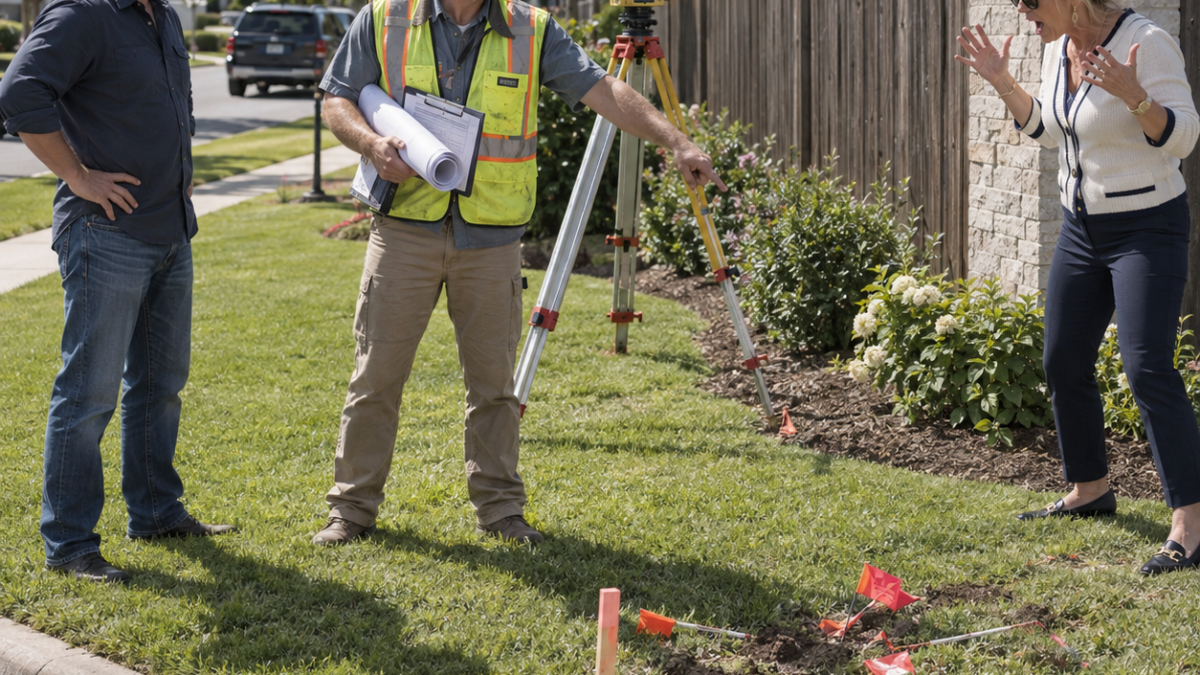
For several seconds, Karen didn’t move.
The landscaping crew working beside her house had gone quiet.
One man stood with hedge clippers half-open in his hands, pretending very badly that he wasn’t listening.
The only sound came from a lawn mower somewhere farther down Meadow Creek Drive.
Then Karen straightened.
It was remarkable how quickly fear could turn back into arrogance when someone had spent years practicing it.
“Twenty-two thousand dollars is ridiculous.”
“That wasn’t my number.”
“Your surveyor is obviously exaggerating.”
“Call him.”
“I have no reason to speak with your contractor.”
I almost smiled.
“You’re probably going to have several.”
Her eyes narrowed.
“What is that supposed to mean?”
“It means you just admitted you removed the markers.”
“I enforced HOA rules.”
“You entered land you don’t own and destroyed equipment you didn’t understand.”
“They were plastic ribbons.”
“Then twenty-two thousand dollars should be easy to explain.”
The landscaper lowered his clippers.
Karen noticed.
“Would you mind getting back to work?”
The man immediately turned toward the hedge.
She faced me again.
“I will discuss this with the board.”
“Good idea.”
“And for the record, Mr. Turner, you have no permission to place signage in common-view areas without architectural approval.”
“They weren’t signs.”
“That is your opinion.”
“No.”
I shook my head.
“That is their function.”
She opened her mouth.
Then closed it.
I didn’t raise my voice.
I didn’t threaten her.
I didn’t call her names.
I had learned a long time ago that once somebody made a mistake this large, the smartest thing you could do was stop helping them.
So I got into my truck.
As I started the engine, Karen stepped toward me.
“Mark.”
I lowered the window.
“You are not going to intimidate me with some inflated contractor bill.”
“I’m not trying to intimidate you.”
“Then what are you doing?”
“Going home.”
I put the truck in gear.
“Dave can explain the rest.”
I drove away.
In the rearview mirror, Karen remained beside her immaculate hedge, staring after me.
When I reached our construction site, Sarah was standing in the unfinished kitchen.
Drywall had gone up that week, but the floor was still bare plywood.
Leo sat in one corner on an overturned bucket building something out of scrap lumber.
Sarah knew from my face that something had happened.
“What now?”
I held up my phone.
“You remember the survey flags?”
“Yes.”
“Karen removed them.”
Sarah stopped.
“All of them?”
“All of them.”
“Why?”
“She said they were ugly.”
Sarah stared at me for several seconds.
Then she laughed.
Not because it was funny.
Because sometimes stupidity crosses a line where disbelief comes out sounding like laughter.
“She actually said that?”
“Almost word for word.”
“What did Dave say?”
I glanced toward Leo.
He wasn’t listening.
Or at least he was pretending not to.
“Twenty-two thousand.”
Sarah’s face changed.
“What?”
I told her about the county grid.
Dave’s crew hadn’t only been locating the future pool fence.
Because our corner of the neighborhood was being updated for a utility easement project, his company had used the work as part of a broader reference network.
Karen hadn’t pulled five or six decorative flags.
She had disturbed dozens of temporary control points and stakes.
Some could be recreated from field notes.
Others would require fresh setup.
The original county monuments were nearly two miles away.
Crews would have to return.
Equipment would have to be recalibrated.
Scheduling had to be rearranged.
And because the utility project had deadlines, the work would now require rush labor.
Sarah put both palms flat on the plywood island.
“Can she make us pay?”
“Dave says no.”
“You’re sure?”
“No.”
That answer frightened her.
I walked over.
“But the contract has a site-protection clause, and Dave has evidence the markers were intentionally removed by a third party. He’s documenting everything.”
Sarah looked toward Leo.
“What about the pool?”
“We wait.”
His head lifted.
“You said pool?”
I cursed myself silently.
He came over.
“Are we still building it?”
“Yes, buddy.”
“When?”
“As soon as we can.”
He looked at the unfinished backyard through the open framing around the future patio doors.
Leo had never complained much about his diagnosis.
That almost made it harder.
He tired faster than other kids.
Sometimes his legs hurt after school.
He hated physical therapy on bad days.
But water was different.
In water, he didn’t feel slow.
He had spent the entire previous summer at the municipal pool learning to float, kick, and move without worrying about falling.
The pool we were building wasn’t enormous.
It wasn’t some luxury resort.
It was a modest rectangular pool with enough depth and length for therapy exercises and enough shallow space for him to play.
The fence had to come first.
“Did somebody break the flags?” he asked.
Sarah and I looked at each other.
“Somebody moved them,” I said.
“Why?”
“They didn’t understand what they were for.”
Leo frowned.
“They could’ve asked.”
Sarah closed her eyes for half a second.
Kids have a way of reducing adult stupidity to its simplest form.
“Yeah,” I said.
“They could have.”
That afternoon Dave came over.
He looked like a different man.
Normally he arrived in faded jeans, work boots, and the relaxed mood of someone who had spent half his life walking fields.
This time he carried a hard case and a folder.
“Show me exactly where you found them.”
We drove to the community dumpster.
Nothing had been removed.
The fluorescent ribbons were still visible through the open lid.
Dave didn’t touch anything.
He took photographs.
Measured.
Documented.
Then we walked the line.
At each location, he photographed the holes left behind.
Some stakes had been pulled cleanly.
Others had been bent sideways and yanked from the ground.
Two metal references near the road had been thrown in with the wooden ones.
Dave stared at one empty spot for a long time.
“That one hurts.”
“What was it?”
“Secondary control point.”
He crouched.
“My crew tied three setups through here.”
“So twenty-two is real?”
He looked at me.
“I wish it wasn’t.”
We stood.
“I can reconstruct pieces from raw data, but because the physical reference marks are gone, I can’t certify the chain without reshooting.”
He looked toward Karen’s house.
Curtains moved.
“Did she actually admit it?”
“Yes.”
“You record it?”
“My phone was running after I found the dumpster.”
Dave looked at me.
For the first time that afternoon, he smiled.
“Good.”
“You sound happy.”
“I’m not happy.”
He closed the folder.
“I’m relieved I’m not going to spend six months arguing about who did it.”
He went back to his truck.
Before leaving, he said, “Mark.”
“Yeah?”
“You know these aren’t technically all permanent monuments, right?”
“I figured.”
“Some are temporary survey markers. Some reference established monuments. I don’t want anybody overstating this.”
“Understood.”
“But intentionally interfering with a licensed survey operation and destroying the markers?”
He shook his head.
“That’s still a serious problem.”
“What happens now?”
“I notify the county project manager.”
“And Karen?”
“She gets an invoice.”
Three days later, she did.
I didn’t see it arrive.
But our mail carrier, Stan, told me about it.
Stan knew everything that happened within five miles and considered confidentiality more of a polite suggestion than a professional obligation.
“Had certified mail for your friend up the hill.”
“She isn’t my friend.”
“I gathered that.”
He handed me our stack.
“Big envelope.”
“From?”
He gave me a look.
“I’m not supposed to tell you.”
“Then don’t.”
“Callahan Land Surveying.”
I laughed.
Stan grinned.
“She signed like the pen insulted her.”
That evening, Dave emailed me a copy.
TOTAL COST OF RESTORATION AND RESURVEY: $22,000.
The invoice listed crew hours.
Additional field work.
County control reconnection.
Equipment time.
Project rescheduling.
Rush mobilization.
Data verification.
Administrative costs.
At the top:
RESPONSIBLE PARTY: OAKS OF MEADOW CREEK HOA / KAREN MILLER.
Dave had addressed it to both.
When I called, he explained why.
“The HOA president claimed authority while doing it. So the association needs notice.”
“And personally?”
“She admitted she physically removed them.”
“So who pays?”
“That’s for lawyers to fight about.”
I leaned back.
“Not me?”
“Mark.”
His voice became firm.
“You hired us for a two-thousand-dollar boundary survey.”
“I remember.”
“The extra cost exists because someone intentionally destroyed our work after completion.”
He paused.
“I am not sending you a twenty-two-thousand-dollar bill because your HOA president can’t distinguish survey control from yard decorations.”
That should have made me feel better.
It didn’t.
Because I knew Karen.
She wouldn’t take the invoice and quietly write a personal check.
She would look for someone else to blame.
I just didn’t expect her to move as fast as she did.
The first violation notice arrived four days later.
LANDSCAPING NONCOMPLIANCE.
The charge?
The native black-eyed Susans and waist-high grass growing along one edge of our property.
The same plants that had grown there since before Karen moved into the county.
The notice claimed they violated approved landscaping standards.
Fifty-dollar initial fine.
Ten dollars per day.
I read it.
Opened a binder.
Placed the letter inside.
Sarah watched.
“You have a binder already?”
“I had an empty one.”
“You labeled it.”
“Yes.”
“What does it say?”
I turned it.
KAREN.
Sarah stared.
“You’re enjoying the binder.”
“I’m not enjoying anything.”
“You used the label maker.”
“That proves nothing.”
Two days later came the next letter.
UNAPPROVED COMMERCIAL VEHICLE.
My Ford F-250.
Personal registration.
No company logo.
No commercial plates.
Parked on my driveway.
One hundred dollars.
Into the binder.
Then came a notice for an “unapproved structural alteration.”
I thought she meant framing on the house.
No.
She meant a removable plywood ramp I’d built at the garage threshold so Leo could drive his little electric ATV over the two-inch concrete lip without jarring his legs.
Two pieces of treated lumber.
One sheet of plywood.
Nothing fastened to the building.
Karen called it a structural modification.
Two hundred fifty dollars.
Sarah read that one twice.
Then she sat down.
“She knows that’s for Leo.”
“Yes.”
“Doesn’t she?”
“Yes.”
Something changed in my wife.
Until that point, Sarah had been the one urging caution.
Don’t escalate.
Don’t let this consume us.
Answer the notices.
Finish the house.
Let lawyers deal with the survey bill.
But Leo’s ramp was different.
She folded the letter carefully.
“So what are we doing?”
I looked at her.
“What do you mean?”
“How do we stop her?”
That question mattered.
Not because I wanted Sarah angry.
I didn’t.
Because she finally understood the same thing I had started to understand.
Karen wasn’t trying to enforce rules.
She was trying to create enough pressure that we would absorb the cost of her mistake.
I sat beside her.
“We document everything.”
“Then?”
“We appeal every notice.”
“Then?”
“We find out who else she’s done this to.”
Sarah looked toward the binder.
“And then?”
“Then we make sure she can’t isolate us.”
That night, I wrote three responses.
No insults.
No accusations.
Just evidence.
For the landscaping notice, I cited the grandfather provision covering established native vegetation on annexed parcels.
For the truck, I attached my registration.
For the ramp, I copied the HOA’s own definition of permanent structural alteration.
Each letter ended the same way:
Please identify the precise covenant provision supporting this violation and provide instructions for formal appeal.
Certified mail.
Return receipt.
Copies filed.
A week passed.
No appeal instructions arrived.
Another violation did.
CONSTRUCTION ACTIVITY OUTSIDE APPROVED HOURS.
The alleged incident was a concrete truck leaving at 5:52 p.m.
The restriction began at six.
I printed the time-stamped security footage.
Binder.
The next notice accused us of improper material storage because roof shingles had been stacked beneath a tarp beside the house.
The covenants specifically allowed covered construction materials on active job sites.
Binder.
By then the thing weighed almost five pounds.
One evening, Sarah found me punching holes in another letter.
“How many?”
“Eleven.”
“Eleven violations in three weeks?”
“Yep.”
“She sent us three in the first six months.”
“Also yep.”
Sarah leaned against the doorway.
“She’s panicking.”
“That’s my guess.”
“Because of twenty-two thousand dollars.”
“Twenty-two thousand reasons.”
Sarah didn’t smile.
“I’m going to talk to Carol.”
“Why?”
“She lives behind us.”
“I know.”
“She told me once Karen made her remove a birdbath.”
“A birdbath?”
“It was a memorial for her husband.”
I stopped punching paper.
“What?”
“She didn’t tell me details.”
Sarah folded her arms.
“But I’m going to ask.”
The next afternoon she came home with a legal pad.
Not metaphorically.
An actual yellow legal pad.
I looked at it.
“You’ve become me.”
“Don’t insult me.”
I laughed.
Then she put it on the table.
Carol had paid six hundred dollars in fines over two years.
Birdbath.
Flower pots.
A bench.
A decorative wreath left on her door three days beyond the approved seasonal window.
Sarah had talked to two other women.
One family had been cited because their son’s bicycle remained near the garage overnight.
Another had been threatened over a treehouse visible from the road.
A third had received repeated notices about a welcome mat.
“A welcome mat?”
“Wrong color.”
I rubbed my face.
“This place is insane.”
“No.”
Sarah sat.
“Most people here are normal.”
She tapped her notes.
“They’re tired.”
That was different.
And more important.
Karen’s power wasn’t based on everyone agreeing with her.
It was based on everyone assuming they were alone.
The next person we spoke with changed the whole fight.
His name was Henry Henderson.
No relation to anybody from my previous military life.
He was seventy-six, a retired civil engineer, and lived two doors down from Karen.
I’d seen him sitting on his porch almost every evening.
Coffee in the morning.
Bourbon after sunset.
Quiet man.
Sharp eyes.
I walked over with a six-pack.
He looked at the beer.
“Bribery?”
“Information exchange.”
“Better.”
He waved me onto the porch.
I gave him the short version.
Survey.
Markers.
Twenty-two thousand dollars.
Violation campaign.
When I mentioned the landscaping notice, he actually laughed.
“She tried that with your father.”
I froze.
“My dad?”
Henderson nodded.
“Years ago.”
“You knew him?”
“Of course.”
He pointed toward our land.
“Your father argued with every developer, commissioner, engineer, lawyer, and bureaucrat who came within fifty feet of those oak trees.”
That sounded right.
“He didn’t like the HOA.”
“He hated it.”
I smiled.
“That sounds even more right.”
Henderson disappeared inside.
Returned with a thick accordion file.
He set it on the porch table.
“Knew I’d need this someday.”
Inside were letters.
Notices.
Photographs.
Meeting minutes.
Copies of covenants.
Some went back years.
“This one,” he said, pulling out a letter, “was my favorite.”
Two-thousand-dollar threatened fine.
Illegal retaining wall.
Henderson’s wall had been built decades earlier.
Karen had tried to apply a setback rule adopted years after construction.
“She ordered me to remove it.”
“What happened?”
“I designed the original drainage plan for this neighborhood.”
He smiled.
“Had the old engineering drawings in my basement.”
“You embarrassed her.”
“Publicly.”
I understood immediately.
“She retaliated.”
“For almost a year.”
He showed me notices.
Shrubs.
Downspout.
Fence stain.
Satellite dish.
“One week she cited me for a cracked driveway.”
He shook his head.
“Two houses away, her friend had a pothole big enough to lose a Labrador.”
I flipped through the file.
“Why didn’t anyone remove her?”
“Fear.”
“Of fines?”
“Of exhaustion.”
That word again.
Henderson looked toward Karen’s house.
“She doesn’t beat people by being right.”
He tapped the file.
“She makes fighting more expensive than surrendering.”
I leaned back.
“Not this time.”
His eyes moved toward me.
“No?”
“No.”
I told him about the survey invoice.
The cease-and-desist hadn’t arrived yet.
That would come the next day.
When it did, even Henderson was shocked.
HAND DELIVERED.
CEASE AND DESIST.
HALT ALL CONSTRUCTION ACTIVITIES.
Karen claimed the HOA needed to investigate “potential unapproved development” suggested by the surveying work.
The phrase almost made me laugh.
Our house had county permits.
Approved plans.
Scheduled inspections.
The pool permit process was documented.
There was no commercial development.
No subdivision.
Nothing remotely resembling the rumor Karen had begun spreading.
But the letter ordered our contractors off the site pending architectural review.
That was the point where Sarah broke.
Not loudly.
She sat on a stack of drywall in our unfinished living room and stared at the paper.
The house smelled like sawdust and joint compound.
Sunlight came through windows that still had manufacturer stickers in the corners.
Leo’s future bedroom was down the hall.
Our bedroom was unfinished.
The kitchen cabinets were still in boxes.
“This was supposed to be the last move,” Sarah whispered.
I sat beside her.
For most of our marriage, we’d moved because the military told us to.
Base housing.
Rentals.
Temporary homes.
Places we liked but knew we’d leave.
When I retired, I promised her stability.
This land was supposed to be it.
Our forever place.
She looked at me.
“What if she actually stops construction?”
“She can’t.”
“What if she ties it up?”
“We’ll challenge it.”
“With what money?”
I didn’t answer.
That was the part people forget when they talk about principle.
Being right can be expensive.
Lawyers cost money.
Delays cost money.
Contractors don’t stay available forever.
Mortgage draws have schedules.
Our savings weren’t unlimited.
Sarah wiped her face.
“What if we just don’t build the pool?”
That hurt more than I expected.
“Sarah.”
“Leo can use the YMCA.”
“It’s forty minutes away.”
“I know.”
“We planned this for him.”
“I know.”
“Then why—”
“Because I am tired.”
Her voice cracked.
“I am tired of every day being another envelope.”
I stopped.
She wasn’t surrendering.
She was telling me what the battle was costing.
I put an arm around her.
For a minute we sat without speaking.
Then she said, “Tell me you have an actual plan.”
“I have part of one.”
“That is not comforting.”
“Jessica.”
She looked at me.
“Morales?”
I nodded.
Sergeant Jessica Morales had been a JAG officer during one of my deployments.
She was one of the smartest people I had ever met.
Also one of the least patient with bullies.
After leaving the service, she’d built a civil practice in Raleigh.
I called the next morning.
She listened for nearly thirty minutes.
When I finished, she said:
“Send me everything.”
“How much?”
“Everything.”
“Jessica—”
“Mark, if you summarize this badly, I’ll charge you extra.”
I scanned the binder.
Henderson’s file.
Survey invoice.
Deed.
Grandfather provisions.
Construction permits.
Violation notices.
Photos of the dumpster.
Recording of Karen admitting she removed the flags.
Karen’s cease-and-desist.
I sent it all.
Two days later, Jessica called.
“Are you sitting?”
“No.”
“Sit.”
I sat.
“This woman is reckless.”
“That was my impression.”
“She appears to have exposed herself personally.”
“How?”
“HOA officers can have protection when they’re acting within their authority.”
“Okay.”
“But entering property and intentionally interfering with professional survey work because she doesn’t like fluorescent ribbon?”
Jessica paused.
“That isn’t normal board activity.”
“So she pays?”
“Don’t get ahead of me.”
I could hear paper turning.
“First, we establish exactly what was removed and what state law applies to each marker. Your surveyor is being careful, which I like.”
“He’s angry.”
“Angry and careful is useful.”
She continued.
“Second, her retaliation matters.”
“The fines?”
“The timing.”
Another page.
“Eleven violations in three weeks after a twenty-two-thousand-dollar demand.”
“Thirteen now.”
“Even better.”
“Better?”
“For evidence.”
I heard her pen clicking.
“Third, this cease-and-desist is absurd.”
“I thought so.”
“County-approved interior construction isn’t hers to suspend.”
“So what do we do?”
“Separate her from the board.”
That caught me.
“How?”
“Fear.”
“I thought fear was her strategy.”
“It is.”
Jessica’s voice hardened.
“We’re going to give the other board members something legitimate to be afraid of.”
The board had three members.
Karen.
Frank Ellis, treasurer.
Maria Delgado, secretary.
Jessica sent Frank and Maria individual letters.
Not threatening letters.
Informational ones.
She laid out the survey destruction.
The invoice.
The admission.
The pattern of retaliation.
Then she quoted the HOA’s own indemnification provision.
Board members were protected for good-faith actions within the scope of duty.
Not for intentional misconduct.
Not for bad-faith conduct.
Not for unauthorized personal acts.
Jessica explained that using homeowner reserve funds to absorb a board officer’s potentially personal liability could create fiduciary problems for anyone who approved it.
In plain English:
If Karen made this mess personally and you knowingly spend everyone’s money to save her, you may be joining the mess.
Frank received his letter on Tuesday.
I saw him Thursday.
He was walking a golden retriever.
Normally he avoided me.
This time he stopped.
“Mr. Turner.”
“Frank.”
He glanced around.
“Can we talk?”
“Sure.”
He lowered his voice.
“I didn’t know.”
“About what?”
“The survey work.”
I waited.
“Karen told us your contractor put unauthorized markers across community property.”
“Some markers were connected to the county easement work.”
“She said they were temporary decorations.”
I almost laughed.
“Surveyors aren’t known for decorating.”
Frank looked embarrassed.
“She said you were demanding twenty-two thousand dollars from the HOA.”
“I’m not demanding anything.”
“Then who is?”
“Dave’s company.”
“Why?”
“Because Karen pulled their work out of the ground.”
He looked toward his dog.
“She said she removed a few flags from the right-of-way.”
“She removed dozens.”
Frank swallowed.
“And you recorded her?”
“Yes.”
His face went pale.
“We have the annual meeting next week.”
“I know.”
“She plans to ask for reserve money to hire special counsel.”
“To defend the HOA?”
“To fight the survey bill.”
“And me?”
He didn’t answer.
That was an answer.
I said, “Frank, I don’t need you on my side.”
He looked up.
“I need you to do your job.”
His jaw tightened.
“I’m beginning to understand that.”
The newsletter came next.
Karen wrote it herself.
Glossy cover.
HOA logo.
A photograph of flowers.
Front page:
PROTECTING OUR COMMUNITY’S INTEGRITY.
She didn’t name me.
She didn’t need to.
It warned residents about “aggressive development activity” on large annexed parcels.
It suggested survey work indicated possible subdivision or commercial plans.
It promised the board would spend whatever necessary to protect property values.
Sarah read the paragraph aloud.
Then looked around our half-built farmhouse.
“Commercial plans?”
“Yes.”
“We have one house.”
“Yes.”
“One pool.”
“Allegedly.”
She gave me a look.
“I am not in the mood.”
“Sorry.”
Her anger had returned.
Better than fear.
She took the newsletter.
Folded it.
Put it in the binder herself.
“She’s lying about us.”
“Yes.”
“What do we do?”
“Nothing yet.”
Sarah stared.
“Nothing?”
“We let her talk.”
“I hate that answer.”
“So do I.”
Jessica loved it.
“Never interrupt an opponent who’s documenting intent for you.”
Sarah did not find that comforting either.
But she channeled the anger.
She spoke with neighbors.
Carefully.
Not campaigning.
Listening.
Carol told her about the memorial birdbath.
A family named Jensen described being fined over a welcome mat.
The Garcias had a bicycle notice.
The Owens had been threatened over a treehouse.
Henderson contributed his file.
Jessica organized affidavits.
Everything became dates.
Amounts.
Copies.
Patterns.
The night before the annual meeting, our dining table disappeared beneath paper.
Leo walked in wearing pajamas.
“Is this homework?”
“Something like that.”
“Yours?”
“Unfortunately.”
He looked at one photograph.
The dumpster.
Pink flags.
“Those are the pool flags.”
“Some of them.”
He frowned.
“Is the lady still mad?”
Sarah and I looked at each other.
“What lady?”
“The one who doesn’t like our house.”
That hurt.
We had never described Karen that way to him.
He had figured it out from tone.
“She doesn’t dislike our house,” Sarah said.
Leo shrugged.
“She always looks at it like this.”
He made a face so accurate I laughed.
Sarah tried not to.
Failed.
Leo smiled.
Then his expression became serious.
“Are we still getting the pool?”
I crouched beside him.
“Yes.”
“When?”
“I don’t know exactly.”
He looked disappointed.
Then nodded.
“Okay.”
No tantrum.
No complaint.
Just okay.
I watched him walk upstairs.
Jessica had told me the meeting was about money.
Governance.
Liability.
Procedure.
For me, the meeting had just become about one word from a seven-year-old boy.
Okay.
He had accepted that adults were delaying something meant to help his body because one woman needed to win.
I didn’t need revenge.
I needed it finished.
The clubhouse was full the next night.
Not crowded.
Full.
Standing room.
People lined the walls.
Neighbors who hadn’t attended in years showed up.
Sarah and I sat in back.
Henderson sat three rows forward with the accordion file on his lap.
Jessica sat alone on an aisle.
Frank looked sick.
Maria looked worse.
Karen looked magnificent.
Hair perfect.
White jacket.
Pearls.
Clipboard.
Gavel.
She entered smiling like a candidate walking onto a convention stage.
The room quieted.
“This annual meeting of the Oaks of Meadow Creek Homeowners Association will come to order.”
Gavel.
Minutes.
Treasurer report.
Landscaping.
Pool maintenance.
Architectural review.
Karen moved quickly.
She wanted the main event.
Finally:
“New business.”
She adjusted the microphone.
“As many of you know, the board has been dealing with an escalating situation involving unauthorized development activity on an annexed property.”
I stood.
“Point of order.”
Her head snapped toward me.
“Sit down.”
“Point of order.”
“You are not recognized.”
Jessica looked toward me.
Tiny nod.
I continued.
“The governing documents adopt parliamentary procedure for annual meetings.”
Karen’s face reddened.
“You are interrupting.”
“Because a material financial liability hasn’t been disclosed.”
Murmurs.
Frank stared at the table.
Maria removed her glasses.
Karen gripped the gavel.
“What liability?”
I almost admired her nerve.
“Twenty-two thousand dollars.”
The room changed.
You could feel it physically.
Whispers.
Questions.
“What?”
“Twenty-two?”
Karen banged the gavel.
“Order.”
I remained standing.
“A licensed surveying company has invoiced this HOA for twenty-two thousand dollars after its field markers and control points were removed.”
Karen leaned toward the microphone.
“That charge is disputed.”
“By whom?”
“The board.”
Frank looked up.
It happened quickly.
Almost nothing.
But everyone near the front saw him.
He shook his head.
Karen froze.
I said, “Frank?”
He swallowed.
Then leaned toward his microphone.
“I have not voted to dispute the invoice.”
The room erupted.
Karen turned.
“Frank.”
He looked terrified.
But he continued.
“The board has not formally voted on payment, denial, litigation, or use of reserve funds.”
Maria added quietly:
“That is correct.”
Karen’s face hardened.
“This is an internal matter.”
Jessica stood.
“My name is Jessica Morales.”
Karen stared at her.
“I represent Mark Turner.”
“We are not conducting a trial.”
“No.”
Jessica’s voice was calm.
“That’s fortunate.”
A few people laughed nervously.
Karen banged the gavel.
Jessica didn’t react.
“Mr. Turner’s family is not demanding twenty-two thousand dollars.”
That silenced people.
“The invoice comes from Callahan Land Surveying after the destruction of professional field work connected both to Mr. Turner’s boundary survey and a county utility easement update.”
She held up the invoice.
“President Miller admitted removing the markers.”
Karen shouted:
“I removed unauthorized visual clutter.”
Jessica turned toward her.
“Did you remove them?”
Silence.
“Karen,” Frank whispered.
She glared at him.
Jessica asked again.
“Did you physically remove survey stakes and flags placed by Callahan Land Surveying?”
Karen’s voice sharpened.
“I removed objects violating community standards.”
There it was.
Again.
Jessica nodded.
“Thank you.”
Karen realized too late what she’d done.
The room began to murmur.
Jessica continued.
“The resurvey cost is twenty-two thousand dollars.”
A man near the front said, “Because of flags?”
Dave wasn’t there, but Jessica had his report.
She explained.
Control grid.
Reference points.
County monuments.
Field verification.
Rush work.
The more specific she became, the less ridiculous the number sounded.
Then she reached the part Karen feared.
“The governing documents provide board members protection for good-faith acts within their authority.”
Jessica paused.
“They do not guarantee protection for intentional personal conduct outside that authority.”
Karen stood.
“This attorney is trying to scare you.”
Jessica looked at the homeowners.
“Yes.”
That surprised everyone.
Including Karen.
“You should be concerned.”
She placed copies of the documents on a table.
“If the board uses association money to protect conduct that was outside legitimate board authority, homeowners deserve to know why.”
Frank’s face had gone pale.
Maria looked toward Karen.
Then away.
Jessica continued.
“And the survey incident did not occur in isolation.”
Henderson stood.
Karen groaned.
“Of course.”
He lifted his file.
“My name is Henry Henderson.”
Everybody knew that.
He had lived there longer than almost anyone.
“For three years, I have kept records.”
He read them.
Welcome mat.
Bicycle.
Birdbath.
Retaining wall.
Driveway crack.
Planters.
Flags.
Parking.
He read names.
Amounts.
Dates.
Some residents stood as their stories were mentioned.
Carol cried when he described the memorial birdbath.
Karen interrupted.
“Every one of those notices was issued pursuant to adopted standards.”
Henderson turned toward her.
“My retaining wall predates your rule by twenty-five years.”
“You were given an appeal.”
“You chaired it.”
Laughter broke out.
Karen slammed the gavel.
Henderson’s voice grew stronger.
“You fined people until they got tired.”
The room quieted.
“You didn’t enforce rules equally.”
He pointed toward his file.
“You enforced them against people who questioned you.”
Karen’s face changed.
Not fear this time.
Rage.
“You bitter old man.”
The second the words left her mouth, she knew.
Henderson didn’t respond.
He didn’t need to.
A woman in the second row stood.
“I move for removal.”
Karen stared.
“What?”
The woman repeated:
“I move for a vote to remove Karen Miller as president and from the board for acting outside her authority and exposing the association to financial liability.”
“Second.”
Another voice.
Then another.
Karen struck the gavel repeatedly.
“You cannot do this!”
Frank finally stood.
The room quieted.
He held Jessica’s letter.
“I reviewed the bylaws with independent counsel this afternoon.”
Karen’s mouth fell open.
“Independent counsel?”
“Yes.”
“Without board approval?”
“I paid personally.”
Something almost like pride crossed Henderson’s face.
Frank continued.
“A motion related to immediate financial risk may be considered.”
Karen pointed at him.
“You coward.”
Frank looked at her.
For years, maybe nobody had ever seen him refuse her directly.
“I am the treasurer.”
His voice trembled.
“But I’m also a homeowner.”
He looked around the room.
“And I am not approving twenty-two thousand dollars of association money to cover an act I never authorized.”
Applause exploded.
Karen screamed over it.
“I was acting as president!”
Maria stood.
“No.”
Karen turned.
Maria’s voice was quiet.
“We never voted to remove those markers.”
“You knew they were there.”
“That isn’t authorization.”
“You agreed they were ugly.”
Maria shook her head.
“I did not tell you to pull them out.”
The board collapsed in front of everyone.
Karen stood alone behind the folding table.
The vote happened ten minutes later.
Nearly unanimous.
Karen remained in her chair as hands went up across the room.
The same residents who had spent years avoiding her gaze now voted openly.
Only two people opposed removal.
When Frank announced the result, Karen stared at the crowd.
“You’ll regret this.”
Nobody answered.
She grabbed her purse.
The clipboard fell onto the floor.
She left it.
The clubhouse doors slammed behind her.
For five seconds there was silence.
Then someone clapped.
Another joined.
Within seconds, the room erupted.
I didn’t.
Neither did Sarah.
She squeezed my hand.
“Is it over?”
“Not yet.”
Henderson was appointed interim board member that night.
Frank temporarily chaired.
Maria remained secretary.
The new board’s first vote was to suspend every violation Karen had issued against us pending independent review.
The second was to revoke her cease-and-desist.
The third authorized payment of Dave’s invoice from reserve funds so the county project wouldn’t suffer further delay.
Then came the vote that mattered.
The association would seek reimbursement from Karen personally.
Twenty-two thousand dollars.
Plus legal expenses.
Frank read the motion.
Karen wasn’t there to hear it.
Maybe that was better.
The next morning, Dave’s crew returned.
Leo stood beside me.
This time the flags were orange.
“Why orange?”
I asked Dave.
He grinned.
“Psychological warfare.”
I laughed.
Leo looked confused.
“What’s that?”
“Nothing.”
Dave’s crew worked from sunrise until nearly sunset.
New reference points.
New line.
New field notes.
The following day they continued.
I watched every stake go in.
Not because I distrusted Dave.
Because I understood now how fragile certainty becomes when someone decides rules are whatever she says they are.
On the third day, a sheriff’s cruiser stopped in front of Karen’s house.
Two deputies walked to the door.
Neighbors appeared behind windows.
I did not move closer.
I wasn’t interested in spectacle.
Karen opened the door.
There was a conversation.
One deputy handed her documents.
Civil complaint.
Demand for reimbursement.
Notice relating to the bank investigation that had started after Frank discovered something else.
Karen’s final mistake.
The morning after the annual meeting, before the board could update banking authority, she had written a large retainer check from the HOA operating account to a law firm.
The amount exceeded her remaining authority.
Frank received an automatic alert.
He stopped payment.
Then reported the attempted transaction.
That transformed an ugly civil fight into something more serious.
Jessica called when she heard.
“She cannot stop making mistakes.”
“What’s going to happen?”
“Don’t speculate.”
“That’s unusually responsible.”
“I bill for responsibility.”
I smiled.
“Seriously.”
“Police will investigate. Prosecutors decide whether anything criminal occurred. The HOA handles the civil side.”
“So no victory parade?”
“Absolutely not.”
Her voice hardened.
“Mark, listen to me. You won the governance fight. Don’t ruin it by becoming vindictive.”
That stayed with me.
Because revenge had become tempting.
I wanted Karen to feel what Sarah had felt sitting in our unfinished house.
I wanted her to understand what it meant to see Leo’s therapy pool delayed because of someone else’s ego.
I wanted every bogus violation notice spread across a table in front of her.
I wanted her to explain herself.
But there is a difference between justice and appetite.
Justice stops when the wrong is corrected.
Appetite keeps eating.
So I stayed away.
The new board hired independent counsel.
Every violation issued against us was reviewed.
All dismissed.
Mailbox.
Landscaping.
Truck.
Ramp.
Construction hours.
Materials.
Everything.
Frank delivered the letter personally.
He stood at our temporary front door holding a folder.
“I owe you an apology.”
“You personally?”
“Yes.”
“You didn’t pull the flags.”
“I let her operate without asking enough questions.”
He looked toward our house.
“I signed notices.”
“Because she told you they were legitimate?”
“Yes.”
“That doesn’t excuse it.”
“I know.”
I respected that answer.
He handed me the folder.
Inside was the formal rescission.
“There’s more.”
The board had reviewed dozens of enforcement actions from the previous three years.
Some were valid.
Many were technically valid but selectively applied.
Others were based on interpretations too vague to justify penalties.
They suspended collection.
Created an appeals process.
Required written citations to specific covenant provisions.
Required two board members to review major fines.
Required disclosure when a board member personally made the complaint.
It wasn’t exciting.
That was why it mattered.
Good governance is boring.
Boring is beautiful after chaos.
The survey company got paid.
The utility project resumed.
Then the association sued Karen to recover the cost.
Twenty-two thousand dollars.
The legal battle took months.
Karen argued she had acted in her official capacity.
The HOA argued she had no board authorization to remove survey equipment.
Dave provided field records.
Photos.
Replacement costs.
My recording.
The landscaper who had watched her admit removing the flags gave a statement.
Frank and Maria both testified that the board never voted to interfere with the survey.
Eventually Karen settled.
She agreed to reimburse the association for the full resurvey cost on a payment schedule.
The criminal investigation into the attempted retainer transaction did not become the dramatic arrest some neighbors expected.
And I was glad.
There were consequences.
Legal fees.
Repayment.
Loss of office.
Public accountability.
That was enough for me.
But Karen didn’t stay.
A FOR SALE sign appeared in her yard less than two months after the settlement.
Sarah saw it first.
She called me outside.
We stood on our unfinished porch.
“There.”
I looked.
Karen’s house.
Sign in the lawn.
“You happy?”
Sarah asked.
I thought about it.
“I think I’m relieved.”
“Different?”
“Very.”
For years, military life had trained me to recognize victory in simple terms.
Objective secured.
Threat removed.
Mission complete.
Civilian life was messier.
Karen wasn’t an enemy combatant.
She was a lonely, controlling woman who had been given a little authority and had mistaken it for ownership over other people’s lives.
That didn’t excuse what she did.
But it changed what victory should look like.
I didn’t want her destroyed.
I wanted her unable to keep hurting people.
She had lost that power.
That was enough.
The moving truck came on a Thursday.
Karen supervised from her driveway.
Nobody gathered.
Nobody cheered.
A few neighbors watched through windows.
I was setting fence posts.
The approved pool fence.
For the first time, our property line was physically becoming what those destroyed flags had tried to establish.
Straight.
Clear.
Undisputed.
Leo carried a plastic level nearly as long as his arm.
He took his job seriously.
“Dad.”
“Yeah?”
“This one’s crooked.”
“It isn’t.”
He pressed the level against it.
The bubble was almost centered.
“Crooked.”
“Traitor.”
He grinned.
I adjusted the post.
Across the road, Karen watched.
She had no clipboard.
No HOA badge.
No gavel.
Just a woman beside cardboard boxes.
For a second our eyes met.
She looked away first.
I went back to work.
That should have been the ending.
But the real ending came when the pool was finished.
It was late spring by then.
Concrete deck.
Six-foot safety fence.
Self-closing gate.
Lock positioned high enough that Leo couldn’t reach it.
The pool itself looked almost modest compared with what we had fought through to build it.
Blue water.
Simple steps.
A shallow therapy area.
Handrail.
The first afternoon we used it, the sun was warm but not hot.
Sarah sat on the edge.
I stood waist-deep in the water.
Leo climbed down carefully.
He hated people fussing over him.
So I backed away.
“You’ve got it.”
He pushed from the wall.
Kicked.
Slowly.
Then again.
His face changed.
On land, exercise sometimes reminded him what his body struggled to do.
In water, his body felt lighter.
He crossed half the pool.
Turned.
Came back.
Sarah covered her mouth.
I pretended not to see.
“Again?” I asked.
“Again.”
So we did it again.
And again.
After fifteen minutes, Leo climbed out.
Tired.
Happy.
He lay on a towel.
“This is better than the YMCA.”
“Don’t tell them.”
He laughed.
Sarah came into the water beside me.
For a while we stood silently.
Then she said:
“Twenty-two thousand dollars.”
“What?”
“All because she didn’t like pink flags.”
I looked at the fence.
“Technically orange flags finished the job.”
She rolled her eyes.
Then rested her head against my shoulder.
“Was it worth it?”
I knew what she meant.
Not the pool.
The fight.
The lawyers.
The stress.
The nights at the kitchen table.
Watching strangers discuss our family as though we were a zoning problem.
I looked at Leo.
“Yes.”
Sarah nodded.
“So do I.”
That summer changed the neighborhood.
Henderson won election as HOA president, mostly because nobody else could convince him not to run.
Frank stayed treasurer.
Maria stayed another year, then stepped down voluntarily.
The first newsletter under the new board was one page.
No glossy photographs.
No passive-aggressive reminders.
Budget summary.
Upcoming road maintenance.
Pool schedule.
Meeting date.
Volunteer request.
At the bottom:
PLEASE SPEAK TO YOUR NEIGHBOR BEFORE FILING A MINOR COMPLAINT WHEN PRACTICAL.
Henderson claimed that sentence saved more administrative time than anything else they did.
The memorial birdbath returned to Carol’s garden.
She invited Sarah over the day she put it back.
Her husband had died eleven years earlier.
The birdbath had been his gift.
Karen had called it an unauthorized decorative feature.
Carol had stored it in her garage for three years.
When she uncovered it, the stone was stained.
One corner was chipped.
Still beautiful.
Sarah helped carry it outside.
Carol cried.
Not because of the birdbath.
Because she had allowed another person to convince her that remembering her husband in her own garden required permission.
The Jensen family bought a ridiculous red welcome mat.
The Garcias stopped panicking if a bicycle remained in the driveway.
Henderson kept his thirty-year-old retaining wall.
Nothing collapsed.
Property values did not fall.
Civilization continued.
One evening Henderson came to our porch with bourbon.
“Peace offering.”
“We aren’t fighting.”
“Then celebratory offering.”
Better.
We sat beneath the old oak.
Leo was in the backyard with Sarah.
You could hear splashing.
Henderson listened.
“That the boy?”
“Yeah.”
“Pool helping?”
“A lot.”
He nodded.
“Then I’m glad you fought.”
I looked at him.
“You helped.”
“Took me long enough.”
“You kept records.”
“I hid records.”
“Difference?”
“Courage.”
He took a drink.
“I had information for years.”
He stared across the road.
“Information isn’t courage.”
I thought about the clubhouse.
“It became courage.”
“Because you gave people somewhere to stand.”
I shook my head.
“Karen did that.”
“How?”
“She attacked too many people.”
He laughed.
“Fair.”
Then he became serious.
“You know why everybody finally turned?”
“Twenty-two thousand dollars?”
“No.”
“That helped.”
“Sure.”
He pointed toward our yard.
“The kid.”
I looked over.
“People knew the pool was for Leo.”
“I didn’t tell many.”
“Neighborhoods talk.”
Of course they did.
“Karen went after the ramp too.”
“Yes.”
“That bothered people.”
Henderson stared at his glass.
“A woman can fine a grown man over flowers and people call it annoying.”
He looked at me.
“Threaten something that helps a kid, and suddenly everybody remembers what kind of person they want to be.”
That stuck with me.
I had spent months thinking the invoice was the turning point.
Maybe it wasn’t.
Money got attention.
Leo created clarity.
A year later, Dave called.
“Got a job near you.”
“Congratulations.”
“Thought I’d stop by.”
He arrived around lunchtime.
We walked the property.
The orange flags were long gone.
Fence permanent.
Pins verified.
Pool complete.
Dave stopped at the corner where the original control point had been destroyed.
“You know, this was the expensive one.”
“I remember.”
He kicked lightly at the grass.
“County put in a protected reference marker farther back after the resurvey.”
“So Karen improved infrastructure?”
“In the most inefficient way possible.”
I laughed.
He looked toward the neighborhood.
“Did she ever finish paying?”
“HOA says yes.”
“Twenty-two grand.”
“Plus her lawyer.”
He shook his head.
“Over ribbon.”
“Pride.”
“More expensive.”
“Usually.”
Dave smiled.
Then he looked toward the pool.
“Worth it?”
I heard Leo yell as he jumped into the water.
“Yes.”
No hesitation.
“Worth it.”
The years after that became ordinary.
Beautifully ordinary.
I finished the house.
Sarah planted hydrangeas along the porch.
Leo grew.
The muscular dystrophy didn’t disappear.
Life isn’t written that neatly.
There were appointments.
Hard days.
New therapies.
Questions about the future that Sarah and I sometimes discussed quietly after he went to bed.
But the pool helped.
It became part therapy, part playground, part gathering place.
Other kids came over.
Leo didn’t feel like the boy who needed special exercise when everyone was racing from one end to the other.
He was just Leo.
Fast in the water.
Competitive.
Loud.
Happy.
That was the thing Karen nearly delayed for the sake of appearances.
Sometimes anger came back when I thought about that.
Then I remembered what Jessica told me.
Justice stops when the wrong is corrected.
So I let it go.
Mostly.
There was one final moment with Karen.
Nearly two years after she moved, I saw her at a hardware store one town over.
I was buying irrigation fittings.
She was standing in the garden section.
For a moment I thought she hadn’t recognized me.
Then she said:
“Mark.”
I stopped.
“Karen.”
She looked older.
Not dramatically.
Just softer somehow.
Without authority surrounding her.
No clipboard.
No neighbors watching.
No microphone.
She was simply another customer beneath fluorescent lights.
“I heard your house is finished.”
“It is.”
“And the pool.”
“Yes.”
She nodded.
“Your son uses it?”
“Almost every day when the weather allows.”
Something moved across her face.
Regret maybe.
Or discomfort.
“I didn’t know.”
“About Leo?”
She nodded.
“I didn’t know why you were building the pool.”
I considered saying something cruel.
The words were available.
You never asked.
You didn’t care.
You were too busy winning.
All true.
Instead I said:
“You didn’t need to know.”
She looked confused.
I continued.
“You didn’t need my son’s medical history to leave survey equipment alone.”
Her face tightened.
“I was trying to maintain standards.”
“I know.”
“People act like I enjoyed punishing everyone.”
I didn’t answer.
She looked down at the cart.
“I thought if I let one thing go, everything would unravel.”
That was probably the most honest thing I’d ever heard her say.
“So you held tighter.”
“Yes.”
“Until everybody pulled away.”
She looked at me.
“Do you hate me?”
The question surprised me.
I thought about it.
“No.”
She didn’t believe me.
“You should.”
“No.”
“Why?”
“Because hating you would still give you a job in my life.”
Her eyes dropped.
That sounded harsher than I meant it.
But it was true.
I no longer wanted revenge.
I no longer wanted an apology.
I no longer wanted her to understand.
My family had moved on.
The neighborhood had moved on.
Henderson had moved on.
Even the grass where those pink flags once stood had moved on.
Karen nodded once.
“I am sorry about your son.”
I said nothing.
“And the survey.”
That was closer.
She swallowed.
“I shouldn’t have touched it.”
“No.”
Another nod.
Then she pushed her cart away.
I watched her disappear between stacks of fertilizer.
That was the last time I saw her.
On the drive home, I expected to feel something dramatic.
I didn’t.
I stopped at a red light.
Bought gas.
Picked up burgers because Sarah texted that nobody wanted to cook.
Ordinary life.
The kind I’d wanted all along.
When I reached home, Leo met me at the truck.
He was older now.
Longer legs.
Still a little unsteady after tiring.
“Did you get fries?”
“Hello to you too.”
“Did you?”
“Yes.”
He took the bag.
“Mom says we’re eating outside.”
We sat beside the pool.
Sunset moved through the oak branches.
The fence line glowed orange in the last light.
Not survey ribbon.
Real fence.
Permanent.
I told Sarah I’d seen Karen.
Her expression changed.
“What happened?”
“We talked.”
“That sounds dangerous.”
“It wasn’t.”
“Did she apologize?”
“Kind of.”
Sarah considered that.
“And?”
“And nothing.”
She smiled.
“Good.”
Leo looked between us.
“Who’s Karen?”
Sarah and I stared at him.
Then both started laughing.
He frowned.
“What?”
I shook my head.
“Nothing, buddy.”
And that may have been the most satisfying ending of all.
For months, Karen had occupied our conversations.
Our kitchen table.
Our mail.
Our finances.
Our plans.
Our sleep.
Years later, my son didn’t even remember her.
That is how power really disappears.
Not when the gavel falls.
Not when the lawsuit settles.
Not when a moving truck leaves.
It disappears when the people once controlled by it no longer organize their lives around it.
Henderson remained HOA president for two terms.
Then refused a third.
His reason was simple.
“Nobody should enjoy this job enough to keep it forever.”
That line became something of a neighborhood motto.
Board terms were limited.
Financial statements went online.
Complaints were logged.
Appeals were independent.
Rules were simplified.
Residents voted to remove nearly a third of the old aesthetic restrictions.
Nobody abolished the HOA.
Nobody turned the neighborhood into chaos.
Lawns were still maintained.
Homes were still cared for.
People still complained sometimes.
Human beings are human beings.
But the purpose shifted.
Rules became tools.
Not weapons.
And if somebody forgot that, there were enough residents who remembered Karen.
One Saturday, during an HOA cleanup day, I found Frank painting a picnic table.
He looked terrible with a brush.
“You missed a spot.”
“Volunteer.”
“Still missed it.”
He laughed.
Then he said, “I owe you something.”
“You already apologized.”
“Not that.”
He set the brush down.
“The night Karen removed the markers, she called me.”
I waited.
“She told me she was doing it.”
That surprised me.
“What did you say?”
“I told her it sounded unnecessary.”
“That all?”
He looked ashamed.
“Yes.”
“Why?”
“Because I didn’t want another argument.”
He stared at the table.
“I knew she was going too far.”
I didn’t say anything.
“I could’ve stopped it.”
“No.”
“I could’ve called you.”
“Maybe.”
“I could’ve called Dave.”
“Maybe.”
He looked at me.
“You’re making this worse.”
“I’m not going to absolve you because you want me to.”
He flinched.
“But I’m also not going to pretend you pulled the flags.”
He nodded.
“I was afraid of conflict.”
“Most people are.”
“That doesn’t excuse silence.”
“No.”
He picked up the brush again.
“That’s why I stayed treasurer.”
“I thought it was because nobody else understood the software.”
“That too.”
I smiled.
He painted.
Then said:
“I don’t want the next quiet person to be me.”
That was enough.
Community doesn’t repair itself because everyone suddenly becomes brave.
It repairs because people learn where their silence caused damage and choose differently next time.
Carol became one of those people.
So did Maria.
So did Frank.
So did Sarah, though she had never been cowardly.
She simply learned that avoiding conflict and preserving peace were not always the same thing.
I learned something too.
I had always been good at confrontation.
Maybe too good.
Military life teaches you to identify threats.
Define objectives.
Hold ground.
But neighbors aren’t enemy positions.
Winning matters differently.
If I had treated everyone who initially sided with Karen as an enemy, the neighborhood would’ve stayed divided long after she left.
Instead, people were allowed to come back.
To apologize.
To change.
Even Barb, one of Karen’s closest friends, eventually brought Sarah a pie.
She stood on our porch looking like she’d rather face a firing squad.
“I believed her.”
Sarah accepted the pie.
“A lot of people did.”
“I repeated things about you.”
“What things?”
Barb looked mortified.
“That Mark was trying to subdivide the property.”
Sarah laughed.
“Into what?”
“I don’t know.”
“How many houses?”
“I don’t know.”
“Did you picture a Walmart?”
Barb finally laughed.
“No.”
Sarah invited her inside.
That’s how it healed.
Not dramatically.
Pie.
Coffee.
Awkward apologies.
Children playing.
People slowly replacing suspicion with familiarity.
The twenty-two-thousand-dollar invoice became neighborhood folklore.
Every time somebody proposed something stupid at a meeting, Henderson would say:
“Before we vote, everybody check the ground for survey flags.”
That usually ended the argument.
Dave hated that his work became a joke.
Secretly, I think he loved it.
On the fifth anniversary of the whole disaster, Sarah found one of the original pink ribbons.
Not a full flag.
Just a torn strip.
It had been caught in the bottom of an old toolbox in the workshop.
She carried it into the kitchen.
“Look.”
I knew instantly.
“Where?”
“Your father’s toolbox.”
I took it.
Faded pink.
Dirty.
Probably stuck there when I recovered tools during construction.
For a second, memories came back.
Dumpster.
Karen’s smile.
Dave’s phone call.
Twenty-two thousand dollars.
The clubhouse.
Leo asking if the pool was still coming.
Sarah said, “You should frame it.”
“No.”
“Why not?”
“Because then Karen wins.”
She frowned.
“How?”
“If I frame this thing, I turn the worst part into the most important part.”
I walked outside.
Sarah followed.
We went to the pool fence.
The oak trees were full.
Cicadas buzzed.
Leo, now twelve, was inside finishing homework.
I tied the ribbon loosely around one fence post.
Sarah smiled.
“That’s framing it with extra steps.”
“No.”
“What is it?”
“A survey marker.”
“For what?”
I looked across the yard.
“Everything we kept.”
The land.
The house.
The pool.
The right to say no.
The right to ask for evidence.
The right to protect my family without becoming consumed by the person trying to stop me.
The next morning, the ribbon was gone.
Wind probably took it.
I didn’t look for it.
Some things are supposed to leave.
What remained mattered more.
The property corners were recorded.
The fence stood straight.
The HOA rules were clearer.
The association finances were transparent.
Neighbors spoke to one another.
Leo swam.
Sarah slept without worrying about another certified envelope.
And when I walked the boundary in the morning, just like I had when Dave first marked it, I no longer saw holes where Karen had pulled something out.
I saw lines we had chosen to respect.
That’s what boundaries really are.
Not walls between people.
Agreements.
This is mine.
That is yours.
Here is where authority ends.
Here is where another person’s life begins.
Karen’s greatest mistake wasn’t throwing away fluorescent flags.
It was believing every boundary she could physically remove no longer existed.
She thought pulling a stake changed a property line.
She thought sending a fine changed a fact.
She thought holding a title changed the limits of her authority.
She thought fear changed right into wrong.
It didn’t.
The survey line remained even when the markers disappeared.
The truth remained even when she rewrote the newsletter.
The law remained even when she waved the bylaws.
And the community’s patience had a boundary too.
She crossed it.
Twenty-two thousand dollars only put a price tag on the lesson.
The real cost was everything she lost afterward.
Trust.
Position.
Friends.
Her home.
The little kingdom she had spent years trying to control.
I sometimes wonder what would’ve happened if she’d knocked on my door that first morning and simply asked:
“How long are those flags staying?”
I would’ve told her.
A few days.
Maybe a week.
She could’ve rolled her eyes.
I could’ve rolled mine.
We might never have liked each other.
That’s okay.
Neighbors don’t have to be friends.
They just have to understand that disagreement is not permission to dominate.
Instead, she pulled them out.
Every last one.
And with each stake she threw into that dumpster, she was unknowingly marking a different boundary.
The limit of what people were willing to tolerate.
Years later, when Leo was strong enough to swim ten full laps without stopping, I sat beside the pool timing him.
Sarah came outside carrying lemonade.
“What’s his best?”
“Eleven minutes forty-two.”
Leo yelled from the water:
“Eleven thirty-eight!”
“You touched the wall late.”
“I did not!”
Sarah sat beside me.
“You’re a terrible coach.”
“He needs integrity.”
“He needs lemonade.”
Leo climbed out.
Dripping.
Tired.
Proud.
His legs shook slightly.
He wrapped himself in a towel.
“You know this pool caused a war, right?” I asked.
Sarah hit my shoulder.
“What?”
Leo looked between us.
“What war?”
“Nothing,” Sarah said.
I smiled.
“Ancient history.”
Leo shrugged.
“Okay.”
Then he grabbed the lemonade.
Again.
Okay.
That word.
The same word he’d used years earlier when I told him we didn’t know when the pool could be built.
Back then it had sounded like disappointment.
Now it sounded like freedom.
He didn’t carry the battle.
We did.
So he wouldn’t have to.
That’s the ending I wanted.
Not Karen crying.
Not a sheriff car.
Not a giant courtroom victory.
My son growing up without remembering the woman who tried to turn his therapy pool into collateral damage.
My wife finally living in the home we’d promised each other.
A neighborhood that understood rules mattered most when they protected ordinary people instead of satisfying powerful personalities.
And somewhere in the county land records, permanent coordinates defining a corner Karen once thought she could erase by pulling up a few flags.
The $22,000 was repaid.
The survey was restored.
The fence went up.
The pool was built.
Karen lost the office she had abused.
But the number was never the real story.
The real story was what happened after she threw those markers away.
She thought she was cleaning up visual clutter.
Instead, she exposed every weakness in the system protecting her.
She gave the surveyor a claim.
She gave my lawyer a pattern.
She gave the treasurer a reason to question her.
She gave frightened neighbors a reason to compare stories.
She gave the board a reason to remove her.
She gave the community a chance to remember that an HOA president is a neighbor with responsibilities—not a ruler with subjects.
And she gave me something I didn’t know I needed.
A reminder that a boundary is only meaningful if you’re willing to defend it without becoming cruel yourself.
I defended mine.
So did Sarah.
So did Henderson.
Eventually, so did Frank and Maria and Carol and every homeowner who finally raised a hand in that meeting.
Karen threw the flags away.
But the line never moved.
And neither did we.








