PART 2: HOA Karen Tore the Lightning Rods Off My Barn for Being “Ugly”—48 Hours Later, Her $4.2M Clubhouse Went Up in Flames
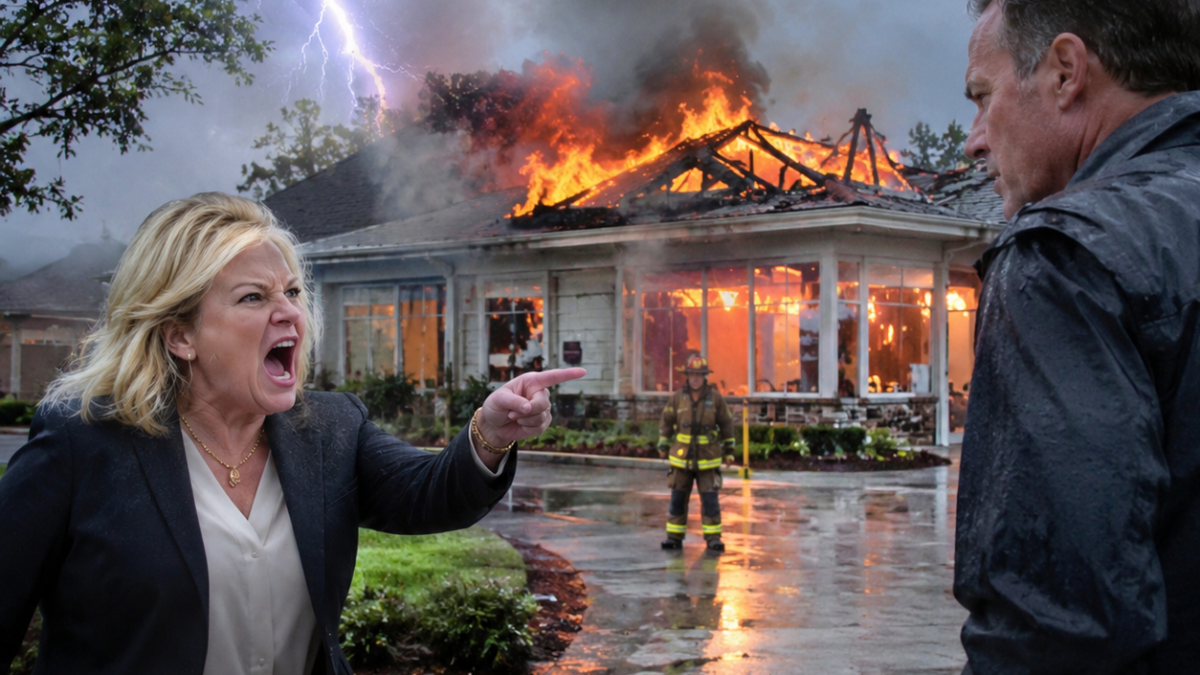
She called three pieces of copper on my barn “ugly” and ordered them gone because they spoiled the view from her $4.2 million clubhouse.
Forty-eight hours later, I stood in the rain watching flames tear across that same clubhouse while she screamed that I had destroyed everything she built.
What she still didn’t understand was that the fire wasn’t the worst thing waiting for her—the paperwork was.
My name is Reed Huxley, and I had owned my ranch long before Silver Ridge Estates existed.
My land sat below the subdivision on a broad slope of pasture, timber, and old fencing that my father and I had repaired so many times I could walk most of it in the dark.
At the center stood my barn.
Not a show barn.
Not one of those polished buildings designed for wedding photographs.
It was a working structure—weathered cedar siding, steel hardware, feed room, workshop, equipment bay, and a roof that had taken decades of wind, hail, snow, and summer heat.
Along the ridge of that roof stood three copper air terminals.
Camille Renshaw hated them.
She told me that the first time she came to my gate.
She was fifty-one, president of the Silver Ridge HOA, and she carried herself like the hill above my ranch had been created specifically so she could stand on it and give orders.
Behind her stood Neil Forsythe, head of the HOA maintenance crew.
Camille pointed toward my barn.
“Those have to go.”
I followed her finger.
“The lightning system?”
“They’re visible from our terrace.”
“So?”
She blinked as though I had missed something obvious.
“We’re hosting the Founders Gala this weekend.”
I waited.
“And?”
“Hundreds of photographs will be taken from the clubhouse.”
I still waited.
She sighed.
“Those copper spikes make the entire valley look industrial.”
“They’re safety equipment.”
“They look like junk.”
I almost laughed.
The system on my barn had been installed professionally.
Three roof terminals.
Copper down conductors.
Grounding electrodes.
Bonding.
Surge protection.
Inspection points.
Derek Montro, a certified lightning-protection specialist, had inspected it less than a year earlier.
Nothing about it was decorative.
Nothing about it belonged to Silver Ridge.
Camille pulled a paper from her folder.
“Architectural nuisance notice.”
I took it.
Looked at the address.
Then at her.
“My ranch isn’t in your HOA.”
“This affects our community.”
“That doesn’t put my roof under your authority.”
She changed arguments instantly.
“Silver Ridge holds a visual easement.”
“A what?”
“A visual easement protecting views from the clubhouse.”
I had spent years in industrial construction reading plans, permits, easements, grounding schedules, and electrical drawings.
I had never heard of a recorded “visual easement” that gave an HOA permission to dismantle safety equipment on a neighboring ranch.
“Show me the easement.”
“I don’t carry every legal document in my vehicle.”
“Then come back when you have it.”
Her face tightened.
I handed the notice back.
“This is not decoration, Camille. Do not touch it.”
She stared past me toward the barn.
“Then make it prettier.”
“No.”
I closed the gate.
For several seconds she stayed outside, looking at the copper terminals as if they were personally insulting her.
Then she turned toward Neil.
“By Friday,” she said loudly enough for me to hear, “I don’t want to see them.”
That was the moment I knew the conversation had never been a conversation.
She had already decided what she was going to do.
The next afternoon, I came home from town and saw a white HOA maintenance truck parked inside my gate.
My first thought was that somebody had called about a fence.
Then I looked at the barn roof.
There had been three copper terminals.
Now there were two.
I hit the accelerator.
By the time my truck stopped beside the barn, two men were on my roof.
One terminal lay in the maintenance truck.
Another worker had a wrench on the second.
Neil stood below them.
I jumped out.
“GET OFF MY ROOF!”
Everyone froze.
Neil looked at me.
“We’ve been directed to perform safety remediation.”
“On whose property?”
He did not answer.
I pulled out my phone.
Started recording.
“Everybody stop working.”
One of the men looked down at Neil.
Neil looked toward the road.
And less than ten minutes later, Camille’s white SUV appeared.
She stepped out smiling.
Like this was her property.
Like I was the inconvenience.
“Reed,” she said, “we discussed this.”
“No. You gave an order you had no authority to give.”
She unfolded a map.
“This barn sits inside a shared scenic corridor.”
I took one look and felt my stomach tighten.
The property line had moved.
Not physically.
On her map.
It cut dozens of feet across my pasture and through the barn.
“That isn’t the county plat.”
“It’s the association map.”
“Then your association map is wrong.”
Behind us, one of the maintenance workers started digging beside the barn foundation.
I turned.
“What is he doing?”
Camille pointed toward a thick copper conductor emerging near the ground.
“That ugly wire needs to go too.”
“No.”
Neil picked up a heavy cutter.
“Neil.”
He hesitated.
I walked closer.
“Do not cut that conductor.”
Camille’s voice hardened.
“Do it.”
The jaws closed.
One hard squeeze.
The copper snapped.
The loose end fell.
And that was when I saw the stamped tag on the older sheathing.
**SR CLUB**
Silver Ridge Clubhouse.
I stopped breathing.
“Neil.”
He looked down.
“Do you know what you just cut?”
He said nothing.
I stared at the conductor disappearing underground and running toward the hill.
Then I looked at Camille.
“If that cable goes where I think it goes, you just changed the grounding configuration of a four-point-two-million-dollar building with no engineer standing here.”
She smiled.
“Then maybe your ugly barn should stop being connected to my beautiful clubhouse.”
For the first time that afternoon, I saw uncertainty flicker behind her eyes.
Because I answered quietly.
“Camille, I never gave anybody permission to connect your clubhouse to my system.”
PART 2
Her smile slipped.
Only for a second.
Then she recovered.
“That is not my concern.”
“It should be.”
She turned to Neil.
“Finish.”
I stepped between him and the barn.
“Everyone off my property.”
Camille looked at me.
“You do not get to interfere with association maintenance.”
“This is not association property.”
“Reed—”
“I am calling the sheriff.”
She gave a dismissive laugh.
“Please do.”
So I did.
Not 911.
Nobody was bleeding.
Nobody had been threatened with a weapon.
I called the sheriff’s non-emergency line and reported trespass and destruction of property.
Then I did something Camille clearly did not expect.
I stepped back.
I stopped arguing.
And I filmed.
Every worker.
Every tool.
Every removed terminal.
Every license plate.
Every sentence.
Neil looked increasingly uncomfortable.
Camille looked increasingly pleased with herself.
By the time they finished, all three roof terminals were gone.
One down conductor had been cut.
The underground bonding conductor had been severed.
Copper components were loaded into the HOA truck.
I said clearly, “Those components belong to me.”
Camille answered, “They are evidence of an architectural violation.”
I almost laughed.
“You’re stealing my lightning equipment and calling it evidence?”
“Use whatever word makes you feel better.”
The sheriff’s deputy arrived as they were preparing to leave.
He listened.
Took names.
Photographed the cut conductor.
Looked at my deed.
Looked at Camille’s map.
Then told everyone the property-line issue would need to be documented through the county records and that nobody should escalate.
Camille loved that.
She heard “civil issue” and interpreted it as victory.
Before she got into her SUV, I tried one last time.
“Have somebody qualified inspect the clubhouse before you use it.”
She stopped.
“Excuse me?”
“You heard me.”
“Our clubhouse is fine.”
“You just cut a conductor labeled for it.”
“It shouldn’t have been on your land.”
“That doesn’t make cutting it safe.”
She gave me a thin smile.
“You are not going to ruin my gala.”
Then she drove away.
I stood beside the barn after the road went quiet.
The empty mounting points on the roof bothered me.
But not as much as that severed conductor.
I knelt beside it.
Copper.
Heavy gauge.
Old installation.
Stamped tag.
SR CLUB.
I had worked industrial construction long enough to know what I did not know.
That matters.
People get hurt when experience turns into arrogance.
I understood grounding systems.
Bonding.
Electrical fault paths.
Lightning protection concepts.
But I was not going to pretend I could diagnose an entire building from one wire in the dirt.
So I called Derek Montro.
He answered on the third ring.
“Reed.”
“I need you out here.”
“What happened?”
“HOA crew removed the barn terminals.”
Silence.
“All of them?”
“Yes.”
“Down conductors?”
“One cut.”
“Anything else?”
“There’s a buried conductor with a tag that says SR Club.”
Another silence.
Longer.
“Do not touch anything.”
“I wasn’t planning to.”
“I mean nothing. Don’t reconnect. Don’t dig. Don’t move copper. Take pictures.”
“Why?”
“Because if that line goes where I think it goes, somebody needs to see the condition before the people responsible realize what they did.”
He arrived two hours later.
Tool case.
Continuity tester.
Camera.
Notebook.
No drama.
That was Derek.
He trusted measurements more than theories.
He clipped into the severed conductor.
Tested sections.
Tracked probable routing.
Compared it to visible infrastructure.
Then stood near the barn looking toward the clubhouse on the ridge.
“This appears to continue toward Silver Ridge.”
“Meaning?”
“Meaning there is a bonding connection between this grounding network and something in their technical corridor.”
“Can my barn protect their clubhouse?”
“No.”
His answer was immediate.
I appreciated that.
“Three terminals on your barn do not magically become the lightning protection system for a building hundreds of feet away.”
“Then why is that conductor here?”
“That is what bothers me.”
He knelt again.
“A bonding system has to be designed as a system. You don’t just borrow a neighboring structure’s grounding network because it happens to exist.”
“Could it be legitimate?”
“Anything is possible if there are engineered drawings, permissions, coordination, inspection.”
“I never signed anything.”
“Then we find the drawings.”
That evening, I barely slept.
Not because I thought lightning would strike immediately.
Because I had the feeling you get when one wrong detail reveals a larger problem.
The next morning, Derek and I started with county records.
Silver Ridge Summit Clubhouse had undergone a major renovation six years earlier.
I remembered construction trucks on the hill.
New ballroom.
Restaurant expansion.
Rooftop terrace.
Decorative metal cupola.
Architectural lighting.
What I had not known was what happened inside the electrical scope.
The original renovation plans were detailed.
Dedicated rooftop air terminals.
Down conductors.
Grounding electrodes.
Surge suppression.
Bonding of rooftop metal features.
A complete system.
Then we got to the completion file.
One page was missing.
Final lightning protection certification.
In its place was a change order.
Derek read it twice.
“Existing adjacent grounding network.”
“What does that mean?”
“It means somebody tied part of the system into an existing grounding network nearby.”
“My ranch.”
“Looks that way.”
“Where is my permission?”
“I don’t see any.”
Neither did I.
No easement.
No license.
No signature.
No notice.
Nothing.
Someone had used infrastructure on my land as part of a technical solution for the clubhouse.
Without asking.
I sat in the county records office feeling anger build slowly.
Not explosive anger.
Worse.
The kind that comes from realizing somebody has been making decisions about your property for years while pretending you do not exist.
Then Derek found old construction photographs.
He pointed at the clubhouse roof.
“Look.”
Small copper terminals lined the upper roof edges.
I opened newer photographs on my phone.
Gone.
“Where did they go?”
“That’s a very good question.”
We pulled later maintenance records.
No obvious redesign.
No replacement certification.
No documented equivalent protection scheme.
The more we looked, the worse it felt.
The clubhouse had once had visible lightning protection.
At some point, components disappeared.
And an unauthorized connection to my ranch remained.
Then Camille sent her crew onto my land and cut that connection too.
I did not call her screaming.
I wrote an email.
Camille.
Entire board.
Neil.
Management company.
Association attorney.
Subject:
**Immediate Safety Inspection Recommended – Summit Clubhouse Lightning Protection**
I kept it factual.
No accusations.
No threats.
I explained what had been removed from my property.
Mentioned the conductor marked SR Club.
Stated that I had never authorized a connection.
Attached photographs.
Then wrote:
**Given the unknown condition of the clubhouse lightning protection and bonding system, I strongly recommend that the rooftop and clubhouse be closed until a qualified professional can inspect the system.**
Derek attached a short technical note.
He was careful.
He did not say the clubhouse was definitely unsafe.
He said system status was unknown.
Inspection recommended before continued occupancy during thunderstorm conditions.
Camille responded in forty-seven minutes.
Reply all.
She called me a disgruntled neighboring landowner.
Said I was attempting to sabotage the Founders Gala.
Claimed the building had passed every required inspection.
I replied with one line.
**Please send the most recent lightning protection certification.**
Nothing.
I waited an hour.
Nothing.
By evening, a giant banner hung across the clubhouse.
**FOUNDERS GALA — SATURDAY**
Camille had answered without answering.
The next day, Neil called me privately.
He sounded nervous.
“She wants the copper flashing painted.”
“What?”
“Anything visible from the terrace.”
“Who is inspecting the system?”
“I don’t know.”
“Did you ask?”
Silence.
“Neil?”
“Yes.”
“What did she say?”
His voice dropped.
“She said she’s the president.”
I closed my eyes.
“Do not alter anything else because I told you to.”
“I know.”
“Do what your own training requires.”
“I know.”
He hung up.
That evening, another call.
Unknown number.
Woman whispering.
“Mr. Huxley?”
“Yes.”
“My name is Sabrina Colbrook.”
I knew the name.
Silver Ridge treasurer.
“We haven’t met.”
“No.”
“Did your contractor say the clubhouse is unsafe?”
“No.”
She sounded surprised.
“No?”
“He said the condition of the protection system is unknown and needs professional inspection.”
“So he didn’t say it’s safe either.”
“No.”
Long pause.
Then:
“Last year, we approved money for lightning protection.”
I sat straighter.
“How much?”
“Eighty-six thousand four hundred dollars.”
“For what?”
“Retrofit and surge mitigation.”
“Was the work done?”
Silence.
“Sabrina?”
“I need to go.”
The line disconnected.
Ten minutes later, my phone buzzed again.
Weather notification.
**SEVERE THUNDERSTORM WATCH — SATURDAY EVENING**
I stared at the screen.
The timing lined up almost exactly with the gala.
By Friday morning, the forecast worsened.
Strong storms.
Frequent lightning.
High winds.
I emailed again.
Attached weather information.
Derek offered to inspect the clubhouse that afternoon.
Emergency assessment.
A few thousand dollars.
Camille refused.
Her response:
**No contractor associated with Mr. Huxley will be permitted inside association property.**
No alternative inspector.
No reschedule.
No cancellation.
Just no.
That was when I forwarded everything to County Fire Marshal Evelyn Brodick.
I had met Evelyn once during a commercial shop inspection.
She was the kind of person who could make a room nervous by quietly opening a notebook.
I explained.
She listened.
Then said:
“I cannot close a building because a neighbor believes there may be a protection issue.”
“I understand.”
“But I can request records.”
“Good.”
“And I can document that the issue was raised.”
“Better.”
She requested electrical permits.
Fire system inspection.
Lightning protection certification.
Roof alteration records.
Maintenance history.
Camille promised to provide everything after the gala.
Evelyn wrote that down.
Two days before the event, Sabrina asked to meet me.
Not at my ranch.
Not at Silver Ridge.
A diner twenty minutes away.
She arrived carrying a folder.
Sat facing the door.
Looked over her shoulder twice.
“You look like you’re meeting a criminal informant.”
“This doesn’t feel far off.”
She pushed the folder toward me.
Inside was the HOA budget.
Fourteen months earlier:
**Lightning Protection Retrofit & Surge Mitigation – $86,400**
Three months later:
Transfer.
**Clubhouse Exterior Enhancement**
Imported stone.
Designer architectural lighting.
Glass railing.
Rooftop terrace upgrades.
Amount moved?
Almost the entire safety budget.
Approval signature?
Camille Renshaw.
My stomach tightened.
“There’s more,” Sabrina said.
She pulled out printed emails.
An engineer warned:
**Removal of visible roof conductors should not proceed without equivalent redesign.**
Camille replied:
**No exposed copper on clubhouse sightline.**
Another warning.
Loss of compliant strike termination and bonding could create serious fire and surge risk.
Camille proceeded anyway.
I leaned back.
Suddenly her hatred for the copper on my barn made perfect sense.
She had not started caring about aesthetics this week.
She had already stripped visible lightning components from the clubhouse because she thought they looked bad.
Then she redirected the money intended to correct the system into decorative upgrades.
Whatever remained had continued using that strange, unauthorized connection to my ranch.
And two days earlier, she had ordered that cut too.
“Does the board know?” I asked.
“Not all of it.”
“Your attorney?”
“I don’t know.”
“Then you need your own counsel before you start handing records around.”
“I’m the treasurer.”
“And that means you have duties.”
She nodded.
“I kept copies because something felt wrong.”
“Good.”
“Do you think the building is going to burn?”
That question hit me harder than anything else.
“I don’t know.”
She looked terrified.
“Nobody can promise what lightning will do.”
“Then what do we do?”
“Get a qualified inspection.”
“I tried.”
“Keep trying.”
Friday night, I stood outside my house.
The clubhouse glowed on the hill.
Architectural lighting washed the walls in warm gold.
The glass ballroom reflected the valley.
The decorative cupola rose above the roof like a crown.
Far west, lightning flickered.
Thin.
Distant.
But real.
I called Camille.
She answered.
“You again.”
“Cancel the gala.”
She laughed.
“You’re threatening me now?”
“No.”
“Because I have board members in this room.”
“Put me on speaker.”
She did.
I heard voices.
Glasses.
Someone shifting papers.
Camille said theatrically:
“Mr. Huxley is demanding that Silver Ridge cancel its Founders Gala because he is unhappy about an architectural disagreement.”
“No.”
The room quieted.
“I’m documenting that I warned you.”
Someone stopped moving.
I continued.
“Your building’s protection system has unresolved alterations. Your own records show prior engineering warnings. You severed a conductor on my property two days ago. Severe thunderstorms are forecast during occupancy.”
Camille interrupted.
“This is harassment.”
“Hire any qualified professional you want.”
“We are not discussing this.”
“Then document that too.”
I hung up.
She did not cancel.
Instead, she emailed every adult homeowner.
The gala would proceed.
Rumors about safety were false.
The clubhouse was fully operational.
Sabrina forwarded the message to me with no comment.
Evelyn made one move that may have prevented fatalities.
She contacted the management company.
No rooftop terrace use if lightning entered the warning radius.
All outdoor guests moved inside at first detection.
Staff acknowledged.
Saturday evening arrived.
Clouds swallowed the ridge.
From my ranch, I could hear music testing through the valley.
Cars climbed the hill.
Men in jackets.
Women in formal dresses.
Valets.
Warm light poured through the glass ballroom.
The storm moved closer.
Wind crossed my pasture.
Horses became restless.
Thunder rolled.
I checked the radar.
Bad.
Then the first bright flash came behind the ridge.
I stood on my porch.
Another thunderclap.
Longer.
Closer.
Up at the clubhouse, staff had already begun clearing the rooftop terrace.
That decision mattered.
Minutes later, the sky opened.
Rain slammed the barn roof.
I stepped inside.
Then everything turned white.
Not bright.
White.
The kind of flash that erases depth for a fraction of a second.
The sound arrived immediately.
A crack so violent I felt it through the floor.
I ran back outside.
For a second, the clubhouse was dark.
Then I saw smoke.
A thin gray line near the western roof.
I grabbed my phone.
Dialed 911.
By the time the dispatcher answered, orange light appeared under the roofline.
“Silver Ridge Summit Clubhouse,” I said. “Lightning strike. Visible smoke. Possible structure fire.”
I ran toward my truck.
Not onto HOA property.
Toward the county road below the hill.
Sirens started in the distance.
The fire grew faster than I expected.
Later, investigators explained why.
The strike hit near the metal cupola.
Surge and arcing entered systems already compromised by years of piecemeal alteration.
Fire reached concealed spaces beneath the cedar roof.
Wind pushed it.
Control equipment was damaged.
The alarm system faulted.
Inside, staff initially thought the power had simply failed.
Then smoke entered the ballroom.
Guests evacuated.
Every person got out.
That fact matters more than anything else in this story.
Nobody died.
Nobody was trapped.
Nobody was left on that terrace.
The building could be replaced.
People could not.
Fire crews arrived hard and fast.
Engines.
Ladder trucks.
Water supply.
Crews protected neighboring homes.
They saved them.
The clubhouse?
Not fully.
The roof burned.
Part of the terrace collapsed.
Heat shattered glass.
Water poured into offices.
Restaurant.
Ballroom.
Furniture.
Electronics.
Lighting.
Association records.
Everything Camille had made beautiful was being soaked, burned, or broken.
I stood outside the safety perimeter.
Rain on my jacket.
Watching.
I felt no satisfaction.
None.
People like simple revenge stories.
Bad person destroys safety equipment.
Lightning arrives.
Poetic justice.
Standing there, it did not feel poetic.
It felt terrible.
A building worth millions was burning because a sequence of decisions had left it vulnerable.
Firefighters were risking themselves.
Residents were crying.
Staff were standing in formal clothes under emergency blankets.
Sabrina was shaking.
Neil had soot across his face.
Then Camille saw me.
Her silver gala gown was streaked black.
Mascara running.
Hair wet.
She pushed past a cluster of residents.
Came toward me.
“You!”
I did not move.
“You did this!”
“No.”
“You disconnected our building!”
That sentence stopped everything around us.
Evelyn Brodick stood maybe eight feet away.
She turned her head.
“Your building was connected to his property?”
Camille froze.
Rain ran down her face.
“I—no. He claims—”
Evelyn stepped closer.
“What did you just say?”
“I don’t know what he did.”
“You said he disconnected your building.”
“I was upset.”
“Was the clubhouse connected to electrical or grounding equipment on Mr. Huxley’s property?”
Camille looked at me.
Then at Evelyn.
“I don’t know.”
Too late.
Several responders had heard her.
One body camera had recorded the entire exchange.
Evelyn immediately ordered evidence preservation.
Burned conductors.
Ground connections.
Electrical panels.
Roof remnants.
Maintenance work orders.
Security footage.
Any alteration records.
By sunrise, the scene had changed from emergency response to investigation.
Jonah Pembry arrived for the insurer.
Gloves.
Camera.
Clipboard.
He did not promise anybody a check.
He barely spoke.
He photographed.
Measured.
Asked for records.
Walked the perimeter.
The first loss estimate was brutal.
Main roof replacement.
Ballroom nearly total loss.
Electrical rebuild.
Smoke contamination.
Water damage.
Restaurant.
Association offices.
Control systems.
Terrace.
Estimated replacement loss:
Nearly $4.2 million.
Camille heard that number and seemed almost relieved.
The building was insured.
In her mind, insurance meant reset.
Write the check.
Rebuild.
Move on.
The next morning, I received a letter.
Silver Ridge’s law firm.
Demand:
**$4,200,000**
They blamed me for altering a “shared electrical safety system.”
I read the letter in my kitchen.
Then read it again.
Anger returned.
Not because they were asking for money.
Because Camille was doing it again.
Turning her decision into somebody else’s crime.
By noon, every homeowner received an HOA notice.
A neighboring property owner had altered a shared safety system before the clubhouse loss.
No name.
No need.
Everybody knew.
People who had waved at me for years avoided eye contact.
One man at the gas station looked at me, then walked to another pump.
That hurt more than I expected.
I could survive a demand letter.
Being quietly treated like the man who burned down the clubhouse?
That was different.
Association counsel Allison Greer sent me a preservation notice.
Do not repair.
Do not move conductors.
Do not delete video.
Do not excavate.
Do not alter anything.
I replied:
**Agreed.**
Then:
**Attached please find video of the alterations performed by your client’s personnel.**
I sent the footage.
Camille arriving.
Neil directing workers.
Air terminals removed.
Conductor cut.
My warnings.
Her refusal.
Everything.
Allison watched it.
I know because later she told me she watched it twice.
Then she called Camille.
Not me.
Camille had a new version.
Her crew removed decorative metal.
I supposedly cut the conductor later.
Problem:
My barn camera recorded continuously.
No gap.
The cut happened on video.
Neil held the cutter.
Camille gave the instruction.
Her story lasted less than a day.
Then came the map.
The supposed “visual easement.”
County recorder found no such easement.
Certified plat showed the real boundary.
Camille’s map had shifted the line across my pasture and through the barn.
Another story collapsed.
Then Neil finally stopped protecting her.
Investigators asked:
“Who ordered you to cut the conductor?”
He answered:
“Camille.”
“Written order?”
“Yes.”
He had photographed it before the HOA maintenance system was locked.
**REMOVE VISIBLE COPPER ELEMENTS**
**PRESIDENT DIRECTIVE**
Camille ordered the management company to collect Neil’s phone.
He refused until investigators copied it.
That mattered.
One person saying no.
Sometimes power collapses one refusal at a time.
I sent the association a formal demand.
Stay off my ranch.
Return my equipment.
Pay to restore the protection system.
Withdraw the $4.2 million claim.
Preserve all records.
Camille called me directly.
“Twenty-five thousand dollars.”
“What?”
“I’ll pay you twenty-five thousand.”
“For what?”
“You sign a statement.”
“What statement?”
“That the grounding system was shared.”
I was silent.
She continued.
“That Silver Ridge always had authority to maintain it.”
I almost admired the audacity.
“You want me to retroactively give you permission?”
“It clarifies the arrangement.”
“It manufactures permission.”
“Reed, be reasonable.”
“You trespassed.”
“We maintained a shared system.”
“You removed my equipment.”
“We addressed a hazard.”
“You cut a conductor without an engineer.”
“You’re not listening.”
“No. I’m listening perfectly.”
Her voice went cold.
“When this is over, you’ll lose that ranch.”
“Good.”
“What?”
“Make sure you keep that recording.”
I hung up.
While Camille threatened me, Jonah was reading the insurance file.
That was far more dangerous to her.
One renewal question asked:
**Has required fire, electrical, or lightning protection equipment been removed or materially altered?**
Answer:
**NO**
Certified by:
**Camille Renshaw**
Date:
Eight months after she had already ordered visible lightning equipment removed from the clubhouse roof.
That did not automatically erase coverage.
Insurance is more complicated than one checkbox.
But it changed the claim.
Jonah opened a special investigation.
Evelyn, Jonah, and an independent electrical engineer examined the burned structure.
Their conclusion was careful.
Important.
Nobody said my three barn terminals would have “saved” the clubhouse.
That would have been technically dishonest.
Instead, they found a pattern.
The clubhouse originally had its own lightning protection.
Visible rooftop components were later removed.
Equivalent redesign could not be documented.
An unauthorized bonding connection to my ranch remained.
Camille’s crew then altered my system and severed that connection.
No professional inspection followed.
The clubhouse remained occupied during a severe thunderstorm watch.
Physical evidence matched the sequence.
Tool marks on the cut conductor matched equipment from the maintenance truck.
Neil’s photographs supported timing.
My cameras showed the work.
The work order showed direction.
The engineering history showed earlier warnings.
Investigators cleared me.
No evidence I entered the clubhouse.
No evidence I altered its system.
No evidence I cut anything.
No evidence I caused or contributed to the strike.
The video showed the opposite.
I tried to stop the alteration.
At a closed board meeting, Camille still demanded that Allison sue me.
Allison asked:
“On what factual basis?”
“He owned the system.”
“Then why did you order employees to remove it?”
Silence.
Sabrina had minutes from an older meeting.
A board member had asked whether removing lightning components was safe.
Camille’s recorded response:
**The clubhouse has survived storms for years. This is aesthetic cleanup, not engineering.**
Derek found another warning letter.
Former contractor.
Existing arrangement should not be considered a substitute for compliant dedicated lightning protection.
Camille had received it.
Then Jonah found the document that changed everything.
A proposal.
Eleven months before the fire.
$86,400.
Restore strike termination.
Dedicated down conductors.
Separate the clubhouse from unauthorized grounding connections.
Upgrade surge protection.
Inspect bonding.
Final page:
**FAILURE TO CORRECT MAY RESULT IN CATASTROPHIC FIRE LOSS.**
Across the top of page one, in Camille’s handwriting:
**DECLINED — VISUAL IMPACT / EXCESSIVE COST**
I sat in Derek’s office staring at those words.
“She wrote that?”
“Yes.”
“She literally wrote visual impact?”
“Yes.”
“On the proposal warning about catastrophic loss?”
“Yes.”
I leaned back.
There are moments when a case stops being complicated.
That was one.
Sabrina produced bank records.
In the same quarter, Silver Ridge spent almost the same amount on:
Imported stone.
Designer lighting.
Glass railings.
Rooftop entertainment improvements.
Camille had chosen what guests could see over what might keep them safe.
And now the very room she wanted to make beautiful was blackened behind fencing.
Jonah informed the board.
The claim was complicated by prior alterations.
Disclosure issues.
Engineering warnings.
Code questions.
Unauthorized work.
Coverage was no longer the simple catastrophic weather claim Camille expected.
The association might receive some coverage under remaining policy terms.
But a single $4.2 million check was no longer guaranteed.
Camille panicked.
Emergency meeting.
She proposed a huge special assessment.
Homeowners erupted.
“Why are we paying if we have insurance?”
“What happened to the safety money?”
“Why was the system removed?”
Camille ordered Sabrina to present only general financial statements.
Sabrina refused.
She sent the entire packet to Allison.
Including one email from Camille:
**I DON’T CARE WHAT THE ENGINEER SAYS. I’M NOT PUTTING COPPER SPIKES BACK ON A $4 MILLION BUILDING.**
That sentence ended something.
Not legally.
Emotionally.
The board finally saw her clearly.
Allison told Camille:
“Continuing to blame Reed increases the association’s exposure.”
“He caused this.”
“No.”
“He owned the system.”
“The video proves your employees entered his land.”
“He interfered.”
“The video proves he told them to stop.”
“You’re supposed to defend us!”
“I represent the association.”
Allison paused.
“Not you personally.”
Camille went silent.
That was the moment her title stopped protecting her.
She turned to directors-and-officers insurance.
Surely that policy would defend her.
The carrier issued a reservation of rights.
Intentional trespass.
Knowingly unauthorized work.
Potential misrepresentation.
Conduct outside authority.
Coverage questions.
For the first time, Camille needed her own lawyer.
Her own money.
Her own defense.
Then my three air terminals were found.
Association maintenance yard.
Still tagged.
Still intact.
Evelyn documented them.
Released them back.
Derek turned one in his hands.
Looked toward the burned hill.
“Funny.”
“What?”
“These survived better than the clubhouse.”
I did not laugh.
I couldn’t.
I looked at the blackened structure.
A building that once glowed over the valley.
The glass ballroom was boarded.
Roof open to the sky.
Scorched timbers.
It did not feel like justice.
It felt like waste.
Two days later, Silver Ridge formally withdrew the $4.2 million demand against me.
I should have felt relief.
I did.
But another letter arrived.
This one came from attorneys representing a group of Silver Ridge homeowners.
They demanded answers from their own board.
Why was safety money redirected?
Who authorized equipment removal?
What had been disclosed to the insurer?
Who approved entry onto my ranch?
Emergency removal vote scheduled.
The meeting could not happen at the clubhouse.
The clubhouse was unusable.
So Silver Ridge rented a conference hall.
The symbolism was impossible to ignore.
Camille had spent years ruling from a glass ballroom on top of the hill.
Now she sat behind a folding table under fluorescent lights.
Rows of angry homeowners faced her.
No terrace.
No chandeliers.
No beautiful view.
No stage.
Just questions.
Camille tried first.
“This was an unprecedented natural disaster.”
A man stood.
“Why did you remove the lightning system?”
“Parts were obsolete.”
“Where is the engineering report saying that?”
She had none.
Another homeowner:
“Why was eighty-six thousand dollars moved out of the safety budget?”
“The clubhouse required exterior improvements.”
“Who approved it?”
“The board.”
Sabrina shook her head.
“Not the full board.”
Voices rose.
Then I was invited to speak.
I did not make a speech.
I connected my laptop.
Played the video.
Entire room watched.
Camille’s truck entering my property.
Workers climbing my barn.
Terminals coming off.
Neil cutting the conductor.
My voice:
**Do not cut that.**
Camille:
**Do it.**
Then my warning.
If that cable goes to the clubhouse, you just changed the grounding arrangement without an engineer.
The video ended.
I displayed the timestamp of my warning email.
Forty-eight hours before the strike.
Then I said one thing.
“I did not ask Silver Ridge to protect my barn.”
I looked at Camille.
“I asked your president to stop dismantling it.”
Then I sat down.
Sabrina stood.
She had documents.
$86,400 retrofit budget.
Transfer.
Camille’s signature.
Engineering warnings.
Insurance renewal.
Maintenance order.
Rejected proposal.
Everything.
Camille snapped.
“You stole confidential records!”
Allison Greer spoke from the attorney table.
“They are association records subject to board review.”
Another shield gone.
Then Neil stood.
He looked sick.
“I removed the equipment.”
People turned.
“I should not have.”
He swallowed.
“Camille ordered it.”
She shot up.
“You were maintenance supervisor!”
“Yes.”
“You made operational decisions!”
“I asked whether we needed an engineer.”
Silence.
“You told me no.”
Camille stared at him.
“You said you wanted it gone before the gala.”
His voice cracked.
“I followed the order. That was wrong.”
That mattered.
He did not pretend innocence.
Did not make himself a hero.
He admitted his failure.
People respect that more than excuses.
Allison summarized the insurance situation.
No single check.
Potential enormous gap.
Coverage disputes.
Multiple responsible parties.
Possible recovery actions.
Then a board member made the motion.
“Remove Camille Renshaw as president, effective immediately.”
She laughed.
“You can’t be serious.”
Second.
Vote.
Camille objected.
Demanded procedural review.
The association attorney confirmed the meeting had been properly noticed.
Ballots counted.
The margin was overwhelming.
Camille Renshaw was no longer president of Silver Ridge.
For several seconds she sat completely still.
Then she stood.
Gathered her papers.
Walked toward the exit.
At the door, she turned.
Looked at me.
No microphone.
No guards.
No polished smile.
“You ruined me.”
I answered quietly.
“No.”
Everyone heard.
“I told you not to touch three pieces of copper.”
She left.
The new board kept working.
Forensic accountant.
Asset tracing.
Insurance negotiations.
Claims against contractors.
Review of Camille’s authorizations.
Reimbursement for my damaged system.
Formal recognition that my ranch was outside HOA jurisdiction.
No “visual easement.”
No scenic corridor authority.
No architectural control.
The financial consequences spread.
Silver Ridge versus insurer.
Silver Ridge versus contractors.
Silver Ridge versus Camille.
My claim for trespass and property damage.
Camille’s private legal fees.
Questions about intentional conduct.
Then the forensic accountant found one more authorization.
Association reserve funds had paid the maintenance crew for the work on my ranch.
Camille’s signature again.
It always came back to signatures.
People think power is loud.
Sometimes power is ink.
A signature can move money.
Authorize work.
Create obligations.
And later?
It can prove exactly who made the choice.
Eight months after the fire, Silver Ridge announced the rebuild.
Except it wasn’t really a rebuild.
Not of the old clubhouse.
They could not afford that.
The new design was smaller.
Simpler.
No elaborate rooftop tower.
Less imported stone.
Less glass.
No extravagant terrace package.
Residents complained at first.
Then the architect showed the safety systems.
Dedicated lightning protection.
Certified.
Independent.
Fully documented.
Air terminals clearly visible along the roofline.
Nobody tried to hide them.
One homeowner asked if they could be concealed.
The new president said:
“No.”
Not angry.
Just no.
“Safety equipment stays visible if it needs to stay visible.”
That became policy.
No removal or alteration of safety-related systems without:
Qualified professional review.
Written board vote.
Required permits.
Documented inspection.
Four rules.
A lesson worth millions reduced to four rules.
Silver Ridge paid to restore my system.
Fence damage.
Inspection cost.
Legal expense under settlement.
Unauthorized entry damages.
Derek did the reinstall.
He carried the first copper terminal up the ladder.
Bolted it exactly where it had been.
Second.
Third.
Then tested the down conductors.
Grounding.
Bonding.
Surge protection.
Everything independent.
Everything mine.
When he finished, he stood beside me.
Sunset hit the copper.
It glowed.
Up the hill, the new clubhouse was under construction.
Its own new air terminals caught the same light.
Derek grinned.
“Still ugly?”
I looked up.
“Apparently ugly got expensive.”
That was the first time I laughed about any of it.
Camille eventually sold her home.
Not immediately.
Life is rarely that clean.
Legal bills accumulated.
Personal exposure grew.
Certain claims were not fully insured.
Settlement obligations followed.
The large house on the hill she had once treated like a throne became part of the financial reality she could no longer control.
When the sale sign went up, people expected me to drive by.
I didn’t.
I had no reason.
Her house was never my goal.
My ranch was.
One morning, Sabrina stopped by.
She had stayed on the board during the transition.
Refused the presidency.
“I’m done with titles.”
“That seems healthy.”
She laughed.
“I thought about what happened.”
“That sounds dangerous.”
“I mean the budget.”
“Oh.”
“We spent eighty-six thousand dollars anyway.”
“More.”
“I know.”
“But not on protection.”
“No.”
She looked toward the hill.
“Stone.”
“Lighting.”
“Glass.”
“I voted for some of that.”
“You didn’t know everything.”
“I should have asked.”
“Probably.”
She smiled sadly.
“I appreciate that you don’t make people feel better when they don’t deserve it.”
“I’m terrible at comfort.”
“I noticed.”
We walked toward the barn.
She looked up at the copper.
“They really bothered her.”
“Yes.”
“I still don’t understand.”
“People care a lot about what other people can see.”
“That’s stupid.”
“Sometimes.”
She became quiet.
“My husband says I should resign.”
“You want to?”
“Eventually.”
“Then do it when you think the system can survive without you.”
She looked at me.
“You sound like someone who should join a board.”
“No.”
She laughed.
“Fair.”
Silver Ridge changed after that.
Not overnight.
Communities do not become healthy because one bad leader leaves.
There were lawsuits.
Arguments.
Assessments.
Resentment.
Some homeowners blamed Camille.
Some blamed the old board.
Some blamed the insurer.
A few still blamed me.
That last group bothered me less with time.
People need simple villains.
The truth was complicated.
The clubhouse fire was caused by lightning.
I did not control lightning.
Camille did not control lightning.
But people control preparation.
They control maintenance.
They control whether warnings are ignored.
Whether money goes to protection or decoration.
Whether unauthorized changes are made.
Whether a building stays open when systems are uncertain.
That was the real story.
Not:
Three rods disappeared, clubhouse burned.
The real story was layer after layer of protection being removed, altered, ignored, undocumented, or left incomplete until one ordinary natural event found the weakness.
That distinction mattered to me.
Because the more dramatic version was easier.
The accurate version was more important.
One afternoon, Evelyn came to the ranch after her final report had been released.
She stood beside the barn.
“Everything restored?”
“Yes.”
“Certified?”
I handed her the paperwork.
She smiled.
“Of course you have it ready.”
“I learned from you.”
“No, you already had the disease.”
She looked up at the terminals.
“People are calling this the lightning rod fire.”
“I know.”
“You hate that?”
“A little.”
“Why?”
“Because it makes it sound like three pieces of copper controlled the whole outcome.”
Evelyn nodded.
“Fair.”
“What would you call it?”
She thought.
“A preventable system failure.”
“That’s less viral.”
“Most accurate things are.”
We both laughed.
Then she became serious.
“You did something right.”
“What?”
“You didn’t reconnect that conductor.”
“Derek told me not to.”
“A lot of people would have tried fixing it immediately.”
“I wanted evidence preserved.”
“And you didn’t want to make something worse.”
“That too.”
She nodded.
“Good.”
Before leaving, she looked toward Silver Ridge.
“Camille kept telling people this was a freak event.”
“Lightning isn’t exactly rare.”
“Not here.”
“Then why did she believe she could ignore it?”
Evelyn shrugged.
“She didn’t believe the storm would happen on the day the consequences mattered.”
That sentence stayed with me.
People take risks because yesterday went fine.
Then another day.
Then another.
No fire.
No flood.
No failure.
Nothing bad happens.
So warning starts sounding like pessimism.
Safety starts looking expensive.
Maintenance starts looking ugly.
Until the day everything it was preventing arrives at once.
Camille’s biggest mistake was not aesthetics.
It was confusing absence of disaster with proof of safety.
The clubhouse survived storms for years.
Therefore, in her mind, the engineers were exaggerating.
The old system looked unnecessary.
The retrofit was overpriced.
The copper was ugly.
Then lightning struck once.
Less than a second.
That was enough.
I kept the architectural nuisance notice.
Framed.
Hung in my workshop.
People assume it is a trophy.
It isn’t.
The paper is ridiculous.
My barn address.
HOA logo.
Instruction to remove “unsightly roof appendages.”
I keep it because the wording reminds me how disasters start.
Not with flames.
Not with sirens.
Not with lightning.
Sometimes they start with a sentence:
**I don’t like how that looks.**
Then:
**Remove it.**
Then:
**We don’t need an engineer.**
Then:
**We’ll deal with paperwork later.**
Then one day there is nothing left to deal with except consequences.
A year after the fire, the new Silver Ridge clubhouse opened.
No gala.
At least not the kind Camille would have planned.
Simple community open house.
Coffee.
Food.
A short presentation.
Fire marshal inspection certificate displayed publicly.
Electrical documentation available.
Lightning protection certification framed near the facilities office.
Sabrina invited me.
I almost refused.
Then Derek said:
“You should go.”
“Why?”
“So you can stare at their ugly copper.”
I went.
The new building was nice.
Not extravagant.
Warm wood.
Smaller ballroom.
No giant rooftop terrace.
Lower profile.
And along the roofline:
Copper terminals.
Bright.
Visible.
Unapologetic.
A homeowner named Martin stood beside me outside.
“You’re Reed?”
“Yes.”
He pointed up.
“Those are because of what happened?”
“They’re part of the designed protection system.”
“You know what I mean.”
“Yes.”
He smiled.
“My wife thinks they look fine.”
“Smart woman.”
“She said anybody who complains should personally pay the insurance premium.”
“Very smart woman.”
Inside, the new board president gave a short speech.
No mention of Camille.
I respected that.
He talked about transparency.
Safety.
Independent review.
Then said something I did not expect.
“We spent years confusing appearance with value.”
The room quieted.
“This building is smaller than the old one.”
He looked around.
“But it is better documented, better protected, and honestly paid for.”
People applauded.
I did too.
Not because Silver Ridge deserved applause for learning basic lessons.
Because sometimes admitting failure publicly matters.
Afterward, Sabrina introduced me to a couple who had lived in Silver Ridge since the beginning.
The woman said:
“We owe you an apology.”
“You don’t know me well enough to owe me much.”
“We voted for Camille three times.”
“That’s not a crime.”
“We believed you caused the fire.”
I nodded.
“That was harder.”
“I’m sorry.”
Her husband said:
“We got the letter the morning after. It made it sound like you had cut the connection.”
“I know.”
“We should have waited.”
“Yes.”
They looked surprised.
I smiled slightly.
“But you’re here now.”
The woman looked toward the new roof.
“I still can’t believe she spent the retrofit money on stone.”
“Stone photographs better.”
She laughed.
Then stopped.
“That’s exactly what she cared about.”
I did not answer.
I had thought the same thing.
Months after opening, Silver Ridge asked whether county emergency planners could use the clubhouse for a storm-safety seminar.
They agreed.
Derek spoke.
Evelyn spoke.
I was asked to speak too.
I said no.
Then Sabrina called.
“Five minutes.”
“No.”
“Three.”
“No.”
“Two.”
“You’re negotiating like Camille.”
She gasped theatrically.
“Take that back.”
I laughed.
Then agreed to two minutes.
When my turn came, I stood in front of maybe seventy people.
I had no slides.
No dramatic photos.
I said:
“I spent years in industrial construction, and the most dangerous sentence on a job site is usually some version of ‘It’ll probably be fine.’”
A few people laughed.
I continued.
“Safety systems often look unnecessary when they’re working. Fire barriers are boring. Grounding is invisible. Surge protection isn’t beautiful. Inspections cost money and produce paper.”
I looked around.
“That doesn’t make them optional.”
Then:
“If a qualified person tells you something protects life or property, you don’t remove it because it ruins a photograph.”
That was it.
I sat down.
Derek leaned over.
“Two minutes and fourteen seconds.”
“Bill me.”
The audience laughed.
Life became normal again.
That mattered.
Horses.
Repairs.
Fence posts.
Shop work.
Storms.
Every time thunder rolled, I noticed it more.
Maybe I always would.
One summer night, a storm moved over the ranch.
Strong.
Lightning every few seconds.
I stood inside the barn.
Derek’s restored system above me.
Surge protection installed.
Everything inspected.
I heard a strike somewhere across the valley.
The lights flickered.
Stayed on.
I looked toward Silver Ridge.
New clubhouse.
Dark except for emergency lighting and a few interior lamps.
No rooftop event.
No guests outside.
Storm protocol.
Someone had learned.
My phone buzzed.
Text from Sabrina.
**Still ugly?**
I looked at the copper terminals silhouetted against the lightning.
Replied:
**Beautiful tonight.**
She sent a laughing face.
That was enough.
Camille disappeared from my daily life.
I heard things.
Legal disputes.
Payments.
Her home sale.
Private attorney.
I did not chase details.
Once she left Silver Ridge, she became someone else’s file.
I had my land.
That was what I wanted.
One afternoon, months after she moved, I saw her at a county office.
We both recognized each other.
She looked tired.
Older.
No tailored HOA blazer.
No security crew.
She walked toward me.
I expected anger.
Instead she said:
“You got everything you wanted.”
“No.”
She frowned.
“What else could you possibly want?”
“I wanted you to leave my barn alone.”
Her face hardened.
“You know what I mean.”
“Yes.”
“You got money.”
“Reimbursement.”
“You got the board.”
“I never joined it.”
“You got my house.”
“I did not touch your house.”
“You destroyed my reputation.”
“I recorded what happened.”
Her eyes flashed.
“There is no difference to you, is there?”
“Between what?”
“Being right and destroying someone.”
I looked at her for a long moment.
“There is a huge difference.”
She waited.
“If I had destroyed your property because I was angry, that would make us the same.”
She looked away.
“I never touched your clubhouse.”
Silence.
“I never cut your conductors.”
Silence.
“I never moved your money.”
Silence.
“I never signed your insurance renewal.”
Her mouth tightened.
“You could have let it go.”
“After the fire?”
“Before.”
“You mean when your crew was on my roof?”
She did not answer.
“That was the moment to let it go, Camille.”
I walked away.
I never saw her again.
For a long time, I wondered whether that conversation mattered.
Probably not to her.
It mattered to me.
Because anger can make you rewrite your own motives.
You start telling yourself you wanted justice when really you wanted to watch someone suffer.
I did not want that.
I wanted boundaries restored.
My equipment replaced.
My name cleared.
The fraudulent claim withdrawn.
Safety handled properly.
Those things happened.
Everything else was consequence.
That distinction kept me from becoming obsessed with Camille after she left.
Some neighbors were not so lucky.
Silver Ridge spent years recovering financially.
The smaller clubhouse helped.
Settlements helped.
Insurance eventually covered portions under applicable terms.
Recoveries from responsible parties helped.
But residents still paid.
Money.
Time.
Trust.
That was Camille’s real legacy.
She did not only burn through a building.
She burned through confidence in leadership.
New board members found themselves answering questions like:
“Who verified this?”
“Where is the report?”
“Who approved payment?”
“Can homeowners see it?”
At first, some complained that governance had become slow.
Sabrina’s response was perfect.
“Slow is cheaper than another clubhouse.”
Nobody argued.
At my shop, one of my younger employees asked about the framed nuisance notice.
I told him the story.
He stared.
“She really called lightning rods ugly?”
“Yes.”
“And then the building got hit?”
“Yes.”
“That’s karma.”
“No.”
He looked disappointed.
“No?”
“It’s probability meeting poor decisions.”
“That’s less fun.”
“It’s more useful.”
He laughed.
Then asked:
“Would the clubhouse definitely have survived if she left everything alone?”
“I don’t know.”
“Really?”
“Really.”
That answer matters.
Lightning is violent.
Buildings can suffer damage even with compliant protection.
Protection reduces risk.
Controls paths.
Improves survivability.
It does not make nature sign a contract.
The wrongdoing was not failing to guarantee a perfect outcome.
The wrongdoing was repeatedly removing, altering, ignoring, and misrepresenting safety measures while pretending risk no longer existed.
That was enough.
He nodded.
“So the lesson isn’t ‘lightning rods always save buildings.’”
“Correct.”
“It’s ‘don’t mess with safety systems you don’t understand.’”
“Much better.”
I pointed toward a welding machine.
“Now stop philosophizing and finish that bracket.”
He laughed and went back to work.
Years later, that is still how I tell the story.
People want revenge.
They want the line where Camille looks up and lightning strikes exactly because she insulted my barn.
Life is not that neat.
The storm did not know Camille.
The bolt did not care about our argument.
It followed physics.
The fire followed conditions.
The investigation followed evidence.
The financial consequences followed documents.
That is what made the ending satisfying to me.
Nothing supernatural had to punish her.
No one had to sabotage anything.
She built the consequences herself.
One removed component at a time.
One ignored warning at a time.
One signature at a time.
The most damaging signature was not the maintenance order.
Not the budget transfer.
Not even the refusal of the retrofit.
It was the insurance renewal.
Camille certified that required protective equipment had not been removed or materially altered.
Eight months after she knew it had.
That single answer gave Jonah a reason to open every drawer.
Once he did, everything came out.
Emails.
Warnings.
Budgets.
Photos.
Change orders.
Unauthorized connection.
Declined proposal.
Work order.
Renewal statement.
People often imagine investigations find one smoking gun.
Sometimes they do.
More often, they find a desk covered with paper.
One document says maybe.
Another says probably.
A third says definitely.
Then the story becomes impossible to escape.
That happened to Camille.
She survived the fire.
Her title did not.
Her financial shield did not fully protect her.
Her story did not survive the records.
One evening, Derek and I sat outside the barn after completing another annual inspection.
He tightened the cap on his meter.
“Everything good.”
“Good.”
“Want the report emailed?”
“Paper too.”
He laughed.
“Of course.”
“I like paper.”
“You like evidence.”
“That too.”
He looked toward Silver Ridge.
The new clubhouse lights had just come on.
Copper terminals along the roof caught the sunset.
He said:
“Funny thing.”
“What?”
“If they had just paid the eighty-six grand…”
“I know.”
“No fire guaranteed avoided.”
“I know.”
“But proper system.”
“I know.”
“Independent.”
“Yes.”
“Documented.”
“Yes.”
“No unauthorized wire running through your property.”
“Yes.”
He shook his head.
“All for less than the stone.”
“People photograph stone.”
“People photograph fire too.”
I looked at him.
“That’s dark.”
“I work lightning protection.”
“Fair.”
The horses moved across the pasture.
Quiet.
The barn smelled like hay and oil.
I looked up at the three terminals.
Same places.
Same copper.
Still visible from the clubhouse.
That was the final irony.
Camille started the fight because people could see them.
Now Silver Ridge had its own visible air terminals.
Nobody hid them.
Nobody painted them.
Nobody called them trash.
When sunlight hit the roof, they were obvious.
A reminder.
Not of me.
Of the cost of pretending appearance is more important than function.
The new board eventually installed a small plaque inside the mechanical room.
Not public.
Not dramatic.
It listed inspection dates.
Service company.
System documentation location.
Emergency contacts.
Sabrina showed me once.
“You like this?”
I read it.
“Very much.”
She smiled.
“I knew you would.”
“That is the most beautiful thing Silver Ridge has ever installed.”
“It’s a laminated sheet.”
“Exactly.”
She laughed.
I meant it.
Beauty is strange after you watch a building burn.
You start appreciating boring things.
Labels.
Test dates.
Ground connections.
Fire doors.
Inspection records.
People trained to ask questions.
Camille wanted everything visitors could see to look expensive.
The new board wanted the things nobody noticed to work.
That was progress.
My ranch stayed outside the HOA.
Formally documented now.
The settlement included written acknowledgment that Silver Ridge had no architectural authority over my property.
I framed that too.
Not on the wall.
In my legal file.
Some things belong in drawers.
The sign at my gate changed.
Simple.
**PRIVATE PROPERTY**
Then below:
**NO HOA AUTHORITY**
Derek laughed the first time he saw it.
“Subtle.”
“I considered neon.”
“Camille would hate that.”
“She doesn’t live here.”
“Good point.”
The sign became a joke with delivery drivers.
One asked:
“What happened?”
“Long story.”
“HOA?”
“Yes.”
He nodded.
“Say no more.”
Apparently everybody has an HOA story.
Mine just involved lightning.
The first anniversary of the fire came quietly.
No ceremony.
No news crews.
Rain earlier in the day.
Clear evening.
I walked to the pasture fence.
Looked up the hill.
New clubhouse.
Smaller.
Safe.
People inside.
A community meeting, I think.
My barn below.
Copper terminals shining.
For a moment, I remembered the old building.
The glass ballroom.
The lights.
The fire.
Then Camille in a soot-covered silver gown yelling:
**You did this.**
I had replayed that sentence many times.
It was easier for her to believe I caused the disaster than to accept that the thing she hated most—the ugly equipment, the warnings, the engineers, the budget line—had all been trying to protect what she loved.
That was tragic in a way.
She wanted a beautiful building.
There is nothing wrong with that.
She wanted people proud of Silver Ridge.
Nothing wrong with that either.
The problem was believing beauty excused everything.
Crossing property lines.
Ignoring professionals.
Hiding technical changes.
Moving safety money.
Rejecting inspections.
Rewriting history after the fact.
Beauty became justification.
Then obsession.
Then liability.
That happens more often than people think.
Not only with buildings.
People remove things that make them uncomfortable.
Warnings.
Rules.
Experts.
Dissent.
Paper trails.
They call them obstacles.
Then eventually those obstacles are the only things standing between a bad decision and catastrophe.
I rested my arms on the fence.
A horse came over.
Nudged my shoulder.
I scratched its neck.
The sky above Silver Ridge was clear.
No storm.
No drama.
Perfect.
That was how I preferred it.
Derek once asked whether I regretted warning Camille.
“What do you mean?”
“She blamed you anyway.”
“I would have warned her twice as much.”
“Why?”
“People were in that building.”
He nodded.
That was the answer.
Whatever I thought of Camille, guests did not deserve danger.
Staff did not deserve it.
Firefighters did not deserve it.
My responsibility ended at my property line legally.
Not morally.
Once I had reason to believe something might be wrong, I said so.
In writing.
Repeatedly.
That mattered to me more than winning later.
Because imagine the alternative.
I know there may be a problem.
Stay quiet.
Let the gala happen.
Building burns.
Someone gets hurt.
Could I live with saying:
“Not my problem”?
No.
Camille could.
That was another difference between us.
She saw boundaries only when they protected her authority.
Ignored them when they limited it.
I saw boundaries as responsibility.
What is mine to control.
What is mine to warn about.
What is mine to leave alone.
That is how adults are supposed to share a world.
Years after the fire, the ranch and Silver Ridge finally settled into peace.
The new president occasionally emailed before any work near the boundary.
“County survey shows this line. Can you confirm?”
I appreciated it.
Once, they needed temporary access for vegetation maintenance near a utility corridor.
They asked.
I said yes.
Written scope.
Dates.
Insurance.
No drama.
Amazing what happens when people request permission instead of inventing it.
After the work, the president called.
“Everything okay?”
“Yes.”
“Any complaints?”
“You parked one truck badly.”
Silence.
Then:
“Seriously?”
“No.”
He laughed.
“I hate talking to you.”
“Good.”
That was normal neighbor behavior.
Not friendship.
Respect.
Camille had always framed my refusal as hostility.
It wasn’t.
No is not hostility.
A boundary is not hostility.
Safety advice is not sabotage.
An engineer saying “don’t remove this” is not disrespect.
That was the lesson she never learned until it cost too much.
Toward the end of one summer, I replaced a section of barn siding.
While moving tools, I found the old cut piece of conductor Derek had preserved after investigators released the site.
Heavy copper.
Tool marks still visible.
Tag:
**SR CLUB**
I held it.
Thought about throwing it away.
Then decided no.
I gave it to Derek.
“What do I do with this?”
“Training.”
“For what?”
“Show apprentices what an unauthorized shortcut looks like.”
He smiled.
“Good idea.”
Months later, he sent me a photo from a class.
The conductor sat on a table.
Young technicians around it.
Caption on screen:
**IF THE DOCUMENTATION DOESN’T MATCH THE FIELD, STOP.**
I liked that better than keeping it as a trophy.
Evidence should teach something after it finishes proving something.
The same became true of Silver Ridge.
Their disaster became procedure.
No hidden safety budget transfers.
No unilateral alterations.
Independent engineering review.
Annual inspection.
Storm protocols.
Board records accessible.
Insurance disclosures reviewed by counsel and qualified technical staff.
Expensive lessons.
But lessons.
One day, Sabrina emailed me a copy of the annual report.
She had finally resigned from the board.
Last page included:
**Lightning protection system inspected — compliant.**
I replied:
**Best line in the report.**
She wrote:
**I knew you’d say that.**
Then:
**I bought a house across town. No HOA.**
I laughed for five minutes.
Maybe that was her happy ending.
Mine was simpler.
A barn.
Three copper terminals.
A gate.
No one crossing it without permission.
A clear sky when I wanted one.
A properly inspected system when the sky was not clear.
And my name no longer attached to a fire I tried to prevent.
If someone asks whether I got revenge on Camille, I tell them no.
Lightning is not revenge.
Fire is not justice.
Losing a home is not a punchline.
The satisfying part came later.
When the association withdrew the false $4.2 million demand.
When the board saw the records.
When Neil told the truth.
When Sabrina refused to hide the money trail.
When engineers rebuilt the system correctly.
When homeowners removed Camille through their own rules.
When my equipment came back.
When the new clubhouse opened with visible protection on the roof.
When I could stand at my barn and know nobody would ever again call those terminals worthless.
That is justice I can live with.
It does not require enjoying somebody else’s pain.
It requires the truth staying intact long enough to matter.
Camille tried to control appearances.
The truth was never pretty enough for her.
Copper looked ugly.
Warnings looked inconvenient.
Engineering looked expensive.
My barn looked beneath her.
The ranch looked like something her community had outgrown.
Then the storm arrived.
For less than a second, every beautiful surface disappeared inside white light.
After that, appearances meant nothing.
Only systems.
Records.
Choices.
And consequences.
I still have the nuisance notice framed in my workshop.
Every now and then, a customer asks about it.
I hand it over.
They read:
**UNSIGHTLY ROOF APPENDAGES**
Then look through the shop window toward my barn.
“Those?”
“Those.”
“They’re lightning rods.”
“Technically air terminals, but yes.”
“Why would anyone complain?”
I shrug.
“She liked the view.”
Then they usually ask:
“What happened?”
I point toward Silver Ridge.
New clubhouse visible on the hill.
Copper terminals lining its roof.
“Eventually?”
I smile.
“They improved the view.”
The customer usually does not understand.
That is okay.
I do.
One evening, years after everything, Derek came for another routine inspection.
He climbed down from the roof.
“Still good.”
“Everything?”
“Everything.”
He handed me the report.
I signed the service acknowledgment.
He packed his tools.
Then we stood beside the barn watching sunset.
The copper glowed orange.
Up the hill, the new clubhouse roof did the same.
Derek said:
“You know what I think the funniest part is?”
“What?”
“Camille wanted the skyline clean.”
I looked at both buildings.
“Now there’s more copper than before.”
“Exactly.”
I laughed.
“Maybe that’s the revenge.”
He raised an eyebrow.
“You said you didn’t want revenge.”
“I don’t.”
I looked at the bright row of terminals on the clubhouse.
“But I can appreciate good design.”
He laughed.
The sun dropped lower.
The valley became quiet.
No HOA truck inside my gate.
No workers on my roof.
No threatening notice.
No phone calls.
No burning building.
Just evening.
I thought of the first day Camille stood outside my fence.
Pointing.
Those have to go.
She believed the world was simple.
Ugly things should disappear.
People who disagreed should be pressured.
Technical warnings could be postponed.
Money should be spent where people could see it.
Boundaries mattered only if they benefited Silver Ridge.
The entire disaster grew from that mindset.
Not lightning.
Lightning only revealed it.
That is the part I wish people understood when they hear the story.
A bolt lasted less than a second.
Camille’s decisions took years.
She removed protection.
Redirected money.
Ignored engineers.
Signed insurance paperwork.
Used my property without permission.
Sent workers back.
Rejected inspection.
Kept the gala open.
Then blamed the one person who warned her.
One second of lightning did not create that.
It exposed it.
I folded Derek’s inspection report and put it in the barn file.
He started toward his truck.
“See you next year.”
“Unless you see a storm first.”
“Very funny.”
He left.
I closed the gate.
Walked back toward the barn.
The copper terminals remained above me.
Still visible.
Still plain.
Still doing a job nobody would ever applaud if they worked correctly.
That is the strange thing about protection.
When it succeeds, nothing happens.
No fire.
No headline.
No viral video.
No one notices.
For years Camille looked at “nothing happening” and concluded the protection was unnecessary.
Now I look at nothing happening and understand it differently.
Nothing happening can be the result of people doing everything right.
That evening, thunder rolled faintly somewhere beyond the western hills.
I looked up.
Dark clouds far away.
No concern yet.
But I checked the weather anyway.
Old habit.
Then I looked toward Silver Ridge.
The new clubhouse was closing its rooftop area early.
Storm protocol.
Lights shifting.
Staff doing what the plan said.
No argument.
No one insisting the view was more important.
I smiled.
Not because I wanted another storm.
Because finally, somebody had learned to respect one.
I went inside.
Outside, three copper terminals stood against the darkening sky.
Camille once called them ugly.
The new clubhouse carried a whole row of its own.
And after everything that happened, nobody in Silver Ridge ever complained about seeing them again.
That was enough for me.
Because in the end, Camille did not lose a $4.2 million clubhouse because I wanted revenge.
She lost control because every warning she dismissed eventually became a record.
Every record became evidence.
Every piece of evidence told the same story.
I asked her to stop.
The engineers asked her to stop.
The budget gave her a chance to fix it.
The retrofit proposal gave her another.
The approaching storm gave her one final chance.
She ignored them all.
Then nature did what nature has always done.
Lightning found a path.
Fire found weakness.
Investigators found the paperwork.
And the woman who had spent years removing everything she thought was ugly finally discovered that consequences do not care how beautiful the building looks.
The old clubhouse was gone.
My barn was still standing.
My three copper terminals were back exactly where they belonged.
And on the hill above me, Silver Ridge’s new roof carried the lesson in plain sight.
Bright copper.
Fully certified.
Impossible to hide.
Apparently, ugly had finally become beautiful.








