PART 2: HOA Karen Tore Out My Legal Property Markers at 2 A.M.—She Didn’t Know My Surveyor Brother Had Cameras
PART 2
The subdivision bordered two sides of the property, but my parcel was a remnant tract left out when the development had been assembled years earlier.
I’d checked everything before buying.
Title search.
Recorded plat.
Tax map.
HOA declarations.
No covenant.
No association membership.
No dues.
No architectural committee.
After twenty years of government housing, temporary assignments, and living wherever orders sent me, those two acres represented something almost embarrassingly emotional.
Permanence.
I wanted to build a workshop.
Two thousand square feet.
Twenty-foot ceiling.
Lift.
Welding area.
Woodworking bench.
Storage.
And in the center of it all, the 1969 Mustang I’d hauled from one duty station to another for years without ever having enough time to restore properly.
That car had belonged to my father.
He bought it used when he came home from Vietnam.
By the time I inherited it, the engine barely ran and rust had started creeping into the quarter panels.
I had promised myself that retirement would finally give me time.
The parcel was supposed to be the beginning.
Karen saw it differently.
My first week clearing brush, I found a pink note taped to a pine tree.
**FRIENDLY COMMUNITY REMINDER**
Any proposed construction adjacent to Willow Creek Estates should be submitted for architectural courtesy review.
I read it twice.
Then laughed.
Courtesy review.
Meaning powerless request dressed in official language.
I threw it in the cab of my truck.
Two days later, Karen appeared.
White Lexus.
Window lowered.
“Mr. Hayes?”
“Yes?”
“I’m Karen Miller, Willow Creek HOA president.”
“Good morning.”
“I wanted to make sure you received our architectural notice.”
“I did.”
“You haven’t submitted anything.”
“I’m not in Willow Creek.”
Her smile stayed in place, but only technically.
“Your parcel borders us.”
“Correct.”
“Which means anything visible from the community affects our values.”
“Probably.”
“So we’ll need to review your plans.”
“No.”
Her eyebrows lifted.
“No?”
“I’m not subject to your covenants.”
“It’s simply a courtesy.”
“Then I’m courteously declining.”
That was the moment Karen decided I was a problem.
I saw it happen behind her smile.
After that, her Lexus passed my property several times a day.
Slowly.
She photographed my gravel drive.
The stacked brush.
A temporary storage container.
Once, I watched her measuring the distance between my property and the subdivision’s walking path with her phone.
I ignored her.
But I called Ben.
“I want the full survey.”
“You already have a boundary description.”
“I want monuments.”
He laughed.
“Neighborhood royalty?”
“Something like that.”
Ben understood immediately.
He spent an entire Saturday establishing the corners.
His total station sat on a tripod in the center of my parcel while Carlos moved the prism.
They tied the current data back to old recorded control points.
GPS.
County plat.
Deed description.
Everything reconciled.
By late afternoon, Ben drove the final steel rod.
He capped each monument with a bright surveyor cap bearing his license information.
Then he placed tall wooden witness stakes beside them with orange ribbon.
“That’s it.”
I looked across the line.
Karen was watching from her patio.
Ben noticed.
“Her?”
“Yep.”
He waved.
Karen didn’t.
He handed me the preliminary map.
“If anybody has a legitimate boundary dispute, they call me.”
“Okay.”
“They don’t move these.”
“Understood.”
“I mean it, Alex.”
He pointed to the monument.
“You don’t adjust it because a fence contractor doesn’t like it. She doesn’t pull it because she thinks the line looks wrong. These are tied to the survey.”
“What happens if somebody moves one?”
“Depends on state law and intent.”
He looked toward Karen.
“But deliberately destroying survey monuments can become a serious legal problem.”
I paid him.
He protested because we were brothers.
I insisted because he was working professionally.
He left around seven.
By sunrise, every marker was gone.
Saturday morning, Ben returned looking less like my brother and more like a state inspection crew.
Company truck washed.
Magnetic signs.
High-visibility vest.
Collared shirt embroidered with **BENNETT SURVEYING & MAPPING**.
Carlos wore the same.
Ben handed me a clipboard.
“Sign.”
“What is it?”
“New work order.”
I read the heading.
**BOUNDARY MONUMENT RESTORATION / CORNER RECORD DOCUMENTATION**
“This isn’t a normal resurvey?”
“No.”
He pointed.
“I documented the original monument locations, and now I’m documenting their destruction and restoration.”
“Cost?”
“More.”
“How much?”
“Don’t worry about it.”
“I’m the client.”
He gave me a number.
I whistled.
“Karen’s expensive.”
“Yes.”
I signed.
Ben handed me copies.
Then he opened another case.
Inside were trail cameras.
I looked at him.
“Seriously?”
“Very.”
“Think she’ll come back?”
“People who do something once because they think they’re entitled usually do it twice when challenged.”
He handed me one camera.
“Oak tree.”
Another.
“Fence post.”
Third.
“Brush line.”
“Cameras on my property only?”
“Absolutely.”
That afternoon, Ben and Carlos restored the corners.
Slowly.
Precisely.
Karen watched through her kitchen window.
This time the installations were harder to remove.
Not because Ben wanted to create some medieval fortress.
Because he wanted obvious evidence of deliberate interference.
He set robust replacement monuments according to his professional standards, documented coordinates, photographed each corner, and filed the necessary record.
When finished, the orange and pink ribbons were impossible to miss.
Karen finally came outside.
She stayed on her side.
“What do you think you’re doing?”
Ben didn’t stop.
“Restoring legally established boundary monuments.”
“I told your brother those are on HOA land.”
Ben looked through the instrument.
“County record says otherwise.”
“Our map says otherwise.”
“Which map?”
She hesitated.
“The Willow Creek community plan.”
“Recorded parcel map?”
“Our official map.”
“Can I see it?”
“No.”
Ben looked at me.
Then back to her.
“Okay.”
That single word infuriated her more than an argument.
“You’re not authorized to be here.”
“I’m standing on my client’s property.”
“You people think you can ignore the HOA.”
Ben finally turned fully toward her.
“Ma’am, I’m not an HOA member.”
“Neither is he according to him.”
“According to the county.”
She pointed.
“Those markers are a visual nuisance.”
Ben blinked.
“A what?”
“They’re visible from my yard.”
“They’re temporary witness stakes.”
“They violate community aesthetics.”
Ben looked around slowly.
Then at me.
“Alex, did you accidentally buy her backyard?”
“No.”
He nodded.
“Then we’re good.”
I had to turn away to hide my smile.
Karen stormed inside.
Before leaving, Ben checked the cameras.
All active.
Motion alerts.
Night vision.
“Now what?”
I asked.
“Nothing.”
“I hate nothing.”
“I know.”
He closed the truck door.
“That’s why this will be good for you.”
At 2:17 the next morning, my phone vibrated.
I had decided to sleep in the truck on the far side of the property.
Not my finest retirement decision.
But I wanted to protect the expensive equipment and, if I’m honest, I was curious.
The alert read:
**MOTION — NORTHWEST CORNER**
I opened the feed.
Black-and-white night vision filled my screen.
For several seconds I saw nothing.
Then Karen stepped into frame.
Floral robe.
Gardening gloves.
Hair pulled back.
Crowbar.
I sat upright.
“No way.”
She walked directly toward the monument.
Looked around.
Then drove the crowbar into the soil beside it.
I hit record on the backup screen capture even though the camera was already saving footage.
Karen pulled.
Nothing.
She repositioned.
Pulled again.
The monument resisted.
Her frustration increased.
She put both hands on the bar.
Worked it back and forth.
After nearly a minute, the installation shifted.
She kept going.
I could hear faint metal scraping through the camera microphone.
She finally got it loose.
Karen stumbled backward.
Then stood over it breathing heavily.
She looked triumphant.
I didn’t move.
Every instinct said walk down there.
Stop her.
Confront her.
But Ben had been explicit.
Do not interfere unless she’s damaging something dangerous or moving toward me.
The camera was doing more useful work than I could.
Karen dragged the first monument away.
Then moved toward the next.
Camera two picked her up.
Same crowbar.
Same gloves.
Same deliberate action.
By the third marker, there was no possible argument that she had accidentally kicked a stake or misunderstood temporary construction tape.
She knew what she was doing.
She worked for almost forty minutes.
When she finally finished the fourth corner, her robe was muddy at the hem.
She gathered the damaged markers.
Dragged them toward her yard.
Then disappeared through the sliding door.
I saved everything.
Three camera files.
Local copy.
Laptop.
Cloud backup.
Then I called Ben.
At 3:09 a.m.
He answered sounding half dead.
“This better be good.”
“She came back.”
Silence.
“Crowbar.”
He was instantly awake.
“Video?”
“Three angles.”
“Faces?”
“Perfect.”
“Monuments visible?”
“Yes.”
“Full act?”
“Almost every second.”
Ben exhaled.
“Do not confront her.”
“I know.”
“I’m serious.”
“I’m sitting in my truck.”
“Good.”
Then he started laughing.
Quietly at first.
“What’s funny?”
“I told you.”
“Don’t get arrogant.”
“I’m your younger brother. It’s required.”
By seven thirty, there was an envelope under my windshield wiper.
Willow Creek HOA letterhead.
Official notice.
Karen had apparently gone from nighttime demolition directly into administrative work.
My alleged violations:
Unauthorized boundary markers.
Unapproved visual obstruction.
Failure to submit landscaping modifications.
Creation of an aesthetic nuisance adjacent to common property.
Fine:
$500.
Daily penalty:
$100.
I photographed the notice.
Then sent it to Ben.
His response:
**KEEP EVERYTHING.**
Another notice came the next day.
Now $1,000.
Then another.
Karen was building a file.
Unfortunately for her, so were we.
Ben introduced me to David Fletcher, a real-estate and property attorney he’d worked with before.
David’s office sat downtown in a glass building that made me nervous about his hourly rate.
He watched Karen’s nighttime video twice.
He didn’t laugh.
He didn’t celebrate.
He paused several frames.
Zoomed in.
Asked when each recording started.
Asked who had custody of the files.
Asked whether the cameras had been entirely on my property.
Then he leaned back.
“This is very strong.”
Ben said, “That’s it?”
“What do you want me to do, dance?”
“I’d accept a small dance.”
David ignored him.
He looked at me.
“The criminal classification will depend on the statute and what prosecutors believe they can prove, so we’re not going to play lawyer on social media and call this four felonies.”
“Fine.”
“But deliberately removing professional boundary monuments is potentially criminal.”
I nodded.
“Civilly?”
“That’s easier.”
He counted on his fingers.
“Property damage. Trespass depending on where she stood. Costs of restoration. Potential harassment. And then we have these.”
He picked up Karen’s HOA notices.
“These are interesting.”
“I’m not in the HOA.”
“I know.”
“She knows too.”
“Can you prove she knows?”
I slid over my deed correspondence.
David smiled.
“Better.”
He read.
Then asked:
“What do you want?”
That question caught me off guard.
“Want?”
“Everybody comes into this office angry and tells me what the other person deserves.”
He leaned forward.
“I want to know what you want.”
“My property left alone.”
“Good.”
“My survey costs reimbursed.”
“Reasonable.”
“The fines stopped.”
“Easy target.”
“And I want to build my shop.”
David nodded.
“Anything else?”
I thought about Karen holding the monument.
The Garcias’ door I’d noticed while walking Willow Creek.
George’s American flag.
I didn’t know their stories yet.
“Not yet.”
David tapped his pen.
“Then we don’t overreach.”
That surprised me.
I expected a shark.
Instead, he sounded cautious.
“Can we sue?”
“Yes.”
“Now?”
“Yes.”
“Should we?”
“Not necessarily.”
Ben leaned forward.
David continued.
“Right now, Karen believes she has authority. She’s documenting that belief. If we immediately hit her with everything, the HOA’s insurer and lawyer may contain her before we understand whether the rest of the board is participating.”
“You want to wait.”
“A little.”
I didn’t like it.
David saw that.
“I’m not asking you to tolerate ongoing physical damage. The new corners get restored when Ben decides it’s appropriate. We send preservation and cease-interference notices.”
“What about Karen?”
“We give her a chance to stop.”
“And if she doesn’t?”
David looked at the video screen.
“Then she makes my job easier.”
In the meantime, I started walking through Willow Creek.
Not spying.
Not campaigning.
Walking.
George Miller spoke first.
Retired Marine colonel.
Harley in the driveway.
American flag flying from his porch.
He watched me pass twice.
Third time:
“You’re Survey Stake Guy.”
I stopped.
“Apparently.”
“Alex Hayes?”
“Yes.”
“George Miller.”
We shook hands.
“No relation to Karen.”
“Good opening.”
He laughed.
“She fining you?”
“Trying.”
“Paying?”
“No.”
“Good.”
I noticed his flag.
He followed my eyes.
“She tried to fine that.”
“The flag?”
“Noise.”
I thought he was joking.
He wasn’t.
“Snapping in high wind.”
“What did you do?”
“Told her my attorney would enjoy the conversation.”
“She backed off?”
“Eventually.”
George looked toward Karen’s house.
“She picks people who don’t fight.”
That sentence stayed with me.
He introduced me to the Garcias.
Miguel and Rosa.
Late seventies.
Quiet.
Their front door was beige.
Rosa hated it.
I learned that within five minutes.
“It used to be yellow,” she said.
“What happened?”
Miguel looked embarrassed.
“Karen.”
Rosa disappeared inside and returned carrying a photograph.
The same house.
Bright buttery yellow door.
Warm.
Cheerful.
“It reminded me of my mother’s house.”
Karen had ruled that color noncompliant.
Fine.
Appeal.
Denied.
More fines.
Letters.
Threats.
Miguel finally repainted.
Rosa’s hands shook slightly when she described it.
“She told us if we couldn’t afford the standards, maybe Willow Creek wasn’t appropriate for us.”
I looked at Miguel.
“She said that?”
He nodded.
“At a hearing.”
“Anyone else there?”
“Three board members.”
Something shifted inside me.
The survey stakes were about my land.
This was different.
Karen wasn’t merely confused about a boundary.
She had developed a method.
Find something small.
Issue notice.
Escalate cost.
Make resistance exhausting.
Most people surrendered.
Over the next two weeks, residents told me more.
Toddler’s plastic slide visible from street.
Garage door open thirty-eight minutes.
Rose bush not on approved plant list.
Basketball hoop.
Mailbox color.
Trash can.
Wind chimes.
Some rules were legitimate on paper.
The enforcement wasn’t.
Warnings for friends.
Fines for critics.
Extensions for people Karen liked.
Immediate penalties for people she didn’t.
I asked for copies only when people volunteered.
Maria Garcia—Miguel’s daughter-in-law, a former legal assistant—helped organize them.
George became fearless once he realized others were talking.
“It’s a pattern,” he said one afternoon.
“It is.”
“So we’re going after her.”
I looked at him.
“I’m going after my problem.”
“Same thing.”
“No.”
He frowned.
“Why not?”
“Because if you want her removed, you’re an HOA member. That’s your fight.”
George stared at me.
“Fair.”
I pointed toward the neighborhood.
“I can provide evidence. I can protect my land. But I don’t get to decide your board.”
That distinction became important later.
Karen’s fines against me reached several thousand dollars.
Then she sent a notice threatening collection.
David finally said:
“Enough.”
He drafted a formal cease-and-desist and preservation letter.
It went to Karen.
Every board member.
HOA counsel.
Insurance carrier.
It explained that my parcel was not subject to Willow Creek covenants.
It demanded termination of all fines.
It demanded no further entry or interference.
It placed them on notice regarding destroyed survey monuments and instructed them to preserve communications, meeting records, emails, camera footage, and enforcement documents.
Karen responded publicly.
At the next HOA meeting, George attended.
So did the Garcias.
So did I, sitting in the back because residents had invited me to speak during open comment.
Karen looked at me.
“You have no standing here.”
George said:
“He has a guest invitation.”
“This is an HOA meeting.”
“And I’m a member.”
The room murmured.
Karen allowed me three minutes.
I didn’t use them to accuse her.
I held up my deed.
“My property is not part of Willow Creek.”
Then the recorded plat.
“My boundary was professionally surveyed.”
Then photographs.
“The original monuments were removed.”
Then a still image from the night video.
Not the full clip.
Just Karen with the crowbar.
The room went silent.
Karen’s face changed.
“That image is illegally obtained.”
David had prepared me for that.
“The camera was entirely on my private property, recording my property.”
“You were spying on me.”
“I was recording the survey monuments.”
George said:
“Looks like you found her anyway.”
A few people laughed.
Karen struck her gavel.
“Order.”
I continued.
“The HOA has fined me for installing those monuments.”
Karen interrupted.
“Because they encroach on common property.”
I held up the survey.
“They don’t.”
“Your brother created that survey.”
“He’s a licensed professional.”
“Conflict of interest.”
That line almost worked.
A few residents murmured.
I had expected it.
So I handed out the independent county data Ben had used and David had already reviewed.
“The survey is based on recorded title, county control points, and filed data. If the HOA disputes it, it is free to hire its own licensed surveyor.”
Karen stiffened.
George asked:
“Have we?”
Arthur, the treasurer, looked down.
Karen said:
“We don’t need to spend association money validating his brother’s work.”
I replied:
“You’ve already spent association money sending me fines based on the opposite conclusion.”
Arthur looked up.
That was when I realized he hadn’t known.
“What legal fees?” George asked.
Karen struck the gavel again.
“Next speaker.”
The meeting dissolved into argument.
I left before it ended.
Outside, Arthur caught up.
“Mr. Hayes.”
“Yes?”
“Could I see your attorney’s preservation letter?”
“Your board received one.”
“I don’t receive all correspondence.”
That was alarming.
“You’re treasurer.”
“I know.”
He looked embarrassed.
“Karen handles legal matters.”
I studied him.
“How much has the association spent?”
“I need to review it.”
“Do that.”
He nodded.
Three days later, Karen created the confrontation that ended everything.
Ben had scheduled another monument restoration.
This time in broad daylight.
Official company signs.
State license displayed.
Body cameras.
Vehicle camera.
David had already notified local law enforcement through the non-emergency line that a licensed survey crew would be working on private property where previous interference had occurred.
Not asking for police presence.
Creating a record.
At ten fifteen, Ben set up the total station.
Carlos called measurements.
Metal rang as they worked.
Karen came outside in a purple sweatsuit.
“What are you doing?”
Ben barely looked up.
“Boundary monument restoration.”
“I told you to stop.”
“I don’t work for you.”
“This is HOA common land.”
“No, ma’am.”
She crossed her lawn.
Stopped near the line.
“You people are trespassing.”
Ben pointed to the monument location.
“My client’s property begins here.”
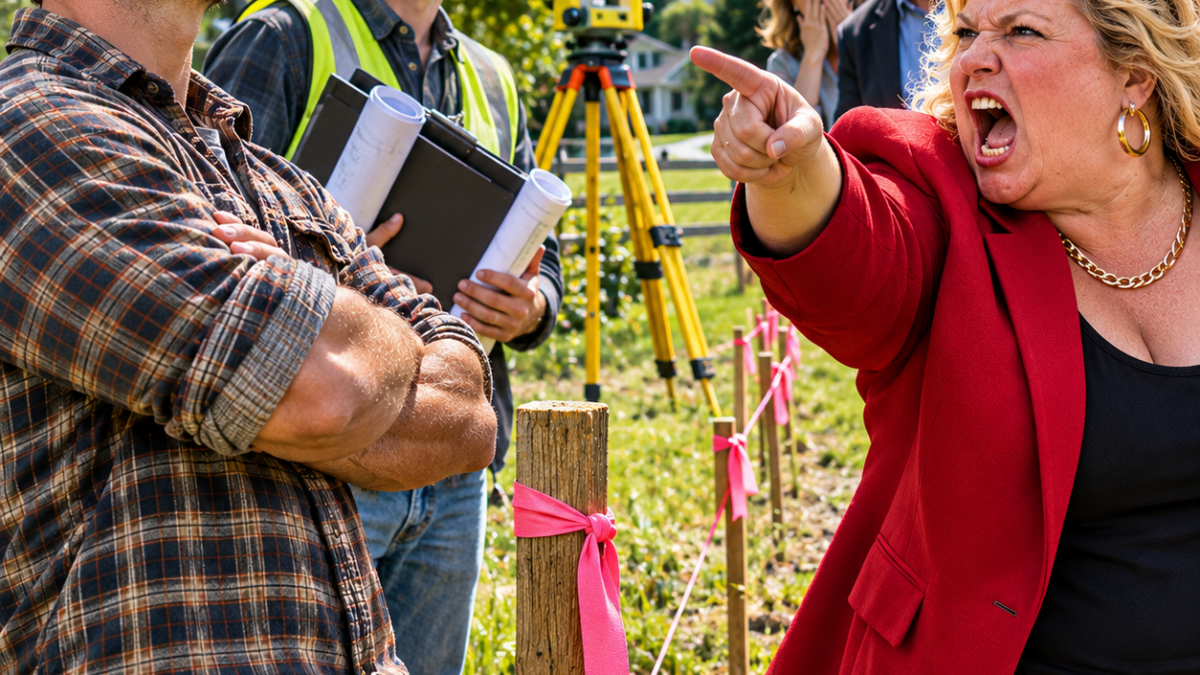
Karen shouted:
“I removed those ridiculous stakes once and I’ll remove them again!”
Nobody spoke.
Ben’s body camera captured every word.
My phone did too.
George had stepped onto his porch.
Rosa and Miguel were watching through their front window.
Ben said:
“Ma’am, are you saying you removed the previous survey monuments?”
“Of course I removed them!”
Her face was red.
“They were on HOA property!”
Ben’s expression didn’t change.
“Thank you.”
That confused her.
“For what?”
“The clarification.”
Karen looked at his camera.
Then at Carlos.
Then at me.
Her confidence flickered.
Only for a second.
She pulled out her phone.
“I’m calling the police.”
Ben nodded.
“Please do.”
Karen stared at him.
“You think that’s funny?”
“No.”
I spoke for the first time.
“We’ll wait.”
She called.
“There are men trespassing on Willow Creek property. They refuse to leave. They’re threatening me.”
That last sentence made Ben look at me.
Neither of us had moved toward her.
Neither had threatened anything.
Ten minutes later, two patrol cars stopped on the street.
Karen hurried toward them.
“Thank God.”
Sergeant Miller stepped out with a younger female officer.
Karen started immediately.
“They’re trespassing. They’ve been harassing the community for weeks. This man keeps installing illegal boundary markers and refuses to follow HOA directives.”
Miller raised one hand.
“Slow down.”
“But—”
“We’ll talk to everyone.”
He walked toward us.
His eyes moved over Ben’s vest.
Tripod.
Signs.
Company truck.
Then me.
“Who owns this parcel?”
“I do.”
Karen shouted from behind him:
“The HOA owns part of it.”
Miller looked back.
“Ma’am, I’ll come to you.”
She folded her arms.
Ben introduced himself.
Full name.
License.
Company.
Purpose.
Then handed over the folder.
Deed.
Recorded plat.
Survey.
Corner record.
Work order.
Sergeant Miller read.
The female officer walked the visible boundary.
Karen kept trying to interrupt.
Finally Miller said:
“Ma’am, please.”
That shut her up for perhaps twenty seconds.
He pointed.
“This parcel is separate from Willow Creek?”
“Yes,” Ben said.
“HOA covenants?”
“None recorded against it.”
Miller looked at me.
“Any dispute filed in court?”
“No.”
“Competing survey?”
“No.”
Then he turned toward Karen.
“Do you have ownership documents?”
“Our master community plan.”
“Recorded deed?”
“The HOA map clearly shows—”
“Do you have a deed?”
Her face tightened.
“No, but—”
He held up his hand.
“Okay.”
Then Ben said:
“Sergeant, there’s another issue.”
Karen’s eyes snapped toward him.
Ben explained the first removed monuments.
The restoration.
The second destruction.
Then he said:
“We have video.”
Miller looked at me.
“Video?”
“Yes.”
Karen stepped forward.
“That was taken illegally.”
Miller looked at her.
“How do you know what video he’s talking about?”
Silence.
George laughed once from across the street.
Karen glared at him.
Ben handed Miller a tablet.
The video played.
Karen at 2:17 a.m.
Robe.
Gloves.
Crowbar.
Marker one.
Marker two.
Marker three.
Marker four.
Nobody spoke.
Miller watched until the end.
Then looked at Karen.
“Is that you?”
She swallowed.
“I was removing debris from HOA property.”
“Is that you?”
“Yes, but—”
“Did you remove these survey monuments?”
“They were illegally installed.”
“That’s not what I asked.”
Her shoulders changed.
For the first time, she seemed to understand she wasn’t controlling the conversation.
“Yes.”
Miller nodded.
The female officer took out a notebook.
Karen’s voice rose.
“But I had every right.”
Ben said:
“No, ma’am.”
She turned.
“You don’t tell me what rights I have.”
Miller interrupted.
“Actually, this is no longer an HOA enforcement conversation.”
Karen stared.
“What?”
“We have a documented property boundary, a licensed surveyor, video of you removing monuments, and your admission.”
“I’m the HOA president.”
“That does not give you authority to alter a private boundary survey.”
She looked around.
Neighbors had appeared.
Doors open.
Porches occupied.
The audience she normally controlled was watching her lose control.
Miller looked at me.
“Mr. Hayes, do you want to make a formal complaint?”
“Yes.”
Karen’s mouth opened.
“Against me?”
I looked at her.
“Yes.”
“You planned this.”
“No.”
“You installed cameras.”
“On my land.”
“You baited me.”
“I put the markers back where they legally belonged.”
“Because you knew I’d remove them!”
“No one made you bring a crowbar.”
Silence.
That sentence landed harder than I intended.
Miller directed the female officer to take my statement.
He asked Karen to step aside.
She didn’t get handcuffed that morning.
That part of the original neighborhood rumor grew with every retelling.
What happened was less theatrical and more serious.
Police documented the complaint.
Collected copies of the footage.
Recorded Ben’s professional statement.
Recorded Karen’s admission.
Then forwarded the matter for review.
Karen went back inside.
No dramatic perp walk.
No sirens.
But something changed anyway.
Everybody had seen the president call police on me.
Everybody had then watched police investigate her conduct instead.
Fear cracked.
The following week, David filed the civil lawsuit.
Karen personally.
Willow Creek HOA.
And board members to the extent their conduct and authorization justified inclusion.
Claims arising from property damage, interference, harassment, and improper enforcement.
We sought survey restoration costs.
Legal expenses.
Related damages.
And declaratory relief confirming the HOA had no authority over my parcel.
The lawsuit hit Willow Creek like lightning.
Arthur called David within twenty-four hours.
Gerald hired his own attorney.
Two other directors demanded an emergency executive session.
Karen sent an email to residents claiming she was being targeted by an “outsider campaign designed to undermine community sovereignty.”
George printed it and taped it inside his garage.
Underneath he wrote:
**WE ARE A SUBDIVISION, NOT A COUNTRY.**
Even I laughed.
Then Arthur found the financial records.
Karen had authorized legal expenses without proper board discussion.
Not theft.
Not embezzlement.
But sloppy governance and repeated use of HOA counsel for her battle with my non-member parcel.
The board panicked.
Their insurer became involved.
Counsel told them to stop issuing fines against me immediately.
Karen refused.
That refusal lasted approximately six hours.
Then the insurer’s attorney sent its own letter.
The fines stopped.
But the residents weren’t done.
Willow Creek bylaws allowed members to petition for a special meeting.
George needed signatures.
He got more than double the required number.
Karen tried to invalidate several.
Maria Garcia checked the petition herself.
They were valid.
Meeting scheduled.
The clubhouse filled beyond capacity.
People stood at the back.
Others crowded near the doors.
Karen sat at the center table.
She looked exhausted.
Still defiant.
But smaller somehow.
George stood.
“We are not discussing landscaping tonight.”
Karen struck the gavel.
“You will follow the agenda.”
George held up the petition.
“This is the agenda.”
Applause.
Karen’s face hardened.
George continued.
“This meeting was called to consider removal of Karen Miller as president and director based on abuse of authority, misuse of association enforcement mechanisms, and conduct creating legal exposure for Willow Creek.”
Karen grabbed the microphone.
“This is defamatory.”
David had warned everyone.
Stick to documents.
No exaggeration.
George nodded.
“Then we’ll use documents.”
First came the Garcias.
Miguel carried a box.
He put it on the table.
Letters.
Fines.
Appeals.
Yellow door.
Rosa stood beside him.
Her voice was soft.
“You told us maybe people with our income shouldn’t live here.”
Karen shook her head.
“I never said—”
Miguel pulled out the hearing notes.
Maria had written the quote down immediately afterward.
Another resident stood.
Rose bush.
Another.
Garage.
Another.
Basketball hoop.
The room filled with years of small humiliations.
Karen defended herself.
“Rules exist for a reason.”
Sometimes she was right.
Several violations had been legitimate.
One resident admitted he’d left trash cans out for days.
Another admitted he’d ignored two warnings.
That mattered.
This wasn’t a courtroom drama where every action Karen ever took was evil.
The problem was how she used discretion.
Who received patience.
Who received punishment.
Who was allowed to appeal.
Who was mocked.
Who was threatened.
Then George introduced me.
I walked to the front.
No uniform.
No military story.
No speech about freedom.
Just evidence.
Image one.
The original monument holes.
Image two.
The discarded stakes.
Image three.
Karen holding one.
She interrupted.
“That photograph was taken without consent.”
I ignored her.
Next.
The restored monuments.
Next.
HOA fine against me.
Next.
Night footage.
I pressed play.
Black-and-white Karen entered the screen.
The clubhouse became silent.
She placed the crowbar beside the marker.
Pulled.
Shifted.
Pulled again.
Ripped it free.
Someone whispered:
“Oh my God.”
Karen’s face turned red.
I didn’t watch her.
The video switched cameras.
Second marker.
Third.
Fourth.
Then I played the daytime confrontation.
Karen shouting:
“I removed them and I’ll remove them again!”
Then:
“I’m calling the police!”
Then the officers arriving.
Then Sergeant Miller asking for ownership documents.
Then Karen admitting she’d removed the markers.
I stopped the video there.
No commentary needed.
Karen stood.
“This was an orchestrated setup.”
I looked at her.
“Which part?”
“You knew cameras were there.”
“Yes.”
“You knew I objected to the markers.”
“Yes.”
“You deliberately reinstalled them to provoke me.”
“My licensed surveyor restored my legal property corners.”
“You wanted me to react.”
“I wanted the markers to stay.”
She pointed at me.
“You wanted this!”
That was the moment I almost lost my temper.
I could feel it.
Months of intrusion.
The destroyed work.
Threats.
The thought of losing my workshop before I’d even poured concrete.
But then I saw Rosa Garcia.
Small woman.
Hands folded.
Yellow-door photograph in her lap.
This wasn’t about winning an argument.
I lowered my voice.
“Karen, I wanted you to leave my property alone.”
The room went quiet.
“You could have hired a surveyor.”
She stared.
“You could have challenged Ben’s survey through proper channels.”
Nothing.
“You could have gone to court.”
Nothing.
“You could have asked the county.”
Nothing.
“You chose a crowbar.”
She sat down.
Then David’s lawsuit appeared on screen.
Not dollar amounts.
Just defendants.
Claims.
Insurance notice.
Potential exposure.
That got the board members.
Gerald spoke.
“I was never informed she was personally removing survey markers.”
Karen turned on him.
“You approved enforcement.”
“I approved sending notices.”
“You knew the dispute.”
“I didn’t know about the crowbar!”
Their alliance ended in front of everyone.
Another director said:
“I was told this was HOA common area.”
Karen said:
“It is.”
George pointed toward the county plat projected behind us.
“No.”
Karen looked around.
Nobody was backing her anymore.
The motion came.
Remove Karen as president.
Remove her from the board.
The vote wasn’t literally unanimous among all homeowners, but it was overwhelming.
Even two directors who had supported her voted yes.
Karen didn’t.
Of course.
When the result was announced, she sat motionless.
George took the gavel.
Not triumphantly.
Carefully.
Karen stood.
Grabbed her purse.
For a moment, I thought she’d say something to me.
She didn’t.
She walked toward the exit.
Residents moved aside.
Rosa Garcia watched her leave.
Not smiling.
That image stayed with me.
After everything Karen had done to her, Rosa still looked sad.
The civil case didn’t end with some million-dollar courtroom explosion.
Real litigation rarely does.
The HOA’s insurer negotiated.
Karen obtained separate counsel.
The evidence made denial difficult.
The HOA agreed to formally acknowledge that my parcel was outside Willow Creek.
All fines voided.
Any collection activity withdrawn.
Survey and restoration costs paid.
Reasonable legal fees resolved through settlement.
Additional damages negotiated.
Karen entered a separate settlement concerning her personal conduct.
Confidential terms.
The criminal matter moved independently.
Because she had no meaningful prior record and because prosecutors reduced the matter through negotiation, Karen ultimately accepted responsibility for a lesser property-related offense rather than facing the most serious charge originally discussed.
Fine.
Community service.
Restitution components.
A record she hadn’t expected when she first yanked a steel marker out of the dirt.
Some neighbors thought she got off too easily.
George especially.
“She should’ve gotten more.”
I shook my head.
“For what?”
“You know what.”
“Punishment isn’t a hobby.”
He stared.
“That sounds suspiciously mature.”
“I hate it too.”
George laughed.
The new Willow Creek board was elected two months later.
Miguel Garcia became president.
He initially refused.
Rosa made him reconsider.
George became vice president.
Their first symbolic decision was something residents called the Yellow Door Rule.
Officially, it was a broader architectural amendment.
Approved color options expanded.
Appeal standards became clearer.
Fines were capped.
Hearings required documentation.
No single board officer controlled both enforcement and appeal.
But everyone called it the Yellow Door Rule.
The day Miguel and Rosa repainted their front door, I went over.
Rosa opened the first can.
Bright buttery yellow.
Exactly like the old photograph.
Her hands trembled slightly.
Miguel handed me a brush.
“No.”
“Come on.”
“Not my house.”
“You started this.”
“No, Karen started it.”
George came walking up behind me.
“He’s scared of paint.”
“I’m not.”
“Army engineer defeated by yellow door.”
I took the brush.
We painted.
When it was finished, Rosa stood in the yard staring.
Then she cried.
Not dramatically.
Just quietly.
Miguel put his arm around her.
“This is silly,” she said.
“No,” I told her.
“It isn’t.”
It was never just paint.
Same as my markers were never just steel.
Objects become symbols when somebody uses them to tell you that your choices, property, or dignity belong to them.
The survey monuments were restored one final time.
Ben came out.
No cameras necessary.
No crowd.
No Karen.
He checked coordinates.
Set the corners.
Filed the record.
Then looked at me.
“Third time.”
“Expensive hobby.”
“You getting reimbursed.”
“Still.”
He pointed at the boundary.
“Fence?”
“Definitely.”
I built it myself.
Six-foot wood privacy fence along the side facing Willow Creek.
Not out of spite.
Mostly.
Every post went where Ben’s survey showed.
I checked twice before setting concrete.
He came by midway through.
“You’re three-sixteenths off.”
I froze.
He laughed.
“You should’ve seen your face.”
“I hate you.”
“Love you too.”
The fence went up.
Panel by panel.
When finished, I stood back.
For months, the boundary had existed as coordinates, steel rods, arguments, police reports, and legal documents.
Now it was visible.
Not hostile.
Just clear.
My side.
Their side.
There is comfort in clarity.
Then I finally poured the workshop foundation.
The concrete truck arrived at seven.
When the first chute opened, I almost couldn’t believe how emotional I felt.
Not because concrete is beautiful.
It isn’t.
Because this was what I had been trying to do before Karen inserted herself into my life.
Build.
That word became important.
Karen spent months tearing things out.
Stakes.
Confidence.
Neighbors’ patience.
Rosa’s yellow door.
I wanted to build.
Concrete.
Steel.
Walls.
Something useful.
A life.
The frame went up quickly.
Twenty-foot ceiling.
Large roll-up door.
Lift.
Electrical.
Welder circuit.
Compressed-air lines.
Woodworking side.
Then came the Mustang.
I’d stored it in a rented garage for years.
When the transporter backed onto my property, I stood with my hands on my hips.
Ben was there.
George too.
Miguel and Rosa arrived unexpectedly.
The car rolled down the ramps.
Faded blue paint.
Rust.
Dust.
Flat-looking tires.
Beautiful.
George whistled.
“That’s the famous Mustang?”
“Unfortunately.”
“It looks terrible.”
“Thank you.”
Ben walked around it.
“Dad would love this.”
That hit me.
The car had been my father’s.
For years I’d told myself I didn’t have time.
Deployment.
Assignment.
Command.
Move.
Then another move.
Retirement was supposed to change that.
The workshop wasn’t really about cars.
It was about finally keeping a promise I’d made to myself.
I opened the driver’s door.
The smell inside was old vinyl, dust, and faint gasoline.
For a moment, I could remember being twelve.
Dad’s hands on the wheel.
His laugh.
The engine louder than necessary.
Ben stood beside me.
“You okay?”
“Yeah.”
He knew I wasn’t.
Didn’t push.
We rolled the car onto the lift.
That evening, after everyone left, I sat alone inside the workshop.
Lights on.
Tools arranged.
Mustang overhead.
Through the open bay door, I could see my fence.
Beyond it, a few Willow Creek rooftops.
One bright yellow door was visible between trees.
George’s American flag snapped in the evening wind.
Nobody fined him.
The sound made me smile.
Karen listed her house a few months later.
I wasn’t surprised.
Her relationship with the neighborhood was gone.
Some residents openly disliked her.
Others avoided her.
The hardest part probably wasn’t the lawsuit or settlement.
It was becoming ordinary.
For years, Karen had been President Miller.
People called.
Asked permission.
Complained.
Feared her.
Then one evening she was simply Karen.
A resident with no gavel.
No authority.
No committee.
I saw her once before she moved.
I was working on the fence gate.
She came around the corner from the public sidewalk.
She stopped.
So did I.
“You got everything.”
Her voice sounded tired.
“What?”
“The property.”
“I already had it.”
“You know what I mean.”
I set down the drill.
She looked toward the workshop.
“Your building.”
“Yes.”
“The fence.”
“Yes.”
“The lawsuit.”
“Settled.”
She folded her arms.
“You got me removed.”
“No.”
She laughed bitterly.
“Come on.”
“I didn’t get a vote.”
“You organized them.”
“They organized themselves.”
“You gave them ammunition.”
“I gave them evidence.”
“Same thing.”
“No.”
She looked away.
For several seconds neither of us spoke.
Then she said:
“You embarrassed me.”
I thought about the nighttime video.
The meeting.
Police.
“I didn’t tell you to remove my monuments.”
Her jaw tightened.
“You knew I would.”
“No.”
“You put cameras there.”
“Because you had already removed them once.”
She had no answer.
I picked up the drill.
Karen said:
“You wanted revenge.”
That stopped me.
Because she wasn’t entirely wrong.
There had been moments I wanted it.
At 2:17 in the morning, watching her fight concrete and steel with a crowbar, I’d felt satisfaction.
At the police confrontation, satisfaction.
When the video played in the clubhouse, satisfaction.
I’d be lying if I denied it.
“I wanted you stopped.”
“That’s not what I asked.”
I looked at her.
“No.”
She waited.
“Part of me wanted revenge.”
Her expression changed.
Maybe she expected denial.
“But revenge wasn’t the workshop.”
I pointed behind me.
“It wasn’t the fence.”
I looked toward Rosa’s house.
“It wasn’t their yellow door.”
Karen followed my eyes.
“Those things are what came after.”
She swallowed.
“So you think you’re the hero.”
“No.”
“Everyone else does.”
“They’ll get over it.”
That almost made her smile.
Almost.
Then she asked:
“Do you hate me?”
I thought about it.
“No.”
She looked genuinely surprised.
“Why not?”
“Too much work.”
That time she did smile.
Barely.
Then it vanished.
“My husband wants to move.”
“I heard.”
“He says I’ll never be happy here again.”
I didn’t know what to say.
So I said nothing.
Karen looked at the fence.
“I really believed that land belonged to Willow Creek.”
“At first?”
She nodded.
“At first.”
That mattered.
“And after the survey?”
She looked down.
“I thought your brother was helping you steal a strip.”
“After the county record?”
Silence.
“After you pulled the first monuments?”
Nothing.
“Karen.”
She looked at me.
“When did you know?”
Her voice was quiet.
“Before the second time.”
There it was.
No lawyer.
No courtroom.
No cameras.
Just the truth.
“You knew.”
“I knew there was a chance I was wrong.”
“That’s different.”
“Is it?”
“Yes.”
She looked toward her house.
“I’d already told the board.”
“Told them what?”
“That you were encroaching.”
My stomach tightened.
“If I backed down, I would have looked incompetent.”
I stared at her.
“So you went out at two in the morning with a crowbar.”
“I was angry.”
“You could’ve stopped.”
“I know.”
That was the closest thing to an apology I would ever get from her.
Not “I’m sorry.”
Not yet.
Just:
I know.
She stepped back.
“I hope your car turns out nice.”
I looked toward the Mustang.
“Thanks.”
Then she walked away.
The moving truck came two weeks later.
No dramatic crowd.
No celebration.
Karen left quietly.
I didn’t watch.
George did.
Of course.
He called.
“She’s gone.”
“Okay.”
“That’s it?”
“What do you want me to do?”
“Fireworks?”
“No.”
“Small flag?”
“Goodbye, George.”
He laughed.
Willow Creek changed after Karen.
Not perfectly.
There were arguments.
There were still rules.
Residents still complained.
One homeowner wanted to paint his house fluorescent orange.
The new board said no.
He accused them of becoming Karen.
George called me.
“What do we do?”
“Read your covenants.”
“That’s your advice?”
“Yes.”
“What if fluorescent orange is technically allowed?”
“Then congratulations on your new landmark.”
It turned out it wasn’t.
The homeowner chose dark blue.
Nobody sued.
Nobody brought crowbars.
Progress.
The Garcias became neighborhood grandparents.
Kids stopped by.
Rosa planted yellow flowers matching the door.
George’s flag continued making its dangerous snapping noise.
Ben visited the shop most Saturdays.
We worked on the Mustang together.
Engine first.
Then suspension.
Brakes.
Body.
We argued constantly.
“Dad would’ve kept the original carburetor.”
“Dad also fixed electrical wiring with household tape.”
“Tradition.”
“Fire hazard.”
One Saturday, Ben was under the car when he said:
“Remember those stakes?”
“Hard to forget.”
“Best advertising I ever got.”
I looked down.
“What?”
“People in Willow Creek started hiring me for surveys.”
I laughed.
“Karen grew your business?”
“Indirectly.”
“Does she get commission?”
“Absolutely not.”
He rolled out.
“Seriously, though. Six jobs.”
“Because they don’t trust their boundaries?”
“Because they realized boundaries should be based on records, not assumptions.”
Good lesson.
A year after the settlement, Miguel invited me to an HOA meeting.
“Why?”
“We want to recognize you.”
“No.”
“It’s already on the agenda.”
“Remove it.”
“We voted.”
“I’m not a member.”
“Exactly why you can’t overrule us.”
Traitor.
I went.
They gave Ben a certificate thanking him for professional assistance.
He loved it.
I received a small plaque.
**GOOD FENCES. BETTER NEIGHBORS.**
I groaned.
George had written it.
Obviously.
I hung it in the workshop anyway.
Beside it, I eventually placed one of the damaged original survey caps.
Ben had kept it as evidence until the case closed.
The steel was bent.
Concrete scars.
Mud long gone.
Small thing.
Almost nothing.
Yet it had started everything.
Years later, I realized the weirdest part of the entire fight wasn’t that Karen pulled the stakes.
It was how easily people accepted her claim that she could.
Authority has a costume.
Letterhead.
Title.
Committee.
Clipboard.
Official envelope.
Karen used all of them.
For residents who didn’t know the governing documents, the costume looked real enough.
That was how she kept power.
Not because her rules were always legal.
Because challenging them was exhausting.
Once people started asking:
Show me the rule.
Show me the vote.
Show me the boundary.
Show me the authority.
Her system weakened.
That’s why Ben mattered so much.
Surveying isn’t exciting to most people.
Coordinates.
Bearings.
Monuments.
Recorded plats.
But when someone says:
“This is mine.”
And someone else says:
“No, it’s mine.”
Eventually feelings stop mattering.
Someone has to measure.
Ben’s work turned my anger into something objective.
A line.
Not my line.
Not Karen’s line.
The line supported by the record.
That objectivity protected both of us, even though Karen refused to see it until too late.
The Mustang took almost three years.
I could have done it faster.
Didn’t want to.
Retirement taught me not everything needed a deadline.
One evening, Ben and I installed the restored engine.
We lowered it slowly.
Guided the mounts.
Bolted everything.
Then months later came the first start.
George arrived.
Miguel and Rosa.
A few Willow Creek neighbors.
I turned the key.
Nothing.
George laughed.
“Army engineering.”
“Shut up.”
Ben checked a connection.
“Try again.”
I turned.
The starter caught.
Engine coughed.
Then roared.
The sound filled the workshop.
For a second, I wasn’t sixty-something.
I was twelve.
Dad beside me.
Mustang alive.
Ben slapped the roof.
George shouted.
Rosa covered her ears and laughed.
I shut the engine down after less than a minute.
My hands were shaking.
Ben saw.
“Dad would’ve loved it.”
I nodded.
Couldn’t answer.
That was the moment everything became worth it.
Not Karen losing.
Not the lawsuit.
Not the money.
This.
The shop.
My brother.
Dad’s car.
People around me who had become friends because of a conflict none of us wanted.
I walked outside.
The sun was dropping.
My fence cast a long shadow across the two acres.
Exactly along the boundary Ben had surveyed.
On the other side, Willow Creek looked peaceful.
Not silent.
Peaceful.
Different thing.
Children riding bikes.
Garage open.
Yellow door.
Flag snapping.
No Lexus crawling past my land.
I leaned against the fence.
Ben came out.
“Thinking deep thoughts?”
“No.”
“Liar.”
“I was thinking how much trouble four metal rods caused.”
He leaned beside me.
“They didn’t cause anything.”
I looked at him.
“They exposed it.”
That sounded like something our father would have said.
Maybe Ben was getting old too.
Years passed.
Miguel eventually stepped down as HOA president.
George became president for one term.
He lasted nine months.
“Why are you quitting?”
“People complain constantly.”
I stared.
“You spent years begging people to stand up.”
“I changed my mind.”
I laughed so hard my ribs hurt.
A younger board took over.
More transparent.
Documents online.
Budgets accessible.
Appeals recorded.
Nothing dramatic.
That’s what healthy governance looks like most of the time.
Boring.
Karen’s name gradually disappeared from conversation.
At first, every issue was compared to her.
“Don’t be another Karen.”
“Karen would’ve fined that.”
“Remember Karen?”
Eventually people stopped.
New families moved in who had never met her.
The yellow door became simply the Garcias’ door.
George’s flag became simply a flag.
My fence became simply a fence.
That’s how I knew the neighborhood had really healed.
Trauma stops being identity.
One morning, a young couple bought Karen’s old house.
They introduced themselves.
Emily and Josh.
Nice people.
They invited me over because they wanted to install a shed near the back line.
Josh said:
“The HOA told us to talk to you because there’s an old property-boundary issue.”
I laughed.
“That’s one way to describe it.”
I called Ben.
He located the line.
Showed them the monument.
Josh stared.
“That’s it?”
“That’s it.”
“No dispute?”
“No.”
He looked relieved.
“We’ll keep the shed ten feet back.”
“Good.”
Emily asked:
“Why is there a camera mount on that oak?”
I looked at Ben.
He smiled.
“Wildlife.”
Technically, we’d captured one extremely territorial animal years earlier.
I said nothing.
The cameras had long since been removed.
No need anymore.
That mattered too.
If you keep fortifications after the war is over, sometimes the war never really leaves you.
The fence stayed because I wanted privacy.
The cameras came down because I no longer needed evidence.
The difference felt important.
One spring morning, I found Rosa sitting on her porch.
Miguel had died the winter before.
She looked smaller without him beside her.
I brought coffee.
We sat quietly.
After a while she looked at the yellow door.
“He loved that color.”
“I know.”
“He would stand outside and stare at it.”
“Sounds strange.”
“He was strange.”
We laughed.
Then her eyes filled.
“You know, Karen didn’t matter anymore after we painted it.”
I looked at her.
“What do you mean?”
“For a year before that, every time I looked at the beige door I saw her.”
She touched the coffee cup.
“Then you all painted it yellow.”
She smiled.
“And it became ours again.”
That sentence stayed with me.
**It became ours again.**
That’s what the property fight had been about for me too.
Ownership isn’t just a deed.
It’s the ability to exist somewhere without another person continuously making you justify your right to be there.
Karen made me feel like I was trespassing on my own future.
The survey restored more than the corners.
The workshop restored the rest.
A few months later, I finished the Mustang completely.
Dark blue.
Original-style interior.
Engine upgraded discreetly.
Ben argued about the wheels.
I won.
Mostly because it was my car.
First drive, I turned out of the workshop.
Stopped at the gate.
George happened to be walking past.
“Finally.”
“Want a ride?”
“Absolutely.”
He climbed in.
We drove through town.
No destination.
Just road.
At a red light, George looked at me.
“You know what the funniest part is?”
“What?”
“Karen tried to stop all this over four stakes.”
I thought about it.
“No.”
“What?”
“She tried to control where my land ended.”
“Same thing.”
“Not really.”
I accelerated when the light changed.
“The stakes were just how reality answered her.”
George laughed.
“That’s annoyingly philosophical.”
“I’m retired. It’s allowed.”
When we returned, I parked the Mustang inside.
The evening light hit the damaged survey cap hanging on the wall.
I took it down.
Held it.
For years, I had viewed it as a trophy.
That night it felt different.
I put it in a drawer.
Ben noticed the next week.
“Where’s the cap?”
“Drawer.”
“Why?”
“Didn’t need it on the wall anymore.”
He looked around.
Mustang.
Tools.
Plaque.
Photograph of Dad.
“Good.”
That was all he said.
The boundary monuments themselves are still there.
Permanent.
Quiet.
Mostly invisible unless you know where to look.
That’s the funny thing about real boundaries.
Healthy ones don’t need to scream.
They just need to be clear.
I still walk the fence every spring.
Check posts.
Look for rot.
Clear vines.
Whenever I pass the northwest corner, I see the small survey cap near ground level.
Ben’s license number.
A few scratches.
Nothing dramatic.
Sometimes I remember Karen standing with the first one in her hand.
**I decide where your property ends.**
At the time, those words made me furious.
Now they almost make me sad.
Imagine needing control badly enough to believe a title on an HOA board could move a property line.
Imagine walking into the dark at two in the morning in slippers with a crowbar because admitting you might be wrong feels worse than committing the act that proves it.
Karen’s downfall started long before the lawsuit.
It started the moment being right became more important to her than finding out what was true.
That’s a dangerous moment for anyone.
Me included.
I came close to making my own mistake.
For a while, I wanted to beat her more than I wanted to build the workshop.
David noticed.
So did Ben.
One afternoon during the lawsuit, Ben asked:
“What happens after we win?”
“Build.”
“You sure?”
“What does that mean?”
“You’re spending more time talking about Karen than the shop.”
I didn’t answer.
He pointed toward the Mustang plans on my table.
“Dad’s car has waited long enough.”
That snapped me back.
Fights are strange.
Even righteous ones can become addictive.
Every email feels like a battle.
Every document a weapon.
Every small victory creates hunger for the next.
If you aren’t careful, the person disrupting your life becomes the center of it.
Karen already had too much of my time.
I refused to give her retirement too.
So I started construction before the final settlement paperwork was finished.
Lawyer handled lawyer things.
Ben handled survey things.
I handled concrete.
That division saved me.
Years later, when people ask what revenge felt best, I usually disappoint them.
They expect:
The police.
The lawsuit.
The meeting.
Karen removed.
Her house sold.
Those moments carried satisfaction.
Sure.
I’m human.
But the best moment came months later.
No Karen.
No lawyer.
No camera.
I was alone in the workshop.
The Mustang was on the lift.
A wrench in my hand.
Music playing quietly.
I opened the side door for air.
Through it I could see my fence.
Beyond the fence, Rosa and Miguel’s yellow door.
Farther down, George’s flag moving in the wind.
And I realized I hadn’t thought about Karen all day.
That was victory.
Not making her miserable.
Becoming free enough that she stopped occupying my mind.
The last time Ben resurveyed anything on my property was years later when I bought a narrow adjoining strip from another owner.
He arrived with updated equipment.
I walked outside.
“Need cameras?”
He looked offended.
“Why would we need cameras?”
“You never know.”
He smiled.
Then looked toward Willow Creek.
“No.”
He drove the new marker.
One clean strike after another.
Nobody came outside.
Nobody shouted.
Nobody threatened him.
The marker went in.
Ben checked the coordinate.
“Good.”
“That’s it?”
“That’s how surveys normally work.”
“Feels anticlimactic.”
“That’s because you’re damaged.”
We laughed.
He packed up.
Before leaving, he pointed at the marker.
“Try not to start a revolution this time.”
“No promises.”
That evening, I walked along the new line.
Fresh monument.
Old monument.
Fence.
Workshop.
Mustang.
Everything where it belonged.
The world didn’t feel conquered.
It felt ordered.
There is a difference.
Karen wanted control.
I wanted certainty.
Control says:
**I decide.**
Certainty says:
**Let’s measure.**
One depends on power.
The other depends on truth.
The older I get, the more I prefer the second.
I never became part of Willow Creek.
They invited me once.
George thought it would be funny.
“Join the HOA.”
“Absolutely not.”
“You’d make a great board member.”
“I’d rather eat the survey stakes.”
He laughed.
Our land remained separate.
But the people stopped feeling separate.
Rosa brought food during holidays.
George used my lift.
Ben occasionally surveyed neighborhood properties.
Kids came by to see the Mustang.
When the new HOA board held a summer picnic, I attended.
No membership required.
That’s what community should be.
Voluntary connection where possible.
Clear rules where necessary.
Respect everywhere.
The old Karen-era enforcement binder eventually ended up with George.
He brought it to my workshop one afternoon.
“What should we do with it?”
“Archive it.”
“Burn it?”
“No.”
He looked disappointed.
“Why?”
“History.”
“You sound like Ben.”
“Terrible insult.”
George put it into a storage cabinet at the clubhouse.
Not displayed.
Not destroyed.
Because ugly records still have value.
They remind future boards what unchecked discretion looks like.
A few pages from our dispute became part of board orientation.
One rule was repeated every year:
**The association has no jurisdiction beyond properties legally subject to its covenants.**
Basic.
Obvious.
Apparently necessary.
The board also added another internal policy.
Any boundary dispute had to be referred to licensed professionals.
No board member could move fences, stakes, monuments, or markers.
George named it the Crowbar Rule.
Maria made him change the official name.
He still called it that.
So did everyone else.
One evening, years after everything ended, I drove the restored Mustang to the edge of my property and stopped.
Sunset.
Workshop behind me.
Fence beside me.
Willow Creek lights beginning to come on.
I shut off the engine.
For a few minutes, I listened.
Birds.
Distant lawn mower.
George’s flag.
Normal neighborhood sounds.
I walked to the corner where the first monument had been pulled.
The current marker sat low in the earth.
Solid.
Undisturbed.
I crouched.
Brushed dirt away from the cap.
Ben’s license number was still readable.
I remembered calling him that first morning.
**They’re gone.**
I remembered his voice changing.
I remembered Karen with the steel rod.
The crowbar video.
Police.
Court papers.
The packed clubhouse.
Rosa’s yellow door.
Then I looked back toward the workshop.
That was the part I cared about now.
The thing that existed because I kept going.
Maybe that’s what boundaries are ultimately for.
Not to create enemies.
To create enough certainty that people can build without constantly defending what is already theirs.
I stood.
Walked back to the Mustang.
Started the engine.
The V8 settled into a deep idle.
For twenty years, I had spent a lot of my life thinking in terms of missions.
Objective.
Threat.
Countermeasure.
Win condition.
Retirement taught me something different.
Sometimes winning isn’t what you force the other side to lose.
It’s what you’re finally free to build after the fight ends.
Karen lost her presidency.
She faced legal consequences.
She moved away.
Those were consequences of decisions she made.
But my ending wasn’t written on her lawn beneath a FOR SALE sign.
It was inside my workshop.
A restored car my father once drove.
A brother who had stood beside me.
Tools arranged exactly where I wanted them.
A fence built on a professionally surveyed line nobody questioned anymore.
And beyond it, a neighborhood where an elderly couple had finally painted their door yellow again.
I put the Mustang in gear.
Rolled through the gate.
The survey marker disappeared behind me.
Exactly where it belonged.
The line was still there.
It didn’t need to be fought over anymore.
It simply existed.
And for the first time since Karen held that muddy stake in her hand and told me she decided where my land ended, that was enough.








