PART 2: HOA Karen Tore Out My Grandson’s Wheelchair Ramp—Then She Learned I’d Spent 30 Years as a Federal Judge
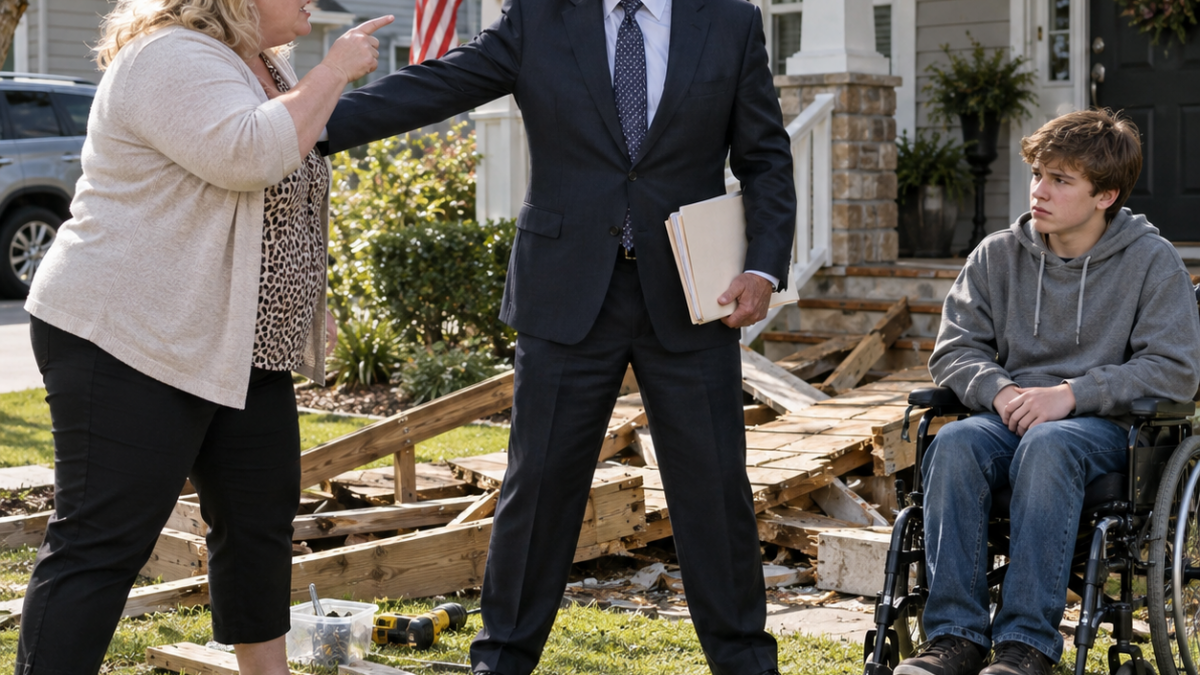
PART 2
The first letter arrived two days later.
Cheap white paper.
Ornate Oak Haven Estates letterhead.
Karen’s signature at the bottom.
I stood in the kitchen reading it while Sarah made breakfast.
Leo was arguing with Mark about whether pancakes should legally qualify as dinner food.
Normal family noise.
That made the contents of the letter feel even uglier.
**VIOLATION: ARTICLE 9, SECTION 2 — UNAPPROVED EXTERIOR ALTERATION**
Fine:
$200.
Then:
**REMEDIATION FEE: $500.**
I read that line again.
Karen claimed the five hundred dollars represented labor performed by “the association president and two authorized board representatives” in removing the ramp.
She had destroyed private property.
Then invoiced me for the privilege.
Finally:
The remaining “debris” had to be cleared within thirty days or an additional fifty-dollar daily fine would begin.
Sarah set down the spatula.
“How much?”
“Seven hundred.”
“For what?”
“Two hundred for building the ramp.”
She stared.
“And five hundred?”
“For Karen tearing it down.”
Mark looked up from the table.
“You’re joking.”
“I wish.”
His jaw tightened.
“She came onto our property with a crowbar.”
“Yes.”
“And now we pay her?”
“No.”
“Dad, this is insane.”
“Probably.”
“What are we doing?”
I folded the letter carefully.
“Nothing emotional.”
He laughed once.
“She wrecked my son’s wheelchair ramp.”
“I know.”
“And you want me calm?”
“I want you useful.”
That landed.
Mark looked away.
Sarah asked:
“What does useful look like?”
“Documentation.”
Old instincts returned faster than I expected.
Evidence does not improve because you are furious.
Chronology does not care whether you are right.
You build a record.
You preserve what exists.
You avoid creating distractions.
I photographed the letter and envelope.
Logged the date and delivery.
Preserved photographs of the ramp before destruction.
Photographed the debris exactly as Karen left it.
Saved security-camera footage from the front of the house.
Then I opened a file.
Not metaphorically.
A physical accordion file.
Inside went:
Original ramp plans.
Receipts.
Photographs.
Medical documentation supporting Leo’s mobility limitations.
HOA bylaws.
Karen’s letter.
Then I sat at my old walnut desk.
Eleanor had bought that desk when I received my federal appointment.
“You’ll need something dignified to write opinions on,” she had said.
For thirty years, I wrote orders there on nights when chambers felt too sterile.
Now I was drafting something very different.
I did not write as an angry grandfather.
I wrote as a man who had spent decades watching angry people destroy good cases.
**Dear Ms. Fletcher and Members of the Oak Haven Estates Board:**
Polite.
Dry.
Precise.
I acknowledged receipt.
Then addressed the ramp.
I cited the Fair Housing Act provision concerning reasonable accommodations necessary to allow a person with a disability equal opportunity to use and enjoy a dwelling.
I explained what the ramp was.
Who used it.
Why it existed.
Then the destruction.
Unauthorized entry.
Property damage.
Disability accommodation.
Then the $500 “remediation fee.”
I stared at that phrase for a while.
Finally I wrote:
**The Association appears to be billing my household for the cost of intentionally destroying the accessibility improvement at issue.**
No insult needed.
The sentence humiliated itself.
I calculated replacement.
Lumber.
Hardware.
Handrails.
Labor.
Engineering adjustments.
$4,750.
I prepared my own invoice.
Sarah read the draft that night.
“You’re billing them?”
“Yes.”
“For the ramp?”
“Yes.”
She kept reading.
Then:
“HUD?”
“If necessary.”
She lowered the paper.
“Are you actually going to file?”
“If they refuse to fix this.”
“Arthur.”
Only Eleanor used to say my name in exactly that warning tone.
Sarah inherited it.
“Yes?”
“Are you doing this because of Leo, or because Karen insulted the judge?”
That question deserved an answer.
I leaned back.
“Both bothered me.”
“Which one is driving?”
I looked toward the living room.
Leo sat at the table building a model airplane.
His chair could move through almost every part of my home.
Except now, again, the front door.
“Leo.”
Sarah nodded.
“Keep it that way.”
“I intend to.”
I mailed the letter certified.
Return receipt.
Karen signed.
Good.
Exhibit B.
While waiting, I went to the county records office.
Not because every HOA record was public.
But enough corporate history, recorded instruments, filings, and property documents existed to build context.
I also obtained association records through the procedures available to homeowners.
The first years of Oak Haven looked ordinary.
Pool maintenance.
Landscaping.
Insurance.
A few violations.
Then Karen became president.
The change was startling.
Fine revenue increased.
Legal expenses increased.
Enforcement references multiplied.
Meeting minutes became shorter and less detailed even as enforcement increased.
That interested me.
Transparency usually moves in the opposite direction.
I began cross-referencing addresses.
Garcias.
Repeated basketball-hoop notices.
Three thousand dollars in cumulative penalties.
Eventually sold.
Mrs. Gable.
Roses.
Lien threat.
A family fined over mailbox design.
A veteran cited because a flag bracket was not approved.
Nothing proved a conspiracy.
But it proved culture.
Karen had turned enforcement from a rare corrective tool into a governing philosophy.
Then her lawyer wrote.
Barry Cutler.
His letterhead was ambitious.
His analysis less so.
He called my Fair Housing position “spurious.”
Claimed bylaws were contractually binding.
Called my invoice “frivolous and frankly insulting.”
Then threatened a restraining order if I continued “harassing volunteer board members.”
I read that line twice.
Mark found me smiling.
“That bad?”
“For them?”
“Yes.”
“Why?”
“They put counsel on notice.”
He frowned.
“Isn’t that good for them?”
“If counsel gives good advice.”
“Did he?”
I held up the letter.
“No.”
That became Exhibit C.
The off-ramp was gone.
I filed a formal HUD complaint.
No drama.
No adjectives.
Timeline.
Photographs.
Medical documentation.
HOA notice.
My response.
Attorney response.
Description of the destroyed accessibility ramp.
Then I waited.
Federal administrative processes do not move at cinematic speed.
That was fine.
I had another front.
Oak Haven itself.
Karen’s authority depended on something I recognized immediately.
Isolation.
In court, one frightened witness feels weak.
Five witnesses who discover the same pattern become powerful.
Karen had made every homeowner believe their conflict was private.
So I walked.
Evenings.
Slowly.
No clipboard.
No campaign literature.
I spoke to people already outside.
Gardening.
Collecting mail.
Walking dogs.
At first, I never mentioned Karen.
Then people did it for me.
Mr. Henderson was first.
Eighty-four years old.
Widower.
Lawn dotted with little ceramic gnomes.
Or it had been.
I noticed empty circular patches in his mulch.
“Everything all right?”
He stared at the bare spaces.
“No.”
“Want to tell me?”
He looked toward Karen’s street.
Then at me.
“She says they have to go.”
“What?”
“My gnomes.”
He almost looked embarrassed saying it.
“My wife collected them.”
“How many?”
“Twenty-three.”
“Where are they?”
“Garage.”
“Why?”
“Third violation.”
He handed me a letter.
Escalating fines.
Threat of lien.
I read it.
“Did anyone complain?”
“She says they violate the natural aesthetic.”
I looked at his yard.
Magnolia.
Boxwoods.
Azaleas.
Twenty-three small gnomes hardly threatened civilization.
“Your wife liked them?”
His face softened.
“Margaret loved them.”
There it was again.
Karen saw objects.
People saw memories.
“Would you come to the annual meeting?”
He shook his head.
“I don’t want trouble.”
“You already have trouble.”
His eyes met mine.
“I’m eighty-four.”
“I know.”
“I can’t fight her.”
“Then don’t fight her alone.”
That changed his expression.
Only slightly.
But enough.
“I’ll think about it.”
Two days later he called.
“I’ll come.”
The Millers were next.
Ben and Chloe.
Young couple.
Toddler.
Their son screamed while Ben wrestled him into a car seat.
“Sorry, Judge,” Ben said.
“For what?”
“The noise.”
“Children are noisy.”
Chloe glanced toward Karen’s house.
“Apparently excessively.”
I stopped.
“What?”
She showed me a violation.
Noise disturbance.
Quiet hours allegedly beginning at six in the evening.
Their toddler had a tantrum on their back patio.
Fine.
Then another warning.
Karen threatened to “contact appropriate child welfare authorities if uncontrolled disturbances continued.”
I felt anger rise.
Not hot.
Colder.
More focused.
“She threatened CPS?”
Chloe nodded.
Ben said:
“She said if we can’t control him, maybe someone should make sure he’s safe.”
I stared at the paper.
That was not regulation.
That was intimidation.
“Keep every communication.”
“We have.”
“Come to the meeting.”
Chloe nodded before Ben answered.
“Yes.”
After that, people found me.
Not the other way around.
Basketball hoop.
Mailbox.
Chalk drawings.
Garage door open.
Flag bracket.
Rose bushes.
Holiday wreath.
Garden edging.
Some violations probably had legitimate technical bases.
That was not the issue.
The issue was proportionality.
Consistency.
Process.
Threats.
Karen treated every disagreement as insubordination.
I began to see the system.
Fine revenue had become normal.
Legal escalation had become easy.
Residents stopped appealing because appeals seemed pointless.
Board members rarely challenged Karen because she controlled information.
That was when Sarah asked:
“What exactly are you trying to accomplish?”
We sat on the porch.
The ruined ramp debris had been moved into my garage as evidence.
Temporary portable ramps allowed Leo access through the side entrance.
Functional.
Not independent.
Not good enough.
“I want the permanent ramp rebuilt.”
“That’s one.”
“I want the fines rescinded.”
“Two.”
“I want Karen removed.”
She watched my face.
“That one sounded different.”
“She destroyed a disabled child’s ramp with a crowbar.”
“I know.”
“And she shouldn’t control accessibility decisions.”
“Agreed.”
Sarah waited.
“What else?”
“I want the neighborhood to stop being scared.”
“That’s bigger than your case.”
“Yes.”
She smiled faintly.
“Judge Pendleton is back.”
“No.”
“Yes.”
“Grandpa Pendleton.”
“Keep telling yourself that.”
The annual meeting came three weeks later.
Previous attendance:
maybe fifteen.
That night:
standing room only.
Sarah came.
Mark came.
Leo stayed home with a sitter.
I refused to let Karen’s spectacle become his entertainment.
Mr. Henderson sat beside me holding one garden gnome.
Red hat.
Blue coat.
Fishing pole.
“You brought one?”
“He wanted to testify.”
I smiled.
Ben and Chloe sat behind us.
Families filled every row.
Karen sat at the front.
Center seat.
Four board members around her.
Janice Riley.
Real estate agent.
David Chen—not my lawyer, just an unfortunate name coincidence in the source—insurance salesman.
A retired dentist.
A homemaker.
None looked comfortable.
Karen banged the gavel.
“Order.”
The meeting began.
Committee reports.
Pool.
Landscaping.
Beautification.
Karen praised “consistent enforcement” for protecting property values.
Then budget approval.
“All in favor?”
A few hands.
“All opposed?”
Hands rose everywhere.
Karen froze.
“What is the meaning of this?”
I stood.
“Madam President.”
Her eyes narrowed.
“Arthur.”
“Before members approve the budget, they should understand exposure created by current enforcement decisions.”
“This is not the forum for your grievance.”
“It is the forum for HOA finances.”
Murmurs.
Karen gripped the gavel.
“Sit down.”
I continued.
“Has the board budgeted for defense of a federal Fair Housing complaint?”
The room changed.
Board members turned toward Karen.
Janice whispered:
“What complaint?”
Karen’s face went pale.
I noticed.
“You didn’t tell them?”
“That is privileged legal business.”
Janice stared.
“I’m on the board.”
Karen snapped:
“You don’t need details.”
That may have been her biggest mistake of the night.
Residents started whispering loudly.
I addressed the room.
“The complaint arises from destruction of my grandson’s wheelchair ramp.”
Someone said:
“They actually tore it out?”
“Yes.”
Another:
“With him living there?”
“Yes.”
Karen slammed the gavel.
“He failed to request approval!”
I looked at her.
“And your answer was to personally enter my property and destroy it?”
“You violated the covenants.”
“Did the board vote to authorize demolition?”
Silence.
“Karen?”
She looked toward the other board members.
No one spoke.
I turned.
“Janice?”
She shook her head.
“No.”
“David?”
“No.”
The retired dentist said:
“I thought Arthur removed it.”
That hit the room hard.
Karen snapped:
“We delegated enforcement authority.”
“Not demolition authority,” I said.
Then Mr. Henderson stood.
Karen rolled her eyes.
He held up the gnome.
“This was my wife’s.”
A few people laughed gently.
Then he explained.
Not loudly.
Not dramatically.
“My wife Margaret bought the first one on our twenty-fifth anniversary.”
He swallowed.
“She died four years ago.”
The room quieted.
“Mrs. Fletcher told me they damaged neighborhood aesthetics.”
Karen interrupted:
“Mr. Henderson has been given multiple opportunities—”
He turned toward her.
“I’m talking.”
That may have been the bravest sentence spoken all night.
Karen stopped.
“I paid your fines.”
He continued.
“I put the gnomes away.”
His voice shook.
“And you still sent me another notice.”
People shifted.
“I’m eighty-four.”
He looked around.
“I thought I was the only person having this problem.”
Then Chloe stood.
“You’re not.”
She described the toddler.
The warnings.
The child welfare threat.
Karen shouted:
“That has been completely mischaracterized!”
Then a man stood.
Basketball hoop.
A woman:
roses.
Another:
mailbox.
Another:
chalk.
The room erupted.
Karen hammered the gavel.
“Order!”
Nobody listened.
She screamed:
“This is a mob!”
The word was almost comical.
These were retirees.
Parents.
Accountants.
Teachers.
A man holding a ceramic gnome.
But fear had taught Karen that silence meant obedience.
Now ordinary people speaking sounded like violence to her.
Mark recorded everything.
Not secretly.
Phone visible.
After several minutes, I raised one hand.
Years on a bench teach you something about rooms.
Sometimes authority comes from speaking less.
People quieted.
I looked at Karen.
“This is not a mob.”
She glared.
“This is your membership.”
Then I turned toward the board.
“And every one of you has a problem.”
Janice’s face had gone white.
“What exactly is our exposure?”
Finally.
The right question.
I answered carefully.
“There is a federal administrative complaint.”
“Against Karen?”
“Against the housing provider and association conduct involved.”
David asked:
“Could insurance cover it?”
“Maybe.”
“Maybe?”
“Policies commonly contain exclusions or coverage disputes involving intentional conduct.”
They looked at Karen.
She looked furious.
I continued.
“If the board cooperates, corrects the accommodation issue, and reforms enforcement, that matters.”
Karen shot up.
“You don’t negotiate for the government!”
“No.”
“I’m speaking for myself.”
“You’re threatening us.”
“I’m giving you information before you make another bad decision.”
She pointed.
“This whole thing is because you think being a federal judge makes you above the rules.”
There it was.
Several heads turned.
Not everyone knew.
Mr. Henderson did.
The Millers did.
But many residents did not.
I had never introduced myself by title.
Retirement was retirement.
Janice stared.
“You’re a federal judge?”
“Retired United States district judge.”
The room went silent.
Karen’s expression changed.
Not defeat.
Calculation.
I hated that almost more.
Suddenly, the law mattered because she knew my résumé.
I said:
“My former position should be irrelevant.”
Then looked around.
“Leo deserved the same accommodation if his grandfather bagged groceries.”
That sentence mattered to me.
Karen’s mistake was not attacking someone powerful.
Her mistake was believing only powerful people deserved to be taken seriously.
I continued:
“The law does not become more important because I know how to cite it.”
Nobody spoke.
“It was already important.”
Then I sat down.
Karen tried to adjourn.
Janice stopped her.
“No.”
Karen stared.
“What?”
Janice swallowed.
“We need answers.”
“You’ll get them in executive session.”
“No.”
David, the insurance salesman, nodded.
“We need to know what happened with the ramp.”
Karen’s power visibly cracked.
“This meeting is adjourned!”
She stood.
Janice remained seated.
“So do we continue without her?”
The room murmured.
Karen stormed out.
Two board members followed.
Janice and David stayed.
I walked toward them.
They looked terrified.
Janice whispered:
“What do we do?”
“Get independent counsel.”
“We have Barry.”
“No.”
David looked miserable.
“Why?”
“Barry represents the status quo that created this.”
Janice rubbed her forehead.
“What do you want?”
I could have threatened them.
The original story had me doing exactly that.
Age had made me less interested in theatrics.
“I want the ramp rebuilt.”
She nodded.
“I want Leo apologized to.”
“Yes.”
“I want enforcement reviewed.”
David nodded slowly.
“And Karen?”
“I do not believe she should remain president.”
They looked at each other.
“Call your own lawyer tonight.”
I turned to leave.
Janice said:
“Judge?”
I stopped.
“I’m sorry.”
That mattered.
Not enough.
But it mattered.
The next morning, I sent a settlement proposal through proper counsel.
By then I had retained Elena Ramirez.
Former law clerk of mine.
Now civil litigator.
Brilliant.
Unsentimental.
She read my draft and crossed out three pages.
“You write like a judge.”
“I was one.”
“You’re a client now.”
“I hate that word.”
“You’ll survive.”
Our demands were broad but focused.
Karen’s removal from leadership.
Formal apology to Leo and family.
Ramp rebuilt professionally at association expense.
Review and rescission of improperly imposed non-safety fines from the previous two years.
Refund process.
Fair Housing training for board members.
Cooperation with HUD.
And individual compensation from Karen for her role in destroying the ramp.
Elena looked at the number.
“Fifty thousand?”
“For Leo’s trust.”
“That part is emotional.”
“Yes.”
“Good.”
I looked at her.
“You usually object.”
“I object when emotion weakens strategy.”
She closed the document.
“This doesn’t.”
The HOA hired new counsel.
Marcus Thorne.
Large firm.
Professional.
He called Elena first.
Then me, with her approval.
“Judge Pendleton.”
“Arthur is fine.”
“I suspect we’re past first names.”
“That sounds expensive.”
He laughed lightly.
Good lawyer.
He went through terms.
Ramp.
Agreed.
Apology.
Agreed.
Training.
Agreed.
Fine review.
Negotiable.
Karen removal.
Already being considered.
Individual payment.
Problem.
“Karen refuses.”
“Then Karen can litigate.”
“The board wants peace.”
“So do I.”
“Would you release the association if it accepts the institutional terms?”
I paused.
That was the key.
Punish Karen.
Or fix Oak Haven.
I looked toward the temporary side ramp.
Leo was outside with Mark.
The answer became clear.
“Yes.”
Marcus waited.
“Yes?”
“If the board votes in open or properly noticed session to accept the reforms, cooperates with HUD, rebuilds the ramp, refunds improper fines, and removes Karen from leadership, we will consider resolving association liability separately.”
“And Karen?”
“Remains individually exposed for her conduct.”
Marcus exhaled.
“I can work with that.”
Two days later:
Emergency board meeting.
Karen arrived with Barry Cutler.
Four other members voted.
Four to zero.
Karen removed as president.
Institutional settlement accepted.
Janice appointed interim president.
Karen reportedly screamed about betrayal.
She threatened lawsuits.
Called it a coup.
None mattered.
For ten years, everyone believed she was Oak Haven.
One vote proved she had always been temporary.
The contractors arrived the following week.
Professional accessibility company.
I gave them my plans.
They improved them.
Composite deck.
Powder-coated railings.
Better drainage.
Smoother transition.
Leo watched from the window.
“Is that mine?”
“Yes.”
“Can Karen break this one?”
Mark laughed.
I didn’t.
“No.”
“How do you know?”
Because law.
Because settlement.
Because consequences.
Because everyone was watching now.
But Leo deserved something simpler.
“Because the grown-ups finally fixed the rules.”
He nodded.
Satisfied.
Children accept justice more easily than adults when justice makes sense.
The newsletter arrived before construction finished.
Front page:
**A NEW DIRECTION FOR OAK HAVEN ESTATES**
Formal apology.
Not vague.
Not “regret that feelings were hurt.”
It stated that removal of the wheelchair ramp was wrong.
Acknowledged obligations to residents with disabilities.
Promised training and revised accommodation procedures.
Mr. Henderson came over carrying the newsletter.
“They said sorry.”
“Yes.”
“They’re giving money back?”
“Reviewing fines first.”
“My gnomes?”
“Bring them out.”
He stared.
“Seriously?”
“Unless one is armed.”
He laughed.
By sunset, all twenty-three were back.
Then he bought four more.
“Retaliation?” I asked.
“Expansion.”
Chloe sent me a photograph of her toddler screaming joyfully in a kiddie pool.
Caption:
**QUIET HOURS VIOLATION IN PROGRESS.**
I laughed.
Oak Haven changed faster than I expected.
Chalk returned.
Basketball hoops remained.
Roses bloomed.
The fine review became uncomfortable.
Some residents wanted every fine refunded.
That would have been easy politically.
Not honest.
Some violations were legitimate.
Blocked fire access.
Unsafe pool behavior.
Actual property damage.
Those remained.
Petty, inconsistent, unsupported enforcement?
Refunded.
The distinction mattered.
We were not replacing authoritarianism with no rules.
We were restoring judgment.
Then came Karen.
I had made a promise to myself the day she destroyed the ramp.
Not revenge exactly.
Accountability.
Still, there is a dangerous point where those words can become interchangeable.
Elena kept me honest.
“We file against Karen individually.”
“Yes.”
“You do not contact her.”
“Agreed.”
“You do not run strategy personally.”
“I know.”
“You especially do not call the judge.”
I stared.
“Elena.”
“I know you.”
“I would never.”
“You spent thirty years in the same courthouse.”
“I understand recusal better than you.”
“Good.”
She smiled.
“Client trained.”
The revised case focused on Karen.
Property damage.
Fair Housing-related claims.
Emotional harm.
Other applicable theories.
Her own signed letters mattered.
Security footage mattered.
Board testimony mattered.
HUD’s investigation mattered.
Then something unexpected emerged.
The $500 remediation invoice.
Karen claimed labor by herself and two board representatives.
The board members denied being present.
All of them.
Elena stared at the document.
“This is interesting.”
“Very.”
“Who were the other workers?”
“That is the question.”
At deposition, Elena asked it.
Karen arrived in an expensive suit.
Barry beside her.
Defiant.
Elena began simply.
“Did you personally use a crowbar to remove Mr. Pendleton’s ramp?”
“Yes.”
“Did you have his permission?”
“No.”
“A court order?”
“No.”
“Specific board vote authorizing entry onto his property and demolition?”
“I had enforcement authority.”
“That wasn’t my question.”
Long silence.
“No.”
“Did two other board members assist you?”
Karen hesitated.
“Yes.”
“Names?”
“I don’t recall.”
“Which two?”
“I said I don’t recall.”
Elena produced sworn statements.
None had been there.
Then:
“Your invoice billed Mr. Pendleton five hundred dollars for three people’s labor.”
“Yes.”
“Who were the three?”
“I don’t remember.”
“Yourself and two people you cannot identify?”
“Yes.”
Elena let silence work.
Then she moved on.
Training records.
That hurt Karen more.
Years earlier, Oak Haven had sent board leadership to a Fair Housing seminar.
Karen attended.
Signed in.
Seminar materials included disability accommodations.
Wheelchair ramps specifically.
Her defense that she did not understand the issue weakened.
Then emails.
One to Barry before destruction:
**If we allow one exception, every resident will claim a special circumstance. Better to enforce first and make him apply afterward.**
Elena read it slowly.
“Did you write this?”
“Yes.”
“Before tearing out the ramp?”
“Yes.”
“Did you know the ramp was being used by a child in a wheelchair?”
“Yes.”
Barry objected.
Elena waited.
Then:
“No further explanation needed.”
Karen’s arrogance had created the strongest evidence.
After four hours, deposition ended.
Two days later, Barry called Elena.
Settlement.
Five thousand.
No.
Ten.
No.
Twenty-five.
No.
Then:
“Karen is facing coverage problems.”
I understood.
The HOA’s insurer disputed responsibility for her individual intentional conduct.
Suddenly, the association she once commanded was no longer funding the war.
Her money.
Her house.
Her risk.
That changes how people understand principle.
She asked whether my original fifty-thousand-dollar demand remained.
I sat in Elena’s office.
She watched me.
“Well?”
“I want Leo’s trust funded.”
“Fifty?”
“Yes.”
“Anything else?”
The original story in my head wanted one more thing.
Karen gone.
Move out.
Leave Oak Haven.
I said it aloud.
Elena didn’t immediately respond.
“What?”
“You think that’s too much?”
“I think you should tell me why.”
“Because the community needs to heal.”
“Maybe.”
“And?”
“And part of you wants to watch her lose her home.”
That angered me.
Because it was true.
I stood and went to the window.
Downtown traffic below.
“I don’t want Leo seeing her every day.”
“He barely sees her.”
“I don’t want Mr. Henderson scared.”
“He isn’t anymore.”
I turned.
“Then what do you suggest?”
Elena closed the settlement folder.
“You spent a career deciding what remedies fit wrongs.”
“This is different.”
“Yes.”
“You’re the injured party.”
“Yes.”
“So don’t pretend you’re sentencing her.”
That sentence stopped me.
I sat again.
“What remedy protects people?”
“Board ban.”
“Already.”
“No-contact provisions.”
“Good.”
“Payment.”
“Yes.”
“Formal acknowledgment.”
“Yes.”
“And if she chooses to sell because she cannot stand living here anymore, that’s her decision.”
I looked at Elena.
“You’ve gotten annoyingly wise.”
“I clerked for an exhausting judge.”
I laughed.
So we did not force a move as punishment.
Karen accepted a substantial personal settlement that funded Leo’s future medical and educational trust.
Permanent prohibition from HOA leadership under the agreement.
No retaliation.
No contact except through counsel where required.
Property damage resolved.
The litigation ended.
Months later, Karen put her house up for sale anyway.
Not because I ordered her to.
Because Oak Haven had changed.
She had no authority there.
Neighbors no longer feared her.
People challenged her stories.
Board records were open.
The gnomes returned.
The child she had called a nuisance rolled past her house on an accessible ramp.
Maybe living there became unbearable.
That was her decision.
The moving truck arrived on a Saturday.
I noticed it from the porch.
But I barely watched.
Because something more important was happening.
The ramp was finished.
Leo sat at the top.
New composite surface beneath his wheels.
Steel rails.
Gentle slope.
Sunlight across the driveway.
Mark stood below.
Sarah beside me.
I crouched next to Leo.
“You ready?”
He touched one wheel.
“Can I really do it alone?”
“Yes.”
“No holding?”
“No.”
“You promise?”
“I promise.”
He rolled forward.
Slow at first.
Then more confidently.
Halfway down, he looked back.
“Grandpa!”
“Eyes forward.”
He laughed.
Reached the sidewalk.
Stopped.
Turned around.
Then rolled back up.
No help.
At the top he shouted:
“I did it!”
Same words as the first ramp.
This time I cried.
Not discreetly.
Thirty years as a federal judge gives you many opportunities to learn that tears do not improve the record.
Retirement relieved me of that concern.
Sarah hugged me.
Mark wiped his eyes.
Leo looked horrified.
“Why are all of you crying?”
Sarah laughed.
“Because your grandfather is dramatic.”
“Runs in the family.”
Leo went down again.
Then up.
Again.
A victory lap.
Then another.
Across the street, movers carried boxes from Karen’s house.
At one point I saw her through a window.
Smaller somehow.
No clipboard.
No golf cart.
No audience.
She saw Leo.
I know she did.
He rolled down the ramp laughing.
For one moment, our eyes met.
No triumph.
No speech.
No “I told you so.”
I had spent enough of my career watching people become reduced to the worst thing they had done.
Karen had consequences.
That was enough.
I turned back toward Leo.
She disappeared behind the curtain.
A few weeks later, the house sold.
New owners.
Young couple.
Two dogs.
They asked me almost immediately whether the neighborhood was “strict.”
I smiled.
“Not anymore.”
Oak Haven held another meeting.
This one mattered.
HUD-approved training.
Disability accommodations.
Reasonable modifications.
Fair Housing responsibilities.
Board procedures.
Records.
Due process.
Janice remained interim president only until the special election.
Then residents chose a new board.
Mr. Henderson refused nomination.
“I’m too old.”
He pointed at his yard.
“I have twenty-seven gnomes to supervise.”
Chloe was elected.
Ben called himself First Gentleman of Noise Violations.
The board rewrote enforcement policy.
No unilateral fines.
Written warning.
Clear appeal.
Emergency action only for actual health or safety threats.
Accessibility requests prioritized.
Independent legal review where federal or state disability rights could be implicated.
And something simple:
No board member could personally enter a resident’s lot to remove alleged violations without lawful authority and proper process.
Hard to believe that needed writing down.
Apparently it did.
Leo’s trust sat untouched except for approved medical or educational costs.
I refused to think of it as Karen’s money.
It was Leo’s.
That distinction mattered.
Over the next few years, muscular dystrophy continued doing what it does.
Some things became harder.
His upper-body strength changed.
Transfers required more equipment.
We modified the bathroom.
Widened one interior doorway.
Installed a lift.
This time, before exterior work, the HOA received our notice.
Janice called.
“Arthur?”
“Yes?”
“You know you don’t need to send fifty-three pages.”
“It was fourteen.”
“It had exhibits.”
“I like exhibits.”
She sighed.
“Approved.”
“No hearing?”
“Arthur.”
“Just checking.”
Leo became a teenager.
Smart.
Sarcastic.
Obsessed with astronomy.
The ramp became as ordinary to him as a hallway.
That was its greatest success.
Accessibility should become boring.
A tool.
Not a symbol.
He rolled over it thousands of times.
School.
Doctor visits.
Friends.
Dates, eventually.
The first date nearly killed me.
Sarah caught me looking through the curtain.
“Stop.”
“I’m observing.”
“You’re spying.”
“He’s fourteen.”
“He’s sixteen.”
“Exactly.”
Leo called from outside:
“Grandpa, I can hear you.”
The girl laughed.
I retreated.
Eleanor would have enjoyed that.
I often thought about her.
Especially when Leo laughed.
She died before seeing the ramp.
But she had known Leo.
Loved him with a ferocity that embarrassed everybody.
She would have hated Karen.
More accurately, she would have fed Karen cookies while explaining precisely why she was wrong.
Eleanor possessed a diplomacy I lacked.
One evening, I sat on the ramp after everyone went inside.
That sounds strange.
A former federal judge sitting halfway down a wheelchair ramp at sunset.
But it had become my favorite place.
The railing was cool beneath my hand.
Mr. Henderson walked by.
Carrying a gnome.
“Another one?”
“Birthday present.”
“What number?”
“Thirty-one.”
“You have a problem.”
He sat beside me.
Slowly.
Carefully.
“You know Margaret would have loved this.”
“The ramp?”
“The fight.”
I laughed.
“She enjoyed conflict?”
“She enjoyed watching arrogant people discover consequences.”
“Then yes.”
He looked toward his house.
“Karen almost made me sell.”
“I know.”
“I had realtor brochures.”
That surprised me.
“You never told me.”
“I was tired.”
Same word again.
Tired.
Abusive systems often win through exhaustion.
Not logic.
Not law.
Exhaustion.
“I thought it’d be easier to move.”
“What stopped you?”
“You.”
I shook my head.
“No.”
“Yes.”
“You did it yourself.”
He smiled.
“Judges always have to qualify everything?”
“Occupational disease.”
He nudged me.
“You knocked on the right door.”
“I didn’t knock. You were outside.”
“Ruining my story.”
We sat in silence.
Then:
“Arthur?”
“Yes?”
“Why didn’t you tell everyone you were a federal judge immediately?”
I thought.
“Because it shouldn’t have mattered.”
“But it did.”
“To Karen.”
“Exactly.”
I looked at the ramp.
“That bothered me.”
“Why?”
“Because she became afraid only when she realized I knew the law.”
Henderson nodded.
“She wasn’t afraid when Leo needed the law.”
“No.”
“She wasn’t afraid when I needed it.”
“No.”
He touched the gnome’s red hat.
“Then maybe the point wasn’t that you were a judge.”
“What was it?”
“You knew where the doors were.”
I looked at him.
“And you held them open for the rest of us.”
That was kinder than I deserved.
But I remembered it.
Years later, people still told the story wrong.
They would say:
“Karen tore out the wrong man’s ramp.”
I hated that version.
Wrong man.
As though there had been a right man.
As though destroying someone else’s accessibility ramp would have been less wrong because their grandfather was a mechanic instead of a federal judge.
So whenever somebody asked, I corrected them.
“She tore out the wrong ramp.”
That was the truth.
The owner’s résumé was irrelevant.
The child mattered.
The accommodation mattered.
The law mattered.
I happened to know how to respond.
Many people do not.
That realization changed what I did with retirement.
I began volunteering more with a legal aid organization.
Not representing clients.
My judicial retirement restrictions and professional circumstances made me careful.
But training.
Education.
Mock hearings.
Helping young lawyers understand housing disputes, disability accommodation issues, and the human cost hidden behind property language.
I told them:
“Never let a small dollar amount trick you into believing the harm is small.”
A $200 fine can terrify someone living paycheck to paycheck.
A $50 daily penalty can trap an elderly homeowner.
A three-step porch can imprison a child if nobody builds a ramp.
Law operates in sentences.
Life operates in consequences.
Leo eventually asked to read the case file.
He was seventeen.
I gave him the sanitized folder.
No medical details he didn’t already know.
No unnecessary communications.
Just timeline.
He read silently.
Then:
“She billed you for tearing it down?”
“Yes.”
“That is objectively hilarious.”
“It was less funny then.”
“And you really invoiced her?”
“Yes.”
He looked proud.
“That’s savage, Grandpa.”
“I dislike that word.”
“You were savage.”
“I was precise.”
“Same thing for old people.”
I glared.
He kept reading.
Then his smile faded.
“She knew I used it.”
“Yes.”
“And still did it.”
“Yes.”
“Why?”
That question had followed me for years.
Control?
Pride?
Rules?
Fear of exceptions?
Cruelty?
I could not read Karen’s soul.
So I gave Leo the only honest answer.
“I don’t know.”
He closed the file.
“You always have answers.”
“No.”
“You acted like you did.”
“Occupational hazard.”
He looked toward the ramp through the window.
“Were you mad?”
“Yes.”
“How mad?”
“Very.”
“Did you want revenge?”
I smiled faintly.
“Yes.”
“What changed?”
I thought of Elena.
Settlement.
Karen’s moving truck.
“You.”
He frowned.
“Me?”
“I realized revenge centered her.”
“And?”
“The point was giving you your ramp back.”
Leo nodded slowly.
“That’s less cinematic.”
“Life often is.”
He smiled.
“I still like the part where she found out you were a judge.”
“So does everyone.”
“Because it’s funny.”
“It was.”
“See?”
I surrendered.
The ramp lasted.
Years.
Snow.
Rain.
Heat.
Composite decking faded slightly but held.
The steel railings never loosened.
Leo went to college.
The day he left, he rolled down it carrying a backpack bigger than necessary.
Sarah cried.
Mark pretended not to.
I did not pretend.
Leo stopped at the bottom.
“Grandpa.”
“Yes?”
“You know I’m coming back for Thanksgiving.”
“I’m aware.”
“So why do you look like I’m deploying?”
“Drive safely.”
“I’m not driving.”
“Then tell whoever is driving.”
He smiled.
Then rolled back up to hug me.
“You gave me this.”
He patted the railing.
“No.”
I shook my head.
“I built the first one.”
“What?”
“The neighborhood built this one.”
He looked around Oak Haven.
Henderson’s gnomes.
The Millers’ house.
Chalk drawings faint on pavement.
Basketball hoop down the street.
“You made them.”
“No.”
I smiled.
“They decided.”
That difference mattered.
After Leo left, the house felt enormous.
The ramp remained.
Somebody once suggested removing it.
I refused.
Not because of Karen.
Because accessibility outlives the person you built it for.
Delivery workers used it.
A neighbor recovering from knee surgery used it.
Mr. Henderson used it when stairs became difficult.
Eventually, I did too.
Age has irony.
At eighty-one, I began using a cane.
At eighty-three, the porch steps became less pleasant.
One morning I stood at the top of the ramp.
Placed my hand on the railing.
And laughed.
Sarah asked:
“What?”
“Nothing.”
“Dad.”
“Your son built me a retirement plan.”
She smiled.
“Technically the HOA did.”
“Best special assessment they ever avoided.”
By then, Karen had been gone for years.
I heard pieces of her life through neighbors.
I never investigated.
Didn’t care.
Somebody said she moved two counties away.
Someone else said she joined a condo committee and was asked to resign.
That sounded too poetic to trust.
I preferred not knowing.
Memory should not become surveillance.
Oak Haven’s board changed repeatedly.
Some good.
Some mediocre.
One spectacularly boring.
That was healthy.
No leader should become the identity of an institution.
Janice eventually moved.
Before leaving, she came to my house.
“I owe you an apology.”
“You already apologized.”
“Not really.”
She sat at the kitchen table.
“I knew Karen was harsh.”
“Yes.”
“I didn’t know she was going to tear out the ramp.”
“I believe you.”
“But I knew she was harsh.”
That mattered.
Janice looked ashamed.
“I kept thinking, at least she does the work.”
I nodded.
That is how many bad leaders survive.
Not because everyone approves.
Because everyone is relieved someone else is willing to do tedious work.
“She ran meetings. Read the documents. Sent notices. Hired vendors. Nobody wanted the job.”
“So you stopped questioning how she did it.”
“Yes.”
She swallowed.
“I told myself the homeowners complaining were dramatic.”
“Some probably were.”
“That made it easier to ignore the real ones.”
I appreciated her honesty.
“What did you learn?”
She laughed.
“You’re interviewing me?”
“Old habit.”
She thought.
“That laziness can become complicity.”
Strong answer.
“And?”
“That being nice is not the same as being harmless.”
I raised an eyebrow.
“Karen wasn’t nice.”
“No.”
“She was nice to us.”
There it was.
Power behaves differently depending on whether you threaten it.
I poured more coffee.
Janice said:
“I hope you know removing her was the right thing.”
“I do.”
“I wish we’d done it before Leo.”
“So do I.”
We sat with that.
Not everything requires absolution.
Some regrets are useful.
They change future behavior.
Oak Haven adopted a phrase after all that.
Not officially at first.
People just started saying it.
**Ask before enforcing.**
Then later:
**Listen before fining.**
Eventually the board combined them in its orientation materials.
It was not sophisticated legal doctrine.
It worked.
When a family installed a temporary ramp for an elderly parent years later, the architectural committee did something revolutionary.
They called.
Not to threaten.
To ask what was needed.
The board helped approve a permanent solution.
No lawsuit.
No HUD complaint.
No crowbar.
That may have been my favorite outcome.
Not defeating Karen.
Preventing the next Karen moment.
I once asked the new president whether she knew the ramp story.
She laughed.
“Everybody knows.”
“That concerns me.”
“Why?”
“Stories get exaggerated.”
She smiled.
“I heard you arrested Karen yourself.”
“I was a judge, not Batman.”
“I know.”
“Who said that?”
“Mr. Henderson.”
Traitor.
Henderson lived to ninety-one.
The last year of his life, his mobility declined.
His daughter pushed him in a wheelchair to my house one spring afternoon.
I saw them at the driveway.
I went outside.
He looked at the ramp.
“Well.”
“What?”
“Guess I finally need your fancy architecture.”
His daughter started pushing.
He waved her off.
“I can do part.”
She helped his hands find the wheels.
He moved slowly up the lower section.
Rested.
Then continued.
At the porch he grinned.
“Not bad.”
“HOA approved.”
“Then I hate it.”
We laughed.
He brought me one gnome.
The fisherman.
The one he held at the famous meeting.
“For you.”
“No.”
“You have to.”
“I have no gnome provisions in my estate plan.”
“Add one.”
He set it beside my porch.
“Margaret liked that one.”
Then it stayed.
After Henderson died, I put a little brass plate under it.
**HENDERSON — STILL OUT OF COMPLIANCE.**
His daughter cried when she saw it.
Then laughed.
That gnome sits beside the ramp to this day.
Objects collect meaning.
Karen never understood that.
To her, a ramp was wood and aluminum.
A gnome was ceramic.
A child crying was noise.
A rose was landscaping.
A chalk drawing was visual clutter.
A rulebook without people is easy.
People complicate everything.
That is why judgment exists.
Law without judgment becomes machinery.
HOAs need rules.
Courts need rules.
Families need rules.
But rules are tools.
The purpose matters.
I spent thirty years on the bench learning that two cases with similar facts can still contain very different human realities.
That does not mean rules change with emotion.
It means facts include context.
Karen thought equality meant treating a wheelchair ramp exactly like a decorative deck extension.
Same approval requirement.
Same aesthetic standard.
Same enforcement.
That was not equality.
It was blindness disguised as fairness.
Leo’s ramp existed because three steps excluded him.
Accommodation was not a special privilege.
It was the thing that made use of the home possible.
Once people in Oak Haven understood that, most were horrified they had ever let Karen frame the issue differently.
That was why I insisted the apology be public.
Not to shame the association.
To change the story.
Leo was not the violation.
The ramp was not the problem.
Their response was.
Years later, I found the original front-page apology while cleaning files.
I almost threw it away.
Then I saw Leo’s name.
I kept it.
Not for him.
For me.
Beside it went one photograph.
Leo, ten years old.
At the top of the rebuilt ramp.
Hands on his wheels.
About to roll forward.
Not yet moving.
Face serious.
That picture captures the moment before freedom.
The next frame, if one existed, would show laughter.
But I prefer the first.
Because courage often looks like a pause.
A child asking:
“All by myself?”
Then choosing to move.
That was the whole fight.
All by himself.
That was what the ramp gave him.
Not convenience.
Agency.
And that was exactly what Karen had taken away when she swung the crowbar.
I think that is why I became so angry.
Judges spend careers deciding disputes where adults claim rights.
Property.
Money.
Contracts.
Liberty.
But Leo had not demanded anything elaborate.
He wanted to leave his home without being carried.
A simple dignity.
When somebody attacks that, abstraction disappears.
One afternoon, long after college, Leo returned to Oak Haven.
He was twenty-four.
Different wheelchair.
More advanced.
Powered.
He stopped beside the old ramp.
“You need to replace this eventually.”
“It’s fine.”
“Grandpa.”
“It was professionally built.”
“Twenty years ago.”
“Barely broken in.”
He inspected the railing.
“You’re impossible.”
“You have no standing.”
He laughed.
Then looked at the gnome.
“Is that Henderson?”
“Yes.”
He became quiet.
“I remember him.”
“He remembered you.”
We sat on the porch.
Leo asked:
“Do you know what I remember from that morning?”
“The ramp being torn out?”
“No.”
That surprised me.
“What?”
“You kneeling beside me.”
I waited.
“You told me we’d build another one.”
“I remember.”
“I thought you meant that afternoon.”
I laughed.
“Ten-year-olds have unreasonable scheduling expectations.”
“You sounded sure.”
“I wasn’t.”
He looked at me.
“You always sounded sure.”
That hurt differently.
Children need certainty adults rarely possess.
“What should I have said?”
“The same thing.”
He smiled.
“I believed you.”
There are responsibilities bigger than legal ones.
Sometimes you speak confidence because the person listening needs enough of yours to borrow until their own returns.
Leo borrowed mine.
I borrowed his.
That is probably how families work.
Before he left that evening, he rolled down the ramp.
Stopped.
Turned.
“Still works.”
“Told you.”
“Needs maintenance.”
“Get off my property.”
He laughed.
“I’ll call the HOA.”
“Try it.”
And there it was.
The story transformed completely.
What once terrified us had become family humor.
That is how I knew the wound had healed.
Not because we forgot.
Because we could remember without reliving the fear.
Karen tore out a wheelchair ramp.
For a while, that act defined Oak Haven.
Then something better replaced it.
The rebuilt ramp.
The new board.
Henderson’s gnomes.
The Millers’ noisy child becoming a teenager.
Chalk drawings.
Fair hearings.
Accessibility training.
Residents who learned to ask questions.
Leo rolling independently into adulthood.
When people summarize the story, they still love the title.
**Karen Tore Out My Grandson’s Ramp—Then Learned I Was a Federal Judge.**
It has drama.
Irony.
Reversal.
But if I could rename it now, I might choose something quieter.
**A Boy Asked to Go Outside by Himself, and a Neighborhood Finally Learned What Its Rules Were For.**
Not viral.
Much truer.
I never won because I was a federal judge.
Being a judge meant I recognized the machinery.
I knew which letter mattered.
Which record to preserve.
Which agency to contact.
Which threat was empty.
Which one was serious.
But Leo won because eventually enough people looked at what happened and said:
This is wrong.
No legal title can manufacture that.
The law can compel behavior.
Community requires conscience.
The strongest moment of the whole story did not happen in federal court.
There was no trial.
No dramatic verdict.
No pounding gavel.
It happened on my porch.
Leo at the top of the rebuilt ramp.
Hands on the wheels.
Asking:
“All by myself?”
And me answering:
“All by yourself, buddy.”
Then watching him go.
That was justice.
Everything else was paperwork.
Years later, when my legs stopped trusting stairs, I stood at that same top landing with my cane.
Sarah offered her arm.
I shook my head.
“I can do it.”
She smiled.
“Wonder where Leo got it.”
I stepped onto the ramp.
Slow.
Hand on the steel railing.
Down.
Independently.
At the bottom, I turned toward the house.
Toward the gnome.
Toward the porch where Karen once stood with a crowbar.
Funny how places remember things.
Or maybe people remember and lend memory to places.
Either way, I felt Eleanor.
Leo at ten.
Henderson.
Sarah.
Mark.
All the ordinary people who had made the years after Karen larger than the fight itself.
I looked at the ramp.
Still strong.
Still useful.
Still there.
Karen believed rules existed to protect appearances.
I spent my life believing law should protect something more difficult.
Human dignity.
Sometimes dignity looks grand.
Voting.
Speech.
Liberty.
Sometimes it looks like a ten-year-old boy rolling out his own front door.
And once you understand that, the rest becomes remarkably simple.
The ramp never needed Karen’s mercy.
Leo never needed a favor.
He needed a fair chance to use his home.
That was the right worth defending.
And when Karen tore away his bridge to the world, she thought she had removed an architectural violation.
What she actually removed was everyone’s excuse to stay silent.
That was her mistake.
Not that she picked a fight with a federal judge.
That she finally gave an entire neighborhood something more important than fear.
A reason to stand up.
And once they did, no crowbar, no gavel, and no HOA title could put them back in their chairs.
Two days after Karen’s deposition, Elena called me just after seven in the morning.
I knew from her tone that something had changed.
“Arthur, Cutler finally understands how bad this is.”
I stood at the kitchen window looking toward the front yard, where the new ramp was nearly finished.
The contractors had installed the powder-coated railings the afternoon before. All that remained were a few trim pieces and the final inspection.
“What happened?”
“Karen wants to settle.”
“She’s wanted to settle before.”
“Not like this.”
Elena paused.
“Her insurance carrier has formally reserved its rights and is refusing to guarantee coverage for intentional conduct outside her authority. Cutler explained that if she loses personally, she may be responsible for the judgment herself.”
That was the moment the law became real to Karen.
Not when she swung the crowbar.
Not when I quoted the Fair Housing Act.
Not when HUD opened its investigation.
Not when her own board removed her.
Not even when Elena placed Karen’s training materials in front of her during the deposition and proved she had once attended a seminar that specifically discussed wheelchair ramps as disability accommodations.
Money did it.
Her money.
Her savings.
Her home.
Her future.
“How much is she offering?”
“First she asked whether your original fifty-thousand-dollar demand is still available.”
I looked toward the living room.
Leo was sitting at the table with Sarah, arguing over a bowl of cereal.
His wheelchair sat perfectly beneath him.
His hands moved quickly as he explained why chocolate cereal was technically healthier if he added a banana.
Sarah was not persuaded.
I smiled.
“The fifty thousand goes into Leo’s trust.”
“That’s what I told them.”
“And?”
“She’ll do it.”
I said nothing.
Elena knew there was more.
“What else, Arthur?”
I looked across the street at Karen’s house.
For ten years, it had been her command center.
That was where the compliance cruiser started every morning.
Where violation letters were drafted.
Where frightened neighbors had watched curtains move while Karen monitored who left trash cans outside ten minutes too long.
I thought of Mr. Henderson hiding his late wife’s garden gnomes.
The Millers apologizing for their toddler crying.
Families afraid to draw chalk on their own sidewalks.
And most of all, I thought of Leo staring through my front window while Karen stood over the wreckage of his ramp.
“I want her gone.”
Elena went quiet.
“Define gone.”
“She sells the house and leaves Oak Haven.”
“That’s a serious settlement condition.”
“So was destroying a disabled child’s wheelchair ramp with a crowbar.”
“I know.”
“She has six months.”
Elena exhaled slowly.
“You understand she may refuse and force us to trial.”
“Then we go to trial.”
“You’re certain?”
“Yes.”
My voice remained calm.
But inside, I knew exactly what I was asking.
It was harsh.
Maybe harsher than anything I would have ordered from the bench without careful legal justification.
But I was not sentencing Karen.
This was settlement.
She could say no.
She could defend herself before a jury.
She could take her chances.
But if she wanted the certainty of peace, Oak Haven deserved certainty too.
“She cannot keep living across the street from the people she terrorized,” I said. “The neighborhood needs a clean break.”
Elena waited several seconds.
Then:
“I’ll deliver the offer.”
Karen accepted before sunset.
Fifty thousand dollars into a protected trust for Leo’s future medical and educational needs.
No further appeal.
No retaliation.
No future HOA position.
And the house listed for sale within the agreed period.
When Elena called to confirm, I expected satisfaction.
Instead, I felt tired.
Deeply tired.
“Arthur?”
“I’m here.”
“It’s over.”
“No.”
I looked toward the ramp.
“It’s almost over.”
Because the case had never really been about Karen.
It had been about Leo.
Three days later, the construction crew finished.
I walked every inch of the new ramp myself.
Composite decking.
No splinters.
Powder-coated steel rails.
A smooth transition at the threshold.
Proper turning clearance.
Gentle slope.
Everything stronger than my original design.
The contractor, a man named Rick, watched me inspect it.
“Judge, I promise you, this thing could probably survive a truck.”
“Don’t test that theory.”
He laughed.
“You want the honor?”
I looked toward the front door.
“Yes.”
Sarah called Leo.
He appeared a moment later.
He stopped at the threshold.
For weeks, we had used a temporary side entrance.
He had grown used to asking for help again.
That bothered him more than he admitted.
Now he stared down the ramp.
“All done?”
“All done.”
He rolled forward slightly.
Then stopped.
“Grandpa?”
“Yes?”
His voice became smaller.
“All by myself?”
Those three words nearly destroyed me.
The first time he used the ramp I built, he had asked the same thing.
Then Karen took it away.
I crouched beside him.
“All by yourself, buddy.”
“No one holding the chair?”
“No.”
“Dad doesn’t have to walk beside me?”
Mark stood behind us.
He shook his head.
“You’re on your own, champ.”
Leo grinned.
Then put both hands on his wheels.
Slowly, he rolled forward.
The front casters crossed the threshold.
Then the large wheels.
He moved onto the gentle slope.
One push.
Two.
Three.
Halfway down, he stopped.
Looked back.
His smile was enormous.
“Grandpa!”
“I’m watching.”
He continued.
At the bottom, the chair rolled smoothly onto the sidewalk.
Leo threw both arms up.
“I DID IT!”
Sarah started crying.
Mark turned his face away and pretended to inspect the railing.
I didn’t bother pretending.
Leo spun his chair around.
Then pushed himself back up.
The ramp gave him resistance, but not enough to stop him.
He reached the porch under his own strength.
“Again!”
He went down.
Back up.
Down.
Up.
Laughing harder each time.
The sound traveled through the cul-de-sac.
Neighbors began appearing.
Mr. Henderson came outside.
So did Ben and Chloe Miller.
Their toddler pointed at Leo and clapped.
Someone farther down the street shouted:
“Go, Leo!”
He made another lap around the cul-de-sac.
For once, nobody cared about quiet hours.
Nobody measured anything.
Nobody reached for a violation form.
The neighborhood simply watched a ten-year-old boy move freely.
Then a truck turned onto our street.
A large moving truck.
It stopped in front of Karen’s house.
The timing was almost too perfect.
Workers climbed out.
The back door rolled open.
Boxes began coming from the house.
Sarah noticed first.
She looked at me.
“That’s today?”
“Apparently.”
Leo rolled past us again.
“Grandpa, watch!”
“I’m watching!”
Across the street, Karen appeared behind her front window.
For one brief second, I saw her clearly.
No expensive suit.
No clipboard.
No gavel.
Just a woman standing inside a house she was leaving.
Her face looked smaller.
Older.
Tired.
Then she looked toward us.
Toward the ramp.
Toward Leo.
He reached the top again.
Turned.
And pushed himself down without anyone touching his chair.
Karen stood there for another moment.
Then stepped away from the window.
I never saw her again that day.
There was no confrontation.
No final speech.
No victorious wave.
I had already said everything that mattered.
The ramp was standing.
Leo was moving.
Karen was packing.
That was enough.
A week later, the Oak Haven newsletter arrived.
The headline read:
A NEW DIRECTION FOR OAK HAVEN ESTATES
Below it was the formal apology.
Not vague language.
Not “we regret any misunderstanding.”
It said plainly that the destruction of Leo’s wheelchair ramp had been wrong.
It acknowledged that the association had failed to properly address a disability accommodation.
It apologized directly to Leo.
Then came the reforms.
Mandatory Fair Housing training.
A written reasonable-accommodation policy.
New architectural-review procedures.
No individual board member permitted to unilaterally remove property.
Clear appeal rights.
Independent legal review before liens.
A comprehensive review of non-safety fines from the previous two years.
Mr. Henderson received reimbursement.
The Millers’ noise notices disappeared.
Other residents received checks.
And one afternoon, twenty-seven garden gnomes returned to Mr. Henderson’s lawn.
Twenty-seven.
He had started with twenty-three.
I walked over.
“I thought your wife collected twenty-three.”
“She did.”
“What are the other four?”
He looked completely innocent.
“Administrative fees.”
I laughed harder than I had in months.
His favorite gnome, the fisherman with the red hat, sat beside the birdbath again.
Mr. Henderson adjusted it carefully.
“Margaret would’ve liked this.”
“I think she would.”
He stared at the little figure.
“I almost sold the house, you know.”
I turned.
“What?”
“Before the meeting.”
He nodded.
“I was tired.”
That word.
Tired.
Again.
Karen’s real weapon had never been the bylaws.
It had been exhaustion.
Make the letters constant enough.
The deadlines short enough.
The fines frightening enough.
Eventually people stop asking whether something is right.
They simply ask what they have to surrender to make it stop.
Mr. Henderson looked toward my house.
“You stopped me.”
“No.”
“You did.”
“You stopped yourself.”
He smiled.
“Once a judge, always a judge.”
“Occupational damage.”
He chuckled.
Then looked toward the ramp.
“Worth it?”
I didn’t have to think.
“Yes.”
The fifty thousand dollars remained untouched in Leo’s trust.
It wasn’t a trophy.
I never thought of it as Karen’s money.
It was security.
Future mobility equipment.
Education.
Medical expenses.
Whatever Leo needed as he grew.
His muscular dystrophy was not going to stop progressing simply because we won an HOA fight.
That reality stayed with us.
Some years were harder.
New equipment.
Physical therapy.
Adaptations.
But the ramp became ordinary.
That was exactly what I wanted.
Leo stopped thinking about it.
He rolled down it to school.
To birthdays.
To doctor appointments.
To friends’ houses.
Years later, to his first date.
I watched that one through the curtain.
Sarah caught me.
“Dad.”
“I’m checking the weather.”
“You’ve been checking the same girl for five minutes.”
“She parked crooked.”
“You were a federal judge, not parking enforcement.”
Leo shouted from outside:
“I can hear both of you!”
The girl laughed.
I retreated.
The ramp remained.
So did the gnomes.
So did the chalk drawings.
Oak Haven gradually became wonderfully boring.
Board meetings discussed drainage.
Pool repairs.
Insurance premiums.
Street trees.
Actual community issues.
Karen’s name came up less often.
That was healthy.
A community should not be permanently defined by the person who hurt it most.
One afternoon years later, Janice came to my porch.
She had served briefly as interim president after Karen.
She carried no papers.
“Coffee?”
I asked.
“Please.”
We sat near the ramp.
She looked at it for a long time.
“I knew Karen was difficult.”
“Yes.”
“I didn’t know she was going to destroy it.”
“I believe you.”
“But I knew enough.”
I waited.
“I should have challenged her sooner.”
“Yes.”
She seemed surprised by the answer.
“You could make this easier.”
“I spent thirty years being paid not to.”
That made her laugh.
Then she became serious.
“I told myself she was efficient.”
I nodded.
“She did the work nobody wanted to do.”
“Yes.”
“And that became permission not to look at how she did it.”
Janice looked down.
“Exactly.”
That may have been Oak Haven’s deepest lesson.
Bad leadership does not always survive because everyone supports it.
Sometimes it survives because everyone else is busy.
Someone else reads the bylaws.
Someone else sends the notices.
Someone else attends the meetings.
Someone else makes the uncomfortable decisions.
Eventually “someone else” becomes powerful simply because nobody is watching.
Karen filled that vacuum.
Then mistook the vacuum for permission.
Years later, a family down the street needed an accessibility ramp for an elderly mother.
The homeowner called me.
“You’re the ramp expert, right?”
“No.”
“Everyone says you are.”
“I’m retired.”
“Please.”
I laughed.
The family submitted the request to the HOA.
The new board responded within forty-eight hours.
Approved.
No argument.
No aesthetic lecture.
No crowbar.
Then the president called to ask whether they needed help finding a qualified contractor.
That was the moment I knew Oak Haven had truly changed.
Not when Karen left.
Not when the lawsuit settled.
When the next vulnerable person asked for help and received help instead of punishment.
That is institutional healing.
You do not prove reform by writing new rules.
You prove it when someone needs those rules and the system behaves differently.
Mr. Henderson lived long enough to see that too.
As his own mobility declined, his daughter sometimes pushed him in a wheelchair.
The first time he came to my house in it, he stared at the ramp.
“Well, Arthur.”
“What?”
“Looks like I finally need your illegal architecture.”
His daughter laughed.
I helped position his chair.
He waved my hand away.
“I can manage.”
He pushed.
Slowly.
Reached the porch.
Breathing hard.
Then grinned.
“Pretty good.”
“Federally approved.”
“Then I hate it.”
We sat together.
He gave me the fishing gnome before he died.
It still sits beside the ramp.
I added a small brass plate:
MR. HENDERSON — STILL OUT OF COMPLIANCE.
His daughter cried when she saw it.
Then laughed.
Leo is grown now.
The ramp is older.
So am I.
One evening he came home and ran his hand along the railing.
“You know this needs maintenance.”
“It’s fine.”
“It’s twenty years old.”
“It was built correctly.”
He stared at me.
“You really haven’t changed.”
“Neither has the ramp.”
“Grandpa.”
“Fine. I’ll inspect it.”
He smiled.
Then became quiet.
“Do you remember what I asked you that first day?”
I knew immediately.
“All by myself?”
He nodded.
“I remember.”
“I didn’t understand why everybody was so upset.”
“You were ten.”
“I just wanted to get outside.”
That sentence still hurts.
Just wanted to get outside.
Everything else had been adult noise.
Bylaws.
Federal statutes.
Liability.
Settlements.
Insurance.
Board elections.
To Leo, there were three porch steps between him and the world.
We built a bridge.
Karen destroyed it.
Then people built it again.
That was the entire story when you removed all the paperwork.
Leo looked toward the street.
“People always tell it like she lost because you were a federal judge.”
“I know.”
“You hate that.”
“Yes.”
“Why?”
“Because it implies what she did would somehow have been less wrong if your grandfather repaired cars.”
He smiled.
“Or worked at Walmart.”
“Exactly.”
“Or didn’t know the law.”
“Especially that.”
I looked at him.
“She didn’t tear down the wrong judge’s ramp.”
“She tore down the wrong ramp.”
“Yes.”
Leo nodded.
“I like that better.”
So do I.
Because Karen’s biggest mistake was never failing to recognize my title.
Her biggest mistake was believing a child’s dignity could be subordinated to her personal interpretation of neighborhood aesthetics.
My career only gave me tools to respond.
The right existed before I quoted it.
Justice existed before I filed anything.
And Leo’s need existed before Karen understood any of it.
When people ask me now whether I regret pushing so hard, I think about that first morning.
The splintering wood.
Metal railing hitting concrete.
Leo’s gasp.
Karen standing there with a crowbar.
Then I think about the final morning.
The new ramp shining in the sun.
Leo at the top.
His hands on the wheels.
“All by myself?”
“All by yourself.”
Then his laughter.
That is my answer.
The lawsuits mattered.
The settlement mattered.
Karen leaving mattered.
Reforming Oak Haven mattered.
But the only verdict that truly mattered came from a ten-year-old boy reaching the bottom of his own ramp, throwing his hands in the air, and shouting:
“I DID IT!”
Everything else was procedure.
That was justice.
[FULL STORY END]








