PART 2: HOA Karen Tore Down My Privacy Screen—She Had No Idea What the County Had Authorized Behind It
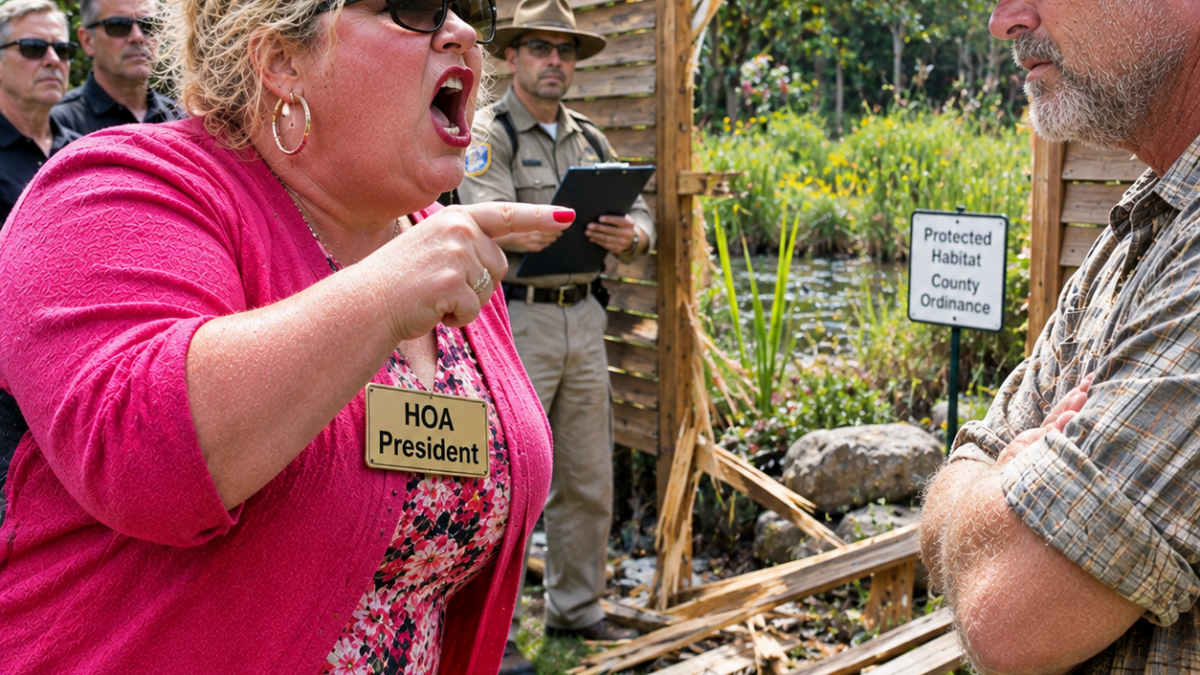
When I saw Karen Miller standing in my backyard while a man with a crowbar ripped apart the six-foot privacy screen protecting the conservation nursery I had built in memory of my dead best friend, every instinct I had carried home from twelve years in the Army told me to stop him, but the engineer in me noticed something worse—the first blast of hard late-morning sun was already hitting seedlings that had been raised for weeks under carefully controlled shade and humidity, and their leaves were beginning to curl before Karen had even finished telling me the HOA had “authorized immediate remediation.”
She thought she was tearing down an ugly temporary wall that offended Oakmont Estates, but behind that screen were individually cataloged plants grown under a county conservation agreement for a species-recovery program, and I had already sent her the permit, explained the project in writing, and warned her that the structure existed for a reason she had never bothered to understand.
What made me stop arguing and reach for my phone was not the splintering wood or even the way Karen smiled while the fabric came down—it was the realization that she was so certain the HOA outranked everyone else that she was willing to say, on camera, exactly who had ordered the destruction and exactly why.
My name is Mark Evans. I came home on a medical discharge after twelve years as a sergeant in the Army Corps of Engineers, with a knee that no longer worked the way it should and a mind that had trouble believing quiet places were actually quiet.
My wife, Sarah, found the house at the end of a cul-de-sac in Oakmont Estates. The building itself was modest, but the backyard backed onto a small strip of county-owned land that had escaped development, and that patch of wild ground was why I wanted the place.
Years earlier, in Helmand Province, my best friend, Corporal David Chen, had talked endlessly about a rare butterfly native to our county—the silver-spotted azure—and the plant it depended on, a small flowering herb called sky leaf verbena. David had been a biologist before he enlisted. He could look at dust, rock, and scrub in a war zone and somehow still notice life.
His dream was to start a conservation nursery when he came home.
He never did.
In his last letter to me, he had sketched the butterfly beside propagation notes for the verbena and written one sentence I never forgot: “You build things, Mark. Build this for me.”
So I did.
After Sarah and I moved in, I approached the county conservation department. They already had a recovery program underway, and when they learned I had engineering experience and was willing to dedicate part of my property to raising plants for habitat restoration, they approved a partnership. I filed the plans, obtained a permit, and built a thirty-foot-long shade screen over a simple wooden frame to create the stable microclimate the young verbena needed.
It was dark green mesh.
It was not decorative.
I will admit that.
But it was permitted, temporary, and functional.
Karen hated it almost immediately.
She had introduced herself two days after we moved in by handing me a violation notice because our moving boxes remained in the driveway too long. After that came the garbage cans, an oil stain from the moving truck, and an American flagpole she claimed was two inches too tall.
I let most of it go.
I had not bought the house to fight anyone.
The screen was different.
When Karen taped an “unauthorized structure” notice to my front door, I mailed her a certified response containing the county permit, an explanation of the nursery, and an invitation to see the seedlings for herself.
Her answer was another fine.
Then another.
She called the nursery a commercial operation, which it wasn’t, and insisted county approval did not override HOA rules.
I kept every letter.
That morning, when she arrived with the crowbar-wielding contractor, I told her one last time to stop.
“You are trespassing,” I said. “He is destroying private property tied to a county project.”
Karen laughed.
“The HOA governs exterior structures.”
“The county permit is in your file.”
“I don’t care about your hobby permit.”
The contractor pulled again.
Half the screen collapsed.
Sunlight flooded the beds.
I watched one row of tender seedlings flatten under the falling fabric.
Then I took out my phone.
Karen saw it.
“What are you doing?”
“Documenting.”
Her expression hardened.
“Fine. Document this.”
She pointed toward the wreckage.
“I’m Karen Miller, president of the Oakmont Estates Homeowners Association, and I authorized removal of this illegal structure.”
I pressed record.
And behind her, the contractor raised the crowbar again.
PART 2
“Stop.”
I didn’t shout it.
I didn’t need to.
The man froze with the crowbar above his shoulder.
Karen turned toward me.
“He’s doing the job he was hired to do.”
I kept the camera aimed at them.
“What’s your name?”
The contractor looked at Karen instead of answering.
She stepped between us.
“He works for the association.”
“I didn’t ask who pays him.”
I shifted the phone slightly.
“Sir, what is your name?”
His grip loosened.
“Donnie.”
“Last name?”
Karen snapped, “He does not have to answer you.”
Donnie looked uncomfortable.
I could tell from his face that whatever Karen had told him before bringing him onto my property had not included words like county conservation program or protected plant recovery.
I pointed toward the crushed seedlings.
“Did she tell you this is a permitted county project?”
“No,” he said.
Karen wheeled around.
“Don’t engage with him.”
I looked back at her.
“Did the board vote to hire this contractor?”
Her jaw tightened.
“You were given ample notice.”
“That wasn’t my question.”
“You are in violation.”
“Show me the vote.”
She shook the papers in her hand.
“I have authority as president to enforce the bylaws.”
“So that’s a no?”
Her face reddened.
“Get the rest of it down, Donnie.”
He didn’t move.
“Donnie.”
He looked at the nursery.
Then at me.
Then at the phone.
“Ma’am, maybe we should go.”
Karen stared at him as though he had betrayed her personally.
“I paid you to remove it.”
“And I removed most of it.”
“You’ll finish.”
“No.”
That single word visibly shocked her.
People like Karen survive because most people eventually decide resistance isn’t worth the effort. A contractor with a crowbar wasn’t supposed to develop a conscience halfway through the job.
She pointed at him.
“You will not be paid.”
Donnie lowered the crowbar.
“That’s fine.”
Then he walked toward the side gate.
Karen looked ready to explode.
I kept recording.
“You’re both going to regret this.”
I said, “Before you leave, Karen, I want the record clear. You entered my property without permission, hired a contractor to destroy a permitted structure, damaged plants cataloged under a county conservation agreement, and you are refusing to stop after being told what this project is.”
She stepped closer.
“You think because you were in the Army and got some little county card that you’re above the rules.”
“No.”
“Then start acting like everyone else.”
“I am.”
I held the phone steady.
“That’s why I’m asking you to follow the law.”
Her face changed.
Not much.
Just enough.
A brief uncertainty.
Then pride swallowed it.
“This is my community.”
“No, Karen. You live here.”
She glared at me.
“There is a difference.”
Her eyes dropped toward the laminated conservation partner identification card I had taken from my wallet.
County seal.
My photograph.
Project number.
She read it.
Then gave a dismissive snort.
“Tree-hugger nonsense.”
“The plants your contractor just destroyed are part of an official restoration project.”
“Then grow more.”
The sentence landed harder than anything else she had said.
Grow more.
As if the months of propagation, the seed stock, the controlled germination, the cataloging, David’s notes, the entire purpose of the nursery could be replaced as casually as a bag of petunias from a hardware store.
I thought of Helmand.
David crouched beside a tiny purple flower growing beside a concrete barrier.
Me telling him only a biologist could care about a plant while mortar rounds were falling ten miles away.
His answer:
“That’s exactly when somebody has to care.”
I looked at Karen.
“Leave my property.”
Her mouth opened.
“Now.”
Donnie was already at the gate.
Karen followed, still clutching her notices.
At the opening she turned.
“You will receive an invoice for demolition and a lien notice for unpaid fines.”
“Send everything in writing.”
“I will.”
“Good.”
That confused her.
It shouldn’t have.
People like her think paperwork is power because they assume nobody else reads it.
She walked away.
The moment the gate closed, I stopped recording.
My hand started shaking.
Not from fear.
Adrenaline.
Anger.
Grief.
All of it arrived at once.
Sarah had been at work when Karen appeared. I sent her the video but immediately followed it with:
**I’m okay. Call when free.**
Then I turned toward the nursery.
That was when the anger became something else.
The plants were suffering.
Rows closest to the torn section had taken full sun.
The humidity was already dropping.
Several leaves had curled inward.
Some had pale patches where intense light had scorched tissue never acclimated to direct exposure.
One section of mesh had fallen across a propagation tray and snapped stems.
I put the conflict aside.
Assess.
Stabilize.
Document.
Those three words had gotten me through more bad situations than any motivational speech ever could.
First photographs.
Wide views showing the demolished screen.
Closer shots.
Broken two-by-fours.
Torn mesh.
Footprints.
Crowbar marks.
Then every damaged tray.
Catalog labels visible.
Plant numbers.
Condition.
Time.
Temperature.
Humidity.
I wrote everything down.
Then I got to work.
Spare tarps.
Clamps.
PVC poles.
Old shade cloth.
Anything that would reduce exposure.
My knee started hurting forty minutes in.
I ignored it.
Then it buckled.
I caught myself against one of the tables.
For a second I just stood there breathing.
That was another thing I hated about coming home.
My brain still believed I could order my body to do anything.
My knee had its own chain of command.
I sat on an overturned bucket.
Five minutes.
No more.
Then back up.
By the time Sarah got home, the nursery looked like a refugee camp made of blue tarps and clamps.
She stepped through the gate.
“Oh, Mark.”
I was kneeling beside a tray.
“Don’t touch those.”
“I wasn’t going to.”
“Sun scald.”
“I mean you.”
I looked up.
She came over.
“You’ve been out here all afternoon.”
“Had to stabilize it.”
“Your knee?”
“Fine.”
“Mark.”
“Hurts.”
She crouched beside me.
“How bad is the damage?”
I looked across the rows.
“Don’t know yet.”
“Can the plants recover?”
“Some.”
“And the others?”
I didn’t answer.
Sarah knew.
She sat beside me in the grass.
For a minute, neither of us spoke.
Then she asked:
“Was she here when you got home?”
“Yes.”
“You recorded?”
“Yes.”
“What did she say?”
“Enough.”
“Good.”
Her voice was quiet.
Not vindictive.
Just tired.
Karen had been wearing us down for months.
The moving boxes.
Garbage cans.
Driveway stain.
Flagpole.
Then the screen.
Every envelope from the HOA had started making Sarah tense before she even opened it.
That was the real cost of petty authority.
Not the fifty-dollar fine.
The anticipation.
The feeling that somebody was always watching for a reason to tell you your home wasn’t quite yours.
Sarah reached toward one of the damaged seedlings but stopped before touching it.
“David?”
I nodded.
She understood what I meant.
This wasn’t simply a project funded by the county.
It was a promise.
I stood carefully.
“I need to call Dr. Thorne.”
Dr. Aris Thorne headed the county conservation department.
He was in his late sixties, quiet enough that when he spoke in meetings, everyone else naturally lowered their voices.
He had championed the silver-spotted azure program for years.
I emailed him the video and photographs.
Then called.
He answered before I finished the first ring.
“Mark.”
“You saw it?”
“What the hell happened?”
I had never heard him swear.
That told me almost as much as his tone.
“HOA president hired somebody to remove the screen.”
“I can see that.”
“She had the permit.”
“What?”
“I sent it certified two months ago.”
“You have proof?”
“Yes.”
“Did she know the nursery was part of our recovery program?”
“Yes.”
“Did she know the plants were cataloged?”
“Yes.”
Silence.
Then:
“How many damaged?”
“Still counting.”
“Do not discard anything.”
“I won’t.”
“Dead plants, damaged material, broken structure, all of it stays documented.”
“Understood.”
“Can you keep the surviving plants shaded tonight?”
“I’ve got temporary cover.”
“I’ll send two staff horticulturists tomorrow morning.”
“Thank you.”
His voice turned harder.
“And Mark?”
“Yeah?”
“Do not engage her further.”
“I wasn’t planning to.”
“I’m serious. She’s no longer dealing with a homeowner complaint.”
“What is she dealing with?”
“The county.”
That was the first moment I felt something close to relief.
Not victory.
Relief.
I had spent months answering Karen alone.
Now I didn’t have to.
The next morning, Dr. Thorne arrived personally with two conservation staff members.
They examined the nursery.
Counted.
Photographed.
Compared current conditions against my previous plant inventory.
Thirty-seven seedlings were eventually classified as destroyed beyond recovery.
More were stressed but salvageable.
Thirty-seven.
To most people, not a large number.
To a recovery program working with limited viable plant stock, thirty-seven mattered.
Dr. Thorne stood beside one tray.
“This one was from David’s original propagation notes?”
“Yes.”
“How much material survives?”
“I have backup seed.”
“Enough?”
“Maybe.”
He nodded.
“We’ll help.”
Then he turned toward the wreckage.
“We need a more resilient structure.”
I almost laughed.
“I’m thinking steel.”
“Good.”
“Commercial shade cloth.”
“Good.”
“Misting.”
“Probably necessary now.”
“Ventilation.”
He smiled faintly.
“You’ve already designed it.”
“In my head.”
“Of course you have.”
The county formally approved an emergency replacement structure and amended our conservation plan to cover the upgraded nursery.
That mattered.
The old screen had been temporary.
The new structure would look unmistakably professional.
Galvanized supports.
Commercial shade fabric.
Misting system.
Ventilation fans.
Anchored foundation points.
It cost far more than the simple screen Karen had destroyed.
I kept every receipt.
Every invoice.
Every hour.
Not because I was thinking about revenge.
Because Dr. Thorne told me to.
“Documentation,” he said.
I almost smiled.
“That’s my language.”
Three days later, Karen sent another violation.
**UNAPPROVED PERMANENT STRUCTURE.**
Sarah handed me the envelope.
“You have got to be kidding.”
I read it.
“She saw the new frame.”
“Did she miss the county truck parked in our driveway for two days?”
“Apparently.”
The violation demanded immediate work stoppage and threatened a lien.
I scanned it.
Forwarded it to Dr. Thorne.
His reply contained four words:
**Please do not respond.**
I obeyed.
The county responded instead.
Karen received a certified demand from county counsel requesting every document related to her actions against our property.
Board authorization.
Meeting minutes.
Invoices.
Contractor identity.
Payment records.
Copies of my violation notices.
Copies of my permit.
Any legal opinion she relied on.
The letter also informed her she was under investigation for interference with a county-sanctioned conservation project and potential environmental violations.
I did not see Karen read it.
Maria did.
I hadn’t met Maria yet.
That came later.
But she told me Karen opened the letter at her mailbox, stood motionless for almost a full minute, then stormed back inside.
The next day I got three new violations.
One for the greenhouse.
One for “excessive construction activity.”
One claiming county vehicles had been parked illegally.
Sarah spread them across the kitchen table.
“She is escalating.”
“Yes.”
“Why?”
“Because backing down would mean admitting she didn’t control this.”
Sarah rubbed her forehead.
“Normal people don’t think like that.”
“No.”
“You sure you’re not enjoying this a little?”
“What?”
“The paperwork battle.”
I looked at her.
She raised an eyebrow.
I admitted it.
“A little.”
“Mark.”
“Not the plants. Not what she did. But she keeps sending evidence.”
“Just remember you’re supposed to be healing.”
That stopped me.
Sarah knew me well enough to recognize something I didn’t want to admit.
Conflict felt familiar.
Familiar things can feel safe even when they’re unhealthy.
I had come home because my body and mind needed quiet.
Karen had given me a mission.
A target.
A timeline.
A file.
Part of me knew exactly how to live inside that.
I promised Sarah:
“The nursery first.”
“Good.”
“Karen second.”
“Better.”
That was when I started talking to neighbors.
Not to build an army.
At least that’s what I told myself.
Mostly I wanted to know whether Karen treated everyone the way she treated us.
George answered that question.
He lived three houses down.
Retired litigator.
Seventies.
Thin.
Sharp-eyed.
The type of man who could make a casual question sound like cross-examination without raising his voice.
I found him wrestling with a bag of mulch.
I helped carry it.
My knee complained.
He noticed.
“Army?”
“Yeah.”
“Figured.”
“How?”
“You lift like you’re trying to prove something to your joints.”
I laughed.
We talked.
Eventually Karen came up.
George’s face changed.
“She got you too?”
“Privacy screen.”
“The green one?”
“The former green one.”
I showed him the video.
He watched it twice.
Then handed back my phone.
“Well.”
“What?”
“She has a problem.”
“The county thinks so.”
“No.”
He pointed toward the screen.
“I mean legally.”
He invited me inside.
His study looked exactly like a retired lawyer’s study should look.
Shelves.
Old case reporters.
Stacks of annotated documents.
He pulled out a folder.
Mailbox violation.
Karen claimed his black mailbox was the wrong black.
“The wrong black?”
“Apparently.”
He showed me the approved palette she had cited.
Then the original covenants.
The newer palette had been adopted at a committee meeting without a quorum.
“Why didn’t you sue?”
George shrugged.
“I showed her the documents. She backed off.”
“Why hasn’t everybody?”
“Because most people don’t want to spend thirty hours researching a hundred-dollar fine.”
That made sense.
He leaned back.
“That’s Karen’s business model.”
“Business model?”
“Make compliance cheaper than resistance.”
I thought of Sarah opening envelopes.
George continued.
“She doesn’t need to be legally right. She just needs people tired.”
Then he looked toward my phone.
“You’re different because she caused actual measurable damage.”
“And involved the county.”
“Yes.”
His eyes sharpened.
“What do you want?”
“To protect the project.”
“That’s the immediate objective.”
“I don’t want her doing this to anyone else.”
“That’s the strategic objective.”
There was a long pause.
Then George smiled.
“Now we’re speaking honestly.”
He made calls.
That’s how I met Maria.
She was a software developer who lived across the street from the clubhouse.
Late thirties.
Quiet.
Fast thinker.
Her dispute with Karen had been a vegetable garden.
Karen claimed vegetables visible from the street constituted prohibited agricultural use.
Maria had saved every email.
Every notice.
More importantly, she had been archiving the HOA website automatically for two years.
“Why?”
She shrugged.
“I build systems. Websites change. I back up things I care about.”
George smiled at me.
“Engineers everywhere.”
Maria opened her laptop.
“Karen changes meeting minutes sometimes.”
I looked at her.
“Changes?”
“She posts drafts. Then versions disappear.”
“Could be corrections.”
“Sometimes.”
She pulled up an archived page.
Meeting minutes.
Then the current version.
Language had changed.
Small edits.
Some harmless.
Others not.
We searched for the meeting before my screen demolition.
Agenda:
**Enforcement discussion regarding unauthorized structure, Lot 72.**
The posted minutes said:
**Board authorized president to take necessary enforcement action.**
“Seems broad,” I said.
Maria nodded.
“I thought so.”
George asked:
“Who attended?”
Maria had already checked.
A neighbor named Robert.
We spoke with him the next day.
He remembered the discussion.
“The board told Karen to send another notice.”
“Any motion to hire a contractor?”
“No.”
“Any authorization to enter Mark’s property?”
“No.”
“Remove the screen?”
“No.”
“Are you certain?”
Robert frowned.
“I was the one who said they should get legal advice before doing anything else.”
George asked:
“Was that in the minutes?”
“No.”
Maria looked at me.
The implication landed.
Karen had not merely interpreted a vote aggressively.
The official record appeared to have been altered to make her authority broader than what the board had actually approved.
Then we checked the contractor invoice.
We didn’t have access yet.
But Karen’s violation notice identified the demolition company.
**Donnie’s Demolition.**
Maria searched the state business registry.
Residential address.
Then social records.
She turned the laptop toward us.
Photograph.
Karen at a family barbecue.
Beside her:
Donnie.
Caption identifying him as her brother-in-law.
George leaned back.
“Well, now.”
I felt the conflict expand.
“This started over a screen.”
George said:
“No. The screen is just where she made a mistake big enough to inspect.”
Stan joined us next.
Retired CPA.
Green visor he wore partly as a joke and partly because he genuinely liked it.
He had questioned HOA expenses for years.
Karen called him “obsessive.”
He considered that professional praise.
Stan requested financial records.
Karen refused.
Said they were being organized.
George drafted a formal request citing homeowners’ inspection rights.
Ten business days.
On day nine, a lawyer responded.
Two-hour inspection window.
Weekday morning.
No copies.
George laughed.
“Standard obstruction.”
“Can they forbid copies?” I asked.
“No.”
He wrote back.
We would attend.
We would bring a scanner.
And Stan.
Karen had boxed herself in.
Refuse, and she created a new legal issue.
Comply, and we saw the books.
She complied.
The clubhouse inspection felt almost surreal.
Karen sat at a folding table with her attorney.
Bankers boxes surrounded them.
Maria set up a portable scanner.
Stan opened the first box.
George sat beside him.
I mostly watched.
Karen tried to make conversation.
Nobody engaged.
The scanner whirred.
Receipt.
Invoice.
Bank statement.
Reimbursement form.
Contract.
Two hours.
Stan kept making the same sound.
“Hm.”
After the seventh “hm,” Karen snapped:
“Is there a problem?”
Stan looked over his glasses.
“I’m reviewing.”
“You seem determined to find something.”
“I am determined to understand the numbers.”
She muttered something.
He went back to work.
Then Maria found Donnie’s invoice.
$1,500.
Demolition services.
Paid from HOA funds.
No competing quote.
No attached board authorization.
No signed contract beyond Karen’s approval.
George looked at me.
“Copy that.”
Karen’s lawyer shifted in his chair.
Then came landscaping expenses.
Payments to a company Stan couldn’t identify.
Reimbursements to Karen.
Office supplies.
The itemized receipt included groceries.
Cosmetics.
Cat food.
Twenty-seven bags of litter over several purchases.
Maria stared at the receipt.
“Does the HOA have a cat?”
Stan didn’t look up.
“Apparently several.”
George covered a smile.
Then paint.
Clubhouse trim.
Specialty supplier.
Maria searched.
Owned by Karen’s cousin.
Premium paid above comparable quotes.
By the end of two hours, we didn’t have a theory.
We had documents.
That was better.
As we packed, Karen folded her arms.
“I hope your little fishing expedition was worth everyone’s time.”
George stopped at the door.
“You know what I always liked about records, Karen?”
She glared.
“They don’t care who feels insulted.”
Then we left.
Stan spent the next week analyzing three years of transactions.
He didn’t call it embezzlement.
Not yet.
He used terms like unsupported reimbursement, related-party transaction, undocumented expenditure, apparent personal purchase.
The numbers grew.
So did the pattern.
Meanwhile, the county investigation moved faster.
Dr. Thorne called me.
“We have a preliminary violation determination.”
“How bad?”
“For Karen?”
“Yes.”
“Significant.”
He explained that county ordinance 1138-B allowed penalties tied to interference with a sanctioned conservation program, restoration cost, damaged material, and protected organisms involved in the recovery project.
The thirty-seven destroyed seedlings mattered.
My records mattered.
The video mattered.
The county’s position was that Karen had acted unilaterally and without valid board authorization.
That meant they were considering personal assessment rather than shifting the penalty to the HOA.
“How much?”
“We’re finalizing.”
“Range?”
“Mark.”
“Fine.”
He sighed.
“Potentially tens of thousands.”
Sarah was sitting across from me.
She heard enough.
When the call ended, she said:
“Are you okay?”
“Why wouldn’t I be?”
“Because you wanted accountability.”
“Yes.”
“And now you’re realizing what accountability looks like.”
I looked toward the nursery.
The new greenhouse frame was almost finished.
Thirty-seven empty catalog spaces remained in my propagation log.
I thought about Karen’s house.
Her life.
Her arrogance.
And, for the first time, the human being underneath all of it.
“She could lose a lot.”
Sarah nodded.
“She also could have stopped.”
That was the part I kept returning to.
Karen had exits.
When I sent the permit.
When I invited her to visit.
When Donnie hesitated.
When I told her to stop.
When the county letter arrived.
She could have said:
I made a mistake.
Instead she sent three more violations.
The annual HOA meeting was three weeks away.
George saw the opportunity immediately.
“Public record.”
“You want to expose everything there?”
“I want homeowners to decide who runs their association after seeing how it has been run.”
Maria built the website.
**Oakmont Homeowners for Transparency.**
No insults.
No memes.
No caricatures.
Documents.
Receipts.
Archived minutes.
Related-party contracts.
Violation notices.
A section on my conservation project.
Video.
County permit.
The county inquiry.
Neighbors submitted their own experiences.
Some anonymously.
Some signed.
Garden.
Play set.
Mailbox.
Wind chime.
Shrubs.
The point was not that every HOA enforcement action had been invalid.
Some weren’t.
The point was the pattern.
Selective treatment.
Invented standards.
Missing procedure.
Power concentrated in one person.
Maria scheduled the email for the night before the meeting.
Everyone received it except Karen and her two closest board allies.
I asked:
“Is excluding them smart?”
George said:
“They will see it within twenty minutes.”
He was right.
Karen started calling people before breakfast.
By noon, she sent a neighborhood email calling the website defamatory.
That gave it more traffic.
Maria messaged:
**She just doubled our audience.**
The meeting started at seven.
By six thirty, the clubhouse was full.
By six forty-five, people stood along walls.
By seven, the hallway overflowed.
I sat with George and Maria in front.
Stan sat farther back with financial notes.
Sarah took the chair beside me.
“You nervous?”
“Yes.”
That surprised her.
“Really?”
“I don’t like crowds.”
She squeezed my hand.
Another thing Karen never understood.
She thought because I had been a soldier, confrontation came naturally.
It didn’t.
I had learned how to perform inside it.
Different thing.
Karen entered at seven-oh-three.
Pink jacket.
Clipboard.
Two loyal board members behind her.
She saw the crowd.
Stopped.
For half a second, fear showed.
Then her chin rose.
Mask back in place.
She called the meeting to order.
Minutes.
Landscaping.
Pool maintenance.
Then treasurer’s report.
A one-page summary.
Stan stood.
“Point of order.”
Karen’s eyes narrowed.
“Public comment occurs later.”
“I’m questioning the treasurer’s report.”
“Sit down.”
George stood.
“Bylaw Twelve, Section Three allows a member to request clarification during presentation of financial reports.”
Karen looked at him.
“This is not your courtroom.”
“No.”
George smiled slightly.
“In court, people usually know when they’re losing.”
Murmurs.
Karen banged the gavel.
“Proceed, Mr. Gable.”
Stan stepped forward.
“The summary is materially incomplete.”
Karen said:
“That is your opinion.”
“No.”
He held up a folder.
“That is my professional assessment after reviewing association records.”
Maria connected her laptop.
The website appeared behind the board table.
**OAKMONT HOMEOWNERS FOR TRANSPARENCY**
Karen spun around.
Her face went white.
“This is unauthorized.”
A man from the back called:
“Are the receipts fake?”
Karen ignored him.
Maria pulled up the cat-food reimbursement.
“Karen, is this your reimbursement request?”
“This is harassment.”
“Is the receipt genuine?”
“You have no right—”
George interrupted.
“Answering would be easier.”
Someone laughed.
Karen’s face reddened.
Then Donnie’s invoice appeared.
$1,500.
“Is this your brother-in-law?” I asked.
She looked at me.
“You.”
“Is Donnie your brother-in-law?”
“That is irrelevant.”
“Did the board approve hiring him?”
“I had enforcement authority.”
“Was there a vote?”
“You know there was.”
Maria pulled up the archived meeting minutes.
Then Robert’s signed statement.
No demolition authorization.
Karen pointed toward Maria.
“You manipulated those records.”
Maria’s voice stayed calm.
“These are timestamped archived copies from the HOA website.”
The room started to turn.
People asked questions.
Karen tried to move on.
Couldn’t.
Stan presented the unsupported reimbursements.
Related-party payments.
Personal merchandise.
Cosmetics.
Groceries.
Cat supplies.
The amount wasn’t yet the final $22,000 forensic figure.
But it was enough.
One homeowner shouted:
“You fined me seventy-five dollars over my mailbox while buying cat litter with my dues?”
Another:
“My daughter’s play set was apparently destroying property values, but this was okay?”
Karen’s two allies stared at the table.
She looked at them.
“Say something.”
Neither did.
The room became louder.
George waited.
Then raised his hand.
The noise softened.
“I move for a vote of no confidence in Karen Miller as president and member of this board, based on evidence of financial misconduct, falsification of records, unauthorized expenditures, and abuse of enforcement authority.”
Voices erupted.
“Second.”
“Second.”
“Second.”
Karen struck the gavel.
“No.”
George looked at her.
“The motion has been properly made.”
“This meeting is adjourned.”
She hit the gavel again.
The handle cracked.
Nobody moved.
That might have been the most important moment of the night.
For years, one hit of that little wooden hammer had been enough to stop people from speaking.
Now everyone simply watched her.
The power had left before the vote.
She just hadn’t accepted it.
“This meeting is adjourned!”
Still nobody moved.
Then the double doors opened.
The room became quiet.
A sheriff’s deputy entered first.
Beside him was a county conservation enforcement officer I recognized from Dr. Thorne’s office.
Officer Miller.
No relation to Karen.
He carried a large envelope.
Karen stared at him.
The entire room watched as he walked down the center aisle.
His boots sounded unusually loud on the clubhouse floor.
He stopped at the front table.
“Karen Miller?”
She swallowed.
“Yes.”
“I’m with the County Parks and Conservation Department.”
He placed the envelope in front of her.
“I am serving you with a formal notice of violation and civil fine assessment arising from the May seventeenth incident at Mark Evans’ property.”
Nobody breathed.
Officer Miller continued.
“The county has completed its investigation.”
Karen glanced at me.
I didn’t move.
“The investigation determined that you personally directed the removal of a structure associated with an authorized conservation project, that the action was undertaken without valid county authority, and that thirty-seven cataloged sky leaf verbena seedlings were destroyed as a result.”
Karen whispered:
“I was acting for the HOA.”
“The county reviewed that claim.”
She looked at her board allies.
One shook his head.
Very slightly.
Officer Miller continued.
“The available HOA records do not establish board authorization for the demolition.”
Karen’s face began to collapse.
“Pursuant to Ordinance 1138-B and the applicable restoration and protected-flora penalty schedule, the total civil fine assessed against you personally is fifty thousand dollars.”
The gasp felt physical.
Sarah’s hand closed around mine.
Karen stared at the envelope.
“Fifty…”
Her voice failed.
Officer Miller waited.
She tried again.
“Fifty thousand dollars?”
“Yes, ma’am.”
“For a screen?”
“No.”
His answer was immediate.
“For the violations described in the notice.”
She looked toward me.
“This is because of him.”
Officer Miller’s face remained neutral.
“The assessment is based on evidence collected by the county, including video, project records, permit records, damaged plant inventory, correspondence, and statements.”
Karen’s voice rose.
“Those plants are weeds.”
Dr. Thorne wasn’t there.
I was glad.
He might have finally lost his temper.
Officer Miller said:
“You have thirty days to pay or file a formal administrative appeal. Instructions are included.”
“What if I refuse?”
“That is also addressed.”
The sheriff’s deputy remained quiet.
Karen looked at him.
“Am I being arrested?”
“No, ma’am.”
“Then why is he here?”
“To ensure service occurs without disruption.”
That answer seemed to humiliate her more than an arrest might have.
The county had expected enough conflict to send a deputy.
Officer Miller nodded once.
“Our business is complete.”
He turned.
The deputy followed.
They walked out.
No speech.
No celebration.
No glance backward.
Karen stayed seated.
The $50,000 notice lay in front of her.
The woman who had threatened to lien my home over a privacy screen now looked afraid to touch the envelope.
George broke the silence.
“The motion remains on the floor.”
Karen looked at him.
“You can’t possibly—”
“We can.”
The vote proceeded.
Hands rose.
Nearly unanimous.
Then one of Karen’s two closest allies raised his hand too.
She saw it.
That hurt.
Her other ally followed seconds later.
Karen’s mouth opened.
Nothing came out.
She had spent years constructing loyalty out of fear.
Fear is loyal only until it changes direction.
Karen was removed.
President.
Board seat.
Both.
Susan, a quiet woman Karen had once cited because her wind chime was supposedly “tonally inappropriate,” became interim president.
That phrase alone would have sounded like satire if I hadn’t seen the violation.
Karen gathered her papers.
The $50,000 envelope went on top.
She walked out without looking at anyone.
No cheering.
Just silence.
Then somebody exhaled loudly.
Others laughed from nerves.
The meeting continued.
That mattered.
Karen’s removal wasn’t the end of Oakmont Estates.
It was the beginning of the neighborhood remembering it belonged to everyone.
Susan’s first motion was simple.
Suspend disputed fines issued under Karen’s presidency pending review.
Passed.
Second:
Cooperate fully with the county investigation.
Passed.
Third:
Hire an independent forensic accountant.
Stan actually smiled.
Karen listed her house the next morning.
I saw the sign while taking out the trash.
Sarah came outside.
“Already?”
“Apparently.”
“Do you feel good?”
I stared at the sign.
“No.”
She nodded.
“Me neither.”
That surprised me.
Karen had terrorized us.
Destroyed the nursery.
Mocked David’s project.
Threatened our house.
Yet seeing a FOR SALE sign on someone’s lawn after a fifty-thousand-dollar penalty didn’t feel like winning.
It felt like consequences.
Those are not always joyful.
The forensic audit finished a month later.
The preliminary irregularities became documented findings.
More than $22,000 in HOA money had been misappropriated or improperly used over Karen’s five-year tenure.
Personal purchases.
Related-party contracts.
Unsupported reimbursements.
The demolition payment to Donnie.
Specialty work routed through relatives.
The new board filed a civil action to recover the funds.
They also sought reimbursement for legal costs incurred defending Karen’s unauthorized actions.
I filed separately for the physical damage to the project and the cost of the replacement greenhouse.
I resisted at first.
Dr. Thorne didn’t.
“Mark.”
“Yes?”
“You need to recover the cost.”
“The greenhouse is better now.”
“That isn’t the point.”
“I can afford it.”
“Still not the point.”
He leaned across his desk.
“If someone destroys conservation infrastructure and the project quietly absorbs the cost, the lesson is that destruction is cheap.”
That convinced me.
Karen fought.
Her attorney called everything conspiracy.
Retaliation.
A vendetta.
The motions went nowhere.
The evidence was too plain.
Video.
Financial records.
Invoices.
Meeting archives.
County findings.
Witnesses.
Eventually, six months after the clubhouse meeting, Karen settled the civil disputes.
The house sold.
Most of what she received from the sale disappeared into obligations.
County penalties.
Civil settlement.
Legal expenses.
Repayment.
I later heard she declared bankruptcy and moved in with a sister in another state.
I never verified the details beyond what became part of HOA records.
I didn’t need to.
Once Karen left Oakmont, I stopped looking for information about her.
That was deliberate.
Sarah noticed.
“You haven’t checked the court docket this week.”
“No.”
“Recovery?”
“Maybe.”
She smiled.
“Good.”
The neighborhood changed almost immediately.
Not because we abolished every rule.
That would have been stupid.
Shared communities need rules.
Road maintenance.
Common landscaping.
Pool safety.
Budgets.
Insurance.
But subjective nonsense disappeared.
The approved paint palette was simplified.
Vegetable gardens were allowed.
Play-set regulations became safety-based instead of color-based.
Mailbox requirements focused on basic consistency rather than tiny shades.
Wind chimes stopped being treated as public emergencies.
Meeting minutes were archived and versioned publicly.
Contracts above a certain threshold required multiple quotes.
Related-party transactions required disclosure.
No president could unilaterally hire a contractor to enter private property.
That last rule passed unanimously.
Donnie eventually sent me a written apology.
It came in a plain envelope.
I almost threw it away.
Inside:
**Mr. Evans, Karen told me the HOA had legal authority to remove the screen and that you had ignored multiple orders. I should have asked more questions before entering your property. I am sorry for the damage I caused.**
That was it.
No excuse.
No request.
I showed Sarah.
“What do you think?”
She read it twice.
“He’s taking responsibility.”
“Yes.”
“Are you going to answer?”
I did.
Two sentences.
**I appreciate the apology. In the future, verify authority before entering someone’s property.**
He never contacted me again.
That felt complete.
The greenhouse flourished.
The thirty-seven seedlings Karen destroyed could not be recovered.
We didn’t pretend otherwise.
But backup seed and surviving propagation stock gave us enough to continue.
Dr. Thorne’s department increased support.
Graduate students volunteered.
The new HOA surprised me by offering to fund part of the project’s water use.
I refused at first.
Susan said:
“Why?”
“It’s a county project on my property.”
“And it benefits the county.”
“Yes.”
“And our community.”
I looked at her.
She smiled.
“Get used to people helping.”
That was harder than it sounds.
For years, the nursery had been something I protected.
First for David.
Then from Karen.
Accepting help meant allowing it to become larger than my promise.
Eventually I agreed.
The HOA paid for a small educational sign near the sidewalk.
Nothing intrusive.
**COUNTY CONSERVATION PARTNER SITE
SILVER-SPOTTED AZURE RECOVERY PROGRAM
PLEASE RESPECT ACTIVE HABITAT RESTORATION**
When it went up, Sarah laughed.
“What?”
“Karen wanted the project hidden.”
I looked at the sign.
“Now there’s a county logo facing her old house.”
“You planned that.”
“I did not.”
“You enjoyed it.”
“A little.”
She kissed my cheek.
“Allowed.”
My knee slowly got worse.
That part of the story has no satisfying legal reversal.
Bodies age.
Injuries stay.
Some mornings I could work for hours.
Others, twenty minutes of kneeling meant ice and anti-inflammatory medication.
For a long time I hated needing help in the greenhouse.
David and I had always joked that I built things and he understood living things.
After he died, I tried to do both.
That was impossible.
Eventually Dr. Thorne sent interns.
Then neighborhood kids started helping.
Maria learned seed tracking.
George, despite being almost twenty years older than me, insisted on moving soil bags until I threatened to call his doctor.
Stan handled inventory spreadsheets.
Susan organized volunteer days.
The project became communal.
That frightened me at first.
David’s promise had been mine.
“You build this for me.”
Not:
Make a committee.
Not:
Put up a sign.
Not:
Invite an HOA.
One evening I found Sarah in the greenhouse repotting seedlings with a teenager from down the street.
They were laughing.
I stood outside longer than necessary.
Sarah noticed.
“You coming in?”
“In a minute.”
She looked at me.
“What?”
“Nothing.”
“Mark.”
I walked inside.
After the teenager left, Sarah wiped soil from her hands.
“You look upset.”
“I’m not.”
“Try again.”
I stared at the rows of verbena.
“This used to feel like David’s.”
“And now?”
“Everyone’s.”
“Is that bad?”
I didn’t answer.
Sarah understood.
She took my hand.
“You think sharing it means losing him.”
I looked away.
She continued.
“David wanted to save a species, Mark. Do you really think his dream was one angry veteran guarding plants behind a screen forever?”
I laughed despite myself.
“That sounds bad when you say it like that.”
“It was meant to.”
The next spring, we reached the stage Dr. Thorne had been waiting for.
The first captive-bred generation of silver-spotted azure butterflies was ready for release.
I had seen adults before.
Wild individuals.
Rare.
Quick.
Easy to miss.
Seeing dozens emerge under controlled conditions from a project rooted in David’s notes was different.
The first one opened its wings beneath the mesh.
Blue.
Not simply blue.
Iridescent.
The color changed with the angle of light.
For a second I was back overseas.
David holding a field guide over instant coffee.
Talking about wings.
Host plants.
Restoration.
Me telling him he could bore a rock.
I had not realized how much of those conversations I remembered until the butterflies began appearing.
Dr. Thorne watched me.
“You okay?”
“No.”
He nodded.
“Good.”
That was apparently the universal response to middle-aged veterans crying over small animals.
We planned a release day.
Not a ceremony at first.
I wanted six people.
Dr. Thorne wanted county staff.
Susan wanted neighborhood families.
Maria created a signup page before I could object.
Within three days, almost the entire neighborhood wanted to come.
I panicked.
Sarah found me staring at the registration numbers.
“One hundred thirty-seven?”
“That’s wonderful.”
“That’s too many people.”
“We have a large yard.”
“It’s a nursery.”
“It’s a celebration.”
“I don’t celebrate.”
“I know. We’re working on it.”
Release day arrived warm and bright.
The greenhouse looked nothing like the original screen Karen had destroyed.
Steel frame.
Professional shade.
Misting.
Rows of flowering sky leaf verbena.
Blue blossoms scattered among green leaves.
Children gathered near mesh enclosures containing the butterflies.
George manned the grill despite everyone telling him not to.
Stan kept asking people whether they had signed waivers until Susan confiscated his clipboard.
Maria photographed everything.
Sarah put a chair beside me.
“For your knee.”
“I don’t need it.”
“You will.”
I needed it twenty minutes later.
Dr. Thorne gave a short explanation of the project.
Habitat loss.
Host plants.
Propagation.
Restoration.
Then he did something I hadn’t expected.
He talked about David.
Not like a martyr.
He never met him.
He simply said:
“This project began because one soldier came home carrying another soldier’s idea with him.”
I looked down.
Sarah’s hand found mine.
Dr. Thorne continued.
“Conservation often sounds like something governments do on enormous landscapes. Sometimes it begins in one backyard because somebody refuses to let a promise die.”
He turned toward me.
“Mark?”
I stood.
Bad idea.
Knee complained.
Sarah gave me the look.
I ignored it.
I faced neighbors who, a year earlier, I barely knew.
People Karen had taught to distrust one another.
Now they were standing around my nursery drinking lemonade.
I hadn’t prepared a speech.
Probably better.
“A year ago,” I said, “most of you knew this place as the ugly green screen.”
A few people laughed.
“It was ugly.”
More laughter.
“I built it because a friend of mine named David wanted to spend his life doing something like this.”
I looked toward the greenhouse.
“He didn’t get the chance.”
The crowd became quiet.
“I thought keeping my promise meant building something exactly the way he imagined and protecting it by myself.”
I paused.
“I was wrong about the last part.”
Sarah smiled.
“Karen tearing down the screen was one of the worst days I’ve had since coming home. Not because of the wood and fabric. Because I watched plants connected to David’s work die while someone told me they didn’t matter.”
I looked toward the children waiting beside the butterfly enclosure.
“But what came after wasn’t just a fight.”
George was listening.
Maria.
Stan.
Susan.
Dr. Thorne.
Neighbors.
“It became this.”
I gestured around us.
“That matters more.”
I stepped down.
Sarah whispered:
“That was almost a speech.”
“Don’t tell anyone.”
Then came the release.
A little girl named Emma helped Dr. Thorne open the first enclosure.
Nothing happened.
Children leaned closer.
“Give them time,” he said.
One butterfly climbed toward the opening.
Paused.
Then lifted.
Blue flashed.
A child gasped.
Another followed.
Then three.
Then more.
The air changed.
Blue wings moved through sunlight.
Some landed on flowers around the greenhouse.
Others crossed the yard.
One settled briefly on George’s shoulder.
He froze.
Maria laughed.
“Don’t move.”
“I wasn’t planning to.”
Another butterfly passed close enough that I felt the movement of air against my cheek.
Then it was gone.
Over the fence.
Toward the county parcel.
Toward habitat plots where volunteers had planted sky leaf verbena from our nursery stock.
I watched until I couldn’t distinguish blue wings from distance.
The sounds around me faded.
I saw David again.
Not the end.
Not the hospital.
Not the folded flag.
Helmand.
Sitting against a concrete barrier.
A ridiculous biology book open on his knee.
“You build things, Mark.”
I closed my eyes.
For the first time in years, the memory didn’t end with him dying.
It ended with him smiling.
Sarah touched my arm.
“You okay?”
“Yeah.”
This time I meant it.
The neighborhood barbecue continued for hours.
Kids chased one another across lawns.
Adults who had once spoken only through HOA complaints traded recipes.
Maria showed people how to access archived meeting records.
Stan explained the new budget until people escaped him.
George found me near the greenhouse after most guests had left.
A few butterflies still moved among lavender and verbena.
He stood beside me.
“Not bad for an ugly screen.”
“No.”
He looked toward the street.
“Remember when this started?”
“Every splinter.”
“I have a theory about the law.”
“That sounds dangerous.”
“Most people think it’s a sword or shield.”
“And?”
“Sometimes it’s a shovel.”
I looked at him.
He continued.
“You dig through enough dirt, eventually you find what somebody buried.”
I smiled.
“You rehearsed that.”
“Absolutely.”
He walked toward the grill.
I stayed.
The $50,000 fine had become the headline everyone remembered.
Karen’s bankruptcy.
Her house sale.
The $22,000 audit finding.
The county enforcement officer walking through the clubhouse.
All dramatic.
All real.
But standing there in the quiet after the party, none of those things felt like the center of the story anymore.
The most important number wasn’t fifty thousand.
It wasn’t twenty-two thousand.
It wasn’t thirty-seven dead seedlings.
It was one.
One promise.
One backyard.
One person deciding he could still build something after spending years surrounded by destruction.
Karen thought the privacy screen was hiding something suspicious.
In a way, she was right.
It hid grief.
It hid memory.
It hid the part of me that still believed if I built David’s nursery exactly right, I could somehow prove losing him had not been meaningless.
Karen tore down the screen.
What she exposed was larger than either of us expected.
The county project.
Her own misuse of authority.
The financial records.
The neighborhood’s fear.
But she exposed something in me too.
I had built a wall around the promise.
Afterward, the wall became a greenhouse.
Then a community project.
Then habitat.
Then butterflies leaving the yard entirely.
The whole point was for them to leave.
It took me too long to understand that.
Years later, the project continued.
Different volunteers.
Different board.
Susan served two terms and stepped down.
Maria eventually joined the board.
Stan swore he never would, then became treasurer because nobody else wanted to hear him complain about accounting.
George remained George.
Older.
Sharper.
Still convinced every disagreement could be improved by a citation.
Sarah and I stayed in the same house.
The greenhouse stayed.
The county renewed our partnership annually.
My knee eventually required surgery.
I hated the recovery.
But the neighborhood covered greenhouse duties while I was stuck inside.
One morning I looked through the kitchen window and saw six people working.
Maria misting seedlings.
A teenager updating tags.
George sitting in my chair pretending to supervise.
Sarah beside him.
I tapped the glass.
George raised his coffee.
I suddenly understood something.
If I had never let anyone help, the project would have died when my body finally forced me to stop.
David had wanted conservation.
Not a monument to my independence.
Karen’s destruction had accidentally forced the project to become stronger than me.
I never thanked her for that.
Some lessons don’t require gratitude toward the person who caused the pain.
They just require recognizing what grew afterward.
The original piece of torn green mesh stayed in my workshop.
I had saved a section after the demolition.
Not for evidence.
The county had enough photographs.
I kept it because one corner still had a small brass tag I had attached when I built the first frame.
**D.C. — 1**
David Chen.
First panel.
Years later, my grandson found it.
“What is this?”
“Old shade cloth.”
“Why do you keep junk?”
“Tradition.”
He rolled his eyes.
Then noticed the tag.
“Who’s D.C.?”
I told him.
Not everything.
Just enough.
“My friend.”
“Army friend?”
“Yes.”
“He liked butterflies?”
“He loved them.”
My grandson looked toward the greenhouse.
“Did he make that?”
“No.”
I touched the old piece of mesh.
“He asked me to.”
The boy thought about it.
“So you did?”
I looked through the workshop window.
A silver-spotted azure settled on a patch of verbena outside.
“Yes.”
I smiled.
“I did.”
That evening Sarah and I sat in the backyard after sunset.
The greenhouse fans hummed softly.
Sprinklers clicked somewhere down the street.
No golf cart patrol.
No violation envelope waiting on the porch.
No Karen.
Just Oakmont.
Not perfect.
People still argued.
Somebody complained about a dog barking.
Someone else wanted stricter parking.
A teenager painted a basketball backboard a color Stan called “an assault on civilization.”
The board survived.
Nobody declared war.
That was the difference.
Sarah rested her head against my shoulder.
“Do you ever think about her?”
“Karen?”
“Yes.”
“Sometimes.”
“What do you feel?”
I considered it.
“Less than I used to.”
“That isn’t an emotion.”
“I know.”
She waited.
I looked at the greenhouse.
“Mostly I think about how many chances she had to stop.”
Sarah nodded.
That was it.
Karen’s downfall wasn’t caused by one privacy screen.
It was caused by years of believing every unanswered challenge proved she was entitled to more authority.
People paid the fines.
So she invented more.
Board members didn’t question her.
So she stopped asking them.
Homeowners didn’t request records.
So she treated the account like hers.
Nobody challenged altered minutes.
So she rewrote inconvenient history.
Then she came to my yard.
She saw a simple wooden frame and green fabric.
Something ugly.
Something easy.
She believed I was just another homeowner who would eventually calculate that fighting cost more than surrender.
What she didn’t see was everything behind it.
The permit.
The county partnership.
The cataloged seedlings.
The conservation program.
David’s letter.
My records.
My training.
And, eventually, neighbors who were just as tired of being afraid as I was.
Karen’s $50,000 fine wasn’t revenge.
It was arithmetic.
The county calculated the damage.
The HOA audit wasn’t revenge.
It was accounting.
Her recall wasn’t revenge.
It was a vote.
Her civil settlement wasn’t revenge.
It was responsibility.
The satisfying part wasn’t that she lost.
It was that the systems she had twisted into weapons finally worked the way they were supposed to.
Records became transparency.
Rules became limits.
Votes became accountability.
And my ugly screen became a greenhouse full of life.
One warm afternoon years later, another release took place.
Smaller than the first.
No big barbecue.
No speeches.
Just county staff, several neighborhood kids, Sarah, and me.
I let a little boy open the enclosure.
A butterfly climbed onto his finger.
He looked terrified.
“Will I hurt it?”
“No.”
“What do I do?”
“Wait.”
He held still.
The butterfly opened its wings.
Blue flashed in the sun.
For several seconds it stayed.
Then lifted into the air.
The boy laughed.
I watched it circle once above the greenhouse.
Then cross the property line.
Past the place where Karen had stood.
Past the spot where Donnie’s crowbar had ripped through wood.
Over the roofs of Oakmont Estates.
Toward the restored habitat beyond.
I didn’t think about the $50,000 fine.
I didn’t think about Karen’s house.
I didn’t think about bankruptcy, lawsuits, cat-food receipts, altered minutes, or shattered HOA politics.
I thought about a dusty afternoon half a world away.
David sitting beside me, drawing a butterfly in the margin of a letter.
“You build things, Mark.”
For years I believed keeping that promise meant building a nursery.
I finally understood it had meant something bigger.
Build a place where life could continue after loss.
Build a community capable of correcting itself.
Build enough trust that one person’s fear didn’t become everyone else’s silence.
Build something strong enough that even if somebody tore down the wall around it, the purpose would survive.
The butterfly vanished over the trees.
Sarah slipped her hand into mine.
The greenhouse stood behind us.
The old privacy screen was long gone.
I didn’t miss it anymore.
What it had protected was finally strong enough to fly on its own.
[END OF STORY]








