PART 2: HOA Karen Tore Down My Fence for Her $1.2M Festival—So I Rebuilt It Overnight and 52 Trucks Found a Steel Wall
PART 2
That evening, I called Anita Fielding.
Anita was the surveyor who had last measured my property.
She was forty-six, precise, patient, and the kind of person who could talk for twenty minutes about a quarter-inch discrepancy without once losing interest.
She arrived the next morning with her GPS rover, tripod, old survey records, and enough equipment to make my shop look like a small engineering site.
“You expecting trouble?” she asked.
“I’m trying to prevent it.”
“Same thing, sometimes.”
She located the original metal markers.
Checked the coordinates.
Measured the fence line.
Then checked it again.
I watched her work.
Finally she stood.
“Well?”
She pointed toward the steel panels.
“Entire fence is inside your parcel.”
“How far?”
“Enough.”
“That’s not a number.”
She gave me the number.
More than enough to remove any reasonable argument that the fence itself sat on common ground.
“And the drainage easement?”
“Still exists.”
“Does it let them send festival trucks through?”
Anita almost smiled.
“Unless those trucks have suddenly become drainage-maintenance equipment, no.”
“Good.”
“I’ll certify it.”
That afternoon, my attorney, Franklin Gable, sent another round of letters.
Franklin was fifty-one and almost impossible to provoke.
I had seen opposing lawyers raise their voices at him while he calmly turned pages in a binder.
That was why I hired him.
He treated anger like a contagious disease.
“Every notice goes certified,” he told me.
“I know.”
“Proof of delivery.”
“I know.”
“And Silas?”
“What?”
“Don’t touch anything they put on their own side.”
“I’m not planning to.”
“Don’t threaten anybody.”
“I haven’t.”
“Don’t block a public road.”
“I won’t.”
He looked at me.
“You say that now.”
“Franklin.”
“I know you.”
“No, you know what I’m paying you to know.”
“That’s enough.”
He sent letters to the HOA.
Event production company.
Town permit office.
Festival logistics contractor.
Our position was simple.
My property was not available.
There was a legal internal access problem.
It was their problem.
Not mine.
I didn’t want the festival canceled.
I didn’t want vendors losing money.
I didn’t want residents angry.
I wanted Autumn Ridge to use a route it legally controlled.
That was it.
Across the property line, Marlene reacted differently.
I learned later that she called HOA treasurer Vivian Sutter into her office.
Vivian suggested rerouting the trucks.
Changing delivery schedules.
Possibly renting alternate staging space.
Every one of those options cost money.
More importantly, every one exposed a bigger problem.
Marlene had already promised vendors that the western route was secured.
She had sold access before obtaining it.
According to Vivian’s later statement, Marlene said:
“When the first truck arrives, Brantley won’t dare stop them.”
Vivian asked why.
Marlene answered:
“There will be too many witnesses.”
That was how she thought.
Witnesses weren’t people who might see wrongdoing.
They were pressure.
A crowd was a weapon.
If fifty trucks were waiting, she assumed I would be too embarrassed to say no.
If vendors were losing money, she assumed they would blame me.
If hundreds of festival attendees were waiting, she assumed I would become the selfish outsider destroying their weekend.
She was building a situation where obeying her felt easier than defending myself.
Then Franklin received something from the town.
A clerk had noticed our notice of non-consent and compared it with the festival permit file.
Inside the permit package was a document titled:
**PRIVATE PROPERTY ACCESS AUTHORIZATION**
Landowner:
**Silas Brantley**
Signature:
Mine.
Except I had never signed it.
Franklin called immediately.
“Where are you?”
“Shop.”
“Don’t leave.”
“That sounds dramatic.”
“I’m looking at an authorization with your signature.”
I went quiet.
“What authorization?”
“For festival access.”
“I didn’t sign anything.”
“I know.”
“How do you know?”
“Because I have your actual signature in front of me.”
He sent a photograph.
I opened it on my phone.
My name.
My signature.
Close enough that a stranger might believe it.
But I knew my handwriting.
“That’s fake.”
“I believe so.”
“Who filed it?”
“Festival permit package.”
“Marlene?”
“We don’t assume yet.”
“I’m assuming.”
“You pay me so you don’t have to.”
“What now?”
“Preserve everything.”
That afternoon, I walked the fence line again.
I looked at those steel panels differently.
Someone hadn’t merely decided to ignore my refusal.
Someone had created paperwork pretending I had agreed.
And somewhere on the other side of that fence, Marlene’s festival countdown kept ticking.
Two mornings before opening day, at 5:15 a.m., my phone buzzed.
Motion alert.
Western boundary.
I opened the security feed.
A truck.
Compact excavator.
Workers.
Two HOA security guards.
And Marlene.
She wore a quilted vest and stood beside the machinery pointing toward my fence.
I was out the door before I finished watching.
When I reached the boundary, one worker had a power saw.
Another had wrapped a heavy chain around a steel post.
The saw cut through tension wire.
Then the excavator pulled.
Steel screamed.
The first section tore out of the earth.
For a second, I couldn’t process what I was seeing.
My property.
My fence.
My materials.
And someone had brought heavy equipment to destroy them.
The second panel started moving.
I parked well away from the excavator.
Got out.
Raised my phone.
“Stop the machine.”
The operator looked over.
He reduced throttle.
I walked closer, staying clear.
“This is private property.”
The operator looked at Marlene.
She stormed forward.
“Keep going.”
He hesitated.
“I’m paying you to open this road,” she shouted. “Not listen to him.”
I turned my phone toward her.
“Marlene.”
“What?”
“Are you confirming that you personally ordered the removal of this fence?”
She stared directly at the camera.
“Yes.”
Franklin would later call that moment a gift.
At the time, it felt like being punched.
I asked again.
“You understand I am the property owner and I have not consented?”
“I don’t need your consent.”
“And you’re ordering them to continue?”
“Yes.”
She pointed.
“And if you keep interfering, I’ll have the rest ripped down too.”
I said nothing.
I let the camera capture her face.
Her voice.
The machinery.
The fence.
The operator restarted.
One section after another came down.
Steel panels bent.
Posts tore from concrete.
The side-gate control cable snapped.
One security camera mounted to a post hit the ground and cracked.
By the time they finished, all 126 feet were gone.
Twenty years of boundary.
Gone in a morning.
Then Marlene ordered crushed gravel spread over the opening.
That part told me something important.
This wasn’t emergency access.
This wasn’t a misunderstanding.
They were building a road.
I walked toward the contractor supervisor.
“I need you to document that I objected.”
He looked toward Marlene.
She shouted from behind him.
“Don’t sign anything.”
I looked at him.
“You’re operating machinery on land your customer does not own.”
His face tightened.
Marlene pointed toward the truck.
“Finish the gravel.”
He finished.
I called the sheriff.
Filed a property-damage report.
Provided video.
License plates.
Contractor name.
Security footage.
Photographs.
Anita arrived again that afternoon.
She measured the torn line.
“Still inside your boundary,” she said.
“I know.”
“I have to certify it.”
“I know.”
She looked at the twisted steel.
“This is bad.”
“I know.”
Franklin sent preservation letters immediately.
No one was to delete footage.
Work orders.
Emails.
Contracts.
Invoices.
Delivery records.
Permit documents.
Everything.
Then he said something that changed the next twelve hours.
“Legally, you can protect your property.”
“I know.”
“That doesn’t mean do something stupid.”
“I wasn’t planning to.”
“What are you planning?”
I looked toward my warehouse.
Franklin sighed.
“Silas.”
“I build fences.”
“Silas.”
“I have panels in stock.”
“Stay on your line.”
“I will.”
“Leave public access clear.”
“I will.”
“No machinery outside your property.”
“I know.”
“And document everything.”
I smiled.
“Now you’re speaking my language.”
I opened our inventory system.
Steel panels.
Posts.
Industrial hinges.
Heavy-duty locks.
Enough material to rebuild that entire boundary twice.
I called my foreman.
“Eddie.”
“What happened?”
“You see the west side?”
“Yeah.”
“I need twelve men.”
“When?”
“Now.”
“Full rebuild?”
“Full rebuild.”
“Higher?”
“No.”
“Stronger?”
“It was already strong.”
“Then what?”
“Exactly where it stood.”
That mattered to me.
I wasn’t expanding.
I wasn’t retaliating by pushing into HOA land.
I wasn’t building a barricade across a public road.
I was restoring my property.
In its original position.
Inch for inch.
Marlene was still nearby when the first forklift rolled from my warehouse.
She stared.
“What are you doing?”
“Repairing my fence.”
She laughed.
“Tomorrow morning fifty-two trucks are coming through here.”
I looked at her.
“Then you should probably start calling fifty-two drivers.”
“You’ll never finish.”
I nodded toward my shop.
“You know what we manufacture?”
Her smile faded slightly.
“No.”
“Fences.”
For the first time that day, she stopped talking.
By sunset, twelve men were working.
Portable floodlights.
Forklifts.
Welders.
Impact drivers.
Concrete equipment.
We split into two crews.
One removed broken posts and evaluated existing footings.
The other staged replacement panels.
Anita stayed long enough to re-mark every post position.
I drove the forklift myself.
Panel after panel.
Steel after steel.
The work helped.
Anger is easier when your hands are busy.
Every time I lifted another section, I thought about Marlene’s excavator.
But I also thought about Franklin’s warning.
Stay on your line.
So we measured.
Again.
And again.
At eight that night, Marlene returned.
She came out of her SUV furious.
“Stop this!”
Nobody stopped.
I walked toward her but stayed outside the active work zone.
“You need to stay back.”
“I am ordering you to stop.”
“You don’t work here.”
“This fence is obstructing festival access.”
“This fence was here yesterday.”
“I removed it.”
“I noticed.”
She pulled out her phone.
“I’ll call the police.”
I lifted Anita’s certified survey.
“Please do.”
Her mouth tightened.
“I already have a case number.”
She changed tactics.
Money.
“You’re going to be personally responsible for every vendor loss.”
“No.”
“Six hundred thousand dollars in contracts are at risk.”
“You signed those contracts.”
“Because access was secured.”
“Not by me.”
“You are intentionally interfering with commercial activity.”
“On my land.”
“You think fifty-two companies are going to care about your little property dispute?”
I looked at her.
“You promised them a road?”
She said nothing.
“Did you?”
Her face gave me the answer.
I continued.
“I’m happy to send every vendor my survey and my refusal letter.”
Fear.
Only a flicker.
But I saw it.
“No.”
“Why not?”
“You will not contact festival contractors.”
“Why?”
“They have nothing to do with you.”
“They’re being told to drive across my land.”
“That’s between the HOA and its vendors.”
“Not when the route crosses my property.”
She stepped closer.
“You stay away from those companies.”
That was when I knew this went beyond arrogance.
She was hiding something.
I found Rowan Carver’s number.
Rowan coordinated the festival deliveries.
Thirty-nine.
Professional.
Exhausted.
And angry before I finished introducing myself.
“You’re the landowner?”
“Yes.”
“Why are you blocking the delivery entrance?”
“I’m not blocking an entrance.”
“I have fifty-two trucks routed through there.”
“You have fifty-two trucks routed through my fenced property.”
Pause.
“The landowner approved it.”
“I’m the landowner.”
Longer pause.
“What?”
“Email me your route instructions.”
He did.
I opened the attachment.
There, beneath the delivery diagram:
**PRIVATE ACCESS SECURED — APPROVED BY LANDOWNER**
I stared at it.
“Rowan.”
“Yeah?”
“I never approved that.”
Silence.
Then:
“Do you have that in writing?”
“My refusal?”
“Yes.”
“Several times.”
“Send it.”
I sent him the certified survey.
Non-consent notice.
Photographs of the fence destruction.
Photos of reconstruction.
He called back.
“My trucks are already loaded.”
“I understand.”
“You know what happens if these deliveries fail?”
“I do.”
“I have stage systems coming from two states.”
“I’m not trying to hurt you.”
“It sure looks like it from here.”
“I get that.”
“What do you want?”
“A lawful route.”
“The HOA says your gate opens at five-thirty.”
“It won’t.”
“Can we negotiate?”
“No.”
“Money?”
“No.”
“Temporary use?”
“No.”
“Why?”
I looked at the broken fence pieces stacked behind my shop.
“Because they already answered that question with an excavator.”
At 2:30 a.m., the main fence was standing again.
We repaired the side gate.
Installed a new camera.
Bolted every panel.
Interlocked the sections.
Tested the gate.
Then I walked the full line with a flashlight.
Exactly where it had been.
Public road clear.
Emergency lane clear.
No barriers outside my boundary.
One employee suggested parking a forklift in front of the gate.
“No.”
“Why?”
“Because the fence is enough.”
“What if they try again?”
“Camera.”
“Silas—”
“I’m not creating a hazard.”
That mattered.
I wanted Marlene trapped by her own choices.
Not rescued by one mistake from me.
At 4:50 a.m., Rowan texted.
**THE TRUCKS ARE ROLLING. HOA SAYS YOU’LL OPEN WHEN WE ARRIVE.**
I looked at the message.
Then at my fence.
I typed:
**There is no such agreement.**
At 5:40, the first truck arrived.
Then another.
Then another.
Within minutes, the western staging yard filled with diesel engines.
Fifty-two trucks.
Eighteen food-service rigs.
Fifteen trucks carrying booths and materials.
Nine stage-structure carriers.
Six generator and technical trucks.
Four lighting rigs.
Every one had been told the western route would be open.
It wasn’t.
The new steel fence stood beneath the floodlights.
Cold.
Straight.
Legal.
Drivers climbed from cabs.
Dispatchers called.
Engines idled.
Refrigeration compressors hummed.
People walked toward the fence with papers in their hands.
Rowan arrived first.
He put one hand against a panel.
Then looked at me.
“This isn’t an event gate.”
“No.”
“This is just a fence.”
“Yes.”
“On private property.”
“Yes.”
He looked at his route packet.
Then back at me.
“I’m going to kill somebody.”
“Please don’t.”
The HOA logistics office kept telling drivers the entrance would open.
Five minutes.
Then ten.
Then Marlene’s white SUV appeared.
She stepped out.
Saw the trucks.
Saw the fence.
Her face changed.
First shock.
Then rage.
She stormed toward me.
“What did you do?”
“I repaired my fence.”
“My entrance!”
“Your entrance?”
She waved toward the trucks.
“You’re blocking fifty-two companies!”
“No.”
“You rebuilt this deliberately!”
“Yes.”
“Do you have any idea what they’re going to sue you for?”
“They contracted with the HOA.”
“That doesn’t matter!”
“It matters to me.”
Drivers had phones out.
Cameras everywhere.
Marlene pointed toward the ground.
“This is common property.”
I lifted Anita’s survey.
“No.”
She grabbed another argument.
“We have an easement.”
I held up the recorded easement language.
“For drainage maintenance.”
“This festival is a community operation.”
“It isn’t drainage.”
She tried the third argument.
“You gave written permission.”
“Show me the original.”
Her eyes shifted.
“It’s in the permit file.”
“I said show me the original.”
Rowan stepped between us.
“My contract says he approved the route.”
Marlene turned.
“He did.”
I looked at Rowan.
“No.”
He held up the delivery packet.
“It says private access secured.”
“I never signed that.”
Rowan turned back to her.
“Who did?”
Marlene raised her voice.
“This man is trying to sabotage the festival.”
“That’s not what I asked.”
She pointed at me.
“He has been hostile from the beginning.”
I said nothing.
Then she made the mistake.
“I tore his fence down once and I can do it again.”
Silence.
Fifty-two trucks.
Dozens of drivers.
Phones recording.
Nobody moved.
Rowan slowly turned toward her.
“You did what?”
Marlene realized what she had said.
“He’s twisting my words.”
“You just said you tore it down.”
“It was an unlawful obstruction.”
I held up my phone.
“I also have video from yesterday.”
Her face went pale.
I pulled up a still image.
Excavator.
Broken fence.
Marlene pointing.
“You tore it down because you wanted a road.”
I pointed behind me.
“I put it back because it belongs to me.”
Two sheriff’s patrol cars arrived.
Investigator Keaton Sloan stepped out.
He was forty-two, calm, and already familiar with my property-damage report.
He reviewed the survey.
Looked at the rebuilt fence.
Compared it to the documented line.
Marlene immediately demanded:
“Force him to open the gate.”
Keaton looked at her.
“I don’t have an order requiring that.”
“This is permitted festival access.”
“On his property?”
“We have an easement.”
“For drainage maintenance.”
“He’s interfering with a major event.”
Keaton’s expression didn’t change.
“Hosting a major event doesn’t create access rights over private property.”
Marlene stared at him.
“You’re taking his side?”
“I’m telling you what I have in front of me.”
Rowan stepped forward.
“We need an alternative route now.”
Marlene looked at the trucks.
Food rigs.
Stage trucks.
Generators.
Lighting.
Millions of dollars’ worth of schedules and contracts collapsing by the minute.
Then she pulled out her phone.
“Bring the heavy forklift.”
I thought I had misheard.
Keaton didn’t.
“What are you doing?”
She ignored him.
Twenty minutes later, a large forklift belonging to the stage contractor rolled toward the fence.
Marlene pointed.
“Get the forks under the gate.”
The operator stared at her.
“You have authorization?”
“Yes.”
“From the landowner?”
“We have permits.”
I spoke from behind my property line.
“You do not have my permission.”
The operator hesitated.
Keaton stepped forward.
“Do not touch that fence while ownership and authority are being disputed.”
Marlene snapped:
“I’m ordering you to proceed.”
The operator looked at her.
Then at Keaton.
Then climbed down.
“No.”
Marlene’s face twisted.
“What did you say?”
“I’m not touching somebody’s fence with a deputy telling me not to.”
“You are under contract.”
“Not for this.”
She stormed toward the gate.
Grabbed the lock.
Pulled.
It didn’t move.
She turned toward an HOA staffer.
“Bolt cutters.”
The staffer froze.
“Get them.”
“No.”
“What?”
“I’m not cutting his lock.”
Marlene looked around.
For the first time, every person she usually ordered around had stopped moving.
So she grabbed a steel bar from the bed of a nearby work truck.
I saw Keaton step toward her.
“Marlene.”
She slammed the bar against the lock housing.
Metal rang.
“Stop.”
Second hit.
The outer casing cracked.
Keaton raised his voice.
“Drop it.”
She hit again.
Deputies moved in.
Marlene struggled with the gate.
“I am opening my festival!”
Keaton took the bar away.
She kept reaching toward the lock.
He ordered her back.
She refused.
After they documented the fresh damage and took statements from witnesses, Keaton faced her.
“Ms. Prescott, you are under arrest for intentional property damage.”
Marlene stared at him.
Then laughed.
“You can’t arrest me.”
“Turn around.”
“I am president of this HOA.”
“Turn around.”
“This is my festival!”
Keaton answered:
“Your title doesn’t give you the right to destroy private property.”
The handcuffs closed.
Dozens of phones captured it.
Marlene looked toward me.
“This is your fault.”
I didn’t answer.
Because it wasn’t.
The fence had never been the real problem.
Her belief that nobody could tell her no was.
And the morning was only getting worse.
Kendra Hollis, the town fire-safety officer, arrived to review festival access.
She opened the approved site plan.
There it was.
An emergency access lane running through my property.
A delivery route running through my property.
She looked at the real fence.
Then the map.
Then at me.
“Did you authorize this?”
“No.”
“Ever?”
“No.”
An HOA employee produced the private-access authorization from the permit file.
Kendra handed it to me.
My name.
My fake signature.
“I didn’t sign this.”
Franklin arrived soon after.
He compared the authorization with another document.
A certified-mail receipt I had actually signed months earlier.
He stared.
“Look at this.”
I leaned closer.
The signature on the festival authorization wasn’t simply similar.
It was identical.
Same curve.
Same pressure pattern.
Even the same tiny ink blot near the last stroke.
Franklin looked at Kendra.
“Somebody copied it.”
She nodded slowly.
A human hand does not accidentally reproduce the exact same defect twice.
We couldn’t yet prove who pasted the signature.
But we could prove something was very wrong.
Kendra turned the document over to the investigator.
Then she reviewed the rest of the permit package.
It got worse.
The approved safety map had replaced part of the actual internal road network with a route across my land.
It wasn’t just a delivery issue.
It affected emergency access.
The town had approved a site plan based on a route that did not legally exist.
Kendra made the decision.
Festival setup stopped.
No equipment movement.
No attendee access.
No opening until the organizers could demonstrate a lawful safety plan.
Marlene’s $1.2 million festival was officially delayed.
Maybe worse.
Rowan called an emergency meeting with vendor representatives.
He spread fifty-two contracts across the hood of a pickup.
Each one contained language guaranteeing access through the west side.
Some vendors had additional emails.
**LANDOWNER COMPENSATED — ROUTE SECURED**
I stared.
“Compensated?”
Rowan looked at me.
“You weren’t paid?”
“Not a penny.”
He opened his laptop.
Payments.
Invoices.
Access charges.
But the money didn’t go to me.
And a large portion didn’t go directly to Autumn Ridge either.
The vendor paperwork named a company.
**SUNDIAL EVENT ACCESS LLC**
I had never heard of it.
Vivian had.
Not the company itself.
But the money.
The HOA treasurer received a banking alert that afternoon.
Payment to Sundial.
Larger than she expected.
She opened the association records.
Started tracing.
Then called Franklin.
What investigators eventually discovered changed the entire case.
Every one of the fifty-two vendors had paid a guaranteed festival access fee.
$2,000 each.
Fifty-two times two thousand.
$104,000.
For what?
Access across my property.
A road nobody owned except me.
A right nobody had leased.
A route I had specifically refused.
Investigators obtained Sundial’s records through proper legal channels.
The company was directly linked to Marlene Prescott.
Some of the money had been used for festival preparation.
Some had gone toward personal expenses.
But all of it had been collected under a promise Sundial had no legal ability to fulfill.
I sat in Franklin’s office when he told me.
“She sold your road.”
“I don’t have a road there.”
“Exactly.”
“She charged fifty-two companies for access to something that didn’t exist.”
“Yes.”
I leaned back.
“The fence wasn’t in her way.”
Franklin shook his head.
“No.”
“It was evidence.”
“Yes.”
That hit me harder than I expected.
Marlene didn’t destroy the fence merely because it was inconvenient.
She needed it gone before the vendors arrived.
Because a steel barrier standing across her “guaranteed access route” would expose the lie immediately.
The fence had to disappear so reality matched the contracts she had already sold.
Then Vivian turned over internal emails.
One changed everything.
It was from Marlene.
**DON’T TELL THE VENDORS THE LANDOWNER HASN’T AGREED. WE’LL DEAL WITH THE FENCE BEFORE THE TRUCKS GET HERE.**
I read it twice.
There was no misunderstanding anymore.
No confusion over easements.
No good-faith mistake.
She knew I had not agreed.
She sold the access anyway.
Then ordered the fence removed.
The HOA board demanded the plans they had originally approved.
Those plans were different.
The board version said the route had landowner consent.
No mention of demolishing a fence.
No warning of legal risk.
No disclosure that I had refused.
For the first time, many residents understood something I had already begun to suspect.
Autumn Ridge itself had been used.
Marlene had hidden facts from her own board.
She had turned the HOA into a shield for a scheme that benefited her.
That mattered to me.
I was angry at the association.
But I didn’t want to pretend every homeowner had personally destroyed my fence.
They hadn’t.
One person had made decisions.
Others had failed to ask enough questions.
Those were not the same thing.
Franklin filed for an injunction.
No HOA employee.
No contractor.
No event organizer.
No one acting for Autumn Ridge could enter my property or remove my fence.
He also filed my civil case.
Fence replacement.
Damaged equipment.
Destroyed security camera.
Gate controls.
Material losses.
Business disruption.
Punitive damages based on intentional misconduct.
We demanded preservation of everything.
Digital permit files.
Email editing history.
Demolition work orders.
Vendor contracts.
Accounting records.
Camera footage.
Several members of the demolition crew contacted us.
Once they learned I had never authorized the work, their attitude changed quickly.
One worker said:
“We were told you had already lost the dispute.”
“What dispute?”
“Easement.”
“Who told you?”
“Ms. Prescott.”
Another produced a work order.
**REMOVE WEST BOUNDARY FENCING BEFORE FESTIVAL SETUP**
No mention of owner consent.
No signed agreement attached.
Nothing.
Autumn Ridge called an emergency meeting.
This time, Marlene wasn’t running it.
The board stripped her of event authority pending investigation.
Homeowners packed the room.
Vendors attended.
Drivers attended.
People were angry.
Not at me anymore.
At the lies.
One elderly resident stood slowly.
His hands shook slightly.
He had apparently lived in Autumn Ridge since the first houses were built.
He looked toward the board.
“She didn’t protect this neighborhood.”
Nobody interrupted.
“She used the neighborhood so nobody would question what she was doing.”
That sentence changed the room.
Because it was true.
Marlene loved saying:
The community needs.
The community decided.
The community authorized.
The community expects.
But when investigators started opening records, the community had not approved most of what she claimed.
She had used four hundred twenty homes as a way to make one person feel small.
Me.
She assumed I would hear “420 homeowners” and back down.
Maybe someone else would have.
I happened to own a steel-fence company.
Bad choice.
Then prosecutors began reviewing the forged signature and the $104,000.
Franklin called me one night.
“This isn’t ending with a repair bill.”
“I figured.”
“Criminal side is getting larger.”
“Good.”
He paused.
“You sound happy.”
“I’m not.”
“Good.”
That irritated me.
“What does that mean?”
“It means the vendors lost money. Homeowners lost money. Your property was damaged. You don’t need to become somebody who enjoys destruction just because she caused yours.”
I hated when Franklin was right.
The civil hearing came first.
Marlene argued that the route had been temporary.
That it served the greater good.
That the festival would have benefited Autumn Ridge.
Her lawyer argued my fence interfered with a major commercial event.
Franklin stood.
“Mrs. Prescott, please identify the document giving you authority to destroy Mr. Brantley’s fence.”
Marlene said:
“There was an agreement.”
“Original?”
“At the HOA office.”
“Signed by Mr. Brantley?”
“Yes.”
“Produce it.”
Her lawyer objected.
The judge overruled.
No original appeared.
Then Anita testified.
She brought her survey.
County records.
Boundary monuments.
She explained that every foot of my destroyed fence had stood on my land.
The drainage easement was limited.
It allowed necessary drainage maintenance.
Not commercial festival traffic.
Not truck access.
Not road construction.
Then Franklin played my video.
The courtroom screen showed the excavator.
The fence.
Marlene.
My voice:
“Are you confirming that you personally ordered the removal of this fence?”
Her voice:
“Yes.”
My voice:
“You understand I have not consented?”
Her voice:
“I don’t need your consent.”
Then:
“I’ll tear down the rest of it if you don’t get out of the way.”
Nobody had to interpret motive.
Marlene had narrated it herself.
Franklin asked:
“If you genuinely believed Mr. Brantley had signed an access agreement, why didn’t you show it to him when he asked?”
She said:
“The paperwork was being processed.”
He continued:
“Why did you proceed after receiving his certified written refusal?”
She said:
“The festival schedule required action.”
“Did his refusal matter to you?”
“The HOA had broader interests.”
“That wasn’t my question.”
Silence.
“Did his refusal matter?”
Marlene looked toward the judge.
“Not under the easement.”
Franklin lifted the easement.
“The one that permits drainage maintenance?”
No answer.
Then came the emails.
**DON’T TELL THE VENDORS THE LANDOWNER HASN’T AGREED.**
Franklin displayed it.
“You knew he had not agreed.”
Marlene looked down.
“Correct?”
Her lawyer stood.
She eventually answered:
“There were ongoing discussions.”
Franklin looked at me.
There had been no discussion.
There had been a demand.
Then an excavator.
The court issued an order protecting my property.
No HOA use of the western strip.
No festival access.
No removal of fencing.
No claim that the drainage easement created commercial rights.
Then damages.
My proven fence and equipment losses totaled $31,400.
Material and business losses:
$21,500.
Compensatory damages:
$52,900.
Then punitive damages.
The judge considered the deliberate nature of the conduct.
Written refusal.
Video.
Forged-looking documents.
Emails showing knowledge.
Continued destruction.
$90,000 punitive.
Total judgment:
**$142,900.**
I should tell you I felt victorious.
I didn’t.
I felt tired.
Marlene’s festival was dead.
Her presidency was collapsing.
My fence was standing.
And somehow we had all spent months proving something that should have required one sentence.
That land is mine.
But the vendors had their own fight.
Their $104,000 was separate from my judgment.
Some had spent thousands hauling equipment across the state.
Some lost other bookings.
Some had refrigerated inventory running for hours.
Some crews had paid overtime.
Some stage companies had reserved expensive equipment.
Refund claims came.
Damage claims came.
Sponsors froze payments.
The festival became a financial crater.
Autumn Ridge homeowners were furious.
They hadn’t just lost an event.
They were paying attorneys.
Auditors.
Contract cancellation costs.
Insurance review.
And the biggest humiliation was that the entire disaster began because their president had promised a road the HOA never owned.
The removal vote passed.
Marlene lost her office.
Lost signing authority.
Lost event control.
Lost the ability to represent Autumn Ridge.
For three terms, she had spoken as if the HOA and Marlene Prescott were the same thing.
Now the HOA was formally separating itself from her.
I thought that would be the end.
Marlene apparently did too.
Money.
Title.
Civil judgment.
Festival failure.
Those are consequences.
But seven months after that morning with the fifty-two trucks, the criminal investigation finished.
Financial records.
Sundial filings.
Emails.
Altered documents.
Signature evidence.
Vendor statements.
Town permit records.
Marlene was charged with fraud and forgery connected to the scheme.
The evidence was heavy.
She eventually accepted a plea agreement approved by the court.
Sentence:
Eighteen months in prison.
Repayment of money collected unlawfully.
Restitution obligations.
Civil judgment still standing.
Legal bills.
Enforcement against personal assets where allowed.
When Franklin called with the news, I was welding a livestock gate.
“Eighteen months,” he said.
I turned off the torch.
“What?”
“Sentence.”
I sat down on a steel stool.
For a while I said nothing.
“You there?”
“Yeah.”
“How do you feel?”
“Everybody keeps asking me that.”
“It’s an important question.”
“No.”
“What?”
“It isn’t.”
Franklin waited.
I looked toward the western fence through the open shop door.
“That’s important.”
“The fence?”
“It’s standing.”
He understood.
Months earlier, I thought the most satisfying moment would be seeing Marlene arrested beside the gate.
It wasn’t.
Then I thought maybe the civil judgment would do it.
It didn’t.
Then I thought losing the HOA presidency might.
Not that either.
The first moment that actually felt like peace happened on a Tuesday morning.
Nothing dramatic happened.
No sheriff.
No lawyers.
No trucks.
No news cameras.
I walked to work.
Unlocked my shop.
Checked inventory.
One employee complained that someone had put a box of stainless bolts in the wrong rack.
Another wanted Friday off.
A customer called about an agricultural gate.
Normal.
Around ten, I walked outside.
The west fence stood exactly where it belonged.
No festival sign.
No orange stakes.
No gravel road.
No excavator.
I stood there for maybe a minute.
Eddie came up behind me.
“Boss?”
“Yeah?”
“You planning to stare at that fence all day?”
“Maybe.”
“We built better ones.”
“I know.”
“Then why are you staring?”
I thought.
“Because nobody’s trying to tear it down.”
He nodded.
“Fair.”
That was victory.
Boredom.
Ordinary property.
A fence just being a fence.
The new Autumn Ridge board published the audit.
Contract approval rules changed.
Any future use of property outside association boundaries required a verified written agreement before advertising.
Before vendors.
Before permits.
Before money changed hands.
No one person could promise somebody else’s property.
No one person could change a site plan without documented review.
Their old festival plan was abandoned.
Some homeowners came to my shop later.
Not as a group.
One at a time.
One woman said:
“I’m sorry.”
I asked:
“For what?”
“We believed her.”
“You didn’t know me.”
“That’s not an excuse.”
“No.”
She looked toward the fence.
“I told my husband you were being unreasonable.”
“You weren’t the only one.”
“I feel terrible.”
I didn’t tell her it was okay.
Because pretending harm doesn’t matter isn’t forgiveness.
I said:
“Next time somebody tells you one neighbor is standing in the way of hundreds of people, ask why.”
She nodded.
That was enough.
Another homeowner brought coffee.
Bad coffee.
But I drank it.
He said:
“My property value didn’t collapse because your fence stayed up.”
“I know.”
“Funny, because Marlene made it sound like everything depended on that road.”
“People say that when they need you scared.”
He looked embarrassed.
“Yeah.”
Vivian resigned as treasurer after the investigation.
Not because prosecutors accused her of creating the fraud.
She said she couldn’t continue after realizing how many warning signs she had ignored.
Before leaving, she came to my shop.
“I approved some event payments.”
“I know.”
“I didn’t know about Sundial.”
“I know.”
“But I should have asked.”
I didn’t disagree.
She looked down.
“Marlene always made everything urgent.”
That sounded familiar.
“If you asked questions, she said you were sabotaging the community.”
“Yeah.”
“She did the same thing to me.”
Vivian looked up.
“I think that’s how she controlled everyone.”
“Probably.”
“Make disagreement feel disloyal.”
“Works pretty well.”
She smiled sadly.
“Until fifty-two trucks arrive.”
That made me laugh.
It was the first time I had laughed about that morning.
Later, Rowan sent me a photograph.
He had taken it at dawn.
Fifty-two trucks filled the staging yard.
Diesel haze hung in the cold air.
The rebuilt fence shone beneath the lights.
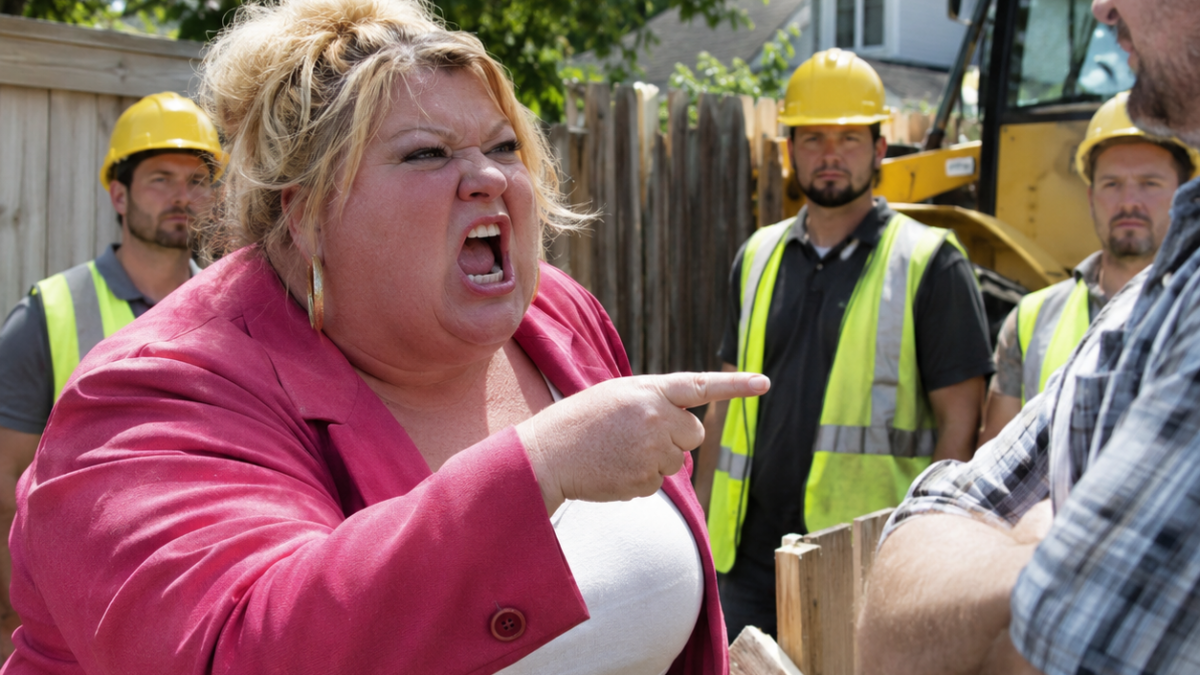
Marlene stood near the middle of the image with both arms thrown outward, mouth open mid-scream.
I stood on my side.
Hands down.
Certified survey tucked under one arm.
Rowan had written beneath the photo:
**THE MOST EXPENSIVE PHOTO 52 COMPANIES EVER PAID FOR.**
I laughed hard enough that Eddie came into my office.
“What?”
I showed him.
He laughed too.
“You keeping that?”
“Yes.”
“Frame it.”
“No.”
“Why not?”
“Too much.”
“You hung a customer complaint from 2017 on the wall.”
“That was funny.”
“This is funnier.”
I saved the photo in the closed case folder.
That was enough.
Then I installed a small sign beside my gate.
**PRIVATE PROPERTY — ACCESS BY WRITTEN PERMISSION ONLY**
No Marlene.
No HOA.
No joke.
No bragging.
I didn’t need to tell the story on the sign.
The fence told enough.
Before reporting to prison, Marlene saw me once outside the courthouse.
No SUV.
No guards.
No clipboard.
No HOA title.
Just her.
She stopped.
I would have kept walking.
She spoke first.
“You ruined everything over a fence.”
I turned.
There are sentences you prepare for months.
That wasn’t one of them.
I answered without thinking.
“No.”
She stared.
“You tore down the fence.”
Her mouth tightened.
“You sold a road that wasn’t yours.”
She looked away.
“You forged permission.”
No response.
“You collected money.”
She started to speak.
I continued.
“You chose everything that happened after.”
She stared at me.
For once, she didn’t have an argument.
I walked away.
That was the last conversation we ever had.
People later asked whether I felt sorry for her.
Maybe that sounds like a simple question.
It isn’t.
I never wanted prison for anyone.
I didn’t wake up hoping to destroy somebody’s life.
I wanted my fence left alone.
That was literally where this began.
If Marlene had looked at my first letter and said:
Fine. We’ll find another route.
None of this happens.
No demolition.
No fifty-two stranded trucks.
No fraud investigation.
No festival collapse.
No civil judgment.
No prison.
She had exit ramps everywhere.
Ask permission.
Accept no.
Reroute.
Tell vendors the truth.
Refund fees.
Stop the excavator.
Stop after the first panel.
Stop when the operator hesitated.
Stop when Keaton warned her.
Stop before hitting the lock.
Stop before lying under oath.
She passed every exit.
That matters.
Because later she described herself as someone whose life had been destroyed by one stubborn property owner.
That isn’t what happened.
Consequences can feel like persecution when you’ve spent years avoiding them.
But the feeling doesn’t make it true.
A year after the festival failure, Autumn Ridge held a much smaller fall event.
Inside its own property.
Local vendors.
Music.
Food.
No $1.2 million projection.
No regional commercial spectacle.
No trucks crossing my land.
One resident invited me.
I declined.
Not out of anger.
I had work.
The following Monday, he came by.
“You missed a good event.”
“Glad to hear it.”
“No traffic problem.”
“That’s amazing.”
He laughed.
“We used land we actually own.”
“Revolutionary.”
“Apparently.”
That conversation made me happier than I expected.
Because that was all I ever wanted.
Use what belongs to you.
Ask before using what belongs to somebody else.
Simple rules.
The funny thing about power is that people often assume it means getting others to do what you want.
Dad taught me something different.
Power is having the ability to say no without needing someone else to agree with you.
When I was younger, he and I repaired that original west boundary together.
Not the exact steel panels Marlene destroyed.
Older ones.
I remember holding a level while Dad set a post.
I said:
“Good enough.”
He said:
“No.”
“It’s straight.”
“It’s almost straight.”
“That is straight.”
He took the level.
Bubble slightly off.
“Almost straight becomes crooked after twenty years.”
I rolled my eyes.
He reset the post.
That memory came back after the case ended.
Marlene lived by almost.
Almost legal.
Almost authorized.
Almost believable.
Almost enough paper.
Almost enough pressure.
Almost enough power.
Dad lived by straight.
Put the line where it belongs.
Set the post correctly.
Get the deed.
Respect the boundary.
Maybe that’s why I never understood Marlene.
She saw a fence and thought obstacle.
I saw a fence and thought line.
Lines matter.
Not because steel is sacred.
Because consent is.
One afternoon, a new employee asked why the western fence had newer steel than the rest.
“Storm?”
“No.”
“Accident?”
“No.”
“What happened?”
“HOA festival.”
He stared.
“Like somebody crashed into it?”
“Something like that.”
Eddie shouted from across the shop:
“Fifty-two trucks!”
I pointed at him.
“Go back to work.”
The kid looked confused.
“Fifty-two trucks hit it?”
“No truck hit it.”
“What happened?”
I sighed.
“You’re going to hear it anyway.”
Eddie yelled:
“Boss beat an HOA with a fence!”
“I did not beat anybody with a fence.”
“You know what I mean.”
That became shop folklore.
The younger workers exaggerated it.
In their version, I rebuilt the entire fence alone.
In three hours.
During a thunderstorm.
While Marlene watched from a helicopter.
I corrected them.
Nobody cared.
Stories become bigger.
Reality was enough for me.
Twelve workers.
Floodlights.
Cold coffee.
Survey markers.
Forklifts.
Steel.
Bolts.
And a deadline.
At 2:30 a.m., I had walked the finished line with a flashlight.
I remember touching one post.
Still warm near the weld.
The shop behind me was exhausted.
Ahead, somewhere on the highway, fifty-two trucks were moving toward a road that didn’t exist.
For a few minutes, I wondered whether I had gone too far.
Not legally.
Emotionally.
What if the vendors blamed me?
What if the town blamed me?
What if hundreds of people did?
Then I looked at Anita’s survey marker.
Property line.
Reality has a calming effect.
That line existed whether people liked it or not.
I didn’t create their problem.
I refused to become their solution without consent.
There’s a difference.
That difference became clearer as the years passed.
Sometimes people asked:
“Why didn’t you just let them use it once?”
Because once wasn’t what Marlene had sold.
She sold control.
She told vendors access was secured.
She filed paperwork claiming authorization.
She modified a permit plan.
She collected $104,000.
If I opened that fence after all of that, I wouldn’t be doing a favor.
I would be helping authenticate her lie.
One truck becomes ten.
One festival becomes annual use.
Temporary gravel becomes permanent road.
Then years later someone points to the history and says:
See?
We’ve always used this.
Not legally.
Maybe not successfully.
But that is how disputes become expensive.
You surrender once because fighting feels rude.
Then your surrender becomes evidence.
Franklin explained that better than anyone.
“Silas,” he told me, “people underestimate how dangerous a false history can become.”
“What do you mean?”
“If enough documents say something happened, later people spend years proving it didn’t.”
“That’s insane.”
“So are most property cases.”
He wasn’t wrong.
Marlene’s plan depended on paper becoming stronger than reality.
Contracts saying access was secured.
Permit maps showing a road.
Vendor payments proving a service.
HOA documents implying consent.
Then she only needed the fence gone.
That was why rebuilding it mattered so much.
Not revenge.
Reality.
Fifty-two truck drivers arrived expecting a road.
They found steel.
Steel doesn’t argue.
It doesn’t get embarrassed.
It doesn’t worry about disappointing vendors.
It just stands where someone put it.
That morning, my fence forced every piece of paper to answer one question:
If Silas agreed, why is his fence here?
Marlene had no good answer.
So she screamed.
Then admitted tearing it down.
Then tried to do it again.
And by doing that, she made the truth impossible to hide.
Years later, one of the vendor drivers came back.
His name was Gary.
Food-service rig.
We barely spoke during the incident.
He stopped at my shop because he was passing through.
“You remember me?”
“Not really.”
“Truck seventeen.”
“That doesn’t help.”
“Refrigerated trailer. I called you an asshole at six in the morning.”
“Oh.”
“Remember now?”
“Little bit.”
He laughed.
“I owed you an apology.”
“You drove three hours for a route somebody promised.”
“Still shouldn’t have blamed you.”
“It was a stressful morning.”
“You were calmer than I deserved.”
“I was tired.”
He walked over to the fence.
“Same one?”
“Replacement.”
“Looks solid.”
“It is.”
He nodded.
“Festival company refunded us eventually.”
“Good.”
He looked at me.
“You know, when we first arrived, every driver thought you had blocked the road overnight just to screw everybody.”
“I know.”
“By noon, nobody thought that.”
“What changed?”
Gary laughed.
“Marlene kept talking.”
That was probably the best summary of the entire case.
Marlene kept talking.
At the demolition.
At the staging lot.
To the board.
To the town.
In emails.
In court.
Every time silence might have saved her, she chose certainty.
She was always certain.
Certain the easement meant more than it did.
Certain the board would support her.
Certain vendors wouldn’t ask.
Certain I would surrender.
Certain the contractor would obey.
Certain the sheriff would force the gate.
Certain homeowners cared more about the festival than truth.
Certain money would cover the mess.
Arrogance isn’t simply believing you are right.
It is believing reality will eventually adjust itself because you are important.
Reality did not adjust.
The property line remained.
One evening, long after the legal cases closed, I walked to the west boundary.
Sunset.
Shop quiet.
Workers gone.
The steel reflected orange light.
I stopped where the excavator had first pulled the post.
There was no visible scar anymore.
New footing.
New panel.
Clean ground.
I thought about Dad.
He died before Autumn Ridge reached its current size.
He would have hated HOA meetings.
He hated meetings in general.
He would have liked Franklin.
Maybe.
He definitely would have liked Anita.
She measured twice.
Dad respected that.
I imagined telling him the story.
“They tore down the entire fence.”
He would have asked:
“Why?”
“Festival.”
Then probably:
“Did you rebuild it?”
“Yes.”
“How long?”
“One night.”
“Twelve men?”
“Yes.”
He would think.
Then:
“Could’ve done it with ten.”
That made me laugh standing there alone.
Dad always believed every job needed fewer people than I did.
I rested my hand on the post.
I used to think property was dirt.
Buildings.
Equipment.
Deeds.
After Marlene, I understood it differently.
Property is the freedom to decide.
Open.
Closed.
Yes.
No.
Those words are ownership.
Marlene didn’t just take steel out of the ground.
She tried to take “no” away from me.
That’s why I rebuilt.
That’s why I stayed awake.
That’s why I called workers.
That’s why I measured every post.
That’s why I refused to park a forklift in the public lane.
I didn’t need revenge.
I needed my “no” standing upright before sunrise.
And it was.
Fifty-two trucks found it.
So did Marlene.
The final financial consequences were ugly.
$142,900 civil judgment in my case.
Separate vendor refund and damage claims.
$104,000 in access fees under scrutiny.
Association costs.
Legal fees.
Audit expenses.
Restitution.
Personal enforcement.
Marlene’s eighteen-month sentence.
People sometimes added every number and said:
“That was an expensive fence.”
No.
The fence cost much less.
Lying was expensive.
Ignoring a property line was expensive.
Selling access you didn’t own was expensive.
Forgery was expensive.
Arrogance was expensive.
The steel was the cheapest part.
The new Autumn Ridge board eventually asked whether I wanted the drainage easement formally clarified in an updated recorded document.
Franklin reviewed it.
The new language made the limited purpose even clearer.
Drainage maintenance only.
No commercial access.
No festival use.
No vehicle route beyond what maintenance required.
I signed the acknowledgement.
Not because the old language was weak.
Because clarity is cheaper than court.
The board president at the time came to my shop.
His name was Daniel.
He looked uncomfortable.
“I want you to know we’re trying to do things differently.”
“Good.”
“We’re not asking you to trust us.”
“Also good.”
“We’re asking you to judge what we actually do.”
I looked at him.
“That’s usually how trust works.”
He smiled.
“Fair.”
He handed me the documents.
Everything proper.
Everything verified.
No fake signatures.
No hidden maps.
No surprises.
I signed where appropriate.
Then Daniel asked:
“Can I ask something unofficial?”
“Sure.”
“Did you really rebuild 126 feet in one night?”
“Yes.”
“Twelve workers?”
“Yes.”
“Why didn’t Marlene know you owned a fence company?”
I laughed.
“She never asked what I did.”
That was maybe the funniest part.
Marlene researched the property.
The easement.
The festival route.
The permits.
The vendor contracts.
My signature.
But not me.
She saw “neighbor.”
“Outsider.”
“One man.”
Obstacle.
She never bothered to learn that my warehouse contained enough steel to rebuild the barrier twice.
Power makes people lazy.
They stop learning about those they plan to push aside.
They assume the title is enough.
Sometimes the person on the other side happens to manufacture fences.
Bad luck.
Or justice.
Depending how you look at it.
I never rebuilt the festival entrance.
Because there had never been a festival entrance.
That language mattered.
Even now, people say:
“The gate where the festival trucks got blocked.”
There wasn’t a gate for them.
There was my boundary.
That was the whole point.
The trucks weren’t locked out of somewhere they had the right to enter.
They arrived at a place they had been falsely promised.
That difference is why I never blamed the drivers.
Or most vendors.
They were victims too.
Some lost a day.
Some lost thousands.
Some had employees sitting in cabs watching the sunrise while lawyers and HOA officials argued.
By noon, many came over.
One driver shook my hand.
“Sorry I yelled earlier.”
“I understand.”
“We were told you took money and changed your mind.”
“I didn’t.”
“I know now.”
Another said:
“They charged us two grand.”
“I just found that out.”
“For your road.”
“I don’t have a road.”
He looked at the fence.
“Yeah. We noticed.”
We both laughed.
Humor comes back after anger runs out.
That was another sign life was becoming normal.
The shop expanded two years later.
We added another fabrication bay.
Funny enough, one of our bigger contracts came from a commercial development outside town.
They needed perimeter security fencing.
Rowan recommended us.
When I called to thank him, he said:
“I figured if anybody knows how to keep trucks out, it’s you.”
“I did not keep trucks out.”
“The fence did.”
“Correct.”
“Still arguing semantics?”
“Still billing for steel.”
He laughed.
Good people can survive bad situations without becoming enemies forever.
That mattered too.
Marlene had tried to turn everything into sides.
HOA versus outsider.
Community versus one man.
Festival versus fence.
Progress versus obstruction.
But reality wasn’t that simple.
Rowan wasn’t my enemy.
Drivers weren’t my enemy.
Residents weren’t automatically my enemy.
Even the demolition workers weren’t all malicious.
Some were contractors who had been lied to.
The problem was specific.
One decision-maker knew she lacked permission.
Then acted anyway.
Keeping that distinction stopped me from becoming bitter toward everyone.
I’m glad.
Anger is useful fuel.
Terrible permanent furniture.
I didn’t want Marlene living in my head after she left Autumn Ridge.
Eventually she didn’t.
The fence stayed.
The story faded.
New people moved into the neighborhood who had no idea what happened.
Some probably wondered why a small PRIVATE PROPERTY sign stood beside such an ordinary stretch of steel.
That was fine.
Not every scar needs a plaque.
One autumn morning, I reached the shop before sunrise.
Cold.
Quiet.
Very much like that festival morning.
I walked outside with coffee.
Fog sat low over the ground.
For a second, headlights appeared beyond the trees.
My body tensed automatically.
Old memory.
Then a delivery truck turned toward the main shop entrance.
Our delivery.
Scheduled.
Authorized.
The driver waved.
I opened the correct gate.
He drove through.
Simple.
I laughed at myself.
There had been a time when diesel engines before sunrise meant trouble.
Now it meant steel arriving.
Life restores ordinary meanings if you give it enough time.
That same morning, I found Rowan’s photograph again while looking for an old invoice.
Fifty-two trucks.
Marlene screaming.
Me standing behind the fence.
I stared at it.
“The most expensive photo 52 companies ever paid for.”
I still liked the line.
But I noticed something new.
In the photo, the fence looked almost insignificant.
A thin line of steel compared to all those huge trucks.
That was the strange part.
The smallest thing in the picture controlled everything.
Not because it was physically stronger than fifty-two trucks.
Because it represented a boundary backed by law.
That is what Marlene never understood.
She thought power was numbers.
420 homes.
52 trucks.
$1.2 million festival.
$600,000 in contracts.
$104,000 access fees.
Big numbers.
I had one survey.
One property line.
One word.
No.
And no was enough.
I closed the folder.
Went outside.
Eddie was loading panels.
“Boss.”
“Yeah?”
“You remember that HOA woman?”
“Unfortunately.”
“We got an order from Autumn Ridge.”
I turned.
“What?”
“New maintenance fence around a drainage area.”
I stared.
He smiled.
“Legal property.”
“Written authorization?”
“Yep.”
“Verified?”
“Yep.”
“Deposit?”
“Paid.”
I laughed.
“Build it.”
There was something beautifully ridiculous about that.
Years after Marlene tried to misuse a drainage easement to destroy my fence, Autumn Ridge hired my company to build a lawful fence around actual drainage infrastructure.
Paperwork correct.
Permission correct.
Property correct.
That is how adults do business.
No excavator at dawn.
No forged signatures.
No fifty-two stranded trucks.
No arrests.
Just a contract.
The crew completed it in three days.
Daniel from the HOA inspected the work.
“Looks good.”
“It’s straight.”
“I assumed.”
“Never assume.”
He smiled.
“I think this neighborhood learned that lesson.”
Maybe.
Communities forget.
People change.
New boards make new mistakes.
But systems can improve.
That is why the audit mattered.
Rules mattered.
Two signatures.
Outside verification.
Conflict disclosures.
Those things sound boring.
Boring is good.
Boring paperwork would have prevented the entire disaster.
Marlene hated anything that slowed her down.
That was part of the problem.
She called caution obstruction.
Questions disloyalty.
Consent inconvenience.
Boundaries selfishness.
Once you rename everything that restrains you, abuse becomes easy.
I learned that too.
The last time I ever thought seriously about Marlene was maybe three years after the festival.
A local reporter called.
She was writing something about HOA governance disputes.
“Would you describe what happened as revenge?”
“No.”
“Why not?”
“Because I rebuilt my fence.”
“But the result was dramatic.”
“That wasn’t the goal.”
“Fifty-two trucks stranded?”
“They were routed incorrectly.”
“Her arrest?”
“She damaged the lock in front of deputies.”
“Her prison sentence?”
“Fraud investigation.”
“So what was your goal?”
I looked through my office window.
“Put my fence back.”
The reporter paused.
“That’s it?”
“That’s it.”
Maybe she was disappointed.
People want bigger motives.
Justice.
Revenge.
Humiliation.
Victory.
Sometimes the most powerful motive is ordinary.
Leave my property alone.
Marlene could never understand that because she believed every conflict was about influence.
For me, it was about home.
Work.
Boundaries.
My father bought those acres when there was almost nothing west of town.
He spent his life there.
I spent mine there.
Every steel rack, every welding table, every scar on the shop floor had a history.
Marlene looked at the western strip and saw a shortcut.
I looked at it and saw part of the life my family built.
That difference is why compromise never happened.
You can negotiate price.
Schedule.
Temporary access.
Conditions.
But consent has to come before all of those.
She skipped the first step.
Everything after became theft wearing paperwork.
If she had asked honestly before signing vendor contracts, maybe I would have considered something.
Maybe not.
We’ll never know.
She never gave me that choice.
That was the violation.
Not just steel.
Choice.
Years later, I replaced one old camera.
The installer asked why I wanted three angles covering the western boundary.
“History.”
“Break-ins?”
“Something like that.”
He adjusted the lens.
“You get much trouble from the subdivision?”
“Not anymore.”
“Good neighbors?”
“Mostly.”
“HOA?”
“Yes.”
He made a face.
I laughed.
“They’re fine now.”
That surprised him.
Maybe it would surprise people who only heard the dramatic version.
But I wasn’t interested in spending the rest of my life at war.
The best ending to a property fight is not eternal conflict.
It is eventually needing no fight at all.
Autumn Ridge stayed on its land.
I stayed on mine.
We occasionally did business.
Residents bought gates from my shop.
I attended one charity fundraiser at their clubhouse years later.
Nobody mentioned Marlene.
That was progress.
When people stop organizing their lives around the person who caused chaos, that person finally loses power.
Marlene once wanted the festival to become the crown jewel of her presidency.
Instead, everyone remembered one photograph.
Fifty-two trucks.
One steel fence.
One angry woman.
The irony was that the picture didn’t make me feel powerful.
It made the fence look powerful.
Maybe that was appropriate.
A good boundary doesn’t shout.
It stands.
People decide whether to respect it.
Marlene didn’t.
And eventually she learned that ignoring a boundary does not erase it.
It only makes the consequences louder.
On the anniversary of that morning, Eddie jokingly asked whether we should have a “fence day.”
“No.”
“Discount panels?”
“No.”
“Festival?”
I looked at him.
He grinned.
“Too soon?”
“It’s been years.”
“So not too soon.”
“No festival.”
“What about fifty-two food trucks?”
“Get out.”
He laughed all the way back into the shop.
I smiled.
I was finally able to joke without feeling the old tension in my chest.
That was another kind of recovery.
The civil judgment had been money.
The criminal sentence had been accountability.
The fence standing had been property restored.
But healing was being able to hear the word festival without immediately seeing an excavator.
That took longer.
The last physical reminder of the demolition was one bent section we had salvaged.
For years it sat behind the warehouse.
Nobody wanted to scrap it because everyone knew what it was.
One afternoon, I told Eddie:
“Cut that up.”
He looked shocked.
“The Marlene panel?”
“That’s not its name.”
“We should keep it.”
“Why?”
“History.”
I considered it.
Then shook my head.
“No.”
We cut it.
Recycled the steel.
Used the value toward new material.
That felt right.
Not every artifact deserves preservation.
Some things are more useful turned into something else.
A few months later, one of our apprentices built a custom farm gate using steel from the scrap batch.
I don’t know whether any part came from that panel.
Maybe.
I liked the idea.
Something once bent by an excavator became part of another farmer’s gate.
That is better than a museum.
I learned a lot from Marlene.
None of it was what she intended to teach.
I learned that documentation can be more powerful than anger.
That saying no early matters.
That a certified letter can save months of confusion.
That contractors should verify authority.
That boards should question urgency.
That vendors should confirm private access.
That government seals shouldn’t be treated like decoration.
That one fake signature can unravel a million-dollar event.
That people who depend on pressure hate written records.
That if someone refuses to put a demand in writing, you should wonder why.
And I learned that rebuilding something can be more devastating to a bully than destroying something of theirs.
I never touched Marlene’s property.
Never sabotaged the festival grounds.
Never blocked a public road.
Never damaged a truck.
Never threatened a vendor.
Never interfered with emergency access.
I restored my own fence.
That was enough.
She did the rest.
She ordered demolition.
Sold access.
Filed false papers.
Collected money.
Ignored warnings.
Damaged the rebuilt lock in front of deputies.
Every escalation was hers.
That is why I slept at night.
Revenge that requires becoming the same kind of person as your opponent isn’t victory.
It is infection.
I wanted my property intact and the truth documented.
I got both.
The consequences belonged to her.
One evening, I stood at the west gate while the sun dropped behind Autumn Ridge.
The subdivision looked peaceful.
Kids riding bikes.
A dog barking somewhere.
Someone grilling.
Nothing about the scene suggested the chaos that had once happened there.
That was good.
I touched the lock.
No damage.
Camera blinking.
Fence line straight.
I thought about Marlene’s last accusation.
“You ruined everything over a fence.”
She still didn’t understand.
It was never over a fence.
The fence was steel.
Replaceable.
I had replaced it in one night.
What she tried to destroy was the idea that my permission mattered.
That was not replaceable so easily.
Once you let someone decide your “no” is irrelevant because their project is larger, richer, or more popular, you teach them to do it again.
So I did not regret rebuilding.
Not one post.
Not one bolt.
Not one hour under the floodlights.
Even knowing the vendors would arrive.
Especially knowing they would arrive.
Because reality needed to be visible before her paperwork became permanent.
Fifty-two trucks made it visible.
The image became famous locally.
But the most important part of the picture wasn’t the trucks.
Wasn’t Marlene.
Wasn’t me.
It was the line.
Steel panels running across the frame.
My side.
Their side.
A boundary.
That is what the entire story came down to.
Years after the case closed, I pulled into the shop early one autumn morning.
5:40.
Almost exactly the same time those trucks had arrived.
I parked.
The western sky was starting to brighten.
Fog hung low.
I walked to the fence.
No engines.
No shouting.
No white SUV.
I unlocked the small gate and stepped through to inspect the drainage edge.
The easement still existed.
Of course it did.
Legal documents don’t disappear because somebody abused them.
A town maintenance crew had been there the week before.
They had emailed first.
Provided identification.
Explained the work.
Scheduled access.
I had opened the gate.
No argument.
That was the proof that Marlene had always been wrong.
I was never against access.
I was against theft.
There is a difference.
I looked toward the spot where the orange festival sign had once stood.
Grass.
Nothing else.
I remembered pulling that first sign out of the ground and setting it back on HOA property.
That had been my first no.
A quiet one.
Marlene could have respected it.
Then came the certified letter.
Second no.
She ignored it.
Then the conversation at the fence.
Third no.
She laughed.
Then the demolition morning.
Final no.
She ordered the excavator anyway.
People sometimes say:
“Why didn’t she stop?”
Because stopping would require admitting someone else had authority over something she wanted.
For certain people, that feels unbearable.
They would rather double down than hear no.
That is how small disputes become criminal cases.
I closed the gate.
Locked it.
The click echoed softly.
I smiled.
Not because I had beaten anyone.
Because the sound was boring.
Just a lock working.
Just a fence standing.
Just a man on his own land.
That is what I fought to get back.
Marlene wanted one road for fifty-two trucks.
She wanted it badly enough to tear down 126 feet of somebody else’s fence.
She wanted it badly enough to sell access she didn’t own.
She wanted it badly enough to hide my refusal from vendors.
She wanted it badly enough to put my signature on paperwork I never signed.
She wanted it badly enough to collect $104,000 behind that lie.
And eventually, she wanted it badly enough to swing a steel bar at my lock while a sheriff’s investigator told her to stop.
People said I destroyed her festival.
No.
Her festival failed because it depended on a road she never had.
People said I cost her the presidency.
No.
Her own board removed her after seeing what she had concealed.
People said I cost her $142,900.
No.
A court calculated the damage caused by her choices.
People said I sent her to prison.
No.
Fraud and forgery evidence went to prosecutors, and the court handled the rest.
I rebuilt a fence.
That was my part.
One hundred twenty-six feet.
Twelve workers.
One night.
Exactly where it had stood for twenty years.
When sunrise came, Marlene found fifty-two trucks waiting for a road she had sold but never owned.
And all I had to do was stand on my side of the steel and let the truth arrive.
In the end, the fence stayed.
The festival disappeared.
The money trail surfaced.
The fake authorization collapsed.
The HOA replaced its leadership.
The vendors got their claims.
Autumn Ridge learned to verify contracts before promising land.
My shop kept working.
And I stopped waking up angry.
That last one mattered more than anything.
Before going inside that morning, I read the small sign beside the gate.
**PRIVATE PROPERTY — ACCESS BY WRITTEN PERMISSION ONLY**
Simple.
No names.
No insults.
No warning about Marlene.
No story.
It didn’t need one.
The line had already been tested.
And it had held.
I put the key back in my pocket.
Behind me, the first workers were arriving at the shop.
Metal doors rolled open.
A forklift started.
Someone turned on the radio.
Another ordinary workday.
Exactly what I wanted.
Marlene Prescott once believed a festival worth more than a million dollars mattered more than one man’s fence.
She learned too late that money does not make somebody else’s property yours.
A title does not make consent optional.
A crowd does not change a deed.
And fifty-two trucks do not create a road simply because someone printed one on a map.
She tore down my fence because she believed I would be too intimidated to put it back.
She was wrong.
I rebuilt it before sunrise.
And when those trucks arrived, the steel was waiting.
So was the truth.
And unlike her festival, neither one needed her permission to stand.








