PART 2: HOA KAREN Took Over My Garage While I Was Away — So I Secured It and Let Her Explain Everything Inside
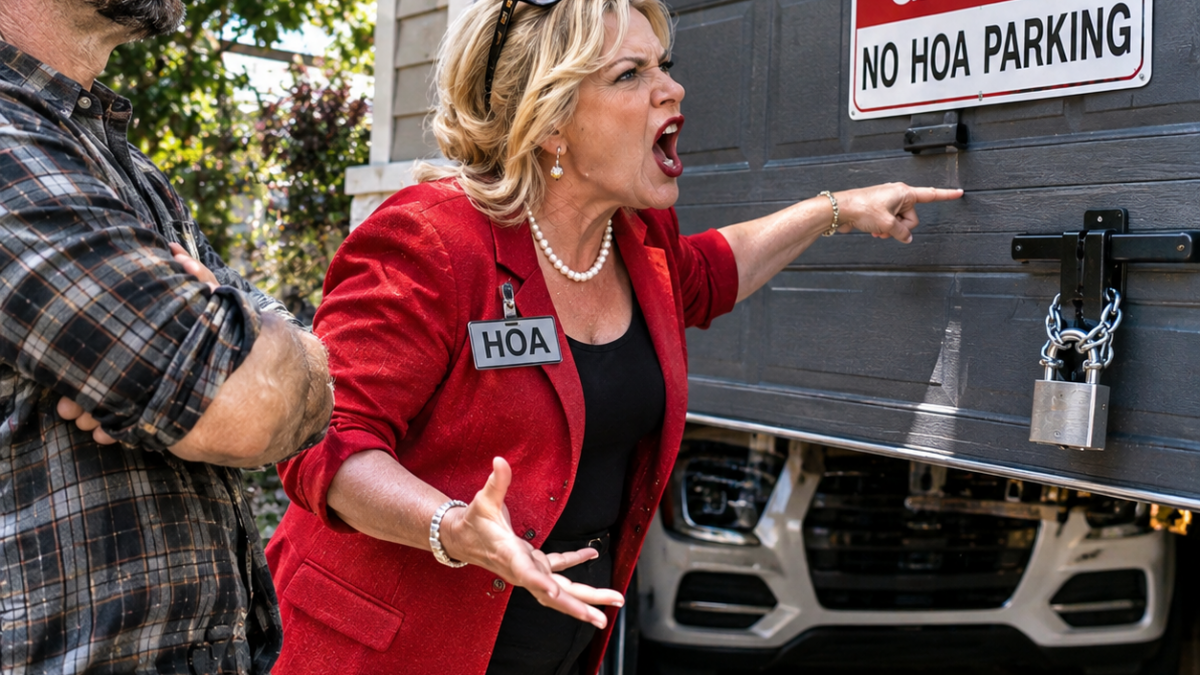
PART 2
I replayed the clip.
Once.
Twice.
Then frame by frame.
Bethany stood just outside the garage.
Khaki slacks.
HOA polo.
Phone in one hand.
Small black device in the other.
She held it near the exterior keypad.
Looked at the garage.
Pressed something.
Then wrote on her clipboard.
At the time I had assumed she was taking another photograph for some ridiculous server-equipment complaint.
Now it looked different.
I called Marcus Levin.
Marcus had been my friend since college and practiced property law in Richmond.
He answered on the fourth ring.
“This better be good.”
“I think my HOA president cloned my garage access.”
Silence.
“That is good.”
“I mean bad.”
“I know what you mean. Start over.”
I told him everything.
The emergency-access provision.
The Mercedes.
The meetings.
The footage.
Then the device.
Marcus interrupted.
“Do not call it a frequency scanner unless you can prove that.”
“Fair.”
“Do you have the original video?”
“Yes.”
“Metadata?”
“Yes.”
“Cloud backup?”
“Yes.”
“Good. Preserve it.”
“I already did.”
“Of course you did.”
I heard papers moving.
“Now tell me exactly what the HOA documents say about emergency entry.”
I read the provision.
Marcus whistled.
“That does not authorize this.”
“Thought so.”
“Actual emergency. Limited entry. Notification. That’s what the clause contemplates.”
“She says extended absence is a safety concern.”
“She can say the moon is a retention pond. Doesn’t make it so.”
I leaned back in the hotel chair.
“What do I do?”
“First, you send written notice.”
“I already told her by phone.”
“Phone conversations become memories. Emails become exhibits.”
That sounded like something I would tell a cybersecurity client.
So I wrote.
**Bethany,**
**You do not have permission to enter, park in, store property in, conduct meetings in, or otherwise use my garage. No emergency currently exists. Any further access is unauthorized. Please remove all personal property immediately and confirm in writing that the garage will not be entered again without an actual emergency as defined in the governing documents.**
Marcus reviewed it.
I sent it.
Copied the property-management company.
Copied the HOA board.
Saved the message.
Bethany replied thirty-seven minutes later.
Three paragraphs.
The first accused me of misunderstanding the association’s responsibilities.
The second claimed the HOA had a duty to protect unoccupied homes.
The third said:
**Your continued refusal to cooperate may result in additional enforcement action.**
Marcus called.
“She put that in writing?”
“Yep.”
“I almost like her.”
“You don’t have to live near her.”
“True.”
The following morning, at exactly 8:04, my motion alert went off.
White Mercedes.
Garage door.
Bethany drove in again.
After receiving the written notice.
I watched from a conference room in Virginia while she parked inside my house like my email had never existed.
That changed something in me.
Not because she had entered again.
Because now I knew she understood I objected.
The ambiguity was gone.
I sent Marcus the footage.
His reply was two words:
**Keep documenting.**
I hated that answer.
“What about calling police?”
“You can.”
“Should I?”
“You’re four hundred miles away. The car may be gone before an officer arrives. You’ll have a he-said-she-said property-access dispute wrapped in HOA documents.”
“So I let her keep doing it?”
“I didn’t say that.”
“What are you saying?”
“I’m saying decide what outcome you want.”
I looked at the screen.
Bethany had opened my mini fridge.
She took out one of my bottled waters.
“My garage back.”
“Then build the record to get your garage back without giving her a counterclaim.”
That was harder than revenge.
Revenge is immediate.
Strategy makes you sit still while your pulse tells you to move.
I called Jake.
Jake lived directly across the street.
Thirty-nine.
IT sales.
Two kids.
One Ring camera aimed almost perfectly at my driveway.
“Need a favor.”
“Does it involve HOA espionage?”
“Technically no.”
“So yes.”
“Save any footage showing people entering my garage.”
“Already doing it.”
I laughed.
“Why?”
“Because this is the most interesting thing that’s happened here since the raccoon got into the pool house.”
Then I called Mrs. Patterson.
She was eighty.
Widowed.
Sharp enough to make most attorneys nervous.
“Garrett?”
“Mrs. Patterson, have you noticed people going into my garage?”
“Oh, honey.”
That tone told me everything.
“How many?”
“Yesterday?”
“Yesterday?”
“Seven.”
I closed my eyes.
“Seven people?”
“Three ladies in the morning. Bethany’s husband around lunch. Two teenagers after school. And that young man who always wears those terrible loafers.”
“I don’t know him.”
“Neither do I.”
She lowered her voice.
“She’s telling people it’s community overflow space.”
“What?”
“That’s what she told the Rodriguez girl.”
I sat straight.
“Did you hear her say it?”
“Yes.”
“Would you write down what you heard?”
“I can do better.”
“What?”
“I recorded it.”
I should have known.
Mrs. Patterson used her phone the way other retirees used binoculars.
She texted the video.
Bethany stood in my driveway with three residents.
I turned up the audio.
“This garage is currently being managed under the HOA’s extended-absence policy.”
One woman asked:
“So Garrett agreed?”
Bethany smiled.
“The association has authority to maintain underutilized spaces when there’s a community need.”
I paused the video.
Underutilized spaces.
My garage.
My Harley.
My tools.
My computers.
Underutilized.
I sent it to Marcus.
He called five minutes later.
“That’s useful.”
“I’m developing an allergy to that word.”
“You should be happy.”
“I’m watching strangers walk through my house.”
“Garage.”
“Attached garage.”
“Fair.”
He became serious.
“Have they entered the interior living space?”
I checked all cameras.
“No.”
“Good.”
“Why good?”
“Because we want clean facts. Unauthorized garage use is enough.”
Over the next week, Bethany expanded.
Morning coffee.
Board meetings.
Her husband grilling on my driveway.
A couple of neighborhood kids doing homework at my workbench.
Folding chairs.
Wine glasses.
Trash in my utility sink.
My tools moved.
Nothing major stolen that I could identify, but sockets were in the wrong drawers.
A torque wrench was left on the floor.
Someone had draped a sweater over my motorcycle.
I stopped watching continuously.
It was making me too angry.
Instead, I created an evidence schedule.
Automated clip preservation.
Motion event export.
Vehicle entry timestamps.
Audio indexing.
Access records.
The same habits I used professionally.
Date.
Time.
Actor.
Action.
Supporting file.
No adjectives.
No “crazy.”
No “criminal.”
Just facts.
Marcus loved it.
“You missed your calling.”
“I have a calling.”
“You’d make a terrifying paralegal.”
Then money entered the story.
Jake sent a photo.
A printed sign on a plastic stand outside my garage.
**EXECUTIVE PARKING — $50/MONTH
CONTACT B. MORGENSTERN**
I stared at it.
Then called him.
“Is that real?”
“I watched her set it out.”
“Please take another picture with the whole driveway visible.”
“You’re scary when you get professional.”
“Thank you.”
Mrs. Patterson confirmed Bethany had offered parking access to two residents.
One of them, a woman named Elise Harper, contacted me herself.
“Mr. Dylan?”
“Yes?”
“I think I owe you an apology.”
“For what?”
“I paid Bethany fifty dollars.”
My grip tightened around the phone.
“For my garage?”
“She said it was HOA-managed executive parking during your extended travel.”
“Did she give you anything in writing?”
“PayPal receipt.”
“Can you send it to me?”
Pause.
“Am I in trouble?”
“No.”
“Are you sure?”
“Yes. I’m interested in the person who sold access, not the person who believed the HOA president.”
That mattered.
Elise emailed the receipt.
Recipient:
Bethany’s personal account.
Memo:
**Premium garage parking — July**
Marcus called the next morning.
“Now we have conversion for profit.”
“In English.”
“She is using property she doesn’t own to make money after being told to stop.”
“That sounds bad.”
“It’s considerably worse than borrowing a parking spot.”
I asked:
“Police now?”
“Soon.”
“Why not now?”
“Because I want the management company’s position in writing first.”
So we wrote them.
Willowbrook used a professional management firm called Westbridge Community Management.
I sent the HOA governing documents, my written revocation of permission that had never existed in the first place, screenshots, and the parking receipt.
I asked one question:
**Does Westbridge contend that the emergency-access provision authorizes the HOA president to use a homeowner’s private garage for personal parking, meetings, storage, or paid third-party parking during an owner’s absence?**
They responded the same day.
**No.**
Then:
**Westbridge did not authorize such use and is requesting an immediate explanation from the board.**
There it was.
Bethany’s shield disappeared.
She could no longer claim property management approved it.
She entered my garage again the next morning.
That was when Marcus told me to contact local police.
I called the non-emergency line from Virginia.
Explained that I owned the property.
Was temporarily away for work.
Had repeatedly revoked any access.
Had video.
Had written confirmation from property management that the conduct was not authorized.
A patrol supervisor took the information.
An officer went to the house.
Bethany wasn’t there when he arrived.
He documented the report.
No arrest.
No dramatic showdown.
Exactly what Marcus expected.
“What good did that do?” I asked.
“It created an independent record.”
Again.
Records.
Everything became records.
Bethany responded by sending an HOA notice accusing me of “interfering with lawful community administration.”
Fine:
Two hundred fifty dollars.
I laughed when I saw it.
Marcus didn’t.
“That’s retaliation.”
“Can we fight it?”
“We will.”
The board itself was getting uncomfortable.
Not all of them knew what Bethany had been doing.
A board member named Daniel Cho emailed me privately.
**Garrett, I need to ask whether Bethany told you the board approved use of your garage.**
I answered:
**Yes. She has repeatedly characterized her activity as HOA-authorized.**
He replied:
**I never voted on that.**
That was the first crack.
Then another board member contacted Marcus.
Then another.
Bethany had apparently been describing the garage arrangement to them as temporary emergency monitoring.
She had never disclosed the paid parking.
She had never told them about the daily personal parking.
She had never told them about meetings.
And she definitely had not told them that I had sent written notice revoking access.
Marcus said:
“She’s been relying on the title more than the board.”
“What does that mean?”
“It means people hear ‘HOA president’ and assume the association must have decided something.”
“Even the directors?”
“Especially lazy directors.”
By week three, Bethany stopped using the garage only for parking.
A contractor appeared.
I got the motion alert during lunch.
Two men carried shelving inside.
Then a mini refrigerator.
Then boxes.
I immediately called Jake.
“What’s happening?”
“She’s renovating.”
“No.”
“I’m literally looking at a guy with a drill.”
I opened the cameras.
Shelves were being mounted to one wall.
Not structural.
Still mine.
Then someone moved one of my cabinets.
I called the police again.
Because I had an existing report, the response was faster.
An officer arrived.
The contractor stopped working.
Bethany showed up ten minutes later.
I listened through the camera microphone.
“This is authorized maintenance.”
The officer asked:
“By the homeowner?”
“The association has authority.”
“Do you have written authorization?”
“I have the governing documents.”
“From the homeowner?”
Silence.
Then:
“He’s being difficult because of an unrelated dispute.”
The officer called me.
“Mr. Dylan?”
“Yes.”
“Did you authorize these contractors?”
“No.”
“Do you want them inside?”
“No.”
“Okay.”
He made them leave.
For the first time, Bethany lost a confrontation while I was watching.
She stood in my driveway after the patrol car left.
Hands on hips.
Staring at my camera.
Then she stepped closer.
Looked directly into the lens.
And smiled.
Not a nice smile.
A warning.
She knew I was watching.
I saved the clip.
That night, the camera feed went dark.
Every camera inside the garage.
Offline.
My heart started hammering.
I checked network logs.
The external camera still worked.
Internet to the house was active.
Someone had physically disconnected the garage network switch.
I called Jake.
He crossed the street.
From outside, he could see the garage door closed.
White Mercedes inside according to the vehicle event log.
I called police.
They inspected.
Bethany answered when they contacted her.
She denied touching anything.
The officer could not force entry into my house based only on my remote suspicion.
I understood.
But I didn’t sleep.
At 2:17 the next morning, my backup cellular sensor came online.
That system had its own battery and connection.
I had installed it years earlier for power failures.
Movement.
Then another alert.
The garage opened.
Bethany drove out.
The main cameras returned twenty minutes later.
Someone reconnected the switch.
That was when this stopped being a neighborhood argument in my mind.
She had interfered with my security system.
Marcus agreed.
“Come home.”
“I have three weeks left.”
“Come home for a day.”
“I can’t walk off the contract.”
“Weekend?”
I checked my schedule.
“I can drive overnight Friday.”
“Good.”
“Then what?”
“We secure your property properly.”
That sentence gave me the first feeling of relief I’d had in weeks.
I drove home at three Saturday morning.
No announcement.
No social post.
No confrontation.
Just me, my truck, two tool cases, and a commercial access-control package I had purchased on Marcus’s recommendation.
The source story would make this part sound like I built a trap.
I didn’t.
I built a lock.
There is a difference.
I owned the garage.
I had repeatedly ordered Bethany out.
Police had documented the dispute.
Property management had denied her claimed authority.
My attorney had sent formal notice.
Now I was replacing every access method she might possess.
New receiver.
New rolling-code remotes.
New exterior keypad.
Physical deadbolt on the service door.
Tamper sensor.
Battery backup.
Cellular alert.
I did not install anything capable of trapping a person.
I programmed the system so the door would never remotely lock if interior motion indicated a person remained inside.
Marcus had insisted on that.
“So nobody can claim you imprisoned them.”
“Agreed.”
“What about her Mercedes?”
“What about it?”
“If she parks inside and leaves the garage on foot?”
I smiled for the first time.
“That’s different.”
Marcus was quiet.
Then:
“Do not move it.”
“I won’t.”
“Do not damage it.”
“I won’t.”
“Do not block a person inside.”
“I won’t.”
“Do not send me messages using phrases like ‘perfect trap.’”
“Fine.”
“Garrett.”
“Fine.”
By five-thirty, the new system was running.
I tested it.
Then restored the garage to exactly how it had been when I arrived.
I did not remove Bethany’s shelving.
Did not touch the mini fridge.
Did not disturb papers she had left on a small folding table.
I photographed everything.
Then I drove back to Virginia.
Sunday quiet.
Monday, 8:02 a.m.
Bethany arrived.
The new receiver ignored her old cloned or master remote.
The garage did not open.
She tried three times.
Walked to the keypad.
Code rejected.
She called somebody.
Then she disappeared out of frame.
Ten minutes later, Westbridge management called me.
“Mr. Dylan?”
“Yes.”
“This is Karen Hsu with Westbridge.”
“Morning.”
“Ms. Morgenstern says your garage access has malfunctioned.”
“It hasn’t.”
Pause.
“She says an HOA emergency access credential no longer works.”
“That’s correct.”
“Did you intentionally revoke it?”
“Yes.”
“We need to discuss—”
“I own the garage.”
“Yes.”
“I’ve reported unauthorized entry to police.”
“Yes.”
“Your company stated in writing that the HOA has no authority to use the garage for parking, meetings, storage, or paid access.”
Another pause.
“That is correct.”
“So why does Bethany need access?”
Karen exhaled.
“She claims HOA records are inside.”
“Then her attorney can coordinate retrieval with mine.”
That ended it.
Bethany did not enter Monday.
Or Tuesday.
Wednesday, she arrived with a locksmith.
I watched from Virginia.
The locksmith examined the door.
Then made a phone call.
He left without touching it.
Later I learned he had asked for proof that Bethany owned the property.
She couldn’t provide it.
Thursday, she parked the Mercedes in my driveway instead.
HOA parking rules prohibited overnight driveway parking for certain oversized vehicles.
I almost laughed myself sick.
Then Friday she found another way.
At 7:44 a.m., I received an interior motion alert.
My stomach dropped.
The new garage door had not opened.
Service door sensor had not opened.
How?
I pulled the camera.
Bethany emerged from the interior door connecting the garage to the house.
I stared at the screen.
Then I understood.
Master house key.
The builder must have provided one along with garage access years earlier.
My alarm showed no forced entry.
She had unlocked my house.
Walked through my living room.
Entered the garage.
I called police immediately.
This time I did not have to explain much.
Existing reports.
Written revocation.
Security upgrade.
New unauthorized entry through the residence itself.
Officer Rodriguez called twenty minutes later.
“Mr. Dylan, are you authorizing Ms. Morgenstern to be in your residence?”
“No.”
“Did you provide her a key?”
“No.”
“She says the association has emergency access.”
“There is no emergency.”
“Understood.”
Rodriguez removed her from the property.
He asked whether I wanted the incident documented as trespass.
“Yes.”
That was the first moment Bethany seemed to understand this might become more serious than an HOA dispute.
She stopped entering for three days.
Then the white Mercedes returned.
Tuesday morning.
But she didn’t try to use my garage opener.
Instead, I watched a tow truck bring the Mercedes onto my driveway.
The driver lowered it.
Bethany spoke to him.
Then she opened my garage manually using a key she still had to the side entry—apparently one the responding officer had not recovered because nobody knew it existed.
She drove the Mercedes inside.
Then left on foot.
I called Marcus.
“She left the car.”
“Inside?”
“Yes.”
“Is she inside?”
“No.”
“Anyone inside?”
“No.”
“Confirm.”
I checked all motion sensors.
Cameras.
Thermal occupancy sensor.
Empty.
Marcus said:
“Secure your property.”
I pressed the lock command.
The garage door deadbolt engaged.
Service door lock engaged.
Interior door already secured remotely.
The Mercedes sat in the middle of my garage.
Bethany stood on the sidewalk.
She tried the keypad.
Nothing.
She tried the remote.
Nothing.
Then she realized the car was inside and she was outside.
My phone rang.
Bethany.
I let it go to voicemail.
Again.
Again.
Then a message:
**OPEN THE GARAGE.**
Another:
**YOU ARE ILLEGALLY HOLDING MY VEHICLE.**
I forwarded them to Marcus.
He wrote:
**Do not respond until I call.**
Five minutes later:
“Okay. Here’s what you send.”
We wrote one sentence.
**Any retrieval of property left inside my garage after repeated written notice prohibiting access must be coordinated through counsel and law enforcement.**
Send.
Bethany called police.
I watched a patrol car arrive.
Same Officer Rodriguez.
He spoke to her.
Then called me.
“Mr. Dylan, Ms. Morgenstern says her vehicle is locked in your garage.”
“That’s correct.”
“How did it get inside?”
“She entered without permission and left it there.”
“Do you have footage?”
“Yes.”
“Can you send it?”
“Yes.”
He gave me an evidence email.
I uploaded the clip.
He called back.
“She’s requesting immediate access.”
“I’m willing to coordinate access with you present.”
“Today?”
“I’m in Virginia.”
That part mattered.
I had not driven home and locked her car in to torment her.
I was at work.
Hundreds of miles away.
“Do you have anyone local who can open it?”
“Not who I’m authorizing without my attorney.”
He paused.
“That may become a civil issue regarding the vehicle.”
“I understand.”
“Are you refusing permanent return?”
“No. I’m preserving my property and evidence. I’ll cooperate with a supervised retrieval.”
That was the legally boring answer Marcus had drilled into me.
Officer Rodriguez accepted it.
Bethany did not.
Her voicemail was six minutes long.
She called me petty.
Vindictive.
Unstable.
Accused me of stealing her Mercedes.
Then she said something strange.
“You have no idea what you’ve interfered with.”
I listened twice.
Sent it to Marcus.
“What does that mean?”
“No idea.”
The answer arrived two days later.
Not from Bethany.
From a repossession company.
A man named Cole Weaver called.
“Mr. Dylan?”
“Yes.”
“I’m trying to locate a vehicle believed to be stored at your address.”
I looked at the security feed.
White Mercedes.
“What vehicle?”
He gave the VIN.
It matched.
“Why?”
“I represent the lienholder.”
I sat back.
“How long have you been looking for it?”
“About three months.”
I closed my eyes.
There it was.
The reason she had been so determined to keep that Mercedes inside garages.
Not just mine.
She wasn’t protecting the neighborhood.
She was hiding the car.
Cole continued.
“We’ve had multiple unsuccessful location attempts.”
“Do you have lawful repossession authority?”
“Yes.”
“Send documentation to my attorney.”
He did.
Marcus verified it.
The lienholder had a valid right to repossess the vehicle.
The balance was significant.
Not eight thousand dollars exactly, as neighborhood gossip later claimed, but enough that the lender had assigned recovery.
That changed the garage dispute again.
Bethany’s vehicle was not merely sitting inside my property.
It was a vehicle she had apparently been moving into private garages while avoiding repossession.
We could not prove that was why she entered mine initially.
So we didn’t say it.
But the pattern mattered.
Cole coordinated with police and Marcus.
The following Monday, I remotely opened the garage while Officer Rodriguez and a recovery agent stood in the driveway.
The Mercedes came out.
Bethany watched from across the street.
She did not own it free and clear anymore.
It disappeared on a flatbed.
Mrs. Patterson called me.
“Garrett.”
“Yes?”
“They took her car.”
“I know.”
“She cried.”
That took the satisfaction out of it.
“Mrs. Patterson.”
“Yes?”
“Don’t celebrate that.”
Silence.
Then:
“You’re right.”
Bethany had done terrible things.
But I didn’t need to enjoy every consequence.
The garage remained locked.
I still had nearly two weeks left on contract.
And that was when the strangest part of the whole story happened.
Bethany stopped trying to enter.
But people kept showing up.
Wednesday morning:
A young consultant carrying a laptop.
Thursday:
A woman with two boxes.
Friday:
A man in a sport coat who stood outside for ten minutes making phone calls.
Each one expected access.
Jake talked to the consultant.
Then texted me.
**Dude. She rented your garage out as office space.**
I thought he was joking.
He sent a photo.
Printed brochure.
**WILLOWBROOK EXECUTIVE WORKSPACE
CLIMATE CONTROLLED
SECURE PARKING
PRIVATE MEETING AREA**
Address:
Mine.
I called Marcus.
Silence.
Then:
“Send me that immediately.”
The woman with the boxes turned out to have paid a $500 deposit.
The man in the sport coat had paid first month’s rent for a desk he had never seen.
Bethany had begun transforming the garage from unauthorized HOA space into something she was actually marketing.
We found an online listing.
Not “Willowbrook Executive Suites” on every platform in America.
The source story exaggerates wildly there.
But the local listing was real enough.
Photos of my garage.
The shelves.
Mini fridge.
Worktable.
Text describing a “premium shared professional workspace managed for Willowbrook residents.”
Contact:
B. Morgenstern.
That was the point Marcus stopped sounding amused.
“This is fraud.”
“Definitely?”
“She is accepting money from people for occupancy rights she does not possess.”
“What do we do?”
“You let police and the Commonwealth’s Attorney decide what charges fit. We do not write their case for them.”
That was Marcus’s constant correction.
Facts first.
Labels later.
We gathered three people willing to provide receipts.
Elise, who paid for parking.
Tara Nguyen, who paid the office deposit.
A consultant named Brian who had paid $250 for a month of access.
All believed Bethany had authority.
None knew the garage belonged solely to me.
Then Daniel Cho from the HOA board sent something important.
Meeting minutes.
Bethany had asked the board two months earlier to approve a vague “underutilized homeowner asset initiative.”
The motion failed.
Two to three.
Daniel had voted no.
Bethany had proceeded anyway.
That destroyed the argument that she believed the board had authorized what she was doing.
She had asked.
The board had refused.
She did it.
Marcus said:
“That may be your cleanest evidence of intent.”
Westbridge suspended all emergency access privileges immediately.
Then they demanded Bethany surrender every master opener and key in her possession.
She returned a box.
Twenty-three remotes.
Eleven keys.
Not 127.
Twenty-three was bad enough.
The management company began contacting residents.
That exposed two additional families whose garages Bethany had used during absences.
The Hendersons were stationed overseas.
She had stored folding tables and HOA decorations in their garage.
The Kowalskis traveled for pharmaceutical sales.
Their garage had been used for overflow event parking twice.
Neither had given permission.
The Hendersons were furious.
Not dramatic.
Not media-ready.
Just furious.
Sarah Henderson called me from Germany.
“I had family photographs in that garage.”
“I know.”
“We left because my husband had orders.”
“I know.”
“And she treated the house like storage?”
“Yes.”
There was a long silence.
Then:
“I feel stupid.”
“No.”
“We gave the HOA our deployment schedule.”
“You were required to provide an emergency contact.”
“We trusted them.”
“That’s not stupid.”
That conversation changed the emotional center of the case for me.
Until then, I had been focused on my garage.
My motorcycle.
My equipment.
My privacy.
The Hendersons had done what military families do.
Packed.
Deployed.
Trusted that home would still be home when they returned.
Bethany had treated their absence as opportunity.
That made the board act.
An emergency meeting was scheduled.
I attended remotely.
Bethany sat at the head of the table.
No Mercedes.
No smile.
Westbridge’s regional manager attended with counsel.
Daniel Cho opened with a motion to suspend Bethany’s authority pending investigation.
She interrupted.
“This is a coordinated attack by Mr. Dylan.”
Daniel replied:
“Garrett didn’t write the minutes.”
“What?”
“You proposed the underutilized-space program.”
Bethany’s eyes flicked toward the screen.
Daniel continued.
“We rejected it.”
“That proposal was broader.”
“You then used his garage anyway.”
“Emergency access.”
Westbridge counsel spoke.
“Our position is that the emergency provision did not authorize routine occupancy or commercial use.”
Bethany turned.
“You approved the master access system.”
“For genuine emergencies.”
“You knew I monitored vacant properties.”
“We did not know you were parking in them.”
Her face reddened.
“You’re all rewriting history because he’s threatening lawsuits.”
I unmuted.
“I haven’t threatened you tonight.”
She looked at the screen.
“You’ve been building a case against me for weeks.”
“Yes.”
“At least you admit it.”
“After you entered my garage.”
She laughed bitterly.
“You think because you work for the government you can monitor everyone?”
“No.”
I kept my voice flat.
“I monitored my property.”
Silence.
That landed.
Daniel made the motion again.
Vote.
Four to one.
Bethany was suspended as president pending full member review.
She voted against.
The next morning, she issued a neighborhood email anyway.
She described the suspension as procedurally invalid.
Claimed outside legal pressure.
Claimed I had entrapped her by changing my garage locks.
That word mattered.
Entrapped.
Marcus laughed.
“Entrapment is a defense involving government inducement to commit a crime.”
“I know.”
“She entered your property before you changed the locks.”
“I know.”
“She monetized it before you changed the locks.”
“I know.”
“She left her car inside after repeated notice.”
“I know.”
“So let her say entrapment.”
The police investigation continued.
Not FBI.
Not federal racketeering.
Not agents kicking down doors.
Real investigations are slower.
Officer Rodriguez referred the reports to a detective because of the money and multiple victims.
Detective Elena Ruiz interviewed me by video.
She asked straightforward questions.
When did I leave?
When did Bethany first enter?
How did she gain access?
When did I revoke permission?
What property had been moved?
What money had been collected?
What did I personally know versus what neighbors had told me?
That last question was important.
“I know only what my cameras show, my records show, and what witnesses provided.”
“Good answer.”
“I work in security.”
“I can tell.”
She requested copies of the original files.
Not compressed clips.
Originals.
Hash values.
System logs.
I provided them.
For once, my profession genuinely helped.
I knew how to preserve digital evidence without accidentally altering it.
Ruiz later told Marcus the footage was unusually clean.
That felt better than any fantasy of prosecutors “weeping with joy.”
Real professionals do not weep when you hand them organized folders.
They say thank you and ask for file metadata.
The HOA hired an independent auditor.
Not because of the garage alone.
Once residents learned Bethany had been taking parking payments personally, they wanted to know whether other money had moved outside HOA accounts.
The audit found problems.
Not a multi-state criminal empire.
Something smaller and more believable.
And in some ways uglier.
Bethany had collected roughly $23,000 over eighteen months through a mix of unauthorized parking fees, “community improvement contributions,” and direct payments residents believed were HOA charges.
Some payments were legitimate HOA-related expenses later reimbursed.
Others had never reached association accounts.
She had also submitted landscaping reimbursements that benefited her own property without clear board authorization.
The auditor would not call it theft.
The board’s attorney used phrases like:
**unapproved related financial activity**
and
**failure to follow association controls.**
Detective Ruiz had her own words.
She called it evidence.
The member meeting happened three weeks after I finally came home.
Walking into my garage for the first time after nearly two months away was harder than I expected.
The door lifted.
Motor hummed.
Light spilled across concrete.
My Harley sat in the corner.
Dust on the tank.
One mirror angled wrong.
Server rack intact.
Tools scattered.
Bethany’s shelves still bolted to the wall.
Mini fridge humming.
Coffee station.
Cheap rug.
Whiteboard.
A stack of printed office forms.
The smell hit me.
Vanilla perfume.
Coffee.
Paint.
Motor oil underneath.
My garage smelled like somebody else’s life had been layered over mine.
I stood just inside.
Didn’t move.
Jake came up behind me.
“You okay?”
“Yeah.”
“You don’t look okay.”
I stared at my workbench.
Someone had put adhesive hooks along the front.
“There were people drinking wine in here.”
“I know.”
“My dad gave me that bench.”
Jake went quiet.
That was the part I hadn’t told anyone.
Dad had built the workbench before he died.
Nothing fancy.
Heavy maple top.
Steel legs.
We assembled it together when I bought the house.
Bethany had treated it like conference furniture.
There were wine rings on the wood.
I touched one.
Jake said:
“We can sand that out.”
“I know.”
But I didn’t want to.
Not yet.
I needed to see the mark.
Needed to feel angry for a minute.
Then Mrs. Patterson appeared.
She carried a manila folder.
Of course.
“Oh, Garrett.”
She hugged me.
Harder than I expected from an eighty-year-old.
“I’m sorry.”
“For what?”
“I should have stopped her sooner.”
“You couldn’t.”
“I watched.”
“You documented.”
“That doesn’t feel like enough.”
“It was.”
She handed me the folder.
Printed photos.
Dates.
Notes.
Copies of visitor plates.
Names.
She had built her own chronology.
I laughed.
“You’d make a terrifying investigator.”
“I watch crime shows.”
“That explains too much.”
Then she looked around the garage.
“She ruined your nice room.”
“No.”
I looked at the Harley.
The bench.
The servers.
“She used it.”
That distinction mattered.
Ruined means something is gone.
This wasn’t gone.
It was mine.
Still.
The HOA member meeting filled the clubhouse.
More than ninety residents.
Bethany arrived with an attorney.
She was no longer sitting at the front.
Daniel chaired.
Westbridge presented the audit.
No theatrics.
Numbers.
Twenty-three thousand in payments outside normal HOA controls.
Unauthorized garage use.
Master access inventory.
Three confirmed homeowner properties entered without an actual emergency.
Parking fees collected.
Office-space deposits.
Board vote rejecting her earlier asset-use proposal.
Then residents spoke.
Sarah Henderson appeared by video from Germany.
Her husband sat beside her in uniform.
She did not yell.
That made it worse.
“We gave the association our deployment information because we believed it would help protect our home.”
She looked directly into the camera.
“We did not give permission for our garage to become storage.”
Bethany shifted.
Sarah continued.
“When you know a family is thousands of miles away and cannot come home easily, that creates a responsibility.”
Her voice cracked.
“Not an opportunity.”
The room went still.
Then Elise Harper.
“I paid fifty dollars because I believed the HOA president had authority.”
Then Tara.
“I paid a five-hundred-dollar deposit for office access.”
Then Daniel.
He read the minutes where the board had rejected the underutilized-space proposal.
Finally, I stood.
I had prepared a speech.
I didn’t use it.
I looked at Bethany.
“You told me page forty-seven gave you the right to use my garage.”
She didn’t answer.
“You knew the board had rejected your space-sharing proposal.”
Her attorney leaned toward her.
She stayed silent.
“You entered after I told you in writing to stop.”
Her attorney said:
“My client is not going to respond to factual allegations while a criminal investigation is pending.”
That was the smartest thing anyone on her side had said.
I nodded.
“Fair.”
Then I turned to the residents.
“I don’t want your sympathy.”
Mrs. Patterson frowned.
I continued.
“I want the master keys gone.”
Several people nodded.
“I want emergency access to require documentation.”
More.
“I want no board officer entering a home alone unless there is an immediate threat to life or property.”
Daniel wrote notes.
“And I want homeowners notified immediately whenever emergency access occurs.”
That became the motion.
Then another resident stood.
“Recall.”
Someone seconded.
Willowbrook’s bylaws required a supermajority of members present.
The vote was overwhelming.
Bethany was removed.
No applause at first.
Just hands.
Then counting.
Then the result.
Her attorney whispered to her.
Bethany gathered her bag.
As she passed me, she stopped.
“You’re proud of this?”
I looked at her.
“No.”
“You locked my car in your garage.”
“You left your car in my garage after I told you to stop entering.”
“You wanted to humiliate me.”
“At the beginning?”
I thought about it.
“Yes.”
Her face tightened.
“But by the end, I just wanted you out.”
For the first time, she looked tired instead of angry.
Then she left.
The criminal case resolved months later.
Bethany did not receive some spectacular decades-long federal sentence.
Real life was quieter.
The Commonwealth’s Attorney pursued charges connected to unauthorized property use and money obtained from people for access she had no right to sell.
Her attorney negotiated.
She ultimately entered a plea to reduced offenses involving fraud and unlawful entry, paid restitution, and received a suspended jail sentence conditioned on probation and repayment.
The exact terms mattered less to me than the restitution.
People got their money back.
Elise.
Tara.
Brian.
Others.
The HOA separately recovered money through a civil settlement and insurance process.
Bethany resigned permanently from any association role as part of the broader resolution.
Her Mercedes never came back.
The lender sold it after repossession.
Her house did not instantly fall into foreclosure because of me.
But her finances were clearly strained.
Several months later, it went on the market.
She sold and moved.
I never learned exactly where.
I didn’t try.
Westbridge survived, barely.
They changed everything.
Emergency master access was eliminated for board members.
Keys moved into a controlled management lockbox.
Two-person authorization except for fire or active flooding.
Digital logging.
Homeowner notification.
Quarterly access audit.
No president cruising around with a collection of remotes.
Daniel Cho became interim president.
Then won the election.
His first meeting lasted forty-two minutes.
Mrs. Patterson called that “a constitutional miracle.”
The Henderson family returned from Germany the following spring.
I met them in their driveway.
Sarah hugged me.
Her husband, Mark, shook my hand.
“I appreciate what you did.”
“I mostly watched cameras.”
“You watched when we couldn’t.”
That sentence stayed with me.
Their garage still contained HOA folding tables left from Bethany’s use.
Daniel personally helped move them out.
Sarah stood inside afterward.
Empty space.
Boxes.
Family bicycles.
She said:
“This sounds ridiculous.”
“What?”
“I missed how the garage smells.”
I understood immediately.
Concrete.
Cardboard.
Motor oil.
Home has smells people never notice until someone else occupies it.
My own garage took weeks to feel mine again.
I removed Bethany’s shelves.
Not immediately.
At first I considered keeping them.
Free storage.
Then every time I looked at them, I saw her contractor drilling into my wall.
So Jake helped me take them down.
We patched the holes.
Repainted.
The mini fridge went into evidence during the investigation, then was returned.
I donated it to the youth center.
The coffee station went to Habitat ReStore.
The rug went in a dumpster.
I kept one thing.
The whiteboard.
Bethany had written a list on it before the garage was secured.
**New parking clients
Nguyen deposit
Monday board coffee
Call Westbridge
Mercedes**
I cleaned everything except one small word in the corner.
**Mercedes**
Jake thought that was weird.
“It’s weird.”
“I know.”
“Why keep it?”
“Reminder.”
“Of Bethany?”
“No.”
“Then what?”
“To lock the door.”
He laughed.
I refinished Dad’s workbench.
Sandpaper.
Stain.
Oil.
The wine rings disappeared slowly.
One was deep.
I could have sanded farther.
I didn’t.
There is still a faint circle near the back-right corner.
If you know where to look.
I like it there now.
Not because of Bethany.
Because Dad’s bench survived something Dad would have found unbelievable.
He was the kind of man who locked his toolbox even when the garage itself was locked.
If I told him an HOA president had turned my workspace into a coworking office while I was away, he would have stared at me for ten seconds and said:
“Why did she have a key?”
Then we would have argued for an hour.
He would have been right.
I had trusted a system I had never audited.
That bothered me professionally.
I spent my life telling organizations:
Do not leave credentials active simply because nobody has abused them yet.
Least privilege.
Access controls.
Logging.
Revocation.
Then I bought a house where a stranger had inherited a master opener from a builder and I never questioned it.
That irony was not lost on me.
So I changed my own habits.
Not paranoia.
Just basic security.
Unique codes.
No shared remotes.
Exterior cameras.
Mechanical backup.
Emergency contact list.
Mrs. Patterson had one authorized code.
She was delighted.
“I outrank the HOA?”
“Everybody outranks the HOA in my garage.”
“Put that on a sign.”
I didn’t.
My Harley took another month.
I had been restoring it before the contract trip.
Bethany’s invasion froze the project.
When I finally went back to it, I spent a Saturday cleaning the carburetor and checking every line.
Jake came over.
“Moment of truth?”
“Maybe.”
Mrs. Patterson appeared too.
Then Daniel.
Then the Henderson kids.
Somehow my first engine start became a neighborhood event.
I almost canceled.
Then I thought:
Why?
This was exactly what Bethany had tried to turn into a violation.
Living normally.
Working on something I owned.
Making a little noise in the middle of the day.
I hit the starter.
The engine turned.
Coughed.
Then caught.
That deep old Harley rumble filled the garage.
Not deafening.
Just alive.
Mrs. Patterson clapped.
Jake raised both hands.
Daniel laughed.
I let the engine settle.
Then shut it down after a minute.
Silence returned.
Mrs. Patterson said:
“That’s it?”
“What did you expect?”
“Fireworks.”
“No.”
“Disappointing.”
The new board revoked my old noise fine.
Not because I asked.
Daniel found several enforcement decisions Bethany had made without proper review.
My seventy-five dollars came back as a credit.
I used it to buy Mrs. Patterson a new doorbell camera.
She objected.
“I already have one.”
“This one is better.”
“Are you trying to recruit me?”
“You’re already overqualified.”
Her old camera had helped establish who came and went while I was away.
Her phone videos supported witness statements.
Her notes gave investigators dates they could compare to digital logs.
She had never hacked anything.
Never trespassed.
Never played spy.
She just paid attention.
That mattered more than some of my expensive equipment.
The garage-parking scandal also forced the community to look at how Bethany had governed.
Not every citation she issued was invalid.
Some homeowners had genuinely ignored rules.
But several enforcement patterns were selective.
Her son’s projects received exceptions.
Friends got warnings.
People she disliked got fines.
The new board reviewed old cases.
Some were corrected.
Others remained.
That was important.
We did not erase every rule just because Bethany abused some.
A functional community still needed governance.
Just not personal government.
Daniel said it best at one meeting.
“The HOA should be boring.”
People laughed.
He continued.
“I’m serious. If we are interesting, something is probably wrong.”
That became Willowbrook’s unofficial standard.
Boring budgets.
Boring maintenance.
Boring elections.
Boring minutes.
No midnight parking empire.
No master keys.
No president treating private garages as office inventory.
Perfect.
My work changed too.
Not in the ridiculous way neighborhood rumors claimed.
I did not become a nationally famous anti-HOA cybersecurity celebrity.
Congress did not pass a law because of my garage.
The FBI did not teach my evidence package at Quantico.
Real life is rarely that flattering.
But one thing did happen.
A property-management firm heard about the access-control failure through Marcus.
They asked whether I would review their security process.
Not HOA politics.
Technical controls.
How master credentials should be stored.
How remote entries should be logged.
How to revoke builder access after turnover.
How to protect vacant homes without giving one volunteer unchecked access.
I did a small consulting engagement.
Then another.
It became a niche side service.
Not glamorous.
Useful.
That felt appropriate.
The strangest client was a military housing nonprofit.
Sarah Henderson referred me.
They wanted simple guidance for families deploying overseas.
Cameras.
Emergency contacts.
Credential management.
Property-management permissions.
Nothing classified.
Nothing fancy.
I sat with ten military spouses in a community center explaining why nobody—not an HOA, neighbor, contractor, or well-meaning volunteer—should retain indefinite access without written rules.
One woman asked:
“What if the HOA says they need a key?”
“Ask why.”
“What if they say emergency?”
“Ask what qualifies.”
“What if they won’t answer?”
“Then don’t hand them the key until they do.”
Simple.
That workshop mattered more than any imaginary national interview could have.
People left with checklists.
Not outrage.
Tools.
The HOA eventually created a small fund for legal assistance when board mistakes affected residents.
The Hendersons suggested it.
I contributed the money I recovered from my property-damage claim.
It was not $340,000.
My actual civil settlement was far smaller.
Enough to cover repairs, attorney time, unauthorized utility use, and damages connected to the garage occupation.
Marcus negotiated it.
Bethany’s insurer and the HOA insurer argued over who owed what.
That took months.
At one point Marcus called.
“They’ve made an offer.”
“How much?”
He told me.
I sat quietly.
“Is that fair?”
“Probably.”
“Does it require confidentiality?”
“Partial. Financial terms only.”
“Can I still talk about what happened?”
“Yes, based on public records and your experience.”
“Can the HOA change the access policy?”
“Already done.”
“Are victims getting restitution separately?”
“Yes.”
“Then settle.”
He sounded almost disappointed.
“No courtroom revenge?”
“I’m tired.”
“That’s often when people make good settlement decisions.”
The money paid to restore my garage.
Then I did something I hadn’t planned.
I created a small scholarship.
Not cybersecurity.
Skilled technical work.
Network administration.
Electrical.
HVAC controls.
Industrial automation.
The kinds of careers where somebody who likes solving practical problems can build a life without needing a glamorous degree.
Dad had been an electrician before moving into facilities maintenance.
I named the scholarship after him.
The first recipient was a girl named Maya Collins.
Eighteen.
Wanted to study industrial cybersecurity at community college.
At the award ceremony she asked:
“Did you really catch someone stealing your garage with cameras?”
“That’s oversimplified.”
“So yes?”
“Kind of.”
She smiled.
“Cool.”
“No. Mostly paperwork.”
“That’s less cool.”
“Much more accurate.”
She laughed.
A year later she emailed me a picture from an internship.
Hard hat.
Laptop.
Control cabinet behind her.
Subject line:
**PAPERWORK STILL BORING**
I wrote back:
**GOOD. KEEP IT.**
That was enough.
Willowbrook changed gradually.
Kids played.
People grilled.
People still received violation letters sometimes.
One resident got fined for leaving a broken-down boat in the street for two months.
He deserved it.
Mrs. Patterson complained anyway because she had developed a philosophical opposition to clipboards.
Daniel told her:
“Rules can still exist.”
She replied:
“Unfortunately.”
Everyone laughed.
Bethany’s old house sold about eight months after she moved.
The buyers were not the Hendersons.
That part of the neighborhood legend is wrong.
A young couple named Priya and Samir bought it.
First week, they knocked on my door.
“Are you Garrett?”
“Yes.”
Samir smiled nervously.
“We’ve heard… stories.”
“I’m sorry.”
“About the previous owner.”
“Ah.”
Priya asked:
“Is the HOA okay now?”
“Boring.”
She looked relieved.
“Perfect.”
They became good neighbors.
Priya planted roses Bethany probably would have rejected for being the wrong shade of something.
Nobody cared.
A couple of years later, Mrs. Patterson turned eighty-two.
The neighborhood held a birthday cookout.
She pretended not to enjoy attention while positioning herself exactly where every photograph would include her.
At one point she pulled me aside.
“You know I almost called you that first week.”
“What week?”
“When Bethany first started parking in your garage.”
“Why didn’t you?”
“I thought maybe you knew.”
I understood.
Everybody had assumed somebody else had permission.
Bethany’s authority lived partly inside that assumption.
People saw the HOA president entering a garage and thought:
Must be authorized.
Board members saw her using “emergency access” and thought:
Must be within policy.
Westbridge knew she held master credentials and thought:
Must be for emergencies.
No one connected the pieces until I looked from hundreds of miles away.
“That bothers you?” I asked.
Mrs. Patterson nodded.
“A little.”
“Why?”
“Because I knew she was nosy.”
“That’s not the same as knowing she’d do this.”
“I should have said something.”
“You did.”
“Eventually.”
“That was enough.”
She looked at me.
“You’re getting sentimental.”
“Don’t tell anyone.”
She smiled.
“I tell everyone everything.”
True.
Five years after the garage incident, I took another six-week contract.
First long trip since Bethany.
The night before leaving, I stood in the garage checking everything.
Harley under cover.
Servers secured.
Tools locked.
Cameras.
Sensors.
Access logs.
Mrs. Patterson’s emergency code.
Westbridge had no code.
Daniel had no code.
Nobody else.
I checked the garage door twice.
Then a third time.
Jake was standing in the driveway.
“You planning to leave?”
“Yes.”
“Today?”
“Yes.”
“Because you’ve been checking that door for twenty minutes.”
I looked at him.
“Trauma.”
He laughed.
Then realized I wasn’t entirely joking.
“You want me to keep an eye on it?”
“I’ve got cameras.”
“I didn’t ask that.”
That was friendship.
“Yeah.”
“Okay.”
He held out his hand.
“Go work.”
I left.
First week, I checked cameras constantly.
Second week, less.
Third week, maybe once a day.
Then one evening, I realized I had gone forty-eight hours without looking.
My garage had been empty.
Exactly as I left it.
No Mercedes.
No meetings.
No folding chairs.
No vanilla perfume.
Nothing.
I opened the camera feed anyway.
Dark.
Quiet.
Harley under the cover.
Dad’s workbench.
That faint wine-ring mark still visible if the light hit it.
I smiled.
Then closed the app.
That was probably the moment the whole thing finally ended for me.
Not when Bethany was removed.
Not when the police reports were filed.
Not when her Mercedes disappeared on a flatbed.
Not when the settlement check arrived.
The ending was realizing I could leave home again without imagining somebody taking it over.
When I returned six weeks later, Jake met me outside.
“Welcome home.”
“Anything happen?”
“Your grass grew.”
“HOA fine?”
“No.”
“Disappointing.”
Mrs. Patterson came over five minutes later.
She carried cookies.
And a folder.
I stared at it.
“No.”
“What?”
“No folders.”
“It’s just your mail.”
“That’s how it starts.”
She laughed.
I opened the garage.
The familiar smell rolled out.
Leather.
Metal.
A little oil.
No vanilla perfume.
I stood there longer than necessary.
Jake noticed.
“You okay?”
“Yeah.”
I walked to Dad’s workbench.
Set down my keys.
The faint ring was still there.
For years I had considered sanding it away completely.
That day I decided I never would.
Some marks stop being damage once you survive what caused them.
The Harley started on the second try.
Deep rumble.
Steady idle.
No violation notice appeared the following Monday.
No white Mercedes rolled into my driveway.
Nobody called the garage “community space.”
It was just my garage.
A place to turn wrenches.
Run tests.
Drink bad coffee.
Remember Dad.
And occasionally explain to some new neighbor why our HOA bylaws now contain three full pages on emergency access.
Years later, Daniel asked whether I regretted locking the garage while Bethany’s Mercedes was inside.
I thought about it.
“Regret?”
“Yeah.”
“You knew she’d be furious.”
“Yes.”
“You knew she might call police.”
“Yes.”
“Would you do it the same way?”
“No.”
He looked surprised.
“What would you change?”
“I’d change the access system the day I bought the house.”
He laughed.
“That’s not what I meant.”
“I know.”
Then I became serious.
“I’d still secure the property. But only after confirming nobody was inside, documenting everything, involving counsel, and offering supervised retrieval.”
“So exactly what you did.”
“Mostly.”
He nodded.
“Good.”
That mattered to me.
The satisfying version of the story is easy:
HOA Karen steals garage.
Homeowner locks it.
Karen loses.
But the real version had more uncomfortable parts.
I was angry enough at times to want humiliation.
Bethany had financial problems I didn’t understand.
She had spent years treating HOA authority as identity.
She lost perspective.
Then started rationalizing behavior that should have embarrassed her long before police became involved.
None of that excused her.
But understanding why someone goes too far helps prevent the next person from doing it.
Unchecked access.
Weak board oversight.
Residents who assumed the president knew the rules.
Management that allowed one volunteer to hold master credentials.
Those conditions mattered.
Remove them and you don’t need a heroic homeowner.
You just need a functioning system.
That became Daniel’s obsession.
He put access reports on every quarterly agenda.
Nobody cared after the first year.
Exactly as he wanted.
Boring.
One evening after an HOA meeting, he stopped by the garage.
The Harley was parked outside.
I was replacing a sensor on one of the server racks.
He leaned against the doorframe.
“Remember when this place had office renters?”
“I try not to.”
“People still tell the story wrong.”
“How wrong?”
“Apparently you locked Bethany inside for three weeks.”
I looked at him.
“That would be kidnapping.”
“I know.”
“They say that?”
“Mrs. Patterson corrects them.”
“Thank God.”
“She says it was only her Mercedes.”
“Mrs. Patterson remains the last defense of historical accuracy.”
He laughed.
Then looked around.
“You ever think about moving?”
“No.”
“After all that?”
“This is home.”
Simple.
That was the final thing Bethany never understood.
She saw an empty house and assumed absence meant vacancy.
An unused garage and assumed unused meant available.
A traveling homeowner and assumed away meant powerless.
But home does not stop being home because the owner is temporarily somewhere else.
A military family’s garage doesn’t become community storage because they deploy.
A contractor’s workshop doesn’t become an HOA office because he travels.
Property does not become abandoned just because somebody with a clipboard notices you aren’t standing beside it.
That distinction cost Willowbrook months of conflict to relearn.
I learned something too.
Security isn’t only locks.
I knew that professionally.
It took Bethany to make it personal.
A lock matters.
So does documentation.
So does a neighbor willing to text a photograph.
A board member willing to say, “We never approved that.”
A management company willing to admit, “That clause does not mean what she says it means.”
A police officer willing to distinguish a civil dispute from a crime.
A lawyer willing to keep an angry client from doing something satisfying and stupid.
A community willing to vote.
All of those pieces kept the garage mine.
The electronic lock just made the boundary visible.
On the tenth anniversary of Dad’s death, I spent the afternoon in the garage.
No work contract.
No neighbors.
No HOA.
Just me.
I cleaned the Harley.
Reorganized the tools.
Found one of Dad’s old combination wrenches behind the workbench.
I had probably dropped it years earlier.
I sat on the floor holding it.
Thinking about how furious he would have been at the whole story.
Then I imagined telling him the part where Bethany parked her Mercedes in the garage after being warned not to and I changed the access system while she was outside.
He would have laughed.
Not because of revenge.
Because Dad loved obvious consequences.
I put the wrench back in his drawer.
Then I looked at the faint wine ring.
Still there.
I ran my thumb across it.
No anger.
Not anymore.
Outside, a car passed.
Garage door remained open.
Sunlight stretched across the concrete.
A kid rode by on a bicycle and waved.
I waved back.
Nothing happened.
No alert.
No clipboard.
No woman telling me an empty space had become hers because I had been gone too long.
Eventually I stepped outside and pressed the button.
The garage door began to close.
Same ordinary mechanical hum I had heard thousands of times.
Halfway down, I stopped it.
Looked inside one last time.
Harley.
Workbench.
Tools.
Servers.
Everything exactly where I had put it.
Then I pressed the button again.
The door settled onto the concrete.
The lock engaged with one clean click.
This time, the sound didn’t feel like revenge.
It sounded like home.
[END OF STORY]








