PART 2: HOA Karen Threatened My Goats for Grazing Near Her Yard—Then She Learned I Owned the Ground Under Her Whole HOA
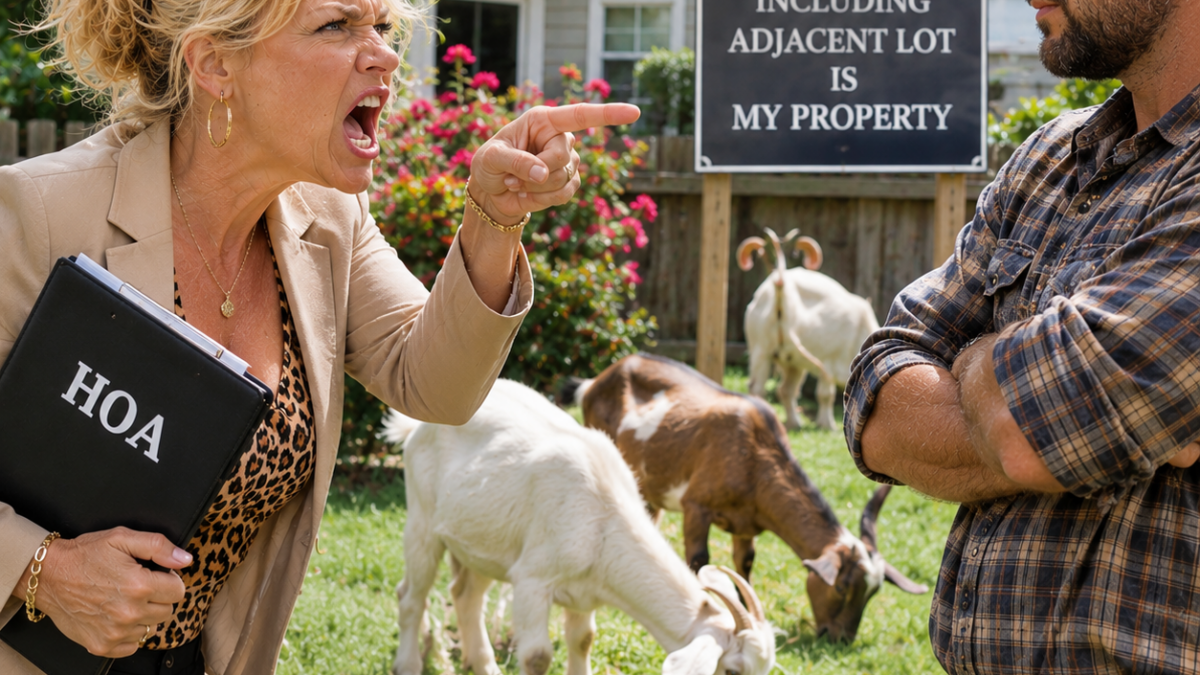
PART 2
## **The Twelve-Page Threat**
The certified envelope arrived three days later.
It was thick enough to suggest Karen had personally declared war on several nations.
Sarah carried it into the kitchen.
“Your girlfriend wrote.”
“She’s more your type.”
Sarah gave me a look.
I opened the envelope.
Twelve pages.
The title alone took up half the first sheet:
**OFFICIAL NOTICE OF COVENANT VIOLATION AND SCHEDULE OF FINES**
I read aloud.
“Harboring non-domesticated agricultural animals.”
Sarah looked through the window at Daisy sleeping in the sun.
“Dangerous criminal.”
“Failure to maintain property in accordance with community aesthetic standards.”
“Your pasture has never been in her community.”
“I know.”
“Public nuisance.”
Sarah groaned.
Then I reached my favorite.
“Olfactory pollution.”
That finally made her laugh.
“What does that even mean?”
“Apparently my goats smell unconstitutionally rural.”
Then we reached the money.
Initial fine:
$1,000.
Daily fine:
$100.
Amount supposedly due already:
$1,300.
At the bottom, Karen summoned me to an architectural-review hearing and warned that failure to comply could lead to additional enforcement, including a lien against my property.
Sarah stopped laughing.
“A lien?”
“That’s what it says.”
“Can they do that?”
“They can attempt to file paper.”
“Jack.”
“No. They cannot lawfully lien the Holloway Grant based on HOA covenants that don’t apply to it.”
“How sure?”
I looked at her.
“Very.”
She folded her arms.
“That means you checked before buying.”
“I checked everything before buying.”
Sarah knew that.
The Holloway Grant had been unusual enough that David Chen and I had spent a full week studying the transaction.
I went to my office and unlocked the file cabinet.
Two documents mattered immediately.
Our deed.
And the 1988 master ground lease.
I laid them beside Karen’s twelve-page masterpiece.
The contrast was almost funny.
Karen’s notice had bold fonts, underlining, threats, and four different references to “community standards.”
The deed didn’t need decoration.
Neither did the survey.
The legal description of Oakwood Estates was precise.
Fifty acres.
Metes and bounds.
Every corner identified.
Everything beyond that legal description was outside the leased subdivision.
My house sat on the larger Holloway Grant.
So did the pasture.
So did Daisy.
So did Buttercup.
I traced the survey with one finger.
Karen’s back patio sat approximately forty-eight feet from the legal lease boundary.
My goats were another thirty feet beyond that.
Her HOA jurisdiction didn’t merely fail to reach them.
It wasn’t particularly close.
Sarah read over my shoulder.
“So what do we do?”
“Answer.”
“You’re not going to their hearing?”
“I’ll go.”
Her eyebrows rose.
“You?”
“I want them to put everything on the record.”
There was the old military instinct again.
Never interrupt the other side while they’re documenting their own mistake.
## **My First Response**
I kept the letter short.
No insults.
No mention of Karen’s threat against the goats.
Not yet.
I cited the exact section of Oakwood’s own governing documents defining the HOA property as the fifty acres described in the ground lease.
I attached the county survey.
Highlighted the boundary.
Then wrote:
**The Holloway Grant property outside the leased Oakwood Estates parcel is not subject to Oakwood Estates covenants, assessments, architectural control, animal restrictions, or enforcement authority.**
Next:
**Daisy and Buttercup are located entirely within the Holloway Grant parcel and have not entered Oakwood Estates.**
Then:
**All fines claimed against me are rejected as void.**
Finally:
**Any effort to file or record a lien against title to the Holloway Grant based on these void fines will result in immediate legal action, including claims for slander of title and any other remedies available by law.**
I sent it certified.
Return receipt requested.
Then I waited.
The green receipt came back signed by Karen.
She had it.
For four days, nothing happened.
I almost believed someone had finally spoken to an attorney.
Then Sarah came home from the grocery store looking furious.
## **The Disease Rumor**
“What happened?”
She set the grocery bags on the counter harder than necessary.
“Karen is telling everyone Daisy and Buttercup are diseased.”
I stopped.
“What?”
“Carol stopped me near produce.”
Sarah imitated Carol’s whisper.
“Karen is *so worried about the children.* Apparently our goats aren’t vaccinated, they’re carrying disease, and they’re dangerously close to the playground.”
I stared.
“The playground is hundreds of yards away.”
“I know.”
“The goats have veterinary records.”
“I know.”
“She threatened animal control.”
“I know.”
Sarah was angrier than I was now.
“She couldn’t beat you with her stupid bylaws, so she’s making us sound dangerous.”
That part mattered.
Karen was changing battlefields.
Facts weren’t helping her.
So she moved to fear.
Disease.
Children.
Public health.
Those words worked because people didn’t need to verify them before becoming uncomfortable.
The next time Sarah and I drove through the subdivision, several people who normally waved looked away.
That bothered her.
It bothered me more that it bothered her.
“I wanted peace here,” she said one evening.
“I know.”
“I don’t want every trip to the grocery store becoming part of some neighborhood war.”
“I know.”
She looked at me.
“Can you end this?”
“Yes.”
“How?”
“I don’t know yet.”
At least I was honest.
## **The Lien Notice**
The second certified envelope arrived the following week.
Karen had ignored my letter completely.
The fines now exceeded two thousand dollars.
The HOA claimed it would proceed with a lien.
And I was ordered to appear before a full Board of Directors executive session.
The title sounded frightening.
That was the point.
Sarah put the paper down.
“She really is going to try.”
“Yes.”
“You’re very calm.”
“I’m not.”
“You look calm.”
“Different thing.”
I created a folder.
**HOA CORRESPONDENCE**
Then another:
**GOAT LOCATION EVIDENCE**
Every morning, I photographed Daisy and Buttercup with enough surrounding geography to show exactly where they were.
Timestamps.
Fence.
Property markers.
Distance to Oakwood.
I installed a discreet security camera watching the boundary.
My anger needed somewhere productive to go.
Documentation gave it a job.
## **George**
I started walking through Oakwood’s public streets.
Not spying.
Listening.
Watching.
Most people were polite.
Some avoided me.
Then I met George.
He was trimming roses in front of a modest brick home.
Older man.
Probably late sixties.
He looked directly at me.
“Jack?”
“That’s me.”
“George Benton.”
We shook hands.
“Nice roses.”
“My wife takes the credit.”
He glanced toward the pasture.
“Heard about the goats.”
“Everyone has.”
George sighed.
“Karen likes enemies.”
That was interesting.
“What do you mean?”
He looked toward the street before speaking.
“A few years back, young military couple lived near the clubhouse. Karen went after them over a swing set.”
“A swing set?”
“Color.”
I stared.
“Wrong color?”
“Not approved.”
He shrugged.
“Fines. Hearings. Letters. Rumors.”
“What happened?”
“They sold.”
“Because of a swing set?”
“Because peace became more valuable than equity.”
That sentence stayed with me.
George continued.
“She’s done versions of that to a lot of people.”
“Why hasn’t anyone stopped her?”
He smiled without humor.
“Because she picks one person at a time.”
Exactly.
Isolation.
Make each target believe they’re alone.
Then I told him something I hadn’t discussed with any Oakwood resident.
“She can’t lien my land.”
“Why not?”
“The pasture isn’t inside the subdivision.”
“I figured that.”
“There’s more.”
He waited.
“I own the ground Oakwood is built on.”
George stared.
“What?”
“The entire fifty-acre subdivision sits on a long-term ground lease.”
“Whose land?”
“Mine.”
He slowly lowered his pruning shears.
“Well, I’ll be damned.”
“I bought the Holloway Grant. The ground lease transferred with it.”
He looked toward his own house.
“So…”
“Your house is yours subject to whatever property structure applies. I’m not claiming your furniture, George.”
He laughed.
“But the dirt?”
“The underlying leased parcel belongs to me.”
His smile grew.
“She picked a fight with her landlord.”
“I’d rather not frame it that way.”
“I would.”
For the first time, I had an ally inside Oakwood.
## **The Hearing**
The clubhouse looked exactly like I expected.
Beige walls.
Fluorescent lights.
Folding chairs.
Karen at the center table like a queen presiding over a minor criminal trial.
Sarah sat beside me.
About twenty residents attended.
George was in the back.
Karen struck the gavel.
“The board will address continued agricultural-animal violations at Mr. Jack Turner’s property.”
I almost corrected her.
My property wasn’t part of Oakwood.
But I let her continue.
She described me as noncompliant.
Uncooperative.
A threat to property values.
Fines:
$3,400.
Then she announced the board would vote to place a lien against my property.
Finally:
“Mr. Turner, do you have anything to say for yourself?”
I stood.
Carried my briefcase to the front.
Opened it.
“Good evening.”
I turned toward the residents.
“I’m going to show you a map.”
Karen rolled her eyes.
I unfolded the official survey.
“This is Oakwood Estates.”
I pointed to the fifty-acre description.
“This is the only property covered by your covenants.”
Then the adjoining land.
“This is the remainder of the Holloway Grant.”
I showed timestamped photographs.
“These are the goats.”
Someone laughed softly.
“Daisy and Buttercup have never crossed into Oakwood Estates.”
Then I put the certified-mail receipt down.
“This proves Karen received written notice explaining the jurisdictional problem two weeks ago.”
Karen snapped:
“Irrelevant.”
I looked at her.
“How?”
“The HOA has broad nuisance authority.”
“Inside Oakwood.”
“The impact affects residents.”
“That doesn’t extend your covenants onto neighboring land.”
She turned toward her board.
“We are not here to debate technicalities.”
I almost smiled.
“Property boundaries aren’t technicalities.”
Her face flushed.
“The board will vote.”
I looked at the other board members.
Two men.
One severe-looking woman.
Then said:
“Before you do, every board member should understand that knowingly recording a lien against land outside your association based on charges you know are disputed may expose you individually to litigation.”
The two men looked immediately toward Karen.
There it was.
Doubt.
Karen saw it too.
“Vote.”
The severe-haired woman raised her hand.
Karen raised hers.
The two men hesitated.
Then followed.
Motion passed.
Karen struck the gavel.
“The lien is approved.”
She smiled.
But the residents didn’t leave.
That was her mistake.
## **The Stories Begin**
Mark Miller approached first.
His wife Jessica beside him.
“What she did was wrong.”
“I know.”
Jessica looked angry.
“She fined us five hundred dollars because our daughter’s basketball hoop stayed near the curb for two hours.”
George joined us.
Then another homeowner.
Satellite dish.
Another.
Work van.
Another.
Garden mulch.
Then the widow.
Rose garden.
Karen had forced her to remove much of it because the design wasn’t “architecturally harmonious.”
The stories were different.
The method was identical.
Violation.
Pressure.
Fine.
Escalation.
Fear of lien.
Submission.
George said:
“She isn’t enforcing rules. She’s collecting obedience.”
That was the moment the fight changed.
It stopped being about my goats.
## **David Chen**
I called David the next morning.
When I finished explaining, he was quiet.
Then:
“She approved the lien?”
“Yes.”
“After receiving your certified letter?”
“Yes.”
“And you have the receipt?”
“Yes.”
“Jack.”
“What?”
“I may send her flowers.”
“Why?”
“She has made my life wonderfully simple.”
David filed an immediate legal challenge to stop any valid encumbrance from attaching to my title.
Then he looked beyond my case.
“If people want to remove her, we need records.”
Jessica, as an HOA member in good standing, submitted a statutory records request.
Five years of finances.
Bank statements.
Invoices.
Vendor agreements.
Meeting minutes.
Credit-card statements.
Karen refused.
David sent a second demand through the HOA’s attorney.
This time the words **court order**, **sanctions**, and **personal liability** appeared.
The documents arrived.
## **The Boxes**
We spent two days in the clubhouse.
Boxes everywhere.
Karen watched from the corner.
George joined us.
Retired accountant.
Best possible ally.
Within hours, he found the landscaping contract.
Prestige Scapes LLC.
Sixty thousand dollars per year.
No competitive bid.
George searched state records.
Owner:
Gerald Poplawski.
Jessica searched social media.
Then held up her phone.
Photograph.
Karen at a family barbecue.
Arm around Gerald.
Caption identified him as her brother-in-law.
George leaned back.
“Well.”
I said:
“That’s not automatically illegal.”
“No.”
He tapped the contract.
“But it’s something you’d disclose.”
No disclosure existed.
Then invoices.
Winter aeration that apparently never happened.
Tree removal for a tree residents said the county had already cleared.
Thousands for annual flowers.
Emergency landscape work nobody remembered.
Then the entrance fountain.
$25,000.
Recorded as:
**COMMON AREA INFRASTRUCTURE REPAIR**
Jessica stared.
“That fountain is infrastructure?”
George smiled grimly.
“Apparently Versailles moved to Tennessee.”
Then the credit card.
Expensive dinners.
Restaurant charges labeled board meetings.
Receipts that didn’t match official meeting calendars.
Reserve funds much lower than residents believed.
The deeper we went, the worse it got.
Sarah joined Jessica in contacting residents.
People started providing statements.
The fear was cracking.
Karen stood in the corner watching her kingdom become evidence.
For the first time since I’d met her, I saw fear.
## **Then David Found Something Bigger**
The financial records could remove Karen.
Maybe trigger an investigation.
But David discovered something much more powerful.
The original 1988 ground lease.
He called me into his office.
“Jack, sit down.”
“That’s never a good opening.”
“This time it is.”
He placed the lease between us.
“Article Twelve.”
I read.
The lessee had to maintain the leased property in good condition, avoid nuisance, avoid conduct bringing the property into disrepute, and avoid exposing the lessor to legal or financial liability.
David tapped the page.
“Karen’s harassment campaign and fraudulent lien create a serious breach argument.”
Then Article Fifteen.
Financial solvency.
Accurate accounting.
Prudent management.
David pointed toward our copied invoices.
“Breach number two.”
Then he turned to page one.
“Now do the math.”
Signed June 1, 1988.
Forty-year initial term.
One twenty-year renewal option.
Renewal required written notice no fewer than twenty-four months before expiration.
I looked at the date.
Then at David.
“The lease expires in eighteen months.”
“Yes.”
“So renewal notice was due six months ago.”
“Yes.”
“Did they give one?”
“No record.”
“Maybe another document?”
“I checked county filings and everything we received.”
He leaned back.
“They missed it.”
I stared.
“What does that mean?”
“The automatic option is gone.”
I thought of George.
Mark.
Jessica.
The widow and her roses.
Sixty families.
“What happens to the houses?”
David answered carefully.
“Don’t get ahead of ourselves. Property interests on ground leases can become complicated, especially with individual homeowners. This would require litigation and title analysis.”
“But?”
“But the master lease gives you extraordinary leverage.”
“I don’t want leverage against families.”
“I know.”
He slid the document closer.
“Then use it to protect them.”
## **The Default Clause**
The lease contained a cure provision.
Material breach.
Written notice.
Ninety days to correct.
If the lessee failed, the lessor could pursue termination remedies.
David listed what a cure could require.
Void the improper lien.
Stop enforcing HOA rules against my separate property.
Independent forensic audit.
Terminate conflicted vendor contracts.
Restore financial controls.
Remove responsible board leadership.
Provide transparent records.
I looked at him.
“She’ll never agree.”
David smiled.
“That’s the point.”
If Karen rejected the cure, homeowners would have to decide whether keeping her in power was worth threatening the ground lease beneath their community.
I didn’t need to evict anyone.
I needed to make Karen’s ego more dangerous to Oakwood than my goats had ever been.
## **The Survey**
Before sending the cure notice, David suggested a fresh survey.
Not for intimidation.
For clarity.
I hired professionals.
Two trucks arrived Sunday morning.
GPS equipment.
Tripods.
Orange vests.
They marked the legal boundary between my seventy unleased acres and Oakwood’s fifty-acre leased parcel.
Bright pink flags every fifty feet.
People watched through windows.
Then they reached Karen’s backyard.
The lead surveyor stopped.
Checked the coordinates.
Moved.
Checked again.
Hammered a stake.
Another.
The pink line cut across what Karen had been calling her lawn.
Through the edge of her rose bed.
Less than five feet from the corner of her deck.
I stared.
The legal fifty-acre lease boundary wasn’t where the landscaping implied.
A significant section of Karen’s manicured backyard extended beyond Oakwood’s leased parcel.
Onto my unleased Holloway Grant acreage.
The woman who had threatened my goats for grazing “near her yard” had been fertilizing, mowing, and screaming from a yard partly located on my land.
Sarah stood beside me.
“Oh.”
“Yep.”
“Are you going to enjoy this?”
“I will behave professionally.”
“That wasn’t my question.”
Karen came running out.
“What are you doing?”
The surveyor barely looked up.
“Marking the county boundary.”
“Remove those flags!”
“Can’t.”
“This is my backyard!”
He tapped the stake.
“Ma’am, your legal boundary is here.”
She stared.
“That can’t be right.”
“GPS says otherwise.”
She saw me.
Her face transformed.
“You!”
“Morning, Karen.”
“This is harassment!”
I looked toward Daisy and Buttercup grazing beyond the fence.
“No. This is a survey.”
“You’re trying to steal my yard.”
I almost admired the irony.
“Karen, I’ve been telling you for months to check the property line.”
“I’ll sue you.”
“You should probably call a surveyor first.”
She stormed inside.
Sarah waited until the door slammed.
Then burst out laughing.
I couldn’t help joining her.
## **The Pink Line**
Those flags became the most talked-about thing in Oakwood.
Not because my survey was more important than Karen’s financial conduct.
Because people understand a visible line.
For years, Karen’s authority had been abstract.
Covenants.
Titles.
Committees.
Now there was a fluorescent pink stripe running through the queen’s rose garden.
A physical reminder that she’d been wrong about the very thing she’d used to threaten everyone else.
Within a day, people were calling George.
Then Jessica.
Then me.
“What happens when the lease ends?”
“Are our homes safe?”
“Can Jack take the neighborhood?”
I gave the same answer every time.
“I don’t want your homes.”
Then:
“But the lease problem has to be fixed.”
## **The Special Meeting**
Oakwood’s bylaws allowed a percentage of homeowners to force a special meeting.
Jessica collected signatures easily.
Rumors did the rest.
Mark’s cousin worked for the county newspaper.
He came.
Photographer too.
Karen tried to declare the meeting invalid before it started.
Nobody cared.
The clubhouse was packed.
This time the residents weren’t afraid of me.
They were afraid of what Karen had done.
Mark moderated.
Then invited me to speak.
I walked forward with a laptop.
First slide:
County survey.
Pink boundary line.
“This is where Oakwood Estates legally ends.”
Next:
Photographs of Daisy and Buttercup.
“Neither goat ever entered that area.”
Next:
My certified response.
“Karen received this before the board approved the lien.”
Then the lien notice.
“So the goat issue was never legally valid.”
Murmurs.
Karen interrupted.
“This meeting is based on misinformation.”
Mark said:
“You’ll get your turn.”
She looked stunned.
Nobody had ever told Karen to wait.
## **The Money**
I changed slides.
Prestige Scapes contract.
“Now we need to discuss something more important.”
Gerald’s business registration.
Then photograph.
Karen beside her brother-in-law.
The room went quiet.
I showed the no-bid contract.
The invoices.
The winter aeration.
The tree-removal charge.
The fountain.
$25,000.
Someone shouted:
“Twenty-five thousand for that ugly thing?”
Laughter.
Angry laughter.
Then credit-card charges.
Reserve-fund decline.
Karen stood.
“These documents are being taken out of context.”
George rose from the audience.
“I spent thirty-two years as a CPA.”
Karen stared.
George continued.
“I’d love to hear the context in which undisclosed payments to your brother-in-law and personal restaurant expenses become normal reserve-fund management.”
The room erupted.
Karen tried shouting.
Nobody was listening anymore.
## **The Ground Lease**
I waited.
Then changed the slide.
**GROUND LEASE — JUNE 1, 1988**
People quieted.
“I know many of you weren’t aware of this.”
I explained the Holloway Grant.
The fifty-acre carve-out.
The long-term lease.
The fact that I was the current lessor.
Then David walked forward.
“My name is David Chen. I represent Jack Turner.”
Karen’s face changed.
David held up the notice.
“As of this morning, the Oakwood Estates HOA has been formally served with notice of material default under the master ground lease.”
Silence.
“The HOA has ninety days to cure.”
Someone asked:
“What does cure mean?”
David answered.
“Correct the violations.”
He read the major requirements.
Remove the lien.
Stop unlawful enforcement.
Independent audit.
Terminate conflicted contracts.
Restore financial controls.
Restructure board leadership.
Then someone shouted:
“What happens if they don’t?”
David paused.
“Mr. Turner may pursue remedies available under the lease, including termination proceedings.”
The room exploded.
A woman screamed:
“Termination of what?”
“The ground lease.”
“And our houses?”
David raised both hands.
“Nobody is coming here tonight to evict families.”
I stepped toward the microphone.
“I do not want your houses.”
The room quieted enough to hear me.
“I bought this land for peace. I didn’t buy it to destroy sixty families.”
I pointed toward Karen.
“But your HOA is a tenant under a contract, and that contract has obligations.”
Then David delivered the second blow.
“The original renewal option also required notice at least twenty-four months before lease expiration.”
Mark asked:
“When is expiration?”
“Approximately eighteen months from now.”
People did the math.
A man near the wall whispered:
“They missed it.”
David nodded.
“As far as the records show, yes.”
Pure panic.
Not because I threatened them.
Because Karen had spent months pretending she was untouchable while the legal foundation of her entire subdivision was quietly approaching expiration.
## **Karen Finally Understands**
Karen stared at me.
“You planned this.”
“No.”
“You bought this land to take our homes.”
“No.”
“You’re a predator.”
I looked at the residents.
“Ask David how many times I’ve told him I don’t want your houses.”
David raised one hand.
“Many.”
A nervous laugh moved through the room.
I turned back to Karen.
“This started because you threatened two goats standing on my own land.”
“You’re destroying this community over animals!”
“No.”
My voice remained low.
“You’re the one who approved an illegal lien.”
She opened her mouth.
“You’re the one whose financial records contain undisclosed family contracts.”
Her face reddened.
“You’re the one whose HOA missed its renewal deadline.”
“You—”
“And you’re the one standing in a backyard that your own survey assumptions got wrong.”
Someone laughed.
Then another.
Karen’s face collapsed.
Not entirely.
But enough.
## **Her Board Abandons Her**
The two remaining board members looked at each other.
Then one stood.
“I resign.”
Karen turned.
“What?”
He gathered his papers.
“Effective immediately.”
“You cannot do this right now.”
“I just did.”
The other board member followed.
Karen sat alone.
Residents shouted.
Some cursed.
Mark and George had to calm people.
I didn’t enjoy that part.
A mob isn’t justice just because you agree with its anger.
I took the microphone.
“Listen.”
It took a minute.
“We are not here to destroy Karen.”
That surprised everyone.
“We are here to fix Oakwood.”
I looked around the room.
“Your homes matter. Your families matter. The ground lease can be resolved. But only if the community acts like a community instead of one person’s private kingdom.”
That changed the room.
Fear became direction.
## **The Reporter**
The newspaper reporter caught me afterward.
“Mr. Turner, could you theoretically take control of all these homes?”
I shook my head.
“That’s not an accurate way to describe my objective.”
“But the lease—”
“My objective is simple. The tenant entity needs to honor the contract.”
“So you won’t evict homeowners?”
“I have no desire to throw innocent families out of their homes.”
“What do you want?”
“A functioning HOA.”
I looked toward the clubhouse.
“And my goats left alone.”
He laughed.
That quote made the article.
## **The Headline**
The county paper ran the story the next morning.
Karen’s photograph beside Daisy.
It would’ve been funny if the situation weren’t so serious.
The story detailed:
The ground lease.
The lien.
The survey.
The family landscaping contract.
The reserve concerns.
Residents’ complaints.
By afternoon, regional television called.
Karen tried to fight back.
She sent an email accusing me of plotting to steal Oakwood.
Almost nobody believed her.
Her emergency meeting drew three residents.
One was Gerald.
Apparently his first question was whether Prestige Scapes would still get paid.
That did not help Karen’s case.
## **The Recall Petition**
Jessica circulated the recall petition.
Within forty-eight hours, more than ninety percent of owners signed.
Karen had spent years making people fear standing alone.
Now nearly everyone stood together.
Facing removal, legal scrutiny, potential fraud investigation, and a master-lease default, Karen resigned.
A week later, a moving truck appeared outside her house.
She and her husband loaded boxes.
The gaudy garden statues.
Outdoor furniture.
Even the giant gnome.
I happened to be checking fence posts when I saw her.
Our eyes met.
For months, I’d imagined feeling satisfaction.
Instead I felt tired.
She looked smaller.
Not physically.
Human.
A woman who had mistaken control for respect until both disappeared.
I nodded once.
She didn’t respond.
Then I went back to work.
## **The Lien Disappears**
Two days after Karen moved, David received formal confirmation.
The lien notice against the Holloway Grant had been withdrawn and expunged.
Every goat-related fine was voided.
The HOA’s attorney issued a written acknowledgment that my unleased acreage was outside HOA jurisdiction.
Sarah read the letter.
“Can we frame it?”
“No.”
“Why?”
“Too petty.”
“You wrote Operation Creek Freedom on a legal pad.”
“Different.”
She laughed.
For the first time in months, our kitchen felt normal.
## **The New Board**
Oakwood needed leadership quickly.
Mark became interim president.
Jessica became treasurer.
George agreed to advise the financial committee.
Their first formal action was accepting the cure plan.
Independent audit.
Immediate termination of Prestige Scapes.
Competitive bidding.
Expense controls.
Legal review.
Removal of enforcement claims outside proper jurisdiction.
They sent Sarah and me a real apology.
Not:
**We regret any misunderstanding.**
It said:
**The Oakwood Estates Homeowners Association acknowledges that enforcement actions were pursued against the Turner property without legal authority and apologizes for the harassment and distress caused to Jack and Sarah Turner.**
That mattered.
Especially to Sarah.
## **The Audit**
The forensic accountants found even more.
Some expenditures were explainable.
Some were merely irresponsible.
Others raised serious concerns.
The questionable payments connected to Gerald were referred to authorities.
Credit-card activity was reviewed.
Meeting records were compared against charges.
Invoices were tested.
The district attorney eventually became involved.
I deliberately stayed out of that process.
My job wasn’t to prosecute Karen.
The evidence existed.
The proper authorities could decide what it meant.
Later, we heard Karen and Gerald reached plea agreements involving fraud-related conduct and restitution.
No dramatic movie trial.
No screaming confession.
Just consequences.
Often that’s what justice actually looks like.
Paper.
Numbers.
Signatures.
## **The Lease Negotiation**
The bigger issue remained.
Oakwood still needed legal security.
The old renewal option was gone.
I could have exploited that.
David reminded me how much leverage I had.
I told him:
“Write a new lease.”
He looked at me.
“You’re sure?”
“Yes.”
“Fifty years?”
“Something long enough that people stop wondering whether their house disappears when I die.”
David smiled.
“That’s almost generous.”
“Don’t spread it around.”
We met with the new board.
I told them:
“I’m not here to punish you for Karen.”
Mark nodded.
“We understand.”
“I want predictable rent.”
“Reasonable.”
“Inflation adjustments.”
“Reasonable.”
“Insurance.”
“Yes.”
“Financial transparency.”
Jessica laughed.
“Very yes.”
Then I added:
“And a good-neighbor clause.”
George raised an eyebrow.
“What does that mean legally?”
David answered.
“It means everyone agrees to communicate before declaring livestock a threat to civilization.”
Even I laughed.
## **A Fifty-Year Future**
We signed the new fifty-year ground lease.
Clear renewal provisions.
Modern protections.
Predictable rent structure.
No sudden surprises.
Homeowners received written explanations.
Lenders and title professionals had what they needed.
The panic disappeared.
Residents who’d spent weeks afraid I might take their homes finally understood that I had used the old lease to force reform, not dispossession.
Mark shook my hand after signing.
“You could’ve destroyed us.”
“No.”
“You had leverage.”
“That isn’t the same as having a reason.”
He nodded.
“I wish Karen understood that.”
So did I.
## **Karen’s Yard**
There was still one awkward issue.
The survey.
Part of Karen’s former backyard—the land now associated with whoever eventually bought the house—extended beyond Oakwood’s leased boundary.
That strip was unquestionably mine.
The new board asked what I wanted to do.
I looked at the pink flags.
The rose bed.
The deck nearby.
Then Daisy and Buttercup.
The petty version of me imagined extending the goat fence.
Sarah knew exactly what I was thinking.
“No.”
“I didn’t say anything.”
“You were picturing Daisy in the rose bed.”
“She’d enjoy it.”
“Jack.”
Instead, David drafted a small boundary-use agreement.
The homeowners could continue using that existing section under a revocable landscaping license so nobody had to tear up a yard immediately.
Clear ownership.
Clear conditions.
No adverse claim.
No drama.
When the new buyers eventually moved in, I explained it personally.
They were mortified.
“You really own this part?”
“Technically.”
“And we can use it?”
“Yes.”
“Why?”
I looked toward the goats.
“Because being right doesn’t require being difficult.”
Sarah later told me that was the most hypocritical thing I’d ever said.
## **The Rose Garden**
One of the first changes under the rewritten HOA rules involved the widow at number twenty-two.
Her roses came back.
Neighbors helped replant them.
George donated cuttings.
Jessica brought mulch.
This time nobody cared whether the mulch matched an approved palette.
I walked past one morning.
The widow waved.
“Mr. Turner!”
“Jack.”
She smiled.
“Thank you.”
“I didn’t plant anything.”
“You did enough.”
I looked at the roses.
Karen had spent years creating uniformity.
The neighborhood became more beautiful almost immediately after people were allowed to be different.
## **The Fountain**
The $25,000 entrance fountain developed a pump problem.
Mark called.
“Do we repair it?”
“How should I know?”
“Everybody associates it with Karen.”
“That’s a terrible reason for me to decide.”
They voted.
Removed it.
In its place, Oakwood planted native Tennessee flowers and installed a simple stone sign.
The new landscaping contract went to a local family company after open bidding.
For much less money.
George became almost offensively happy about the savings.
## **Daisy and Buttercup Become Celebrities**
This was the part I never expected.
Children in Oakwood became fascinated with the goats.
Parents started asking whether kids could see them.
I said yes—if accompanied by an adult and only when Sarah or I were available.
One Saturday, George brought his granddaughter.
Daisy immediately tried eating her shoelace.
The girl laughed for ten minutes.
Mark joked:
“We should charge Karen’s old landscaping company a consulting fee. These goats do better work.”
“Don’t give Sarah ideas.”
Too late.
She ordered a little wooden sign:
**DAISY & BUTTERCUP
INVASIVE PLANT MANAGEMENT DIVISION**
I complained.
Then mounted it myself.
## **The Thing That Still Bothered Me**
For all the satisfying outcomes, I couldn’t forget Karen’s original threat.
*I’ll have them put down.*
The words stayed with me.
Not because I believed she still had power.
Because they revealed how quickly some people treat living things as disposable when those things interfere with their preferences.
Sarah caught me watching the goats one evening.
“You’re thinking about her.”
“A little.”
“Why?”
“She could’ve done something stupid.”
“She didn’t.”
“Because we stopped her.”
Sarah leaned on the fence.
“Then stop letting the thing that didn’t happen steal time from the things that did.”
I looked at her.
“You’ve been saving that line?”
“Nurse wisdom.”
She was right.
Again.
## **What George Told Me**
One afternoon, George and I sat on my porch.
He looked toward Oakwood.
“Place feels different.”
“Less beige?”
He laughed.
“That too.”
Then:
“People talk now.”
“What do you mean?”
“Before, everybody wondered what Karen would think.”
He shook his head.
“Now they ask what each other thinks.”
That’s a community.
Not a collection of people obeying one loud person.
A community.
## **The Hardest Conversation**
Months later, a former board member came to see me.
One of the men who had voted for my lien.
His name was Richard.
He stood awkwardly near the driveway.
“I owe you an apology.”
“Yes.”
That surprised him.
I wasn’t going to make it easy.
He swallowed.
“I knew something wasn’t right.”
“Then why did you vote?”
“Karen said the HOA attorney had confirmed we were protected.”
“Did you ask the attorney?”
“No.”
“Did you read my letter?”
He looked down.
“Yes.”
“Then why?”
Richard took a long breath.
“Because I was scared of her.”
That answer mattered.
Not enough to excuse him.
Enough to explain him.
“She’d turn on people.”
“I know.”
“I had two years left before retirement. I didn’t want trouble at home.”
“So you gave it to me instead.”
He flinched.
“Yes.”
Silence.
Finally I said:
“Don’t ever do that again.”
“I won’t.”
I believed him.
Fear creates followers.
Accountability can turn some back into adults.
## **The Press Loses Interest**
Eventually, reporters moved on.
No more cameras.
No more headlines.
That was good.
Oakwood returned to being unimportant.
A neighborhood should be unimportant to the news.
The ground lease became boring paperwork again.
My pasture became pasture.
Karen became somebody who used to live nearby.
The goats returned to their primary occupation:
eating everything Sarah wanted gone and occasionally things she didn’t.
## **Our Anniversary**
Sarah and I celebrated our anniversary on the ridge.
Dinner outside.
No clubhouse.
No lawyers.
She looked over the valley.
“Remember what you said when we bought this place?”
“What?”
“Peace.”
I smiled.
“Didn’t work out perfectly.”
“No.”
She watched the Oakwood lights appear.
“But maybe better now.”
“How?”
“We know the neighbors.”
That was true.
Before Karen, Oakwood had been something we wanted distance from.
Afterward, George was a friend.
Mark and Jessica came for dinner.
Kids visited the goats.
The widow sent roses to Sarah.
The fight had forced us into a community we never intended to join.
Not legally.
Humanly.
## **The Land Under Their Feet**
People still misunderstand the ground lease sometimes.
They hear:
**Jack owned sixty houses.**
Not exactly.
Ownership structures involving land and improvements can be complicated.
What mattered to the story was simpler.
Oakwood’s HOA did not own the fifty acres beneath the subdivision free and clear.
It occupied that land under a master lease.
I owned the underlying leased land as successor lessor.
And the HOA’s rights depended on honoring that contract.
Karen spent years behaving as though the HOA was the highest authority in the neighborhood.
She never bothered to ask what document gave Oakwood the right to exist there in the first place.
That arrogance almost cost everyone dearly.
## **The Missed Deadline**
The missed renewal deadline became legendary.
George once told me:
“You know what keeps me up at night?”
“What?”
“We probably had that lease buried in some box.”
“Probably.”
“Nobody knew.”
“Apparently.”
“What if Karen hadn’t started this?”
I thought about it.
“Someone would’ve discovered it eventually.”
“When?”
“Hopefully before expiration.”
He shook his head.
“Your goats may have saved sixty houses.”
I looked at Daisy.
Daisy sneezed.
“Heroic.”
## **The Real Reason I Renewed**
People called me generous for signing the fifty-year lease.
That wasn’t the whole truth.
It was also practical.
I didn’t want years of litigation.
Didn’t want title chaos.
Didn’t want lenders panicking.
Didn’t want sixty families forced into expensive legal uncertainty.
And I didn’t want to spend retirement managing a property crisis Karen created.
Sometimes mercy and self-interest point the same direction.
That’s fine.
Good outcomes don’t require pure motives.
Just responsible choices.
## **Karen’s Restitution**
I learned about the final criminal resolution through George.
Karen and Gerald had accepted plea arrangements.
Restitution back to the HOA.
Penalties.
Restrictions.
No prison in the end, as far as I understood.
George was disappointed.
“Should’ve locked them up.”
I wasn’t.
“Money comes back?”
“Some.”
“Then let it end.”
“You’re getting soft.”
“No.”
I looked toward Oakwood.
“I just don’t need her punished forever to know she was wrong.”
That was true.
## **The Most Satisfying Revenge**
The most satisfying thing wasn’t Karen moving.
Or the indictment.
Or the survey line through her roses.
It was Oakwood improving after she left.
Reserve funds rebuilt.
Contracts bid competitively.
Rules simplified.
Residents attended meetings.
Meeting minutes were published.
People challenged board decisions without fearing retaliation.
And nobody filed retaliatory fines against them for doing it.
Karen had built power by making people believe resistance was dangerous.
Her downfall made resistance normal.
She wanted obedience.
She accidentally created participation.
That’s a better ending than revenge.
## **The Fence Moves**
Eventually, I replaced the old section of fence near Karen’s former yard.
Not along the landscaping line.
Along the actual legal boundary.
The new homeowners understood.
The goat pasture expanded slightly.
Sarah stood beside me while Daisy explored the new grass.
“So technically…”
“No.”
“You don’t know what I was going to say.”
“You were going to say Daisy finally got Karen’s yard.”
“I was going to say part of it.”
“Sarah.”
She smiled.
Daisy started chewing honeysuckle exactly where Karen once stood screaming.
I’ll admit:
That felt satisfying.
## **What Power Actually Is**
Karen thought power meant being able to make people comply.
I learned in the military that real authority works differently.
Legitimate authority has limits.
Defined scope.
Responsibility.
Accountability.
The moment someone begins treating authority as personal ownership, they’ve usually stopped understanding the job.
Karen called herself president.
Fine.
President of an HOA.
Not president of Tennessee.
Not owner of my goats.
Not owner of the Holloway Grant.
Not even owner of much of the land beneath the community she claimed to rule.
The title was real.
Her interpretation of it wasn’t.
## **The Deed**
I keep the Holloway deed in a fireproof safe.
Ground lease too.
New lease.
Survey.
Everything.
One day my grandson asked:
“Why do you keep so much paper?”
“Because paper is cheaper than arguing.”
He didn’t understand.
He will someday.
## **The Pink Flag**
I kept one pink survey flag.
Sarah caught me putting it in my office.
“You said you weren’t petty.”
“Historical artifact.”
“It’s a plastic flag.”
“It represented a critical property determination.”
“It went through Karen’s roses.”
“Coincidence.”
She laughed.
I kept it anyway.
## **Five Years Later**
Five years after Karen first threatened Daisy and Buttercup, Oakwood looked different.
Not dramatically.
Still houses.
Still lawns.
Still an HOA.
But the sameness had softened.
Different mailbox colors.
Basketball hoops.
Children’s toys.
Gardens.
One house had bright blue shutters.
Karen would’ve fainted.
The widow’s roses were magnificent.
George’s garden remained better than everyone else’s.
Mark was no longer president.
He’d served his term and happily stepped down.
Another resident took over.
That mattered to me.
Healthy systems don’t depend on permanent rulers.
## **Buttercup Gets Old**
Buttercup slowed first.
Goats don’t live forever.
Her jumping became less enthusiastic.
She preferred lying in the sun near the barn.
Sarah fussed over her constantly.
When Buttercup finally died, years after the HOA fight, Sarah cried harder than I expected.
So did I.
We buried her beneath a dogwood near the pasture.
George came over.
Mark and Jessica too.
Their daughter placed flowers on the soil.
Daisy stood nearby making impatient noises because ceremonies interfere with feeding schedules.
That evening, Sarah said:
“Karen threatened to have her killed.”
“I remember.”
“And she ended up living out her whole life here.”
I looked toward the dogwood.
“Yeah.”
That felt like another kind of victory.
## **Daisy**
Daisy lived longer.
Meaner too.
Age gave her absolutely no dignity.
She still attempted escape whenever someone forgot a latch.
Still ate clothing if given the opportunity.
Still treated landscaping as a buffet.
Oakwood children loved her.
Someone gave her the unofficial title:
**The Goat Who Defeated the HOA.**
Completely inaccurate.
I allowed it.
## **The Story People Tell**
Over time, the story became simpler than reality.
Karen complained about goats.
Jack revealed he owned Karen’s yard.
Karen lost everything.
Funny.
Clean.
Memorable.
The truth was messier.
Ground leases.
Property boundaries.
Covenants.
Financial records.
Family contracts.
Slander of title.
Audit rights.
Renewal deadlines.
Fear.
Neighbors.
Marriage.
Choices.
That’s what real conflicts look like.
The dramatic moment rests on months of boring work.
## **David’s Lesson**
David and I had lunch years later.
He asked:
“What do you think actually won the case?”
“The lease.”
“No.”
“The audit?”
“No.”
“The survey?”
“No.”
I sighed.
“Then enlighten me.”
“Karen.”
I laughed.
“She won my case?”
“She created it.”
He counted on his fingers.
“She threatened the animals.”
“Sent invalid fines.”
“Ignored certified notice.”
“Approved the lien.”
“Stonewalled records.”
“Left conflicted contracts in the books.”
“Missed the lease renewal.”
“And attacked the landowner.”
David smiled.
“You couldn’t have designed a better opposing party.”
He was right.
Arrogance is expensive because it keeps rejecting cheap exits.
## **The One Thing I Regret**
I regret how much stress Sarah carried.
She handled it beautifully.
That didn’t mean it cost her nothing.
There were nights she lay awake.
Days she dreaded grocery shopping because people stared.
Hours she spent helping Jessica call residents when she could’ve been doing anything else.
The conflict was mine in the beginning.
Karen made it ours.
One evening, years later, I apologized.
Sarah frowned.
“For what?”
“Dragging you through it.”
“You didn’t.”
“I could’ve walked away.”
“And let her lien our property?”
“No.”
“Let her threaten the goats?”
“No.”
“Let her steal from the residents?”
I smiled.
“You’re not making this easy.”
She took my hand.
“We were married before Karen.”
“We were married after Karen.”
“That means we handled it.”
Fair.
## **The Ridge**
The view from our ridge hasn’t changed much.
Oakwood below.
Pasture around us.
Forest beyond.
Sometimes I think about the day I bought the land.
I thought ownership meant privacy.
Now I think it means responsibility too.
The ground beneath Oakwood may legally be mine under the lease structure.
But sixty families built lives there.
Their children’s heights are marked on kitchen walls.
Their parents planted trees.
People buried pets in backyards.
Karen saw property as control.
I learned to see ownership as stewardship.
That difference shaped the ending.
## **Why I Didn’t Take Their Homes**
Some people hear the story and say:
“You should’ve kicked everyone out.”
Why?
Because their HOA president was awful?
Because they were afraid?
Because some initially believed her?
Destroying innocent families to punish Karen would’ve proven nothing except that power had changed hands.
I didn’t want Karen’s throne.
I wanted the throne gone.
## **The Last Conversation About Karen**
Years later, George asked whether I’d heard from her.
“No.”
“Wonder what she’s doing.”
“Hopefully something without a gavel.”
He laughed.
Then:
“You forgive her?”
I thought.
“I don’t know.”
“Still angry?”
“No.”
“Then what’s left?”
“Nothing important.”
Maybe that’s forgiveness.
Maybe not.
It was enough.
## **The New Neighbors**
The couple who bought Karen’s former house eventually came over.
Their names were Ben and Emily.
They were nervous.
Ben said:
“We heard there was some property-line history.”
“That’s one phrase.”
Emily glanced toward the pasture.
“Do the goats come over?”
“Daisy thinks property law is flexible.”
They laughed.
Then I showed them the survey.
Explained the landscaping license.
Clear.
Simple.
No threat.
Ben said:
“Thank you for being reasonable.”
I looked at the old pink flag inside my workshop window.
“I’ve seen the alternative.”
## **The Yard She Thought Was Hers**
One summer morning, I stood at the fence where Karen had first screamed.
The legal line was now obvious.
The pasture extended exactly where it should.
The former Karen house had a smaller but clearly defined yard.
Nobody cared.
Nobody’s property value collapsed because the lawn lost some footage.
Nobody’s life ended.
That was the absurdity of it.
Karen could have learned the actual boundary on day one.
Adjusted expectations.
Lived peacefully.
Instead she tried to expand her authority with threats.
And eventually discovered that the ground beneath her confidence belonged to someone else.
## **The Final Lesson**
People ask me what they should do with an aggressive HOA.
My answer isn’t dramatic.
Read.
Document.
Don’t assume a letter is valid because it has a logo.
Don’t assume a board president knows the boundaries of her authority.
Keep receipts.
Keep surveys.
Keep contracts.
Respond professionally.
Get qualified legal help when necessary.
And don’t confuse calm with surrender.
Karen expected anger.
Angry people make mistakes.
I gave her paper.
She couldn’t bully paper.
## **The Real Revenge**
If you want the revenge version, here it is.
Karen threatened my goats.
Daisy lived peacefully for years afterward.
Karen fined my land.
Every fine disappeared.
Karen approved a lien.
The lien was expunged.
Karen claimed her HOA controlled my pasture.
A survey put pink flags through her own lawn.
Karen used residents’ money to strengthen her power.
The records exposed her.
Karen made the homeowners afraid of me.
They became my allies.
Karen treated the HOA like her kingdom.
Its master lease proved it was a tenant.
Karen’s board refused to admit mistakes.
The lease default forced reform.
Karen tried to make me leave the goats’ pasture alone.
In the end, she was the one who left Oakwood.
That’s plenty.
## **But Revenge Isn’t the Ending**
The ending is the new lease.
The roses.
The children’s basketball hoops.
Transparent contracts.
Daisy trying to eat a shoelace.
George waving from his garden.
Sarah standing beside me on the ridge.
That’s the part that matters.
A bully leaving is satisfying.
People learning how to live together after she leaves is better.
## **One Last Summer Evening**
One summer evening, Sarah and I sat outside watching the sun drop behind the ridge.
Oakwood’s lights started appearing below us.
Daisy grazed near the fence.
Older now.
Slower.
Sarah rested her head against my shoulder.
“Remember when we wanted no neighbors?”
“Yes.”
“Didn’t work.”
“No.”
“Regret it?”
I thought about George.
Mark.
Jessica.
The widow’s roses.
Kids visiting the goats.
The families whose ground lease was secure for another fifty years.
“No.”
Sarah smiled.
“Me neither.”
Down the hill, someone waved.
I waved back.
## **The Ending Karen Never Expected**
Karen thought my goats were the problem.
They weren’t.
They were simply the first thing on my side of the property line she couldn’t control.
That bothered her.
So she sent notices.
I answered.
She increased fines.
I documented them.
She spread rumors.
People eventually compared stories.
She threatened a lien.
I brought out the survey.
She approved the lien anyway.
I brought in David.
She stonewalled records.
The law forced them open.
She called herself the protector of Oakwood’s property values.
The books showed money moving toward family contracts and vanity projects.
She treated my pasture like part of her HOA.
The survey showed her own manicured lawn crossing onto mine.
Then came the document she never knew existed in any meaningful way.
The master ground lease.
The contract beneath the entire neighborhood.
A contract that did not care how loud Karen shouted.
A contract that required responsible management.
A contract her board had breached.
A contract whose renewal deadline they had already missed.
That was the moment the story stopped being about whether two goats were standing too close to Karen’s flowers.
Suddenly Karen had to explain to sixty families why the man she had spent months calling a nuisance was also the landowner whose signature could help secure their community’s future.
She had wanted leverage over me.
Instead she had spent months manufacturing leverage for me.
I could have used it cruelly.
I didn’t.
Because the Millers weren’t Karen.
George wasn’t Karen.
The widow wasn’t Karen.
The children riding bicycles through Oakwood weren’t Karen.
They deserved better than being collateral damage in somebody else’s ego battle.
So we fixed it.
Karen lost her power.
Questionable finances went to auditors and authorities.
The lien disappeared.
The HOA changed.
The lease was rewritten.
Families stayed.
And my goats kept grazing.
That’s the ending I can live with.
Not because I defeated a woman.
Because when I finally had enough power to make everyone else afraid, I chose not to use it the way she had.
Sarah once told me that was the difference between winning and becoming your enemy.
She’s right.
Today, if I walk down to that old fence line, I can still remember exactly where Karen stood.
I remember the finger pointed at Daisy.
I remember her face turning red.
I remember the words:
**“Get your filthy farm animals away from my pristine lawn.”**
The irony still makes me smile.
Because Daisy never entered Karen’s yard.
Karen’s yard had entered mine.
And behind that little boundary mistake was an even bigger truth she never bothered to learn:
The HOA she believed she ruled like a private kingdom didn’t even own the ground beneath its own feet.
I did.
But ownership wasn’t what destroyed Karen.
Her own choices did that.
All the deed did was make sure she couldn’t escape them.
The Holloway Grant is quiet again.
The fence is where it belongs.
Oakwood is stable.
The roses are blooming.
The goats are—or were—exactly where they had every right to be.
And whenever I think about the whole ridiculous battle, I come back to the same lesson I learned long before Karen appeared at that fence:
**Never threaten a man over a property line until you’ve checked who owns the ground you’re standing on.**








