PART 2: HOA Karen Threatened $5,000-a-Day Fines Over My “Hideous” Workshop—Then City Hall Proved My Land Was Never in Her HOA
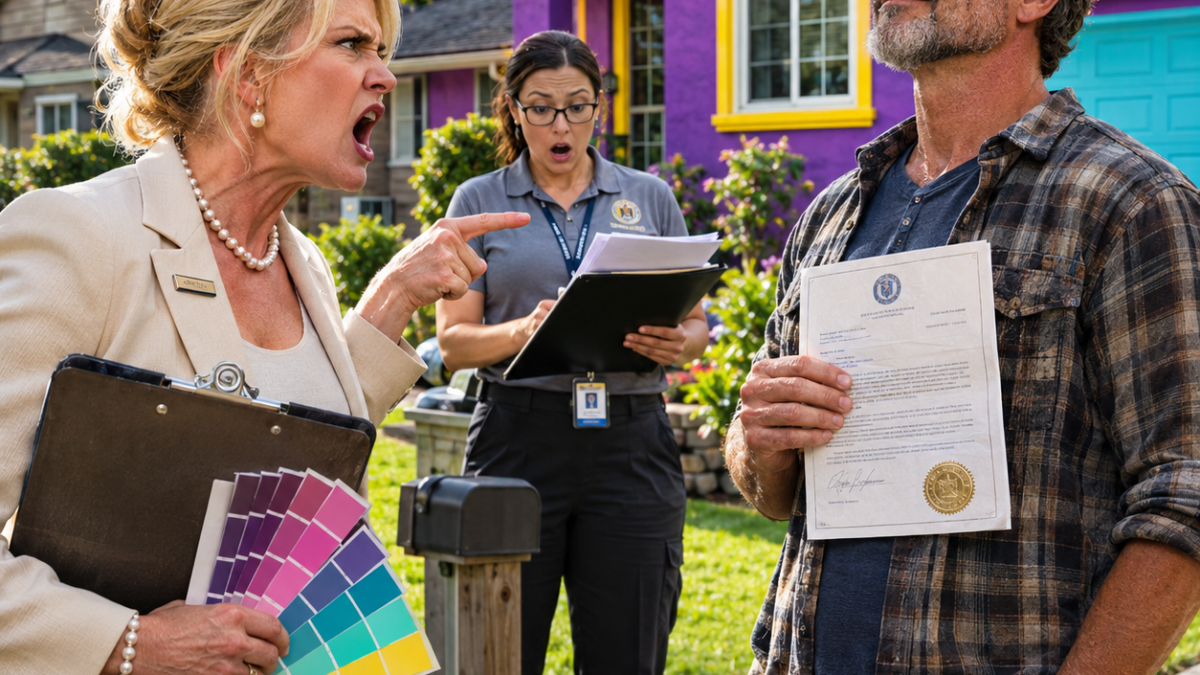
PART 2
The story really began long before Karen Miller ever bought her clipboard.
It began with my grandfather.
Arthur Davies wasn’t the kind of man who talked much about legacy.
He built things.
That was how he communicated.
He bought five acres outside town in 1960, when the area was mostly farmland, pine woods, and long stretches of two-lane road where you could drive ten minutes without seeing another car.
There was no Whispering Pines.
No homeowners association.
No community entrance monument.
No manicured retention pond.
Just land.
Arthur built the house first.
Brick ranch.
Low roof.
Wide porch.
Nothing fancy.
Everything solid.
Then, in 1968, he built the workshop.
Two thousand square feet.
Concrete slab thick enough to support almost anything he could drag inside.
Heavy timber posts.
Metal roof.
Wide sliding doors.
High ceiling.
When I was a boy, that workshop seemed larger than a church.
The smell is what I remember most.
Sawdust.
Machine oil.
Fresh-cut oak.
Coffee.
Sometimes cigarette smoke from one of his friends, though my grandmother hated that.
He taught me how to use a framing square there.
How to read plans.
How to sharpen a chisel.
How to weld without embarrassing myself.
How to fix things instead of automatically replacing them.
Most importantly, he taught me patience.
I once ruined an expensive piece of walnut because I rushed a cut.
I was thirteen.
Arthur looked at the ruined board, then at me.
“Why’d you hurry?”
“I wanted to finish.”
He nodded.
“And now?”
“Now I have to start over.”
“That’s what hurry bought you.”
I never forgot that.
Years later, the Army Corps of Engineers felt natural.
Different scale.
Same mentality.
Measurements.
Plans.
Load calculations.
Logistics.
Redundancy.
Documentation.
I spent twenty years working on infrastructure projects where mistakes mattered.
Bridges.
Temporary roads.
Drainage.
Defensive structures.
Facilities.
You learn quickly that confidence means nothing if the numbers are wrong.
A person can shout at concrete all day.
Concrete still behaves according to physics.
Rules work the same way.
Real rules, anyway.
After I retired, Sarah and I inherited the property.
By then, the world around my grandfather’s land had changed completely.
In the late eighties, a developer had purchased the surrounding acreage.
Whispering Pines appeared in phases.
Curving streets.
Large homes.
Matching mailboxes.
Decorative stone walls.
Little cul-de-sacs.
The developer built around Arthur’s property because Arthur refused to sell.
I knew that part.
Everyone did.
What I didn’t know was exactly how they had documented the exclusion.
When Sarah and I moved in, we started receiving HOA notices and annual dues statements.
The dues were modest.
A few hundred dollars a year.
I never questioned them.
I assumed the property had eventually been incorporated into the association through some later agreement.
My grandfather’s records were extensive but not perfectly organized.
And frankly, I didn’t care enough to investigate.
The HOA maintained the subdivision entrance.
They hired landscaping crews.
They maintained a streetlight near the corner and a small common park.
I paid.
The amount was small.
Life was peaceful.
For years, that arrangement caused no problem.
I mowed my lawn.
Kept hedges trimmed.
Maintained the house.
Didn’t park junk cars outside.
Didn’t throw wild parties.
Didn’t give anybody a reason to complain.
The workshop remained weathered red.
Faded.
Peeling.
Apparently that made it invisible to the HOA.
Then I restored it.
That was my mistake.
Or rather, that was what made Karen notice me.
I had finally found an M35A2 worth saving.
The old military truck had spent years sitting behind a warehouse.
The chassis was surprisingly good.
Engine needed work.
Canvas was destroyed.
Electrical system had been modified by at least three people who had no business owning wire cutters.
I loved it immediately.
Sarah looked at the photographs and asked:
“You’re serious.”
“Very.”
“Where are you putting that monster?”
“Workshop.”
“You mean your grandfather’s workshop.”
“Yes.”
“The one currently full of everything your grandfather ever refused to throw away.”
“Yes.”
She laughed.
“You’ll need six months just to find the floor.”
It took three.
Once I cleared enough space, I decided the workshop itself deserved attention.
Boards repaired.
Roof inspected.
Doors rebuilt.
Then paint.
The original red had faded almost pink in places.
I wanted something tied to the truck and my military background.
Olive drab.
Not neon green.
Not camouflage.
Not a giant flag painted across the wall.
A dark, historically appropriate military green.
I spent a week prepping.
Power washing.
Scraping.
Sanding.
Priming.
Two coats.
When I finished, I stepped back and felt something I hadn’t expected.
The workshop looked new without looking new.
It still looked like Arthur’s building.
Just stronger.
Purposeful.
Sarah came outside.
She stared at it.
“Well?”
I asked.
She tilted her head.
“It looks like a bunker.”
“That’s not criticism.”
“It wasn’t meant as one.”
She smiled.
“Your grandfather would’ve liked it.”
That mattered more than anything Karen could ever say.
The following morning, a violation notice appeared under my door handle.
Not mailed.
Hand delivered.
**UNAPPROVED EXTERIOR MODIFICATION**
Remedy:
Repaint using approved Whispering Pines color palette.
I called the number.
Karen answered.
“Architectural Review.”
“Karen, this is Jack Davies.”
Pause.
“Oh.”
That single syllable told me she already knew why I was calling.
“I received a notice about my workshop.”
“Yes.”
“The structure predates Whispering Pines.”
“The structure isn’t the issue.”
“The paint is.”
“Exactly.”
I leaned against the kitchen counter.
“What’s wrong with it?”
“We don’t allow military-style exterior finishes.”
“Military-style isn’t a color classification.”
“It clearly violates neighborhood aesthetics.”
“Which specific rule?”
“The Architectural Review Committee has discretion over exterior modifications.”
“Where was the committee when the building was peeling red?”
“That was an existing condition.”
“So deterioration was acceptable.”
“Don’t twist my words.”
“I’m trying to understand them.”
She sighed.
“Jack, pick an approved color.”
“What do you recommend?”
“Sunset Dune.”
“That’s beige.”
“It’s extremely popular.”
“I’ve noticed.”
“You don’t need to be sarcastic.”
“I wasn’t.”
I tried explaining the history.
My grandfather.
The truck.
The restoration.
I even emailed old black-and-white photographs showing Arthur standing outside the building decades before Whispering Pines existed.
Karen answered with a certified violation notice.
Two hundred dollars per day.
Then two weeks later she came to my lawn and announced five thousand dollars per day.
That’s when I created the binder.
That night, Sarah found me at my desk.
“You’re doing the thing.”
“What thing?”
“The military thing.”
“I wasn’t aware there was one.”
She pointed at the binder.
“Tabs.”
“Tabs are useful.”
“You have three highlighters.”
“Different categories.”
“You’ve created an index.”
“Indexes are useful.”
She sat beside me.
“Are we really fighting over paint?”
I looked toward the window.
The workshop was barely visible in the darkness.
“I don’t think it’s about paint.”
“What is it about?”
“Control.”
Sarah sighed.
“Jack, I like the color. But if changing it saves months of stress—”
“No.”
She raised an eyebrow.
“I didn’t finish.”
“Sorry.”
“If changing it saves months of stress, maybe we should consider it.”
I leaned back.
“What happens the next time she decides something?”
“That depends.”
“Mailbox?”
“We already have a mailbox.”
“Truck.”
“You keep that inside.”
“Flag.”
“We have one.”
“Fence.”
She sighed.
“I understand the principle.”
“Do you?”
“Yes.”
Her voice sharpened.
“But I also understand that I married a man who can turn a disagreement over paint into the Normandy landings.”
I laughed.
“Fair.”
She took my hand.
“Just promise me you won’t let pride make decisions.”
That was good advice.
“I promise.”
The next morning, I started reading.
Whispering Pines CC&Rs.
Eighty-seven pages.
Article Four.
Architectural control.
Karen was correct about one thing.
The language was broad.
Any exterior modification to any lot or dwelling subject to the declaration required approval.
The Architectural Review Committee could deny changes inconsistent with the visual character of the subdivision.
If my property was covered, olive drab could become an argument.
Not a great argument.
But an argument.
I needed to answer a more basic question.
Was my property actually covered?
That thought wouldn’t leave me.
Karen had said:
“You pay dues.”
That was true.
But paying money doesn’t automatically create jurisdiction.
I searched my grandfather’s old paperwork.
No obvious HOA annexation agreement.
No covenant signature.
No deed restriction mentioning Whispering Pines.
My deed identified Parcel 7B.
That number became important.
The following morning, I drove to the county records and plats office.
It was exactly the kind of place I enjoy.
Quiet.
Fluorescent lights.
Metal shelves.
Old maps.
People who care about dates and document numbers.
A clerk named Martha asked what I needed.
“Original subdivision plat for Whispering Pines. Initial filing.”
“What year?”
“Late eighties. Probably 1988.”
She disappeared.
Returned pushing a large bound volume.
“You planning to build something?”
“Hopefully prevent something.”
She gave me a look.
“HOA?”
I smiled.
“That obvious?”
“Honey, anyone asking for thirty-year-old subdivision plats is either suing a neighbor or fighting an HOA.”
“Second one.”
“Good luck.”
She opened the book.
Large folded plat.
Whispering Pines, Phase One.
I traced the streets.
Found Pinewood Trace.
Lot numbers.
Property lines.
Then the subdivision ended.
Next to it sat a large rectangle.
**PARCEL 7B**
Different notation.
Different deed reference.
Then I saw the handwritten note.
**Parcel 7B excluded per existing deed. Not subject to Whispering Pines covenants.**
I stopped breathing for a second.
Read it again.
Then a third time.
Martha looked over.
“You find something?”
“Maybe.”
I photographed the note.
Then asked for a certified copy.
But one plat wasn’t enough.
Documents can be amended.
Property can be annexed later.
I needed chain of title.
So I spent the rest of the day digging.
My grandfather’s original deed.
Subsequent transfers.
Inheritance records.
No annexation.
No covenant adoption.
Then Whispering Pines HOA articles of incorporation.
Appendix.
List of parcels subject to association authority.
I ran my finger down the numbers.
Lot 1A.
1B.
2A.
2B.
Dozens more.
No 7B.
I checked twice.
Then again.
Nothing.
My property wasn’t in the association.
It had never been in the association.
I sat at a long wooden table surrounded by certified documents and felt something strange.
Relief first.
Then anger.
Twenty years.
For roughly twenty years, I had paid HOA dues.
Not large amounts individually.
But year after year.
And Karen was now threatening me with five thousand dollars a day under rules that didn’t legally apply to my land at all.
I returned to Martha’s desk.
“I need certified copies of everything.”
She looked at the stack.
“Going to be a long afternoon.”
“That’s fine.”
She smiled.
“Found your answer?”
“I think I found hers.”
I didn’t confront Karen.
That surprised Sarah.
When I came home, I spread the records across our dining table.
She read the plat note.
Then looked at me.
“We’re not in the HOA?”
“No.”
“But we’ve been paying.”
“Yes.”
“For twenty years.”
“Yes.”
“Can we get the money back?”
“Probably.”
“And the fines?”
“Worthless if these records hold up.”
She stared toward Karen’s house.
Karen lived several streets away, but Sarah looked as though she could see her through the trees.
“Go tell her.”
“No.”
Sarah turned.
“No?”
“Not yet.”
“Why?”
“Because I want a lawyer to verify it first.”
She narrowed her eyes.
“That was very reasonable.”
“I promised.”
“I don’t trust it.”
The next day, I called Evelyn Albright.
Her reputation in local real estate law was formidable.
Her office occupied the second floor of a restored downtown building.
Dark wood.
Tall windows.
Bookshelves.
No motivational posters.
Good sign.
Evelyn was in her late fifties.
Sharp suit.
Sharper eyes.
I told the story from the beginning.
Then handed over the documents.
She read silently.
The violation notice.
Karen’s fine schedule.
My deed.
Plat.
Articles.
Chain of title.
Finally she leaned back.
“Mr. Davies.”
“Jack.”
“Jack, do you know what you’ve brought me?”
“Hopefully good news.”
She smiled.
“This is considerably better than good news.”
She tapped the plat.
“Your property appears to have been deliberately excluded from the development.”
“Yes.”
“The HOA’s incorporation documents don’t include the parcel.”
“Correct.”
“I see no later annexation.”
“Neither did I.”
“And they have collected dues from you for approximately twenty years.”
“Yes.”
“Did anyone ever provide a membership agreement?”
“No.”
“Did you sign anything?”
“Not that I’ve found.”
She picked up Karen’s fine notice.
“And now they’re threatening five thousand dollars per day.”
“Yes.”
Evelyn shook her head slowly.
“This is extraordinary.”
“What do we do?”
She looked at me.
“Nothing.”
I frowned.
“Nothing?”
“Temporarily.”
“That sounds unlike a lawyer.”
“You misunderstand.”
She leaned forward.
“We do not warn Karen that you’ve discovered the jurisdiction problem until we know exactly how far she’s willing to go.”
I studied her.
“You want her to keep fining me.”
“Yes.”
“Why?”
“Because right now, you have bad letters from an organization with no authority.”
She tapped the table.
“If she escalates into recorded legal action against the title of property she does not control, our position becomes much stronger.”
“A lien.”
Evelyn smiled.
“You’re an engineer.”
“I like predictable failures.”
“So do I.”
I didn’t particularly like the strategy.
But I understood it.
The danger was emotional pressure.
Every new letter would feel real even if legally defective.
Sarah hated the plan.
“You’re letting her threaten our home.”
“Temporarily.”
“She doesn’t know it’s fake.”
“Neither do most bullies.”
“That doesn’t make me feel better.”
I took her hand.
“We have counsel.”
“We have documents.”
“Yes.”
“And if she actually files something?”
“Evelyn handles it.”
Sarah looked unconvinced.
“I don’t like traps.”
“Neither do I.”
“That’s not true.”
“Fair.”
For the next month, Karen performed exactly as Evelyn predicted.
New notices.
Increasing fines.
Photographs from the road.
Emails.
Threats.
Karen began driving past slowly.
Once I saw her standing at the edge of my property taking pictures of the workshop.
I waved.
She didn’t wave back.
The M35 restoration continued.
Engine work.
Electrical.
Brakes.
Canvas.
Each sound from the workshop probably drove her insane.
Then one Tuesday morning, a tow truck backed into my driveway.
That changed the tone.
The driver climbed down with paperwork.
“Jack Davies?”
“Yes.”
“I’m here for the commercial vehicle.”
He pointed toward the M35.
I almost admired Karen’s persistence.
“That vehicle is privately owned and historically registered.”
“I got a work order.”
“From Whispering Pines?”
“Yes.”
I held up one finger.
“Give me thirty seconds.”
I went inside.
Returned with two documents.
Certified plat.
Letter from Evelyn.
The driver read.
His forehead tightened.
“This says you’re not in the HOA.”
“Correct.”
“They told us you’re refusing enforcement.”
“They’re lying.”
He looked toward the truck.
Then called his dispatcher.
I couldn’t hear everything.
But enough.
“Yeah, he’s got a lawyer’s letter.”
Pause.
“No.”
Pause.
“County plat too.”
Longer pause.
“You want my name on this?”
Another pause.
Then:
“Good.”
He hung up.
“Boss says we’re out.”
“Smart boss.”
He handed me the work order.
“You might want this.”
Karen’s name was on it.
Again.
I smiled.
“Thank you.”
As he drove away, I glanced across the street.
One curtain moved.
Karen had been watching.
The failed tow didn’t make her cautious.
It made her furious.
Two weeks later, the certified letter arrived.
HOA legal counsel.
**NOTICE OF LIEN**
Amount:
$78,400.
Unpaid fines.
Administrative costs.
Legal fees.
Sarah sat at the kitchen table staring at it.
“Seventy-eight thousand dollars.”
“Yes.”
“They really filed this?”
I checked the recording information.
“Yes.”
Her face went pale.
For the first time, the fight stopped feeling entertaining.
A lien is not a nasty email.
It’s a claim against property title.
A cloud.
Something that can interfere with selling, refinancing, estate planning.
Karen had taken the dispute from petty harassment into serious legal territory.
I called Evelyn.
“It’s here.”
“Amount?”
“Seventy-eight four.”
Silence.
Then:
“Perfect.”
“That’s not the word Sarah used.”
“Bring it to me.”
I did.
Evelyn examined the document.
Then looked up.
“Now we move.”
The lawsuit was filed against Whispering Pines HOA.
The board members.
Karen personally.
Claims included fraudulent or wrongful lien conduct, misrepresentation, unjust enrichment, slander of title, and related causes of action appropriate to the facts Evelyn believed she could support.
We demanded removal of the lien.
Return of dues.
Interest.
Legal fees.
Damages.
We also referred the recorded filing and supporting documentation to the appropriate county authorities for review.
Then Karen did something almost unbelievable.
She scheduled a special neighborhood meeting.
Subject:
**ENFORCEMENT ACTION AGAINST NONCOMPLIANT PROPERTY**
Her plan was obvious.
Public pressure.
She wanted residents to approve moving toward foreclosure enforcement.
She wanted a room full of people to validate her.
Evelyn called me.
“Attend.”
“I planned to.”
“Don’t reveal anything until she commits.”
“Commits to what?”
“Her version of the story.”
Karen sent flyers.
Emails.
Photographs.
One showed my workshop under bad lighting, olive paint almost black.
Caption:
**ONGOING ARCHITECTURAL VIOLATION**
By meeting night, nearly a hundred residents crowded the clubhouse.
Sarah came with me.
“You don’t need to.”
“Yes, I do.”
“You hate these things.”
“I hate her talking about our home like it’s contaminated.”
Fair.
Karen stood at the podium.
PowerPoint behind her.
Board members seated like a tribunal.
She began with community standards.
Then property values.
Then collective responsibility.
My workshop appeared on the screen.
Karen pointed dramatically.
“This is what happens when one homeowner decides he is above the rules.”
I remained still.
Sarah squeezed my hand.
Karen went on for almost ten minutes.
Then came the lien.
“Nearly eighty thousand dollars.”
Murmurs.
“And still Mr. Davies refuses compliance.”
A few residents looked toward me.
Karen lowered her voice.
“The board has exhausted every reasonable option.”
She paused.
“Therefore, I am asking for a motion authorizing counsel to begin foreclosure proceedings.”
The room changed.
Even people who disliked my workshop understood what she’d just said.
She wanted to pursue my house.
Over paint.
A man in front slowly raised his hand.
Before he could speak, I stood.
“Point of order.”
Karen’s face tightened.
“You are not recognized.”
“I think residents should hear one fact before voting.”
“You are the subject of this enforcement action.”
“Exactly.”
“You do not have the floor.”
A voice from the back interrupted.
“Let him speak.”
Evelyn.
She stood against the wall holding a thick manila envelope.
Karen froze.
“Who are you?”
“Evelyn Albright. Counsel for Mr. Davies.”
Silence.
Evelyn continued.
“You can let my client speak, or I can.”
Her tone was calm.
“I promise you’ll prefer him.”
Karen looked toward the security officers she’d hired.
They looked away.
I stepped into the aisle.
“For the past several months, Karen has told you I’m refusing to follow rules that apply to every homeowner.”
Karen grabbed the microphone.
“Because you are.”
I looked at her.
“No.”
Then at the room.
“Because my property is not part of Whispering Pines.”
For a second, nobody reacted.
Then whispers.
Karen laughed.
Actually laughed.
“That’s absurd.”
I nodded toward Evelyn.
She began passing copies down the rows.
One page.
County plat.
Parcel 7B outlined.
Surveyor note.
**Excluded. Not subject to Whispering Pines covenants.**
On the bottom, the association’s own incorporation parcel list.
No 7B.
I continued.
“My grandfather bought this land before Whispering Pines existed.”
People looked down at the pages.
“The developer built around him because he refused to sell.”
Karen shook her head.
“Our records show—”
“Your records are wrong.”
Evelyn walked forward.
Karen’s confidence cracked.
Evelyn placed a thick document on the podium.
“This is a filed civil complaint.”
The sound of paper hitting wood seemed louder than it should have.
“The HOA, its board, and Ms. Miller have been sued concerning years of dues collected from a parcel outside association jurisdiction, escalating enforcement, and the lien recently recorded against Mr. Davies’s property.”
Karen stared.
“This is intimidation.”
“No.”
Evelyn’s voice stayed level.
“This is litigation.”
Someone laughed nervously.
Then a resident asked:
“You’ve been collecting dues from him for twenty years?”
I answered.
“Yes.”
Another:
“You knew he wasn’t in the HOA?”
Karen snapped:
“He is in the HOA.”
Evelyn held up the plat.
“Then produce the annexation agreement.”
Karen said nothing.
“Produce the deed restriction.”
Silence.
“Produce his signed membership agreement.”
Nothing.
Karen grabbed the microphone.
“This meeting is being hijacked.”
A man near the center stood.
“I want to see the records.”
Another voice:
“Did the whole board know?”
One board member, George, looked terrified.
“I didn’t.”
Karen turned on him.
“Don’t start.”
George stood.
“I said I didn’t know.”
“You approved enforcement.”
“You told us the parcel was covered.”
The room erupted.
Years of resentment came loose.
Residents shouting.
Questions.
Accusations.
Then stories.
“My patio.”
“My fence.”
“My flag.”
“My parking fines.”
One woman yelled:
“You fined us during my husband’s funeral!”
Karen tried the gavel.
Nobody cared.
Sarah stood beside me.
Her hand found mine.
“This is insane.”
“This is what fear sounds like when it stops.”
We left before the meeting ended.
The next morning, a local reporter called.
I gave him documents.
Not opinions.
The county plat.
Lien.
Incorporation records.
Karen gave him opinions.
That didn’t help her.
The article ran two days later.
Suddenly my olive workshop wasn’t the neighborhood eyesore.
It was the photograph attached to a story about HOA jurisdiction and alleged overreach.
Whispering Pines management announced an internal review.
County investigators opened inquiries into the lien filing.
Then neighbors began contacting Evelyn.
An elderly widow described fines issued during her husband’s wake because visitors parked on the street.
A young couple had torn out an expensive stone patio after Karen claimed the paver color violated standards.
A veteran had been repeatedly cited over a flagpole.
Maria, an older woman from three streets over, told me:
“She measured my ornamental grasses.”
I thought I’d misheard.
“With what?”
“A tape measure.”
“How tall were they?”
“Two inches over.”
She laughed bitterly.
“Fifty dollars.”
The stories mattered because they changed the lawsuit from one isolated dispute into a broader narrative of enforcement practices.
The recall petition started without me.
I didn’t organize it.
That was important.
Residents did.
Karen accused me anyway.
She sent an HOA-wide email claiming I was orchestrating a hostile takeover.
That email became another exhibit.
The petition required a modest threshold.
Residents crushed it.
The recall vote removed Karen with overwhelming support.
The remaining board members resigned or cooperated.
George came to my workshop one evening.
He looked older.
Tired.
He held an envelope.
“Can we talk?”
I put down the wrench.
“Sure.”
He looked around the workshop.
The M35 sat almost finished.
“You know, I actually like the color.”
I laughed.
“Dangerous opinion.”
He didn’t smile.
“I should’ve asked questions.”
“Yes.”
He nodded.
“I trusted Karen because she knew the documents better than anybody.”
“She knew selected parts.”
“I know that now.”
He handed me the envelope.
Inside was a cashier’s check.
Reimbursement of past dues plus calculated interest as part of an interim resolution arrangement.
I stared at it.
“This isn’t everything.”
“No.”
“Legal settlement is separate.”
“Yes.”
George looked toward the floor.
“We let her do this.”
I didn’t answer.
“Every time somebody complained, we told ourselves she was strict but effective.”
He swallowed.
“We didn’t want the work.”
That was honest.
Karen’s power hadn’t appeared magically.
People handed it to her because administration was annoying.
Reviewing applications.
Reading covenants.
Attending meetings.
Checking facts.
Karen volunteered to do all of it.
Then became indispensable.
Then untouchable.
“New board needs procedures,” I said.
George nodded.
“Not personalities.”
“Exactly.”
He left.
The civil case eventually moved to mediation.
This time the mediator was a retired judge.
Neutral location.
No Karen.
The insurance lawyers had apparently decided her presence would only make everything worse.
Evelyn and I sat on one side.
Three lawyers representing the insurer and association sat opposite.
Two interim board members joined them.
The mediator opened with the usual speech about compromise.
Evelyn waited.
Then said:
“Judge, I want to save everyone time.”
The lead insurance attorney shifted.
Evelyn continued.
“The parcel exclusion is not ambiguous.”
Nobody argued.
“The recorded lien existed.”
Silence.
“Twenty years of dues were collected.”
One attorney said:
“Under mistaken assumptions.”
Evelyn nodded.
“Then let’s discuss the price of those assumptions.”
Negotiation lasted hours.
They offered dues.
Then dues plus interest.
Then legal fees.
Then damages.
Evelyn kept pushing.
I occasionally wondered whether she enjoyed this too much.
At one point, the lead attorney said:
“A million dollars in punitive demand is excessive.”
Evelyn leaned back.
“Then try the case.”
He frowned.
“The HOA did not knowingly—”
She interrupted.
“Your former president threatened five-thousand-dollar daily fines over paint on a parcel outside the association.”
“That was not an authorized schedule.”
“Wonderful. Then we can discuss governance failures.”
He stopped.
Eventually, the case settled for a substantial amount.
Enough to repay every dollar we’d paid.
Enough to cover legal fees.
Enough to compensate us for the lien and harassment.
The association issued a written public apology.
The lien was removed.
Records corrected.
Most importantly, there was now no ambiguity.
Parcel 7B was outside Whispering Pines.
No dues.
No architectural committee.
No fines.
No contact except where legally necessary for shared municipal matters.
Sarah read the final agreement twice.
Then smiled.
“So we really don’t belong to them.”
“No.”
“We’re surrounded by the HOA.”
“Yes.”
“But not in it.”
“Correct.”
She looked toward the workshop.
“Can I paint the house purple?”
“Please don’t.”
She laughed.
“Interesting. Suddenly you like architectural standards.”
“I like eyesight.”
The criminal side of Karen’s situation proceeded separately through the appropriate authorities.
I stayed out of it as much as possible.
That surprised some neighbors.
They expected me to celebrate every consequence.
I didn’t.
By then, I was tired.
I wanted peace more than punishment.
Karen had already lost the presidency.
Lost credibility.
Lost the control she valued.
Whatever happened next belonged to the legal system.
I wasn’t going to turn another person’s downfall into a hobby.
The new board began rebuilding Whispering Pines.
Mark and Lisa, the couple Karen had targeted over their stone patio, became key leaders.
Their philosophy was simple.
Rules should have purpose.
Enforcement should be consistent.
Board records should be open.
Homeowners should be treated like adults.
Meetings became boring.
I considered that the greatest reform.
No theatrical gavels.
No public humiliation.
No ten-minute speeches about “community values.”
Budgets.
Landscaping.
Maintenance.
Done.
Maria’s ornamental grass grew freely.
Dave’s children had a bright yellow playset.
Somebody painted a front door blue.
Nobody died.
Property values did not collapse.
Civilization survived.
One Saturday, Mark and Lisa stopped by my workshop carrying beer.
“We wanted to say thank you.”
“You’ve already thanked me.”
“Not enough.”
I opened two bottles.
Sarah joined us.
Mark looked at the olive wall.
“Still hate that color.”
I laughed.
“Get off my property.”
“See? Tyrant.”
Lisa smiled.
“Actually, we removed Sunset Dune from the official palette.”
I stared.
“You did what?”
“Retired it.”
“Why?”
Mark raised his beer.
“Historical trauma.”
That was one symbolic victory I allowed myself to enjoy.
The workshop returned to what it had been before Karen.
Not a political statement.
Not a battleground.
A workshop.
I finished the M35.
New canvas.
Electrical system corrected.
Brakes rebuilt.
Engine tuned.
Chrome and metal cleaned.
Olive drab paint matched.
The first time it rolled out under its own power, Sarah stood in the driveway filming.
I stopped beside her.
“Well?”
“It sounds like a building moving.”
“That’s praise.”
“It wasn’t.”
A few months later, I registered the truck for the town’s Fourth of July parade.
My grandson sat beside me.
He was ten.
Could not stop smiling.
We rolled down Main Street behind the veterans’ group.
American flag flying from the rear.
Engine rumbling.
People waved.
Kids covered their ears and laughed.
Then I saw Karen.
Orange safety vest.
Trash grabber.
Community service.
I hadn’t expected that.
For a moment, our eyes met.
No clipboard.
No podium.
No followers.
Just Karen.
I felt no joy.
That surprised me.
Months earlier, I might have imagined that moment as perfect revenge.
Instead, she looked tired.
Smaller.
Human.
She looked toward the truck.
Then away.
My grandson waved at the crowd.
“Grandpa!”
“What?”
“You missed them!”
I looked ahead.
A group of children waving flags.
I waved back.
That was better.
After the parade, Sarah asked:
“Did you see her?”
“Yes.”
“How did it feel?”
I thought.
“Finished.”
She nodded.
“Good.”
We used part of the settlement money to create something my grandfather would have understood.
The Arthur Davies Memorial Scholarship.
Local community college.
Students entering skilled trades.
Carpentry.
Welding.
Automotive technology.
Diesel mechanics.
Construction.
The first recipient was a nineteen-year-old named Miguel who wanted to become a welder.
He came to the workshop with his mother after the award ceremony.
He stared at the M35.
“You restored this?”
“Yes.”
“Everything?”
“Most.”
He walked around it.
“This is incredible.”
I handed him one of Arthur’s old combination squares.
Not the expensive one.
I wasn’t that generous.
“My grandfather taught me using tools in this building.”
Miguel looked at it.
“You sure?”
“Use it.”
He nodded.
That mattered more than the settlement check.
Karen had tried to turn Arthur’s workshop into a liability.
The fight ended up funding people who wanted to build things.
If you’re looking for the most satisfying revenge, that’s it.
Take something ugly.
Convert it into something useful.
Not destruction.
Transformation.
Years passed.
Whispering Pines changed.
New families arrived who barely knew the story.
Some assumed my property was part of the HOA because it sat physically inside the development.
Every few years, somebody on a new committee would ask why my mailbox was different or why my workshop wasn’t on their maintenance maps.
The new board would answer:
“Parcel 7B.”
That phrase became almost legendary.
Once, a new resident joked:
“Is Parcel 7B like Vatican City?”
I laughed.
“No Swiss Guard.”
“Could add one.”
“HOA approval?”
“Very funny.”
Sarah loved the absurdity.
One evening, we sat on the porch looking toward the workshop.
Fresh sunset light made the olive paint almost warm.
She said:
“Do you remember when I told you to repaint it?”
“Yes.”
“You’re never letting that go?”
“No.”
She laughed.
“I was trying to protect our peace.”
“I know.”
“And you turned it into a war.”
“I know.”
“Was I wrong?”
That was harder.
“No.”
She looked surprised.
“You weren’t wrong to want peace.”
“But?”
“Peace bought by surrendering something that wasn’t theirs to control wouldn’t have lasted.”
She nodded.
“That’s fair.”
We sat quietly.
Then Sarah said:
“Your grandfather would’ve loved this.”
“The lawsuit?”
“The workshop.”
I smiled.
“Probably the lawsuit too.”
Arthur had been stubborn.
Not loud.
Not dramatic.
But stubborn.
When the original developer offered to buy his land, he’d refused.
They increased the offer.
He refused again.
Finally they built around him.
I found one of his old notebooks years after the lawsuit.
A single line from 1987:
**Developer back again. Told him no. Land is not for sale.**
That decision, written in pencil decades earlier, created Parcel 7B.
He had preserved the land without ever knowing I’d someday need that boundary to protect it from an organization that didn’t yet exist.
That made the county plat feel almost sacred.
Not because maps are emotional.
Because boundaries preserve choices across generations.
Arthur chose not to join.
I inherited that choice.
Karen tried to erase it with assumptions and paperwork.
The real fight was about whether her convenience could overwrite his recorded decision.
It couldn’t.
That’s why documentation mattered.
Not because paperwork is powerful by itself.
Because good paperwork preserves truth after people forget.
Karen’s records said I was a member.
The county’s records said I wasn’t.
One side was convenient.
The other was foundational.
Foundational won.
Years later, I still kept the original Whispering Pines binder.
Not on my desk.
On a shelf.
Inside were the notices.
The $200 fine.
The $5,000-a-day threat.
Tow order for the M35.
The $78,400 lien.
County plat.
Lawsuit.
Settlement.
Apology.
Sometimes I open it for young veterans or neighbors dealing with bureaucracy.
Not to show off.
To make one point.
Never assume a letter is correct because it looks official.
Read the authority behind it.
Ask:
Who issued this?
What gives them power?
What are the boundaries?
What procedure did they follow?
Most bullies depend on people skipping those questions.
They use confidence as evidence.
Karen was extremely confident.
She was also wrong.
One spring afternoon, a new HOA president named Daniel came to my driveway.
He stayed outside the property line.
Smart man.
“Jack?”
“Yeah?”
“Got a question.”
“HOA?”
He smiled.
“Unfortunately.”
“What happened?”
“We’re replacing entrance landscaping.”
“Congratulations.”
“One contractor wants temporary equipment access along your side road.”
“That’s my road.”
“Exactly why I’m asking.”
I stared at him for a second.
Then laughed.
“What?”
“Nothing.”
“Is that a yes?”
“Show me the plan.”
He handed me a map.
We reviewed it.
Agreed on dates.
Insurance.
Ground protection.
They used the road for two days.
No conflict.
No certified letters.
No fines.
No lawsuit.
Daniel returned afterward.
“That was easy.”
“Yes.”
He looked toward the workshop.
“Karen could’ve saved herself a lot of trouble.”
“All she had to do was ask.”
That’s what so many people misunderstand about property rights.
Boundaries aren’t anti-community.
They’re what make cooperation possible.
If I know what’s mine and you know what’s yours, we can negotiate.
Share.
Borrow.
Grant access.
Say yes.
Say no.
Without boundaries, “community” becomes a word powerful people use to justify taking.
Karen used that word constantly.
Community standards.
Community values.
Community appearance.
But her definition of community always ended with somebody else obeying her.
Real community appeared after she was gone.
Neighbors talked.
Board members asked.
People disagreed without becoming enemies.
That was better.
One summer evening, the scholarship committee invited Sarah and me to meet the latest group of students.
Five recipients that year.
One studying HVAC.
One electrical.
One welding.
Two carpentry.
I told them about Arthur.
Not Karen.
Not the lawsuit.
Arthur.
A man who believed useful hands were never wasted.
Afterward, one student asked why the scholarship existed.
I glanced at Sarah.
She smiled.
“Tell him.”
So I did.
Short version.
Workshop.
Paint.
HOA.
County records.
Settlement.
The student laughed.
“So this scholarship exists because somebody hated green paint?”
“Basically.”
He shook his head.
“That’s crazy.”
“Yes.”
Then I looked at the students.
“But that’s what you do with bad material.”
They waited.
“You salvage what you can and build something better.”
That became the line I remembered.
Not anything I said at the HOA meeting.
Not Evelyn’s devastating legal arguments.
That.
Salvage what you can.
Build something better.
The workshop itself needed another paint job eventually.
Olive drab again.
Naturally.
I was older by then.
My knees complained about ladders.
Miguel—the first scholarship recipient—had become a welding instructor.
He came back with two students to help repair a damaged metal door frame before I painted.
Sarah brought lemonade.
We worked all Saturday.
At one point, Miguel stepped back and looked at the wall.
“You know they make nicer colors.”
I stared at him.
“Scholarship revoked.”
He laughed.
“You can’t revoke it. I graduated.”
“Technicality.”
That word made Sarah laugh from across the yard.
“Careful, Jack.”
I realized what I’d said.
“Bad choice.”
The whole group laughed.
The olive paint went on.
Fresh.
Strong.
Exactly the way I wanted it.
No approval form.
No committee.
No Sunset Dune.
Just my property.
One day, while going through Arthur’s old tools, I found a photograph I’d forgotten.
1968.
Workshop brand new.
Arthur standing in front.
Hands on hips.
Work boots.
White T-shirt.
Behind him, the building was not red yet.
Bare siding.
On the back he’d written:
**Built it myself. It’ll outlast me.**
He was right.
It outlasted him.
It outlasted Karen’s presidency.
It may outlast me.
That’s legacy.
Not controlling what everyone else does.
Building something that remains useful after you’re gone.
Karen wanted to leave a perfectly uniform neighborhood.
Arthur left a workshop.
I know which legacy I’d choose.
People still sometimes describe what happened as me “destroying” the HOA.
I didn’t.
Whispering Pines still exists.
It should.
Common areas need maintenance.
Neighborhood contracts need management.
Budgets need oversight.
The HOA wasn’t inherently the enemy.
Unchecked authority was.
Karen turned governance into personal power.
The replacement board turned it back into administration.
That’s exactly what should have happened.
If I’d truly destroyed the HOA, residents would have inherited another set of problems.
Instead, they repaired it.
Like an old truck.
Remove damaged components.
Keep what’s sound.
Replace what failed.
Document the changes.
Test.
Move forward.
Maybe that’s the Army engineer in me.
I don’t believe everything broken needs demolition.
Some structures deserve restoration.
The M35 was one.
The workshop was another.
Whispering Pines, surprisingly, was a third.
Karen?
That’s more complicated.
I don’t know what happened to her years later.
I heard she eventually moved.
Somebody said another county.
Somebody else said she stayed nearby with family.
I never investigated.
Why would I?
There comes a point when victory requires letting the opponent leave your mind.
For months, Karen occupied ours.
Every envelope.
Every car slowing near the house.
Every phone call.
Every meeting.
Even after we won, I sometimes saw a white SUV slow down and felt my body tense.
That annoyed me.
Sarah noticed.
“You’re still fighting.”
“No.”
“Yes.”
She pointed toward the road.
“Every time a car slows down, you look.”
I didn’t answer.
“Jack.”
“What?”
“She lost.”
“I know.”
“Then let her.”
That was harder than court.
Let her lose.
Stop replaying arguments.
Stop rehearsing what you’d say if she came back.
Stop imagining better responses.
The mind loves unfinished battles even after the paperwork says they’re over.
So I moved the binder to the shelf.
Worked on the truck.
Expanded the scholarship.
Had dinner with neighbors.
Lived.
Eventually, a slow car was just a slow car again.
That’s when I knew the fight was truly finished.
The Fourth of July parade became an annual tradition.
My grandson eventually became too old to think riding in an M35 with Grandpa was the greatest thing imaginable.
Then, fortunately, he grew older still and decided it was cool again.
Teenagers are complicated.
One year, as we lined up behind the veterans’ group, he asked:
“Is this the truck Karen tried to tow?”
“Yes.”
“Was she really that bad?”
I thought about how to answer.
“She made bad decisions.”
“That sounds diplomatic.”
“I’m old.”
He laughed.
“Dad says she tried to steal your house.”
“She tried to enforce a lien.”
“Same thing?”
“Not exactly.”
“But she could’ve.”
“That was the threat.”
He looked out the windshield.
“You weren’t scared?”
I considered lying.
“No.”
He turned.
“You were?”
“Of course.”
“You never acted like it.”
“That’s not the same thing.”
He thought about that.
I continued.
“Courage isn’t being certain you can’t lose.”
“What is it?”
“Knowing you could and doing what needs to be done anyway.”
He nodded.
Then smiled.
“Can I drive?”
“No.”
“Worth asking.”
We rolled forward.
Engine rumbling.
Workshop paint reflected in my side mirror as we left the property.
Olive drab.
Still there.
Still mine.
Sarah died many years later.
Not during the fight.
Not soon after.
We had a lot of good years.
I mention that because the story of Karen eventually became something we laughed about.
Not something that defined our marriage.
On our last summer together, Sarah sat on the porch while I worked on the workshop door.
She was weaker then.
Age had caught up with both of us.
“You know,” she said, “I still think beige would’ve looked fine.”
I turned.
“After all these years?”
She smiled.
“I just want to see your face.”
“You’re cruel.”
“Learned from Karen.”
“Too far.”
She laughed until she started coughing.
I went to her.
She waved me away.
“I’m fine.”
We sat together.
She looked at the workshop.
“I was afraid we’d lose the house.”
“I know.”
“You never told me how afraid you were.”
“I was trying not to make it worse.”
She took my hand.
“I knew.”
“Of course you did.”
“I always knew.”
We watched the sun lower.
Then she said:
“I’m glad you didn’t repaint it.”
That was all.
No speech.
No dramatic lesson.
Just:
I’m glad you didn’t repaint it.
Years of conflict reduced to one simple truth.
We had kept something that mattered.
Not the color.
The right to choose.
After Sarah passed, I thought about changing the workshop color.
Not because of Karen.
Because sometimes grief makes you want the world to look different.
I bought several paint samples.
Gray.
Red.
Dark blue.
I put them on a board.
None looked right.
Finally, I bought olive drab again.
As I rolled the first strip onto the wall, I could almost hear Sarah laughing.
Of course.
Some things don’t need changing.
Today, the workshop still stands.
The M35 still runs.
Slower owner.
Same truck.
The Arthur Davies Memorial Scholarship has helped more students than my grandfather ever could have imagined.
Whispering Pines is still an HOA neighborhood.
Parcel 7B still isn’t part of it.
The current board sends me invitations to community barbecues.
Invitations.
Not notices.
Sometimes I go.
Sometimes I don’t.
That’s the beauty of choice.
If you drive down Pinewood Trace today, you’ll notice the transition.
Beige.
Taupe.
Gray.
Cream.
Then suddenly:
Olive drab workshop.
Brick ranch.
Older trees.
Different mailbox.
It’s obvious now that the property came first.
The neighborhood grew around it.
For years, Karen treated that difference as a defect.
Now residents treat it as history.
A small sign stands near my driveway.
Not an HOA sign.
Mine.
It reads:
**DAVIES FARMSTEAD — EST. 1960
PARCEL 7B**
Bob gave it to me as a joke.
I kept it because I liked it.
Every once in a while, somebody asks what Parcel 7B means.
I tell them:
“It means read the map.”
That’s usually enough.
The full story takes longer.
A workshop.
A can of paint.
A five-thousand-dollar daily fine.
A county clerk named Martha.
An old plat book.
A lawyer with sharp eyes.
A failed tow.
A seventy-eight-thousand-dollar lien.
A room full of neighbors.
A woman with a clipboard discovering that confidence isn’t jurisdiction.
But if I had to reduce everything to one moment, it wouldn’t be Karen losing the recall.
It wouldn’t be the settlement.
It wouldn’t be seeing her during community service.
It wouldn’t even be the day City Hall confirmed our parcel had never been part of Whispering Pines.
It would be much earlier.
Karen standing in my yard.
Pointing at my grandfather’s workshop.
Telling me:
“This isn’t about what you want.”
She meant that my ownership didn’t matter.
My history didn’t matter.
My choice didn’t matter.
Her authority did.
She was wrong.
Property isn’t absolute.
No right is.
We all live under laws, safety rules, zoning, legitimate regulations, obligations to neighbors.
But authority must be real.
It must come from somewhere.
It must have boundaries.
And it must be accountable.
Karen’s authority ended before my driveway began.
She just didn’t know it.
Or didn’t care to check.
That was the mistake that ended everything.
She thought the workshop was the weak point.
Instead, it became the place where I organized the evidence that exposed her.
She thought the HOA documents were weapons.
They became the documents that proved I wasn’t subject to them.
She thought the lien would force me to surrender.
It became the legal act that finally forced everyone to examine her conduct.
She thought threatening my home would make me afraid enough to repaint.
Instead, it made me certain the fight could no longer stay private.
That’s the irony.
Every escalation she chose gave me stronger evidence.
I never needed to destroy Karen.
I only needed to stop protecting her from the consequences of her own decisions.
Once I did that, the rest happened quickly.
The workshop survived.
The house survived.
The neighborhood improved.
The scholarship grew.
Life moved on.
And the last time I painted that building, I stood back when the second coat dried.
The afternoon light hit the wall.
Deep olive green.
Strong.
Quiet.
Exactly right.
My grandfather would’ve approved.
Sarah would’ve teased me.
Karen would’ve hated it.
Only the first two opinions ever mattered.








